Jason Paul's Blog
April 7, 2025


May 28, 2023
Pupation: An Excerpt From The Mediaura Revival

He wasn’t thinking about his childhood sweetheart, a girl whose influence could still be felt in the vague but inextricable associations he made between the carnal and the Gaian. A victim of his schooling, she always put him on edge, more so after she became his friend. The mise en scène of all those cinematic westerns led him astray. She got tarred with the same brush as thunderous hoards on horseback brandishing tomahawks and toting sacks of scalps. He thought it in her blood, the same way his mother had told him the Church was in his. But at least he only feared her, unlike those who only ever called her The Pawnee.
But he wasn’t thinking about her now, for to think of her would have meant thinking of the fields, the innocent beginnings, catching butterflies and poaching pears from the neighborhood’s orchards. To be with her was to…
View original post 972 more words
May 21, 2023
McCarthy’s Betrayal: Blood Meridian’s Denouement
The Great American Novel
McCarthy’s Blood Meridian is right there alongside Moby-Dick.
Since fin de siècle, literary critics have devoted a considerable wedge of their time to the identification of the Great American Novel. Though many novels receive this moniker, few wear it long enough to ride out the decade of their inception. Time is to the novel what litmus is to the chemical. Thirty years shy of its bicentennial, Melville’sMoby-Dick(1851) is one of the few novels that unite literary criticism on this issue. For many, Melville’s novel is a lantern-lit monolith that shines both back through time and back across the Atlantic to the only other comparable work of literature in the English language, Shakespeare’sHamlet(c1870). And now, with critics recently recognising the indefatigable flame that defies the dim and grows brighter with each passing year, another novel has been indelibly branded both Great and American, Cormac McCarthy’sBlood Meridian(1985).
Ring-bound theses have been dedicated to singular…
View original post 971 more words
May 14, 2023
(Review) Véra: Mrs. Vladimir Nabokov (1999) By Stacy Schiff
Such magical people, the Nabokovs, endowed with a half-measure more of the resolve necessary to survive a time of unparalleled upheaval. With little or no money from lessons given in languages not their own, the couple moved from Russia to Germany to France before finally making their way across the Atlantic to the New World, where, in an act of instant assimilation, the pair received their New Names, exchanging their terminal V’s for double-stop F’s.
Schiff’s book, I confess, was chosen for the pages in which the ghost of the great man lingers, manifest only now and again, wandering into frame like a stagehand stumbling out of the theatrical wings. But my hawkish attention grew increasingly myopic, no longer concerned with the scuffling over shoulders and the half-spied movements inside deeper rooms. Very quickly, the chief concern was the titular woman in the fore.
Quite simply, and selfishly, I wasted no time falling in love with Véra. The forthcoming criticism should be voluble but at least applaud the honesty. That this woman gave herself so completely over to her husband, made his endeavors her own, should make any man envious of the author. She was erudite (Schiff provides examples that suggest even more so than Vladimir), sophisticated, and uncommonly beautiful. She corrected his grammar, translated his earlier works, and typed up most everything he wrote in longhand. But this kenosis before her husband is what remains the lasting and (forgive me) most endearing impression. Véra steadfastly renounced any anticipated credit for the Nabokovian oeuvre, going so far as to burn letters and journal entries in her hand whilst literally pulling her husband’s work from the very same flames – Lolita was twice rescued from the incinerator following Vladimir’s bouts of editorial angst.
On Schiff, it is hardly surprising she received the Pulitzer Prize for Biography the year following Véra’s release. Here, Schiff has produced a wonderfully well-researched and well-written book. In my experience, few biographies are enjoyable reads. Many consist of the sort of expository prose one might encounter in an incident report. But Schiff’s prose is different. She writes not like a journalist but like a belletrist. The shape of the text, too, is something to be commended. To a certain extent, the text has to run chronological, but Schiff is so at home inside the Nabokovian milieu that she is able to come temporally unmoored when it matters and return at will, an ability not dissimilar to the one exhibited by Vladimir in his quintessential memoir, Speak, Memory! Speaking of whom, the character Schiff makes of the author is particularly endearing and proportionately plumb in a story that belongs to Véra.
Readers motivated by their love of the author find themselves equally satisfied. In between the burgeoning infatuation with Véra (a sort of guilty covetousness), I had my already intimate knowledge of the man augmented. Several times I was surprised by an aside. In a piece I once wrote about displacement and mimesis (ostensibly a puffed up excuse to write about the Eurasian jay), I postulated an avian aversion on the part of V.V.. The presumption was that the dietary habits of aves (commonly lepidoptivorous) would be somewhat irksome to the novelist, a man of renown in two spheres: his inventory of butterflies resulted in an eponymous discovery. The presumption was built out of a personal disdain for cats and the existential crisis inflected on avian species. But after having read Véra, I believe this to have been an inaccurate assessment. There are passages in which aves figure not as villains but as indispensable cells in the Gaian biome. There is also his earliest literary incarnation, Sirin, the avian allusion of a surname he used to differentiate himself from his father. Learning something new about the author was my primary motivation, and Schiff didn’t disappoint, but her ability to make me fall in love with Véra is what makes this biography a flagship of the genre.
The wives of some of history’s heroes have had their contributions to greatness erased – Mileva Marić Einstein, for example. Where Véra is concerned, this appears to have been her wish. Again, selfishly, I am pleased it was never granted.
Learn more about Stacy Schiff here: https://www.stacyschiff.com/about-stacy-schiff.html
May 6, 2023
Peek-a-Boo Shoes
Rather than look around the room, which is drab and sparingly furnished with plants that drink as much water in a season as a waxwing does in a day, two lines of leather chairs that promote exactly the kind of eye contact visitors had hoped to avoid, and a wealth of multivalent glossy literature on haute couture, celebrity gossip, and spicy food, the young woman stares at her beautiful new shoes.
She swore she’d never commit to something so dear. But here they are: patent black, peek-a-boo pumps with dorsally fixed, archetypal red hearts. From the chair, in this light, she can almost see herself returning her own gaze. A version of her form moves in the inverted cardioids, the orientation of which better resemble arrowheads than hearts, tips pointing away from toes to some indeterminate place in the future, somewhere she and the shoes can travel together.
She hadn’t been herself that day. It was as if everything she’d ever set in stone apropos utility, purpose, and cost got deflagrated in the passion that had somehow grown too strong to quell. No hand in its emergence, she is convinced that wherever the fire had come from it certainly hadn’t come from her, couldn’t have, since she’d been displaced by it. She’d been pushed aside and forced to watch as her limbs were commandeered, their movements the music of a stave she never wrote.
The squeaky leather of the chairs, the sighs and dry, glottal pops remind her she is not alone. The telephone rings front of house. Doors open and close at the end of slate-grey corridors. Voices neither sanguine nor dour enter into short exchanges. The AC whirs beneath it all. A quick look up from the shoes and everything falls into place. The brittle leather chairs look to have been expensive at one time but now resemble the desiccated surface of baked red rock. Two other chairs sit on inch-high casters and have backs that recline; they look cold, though. Most of the magazines are dog-eared and torn. Yucca leaves nod in the drafts of air made tangible by sliding glass doors. The framed landscape hanging in lamp light behind the chairs is a late autumnal milieu that hasn’t been touched since hung. The floor is coarsely carpeted in the same canvass brown until it reaches the clean cut of the corridor, where grey polyvinyl shines almost white under the sterile halogen overhead as it narrows like a tunnel.
And now here they are again, the shoes, inexplicably a part of her and somehow so much more. It’s more than she can do to look away. As she shifts her weight she sees the hearts swell and relax like an animation and she damn near comes undone, very nearly letting it wash over her, the love, but intuitively feeling that even just a tentative toe this uterine body of water would be a toe too deep. Its compelling undertow is felt from the surface. It would change her in innumerable ways. She knows this. All she has to do is let it in. But she cannot entirely conceive how much she would change, measures for which no gauge exists.
As much as this frightens the young lady, the thought of anything happening to those peek-a-boo shoes is almost too much to stand. The love is weightless, soft centred, nascent, throbbing beneath the diaphanous keratin it hopes one day to breach. But why witness the slow death of innocent beauty? These streets are no place for such precious pink soles. One day, little feet, you’ll scuff and crease at the hand of these nasty, dirty streets, changing in ways that’ll only differ in degrees of heartbreak.
Despite being so young, she already knows what it is to experience loss; she knows what it is for blood to stiffen, congeal, and crawl where once it ran, glazing the calcified organs of a dummy that no longer welcome its arrival. Memories of breath bayed for but never caught remain visceral. And all this is born of a love unequal to the one that now waits to be made complete. It very nearly is. She feels herself rising to meet this love as a sapling does the sun, whose loss no splint could ever make undone.
Without correction she’ll soon meet it head on. This she sees as clearly as the carpet beneath her feet. No going back from here. To live with the dread of scuffs and creases is to live no life at all. Her every footstep would require the most obsequious negotiation of crevice, peep-toe-tip-stumping flag, heel pinching grate, and ankle turning curb. The sum of her days would be a spent avoiding wheels, water, and cobbles. Her every outing would have to be scouted for heavens threatening to open. What a way to live. Such commitment might well fit her in the future but the future is not now, and not any time soon.
The stems of the heels are like fine pencils yet to have been sharpened, with pink rubber tops that touch the pavement as she walks, erasing footprints before they can even be made. In time even their ghost will fade. But the more she looks into the affectionate little ideograms, the more she sees of herself grow and take definition, recognizing her hooded eyes, curly bangs, button nose, and broad, congenital earlobes. With the concatenation of features beginning to coalesce, what she knows she has to do becomes all the the more difficult. She cannot keep the shoes. This much is plain. Keeping the shoes is out of the question. She cannot keep the shoes. But what if she were to keep the shoes?
It no longer makes any difference. They are calling her name, asking her if she wouldn’t mind just hopping into one of the chairs on casters. It is on this chair that she is pushed along the shiny vinyl corridor, steered through doors warning everyone but AUTHORISED PERSONNEL against admittance, doors before which hands are pumped under pods. The leather chairs and plants recede behind her. Despite the extra light, it feels colder here, but she’ll not cold for long – twenty minutes max, they say. And so she stands as asked, naked heels crushing the cold vinyl floor as she walks across the room, the peek-a-boo two tucked out of sight under the leather chair that had borne her weight, reposed and preserved among plants from Western Lands.
April 29, 2023
The Memento
The Memento
Short story by Jason Paul
Where they ended up was not where they began. This was the way it always went. Ordinarily, they find their way back because they, or rather he, has the good sense not to take it too far. What it feels like, for him at least, is taking the skiff out in the middle of a squall: the further into it they go, the less probable it is they’ll return. And even if they do return, they’ll come back as changed as the tides that bear them. Thankfully, he can read the water and so often refuses to sail, or else pulls up short of trouble. But in recent weeks, the buoys have taken up with the current and wandered further afield. Last time, he lost all sight of land until it bobbed up above the horizon just long enough to chase. And still she is willing to tease ever more…
View original post 1,108 more words
April 23, 2023
Sky in Water
Short story
Mother stands as close as the smocks allow, watching Little Girl atop the table, flat on her back beneath retractable lamps. The smocks move exactly as rehearsed: canary-yellow mittens pulled from little blue hands, pink plastic coat unzipped and thrown to the floor, beloved sweater with spangles shorn into a cardigan. Mother says that it happened just now every time the smocks ask. She says to help Little Girl, above whose torso threads of steam so completely drawn now belie direction in the pale glare of the Halogen overhead.
More questions are put to Mother, forcing her to revisit the scene. As variously coloured qualia begin to coalesce, she again sees sky in water, the nimbus dappled azure replete with wind-borne leaves, stilled ripples born of the leaf-reaching mitten now sinking to the bottom, its wearer a cherub sailing wet zephyrs. She sees again those outstretched arms seeming to implore…
View original post 1,092 more words
April 16, 2023
The Cupboard Underneath the Stairs
By now the boy had overcome the fear that so crippled his mother, who was still fully prepared to take hold of his wrist and dash to the cupboard underneath the stairs. This is where the two of them hid whenever the mother realized what was going on, which was always much later than the boy; she denied it until it was right upon them. The boy had learned to recognize the sequence of events his mother chose to quixotically ignore.
There really is calm before a storm. Being made aware of this stillness is not dissimilar to the sensation the boy experiences whenever his mother shuts off the television set before bed: fast asleep, sound is acknowledged only after it is snuffed. Busy in serious play, he is seven deep in a Battle Royal before he realizes what’s going on. Sorting his figures for sinusoidal drama, he’d been too…
View original post 2,469 more words
December 3, 2022
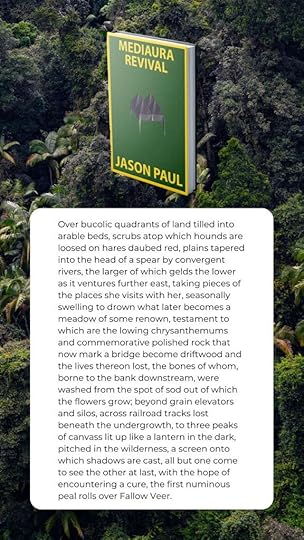
The Mediaura Revival
Extract from the novel
June 23, 2022
The promotion
It’s been four years since our school went bankrupt and left me unemployed. I say our school not because I felt some sort of ownership but because it is the only school in the village. There were two positions open when I interviewed: history and English. The headmaster had tried to steer me into the history department, but my own schooling, beginning with the ribbing of a rat catcher, had burnished the plaque divinely screwed to my soul: logophile. Evidently, there was a dearth of history buffs back then. So, I ended up teaching both subjects, for a time. I was thirty-five when I retrained after putting an end to a foolish pursuit. Those who can’t… But listen, if you’re thinking about getting into teaching, go no lower than college; the work is undoubtedly more rewarding when those on the register have chosen to be there. Plus, you get time to work on your own oeuvre. With all the lesson plans, progress reports, and bureaucracy, I wouldn’t have had time, let along the inclination to leave something literary for posterity.
There were islands of inspiration, one or two minds tuned to the same frequency, but mandates and the law of averages leave you with an overwhelming majority of pupils who resent the mode. This likely had a lot to do with why our school went bust, not that it made much difference to the pupils, whose poor grades somehow put them on a bus to a better school in another town. I, on the other hand, was left oarless up a saprogenic waterway. Rather than explore distant pastures, I chose to try my hand at the writing of copy for our energy management start-up (here, we encourage such plurality). That was a little over three years ago. All indications are that the change has been an unmitigated success, the latest of which being the rumored promotion now in the offing. It’s all so desperately sad. Being complimented on the copy you wrote because it carries a third-grade readability rating is both unintentionally backhanded and just about the most depressing thing I’ve ever heard. Lucas, a graphic designer with an eight-ball tattoo on the back of his hand, overheard the manager discussing the position with Magda from HR. Every morning, he asks whether or not the offer has arrived. It hasn’t, yet. He says it’s coming… any day now.
Today is any day, a longer day than the one before, its light stiffening stalks and straightening spines earlier than yesterday, with folks up and out of the house long before work for a dose of serotonin. A slow cycle to the office is more my pace. It gives me time to think, right now about what I might say, should Dinesh, the Head of Marketing, offer me the position. But more often than not, my thoughts reel with the wheels as I take in the scene. With the sun this low, the watery boulevard gleams like a silver screen from the past, and that’s just what it is, when you think about it. But for the hill yonside of the river, a thigh-burner no matter the hour, the morning ride is the second-best part of the day; the thrillingly regressive free-wheeling of the downhill return home has never been travelled without squeezing the brake in sublimity. Most mornings, I pass children bound for the school up the road from our office. This morning is no different. Some kids skip ahead but many, girls in the main, prefer to reach up for the lank hands of their grateful parents. Boys either race ahead or lag behind. Nearly everyone in town is taking the first languid steps into a new day; although, a select few, fellers riding garbage trucks, for example, have it already halfway done.
Surely, the summer is mid-imago this morning. The thermometer outside the galvanization plant already reads twenty-six. But it’s not just the heat. The lilacs that fringe the bridge have flashed their last, their annual only; the dusting of their husks seems the swansong of a vanishing spring. I’ve always thought summer rather than autumn the death of sweet things. Spring, for all its brevity, is fragrant and colourful; summer is yard-brush coarse and baked brittle. Green again for a spell, the lilacs shake under the weight of chattering sparrows that either cheer or chide my arrival. Theirs is a shade of vermillion, not lilac, with cones as phallic as they are effete. The rains did them little harm – wet this year: May instead April showers. Climate change is to blame, they say, by which they mean us. But if our lilacs were to bloom in July, would that then make spring a late bloomer? The same folks worried about shifting seasons say it can all be undone, if not for the want of effort, though I’m not convinced.
No air-conditioning in our building. We expect to move to a modern facility once revenue picks up, which I hope is no time soon; I’m content to work beside my open window. It is occasionally a distraction, though. All manner of things come in with the breeze: shrieking swifts, greetings, burnt toast, and paired dings. Even the idle rumble and ire of tired drivers leaving the junction conforms once here, augmenting the wind-struck reeds of quivering dendra in the copse across the way to become a balmy lullaby. Of course, these sounds fall away once the schoolchildren are released.
For the most part, what I do is rewrite all these service manuals, technical documents, and agreements to make them more palatable for a lay readership, which includes me – I write for myself. They tell me the work I do is done well but to be honest, it isn’t all that challenging. The Creative Director says there’s an art to the simplification of language. But simple words, to me at least, come simply. I’m just now finishing a pamphlet for the Insula-cube Pro9. They often ask me to write how-to guides for the content drive. I say write but what they actually want me to do is plagiarize – this field is rife with it, which is fortunate because search engine algorithms actually reward the practice.
Noon is hunger’s knocking off. Though it depends on the pressures of the day, I usually take my sandwich over to the stone wall around the forgotten altar over the road for some quiet reflection. It isn’t difficult to keep track of lunchtime, its arrival announced the children up the street as much as a pangs in the stomach. At my desk, I’m able to bring the school’s green railings into view, sober as arrows, knotted tops lost in the overhanging lobes of an impressive oak, dozens of slender legs showing between their lengths. But all this is out of sight from the altar. Here, I get only echoes, the dissonance of so many voices making it difficult to parse more than the occasional imperative and its diminutive. Indistinguishable at the best of times, their bright, homogenous voices belie even their genders. One of them will shout ‘come on’ and I’ll try to guess whether it had been an invitation or an order.
I’m often ferried back to my own childhood, hearing in the cadence of their voices a friend begging me to flee a misdemeanour or goading me into a chase along painted lines in hardcore. What we did at break time was play professions: varieties of driver, astronaut, soldier. Of course, this was whenever we weren’t playing football. We all had our favourites. I found heavy machinery fascinating for a time. There was something about the miming of cranes, the precision of diggers, and the tipping of trucks that calmed me. A friend and I would pile up pinecones or rocks in one corner of the playground and set about distributing them according to predetermined weight restrictions and deadlines. We were usually of the same mind but whenever pulled in different directions, we compromised: today one way, tomorrow the next.
A different style of management now looms. Naturally, there’s more money in it, and much more than is to be had in English pedagogy, but I doubt the work will be all that different. The content we produce will be brought to me for approval just as my pupils used to parade their homework on The Tragedy of Macbeth. I’ll no longer write but direct. This will make me different. Because look, there are those who bring things and those to whom things are brought. Never the twain shall meet. Migrating from the former to the latter means marooning myself. This much I managed to glean in the school yard – friendship depends on equality. Sure, meetings will afford them a say, but it’ll come down to me in the end, and I’ll no doubt slight one of them whatever I decide. See, I’m already drawing lines.
One of the teachers has a handbell she only rings once the hour is up. I guess the children only need to be coaxed back inside. The disyllabic dings are a clarion call from my past. I required no such coaxing. Once the hour was up, we were invited to find a foam mat and sprawl, drink a cuboidal carton of milk, and eat a couple of cookies as the teacher read us a story. We were all asleep before the book was reshelved. Perhaps this explains why being read to feels faintly mystical all these years later: peddled prose was once the conniving incantations of somnolence. I only remember the quests: seafarers, sirens, and mermen. It seemed to me that all men grew up to become captains. Those stories always put me high upon many a cresting deck of caulked and coated timber. And after such stories, I’d want to play pirates in the water with action figures and plastic odds and ends. We were great that way, taking the medium and turning it into an appropriate game. I wonder if sandcastles are being careful slid out of buckets at the school up the street, each one replete with crenulations, buttressing, and half-baked cornices. There was never enough sand or space. Or time, for that matter – the bell’s ding always came much too soon.
No bell in our building, per se, though it tolls nonetheless. Most don’t miss many. I’ve been neither late arriving of a morning nor late coming back from lunch, though often late leaving. Perhaps that’s why they want to promote me. They see in me a man willing to do the necessary to see a thing out: rigorous and dependable. A goddam doormat! Climbing the stairs, I come upon the manager. “I wonder if you have a second” and so on and so forth. “New expedition… New crew… You at the helm… What do you say?” Slow on the uptake, I ask for a day to mull it over. Evidently, he’d expected to be missing a hand by now. But it’s a bad decision that’s made in haste. He gives me my day, begrudgingly. I do my best to convey gratitude before rejoining the team.
In their augury, they saw me as their altar, sand-white pointing and shuffled stone. There is no reason not to trust their judgement. But the bell is yet to ring on the children up the street and I can’t shake a feeling: I’m the sand left in the bucket, a cornice that could have been a castle. I really should close my window. After all, how many times can a man make himself a castle? From sand we were made and to sand we shall return. No amount of wishing can ever make this otherwise. My whole life I’ve felt as though waking atop a crashmat, covered in crumbs and crusted milk, clawing at vanishing recollections of heroism. There was little compassion in the reading of such fictions, none besides the brevity of lilacs. Much is lost but forgotten quickly. What remains are the manifest fantasies of painted lines in hardcore – everything else is sand. Simple and honest, the inevitability of those games is the true nightmare of adulthood.
Lucas is at my desk when I return. “Well,” he says, “when do you start?” A rumour no more. Well, I say, there’s a lot to iron out between then and now and so on and so forth. Looking for a way to snuff the subject he is unwilling to drop, I hear the latch arm of the window jounce on its pin and turn. “If you need an assistant,” he says, before guffawing. But I’m already out the window, sailing with purpose, ducking power lines, vaulting hedges, weaving between the butterflies in the lime, drawing ever nearer the oak, arrows of green there underneath, between which run the hairless legs of the children up the street, whose tireless screams come redolent of as much augured terror as oblivious glee.