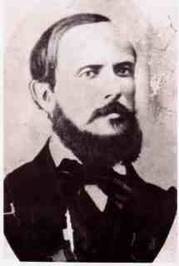
Carlo Pisacane, Duke of San Giovanni (22 August 1818 – 2 July 1857) was an Italian patriot and one of the first Italian socialist and anarchist thinkers. Pisacane is considered an early proponent of propaganda of the deed. During the historical period known as Risorgimento, he represented the extreme left, and he introduced Anarchism in Italy.
Pisacane was born in Naples to an impoverished noble family, and entered the Neapolitan army in 1839; but having become imbued with Mazzinian ideas he emigrated in 1847, and after a short stay in England and France served in the French army in Algeria. The revolution of 1848 recalled him to Italy; he played a part in the brief Roman Republic, and was an instrumental part of the war commission in the deCarlo Pisacane, Duke of San Giovanni (22 August 1818 – 2 July 1857) was an Italian patriot and one of the first Italian socialist and anarchist thinkers. Pisacane is considered an early proponent of propaganda of the deed. During the historical period known as Risorgimento, he represented the extreme left, and he introduced Anarchism in Italy.
Pisacane was born in Naples to an impoverished noble family, and entered the Neapolitan army in 1839; but having become imbued with Mazzinian ideas he emigrated in 1847, and after a short stay in England and France served in the French army in Algeria. The revolution of 1848 recalled him to Italy; he played a part in the brief Roman Republic, and was an instrumental part of the war commission in the defence of the city. After its capture by the French, he again went into exile, first to London and then to Genoa, maintaining himself by teaching.
In 1857 he organized an expedition to provoke a rising in the Neapolitan kingdom and sailed from Genoa with a few followers on 25 June 1857. They landed on the island of Ponza, where the guards were overpowered and some hundreds of prisoners liberated, and on 28 of the same month arrived at Sapri in Campania and attempted to reach the Cilento. But no assistance from the inhabitants was forthcoming: the Neapolitan authorities had spread the news that Pisacane and his followers were brigands who had come to steal and pillage, and the local peasants, instead of rising against the Bourbons, joined the Neapolitan troops in fighting the invaders and Pisacane himself was killed at Sanza, province of Salerno, Campania....more

 Sign in with Facebook