
Neel Burton's Blog
March 13, 2026
Free to Download: Growing from Depression
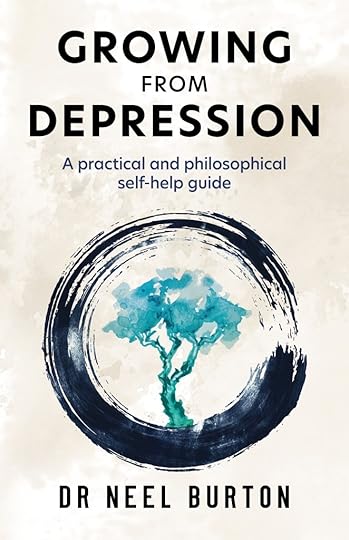
What if depression were a blessing as well as a curse? This is a book about how depression can have benefits as well as costs, and how to reap those benefits while making yourself feel better—better, in fact, than ever before.
 Semi-finalist, the BookLife Prize
Highly Commended, the BMA Book Awards
A comprehensive, sympathetic, and thought-provoking guide for those who want to explore their depression in more depth. —The British Journal of Psychiatry
This book brings understanding and encourages independent solutions. It is remarkable in its shortness and practicality. —The British Medical Association Book Awards
★★★★★ I have read most of Dr. Neel Burton’s books and have enjoyed them immensely … All in all, I found this to be a very insightful and engaging book on depression. —Jamie Bee, Amazon.com Top 50 Reviewer
Grab your copy now for a new and powerful way of looking at depression.
READ now FOR FREEThe post Free to Download: Growing from Depression appeared first on Neel Burton author website and bookshop.


Nietzsche and the Stoics on Eternal Return
Nietzsche’s thought experiment to determine our own greatness.
 Sisyphus, by Titian.
Possibly under the influence of Plato, who was himself influenced by Pythagoras, the Stoics held that the universe undergoes cycles, being periodically destroyed in a great conflagration [Greek, ekpyrosis] and then reborn, ad infinitum.
Because God, being perfectly rational, is bound to make the same choices, each cosmic cycle plays out similarly or even identically, so that the world as we know it, with us in it, existed in the previous cycle and will recur in the next.
In around 200 CE, the philosopher Alexander of Aphrodisias wrote: “[Chrysippus and the Stoics] hold that after the conflagration all the same things come to be again in the world numerically, so that even the same peculiarly qualified individual as before exists and comes to be again in the world…”
In his Letters, the Roman Stoic Seneca (d. 65 CE) tells Lucilius: “Things that vanish from our sight are merely stored away in the natural world: they cease to be, but they do not perish… the day will come again that will return us to the light. It is a day that many would refuse, except that we forget everything before returning.”
This concept of eternal recurrence, or eternal return, is even echoed in the Bible:
The thing that hath been, it is that which shall be; and that which is done is that which shall be done: and there is no new thing under the sun. Is there any thing whereof it may be said, See, this is new? It hath been already of old time, which was before us. There is no remembrance of former things; neither shall there be any remembrance of things that are to come with those that shall come after (Ecclesiastes 1:9-11).
In the City of God Against the Pagans (426 CE), St. Augustine seeks to deny that these and other such verses refer to eternal return. If “the wicked walk in a circle,” says Augustine, “this is not because their life is to recur by means of these circles, which these philosophers imagine, but because the path in which their false doctrine now runs is circuitous.”
Enter NietzscheIn the 19th century, Nietzsche used eternal return as a thought experiment, as perhaps the Stoics had done, to determine the degree to which our individual will is aligned with the will of the world.
How, asks Nietzsche, would we feel if a daemon visited us one night and told us that we will have to live out our life over and over again? Would we feel joy, or desperation?
In the chapter of Ecce Homo (1908) entitled, Why I Am so Clever, Nietzsche says, “My formula for greatness in a human being is amor fati [love of fate]: that one wants nothing to be different, not forward, not backward, not in all eternity. Not merely bear what is necessary, still less conceal it … but love it.”
Nietzsche’s Nazi sister had this line deleted from Ecce Homo: “I confess that the deepest objection to the Eternal Return… is always my mother and my sister.”
In his essay, The Myth of Sisyphus (1942), Albert Camus compares the human condition to the plight of Sisyphus, the mythical king of Ephyra who was punished for resisting the gods by being made to repeat forever the same meaningless task of pushing a boulder up a mountain, only to see it roll back down again. Camus concludes, “The struggle to the top is itself enough to fill a man’s heart. One must imagine Sisyphus happy.”
Even in a state of utter hopelessness, Sisyphus can still be happy. Indeed, he is happy precisely because he is in a state of utter hopelessness, because in recognizing and accepting the hopelessness of his condition, he at the same time transcends it.
Or, in those wonderful words of Virgil, “The only hope for the doomed is no hope at all.”
Neel Burton is author of Stoic Stories.
The post Nietzsche and the Stoics on Eternal Return appeared first on Neel Burton author website and bookshop.
January 14, 2026
Free to Download: Growing from Depression
What if depression were a blessing as well as a curse? This is a book about how depression can have benefits as well as costs, and how to reap those benefits while making yourself feel better—better, in fact, than ever before.
Semi-finalist, the BookLife Prize
Highly Commended, the BMA Book Awards
A comprehensive, sympathetic, and thought-provoking guide for those who want to explore their depression in more depth. —The British Journal of Psychiatry
This book brings understanding and encourages independent solutions. It is remarkable in its shortness and practicality. —The British Medical Association Book Awards
★★★★★ I have read most of Dr. Neel Burton’s books and have enjoyed them immensely … All in all, I found this to be a very insightful and engaging book on depression. —Jamie Bee, Amazon.com Top 50 Reviewer
Grab your copy now for a new and powerful way of looking at depression.
READ now FOR FREEThe post Free to Download: Growing from Depression appeared first on Neel Burton author website and bookshop.
Why Hitler Was Such a Persuasive Orator

Lessons from Aristotle: Protecting democracy from demagogues.
Both Plato and Cicero argued that the best orator is a philosopher, or, at least, a good person or person of virtue. If you were not a philosopher or a good person, you were not an orator but merely a sophist or demagogue.
Against this, we have to contend with the fact that even a wretch like Hitler was able to move crowds—and quite powerfully and world-historically at that. Everything about Hitler was warped, his character (ethos), the arguments he used (logos), and the emotions that he sought to instil (pathos), but, still, people followed him in their droves because they themselves were wretched and warped.
A lesson from AristotlePlato’s long-time student Aristotle, who lived some twenty-four centuries ago, was perhaps the first to understand that the bedrock of democracy is an affluent, educated middle class.
In the Politics, Aristotle says that, compared to states with a large middle class, states of the rich and poor tend to strict oligarchy (“rule by a few”) or rampant democracy, and, ultimately, to tyranny.
Unfortunately, few states have a large middle class, so that the middle, balanced form of government is rare. According to Aristotle, a democracy becomes preferable when the quantity of the poor exceeds the quality of the rich. Otherwise, an oligarchy is preferable.
The form of the democracy or oligarchy depends on the precise composition of the state. But in every case, the middle classes ought to be included in government, because only they are able to successfully mediate and arbitrate between the rich and the poor.
What we can do right now to protect against demagoguesIf today’s democratically elected governments wish to preserve and perpetuate the system that elected them, and ensured an unprecedented eighty years of peace, they need to introduce better, stronger safeguards and balance an excess of democracy with oligarchy, or, to be more precise, aristocracy (“government by the best”) or repositories thereof—such as tighter rules and more stringent criteria for selecting political party leaders and a more independent or autonomous judiciary.
But for the longer term, they need to look to the economy, social justice, culture, and education. Because rhetoric, or oratory, is not carried out in a vacuum. What is ethos, what is pathos, even what is logos alter according to the dispositions and inclinations of the audience or public—although I do believe that, overall, and over time, with the lessons having been learnt, the good, the true, and the just are naturally more persuasive.
No tyrant lives forever. Now war rages on forever. Men come and go as leaves year by year upon the trees, and every second or third generation must learn the lessons anew.
Or read.
Neel Burton is author of How to Think Like Plato and Speak Like Cicero.
The post Why Hitler Was Such a Persuasive Orator appeared first on Neel Burton author website and bookshop.
January 12, 2026
Jean-Jacques Rousseau: The Life and Ideas of a Revolutionary Thinker

Jean-Jacques Rousseau was born in 1712 in the Republic of Geneva. At the age of 16, he ran away from the city and the abusive engraver to whom he was apprenticed.
In neighbouring Savoie, he found shelter with a priest, who put him onto the attractive Françoise-Louise de Warens, who had separated from her husband, converted to Catholicism, and become a proselytiser in the pay of Victor Amadeus II of Savoy. Completely smitten, Rousseau completed his conversion to Catholicism in the Piedmont-Sardinia capital of Turin, where he supported himself by working as a footman and secretary for an ailing countess.
At the age of 20 or 21, Rousseau returned to Warens in Chambéry, and their relationship turned sexual. Although Warens was also intimate with her household steward, Rousseau considered it the greatest love of his life. He began to call her Maman (“Mummy”), and she him Mon petit (“My little one”).
In those years, Rousseau struggled to establish himself in a career and spent a year travelling. He travelled mostly on foot, meeting people from all walks of life. When he returned to Warens, he pursued his passion for music and read deeply. But Warens could no longer support him, so, at the age of 27, he took up a position as a tutor in Lyon, which gave him the opportunity to reflect on pedagogy.
Paris and VeniceWith Warens growing cold on him, in 1742, at the age of 30, Rousseau moved to Paris to present a new system of musical notation to the Académie des Sciences. The Académie praised his mastery but found his system impractical and rejected it.
In 1743, his Enlightenment connections led him to a job as secretary to the French ambassador in Venice. He revelled in Italian music but did not get on with the ambassador and, the following year, returned to Paris.
He met a laundry girl called Thérèse Levasseur, who would become his life companion. In 1746, she bore the first of their five illegitimate children. All five were immediately handed to a foundling hospital, where the chances of surviving into adulthood would have been slim. Later, Voltaire would anonymously publish a pamphlet to expose this secret and discredit Rousseau as a moral and educational authority.
Rousseau wrote ballets, with little success. He began to spend a lot of time with Diderot, Condillac, and d’Alembert, and became involved with Diderot’s brainchild, the Encyclopédie, to which he contributed almost four hundred articles on politics and music. The Encyclopédie, which stood at the heart of the Enlightenment, was denounced by both the king and the Church.
Rise to fameIn 1749, Diderot was imprisoned in Vincennes. While walking to Vincennes, Rousseau read an announcement in the Mercure de France for the Dijon Academy’s essay contest, on the question, “Has the restoration of the sciences and arts contributed to the purification of morals?” This led to the radical idea that the arts and sciences had led to the moral degeneration of man, who began as moral and vigorous—or, at least, uncorrupted by vanity, superficiality, inauthenticity, luxury, and inequality. In his Confessions, Rousseau wrote, “Within an instant of reading this [advertisement], I saw another universe and became another man.” With his prize-winning essay, Discourse on the Arts and Sciences (the “First Discourse”), he rose into a cause célèbre.
In 1752, he wrote a simple, Italian-inspired one-act opera, Le Devin du village, which premiered at the royal court at Fontainebleau. The king liked it enough to offer him a pension, which he declined—gaining notoriety as “the man who had refused a king’s pension.”
In 1754, Rousseau returned to Geneva and converted back to Calvinism. He embraced a personal, natural religion, or “religion of the heart,” which, together with his belief in the corrupting influence of civilisation, set him apart from the other Encyclopédistes, who championed reason, progress, and atheism.
In 1755, he completed his second major work, the Discourse on Inequality (the “Second Discourse”), in which he painted a rosy picture of man in the original “state of nature” and argued that private property is the original source and basis of all inequality and misery. When Voltaire received his copy, he wrote back to Rousseau: “No one has ever employed so much intellect to persuade men to be beasts. In reading your work one is seized with a desire to walk on all fours.”
Sophie d’Houdetot and La Nouvelle HéloïseThe saloniste Madame d’Epinay, having noticed the second discourse, offered Rousseau a pension together with a cottage on her estate in Montmorency. He refused the pension but moved into the cottage with Thérèse and her mother.
He resented being in the keep of Madame d’Epinay and soured things by falling head over heels for her cousin, Sophie d’Houdetot. He came to believe that there was a plot against him and wrote a series of damaging letters. In 1757, he moved with Thérèse into a villa on the nearby estate of the duc de Luxembourg, who became his patron.
His bestselling novel, Julie, ou la nouvelle Héloïse (1761), is inspired by his liaisons with d’Houdetot and Warens.
The Social Contract and EmileAfter Julie, Rousseau turned his pen to his two most acclaimed works, the Social Contract and Emile.
In the Social Contract, he sets out how to create a just state in which we may recover some of our natural freedom and goodness.
In Emile, he lays out a system of education that might preserve the individual’s innate vigour and morality. Having encouraged the child to become active, curious, and critical, it remains, in adolescence, to make him into a loving and feeling being, “to prefect reason by sentiment.”
Emile, however, is aimed exclusively at wealthy orphan boys with a dedicated, live-in tutor (orphan, to remove the corrupting influence of the parents). In the section on Emile’s female counterpart, Sophie, Rousseau states that women should be “passive and weak” and “put up little resistance.”
Book IV contains the controversial “Profession of Faith of the Savoyard Vicar,” in which the vicar’s argument leads only to natural religion, that is, to an unmediated, self-discovered relationship with a creator God.
In a letter, Voltaire deemed Emile “a hodgepodge of a silly wet nurse in four volumes, with forty pages against Christianity, among the boldest ever known.”
Years of exileBoth the Social Contract and Emile were banned from France and Geneva, with warrants issued for Rousseau’s arrest.
Over the next few years, Rousseau moved from place to place until his reputation caught up with him. His nemesis Voltaire invited him in vain to Ferney on the Geneva border, where renegade writers could border hop to escape the authorities.
In 1766, Rousseau travelled to England with David Hume. Tasked with escorting Thérèse to England, James Boswell seduced her en route, with Thérèse telling him, “Don’t imagine you’re a better lover than Rousseau.”
His paranoia intensified, and he began to suspect Hume of being at the centre of a plot to ridicule him. The two men fell out when Hume, seeking to protect his reputation, published an account of the whole affair.
Return to France and deathRousseau returned to France in 1767 under an assumed name and spent the next three years in relative seclusion. He married Thérèse, practised botany, and wrote his disarmingly candid Confessions.
He died in 1778, at the age of 66, from what was recorded as apoplexy (some said suicide). In 1794, his remains were transferred to the Panthéon and placed next to those of… Voltaire.
The post Jean-Jacques Rousseau: The Life and Ideas of a Revolutionary Thinker appeared first on Neel Burton author website and bookshop.
January 1, 2026
Kant’s Categorical Imperative Explained

Despite his love of hosting, conversation, and fine dining, Kant’s house was unadorned and austere. He had only one picture, which hung above his bureau. This picture was of Jean-Jacques Rousseau, who was only 12 years older than him. According to lore, the only time Kant failed to take his daily walk was when he received his copy of Rousseau’s Émile.
How did Rousseau’s outlook work its way into Kant’s moral philosophy? If for Rousseau, it is by following the “general will” that we can be said to be free, for Kant, it is by obeying those moral laws that we would will as universal laws. Moral laws that we would will as universal laws are given not by our individual will but by our rational will, which we have in common with all other rational beings.
We often experience this dichotomy in our minds: this is what I selfishly or frivolously want to do, and this is what I truly ought to do—because I want to live in a better society that abides by this rule, and would resent it if other people behaved in such a biased, thoughtless way.
To conform to the universal law is not to be a slave; on the contrary, it is to follow reason and free ourselves from our irrational and disordered appetites. For Kant, this capacity to overrule our individual will lies at the heart of our special dignity as human beings.
The Categorícal Imperative vs. the Golden RuleWhen obeying those moral laws that we could consistently and rationally will as universal laws, we are following the so-called Categorical Imperative, which might be re-stated as, “Always act such that the maxim of your action can at the same time be upheld as a universal law.”
This is similar to the much older Golden Rule of the Bible, according to which we should treat others as we would want to be treated. But whereas the Golden Rule is based on personal desire, which is subjective (I might, for example, be a masochist, or be willing to tolerate a degree of mistreatment), the Categorical Imperative is based on reason, which is objective.
Hypothetical imperatives and consequentialismHypothetical imperatives are practical rules for achieving a desired outcome, for example, “If you want to lose weight, you should watch what you eat.” If you do not desire a particular outcome, you do not need to follow the rules. In this much, hypothetical imperatives are conditional and contingent. Categorical Imperatives, in contrast, are universal moral commands that bind everyone regardless of their aims, for example, “Do not lie” or “Do not steal.”
Hypothetical imperatives answer to the lower faculty of desire, which aims at pleasure. Categorical Imperatives answer to the higher faculty of will, which functions rationally and autonomously by following the laws which it legislates for itself, regardless of consequences or personal feelings.
For Kant, true moral actions must be motivated by duty, not some desired outcome. Thus, Kantian ethics are sometimes described as deontological, or duty-based, and contrasted with consequentialism (for example, utilitarianism), which is outcome-based. For Kant, moral systems based on outcomes or desires, such as utilitarianism, operate on hypothetical imperatives, not true moral law.
Perfect vs. imperfect dutiesKant provides some examples to add flesh to the bones of the Categorical Imperative. Imagine a person in financial need who borrows money and promises to pay it back, in the knowledge that they never will. If this action were universalised, promises of repayment would no longer be believed and the entire practice of lending would collapse. Kant also points out that abusing the lender in this way reduces a dignified being with ends of his own to a mere means to an end (“Act always treating humanity, in yourself and others, as an end and never merely as a means” is the second formulation of the Categorícal Imperative).
Second, imagine a person who does not intervene to help a person in distress. Were this maxim to be universalised, no one would ever help anyone, making the world into a worse place.
In the first case, not repaying a loan, the maxim cannot be universalised because it would involve a contradiction. In the second case, not helping a person in distress, there is no such contradiction. Nonetheless, it would not be rational to will a world in which no one ever helped anyone. Whereas repaying a loan is a “perfect duty,” helping someone in need is an “imperfect duty” in that we have some latitude in how we go about fulfilling it. Though we ought to be benevolent, we do not need to go about helping everyone all the time.
Failing in an imperfect duty, such as helping others or cultivating our talents, does not attract the same strict blame as violating a perfect duty, so long as we do not adopt a maxim contrary to the imperfect duty.
Kant’s example of the prudent grocerWhen we do help someone, our action must be motivated by duty if it is to have moral worth. If I help someone from inclination, for example, from sympathy or because it makes me feel good, I am still doing a praiseworthy thing, but my action, being circumstantial rather than principled and reliable, lacks moral worth.
Imagine a grocer who always gives the correct change, but only to avoid being caught and losing his reputation. His behaviour, though not blameworthy, is lacking in moral worth. If he knew that he could not get caught, he may behave differently and dishonestly. Because his behaviour is prudential and circumstantial, rather than born out of duty, it is not categorical.
For Kant, a paradigm of moral worth is the person who hates life and longs to commit suicide, but stays alive purely out of duty. Because this person has no self-serving inclinations, he is acting purely from duty, rather than mere “conformity to duty.” Similarly, a hard-hearted person who has no other motivation than duty has a moral worth “beyond all comparison the highest.”
How to identify the Categorical ImperativeDuring his trial in Jerusalem in the 1960s, the Nazi Adolf Eichmann, a major organiser of the Holocaust, claimed to have been abiding by Kant’s Categorical Imperative—having interpreted “doing your duty” as blind obedience to superior authorities.
To identify the Categorical Imperative, we need to look inward to our rational self and engage in our own moral reasoning—asking whether the maxim guiding our action could be universalised—rather than delegate responsibility to some external authority such as a dictator (say, Hitler) or even a religious doctrine (say, the Ten Commandments).
So long as they reason correctly, every rational being, human or otherwise, should be able to arrive at the same Categorical Imperative. As pure rational wills, shorn of our attributes, temperaments, and desires, we are all the same. Whenever we carry out an action with a moral dimension, we implicitly universalise that action for all other wills.
In her analysis of the Eichmann trial, the philosopher Hannah Arendt introduced the concept of the “banality of evil,” highlighting that evil can be perpetrated not only by fanatics and psychopaths, but, more ordinarily, by “normal” people who fail to engage in critical self-reflection.The post Kant’s Categorical Imperative Explained appeared first on Neel Burton author website and bookshop.
December 28, 2025
The Beautiful vs the Sublime: Key Philosophical Insights

The sublime: What is it and why are we so keen to experience it?
The distinction between the beautiful and the sublime goes back at least to Longinus (first century CE), who saw the sublime as an overwhelming, ecstatic force that uplifts the soul with grandeur. A flower is beautiful, and so is a great oak, but the great oak is also sublime, and it is its sublimity rather than its beauty that we retain.
Longinus and literary sublimityAt the heart of our attraction to natural grandeur is our desire for transcendence, which is then expressed through sublime art and language. In On the Sublime, Longinus laid out five sources of literary sublimity: noble concepts; passionate feeling; figures of speech; noble diction; and dignified composition. The first two, he claimed, are innate, while the last three are learnt.
Edmund Burke on the sublime, or why we ride rollercoastersLater thinkers like Edmund Burke and Immanuel Kant more sharply distinguished between beauty and sublimity, which they presented as antithetical. In A Philosophical Enquiry into the Origin of Our Ideas of the Beautiful and the Sublime (1757), Burke associated beauty with the likes of smallness, smoothness, and delicate form; the sublime, in contrast, he associated with power, vastness, and obscurity.
Whereas the beautiful (like a flower or a gentle landscape) gives rise to feelings of love, pleasure, and relaxation, the sublime (like the open seas or a raging storm) gives rise to overwhelming feelings of awe, terror, and delightful horror.
However, the sublime is only delightful, awe-inspiring, and aesthetic when it is experienced from a certain distance or place of safety; otherwise, if it represents an imminent danger, it is simply terrible.
Many who partake in extreme sports like paragliding or bungee jumping, ride rollercoasters, or watch horror movies are really seeking the thrill of the sublime, triggering the atavistic fear of death in the full knowledge that they are safe.
Feelings associated with the sublime are far more powerful than feelings associated with beauty, because feelings associated with self-preservation are far more powerful than feelings associated with pleasure. Who, asked Burke, would choose a life of great pleasure if it were fated to end in slow torture?
Kant on the sublime: A bridge between two worldsKant read Burke and elaborated upon his ideas. He distinguished between two forms of the sublime, the mathematical sublime, which arises from the contemplation of immensity (like the starry heavens or the pyramids) and overwhelms our cognitive capacity, and the dynamical sublime (like a violent thunderstorm or raging waterfall), which arises from the contemplation of great power and overwhelms our practical capacity.
With the mathematical sublime, the failure of our senses awakens our divine reason, which can easily grasp the idea of infinity or absolute totality, even when our senses cannot. With the dynamical sublime, our feeling of helplessness and physical insignificance awakens our moral vocation, which is immune to natural forces, as well as the noumenal world (the world as it really is, beyond mere appearances), in which we too are powerful, majestic, and absolutely free.
In sum, the feeling of the sublime reminds us of the superiority of our rational, moral noumenal selves over the phenomenal world and our mortal, phenomenal selves. Whereas the beautiful makes the phenomenal world feel like a better place, the sublime reminds us that we belong to an altogether different world.
Both beauty and sublimity bridge the divide between the two worlds, the one through harmony, the other through disruption, or disjunction.
The post The Beautiful vs the Sublime: Key Philosophical Insights appeared first on Neel Burton author website and bookshop.
December 22, 2025
Why Computers Could Never Experience Beauty

The significance of beauty in Kant’s philosophical system.
Kant’s philosophy of beauty is the culmination of his philosophical system.Kant viewed beauty as a “bridge” between the world as it appears and the world as it is.Beauty, for Kant, is a vision of heaven on earth.Kant’s third critique, The Critique of Judgement, was published in 1790, two years after the Critique of Practical Reason. Although it did not receive the immediate attention of the previous two critiques—some even dismissed it as the product of senility—its historical impact has been significant. Kant himself looked upon it as “bridge between realms”, and the completion of his critical project.
Hierarchy of the fine artsKant established a hierarchy of fine arts based on the capacity to engage the imagination and understanding and their potential for moral and intellectual improvement and the stimulation of afterthought [Nachdenken]. First came the speaking arts of poetry and rhetoric, then the ‘formative arts’ such as painting, sculpture, and architecture, and finally the ‘arts of the play of sensations’ such as music.
Nature as a modelFor Kant, nature, which appears purposive [Zweckmäßig] to the human mind, is the model or standard for artistic beauty. An appreciation of natural beauty suggests a moral disposition, whereas even “a hardened old usurer” could take an interest in art—pointing to the pre-eminence of natural beauty. The artist (genius) aims to create art that appears as if it were a product of nature.
The core of aesthetic judgement of both nature and art is the perception of “formal purposiveness”, or “purposiveness without a purpose” [Zweckmässigkeit ohne Zweck], which allows for the “free play” of the cognitive faculties and leads to aesthetic pleasure. When Friedrich Schiller (d. 1805) wrote that a person “is only fully human when he is at play,” he was building on Kant.
The four moments of a pure aesthetic judgementFor Kant, a pure aesthetic judgement has four complementary aspects, or ‘moments’, based on the logical functions of judgement: quality, quantity, relation, and modality. These are, respectively, disinterested satisfaction, universal subjectivity, purposiveness without a purpose, and necessary delight.
Disinterestedness: Our satisfaction in beauty must be purely disinterested, that is, without any consideration for instrumentality (for example, the utility of the vase, the worth of the painting), moral significance, or even existence. Our focus ought to be purely on the contemplative experience of the object itself. In other words, we ought to look upon the object, or its beauty, not as a means-to-an-end but as an end-in-itself. If something merely satisfies or gratifies our appetites, it is agreeable rather than beautiful. Thus, “Canary-wine” is merely agreeable—unless, it has been argued, we adopt a disinterested attitude towards it, swishing it and spitting it out. In his Anthropology, Kant noted that moderate consumption of wine can facilitate conversation and promote “virtuous sociability”.
Universal subjectivity: When we call out something as beautiful, we expect other disinterested, right-thinking people to agree with our judgement, as if beauty were an inherent property of the object. The agreeable on the other hand is a ‘private feeling’, and we are not indignant if others do not share our penchant for blue cheese or anchovies. Whereas the judgement of the agreeable is born out of our personal characteristics, the judgement of beauty is disinterested and born out of the same pure reason that we have in common with every other rational being. Here again, in his aesthetics, is this Kantian notion of the objectivity of inter-subjectivity. Judgements of taste are neither purely subjective (based solely on individual pleasure), as Hume believed, nor purely objective (based on a perfect standard in the object itself), as Baumgarten believed. Instead, they are an expression of the free play of the cognitive faculties that all human beings have in common.
Purposiveness without a purpose: Beauty does not reside in an object’s instrumentality. Nor is it an inherent property of the object. Instead, the judgement of beauty arises from the object’s form displaying a ‘purposiveness without a purpose’. The object’s form appears to have been designed with some indeterminate purpose, exhibiting order and harmony. ‘Beauty is a form of purposiveness in an object, so far as this is perceived in it apart from the representation of an end.’ Kant argued, controversially, that the ingenu is at greater liberty to enjoy the beauty of a flower than the botanist, who gets caught up in the various ends of the flower and its parts. Kant’s philosophy of beauty significantly influenced the development of a movement in art criticism known as formalism, which emphasises compositional elements such as form, colour, and spatial arrangement over content or context.
Necessary delight: The object is the source of necessary pleasure or satisfaction. Even though this pleasure not an objective property of the object, it is grounded in an a priori principle of the mind, namely, the free play of the cognitive faculties, not least, the intuitions of time and space. As such, it ought to be universally shared and acknowledged. The feeling of beauty, uniquely, bridges the divide between the objective, deterministic world of nature and knowledge, and the subjective, free world of judgement and morality. That’s why computers, and non-rational beings, could never experience beauty.
In conclusion: Why we should value beautyThe experience of beauty and purposiveness without a purpose arises whenever the deterministic and indifferent phenomenal world appears to align or harmonise with the noumenal world of reason and morality and conspire with the moral ideal that we, humanity, are working at. In other words, beauty is a vision of heaven on earth—which is why we should value beauty and surround ourselves with beautiful things.
Beauty and beautiful things make the world feel like a better place, a place, finally, that feels like home.
The post Why Computers Could Never Experience Beauty appeared first on Neel Burton author website and bookshop.
November 28, 2025
My beautiful books
The best books are those that tell you what you already know, but didn’t know that you knew.
Short introduction video (90s)
Find out more about the Ataraxia and Ancient Wisdom series—and about me.
The post My beautiful books appeared first on Neel Burton author website and bookshop.
My Beautiful Books 🦌🛷
Written for the mind, soul, and senses.
Short introduction video
Find out more about the Ataraxia and Ancient Wisdom series—and about me.
The post My Beautiful Books 🦌🛷 appeared first on Neel Burton author website and bookshop.


