JoeAnn Hart's Blog
March 3, 2026
Refugia – New short fiction in The Upper New Review
 Refugia
by JoeAnn Hart
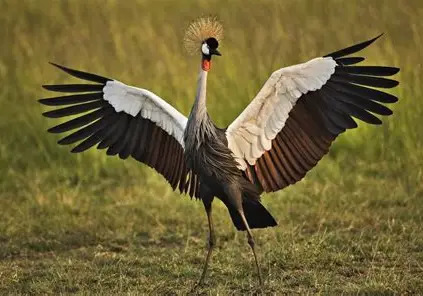
Ahimsa was so much better at this bedtime story thing than me. I was always looking for concrete answers, but she liked to keep questions open. She said that much of the brain’s wiring takes place after birth, so we had to make Robin’s wiring as expansive as possible while we could. The Earth will never come alive for him unless our songs and stories give life to all the beings, seen and unseen. Still, it wasn’t my favorite activity. He could be a little wound-up this time of day.
“Redberry!” Robin shouted. His pudgy hands reached out for the colander in Ahimsa’s hand. “Want a redberry!”
“Raspberry,” I said. “Razz…berry. And please.”
“Redberry!” he said. “And please!” He opened his mouth wide as if Ahimsa didn’t understand what it was he wanted. His body was small, but his will enormous.
“Raspberry!” I repeated.
“He can call it what he wants,” Ahimsa said, as she placed a scarlet berry on his tongue.
“Don’t you think we should try to use a common language?” I asked.
“We both knew what he wanted, and he knew we knew. What more out of a language do you want?” A light-bell pulsed from above. “Bedtime,” she said. “Isaura, put him down so I can finish the day’s hatch report.”
I swooped Robin up in my arms and he struggled with laughter. His body was so alive. He was just bathed and smelled like almond soap. Almost four years old. I felt as if something was wrong with him, we’d know by now. We were almost out of the woods.
“Story! “he shouted.
I groaned, and Ahimsa gave me a look. No need for words with her.
“Okay, a book,” I said, putting him back down. “One book.”
“Two books.”
I pulled up the rocking chair by the window. “Sit on my lap and we’ll read one book, or you can go straight to your room and we’ll read no books.”
Robin made a running leap, then jumped up on me with such force the rocking chair tilted back. He thought this was hilarious. After I stabilized the chair, he chose a new book from the hologramic panel I pulled down in front of us. “The Fluffy Fantailed Fairfeathers,” I announced, and we settled in. “’A long, long time ago, there was a flock of fantastic birds called the Fluffy Fantailed Fairfeathers living on a small island in a great big lake. They had many beautiful colors in their feathers. Violet, red, yellow, green, orange, and blue. Even magenta! When they were happy, and they were happy all the time, they fanned open their feathers and made rainbows of their tails.’”
“Colors are pretty,” said Robin, gently touching a tail.
“Want to know something interesting about color?” I asked. I wanted to tell him that the real world was gray and color was an illusion. The brain compared wavelength variations to create color, without which it would be hard to sort out the world. Ahimsa would have trouble finding those berries among the brambles, because everything, the leaves, stems, and berries, would be gray. Our brains create something that is not there, so that we can make sense of our environment.
“Don’t say it,” Ahimsa called from the other room. “Beauty doesn’t need any explanation.”
“Yes, pretty,” I told Robin, and made a mental note to share my color lesson later. Colors might only be wavelengths of sunlight, but the light was real, even as it shone on us and through us, even as it reflected off of us and onto one another. But it was hard to teach him about the realities of the world with Ahimsa right around the corner. I believed information expanded wonder, but she thought at his age, and in our current world, the less said about reality the better.
“And rainbows,” said Robin. “I like rainbows.” He sat balanced on my knees, studying the bird tails in the illustration, putting his nose right to the panel and pushing his face through the hologram image. Then he sat up straight and pointed out the window, past the flight cages and over the woods. The sun was low in the sky and was framed by a rainbow. There was always a rainbow, often several at the same time. Not really a good thing apparently. We’re told the sky is clear blue underneath the haze, and rainbows should be special. That’s what our global intelligence system, Talos, was trying to work back to. Right after the Extinction Emergency, countries—the ones that still functioned—began spraying saltwater mist over the oceans, creating low-lying clouds to reflect sunlight and lower the planet’s temperature, and while it made the world a little dimmer, it worked. It bought us time. Or at least, it bought some of us time. For other parts of the world, it messed with the monsoons and upended food and water supplies. There were always unintended consequences with geo-engineering. You could say that we went through a century or more of unintended consequences, as humans tried everything and anything rather than just stop using fossil fuels. That only ended when we nearly ended. As Ahimsa says, we always make the right choice when there is no other. These days, global marine cloud brightening is regulated by Talos to the benefit of everyone, and as the atmosphere cools it has slowly decreased the spraying. One day soon, we’re told, the sky will be sky-blue once again.
“I like rainbows too,” I said.
“Can I have all the colors on my feathers too?” he asked.
I ran my hand along his featherless arm. His skin was tinted a pale silver-green, as was ours, a reflective tone that Talos integrated into the human genome ages ago as a guard against lingering radiation. If we don’t need it in the future, it will be slowly phased out, like the cloud brightening. Like Robin’s hair. Talos recently started splicing follicles back into the genome, believing this generation just might be able to keep their hair. Robin’s is a thin brown fuzz, but it’s more than Ahimsa and I have under our turbans.
“You don’t have feathers,” I said.
“Yes I do,” he said, and he pulled up his pajama tunic and showed me a single, dark hair on his stomach.
I looked around for Ahimsa, but she must have been in the hatchery. I wasn’t sure about this hair. Did a rogue follicle indicate a deeper problem?
“It’s a hair, not a feather,” I said. “Let’s show that to Ah sometime.”
“I want to show Ah now.”
I pulled his tunic down and patted his tummy. “Later,” I said. “Let’s get back to the story… ‘The Fairfeathers were so beautiful that a little girl named PattiCake came to the shore everyday to watch the birds swishing and swashing their rainbow tails as they paraded around the island.’”
“Was the island Zaratan?” Robin asked. “The island that was a giant turtle?”
“No, the Fairfeathers don’t live on Zaratan, that’s another book.”
“Can we read that? I want to see the giant turtle.”
“We can read it tomorrow. Right now we are reading this one before bed.”
“No bed. Were Fairfeathers one of the First Birds?”
First Birds were the predecessors of the birds today. They had the genome they were born with, not the ones manipulated by Talos so they could survive in a world so very different from the one they had evolved in. Talos used the stored genetic material of the thousands of bird species that once existed—the First Birds—and combined them with genes from other plant and animal species to create today’s birds, such as the robins that we raise and rewild. Was a Fairfeather meant to be a First Bird in the book? There were birds that once existed, birds that still existed in some form or another, and then those in children’s books like this, fantasy birds that never existed but were often meant to stand in for First Birds. Fantasy birds gave them a hint of what had been, so they knew what we were all working towards, without smothering them in grief along the way.
Ahimsa was standing at the door, looking at me. Possibly she’d been there for some time. “I’m not too familiar with these Fairfeathers,” she told Robin. “They may or may not be First Birds, but they are certainly special birds.”
And then she was gone. I wondered if I should call her back to look at the dark hair.
“Can we go see them?” Robin asked. “Can we go to the island and see the Fairfeathers?
“The Fairfeathers live in this book,” I said. “And when we read the book, they live in our heads.”
Robin put a hand to his head with a worried look. “Birds?”
“Our imaginations,” I said. “They live in our imaginations. I’m going to keep reading this story now if that’s okay with you.”
He looked around the room. “Where is imagination?”
I put my hand on my own head, which was beginning to ache. “The imagination is in your brain, and these birds are now part of your imagination.”
“Brain!” He tapped my head, then he tapped his. He knew his anatomy. Brilliant child.
“Let’s get back to the story,” I said.
“Is it a real story?”
“It’s a real made-up story. Let’s just read it. ‘The Fairfeathers laid their eggs in burrows on the island, and after they hatched, the baby Fairfeather chicks peeped and pecked all around the island until they were old enough to fly. The deep water around the island kept them safe from the animals who wanted to eat them.’”
“Our eggs come by hover.”
“Yes, they do,” I said. Every day a gross of fertilized robin eggs arrived from a Talos biofab unit for us to hatch out, nurture, then release into the woods. “But Fairfeathers lay their eggs in the wild,” I explained.
“The wild,” Robin said. He looked outside at the trees quietly growing next to a field humming with bees. Birds swooped over the grass searching for the last meal of the day. All the elements of a temperate ecosystem, all created in a biofab unit. Real wild areas, those as yet untouched by Talos, were burnt-out barrens. But for Robin, for now, the wild was simply the outdoors. He looked back at the hologram and studied the illustration of a lush, green island with beautiful birds, surrounded by water that reflected the sky above.
“Why is the sky blue?” he asked and drew his finger across the panel.
The story was obviously set before the worst of the Extinction Emergency of the early millennium, before we had to mist over the sun. That’s what I wanted to say but didn’t. Ahimsa was not far away. “In this story,” I said, “it just is.”
He nodded solemnly and I pulled him closer, feeling the beat of his heart against my chest.
“Okay, let’s get back to the story,” I said. “‘Then one day, the rains stopped coming, and the water level of the lake got lower and lower. This went on for a long, long time, until one day the water was so low that one day, the animals who lived near the lake were able to just walk to the island, dig up the Fairfeather burrows, and eat the eggs. The Fairfeather chicks tried to run and hide, but the animals ate them too.”
I wondered what kind of book this was for a child, although Robin was no stranger to death. None of us were. Many of the robins perished here at the station before they reached adulthood. “Will they all die?” Robin asked in a whisper.
“The adult birds are still there,” I said. “Looks like only the eggs and chicks are being eaten.”
“Who eats them?”
From the pictures, it looked to me like big feral cats and some kind of giant rodents. “I think they made these animals up.”
“Talos made them?”
“No, the author of this book made them in their head.” I touched the panel page. “Let’s keep reading. ‘PattiCake had been watching the water get lower, and when she saw the animals walk to the island to eat the eggs and chicks, she gathered up all the people in town and brought them to the lake. ‘Something has to be done,’ she said.’”
The illustration showed a few dozen humans standing next to what was now a very small, shallow lake. They had pink skin or brown skin, but none were tinted green. Instead, they wore old-school protection gear, used before Talos was programmed to save us with a geno-knife and symbiogenetic combinations.
“Look,” I said. “They’ve come to help.” Actually, it was hard to imagine any of them being able to help, they were all so sickly looking, even PattiCake. “’The townspeople saw what the problem was,’ I continued, ‘but they could not stop the hungry predators from eating the eggs and chicks. The people tried building a fence, but the animals climbed over it. They tried to scare them away but got scared themselves when the animals tore at their protective gear.’”
“The animals are bad,” said Robin.
“No, not bad,” I said. “They’re just trying to survive.”
“Can’t they eat cricket wraps like us?”
“They have to eat whatever they find.” I touched the panel and began reading again. “The Fluffy Fantailed Fairfeathers hopped around their island, poking their long necks into all the burrows, looking for their eggs. They searched under all the bushes for their chicks. They were so sad, they dragged their beautiful tails behind them until they were the color of dirt. PattiCake and the townspeople watched as one by one, the Fluffy Fantailed Fairfeathers started flying away into the dust-filled skies, off to find another island to lay their eggs, searching for somewhere safe.”
“Far away?” asked Robin.
“Maybe,” I said. I really hoped that this was not an endling story. I wondered if I should just stop reading.
“Will that happen to our robins?”
“No silly, they stay around here.” I did not say that they learned soon enough not to leave the woods, or else perish in the barrens.
“No one eats the robins?”
Do I tell him about the magnificent hawks who dined on the robins? The goal of de-extinction and rewilding wasn’t just to restock the world with creatures, it was to create an integrated web of life, restoring relationships, not just bringing back single species. I heard Ahimsa in the kitchen and decided to keep it simple. “That’s hard to tell.”
“Will the animals eat the townspeople?”
“Can we get on with this story please?” I touched the panel. “‘When PattiCake saw the last of the Fairfeathers fly away, she began to cry. Then, one by one, all the townspeople arrived and they began to cry too. They cried and cried, and more humans came and they cried too, because they all loved these birds so much. ‘It’s over!’ they told one another.’”
“The story is over?” said Robin.
“No. They just think the story is over.” There was so much hopelessness in those early days, so many deaths of despair. Now we know the importance of keeping hope alive and finding joy in our work. Ecological health leads to spiritual health, as our teachers used to say.
“What did they do?” Robin asked.
“Well let’s find out,” I said and touched the panel. “‘PattiCake and the townspeople stood by the dried-up lake and cried for days and days, and then weeks and weeks, and months and months, until one day, the lake began to fill up with tears. The more they cried, the higher the water got, until one day, the water was too deep for the animals to get to the island.’”
He put his hands on the illustration. “Water!”
“What do you see in the sky?” I asked.
“A bird. Two birds!”
“’And so, one by one the Fluffy Fantailed Fairfeathers came back to the island to raise their families. Soon the burrows were filled with eggs and little chicks were peeping and pecking all over the island, safe from harm. The townspeople had loved the birds enough to mourn them. PattiCake named herself the water guardian for life, and every time the lake got low, she gathered the townspeople to the shore. When she told them they could lose the Fluffy Fantailed Fairfeathers again, they would begin to cry and bring the water level back up to safety. PattiCake and the townspeople saved the birds with their love. The End.”
“Can we go to the island and see the Fairfeathers?” he asked.
“No, it’s bedtime.”
“Tomorrow? I want to see the Fairfeathers.”
“We can’t see them,” I said, and turned off the hologram. “They’re only in our heads, remember? It’s time for bed.”
“No bed,” he said.
“Yes bed.” I stood up with him clutched in my arms, and as he struggled, Ahimsa came to the door.
“He’s not down yet? What have you two been doing?”
“Have a look at this,” I whispered, and I pulled up Robin’s tunic. “That hair.”
“Feather!” said Robin. “It’s my feather!”
Ahimsa looked closely at the dark hair, then she plucked it off. “Ouch!” said Robin.
“There,” she said. “Problem solved.” She kissed his stomach and pulled down his tunic. Then she kissed him on the forehead. “Nighty-night, sweetie.”
Robin’s head rested on my shoulder in defeat, and he was nearly asleep when we got to his room. He pointed out his window. “Colors,” he whispered. Another vibrant sunset, glorious in oranges and reds, even a splash of green. The field glowed and the woods shimmered in the reflected light. Like the rainbows, our sunsets were amplified by the crap we’d put into the sky. Still. The colors might not be real, but they were our reality. This was our world, and the world needed us to love it madly. “Nigh-night, sunset,” he said, with a weak wiggle of his fingers as I laid him down. His eyelids flickered as he fought sleep, then surrendered. I tucked him in with a kiss, then waited for my heart to return to my chest. We might still be wandering in the woods, but we were far from lost.
Author’s Note“Refugia” is a story within a story about keeping a fictional bird species alive with love. It is one of a series of connected short fiction, set somewhat in the future. The first in the series, “Good Job, Robin,” was published in Slate.com in 2022, as part of their Future Tense column. The stories center around a young couple, Isaura and Ahmisa, as they struggle to raise a family in a world of depleted and compromised resources. Their life’s work is the science of rewilding species. Other stories in the series have appeared in The Dodge and Dark Matter, Women Witnessing, and have been anthologized in Transform the World and the Best Spiritual Literature of 2025. The stories explore the best ways humans can govern themselves, and question whether artificial intelligence systems can help override human greed and ignorance, while promoting human cooperation and empathy. Or not.
Author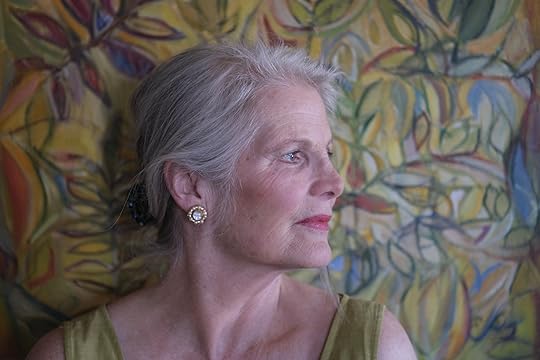 JoeAnn Hart
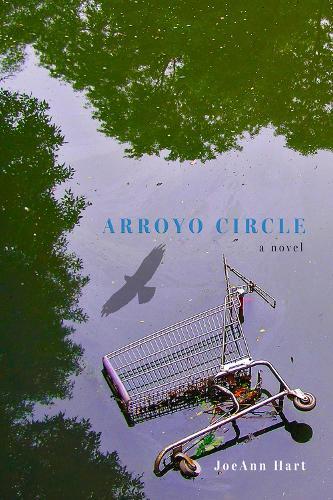
JoeAnn Hart is the author of Arroyo Circle, a novel in which hoarding and homelessness are depicted through the dark marriage of environmental degradation and rampant capitalism. Her other books include the prize-winning fiction collection Highwire Act & Other Tales of Survival, the crime memoir Stamford ’76, the novel Float, a dark comedy about plastics in the ocean, and Addled, a social satire. Her short fiction, reviews, and essays have appeared in a wide range of publications, including Orion, Terrain.org, Slate.com, Lit Hub, and others. Her work explores the relationship between humans, their environments, and the other-than-human world.
In Rachel Carson’s acceptance speech at the National Book Award for The Sea Around Us, she said “The aim of science is to discover and illuminate truth. And that, I take it, is the aim of literature.” In that spirit, almost all my fiction writing in the past decade seeks to find humanity’s uneasy place in the natural world. Lately, I have been playing with speculative fiction, which imagines what life will look like in the near future if we do nothing to halt human-caused climate change.


January 31, 2026
The Natural World in Books; A Few Non-Fiction Picks
https://climatefictionwritersleague.substack.com/p/the-natural-world-in-books-a-few
by JoeAnn HartClimate Fiction Writers LeagueJan 27, 2026Today we have an essay by JoeAnn Hart, author of Arroyo Circle , a novel about wildfires in Boulder, Colorado causing Shelley, a white, middle-aged handmaiden to a hoarder, to learn about Buddhism and the healing powers of nature from a scientist. All of the links go to reviews of books at EcoLit Books, written by JoeAnn.
Reliable scientific information is the backbone of my fiction, where I incorporate animal life, genetics, environmental catastrophes, and scraps of engrossing facts I pick up on life’s messy trail. Sometimes I garner info from academic papers, but those are usually as dry as kindling. My mind wanders and not in a good way. For me, and I would guess for many others, such information is more easily absorbed through the scrim of a feeling human with excellent writing skills, someone who might even share their own personal experiences. Just as with climate fiction, I like science woven into non-fiction without sounding like an early morning presentation at a phycology conference.
For my novel, Arroyo Circle, where late-stage capitalism is viewed through the lens of environmental degradation, I read a teetering stack of material on wildfires. That stack gave me the technical knowledge I needed, but a memoir I reviewed for the website EcoLit Books, Soil, The Story of a Black Mother’s Garden by poet Camille Dungy, told me what it felt like. Dungy also helped me understand the ecologies of the western landscape where she lives, and where the novel is set. Other great regional books that will make you feel the cactus needles are Mountain Time, A Field Guide to Astonishment by Renata Golden, and recently Satellite by Simmons Buntin. They are a good resource for anyone setting their fiction in the desert, which, as the earth keeps warming, might soon include all fictional settings.
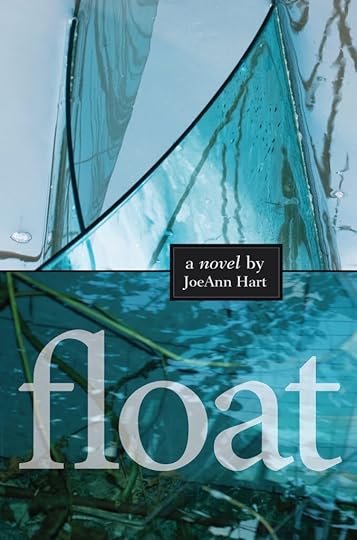
Marine research was my middle name as I wrote Float, a dark comedy about plastics in the ocean (for a book about the role of humor in climate fiction, read Aaron Sachs’ Stay Cool), and I continue to read about the sea because the Atlantic is right outside my door and rising. One of my favorites is Between the Tides by Adam Nicolson (published in the UK as The Sea is Not Made of Water). He starts off discussing tidepools then lets his thoughts drift to Viriginia Woolf, Walt Whitman, and T.S. Eliot. Fun fact: Not only do winkles have shells to protect them from predators, but the very smell of a crab in a tidepool will induce them to increase their shell thickness by 30%. I also took a deep dive into the world of jellyfish with Stung! by Lisa-Ann Gershwin, and found it informative as well as terrifying. They were the first multi-cellular animal and might well be the last.
No matter the setting or theme, animals always play a role in my fiction so I’m constantly referring to my notes from Ed Yong’s An Immense World. I read it with utter fascination, although Gene Helfman wrote the in-depth review for Ecolit. The scientific studies that Yong presents are readable as well as astounding and, as Helfman wrote, they will change how you perceive the world. This is a book about sensory perceptions and the umwelt of the non-human world. Trust me, you will never leave an outdoor light burning again. Other great science-based books on animals are Vesper Flights by Helen Macdonald (author of H is for Hawk), and The Narrow Edge by Deborah Cramer, who tracks the flyway of a migratory bird called the red knot as she wrestles with the consequences of human interaction with the natural world. A very different sort of animal book is How To Be Animal, A New History of What it Means to Be Human by Melanie Challenger, which, in these days of mass extinctions, unpacks genetics and cloning as ways to save species, not the least to save our own.
Maria Popova writes a fantastic newsletter called The Marginalian where she invites us to join her as she explores the mysteries of ourselves and the universe. She has led me to many books over the years, and she recently came out with her own, The Universe in Verse, which gorgeously weaves art and science together. Lastly, I encourage every climate fiction writer to grab a copy of The Best American Science and Nature Writing every year. I don’t often review these because each essay is usually its own little marvel. The 2025 edition, A Collection of the Year’s Most Insightful Essays on the Natural World, Climate Change, and the Wonders of Science curated by the Susan Orlean, will come out in the fall and I am prepared to be amazed.
Find out more about JoeAnn’s books Float and Arroyo Circle.
JoeAnn Hart writes about the pervasive and widespread effects of the climate crisis on the natural world and the human psyche. She is a regular reviewer of environmental fiction and non-fiction for EcoLit Books, as well as Terrain.org.
December 14, 2025
Best Spiritual Literature 2025
I am so pleased to announce that have a piece of short fiction in the newly released Best Spiritual Literature anthology from Orison Books. It is a deeply moving collection and a strong corrective for our difficult time.
To be honest, I had been a little surprised when the Dodge literary journal, where the story was first published, nominated it for the collection, and even more surprised when it was accepted. But the process has opened my eyes to the strong connection between environmental and spiritual literature, where writers of both ask the same question: What is the best way for humans to live on this Earth?
https://www.orisonbooks.com/product-p...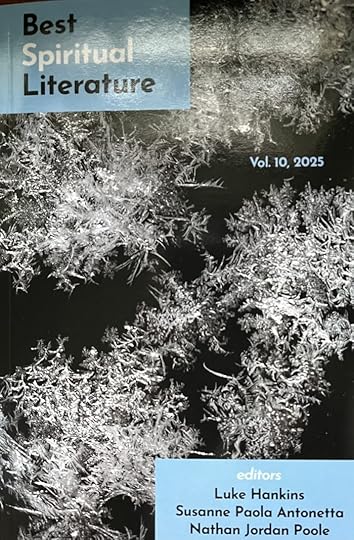
March 19, 2025
November 14, 2024
The Best Books of Horrific Fictional Floods
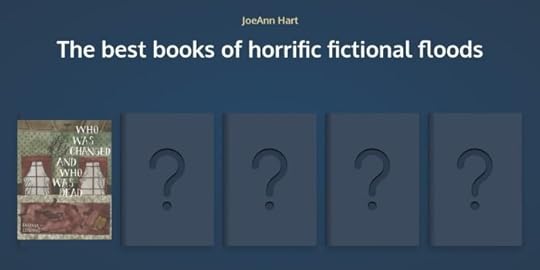
Flooded with emotions? I’ve got some great book recommendations here.
October 10, 2024
Arroyo Circle Launch with JoeAnn Hart & Maureen Aylward on video
If you missed the launch, enjoy it now!
September 16, 2024
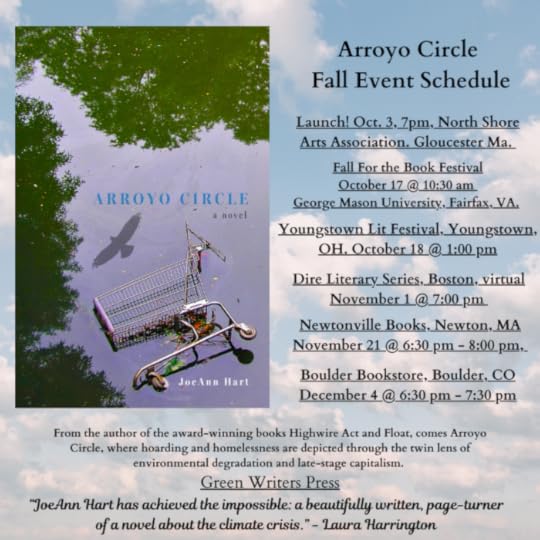
Arroyo Circle Launch October 3rd!
First Arroyo Circle event is the Launch and Conversation with TownGreen Director Maureen Aylward at the North Shore Arts Association, 11 Pirates Lane, Gloucester, Ma. 7pm.
September 6, 2024
Discounted Pre-Order for Arroyo Circle Ending Soon
Last Chance to preorder Arroyo Circle at a discount.
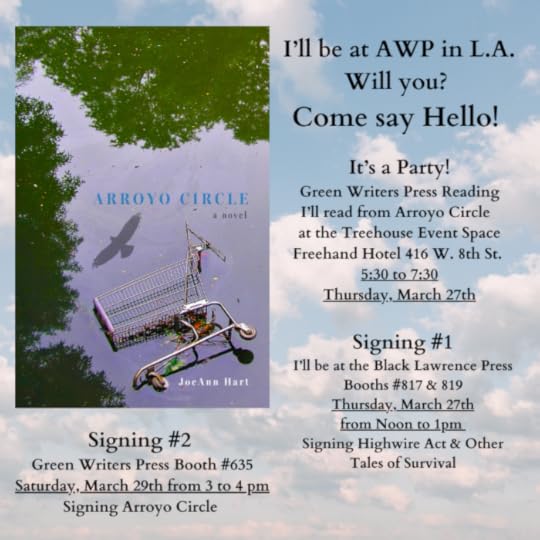
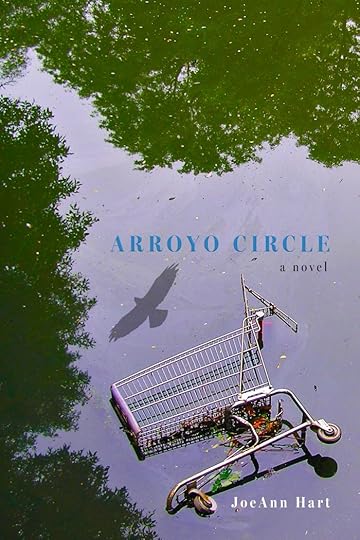
In ARROYO CIRCLE, hoarding and homelessness are depicted through the dark marriage of environmental degradation and late-stage capitalism through the lives of Shelley, a white, middle-aged handmaiden of a hoarder, and Les, an unhoused, shape-shifting scientist in Boulder, Colorado.
Release date October 1st.
August 21, 2024
Brace Cove
https://www.thecommononline.org/brace...
Dispatches, The Common Online, August 21, 2024
Gloucester, Massachusetts
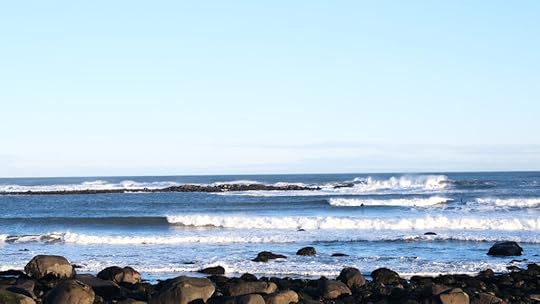
It was mid-winter, so I timed my afternoon walk to end before the early night. Heading to the beach, I crossed a sea-battered causeway that dropped off to the salty Atlantic on one side, and the fresh water of Niles Pond on the other, ending at Brace Cove. Formed by two boat-breaking arms of intertidal granite, waves were still crashing into the cove from a recent storm. Migratory seabirds struggled to fly in the crosswinds. Added to the elemental roar of water was the steady screech of stones grinding in the surf, too rough a day even for the resident seals. As I stepped down from the causeway and onto the beach, I saw a man with binoculars around his neck. He was talking on the phone and there was a large, motionless shape at his feet.
Atlantic white-sided dolphins live in temperate waters off the coast. These gregarious animals swim alongside Gloucester’s whale watch boats, leaping for joy. The dolphin’s eyes were still so alive, it was hard to believe she was dead. The high tide had left her body right below the wrack line. She was not entangled in fishing gear, and there was no obvious bruising from a boat strike. Having drifted too close to land during the storm, she must have gotten caught in the powerful churn of the incoming waves and drowned. The man put his phone away. He told me he had contacted the Seacoast Science Center who would send someone out, and then we both stood in silence. The sun hung low behind us. The dolphin’s body cast a long shadow on the sand, stretching towards the sea.
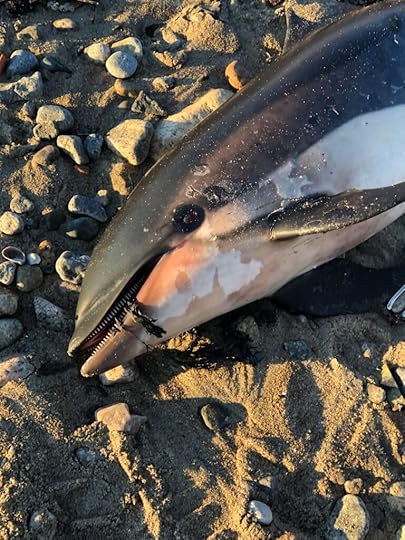
She was less than six feet from nose to tail, which is not full grown for a female. Being a mammal, she had a vulva for live birth, but was too young to have bred. The only marks on her body were shallow tooth scratches. Dolphin teeth. The tines were perfectly matched with her own, suggesting that members of her social group had tried, and failed, to save her. The marks were not curved like a bite, but straight, as if dolphins had pushed with the sides of their heads, their teeth lightly grazing her skin, trying to raise her up for air. They worked against the wild tumult of the ocean, with stones and marine debris crashing through the water around them. It was so loud. There was no light, only fear. Finally, due to echolocation, her family could see her heart stop beating, and then they had to let her go. She was swept towards an unknown shore and now laid at my feet. Grief crashed over me, even as I imagined the care that saw her to the end.
The next day, I found her farther along the beach, where the tide had pulled her out, then back in, leaving her a few dozen yards away. A stick was placed exactly parallel to her body, which meant some official was monitoring her movement. The date of her death was written in pink oily chalk on the black expanse of her skin. Her body was now her gravestone. She was still perfect except for this, but the next day there were signs of blood pooling in her carcass, staining her white streaks purple. A length of seaweed was caught in her mouth. Every day, for three days, she moved up the beach with the tides, the stick carefully replaced each time she came to rest. There was more pooled blood, but no signs of desecration. Coyotes and other scavengers left her alone.
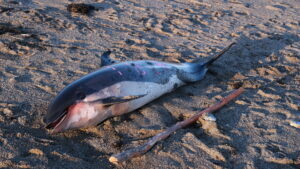 And then she was gone. She had reached the curved tip of the beach where a seawall prevented a landing, and when the tide let out, she went with it for the last time. Home. I watched the distant horizon for some time. Gulls cried at one another as they tumbled through the air, then settled on the water like sitting hens, drifting on the swell. Night was coming, but while daylight lasted, seals hauled themselves up on the exposed rocks to luxuriate in the winter sun.
JoeAnn Hart is the author of Arroyo Circle, a novel of reclamation in a time of loss, to be published by Green Writers Press in October 2024. Her other work includes the fiction collection Highwire Act & Other Tales of Survival, the memoir Stamford ’76, and the novels Float and Addled. Her writing explores the relationship between humans, their environments, and the more-than-human world.