Jared Tendler's Blog
April 22, 2026
Golf is Not 90% Mental

The old adage that golf is 90% mental is wrong. Thinking this way is like still playing with hickory shafts or a balata ball. The game evolves. So does our understanding of the mental game. It’s important, but it can’t possibly be the most important element in a physical game like golf. Psychology alone can’t turn a 20-handicap into a scratch player.
Golf isn’t 90% mental, but your worst golf is 90% mental.
That’s why this change in perspective is so important to player improvement. Too often golf psychology has been filled with empty platitudes that sound good in theory, but now you can use it specifically to raise the worst parts of your game.
Check out my article for Golf Magazine and let’s change how we view the importance of the mental game in golf. Please share it with your friends – I’d love to see this become one of the popular articles on Golf.com.
The post Golf is Not 90% Mental appeared first on Jared Tendler.


April 14, 2026
New Book: Everyday Golf Psychology
 I’m excited to announce that my latest book, Everyday Golf Psychology, will be available April 21st! Three years in the making and I couldn’t be happier with how it turned out.
Among many topics, Everyday Golf Psychology gives the advice I needed 30 years ago when I choked trying to qualify for the U.S. Open – I missed four short putts and a playoff by one shot in local qualifying. This failure, and my subsequent inability to find answers from traditional golf psychology, derailed my professional golf aspirations, but drove me to build a better mouse trap and into my career as a mental game coach.
It’s hard to express how much it means to me that I can now offer something meaningful to the game of golf and to your game specifically. This is a full circle moment that took me to places I could have never imagined.
Diving into industries like poker, trading, and esports, where I had little direct experience, allowed me to strengthen my system in a myriad of ways. Free from pre-conceptions, unburdened by personal experience, and challenged by the demand of helping the best in the world, I had to constantly step up my game.
It forced me to communicate concepts and perspectives clearly enough that clients and readers could produce transformative results, not just apply band-aids. Each iteration deepened my knowledge, and simplified the process.
As Albert Einstein once said, “You don’t really understand something until you can explain it to your grandmother.” Well, my grandmother was a club champion and single digit handicap, and though she’s long since passed, with this book I think I succeeded in following Einstein’s words.
“Faults and Fixes”
As a kid I remember reading Golf Digest and poring over one of my favorite sections, “Faults and Fixes,” which provided advice on the technical side of the game. Slicing too much? Having trouble getting out of the bunker? Want to control trajectory? This monthly section had the answers.
Everyday Golf Psychology was written in that same spirit of problem-solving. It’s aimed at correcting the most common problems plaguing golfers today and, like my poker and trading books, is full of clear, actionable advice. You’re not learning about psychology for the sake of it, or in broad generalities. What you learn helps you correct the mistakes costing you shots and many of these problems affect golfers at every level of the game.
While tour pros have solved a lot of their ills, even they aren’t immune and face similar issues that you do, like battling negativity, succumbing to pressure, losing confidence, overreacting to bad luck, and hitting uncommitted shots.
I know there are a lot of other golf psychology books. Those who know my work are probably surprised the title is not The Mental Game of Golf – crazily enough, there are already four books with a version of that title. Mine was not going to be the fifth.
I also wouldn’t write a book unless I thought it offered something unique. That’s why I waited so long to take this on. The book is not a rehash of existing material. It goes beyond conventional wisdom and offers a fresh take on what’s required to produce results that are stable and lasting.
It challenges long-held conventions on the game, including the idea that golf is 90% mental … It’s not and it’s not even close. I discuss this in the opening chapter and you can download it here for free.
Psychology of course matters, but how to use it effectively is often misunderstood. While the game isn’t 90% mental, the difference between your best and worst rounds is much more about mentality, not swing.
This book narrows the gap between your best and worse, allowing you to thrive under pressure, build lasting confidence, take your game from the range to the course, and focus less on score and swing. Take a look at the Table of Contents and you’ll see the common problems I take on – they’re the ones causing too many ups and downs in your performance.
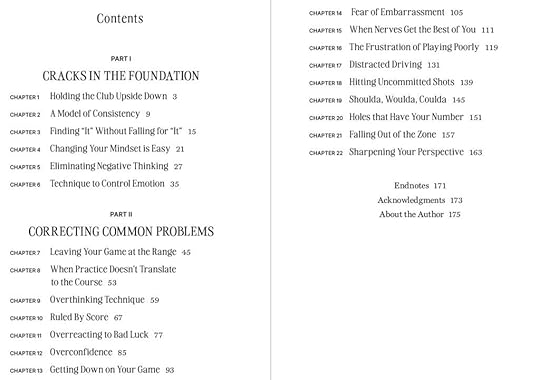
What I’ve created is not burdensome or meant to feel like work. It fits in how you already approach the game – whether you frequently practice or just go play when you can, the book helps you rethink your psychology, so you can stop making costly mistakes and enjoy the game more. Plus, it’s a resource you can use time and again as you take your golf game to higher levels.
Golf has been an important part of my life for nearly 40 years. I’ve poured my heart into this book and am excited to finally share it with you.
You can pre-order from me directly to get a signed copy. Or, on April 21st, you can pick up a hardcover, softcover, ebook, or audiobook wherever you typically get books.
The post New Book: Everyday Golf Psychology appeared first on Jared Tendler.
March 9, 2026
Risky Business
Risk is everywhere. From leisure activities, like renting a paddleboard, skydiving, or taking your kids to a trampoline park, to driving a car, opening a retail store, or eating food from a sketchy restaurant.
Often these risks exist in the background. We sign waivers without looking closely, and accept that sometimes shit does happen.
But you’ve made risk your business.
In trading, poker, and golf, risk is built into the fabric of your decision making. No risk, no reward. You know this and yet there are times where an aversion to risk alters your strategy and undermines your potential.
You’ll see traders make mistakes like not letting a winner run to avoid the risk of it going against them, not building a bigger position when they have a lot of conviction because they fear it will blow up again, or avoiding a trade with a slightly higher risk/reward because it seems like a gamble. As you’ve learned already, mistakes like these are really signals.
Poker players know this feeling when they fold strong hands in high variance spots, rather than playing to win. Big moments create a lot of tension and pressure to get it right. Attempting to protect yourself from losing money, you can save yourself temporarily but cost you in the end. While you’ve preserved your stack, being aware of backing down can cause you to overreact and play more aggressively, or internally tilt for making a clear mistake.
Golfers experience it when playing too conservatively–playing too far away from trouble that might get them into trouble of another sort, or doesn’t provide the opportunity to improve or lower scores in the long-term. You may struggle to trust a change in your swing to avoid the risk of embarrassing yourself or posting big numbers. Both prevent you from gaining the reps you need on the golf course to cement the change.
Remember, you’ve already determined a strategy that accounts for the level of risk that fits your temperament and situation. Risk aversion goes against that and reduces your chance for profit and success, while increasing turmoil and chaos, widening the gap between your potential and your results.
The Function of Risk Aversion
The Spitball examples I’ll go through all come from struggling traders, but poker players and golfers will feel some sense of shared experience. While performance environments vary, the general reasoning for why this exists is common.
To make progress, you need to understand the function that risk aversion serves: protection. What are you protecting yourself from? What are you trying to avoid? Let’s take a look at a few examples to examine this more.
Scenario 1: I have a good profitable strategy, I have been forward testing it every day for over a year between the London and NY sessions. But when it comes time to execute a trade, I don’t, I always look for excuses in my head “what if” (it comes to another zone, etc.) even though I know it fits the plan. I don’t take trades and it’s killing me in the head.
My sense here is you are trying to avoid the pain of underperforming and feeling like you wasted your time. Logically you know that this strategy is ready for the live market, but you’re unwilling to take the chance that it could fail.
By protecting from the risk of failing you’re also protecting yourself from the opportunity to succeed. The long-term risk of not executing your strategy is far greater, assuring you fail long-term.
Or, you choose to take the risk at the expense of learning more about how your strategy needs to evolve, facing hardship and the challenge to upgrade it. Short-term pain, but it gives you the option for long-term success.
You can play out the “What If’s.” All the excuses in your mind reflect areas of uncertainty. Risk aversion, anxiety, fear, all prey upon uncertainty. By actually answering the question “what if I trade this setup and it loses?” you begin to create certainty–in the strategy, in your risk management and sizing, in yourself in being able to understand and handle the situation.
Creating certainty around these questions will reinforce the strength of your strategy or might lead to small adaptations. Either way, you’ll better trust what you built. This won’t immediately take away your anxiety and fear. Use it as a form of Injecting Logic to help your mind find the stability to act in alignment with your strategy.
Scenario 2: I have always struggled with hesitation in stock trading and it eats at me. I size super low and even then I still hesitate. I think for me it’s a combination of fear of loss, fear of being wrong and I think I’m trying to avoid the feeling of pain from being wrong or losing money. I have been doing this for about a year now and I still struggle with the problem massively and I have no idea what to do here. It holds me back so much. The amount of trades that have gone without me is absolutely insane. I have tracked everything I have hesitated to take and I would be profitable if hesitation didn’t hold me back.
The persistent in-the-moment hesitation, despite scaling down and reducing capital risk, hasn’t moved the needle much, which tells me you are dealing with something deeper. My suspicion is that you are dealing with some perfectionism, knowing how much you could have made from perfect trading is evidence, plus it makes the pressure worse.
The advice from Scenario 1 is probably insufficient because the flavor of risk aversion has wider significance. Your expectations and desire for control are more intense. You may be bringing some personal issues to this endeavor, perhaps some built-up self-criticism, resentment, and accumulation of emotion that leads to lack of confidence in your strategy or yourself.
If you don’t have confidence in yourself, how can you believe in something you’ve defined or created? That lack of confidence taints the whole strategy and makes it feel less reliable, and thus riskier.
You can chip away at this problem by taking a “suck less” mentality, but it’s going to be a real-time battle until you start to gain clarity on the deeper flaws or issues you’re facing and have made some progress.
Look at the next 2-3 months as a trial. Take monetary results out of the picture and use it as a chance to learn and grow on the mental, emotional, and technical sides. Develop your strategy more. You would never go to a doctor who only completed one year of medical school. It’s ok to be an infant, but maybe you are trying to run before you crawl.
*********
In a vacuum, evading risk isn’t wrong and at times will work out in your favor–the stock tanked right after exiting, your opponent had the nuts, you missed the ball on the green. But playing it overly safe to avoid bad outcomes means you’re guaranteed to underperform in the long- term.
If you’d like my blog delivered right to your inbox, click here to be added to the list.
The post Risky Business appeared first on Jared Tendler.
February 9, 2026
Boom & Bust

Boom or bust. Feast or famine.
If you deal with extreme ups and downs in your performance, you know exactly what this feels like.
You’ll have stretches where everything clicks—strong results, confidence high, execution sharp—followed by bewildering crashes that seem to erase all progress. One month you’re a golfer whose handicap drops from 10 to 7. Then inexplicably you’re struggling just to break 90.
In trading, you have streaks where you’re either crushing the market for weeks or steadily making solid gains for weeks, feeling in sync, stacking profits, envisioning future glory, only to watch it all evaporate in an inferno of overtrading, revenge and greed.
In poker, it feels like all the work put into your game has paid off, you’re locked in, making great reads, building your bankroll, constantly going deep in tournaments, then one day it all starts to disappear, you tilt and give away heaps in soft game, and you struggle to get you rhythm back and steadily bleed each session, unable to stop the slide.
The shared characteristic of these boom and bust cycles isn’t just poor results; it’s the inability to stop the cycle of emotional chaos that paralyzes progress.
Eventually this can lead to lower motivation–why keep picking yourself up again when you’ll end up back at square one?
Breaking out of this cycle is hard because there are multiple moving pieces and the first one is often the least well known: overconfidence.
During the boom phase, when things are going well, overconfidence quietly builds. Execution starts to slip, but it’s not obvious and goes unpunished. This is especially true in poker and trading where variance can bail you out. You play a marginal hand poorly but still win. You hold a winner longer than usual and the market moves your way—rewarding the extra risk.
Your success goes unpunished.
Golfers can get lucky too. The hero shot out of the trees finds the green, not the water. Escaping calamity provides a confidence boost, not a reality check.
At some point, however, the bubble bursts. Small gambles don’t pay off, variance inevitably turns, things start to become a struggle. You force, trying to make something happen. Process and execution degrades further as the self-inflicted mistakes make things worse.
As the bust phase accelerates, emotions hijack technique, strategy, and reason. You look for results–money, wins, great shots–to find stability. But your mind and emotions are too far gone. Anger, revenge, hope, wishing, loss of confidence, the f*ck it’s all converge and force you to make decisions that you know aren’t correct, but can’t stop.
You might even start procrastinating, not working as hard as you should, losing interest, looking for the reset to snap you out. Others will do the opposite, voraciously consuming content searching for an answer: backtesting and studying charts in trading, working with solvers and reviewing videos in poker, or endlessly hitting balls on the driving range in golf.
It’s always better to look for a solution than simply escape. Sure a break can be welcome opportunity to come back refreshed enough to find your groove again…but nothing changed. You just dumped the emotion out of your mind, like emptying a bucket catching leaky water. You’ll be back in the chaos again once the cycle resumes.
Overworking yourself isn’t the answer either. No, you can’t just out work this problem by studying more, improving your discipline, or fixing your swing. The problem isn’t technical and mostly comes from your mental game. So if you’re going to work hard, work on the right part of the problem.
The deeper issue includes a faulty desire to go back. In the depths of the bust phase, you’re desperately trying to get back to the top.
You don’t want that.
The top, at least how you’ve experienced it in the past, is too fragile and lacks the integrity to prevent the crash.
You don’t want to go back to that.
You want to build something new. You want to build a stronger foundation to your mental game. One that doesn’t allow your performance to crash…or get too high.
Breaking the Cycle
To truly break the cycle, you need to isolate each piece of it and understand the lifecycle.
Chronologically, overconfidence is generally where the problem starts. Spotting the early signs of overconfidence is critical. For some of you, this alone can significantly change the cycle. Minimize the high and you’ll reduce the crash.
Take a look at this blog on Overconfidence to help you recognize signals that often go unnoticed.
Curbing your overconfidence can be tough–for one, you might deny your overconfident because you’re overconfident. As one client described it, his mind felt like it had a glaze on it, blunting the seriousness of any transgression. That can be tough to crack. Sometimes briefly stepping away when things are going great, is a helpful way to spot the overconfidence, correct it, and get your mind back on solid ground.
The bust cycle is chaotic, but presents clear opportunities to learn the truth about your C-game.
C-game has the power to pull you down to its weakest point. You’re not going to fix your weak points until you understand them. In the midst of emotional chaos, take a lot of notes detailing what you’re experiencing.
Rather than trying to get your best back, figure out what’s causing your worst. That’s how you’ll start to minimize the down cycle, now, and next time around.
You might even find that your current C-game is already stronger than it was. While this most recent bust was bad, it’s less bad than before—less of the f*ck its, better risk management, less hope, more control.
Think back to previous cycles and periods in your career. Compare your current C-game to your previous C-game. Are things as bad as they were? Odds are no. So how’d you do it?
Did taking time off help? Reading stories from traders, poker players or golfers about their struggles? Was it doing certain types of studying or work? Understanding why something works will help you use it as a tactic, not just a last resort.
Keep in mind that you will have to go through a full cycle to have any evidence of real progress. Overconfidence sneaks in when you are doing well and you forget you have to fix this stuff—you think because you have improved, it’s all solved. Don’t fall into that trap.
Your inchworm will continue to progress. There are always going to be periods of advancement. When things slide downward, your job is to suck less and build your C-game and B-game back stronger than they are today.
Build a stronger foundation for the next upward cycle.
Recognize details and have corrections for each piece of it – then apply them regularly and consistently.
Cycles will continue. Ups and downs are part of growth. Minimize the severity of downside and you’ll build a foundation that will sustain a bigger upside.
If you’d like my blog delivered right to your inbox, click here to be added to the list.
The post Boom & Bust appeared first on Jared Tendler.
January 5, 2026
Everything Gets Easier When Your Goals are Right

I talk a lot about goals, particularly around this time of year as we set our sights on the opportunities before us.
I talk a lot about goals because they’re fundamental to developing your mental game into an asset that helps drive your success. Like any other key area of the mental game, flaws or weaknesses cause a variety of problems.
If you’ve struggled to find consistent motivation, deep focus, strong discipline, or you procrastinate, succumb to impulses, and are too results-oriented (all common issues I work on with clients regularly) the answers might come from constructing clearer goals.
Clients never arrive on my virtual doorstep saying they have a problem with their goals. Yet many of them do.
If you’re underperforming, unable to sustain the focus you know you need, constantly breaking rules that you set for yourself, forgetting key elements of your routine or strategy, overrun by the deluge of dopamine-stimulating temptations, or other discipline related problems, better goals could be the answer.
Goals provide direction for your motivation. There’s lots of things we want and need – our goals harness the energy, drive, and passion to go and get it. Motivation fractures when your goals are unclear or conflict. Once fractured, you lack the kind of concentrated energy needed to achieve the goals you have set for yourself in poker, trading, or golf.
While motivation is the boss, focus does the dirty work. It’s in the trenches gathering the specific info you need to achieve your goals. When you lack clarity in your goals, it’s much easier to lack focus and have your mind drift in different directions. Focus doesn’t know exactly what the boss wants. We often refer to this as being distracted, but that term hides the truth – you are focused, just not in the direction that you truly want.
The proverbial muscle of the mind is discipline. Like a muscle, it’s either getting stronger or weaker. You’re either getting stronger in the way you want – to have the strength to hold your focus and motivation in the right place for long periods of time – or you’re getting weaker, more undisciplined, and less capable of getting what you want.
If you believe that you can wait until tomorrow to work towards your goals, that’s procrastination. Unfortunately, all you’re really doing is getting better at delaying what’s necessary and waiting for motivation to come easily. It’s easier to be motivated when you’ve delayed enough to produce a time crunch, amping up the stress and pressure. Performance endeavors like poker, trading, and golf require you to develop hardened skills for success. You can’t cram at the last minute like a student prepping for a test.
Lastly, there is an intimate relationship between process, execution, and results. When you’re overly results-oriented, motivation and focus on results, as if that’s how you get results. Instead, strengthen the emphasis on process and execution as the means to get the results you’re after. Re-training doesn’t happen instantly, your abilities develop over time.
Goals in Action
Here’s a great example, from one of the readers of the blog, who’s struggling in the areas related to this topic and I’ll spitball my thoughts on what’s going on and what to do:
“I fell in love with trading around 2 years ago, wasted 1 year and truly started learning this year. What I realized is that it’s more difficult and takes more time than I expected. It’s also difficult at home with my entire family to focus, the distractions with social media have never been worse than today. I keep finding myself wasting this valuable time, an opportunity many would dream of. Do you have any advice that could help me to stick to my goal of becoming a disciplined trader?”
The sentence that jumped out at me most was the realization that trading was more difficult than this new trader thought it would be. Difficulty is a test of motivation. When something is new and exciting, it’s easy to do what’s necessary to improve and make progress. Once progress gets harder, or if results don’t come as expected, difficulty can become an excuse to allow your focus to drift – which, unfortunately, is when you need that focus the most!
My guess is that the distractions of family were there six months ago, but only became a more obvious problem once trading got harder, and perhaps you lost a bit of hope that success could come quickly.
The first thing to examine is your “Why” – why do you want to become a successful trader? Why do you care so much? Why do you want it so much that you’re willing to put in the time and energy to become sufficiently disciplined?
I assume that your Why initially included making easy money. Now, you see that your why needs to extend beyond just money and include things like, developing better focus and discipline – skills that can aid you not just in trading but elsewhere in life, as I talked about in last month’s blog.
Practically speaking, distractions from having family around while trading from home can be hard. Family matters. You don’t want to shut them out. However, you need to find a practical way to deeply focus when trading. Have a dedicated space to trade. Be sure the people around you value the time you’re dedicating to trading. Learn how to toggle back and forth from trading and family, each time getting back into a “bubble” where trading is once again your only focus. Yes, this is a skill in itself.
The seduction of social media is understandable. It offers quick, easy hits of novelty and entertainment. But why are you choosing to use your time and energy on it vs. what’s needed to improve as a trader? I’d bet that part of it is an escape from the difficulty you’ve encountered in trading.
It all comes back to what you really want and why.
Becoming disciplined is about making better choices about how to allocate your energy and focus. You’re not yet skilled or strong enough yet. That’s ok! The only way to make progress is by starting with an honest appraisal of where you are at right now
I’m not suggesting this capacity has to be developed overnight. It takes time to develop mental toughness and strength. Put in the time and energy over the next 6-9 months, make significant progress, and move onto the next stage of your development.
More Resources
Strong goals should properly reflect what you truly want. Ensure you have a deep, well-crafted reason for your “why” behind the goals that’s not just temporarily inspiring but drives consistent energy – the type needed to navigate ups and downs.
Keep in mind that weaknesses in your goals or conflicting goals will not always be obvious. For instance, you may be intellectually committed to the idea of working on process and execution, but deep down you want results now.
Conflicting motivation like that disrupts your ability to stay the course, consistently perform, and work the process the right way. For more direction and motivation for goal-setting, refer back to this January 2025 blog as a general resource on goal-setting.
This is a great time of year to set out strong, meaningful goals. Then go after them with consistent drive to navigate the ups and downs and reach your end goal for the year.
If you’d like my blog delivered right to your inbox, click here to be added to the list.
The post Everything Gets Easier When Your Goals are Right appeared first on Jared Tendler.
December 8, 2025
Soft Skills to Hard Assets

Achieving your goals, aspirations, and dreams can be challenging. You may reach a point where you start to wonder if the large amount of time and energy you’re investing into trading, poker, or golf is worth it. The path has not been as easy as you had hoped and, if you’re not yet hitting the levels of success and profitability you want, you may question the value of continuing.
The purpose of this blog is not to help you make a decision whether or not to continue. Frankly, there’s value in this blog even if you’re just starting out or already successful, because I want to challenge you to see the situation differently.
It’s easy to get swept up in the idea that it’s only worth spending so much time if you “realize your potential” and have monetary success, or the success you envision.
However, when you reach a stage where the game gets harder, an opportunity emerges that often goes unnoticed and can guarantee that your time will, to some degree, have been worth it – regardless of what you achieve. Knowing that your efforts will not have been wasted can reduce a lot of strain at a point when you could use a lighter load.
The general idea of personal improvement can be large, hard to define, and the feedback loop is quite long. One of the reasons I love working in these performance areas is they give you a contained learning environment, where you get clearer feedback than you often do in everyday life, or in your personal life.
If, for instance, you want to be a better partner, you might only have 3-4 arguments a year where your learnings will be put to the test, whereas in poker, trading, or golf, you’re tested every time you enter the arena – you’re constantly given the chance to build skill.
When trading, poker, or golf get hard, use it to cross-train for improvement in other areas of your life. If you’re struggling in multiple ways, this perspective can give you a bit of light in the darkness – a way of seeing the potential benefits more broadly and beyond what’s right in front of you.
By strengthening critical skills, gaining experience, and developing knowledge, you can bring them to other aspects of your life. I often hear from clients who talk about how working on their mental game has helped them deal with their emotions better, improve their relationships, deepen their love for hobbies, become better parents, and more.
Yes, your primary focus is success in your chosen arena, but you can have both without expending much extra effort. Here are a few examples:
Work Ethic: This is the most challenging thing you’ve faced. Whether or not you’ve had a strong work ethic before, you’ll become stronger at persevering, staying consistent, and doing the necessary work.Improve Learning: Learning is at the heart of improvement. If you can be more efficient in learning, you’ll be more efficient in developing your skills and raising up your performance. Identify & Resolve Emotions: Emotional awareness, analysis, control, and resolution are key skills in any endeavor. Developing the ability to work through and correct the issues affecting you, gives you a leg up.Dissect & Analyze Problems: Finding the root cause of your emotions trains you to solve any technical problem from this perspective, giving you a sustainable foundation of growth.Understand Luck/Variance: People typically underestimate the role of variance in business and life. Having a clearer picture of it helps you understand what you control and what you can’t, which stabilizes confidence.
Effectively, what are often defined as soft skills become hard assets you can leverage beyond poker, trading, or golf. These are just a few examples of the many that you can develop.
This is especially helpful for those of you who may have taken a break from a more traditional work environment to build your trading or poker career and worry about holes in your resume. Being able to more clearly define these independent skills can make you better at “selling” that experience if you were to need to get a new job. Want to convince someone else that the time spent was valuable? First, prove it to yourself.
At the end of the day, when you have a guarantee like this, when you see the bigger picture beyond the tangible results – the money, the lower handicap – you’ll deepen the value you derive from your effort whether you succeed or fail in reaching your goals.
Plus, removing this layer of anxiety, stress, or pressure, can make your emotions more stable, leading to more consistent performance and the tangible results you are chasing. This could be the shift you need to help you breakthrough and reach the level of success you envision.
And, if you get to be a better person and have more success elsewhere, you can truly have your cake and eat it too!
If you’d like my blog delivered right to your inbox, click here to be added to the list.
The post Soft Skills to Hard Assets appeared first on Jared Tendler.
November 10, 2025
Hating to Lose
I introduced a recurring segment in the blog back in September called “Your Pitfall – I Spitball”, where I dissect and hypothesize reader-submitted concerns to help you better analyze yours.
Let’s jump into this month’s scenarios, which are tied to the issue of hating to lose – a problem that’s rarely just about losing, but about how your severe reaction to losing ends up costing you more.
Scenario #1:
“It is quite common that after 2-3 profitable trades, a losing trade and the market starts moving sideways, I can’t walk away, and try to trade further, and usually end up with a big loss. In retrospect, it is understandable that the market movement is not tradable, but I can’t get away from the computer in time.”
The first question to ask here is what emotion is paralyzing this trader. Since they didn’t list it I wonder if they’re aware, or if they’re just aware of the consequences. I also wonder if they lack the real-time skill to recognize whether market conditions aren’t right – that’s easy after the fact, but is it beforehand? Or do they have that skill, but the emotion impairs judgment so much that they just care about making up for the loss?
We don’t have a lot of information about what is happening, but here are a few things that I suspect. First, hating to lose may not be the most consequential part of the problem – they might have difficulty walking away from trading in general, whether winning or losing – an action junkie who loves the intensity of the markets and regularly gets too swept up to pull themselves away.
This isn’t the worst problem to have if they put firm risk management controls in place about the number of trades/day, or a daily loss-limit, and the market provides plenty of opportunities. On profitable days they may take more losses than ideal and might force trades with lower probability, but the sum total is not that costly. But when the market stops providing opportunity and that intensity overrides their ability to be in control on days like the one described above, losses mount.
It’s also possible that losing is the most consequential element. Perhaps this trader expects to win, or gets too attached to their high water mark of the day, not wanting to ever drop below it. Maybe they want control over their daily results, and losing at a time when the market is slow triggers a need to force trades and make something happen.
Or, confidence could be too closely connected to PnL, and they hate losing after being up because they rapidly swing from feeling confident about the day to losing those good vibes.
Overconfidence, however, could also be a culprit. When they’re winning, it’s easy to become overconfident and expect the following trades to pay off. When the opposite happens, the loss causes a classic overreaction – the bubble bursts and they force trades to get a quick win and recapture that overconfident state of mind.
I’ve brainstormed a handful of reasons they’re struggling, but ultimately, they need to nail down what’s happening for them. I suggest completing a Mental Hand History (MHH) to clearly understand what’s at the core of this problem. Maybe one of my ideas nails it, and if not, I suggest using The Mental Game of Trading to come up with a clear correction to use and aggressively apply in moments when intensity, overconfidence, or anger around losing rises up and could impair execution.
The next scenario is from a trader who has already worked on their mental game, but is still struggling.
Scenario #2:
“I’m a day trader and my problem is revenge trading when I tilt. I’ve mapped out my emotions, done my mental hand history analysis and identified the root cause of my problem. I set a timeline (sub- consciously) to achieve a certain profit target which leads to flaws like expecting to make profits trading everyday. When I make a loss or two I easily tilt and start to look for revenge trades. I found out it’s because a losing trade feels like a step back or loss of time towards achieving my goal. I’ve tried a lot of different things the past 4 months but none seems to work.”
When working my system, how well you are able to identify the root flaw is critical. This can be one of the hardest things to do on your own. If you’ve done a lot of work, and there’s a lack of progress or the problem remains unresolved, it’s likely the root cause hasn’t been nailed down yet.
My take: This trader is expecting to profit from trading every day and is frustrated to not have made a more significant dent in their aspirations. Given the work they’ve already done, I’m going to suggest that their definition of progress is too narrow – defined by PnL – and they lack the ability, or enough skill, to qualitatively determine how they’re performing in a non-PnL way day-to-day.
One reason I suspect this is that they consider a losing trade a step backwards. Losing a trade with a good process can’t be defined as a step backward. Realistically, making money with bad process would be a step backwards – I imagine that logically they understand this, but, deep down, making money, regardless of execution quality, would be viewed as a step forward.
Yes, money is the scoreboard in trading, but it is not reliable for measuring performance in the short-term. Think about trading like a basketball game. One trade is akin to a pass or one shot in a game. Sure it’s not fun to miss a shot or throw a bad pass, but you wouldn’t view either as a step backwards, or a loss of time. It’s just too short of a timeframe to evaluate performance. Imagine if a basketball player sought revenge after one bad shot.
To shift out of the focus on daily PnL, this trader should instead be looking at PnL over a larger timeframe, like three to six months – this is effectively how long it can take for a trader to effectively play one basketball game.
In the near term, you need a clearer way of evaluating performance to recognize days when you’re taking losses but are still performing well, and controlling what you can control. The A-to-C-game analysis is the primary tool for this work. You can download a template of the A to C-game Analysis here. And to see an upgraded way of treating this problem vs. just what is covered in The Mental Game of Trading, you can also check out this video from a seminar I gave on this topic.
The last thing to consider here is finding the root flaw and thinking you are done. Getting to the root is a critical step but you also need to apply the correction daily to truly make a change.
Hopefully all of you have found value in this blog, and if you’d like me to spotlight one of your pitfalls, fill out this brief survey.
If you’d like my blog delivered right to your inbox, click here to be added to the list.
The post Hating to Lose appeared first on Jared Tendler.
October 6, 2025
Breaking Bad Habits

Some parts of your mental game work require a change in habits. The most basic being the need to break how you even engage with the mental game. In my experience a lot of people want to fix their mental game without actually spending time actively trying to improve it. And that won’t work.
Of course, there are many other bad habits you could have – such as skipping aspects of pre and post-routines, or missing them entirely, sloppiness in execution, or allowing distractions to reduce focus.
The list is too long to attempt to be comprehensive…but you already know your own bad habits. They are the firm aspects of your C-game and you have plenty of evidence to know that they are not serving your best interests and stand in the way of you achieving your goals.
Whenever correcting bad habits, it’s important to first distinguish between whether they’re caused by a discipline issue or an emotional problem.
Emotional problems are not bad habits to re-train. In fact, if you treat them like a discipline issue and attempt to correct them using tactics designed to improve discipline, you’ll make things even worse!
Correcting a discipline issue requires that you push yourself to build mental strength and endurance around a bad habit – but around an emotional problem, that will create a pressure cooker-like effect. Rather than correcting your emotional reaction, you suppress it and then intensify it so much that your mind will eventually be overwhelmed. The dam breaks and your mind is flooded with more emotion than you can handle and significant mistakes, losses, and setbacks can ensue.
That’s why it is so important, when analyzing your C-game, to distinguish bad habits that are firmly being caused by emotion. Emotional problems require deeper analysis to identify the root cause, something you can work through using the Mental Hand History (MHH).
After you’ve made progress with your emotional reactions you might find that while you don’t react with the same fear, frustration, or euphoria as you did before, some bad habits remain. Here you’ve cleaned up the reaction but haven’t trained the correct action – like staying in a trade longer, folding a hand on the river when you know you’re beat, or being clear on the exact shot you want to hit on a tough hole.
While the emotional downsides of those situations may be diffused, the habits still need to be broken.
Or it’s possible your bad habits are firm discipline issues, like impatience, procrastination, distractibility – that led you to develop habits which may not have been costly at earlier points in your career, but are now.
“We don’t rise to the level of our expectations, we fall to the level of our training.” ― Archilochus
With these habits, there have likely been times when you’ve broken out of them for a bit. A common short-term motivation is New Year’s Resolutions.
That time of year many people rely on the inspiration of a new year to avoid succumbing to the ills that plagued them the prior year. But this is a temporary fix. The magic of the new year may seem like it washes away your sins, but when momentum fades the old rhythms reemerge.
Unfortunately, bad habits truly do die hard.
How to Break Bad Habits
The MHH is a tool I recommend to analyze emotional issues tripping you up. When you’re trying to leave bad habits behind, the MHH takes a slightly different shape but with the same fundamental framework. You go through a series of steps to make progress.
Sometimes bad habits are only defined as “bad” because you are in the middle of improving. Those very habits might have once represented your A-game. They aren’t necessarily wrong, they’re simply outdated. And now that your A-game has evolved, they hold you back.
To truly break them requires identifying why they served you in the past and identifying the logic that supports that analysis. Next is evaluating why that logic is flawed in context of what you now understand.
Sometimes you know what the correction is. You have a process. Your A- and B-game don’t include these mistakes, so the answer could be as simple as being better prepared and having corrections in place more firmly. You might need to get tougher, and have more command, conviction, and desire to fix it. Find a way to Suck Less.
Or maybe you have been a little lazy, simply hoping it would go away.
Hope doesn’t cut it. You need to be actively working on it and be diligently focused on reaching Unconscious Competence. As long as you are still in the earlier stages of training, or re-training, a habit, you’re vulnerable to distinct steps backwards.
If you feel like you’re doing that and still getting tripped up, there may be some elements you’re not firmly understanding or in control of. At that point, revisit the MHH for underlying emotional causes.
Lastly, you might also check out Atomic Habits by James Clear, which is a book both I and many of my clients have enjoyed.
If you’d like my blog delivered right to your inbox, click here to be added to the list.
The post Breaking Bad Habits appeared first on Jared Tendler.
September 8, 2025
Urge to Make it Happen Now
A couple months ago I asked readers of my blog to submit questions/situations for me to review – providing us with a different style of content from my usual writing which I’m calling “Your Pitfall, I Spitball.” I got a lot of great responses and have selected two that share a similar theme.
My intent is not just to provide advice, I want to use real problems as a way to also help you understand how I dissect them so you can further develop this skill.
Before we dive in, two bits of context. The first question that always goes through my mind is: Why does this person feel that way, or why are they struggling in this situation? There’s no randomness when it comes to performance, or performance problems. Sure our results can be random – but not our performance. Many of you often don’t know what’s causing the variation that exists in your performance, but that info is essential, and that’s why it’s the first thing I consider.
Second, we’re also going to examine both what’s included in the question/problem and hypothesize what’s missing…often what’s missing is the most relevant. During my client sessions, I ask a lot of follow up questions to help tease the details out. Here I brainstorm a few possibilities that often appear around these problems, such as balancing emotional stress, family pressure, and real-world chaos.
Let’s dive into two scenarios that are both about wanting to make something happen quickly. When you “have” to make money, you often trade worse.
Q1: “I struggle greatly with sizing correctly. I feel like the amount of money I am ready to risk is not sufficient enough to make any significant amount of money, and keep sizing bigger than I am mentally ready to, which keeps adding more emotions to my trades and makes proper execution extremely difficult.”
Q2: “Most of the time I run into trouble now is due to wanting to be rich within my “window “. Oversizing, not honoring stops, etc. is usually because I want to pass my evaluation TODAY or get to payout NOW. But the market doesn’t care about MY (arbitrary) deadlines. I’ve done better with my perspective recently but think you can really hammer it home.”
I’ll start with Q1, which is less severe. In the recent Ask Better Questions blog I talked about the importance of asking the right question to elicit information that helps get to the bottom of an issue so you can start addressing it more quickly. My first questions are:
How long have they been trading?Why is this person adding so much emotional intensity to their trading that they are steamrolling any ability to trade their system the way they are supposed to?Why is money such a huge driver for them at this point in their trader career?The reason it’s important to understand how long this person has been trading is because my advice for this issue would be very different for a veteran trader who has been at it for more than 10 years vs. a relative newcomer who has been trading for 6 -18 months.
With a seasoned trader, this issue indicates there may be some scar tissue and an inability to handle losses. My suspicion would be that they have been treading water recently, and have scaled down with the intent of lowering emotions, only to produce different emotions because the situation is so distasteful. They likely have a lot of accumulated emotion around losses and being forced to limit the size of trades.
For newer traders, however, it’s very common to want to scale up faster. The challenge is that you do so at the risk of not developing your skill set more deeply. Being able to apply your strategy/system on a regular basis and make small, discretionary adjustments is vital to your long-term success and scaling up quickly prohibits you from working towards unconscious competence.
Traders often don’t appreciate how vital it is to have a majority of the basic elements of their strategy or system reach the level of Unconscious Competence, where it’s mastered and requires no thinking. Mastering elements of trading doesn’t mean you’ve mastered trading – but in order to become a highly skilled and successful trader you must master the foundational parts. Those building blocks must be strong in order to free up your mind to tackle the nuances of trading that often make a huge difference in profitability.
Wanting to speed through the learning process is a classic error. Rather than racing upwards without a foundation to support your ascent, take time to apply your current skills consistently and effectively. Focus more on skill acquisition than profit.
My suspicion is that this trader is new-ish (probably more in the 18 – 24 month category), is trading on the side, and looking to make trading either a significant secondary income or a full-time profession. They likely also believe that the amount of money they are making is the primary determinant of their long-term viability as a trader vs. the integrity of their skill set.
I would argue, however, that skill set is far more important for longer viability. You can’t copy/paste your results from one month to the next. PnL doesn’t carry over, but skills do. That’s what determines your capability in the future, but you can’t force skill to develop, just like you can’t force muscle to develop faster. Sure you could take steroids, but you do so at the risk of long-term consequences. If you force PnL, it can produce significant out-sized gains that don’t reflect skill and crumble in the future.
This trader likely believes money is more important than skill and that’s the primary flaw to correct. My advice here is to take a step back to refocus your energy on skill and execution. Make a dedicated chunk of trades (50 or 100) where you don’t care about the size, only caring about skill development and the quality of execution. Grade the quality of the trades and journal about what you learned during the trading day.
Remove the pressure impairing your ability to develop skill. Embrace the fact that money should be the carriage, not the horse. The real driver of long-term success is your skills, knowledge, and experience. PnL/Results should follow from that.
Mind you, it will take some time to develop the skill and reorient your mind to that approach. I would suggest dedicating about three months. From there, map out a schedule/pacing of what it would look like to increase size. Consider consulting other traders on how to do that effectively. Err on the side of caution in this phase. Once you scale up without impairing execution, consolidate that expansion of skill before increasing size again. Carve out this highly concentrated period of time to incubate and develop skills and perspective and you’ll create a higher base to launch your next move.
Now let’s move on to Q2, here it is again:
“Most of the time I run into trouble now is due to wanting to be rich within my “window “. Oversizing, not honoring stops, etc. is usually because I want to pass my evaluation TODAY or get to payout NOW. But the market doesn’t care about MY (arbitrary) deadlines. I’ve done better with my perspective recently but think you can really hammer it home.”
For this second scenario, my questions to begin digging further would start the same way. The difference here is the issues go beyond sizing and center on aspects of their trading execution being compromised.
Here it’s clear they’re a relatively newer trader and in my head I’m wondering what additional flaws may be present that would distinguish this person’s issues. I immediately think about wishes, such as a wish for trading to be easy and thus easy to become rich. Or, perhaps there’s a flawed view that the “window will close,” and you only have a small window of time to be successful as a trader. While it may seem that way, I’ve worked with many traders who are successful in second careers in their 50s and older. It’s not like being a professional athlete where the necessary attributes, like speed and strength, automatically decline.
Of course, some traders worry that they have a smaller window due to family pressures. They aren’t sure how long trading is viable if their income is not sufficient. At the same time, however, they want to provide a certain lifestyle and if their main career is stuck at a certain level, trading seems like a way to accelerate that, which can play into fantasies of what they could provide.
When I consider the difference between the trader in Q1 and the trader in Q2, I wonder what the accelerant is that’s intensifying the emotions to a higher level. What’s the gasoline, so to speak? It might be situational, but situations still expose underlying beliefs, flaws, or wishes that make the situation a bigger issue. In other words, the situation magnifies an existing problem to a large enough extent to be noticeable and get you to work on it. But the situation is not the cause. The cause in this case is the wish driving you to make trading work NOW.
While this trader has evidence of a wish, they do seem to have some logic present. Were they only to follow the advice from Q1, they could make some progress but would not truly crack through. They have to figure out the underlying wish using the Mental Hand History (MHH) and ultimately kill it. That doesn’t mean killing the dream – it means freeing you up to see the road ahead of you in a realistic manner so you can pace yourself and realize the dream in a pragmatic way, that keeps an eye towards being successful long term.
If I were to guess, I’d bet the underlying wish is to become rich quickly and easily. That’s the crux of the problem.
The truth is, however, that you don’t want to get rich without the skill of being able to handle it. Approximately 80% of lottery winners are broke, or back to their prior net worth, within 3-5 years. If you hit it big in trading tomorrow without the skills to back it up, odds are that the money would disappear quickly.
You can’t allow the urgency to make things happen now override the real driver of success.
*******************
Obviously I’m making some leaps here because I am not talking to the traders directly. But whether I’m right or wrong, hopefully seeing the way I think about the problem is helpful. I’d love to hear if you liked this blog format. If you have feedback, or a question you’d like to have reviewed, please submit it here.
If you’d like my blog delivered right to your inbox, click here to be added to the list.
The post Urge to Make it Happen Now appeared first on Jared Tendler.
August 11, 2025
Effective Journaling

I recently asked for feedback on topics you’d like to see covered in blogs. Effective journaling was one of the suggestions and I decided to tackle it right away because of the ROI. Journaling is the highest value activity you can do that’s not actually playing or competing given the benefit it provides in the time you spend.
Journaling serves multiple purposes. Most importantly, it gives you a chance to look at your performance with some objectivity, the way a coach would. I’ve discussed this concept before, that most of you are without a dedicated coach observing your every move, and so you need to be an effective coach for yourself.
While you are trading or playing, you don’t want to be too self-reflective, beyond making real-time adjustments (or knowing when to quit), since it distracts from delivering your best performance. When your job is to perform and compete, that needs to be your sole focus. Afterwards, however, it’s vital to stop and reflect on the quality of the performance as it directly affects future performance.
Journaling gives you what a good coach would provide: The feedback needed to improve. Journaling helps you understand what you did well, where you improved, what you did poorly, what you can learn, and how you can do better the next time you play or trade. If a coach was watching you the whole time, this is what they would comment on afterward. While you can try to do this reflection in your head, it’s inefficient. The mind has a limited ability to manage and wade through large amounts of information and retain it into the future. Journaling can help you do it for yourself.
Journaling also helps you clear out the clutter in your mind, get organized, and make sense of what happened. It’s an opportunity to release emotions in a productive way and learn from each experience, so you can recover quickly and avoid accumulated emotion. This allows you to move on with your life and come back to trading, poker or golf with a clear mind, ready to perform at a high level, or at least improve upon previous efforts.
Journaling is not a complicated exercise, but it is one that is easily undervalued. Many of you have tried it at times but the habit doesn’t stick – you go through waves where you do it regularly, only to fall off during periods when you’re doing quite well, evidence of some subtle overconfidence weakening your process. You’ve also stopped journaling when your performance has been so bad you don’t want to review it and make yourself feel worse.
Some of you fall out of the habit simply because you’re not convinced of the value. It’s a fair question to ask, but not one that you’re consciously addressing, so it just slips out of your mind. Always remember that as competitors you’re involved in an ongoing experiment to figure out how to be the best trader, poker player, and golfer you can be. You try things and see what works. Not doing something can be a way to actually find out its value. What I hear frequently, even from clients, is “I slipped up recently with my journal even though I know it’s something that’s been quite valuable.” Sometimes you need extra proof that journaling is, in fact, a tool that helps you to avoid steps backwards, recover faster from a tough day, avoid getting swept up in a big win, and develop new insights into your game and mentality.
If you have gone through cycles like this before, or if qualitative journaling is something that’s new to you, remember that like any other habit it’s going to take time to build and master. The establishment of the habit can be challenging at times, but the idea is to eventually reach the point where it’s so ingrained as part of your daily routine that you can’t not do it.
Many have made the mistake of thinking they have made it a permanent part of their routine only to slip up when traveling, returning after an illness, or dealing with personal distractions. Don’t lament losing momentum, see how quickly you can recover the habit.
To get started, I suggest committing to a two to four week period of time where you’ll journal 3 – 5 minutes each time. This is a reasonable starting point to begin judging for yourself the benefits that it can have. And when you recognize the benefits, make note of them in a separate section of your journal to reinforce the value.
As far as the format of your journal, do whatever works. Maybe you like to have a dedicated notebook and write with a pen. Maybe you want to type it out, or use voice to text. There is a benefit to journaling even if you never look at it again. So do whatever works for you.
For myself I have found that when I’m writing about something I don’t have a firm grasp on yet and I’m just beginning to understand it, I can’t type. Writing by hand helps me explore the ideas and allows my mind to go in different directions.
Once I know the direction, however, I switch to typing because it is a much faster way to get my thoughts out. There is also benefit in talking things through. When I’m brainstorming an idea, I do much better with someone else than alone. If you aren’t sure what works best for you, try these different avenues. For traders, if you think a sparring partner to discuss topics with would be helpful, The Mental Game of Trading LIVE offers an opportunity to link up with like-minded traders to collaborate with so you are not alone in the process.
Journaling As Cool-Down
Journaling immediately after you play or trade is about preparing for tomorrow. Mental clarity is one the most important factors for doing your best. Trading, poker, and golf are intense activities. Your mind absorbs a lot of information in each session/game, and if you rely on the brain’s natural digestion of all of this data, it might impair your sleep and your ability to recover, which means you’ll show up the following day a little bit cloudy. At its most basic level, the post-session journaling is designed to process information more efficiently.
On days where intense emotion is triggered, or at least enough that it affects your performance, the risk is that emotion will carry over to the following day. You need to get the emotion out and the best time to do it is soon after you’re done.
I know you don’t want to. You want to move on and not focus on it anymore. But you can’t. The mistakes and losses rattle around in your mind and limit your ability to truly move on. Journaling can help get those issues out of your mind, so you can rest and reset. Plus, you gain an opportunity to discover something transformative that could improve your reactions in the future.
In general, you want to capture the learning/lessons/mistakes from a strategic/technical/mental standpoint. If you take notes throughout the day, you can build on them or review them like a daily report. Doing something is better than nothing. At a minimum, do a brain dump, writing out everything in your mind, what happened, what the emotion was, what the trigger was, any other key details of the hand/trade/situation that can easily get lost. Details can disappear from memory and they can be the key to solving the problem and minimizing the chance it’s going to happen again.
Some people have a difficult time with a blank sheet of paper. Here are three basic questions you can use in reflecting afterward:
What did you do well in general and/or improve on the things you’ve been working on?What mistakes did you make?How can you improve on them and/or be better next time?It’s a simple, straightforward way to get started.
On days when your emotions are particularly intense, you can also complete a Mental Hand History. Clients find that structure helps them to get the emotion out and analyze the problem more deeply while the emotion is quite raw. This can be hard, but you’ll get an opportunity to uncover hidden insights that can be very revealing and create a breakthrough.
Journaling in Your Warm-up
Journaling can also be used in your warm-up to create a bubble around poker, trading or golf, where the only thing that matters is performance. That doesn’t mean performance is the most important thing in your life, it just means at that time, you want to have deep focus where nothing else is distracting you from the activity.
When you have external concerns that are very real, whether it is illness, financial struggles, moving, a laundry list of tasks to complete, or strife in a relationship, all of those emotions and tasks swirl around in your mind, impairing your judgement and ability to be focused and present.
To create your bubble, write for up to 15 minutes, one hour before you start to play/trade. This gives you an opportunity to get some of the emotion out and/or make a list of tasks, with the intent of being able to put them away for now. Once you’re done, draw an imaginary line in your mind where all of the concerns you’ve noted down are behind you, and you can pick them back up once you’re done.
In a way, this gives you a short break, or vacation of sorts, from those tasks and concerns. There’s nothing to do about them now. You’ve logged them and now you can focus on the job at hand.
This kind of journaling is capped at 15 minutes because you don’t want to go too deep and tap a whole well of emotion just before you perform. You want a little release without getting too deep. That said, the additional 45 minutes left in your warm-up time does give you an opportunity to add anything still rattling around in your mind.
You could also re-read your journal from the previous days during your warm-up, but you don’t need to. Sometimes it can be overwhelming to have to review it.
There is, however, additional benefit available when you review the journal in the future because it can be a great way to reference how you were thinking/performing in the past. Your mind has a limited capacity to recall data and manage it, but a journal helps to offset those limitations. And if you are struggling with similar issues from before, reviewing a journal can give a different perspective and help you dig out the important information.
***
Thank you again to everyone who responded to the survey with feedback about what you want to hear more about in future blogs. I’m a big believer in journaling and hope these tips will help you start to form the habit or pick the habit back up if you have fallen off the wagon.
If you’d like my blog delivered right to your inbox, click here to be added to the list.
The post Effective Journaling appeared first on Jared Tendler.