
Simon Sharpe's Blog
November 24, 2025
COP30: Never mind the roadmap; the road is made by walking
The world is investing twice as much in clean technologies as in fossil fuels this year. Investment is a leading indicator of economic change, from which emissions reductions follow.
We all know there is a long way still to go. But from meetings at and around COP30, the agenda for diplomacy to speed up progress in eliminating emissions is increasingly clear. In short, the priorities are to spread the zero-carbon transition globally in the sectors where we’re ahead, and to start it in the sectors where we’re behind. A stronger collective focus on these priorities could be transformative.
Spreading out
Renewables accounted for over 90% of power generation capacity added globally in 2024. Special Envoy Liu Zhenmin and other Chinese representatives spoke at COP30 not only of China’s progress in its own deployment (meeting its 2030 renewables target 6 years early), but also of how the cost reduction it has brought about is enabling faster deployment worldwide.
The explosion of solar PV deployment in Pakistan is an example. Pakistan’s imports of solar panels over the past 6 years exceeded its total installed generating capacity, driven mainly by the actions of households and farmers seeking access to cheaper energy.
The fact that only a small fraction of global clean energy investment – around 15% – goes to developing countries other than China, and the ways in which high costs of capital block further investment, are well documented. Addressing this is an obvious priority for diplomacy. The EU and China agreed to work together to accelerate global renewable energy deployment in their joint statement on climate change of July this year. Experts in the investment and think tank communities on both sides are already working together on proposals to put this into practice, aligning China’s interest in clean tech exports, Europe’s interest in global emissions reduction, and developing countries’ interests in access to low-cost energy.
A similar priority is emerging in road transport, the sector that is doing more than any other to destroy demand for oil and erode the political power of fossil fuel interests. Electric vehicles have gone from 2% to over 20% of global car sales in the past 6 years. Global sales of electric medium- and heavy-duty trucks increased by nearly 80% last year. As the lead markets of China, the EU and California bring down the technology costs, other countries are motivated to follow by their interests in lower transport costs, and manufacturing jobs. The countries working together in the Zero Emission Vehicles Transition Council are increasingly aligning their practical cooperation initiatives with these objectives.
As technology develops, confidence increases. At COP30, Brazil and Mexico announced they were joining the coalition of countries committed to making all new truck sales zero emission by 2040, bringing the membership of this group up to a quarter of the global market.
Starting up
The contrast between these sectors where transitions are speeding ahead, and the energy intensive industrial sectors that account for about a fifth of global emissions, is stark. Only 0.1% of global steel production last year used near-zero emission technologies.
The overriding challenge in these sectors is to deploy clean technologies that cost more than fossil fuel alternatives in a context of competitive international trade. Joint research by a network of think tanks across Europe, China, India, Brazil and Africa (of which my organization is one) suggests that this is less difficult than governments generally assume, and could be greatly accelerated by targeted international cooperation on trade.
Away from the mud-slinging of the formal negotiations, steps towards cooperation of this kind were being taken. Brazil, with support from China and Australia, launched an ‘Integrated Forum on Climate Change and Trade’, to begin a long-overdue strategic dialogue on these issues. Chinese and European steel industry bodies, together representing 60% of global steel production, agreed to work together to establish interoperable standards and advance trade in low- and near-zero emission steel. Brazil, China, the EU and others agreed to work towards shared standards across carbon markets. While the EU needs a way to reconcile market conditions with its near-term decarbonization objectives, Brazil and other countries in the global ‘sunbelt’ see an opportunity for clean-tech-based industrialization.
Agriculture and land use is the other set of sectors where progress has been slow. Deforestation rates globally have fluctuated but not fallen. Brazil’s Tropical Forests Forever Facility, launched at the COP30 leaders’ summit with support from over 50 countries including Indonesia, China, Norway, DR Congo, Malaysia, Ghana, and the UAE, is a serious effort to address this problem. With more contributions, its investment fund could for the first time provide a strong and reliable financial incentive to keep forests standing.
The other half of this challenge is to weaken the incentives for deforestation created by unregulated trade in agricultural commodities. Brazil has suggested deforestation will be on the agenda of the new climate change and trade forum. The major commodity producer and consumer countries that have been working together on these issues in the Forest, Agriculture and Commodity Trade dialogue are developing a shared understanding on how to move forward, aligning interests in food security, exports, and economic diversification. An agreement last month by an association of Chinese beef importers to buy deforestation-free Brazilian beef is an indicator of the direction of travel.
Prioritizing political capital
Global goal-setting and practical cooperation are not mutually exclusive forms of diplomacy, but political capital, time and attention are limited. Governments should think hard about which of these forms of diplomacy, in the current context, can better serve their objectives.
If COP30 had agreed a ‘roadmap to phase out fossil fuels’, what would it ideally have contained? The most useful content would have been practical, problem-solving steps of the kind described above, harnessing countries’ differing strengths and interests to produce change on a scale that no country can achieve alone.
There is no need for such an agenda for cooperation to be agreed among 198 parties. Why wait for the plan to be signed off by Saudi Arabia? There is already enough alignment of interests for influential countries to work together effectively on each of these challenges. China, India, Brazil, the EU and a few others can together achieve a critical mass for change, in most sectors.
Equally, there is no need to wait for agreement on the end of the road before taking the first steps along it. The Australian and Chinese scientists who collaborated on solar PV technology in the 1980s had no certainty on where their efforts would lead. Neither did the Californian policymakers and Norwegian activists who pioneered measures to deploy electric vehicles in the 1990s. It has not taken many years for the reality of the energy transition to diverge spectacularly from the predictions of economic models.
The road towards a clean economy does not yet exist in its entirety. The technologies, economic systems, and political interests of the future will emerge from our actions now.
Antonio Machado said it best:
Traveller, your footprints
are the only road, nothing else.
Traveller, there is no road;
you make your own path as you walk.
As you walk, you make your own road,
and when you look back
you see the path
you will never travel again.
Traveller, there is no road;
Only a ship’s wake on the sea.
Global consensus is a lagging indicator of economic change. By the time the UN talks agreed at COP26 that the use of coal power should be reduced, coal’s share of global electricity generation had been falling for eight years. The way for diplomacy to speed up change is not to haggle more over words to describe the destination. It is to focus on the most effective steps that can be taken now.
The post COP30: Never mind the roadmap; the road is made by walking appeared first on Five Times Faster.


November 24, 2024
What to make of the Baku COP
The Baku metro announces its arrival at each station with a blast of triumphant music. It sounds as if it has achieved something heroic. For a minute, there is a rush of people moving back and forth. Then the doors close, and the train goes on its way, just as it did before.
One could be forgiven for thinking the COP process is similar. World leaders arrive, signalling their presence with a blast of political statements. For a day or two, they and their bag-carriers hurry back and forth. Then they depart, and go about their business just as before.
In many ways, there is less to COP than meets the eye. This COP, number 29 in the series, is likely to be remembered mainly for three things: the deal on finance; Trump’s election win, creating the expectation that the US will again pull out of the Paris Agreement; and the President of the host country telling the conference that oil is a gift of God, amid concern about fossil fuel lobbyists outnumbering delegates from the ten most climate-vulnerable countries combined. But none of these is quite what it seems.
The new finance goal is a global one; it does not specify what contribution any individual country should make. As the researcher of climate diplomacy Scott Barrett once said of the 2°C goal, ‘Everyone is responsible for meeting it, meaning that no country is responsible for meeting it.’ Each rich country will decide for itself whether to stump up any funds, and if so, how much. The overall goal may or may not be met. Many countries would have provided funding in the absence of any global goal; some will refuse to help despite the goal. And since this is an aspiration for the future, not a deal where money changes hands, it is subject to the wishes of governments that have not yet been elected.
Trump’s election win is undoubtedly bad news for the future stability of the climate. Although he cannot reverse the clean energy transition (more coal power plants closed in the US during his first term as President than during the preceding term of Barack Obama), he can do harm by not taking the actions that are needed to accelerate it through all sectors of the economy. But pulling the US out of the Paris Agreement is not the problem: this will be purely symbolic. As China’s climate envoy Liu Zhenmin commented, this will be the third time (if you count Kyoto). It will not alter China’s interests in energy security, clean air, and making and selling clean technologies. Neither is it likely to substantially change the interests of other countries.
As for the oil lobbyists, they do not need a climate change conference to do their deals. Just like Gazprom does not need Russia’s COP pavilion, where it handed out children’s colouring books with pictures of petrol stations, to sell gas. Their presence would matter if the COP was deciding anything substantial, but it isn’t. And that, in fact, is the real problem.
The most striking thing for me at this COP was how often people remarked that the process of negotiation was not doing anything helpful, and how, unlike in the past, very little opposition to this view was expressed.
When you have all the countries in the world around the table, discussing a problem as broad in scope as climate change, normative global goal-setting is about the best you can hope for. So that is what the climate negotiations do, as well as agreeing a lot of processes for accounting and reporting. That is a not a recipe for achieving rapid structural change in the global economy. It is not going to keep anybody safe.
Demand for coal, oil and gas is destroyed by policies that accelerate the deployment of zero emission technologies. As the IEA and UN Climate Change High-Level Champions have advised, there are many ways that countries can work together to make this happen more quickly, at lower cost, and with less difficulty. That includes financial support – not aspirational goals for the future, but actual contributions made in the present, for specific purposes in specific places.
A call from prominent figures in the climate movement for ‘smaller, more frequent, solution-driven meetings’ is along the right lines. This will not emerge from within the process of UN negotiations, where everything is subject to the veto of Saudi Arabia. And neither should it. The grand climate problem is a set of many smaller problems: how to replace coal plants in power systems; how to produce soy beans without deforestation; how to make clean steel competitive in global markets; how to protect agriculture against extreme weather events. Each of these problems can best be addressed by small groups of countries with the right influence and interests, working together in very specific ways. It is no more helpful to invite every country in the world into each of these discussions than it would be to involve 197 parties in an attempt to negotiate peace in the Middle East.
The institutions for practical, focused, sector-specific collaboration on the problems of emissions reduction and resilience have barely begun to be built. This is now the most urgent task for climate change diplomacy. With US leadership out of the question for the next four years, it is the world’s next two largest economies, the EU and China, that must rise to this challenge. Both are committed to the low carbon transition (for different reasons). Both will need to overcome their habit of looking inward – the EU focusing on reaching agreement among its own members, and China treating climate diplomacy as a defensive exercise – and increasingly look outward, to work with each other and with other countries to change the global economy.
Just as the Baku metro makes most of its progress in a tunnel, where no-one can see it, most of the progress on climate change is made through detailed policy decisions in national capitals, largely unnoticed by the international media. Diplomacy will be useful when it makes these decisions easier. It does not need to be triumphal, only effective.
The post What to make of the Baku COP appeared first on Five Times Faster.
December 13, 2023
COP28: signal, noise, and structure
Another one down. 28 of them. 100,000 people shivering in the air conditioning while the world bakes outside. Emissions still going up. What’s new?
The signal
There is a trade-off in diplomacy between breadth and depth. You can’t expect a negotiation among 198 parties to agree anything deep and substantial, but it can use its legitimacy to send a broad signal about the direction of travel. COP28 did that reasonably well.
The commitment to aim for a tripling of renewable energy capacity globally by 2030 (first made by the G20, ahead of COP) is significant because it is in line with the exponential growth trend that renewables are on. It implies an annual growth rate of 17% – exactly what the average growth rate has been for the past seven years. That is a big shift: from 2006 to 2020, governments underestimated how much renewable energy capacity they could deploy by an order of magnitude. It appears that governments increasingly recognise how fast progress can be, and that is good news.
Incidentally, the shift in perceptions was reflected in almost ubiquitous talk of positive tipping points in the transition. Even OPEC, the oil cartel, warned its members that “pressure against fossil fuels may reach a tipping point with irreversible consequences”. (That’s right: irreversible progress towards an economy with cheaper energy that doesn’t make the planet uninhabitable for people.) I don’t think I heard anyone say the words ‘marginal abatement’.
The agreement that countries should contribute to a global effort to ‘transition away from fossil fuels in energy systems… so as to achieve net zero by 2050’ helpfully sends a negative signal about the growth prospects of fossil extracting industries, and reinforces the norm that 2050 is about the right time to reach net zero (earlier than many large countries are currently aiming for).
Another signal, less noticed but still helpful, was the formal endorsement in negotiated text of a goal first agreed by leaders of many countries at COP26 two years ago, to halt and reverse deforestation and forest degradation by 2030.
Finally, a different kind of signal was sent by the commitment of $700m to the new ‘loss and damage’ fund – a recognition in all but name of the right to compensation. How much this will help in practice remains to be seen. According to one estimate, that amount of money is less than the losses suffered by the world every two days in extreme events attributable to climate change.
The noise
An enormous amount of noise was generated by everyone involved in and reporting on the COP, on the question of which words to use to describe the world’s intention of moving away from fossil fuels.
While the signalling is, as I’ve said, important, the noise can be misleading in several ways.
First: The goal of ending the use of fossil fuels (except where emissions are captured and stored) is already implied by countries’ commitment in the UN Framework Convention on Climate Change (1992) to stabilise atmospheric concentrations of greenhouse gases, by the commitment in the Paris Agreement (2015) to achieve a balance between emissions sources and sinks, and by the commitments to achieve net zero emissions nationally that almost every government in the world has made. The ‘phasing out’ commitment that many called for would have been a more explicit statement of existing goals, not a new goal.
Second: Goals are useful, but they don’t meet themselves. The pace of progress on global emissions depends far less on the wording that countries collectively use to describe the goal than it does on the actions they take to make it easier for each other to move forward.
Third: The focus on ‘phasing out fossil fuels’ led many to believe that what was under consideration was action to constrain fossil fuel supply. This is a misperception. The US, one of the most vocal supporters of ‘phase out’, celebrated hitting an all-time high in its oil production during COP28. The UK, another supporter, has not changed its policy of maximising extraction of oil and gas from the North Sea. No country that has fossils is seriously considering not digging them up and selling them for burning. Fossil fuels will be phased out by actions that destroy demand for them. The shift to clean power systems destroys demand for coal. The shift to electric vehicles destroys demand for oil. Helping the transition in each emitting sector progress more quickly is the fastest way to ditch the fossils.
The structure
Momentum is growing behind efforts to increasingly focus climate change diplomacy on practical cooperation: the ways countries can work together to make faster progress. This is welcome.
In every sector, practical cooperation initiatives are emerging, growing, and progressing. COP28 saw the commitment of $1bn towards practical projects to help countries cut methane emissions, and the creation of new platforms to match financial and technical assistance with developing countries’ demands in industry and hydrogen. More countries agreed to align policies towards 30% of new heavy road vehicles being zero emission by 2030, and 100% by 2040; this group now covers over 20% of the global market, up from 5% a year ago. The UK, Germany, US and Canada committed to use public procurement to create the first markets for low carbon steel and cement, as part of a group of countries whose membership has grown over the past year from 9% to 20% of the global steel market.
The Breakthrough Agenda, a process to continually advance practical cooperation in each of the emitting sectors, is steadily growing. Its member countries now cover over 80% of GDP. Most of them committed at COP28 to participate in at least some of an extensive set of priorities for collaborative action over the coming year, and added buildings and cement to the list of sectors they will work on together.
In the negotiated text that outlines the world’s response to being off-track for avoiding dangerous climate change, countries decided to launch ‘a set of activities to significantly enhance international cooperation… with a view to keeping 1.5°C within reach’. The UN negotiations, with their universal participation, cannot be the place for deep and substantial cooperation, but they could at least begin to build some consensus on priority areas to address, and encourage countries to work together more substantively in smaller groups.
There is a long way to go: countries have barely begun to discuss the difficult questions of standards and trade that will be critical to the pace of transitions in industry and agriculture. A decisive shift in the focus of climate change diplomacy – from economy-wide to sector-specific, from universal participation to small groups, from targets to actions – is still needed.
The end of a COP can feel like a do-or-die moment, when the future of humanity is in the balance. Some commentators spoke about the end of COP28 in that way. But in truth, it isn’t. Most of the policy decisions that determine the trajectory of global emissions are made in national capitals, at other times throughout the year, usually motivated mainly by interests other than climate change. Diplomacy is useful when it influences those decisions; if it becomes more practical, it will influence them more often.
So, as we say goodbye to Dubai, and look forward to Baku, it is what climate diplomacy does in between that really matters.
The post COP28: signal, noise, and structure appeared first on Five Times Faster.
June 24, 2023
It’s not about your footprint, it’s about your point of leverage
I hadn’t known before that the idea of a carbon footprint was deliberately promoted by an oil company. But now that I know – thanks to an informative article from Mark Kaufman – I’m not really surprised.
Why would an oil company push us to think about our carbon footprints? For the same reason that car companies in the 1920s created PR campaigns on how to be a safe pedestrian at the same time as they lobbied against speed limits. Putting the focus on individual behaviour distracts us from what really matters: the things we can do to change the system.
Of course, it’s easy for this argument to sound self-serving, especially coming from someone like me, an overconsuming western European. That’s why it was helpful of some researchers at MIT to point out that even a homeless person living off soup kitchens has an unsustainably high carbon footprint, if they live in an intensively fossil fuelled economy. The bottom line is this: reducing your footprint is a good thing, but it’s not what matters most.
What really matters is your point of leverage: what are you well-positioned to do, to bring about system change? You can think of it as comparative advantage: what can you do better than most people to bring about system change? We all agree system change in the emitting sectors of the economy is what’s needed to solve climate change, so let’s think seriously about how we can make it happen. It won’t happen by itself.
The distinction between footprint and leverage applies to any entity at any scale. Here are some examples.
Individual
If you live in a democracy, your vote might be your point of leverage. Governments have the power to re-write laws, restructure markets, and replace infrastructure systems. It doesn’t matter if you walk to the polling booth or drive there in a tank. Vote for the party that will do something about climate change. And you could do more than just vote. An energy minister I once worked for received more letters from members of the public complaining about wind turbines spoiling the view than letters asking the government to do something about climate change. If you have a democracy, don’t waste it.
If you’re an activist, your point of leverage might be suggesting pragmatic new solutions. Or it might be protest. As another good article on this subject pointed out, it would have been a shame if Greta had stayed at home worrying about her recycling instead of going to sit outside school and hold up a sign.
If you have professional expertise, it’s likely that putting this to use is your best point of leverage. If you’re an architect, design energy-efficient buildings; if you’re a teacher, tell the next generation what it needs to know. Most important of all, think about how you can influence your…
Organisation
Many businesses these days are setting themselves net zero targets. That’s a good thing, to be encouraged, as long as they are serious about it. And yet…
If you’re a battery manufacturing company, I don’t care how many megawatt-hours of our not-yet-entirely-clean electricity you burn through, if you can invent some better batteries that will help the world decarbonise road transport more quickly.
If you’re an advertising company, you can eat beefburgers at lunch with your clients every day as far as I’m concerned. I really want to know if you’ll refuse to give any business to newspapers that still promote commentators who deny climate change and spread misinformation about solutions.
If you’re an airline company, for goodness’ sake don’t expect us to thank you for planting trees to offset your emissions. They will all burn down anyway. Tell your suppliers to figure out how to make zero emission planes, and tell the government what regulations you need to make it commercially viable to operate them.
It’s not just businesses. If you’re a university, insulating your buildings probably isn’t your best contribution to solving the challenge of the century; it’s what you research and teach that matters. If you’re a church, sticking solar panels on the roof is a good gesture, but moral authority is your point of leverage; it’s what you preach that matters.
System change happens when each person, and each organisation, pulls the levers that they are best able to pull. The transition from cesspools to sewers happened because doctors discovered and communicated the health risks of sewage in the streets, engineers developed pipeline technology, and governments installed water infrastructure. It didn’t happen because everyone stopped shitting.
Country
It might seem odd to extend this distinction to countries. It’s clear that governments must act to reduce emissions from all parts of the economy, with the aim of reducing their national carbon footprints to zero as quickly as possible. This is especially true for countries that are large, or rich, or both.
But the options available to any country depend on the conditions created by others. Scientists, activists, innovators and policymakers in the US, Japan, Australia, Germany and China have made cheap solar power available for all the world to use.
If we want to speed up global decarbonisation, then we need each country to think not only about its footprint, but also about its point of leverage for system change at the global scale.
Leverage can come from innovation combined with natural resources. Morocco’s leadership in concentrated solar power, and Kenya’s leadership in geothermal energy, have helped make these into viable options for other countries.
Leverage can come from thought leadership combined with moral authority. Through the Bridgetown Agenda, Barbados may do more than any other country to increase developing countries’ access to affordable finance for investment in clean technologies.
Leverage can come from geographical position. Egypt and Panama could speed the transition to zero emission shipping, if they make compliance with tough standards a condition for passing through their canals.
Buying power can be a huge source of leverage. The European Union, as the world’s largest single market, has this in spades. The standards it sets for cars already influence manufacturers all over the world. Its diplomacy ought to be focused on coordinating this buying power with other large markets.
Producer power is significant too. China, producer of over half the world’s steel, can dictate the pace of change in that sector if it coordinates with other large producers. But early in a transition, you don’t have to be large to be influential. Sweden can have outsized impact from developing the world’s first near-zero emission steel plant, if it thoroughly shares the learning from this with others.
Progress to net zero emissions globally will not be fast if each country only looks inward. If each does what it must at home, but also looks outward, recognizing and acting on its opportunity for leverage at the global scale, change could happen faster than we expect.
Focusing our efforts
In complex systems like the economy and society, cause and effect are usually disproportionate. Small interventions can lead to large changes – the well-known ‘butterfly effect’. The opposite is also true: large interventions can have very little effect, if they are poorly targeted. That’s why it’s worth thinking carefully about where best to focus our efforts.
One of those early oil company adverts urged you to ‘find out your carbon footprint’. Now that meeting climate goals requires us to decarbonise the global economy five times faster than we have done so far, I’d like to suggest a new principle: find your point of leverage – and use it.
The post It’s not about your footprint, it’s about your point of leverage appeared first on Five Times Faster.
January 20, 2023
Super-leverage points
The biggest risk of dangerous climate change comes from the way all the tipping points in the Earth system are linked. Ice sheets, ocean currents, permafrost, and the Amazon Forest are all connected. Crossing one tipping point increases the chances of crossing others, increasing the pace and scale of change until the whole climate enters a different – and for us, less hospitable – state.
What if the same is true in the economy: that the greatest opportunity for rapid change comes from the links between positive tipping points in each of the emitting sectors? In a new report that I’ve worked on with friends from Systemiq and Exeter University, we’ve mapped out some of these positive tipping points and the links between them. The links come from the way that certain technologies can support low carbon transitions in many sectors, and from the fact that the more these technologies are deployed, the more their costs come down.
When we put all those connections together, we see a map of the global economy with many positive tipping points, each linked to others by reinforcing feedbacks that amplify change. Looking at this map presents us with an obvious question: where are the most powerful places to intervene, if we want to change the whole system quickly?
In any individual sector, we can identify leverage points: actions that are relatively low cost or low difficulty but that have a high impact in accelerating the transition. In the whole system, we can identify super-leverage points: we define these as actions that are high leverage in the sectors where they are taken, and that influence transitions in other sectors in a way that is positive in direction, high in impact, and reasonably high in probability.
We propose three. To be clear, none of these is enough on its own – but each of them stands out for its unusually high degree of leverage.
1) Zero emission vehicle mandates. Evidence from California, China, British Columbia and Quebec shows this policy can be outstandingly effective in accelerating the transition to zero emission vehicles. Cars are quickly becoming the largest global market for batteries. Giving electric vehicles a 60% share of global car sales would increase battery production volumes by a factor of ten, and bring down battery costs by around 60%. This would help cross the second tipping point in the power sector, where power from solar or wind with energy storage becomes cheaper than power from coal or gas. Cheaper batteries would also help the transition to zero emission trucks. And cheap, clean electricity will support the transitions to zero emissions in heating, cooling, and many industrial sectors.
2) Green ammonia mandates in fertilizer production. Of all the sectors where green hydrogen could support decarbonization, fertilizer production is the one where it could be the least difficult to create large-scale demand for green hydrogen quickly. This is because the clean vs fossil cost differential is relatively low, and because no change in the end-use technology is required – it involves replacing a fuel, not a factory. Giving green ammonia a 25% share of fertilizer production could create demand for 100GW of hydrogen electrolysers, enough to bring their cost down by 70%. Together with cheap clean electricity, this would enable low-cost green hydrogen to support the transitions in steel, shipping, and potentially aviation. It would also lower the cost of long-term energy storage, important for power sector decarbonization.
3) Public procurement of alternative proteins. Reducing emissions from livestock is difficult, but product substitution could be easier. Growing plants uses far fewer resources than growing animals, so plant-based proteins can be cheaper than meat. If they taste the same, why not eat them? In Europe, public procurement accounts for 5-6% of food sales – so it can be used to rapidly scale up the market for alternative proteins, helping to improve their quality and bring down their costs. A 20% market share for alternative proteins could free up 15% of agricultural land, reducing pressure for deforestation. The combined effects on livestock and land use mean that emissions from alternative proteins could be 90% lower than those from meat.
No country on its own can activate these super-leverage points, but small groups of countries aligning their actions can. In most emitting sectors, the top ten countries account for a half to three quarters of global production or consumption – easily enough to shift the global market.
These opportunities are under-recognized. When governments meet for their next big climate get-together, they should spend less time lobbying each other on far-off targets, and more time agreeing on how to align their actions now to create a positive tipping cascade in the global economy.
The new report, The Breakthrough Effect: how to trigger a cascade of tipping points to accelerate the net zero transition, is online here: https://www.systemiq.earth/breakthrough-effect/.
The post Super-leverage points appeared first on Five Times Faster.
January 11, 2023
Three less visible battles to win
We all know that stopping climate change involves replacing a lot of physical infrastructure: power plants, pipelines, boilers and blast furnaces. But what if replacing some invisible infrastructure – that of ideas and institutions – is equally important? After all, as Keynes said, sooner or later it is ideas, not vested interests, which are dangerous for good or evil.
For a start, what’s the infrastructure that makes sure heads of government know just how bad climate change could get? Seeing the news about European ski resorts closing because their snow has been washed away by rain reminds me of my first experience of the Intergovernmental Panel on Climate Change: there were nine times as many research papers on this subject as on the risk of un-survivable heat. Is there any reason why risk assessments of climate change should not be as rigorous as those of pandemics, terrorism, or financial instability?
Second, what about the ideas in economics that exert a critical influence over governments’ policy decisions? The first person to write a book on economics, 2,400 years ago, understood that there was a fundamental difference between the question of how to allocate the resources we have, and how to go out and create new ones. With that distinction forgotten, governments following economists’ advice are busily creating carbon markets – probably the least effective way they could address climate change. As if it was a tax on horse manure that created the car industry.
Finally, what are the institutions in diplomacy that will get the job done? After thirty years of countries lobbying each other over emissions targets, we still have targets that in aggregate point up, not down, over the course of this decade. Meanwhile, what about actually working together on the bits of the global economy that we need to change? The European Union can expect a rough response from countries like China and India to its new unilaterally-imposed carbon border tax. Might it not be a good idea, at some point, to sit down and discuss how to decarbonize the global steel industry?
My new book – Five Times Faster: Rethinking the Science, Economics, and Diplomacy of Climate Change – is about why we need to change this invisible infrastructure, and how we can do it. People are already fighting for these changes, but they need more support. Limiting warming to 1.5°C means decarbonizing the global economy five times faster this decade than we managed over the last two decades. For that kind of acceleration, winning these less visible battles is essential.
If you would like to help spread these messages, please contact Melissa at fivetimesfasterbook@gmail.com. You can find information on the book at fivetimesfaster.org.
The post Three less visible battles to win appeared first on Five Times Faster.
November 18, 2022
Moore of the Wright stuff: COP27, cooperation, and calling peak fossils
The Sinai is falling away beneath me, and the sound of overcrowded conference halls is clearing from my head. I’m flying out of COP27 and, I suspect like many others, pondering our position.
A presentation by Cameron Hepburn at the China pavilion earlier this week reminded me of a strange thing about clean technologies: they seem to be following both Moore’s Law and Wright’s Law. Moore’s Law suggests that costs fall predictably as a function of time. Wright’s Law suggests that costs fall predictably as a function of cumulative deployment. For both to be true at once, deployment must be predictable as a function of time.
How could that be true? To any of us close to policy or campaigning, that seems the opposite of our experience. Deployment of clean technologies can be fast, slow, or non-existent, depending on actions taken or not taken.
The explanation, I think, lies in the way we are all caught up in the reinforcing feedbacks of technology development. When one country pushes forward with deployment, performance improves, and costs come down. The better and cheaper technology attracts the interest and support of other countries, and when the first one loses interest, these new supporters pick up the baton and push forward. Their efforts, in turn, make it easier for others to follow. While at any point in time, some countries are pioneers and others are laggards, globally and over long time periods, it roughly averages out.
This fits with the story told by Greg Nemet in his book, How Solar Energy Became Cheap. The USA led the way in developing solar photovoltaics in the 1960s and 70s, and again in the 1990s; when it slacked off in the 1980s, Japan made the running. In the 2000s, Germany moved to the fore; then in the 2010s, China took over. Each of these leading countries drew on its unique strengths to improve the technology and cut its costs, making it more attractive to the next. Now that solar costs one ten thousandth of what it did when it was first deployed, we are all on board. Solar accounted for more power capacity additions globally than any other technology last year. According to recent analysis by the International Energy Agency, the solar industry’s announced plans for increases in manufacturing capacity over the course of this decade are consistent with the levels of deployment we need in a 1.5°C scenario.
This is cause for hope, because it suggests we could be on track for a near net zero emission global energy and industrial system by mid-century (that is, eliminating three quarters of global emissions – everything except land use), and for saving $12 trillion in the process.
But it is not cause for complacency. The line of global deployment over time might look roughly straight (on a logarithmic scale) over half a century, but within the space of a decade, it has major fluctuations.
A fluctuation up or down this decade can be the difference between keeping a just-about stable climate, or waving goodbye to the Greenland ice sheet and saying hello to uninhabitable heat.
There’s an obvious conclusion: if we want to go fast, acting one after another is not good enough. We need the big players to act at the same time. Twice as much deployment each year means twice as much cost reduction. Not only that, but we need them to act together. Coordinating their actions in each emitting sector to shift global markets more quickly towards the clean technologies that we have, and to develop the new technologies that we still need.
The three largest emittersOne morning this week, I visited in turn the ‘pavilions’ (over-decorated, under-soundproofed, plastic stage-and-seating arrangements) of the world’s three largest emitters. At the US stage, energy secretary Jennifer Granholm was talking about the half-a-trillion dollars that her government is throwing into clean technologies of all kinds, from hydrogen to heat pumps. City mayors spoke about how they were working with trusted local community organisations to promote uptake of subsidies and grants that would give people lower energy bills, warmer homes, and cleaner air.
At the China pavilion, long-serving climate envoy Xie Zhenhua said he wasn’t worried by the recent increase in coal-burning in Europe. He knew it was only a temporary blip in response to a crisis; Europe’s trend away from coal power, and its broader commitment to decarbonise, were perfectly clear. China, similarly, would be unwavering. The recent Communist Party Congress had left nobody in doubt that the work to plan for carbon neutrality must continue. Renewables and energy efficiency were already becoming engines of job creation and growth in the Yangtze River Delta area. In the heart of Yellow River coal country, 100 GW of renewables were under construction in the desert. Energy storage and hydrogen were priorities for innovation. An American academic said there was good evidence that China had followed through on Xi Jinping’s commitment a year ago to end the financing of coal plants in other countries. As a result, around 21 GW of planned coal plants have been cancelled.
In the room that India had almost managed to make look like the inside of one of its own government departments, the talk was of the new bulk public procurement programme for electric buses. The government was aiming to replicate the spectacular success it achieved with LED lighting, where bulk procurement cut costs by 85% within four years, kicking inefficient lightbulbs out of the market and bringing electric lighting to many homes for the first time. The signs were good: the procurement of the first 5,000 buses earlier this year had gone so well that the government was now planning to buy 50,000. Officials from the states of Haryana, Kerala, and Maharashtra said they were keen to expand their fleets. An independent expert said the scheme was so impressive that the European Commission had come to ask India for advice, and the World Bank was looking to replicate it elsewhere.
These were moments to raise anyone’s spirits. But, you may say, aren’t there people in each of these countries who oppose the transition – vested interests looking to slow it down, or even reverse it if they can? Yes, and in a way, that is exactly the point. No country is a monolithic block of national interest. In every country, as the authors of the brilliantly titled ‘Prisoners of the Wrong Dilemma’ point out, the pace of the transition is the outcome of many battles between interest groups ranged for and against it. The true game of climate diplomacy is for the actors in different countries who favour transitions to find ways to help each other. To make each other’s tasks less difficult.
Real cooperationIf you followed the media coverage of the formal negotiations at COP27, you will have heard reports of acrimonious arguments about compensation (‘loss and damage’). Wholly justified though these claims are, it can look less like collaboration, and more like a depressing stalemate.
As ever, though, real cooperation was happening outside the negotiations bubble. Most of the people at COP really were there to learn from each other, and to help each other.
Anyone who attended could give a different list of examples. Perhaps the most prominent this year was the Just Energy Transition Partnership that Indonesia agreed with a group of supporting countries and private investors. Expected to mobilise $20 billion in investment, it would help Indonesia roughly double the amount of renewable power it deploys this decade, and move more quickly away from coal.
In the heavy industrial sectors, the best news was that the US and Japan had joined India, Germany, the UK, Canada, and UAE in the Industrial Deep Decarbonisation Initiative. These countries will use public procurement to create the first markets for near-zero emission steel and cement, together creating a far stronger incentive for industry to invest in the new plants to make those materials than any of them could by acting alone.
African countries were at the forefront of many initiatives to scale up renewable power and develop green hydrogen. Egypt and Morocco each played notable leadership roles. In the Green Grids Initiative, backed by 90 countries, the multilateral development banks, and a host of experts, were making progress towards agreeing the top priority electricity interconnectors to move forward, connecting regions of high renewable supply with those of high energy demand, as part of the African Union’s continental power system masterplan.
In transport, there was good progress on cars, with France and Spain joining 39 other countries and 14 vehicle manufacturers in committing to making all new car sales zero emission by 2035. Even more welcome was the commitment of 25 countries to make all new trucks and buses zero emission by 2040 – up from 15 countries a year ago, and none the year before that.
But, for the second year running, it was shipping that provided my favourite COP moment of cooperation. Shipping burns the dirtiest of all liquid fuels, and for decades its discussions on decarbonisation were as sluggish as an overloaded tanker. In the last few years, however, the sector has come to life. Independent analysis from the Global Maritime Forum showed that governments, ports, cities, ship owners, and operators – including eight companies responsible for 85% of global container shipping capacity – were making real progress towards establishing green shipping corridors. This is not easy, and the first zero emission vessels on long-distance routes are only expected to be operational by 2027. All the better, then, that the right actors are working together in detail to figure out how to do it.
I learned that one of those green shipping corridors is being developed between the cities of Shanghai and Los Angeles – a route that carries 40% of all the goods that go from China to the US. While Presidents Biden and Xi grandly announced this week that their countries were once again talking to each other, apparently their port operators had never stopped. It seems nobody had told them they were supposed to be enemies. They had, as my old boss used to say, just buggered on with what they were doing.
Support is growing for the idea that we should not be leaving such collaboration to chance. It should no longer be a side-event; it should be the centre of our efforts. At COP26, forty-five countries committed in the Breakthrough Agenda to work together to make clean technologies and sustainable solutions the most affordable, accessible and attractive option in each emitting sector before the end of this decade. Recently, leading thinkers from India, China, the US and EU called for climate diplomacy to shift more firmly in this direction.
In September, the IEA, IRENA, and UN High-Level Climate Action Champions published the Breakthrough Agenda Report 2022, recommending ways for countries to work together to make faster progress. At COP27, countries representing over half of global GDP responded by agreeing a set of priority actions that they would take jointly in power, hydrogen, steel, road transport and agriculture, over the coming year, working through a wide range of initiatives. France, Morocco and Canada proposed adding to the Agenda the sectors of buildings and cement.
This is what we need: countries, and companies, getting serious about getting organised.
Reaching peak fossil‘So what?’ the critics will say. ‘What does it all add up to?’ The truth is that nobody really knows. The pace of system change is hard to predict. But here’s one last reason for hope. The IEA, not known for the optimism of its clean technology forecasts, now predicts that peak demand for fossil fuels will be reached before 2030.
What happens then? Well, probably not a linear decline. Something more like an upside-down S-curve – the mirror image of the clean technology growth path. Just as renewables are boosted by the reinforcing feedbacks of development and diffusion, fossil fuels will be plagued by the reinforcing feedbacks of decline. Falling demand will disincentivise investment, increasing the cost of capital, pushing up costs, contributing to further reductions in demand. A process that appears slow at first will soon accelerate, outpacing people’s expectations. As Churchill might have said, peak fossil demand won’t be the beginning of the end, but it might just be the end of the beginning.
So, as I come in to land at lovely London Luton airport, I’m thinking that by the time I fly to COP35 (in the year 2030), it will be on a plane whose jets burn sustainable aviation fuel. Its metals will have been made with heat from hydrogen, produced with electricity from solar and wind. Its plastics will be made from advanced biofuels, and its staff will be serving plant-based burgers that taste just like beef. Unless I’m on Wizz Air again, in which case there will still be no proper food.
ReferencesAklin & Mildenberger (2020), ‘Prisoners of the wrong dilemma: why distributive conflict, not collective action, characterizes the politics of climate change’.IEA (no date), World energy outlook 2022 – analysis, IEA. Available at: https://www.iea.org/reports/world-energy-outlook-2022 (accessed: 18 November 2022).IEA (no date), Breakthrough agenda report 2022 – analysis, IEA. Available at: https://www.iea.org/reports/breakthrough-agenda-report-2022 (accessed: 18 November 2022).Ghosh, Runge-Metzger, Victor and Zou (2022), ‘The new way to fight climate change’.Mathur, R., Waghray, K. and Vats, G. (no date), Transitioning towards low-carbon and climate resilient pathways by 2050, TERI. Available at: https://www.teriin.org/event/transitioning-towards-low-carbon-and-climate-resilient-pathways-2050 (accessed: 18 November 2022).Owen-Burge, C. (2022), The breakthrough agenda: A master plan to accelerate decarbonization of five major sectors, Climate Champions. Available at: https://climatechampions.unfccc.int/breakthrough-agenda/#:~:text=The%20Priority%20Actions%20include%20agreements,to%20ensure%20credibility%20and%20transparency (accessed: 18 November 2022).Peaking: The series (2022) RMI. Available at: https://rmi.org/peaking-the-series/ (accessed: 18 November 2022).Renewable capacity highlights 2022 – IRENA (no date). Available at: https://www.irena.org/-/media/Files/IRENA/Agency/Publication/2022/Apr/IRENA_-RE_Capacity_Highlights_2022.pdf?la=en&hash=6122BF5666A36BECD5AAA2050B011ECE255B3BC7 (accessed: 18 November 2022).Senlen, O. et al. (2022), Approaching the milestone: The impending end of new coal power plant construction, E3G. Available at: https://www.e3g.org/publications/approaching-the-milestone-the-impending-end-of-new-coal-power-plant-construction/ (accessed: 18 November 2022).Victor, D., Geels, F. and Sharpe, S. (2022), Accelerating the low carbon transition: ETC, Energy Transitions Commission. Available at: https://www.energy-transitions.org/publications/accelerating-the-low-carbon-transition/ (accessed: 18 November 2022).Way, R. et al. (2022) ‘Empirically grounded technology forecasts and the Energy Transition’, Joule, 6(9), pp. 2057–2082. Available at: https://www.sciencedirect.com/science/article/pii/S254243512200410X.This article was first published at https://www.rapidtransition.org/commentaries/moore-of-the-wright-stuff-cop27-cooperation-and-calling-peak-fossils/.
The post Moore of the Wright stuff: COP27, cooperation, and calling peak fossils appeared first on Five Times Faster.
February 11, 2022
The most efficient way to decarbonise may not be what many think
The most outstanding successes of decarbonisation policy in China, India, Brazil and Europe have come from targeted investment policies, including subsidies, cheap finance, and public procurement. If we stop thinking of these policies and public intervention as ‘second best’, we can replicate their successes and make faster progress towards climate targets, both nationally and globally.
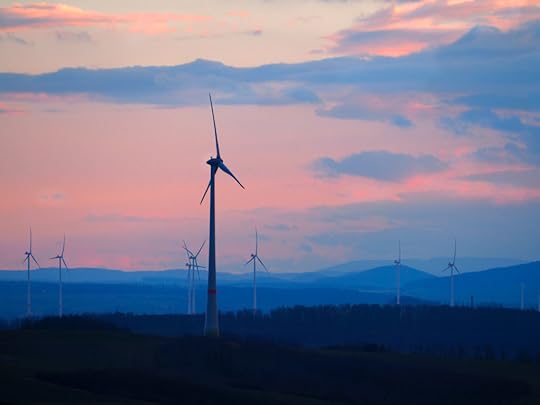
The unexpected success of investment and public backingIn the UK, we like to boast about the success of offshore wind power, whose cost has fallen by around 70% within a decade. Government subsidy was the most important ingredient in this success, creating a market within which learning, innovation, competition, and economies of scale could drive costs down. The fruit of that effort is offshore wind power that is now cheaper than the market rate, meaning that fixed price contracts now involve the industry subsidising the public, rather than the other way around.
 Credit: ‘Windkraft’ by Michael Mueller via Flickr (CC BY 2.0).
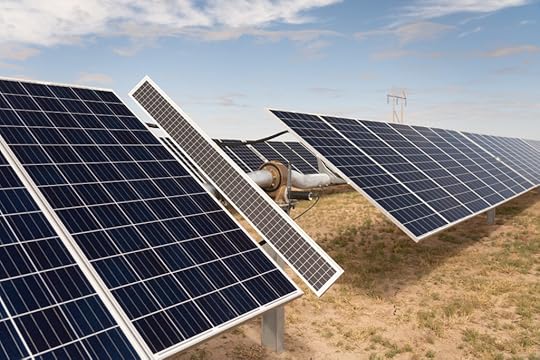
The centrality of targeted investment in this story of success is not unique. Brazil used subsidy and cheap public finance to grow the share of wind in its power generation mix more quickly than any of the other large emerging economies, while creating an industry supporting 150,000 jobs. The growth of solar power has been supported primarily by subsidy, most notably first in Germany, and later in China. Whereas in the mid 1990s, solar power cost over ten times as much as fossil-fuelled electricity, now it is hailed by the International Energy Agency as ‘the cheapest electricity in history’. India, meanwhile, used massive public procurement to drive a transition to efficient LED lighting, bringing down its costs by over 90% in less than a decade, while increasing its deployment by a factor of several hundred, and bringing electric lighting to hundreds of millions of households for the first time.
Making decisions differentlySomewhat shockingly, a new report launched by the Economics of Energy Innovation and System Transition project at the COP26 climate conference in Glasgow, 2021 finds that, in general, these outstandingly successful policies were implemented despite, and not because of, predominant economic analysis and advice. That is because they ran contrary to several widely accepted principles, or rules of thumb: that governments should prefer carbon pricing as the most efficient way to incentivise decarbonisation; that decarbonisation policies should, wherever possible, be ‘technology neutral’; and that we should take the cheapest opportunities to reduce emissions first. These policies broke all of those rules – so how come they did so well?
As the report, by a group of academics from China, India, Brazil, and Europe, sets out, a shift in economic thinking can explain a lot. Instead of assuming that almost everything will stay the same, we can remember that our objective is transformational change. Then the question for analysis becomes: which policies will most effectively drive self-accelerating change in the economy?
 Credit: ‘Solar Fields’ by Jonathan Cutrer via Flickr (CC BY-NC 2.0).
Targeted investment can work well because it channels resources to the new technologies, directly strengthening the reinforcing feedbacks of innovation and diffusion. Taxing the old system does not have the same effect – at least not until the new technologies are well established, at which point taxes may be able to help activate a tipping point. To give a historical analogy, the transition from horses to cars was not brought about by a tax on horse-excrement (even though horse-excrement was a real problem); it was done by investing in motors, engineering, and factories, by building roads, and by writing the Highway Code.
The first steps towards transformational change will almost never be cheaper than small tweaks to the existing system. The first cars were much more expensive than horses, as well as slower, less reliable, and more dangerous. The first solar panels were vastly more expensive than replacing a coal power station with gas. If our objective in low carbon transitions is the wholesale replacement of one system with another, then policies that look good value in the short-term – like burning fossils a bit more efficiently – will be poor value in the long-term. Investing in the new system, while it looks alarmingly expensive at first, turns out to be the better bet.
This article was first published at https://www.rapidtransition.org/commentaries/the-most-efficient-way-to-decarbonise-may-not-be-what-many-think/.
The post The most efficient way to decarbonise may not be what many think appeared first on Five Times Faster.
February 9, 2021
What do the world’s fastest transitions to low carbon power and transport have in common?
Norway is making the world’s fastest transition to zero emissions road transport. Over half of all cars sold in the country are electric vehicles (EVs), about ten times the share that EVs have achieved in most major markets, and twenty times as high as than the global average.
The UK is making the world’s fastest low-carbon transition in the power sector. Coal power, which made up 40% of the generation mix just eight years ago, is now close to being eliminated. Over the last decade, the rate of decarbonisation in the UK power sector has been twice as fast as that of any other major economy, and about five times as fast as the global average.
As Tim Lenton and I show in our new research paper, what these two examples have in common is that they involved the activation of tipping points. A tipping point occurs where a small push leads to a large change in the state of a system. Imagine leaning back in your chair as you read this article, pushing with your feet so that the chair pivots on its back legs while the front legs go up in the air. Up to a certain point, if you stop pushing, the chair will go back to its normal position. Beyond that point, the chair will fall backwards and you will find yourself in an entirely new state – lying on your back with your feet in the air, looking like an idiot. That point is the tipping point.
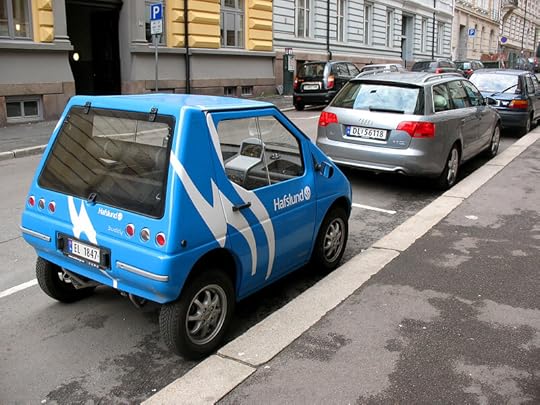 Image: Buddy electric car in Oslo, Norway by Shannon Kringen (CC BY 2.0).
In Norway, a combination of tax and subsidy made it cheaper to buy an EV than an equivalent petrol car. This appears to have activated a tipping point in consumer preference, leading most people to decide that EVs were a better option, instead of sticking with gas-guzzlers.
In the UK, a fixed carbon tax in the power sector made electricity from gas cheaper than that from coal. This switched the position of those two fuels in the market, meaning that gas would be called on to generate before coal, instead of afterwards. The result of that small change in relative pricing was a large change in the amount of revenue that coal power could earn. Along with the direct impact of the carbon tax on the cost of coal power, this activated a second tipping point, ‘flipping the economics [of coal power] over from barely profitable to loss making’, in the words of one utility analyst. Utility companies increasingly decided they were better off blowing up coal power stations than continuing to operate them.
A tipping point is not a magic solution to all our climate change problems. Technologies like solar power, wind power and batteries have to be researched, developed and deployed before tipping points such as those described above become available. A range of other policies are important too: there is no point having cheap EVs unless you have the charging infrastructure. Still, the fact that tipping points can lead to such world-beating rates of change surely gives us grounds for hope.
Why are there not more of these examples?One reason we do not see more of these examples could be that traditional economic advice has not encouraged governments to look for them.
A single carbon price across the whole economy has often been recommended as the most efficient policy, on the basis that it would equalise the pressure for change in all sectors. The problem is: each sector that we need to decarbonise is different. It is easier to tip over a plastic deckchair (the power sector) than a heavy armchair (the steel sector). A single economy-wide carbon price would be too low to activate a tipping point in some sectors, and unnecessarily high in others. In practice, the desire to avoid such a carbon price being too high in some sectors would be likely to result in it being too low in all of them.
If we understand the economy not as a machine to be ‘optimised’, but more like an ecosystem to be tended so that it grows in ways that are beneficial to us, then it becomes natural to look for tipping points when we want to find efficient ways to achieve rapid change.
Tipping cascades in the global economyTim Lenton is known for his pioneering research on tipping points in the Earth system that could be crossed as a result of climate change. One of the most concerning possibilities he has brought to light is the risk that the activation of one tipping point could increase the chances of activating another, and then another, creating a cascade of change towards a new and less hospitable state of our planet.
What we realised when we talked about it together was that a similar phenomenon could occur in the global economy. In fact, it already has: tipping cascades are visible in past industrial revolutions, and more recently in the global financial crisis.
In our paper we sketch out the ways in which our two examples could contribute to tipping cascades in the global economy – accelerating low carbon transitions through industries, across borders, and between sectors. Small groups of countries working together may be able to make this a reality, and through our COP26 campaigns, the UK and our international partners will give it our best shot.
The fast transitions of the past have often involved government, business and civil society working together, reinforcing each other’s actions. We surely need that kind of collaboration now. If we want to tip fossil fuels out of the global economy fast enough to keep a safe climate, we had better join together in doing the tipping.
Read the full paper here: Upward-scaling tipping cascades to meet climate goals: plausible grounds for hope.
This article was first published at https://www.rapidtransition.org/commentaries/what-do-the-worlds-fastest-transitions-to-low-carbon-power-and-transport-have-in-common/.
The post What do the world’s fastest transitions to low carbon power and transport have in common? appeared first on Five Times Faster.
November 27, 2020
How a critical mass of countries could double the pace of the global transition to zero emission vehicles, and how you can help
Simon Sharpe, Deputy Director, UK COP26 Unit, and Drew Kodjak, Executive Director, International Council on Clean Transportation
The transition from petrol and diesel cars to zero emission vehicles is accelerating towards a tipping point. Governments of some of the world’s largest and most influential car markets just agreed to work together to make it go even faster.
 Policy drives the pace of change
In Europe, electric vehicles’ (EV) share of new car sales increased from 3% in the first half of 2019 to 8% in 2020, and has continued to accelerate to 12% in September. Looking at individual countries, Norway’s EV sales share reached 70% in September, while major markets were led by Germany at 16%, France at 11% and UK at 10%. China’s EV market share hit nearly 6% in July, while California – the market leader in the US – hovered above 13% EV sales in the first half of 2020.
Europe’s rapid growth has not come about by accident. Policies such as regulatory standards, purchase subsidies, investment in charging infrastructure, and public communications, have played a critical role. For example, to comply with Europe’s CO2 standards, global auto manufacturers introduced 143 new EV models in 2019. And at least five European countries have come out with green recovery packages that provided incentives for EVs.
A new international effort is targeting the gains from coordinated actionLow battery prices are the key to unlock more affordable electric cars that can be sold in higher volumes. The cost of EV batteries has fallen by nearly 90% over the last decade, and some project EVs will hit cost parity with petrol cars within the next several years. By working together to accelerate the growth of the global market, countries can bring costs down more quickly, and arrive earlier at this tipping point where ZEVs become cheaper to buy than petrol and diesel cars, as well as being cheaper to run – and of course, less polluting.
Today, for the first time, ministers and representatives from fifteen governments that set the rules for around half of the global car market, came together to form a Zero Emission Vehicle Transition Council. Together with partners in industry and civil society, they form a critical mass that can shift the global market. Today they agreed to work together to accelerate the pace of the global transition.
Doubling the pace of the transitionTo meet the goals of the Paris Agreement on climate change, we think all new car sales globally need to be zero emission by around 2040, and earlier if possible in the major markets. That means roughly doubling the pace of the transition. Such an acceleration will be challenging, but Europe’s recent experience should serve as a reassuring sign of what is possible.
As host of the COP26 UN climate change talks in 2021, the UK is bringing governments, businesses, and civil society together to work towards this goal. We are inviting Governments to support this by requiring all new cars sold within their markets to be zero emission by 2040 or earlier. (The UK just committed to phasing out petrol and diesel cars and vans by 2030.) NGOs can advocate strong policies, and highlight the benefits for public health, energy security, consumer savings and industrial competitiveness. Vehicle manufacturers can commit to making all the cars they sell zero emission by this time, and their shareholders can encourage them to do so. Businesses that own large vehicle fleets can contribute by committing to buy only zero emission vehicles, and by joining the EV100 initiative.
As COP President Designate Alok Sharma has said, by working together, we can certainly make faster progress.
This article was first published at https://www.linkedin.com/pulse/how-critical-mass-countries-could-double-pace-global-zero-sharpe/.
The post How a critical mass of countries could double the pace of the global transition to zero emission vehicles, and how you can help appeared first on Five Times Faster.
Simon Sharpe's Blog

- Simon Sharpe's profile
- 4 followers

