K.J. Joyner's Blog
April 6, 2024
Speakers in the Wood
In learning the language, the information I’m going to talk about here only matters if you get confused between Mohican and Mohegan. (They’re two different things with two different languages. I promise.) For some it’s just something that’s interesting to know. If you’re of Algonquian descent, this pertains to you. This talks about people and places that your ancestors’ ancestors came from. And besides, it’s cool.
Who were the Algonquian speaking people and why do I say it with such a mouthful of words?
Let me answer the latter first. I’m saying it that way because there are a large number of tribes that span from the American northeast to the midwest which are classified under a single umbrella: the Algonquian language. It’s just easier for me to start there: there’s a bunch of American aboriginals, and they all spoke the Algonquian language.
The thing is with this language, they all didn’t speak it exactly alike – no more than a New Yorker is going to sound like someone from the Deep South. In some cases the differences were getting extreme, and in some cases not to much.
Their cultures, too, followed the same pattern. It’s believed by historians that overall the Algonquian tribes shared similarities from tribe to tribe (for example, they were all patrilineal1). They also had differences, such as different dances around the circle or with marriage customs. Cultures fracture over time; that’s just human nature, and these folks had been running about early America being natural for at least 8,000 years before the unlucky folks in the northeast had their first European contact.2 Without *natural* change and adaptation, a culture (and sometimes the people as well) die.3
So the Algonquian language and the people who spoke it’s variations spanned a pretty large area: from the northeast in the New England Area, to the southeast, to the Great Lakes area, to parts of the midwest. There were other people in the southeast as well, who spoke a different language with completely different ways, but to keep things clear we’re not talking about them. Both groups of people together tend to be called the Woodland Indians, mostly because when the Europeans first came the land was far more forested than it is now (and the air was probably better). But because of a little confusion with the Woodland Period, which is a prehistoric period in American history and what you’ll probably find the most if you try the wrong internet search, let’s just stick to Algonquian people and call it a day.
Going back to where I mentioned that the Algonquian people covered a wide space of land on Turtle Island4, this means there were a lot of tribes. Over 30 as a matter of fact. Anthropologists have divided them into three classifications5.
The classifications are: Central Algonquians, Eastern Algonquians, and Subarctic Algonquians. The Central Algonquians are then divided into two subgroups, forest and prairie tribes, to make four classifications altogether.
The Forest Tribes – confusing, when you think about it, because these tribes are associated with America’s midwest and prairie lands in modern times. But they didn’t always live there.ChippewaMenominiOttawaCreePotawatomiThe Eastern AlgonquianMicmacMontaukMaleciteAbnakiPennacookNarragansetMahicanWampanoagPequotDelawarePrairie Tribes (Didn’t I say it could get confusing?)SaukShawneeKickapooWinnebagoMiamiPeoria-IllinoisPrairie Potawatomi (Mascouten)Subarctic TribesMontagnaisNaskapiThe ones that tend to be looked over the most in articles, academic writings, and even the media are those of the northeast, the northeastern Algonquian people. Robert Ritzenthaler theorized this may be because they were not only the first to make contact but the first to disappear. They were the first to be put on reservations and, for a variety of reasons not limited to the introduction of Christianity, were the first to lose most of their culture. They’re also, in my experience, some of the first to resist taking some of that culture back when involving spirituality and what Christianity has taught them is bad.
At least when I was going to elementary school, many people also acknowledged the impact the northeast tribes had on American culture. Despite the number of people not just here on Turtle Island but across the big water that somehow think Americans are just like all of the European countries and should and do emulate Mother England, American culture’s beginnings and language have been forever shaped by the northeastern tribes. We Americans are unique, just like everyone else, and the early native Americans had a hand in it.
It shows in American language with words such as moose (mos in Mohegan), succotash (suqatash), hominy, wigwam (wiqám), papoose (páhpohs), squaw (sqá)6, and pawpaw. It shows in place names such as Massachusetts and Connecticut. These words, names, and no doubt even some tiny parts of our day to day cultural weirdnesses, are one of many ways the tribes have managed to survive.7
When I say each tribe tended to speak a different version of Algonquian, I’m saying they each had their own dialect. Some tribes could understand each other easier than others. Today, a lot of those dialects have been lost.
There are revitalization attempts in some tribes to rescue what’s left of their own language, or to bring back to life languages that have died. This website deals mostly with the Pequot-Mohegan dialect of the Algonquian language. It is considered a dead language, but there are people out there crying, “It ain’t dead yet!” and suggesting it go for a walk.
Mohegan nanu Fidelia Fielding, or “Flying Bird”, is the person the Mohegan-Pequot language owes a big thanks to. She was the last speaker, so she wrote as much down as she could in her diaries and other books to preserve it. Without her efforts, not only would Mohegan not have a fighting chance but other languages that were able to recapture their syntax (structure) as well. It was mostly from her records that Dr. Stephanie Fielding pieced things together for you and me.
In the future, we hope to touch more on the lives and cultures of the northeastern tribes in particular as these are the ones mostly associated with the Mohegan-Pequot language. In the meantime, go back and pick out the words we slipped into here. This is how you speak a language. You use it, even if only by a little at a time until you have more than you realize.
We are still here, and our language shows it.
_____________________________________
relating to, based on, or tracing descent through the paternal line – https://www.merriam-webster.com/dictionary/patrilineal, Merriam Webster Dictionary accessed onlinetanakiwin.com/wp-system/uploads... changes tend to have the same effect.The American Continent, North America usually when referencedWoodland Indians of the Western Great Lakes, TheRitzenthaler, Robert E. & Pat. Waveland Press, Inc. 1983. pp.11-17Which is NOT a dirty word! Sqá simply means, “woman”. Those who think otherwise have fallen for misinformation.Which means when people demanded that Squaw Rock be given a name change because they insisted it was a dirty name, they were erasing the Algonquian people further out of history and out of our culture. Simply criminal. (And yes, they were told repeatedly it was not a dirty word.)


February 10, 2024
Rabbit and Moon
It’s February Album Writing Month (FAWM), and I’m participating. I think it’s my second year?
You’re supposed to write, or try to write, 14 songs — an album. My problem? I write one or two and either get sick, get busy, or decide I want to polish the ones I’ve written into something better rather than carrying on writing more crap.
… I’m kind of at that point now. On the other hand, I wrote more than last time.
So I thought I’d share Rabbit and Moon with you. I’ve got it in a special album at Bandcamp called The Fawms. The songs here are free. The catch is I might remove them later and either they get put in a vault or I try to record something decent for the album in the works.
It’s a traditional story… because I’d tried to kill Rabbit in another song and I felt a little guilty, so I gave him his own.
January 31, 2024
I travelled thousands of miles for this interview (Leslie Fish)
And finally Part III (all that’s up so far):
I hate the way I read the questions in these things. LOL. I was trying to be extra articulate and only sound extra stupid.
August 15, 2023
Cash Is King
by Sophie Quinton, Stateline
May 11, 2021
Read Stateline coverage of the pandemic’s effect on the economy .
DENVER — After a constituent called Colorado state Rep. Alex Valdez last spring and complained that some local businesses weren’t accepting cash, the Denver Democrat started noticing cashless businesses everywhere, from restaurants to his local coffee shop.
Valdez thought refusing cash due to the COVID-19 pandemic made no sense, as merchants were still willing to touch debit and credit cards. And he feared such policies could shut out people without bank accounts, a group that’s disproportionately low-income, Black and Hispanic.
So this year Valdez sponsored a bill that would require retailers to accept cash, with a few exceptions. “We really just need to reaffirm that cash is currency,” he said.
In recent years, left-leaning leaders in cities such as New York, Philadelphia and San Francisco, as well as in the state of New Jersey, have enacted similar laws to protect unbanked customers who rely on cash. Massachusetts has required businesses to accept cash since 1978.
The idea gained traction this year, after public health measures and scattered coin shortages made it more difficult for some consumers to make cash purchases in 2020. Republican lawmakers in Idaho, Mississippi and North Dakota proposed bills that would require shops and restaurants to accept cash, and Washington, D.C.’s City Council voted on a cash transaction bill.
While the bills in Democratic-controlled Colorado and Washington, D.C., passed, the red state proposals did not. Many Republicans opposed the bills, siding with business groups that argue retailers should be free to choose how to serve their customers.
“We don’t support mandates; we believe that the business owner is entitled to accept or reject any method of payment, as they wish,” said Tony Gagliardi, Colorado state director of the National Federation of Independent Business, a trade group.
Stateline
Consumers increasingly are using credit or debit cards to pay even for low-cost purchases, such as a cup of coffee, surveys show, and apps such as Venmo and Apple Pay are becoming more popular. Credit card companies—which charge retailers fees every time a customer uses a card—have encouraged businesses to stop taking cash.
Yet it’s unclear how many U.S. retailers have gone fully cashless. In a 2021 survey, 85% of sellers who accept cash and use the online payment processing service Square said they never plan to stop taking cash, according to Shelle Santana, an assistant professor at Harvard Business School who has been analyzing Square transaction data.
High-profile national chains that stopped accepting cash in recent years—such as Amazon Go stores and the fast-casual salad chain Sweetgreen—reversed their policies after facing criticism for excluding shoppers who rely on cash.
During the pandemic, the federal Centers for Disease Control and Prevention has encouraged stores to use “touchless” payment methods, such as apps, to prevent surface transmission of COVID-19. But the agency has also noted that the virus primarily spreads through the air, not by clinging to surfaces.
Supporters of cash transaction legislation say it’s still important to reaffirm the use of coins and paper money.
About 7.1 million U.S. households don’t have a bank account, according to the Federal Deposit Insurance Corporation’s latest survey in 2019. Rates are highest among low-income, Black, Hispanic and Native American households, as well as households headed by a person with disabilities, the FDIC survey shows. Nearly half of the unbanked people surveyed told the agency they can’t afford to maintain a minimum balance in an account.
By requiring businesses to accept cash, lawmakers can prevent retailers from discriminating against unbanked people, even unintentionally, said Carol Hedges, executive director of the Colorado Fiscal Institute, a Denver-based think tank.
“This seems to me to be one [policy] that’s a relatively burden-free way to make sure that we don’t accidentally, or unintentionally, create additional bias in the system,” she said.
Is Cash King?
Much of the cash transaction legislation that advanced before the pandemic was motivated by social justice concerns, as people of color are less likely to have bank accounts, debit cards or credit cards.
“Moving to cashless transactions would be quite exclusionary to already economically vulnerable populations,” said Diane Standaert, senior vice president for policy and advocacy at HOPE, a credit union and development organization based in Mississippi.
More than 1 in 5 Black Mississippians lack a bank account, Standaert said. “We see exactly who would be excluded by any move to go cashless,” she said.
Although only 5.4% of U.S. households lacked bank accounts in 2019, according to the FDIC, that share fluctuates with the state of the economy. In 2011, just after the financial crisis and Great Recession, the unbanked rate hit 8.2%.
Colorado’s unbanked rate—which was 3.3% in 2019—may have risen since then because of the recession caused by the pandemic, Valdez said. “We need to look at the long-term implications of the economic disruption,” he said. “There are an increasing number of people who won’t be able to make ends meet.”
Going cashless works for some retailers because it allows them to process payments faster, Harvard’s Santana said. Mercedes-Benz Stadium in Atlanta, for instance, stopped accepting cash in 2019 to minimize lines at concession stands. Some businesses also prefer cash because it saves them money on credit card processing fees.
There’s little data available on how many businesses went cashless during the pandemic, or how long those policies lasted.
MAD Greens, a fast-casual salad chain based in Golden, Colorado, stopped taking cash in April 2020 because of health and logistics concerns, Peggy Littleton, director of marketing, said in an email. “Cash requires extra time, effort and resources, all of which have been scarce in our industry for the past year,” she said.
The company began accepting cash again last month, Littleton said. “This was not politically motivated in any way,” she added, noting that the company hasn’t taken a position on the Colorado bill.
Square sellers processed more cashless payments last spring, during the height of COVID-19 stay-at-home orders. The jump most likely reflected a surge in online sales, Santana said, rather than a decision to refuse cash.
Many of Square’s sellers are small eateries such as coffee shops, restaurants and delis, which weren’t offering much takeout before the pandemic forced them to limit in-person service. “That wasn’t their main business model,” Santana said of takeout. “And then that became their main business model.”
Cash now comprises close to 30% of Square’s U.S. transactions, down from about 40% in March 2020. “There is this surprising resiliency of cash. It keeps hanging around,” Santana said.
Legal Tender
Lawmakers who’ve sponsored bills that would require retailers to accept cash say they were surprised to learn there isn’t a federal requirement.
“I never knew that this had to be done at the state level,” Valdez said. “I figured that the federal government had done this.”
Mississippi state Rep. Chad McMahan was so certain businesses had to accept cash that in a viral 2020 Facebook post he falsely told constituents that if their cash payments were refused, “the debt is paid in full.”
“If you are a business owner and you refuse to take cash, you are breaking the law,” McMahan, a Republican, wrote.
McMahan sponsored a bill this year that would have required businesses to accept cash, unless the seller suspects the cash is counterfeit, the buyer is contractually obligated to pay electronically, or no attendant is present because electronic devices offer 24-hour services. Under his bill, refusing cash would be a misdemeanor offense punishable with a $100 fine.
The bill died in committee. McMahan’s office did not respond to Stateline’s requests for comment.
Cashless transaction bills have been opposed by some Republicans and business leaders, who argue that businesses should be able to decide how to serve customers.
“If you are a small business owner, it should be up to you how you want to take payment,” Colorado state Sen. Rob Woodward, a Republican, told The Colorado Sun last month. “For some, they may want chicken or eggs or credit cards, what have you.”
North Dakota state Rep. Ben Koppelman, a Republican sponsor of a cash transaction bill, acknowledged in written testimony that the issue involves balancing a buyer’s rights with a seller’s rights.
“There are two traditional and fundamental conflicting freedoms here,” he wrote. In this case, the buyer’s right to pay however they choose should prevail, Koppelman argued.
But his bill was overwhelmingly rejected by the Republican-controlled state House, 70-21. Koppelman did not respond to requests for comment.
Valdez’s bill would make it a crime punishable by a $250 fine for Colorado retailers that accept payment in person to refuse cash (with some exceptions, such as when customers need to provide a credit card number to pay a security deposit). It passed the state Senate with a single GOP vote but won more Republican support in the House. Democratic Gov. Jared Polis has yet to sign the bill.
Valdez said the bill wasn’t particularly controversial. “The truth is, this is better for merchants anyway, because they don’t have to pay processing fees and the like,” he said.
_______________________________________________________________________________________________
Stateline is part of States Newsroom, a nonprofit news network supported by grants and a coalition of donors as a 501c(3) public charity. Stateline maintains editorial independence. Contact Editor Scott S. Greenberger for questions: info@stateline.org. Follow Stateline on Facebook and Twitter.
December 27, 2022
July 29, 2022
Test
It’s over 10 years too late, but I just decided to play with my Word 2007 blog making feature.
So. Test.
December 15, 2021
Pet Peeve and the self entitled customer
Pet peeve: people who come to woksprint.com to dictate prices. There are a lot of them. Some are nice, some are not. I will explain now, because not everyone who says something fits this description.
I keep prices as low as possible. I just took a whole week to comb the store and edit each and every single item to reflect lower price changes. I’m not quite done yet. My eyes are melting out of my head.
I’m always looking for ways to lower shipping costs. I recently added a “free shipping” option on some items that actually enabled me to lower some item costs even more because math is weird. (And on the items that I would have had to raise prices by too much, well, they are not free shipping.)
I even used to waste my time to spread the word. I once went to the discord filk channel to tell people that, hey, eBay forces me to raise prices there. That was a waste of time but I tried. The troll. OMG the damn troll who just didn’t want to say thank you and be done, but had to nitpick. Phuck. I hate negative channels.
I break even usually. I wish I could pay my bills with this, but I don’t. (I will not complain if I ever do.)
I don’t always get prices correct, and I do appreciate input but I’m not a piece of dirt to be talked down to about the matter. Just help me update things, tell me when something isn’t rare (because I might mark an item rare if I can find no information about it), and let me handle things. I am the person who sometimes spends 12 hours a day working on this website. You are the person who made the CD and has a little information I could use, but you are not the person paying the bandwidth.
Also in some cases I have a reason for the prices I choose. The way CDs were hawked by people who immediately took them to EBay to sell them at double and even triple price is burned in my mind.
Furthermore, I may donate part of the proceeds to charity but I am most decidedly NOT a charity. I’m not necessarily paying my bills with this, but you honestly can’t expect me to take resources from my house over this.
I’m glad to know the information, but that doesn’t mean I’m willing to just dump it from my catalog and see it gone because you object to how I’m handling my business. I don’t even take forever out of print stuff from the catalog. It’s a record of sorts.
Don’t come at me all shocked I managed to get your CD when you didn’t sell it to me directly. Instead be thrilled that it’s in circulation enough that it landed fortuitously in my lap. Also, before you do come at me all shocked, make sure an email from me didn’t land in your spam folder. I can’t count the times I’ve been approached by people over this and that, and I’d messaged them to compliment their cover or some other issue a year before.
I have added music that had content I wasn’t comfortable with. I have added music I loved. I try to be fair here. Don’t fuss at me because you have decided so-and-so is the bad guy of the week. I don’t care.
Last but not least. If I have your CD in the store, but no link to your webpage in the listing, please provide. (Just don’t overwhelm me or I’ll never be able to get to it.) Once in a while I find the time to add that information so that people can find you online. I also link articles from time to time. This is a store, yes, but one of it’s aims is to promote you guys. Which means if I ask for that information and get no answer I’m going to pass your stuff over and eventually stop asking or responding.
Sometimes when googling information about filk music, Woksprint is the third or even first result for me. It wasn’t by design, but we’re up there sometimes when searching for certain items. This is good for you. Please don’t kick me in the face for my hard work.
Just, in a nutshell and to stop being Southern polite here, coming at me with expected entitlement is not appreciated. Thank you.
December 12, 2021
Madness, I say!
It occurred to me tonight that I hadn’t posted anything since my last, fairly tragic-sounding, update. And that perhaps I should say something to let people know I’m still alive, although I also realize that if people reading these posts truly cared if I were alive they’d have inquired by now.
I made it through covid fine. The other half ended up hospitalized. I and the doctors agreed that if he’d followed instructions and did things like move around, as opposed to laying on the couch without moving all day long, he might have been able to fight it better. Either way, he survived and we’ve been surviving since.
During his hospitalization, some things came to light regarding certain lies he had been telling to me… and our marriage almost didn’t make it. We still get bumps from it, and I still am apt to just decide it’s not working out and leave. But I’m giving him a chance as best I can. ‘Nuff said on that.
In the meantime I’ve making music and carrying forward. I’ve to try to save money to go to a professional studio with my next album. I thought about Kickstarter, and even talked about it in one of my one song concerts, but I highly doubt a Kickstarter would make it. One step at a time, though.
I was interviewed on a Youtube Podcast just after my birthday. I’ll embed it below for you, if you’re bored or curious or both. (finds, embeds)
I tried to perform two songs and flubbed them both, so if you want to cut to the chase here’s my latest online concert. This time it’s a two song concert.
September 8, 2021
C is for…
M’kay so real update time.
Hubby and I both have #COVID.
He’s worse off than I am.He was sick the day of the convention I went to last weekend (Burgcon, pretty decent little thing), so of course didn’t attend. I was soon to follow with feeling like crap. On retrospect, even though I wasn’t sick yet, I wish I hadn’t gone to the convention but I am not the fortune teller my father is.
For me it was a couple of days of sleeping and taking lots of stuff to keep my nose running. For him it’s just ongoing.I have always weathered things better than him. Something about me being willing to take my vitamins and supplements properly among other things like a healthier liver. Vitamin D absorbs if you take it with protein, for example. I’m always nagging him to eat with his Vitamin D. I’ve never seen him do it unless I corner him and force an egg into his mouth.
A friend thoughtfully sent us a small bit of groceries – considering we’re out of some stuff. Among it was Hi-C orange or some such, with Vitamin D. Tim Belcher told me today that these drinks made it so he doesn’t have to take the real vitamins or drink his echinacea tea. (Getting why he’s worse off than I am yet?) Please don’t enable my husband to be stupid. He’s doing it well enough on his own.

My current gripe is the inability to get tea bags. We have other stuff. I need tea to drink because I M R Southern and need tea to drink or I shall shrivel up and turn into powder.
Well, that and the inability to pay bills. With him sick on the couch, the pay we were anticipating that would have mostly caught us up this month is literally cut in half.
Oh, and the damn cats have went into heat again today. They had appointments this week through a friend we postponed because we were quarantining. This is the 2nd time COVID has gotten in the way of getting these cats spayed. I swear this COVID virus loves the idea of me having a trillion cats.
July 13, 2021
Returning to the old ways.
Ages ago, when it came to my art prints, I would make giclee prints. They were pretty popular. When I switched to buying small runs of larger posters, I had some complaints but at the time I thought it was better; more professional.
Fuck that. I’m going back to making giclee prints. They’re more interesting to do. I like the control, and the sheer fun of it. As a result, I’ve spent the past few days immersed in playing with my printer and digging up all my artwork including some that has never seen the light of day.
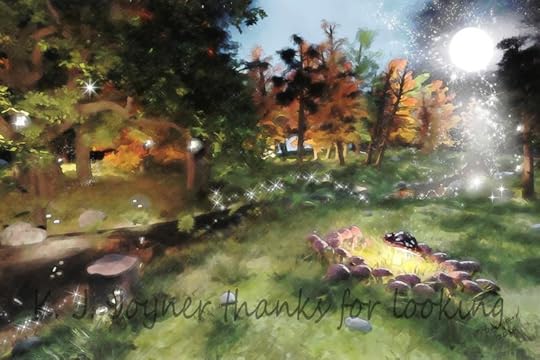
Like this piece:
https://www.etsy.com/listing/1036808688/forest-moon-magical-forest-fantasy-art
I want to show you the image, but my blog suddenly isn’t letting me upload media. Sigh. Suffice it to say, that part of going back to giclee printing is returning to using etsy – even though I’d probably die of shock if anyone shared the piece much less bought a print. It’s not like I’m some big named superstar that has a PR team to share things for pay or anything. Those are the only things people want to hit the share button for…. Right?
Anyway. Is it 4 in the morning already. I didn’t mean to stay up this long. Anyhoo, this particular image started out as a book/CD cover commission but was rejected. I’d offered it to someone else, but life stepped up and said, “Newp!” Many moons later I’m saying fuck it. I’m taking it out of the closet and now you can see it. Weeeee.
I’m going to bed.