
Martin Reaves's Blog
August 16, 2017
SELF-DESTRUCT IN THREE, TWO, ONE…
Are you still here???
If you’re reading these words, you really want to hop over to the new bog and follow along.
This blog is going to self-destruct. Things will go BOOM, and letters and mixed metaphors will go flying all over the place. And who knows who or what might come for you if you insist on staying here..
[image error]
Click HERE to follow the new blog. Or click THERE. Or even right HERE.
Listen to Arnold.
Filed under: Random Awesomeness Tagged: blog, Martin Reaves, new is always better, Writing



August 10, 2017
Mott is Moving
Hey there, friends and neighbors!
I will be moving the content of Mott’s Ruminations to a shiny new blog titled…wait for it…Martin Reaves!
Hey it’s my name, so sue me.
Anyway, I’ll be recycling posts there for a short while, whilst all y’all hop over and follow the new blog. I hope you’ll join me. Scribblers on Celluloid will be back–I’ll be reposting the older reviews to the new site. All new Scribblers reviews will only appear on the new site.
Enough already. Click RIGHT HERE to join the shiny newness.
Cheers.
Filed under: Random Awesomeness



July 16, 2017
Hidden Meanings Continued…
Hidden Meanings Continued…
The Norinko Hanasaki Investigation
By Martin Reaves
Introduction:
I contacted Anthony Servante about my suspicions regarding the poetry analysis in Part 16. This happened early yesterday (Saturday), and I have to be honest: after laying out my misgivings for Anthony, I froze up. Saying those things out loud made them real—and I’m not sure I can handle that much reality. Obviously I changed my mind and here I am. Sorry for the delay, but the more you read, the more you may begin to understand my reluctance to continue. Anthony is handling the search for the journal over at Servante of Darkness. Everything in me wants to simply tell you to go to his blog, stay there. He started this, and maybe he should finish…
Screw it. We’re here, right?
Before I hem and haw my way out of posting this, I should tell you what I deciphered. Or maybe I’m still guessing. I don’t know, but I can’t deny what seems to be reaching up off the page.
The poems follow a pattern.
Here’s how I see it:
There are three segments to the poetry. Even though the individual poems don’t show this triad, the groupings echo the same pattern, like Morse Code signaling an SOS. On the one hand, they’re a cry for help; on a much more sinister hand, they appear to be some kind of instructions.
I will explain this at length to Anthony later, assuming our brief chat yesterday wasn’t sufficiently disturbing. I just need to get this shit out of my head and onto the page.
The first segment of the poetry describes an entrance, the second a location, and the third an exit. The three parts are certainly vague but not so much that they’re not obvious. It’s the repetition of the three that provides the pattern. When grouped together, the first and last segments read “exit entrance location.”
The exit and entrance are the same location. The tunnel.
The McClure Tunnel. The Santa-Frickin-Monica Freeway tunnel. I wish I’d never heard of that cursed LaLa Land hole in the earth. I’m serious.
But that’s the location. What’s missing is the “how.” The “where” doesn’t help without the “how.”
I’ll let Anthony pick it up from there. He’s already working on finding the journal of Norinko. I want to say I’m done, but I’ve committed to help with the investigation, and I’ll admit I still want to help those involved. Norinko’s friends and family—they deserve answers.
I’ll chalk this up to a cautionary tell as to what I offer in the future.


July 5, 2017
Hidden Meanings in Fables & Poetry
Hidden Meanings in Fables & Poetry
A Norinko Hanasaki Investigative Case
By Martin Reaves
(Shout, by LOKI)
Introduction:
Okay, folks, things are getting interesting.
In case you’re just joining me on this, I have picked up the ongoing investigation surrounding the disappearance of Norinko Hanasaki from a moving bus passing through the infamous McClure Tunnel in Los Angeles, June of last year. If you have no idea what I’m talking about, I highly recommend you catch up with Parts 1–10 on Anthony Servante’s blog HERE, and then continue with Parts 11, 12, 13, and 14. Lastly, pick up Part 15 HERE on Mott’s Ruminations. It will help clarify—if that’s even possible—what’s to follow.
Do it now. Read the other posts. Skim if you must. I’ll wait.
Got it? Everyone back and accounted for?
Okay. I wanted to share some emails I’ve received since taking over this investigation. Maybe some of you will have better luck than I separating fact from fiction. Or maybe it’s all fact and our barometers need to be adjusted. I honestly don’t know at this point. (I feel your pain, Anthony.)
And—though it may seem random at first blush—I’d also like to throw out a literary net of Ambrose Bierce’s works to see what we might catch. There’s a method to my madness, I promise.
But first the emails, unedited, in all their weird glory.
Email #1
I know where Norinko is. She’s in the Black Hills Forest with the Blair Witch and Bigfoot.
Email #2
I am Marie Mayakowski. I understand you’ve taken over the investigation of Norinko Hanasaki from the Servante of Darkness Blog. I guess I’ll just come out and say it. I saw the bird. The one Norinko drew. It was behind Dubois when he contacted me by Skype. Then the screen just faded. I thought the computer crashed, but the green power light was still blinking. It was as if something were blocking the screen. When the screen cleared up, Chris was gone. I’m not making this up. And if I am, then where’s W. Chris Dubois? Chris was my friend. I don’t know why, but I think time is running out. I can feel it. The bird. It wasn’t a drawing like I thought. It was flesh and blood. It moved just before the screen went blank. And I’m sure it looked right at me. I need your help.
Email #3
I hope you follow the path left to you by Anthony Servante. Anthony told us to help you. And we will.
Your friends,
Suzie and Bridget
Email #4
You better watch your back, Mr. Reaves. You’re on very thin ice. Some things are best left alone. You’ll end up with Mr. Servante soon. You know the Servant of Darkness is the Devil, right!! Don’t you forget it!! Heathen!!
~ ~ ~
Still with me, friends and neighbors? While you let those emails digest, I’d like to pay a visit to Ambrose Bierce. Google Mr. Bierce if you want to know more about him. In particular, you may find his piece “Occurrence at Owl Creek Bridge” of interest. For now, just read on. We’re looking at the potential for hidden meaning here, and I’m hardly the first to do so. Stay with me…
Fantastic Fables by Ambrose Bierce
Ambrose Bierce was a fierce critic of the Railroad Barons who brought pain, suffering, and death to the Chinese, Japanese, and other Ethnic groups who were paid slave wages to lay the railroad track for the Southern Pacific and Central Pacific Railroad companies, companies led by the powerful quartet known as the Big Four (Leland Stanford 1824-1893, Collis Potter Huntington 1821-1900, Mark Hopkins 1813-1878, and Charles Crocker 1822-1888), aka, The Associates. Bierce used two manner of criticisms to deride the Barons: One, satirical fables as published in his political work, Fantastic Fables; two, in poetic form, in books and poems that challenged the meaning of commonly accepted beliefs.
One: The Fables
The Massacre
SOME Holy Missionaries in China having been deprived of life by the
Bigoted Heathens, the Christian Press made a note of it, and was
greatly pained to point out the contrast between the Bigoted
Heathens and the law-abiding countrymen of the Holy Missionaries
who had wickedly been sent to eternal bliss.
“Yes,” assented a Miserable Sinner, as he finished reading the
articles, “the Heathens of Ying Shing are deceitful above all
things and desperately wicked. By the way,” he added, turning over
the paper to read the entertaining and instructive Fables, “I know
the Heathenese lingo. Ying Shing means Rock Creek; it is in the
Province of Wyo Ming.”
“The Massacre” in question here is the Rock Springs killings in Wyoming (note the final play on words “Wyo Ming”) where 28 Chinese workers were killed. Bierce paints the “law-abiding” murderers as bound for “eternal bliss,” while the “Heathens of Ying Shing” are “deceitful” and “wicked.” He mocks the newspaper’s coverage of the massacre as “entertaining and instructive,” an ironic reference to the “Christian Press” coverage of the Missionaries who were massacred by “Bigoted Heathens” in China. When the massacre involves white missionaries, it is a crime against heaven, but when it happens to the Chinese it is a just reward. Bierce is mocking the injustice of the press in its coverage of killings of color.
The Kite, the Pigeons, and the Hawk
SOME Pigeons exposed to the attacks of a Kite asked a Hawk to defend them. He consented, and being admitted into the cote waited for the Kite, whom he fell upon and devoured. When he was so surfeited that he could scarcely move, the grateful Pigeons scratched out his eyes.
Here, Ambrose Bierce depicts the Barons as pigeons seeking the help of the Chinese workers (the hawk) to build the railroad, but once the work was done, the Barons disabled the workers from providing support for themselves or their families. Using the “fable” form to mock the railroad tycoons, Bierce teaches us a lesson about the rich taking advantage of the poor. In reality, it is the hawk that feeds on the pigeon, so when the pigeons blind the hawk, Bierce is telling us that the masses outnumber the rich few, and an organized workforce (like the pigeons in the fable) can disable the power of the wealthy to their advantage.
(Fables courtesy of Fantastic Fables by Ambrose Bierce Dover Edition 1970.)
Two: The Poems
In contact, lo! the flint and steel,
By sharp and flame, the thought reveal
That he the metal, she the stone,
Had cherished secretly alone.
A traveler observed one day
A loaded fruit-tree by the way.
And reining in his horse exclaimed:
‘The man is greatly to be blamed
Who, careless of good morals, leaves
Temptation in the way of thieves.
Now lest some villain pass this way
And by this fruit be led astray
To bag it, I will kindly pack
It snugly in my saddle-sack.’
He did so; then that Salt o’ the Earth
Rode on, rejoicing in his worth.
As in his fables, Ambrose Bierce continues to mock the rich and corrupt in his poetry. The traveler steals the fruit as an act of kindness in order to prevent other passers-by from being tempted to pilfer from the same tree. He prevents the corruption of a future villain by removing the fruit. He is sarcastically called “Salt o’ the Earth” for his benevolent deed. The intent of the poem is to depict the truth inside a lie: The thief is a saint for his misdeed—just as the railroad barons are saints for sending the Chinese to their deaths in the tunnels with nitro.
A is defrauded of his land by B,
Who’s driven from the premises by C.
D buys the place with coin of plundered E.
‘That A’s an Anarchist!’ says F to G.
The intent of this poem by Ambrose Bierce similarly elevates the status of the criminal and turns the victim into an “Anarchist.” This poem is a perfect summation of the events in the Mussel Slough Massacre, where A was the settlers, B was the Barons, C was the hired gun Crow, who killed the settlers, and D and E are the railroad company. F is the newspaper media, while G is the gullible reader of the biased articles of the newspapers owned by friends of the rich barons. Bierce loved to use bloody events of the era to support his satiric depiction of the corrupt, from the railroad companies to the newspapers.
A Second Look at the Norinko Poetry
Using the Bierce technique, I wanted to look at the poetry that we have seen so far in the investigation. Remember, these poems were gathered under mysterious circumstances. The people who found Norinko’s journal felt an uncontrollable compulsion to write poetry—everywhere: on the windows of the bus, apartment walls, police cars, locker rooms, wherever they were when they found the notebook of Norinko. Let’s keep that in mind as we look at the following poetry.
Buzzkill liked to sleep
He slept in class
He slept in deep
He slept in the tunnel pass.
Buzzkill liked to party
She joined the hunger fast
Always first to arrive
Always leaving last.
Here we have two poems about Buzzkill. We can trace these poems back to Norinko who wrote them the day she disappeared. Or did she? There has been speculation that the notebook was empty the day she went missing and that the poems appeared afterward, as if by magic. The reference to “tunnel pass” is clearly the Santa Monica Freeway Tunnel where Norinko disappeared. But the pronoun “he” is not Norinko herself, a girl, so who is it? Whoever or whatever “it” is, it followed Norinko from school to the tunnel. The first reference to herself is “She joined the hunger fast,” a reference to some corrupt presence denoting that she would be first and last in this “party” of the “it” in question.
~ ~ ~
Three corners wide
The brink of darkness hovers
Angels hear my tears.
The second person to disappear was the bus driver, Miriam Hernandez. Based on the description of her apartment by police and Dubois, she was a religious person. She references the tunnel where “angels” spoke to her, as she reported to the deputies and to Suzie and Bridget. The “brink of darkness” echoes Norinko’s “tunnel pass,” an entrance in the tunnel perhaps, but definitely not the tunnel itself. Something in the tunnel.
~ ~ ~
Adrift, I walk within a space
Destined to stay in this place
Here, I will defy what they say
Never to defer to their ways
I will fight with every breath in me
I will never bow to their ascendancy
I wish I could see
Where it is that I am
But I feel if I did
I’d be deaf and damned.
~ ~ ~
I found a friend in common
With life and death
Here in the marrow
Of my final breath.
~ ~ ~
There is no going home
My badge, my gun, my files
Swallowed by the creature
In the tunnel’s last miles
Under the veil of night
I hear whispered words in my mind
They speak of utter annihilation
~ ~ ~
I am not lost
Continue to look
There in the dark
Here in the book.
We shall rise again like birds
From the ashes of your words.
I’m going to stop here. I just noticed the order of the poems. Do you see it? There’s something there. When I last spoke with Anthony Servante, he suggested that I take a closer look at the poetry in Parts 1 – 15 and find clues to the location of the Norinko journal. I figured the missing people out there are somehow associated with the journal of Norinko. There’s Norinko herself, the bus driver, the two deputies, detective Wu, and Dubois (aka Tom Thumb). Dubois met with Wu at the school. That’s the last known location of the journal.
From what I could gather from Marie’s email (see above) and her confessions about impersonating Dubois as Tom Thumb, the notebook was not found at his home before he went missing. That leaves the school. It’s still there, or someone found it. The message in the order of the poetry holds the answers.
I have to stop looking at the poetry as poetry.
They’re not poems…they’re instructions.
I did not sign up for this. Each poem seems to correspond to each missing person. There’s a piece of a message in each poem. It is not complete.
Wait, I think I get it. These poems—these messages…dear God, they’re a cry for help.
I’m sorry to end this without resolution, but I’m not sure the satisfaction of my curiosity is worth the risk.
I need to contact Anthony. I may or may not be back with Part 17.


June 26, 2017
The Wandering Corpse
Part 15
The Wandering Corpse
A Norinko Hanasaki Research Case
By Anthony Servante
Sponsored by Martin Reaves
Introduction:
Welcome, Servante of Darkness readers, newcomers—and, of course, my faithful followers—to the real-time unfolding of events surrounding the disappearance of Norinko Hanasaki from a moving bus passing through the infamous Santa Monica Freeway (McClure) Tunnel.
Because the Norinko investigation has spilled into the personal life of Anthony Servante, the Norinko cases will continue here indefinitely. Part 15 was in the works when Anthony contacted me. I present it to you as is.
Part 16 will resume anon from my perspective. Stay tuned.
Without further ado, I hand the mic to Mr. Servante.
The Wandering Corpse
Elmer McCurdy (January 1, 1880 – October 7, 1911)
When I visited the temple last week, I learned of a man named Elmer McCurdy. I would like to share his story.
Elmer McCurdy robbed trains in the late 1800s to early 1900s. As such, he was a villain to the railroad barons and a hero to the rail workers. While working alongside the Chinese on the railroad, Elmer learned about the dangers of nitroglycerin demolitions building tunnels. He found stealing from the trains was less risky than blowing up mountains for the track. He was wrong. He was shot dead in a failed robbery attempt.
And that’s where Elmer s story begins.
McCurdy’s remains were mummified with arsenic, an early form of embalming for penniless corpses. And since there was no money for a coffin, Elmer’s body was placed outside the funeral home in Oklahoma to showcase the fine work of the mortician.
The body was stolen and made its way to several sideshows before ending up in a California carnival called Nu Pike Long Beach, where it was discovered by a TV crew filming an episode of the Million Dollar Man. Along the way, Elmer received three burials, and, each time, managed to escape from the grave. He was dubbed “The Wandering Corpse”.
When the Chinese learned that it was McCurdy’s body in the carnival, they raised money to give their former hero a proper burial. However, Oklahoma claimed rights to the enigmatic Elmer to be buried alongside other gunmen of renown. To prevent any further escapes from the grave, he was placed in a coffin and covered with concrete to prevent him from wandering off again.
The Chinese fans of McCurdy were dismayed. This sacrilegious burial could mean only one thing for the former train robber–he was doomed to wander Diyu forever. Even to this day, many Buddhist temples keep a candle lit for Elmer McCurdy to find his way home.


May 11, 2017


August 5, 2016
Scribblers on Celluloid #8: Through a Glass Darkly
A Writer’s Review of: Through a Glass Darkly

Release Date: October 16, 1961 (Sweden)
MPAA Rating: NR
Starring: Harriet Andersson, Gunnar Björnstrand, Max von Sydow, Lars Passgård
Written by: Ingmar Bergman
Directed by: Ingmar Bergman
Spoiler Level: Medium.
Greetings hacks and scribblers. It’s Summer here in Northern California, as it most likely is in other parts of the world. And it’s hot. Like, peel your skin off HOT.

Heat or no heat, I have been writing—if not quite like a house afire, at least I’ve managed a few tendrils of smoke. Short pieces have been submitted and accepted (yay me), and Rosebud Hill, Volume 1: Searching for Willoughby is now available in paperback and for Kindle. Click on the pic below and buy it, if you are so inclined. Go ahead, I’ll wait…

Now that we have that out of the way, a quick word on the direction of Scribblers on Celluloid. When I first began this series, I fully intended to only include movies that had a lot to say about writing (specifically) and writers (in general), or vice versa. For the most part I feel I’ve held to that. But Through a Glass Darkly gave me pause. Because, in many ways, it is really not about writing, although one of the main characters is a novelist. But it is a terrific film. So what, my inner voice said, there are lots of great films out there. Are you going to review them all? Well, no. I’m not. Then why this one? Because, darn it, it actually does have something to say to writers, even if we have to dig to find it.
So then, the new rule for SoC is this: If a movie has a writer as a main character—and that character’s writer-ness has at least some bearing on the story—then we have a contender for inclusion in SoC.
Read on…I give you Through a Glass Darkly.
The Whiz-Bang Synopsis:
Recently released from a mental hospital; Karin rejoins her emotionally disconnected family on their island home, only to slip from reality as she begins to believe she is being visited by God.
The Slightly More Informative (if somewhat misleading) Synopsis:
In this drama, set on a remote island, a schizophrenic woman is discharged from a mental hospital and recovers during a family holiday with her husband, brother, and father. Her father, who happens to be a prominent psychologist, coldly observes her and takes notes of her behavior without her knowledge.
My Take on Things (or why this movie made the cut):
Okay, here’s the deal. As noted above, this movie is not about writing, or writers. But, in another sense, every movie that deals with life has something to say to writers. Not enough? Well, Through a Glass Darkly does have a writer as one of the main characters, and in a movie with only four characters, that’s 25% of the cast. My first viewing of this film left me wondering if I could include it, no matter how much I liked it. But the more I thought about it, the more I was haunted by the obsession of the writer in the film. This movie is a work of art, but without the writer’s fixations (more on this below), the story would not have affected me so deeply. It made the cut.
Entertainment Quotient:
Rotten Tomatoes rated this movie as Certified Fresh with an astounding 100% approval rating. I’ve already stated that this movie is a work of art. Ingmar Bergman seems to have a habit of this kind of thing. Through a Glass Darkly is the kind of movie I hoped to stumble on when I started Scribblers on Celluloid, which is to say not your usual Hollywood fare. This is a Swedish film, which means subtitles, filmed in almost claustrophobic black-and-white. There is virtually no soundtrack in this movie, save for the intermittent use of the J. S. Bach’s haunting, solo cello piece “Cello Suite No. 2 in D Minor.” This is a depressing little nugget of a movie, and I loved every minute of it.
The cast consists of schizophrenic Karin (Harriet Andersson); Karin’s writer father David (Gunnar Björnstrand); Karin’s husband Martin (Max von Sydow); and Karin’s sexually frustrated brother Minus (Lars Passgård). I’ll just say here that I think Harriet Andersson may be one of the most gorgeous actresses I’ve ever seen, and she knocks this role out of the park. It’s virtually impossible to take your eyes off her.
Bergman does a wonderful job of sucking us into the easy, seaside farm life of the family as they welcome the return of the traveling father, dining outdoors at a rustic table, toasting, laughing. But beneath this false charm looms Karin’s illness. Everyone knows Karin is schizophrenic, as does Karin herself. She has good days and bad days. There is slim hope for recovery. But she seems early on to be the most stable of them all, save for Martin (who is the doctor referenced incorrectly in the synopsis above as her father). Twenty minutes into the film, as Martin and Karin are getting ready for bed, we begin to see past the easy facade to Karin’s own fears: fears of her illness, fears of losing her way and being unable to come back to reality. Karin’s soft reflection makes this exchange all the more terrifying:
Martin: “Are you sad, Karin?”
Karin: “Not really.”
Martin: “What are you thinking about?”
Karin: “Sometimes we’re so defenseless. Like children cast out into the wilderness at night. The owls fly past, watching you with their yellow eyes. You hear the pitter-patter and rustling, the soughing and sighing, all the damp noses sniffing at you. The wolves bare their teeth.”
A little later, Karin says this: “Am I so little, or has the illness made a child of me? Do I seem strange to you?”
What must it be like to be fully aware of your illness and be unable to stop its progression? This is a fear I have long held, that I would somehow cross some line, that I would know it had been crossed, and that I could only watch from some inner place as my mind unraveled. Maybe this is why this movie spoke to me so strongly. If we have any doubt as to the extent of Karin’s illness, we have this scene later that same night:
Karin wakes in the middle of the night to the sounds of a loon, a fog horn, and we get the sense that she may be hearing more than we are. She crawls out of bed and tiptoes upstairs to an empty attic room. We know immediately that she’s been here before. She leans against the tattered wallpaper as if listening…through a tear in the paper, we hear what she hears: whispers, unintelligible but terrifying. She backs away, still listening, and stands in the middle of the room, responding physically to something we can’t see. This scene is almost unbearably sensual as we watch her writhe in the throes of some odd ecstasy.
Later, to add insult to her obvious mental injuries, she stumbles on her father’s diary. The content of this diary is made infinitely more tragic as we hear her father’s words read aloud from her own mouth: “Her illness is incurable…with periods of temporary improvement. I have long suspected it, but the certainty is nevertheless almost unbearable. I’m horrified by my curiosity, by my urge to record its course…to make an accurate description of her gradual disintegration…to use her.” There’s much more to dissect in this film, not least is the odd sexual tension between Karin and Minus, a disturbing plot element that factors in later in the film. But this column is about writers, and we must get to it.
Let’s leave this section with Karin’s words as she confides in Minus about “the others.” She takes him to the empty attic and tells him about the voices, about her midnight trips to the room, how she falls through the wall as through foliage. She tells him all of it, and this exchange—while ostensibly a facet of Karin’s illness—seems to speak to writers and their sometimes obsessive creation of worlds:
Minus: “Is all this for real?”
Karin: “I don’t know. But these are not dreams. They must be real. Now I’m in one world, now in another. I can’t stop it.”
The Writerly Element:
It seems fitting that, in a film about schizophrenia, the writerly element would be less than pleasant. Many writers suffer from one kind of mental illness or another, some much worse than others. I’ve recently (the past few years) been battling with anxiety and depression. Lots of people deal with these things, but writers seem more inclined to flirt with depression. At the very least, the serious writer will bump up against an unhealthy obsession somewhere along the line; it’s pretty much de rigueur that a writer be at least a little nuts. It’s probably not accurate to say that Karin’s father, David, is mentally ill, but his behavior (from such a sophisticated, erudite gentleman) is unnerving. He has been taking detailed notes of his daughter’s mental decline and seems unable to control himself. Again from his diary: “I’m horrified by my curiosity…my urge to record its course…to make an accurate description of her gradual disintegration…to use her.” He knows what he’s doing is reprehensible, but he can’t stop. Folks, that is obsession, and there are times when I think obsession may be the writer’s sharpest tool.
But let’s back up a few frames to earlier in the film, after that first lighthearted dinner. Minus (clearly striving to gain his father’s attention, if not affection) has written a play, which he, Karin, and Martin perform on a small, ramshackle stage erected in the yard. This rustic outdoor theatrical production is of a story called The Artistic Haunting, in which Minus plays a puffed up artist in love with a dead princess played by Karin.
There is a whimsical feel to the play, but also a thread of discomfort as David watches his son and daughter reciting lines that essentially make fun of his own profession as a writer.
Minus: “I am a ruler of my own kingdom. I am an artist. An artist of the purest kind. A poet without poems. A painter without paintings. A musician without notes. I scorn ready-made art; the banal result of vulgar effort. My life is my work, and it is dedicated to my love for you.”
To prove his love, the princess tells him, the artist must join her in death.
He replies: “An easy sacrifice. For what is life to a true artist?”
Karin: “You thus perfect your work of art and crown your love. You ennoble your life and show the skeptics what a true artist can do.”
Then doubt creeps in, and Minus says: “What am I about to do? Sacrifice my life? For what? For eternity? For the perfect work of art? For love? Have I gone mad? Who shall see my sacrifice? Death. Who shall gauge the depth of my love? A ghost. And who shall thank me? Eternity. (This is noteworthy because ultimately we writers want recognition, no matter how noble we may think we are locked up in our own dark attic rooms, listening to voices).
Minus’s artist waits too long and the princess departs into eternity without him. His response: “Well…such is life. I could, of course, write a poem about meeting with the princess. Or paint a picture, or compose and opera, although it would need a more heroic ending.”
This seems to be all about the noble idea of sacrifice, and it does seem pointed at their father; David is constantly on the run, from his family, from his daughter’s illness. He seems to be sacrificing for his art (with all that travel), but what he’s really doing is avoiding the truth, hiding from reality. And this makes his obsession with recording his daughter’s demise all the more twisted—he sees it, is fascinated by it, obsessed with it…and yet, everything he does is designed to keep him at a remove.
And isn’t this what we do in our writing? Particularly those of us who dabble in dark fiction? We create dark and muddy worlds where horrible things happen, all in an unconscious effort to avoid the very horrors we create. That’s a kind of mental illness, and where would we be without it? A lot of this is obviously reading between the lines and making writerly connections where they may or may not have been intended, but we have this exchange later that points directly at the writer’s inner demons. While out on a boat together, Martin confronts David and tells him that Karin read his diary. Martin asks what he wrote and David tells him.
Martin: “Your callousness is perverse. You’re always on the hunt for subjects. Your daughter’s insanity. What a great idea! Write your book. Maybe it will give you your heart’s desire. Your big breakthrough as a writer. Then you won’t have sacrificed your daughter in vain…”
Later, Martin tells David that, while his writing is good, his convictions are not believable: “Why not do something respectable instead?” (ouch)
Martin: “Have you written one word of truth in your life as an author?”
Papa: “I don’t know.”
Martin: “See? Your half-lies are so refined that they look like truth. You’re empty, but clever. Now you’re trying to fill your void with Karin’s extinction.”
All this begs the question: How far is too far? How much of life (and others’ misery) is allowable as grist for our mill? Are we writers horrible to look with interest on others’ suffering? Rhetorical questions, one and all, and I leave you to ponder them.
Why Bother:
Because, to quote the Cheshire Cat, “We’re all mad here.” We could do worse than to keep that in mind—not to be afraid of our latent madness, but to be aware of it, to learn from it. Maybe, instead of documenting someone else’s illness, we can look hard at our own. Maybe, in the end, that’s really what Karin’s father was doing. He ran away from his daughter’s illness and into his novel, which was a hiding place for all his fears and losses.
Karin (asking her father about his latest novel near the end of the film): “Is it any good?”
David: “One draws a magic circle around oneself to keep everything out that doesn’t fit one’s secret games. Each time life breaks through the circle, the games become puny and ridiculous. So one draws a new circle and builds new defenses.”
Karin: “Poor little Papa.”
David: “Yes, poor little Papa, forced to live in reality.”
Overall Rating: 5 out of 5 Quills
Final Thoughts:
In one of her many dark moments, Karin says: “It’s so horrible to see your own confusion and understand it.” Horrible, yes. Maybe even terrifying. But for the writer…perhaps it’s the only path through to a new kind of sanity.



July 14, 2016
Longs Walks On The Beach…Who Needs ‘Em?
It so happens I do enjoy long walks on the beach. Probably not with you, but then I don’t really know you, do I? You could be a perv, or a serial killer, or a Trump supporter. I’m sure you’re nice, but I just can’t take the chance. You could be…
Wait, where was I? Oh, right, I hadn’t actually started yet. Well, here’s the thing: this post is not about walks on the beach, long, short, or otherwise. It’s about interviews. Or, more to the point, an interview with me. The folks over at Serious Reading were kind enough to post the interview and if you click on my serious face below you can read it.

I considered doing an interview with Frivolous Reading, but that would require you to click on my silly face below. But don’t do it. Do NOT click on silly face. Ironically, I’m serious about this. Don’t click on it.

Told you.
Anyway, an interview is an interview is an interview, and the best part about this one is those Serious folks also posted a review of my novel A Fractured Conjuring, which you can read by clicking on the image of the book below. Go ahead, it’s safe.
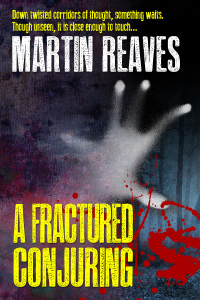
That’s all I have for you at the moment.
Oh, and in case you got frivolously caught up in all the seriousness and forgot to click Serious Me, here’s another opportunity. Click away.
And if you are so inclined, you can find the rest of my books over at those madcap guys and gals called Amazon. Click on my logo below and check it out. Then you might want to go soak that clicking finger–it’s had a tough day.


June 21, 2016
Again, Narcissism
A few days ago, this happened: a rave review of my novel Relative Karma.
This is a big deal. To me. All reviews are important, and I greet each one–whether good or bad–with gratitude.
But this latest one knocked me back a step. Because the review was done by Anthony Servante. And if that wasn’t enough, my book was given to Servante by one of my literary heroes, Trent Zelazny.
And, though Relative Karma was published second, it is actually my first novel. A novel based loosely on real-world events. My world. A world I hope never to revisit. Somehow, inexplicably, this book continues to connect with readers. I don’t understand that, and I don’t have to. I just have to be grateful.
And I am. Because reviews like this make me keep going. It’s possible that someday I will be able to carve out a living doing what I love: writing books and stories. For now it is enough to know I am doing it, and doing it in a way that seems to be working.
Mr. Servante’s review is below. When you are done, read everything else he has done and be glad you made his cyber acquaintance.
And read Trent Zelazny‘s work. All of it.
Click on the picture to read the review:
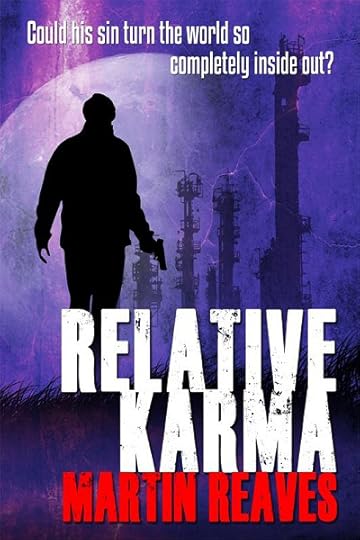
And if you are interested in more from me, click on the image below.



June 1, 2016
A List of Things That Don’t Make You A Writer
Are You a Writer? I mean, really???
A bit snarky, but too good not to share. Enjoy,
“Owning a laptop… Going to a coffee shop… Having a cat…”
Source: A List of Things That Don’t Make You A Writer


Martin Reaves's Blog

- Martin Reaves's profile
- 55 followers

