Cyndi Stuart's Blog
October 30, 2026
Make Mine a Double

I had a very specific idea of what a writer looked like. During the fifteen years I spent producing film and television, I crossed paths with just about every kind of creative person imaginable, each carrying the equipment of their particular species. Directors arrived with storyboards and cinematographers debated lenses with the solemnity of men discussing religion, while engineers unfolded blueprints until there was nowhere left to put your coffee. Producers like me carried schedules, budgets, and the slightly delusional confidence that everything would be finished by Friday because we’d already made the unfortunate decision to promise the client it would be.
The writers carried yellow legal pads that looked exhausted before the meeting began, their pages covered with scratched-out sentences, arrows running into margins and handwritten additions squeezed into spaces where no further thought should reasonably have fit. While we worried about delivery dates, they could spend fifteen minutes deciding whether a man should look out a window or stare out a window, until an engineer finally pointed out that the words meant essentially the same thing.
The writer explained that they didn’t feel the same, which made very little sense to me then and considerably more sense now. But of all the writers who wandered through our production company, the one who permanently became a writer in my imagination was Kevin, and nearly forty years later I still see his ashtray before I see his face.
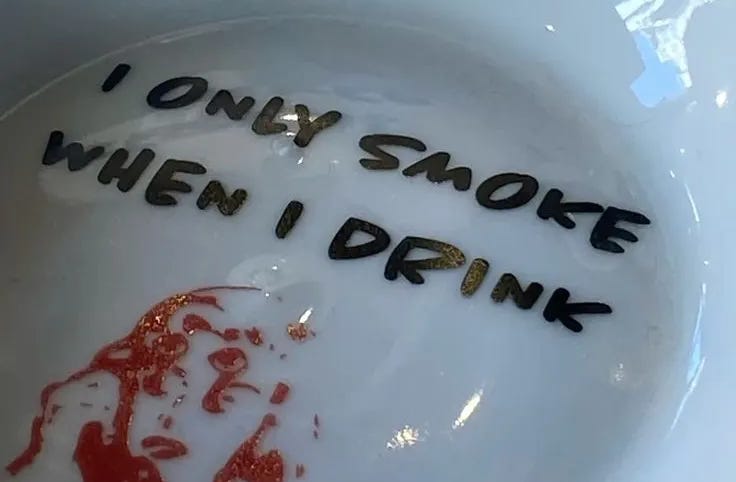
It was an enormous hand-blown bowl of dark glass with I ONLY SMOKE WHEN I DRINK written across it, a declaration usually accompanied by a crystal tumbler of eighteen-year-old Scotch. The bowl overflowed with Virginia Slim Lights Menthols, those impossibly long white cigarettes looking strangely delicate between the fingers of such a large man, their crushed remains collecting in a tiny burned forest on his coffee table.
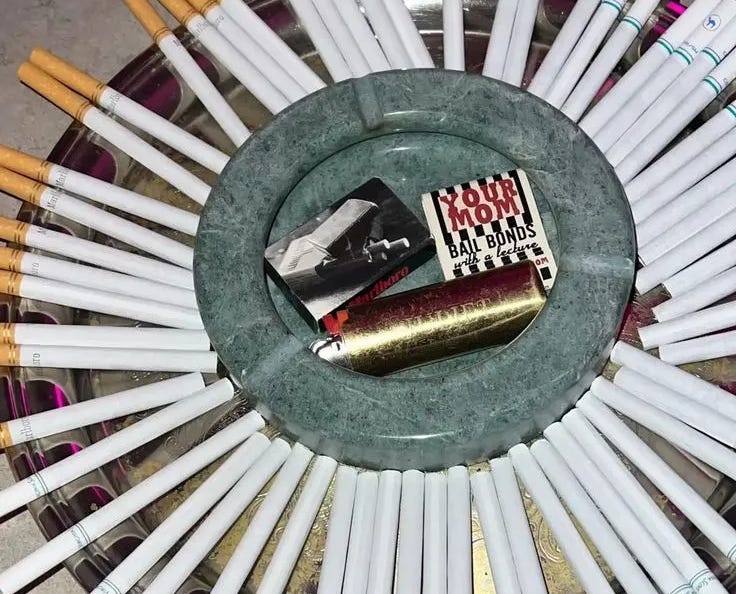
One of his more recent girlfriends had assembled an entire cigarette tray so he would never be more than an arm’s reach from a pack or a lighter, a level of romantic preparedness I’m not sure I’ve encountered before or since. Between that tray and the ashtray, she had apparently identified the practical requirements of loving Kevin and organized them within reach.
His house smelled of menthol smoke, Scotch, old books, wool and paper, with years of cigarettes worked so deeply into the furnishings that opening a window would have been less an act of ventilation than an insult to the architecture.
Kevin was a big man with skin so pale it was nearly translucent, as though sunshine had been offered to him years earlier and he’d politely declined. His long red hair slipped into his mouth while he talked and every few minutes he’d blow it away without losing his place in the story, then reach for another Virginia Slim and continue. He shuffled between rooms with a glass in one hand and a cigarette in the other, never appearing especially persuaded by anyone else’s need to hurry.
Once he started telling a story, you generally forgot whatever you’d been in a hurry to do. My favorite concerned his great-grandfather, whom Kevin swore had invented the escalator, and whether his family tree could withstand historical scrutiny hardly mattered once he had everybody leaning closer.
He could begin with machinery and somehow arrive at a person, which helped explain why Westinghouse, Respironics and MSA requested him by name. Engineers would sit across from him explaining equipment I barely understood while he smoked and scribbled until their specifications came back sounding like something a human being might care about.
Then one January morning ten Westinghouse engineers arrived at our production company for a script-development meeting, and Kevin failed to arrive with them.
Coffee steamed beside the blueprints and coats hung where we’d put them as nine o’clock became nine-fifteen and then nine-thirty, with the glances toward the conference-room door becoming increasingly directed at me. Apparently being the producer made the whereabouts of a missing writer during a Pittsburgh snowstorm another item on my list of responsibilities.
I smiled because producers become very good at smiling while internally calculating how many things are currently on fire, and announced that I was going to check with our chef about freshly baked croissants and an assortment of jams.
Then I grabbed my coat and ran to the car, leaving ten engineers temporarily in the care of breakfast pastries.
Snow softened Pittsburgh into shades of white and gray as I climbed the winding roads toward Mount Washington, the windshield wipers struggling while the seat heater attempted to restore feeling to my thighs. When I reached Kevin’s house, the snow was untouched, with no tire tracks coming out of the driveway and no footprints suggesting he’d attempted to leave.
I climbed the steps and knocked, waited, and knocked harder before trying the doorknob, which turned easily beneath my hand. Warm air met me as I opened the door, and the smell was so thoroughly Kevin I probably could have found the place blindfolded. Books stood in uneven towers along the walls and yellow legal pads occupied tables and chairs, their pages crowded with arrows and crossed-out sentences and handwriting considerably more energetic than their author.
Kevin was asleep on the living-room floor with his bathrobe open at the collar and his long red hair covering part of his face, one arm stretched toward an empty crystal tumbler just beyond his fingertips. For a few seconds I stood there listening to a clock tick somewhere behind me while ten Westinghouse engineers sat downtown waiting for this enormous pale man to explain their company back to them.
I went into the kitchen for a glass of water and knelt beside him, saying his name and touching his shoulder until his eyes opened. He looked at me without recognition and then toward the window and the clock, allowing me to watch the pieces slowly arrange themselves until his face changed.
“Oh… shit,” he said, which spared both of us the need for a lengthy discussion.
He pushed himself off the floor and disappeared down the hallway while I waited among enough secondhand smoke to develop a habit of my own. A few minutes later he reappeared in a wrinkled corduroy jacket with his hair only marginally improved and the faint smell of Scotch still traveling with him.
On the way out he reached for his yellow legal pad and announced, “Give me a double,” before taking a double shot of Scotch, apparently satisfied that he now had everything necessary to conduct business. I’d left ten Westinghouse engineers waiting over coffee and croissants while their writer was fortifying himself for the meeting with eighteen-year-old Scotch, and somehow I remained the person responsible for making sure this all went well.
Within a week another Kevin script landed on my desk, and nobody at Westinghouse seemed especially concerned that its author had required retrieval from his living-room floor. They loved the pages and asked for him again, which may have been when I decided writers operated under workplace rules unavailable to the rest of us.
For years afterward the word writer brought me straight back to Kevin’s living room, where smoke curled above the ashtray, and red hair fell across his face while a pencil moved over yellow paper. I certainly never imagined myself occupying that position, particularly since I’d already seen what could happen when the producer had to come looking for you.
At fifty-eight, I sat down to write my first book with none of the equipment I’d associated with the profession. I’d given up cigarettes years earlier, and Scotch was unlikely to improve my manuscript, while my habit of waking before dawn eliminated any need for someone to retrieve me through a blizzard.
Recently I’ve been writing even more than usual, often beginning while the windows are still black and the house is quiet enough to hear the coffee maker working. A few weeks ago I found an old oversized sweater in my closet, soft with age and stretched enough to fit comfortably over my pajamas, and pulled it on before sitting down at the computer. I wore it again the next morning and the morning after that until it became the thing I reached for before dawn without turning on the closet light.
One morning Tom found me in my pajamas and that sweater with my curls doing whatever they’d decided to do overnight and coffee beside the keyboard. I’d been moving a paragraph around long enough to rewrite it, read it aloud and put it back, eventually questioning the emotional integrity of one completely innocent comma.
He stood there taking in the sweater and the hair and whatever expression a woman wears after spending two hours arguing with words before sunrise.
“I guess you’re officially a writer now with that Hemingway sweater,” he said, leaving me to look down at what I was wearing and consider how this had happened.
For a moment I was back in Kevin’s living room with the menthol smoke and the eighteen-year-old Scotch and the red hair falling over a yellow legal pad, while somewhere downtown ten engineers waited for a script meeting to begin.
Nearly forty years later, I was sitting in my pajamas before sunrise wearing an old sweater and refusing to move on until a sentence felt right, which meant Kevin had finally made his point about looking out a window versus staring through one.
God help me if Tom ever brings home an ashtray because I’m beginning to understand how a girlfriend might decide the most useful thing she could do was organize the equipment.

Random Thoughts From the Shady Side 🌸
These are the stories that wander into my head while I’m drinking coffee, digging through closets, arguing with commas, or remembering people I haven’t thought about in forty years. Some become bigger stories. Some are simply thoughts I couldn’t leave alone.
If you’re new here and want to wander a little deeper into my life, the longer stories live here: Read more from The Shady Side → The Shady Side of Friendship
Fair warning: it gets considerably shadier from there.


October 28, 2026
Down the Rabbit Hole

I’m writing about a narcissist, which means I’ve spent the better part of the afternoon trying to make a man take responsibility for his behavior, and apparently even fictional men would rather add another eighty pages to a manuscript than admit they’re wrong.
The surprising part is that, as I’m learning to write, the writing itself is getting easier. I can follow Sophia into a scene in The Other Species, hear the conversation, feel where something shifts, and finally understand what needs to happen next, which would be a lovely development if my actual life would stop approaching my desk with questions. I had assumed learning to write a novel would be the difficult part, but apparently the advanced course is getting everyone to let you finish a goddamn paragraph.
Sophia is beginning to recognize how thoroughly someone has rearranged her reality, and I’m following the conversation carefully because this is the moment when his charm slips just enough for her to see what’s underneath. I know what he’s about to say, I know why she’s going to believe him, and for once I can see exactly how to get it onto the page when Tom appears in the doorway and asks whether I want chicken.
I look up at him, apparently unaware until this moment that someone could walk into a psychological crime scene carrying a dinner option. Of course I want chicken, because maintaining a human body apparently requires me to participate in a food selection process every single day until I die. I had briefly forgotten about dinner while trying to understand how a woman loses faith in her own mind, but thank God someone is staying on top of the poultry.
I tell him chicken is fine, which I foolishly assume concludes my involvement, but he would also like to know how I want it prepared, and now we’re in preproduction. There will be a concept, a discussion of available ingredients, and possibly a location scout through the refrigerator before we can secure final approval on a meal I would happily eat standing over the sink if it meant I could get back to the sentence that was here before the chicken arrived.
Tom is being considerate, which makes it especially inconvenient that I’m experiencing his kindness as an assault on my central nervous system. He isn’t doing anything wrong, and I’m aware of that even as I stare at him with the strained patience of a woman being asked to choose salad dressing during a hostage negotiation.
By the time we establish dinner, I return to the screen and discover that the sentence has left without providing a forwarding address. I read the paragraph again, hoping it will recognize me and let me back in, but now all I can hear is a question about chicken preparation, and I’m fairly certain the narcissist is enjoying this.
What I need is for someone who knows how to do this to explain how you write a book while continuing to be a reachable, reasonably pleasant member of a family. There must be a technique, a sign, or a particular facial expression that communicates how deeply I love you while also making it clear that if you ask me where we keep the aluminum foil, I may have to leave the country.
Explaining that I’m writing seems to be interpreted as an update about my current seating arrangement, because I’m still here, after all, sitting in a chair in our house, which apparently makes me available for any matter that can be introduced as a quick question. I would like to meet whoever decided those were reassuring words, because the question may take four seconds, but getting my brain back into the scene requires me to rebuild the entire emotional atmosphere while trying to remember why somebody was standing near a window.
I can no longer remember whether she was about to leave him, confront him, or finally understand him, but I can now confirm that we have mustard.
Alice had the advantage of falling down a rabbit hole that physically removed her from the people who might need to discuss dinner. I go down mine while remaining visible from the hallway, which feels like a serious flaw in the design.
Then the phone rings, and it’s someone I love, so naturally I answer, because I want to hear from my family and apparently would also like to finish a novel sometime before my characters qualify for Social Security. We talk, I make a note of something I need to do, and when I return to Sophia, I find her waiting in the same awful situation where I abandoned her. At this point, I’ve left this woman alone with a narcissist so many times to handle household business that she should probably be questioning my loyalty.
I finally get moving again, and that’s when my bladder decides it would like a meeting, because apparently my own organs have been watching everyone else interrupt me and would like equal access.
Naturally, the line I’ve been struggling with arrives while I’m in the bathroom, because my brain is an asshole with a gift for scheduling. Now I’m repeating a sentence under my breath while washing my hands, trying to preserve its exact wording as though I’ve been entrusted with nuclear codes, when something outside catches my eye.
There’s a turtle, which means we must now determine whether a creature that has survived through millions of years of evolution requires immediate supervision from a woman who cannot remember why she walked into the kitchen.
The freshwater canal was supposed to be peaceful, but apparently I moved beside a wildlife channel with no ability to pause the programming. Something swims past, something lands, something rustles in the grass, and there I am at the window, investigating with the urgency of a detective whose only lead is a suspicious leaf. I would like to blame every interruption on other people, but unfortunately there is substantial evidence that I’m also a problem.
Still, surely there’s a way to learn this, because I’ve built businesses, worked in production, and managed projects with enough moving parts to require actual crews. I should be capable of arranging an hour in which nobody needs anything from me, including me, yet somehow that has become the most ambitious production of my career.
I’m beginning to wonder whether this is why writers go away to finish books, and whether those secluded cabins and remote retreats have less to do with artistic inspiration than with being somewhere nobody can ask whether the dishwasher is clean. I used to picture a writer gazing over a misty lake, waiting for the muse, and now I suspect she’s sitting there in yesterday’s clothes, practically weeping with gratitude because she has completed three consecutive thoughts without discussing a side dish.
I understand her completely, and if someone could forward the address before the next household consultation, I would appreciate the opportunity to investigate availability.
Just as I’m beginning to understand the appeal of geographic isolation, Tom receives a new sound system and decides this would be an excellent time to determine whether the bass can rearrange the internal organs of everyone living along the canal. Apparently, plugging it in and confirming that music comes out would be an insult to the technology, so we must now establish whether it can communicate with submarines.
I feel the first vibration through my chair while I’m deciding whether to kill the narcissist or set myself on fire, and then I hear Norah Jones singing “Come Away with Me,” because my husband knows it’s one of my favorite songs and has apparently decided to make this interruption emotionally impossible to prosecute.
Had he played something I hated, I could have marched into the other room with a legitimate grievance, but now the inconsiderate bastard is being thoughtful, and I have to factor that into my response.
From the other room, Tom wants to know how it sounds, and I’m trying to find an answer that adequately conveys the experience of being married to a man who remembers what I love and would like me to appreciate it at the exact moment I’m writing about a man who weaponizes affection. It’s a fairly complicated emotional transition to make while the desk is vibrating, so I settle for telling him it’s loud, although I had hoped the movement of the furniture might have conveyed that without my needing to participate.
He adjusts something, which briefly raises my hopes until I realize we’re testing a different setting rather than pursuing silence. Apparently, my feedback has been received as a technical observation, and now we need to explore the full range of ways Norah can prevent me from finishing this book.
I have spent forty minutes getting inside Sophia’s head, and my husband has just booked her a live performance.
Tom would also like to know whether I can hear the bass, which seems like a question I should be permitted to answer after my teeth settle. Somewhere beneath my feet, I assume the turtle is experiencing a change in water pressure, while inside the house I’m being invited to come away with Norah at a volume that suggests leaving is no longer optional.
The truly aggravating part is that I love the goddamn song, so now I’m listening, which means I’ve lost the scene, but I can’t even commit to being furious because he chose it for me. I’m sitting there with affection, irritation, and a fictional narcissist all competing for space in my head, while my husband is having a wonderful afternoon demonstrating the depth of his new speakers.
I get up and go to the doorway, where Tom is studying his equipment with the absorbed expression I had been hoping to wear at my desk. I explain that I’m trying to decide what happens to the narcissist, and after establishing which man I’m referring to, he reaches for a control and directs my attention to a part of the song he would particularly like me to hear.
I stand there while one of my favorite songs fills the room, looking at a man who has remembered something sweet about me and chosen the worst possible moment to turn it up. Norah wants me to come away with her, Tom wants me to hear the bass, and Sophia would probably like me to return to work before she has to survive the rest of this relationship without adult supervision.
What I cannot imagine is writing horror, because I’m already getting up from this desk emotionally aggravated by a man I invented. If I spent six hours convincing myself there was something breathing behind a basement door and Tom suddenly appeared to ask about potatoes, one of us would require medical attention, and the other would have to explain to the paramedics why dinner was involved.
At least with a narcissist, I know what the monster wants, although getting him to admit it could take the rest of the series.
Eventually I sit down again, read far enough back to remember where I was, and feel the scene returning. Sophia says something that surprises me, his response arrives immediately, and for a few wonderful minutes I’m following them without noticing the room around me, until Tom wants to establish what time I would like to eat.
I turn toward him with the expression of a woman who loves her husband very much and is actively pricing cabins, then ask for five minutes before returning to a fictional man who also believes everybody else should adjust their expectations around him. The irony is offensive, and I would appreciate some privacy while I write it down.
By this point, taking my work outside seems like a reasonable compromise, because surely I can put a little distance between myself, the music, and the ongoing banter without actually abandoning my marriage or applying for a residency in a lighthouse.
I head outside with whatever remains of my concentration, prepared to accept the peaceful embrace of nature, and a crow immediately decides this would be an excellent time to deliver an announcement at the absolute limit of his capabilities.
I don’t know what he’s saying, but judging by the volume and repetition, he either owns this property or has been trying to reach me about my car’s extended warranty.
I wait for him to finish, because apparently I have learned nothing today about the dangers of assuming an interruption has a natural conclusion. He takes a breath just long enough for me to believe we’ve reached an understanding, then resumes with the confidence of someone who has a microphone and no intention of respecting the program.
Inside, my husband is testing the bass, while outside, this feathered son of a bitch is testing the treble, and I have somehow become the unwilling audience for a sound check that now includes the entire fucking ecosystem.
I look toward the canal, where the turtle continues about his business without a phone, a dinner decision, or anyone asking him to appreciate a new speaker, and briefly envy a creature whose primary obligation is getting to the other side of something.
Whatever advice experienced writers might have about working through distractions, I would love to hear it on a day when I haven’t already been defeated by poultry, plumbing, wildlife, and one of my favorite songs.
For today, I’m giving up and leaving Sophia exactly where she is, because I have reached the point where a fictional woman trapped in a terrible relationship has had more uninterrupted time with her thoughts than I have.
I head back inside to find out what we’re doing with the chicken, because today is apparently not a writing day, and if the crow has an opinion about dinner, he can come in and discuss it with Tom.
By now, I’ve decided it’s time to mix a vodka cocktail and watch the iguana walk the seawall, because apparently I can spend the afternoon supervising every species in Florida except the one I’m supposed to be writing about. He seems perfectly capable of getting where he’s going without consulting me, which immediately makes him one of my favorite people.
And because my publicist would probably prefer that this afternoon result in at least one attempt to sell a book, here’s the link to Dressing Room Confessions, book one of the Shady Side series, which I did somehow manage to finish despite living in an environment where even the birds refuse to respect office hours.

October 25, 2026
H Is for Heroin

You tell yourself this is the last time you’re giving them money, and you mean it right up until the moment they call with another emergency. You recognize the story because you’ve heard a dozen versions of it before, but something in their voice sounds frightened, and suddenly you’re imagining what might happen if you refuse. So you reach for your wallet, knowing perfectly well that you’ll hate yourself for it tomorrow, and spend the rest of the evening wondering whether the money bought groceries, paid a bill, or disappeared into something you don’t even want to think about.
The next morning you promise yourself you’ll be stronger, although by now you’ve made that promise so many times it has become almost embarrassing. You stop leaving cash on the kitchen counter, begin keeping track of your prescription bottles, and develop the peculiar habit of checking your jewelry before and after family visits. You know how awful that sounds, particularly when the person you’re watching is someone you love, but you’ve already learned what happens when you don’t pay attention, and there’s only so much missing money you can blame on your own forgetfulness.
The worst moments aren’t necessarily the arguments or the things that disappear. Sometimes they’re the perfectly ordinary conversations when the person sitting across from you laughs at something you’ve said, reaches for another cup of coffee, and looks so much like the person you remember that you almost convince yourself the nightmare is over. You find yourself enjoying their company, relaxing for the first time in weeks, and then notice something small that doesn’t quite add up. A nervous glance at the telephone, an explanation that changes halfway through, or an unexpected request for money, and suddenly you’re back to studying every word, wondering which parts of the conversation were real.
And then there are the nights when you can’t reach them, when anger gradually gives way to worry and worry becomes the kind of fear that makes you consider calling hospitals. You lie awake rehearsing the lecture you’re going to deliver when they finally answer, determined that this time you’ll tell them exactly what their behavior is doing to everyone who loves them. But when the telephone finally rings and you hear their voice, the lecture disappears because they’re alive, and for that moment you’re willing to forgive almost anything.
Before Isabella, I knew almost nothing about heroin. As far as I was concerned, it was one of those drugs rock stars took, something associated with backstage dressing rooms, trashed hotel suites, and musicians who occasionally turned up dead before their next album was released. It belonged to a world so far removed from my own that I had never given it much thought, and I certainly never imagined it would find its way into my family.
I didn’t know what it looked like, how it was sold, or how completely it could take over someone’s life. I had no idea what eight little bags of heroin meant, why people would steal from their own families to get it, or how quickly a mother could find herself behaving like someone who belonged in a crime novel.
But I was about to find out, and somewhere along the way I would become so desperate to save my daughter that I would start doing things no reasonably intelligent woman should ever consider. Including tracking down the man who was selling it to her.
October 24, 2026
Your Place or Mine?

Many of you have written asking what happened to the friendship I told you about after The Shady Side of Friendship reached thousands of readers, so pull up a chair; I owe you the rest of the story. When I followed that article with a Note asking your opinion about repairing a friendship we hadn’t spoken in six months, I was giving a birthday text considerably more thought than a woman who has survived my life should reasonably give a telephone.
Let’s call her Molly and her partner Scott, a man from the UK whom Tom and I met in the Dominican Republic nearly five years ago and eventually introduced to Molly. The matchmaking deserves its own story, and fortunately I already have it drafted and waiting for you, a follow-up to It’s Easier to Find a Husband Than a Job called The London Club. We were very successful at putting these two together, although apparently I’d had better luck arranging her love life than managing our friendship.
I knew she was in the UK with our friend for her birthday and set an alarm to send my wishes, which eventually led to lunch halfway between our homes. Four hours later neither of us wanted to leave, and we were talking about how we used to live in the same apartment building, where we’d met at the pool and fallen into daily walks and burgers on the grill before usually ending up in my apartment.
Then Tom and I moved an hour away to a freshwater canal home closer to our adult children, and popping over became a two-hour round trip, requiring more coordination than finding each other downstairs in swimsuits. Before we could turn another lunch into a negotiation between calendars, I suggested a weekend at our place, and Molly said yes immediately.
For a week we happily discussed the menu and what she should bring, with the guys’ favorite cigars and Dominican beer already on the list for old times’ sake. We planned swimming and an arrival before sunset while I settled on ribs, my famous cornbread soufflé and corn on the cob, apparently determined to welcome our British friend with enough corn to qualify for an agricultural subsidy.
I’d also insisted on proper pool loungers with cup holders because if we were going to discuss the next chapter of our lives, I wanted to do it reclined with somewhere to put my drink. Tom spent considerable time inflating them while I handled the food, each of us contributing to what I envisioned as a rather lovely little getaway.
By the time their suitcase rolled through the door, the ribs were slow roasting over a bed of sauerkraut and onions, and the soufflé was cooling, leaving the kitchen smelling like dinner before anybody needed to sit down and eat it. They settled into a guest suite facing the pool while I mixed our favorite cocktails and Molly changed into her swimsuit, giving me just enough time to finish the drinks before joining her.
Our lanai stretches into an outdoor living room and dining area with the outdoor kitchen nestled along the canal, where we can spread out without getting so far apart that anyone misses the story. The pool has no screen enclosure, one of the reasons we loved this home from the beginning, although the birds occasionally land on our furniture as though we arranged it specifically for them.
Fishermen float past and wave, and sometimes we watch them reel in a fresh bass without leaving our seats, while iguanas appear along the water and the burrowing owls next door conduct their business. With bunnies around the property and birds overhead, we have a steady stream of visitors who arrive unannounced and contribute absolutely nothing toward the upkeep.
We’re also close enough to the shrimping boats to buy freshly caught shrimp from a local guy whose grandfather used to sell us shrimp from the back of his truck. After years of reading menus that explain a shrimp’s upbringing before revealing what it costs, I’m perfectly happy to bring ours home and prepare dinner in our own kitchen.
That afternoon our quick dip became two hours in the pool while the guys caught up and the ribs continued cooking without requiring me to participate. My daughter dropped in with a friend from Pittsburgh, and we invited them to stay for dinner, adding two plates without consulting a hostess who needed to determine whether six people could occupy a table intended for four.
The food made its way to the table, and the laughter continued for hours, uninterrupted by a recitation of specials requiring more concentration than the conversation we’d come to have. I didn’t need anyone to explain that dinner had been lovingly prepared because I was sitting right there, available to accept compliments whenever there was a natural opening.
Afterward everyone helped load the dishwasher while I turned on the lanterns and lit candles on the lanai, giving us somewhere to settle as daylight faded over the canal. We talked about states we hadn’t seen and music we wanted to find tucked into cities like Nashville, following possible trips beyond the usual suggestion that we ought to go someday.
The guys wandered into aviation and sports cars while Molly and I talked about their new home and the visit that would soon have us arriving at their door with a suitcase of our own. Somewhere among the destinations we got into longer conversations about how we wanted to spend the next chapter of our lives, with time to follow a thought without somebody asking whether we’d like dessert just as we reached something worth staying for.
At a restaurant we might have ordered an eighteen-dollar interpretation of cheesecake to keep the table a little longer, but here I could pour another drink while their suitcase remained down the hall.
The next morning they were still there, and they’d brought fresh Danish, which required considerably less attention than the ribs and left me free to percolate the coffee. We settled on the lanai with pastries and picked up conversations from the night before while the birds carried on overhead, and our laughter roared down the waterway.
There are still days when I miss the manicured medians of Naples, where even the landscaping looks as though it has a standing appointment with someone who knows exactly what to trim. Those days usually pass around 9:15 when my favorite flock of white ibises takes flight in the distance, at least twenty-five of them lifting above the canal with their black wingtips showing against all that white.
This is where I’ll finish The Other Species and The Reel Crime, although the people in those books now compete with everything outside my window. Fifth Avenue supplied plenty of characters, but the birds have developed a habit of interrupting their arguments, and I’m finding myself considerably more willing to look up from the page.
My closet still holds the dinner dresses and fancy clutches with shoes to match, while the swimsuits and loungewear keep multiplying and getting considerably more use. We’ve all done the black-tie events and small talk bullshit dinners that end with a bill suggesting we’ve purchased an interest in the building, and lately I’m enjoying a dining arrangement where my shoes are optional.
Tom and I moved here a little over six months ago to be closer to our children and create a sanctuary where friends could escape for a weekend, and somehow we haven’t been out to dinner since. When we talk about the rest of our lives, these are the weekends we want more of, with family pulling up another chair and friends staying long enough that we need to figure out what everybody wants for lunch.
Molly and I decided over breakfast that we hadn’t had nearly enough pool time and went to find our swimsuits while Tom loaded the dishwasher, returning to our loungers before the day could require anything more ambitious. With all six sliding glass doors open, I could yell inside that we needed a snack without making the considerable effort of getting out of the water.
Tom investigated the refrigerator and emerged a few minutes later with a pool-appropriate plate holding crackers, cheese, olives, last night’s beautifully marinated sauerkraut and beets for color. Molly and I laughed hysterically at the realization that this man had opened a refrigerator full of possibilities and decided two women in a swimming pool needed a selection from the agricultural regions of Eastern Europe.
We only had to look at each other to start again, and somewhere in the middle of it my carefully selected lounger began losing air, slowly lowering me into the water like a woman whose complimentary upgrade had been revoked. Tom had spent all that time inflating the furniture, and I’d spent a week planning the menu, only for us to end up with poolside cabbage and a lounger that apparently converted into a submarine.
By the time my curls were soaked, Molly’s laughter was echoing down the canal, and our Martha Stewart getaway had veered into territory Martha would probably decline to endorse. After six months of silence, neither of us could get a sentence out again, although this time we only had to look at each other to understand exactly why.
Somewhere between the sauerkraut and the sinking raft, our friendship slipped right back into place, with no reservation required and Tom standing beside the pool holding the beets.
If you’ve ever found yourself laughing with a friend over something nobody else would understand, you’ll recognize the women in Dressing Room Confessions, my first novel, where friendship gets tangled up with secrets, questionable decisions, and the things we finally admit when we’re comfortable enough to stop pretending.
There’s room for you in that circle too, although I can’t promise those women will behave as well as our weekend guests, and I certainly wouldn’t leave them alone with your husband or your best shoes. 🌸
October 21, 2026
The Casanova in a Speedo

I’ve often wondered who first decided that men should be allowed to parade around in public wearing a scrap of fabric barely large enough to cover the family jewels. Apparently, the idea goes back thousands of years, when ancient civilizations were perfectly content to send their men into the world wearing loincloths, and somewhere along the way, a clever Australian swimwear company decided that what modern civilization really needed was a smaller version made of stretchy fabric. By 1956, the Speedo brief had arrived, and early wearers on Australia’s Bondi Beach reportedly encountered the police over questions of public decency, which suggests that even the Australians, a people hardly known for being prudish about swimwear, occasionally felt that enough was enough.
Personally, I believe the invention should have come with a warning label, although I suppose that would have required more fabric than the designer was willing to provide.
The Shady Side is a reader-supported publication. To receive new posts and support my work, consider becoming a free or paid subscriber.
Now, ladies, before you start imagining Brad Pitt emerging from the Mediterranean with water dripping down his magnificent chest and a tiny Speedo hugging every inch of his beautifully sculpted physique, I should probably explain that the gentleman at the center of my story looked considerably less like a Hollywood leading man and considerably more like the fellow who had eaten one.
His name was Jeffrey. And he had absolutely no idea that the rest of us might have preferred a little more mystery.
Jeffrey was built like a brick shithouse, although not in the muscular, broad-shouldered sense that expression usually suggests. He was considerably more generous around the middle, with a belly that hung proudly over the waistband of his Speedo, a balding head that reflected the afternoon sunshine and a pair of perpetually rosy cheeks that suggested he’d been enjoying the country club bar considerably more than the fitness facilities. His chest was covered in enough hair to require its own landscaping service, and nestled somewhere in that luxurious undergrowth was an assortment of gold chains that bounced cheerfully against his stomach whenever he walked. The Speedo itself was a masterpiece of misplaced optimism, a tiny triangle of fabric attempting to maintain diplomatic relations between body parts that had absolutely no intention of cooperating.
And yet Jeffrey would parade around that swimming pool with the magnificent confidence of a man who believed every woman reclining beneath those striped umbrellas had been waiting all afternoon for his arrival, occasionally pausing to survey the scenery while the rest of us silently contemplated whether the country club might consider introducing a dress code requiring men to wear enough fabric to qualify as clothing. I have to applaud that kind of self-assurance because there is something almost inspirational about a man who can look in the mirror, see what Jeffrey saw, and decide that the only thing standing between himself and irresistible sex appeal is a smaller bathing suit.
Personally, I would have preferred a much larger one, possibly accompanied by a bathrobe, but Jeffrey was not a man who concerned himself with the delicate sensibilities of his audience.
His wife was often sitting somewhere beneath those striped umbrellas, enjoying the same country club lifestyle that had brought Jeffrey into my social circle, which made what happened one afternoon in my women’s clothing boutique considerably more interesting. Because Jeffrey walked through my front door with a woman who most definitely wasn’t his wife. And she was spectacular.
〜〜〜 ❀ 〜〜〜
The Showstopper
She was young, Black, and drop-dead gorgeous, with flawless skin, magnificent curves, and the sort of figure that made you wonder whether God had been feeling particularly generous the day she was assembled. Her neckline plunged toward territory that most women reserved for their honeymoon, and the clothes she wore seemed less interested in covering her body than celebrating its considerable accomplishments. She moved through my boutique with the easy confidence of a woman who knew exactly what she had to offer and had never experienced much difficulty attracting an appreciative audience.
I watched her glide toward the clothing racks before turning my attention to the gentleman accompanying her, who was following a few steps behind with the satisfied expression of a man who had just won the lottery and was personally acquainted with every woman selling tickets.
Oh, Jeffrey.
If ever there was a man who had received an extraordinarily generous helping of self-confidence without the corresponding physical attributes, it was Jeffrey, although I had to admit that his ability to attract beautiful women suggested he possessed certain talents that weren’t immediately apparent beneath his country club attire. Standing beside this magnificent young creature, he looked like a wealthy uncle who had somehow wandered into the wrong photograph, and yet there was nothing remotely paternal about the enthusiasm with which he watched her select one revealing outfit after another.
She lifted dresses from the racks and held them against her figure, examining the effect in the mirror while Jeffrey hovered nearby with the delighted expression of a man who had absolutely no objection to spending money when the results were going to be displayed on a beautiful woman. I knew his wife well enough to recognize that this wasn’t her, but I had no intention of interrupting what appeared to be a very promising shopping expedition to inquire about the particulars of their relationship.
After all, I was running a boutique, not conducting marriage counseling, and the gorgeous creature examining my merchandise looked as though she could do considerable damage to a credit card if properly encouraged.
Jeffrey reached for his wallet and produced a black American Express card with the casual confidence of a man who had never been personally acquainted with a spending limit, and somewhere between the dressing room curtains and the cash register, I began to appreciate him in an entirely new way.
I had no idea that this was the beginning of one of the most entertaining chapters of my retail career, or that the gentleman standing in front of my cash register would eventually require more administrative attention than some of my wholesale accounts.
At the time, I was simply delighted to have another customer with excellent taste in expensive clothing and absolutely no apparent interest in discussing the prices.
〜〜〜 ❀ 〜〜〜
The Black American Express Card
There is something wonderfully liberating about dressing a woman whose shopping companion has no interest in the price tags, particularly when you own the boutique and have a rather substantial collection of beautiful clothes that need to find appreciative homes. I had spent years learning how to recognize what made a woman feel extraordinary, whether it was a beautifully tailored jacket, a dress that skimmed her curves in exactly the right places or a neckline that suggested she had absolutely no intention of spending the evening discussing the weather. Jeffrey’s gorgeous companion was particularly fond of the latter.
She loved clothes that showed off her figure, and I could hardly blame her because she possessed the sort of body that designers dream about and other women occasionally curse while standing in front of their bedroom mirrors. Jeffrey seemed delighted by every selection, and the more daring the outfit, the more enthusiastic he became about purchasing it, which struck me as an excellent arrangement for everyone involved, especially the woman behind the cash register.
The black American Express card soon became a familiar fixture in my boutique, appearing with such regularity that we eventually kept it on file. Jeffrey’s purchases could run to three thousand dollars a month, which was a considerable amount of money to spend on women’s clothing, even in a boutique where the merchandise wasn’t exactly intended for bargain hunters. I appreciated his generosity enormously, although it gradually became apparent that his enthusiasm for outfitting beautiful women extended well beyond the spectacular creature who had first accompanied him through my front door.
There were five girlfriends altogether, in addition to the wife who also happened to shop in my boutique, although I can only remember three of those women with any clarity. There was the magnificent young Black beauty who had first accompanied Jeffrey through my front door, the long-haired blonde preparing for a romantic adventure in Las Vegas, and Miss Morton Salt, an educated chemical engineer whose presence at Jeffrey’s expensive business dinners added another fascinating dimension to his extracurricular activities. The other two have disappeared into the fog of my retail memories, which is probably understandable considering I was running a women’s clothing boutique and not the Pittsburgh branch of the Federal Bureau of Romantic Investigations. What I do remember is that Jeffrey’s black American Express card was financing an extraordinary amount of women’s clothing, and somewhere between his wife and five girlfriends, I had apparently become the unofficial wardrobe mistress to an entire romantic empire.
Keeping track of which woman belonged to which purchase eventually required more than my usually excellent memory, particularly since Jeffrey’s wife was also a customer and I had absolutely no desire to witness a marital catastrophe unfold between my designer clothing racks. My employees and I began keeping index cards documenting the purchases, an arrangement that would have seemed completely ridiculous under ordinary circumstances but became increasingly sensible as Jeffrey’s collection of beautifully dressed women continued to grow.
I sometimes wondered whether Jeffrey maintained a similar filing system at home, because I could barely remember which girlfriend preferred which designer without consulting my little cards, and he was presumably expected to remember considerably more intimate details about each of them. Birthdays, anniversaries, favorite restaurants, promises made over candlelit dinners and the occasional explanation for why he couldn’t possibly spend the weekend together must have required a level of concentration generally reserved for air traffic controllers.
Yet Jeffrey moved through his romantic adventures with the cheerful confidence of a man who had never encountered a problem that couldn’t be solved with a generous expense account and a little creative scheduling. And I kept selling clothes.
〜〜〜 ❀ 〜〜〜
The Showstopper Had Plans
The beautiful young woman who had first accompanied Jeffrey into my boutique remained the most memorable of his girlfriends, partly because she was so extraordinarily attractive and partly because she seemed to have considerably greater ambitions than simply enjoying the occasional shopping spree. She wanted Jeffrey to leave his wife.
Now, I have always believed that beauty is a powerful advantage in life, particularly when accompanied by intelligence, confidence, and the ability to recognize when someone is selling you a rather questionable version of the future. This woman certainly possessed the beauty and confidence, although her determination to turn Jeffrey into a permanent romantic partner left me wondering whether she’d fully considered what she was attempting to acquire.
I could understand enjoying his generosity, appreciating the beautiful clothes and perhaps even finding something endearing about his larger-than-life personality, but the prospect of spending the rest of one’s life watching Jeffrey parade around a swimming pool in a Speedo seemed like a rather substantial commitment for a woman who could presumably attract a gentleman with a more flattering relationship to Lycra.
Nevertheless, she was clearly smitten, and Jeffrey appeared to enjoy every moment of her attention. There was something almost comical about seeing them together, this magnificent young woman whose body seemed designed for magazine covers and the balding, rosy-cheeked executive whose gold chains suggested he had once mistaken a jewelry counter for a buffet. She had the appearance of a woman who might be photographed stepping off a yacht in Saint-Tropez, while Jeffrey looked like the gentleman who had sold the yacht and insisted on appearing in the publicity photographs.
Yet she wanted him.
Not simply his credit card or the clothes or the dinners, although those were certainly pleasant additions to the arrangement, but the man himself, complete with his belly, his jewelry and the rather inconvenient wife who occupied the position she hoped to inherit.
I never knew exactly what Jeffrey promised her, and I wouldn’t pretend to have been present for the private conversations that took place between them, but I knew she wanted more than the role she currently occupied. There is a particular kind of optimism required to believe that a man who has already accumulated a wife and several girlfriends will suddenly discover the joys of monogamy once he has selected you as the winner, and I suppose romantic hope has never been especially interested in statistical probability.
What I found particularly fascinating was that Jeffrey, despite his rather generous interpretation of marital fidelity, had some extremely traditional expectations about the behavior of the women who loved him. I discovered just how traditional one evening when I stopped at a restaurant and found myself sitting at the bar, minding my own business, before being invited into one of the most spectacular displays of male hypocrisy I’d ever witnessed.
〜〜〜 ❀ 〜〜〜
The Audacity of Jeffrey
I was sitting at the bar enjoying my evening when I noticed Jeffrey having dinner with his gorgeous young girlfriend. They spotted me and invited me to join them, which seemed like a perfectly pleasant way to spend the evening, particularly since I knew them both and had already spent a considerable amount of time helping the young woman assemble a wardrobe financed by Jeffrey’s seemingly inexhaustible American Express card. I joined them at their table expecting the usual conversation that accompanies a nice dinner, completely unaware that I was about to find myself in the middle of a romantic argument that would have been worthy of its own television special.
Somewhere during dinner, the subject of another man came up, and Jeffrey discovered that his beautiful young girlfriend had apparently been seeing someone else. The atmosphere changed as his irritation became increasingly obvious, and I found myself watching a man with a wife and five girlfriends become genuinely outraged by the possibility that one of those girlfriends might have a romantic life that didn’t revolve exclusively around him.
Now, I’ve witnessed some extraordinary examples of male behavior over the years, but there was something particularly entertaining about sitting across from a married gentleman who had practically established his own romantic franchise while listening to him object to the possibility of competition. His perpetually rosy cheeks seemed especially appropriate for the occasion, and the more upset he became, the more fascinated I was by the extraordinary workings of his mind. Here was a man who had managed to maintain enough female companionship to require an index-card system at my boutique, yet he apparently believed the beautiful young woman sitting beside him should reserve her affections exclusively for the gentleman paying her clothing bills.
The woman sitting with us was young, stunningly beautiful, and perfectly capable of attracting the attention of men who didn’t require a country club membership and a black American Express card to compensate for their physical shortcomings. Jeffrey, meanwhile, was behaving like a Victorian gentleman whose beloved fiancée had been discovered in the arms of the village blacksmith, apparently oblivious to the fact that he was simultaneously maintaining enough romantic relationships to require the administrative assistance of my boutique employees. I kept watching him, waiting for some flicker of recognition that perhaps he wasn’t in the strongest position to demand exclusivity, but nothing about his expression suggested that the irony had occurred to him.
What fascinated me most was the conviction behind his outrage, because Jeffrey wasn’t pretending to be jealous or putting on a performance for our benefit. He genuinely seemed to believe that his girlfriends owed him a level of devotion he had absolutely no intention of offering in return, and I found myself imagining the sort of romantic contract a man like Jeffrey might devise if someone foolishly allowed him to write the rules. Naturally, he would retain unrestricted access to every attractive woman within his national sales territory while the ladies would be expected to remain faithfully at home, beautifully dressed in the clothes he’d purchased, awaiting their next scheduled appointment with the great man himself. Any unauthorized fraternization with another gentleman would presumably constitute a serious breach of contract, punishable by an extended lecture over dinner and perhaps the temporary suspension of shopping privileges.
By the time the evening was over, I was still trying to understand how a balding, overweight country club Casanova with five girlfriends and a wife had managed to convince himself that he was the injured party in someone else’s infidelity, although I suppose a man who could stroll around a swimming pool in a tiny Speedo with his belly hanging over the waistband and a collection of gold chains nestled in his chest hair had long ago developed a remarkable immunity to self-examination.
I had walked into that restaurant hoping to enjoy an ordinary evening at the bar and somehow ended up with a ringside seat to Jeffrey’s personal interpretation of fidelity, which apparently required everyone involved to be faithful except Jeffrey. And to think I hadn’t even needed to buy a ticket.
〜〜〜 ❀ 〜〜〜
Miss Morton Salt
Then there was Miss Morton Salt, a woman whose presence in Jeffrey’s romantic collection was particularly interesting because she was a chemical engineer, an educated professional who seemed perfectly capable of navigating complicated technical problems while somehow finding herself entangled in the romantic arrangements of a married man with five girlfriends.
Jeffrey’s business dinners at Morton’s were expensive affairs, the sort of evenings where substantial steaks arrived on white tablecloths, wine flowed generously, and the bill could make an ordinary person reconsider the wisdom of ordering dessert. Miss Morton Salt was part of that world, accompanying him to dinners that blended professional entertaining with his rather enthusiastic pursuit of female companionship.
I found her fascinating because she didn’t fit the easy stereotype people sometimes attach to women involved with married men. She was educated, professionally accomplished, and presumably accustomed to evaluating complex situations with the careful precision required in engineering, yet here she was participating in a relationship that seemed to defy every principle of sensible risk management.
Of course, love and common sense have never enjoyed a particularly reliable working relationship, and Jeffrey was living proof that a man didn’t need movie-star looks to inspire extraordinary lapses in judgment. I called her Miss Morton Salt in my own mind because of those dinners, although the nickname also seemed appropriate for a woman who had wandered into one of the saltiest romantic arrangements I’d encountered.
By then, I was beginning to appreciate that Jeffrey didn’t simply have a preference for one particular type of woman. His interests were considerably more diverse, ranging from spectacular young beauties who favored plunging necklines to educated professionals who could presumably explain the chemical composition of the very fabric I was selling. He was an equal-opportunity enthusiast when it came to beautiful women. And an exceptionally enthusiastic customer when it came to dressing them.
〜〜〜 ❀ 〜〜〜
A Blonde Walks Into a Boutique
Another memorable member of Jeffrey’s romantic collection was a blonde with long, rather straggly hair who arrived in my boutique preparing for a trip to Las Vegas, a destination that seemed to hold particular appeal for the executives who populated the national homebuilding industry. She needed clothing suitable for the occasion; Jeffrey was apparently happy to finance the expedition, and I found myself once again helping a woman prepare for a glamorous adventure with a married man whose professional responsibilities seemed remarkably compatible with his romantic interests.
Las Vegas was practically a second home to certain members of the construction industry, where national conventions and trade shows provided endless opportunities for company presidents, sales directors, manufacturers and suppliers to gather in luxurious hotels and discuss the latest developments in residential construction. There were exhibits devoted to flooring, brick, carpeting and building materials, along with elaborate dinners, cocktail receptions and hospitality suites where the networking apparently continued long after the convention center had closed for the evening.
I couldn’t help imagining the packing process in some of these households, with wives carefully folding their husbands’ business shirts and reminding them to take comfortable shoes for the convention floor while somewhere across the country a girlfriend was selecting a plunging neckline for the very same trip.
The blonde was preparing for Las Vegas, and Jeffrey’s black American Express card was once again performing its customary magic at my cash register. I don’t remember every outfit she selected, but I remember the circumstances because by then the connection between Jeffrey’s business travel and his romantic adventures had become difficult to overlook.
I found myself wondering how many men attending those conventions were actually there to discuss building materials and how many considered the seminars an inconvenient interruption between cocktails and extracurricular activities. The possibilities were endless, particularly when you considered that many of these executives had known one another for years and traveled in the same professional circles.
Of course, I wasn’t suggesting that every man attending a homebuilding convention was behaving like Jeffrey, because I’m sure some perfectly respectable gentlemen went to Las Vegas, attended their meetings, called their wives and returned home with nothing more scandalous than a collection of promotional pens and a headache from the convention buffet. Jeffrey simply didn’t appear to be one of them.
〜〜〜 ❀ 〜〜〜
The Most Dangerous Place in Shadyside
There were moments when I thought the most dangerous place for Jeffrey’s marriage wasn’t a hotel suite in Las Vegas or a cocktail lounge in some distant convention city, but my own boutique, where his wife and several girlfriends were all perfectly capable of walking through the same front door.
I had spent years building a business where women felt comfortable, beautiful, and welcome, and the dressing rooms had become places where customers occasionally shared things they wouldn’t dream of mentioning over dinner with their husbands. I’d heard about marriages falling apart, secret lovers, financial disasters, and the extraordinary lengths women sometimes went to maintain appearances, but Jeffrey had managed to introduce an entirely new category of potential catastrophe into my retail operation.
Imagine the scene if his wife arrived to collect a dress while one of his girlfriends was standing at the counter purchasing an outfit with the very same black American Express card. Or if two of the women happened to select the same beautiful dress for separate evenings with the same gentleman, neither realizing that the other had already worn it to dinner.
The possibilities were enough to make a boutique owner develop a nervous twitch.
My employees and I had become remarkably attentive to the details of Jeffrey’s purchases, partly because good retail management required accurate records and partly because nobody wanted to be standing behind the cash register when the romantic equivalent of a six-car pileup occurred among the designer clothing racks.
I sometimes pictured the headline if the entire arrangement ever came crashing down.
COUNTRY CLUB CASANOVA EXPOSED IN LOCAL BOUTIQUE. FIVE GIRLFRIENDS, ONE WIFE AND A VERY BUSY AMERICAN EXPRESS CARD.
Naturally, I would have preferred that my business receive publicity for its beautiful merchandise rather than its supporting role in a marital scandal, although I suppose any woman who has spent enough time in retail understands that customers occasionally bring considerably more baggage through the door than the handbags they’re carrying. And Jeffrey had enough baggage to require his own carousel at the airport.
〜〜〜 ❀ 〜〜〜
The Gentlemen’s Club
What I hadn’t realized when Jeffrey first wandered into my boutique with his gorgeous girlfriend, and that magical black American Express card, was that he wasn’t exactly an endangered species. In fact, among his particular circle of country club executives, he was practically a member of a breeding program.
These were company presidents, national sales directors, carpet manufacturers, brick suppliers, and assorted captains of the homebuilding industry who spent an extraordinary amount of time attending conventions, entertaining clients, and conducting what I can only assume were very important inspections of hotel mattresses across America.
The fascinating part of this group of male sluts was how well some of these men knew one another’s arrangements. Girlfriends in different cities, familiar faces appearing at conventions, and an old boys’ network where keeping your mouth shut about another man’s extracurricular activities seemed almost as important as closing the next business deal. And Jeffrey, bless his overconfident little Speedo, was only one of them.
There were others with considerably more impressive titles, more discreet arrangements, and reputations so polished you could practically see your reflection in them. One gentleman in particular would eventually become a rather significant character in my own life, although that’s a story requiring considerably more wine and possibly a legal disclaimer.
As for Jeffrey, I never did figure out what those five women saw in him, but I certainly appreciated what they saw in my clothes. I wasn’t sleeping with the man, I wasn’t married to him, and I had absolutely no intention of becoming his moral guidance counselor.
I was simply the woman behind the cash register, watching a country club Casanova finance an entire collection of beautifully dressed bad decisions. And ladies, if you think Jeffrey was the biggest male slut in that particular country club boys’ club, you are in for one hell of a surprise.
We’ve barely unzipped the garment bag. 🌸
After all, the women can’t have all the fun or cause all the scandal as they did in my first novel, Dressing Room Confessions, so here’s to the men who inspired Book Two, The Other Species. Gentlemen, it’s your turn in the dressing room, and I wouldn’t get too comfortable.
The Shady Side is a reader-supported publication. To receive new posts and support my work, consider becoming a free or paid subscriber.
October 18, 2026
G is for Gunpoint

The Secrets I Was Never Supposed to Tell — Letter G
Before you read this confession, I suggest you catch up with F Is for Forgiveness, because this story begins where that one ended. I had returned to help care for William, my third ex-husband, a man who had once cost me nearly everything and who was now dying of throat cancer. After almost ten years apart, I had finally found enough peace within myself to offer him something I never imagined I would.
Forgiveness.
I should have known that returning to the scene of one of my greatest personal disasters might come with a few complications, although even my overactive imagination couldn’t have prepared me for what happened next.
You see, William and I had once belonged to a rather exclusive little world where the houses were enormous, the country club memberships were expensive, and the men seemed to believe their bank accounts entitled them to make decisions for everyone else. I’d put some distance between myself and that world years earlier by moving into the city where I could enjoy a life that no longer revolved around their ridiculous little kingdom. I was still living in Pennsylvania but far enough away that the marriage, the financial disasters, and enough dirty laundry to keep an industrial washing machine running for a decade were behind me.
Or so I thought.
Because while I had moved on with my life, apparently a few of those pompous assholes hadn’t received the memo. I had returned with the best of intentions, which, if you’ve been reading my confessions long enough, you already know is often where my trouble begins. There were old friendships, unfinished business and secrets that had been carefully tucked away behind beautiful front doors for years.
And somewhere in that little world of manicured lawns, expensive Scotch and men who mistook money for power, my return was about to cause one hell of a problem. I thought the hardest part of going back would be facing the man I had finally forgiven.
I was wrong.
October 17, 2026
Fifty Shades of Red

Tom and I were wandering along Fifth Avenue in Naples one evening when we decided to pop into Del Mar for a cocktail. It was one of those beautiful Florida evenings when the heat had finally loosened its grip, the palm trees were swaying just enough to remind you that you lived in paradise, and everyone in town seemed to have emerged from their air-conditioned houses to show off their latest outfits. Naples does love an occasion, even when the occasion is simply Thursday, and judging by the crowd at Del Mar, half the women in town had decided to celebrate it with a new handbag.
The restaurant was buzzing with conversation while bartenders shook cocktails and waiters maneuvered between tables carrying trays of drinks. Women leaned toward one another over enormous glasses of wine, their jewelry catching the soft lighting, which I always appreciate because at this point in my life I’d rather have good lighting than a good dermatologist. There were enough Chanel and Hermès handbags hanging from the barstools to finance a small country, and the women who owned them looked perfectly comfortable remaining there until somebody turned off the lights. Tom and I circled the bar twice, doing that ridiculous little dance where you hover behind someone hoping they’ll reach for their check, before finally giving up and squeezing onto a bench near the entrance.
A young woman came along and settled beside me with barely enough room between us for a cocktail napkin, so naturally I started talking to her. I’ve never been particularly good at sitting quietly beside a stranger, especially when we’re practically sharing a lap. Within minutes we were laughing, and before long her mother appeared with her husband, a striking brunette with glossy dark hair, fabulous red lipstick and a French accent that made even the most ordinary conversation sound interesting.
I’ll call her Simone.
She divided her time between Paris and Naples, selling extraordinary couture clothing to women who apparently considered a five-thousand-dollar jacket a perfectly reasonable impulse purchase. Her beautifully manicured hands participated in every conversation, and since I’d owned my own boutique and loved fashion, we immediately had plenty to talk about. Somewhere between discussing designers and the peculiar habits of wealthy women, we discovered we were both Libras, which naturally gave us another reason to continue talking.
Her husband Charles joined us, and we discovered they’d met aboard a cruise ship while both were traveling alone. Well, I needed to hear that story because I happen to love an unconventional romance, especially one involving a vacation, cocktails, and two people who apparently boarded a ship single and came home with entirely different plans. Considering I’d met Tom online and married him six months later, I was hardly in a position to question anybody else’s romantic timetable.
Nearly two hours passed before we realized how long we’d been sitting there. The cocktail crowd had given way to dinner guests, glasses continued clinking around us, and the five of us were laughing as though we’d arrived together. I remember enjoying that wonderful ease you sometimes find with strangers, when the conversation moves effortlessly from one subject to another, and nobody seems particularly interested in looking at the time. Before leaving, we exchanged telephone numbers and promised to get together again, and unlike most enthusiastic promises made after several cocktails, we actually followed through.
Over the following weeks, we met for dinner several times, and what had started as a chance encounter on a crowded bench was turning into a lovely friendship. Simone was always entertaining, particularly when describing the women who spent small fortunes on the couture she brought from Paris, and I enjoyed her animated stories almost as much as I enjoyed watching her tell them. One evening she invited us to her house for cocktails, where we would meet her new neighbors, Vivienne and Edward.
Now, Simone’s house was interesting, to say the least. It was a mid-century modern with wonderful architectural potential, although the decorating appeared to have stopped somewhere between the moving truck and the first cocktail party. Artwork leaned against walls waiting to be hung, enormous monstera plants drooped in their pots practically begging for water, and in the middle of it all sat a baby grand piano with an actual pianist entertaining us. I stood holding my champagne and looking around, wondering whether the pianist had been hired to distract everyone from the fact that nobody had unpacked the artwork or watered the plants, because personally, I’d have spent the piano budget on a decorator and a garden hose. Meanwhile, Charles was hurrying through the kitchen searching for another bottle of champagne while Simone floated between her guests looking perfectly at home in surroundings that made the designer in me want to start rearranging furniture.
Vivienne and Edward arrived looking as though they’d stepped directly out of Town & Country. Vivienne was seventy-nine, a retired schoolteacher with beautifully styled hair, impeccable clothes and the unmistakable appearance of a woman who’d made excellent use of the cosmetic enhancements available to anyone unwilling to surrender to gravity without a fight. Edward was equally polished, tall and distinguished, with beautifully tailored clothes and the sort of old-fashioned gentlemanly appearance that’s becoming increasingly difficult to find. He’d spent most of his career selling life insurance, apart from a brief detour into selling fine men’s clothing on Fifth Avenue, where he’d apparently developed an appreciation for dressing well that had stayed with him ever since. Judging by his wardrobe, that little career change had been an excellent investment.
I liked them immediately, especially Vivienne, who seemed to know practically everyone in Naples and had a social calendar that made mine look positively pathetic. Between tennis, bridge, dinner parties and annual holiday gatherings, I couldn’t imagine when she found time to sit down, although judging by her appearance, she certainly wasn’t neglecting herself. We settled into conversation while the pianist continued playing beside the thirsty houseplants, and somewhere between the champagne and stories about Naples society, I discovered that Vivienne was also a Libra. Three Libras in one room, all of us interested in beautiful things, good company, and having our opinions heard, which should probably have required some sort of permit.
Before the evening ended, Vivienne invited me to her annual ladies’ holiday party, where she promised to introduce me to some of her friends. I’d moved to Naples hoping to build a wonderful circle of friendships, and here I was meeting interesting women, receiving invitations and imagining all the lovely lunches and dinners ahead of us.
A few weeks later, Tom and I invited everyone to our house to make homemade pierogies. Our longtime friends Stephen and Margot were visiting from London, and I thought an afternoon of rolling dough, drinking wine, and making enough pierogies to feed a small Polish village sounded like a wonderful way to spend time together. Now, making pierogies isn’t glamorous work, particularly when you’re standing over a bowl of potato filling with flour on your clothes and dough stuck to your fingers, but apparently nobody had explained that to Simone.
She arrived wearing a designer bustier that looked straight off a Dolce & Gabbana runway, dripping in enough Cartier and Van Cleef & Arpels jewelry to make the security guards at Saks Fifth Avenue nervous. A bustier to roll pierogi dough! There I was with potatoes to mash, flour covering my countertops and enough dough to keep us occupied for hours, and in walked our glamorous Parisian looking as though she’d mistaken my kitchen for a private fashion show at the Ritz. Gold flashed at her wrists while diamonds sparkled at her ears, and every time she waved those beautifully manicured hands, I worried a Van Cleef bracelet might end up in the potato filling. I couldn’t decide whether to hand her a rolling pin or offer her a glass of champagne and a velvet rope.
Stephen and Margot had traveled all the way from London only to find themselves working an unpaid shift in a Polish kitchen in Florida, while Vivienne and Edward joined the assembly line and wineglasses competed for space with bowls of filling. By the time we’d finished, my kitchen looked as though a bakery had exploded, but everyone was laughing, and I was delighted to have these new friends sharing an afternoon with people I’d known for years. I’d certainly seen women overdress for lunch in Naples, but this was the first time I’d considered asking a guest to sign a jewelry waiver before touching the mashed potatoes.
Not long afterward, Vivienne and I started a book club, and before I knew it, twelve women were meeting for lunches and literary discussions that occasionally managed to involve the book. Vivienne knew women from tennis, bridge and her countless social gatherings, including Caroline and her neighbor Christine, two women who seemed to have mastered the art of looking down their noses without disturbing their expensive makeup. Caroline was wealthy, opinionated and extraordinarily gifted at finding something wrong with practically anything, while Christine had married a man who’d inherited his parents’ successful hardware business and the money that came with it. Between them, they had enough financial security to avoid most of life’s ordinary inconveniences, although you certainly wouldn’t have guessed that from listening to their complaints.
Simone wanted to join our book club, but Vivienne, Caroline and Christine were adamantly opposed. They complained that she was always trying to sell couture to the women she met, that she spent too much time in Paris and that her English wasn’t particularly good, which I found interesting considering they understood her perfectly whenever they wanted to know where she’d bought her jacket. Of course, whenever Simone appeared in person, everyone was charming and complimentary, with enough air kisses to suggest they’d been friends since childhood. I wasn’t making the membership decisions, and I certainly wasn’t going to repeat their unkind remarks to a woman I’d welcomed into my home.
Thanksgiving arrived, and Simone invited Tom and me to spend it with her and Charles, partly because she wanted company and partly because her new mother-in-law was coming and she needed protection. Protection from what, I wasn’t entirely sure, although having survived three marriages myself, I was hardly unfamiliar with the hazards of holiday entertaining.
The dining table looked as though someone had raided the finest floor of Bergdorf Goodman. Delicate Bernardaud Limoges porcelain, or something equally expensive, sat beneath sparkling Baccarat-style crystal, with polished silver arranged so precisely I was almost afraid to move my fork. I couldn’t tell you what we were eating, but I was fairly certain the place settings were worth more than my first car. Simone had spent the afternoon arranging everything beautifully while managing to avoid the actual cooking, which I found rather impressive considering she was navigating the kitchen in a pair of sky-high red stilettos that looked suspiciously like Louboutins. Every time she crossed the room, those heels clicked against the floor while she laughed and tossed her dark hair, looking more prepared for cocktails at the Ritz in Paris than carving a Thanksgiving turkey.
Charles, meanwhile, looked as though he’d been working the breakfast shift at a roadside diner since sunrise. His face was flushed, his shirt was damp and he was still sweating as he hurried between the stove and the countertops, complaining that he’d been in the kitchen since four that morning preparing his very first Thanksgiving feast. At fifty years old, the man had apparently never made mashed potatoes in his life, and now here he was attempting an entire holiday dinner while trying desperately to impress his mother. Every pot seemed to need his attention at once, and the poor man barely had time to finish one complaint before something else demanded stirring. I had brought my homemade pierogies from our party a few weeks earlier, figuring they were at least one thing Charles didn’t have to worry about, although I couldn’t help wondering whether his mother would find something objectionable about those too.
Charles’s mother sat watching this performance with the expression of a woman who’d just discovered somebody had put a paper napkin beside her Limoges. Her perfectly coiffed hair hadn’t moved an inch, and the old-fashioned red lipstick around her tightly pursed mouth had settled into every fine line nature had managed to create despite her best efforts. Her late husband had made a fortune in hedge funds, leaving her with an oceanfront Caribbean villa and enough money to ensure she’d never have to check the price of anything again. Unfortunately, it hadn’t bought her a particularly sparkling personality.
At least not until she poured herself a Hendrick’s gin.
One Hendrick’s later, the woman who’d barely managed to contribute to the conversation was suddenly giving me a complete financial briefing on her son’s inheritance. Apparently, Simone couldn’t boil an egg, couldn’t be trusted with the family fortune and had arrived from Paris with ambitions that extended considerably beyond selling couture to wealthy Naples women. Meanwhile, Simone was dancing around the kitchen in those ridiculous red heels, giggling away while her mother-in-law watched her over the rim of her glass. I stood between the two of them admiring the porcelain, wondering whether I should ask for another cocktail or simply pull up a chair and take notes.
And to think I’d almost stayed home and cooked my own turkey.
Not long afterward, Tom and I welcomed three couples to our four-bedroom villa in the Dominican Republic for a two-week vacation. Vivienne and Edward joined us, along with Peter and Tara and our longtime London friends Stephen and Margot, and the house was filled with the wonderful commotion of people enjoying themselves without schedules or obligations. Mornings stretched into long conversations over coffee, afternoons disappeared beside the pool and evenings usually involved cocktails, laughter and somebody suggesting we open another bottle of wine. It was exactly the kind of relaxed time with friends I’d hoped to enjoy more often.
Simone wasn’t among our guests, and when she learned about the trip, she was furious that she hadn’t been invited. I explained that every bedroom was occupied and offered to have her and Charles visit another time, but apparently she wanted the vacation we’d already filled rather than one we could actually accommodate. I was sorry she’d felt excluded, although I couldn’t quite understand what she expected me to do about the sleeping arrangements, since the villa had four bedrooms before the conversation and, despite her disappointment, still had four afterward.
By the time Vivienne’s annual ladies’ holiday party arrived, Simone had apparently decided that I deserved to pay for her disappointment.
The house was filled with beautifully dressed women carrying appetizers and white elephant gifts, with serving dishes covering the counters and enough holiday jewelry sparkling beneath the lights to keep a small insurance company in business. Caroline and Christine were seated directly behind me, which gave me the unfortunate opportunity to hear practically every observation they made about the other guests, particularly Simone, whose behavior they found increasingly objectionable. Whenever she passed, they’d exchange glances, roll their eyes and make another remark about her obnoxious Parisian accent, apparently forgetting that only a few feet separated their chairs from the woman they were discussing.
Simone had arranged for an exclusive handbag designer to appear at her fashion studio the following day, where invited guests could purchase extraordinarily expensive handbags, and she spent much of the party making certain everyone understood that invitations were limited. She took particular pleasure in mentioning the event to women who hadn’t been invited, which struck me as a rather elaborate way of announcing that you were hosting a shopping opportunity. Caroline and Christine were practically beside themselves with disapproval, although neither seemed remotely interested in saying any of it to Simone’s face.
Then the front door opened and the handbag designer herself walked in, apparently having been invited by Simone without Vivienne’s knowledge. I noticed Vivienne’s expression change as she realized an unexpected guest had appeared at her carefully planned party, but she recovered beautifully and offered the woman a cocktail. The designer eventually settled into the seat beside me, and since I’d owned a boutique and once spent an afternoon sipping wine with Norma Kamali in Norma’s own closet, I wasn’t particularly intimidated by someone selling expensive handbags. I’d spent enough time around designers to know that beneath the glamorous names and extraordinary price tags, they were people like everyone else.
Throughout the evening, Simone had been directing little remarks toward me whenever the opportunity presented itself, and the French accent I’d found so charming on that first evening at Del Mar had acquired an entirely different edge. I tried to enjoy the party, talking with the women around me and ignoring her increasingly unpleasant behavior, but by the time the white elephant gifts had been exchanged and the appetizers were disappearing into containers covered with aluminum foil, I was ready to go home.
Some of the women were lingering near the bar for another cocktail while others gathered their gifts and said goodbye, so I quietly made my way toward the living room, hoping to leave without any more unpleasantness. I was almost through when Simone stepped directly in front of me and pointed one beautifully manicured finger inches from my face.
“I don’t know why you won’t invite me to your book club, Cyndi. Do you think I don’t read?”
For a moment I simply stared at her, trying to understand how the woman who’d spent an afternoon laughing in my kitchen and invited us to Thanksgiving dinner was now standing in front of me demanding an explanation for a decision I hadn’t made. Her expression was hard, her voice was rising and the finger remained suspended between us as she continued.
“I want to be in it and you won’t accept me. Why? Tell me why! Just say it! What’s your problem with me?”
I tried to explain that the membership decision wasn’t mine, but she wasn’t interested in listening, and as her accusations continued, I became painfully aware of the women still gathered nearby. Caroline and Christine had spent the evening criticizing Simone from the safety of their chairs, while Vivienne knew perfectly well who controlled the book club and who had objected to Simone joining. Yet here I was being confronted by a woman I thought was my friend, and not one of the people who knew the truth seemed inclined to help me.
I looked toward the other women, expecting someone to speak, even if only to clarify that I wasn’t responsible for the decision, but nobody did. The glasses remained on the bar, conversations seemed to have lost their enthusiasm and the women who’d had so much to say about Simone when she wasn’t listening suddenly had nothing to contribute. I wasn’t expecting anyone to wrestle her to the floor, although that certainly would have made the evening more memorable, but one person saying that I hadn’t made the decision would have been enough.
What shocked me wasn’t simply the accusation, because misunderstandings happen and friendships survive them all the time. It was looking into the face of a woman I’d genuinely liked and realizing how viciously she was prepared to treat me, while the women who’d spent months smiling across luncheon tables were content to let me stand there alone.
I finally managed to leave, still trying to make sense of the evening, and the following morning I found myself thinking that surely somebody would call. Vivienne knew what had happened in her home, Caroline and Christine knew why Simone hadn’t been admitted to the book club, and I imagined that once everyone had recovered from the party, at least one of them might acknowledge how unfairly I’d been treated.
The morning passed without a call, and by evening my phone was still quiet.
I kept remembering Caroline and Christine sitting behind me making nasty remarks about Simone’s accent, then apparently developing the conversational abilities of two decorative throw pillows the moment she started pointing her finger at me. Their silence bothered me almost as much as Simone’s outburst, particularly because I’d begun to think of these women as genuine friends.
Nevertheless, the lunches continued, and so did the book club. The women still arrived with their designer handbags and stories about European vacations, restaurant reservations and the latest inconveniences that had disrupted their otherwise comfortable lives. Caroline was especially gifted at turning an ordinary lunch into a detailed account of whatever disappointment she’d experienced that week, and just when someone managed to change the subject, she’d discover another grievance requiring everyone’s attention.
Around that time, my first novel had been published, something I’d worked toward for years, and I was excited to finally hold the finished book in my hands. At a boutique reading, twenty-four copies sold, many to women who barely knew me but were curious about the story and interested in how I’d come to write novels after spending so much of my life doing other things. At our book club, only five of the twelve women bought a copy, and among those who didn’t were Tara, who’d spent two weeks as our guest in the Dominican Republic, and Caroline, who apparently had room in her life for every complaint imaginable but not one more book.
I certainly wasn’t expecting anyone to purchase my novel simply because we were friends, but I couldn’t help noticing that women I’d never met seemed more interested in something I’d worked so hard to create than some of the women sitting across from me at lunch. When you’ve spent years writing a book, you naturally hope your friends might at least be curious enough to ask about it, although apparently curiosity was another luxury that wasn’t included with the country club membership.
As my sixty-fourth birthday approached, there was a dinner planned with the Libra ladies, and ordinarily I’d have been deciding what to wear and looking forward to an evening of cocktails and laughter. But Caroline was going to be there, and every time I pictured that dinner table, I could see myself sitting across from her, smiling politely while pretending I hadn’t heard the things she’d said or noticed the things she’d done.
This was the same woman who hadn’t believed me when I’d told her my aunt couldn’t read, hadn’t bothered to buy my first novel and had spent Vivienne’s holiday party ridiculing Simone behind her back, only to sit silently when Simone confronted me over a book club decision Caroline herself had helped make. I could already imagine her settling into her chair, ready to discuss whatever fresh disappointment life had delivered that week, while I smiled across the table and pretended we were having a wonderful time. At sixty-four, I figured I’d earned the right to enjoy my own birthday without paying good money to sit through a performance I no longer had any interest in attending.
So I canceled the dinner and sat down to write an essay called Poor Me, inspired by Caroline’s remarkable ability to find misery in a life filled with privilege. I wrote about the complaints, the entitlement, and the exhausting business of listening to someone who seemed to have everything except an appreciation for it, and I explained why I’d decided not to spend my birthday celebrating with her.
When the article was published, Vivienne wasn’t pleased, and after all those dinners, our Dominican Republic vacation, and the book club we’d started together, our friendship ended abruptly. There was no dramatic final confrontation with champagne glasses flying across a restaurant or someone storming away in a designer outfit, which, frankly, would have been more entertaining and at least offered a little closure. The invitations simply stopped, and a woman whose company I’d genuinely enjoyed was suddenly no longer part of my life.
More than once, I considered calling Vivienne because I remembered the good times too, especially that first evening at Simone’s house when she and Edward arrived looking so beautifully put together while the pianist played beside the thirsty monstera plants. I remembered the afternoons in the Dominican Republic when we could sit around talking without worrying about tennis games or lunch reservations, and I wondered whether I should explain what I’d written or apologize for whatever had hurt her.
But every time I considered picking up the phone, I remembered that holiday party, Simone’s finger pointing at my face and the women who knew perfectly well why she hadn’t been admitted to the book club. I remembered standing there waiting for someone to say something, followed by an entire day of silence when I’d hoped at least one friend might call to see whether I was all right, and somehow I never managed to convince myself that another explanation was necessary.
I moved to Naples imagining wonderful friendships, long lunches, spontaneous dinners and women who might actually show up for one another when life got messy. Instead, I found myself spending an extraordinary amount of time with women whose handbags had more personality than they did. We could spend three hours discussing where to have lunch, another two complaining about the service, and the rest of the afternoon dissecting someone who hadn’t been invited, and I participated in this little social circus far longer than I care to admit because I genuinely believed there were friendships worth keeping beneath all that beautifully polished nonsense.
Looking back, I could have saved myself an awful lot of time, money and perfectly good lipstick. The lunches were lovely, the homes were beautiful, and the champagne was always cold, but once the glasses were empty, there wasn’t much friendship left to take home. I suppose I should be grateful for one thing, though, because after all those years in Naples, I finally came away with something worth keeping.
A damn good story. 🌸
Friendship has given me some of the greatest memories of my life and a few stories you wouldn’t believe if I hadn’t lived them! 😂
I’ll be growing this friendship series on The Shady Side, sharing the beautiful, the complicated, the hilarious, and the occasional betrayal that comes with a lifetime of friendships.
Because some friendships last forever, some teach us lessons, and others give us enough material to write a novel! 🌸
October 15, 2026
I’m Still Standing

Everybody loves a comeback story once the teller has clean clothes, enough money in the bank, and enough distance to make the ugly parts entertaining. We like to call it resilience, grit, tenacity, bouncing back, all those lovely words that make survival sound as though somebody knocked you down and you sprang right back up with better hair and an inspirational quote. I never remember much bouncing. I remember crawling, begging, lying when the truth wasn’t going to get me through the day, trying something that didn’t work and then trying something else because two little people were watching me who still needed breakfast whether their mother had a fucking plan or not.
I remember sitting in therapy at Catholic Charities because you paid what you could afford, and sometimes what I could afford was one dollar. I would dig through my purse, hand over that dollar, and sit across from someone hoping they had an answer I hadn’t already exhausted, because I was young, scared, raising children, and trying to survive marriages I had once believed would last forever. My Catholic upbringing had given me a very clear understanding that divorce was a sin and considerably less information about what a woman was supposed to do when staying hurt, so I begged for solutions and then walked back outside carrying the same life I had brought through the door.
My parents weren’t the kind you could fall backward into and assume they would catch you. No car waited in the driveway when I turned sweet sixteen, no family checking account magically became mine when adulthood went sideways, and my father was especially unimpressed by problems he believed my own decisions had helped create. There were times I went home hoping for help and left with another reminder that I had made bad choices and needed to figure them out, except occasionally my mother would wait until he wasn’t looking, reach into her purse, and slip me a twenty as though we were pulling off a small bank robbery together. I never had to ask what it was for because I already knew. Twenty dollars meant gas, and gas meant I could get to my night shift at the bar, and getting to work meant maybe I could earn enough to solve whatever problem was screaming the loudest the next morning.
Sometimes there wasn’t a twenty.
Once I sat looking at an empty gas gauge, knowing I was supposed to be at work and had absolutely no way to get there, so I called off and told them my grandmother had died. I would like the record to show that she absolutely had died; it had simply happened five years earlier, a minor chronological detail that desperation convinced me did not need to be included. Grandma got a second funeral, I got one night to figure something out, and the next morning the gas tank was still empty.
When I could get to the bar, I worked, and I always found something to eat in the kitchen because buying myself dinner was not high on the list. Sometimes the cooks had extra food, and sometimes a plate came back from a table looking as though nobody had touched it, and if it looked safe, I ate it. Then I fixed my face, went back behind the bar, poured another drink, laughed at another joke, and looked like a woman who had everything under control while privately calculating what tonight’s tips could buy and how much gasoline it would take to get home and back again.
Maybe that’s where my stupid little saying, fake it until you make it, really came from, because I wasn’t faking success.
I was faking fine.
For a while, my two children and I lived back at my parents’ house with a deadline hanging over us for when we needed to leave, and I started volunteering to work holidays because being at the bar felt easier than sitting inside a holiday that didn’t feel particularly festive. Hallmark has probably destroyed every holiday for me anyway, with those fucking snow-covered houses, perfect mothers pulling something golden from the oven, fathers who apparently have nothing more troubling to do than straighten the Christmas tree, and grown children thrilled to sleep in their childhood bedrooms. I kept waiting for one of those holidays to accidentally happen to me.
One Thanksgiving, Hallmark walked into the bar.
It was a large family, three generations taking over one of my tables, pulling chairs closer and passing things across one another while the children squirmed and the adults talked over each other and everybody seemed completely comfortable being noisy together. Coats hung over chair backs, plates covered the table, somebody was always reaching across somebody else, and every time I came back there seemed to be another story going around that half the table had apparently heard before and still wanted to hear again.
At the head of it sat the grandfather.
He had one of those faces that made you want to stay a little longer. His family teased him, leaned toward him when he spoke, and passed him things before he asked, and I kept circling that table with drinks and plates, watching all of them belong to one another. Nobody seemed worried about saying the wrong thing. Nobody looked as though there was a clock ticking somewhere telling them when they needed to leave. They were simply having Thanksgiving while I carried it back and forth from the kitchen.
At some point he looked up at me and asked why a pretty girl like me was working on Thanksgiving.
I could have smiled and given him the easy answer, but something about him made me tell the truth. I told him about my two little children, that we were living with my parents, and that there was a deadline for us to get out. I probably told him more than he expected because apparently oversharing was one of my gifts long before Substack existed, but he didn’t interrupt me, correct me, or start listing the decisions I should have made differently. He just sat there and listened while the beautiful chaos of his family carried on around him.
Eventually everyone pushed their chairs back, found their coats, gathered the children, and disappeared through the door together, leaving behind the usual Thanksgiving wreckage of glasses, napkins, and half-finished plates. I started clearing their table and found two crisp one-hundred-dollar bills waiting for me.
Two hundred dollars. I can still see them. I can still see him. I stood there holding those bills, looking toward the door they had already walked through, and what I wanted more than the money was something I couldn’t put in my apron. I wanted him to be my dad.
Then I cleared the rest of their Thanksgiving from the table, wiped it down, and got it ready for the next family. By the end of that shift, I had made seven hundred and fifty dollars in tips, more than I had ever made in a single shift. I don’t remember the faces of the people who left the other five hundred and fifty.
More than forty years later, I still remember his.
My heart lived near the bottom of my chest for a lot of those years, and I didn’t know enough about anything else to understand how heavy it had become. Even the things that were supposed to arrive wrapped in joy seemed to find me in the middle of another emergency. I became pregnant with my daughter at eighteen, already married to an abusive husband and trying to understand how I was going to become somebody’s mother while I was still barely old enough to understand myself. There was no beautiful baby shower, no fancy cake, no afternoon spent opening tiny pajamas while a room full of women fussed over me; there was simply a baby coming and a young woman already learning how quickly love and fear could occupy the same room.
Six years later, my son arrived while I was alone and our parents were helping his father buy a ticket out of the country to save his ass from prison after insurance fraud. While other women were choosing cake flavors and tying ribbons around favors, people around me were figuring out how to get my baby’s father out of America.
I had babies while putting out fires.
Maybe that is why I have been to exactly one baby shower in my entire life, my grandson’s, and even then I somehow ended up in the kitchen washing every dish I could find while everyone else gathered around to watch the presents being opened. Nobody asked me to wash them. Nobody needed me to wash them. I simply found the sink, turned on the water, and gave my hands something to do while tiny clothes came out of boxes in the other room.
Weddings do something similar to me. I can walk into a beautiful reception and notice the flowers, lighting, linens, and the one centerpiece that desperately needs to move three inches to the left, but somewhere between everyone standing for the bride and the vows being exchanged, my heart starts sinking back toward that old familiar place. I know what it feels like to stand in a wedding dress and believe something with your whole heart, and I know what it feels like when believing it turns out not to be enough, so while everyone else is crying over the vows, some part of me is usually wondering whether anybody needs help in the kitchen.
I knew kitchens. I knew work. I knew how to find something to do with my hands when my heart was breaking.
There were years when those hands carried diamonds into pawn shops and slid them across counters beneath fluorescent lights while a stranger picked them up, turned them between his fingers, and decided what a piece of my old life was worth that afternoon. I hated standing there waiting for the number because I remembered where I had worn those diamonds and who I had been when owning them seemed normal, and there was always a moment when I wanted to reach across the counter, take everything back, and walk out.
Then I thought about my children. The diamond stayed.
I sold Louis Vuitton luggage that had once traveled on private planes because groceries needed to be bought and rent needed to be paid. One week I had eight dollars to my name and drove around watching the gas gauge while calculating how many miles stood between me and empty, a calculation I had become remarkably good at by then. I wish I could tell you I had stopped caring about the things I sold because motherhood had made me spiritually superior to material possessions, but that would be bullshit. I loved those things. I had worked for them, enjoyed them, and remembered the woman I had been when I bought them, and watching pieces of that life disappear across counters hurt like hell.
But you cannot feed a child a diamond.
The loneliness was harder because there was nothing I could slide across a counter and exchange for relief. There were times I wanted somebody else to know what came next, somebody else to make a decision, somebody else to let me put my head down for five fucking minutes without worrying that everything would collapse while I wasn’t looking, and sometimes that made the wrong people look remarkably right.
I liked powerful men. Ambition turned me on, confidence got my attention, and a man who walked into a room like he owned the damn building could make me overlook a disturbing amount of evidence. I had spent years making a living seeing potential other people missed, so naturally I applied the same questionable talent to my love life. Give me a man with two extraordinary qualities and six enormous red flags, and I could become completely fascinated by the two good ones, convinced there was an even better man buried somewhere underneath all that bullshit.
One of them was the president of a national homebuilding company, a man with more power than anyone I had ever known, who arrived after I had lost almost everything in a single week during the collapse of my third marriage. He looked at my financial situation and decided I was irresponsible, and apparently what I needed wasn’t compassion or a paycheck but lessons.
I designed his oceanfront condo, which he dismissed as me “fluffing a few pillows,” even though I slept on the concrete floor so I could watch the morning light hit the ocean before choosing the perfect shade of blue. When I asked to be paid, he withheld the money. Around the same time my car lease expired, the man teaching me financial responsibility asked me to customize his two-hundred-and-fifty-thousand-dollar Aston Martin while four vehicles sat in his garage, then eventually loaned me the oldest one for two weeks while I figured out my own transportation. I cared for his eighty-four-year-old blind mother while he traveled, drove where I needed to drive, and kept trying to prove that I was not the woman he had decided I was.
His jealousy and rage eventually became so relentless that I ended up in a psychiatric ward for two weeks. No comeback montage. No inspirational music. Just me.
Years later, I put pieces of that relationship into The Other Species, the second novel in the series I started writing at sixty, which feels like a fairly decent return on a terrible investment.
He got the Aston Martin. I got an entire fucking novel, and mine has better mileage.
Then I tried again, because that is what I always did. I had already turned one clothing boutique into three locations, built an international talent agency with Golden Globe actors, run a production company with twenty-two employees that created mouth manipulation for a talking dog, and renovated homes other people couldn’t see the possibilities in. When something worked, I pushed harder. When something failed, I looked around for whatever was still standing and started there.
After the president forced me to close my store, the next possibility arrived wearing ten million dollars and the promise of changing the film industry in our city. The investors showed me an abandoned paper mill filled with years of waste, filthy drains, and murky water, the kind of place any sensible woman would have walked through once before politely declining. I was already seeing sound stages.
Eventually that filthy old factory became a ten-million-dollar film studio with Paramount Pictures attached, and for a while my inability to recognize a terrible idea paid off spectacularly.
There were years when the money came, and I enjoyed every damn cent of it. I lived in oceanfront condos, a Civil War farmhouse, a country estate with horses, a cattle ranch, and a city loft before eventually becoming an expat in a Spanish-style villa in the Dominican Republic. I spent Christmas in Rome, stomped grapes with the owners of a working winery in Tuscany, wandered through Positano and Sorrento, and traveled through forty-eight states while Montana and Utah somehow escaped me.
At one point I owned more than five hundred pairs of shoes. I spent enough time at Caesars Palace that the roulette dealers knew my name. Eight and eleven. Those were my numbers. One particularly good run ended with fifty pairs of shoes being shipped home because apparently the woman who once couldn’t afford enough gasoline to get to the bar had developed a fairly aggressive relationship with disposable income.
I loved it.
I loved filling the gas tank without watching the numbers. I loved ordering dinner without mentally subtracting it from something my children needed. I loved the houses, the clothes, the good wine, and walking into something beautiful knowing I could afford to be there. I loved winning because I remembered exactly what losing tasted like, and sometimes it tasted like somebody else’s untouched dinner in a restaurant kitchen.
Then the roulette ball moved again.
As the studio neared completion, two investors accused me of stealing, and my name landed on the front page of the newspaper in the same city where I had once been named Businesswoman of the Year. People who knew me and people who had never met me could read about me over breakfast, and although both investors were later sent to prison for tax evasion, there was no matching front page waiting for me when that happened.
Apparently accusations travel first class while everything afterward loses its luggage.
Not every disaster in my life was handed to me. I chose some of the wrong people, stayed when I should have left, trusted too quickly, spent too much, risked too much, and occasionally saw the warning sign perfectly well before driving straight past it. Sometimes the next man, business, investor, or enormous idea arrived when I was lonely enough, frightened enough, or broke enough that I grabbed whatever looked like movement because standing still meant having to look directly at where I was.
So I moved. Sometimes forward. Sometimes sideways. Occasionally straight into another fucking wall. Then I looked around for the next thing. A dollar at Catholic Charities. A twenty from my mother’s purse. A Thanksgiving shift. Two crisp hundred-dollar bills. A plate that came back untouched. A diamond. A night behind the bar. A filthy paper mill. An idea nobody else could see yet. When there wasn’t much left, I used nerve. At sixty, I sat down at a keyboard and started using that too.
One novel became six, and eventually strangers began finding my stories and sending me two words. Me too.
Then came the rest of their stories—the marriage nobody knew was falling apart, the addiction inside the family, the parent they still hadn’t forgiven, the thing that happened decades ago that they had never said out loud. I read those messages in a life that looks nothing like the one where I stood in a restaurant kitchen deciding whether somebody else’s dinner looked untouched enough to eat, but I know that woman better now than I did when I was her.
Lately people have asked me to collaborate, help build their ideas, or write the how-to books they think I should write about business, relationships, failure, and starting over, and I am genuinely touched every time someone trusts me enough to ask. Ten years ago I probably would have said yes before either of us had figured out what the hell we were doing.
I don’t want another empire now.
I have five novels waiting behind the first one, stories I paid for in ways I didn’t understand while I was living them, and most mornings I sit down and write for four or five hours. I still design homes when I love the people I’m doing them for, still obsess over curtain lengths and furniture placement and apparently believe civilization depends upon the proper karate chop of a decorative pillow, but I don’t need another investor, another partner or another enormous idea to prove I can build something from nothing.
And perhaps the strangest thing I’m learning at sixty-four is what to do when nothing is on fire. I can leave the dishes in the sink. I can stay in the room while the presents are being opened. I can watch somebody I love have the beautiful baby shower I never had without disappearing into the kitchen because my hands don’t know what else to do. I can let a holiday simply be a holiday, although Hallmark and I may still need therapy.
I can remember that grandfather at the Thanksgiving table without needing him to become my father, remember the two crisp hundreds without needing to be the woman desperate for them, and remember the girl behind the bar without being ashamed that she ate what came back to the kitchen. She did what she had to do.
So did the eighteen-year-old mother, the woman standing at the pawn counter, the woman in the psychiatric ward, the mother fighting to feed her children, the woman walking through a filthy paper mill already seeing sound stages and every version of me who tried something, watched it fail, and reached for something else. They didn’t bounce back. They just kept going. And somehow, after all that crawling, begging, working, risking, losing, loving, laughing at completely inappropriate moments, and trying one more fucking thing because there wasn’t another choice, I’m still standing.
At sixty-four, maybe that’s enough. Or maybe it’s finally the beginning. 🌸
The Shady Side is a reader-supported publication. To receive new posts and support my work, consider becoming a free or paid subscriber.
October 12, 2026
Age Is My Superpower

I turned 64 this month, and I’ve come to a rather entertaining conclusion. Age is my superpower. Not because I’ve suddenly figured out the meaning of life or developed some extraordinary wisdom that qualifies me to tell other women how to live theirs. Quite the opposite. I’ve finally reached an age where I can admit I don’t know everything, don’t particularly care to, and have absolutely no interest in pretending otherwise. After six decades of decisions, some brilliant and others that should have come with a warning label, I’ve discovered something I wish someone had told me when I was 25. Getting older isn’t the tragedy. Spending your younger years worrying about getting older is.
When I was younger, I thought women in their sixties had everything figured out. They seemed so certain of themselves, so comfortable in their skin, so wonderfully immune to the nonsense that kept the rest of us awake at night. I imagined they had some secret handbook that arrived in the mail with their AARP membership. Well, here I am at 64, and I can assure you no handbook ever arrived. I still occasionally make questionable decisions, have conversations with myself in the shower, and find myself wondering how the hell I got into certain situations. The difference is that I no longer spend three days beating myself up over them. I have a good laugh, make another cup of coffee, and move along.
I’ve also stopped being impressed by confidence. I’ve met plenty of confident idiots in my lifetime, and some of them were wearing very expensive suits. I’ve sat across conference tables from men who could command an entire room without having the slightest idea what they were talking about. And for years, I mistook that kind of certainty for intelligence. Not anymore. These days, give me someone curious. Someone who can admit they’re wrong, ask a question without feeling foolish, or change their mind when they learn something new. I’ve discovered that the smartest people in the room are rarely the ones doing all the talking.
And speaking of talking, I’ve become much more particular about whose opinions I invite into my life. There was a time when I wanted everyone to like me. I wanted to be the good wife, the successful businesswoman, the dependable friend, the daughter who made her parents proud, and the woman who somehow managed to keep all those plates spinning without dropping a single one. Good Lord, that was exhausting. Somewhere along the way, I realized I was spending an extraordinary amount of energy managing other people’s expectations while completely ignoring my own. At 64, I still care about people, sometimes far more than I should, but I’ve stopped confusing their approval with my happiness.
I’ve also learned that being needed and being loved are two entirely different things. That’s a lesson I paid dearly for, particularly in my marriages. I’ve been married four times, which either makes me an incurable romantic or someone who should have invested in a background-check company. 😂 I’ve loved men who didn’t deserve me, trusted people who betrayed me, and stayed in situations long after the expiration date because I believed loyalty meant never giving up. Now I understand that sometimes the bravest thing a woman can do is walk away without demanding that everyone understand why.
But here’s something nobody prepared me for. The older I get, the more I recognize the young girl who still lives inside me. She’s the one who wanted to be loved, who dreamed of doing something extraordinary, who sometimes felt she wasn’t quite enough because she didn’t have the education or pedigree that other people seemed to possess. She’s still here, only now she has a 64-year-old woman looking out for her. And believe me, that woman doesn’t put up with nearly as much nonsense.
I didn’t begin writing novels until I was 58. Imagine that. After years in advertising, entertainment production, building businesses, designing homes, raising children, surviving divorces, and rebuilding my life more times than I care to count, I discovered an entirely new part of myself. I’ve since written six novels, one published and five drafted, and I’m still amazed that all those characters and stories were waiting inside me. At an age when society seems determined to convince women they should be slowing down, I found something that makes me want to get out of bed at four in the morning. And not because I have to pee, although that’s occasionally part of the arrangement.
There’s another wonderful surprise that comes with age. You stop competing with other women and start appreciating them. I can look at a beautiful 30-year-old woman and admire her without wishing I were her. I can celebrate another woman’s success without wondering what it says about my own. I can sit across from a woman who’s lived an entirely different life and find myself fascinated by everything she knows that I don’t. We spend so much of our younger years comparing ourselves to one another, and for what? We’re all just girls trying to figure out this crazy business of being alive, only some of us have been doing it a little longer.
And my body? Well, she and I have finally reached an understanding. I’ve stopped coloring my hair, embraced my natural curls, had my breast implants removed, and decided I’m not particularly interested in chasing a younger version of myself around a doctor’s office. No Botox, no fillers, no desperate attempts to erase the evidence that I’ve actually lived. Don’t misunderstand me. I still love beautiful clothes, a flattering photograph, and lighting that doesn’t make me look like I’ve just been exhumed. I’m 64, not dead. But I’m no longer interested in apologizing for a face that has carried me through every extraordinary, heartbreaking, ridiculous chapter of my life. Those lines around my eyes? Some came from crying, but an awful lot came from laughing, and I’d hate to erase the evidence of either.
Perhaps the greatest gift of getting older is understanding how precious time really is. When you’re young, you spend it as though there’s an endless supply. You postpone the trip, put off the conversation, stay in the wrong relationship, and convince yourself there will always be another opportunity. Then one day you look around and realize your children are grown, your parents are gone, old friends have become irreplaceable, and the years that once seemed to stretch endlessly ahead of you have suddenly become something you treasure. You begin to understand that time isn’t something you save for later. It’s something you spend on what matters now.
I think about that when I’m with my daughter, Angela, enjoying the simple pleasure of having her live just a few miles away after years of being separated by distance. I think about it when I board another airplane to spend time with my son, David, and my four-year-old grandson, Dawson, who couldn’t care less about my accomplishments but is very interested in whether Mimi has brought enough Nerds candy. I think about how precious my time with David has become now that he’s grown with a life and responsibilities of his own, and how much I treasure the moments when we’re simply together. And I think about it when I’m sitting with my husband, Tom, doing absolutely nothing remarkable except enjoying the comfort of being together. These are the moments I once might have overlooked while chasing the next big thing.
I still have ambitions. Plenty of them. I want to publish the rest of my novels, tell more stories, travel to places I’ve never seen, laugh until my stomach hurts, and keep discovering things about myself that surprise the hell out of me. I have no desire to become one of those women who spends the second half of her life talking about how wonderful the first half was. Some of my best chapters haven’t been written yet, and I intend to be around long enough to make them interesting.
But I don’t want anyone mistaking this for advice on how to age gracefully. Good heavens, I’ve never done much of anything gracefully. I’ve stumbled, fallen, made a spectacular mess of things, and occasionally crawled my way back to something resembling normal. I don’t have a formula for happiness, a ten-step program for reinvention, or a morning ritual that will transform your life. What I have is a lifetime of experiences, a rather impressive collection of mistakes, and enough stories to keep me writing for years.
And perhaps that’s what I love most about being 64. I no longer feel the need to turn every lesson into a rule that someone else should follow. My life isn’t an instruction manual. It’s a story. Some chapters are funny, some are painful, and a few would probably get me escorted out of polite society if I told them over dinner.
I’m still learning. Still changing. Still occasionally getting it completely wrong. Only now, I know something the younger me didn’t. I don’t have to become someone else to be proud of the woman I’ve become. And if that’s not a superpower, I don’t know what is.
This Sunday, I’ll be sharing G is for Gunpoint, followed the next Sunday by H is for Heroin, two deeply personal chapters in my A–Z series, The Secrets I Was Never Supposed to Tell. These stories are exclusively for my paid subscribers, and I’ll admit they haven’t been easy to revisit. But they’ve reminded me exactly why age is my superpower. Some stories take decades to find the courage to tell. These are two of mine. 🌸
The Shady Side is a reader-supported publication. To receive new posts and support my work, consider becoming a free or paid subscriber.
October 11, 2026
The Man I Almost Underestimated
In 2012, my son David and I had just opened the Pittsburgh office of a Hollywood talent-management company. It sounds considerably more glamorous than the daily reality of convincing actors that one good headshot did not require a wind machine. By then I had spent enough years in the entertainment business to recognize the usual entrance. People who wanted representation arrived prepared to impress me, usually armed with headshots and résumés and enough confidence for three people. They knew their credits and somehow managed to mention the important ones before their ass hit the chair because every actor understood that the audition started long before anybody handed them a script.
Edwin Lee Gibson apparently had not received that memo.
He wandered into our office one afternoon without an appointment. He was casually dressed with his hair cropped close and a cigar somewhere on him. Nothing about him suggested he had spent the morning rehearsing the impression he intended to make. In fact, he looked more like a man who had been walking down a Pittsburgh street when it occurred to him he might as well pick up a talent manager while he was out.
There was no carefully rehearsed introduction and no attempt to convince me Hollywood had somehow overlooked the next Denzel Washington. Edwin settled into the chair across from my desk and looked directly at me as he began explaining why he had come.
A few words into his first sentence, something changed.
His eyes stayed on mine while his mouth worked around the beginning of a sound that refused to come. His lips pressed together, and his jaw tightened slightly beneath them. He tried again with the same result. I already knew the word he wanted. I could practically see the damn thing sitting between us. Because I have spent most of my life being helpful when nobody asked me to be, every instinct I possessed wanted to reach across the desk and hand it to him.
Something about Edwin stopped me from doing it. His eyes weren’t darting toward the floor, and they weren’t searching my face for embarrassment. His hands were even more confusing because they remained completely calm. There was no tapping against the chair and no nervous performance happening anywhere else in his body. All the effort seemed concentrated around his mouth while the rest of him appeared perfectly certain that the word would eventually surrender.
I waited long enough for it to do exactly that.
Edwin continued with whatever he had been saying as though nothing particularly noteworthy had happened. There was no apology and no explanation. A few sentences later, his mouth caught again while his eyes remained steady and his hands stayed quiet. By then I understood that Edwin had a pronounced stutter. A single sentence could take several minutes to make its way across my desk, yet he never tried to disguise it and certainly didn’t appear ashamed of it. When a word stopped him, he stayed with it until it came.
Somewhere during that first conversation I also understood that finishing his sentences would be a very bad idea, so I shut up and waited while Edwin worked his way through every word he had come to say. Anyone who knows me personally will understand that the shutting-up portion of this story was already asking quite a lot.
The meeting lasted nearly an hour, which gave the talent manager sitting on my side of the desk plenty of time to develop what she considered a legitimate professional concern: how the hell was I going to get this man through an audition?
I knew those rooms because I had spent years inside them. I knew the folding chairs lined against the walls and the actors holding the same three pages while pretending not to study one another. I knew the casting assistant checking names from a list and the person behind the door watching the clock. There might be twelve actors waiting to read before lunch with another twelve arriving afterward. An actor could have five minutes to prove he belonged in the room, and sometimes he was lucky to get two. Nobody was going to stop the machinery because my client needed more time.
While Edwin sat across from me completely comfortable with who he was, I had already left the office inside my head and begun solving a problem he had never asked me to solve. I wasn’t mocking him or pitying him. In fact, I liked him immediately and found him fascinating. I was simply a woman who had spent years in entertainment learning to identify obstacles before they became expensive, and I believed I had identified his.
At the time, I thought I was being very good at my job. That turned out to be the problem.
Near the end of our meeting, Edwin told me he was appearing in a play. He produced two tickets to Barebones Productions’ Jesus Hopped the ‘A’ Train and asked David and me to come see him at the New Hazlett Theater on Pittsburgh’s North Side. There was no speech about his training and no résumé pushed across my desk. He didn’t bother mentioning the decades he had already spent acting or the OBIE Award I would later discover he had won. Any of that information might have saved me from looking like an idiot in this story, but Edwin apparently wasn’t interested in saving me.
Instead, he handed me two theater tickets and trusted me to figure out the rest.
A few nights later, David and I walked into the New Hazlett carrying those tickets. I had enough professional curiosity to admit now that I wanted to see how this was going to work.
I have always loved a theater before the lights go down because the room still belongs to everybody. People found friends beneath the lobby lights and shrugged out of coats before making their way toward their seats. Programs changed hands and conversations traveled across the rows. Someone behind us laughed too loudly while a couple squeezed past our knees to reach seats farther down. People discussed dinner and read cast biographies beneath the house lights as the stage waited patiently for all of us to shut up.
David and I also represented Patrick Jordan, the artistic director behind Barebones Productions, so I understood what the evening meant to him. Patrick had wanted to bring Stephen Adly Guirgis to Pittsburgh. Derrick Sanders was directing the production and Raúl Castillo was playing Angel Cruz opposite Edwin as Lucius Jenkins. I knew enough about the production to understand its importance, but when the house lights began to disappear, none of that was occupying my mind.
I was thinking about Edwin’s mouth.
The conversations softened until only fragments remained. Programs disappeared into laps, and the person behind me finally stopped laughing. For one last moment I could see the faces around me before darkness swallowed them and Rikers Island emerged beneath the stage lights.
The comfortable theater we had entered no longer existed. Angel Cruz had shot the leader of a religious cult, while Lucius Jenkins had murdered eight people and found God as he waited to be sent to Florida and the death penalty. These were two men with terrible things behind them and judgment waiting ahead. They were trapped inside cages arguing about guilt and faith and forgiveness while the rest of us sat safely in the darkness deciding whether salvation could belong to someone after he had done something unforgivable.
When Edwin walked onto the stage, I recognized his eyes first.
They were the same steady eyes that had watched me from across my desk. His hands were quiet too, but then Lucius opened his mouth, and Scripture came pouring out with a rhythm and certainty I had never heard in my office. There was something almost preacher-like about him now. The difference was that this preacher had eight dead people following him invisibly around the stage.
One sentence became another as Edwin’s voice filled the theater without asking permission. Every word arrived exactly when he wanted it to arrive, while I sat in the darkness watching his mouth because apparently I had brought my assumption into the theater with me and given it a very good seat.
I wish I could make that confession sound more sophisticated. Some part of me was still waiting for the stutter because I had spent nearly an hour watching words catch inside that mouth only a few nights earlier. I had already decided that eventually one of them would catch here too. I didn’t want it to happen and desperately hoped it wouldn’t, but assumptions don’t disappear simply because we consider ourselves nice people.
Eventually I stopped counting sentences because Edwin was doing something far more interesting. Lucius barely needed to move. He could stand almost perfectly still while something changed behind his eyes and altered the entire room. When Raúl’s Angel challenged him, Edwin didn’t rush to meet the energy. He allowed it to come toward him and then returned something entirely different. Anger could flash across his face before disappearing. Humor somehow found its way into a story about murder and death row, and the audience would laugh before remembering where the hell we were.
Then Edwin stopped speaking, and my body recognized the silence before my brain understood what was happening.
I had sat inside that silence before. Only days earlier I had watched his mouth fight for a word while his jaw tightened beneath it, so I immediately assumed the stutter I had been waiting for all evening had finally followed him onto the stage. I watched his lips for the struggle I recognized and saw nothing. His jaw remained relaxed. Then I looked into his eyes and finally understood what everyone else in that theater probably already knew.
Edwin wasn’t trapped inside the silence. He owned it.
His hands remained still while he allowed the quiet to stretch across the stage. The programs stopped rustling, and the coughing disappeared. Hundreds of people sat in complete silence while one man decided exactly how long we would have to wait before hearing his voice again. He held us there until the silence itself became part of the performance, then Lucius delivered the next line, and I felt the entire theater exhale around me.
A few nights earlier I had sat across from a man whose stutter created silences neither of us controlled. Now an entire theater was sitting inside a silence he did, and somewhere inside that realization I finally stopped watching Edwin’s mouth and began watching the actor.
Lucius moved inside his cage while Angel challenged everything he claimed to believe. These were two men arguing about God after doing things that should have made God very difficult to discuss. Murder sat behind them while judgment waited ahead, and somewhere between the Scripture and anger, every professional concern I had carried into the theater began disappearing. The imaginary casting director checking her watch went first. The audition room followed. My office disappeared along with the cigar, and eventually even Edwin vanished until the only man left beneath those lights was Lucius Jenkins.
By the time the lights came down, I had forgotten I was supposed to be evaluating anything.
Applause filled the theater while the actors returned to the stage as themselves. People around us stood and reached for coats as programs were folded into purses. Conversations began before we reached the aisle because everyone was trying to explain what they had just witnessed, while I remained in my seat for another moment, thinking about the man who had sat across from me only days earlier.
I had spent nearly an hour wondering how I could represent an actor with a stutter. Edwin had just spent an evening showing me exactly how.
When he wandered back into our office a few days later, he looked almost annoyingly like the same man who had first walked through the door. There was no theatrical entrance and no visible evidence that he had recently rearranged something inside my brain. His clothes were casual, and the cigar was somewhere nearby. He settled into the chair across from me and before long his mouth caught on another word.
His eyes stayed steady, and his hands remained calm while I waited for him to finish. This time I didn’t see an audition room when I looked at him.
I saw Lucius.
When Edwin finished what he wanted to say, I told him he needed to leave Pittsburgh because whatever I had witnessed beneath those lights belonged in a bigger room. I believed he belonged in New York.
Only afterward did I begin discovering everything Edwin had neglected to mention during that first afternoon. He had started getting paid to act when he was sixteen. By the time he wandered into my office, decades of theater were already behind him, and he had won an OBIE Award for playing Oedipus in The Seven.
This would have been useful information, but apparently Edwin didn’t believe in leading with the résumé when two theater tickets would do.
His relationship with acting had begun back in Houston. His mother was trained in classical voice and understood why acting might be a difficult profession for a son who stuttered. His father collected garbage and repaired cars on the side. His philosophy was considerably simpler because it was Edwin’s life, and he believed his son should do whatever he wanted with it.
At sixteen, the kid with the stutter landed his first professional acting job playing the Tin Man in The Wiz. I love that part of his story because somewhere there was a sixteen-year-old Edwin waiting backstage while perfectly reasonable adults could have assembled an impressive list of reasons acting might not be the most practical career for him.
Apparently Edwin never asked reasonable adults to vote.
Years later I would hear him describe his stutter as his superpower, and suddenly that afternoon in my Pittsburgh office looked very different. Edwin hadn’t spent his life trying to escape language. He had run toward it. Words required something different from him, which meant he learned to listen differently too. He became fascinated by the rhythms and patterns of speech and eventually used those observations to help build characters.
That was when the full absurdity of our first meeting finally hit me. Well, fuck me. I had been sitting behind my desk worrying about Edwin’s relationship with words while Edwin had spent a lifetime studying ours.
By the time I met him, there were already decades of theater behind him and considerably more waiting ahead. Peter Brook would bring him into his company in Paris. Edwin would inhabit Oedipus and Dick Gregory and Stepin Fetchit while continuing to build the kind of acting career that doesn’t always announce itself loudly enough for people outside the theater to understand its depth.
Eventually Edwin started invading my television, which became one of my favorite ways of being reminded how spectacularly I had misread that first afternoon. I would be minding my own business, and suddenly there he was on Shameless. Later he appeared on Law & Order: SVU and Chicago P.D. before turning up in Fargo with Chris Rock and Jason Schwartzman. Then I watched him disappear into Bill Russell in Winning Time and caught myself studying his face until I realized I had fallen into a very old habit.
I was watching his mouth again. By then I really should have known better.
Somewhere along Edwin’s journey, Christopher Storer sat in a Chicago theater and watched him perform. The curtain eventually came down, and everybody went home, but Storer remembered him. Years later, Edwin received an opportunity to audition for a new television series about a Chicago restaurant. He nearly passed on Ebraheim because he had spent too many years creating complicated human beings to casually step into somebody else’s stereotype. When he finally decided to audition, there was nobody available to read opposite him, so he turned on the camera alone and performed a monologue for a man who already knew what happened when Edwin Lee Gibson walked onto a stage.
Then The Bear happened, and suddenly Edwin was standing inside that stainless-steel Chicago kitchen with Jeremy Allen White, Ayo Edebiri, Ebon Moss-Bachrach and Liza Colón-Zayas. Tickets screamed from printers while pans hit burners and knives struck cutting boards. Everyone around Ebraheim seemed perpetually thirty seconds away from brilliance or collapse, yet Edwin stood in the middle of the beautiful chaos with the same stillness I had watched years earlier at the New Hazlett.
I knew that stillness because I had watched him use it to hold an entire theater. The kitchen could spin around Ebraheim without Edwin ever fighting for our attention, which was precisely why you found yourself watching him. Eventually photographs appeared that I never could have imagined from behind that Pittsburgh desk. Edwin stood beside the cast of The Bear as the series collected major awards and the ensemble won the Screen Actors Guild Award for Outstanding Performance by an Ensemble in a Comedy Series.
Whenever I saw those photographs, I could still see the cigar. More importantly, I could still see the woman sitting on the other side of that desk.
She matters to this story because I wasn’t cruel that afternoon and I wasn’t dismissive. I certainly wasn’t rooting against Edwin. I was experienced and practical. I had spent years learning the entertainment business and felt certain that I understood the obstacle sitting three feet away from me.
That may be exactly why I needed Edwin.
The dangerous assumptions aren’t always the ugly ones. Sometimes they are the perfectly reasonable conclusions we reach while believing we know what the hell we’re talking about. I knew audition rooms and casting directors. I understood how quickly the entertainment business moved and how easily talented people could be dismissed before anyone bothered to discover what they could actually do.
What I didn’t know was Edwin.
There is another piece of his life I discovered later that makes the whole story feel almost ridiculously circular. The man whose voice I had quietly worried might limit him spent years helping other people understand the value of theirs. Edwin taught theater and writing to young people and later led creative-writing workshops at Rikers Island. The same place where Lucius Jenkins had first come alive for me became a place where Edwin sat with people whose lives had also been reduced to one visible thing and reminded them that their voices still mattered.
Of course that would be Edwin.
For years I liked telling myself that I recognized his talent that night and did something important afterward by telling him he belonged in New York. That is a lovely version of the story for the talent manager, but it gives the talent manager entirely too much fucking credit.
Edwin already knew who he was.

He had walked into my office carrying decades of experience I knew nothing about and enough belief in himself that he never needed to argue with the assumptions probably written all over my face. He didn’t need me to rescue him or explain his own potential back to him. He simply handed me two theater tickets and gave me enough time to catch up.
Fourteen years later, life has arranged one more reversal I never could have imagined from behind that desk because somewhere along the way I became the person trying to make a living with words.
I became a novelist at sixty.
Starting that late has taught me something about walking into a room carrying a dream that perfectly reasonable people might decide should have arrived years earlier. My second novel is coming, and Edwin has agreed to read it and write a review, which means that sometime soon I will send Edwin Lee Gibson thousands of my words.
There is something almost too perfect about that. I can still picture his first words making their way across my desk while his eyes remained steady and his hands rested calmly as his mouth fought for each one. Now I will hand him words I have moved and deleted and rewritten until they finally sound like me, then wait while he decides what he thinks of them.
Turns out I wasn’t the person in that room who needed help finding her voice. I was the one who needed to learn how to listen.
Fourteen years later, I am incredibly proud to call Edwin my friend. I’ve watched the man who once sat across from my desk become exactly the actor he already knew he could be, not because his stutter disappeared or because he somehow conquered it, but because he never allowed it to decide how large his life was permitted to become. He carried it with him from that chair in Pittsburgh to stages around the world and eventually onto television screens in millions of homes, turning the very thing someone else might have called a limitation into what he calls his superpower.
And maybe that is what I’m proudest of when I look at my friend now. Edwin never waited for the world to decide he was ready. He already was. The rest of us just had to catch up.