
Ann Stephens's Blog
July 22, 2026
The Gentlewoman vs. Summer

Dear readers,
I write today in a state of utter depletion. I am prostrate. I am lethargic. I am positively limp. You are doubtless asking yourself what brought me to this state of complete immobility.
The answer, dear friends, is summer.
Not the pleasant warmth of the sun driving away England’s famous rainclouds. No, I am currently subjected to a temperature roughly akin to the boiling lakes of the damned found in the devil’s realm. Mrs. Stephens assures me that the outside air is not as hot as all that. But she is wrong! The temperature as I write is expected to reach a full 100 degrees Fahrenheit today. How can humans exist in such conditions?
One can only lace one’s corset as loosely as one dares, dress in the lightest of muslin, and remain both supine and immobile in the shade. The addition of a parasol and wide-brimmed hat will further protect complexions from the blazing heat and light. Better yet, remain inside, in a darkened room until sundown abates the miserable temperatures.
To my additional horror, Mrs. Stephens is preparing to slake her thirst with — my heart grows faint — a beer. I am hardly one to point fingers at the consumption of alcohol, considering how fond I am of cold champagne. But never has a drop of so plebian a beverage as beer so much as touched my lips.
I have implored my hostess to try a cool beverage very popular in my own time and place, one that can be imbibed safely by everyone from infants to the elderly: barley water. There were as many versions as there were households — every household had their own preference. Mrs. Beeton included a recipe in her Book of Household Management. Even the Royal Family had a version.
For my fellow-sufferers, I have located a recipe closer to that used in my childhood home here. There is rather a lot of information, but the basic directions are not difficult. Do let us know if you try it!
In the meantime, move as little as humanly possible.
Beer and a finished first draftAnn here. Days like this, I have to make a point of drinking of plenty of water. Even in my air-conditioned house, my office gets pretty warm. But on a hot, hot evening when work is done, there’s nothing like a cold, cold beer. It’s not like I can have more than one, or I’ll plop face down onto my keyboard, snoring away. (Yes, college me is making fun of present me right now.)
I do plan to try the simpler of the two barley water recipes, though. I’ll include my own results in the next newsletter.
Aside from staying cool, I’m happy to say that I just finished the first draft of my latest endeavor. It’s in a slightly different genre: historical women’s fiction. My heroine is a respectable widow in her mid-thirties who discovers that her niece’s fiancé is not what he’s cracked up to be. Before long, she’s embroiled in trying to sort out her brother’s marriage, breaking up her niece’s engagement, and engaging in a jewelry heist. All while trying to hide the fact that her late husband left her flat broke. It won’t be coming out till next year, but I’m looking forward to it.
What I’m Reading & WatchingI tried a different era of historical romance with EDITH HOBSON DECLARES INDEPENDENCE, by Alcey Stafford. It’s placed in the 1920s and set in my home state of Nebraska. I enjoyed the reunited lovers trope, the heroine who comes face to face with what she truly wants, and the hero with war injuries who doesn’t let them get in his way.
I’m spending a lot of time on Netflix this summer. Hubby and I are working our way through the latest season of Dark Winds, and I’ve watched Pursuit of Jade (Chinese) and Phantom Lawyer (Korean) and enjoyed them.
Drop a line and let me know what you’re watching and reading this summer.


May 2, 2026
The Gentlewoman and the Count of Monte Cristo
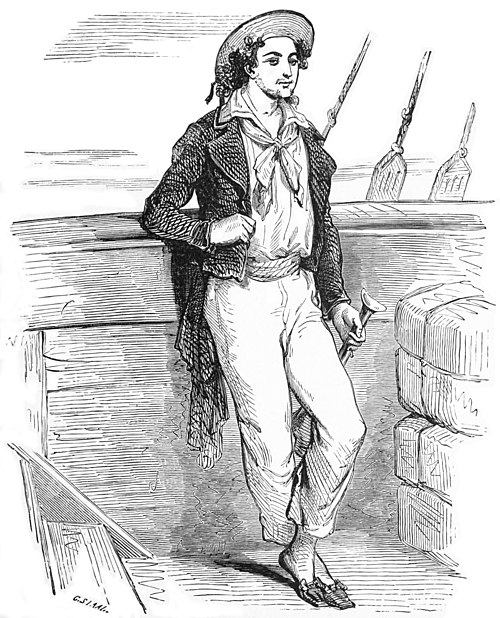
Mrs. Stephens has recently introduced me to ‘television’! While modesty can only cause me to recoil from the shocking depictions of brazen women and brutish men (I may never again be able to read the word ‘bone’), I could not resist viewing a presentation of The Count of Monte-Cristo on something called Masterpiece Theatre. Please note that, unlike Masterpiece Theatre, *I* use the original spelling.
Alexandre Dumas’ tale of the wronged and vengeful Edmond Dantes has been one of the most popular books in European literature. French readers went mad for it during its first publication as a serial from August 1844 to January 1846 in the Journal des Débats. As there were numerous booksellers in other countries, including Great Britain, that sold French literary and periodicals, word of the story spread like a veritable conflagration.
Mind you, a number of critics and other novelists poo-pooed Dumas’ success. In France, Gustave Flaubert dismissed The Count of Monte-Cristo as a novel about superficial characters that “resolves itself without a single minute for reflection.” In the British Quarterly Review, George Henry Lewes dismissed the work as “a waste of time” and referred to his readers as persons “who read simply for amusement . . . to fill the vacant hours of their useless lives.”
To Mr. Lewes, I say, “Harumph!”
One English periodical, The Leader, insisted on March 30, 1850 that Dumas was “laughed at by all Europe, despised by all Europe, but read by all Europe.”
In modern parlance, Monsieur Dumas cried all the way to the bank.
In Britain, Ainsworth’s Magazine serialized an abridged English translation of the Count of Monte-Cristo in 1846. I devoured every issue and counted the days until the next one. The novel was discussed over every tea-table: What Dantes would do next, the villany of Villefort, the trials of the young lovers Maximilien and Valentine. Absolutely everyone knew the story!
When the first unabridged English translation was published in book form in 1846, you may be sure I spent my pin money on both volumes, and read all 117 chapters. (Really, I do not understand how modern minds boggle at the idea of reading a mere 400 pages.)
One last note in the interests of honesty. It was later revealed that Alexandre Dumas père depended on what are now called ghost writers for his prodigious output. He wrote The Count of Monte-Cristo and The Three Musketeers (among other works) with Auguste Maquet, a historian who had turned to writing fiction. Eventually, Maquet would sue Dumas for rights to co-authorship and royalties for . The courts decided in favor of Dumas, and after 1851 Maquet ended their association. He then successfully wrote his own plays and novels for several years until he died in comfortable circumstances, respected in his own right by his contemporaries.
But he never achieved the fame alone that he had done with Alexandre Dumas, and Dumas never achieved the readership that he did working with Maquet.
And now a word from Ann
I hope readers enjoy the posts written in the voice of my alter-ego, The Gentlewoman. I truly enjoy writing them. For one thing, I read a lot of Victorian era books (including the full, unabridged 117 chapters of the Count of Monte Cristo), along with newspaper articles, letters and diaries when I can find them online. The language used was far more formal — and often convoluted — and writing as a woman from 19th century Britain.
A few things that I couldn’t work into the Gentlewoman’s pos might be of interest to you. First, writers for periodicals and newspapers, including journalists, were paid one of two ways: either by the column inch, or by the word. The latter lasted into the 20th century. In On Writing, Stephen King writes of getting paid by the word when he was starting out. helps to get those conventions out of my brain.
Second, Dumas père had a family history worthy of his swashbuckling books. His father was a native of the island of Haiti, born the bi-racial son of a French marquis and an African slave. Thomas-Alexandre Dumas Davy de la Pailleterie was taken to France after his father sold his mother and two siblings. Thomas-Alexandre never saw them again. He was placed in military school, given a nobleman’s education, and joined the military in 1786. When the French revolution broke out, he took the side of the République, and by September of 1793 he was a commander-in-chief of the revolutionary Army of the Western Pyrenees. Unfortunately, Thomas-Alexandre eventually fell afoul of Napoleon Bonaparte and was forced out of his military career.
Dumas was Thomas-Alexandre’s only legitimate son, and it is speculated that Alexandre’s proclivity for writing high adventure was influenced by the career of his father.
Alexandre’s son, another Alexandre (known as Dumas fils), was born of an affair with a dressmaker named Marie-Laure-Catherine Labay. Born in 1824, the younger Alexandre was acknowledged by his father when he was around 5 years old. While this gave the boy some standing socially and legally, French law gave all custody rights to a child’s father. (This was the norm throughout Europe and in the United States, and a major plot point in a manuscript I recently finished.)
Thus mother and child were torn apart, and it is believed that her agony affected much of Dumas fils’ writing. He had his own agony, as his school days were marked by insults both for his African heritage and his bastardy. As an adult, his novels and plays often reflected the belief that men who fathered illegitimate children should legitimize them and marry their mothers. Dumas fils wrote his best-known work, La Dame aux Camélias, in 1848. It is known in English as Camille. To make some money quickly, Dumas the younger wrote the novel up as a play, which proved to be an even bigger hit than the book. The composer Guiseppe Verdi even used it as the source for his opera La Traviata. Following his theatrical triumph, Dumas fils turned largely to writing drama. During his lifetime, his fame surpassed his father’s.
A Few Book RecommendationsThe Black Count, Tom Reiss – a biography of Thomas-AlexandreThe Count of Monte Cristo, Alexandre Dumas – if you’re feeling braveThe Three Musketeers, Alexandre Dumas – also long, courage neededOr you can watch the Count on Masterpiece Theatre and the 1972 version of Musketeers.Does anyone else have some 19th century book recs? Or movie/TV recs based on 19th century fiction? I’d love to compare notes!
A Few TidbitsI now (finally) have buy links on my Bookshelf page, if anyone is interested in my ebooks. Except for Amazon which is giving me difficulties at the moment – I hope to have this resolved soon.
My books are available on the Zon — it’s just that right now that you will have to navigate there instead of following a link.
Questions or comments? Let me know!
February 28, 2026
The Gentlewoman’s Guide to Courting a Princess

In the course of feminine events, it was once necessary for a young lady to be introduced to society before she could be considered as a prospective bride.
I am assured that this is no longer the case, and that females as young as fifteen or sixteen go on ‘dates’ with minimal, or worse, no chaperonage, and are not considered ruined, or even fast. One hardly knows what to think. In my day, ladies were not permitted to know their own minds until middle-age or widowhood — whichever came first.
At the top of society, coming out involved moving to the family townhouse in London or renting one in a fashionable area from early spring until summer, purchasing an entire wardrobe from the most fashionable modistes, and presentation at Buckingham Palace. Following this event, the young lady — preferably no older than 20 — attended a madcap round of balls, suppers, musical evenings, and performances of the opera, theatre, and ballet.
The pinnacle and purpose of all this activity was to receive a proposal of marriage from (ideally) a peer of the realm, or (acceptably) a peer’s heir, or (at the very least), a gentleman of breeding and good fortune. With luck, one might even end up with a husband close to one’s own age, with compatible interests.
Unless one was royalty.
RequirementsQueen Victoria, by the time she ascended the throne at the tender age of 18 years, had been presented to nearly a dozen potential spouses. Mutual suspicion and dislike between her mother, the Duchess of Kent, and the entire British royal family led both sides to line up the young princes of Britain and Europe like so many piles of ammunition.
Of course, eligible suitors for Princess Victoria of Kent (as she was known prior to inheriting the crown) were defined by the Royal Marriage Act of 1772, which forbade marriages into “foreign families” and without the monarch’s consent as “signified under the great seal and declared in council”. Unofficially, this was understood to mean ‘no commoners and no Catholics’, although I am told that these prejudices are not strictly adhered to in modern times.
Within these restrictions, it was possible for royal spouses to discover the most tender bonds of love within marriage — only consider King George III and Queen Charlotte. Of course, such a union might also result in disaster. The marriage of George IV and Caroline of Brunswick comes to mind.
This writer has not mentioned the princess’ father, Prince Edward, Duke of Kent. Alas, he died when the princess was a mere eight months old.
His widowed Duchess, from the minor German Duchy of Saxe-Coburg-Saalfeld, had not impressed the British royal family during her brief marriage. Princess Victoria was her one source of power, and the Duchess soon fell under the sway of an unscrupulous equerry of the late Duke, one Sir John Conroy. He soon convinced her that the young princess should be isolated from her dissolute royal uncles, and must be guarded from danger at all times.
I regret to say that King George IV, William IV and their brothers made Sir John’s task all too easy. A litany of debt, mistresses, illegitimate children, and forbidden marriages followed them through Polite Society.
When William IV ascended to the throne in I830, he was 64 years old and had no surviving legitimate heirs. He accepted Princess Victoria as his almost-certain successor. The salvos of suitors would begin well before she turned 18.
Early SkirmishesThe Duchess of Kent fired first in 1832, when Princess Victoria was all of 13 years old. Her mother introduced her to Hugo and Alexander von Mensdorff-Pouilly, sons of her sister Sophie. Nothing came of the introduction other than the princess’ comment in her diary that the von Mensdorffs were “merry and kind”.
King William countered the following year by communicating to the Duchess of Kent that he wished the princess to marry George of Cambridge, the son of his brother, Prince Adolphus. Predictably, the Duchess ignored him.
William suggested that Victoria might like to marry another George, the son of his brother Ernest. As Ernest would become King of Hanover on William’s death (women were barred from inheriting), a marriage to George of Cumberland would eventually reunite the kingdoms.
This reasoning did not impress the Duchess. In 1834, she presented another set of her nephews, Alexander and Ernst of Württemberg. Victoria described them in her diary as “tall” and “amiable”, adding that Alexander was “very handsome” and Ernst possessed a “very kind expression”.
By 1835, the Duchess’ brother Leopold took an interest in the now 16-year-old Princess Victoria. Leopold happened to be the widower of England’s beloved Princess Charlotte, daughter of George IV and Queen Caroline. Princess Charlotte’s death from complications of childbirth (alas, an all-too-common occurrence).
Since then, Leopold had accepted the crown of Belgium and taken a second wife. Still, he wasn’t above trying to keep possession of his and Charlotte’s former estate as well as a hefty stipend from Parliament. Getting on the good side of his niece, the future Queen of England, might prove useful in the future.
On a more human level, he despised Conroy’s influence on his sister, and heartily disapproved of her treatment of Princess Victoria.
Prisoner PrincessBy this time, the princess had almost no privacy, not even a bedchamber of her own. She was required to sleep in the Duchess’ room. The Duchess also insisted on reading Victoria’s diary regularly. The princess was only allowed to write to a few correspondents approved by her mother and Conroy.
King Leopold of Belgium was one of those correspondents. Happily for Victoria, she could trust him.
The following year, in 1836, King William and Queen Adelaide forced the Duchess’ hand, insisting on seeing Princess Victoria more often, and by herself. After all, it could only do the princess’ reputation good to be seen with the man whose throne she was going to inherit. The King’s dislike of the Duchess of Kent did not extend to her daughter. He was aware that the princess lived in a state of near house-arrest, and he feared dying before Victoria was eighteen, the age when a King or Queen of England could reign without a regent.
During one stay with the King and Queen, Victoria encountered John, Lord Elphinstone, and soon developed what is nowadays referred to as a ‘crush’ on him. Lord Elphinstone was also smitten, going so far as to sketch her in church. (Was he supposed to be attending to the sermon? Tsk.) Despite the Elphinstone title being 13 generations old, his lordship was not royal, and was thus considered completely unsuitable by both the King and the Duchess.
Lord Elphinstone was soon assigned to a high post in Madras. Gossip had it that the post was to remove him from proximity to the princess. That Lord Elphinstone never married fueled speculation over the decades, but there is no solid evidence of lingering romantic inclinations toward his sovereign.
Meanwhile, the Duchess attempted to distract the princess with yet another set of nephews, this time Ferdinand and Augustus, whose father had married into Hungarian nobility. Ferdinand was engaged, but Princess Victoria rather fancied him. Following one evening, she wrote “ . . . dear Ferdinand came and sat near me and talked so dearly and so sensibly. I do so love him . . . I think Ferdinand handsomer than Augustus, his eyes are so beautiful”. However, this branch of their family had converted to Catholicism, which made them ineligible under the Royal Marriages Act — as Victoria well knew.
At this point, King William, As mentioned earlier, King Leopold had taken an interest in the princess’ future spouse. He had also taken an interest in one of his nephews: 16-year-old Franz August Karl Albert Emmanuel, younger son of the Duke of Saxe-Coburg and Gotha. A few months younger than Princess Victoria, he planned to study at Bonn University and travel through Europe with his older brother. Leopold and his most trusted confidant, Baron Christian Stockmar, thought this prince might be a good match for the princess based on their near ages and his “excellent intelligence” and “pure, unspoilt nature.”
He had coaxed his sister the Duchess into inviting the young prince and his brother to England in May, 1836. Victoria was duly introduced. Earnest was charming, but the young Franz August Etcetera, known within the family as Albert, dozed off during at least one of the elaborate evening-long dinners. (In his defense, a particularly grand dinner could last into the early hours of the morning.)
However, Albert and Victoria bonded over their mutual love of music. He and Earnest joined her party at the opera and attended her private music lessons. Albert and Victoria played piano duets together. Nor did it hurt that the princess found this cousin good-looking, although in a letter to her Uncle Leopold, she dwelled on other qualities. “He is so sensible, so kind, and so good, and so amiable too. . . I hope all will go on prosperously and well, on this subject of so much importance to me.”
All did go prosperously and well, for on February 10, 1840, Queen Victoria married Prince Albert in one of the most famous love matches in the history of the British royal family. doubtless fed up to the teeth with the parade of the Duchess’ nephews, sent for Princes Willem and Alexander of the Netherlands. They were at least not cousins. But in a letter to her uncle Leopold, Victoria dismissed them as “very plain . . . moreover they look heavy, dull and frightened and are not at all prepossessing.”
Uncle Leopold Makes a MatchAs mentioned earlier, King Leopold had taken an interest in the princess’ future spouse. He had also taken an interest in one of his nephews: 16-year-old Franz August Karl Albert Emmanuel, younger son of the Duke of Saxe-Coburg and Gotha. A few months younger than Princess Victoria, he planned to study at Bonn University and travel through Europe with his older brother. Leopold and his most trusted confidant, Baron Christian Stockmar, thought this prince might be a good match for the princess based on their near ages and his “excellent intelligence” and “pure, unspoilt nature.”
He had coaxed his sister the Duchess into inviting the young prince and his brother to England in May, 1836. Victoria was duly introduced. Earnest was charming, but the young Franz August Etcetera, known within the family as Albert, dozed off during at least one of the elaborate evening-long dinners. (In his defense, a particularly grand dinner could last into the early hours of the morning.)
However, Albert and Victoria bonded over their mutual love of music. He and Earnest joined her party at the opera and attended her private music lessons. Albert and Victoria played piano duets together. Nor did it hurt that the princess found this cousin good-looking, although in a letter to her Uncle Leopold, she dwelled on other qualities. “He is so sensible, so kind, and so good, and so amiable too. . . I hope all will go on prosperously and well, on this subject of so much importance to me.”
All did go prosperously and well, for on February 10, 1840, Queen Victoria married Prince Albert in one of the most famous love matches in the history of the British royal family.
Sources of quotations:
Weintraub, Stanley. Victoria: An Intimate Biography. New York, Truman Tally Books | E.P. Dutton, a division of NAL Penguin, Inc. 1987
Royal Collection Trust, Description of Princes Ferdinand (1816-85) and Augustus (1818-81) of Saxe-Coburg and Gotha when children c.1824, RCIN 403689
December 27, 2025
The Gentlewoman’s Guide to Boxing Day
It has come to my attention that there is no tradition in the United States of the fine British tradition of Boxing Day. My poor dear American cousins, I can only extend my sympathies on your lack of this pleasant custom.
For centuries in England, the first weekday after Christmas was set aside as a day of charity and recovery from all the hurly-burly leading up to the holiday. It was also used as a day to pass on one’s blessings to the less fortunate. Churches would open their alms boxes and distribute money to the poor, while employees would often be given an envelope with a year-end gratuity (what I believe is called a ‘bonus’ in modern times). Servants would be given cast-off clothing and occasionally leftovers from Christmas dinner in boxes to take to their families — hence Boxing Day.
My hostess, Mrs. Stephens, has given me what she refers to as ‘side-eye’ upon my mention of cast-offs and leftovers as gifts. But they were often appreciated, the clothing in particular.
If there were no members of the family who could wear the items, they could be sold to one of the second-hand clothing shops that dotted most cities in the British Isles. These establishments ranged from respectable ones dealing only in high-quality gowns bought from ladies maids, down to rag-and-bone shops such as the one mentioned by Mr. Dickens in A Christmas Carol. A box of discarded clothes thus provided either additional clothing or cash to a working class family.
The leftover food would have provided a welcome change to people who subsisted mostly on bread and tea. I will confess, however, that I should be underwhelmed at being given the leavings of someone else’s meal as a gift.
Beginnings?
The origin of Boxing Day is lost in the mists of hearsay and tradition. The first use of the term to mean ‘the day after Christmas’ was in 1743. But Samuel Pepys refers to the custom of donating money “to the boys’ box against Christmas” at his shoemaker’s in his diary. This sort of donation lasted into the days of my august Queen Victoria. Besides making a bit of a ceremony of giving gifts to one’s servants (quite the opposite of giving so that ‘the right hand knoweth not what the left hand does’), it was customary to send a gratuity to tradesmen that one patronized, as well as chimney sweeps, sewing women and laundresses, and other such indispensable persons on the day after Christmas.
Going further back, churches in the Middle Ages encouraged generosity during Advent, the season of preparation for Christ’s birth. Money was rare in a time when much of the population depended on barter for their necessities. If one had access to actual coins, one was expected to drop a few into the church’s locked wooden alms box. The day after, as mentioned above, the box would be opened and the money (in theory, at any rate) used to relieve the most poverty-stricken members of the parish.
Boxing Day is now a holiday across the Commonwealth. It is intended as a day of relaxation to enjoy one’s new gifts in the company of friends and loved ones. The lady of the house is not expected to cook, which must be an enormous boon in these sad, servantless days.
As in my time, sporting events are still held on it, although a deplorable habit of opening shops for sales now exists. I understand that Boxing Day is either the most profitable or second-most profitable day of the year, but the image of exhausted clerks and cash boys run off their feet saddens one. Ah, I am informed that these employees are now referred to as ‘sales associates’. I suppose one must adapt to modern times.
I do hope you have enjoyed this look into an old custom. I look forward to further correspondence in the New Year! Do tell me if you are lucky enough to enjoy Boxing Day, and how you do so!
Your Favorite Holiday Books & Movies
Here are the answers to my question about your favorite holiday books and movies last month: Only two book titles came in: The Christmas Trolls, by Jan Brett — I bet that is someone who has kids, lol! And Lady Louisa’s Christmas Knight, by Grace Burrowes — not suitable for children, but Burrowes writes wonderful sexy romances. I should check this one out.
Apparently we’re watching a lot of movies and television shows this time of year: Home Alone, White Christmas (I can’t get enough of Vera-Ellen’s dancing. OMG her feet are so precise!), Love Actually, The Holiday, the 1930s Christmas Carol, The Muppet Christmas Carol, It’s a Wonderful Life, The Polar Express, and of course Die Hard.
TV shows were A Charlie Brown Christmas, Rudolph the Red-Nosed Reindeer, How the Grinch Stole Christmas (the 30 minute TV show I grew up with – woot!), Frosty the Snowman, and Santa Claus is Coming to Town.
Happy New Year
Are you ready for 2026? Me either. I gave up on resolutions long ago in favor of a yearly review that gives me a chance to see what worked and what didn’t over the last year, and lets me decide to keep or discard goals, or come up with new ones. ‘They’ say to limit your goals. Oh that I could just list three or six, LOLOLOLOL. My one professional goal is to publish A Most Improper Connection, most likely in the second half of the year.
What about you? If you could only focus on one goal or resolution this year, what would it be?
 Picture by Biella Biella via Pixabay
November 24, 2025
The Gentlewoman’s Guide to Second Sons
As any lady raised in good society knows, the most eligible parti for prospective marital consideration is the man with the highest title. And in Great Britain, those men, by and large, are firstborn sons of the peerage. Those lucky males have, so to speak, won the inheritance lottery. To them comes the title, the family estate, and the bulk of the family fortune.
Second (or third, fourth, fifth and so on) sons of the nobility in England are launched into the world and expected to fend for themselves. A lucky few might be left or given enough capital to provide them with a few hundred pounds of income per annum. But any wise young lady knows that such a middling amount would only purchase a few of the elegancies of life. Younger sons are all very well for flirting, dancing and witty conversation, but a more permanent connection would be . . . impractical, except when the lady herself comes well-dowered. Finding a wealthy wife is often the solution to a younger son’s search for an income.
Failing that, the younger sons of the nobility are obliged to make a living in the few fields that did not result in a loss of social standing: the clergy, the military, or diplomatic service. Great things can be accomplished by younger sons in these areas. The Duke of Wellington, for example, was a second son.
Under no circumstance should a man from a high-ranking family involve himself in anything so vulgar as trade. Unless, of course, such trade has earned the man a whacking great fortune.
Which brings me to Morgan Tregarth, former scapegrace second son turned merchant prince.
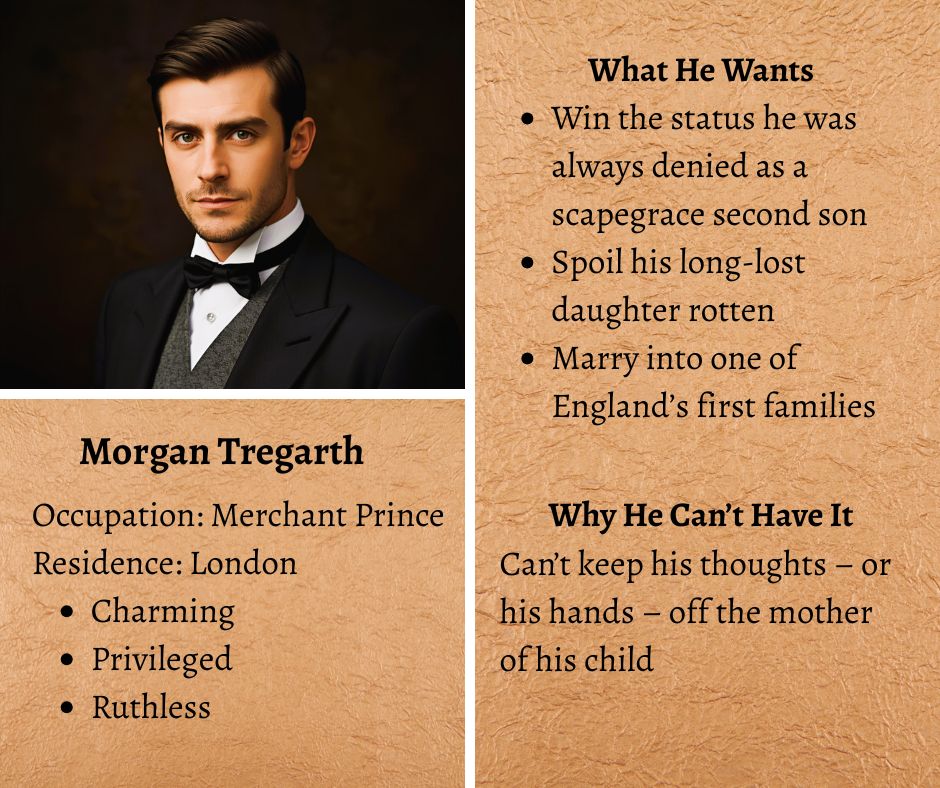
Morgan is the hero of my current work-in-progress, A Most Improper Connection. As the son and brother of the third and fourth Viscounts Tregarth, and guardian of the fifth Viscount, his place in London’s exclusive drawing rooms is assured. The ton is even willing to turn a blind eye to his eccentric refusal to give up a very lucrative import business.
Morgan, once sent off to India in disgrace, is received by the Best People, socializes at the most exclusive clubs and is half-heartedly pursuing an earl’s impeccably-bred daughter. He’s even found his long-lost daughter. Unfortunately, the girl’s mother is very much alive, and very much objects to losing the only family she has left.
Wishing you a Happy Holiday SeasonI don’t have a publication date yet for A Most Improper Connection, and at this point I hesitate to say more than ‘coming sometime in 2026’. Right now I’m at the point in the year when it has been 0 days since I’ve baked something. No complaints — I actually look forward to Thanksgiving leftovers and I really look forward to Christmas cookies. I hope everyone who reads this has a happy Thanksgiving, Friendsgiving, or whatever delights you to celebrate.
Speaking of Holidays . . .I know what books and movies I love to watch this time of year (The Lion in Winter is a Christmas movie and I will die on that hill), but I’d love to include those my readers enjoy in my December post. Email ann@annstephensauthor.com or drop a comment! I look forward to hearing from you.
April 30, 2025
Bringing in the May

For summer is a-come in,
and winter’s gone away.
All in the merry morning
that is the month of May.
— From May Day, by Christina Rossetti
When I was a child, my mother taught my sisters and me to roll colored construction paper into cones, staple braided crepe paper handles to them, and place a few candies in each one. Every May 1st, we were then sent forth into our neighborhood with them.
Our mission was to hang our offerings on the door handles of our friends, ring the doorbell and run. Under no circumstances were we to be seen. This was our version of May baskets.
Needless to say, we fooled no one, even before the days of camera doorbells. I always felt a little silly doing this, because we were the only ones who participated in this strange custom. I’m not entirely sure why we did it. Perhaps because her parents were born in the 1880s, when May Day was A Thing. Or perhaps she’d heard tales from her grandfather, who had immigrated from England, where May Day was Quite a Big Thing.
In America, girls from grade school to high school might be crowned as a May Queen, and be-ribboned maypoles would be set up for children to dance around. May baskets were made and distributed (theoretically anonymously) to friends and neighbors. Gardens would be planted, and bouquets of flowers picked to bring into the house.
This bringing in the May — fetching flowers and green branches from woods and fields, was an ancient custom across northern Europe from Russia to Ireland. What a relief it must have been to throw open the doors to sunlight and pleasant fresh air after spending winter inside, huddled in smoky air from the fire.
Germans had Walpurgisnacht on April 30-May 1, with animals and people passing through fires for good luck. Once upon a time the fires were sacred, and passing through them was thought to be a blessing from pestilence and witchcraft for the next year.
Sacred fires played a part in rural Irish celebrations as well, for similar reasons. The Catholic church had replaced the Celtic festival of Beltane with May Day, but the fires, the branches and flowers over doorways and windows, remained. Rural Irish might make a May bush as well by decorating a thorn bush with garlands of flowers or ribbons. The local church would choose a May Queen, as in ‘well, aren’t you the queen of the May’.
By the Victorian era, May Queen in Ireland, England, or America were intended to be girls and young women of good character, dressed in white and crowned with blossoms to represent purity and the promise of spring. Human nature being what is, I expect this was mostly a popularity contest — hopefully the ‘queen’ was popular because of kindness to her fellow students.
Elizabethan John Stowe wrote in 1598 that in London, the population “did fetch in May-poles, with divers warlike shows, with good archers, morris dancers, and other devices, for pastime all the day long; and toward the evening they had stage plays, and bonfires in the streets.”
That sounds like quite the street festival! If my childhood had had something like that on May Day, I probably wouldn’t have felt so foolish.
Still . . . I think I’m going to pick up some paper and make a few May baskets.
How is May Day celebrated in your part of the world? Let me know in the comments — I love learning about new (to me) customs.
October 28, 2024
Mrs. Gaskell’s Gothic Ghost Stories

Elizabeth Gaskell: author of 19th century gems such as Cranford, Mary Barton, and North and South. Also Elizabeth Gaskell: author of Gothic short stories, filled with all the hauntings, burning hearts, family curses and general melodrama that Victorian readers craved. (Image by Sandy Flowers from Pixabay. Assisted by AI.)
I was amazed to find that this cheerful, hospitable minister’s wife, with her sympathetic observations of Manchester’s slums and the factory workers who lived in them, wrote gothic horror. Not all of her short stories belong to this genre – for example, the genteel and delightful Cranford was a compilation of short stories written mostly between 1849 and 1853, for Sartain’s Union Magazine and Charles Dickens’ periodical, Household Words. Other short stories could be considered part of her ‘industrial fiction’ along with most of her major works.
However, several of her shorter pieces include the hallmarks of Gothic horror: an oppressive atmosphere, supernatural elements (if not always ghosts), guilty secrets of a family or individual, long-lost relatives, physical or emotional isolation, and, of course, creepy old manor houses.
The truth is that Elizabeth Gaskell thoroughly enjoyed telling and writing ghost stories. She collected them, taking an avid interest in local folk tales wherever she traveled. She was known for frightening her guests with gruesome tales told with trademark gusto.
But who read them?The majority of her short works were published in Household Words and then All the Year Round, both owned by Charles Dickens. He started them to increase his own sales and readership, but he also solicited pieces from other popular writers. Everyone benefited: magazine sales profited Dickens, the writers were paid per story, and everyone got more readers. He dismissed ghosts and eerie events, but he was happy to use them in works like Bleak House and A Christmas Carol to attract readers. As for his periodicals, hardly an issue came out without a ghost story, many of which came from Mrs. Gaskell’s pen.
Dickens aimed for a middle-class audience, so the fiction reflected the popular culture of mid-nineteenth century Britain. True, the British were starting to embrace books and plays representing realistic characters and situations, as witnessed by the success of Gaskell’s novels about the poor and working class. At the same time, the influence of the Romantic era still appealed to the reading public. Brooding heroes, family curses, revenge, unexplained insanity and forbidden/betrayed love filled books, magazines, plays and ballets. Alongside this, audiences adored sentimentality and unrealistically elevated views of human nature, domesticity, and childhood innocence. Gothic literature and stage pieces hit all these notes.
The appetite for things that went bump in the night was likely encouraged by one of the harshest facts of the 19th century: Victorians lived with death from disease in a way that many of us find hard to grasp. Before antibiotics and vaccines, diseases like measles, whooping cough, sepsis, and tetanus routinely killed people before their 18th birthday. Other fatal diseases that spread before the acceptance of germ theory were cholera, typhus and typhoid fever. Tuberculosis, known as consumption, slowly killed people of all ages.
What else might have inspired Mrs. Gaskell?Even if you survived childhood, one estimate is that you had a 30% chance of losing at least one parent before your fifteenth birthday. Belief that cherished parents or children lived on in the after-life, and might still influence or visit, must have offered comfort. Gaskell’s own mother died when she was thirteen months old, six of her seven siblings died in childhood, her adored older brother was lost at sea, and then she in turn lost her only son when he was only a year old. As a minister’s wife, she had a firm belief in a world beyond ours. Irreligious superstition was frowned upon in so respectable a woman, but at the same time, she insisted to friends that she had once seen a ghost. (Alas, there aren’t details in the sources I’ve found.)
Both in her novels and her gothic stories, Elizabeth Gaskell mused on the effect of losing a parent, often the mother. Although she grew up in a happy home, raised by a loving aunt, she must have wondered what kind of guidance and encouragement she would have received from her own mother, had she lived. In her work as a minister’s wife who regularly attended the poor of Manchester, she would also have witnessed what the loss of a parent could mean. Factories employed men and women, so the death or abandonment of an earning adult could ruin a family, in addition to the emotional toll.
I’ve only read a few of her short stories so far. I have read those below – some are ghost tales, all are gothic. I hope you enjoy my brief descriptions and notes about tropes. Most are available to read online here: http://victorian-studies.net/EG-Works.html
Disappearances (1851): This reads almost as a written version of an ‘unexplained disappearances’ video on YouTube, except about fictional characters. It’s simply a series of unrelated vignettes by an unidentified narrator. Perhaps Gaskell had in mind her brother’s never-explained disappearance at sea when she penned it.The Nurse’s Story (1852): An honest-to-goodness ghost story, featuring a young orphan stalked by two malevolent ghosts. The narrator is the child’s faithful nursemaid, Hester, who recounts life in a crumbling old house complete with an organ-playing ghost, two spooky old women, and a horrible family secret.The Squire’s Story (1853): Gothic, but not a ghost story, about a new guy in town who isn’t what he says he is, the wife he deceives, and an off-page murder.The Poor Clare (1856): Features a witch rather than a ghost. Abandoned fake wife, secret baby, a witch’s curse, evil doppelganger, family rejection, revenge from the past, repentance and forgiveness.The Doom of the Griffiths (1858): Almost a plot within a plot featuring an ancient family curse/prophecy, a conniving stepmother, rejection of a child, a poor but good woman, the collapse of an ancestral line.The Ghost in the Garden Room (1859): Featured in All the Year Round’s Christmas issue – because nothing says “Merry Christmas” like a story of callous youth, grinding poverty and a murderous son?? Please note, there isn’t actually a ghost in this story. All very confusing. Have some eggnog.Do any of these sound like a good Halloween read?
May 27, 2018
Fast Five: What I look for in a Hero
[image error]It’s a holiday weekend, I need to get a post up by the end of the month, and I’m dry as a bone for inspiration. So in my desperation, here is a list of qualities I love to see in a hero. I’d love to get feedback from others about works for you in a hero.
Qualities in a hero that make me melt:
1. Kindness: However secretively and grudgingly it’s offered, even the most cynical, badass hero has to be able to scrounge up sympathy for at least one living creature besides the heroine.
2. Fidelity: To family, friends, platoon, mentor, his own moral code — I don’t care which. If a guy can’t show heartfelt loyalty to anyone or anything else, I’m going to have a hard time believing he’s going to stand by the heroine in the long run.
3. Sense of humor: Because there is nothing in this world better than a soulmate who gets your jokes.
4. Master of the Game: The ability to think ahead and to think fast shows smarts. Brawn is great for the heroine to run her hands over, but I love a man who formulates a plan to solve his problems. And then formulates Plan B. And Plan C. And . . . well, you get the drift. There’s a reason I have a soft spot for Batman.
5. Man Brain: If the character is meant to be a straight cis male, please don’t give me a chick in a cravat. I will make serious side eye at a straight hero who analyzes his innermost feelings to his fellow male BFF. Actual, breathing men have assured me that while they do have All The Feels, they would undergo torture rather than discuss them with another man, no matter how trusted. Men also tend not to notice details like the difference between sea green and sage green unless they’re something like a painter, where knowledge of colors is necessary. Ditto for familiarity with women’s clothing, unless he’s a clothes horse himself or has a lot of female relatives. He’ll register impressions like ‘pretty’ or ‘sexy’, for example, but probably won’t know who designed the outfit.
So that’s my list — what turns you on in a hero? Comments welcome!
April 24, 2018
His Royal Highness Who?
[image error]Congratulations to the Duke and Duchess of Cambridge on their new baby boy!
According to the BBC, bookies have Arthur as the likeliest bet for the new prince’s first name. I’m not holding my breath, and I’ve got my doubts about the second runner-up, Albert. Here’s why: The couple’s other two children have been named for a king and an heir apparent to the throne. If they follow this trend for their third offspring, their choices are limited.
In the nearly one thousand years since the Normans conquered England, there have only been nine names borne by the nation’s kings.
Nine.
Four Williams, eight Henrys, one Stephen, three Richards, one John, eight Edwards, two Jameses, two Charleses, and six Georges. And some of these names are already Right Out.
For example, William. The wee babe’s daddy is already a Prince William. Two would be confusing.
Henry – Same problem. Even if they go with Prince Henry to differentiate him from Uncle Harry, there’s also the fact that the last King Henry went through a lot of wives. I think they’re going to give this one a pass.
Stephen – I would personally be delighted with a Prince Stephen (duh!), but the one and only King Stephen brought ruin to the country by starting an 18-year civil war with his cousin (and rightful heir) Matilda. Also, let’s take a moment to be thankful that the young princess wasn’t named Matilda.
Richard – yes, it conjures the image of Richard the Lion-Hearted, but on closer inspection, I suspect their Highnesses will give this one a pass, too. For one thing, Lionheart used the English as a cash cow to fund a very expensive Crusade. (And to pay his ransom when he was taken prisoner on the way back home. Bad form.) The second Richard is often considered a tyrant, and the third usurped the crown from his young nephews (whose deaths he is suspected of arranging).
John – still one of the most reviled kings in British history. His barons had to insist on the Magna Carta. My guess is this will be a firm ‘nope’.
Edward – a very nice name, and there have been a lot of them. Unfortunately, the last one abdicated when he couldn’t marry a twice-divorced American. Worse, he was a Nazi sympathizer. Hard no here, too.
James – the last one was forced off the throne due to fears of Catholicism. But times have changed, and besides, the little prince will be raised in the Church of England. James might have some potential as a name for the newest royal.
Charles – the first Charles was a disaster as a monarch. The divine right of kings may have been a thing across the channel in France, but the British hadn’t bought into that since the Magna Carta (see John). The second Charles didn’t like Parliament any more than his dad did, eventually dismissing it for the last four years of his reign. But nobody wanted to go back to Oliver Cromwell’s dour Protectorate, so Charles II is still remembered kindly. However, there’s currently a Prince Charles.
George – they already have one.
Granted, there are other names that have been borne by princes who didn’t become king: Edmund, Geoffrey, Arthur, Leopold and Alfred, among others. Albert is currently a front-runner, based on the popularity of the television show Victoria. If that’s the case, just name the boy Prince Tom Hughes Something Something and be done with it.
Also high in the books are Arthur and Philip, which could very well have some appeal. Arthur is one of Prince Charles’ middle names, and the Duke of Edinburgh, at nearly 97, might like to see a namesake.
My guess for the new prince’s name? James Arthur Philip Mountbatten-Windsor, give or take a middle name.
Does your family have any traditional names? Or do you have any guesses about the new prince’s name?
Advertisements
March 17, 2018
Words More Enduring
[image error]A word is more enduring than worldy wealth. — Irish proverb
At the discovery, several years ago, that I have a pair of Irish ancestors, I smiled a little. They’re pretty far up my dad’s family tree, having left Dublin a generation before the Great Hunger. I haven’t found any other genetic connection with the Emerald Isle to date.
Nevertheless, it tickles me to have this faint connection to the Irish and their Gaelic forebears. I have to love a people who place such high value on a good story.
Like their fellow Celts in Scotland and Wales, pre-Christian Gaels in Ireland developed a respected caste of oral storytellers, poets and historians. With writing limited to Ogham inscriptions in wood or stone, clans depended on the memories of filid, brehons, and bards.
Like druid priests, a fili, or poet, studied for years. Instead of focusing on religion, filid memorized lore, history, and genealogies. Their purpose of protecting and guarding knowledge is still reflected in modern Gaelic. The highest rank of fili, the ollam, is now Gaelic for professor. Filid also composed elaborate poems to praise their chieftain or patron (or satirize him if suitable payment had not been forthcoming for the last poem).
A brehon specialized in legal knowledge. The poetry and stories they learned focused on laws, customs, crimes and punishments – the equivalent of modern case law, perhaps. It’s not clear whether they functioned as advisors to chieftains and kings, or if they had the authority to pass judgement themselves. Either way, they held a valuable position within the household or clan.
[image error]Less scholarly, and less prestigious, bards provided entertainment. They wrote songs as well as poems, accompanying themselves with a harp to amuse a feasting crowd or a circle of villagers gathered by the hearth. Like the filid, though, they could praise a good patron or heap scorn on a stingy one and they garnered respect.
Christianity brought Latin and slightly increased literacy to Ireland. Monks recorded many of the oral histories in manuscripts like the Yellow Book of Lecan, but the traditions of the poets and bards remained strong. Neither Viking nor Norman settlement could entirely do away with them. But when the English conquered Ireland, official policy was to superimpose their language and Protestantism over the Gaelic-speaking Catholic population.
Marginalized, the Irish clung to their native language, music and history, and so the seanchai, or storyteller, developed from the old bardic traditions. Like bards, a seanchai learned old tales from older storytellers, gathering them year by year without any help from the written word. Often they journeyed from place to place, swapping an evening’s or several evenings’ worth, of entertainment for room and board.
Thus legends and myths of heroes, queens, kings, lovers, and saints were preserved, along with cautionary tales of sidhe and their inhabitants from the Other World. By memorizing and re-telling these vestiges of Irish history and customs, generations of seanchai safeguarded the language and culture of their people until interest in the old language and ways revived.
Behold the power of story.
Advertisements

