Mike McCabe's Blog
August 26, 2026
Complexed to the Max
Playing God is a fraught vocation. Making a being that can run faster and jump higher than any human ever has, conquering nature’s power to infect us with disease or cripple our bodies, that’s heady stuff. Could even say miraculous, and miracle making is mighty intoxicating.
While under the influence, we tend to gloss over how gods themselves are human creations, conjured to provide answers to unanswerable questions. Not that we don’t develop theories taking us right up to the bounds of our cleverness before handing the ball off to God. The universe began 13.7 billion years ago as a small, hot, dense speck of matter, which exploded and kept expanding to its current size.
How large are we talking? Can’t really get our heads around that, so we say infinitely large, goes on forever. What lies beyond forever? Can’t possibly know, but that doesn’t stop us from theorizing. Nothing, there’s nothing beyond forever. Can’t really get our heads around that either. What surrounded that speck of matter 13.7 billion years ago before it blew up? Better phone a friend. Better yet, make a being that can explain things better than any human ever has.
Our habit of referring vexing questions to God has never stopped us from also wanting to play God. Can’t help ourselves, always trying to answer questions that have had us stumped, forever pushing beyond the borders of our bodies and minds, as if deep down we’ll remain dissatisfied until we can actually be God. That dissatisfaction has driven us to make beings that not only can run and jump better than us, but also can think bigger and faster than we can.
We are driven to tamper with nature’s design just as the most ingenious humans were driven the better part of a century ago. They figured out how to split atoms. The promise of a virtually limitless new supply of energy brought with it tragic consequences producing death, destruction and ongoing human misery, filling the most brilliant minds of the era with remorse.
Drawing no lessons from past folly, those most endowed with the God complex today are hellbent on augmenting human intelligence, with the promise of a new industrial revolution and life-altering medical breakthroughs, from curing cancer to helping the paralyzed move and the blind see.
The promise brings with it harrowing consequences up to and including human extinction. That’s not my assessment, it comes from the British-Canadian computer scientist who was awarded the Nobel prize in physics for his work in artificial intelligence. He warns there is a 10% to 20% chance that AI will wipe out humanity within the next three decades. He’s not alone. Another Canadian researcher who’s been at the forefront of AI development says we’re barreling toward extinction by creating a competitor to humanity that is smarter than us.
Even if you like our odds of dodging extinction, there will be casualties. Data centers—the vast warehouses of computer servers needed to power AI—are thirsty devils. It is estimated that by sometime next year, global AI demand will push water usage by data centers to between 4.2 and 6.6 billion cubic meters, a massive additional draw on a resource that already is stressed to the point where a United Nations report declares the world in “global water bankruptcy,” meaning human use and pollution have permanently exceeded safe replenishment limits in many regions.
AI data centers also are energy hogs. Their electricity usage has tripled over the past decade and is projected to double or triple again by 2028. The anticipated spike in demand for power is giving coal a reprieve and is expected to boost greenhouse gas emissions from generation plants by 30%, undermining the nation’s clean energy goals.
God complexed to the max, the current federal regime is all-in on AI and has been feverishly working to remove existing guardrails put in place by the previous administration and some states as well as trying to block future state efforts to protect the public from harmful AI impacts. Opposition Democrats have put up little resistance so far, appearing paralyzed on the issue, afraid to stand up to Wall Street, the tech industry and labor unions in the building trades that covet the temporary jobs that come with data center construction.
For now, the politicians are out of step with the public. A national public opinion survey conducted by Marquette University Law School found majorities of self-described Republicans, Democrats and independents, regardless of gender, in all age groups and income levels, believe the costs of AI data centers outweigh their potential benefits. A whopping 70% of respondents said they thought artificial intelligence is overall a bad thing for society.
This is the ray of hope. It’s not the high and mighty who can see through the AI fog, it’s not the best and brightest. It’s the masses, kids and working stiffs alike, country folk, urbanites and suburbanites, seeing and thinking clearly, all acutely aware that AI exposes 80% of the U.S. workforce to automation, all realizing their way of life may very well be technologized out of existence.
They see AI as all supply and no demand. They see it being shoved down all our throats despite hardly anyone ever asking for it. They have a hard time seeing benefits coming close to offsetting the costs. They recognize a God complex when they see one.


August 18, 2026
For Fear
Words of the prophets are written on restroom walls. Spent a glorious week in the great outdoors doing much of nothing. Heard loons yodeling, watched eagles soaring, ate more dessert than usual. Stopped at a coffee shop before hitting the road for home. Used the bathroom on the way out. On the wall above the toilet, four sentences in bold print, black ink.
“When I was 5 years old, my mother always told me that happiness was the key to life. When I went to school, they asked me what I wanted to be when I grew up. I wrote down ‘happy.’ They told me I didn’t understand the assignment, and I told them they didn’t understand life.”
Wasn’t the first time I’d come across the quote. It’s often attributed to John Lennon, though there’s no definitive proof he ever said it. Doesn’t matter, still warmed my heart, brought Leo Buscaglia to mind.
The charismatic educator and author passed on 28 years ago, but his essence seems even more removed than that from today’s America. Given the way things have been going, it’s hard to believe someone like Leo Buscaglia was a big deal that recently. At one point, five of his books were on the New York Times bestseller list at the same time. He taught a college course simply called “Love” and PBS regularly aired his lectures. During 1980s pledge drives his specials were the highest-earning programs for public television stations, again and again breaking their fundraising records.
Buscaglia’s speaking style was animated and effervescent. His message focused on embracing tenderness, living life fully and without fear. He’d implore his students to count how many times a day they say “I hate” this or that instead of “I love.” He’d lament how the vast majority of them weren’t sure of the color of their mother’s eyes. He’d remind his audiences that as children learn language, they learn the word “no” long before they learn the word “yes.”

If Leo Buscaglia were alive today, my guess is he’d be dismayed by current social conditions but not discouraged. Dismayed by how few resist the temptation to demonize others, how quick we are to demean. By how commonplace acts of cruelty have become, by what a powerful force fear is in today’s America. He’d see so many staying in toxic relationships for fear of being lonely, keeping jobs they hate for fear they might not find another. He’d be holding his head in his hands, deeply pained.
He’d see voters choosing what they consider the lesser of evils. Casting their ballots against what they hate, not for that which they love. Almost always against, rarely if ever for. In so doing, telling themselves “No!” to placate their fears rather than “Yes!” in the hope their dreams might take flight. He’d want to scream.
Dismayed for sure, but not likely discouraged. My guess is he’d know each of us is struggling, carrying one load or another that’s too heavy to bear any longer, making us all deserving of sympathy and grace. He’d remind us how we all were taught early on to be afraid. Don’t cross the street alone, there’s traffic, you’ll get hit. Don’t touch, that’s hot, you’ll be burned. Don’t jump from there, it’s too high, you’re bound to get hurt. For safety’s sake, we all heard “no” a whole lot more often than we ever heard “yes.”
Here we are in today’s America, scared of each other, quick to demean, forever tempted to demonize. Here we are, loaded down with caution, playing it safe for fear some know-it-all will tell us we didn’t understand the assignment. If Leo Buscaglia were alive today, my guess is he’d be telling us to throw our abundance of caution to the wind. Screw the assignment, tell ‘em they don’t understand life.
August 10, 2026
The Room Where It Never Happens
Feels oh so familiar. Another election season, seeing others going through what I once experienced, it takes me back. Like everyone, I’ve been shaking my head as I watch the intra-party warfare here in Wisconsin and elsewhere, but I do see it all in a very different light than I would if I’d never been a candidate myself.
I’m no stranger to politics, been around it for years. Still, running for office opened my eyes to stuff I could’ve sworn wasn’t there before, brought blurry things into sharp focus, took me way outside my comfort zone, broadened my horizons, leaving me better-equipped as a citizen after my short-lived running days were over.
Can’t call running a comfortable undertaking, was anything but. I’m an introvert and every day was reminded campaigning is for extroverts. Think entering a stranger’s house uninvited, trying to blend into a room full of people who all know each other. I’m an independent and far too many stops felt like landing on a distant planet inhabited only by partisan stalwarts. Still, I can say without reservation or caveat that I cherished the experience and have no regrets whatsoever. I’m no worse for wear.
Few remember, but I was on the ballot for governor in 2018, one face among many in a crowded field. I hadn’t spent my life preparing for that moment, attending all the party functions, being seen in the right places by the right people. I’d done quite the opposite, working for the better part of two decades as a government watchdog sniffing out corruption at the Capitol and howling wherever the scent led. That earned me a small but faithful following. It also made me something of a skunk at all those party picnics.
Countless times, I got up in front of audiences and lambasted the political establishment. Many a time my remarks were challenged, sometimes indignantly. Was repeatedly asked who exactly is this establishment I kept referring to. Gained considerable insight from those questions. They assumed I was talking about top party officials or the congressional delegation or state legislators. I was not.
The central nervous system of the political establishment is not located in the Capitol or at party headquarters. It is found in nondescript offices, nestled in generic commercial complexes, workplaces that could easily be mistaken for real estate agencies or accounting firms or medical practitioners. These out-of-sight lairs are where the political consultants hang their shingles and ply their trade.
There are more than 2,000 political consulting firms operating across the country. They do the polling and research, run campaigns, produce ads and buy airtime. The operatives they employ live and breathe politics, make their living off it, quite a few have gotten filthy rich off it. Their singular focus on elections—this one, the next one, the one after that—disconnects them from real life, insulates them from the struggles of working-class Americans.
When I ran in 2018, I did not sign on with any of the consulting firms, big or small. I ran a grassroots campaign with the help of more than 3,000 volunteers, traveling over 100,000 miles in 11 months to meet as many voters face to face as possible. To the consultants, this was disqualifying, an intolerable affront to the industry. I wasn’t playing their game and nothing else mattered, not my background, my experience, my accomplishments, my beliefs, my passion, none of it.
Being political professionals, though, they knew very well they couldn’t do harm to my candidacy by badmouthing the way I was pounding the pavement, or by defending political corruption and assailing my longstanding efforts to combat it. They undoubtedly scoured the landscape for ill-advised tweets or skeletons in closets, evidently couldn’t find anything damning enough about me or my supporters. So, they created a narrative out of thin air and spread it on the down low, whispering it far and wide.
For weeks, at every party-sponsored forum or function I attended, in every part of the state, in meet-ups hundreds of miles apart, I got the exact same question: We hear you are anti-labor, opposed to unions, is that true?
Strange question to ask a candidate committed to repealing the law that took collective bargaining rights away from government employees in Wisconsin. I went beyond that, calling for the union-busting law deceptively labeled “right to work” to be repealed and replaced with a new law making it easier for all workers in every sector to unionize. Replacing the minimum wage with an earnings floor that’s truly a living wage was a centerpiece of my campaign. I was the only candidate in the race willing to call for the nation’s first statewide test of Universal Basic Income to see how well it could cushion the blow of jobs being technologized out of existence.
I took these stands because of the anguished cries of so many who are finding it impossibly difficult to make ends meet and who desperately need a raise. After a while, local Democrats started feeling rather silly asking that question when I was proving to be the most pro-worker candidate in the field. So, the shadowy figures behind those nondescript office doors got busy creating a new narrative to spread on the down low.
For many more weeks, at every party-sponsored forum or function, the same question came up over and over again: We hear you are actually a Republican and were planted in the race to muck up our primary, is that true?
That sounded beyond silly to the many Republicans I know. Most of them see me as being well to the left of your average Democrat, if anything a lowercase socialist, definitely not a Republican. Still, the question came at virtually every stop, in far-flung places, making it impossible to explain away as some odd series of coincidences.
What I’ve been hearing in 2026 sounds oh so familiar. It’s the sound of whispers coming from the room where something of urgent importance never happens. Never heard there are the exasperated groans of the working poor who are struggling mightily to get by on what little they make. The room is sealed off, as good as soundproofed, the operatives inside making a small fortune selling candidates for public office the way cosmetics or laundry detergent are sold. They can’t remotely relate to those who’ve given up trying to imagine ever being able to afford a home of their own or have the means to raise a family.
Those operatives, the true political establishment in this country, won’t publicly defend how their industry nurses at the teat of billionaires and mega-corporations, they know they don’t have a leg to stand on. They won’t defend an economy that enriches them while it savages so many others. Instead, they’ll whisper about some cringeworthy tweet or YouTube video, about who’s supposedly electable and who’s not, whatever it takes to divert your attention from important matters and how they’re making those matters worse.
The only way to stop them is for us voters, you and me and our friends and neighbors, to tune out those noisy whispers and listen instead for the muffled cries.
August 3, 2026
The Lights Are Coming On
I’m no Socialist but voted for two of them today. Those aware of my intentions kept asking me if I’m afraid they’ll lose in the end. No, that’s not my fear. The thing that scares me is what will become of our country if we’re made to forget a time when ours was a far more decent society, one that waged war on poverty, empowered the working class, made sure the rich pay their share of taxes, used the proceeds for the common good.
Today’s Republican Party likes seeing America become increasingly unjust, ever more in service of the rich and powerful. Those who rule over today’s Democratic Party can live with creeping injustice, they’re too spooked by the word socialist to keep us remembering what an equality-seeking, middle-class-building America looks and acts like.
So many threads in our nation’s fabric were sewn into place when socialism was not the bugaboo it is today. Think about the public library system, a nationwide network of community pillars making books available to every American for free. Could any modern-day equivalent of that monumental accomplishment even be considered today? Not without being condemned as radically socialist.
Think about rural electrification, a national program to string power lines up and down every city street and country road, bringing electricity to every American doorstep, every barn, every farmhouse, no matter how remote, nobody left behind. No private company would have gone to the expense of running those lines vast distances to the most sparsely populated parts of our country when they’d only have gained a few extra paying customers. It took a federal agency to do it. Is a comparable undertaking possible in today’s poisoned political climate? Not without the courage to withstand nonstop pinko commie innuendos.
Think about the postal service. Timely mail delivery to every American household, again no matter how remote. A socialist institution if there ever was one. Could such a thing be established today? Can we prevent the one we have from being dismantled? The interstate highway system, that was socialism of the highest order. Hard to imagine public works of that magnitude even be attempted nowadays. Social Security, Medicare. Critics slurred them as socialism at the moment of their creation, still do. Even the GI Bill got that treatment. Is it possible to do something together on such a grand scale again?
For America to thrive going forward, the answer to these questions has to be yes. We need to find in ourselves the capacity to say yes. Privatizing everything as we are, making everything a profit-making enterprise, is nuts. For-profit companies are good at providing wants, they’re piss-poor at meeting needs. Medical care is a vital necessity, a matter of life or death. We have let each other settle for a system that rations care depending on the size of bank accounts. Those with great means get the best care. The needs of those with little to their names are left unattended.
This is uncivilized. Morally beneath us as a society. The solution is sitting right there in plain sight, a universal single-payer system like the one every other industrialized nation in the world already has. But surely you know what it gets called. Socialized medicine.
The American Dream is out of reach for too many. The dream is that if you work hard, you can own your own home and comfortably raise a family. It’s out of reach because housing and child care have grown so blasted expensive. The “free market” made housing and child care ultra-costly markets, it will not suddenly make them affordable, that will take public intervention, a national effort, one sure to be demeaned as socialism.
Policies like universal health care and affordable day care are as American as apple pie, as American as public libraries and post offices and freeways. They make a thriving middle class possible, but those who want no part of any kind of collective venture call them radical socialism, a scare phrase pure and simple, code for “run for the hills!” As they’re running, they might notice there are power lines passing over all those hills. Wherever they come to rest, they’ll be able to flip a switch and the lights will come on.
I’m not a member of any political party, not the Democrats, not the Republicans, not the Socialists, none of them. I got my start in life working in my family’s business, helping my folks on our dairy farm, a capitalist enterprise. I don’t want government control of all means of production. I’m comfortable leaving wants to capitalism, but meeting basic needs requires community. If you want a new cellphone or TV or washing machine or lawn mower, you’re on your own. But if we are to have decent roads to drive on, we can’t each build our own. That we have to do together. And someone will probably call it socialism.
July 27, 2026
A Scarecrow Named Lex
Such a shabby figure, way up there looking down. No more than an overstuffed sack, situated high on a pole in the field where the status quo grows, keeping the hangry rabble away from the established order nearly ripe for harvest. His name is Electable Phallusee. Lex for short.
“I am convinced that the only options worthy of consideration in this moment are the usual ones,” Lex tells passersby in search of their deepest desires. “All things must be done in the proper way.”
“Usual!” blurts out one of the seekers. “Bah!”
“Proper!” cries another. “Humph!”
The sack glares down at them. “What an uncomfortable feeling to know one is a fool,” Lex says disdainfully.
“Fool!” shouts a third. “Who’s the fool? You seem unaware your arm is coming off.”
“I hadn’t noticed,” Lex answers dismissively. “No matter, don’t need it anyway.”
“It appeared so strong. Must’ve been weaker than it looked,” says the first seeker of deepest desires. “Doesn’t it hurt you to lose it?”
“Oh no, I’ll just get a new one to put in its place.”
“One of your legs is about to fall off,” the second seeker warns.
“Whoops, there goes some more of me again!”
“You’re not much of a help to anyone in that condition,” says the third.
“My job is not to help, it is to scare off trespassers like yourself,” Lex replies in a haughty tone. “Do I scare you?”
“No, I just thought you might be hurt,” number three says in return.
“But I don’t scare you?”
“No, of course not.”
The sack slumps for an instant, then rallies. “I have no intention of giving our status to your kind, there’s only room in this field for quo of the highest quality. When I’m through, every last one of you will be scared, frightened out of your wits, and you will go away and never return.”
“We are too hungry, too tired to be frightened,” number one fires back.
“Whether you are in trouble or in pain is no concern of mine,” Lex declares coldly.
“Then you are heartless,” number two concludes.
“I would rather have a brain than a heart, because fools would not know what to do with a heart if they had one,” counters the sack. “Your heads are in the clouds, and we know better than you, that devils don’t come from hell beneath us, they come from the sky.”
Lex now looks quite pleased with himself. “How can the three of you talk when you haven’t got one brain between you?”
“I don’t know,” the first seeker answers. “But some people without brains do an awful lot of talking, don’t they?”
“Indeed, they do,” the second one agrees.
“An awful lot,” chimes the third.
Lex pays them no further attention, returns to his sole duty, whiling away the hours conferring with those in power, consulting with them in vain.
July 22, 2026
Blast It All, My Take's Gone Cold
When did getting noticed become more important than being honest or decent or right? Guessing here that the answer coincides with the rise of the hot take. Everyone who’s anyone is putting them out there. Social media influencers, sports commentators, political pundits, wannabe celebrities of all sorts.
Hot takes by their nature have to go against the grain, they can’t be even remotely close to conventional wisdom. They have to be fresh, which leads them to be hasty and half-baked. They have to be bold, which tends them toward absurd. They have to be edgy, which more often than not puts them on the nasty side if not downright cruel.
If the aim is to start an argument for the sake of arguing, hot takes serve that purpose, pointless though it may be. If the goal is to inform or educate, they do pretty much the opposite. In every taker’s estimation, gaining recognition always trumps enlightenment. The point is not to be smart or truthful or correct or even understood, the point is to be known. If saying something dumb makes you stand out from the crowd, then dumb is hot. Empathy and kindness have no place in a hot take; those virtues get in the way of the chief objective. In malice there is heat for the taking.
Loud is piping hot. In the universe of hot takes, thoughtful takes a back seat to bluster every time. From the late Charlie Kirk to the very much alive Ben Shapiro in the political world to the likes of Stephen A. Smith and Mad Dog Russo in the sports world, the heat is on, with the volume cranked all the way up. Different personalities feeding different material to different audiences, sharing one thing in common, a talent for commanding attention.
Hot takes are harmless insofar as they remain idle chatter, mere background noise. They grow sinister when they are regarded as the equivalent of or even a surrogate for meaningful dialogue and earnest debate. That’s where our society has gone, this is what has been widely embraced. For many if not most Americans, the various social media platforms that litter the digital landscape are fast replacing traditional media institutions like newspapers, radio and television as primary sources of news and information about the goings-on in our communities and our world.
There’s grave danger in this warping of our information ecosystem, as all these social media platforms are essentially the airports hosting an endless stream of takeoffs and landings of hot takes, be they unwittingly deceptive or deliberately disingenuous, be they mildly offensive or monstrously malicious. While notoriety takes flight, there are casualties on the ground, truth among them.
As I observed here a little over a year ago, there’s a reason what we do all day on our phones is called doomscrolling and not hopescrolling. Social media algorithms favor doom over hope, lies over truth, hate over love. The more unscrupulous content creators among us figure that out in no time. In order to stand out, get noticed, make their posts go viral, amass a huge following, establish a brand, profit off peddling that brand, they have to sell what the algorithms buy. Doom, lies, hate.
The artificial form of intelligence that rules over the algorithms engineers them to prioritize doom, dishonesty and disdain and actively discriminate against hope, truth and love. Not because of some inherent preference for vice over virtue. The engineering is simply following orders to capture audiences and deliver them to advertisers by keeping users forever logged in, perpetually scrolling. It so happens the most efficient way to do that is to alarm people, agitate them, put them on edge, keep them there.
If this is the road to notoriety, I gladly choose obscurity. If this is what makes a take hot, let mine go cold. If this means few will read what I write or hear what I’m saying, I’m at peace with that.
Human communication is filled with flaw, sometimes comically so. Any illusion I had about it was laid to rest by a lifetime spent in meetings where people prattled on incessantly, meetings that ended not when everything under discussion had been said but when everyone had said it. There was truth in some of the talk, often it fell short of that mark. Lying is as old as humanity itself; it’s in our nature. I wrote once before about how creative we humans can get when it comes to fibbing, fabricating, gaslighting, misrepresenting, dissembling, duping, deluding and whatever other form dishonesty may take.
That’s an observation, not an excuse. Searching out a higher road, one paved with candor and goodwill, with kindness and compassion, is still worth it. There’s immeasurable value in acting as if being honest or decent or right is more important than getting noticed, even if it gets us ignored. Lighthouses don’t shout or boast or curse, they don’t chase after ships or recruit captains to join the ranks of their followers, they merely cast a light across the water that’s there whenever a vessel might have need of navigation.
Be a lighthouse. That’s my decidedly cold take.
July 15, 2026
Utterly Avoidable Calamity
Most can, many should, few do. Read, that is. More than half of all adults in our country do not read a book of any kind over the course of an entire year. That’s according to the National Endowment for the Arts, which conducts the most comprehensive survey of the nation’s reading habits.
Reading is no longer a mainstream hobby. In less than two decades, the proportion of Americans who read for pleasure on any given day fell from 28% to 16%. Gambling is now a more common leisure activity than reading. Let that sink in. Coming across sobering statistics like these led The Atlantic to splash an ominous warning across the cover of its just-issued August edition in faded, smudged lettering, all caps: THE AGE OF READING IS OVER.
A fair amount of hyperbole, to be sure. The Atlantic is a damn good journal, but this isn’t the first time its editors have gone overboard to grab the attention of a distracted public. A little over two and a half years ago, the magazine published a meticulously researched and intricately detailed report under the headline, “It Will Never Be a Good Time to Buy a House.” Never is a long time. The story’s subtitle went on to hedge a bit: “Maybe in 2030?”
Just last month, another Atlantic article urged readers to “Assume You Will Be Hacked” because “AI is enabling a deluge of cyberattacks the likes of which we’ve never seen before.” Perhaps not wanting to be too much of a buzzkill, the magazine did not draw a through line between AI’s empowerment of cybercriminality and its culpability for the demise of reading.
As August’s cover article correctly observes, for most of history the biggest reading problem was illiteracy. People didn’t know how to read books. Today, the biggest problem is what the report’s author calls post-literacy. People know how to read books, but don’t.
The decline in book reading cuts across age groups, gender and education levels. Even those who traditionally did the most reading—retirees, women and college graduates—have largely abandoned the practice. Kids too are drifting away from reading. From 1984 to 2025, the percentage of 13-year-olds who say they rarely or never read for fun nearly quadrupled. The bookworm is an endangered species.
Authors and publishers are responding to society-wide attention deficits, condensed AI-generated information summaries and leisure-time competitors—gaming, online gambling, compulsive scrolling, binge-watching video streams, to name a few—by making books simpler and shorter. Sentences in New York Times best sellers today are roughly one-third shorter than they were a century ago. I’ve personally experienced the shortening and sweetening of literature on the author’s side of things, encountering numerous agents and publishers who said up front they would not consider manuscripts over 100,000 words and an editor who pushed me to reduce the length of my novel by 20%, giving me a formula for doing so.
A society that stops reading loses more than books. Reading, writing and thinking are joined at the hip. That symbiosis is gravely threatened by the large language models of artificial intelligence. When we let AI synthesize information for us rather than plowing through it ourselves, we sacrifice some capacity for diving into a subject deeply and distinguishing between what is trivial and what is important. When we ask AI to write for us, the product we get in return isn’t really writing, for there is no underlying vision, no originality, no heart, no soul, just a bunch of random sentence fragments spliced together in a way calculated to give us what we are seeking.
Gloria Caulfield, a commencement speaker at the University of Central Florida’s graduation ceremony in May called AI the next industrial revolution and was promptly booed lustily. She clearly was taken aback by the reaction and shouldn’t have been. She must’ve thought that young people who’ve done all their growing up during the digital age naturally would be warm to the latest tech innovations, but she thought wrong. They’re not sold on this one, nor should they be. They see fledgling careers potentially evaporating before they can manage to establish themselves professionally.
Future employment prospects are understandably a primary concern for new entrants into the job market, but it is hardly the only worry concerning artificial intelligence. Caulfield does have cause to consider this new fad an industrial revolution, just not the cause she had in mind as she spoke. AI is industrialized plagiarism. Instead of lifting entire passages from one or two books or some journal as human plagiarists do, it combs through millions or even billions of sources in milliseconds, picks a few needles out of haystacks the size of mountain ranges, the ones most pertinent to the question we’ve asked or the task we’ve assigned. Our wish is AI’s command, but each time we rub that genie’s lamp, we grow a little less able to read, write and think for ourselves.
Writing is hard. Sometimes the words don’t come, you get stuck, it takes patience and perseverance to work through that blockage. Writing involves the drudgery of painstaking research, relies heavily on imagination and creativity that always seem to arrive in fits and starts. It is hard, that is why it’s so worthwhile and rewarding. Puts reading in a whole new light, too, a bonus benefit.
America is troubled. Our social fabric is fraying. We stand at the precipice of disaster, an utterly avoidable calamity. Thoughtlessness and cruelty threaten to push us over the edge. More than any other single factor, pulling back from the brink depends on our ability to see life from more than just the narrow perspective of our own lived experience. There’s always been great value in walking in another’s shoes. That journey is at a premium these days. The trek is a long one, involving many steps, but cannot be made without these three: Read, write, think.
July 8, 2026
Warts and All
It is not to love or hate, it is to see. History’s purpose, that is. History that’s worth a damn does not whitewash over stains on our past, something that often is done in the name of patriotism. History that is accurate and truthful does not pull punches when it comes to criticizing actions or pointing out mistakes. Insisting on accuracy and honesty does not mean you hate your country. It means you wish to clearly see what it was, understand what it is now, so you can do your part to make it better.
History rooted in reality does not lionize or demonize; it embraces complication. One version of American history that’s been widely taught characterizes our nation’s founders as brilliant, heroic giants. An alternative version that’s gained prominence in some quarters portrays them as scheming, ruthless hypocrites. Truth is, they were all of the above. There’s reality and deception in both versions.
Many of the founders were slaveholders, and most who weren’t abided it. That’s not the perspective of any hate-America crowd, it’s an established fact. Numerous founders not only condoned but were directly involved in committing genocide against indigenous populations and stealing their land. Another established fact.
These men also were unquestionably imaginative and innovative, designing the world’s first successful anti-colonial, democratic revolution that resulted in a federal republic, one that inspired copycat uprisings across the globe for generations to come. They were undeniably brave, for the words they wrote and the deeds they did were acts of treason punishable by death. They risked everything for freedom. Their freedom.
On Independence Day, a former state legislator who is now running for Congress commented that “we still have so much work to do to realize the vision of our founders—that all of us are created equal.” Admirable sentiment, one very much in keeping with the prevailing understanding of what the founders had in mind, though not necessarily reflective of the founders’ actual vision. Maybe it was their aspiration, maybe we just hope it was. In any case, the declaration they all signed did not say all of us are created equal. It said “all men are created equal.”
They went on to write a constitution that elaborated further on exactly who is deemed equal, namely white male property owners. Roughly 10% of the nation’s population at the time, that’s who they made eligible to vote, that’s who they gave “unalienable rights.” Yet these aristocrats, men steeped in hereditary privilege, were both humble and wise enough to include a mechanism to alter their design as needed. History records Thomas Jefferson writing that “as new discoveries are made, new truths discovered and manners and opinions change, with the change of circumstances, institutions must advance also to keep pace with the times.”
Subsequent generations took the founders at their word, that defying a king and establishing a constitutional republic was done “in Order to form a more perfect Union.” In pursuit of that more perfect union, those generations altered the founders’ ingenious design, steadily expanding the definition of who is deemed equal, who is entitled to rights. Slavery was ended, women got the vote, so did the unpropertied.
Where history leaves off, the current moment calls us to the pursuit. Perfection is not the objective, we are human, perfection is not ours to have. No machine can make us so, no cosmetics, no attire, no exercise regimen, no diet, no pill, no therapy. We can conjure up fairytales about ourselves, but those are half-truths at best, outright lies at worst. Either way, damning testimony to our imperfection.
The best we can do is see ourselves exactly as we are, warts and all, and imagine how we might improve, then do the work. An ideal is worth aspiring to. As a Green Bay legend, coach Vince Lombardi, said: “Perfection is not attainable, but if we chase perfection we can catch excellence.”
Our field position may be poor at this stage of the game, a considerable distance may lie between the ball’s current placement and the end zone, but there is still a goal line that needs crossing. All of us—all of us—are created equal, endowed with unalienable rights, duty bound as citizens to secure these rights for everyone by instituting governments that derive their just powers from the consent of the governed. May we be so fortunate one day to have history record that we recovered our own fumbles, drove the length of the field, going for broke on fourth down against a furious blitz, catching excellence as our time expires.
July 1, 2026
Redeclaring Independence
Looking around, the mood is hardly celebratory, yet celebrate we should. Another July 4th fast approaches, another Independence Day, but this one marks an especially notable milestone, 250 years since the great experiment began. A respite from work will be enjoyed, families will gather, grills and fireworks will be lit, partying and sport will rule the day, all to honor a document signed a quarter-millennium ago.
Little thought will be given to the faded piece of parchment or the handwritten words on it that made every fourth day of July a national holy day. Few questions will be asked, many should be, for that would be the worthiest way to celebrate.
After all, can we not see in our time the need to dissolve certain political bands that bind one to another and pit them against their own brethren? Have we not witnessed domestic insurrections amongst us, citizens bearing arms against their country?
In our day and age, do we not suffer under a regime that refuses to assent to laws? Have we not seen this regime obstruct the administration of justice, endeavor to make judges dependent on its will alone? Has it not subjected us to a jurisdiction foreign to our constitution?
Does it not seek to obstruct the laws for naturalization of foreigners? Does it not actively work to prevent their migrations? Has it not sent swarms of officers to harass our people? Has it not quartered large bodies of armed troops among us? Is it not depriving many of due process and the benefits of trial by jury? Is it not transporting many beyond seas to be tried for pretended offenses?
Has this rogue regime not kept us at war without the consent of our legislature? Has it not arbitrarily established conditions for the appropriations of lands? Has it not announced its intent to enlarge the nation’s boundaries so as to introduce the same absolute rule into these colonies? Greenland and Denmark are asking.
Has trade with many parts of the world not been cut off or impeded? Have taxes not been imposed on us without our consent? Are our coasts not being ravaged, are none of our towns burning, are the seas not being plundered, are no lives being destroyed?
Has the ruling regime not abolished most valuable laws and fundamentally altered the forms of our governments? Has it not usurped legislative authority and declared itself vested with the power to legislate for us in all cases whatsoever?
Right here and right now, are we not exposed to all the dangers of convulsions within? Have there not been acts of cruelty totally unworthy of a civilized nation? Are we not witnesses to deceit, treachery and calculated breach of trust on a scale not seen in our lifetimes?
In response to the oppressions of our times, a long train of abuses and usurpations, have we not petitioned for redress of grievances? Have our repeated petitions not been answered only by repeated injury? Do we not then find ourselves under the dominion of a prince whose character is marked by every act defining a tyrant, one unfit to be the ruler of a free people?
Has our experience not shown that we the people are more disposed to suffer injustices than to right ourselves by ridding our land of the forms of evil to which we’ve grown accustomed?
When pursuits done in our name are plainly designed to reduce us to objects of an absolute despotism, is it not our right, our duty, to redeclare our independence in the service of throwing off such wicked authority?
As Tucker Carlson and Joe Rogan are so fond of saying, just asking questions here.
June 23, 2026
The Makeup's Coming Off
Maybe she’s born with it, maybe it’s Maybelline. This advertising catchphrase from a cosmetics industry giant comes to mind when thinking of one of my pet peeves, namely the color coding of states and communities to indicate their ideological leanings and party preferences. To say a place is Republican red or Democratic blue is not a reflection of reality, it’s a thick application of makeup concealing underlying complexities and ever-evolving tastes.
This color coding is done and tolerated despite two fairly obvious truths. First, coloring a place red or blue implies everyone there shares the same partisan affinity when, of course, substantial numbers—sometimes perilously close to half—prefer the other party. Even saying that doesn’t factor in the large number of people who dislike both major parties and thirst for some alternative.
Second, party affiliations are not set in stone, they are fluid. Our Republican president won the county where I grew up by over 30 percentage points in 2016 and by more than 40 percentage points in 2024. Democrats represented the area when I was young.
America is now in the early stages of a seismic generational shift in political values and identification. The number of young Americans with a positive view of capitalism is down nearly 20 percentage points from a decade earlier. Meanwhile, nearly two-thirds of the youngest adult generation views socialism favorably. Right-wingers are unnerved to say the least.
The greed-is-good crowd flails wildly in trying to explain this development. They howl about how social media is radicalizing our nation’s youth. They whine that Gen Z is ignorant of how “the blame assigned to capitalism really belongs to the growth of socialism.”
A few right-of-center types are more measured in their assessment of Gen Z’s politics, allowing for the possibility that “they don’t like vast income inequality and all the human suffering that comes with it.” You think?
At least one let himself venture even further afield: “Young people today are not radicals. They are pragmatists frustrated by broken promises. They still value individual liberty, innovation and the ability to build a better life. What they’re rejecting is the version of capitalism they’ve seen in practice — a system they perceive as rigged, extractive and unresponsive to ordinary people.” Ding ding ding!
This is nothing new. Capitalism’s excesses have fueled growth in socialism’s popularity before, even in places that today get painted bright red. One hundred ten years ago, farmers in North Dakota were at wit’s end about the insensitivity of elected officials to their economic plight. They were at the mercy of powerful cartels, couldn’t get fair prices for their grain or credit at a reasonable rate. They were paying up to 12% interest. Grain elevators graded grain as lower quality, costing farmers upwards of $55 million a year.
A pair of Socialist Party organizers—flax farmer-turned-political agitator A.C. Townley and farm-raised teacher Albert Bowen—enlisted tens of thousands of followers eager to get out from under the thumb of out-of-state tycoons who were gouging them. Farmers in North Dakota were sensible pragmatists, not ideologues. They did not want to be labeled as radicals, subversives, or members of the Socialist Party. But they also weren’t afraid to embrace “socialist” solutions to their chronic economic problems. Townley and Bowen understood this, and called their newborn political organization the Nonpartisan League. This became the face of socialism in North Dakota.
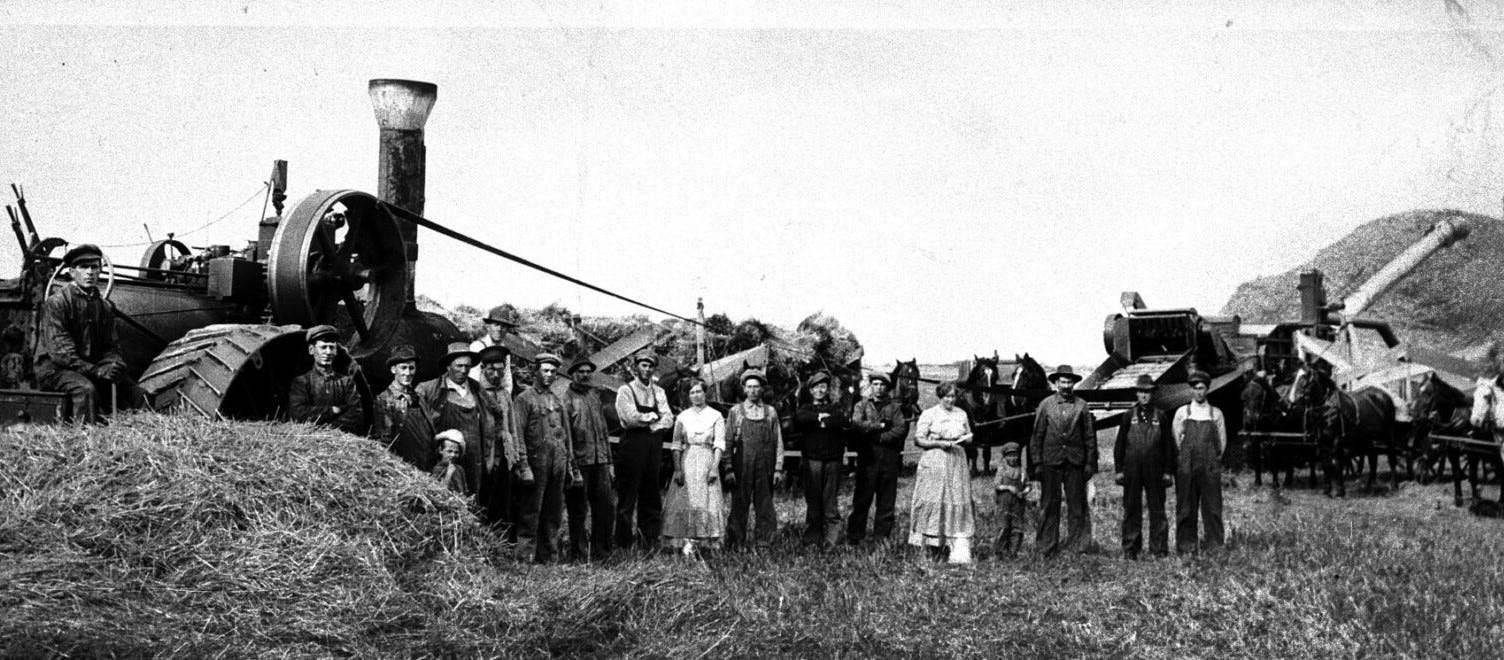
NPL supporters were called every name in the book, “red Socialists,” expert hypnotists,” “revolutionaries,” “traitors,” “dreamers,” “sweet-mouthed flatterers,” “confidence men,” “anarchists,” “charlatans,” “atheists,” “agitators,” “dynamiters,” “free lovers,” “carpetbaggers,” “home wreckers.”
Townley, Bowen and the legions behind them were undaunted. They put NPL-backed candidates up against those favored by the state’s political machine, and took over North Dakota’s dominant Republican Party in 1916. A wheat farmer and NPL member named Lynn Frazier was elected governor with almost 80% of the vote, and NPL-backed candidates won every other statewide office except one as well as a majority in the state legislature.
Upon gaining power, the NPL acted. Farmers were given credit at significantly lower interest rates through the establishment of the state-run Bank of North Dakota, which opened in 1919 and still operates to this day. A state grain elevator was established by 1922, providing a fair market for grain and a source of feed and seed. Insurance was provided against fire, tornado and hail damage. The NPL gave North Dakota’s women the right to vote, too.
Journalists from across the country entranced by the NPL’s stunning rise to power in North Dakota made pilgrimages to the state, many making fun of the “rubes” and “yokels” who had gained control of North Dakota politics, dismissing them as “tools” of “Boss Townley” and his henchmen. William MacDonald of The Nation had a strikingly different take, writing that the farmer legislators were “…neither visionary theorists nor wild-eyed radicals…. I have seldom observed a state legislature whose controlling majority was so obviously sensible.”
Fast forward a little more than a century, and our nation’s largest city has a democratic socialist mayor who’s similarly making sense and getting things done. Filling over 100,000 potholes and clearing storm drains to protect against flooding. Making landlords and employers pay restitution to tenants and workers. Partnering with the state to roll out the first wave of free child care spots for two-year-olds in historically underserved communities. Laying the groundwork to establish city-owned grocery stores.
Those who are sure this is a one-off might want to think again. The nation’s capital is all but assured to elect a democratic socialist mayor. Looks like America’s second largest city might, too. There’s a good chance we’ll get one as governor right here in Wisconsin, if Gen Z gets its way and panicked establishment Democrats prove unable to hold off the shifting tides by putting their thumbs on the scale for the umpteenth time.
History doesn’t repeat, but it does rhyme. Past generations in red places, blue places, my own home state, sang verses eerily similar to what Gen Z is rapping now. The kind of change brought about before is coming again.