
Cynthia Sally Haggard's Blog: Cynthia Sally's Blog
November 28, 2025
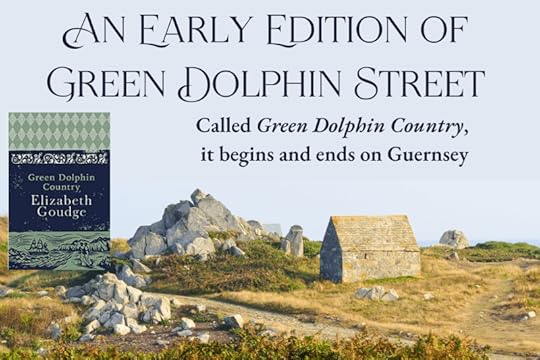
GREEN DOLPHIN STREET by Elizabeth Goudge
Is it Marianne, or Marguerite? Poor William could never remember the names of the two sisters, even though they had very different personalities. Marianne was a fiery independent woman, who would not have been out of place in the 21st century. Her gentle sister Marguerite had more old-fashioned qualities. When William had successfully made a life for himself in New Zealand, he decided to write home to St. Pierre in Guernsey, and ask for the hand of the woman he loved. The woman he loved was gentle Marguerite. But in the letter he wrote to their father, he asked for Marianne.
So Marianne set off for an unknown place, happy to be shed of provincial St. Pierre that hemmed her in. Fiery and courageous, she made a success of herself in New Zealand, taking the inevitable hardships in stride. She had no idea that she was not the bride her husband had in mind until they returned to Guernsey.
The scene where she confronts her sister Marguerite with her knowledge that she was the wrong bride is one of my favorites. One doesn’t expect nuns to be speechless with laughter, but this scene is such a luminous one, for the laughter, the love and the forgiveness.
Elizabeth Goudge (1900 -1984) is a mostly forgotten author, but at her best, she married wonderful storytelling with spiritual depth. I often wish I could write like her.
 The post GREEN DOLPHIN STREET by Elizabeth Goudge appeared first on Cynthia Sally Haggard.


November 24, 2025
My Visit to Weald & Downland Museum in West Sussex
Of course, when I visited the Weald & Downland Musuem, I did it in a lot less time that advertised. The website says it takes four hours to go through. I did it in two. Perhaps it was because it was April, and there were scarcely any volunteers there to explain Weald & Downland to the curious visitor.
Managing to find an empty parking lot where I could park the car easily (quite an achievement in Britain), I looked at my watch. It was just after ten, almost exactly when they opened, so I went in, purchasedt my ticket, and started on my journey.
First of all, I walked past various Medieval buildings—the Bakehouse, the Dairy—until I got down to the Mill. I wanted to find out how to get to the Cafe, where I intended to have some lunch, but my way was blocked as that end of Weald & Downland is used for Repair Shop, a very popular program on the telly. And so I went back to the ticket office, and they told me how to get to the Cafe.
Next, I went to the Market Square, and popped in for a chat about Stained Glass. I was the only person there as it was very quiet generally. Then I continued walking. By this time, it was eleven o’clock and I was hungry. And so, I decided that before seeing the rest of Weald & Downland I really should get something to eat. So I went back to the Cafe. Unfortunately, they were still doing their breakfast menu. And no-one told me that the lunch menu would start at 11:10 (when a crowd of people arrived for elevenses and were allowed to order lunch),, even though, miinutes before, I’d ordered a lunch item, only to be told I couldn’t have it. And so, I got the Weald & Downland breakfast muffin, which consisted of a sausage patty, 2 rashers of bacon, cheese and egg. It was unexpectedly good, and had the additional benefit of not being too carby. I was still hungry, so went back to the counter to get a slice of fruit cake and a chai latte. Then I went on my way.
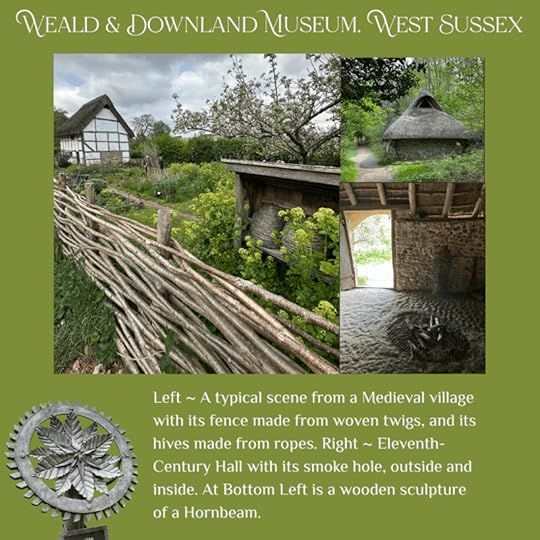
I found a mowed path that took me into the heart of Weald & Downland, to the Bayleaf Manor House (Tudor) and to various other buildings. Checking my map, I opted for the very steep walk up to the top of the land. It was steep. And unfortunately there were no views to reward you when you got to the top, as everything was masked by trees. But it did have some “sculptures,” evocations of various trees such as Ash, Hawthorn, and Hazel.
On my way down, I passed an 11th-century Anglo-Saxon Hall that had been reconstructed. What a pity there was no-one there to explain it all to me. Shortly after that, I found myself not far to the entrance of Weald & Downland. Checking my watch, I found it to be about 1:30.
What to do? I really didn’t feel like going back to the B & B just then. And I had heard someone talking about Chanctonbury Ring, a Prehistoric Hill Fort. And so I decided to drive over there to take a look at it, promising myself I would have a good walk.
Of course, it was 27 miles away and took some time to get there. My GPS led me up one of those muddy one-lane country roads. Eventually, the road gave out into a web of bridle paths and I had to come to a stop. I got out and took a couple of shots of Chanctonbury Ring. It was close enough to get decent pictures, but too far away to get to by foot. And I had no idea of how to drive up there to get in the walk I’d promised myself. I suppose I could have tried, but I was now tired, and decided to save my energy for going home. The traffic going the other way had been horrendous, but somehow my GPS knew that and gave me a route that avoided all the traffic.And so I made it back to the B & B, by 3 pm, tired out and ready for a relaxing evening.
I have to say I was disappointed by Weald & Downland. Like Fishbourne Palace, it was too silent, with no-one there to lead you through it. I have no idea what it is like in high season, but I would recommend any of you thinking of visiting these places to call ahead and see if you can get on a tour.
 The post My Visit to Weald & Downland Museum in West Sussex appeared first on Cynthia Sally Haggard.
November 21, 2025
Amazon Coffee Table Book Giveaway ~ Can You Weave A Life
It is the Holiday Season again!
But what to do for that beloved hard-to-find-a-gift person in your life?
Enter Cynthia Sally’s Book Giveaway and receive a SIGNED coffee table book: CAN YOU WEAVE A LIFE FROM FAIRYTALES ~ and other favorite blogs from 2021 to 2022. This is a 162-page book with the text to the left and the image to the right. Text is written by me (Cynthia Sally Haggard) and the book is designed by Melissa Stevens of The Illustrated Author Design Services.
I have NINE FREE copies to send!
Enter Now!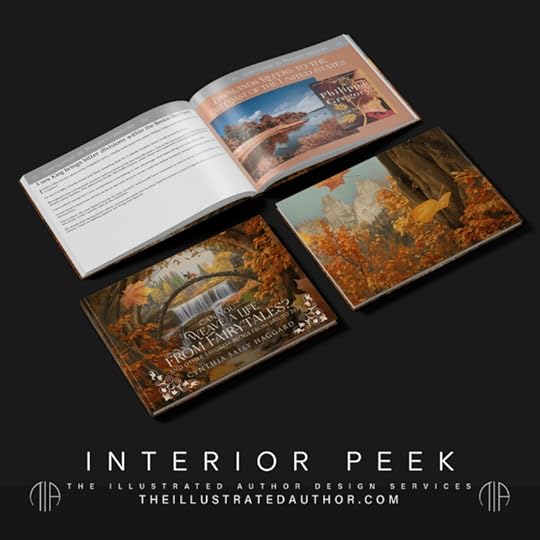 The post Amazon Coffee Table Book Giveaway ~ Can You Weave A Life appeared first on Cynthia Sally Haggard.
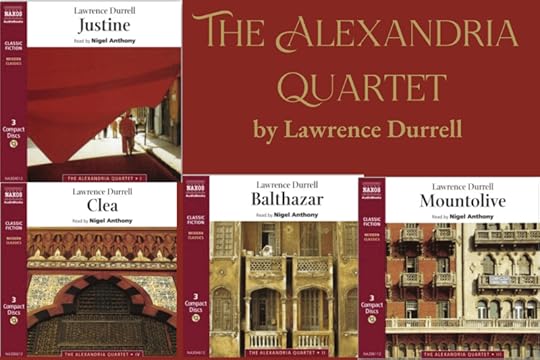
THE ALEXANDRIA QUARTET by Lawrence Durrell
It is easy to see that Lawrence Durrell started life as a poet, for his prose is magnificent. But his strongest suit is his brilliant evocation of time and place in recreating the alien landscape of Egyptian Alexandria in the late 1930s and 1940s, during World War Two. And his characters are marvelous: Nessim and Justine, Darley and Melissa, Mountolive and Leila, and Balthazar and Pombal, all quirky, all seeming to fit perfectly into a strange place which is an interesting blend of East and West.
This is not to say that THE ALEXANDRIA QUARTET doesn’t have its flaws. Those of you who haven’t read these volumes and dive into JUSTINE (the first volume) should be warned that this is Durrell’s most experimental novel. After some wonderful brush-strokes that delineate Alexandria and environs, he plunges us in. The experience is rather like going through an elderly relative’s papers, all spread out over the desk in no particular order, and it is our job to make sense of it. JUSTINE places quite a burden on the reader by the formlessness of its structure. The novel is in four parts, but there are no chapters. Instead, when Durrell runs out of steam, we hit these abrupt breaks, and just as abruptly start up with something else. This can be irksome for the reader, with all these starts and stops, because just as we’re getting into something, we have to drop it and pay attention to something else. Accordingly, JUSTINE has a cloudy quality to it, like an undeveloped photograph, and the only clear thing that emerges is how obsessed the narrator is by Justine—the mysterious, elegant, beautiful, sensual wife of wealthy banker Nessim Hosnani.
The narrator of JUSTINE is un-named, and we don’t actually find out that his name is LG Darley until the end of BALTHAZAR. Of course LG Darley is a dead-ringer for Lawrence George Durrell, the author himself. When we first meet the narrator in JUSTINE, he is a Brit living in Alexandria who has a modest teaching job. One day, Justine accosts him after a lecture and takes him home to meet husband Nessim. And thus the machinery of the novel is set into motion.
Who is Balthazar? He is a close friend of Justine’s who holds weekly meetings, referred to by narrator L. G. Darley as “the Cabal.” Of course, he is a well-known member of the Jewish Community in Alexandria. If JUSTINE was incoherent, then BALTHAZAR is a more coherent version of the same story, told by the same narrator (L.G. Darley), with some extra background details that help us to make sense of the narrative, and chapters (!), which help with the flow of information.
By far my favorite of the four novels is MOUNTOLIVE, the story of a junior officer of exceptional promise at the Foreign Office, who scales the heights of the Diplomatic Services to become Ambassador. In Durrell’s hands it becomes much more than this, since these four novels are meditations and reflections on modern love. Of course MOUNTOLIVE provides all the juicy details about his personal life, as well as the office politics and intrigues of the British Embassy in Cairo and the British Consulate in Alexandria. The reason why this novel is my favorite is because it is the only one to have a coherent structure. All the anecdotes, digressions, free-associations and blind alleys are knitted together by having as a spine the story of Mountolive’s life and career. The other thing that is superb about this novel is the different perspective it gives on the story of the Hosnanis and their friends, which we have heard twice now, once in JUSTINE and once in BALTHAZAR.
CLÉA is the last novel, and not nearly as strong as MOUNTOLIVE. At least it actually has chapters, which give the narrative flow some shape. But like BALTHAZAR (and JUSTINE) there are too many rambles into the weeds for my taste.
So much of these three novels (JUSTINE, BALTHAZAR and CLÉA) have a post-prandial air to them. They sound like someone who has just dined on French cuisine accompanied by exquisite wines. Slightly drunk, this raconteur is holding a brandy in one hand and a cigar in the other, telling one bizarre anecdote after another. Very entertaining if you are Durrell’s guest. But for a novel? Not so much.
 The post THE ALEXANDRIA QUARTET by Lawrence Durrell appeared first on Cynthia Sally Haggard.
November 17, 2025
Guided Tour of Chichester plus visit to Parham House
The guided tour of Chichester (led by a volunteer called Jean) began outside the Cathedral which was built by the Normans, starting in 1075. So this year is their 950th Anniversary. Jean talked about the origin story, in which Verica, a King of the Belgic Atrebates Tribe whose kingdom was centered on Sussex and Hampshire and whose capital was close to present-day Chichester, went to Rome to ask for help. Apparently, his family had become friendly with the Romans after Julius Caesar’s arrival in Britain in 55 BCE, and so Verica became a client King of the Romans when he ascended his throne in 15 CE. His appeal for help gave the Romans the pretext they needed for invading, which they did in 43 CE. Jean thinks it quite possible that some of the Roman army arrived in Chichester Harbor, because Verica’s tribe was known to be friendly. In any event, there was a peaceful takeover of power by the Romans, although, as Jean pointed out, it would have been very rough for some people, who might not have been at all happy that the Romans had arrived and taken control.
Verica’s heir Cogidubnus or Togidumnus aka Tiberius Claudius Cogidubnus was a Roman Citizen, and there is a stone in the wall of the Old Market Hall connected with him, that says ~ To Neptune and Minerva,
for the welfare of the Divine Temple,
by the authority of Tiberius Claudius Cogidubnus,
great king of the Britons,
the guild of smiths
and those in it gave this temple at their own expense
…ens, son of Pudentinus, presented the forecourt.
This Tiberius Claudius Cogidubnus is also thought to have been the owner of the villa at Fishbourne. (If you have never been, you really should. The mosaic floors are amazing.)
After the coming of the Anglo Saxons, this area was ruled (according to the Anglo-Saxon Chronicle) by Aella and his three sons. One of those sons was called Cissa, and that is supposed to the origin of the name Chichester, which apparently means “Cissa’s Camp.”
After that, we turned into North Street and she took me to Priory Park to see the “redundant chapel” all that is left of the monastery, plus a shapeless mound that is all that remains of the castle. Then we wound our way to the Pallant Area, to see the famous Art Gallery, housed in a handsome Georgian House, built in 1712 for Henry “Lisbon” Peckham and his wife Elizabeth. No expense was spared, and so he ran through his wife’s considerable fortune building this house. It is well worth visiting.
After that, she took me to the Bishop’s Garden and mentioned the walks on the Roman walls (also well worth doing.) We parted on Canongate, after she’d told me all about Chichester’s patron saint St Richard.
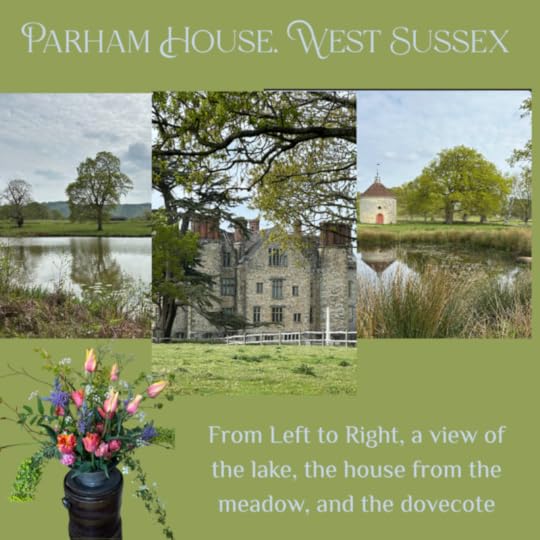
After lunch, I made my way to Parham House, buyint a ticket for both the house and garden. And I was glad I did for, unlike Petworth, which was this austere forbidding pile, Parham was charming. Built in the Elizabethan times, the foundation stone was laid in 1577 by 2-year-old Thomas Palmer, whose family remained there until 1922, when it was bought by the Pearson family.
Leaving my backpack at the front desk, I followed the advice of the docent and went up to the top of the house to take in the Long Gallery, passing through impressive 16-century parlors and bedchambers as I went. After that, I visited the gardens and they were glorious. How lucky I felt to be roaming around an English garden in the Wonderful Country of Sussex on a Thursday, when most folk have to work.
It was a wonderful day!
 The post Guided Tour of Chichester plus visit to Parham House appeared first on Cynthia Sally Haggard.
November 14, 2025
ISAAC’S STORM by Erik Larson
In his 1891 monograph, meteorologist Isaac Cline (1861-1955) claimed that the thought of a hurricane every doing serious damage to the port city of Galveston Texas was “a crazy idea.” How tragically wrong he proved to be when, nine years later, on 8 September 1900, Galveston was destroyed by a hurricane.
Even though ISAAC’S STORM is a work of fiction, author Erik Larson is too good a writer not to put this tragedy into context. Not only does he gives us a brief history of meteorology (a history that stretches back to Ancient Greece and beyond), but he also tries to provide us with a glimpse into the mindset of Victorians, and men, in particular. In 1900, the United States was still a young country, filled to the brim with confidence. Of course, this confidence veered into overconfidence all too often, as can be seen from Isaac Cline’s statement above. Victorian men did not ever want to feel that they were wrong. If they were actually wrong about something, their course of action was to dig their heels in. They were also closed-minded about other cultures. In the case of Isaac’s superiors at the Weather Bureau, this meant that any information from Cuban meteorologists was to be blocked. This also, proved to be a tragic mistake, because the Cubans, who were much more used to hurricanes than the Americans, were actually better meteorologists. They actually predicted the hurricane that struck Galveston. By contrast, the citizens of Galveston were told, that morning in September 1900, that the weather was going to be “pleasant” with “increasing winds”. There was nothing, nothing to indicate that a dangerous hurricane was approaching.
And so, the Galveston hurricane has remained the worst natural disaster in US history. Out of a total population of 37,000, Galveston may have lost as many as 8,000 people that day, about one-fifth of its population.
Erik Larson makes this tragedy personal, by portraying it through the relationship between Isaac Cline and his younger brother Joseph. Joseph also was a meteorologist, working at the Weather Bureau. But, at nine years younger, he was Isaac’s subordinate. This not only meant that he earned less money, but that his opinions were not respected in the same way that Isaac’s were. This proved to be yet another tragic mistake as it was Joseph, not Isaac who correctly predicted that a devastating hurricane was coming.
However, Isaac was punished by the scale of his loss. Unlike his brother Joseph, who was an unmarried man, Joseph had a wife and three daughters with another on the way. Isaac nearly drowned, and was only able to save one of his daughters, the youngest Esther Bellew. Joseph managed to save the two older daughters Allie May and Rosemary. But Isaac’s wife Cora disappeared. It took over a week, but her body was finally discovered in the ruins of his house.
Strangely enough, Isaac was promoted and his pay increased not long after this fiasco. By contrast, Joseph was demoted and his pay decreased. To be fair, Joseph had refused an assignment on the grounds of ill health, while Isaac left Galveston with the Weather Bureau, when it moved to New Orleans.
But it still remains a puzzle as to why Isaac was promoted, when his actions (or rather lack of them) were responsible for so many deaths. Reading between the lines, we can imagine that one of the reasons why Isaac may have been so successful was his personality. He comes across as a genial colleague, someone who was a good team player. By contrast, Joseph was much more confrontational. It also didn’t help that he was a high-maintenance person who constantly complained about his health. The brothers differing treatment, as well as their differeing predictions about the storm, caused a permanent rift. After Isaac left for New Orleans in 1901, the brothers never spoke again.
If you have never heard about the Galveston hurricane, and enjoy historical fiction, I highly recommend this book, which is extremely well-researched and well-written.
 The post ISAAC’S STORM by Erik Larson appeared first on Cynthia Sally Haggard.
November 10, 2025
Petworth House & Park, Sussex
It poured with rain last night ~ I could hear it pattering on my slightly open window through my sleep ~ so instead of going to Weald & Downland today, I went to Petworth House.
First of all, I visited the village of Petworth, because I have run out of hairspray. After doing a horrible job of parking the car in a free spot near the town center ~ it looked like it had been parked by a man ~ I turned two right corners and found the Pharmacy on my right? But why did I have no idea where I was going? Because the Wi-Fi wouldn’t work, and so I couldn’t get Google Maps to give me directions.
Eventually, I found the pharmacy, made my purchase, returned to the car and left. Lizzie, my landlady at the B & B, had told me that Petworth village was a quirky place, and it sounded like she loved shopping there. But on that Wednesday (admittedly around 10:15 in the morning) it seemed very quiet, almost dead. The only shop that appeared to be open was the pharmacy.
I got back in the car and drove to Petworth House. To my dismay, a horde of people showed up, snagging all the parking spots in the first car park, and so I had to drive around to the second. Given that unpleasant surprise, I decided to have an early lunch at 11, so that I could get into the cafe before the hordes arrived. Imagine my surprise when they all showed up at 11:10. I had no idea why, having forgotten British people’s propensity for elevenses. Because that was what it was. They’d packed the cafe to the rafters, but were only having tea (or coffee) and biscuits. I, however, did manage to find a table, so I ordered a double lunch ~ two sandwiches, two cans of wine, two flapjacks and one cappuccino. (The reason for this is because the other “lunch” can be eaten this evening for dinner.)
As I sat munching away at my Egg Salad Sandwich, and sipping a filmy glass of white wine, the cafe became more and more packed, with a huge queue forming. A woman appeared, looking flustered, and so I told her she was welcome to sit at my table, where there were two empty spaces. “But there are three people,” she said. She quickly conferred with another woman, and it was clear they were in a bind. So I hefted my backpack from the chair it was sitting on, telling the women that actually there were three spaces. They were very pleased. Soon we were chatting away about Donald Trump (naturally.) I told them that most Americans were very poor, living from paycheck to paychek. That they may have glorious views living in the Appalachians Mountains of West Virginia. But they were living in unincorporated townships with no trash pickups, no running water, and were living in shacks. Told them that cutting Social Security and Medicare would be a disaster for millions of people. We talked about Racism in America, and I said it continued to be a painful wound. Then I asked about Class Conflict in Britain, and they said it was still going on. When I asked about my accent, and if I sounded too posh, they said no. The first woman I met said my speech was very clear and I pronounced all of my “th”s properly. But they didn’t think I was a snob. After all, I had invited all three of them to sit down at my table. I hadn’t looked them up and down and said ‘No.”
After that, we parted. I visited the Servants Quarters (very interesting) and then went into the house. Although Lizzie said it was beautiful, I have to say that Petworth House is one of the ugliest houses I’ve ever been to. Outside, it’s just a pile of masonry without any redeeming features. Inside, it is gloomy.
I dutifully went through all the rooms (it was free for me, as I am a National Trust member), but thankfully it came to an end. So I decided to walk in the deer park.
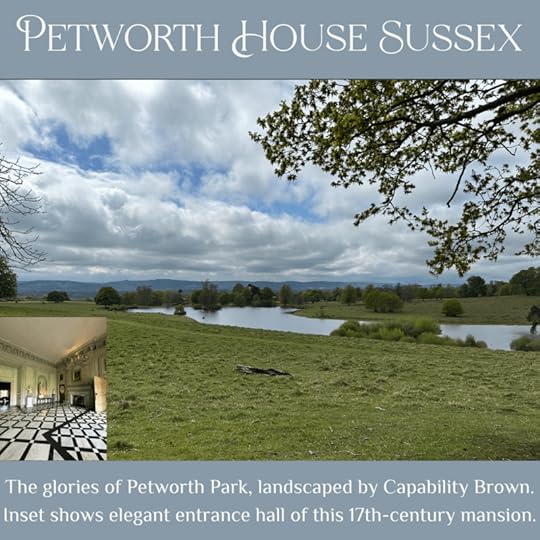
With my back to the house, I walked a “path” that had been mown into the grass and soon found myself at a large lake. To my right, was a hill, which I climbed. This gave me a much better view of the surrounding countryside. Spotting some people on another hill, I made for it, only to find another lake. By this point I had a good view of the road that runs alongside the boundary of the estate, the A283. How glad I was of my puff jacket, for despite the fact that temps were in the 50s, there was a cold wind.
As I walked, I realized how unusual it was to walk in the countryside like this, without being forced to deal with the 21st Century in the form of roads, or buildings. There was nothing there but trees, grass, and the rolling Sussex hills. True, anytime you walk in the countryside, you have to reckon with the fact that you are walking through an open lavatory, as animals crap all over the place. But at least I didn’t have to deal with huge cow turds. These were small turds made my deer, rabbits, mice, and god knows what else.
After getting some good shots of the estate, I turned back the way I’d come as I knew I had to get through that Tijou Gate in order to get out of the Deer Park. The Tijou who designed that gate at Petworth, was the same Jean Tijou who began working in 1689 under William and Mary, and died in 1712 in the reign of Queen Anne. He was a French Hugenot iron worker, known for his gates at Hampton Court Palace, Kensington Palace and St Paul’s Cathedral.
After going through it I walked back in the direction of the car park. The flowers, the bluebells in particular, were lovely. Getting into my car, I programmed it to take me back to the Charlton B & B. It had been a very satisfying day.
 The post Petworth House & Park, Sussex appeared first on Cynthia Sally Haggard.
November 8, 2025
THE TALE OF TWO CITIES by Charles Dickens
If there is one thing that people remember about Charles Dicken’s A TALE OF TWO CITIES, it is of Madame Defarge knitting while the heads roll:
“The ministers of Sainte Guillotine are robed and ready. Crash!–A head is held up, and the knitting-women who scarcely lifted their eyes to look at it a moment ago when it could think and speak, count One.”
This is a brilliant example of how brutality dulls the mind in the face of horror. Dickens uses knitting, which we normally associate with a cozy home life, and pairs it with the guillotine to make it seem sinister and arresting. What is odd about this scene is that it is the only example I could find of Madame Defarge actually knitting beside the guillotine, and she isn’t there, a fact that is made much of by her side-kick ‘The Vengeance’. So one could say that this scene is also a perfect example of how memory has difficulty in processing negatives. Because what people actually remember is that she is there, in her chair, knitting. Here is an actual example of Madame Defarge knitting, and why it is so important:
“Next noontide saw the admirable woman in her usual place in the wine-shop, knitting away assiduously. A rose lay beside her, and if she now and then glanced at the flower, it was with no infraction of her usual preoccupied air. There were a few customers, drinking or not drinking, standing or seated, sprinkled about. The day was very hot, and heaps of flies, who were extending their inquisitive and adventurous perquisitions into all the glutinous little glasses near madame, fell dead at the bottom. Their decease made no impression on the other flies out promenading, who looked at them in the coolest manner (as if they themselves were elephants, or something as far removed), until they met the same fate. Curious to consider how heedless flies are!–perhaps they thought as much at Court that sunny summer day.
“A figure entering at the door threw a shadow on Madame Defarge which she felt to be a new one. She laid down her knitting, and began to pin her rose in her head-dress, before she looked at the figure.
“It was curious. The moment Madame Defarge took up the rose, the customers ceased talking, and began gradually to drop out of the wine-shop…”
While talking with the spy Barsad in the most unhelpful fashion possible, Madame Defarge is knitting in code such details as his name and appearance. Which is presumably why she wants the other inhabitants of the shop to go away, so that she can concentrate. I love the way in which Dickens picks out seemingly unimportant details to make a point. For example, the flies are compared to those courtiers who lounged around Versailles, pursuing pleasure with abandonment, heedless of the storm that is brewing up beneath them. This is a remarkable novel, and if you haven’t read Dickens before, I suggest you give this one a try.
 The post THE TALE OF TWO CITIES by Charles Dickens appeared first on Cynthia Sally Haggard.
November 4, 2025
Travel Day ~ Heathrow to Chichester
Arriving at the Alamo/Enterprise at Heathrow, a full hour before my booking, I was lucky enough to be looked after by Abdul, who turned out to be a Rainmaker. He found me an SUV right away, which I declined, saying it was too big for me. As I am used to driving on the right, this means that my cognitive map of a car doesn’t extend left, and so the last thing I need is a huge vehicle to manage. So he showed me a nearby sedan. But it had a manual shift. Again, I apologized, saying I really couldn’t handle a manual shift. And so he disappeared, saying he would be back in a couple of minutes.
To my great surprise, Abdul was as good as his word. He did return a couple of minutes later, with a sedan car, with a huge boot, automatic shifting and a built-in GPS system that was a lot more intuitive than the car I’d rented in Manchester, because it used a touch screen.
He got into the car to show me how to use it, and programmed it to take me to The Mill Inn, Shottermill, Haslemere. I drove off the lot, and (naturally) went the wrong way. Fortunately, I noticed this right away, turned around and, got onto the right road which took me to the M25. Everything was fine until it was time to turn onto the A3. That junction had massive roadworks going on, and it took ages to go through it. But once I was on the A3, once the beauty of a lovely sunny day in the English countryside in spring got to me, I really enjoyed myself. Shortly after going through a tunnel at Hindhead, I got off onto the A333, which took me to Shottermill Road in Haslemere. But where was the pub? Fortunately, I turned around and went back along Shottermill Road. Somehow I went the right way, and saw the pub on my right. I pulled into the parking lot and parked the car.
It was 12 Noon on the dot when I arrived, and no-one else was there. But they were serving lunch. I found a small table and ordered crudites with hummus and fish cakes. The hummus was delicious, but was servied without any bread. However, when I asked for some, she brought me too slices of toast! It was heavenly. Then I had the crab cakes, also marvelously cooked, not too greasy or too rich. After that, I asked for the Alfogato, as I needed my coffee and just wanted a light dessert of vanilla ice cream.
After that, I programmed the car to take me to the Novium Museum in Chichester on Tower Street. Again, the drive there was delightful. I turned left onto Tower Street and followed around, seeing the museum on my right hand side. But there was no-where to park. Shortly afterward, I saw a parking sign and descended down into a basement parking lot, despite the red sign suggesting that I shouldn’t do it. However, there was plenty of space, so I parked the car and then tried to figure out how to pay for it. Fortunately, it took the PayByPhone App. Unfortunately, the App wasn’t coming up because the WiFi wasn’t working so deep underground. So I took a photo of the number I needed to plug in for the parking space, and left. Once I’d come up above ground, I added the rental car, plugged in the number and paid for 2 hours. By now, it was about 2pm, so the parking period would end at 4.
I walked around the corner to the Novium Museum and everyone was very pleasant in there and helpful. I talked about the places I wanted to visit. Weald and Downland was an all-day experience, so was Petworth. Parham house only opened at 2pm, although the cafeteria opened at 12. But it wasn’t open every day, and so I would have to check up on it. Everything seemed to be open on a Wednesday. Then I inquired about guided walks around Chichester, and they also handed me a leaflet about a guided bus tour, which I said would be good in case of rain.
I was supposed to check in at 3pm at the Charlton B & B, but it was only 2:15, and so I walked along West Street to the Market Cross, up and down North Street, then turning onto East Street. And that is where my memories came alive, for I recognized the end of East Street, just where The Hornet comes in. I programmed 18 Whyke Lane into my iPhone, the address where my father had lived with his second wife, and followed Market Avenue around to Stirling Road, bearing left into Caledonian Road, and right into Whyke Lane. The house on the corner to the right was Number 14, meaning Number 18 was a few doors down. Standing in front of Number 18, it looked completely different from my childhood memories. It had a red door, a Victorian lamp and a new paint job. But I was happy to see that It looked well-cared for. I took a shot of it, and then walked along Whyke Lane in the direction of Lyndhurst Road. At the corner was the DIY store that Daddy loved, still called LindWhyke Store. Then I turned around, crossed the street, and took another shot of 18 Whyke Lane from across the road, before following Whyke Lane all the way back to The Hornet. For most of that distance Whyke Lane is a just a path between two walls. I used to walk that route frequently with my stepmother and sister, fifty years ago, when I was fourteen. It was a great shortcut for getting to East Street.
Reaching East Street, I realized that it was time to go back to the car. I walked back along East Street to the Market Cross, before walking along West Street past the Cathedral. At that point, I dropped a message to the owner of the B & B, saying I would be there in 20 minutes or so. Turning right into Tower Street, I was obliged to walk down the car entrance as there was no other way of getting to the car. Along the way, I noticed a lot of broken glass on the left hand side. I hoped that I had avoided it.
When I found the car, the tires looked just fine, so I got in, and then had the difficult task of turning it around in a tight space with pillars and other cars to avoid. But eventually, I got out and we were on our way. Of course, I made a wrong turn, and had to back track along Wellington Street and College Avenue. But I eventually the Disembodied Voice led me onto the A 285, to Charlton.
I managed to find the B & B without much trouble, and the door was open to Number 5. The host could not have been kinder. A motherly woman, she ensured I had fresh water, and decaf tea bags in my room. She invited me to sit downstairs whenever I wanted. And even told me to visit The Fox Goes Free, the local pub about 0.3 miles away.
I wish I could say that I took her advice, but by the time I’d unpacked, I was too tired to go out, even though it was a beautiful evening. I promised myself to do it later on this week.
 The post Travel Day ~ Heathrow to Chichester appeared first on Cynthia Sally Haggard.
October 31, 2025
THE LOST PASSENGER by France Quinn
Poor Eleanor is so naive. Aged 19, when this novel opens, she loves nothing more than reading novels, especially those with a Cinderella-ish flavor to them. When she is not immersed in her favorite pastime, she dreams of finding love and romance in her own life.
Enter Frederick Coombs, the son and heir of an Earldom. He is kind, charming, and has wonderful manners. He takes the time to talk to shy Eleanor at a party, drawing her out. She likes hiim. He comes to tea. He returns for more tea. Even her father, a shrewd man used to hard bargaining, is charmed by this handsome young man. In no time at all he pops the question. Naturally Eleanor is thrilled .And so they marry, dear reader.
If this were a Jane Austen novel, the story would end there. But what happens next is chilling. For Eleanor is subjected to abusive behavior on the part of her mother-in-law and husband. These charming people have rather strange beliefs. They do not think a mother should spend much time with her child. Instead, they believe that the child should be brought up by a nanny, who has managed to impress a duchess or two. When Eleanor, still recovering from the birth of her son, realizes that she is only going to be allowed to spend twenty mintues a day with him and becomes distraught, everyone, including the doctor, threatens her with the prospect of being locked up as a sure tonic for her “madness.”
Terrified, Eleanor makes herself conform the the strictures of this aristocratic British family. Imagine her dismay when her husband informs her that their son will leave the family home at the age of seven to be educated at a private boardiing school as a preparation for Eton. What is Eleanor going to do? She has so little time left to spend with her son.
Fortunately, her father, a rich businessman, decides to treat her with tickets on board the Titanic. Eleanor is thrilled as it means that she sees it as an opportunity to spend time with her son. For her father’s tickets are just for herself and her husband, her son and two servants. Of course she has to work very hard to convince her reluctant husband and domineering mother-in-law that her son Teddy will be traveling with her to New York (and back) without the nanny. But somehow, she manages to do that.
Of course, everyone knows what happens to the Titanic. Because Eleanor and her party are in first-class, they are offered the life-boats first. However, the men have to stay behind until those first boats are filled with women and children.
And so, Eleanor becomes a widow.
Not long after Teddy was born, Eleanor was coerced into signing a document that stated that in the event of Frederick’s death, Frederick’s parents (not Eleanor) would become Teddy’s guardians. And so Eleanor hatches a desperate plan to take on the identity of the young woman who acted as Teddy’s nanny aboard the Titanic. All she knows about this woman is that she disappeared into the bowels of the Titanic to fetch her savings, that her name was Molly Morton, and that she had relatives waiting for her in New York.
If you are wondering whether this story about the strange goings-on in the British aristocracy could be true, you only have to look at the experiences of the Empress Elisabeth (Sissi) of Austria (1837-1898), who had a similarly domineering mother-in-law who took away her three eldest children before handing them off to paid staff to look after them.. Such traumatizing experiences probably contributed to the mental health issues that Sissi suffered from all her life.
It is also true that aristocratic young men had been leaving their families of origin at the ages of seven or eight for around a thousand years. These young boys were sent to another aristocratic household to learn their fighting skills from the lord of the manor, and their manners from his lady. For example, the young Richard III (1452-1483) was sent away from his mother at the age of eight to train in the household of his cousin Richard Earl of Warwick (1429-1471), in 1460, shortly after his father died.
Although a similar story is told in the the 1997 movie TITANIC, I highly recommend this novel as author Frances Quinn has told a compelling story about the mores of the British aristocacy, a brave bid to escape a the cruelties of an aristocratic gilded cage, and how the protagonist Eleanor/Molly finally makes peace with her past.
 The post THE LOST PASSENGER by France Quinn appeared first on Cynthia Sally Haggard.
Cynthia Sally's Blog

- Cynthia Sally Haggard's profile
- 129 followers

