
Boo Walker's Blog
July 6, 2026
Origins of The English Bookstore in Bologna
I’ve not admitted this to anyone, even my wife or agent, but writing it was a direct result of the profound joy I had in reading Gabrielle Zevin’s glorious novel, The Storied Life of A.J. Fikry.
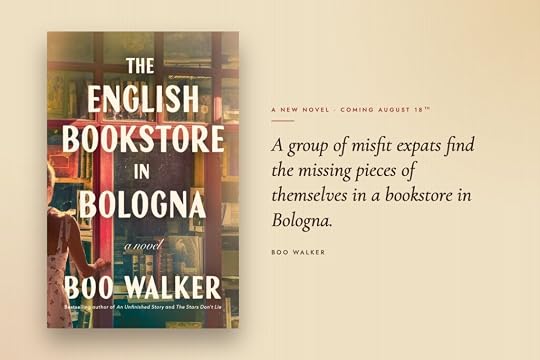
I remember the moment precisely. My family and I were living in Valencia, Spain, and I’d been toying with writing a tale about misfit expats—something akin to my Red Mountain series—but I hadn’t quite found the essence yet. Seemingly unrelated, I’d also been struggling to find print copies of English books and had been wishing there was a lovely English-language bookstore like Paris’s Shakespeare and Company.
Along came A.J. Fikry…
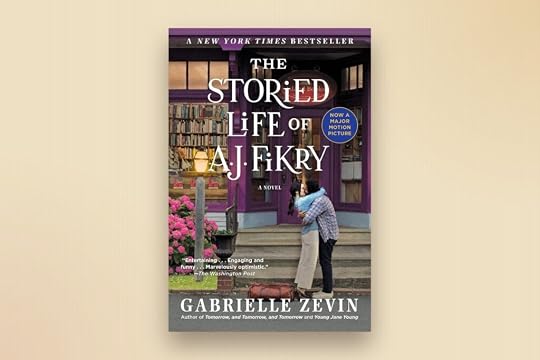
It’s an incredibly compelling story about a grumpy bookstore owner who falls in love with a wonderfully complicated woman. Gabrielle’s writing is exceptional, as always. On that note, her latest, Tomorrow, and Tomorrow, and Tomorrow, is also dazzling.
Though their genres are totally different, I see strong prose ties between V.E. Schwaband her. They both have an extraordinary ability to drop nuclear-bomb phrasing while still allowing a captivating story to lead the way.
I wished I’d loved the Fikry movie more, but that’s fine. We have the book. If you haven’t read it, you’re in for a treat. It captures so much of why we love books and bookstores, and it’ll restore your passion for reading if you’ve been in a slump.
My first thought, as I set the finished book down, was: Hey, not fair, I want to write a novel set in a bookstore!
So began a wonderful journey as I brought my own bookstore curmudgeon to life.
While living in Spain, I was in a really good place creatively. I’d start my days with an hour or two walk through the Turia Garden, then write for a few hours, then join my wife and friends for an always delightful long, long lunch before a siesta. I don’t know that I’d ever felt so rich emotionally, so spiritually grounded, so utterly rooted in the present.
Words flew from my fingers. My protagonist’s name was Sandy, and I fell into the rhythm of her prickly voice with such ease that there were times that I totally left my own skin. I’d dream from her point of view.
But as I reached one-hundred pages, I hit a huge snag.I’d presented three story ideas to my publisher, Lake Union, pushing for a two-book deal. Sandy and her community of bookstore misfits didn’t make the cut. I was devastated but had no choice but to shelf the story for another time. That was back in 2021.
Fast-forward to two years ago. Sandy was haunting my dreams, demanding I tell her story. And yet, I’d written A Spanish Sunrise in the meantime and had already captured so much of what I love about Spain. Worried that she might slap me, I asked Sandy if she’d mind if I set her bookstore in Italy.
She smirked at the idea, which was a huge sign, because Sandy rarely smirks. This time, my publisher was all about the idea, and the story began to lock into place, especially since my wife is Italian and close to nabbing her citizenship. Though it was her grandparents who were born in Italy, I’m not sure anyone is more Italian than my wife, so I know the culture; we visit often.
After a lot of research, we (my wife, Sandy, and I) decided that the ancient city of Bologna would be the perfect setting, so I booked a trip and immersed myself in what became one of my favorite spots in Europe. On one of my long walks, as I scribbled madly in a notepad, I came across a charming street that took my breath away, and in my mind’s eye, Sandy’s bookstore came to life.
In the novel, I made up the street name, but I can still see so clearly the cobblestone street, the terracotta, the frescoes, the flower boxes bursting with begonias, surfinas, and geraniums. I can smell the yeasty goodness of the nearby panificio; I can hear the chirp of the swifts and doves as they danced between the columns of the elaborate porticoes.
I spent the rest of the trip letting Bologna seep into me, and I made room in my head for the rest of the cast of expats. A mousey British woman with a tremendous secret; a recently retired man who fears he has nothing left to offer; his daughter, a psychotherapist who is having the most epic of midlife crises; and a young nerd from Colorado who has finally found someone who loves him. Let’s just say they’re all going about their lives in the wrong way, and it might take a bookstore and its curmudgeonly porcupine owner to save them.
(Oh, and there’s a love interest chef who is trying to get a Michelin star. I’ll save the silly tale of my undercover visit to a Michelin-starred restaurant for a later missive, but know that there’s delicious food all over this book.)
I’ll leave you with one last ingredient that made this book special.If you’ve followed me long enough, you know the obstacles I’ve faced as a creative, the warring with imposter syndrome, the tight deadlines, the figuring out how to do this thing for a living, especially after having lost my first career due to a hand issue.
More and more, especially so with this book, I’m not writing to impress anyone, to hit the bestseller list, to make money, to satisfy reviewers. I’m simply committed to falling into flow as often as possible and breaking bread with the magic that’s all around us—whatever you’d like to call it. I’m writing what I want to read and what delivers me joy to write, and the hell with what anyone thinks about the finished product. What’s funny is I think that mindset actually creates a better book! You’ll have to be the judge.
After all these years, I’ve come to peace with the fact that I’m not in a competition with other authors or artists. I just want to be better than I was yesterday, and I want to release onto the page totally unfiltered and authentic Boo Walker, while at the same time, acting merely as a vessel, so that the stories and characters already out there in the ether might land onto my blank pages without me marring them with my ego.
Perhaps that makes some sort of sense. It sure does to me.
That’s the place from which I wrote this book, and it’s a tremendous honor to soon slip it into your hands.
The post Origins of The English Bookstore in Bologna appeared first on Boo Walker.


January 17, 2026
A Southerner’s Guide to a maine wintah
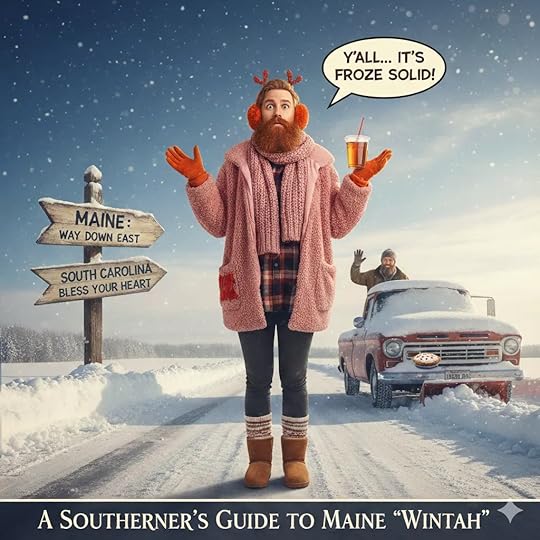 10 things this southerner has learned about living in Maine and having my first proper cold-climate-living experience:You become a master of moving from one laceless shoe to another, from indoor slippers to rain boots to snow boots and back. And birks in the summer. You only lace up for cardio.There is what they call a January thaw, which is when a tease of January warmth melts the December snow, but there’s no question that the real wintah is still on its way. Proof of that started last night.There are some mornings you wake up to new snow and shrug. Back in South Carolina growing up, you eyed a potential snow day as if it could be the Second Coming.Low-forties is T-shirt and shorts weather up here; low-eighties is unbearably hot for Maine-uhs.No matter how bitter and cold the wintah, the old timers at the barber shop will still tell you that it’s nothing like it used to be. “Back in my day, you’d see ten feet of it in an aftuhnoon! I’d have to dig my cah out with a backhoe.”Sweats are an acceptable attire for leaving the houseShoveling snow is one of the great joys on earth. Something about being out there in the frigid cold after it dumped, the sky melting into pinks and purples, your heart kicking into gear as you work the shovel through fluffy powder and breathe in what is an almost impossible silence.There is no need to shovel if warm weather is forecasted the next day, as the sun will do all the work for you. Sometimes, I shovel anyway.Even if my son stays here and has kids and then his kids have kids, even they will not be considered true Maine-uhs. They will always be “from away.”Using window A/C units is perfectly acceptable up here–even in the fanciest of houses; down South, you wouldn’t be caught dead with those things protruding from your windows. You’ll find what is called central heating and air…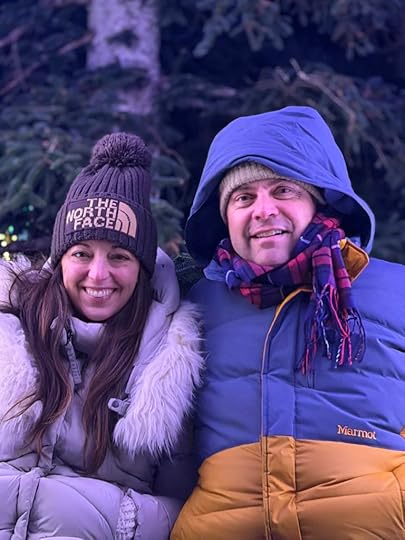
The post A Southerner’s Guide to a maine wintah appeared first on Boo Walker.
January 16, 2026
Leaping into the unknown of a new year
I’ve spent the first part of my early morning enjoying the brilliance of Maggie O’Farrell through her lovely novel Hamnet, and it’s set aglow the warm places in my chest, and it’s from here that I want to send you my love and well wishes as we crawl or jog or leap into new beginnings.
You won’t hear from me about how terrible it is out there right now. There’s enough of that going around. Sure, things could be better, but I have little time for anxiety and fear—certainly none for hatred. There’s too much good to chase, to be done, to be created, in what little time we have.
It’s a wonderful time to be a creator—perhaps the best in history!—just as it is to be a fan, a supporter, a curator of creative output. The juices are flowing, amigos!!!! If you close your eyes and let go of your worries and all the noise and listen and feel—really feel, you might sense that river of creativity and beauty rushing through you.
I feel so blessed to live in a world where Yo-Yo Ma and Bela Fleck and The Cure and Pat Metheny can exist with my new favorite band, Geese. Their album, Getting Killed, might not be for everyone (my wife can’t stand Geese), but it has devoured me this year. Cameron Winters is creating from the absolute core of the divine. And I’m so flipping excited that there are people on Substack with magic ears and a desperate love of music, like Jacqui Devaney and Marc Myers and Stephan Kunze, who lead me to new aural frontiers. They set the stage for my own creativity, as I write best when good music plays loudly through my headphones.
I’m so fortunate to inhabit a world where I can choose to read Maggie O’Farrell, or Tamara, or Anthony Horowitz, or Kevin Kermes when I wake. Or Chris Whitaker, Jess Walters, Wally Lamb, V.E. Schwab, Claire North, EMILY ST. JOHN MANDEL!
Frank Conroy’s Body & Soul came into my life this year, by way of a former high school teacher at St. Andrew’s-Sewanee called Tom Gladstone, who stoked my love for music and the written word when I was still trying to find my way as a lost seventeen year old who’d been booted out of another school for leaning a hair too far into vive la résistance. (Maybe I’ll tell you that story over a glass of gamay one day; you’ll have to come find me in Maine.) Though it was published long ago, Body & Soul will always stand at the top of the art I discovered in 2025. I’m not sure I’ll ever experience something else so profound. Every sentence dazzles.
Another book that hit me hard was Dr. James Doty’s Mind Magic. It’s a tragedy that we lost him this year, but his message lives on. I’ll share with you one of my favorite lines from his book, the lesson that took him sixty-plus years to learn:
Only when we believe we are enough in ourselves do we find the ability to contribute to life, but only in contributing to our world do we discover we are inherently enough.
How is it even possible that humans can create epic movies like One Battle After Another and Jay Kelly? Especially in a time when it’s hard to get movies made. Don’t even get me started on Task from HBO. That show shattered me, tore me apart. I’m only now sleeping okay again. But I’m also still caught up in its spell, as Task was such a mind-bending feat of storytelling. Find me a television series that does a better job at building out each character and creating empathy.
I can’t avoid mentioning Taylor Sheridan too. I love that we live in a time where he can keeping making whatever the hell he wants to. Oh, and let’s not forget the production company, A24, who has the Midas Touch when it comes to the camera. If you haven’t seen Past Lives yet, what are you still doing here? I’ll happily consume whatever they put on the screen. And Stranger Things! Give me, give me, give me! Soooo good!
I am beyond grateful that I’m allowed to partake in this creative energy that exists right now. How is it that little ol’ boo walker from Spartanburg, South Carolina can be living this life, writing stories for a living, being supported by a wonderful agent and publisher who believe in him, a readership who will go almost anywhere with him, and friends and family who embrace even the worst parts of him, while taking it all in with the woman of his dreams and a child that fills every corner of every cell of his existence with hope and joy and love?
I’m thankful that YOU are here, reading my words, partaking in all this lovely energy too. And I hope with all of me that you’re finding the light in the darkness, the glittery specks of awe that flash when we’re open to seeing them. If you’re not already there, I hope you’re on your way to finding exactly what it is you’re supposed to be doing here on this big bright blue ball.
I’m getting closer. I’m shedding more and more of my ego. I’m creating art that is unfiltered, that’s soul deep, that is exactly and only and truly me, while at the same time, I’m determined to make all of it—my writing, my living—less about me, hoping that I might simply serve as a creative vessel, a mere literary garden hose pointed toward my screen.
And my desire, as we step forward into the unknown of a new year, is that I may shine my light brighter, that I may open my heart wider, that I might create something new that makes a difference to someone out there, even if that’s simply to give them a brief respite from what hurts.
If you have a moment, tell us about yourself in the comments section. It’s time to start building this community of artists and art lovers. Who are you? What are you trying to do? And what can I do for you in the coming year here on Substack? What topics can I cover? What fears of mine or yours can I explore?
I’m eager to get started.
But for now, I’m signing off from 2025 and going to put all I have into my family and our little extraordinary life.
Peace and love and gratitude to you,
boo
(as originally shared via my Substack, Drowning in Words.)
The post Leaping into the unknown of a new year appeared first on Boo Walker.
December 9, 2025
And the idea strikes…
The best story ideas come to those who aren’t trying
(As originally shared via my writerly posts on Substack)
Funny how life works…
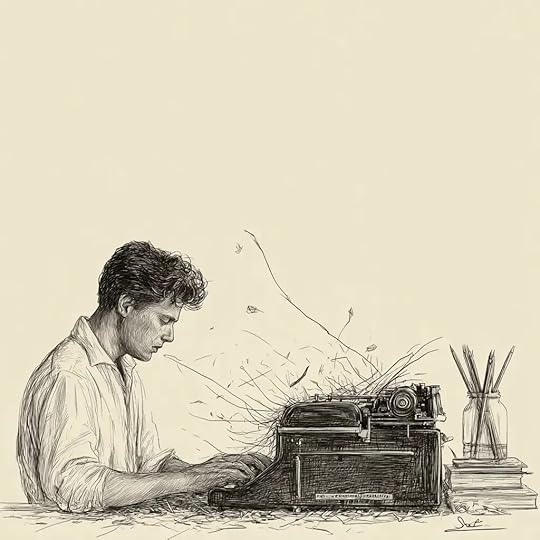
I was biking around Peaks Island here in Maine while chatting to my wife on the mainland. I told Mikella I wasn’t feeling any new story ideas and might take some extended time off, that I needed to wait till something smacked me in the face. I didn’t want to write until the words were wild beasts hurling themselves up against the bars of my cage.
That’s hard to do, friends, when you are the sole breadwinner in the family. It’s a strange place to be in to not have a new project in the works, to have itchy typing fingers with nowhere to go. If you’re not careful, it can be unsettling.
It’s also an exhilarating position to be in, where you expose the marrow of life. That same feeling you get when you leave a job you don’t love to chase a dream; or when you loosen the grip on your easy life and pack your bags and move to a place just because life is short and you’re craving an adventure.
I wasn’t telling Mikella my idea of taking a break out of a sense of fear. I was sharing it with her as I would any breakthrough, as an artist who’d remembered I’m not alone. In creating. In making art. There is a higher power that wants to assist. As Paul Coelho wrote in The Alchemist, “When you want something, all the universe conspires in helping you to achieve it.” Why would I want to go on without such potent guidance?
As an Individualist, #4 on the Enneagram chart, I couldn’t possibly subscribe to a particular belief system. My spirituality is my own and no one else’s. I’m not even sure I could communicate it properly if someone pushed. Words and images couldn’t possibly capture what gets me going in the morning, what pushes me to want to be a better man, a better human.
That said, my belief system is likely similar to yours in so many ways, no matter if you’re religious, atheist, agnostic, or somewhere in between.
What I mean is, there’s a powerful energy surging through the multiverse, through all of us, through every cell that surrounds us. I certainly can’t tell you what it is, but I bear witness to it whenever I take a moment to let my ego subside.
There’s a spot on Peaks Island, a section of road that runs along the rocky coast that’s one of the most awe-invoking on earth. A dazzling amount of cairns decorate the shore. A few woody islands—as Maine as it could ever get—stand in the distance. Lobster boats and sailboats pepper the cool azure sea. Two lighthouses steal the show on the horizon, beacons bringing us home. Oversized seagulls squawk from the sky. And the heady smell of salt and seaweed pushes through in a steady breeze.
This is where I was biking as I was speaking to my wife, confessing my creative surrender. No, I wasn’t afraid. I was more alive than I’d been in a long time, putting all my trust in the vibrant energy intoxicating me with wonder.
Even now, chills prick my skin as I recall the source flowing through me on that day.
Seconds after we hung up (I’m not kidding), a premise smacked me in the face, nearly knocked me off the bike. A fully intact premise. I’d been teasing at an idea, allowing a few characters to rap on the door, seeing them walk an island like Peaks. I felt some of what they were feeling, a fresh start after something bad happening, but I wasn’t sure where I was going.
The following settled into me, word for word:
When the cushy life of a family of three implodes in California, they retreat to an island house in Maine that they inherited from an aunt, whose only stipulation was that they can’t sell it. Can the island and this house be their salvation?
It was as if someone had whispered it to me.
I skidded to a stop and wrote the idea down before I would forget. Where had it come from? Was my surrender what had shimmied it loose? Is it when we finally let go that God speaks to us? Or when the energy runs through us? When the wind finally whispers? How is it that a fully intact premise struck me in that exact moment?
My theory is that we’re not alone when we’re creating at our best. In fact, when we’re at our best, we’re nothing more than conduits, right?
I guess it’s time to open up a blank document and tease this baby out let the source tease this baby out. There’s nothing like pure surrender to get the juices flowing.
Kind of feels like the wild beasts just broke one of the bars.
I suspect someone in my life might say I shouldn’t reveal a new story idea, but I’m okay with it. It may or may not stick. Who knows? But as I share my process in the coming months, it seems only right to use a real-life example. If someone out there wants to steal my idea, give it a go. Would love to read it; I suspect it would be totally different from mine. Might I even call it fan fiction?
The post And the idea strikes… appeared first on Boo Walker.
September 20, 2025
Book Club Questions – Before We Say Goodbye
Book Club Questions
1. Have you read other books in the Red Mountain series? How does this story fit and compare with them? Do similar themes run through the other books?
2. Throughout Otis’s journey, he has trouble getting out of his own way. Discuss his struggles. Could you show the same patience as Rebecca?
3. Looking at Otis’s and Bec’s parents, how did they affect their children? How do your parents affect you? (I know, that’s a big one! Everyone grab their wine.)
4. What did Woodstock mean to you? Who were your favorite musicians of the sixties and seventies?
5. Did you know anyone who went to Vietnam? How did the war change them? How did it affect you?
6. Has this book altered how you feel about wine? Have you ever traveled to wine country?
7. Who were your favorite and least favorite characters? Discuss.
8. Otis learned a great deal from Carmine and then passed those skills to Vance and Brooks, among others. Discuss the importance of mentorship. Did you have a mentor?
9. How did you feel about Boo’s employment of Bec’s ghost as a narrator in the story?
10. Coyotes are a recurring symbol throughout the book. What do they symbolize? What other symbols did you notice?
11. Rebecca believed heavily in manifestation, the idea that you have a hand in creating your reality. What’s your take on it? How much do you think Otis’s and Bec’s success was due to manifestation and how much to hard work?
12. Do you believe that we have a soulmate? Or soulmates? Does love transcend the grave?
The post Book Club Questions – Before We Say Goodbye appeared first on Bestselling author Boo Walker.
July 15, 2025
First Drafts and Other Torture Devices

(As first shared via Writer Unboxed)
The blank page of a new chapter stared at me like a grizzled gunslinger holding a hand over his six-shooter. My fingers trembled over the keyboard. Never had I wanted to help my in-laws with their printer issues more in my life. Or go to Costco. Anything but start my Pomodoro timer and leap into the unknown.
I have similar mornings more than I’d like to admit, but a month ago, as I reached forty-something thousand words in my WIP, I ground to a halt, and there was nothing funny about it.
Having exhausted myself tackling two complicated books last year, I tried to make this one easier by shooting for 90,000 words, keeping it to one POV, and writing a tale that wouldn’t require as much research. That way, I wouldn’t have to prepare and could spit out a winner without having to descend too deep into the literary cave where demons dine on writers’ brains.
And yet, there had been nothing easy about it, and that broke my heart.
What about Grisham? He probably wrote his last bestseller on a recliner while watching the news. No plot, no problem. And Emily St. John Mandel? I bet she doesn’t even have to edit; perfect sentences simply flow from her fingers. Then there’s me, prying words out like rotten molars.
I can’t speak for all writers, but I’m twenty years in, and it’s not getting easier. I get nowhere without getting my hands dirty. My attempt at phoning one in backfired epically. My WIP now has four POVs, including two unreliable narrators, and will likely surpass 130,000 words. That’s what I get for trying to outsmart the system.
Why do I do this to myself? Because I’m a writer, which is defined as a human who likes to torture themselves on the daily to create a product destined to elicit devastating reviews that will tear their heart out of their chest and stomp on it.
For those of us who are not Stephen King, this novel-writing thing can be a grind, and there is no more challenging part than writing the first draft. I had to dive deep into my bag of tricks to find a way forward. Thankfully, one thing I still have intact after being the victim of fourteen novels is resilience. I’m like a warrior hobbling off the battlefield with only the hilt of his sword.
Being a craft junkie, I revisited some of my favorite wisdom that I’ve collected over the years. One that set me back on track was from Cal Newport:
“Grand achievement is based on the steady accumulation of modest results over time.”
I cherish that idea.
There’s another quote that I ponder while I’m in hell being shot at by evil robots chanting “You’re wasting your time, you worthless piece of…”—er, I mean, while I’m in the early stages. Shannon Hale said:
“I’m writing a first draft and reminding myself that I’m simply shoveling sand into a box, so that later I can build castles.”
I need that one tattooed onto my face.
First drafts should be fun. We must play in our sandboxes like the wondrous children we once were. Sometimes, during a sprint, as I’m wrestling a writhing behemoth, I’ll intentionally insert something silly to remind myself that first drafts are for my eyes only. In the middle of a passage, I’ll write: Booby, Booby, Doo, where are you? Or, if I’m not yet “seeing” my protag’s dress, I might type: she wore a boring red dress that was so red that the president declared it was a new red that was redder than any red in the history of red. (Now that’s talent.) It’s fun to encounter those Easter eggs during the rewrites.
Okay, I’m sitting on 176 pages of lukewarm prose and peering down the barrel of a deadline. I’ve cried and been berated by the little boy inside of me. I’ve allowed the fear of producing nothing more than slop machine-gun me with doubt.
But I see the light! I’m reminded for the billionth time that it’s okay my early draft is warthog ugly. There’s no other way to get to the good stuff. As Fredrick Backman says:
“Chaos, chaos, chaos, book.”
Here’s my best effort at capturing my process, though it’s constantly evolving. I brainstorm, free-write, and scribble out ideas for a while, then eke out an outline using Scrivener’s corkboard feature. Once I foolishly think I’m ready, I dive in, slaughtering the English language with my word salad. I might make it halfway before I run off the tracks. Then I return to my outline, rework it with knowledge gained from this salad-shooter shit show, and try again, deleting wildly, rewriting entire chapters, but hopefully getting further this time. Each attempt makes the story more vivid in my mind.
If we approach early drafts with a carefree mindset, they can be a land of discovery. I love sprinting to a timer, as it sets me free. If I can help it, I don’t stop typing, often hitting a thousand words in twenty-five minutes. They’re mostly gobbledygook, but something wonderful happens. My left brain—the washed-up Oxford English professor in highwater trousers who questions everything—goes quiet, letting my right brain soar, often spitting out something that surprises me.
For example, I had a character with a muffled external goal. After a quarter-life crisis triggered by a failed book launch, she moves to Bologna to rediscover the happier version of herself that studied there in her teens. I’m the king of vague external goals, but I was having a hard time figuring out what she was doing all day on this journey of self-rediscovery. One-hundred pages in, during a mad finger dance, it hit me. She’s trying to do everything but tackle another book, but the urge to write keeps niggling at her. Eventually, she’ll cave and attempt a second book in secret, like an alcoholic knocking back shots of Smirnoff in the closet. It was only in taking a stab at mashing keys did this idea reveal itself. Hey, even though I had jumped the gun earlier this year and tried to write without a clear path, I still made progress.
When I backed up to start again, I did something I’ve meant to do for a long time: get organized. I started an Excel sheet called “The Brain.” The intent was to create the sheet of all sheets that captures everything I’ve learned; a tool that could be used as a template to prepare for each of my future books, ideally turning first-draft bloodbaths into Ritz-Carlton bubble baths.
The upper cells are dedicated to the title, premise, theme, etc. Color-coded columns for every arc-worthy character prompt me for short bios, Enneagram type, mentor figure, enemy, A-to-B shifts, a verb that captures their essence, internal and external goals and needs, and on and on. Further down in the same columns are beat sheets, which feature my version of the hero’s journey. There’s a section with notes to myself, such as reminders to include all six senses and add urgency. There’s also a to-do list, with tasks like work through Parker and Stone’s But, Therefore formula. I’ve even added my favorite quotes to a section at the bottom. For a guy who hates Excel, it’s a slightly impressive sheet.
Excluding the current book, which is moving in the right direction again, thanks for asking, I’ve always dedicated a ton of time to prep work and outlining, and it just works for me. Going forward, I plan on filling out every cell in “The Brain” before I start typing. Some of it doesn’t come easy, either, especially figuring out the latter beats. It requires full immersion into the story world without a keyboard in sight.
Writers love to debate plotting vs. pantsing. I plot by pantsing in my head first. This sort of journey of discovery is just as fun as typing to figure out what happens. I spend countless hours drifting off, slipping into my characters’ skin, and following their arcs all the way to the finale. It feels freeing to accept and confess that I’m one who requires deep prep work beforehand, especially since I write on deadline. I can’t afford to go in the wrong direction for too long.
I’ll leave you with this, a concept this over-caffeinated, insecure overachiever known to define his self-worth by his daily wordcount must beat into his own head. Amidst those soul-sucking, brick-wall moments during drafting, give yourself a break and remember to trust in the process. Allow yourself the joy of the incubation period. Writing isn’t always typing. Write by walking, strolling, watching Shrinking, daydreaming, Yoga-ing. Or by creating your version of “The Brain.” Then take another stab with no expectations. Once your inner voice tells you that you’ve lost control, step back to recalibrate again. Most of all, keep it fun. A few steps forward every day will take you to the grandest of heights.
The post First Drafts and Other Torture Devices appeared first on Bestselling author Boo Walker.
April 14, 2025
Why I Have to Map Out My books
 Last month, I jumped into writing the first draft of my WIP (work-in-progress) with little planning. I figured that after doing this fourteen times, surely it had gotten easier and I could rely on my instincts. It was like biting into an apple that I didn’t know was made of bronze. So I spent the last few weeks walking and talking and thinking through my ideas, sculpting the thing in my head. I consulted my psychotherapist wife, Mikella, who is the brains behind anything worthy I’ve ever created, and the brilliant Nathan Van Coops, who understands story like few I’ve ever met. I covered my whiteboard and created a deep Excel sheet and nearly blew up my Scrivener software with character and setting sheets and corkboard outline beats. I asked myself and the characters questions and figured out how they would change over the course of the story and what plot points would force that change. From the outside, I probably looked like a man in a straitjacket mumbling to himself. I’ve done this level of planning for all my novels but had hoped this one would be different. I kept wondering if Pat Conroy or John Grisham or Fredrik Backman or Kristin Hannah or Jodi Picoult still had to prep like that. Or did they just sit down and let it flow? I suppose it doesn’t really matter. I just know what works for me. Everyone always talks about plotting vs pantsing (writing by the seat of your pants like Stephen King). The argument for pantsing is that you get to enjoy discovering as you go. What I find, when I think through the novel ahead of time, is that I get the joy of discovering without having to sit in front of my keyboard. Writing isn’t always typing. As a caffeine-fueled American cliche of a man who feels guilty if I’m not getting in my word count, I have to remind myself of that fact. *Writing isn’t always typing.* Anyway, here’s a nod to that adage about measuring twice and cutting once. Doing this for a living, and trying to spit out one or two books a year, I just don’t have the luxury of going down a path and then realizing it’s not working and having to delete 30k words. And I don’t need to if I plan ahead. (Not that I don’t delete 50k words every project, but the reason is not that I went in the wrong direction; it’s that what I produced was literary sludge.) And outlining certainly doesn’t limit your creativity. Though I have my story beats mapped out, I am wide open to surprises. This prep work also serves to drive a stake into the heart of that bastard self-doubt gremlin who sits on my left shoulder. And whenever he’s silenced, the fun amps up. Tomorrow, I start again, hacking away with a clearer vision. I will sit down, start my 25-minute Pomodoro timer to initiate my writing sprints, and let loose my imagination, knowing that this time I have a story compass in hand. There are your writing thoughts for today. Bottom line, it doesn’t get any easier, and you should only ever write a book if it seizes you by the throat and won’t let go… because writing is hard.
 The post Why I Have to Map Out My books appeared first on Bestselling author Boo Walker.
February 27, 2025
The Serendipitous Origins of The Secrets of Good People
 Peggy Shainberg, co-author of The Secrets of Good People
The circumstances of how The Secrets of Good People came to be still blow my hair back every time I think of them. In August 2020, I hosted a release party for my novel An Unfinished Story at our friends’ restaurant called Grace in Pass-a-Grille, Florida, where my family and I lived at the time and where much of the story is set. If you haven’t read it, An Unfinished Story is about a widow who tries to convince a well-known and washed-up author to finish her late husband’s book. It’s how she faces her grief.
A day later, I received an email from a woman named Leigh Shainberg Howe, mentioning that she’d attended the dinner and happened to be in possession of her mother’s unfinished manuscript, an Agatha Christie–style murder mystery set in 1970 Florida. Leigh asked if I’d be willing to take a walk with her on the beach so that she could bounce a few questions off me, as she was intent on finishing the book. We connected a few days later and had a lovely chat about what it would take to bring her mother’s story to fruition.
Her mother, Peggy Shainberg, was no stranger to the written word, as she’d written for newspapers all her life. She also lived next to Walter Farley, the author of Black Stallion. Equally cool to me, her sister typed out most of the novels of John D. McDonald, who was the creator of Travis McGee and one of my biggest inspirations. In fact, I’ve even visited the marina in Fort Lauderdale where McGee kept his boat, The Busted Flush. (Yeah, yeah, I know it’s fiction.) As you can imagine, my walk on the beach with Leigh stuck with me afterward.
Fast-forward to June 2023. I’d relocated from Spain to Maine and was in the process of coming up with a few new story ideas. Leigh came back into my life. She’d reached out to my agent and convinced her to read what her mother had written. My agent called me and said, “I know co-writing’s not exactly what you do, but you should give it a read.” Though I’d written a few mystery/thriller books back in the old days—stories now under the pen name Benjamin Blackmore—a 1970s locked-room mystery was far from what I was writing now. Not to mention, I wasn’t interested in finishing other people’s manuscripts. That just wasn’t my bag. Or was it?
I’ll never forget the day I sat down to read what Peggy had written. It was super early, long before the sun had come up, and I was drinking coffee in my little writer’s cottage on an island off the coast of Maine and thought I’d go ahead and read a few pages and find a polite way to say no. The next thing I knew, I’d finished every word she’d written—all forty-five thousand of them. I tore through it, I tell you! The writing was exceptional. The characters jumped off the page. And I was hooked from the first sentence. Not only all that, but I felt absolutely compelled to finish what Peggy had started.
Leigh and I began chatting, and as the project became more real, it got scarier, especially for Leigh, who had put a ton of work into this book, typing her mother’s written words, coming up with ideas for the plot, convincing me to take a look, and most importantly, deciding to put her trust in one particular writer: me. We kept talking, and as we continued to hash out the details, she asked me to speak with her sister, Lynn.
It was clear their mother meant a great deal to them and doing this project the right way was paramount. All I could do was promise that I’d give them my all. The fear on my part started stacking up, as I didn’t want to disappoint them or anyone else in their family. For the record, Peggy didn’t leave behind an outline or any notes mentioning who did it in this whodunnit. I had to figure it out myself.
Then a cherry on top came to light, an incredible connection that solidified that we’d come to this point for a reason. As I was getting off the phone with Lynn, she said, “I should tell you about my parents. My dad, Norman, was a Jewish podiatrist and became a fighter pilot in World War II. In August of 1944, he was shot down over France and endured a bad leg injury. Thankfully, he was rescued by French resistance fighters, but his leg was in such bad shape that they told him he needed to turn himself in to the Nazis so that they could amputate. Otherwise, he would not survive. The Nazis amputated his leg and put him in a prison camp, where he miraculously survived the rest of the war. Returning to Memphis, he met Peggy, the love of his life. In 1948, they won a contest on Bride and Groom, a radio show based out of Los Angeles that was the start of ‘reality shows.’ The show paid for Peggy and Norman to fly out to California and enjoy a world-class wedding, including a wedding dress fit for a queen.”
I stopped Lynn there. “Wait, that sounds familiar. Can I call you right back?” I hung up and called my dad in Flat Rock, North Carolina. “Hey, Dad, didn’t Grandma Betty and Papa Hacky win a radio contest and get married in California?”
“That’s right. Bride and Groom.”
“No way. Do you remember what year?”
“1948.”
Peggy and her husband were married the same year and on the same radio show as my paternal grandparents! Any creative talent that I have comes from my grandma Betty. She will always be my biggest hero. My grandfather, Hacky, was also an amazing human and, like Norman, fought Nazis from an airplane in World War II—but as a tail gunner. I tear up every time I think about the link between my grandparents and Peggy and Norman. (See the photos below of the happy couples headed to their Bride-and-Groom weddings in California.)
Once I’d confirmed the story, I called Lynn back and then connected with Leigh, and we all teared up together. If that connection wasn’t a green light, I don’t know what would ever be.
Even how the title came about was a sign. I’ve had this title for years, and knowing it was a winner, I’ve tried to squeeze a few stories into it. I even pitched a previous novel idea to Lake Union using this title. But the other stories never seemed to fit. As I was reading Peggy’s story, though, I had this lovely feeling that the title had been patiently waiting for Peggy’s story to find me. I hope she likes it.
Peggy Shainberg was a wonderful writer, and it was an honor to jump into this world that she created. I hope I did it justice. I can tell you this: On the wall next to my desk, I have a lovely picture of Peggy at her typewriter. She’s staring right at me, and often, as I was writing, I could feel her urging me on, whispering to me, encouraging me, and making suggestions.
This has been one of the most challenging yet fulfilling and enjoyable projects of my life. To you, my readers, thanks for allowing me to take a chance and write something far outside my comfort zone. I hope you found yourself fully entertained, as I was, right from the get-go.
Most of all, here’s to Peggy, who had a lovely mind, an incredible imagination, a daring voice—especially for her time—and a sensational sense of humor.
Order the book in digital, audio, or print on Amazon here. Order via Bookshop.org here. Or any local bookstore has it or can bring it in!
 Betty Ruth and Hacky Walker
 Peggy and Norman Shainberg

The post The Serendipitous Origins of The Secrets of Good People appeared first on Bestselling author Boo Walker.
The Serendipitous Origin of The Secrets of Good People
Peggy Shainberg, co-author of The Secrets of Good PeopleThe circumstances of how The Secrets of Good People came to be still blow my hair back every time I think of them. In August 2020, I hosted a release party for my novel An Unfinished Story at a friend’s restaurant called Grace in Pass-a-Grille, Florida, where my family and I lived at the time. If you haven’t read it, An Unfinished Story is about a widow who tries to convince a well-known and washed-up author to finish her late husband’s book. It’s how she faces her grief.
A day later, I received an email from a woman named Leigh Shainberg Howe, mentioning that she’d attended the dinner and happened to be in possession of her mother’s unfinished manuscript, an Agatha Christie–style murder mystery set in 1970 Florida. Leigh asked if I’d be willing to take a walk with her on the beach so that she could bounce a few questions off me, as she was intent on finishing the book. We connected a few days later and had a lovely chat about what it would take to bring her mother’s story to fruition.
Her mother, Peggy Shainberg, was no stranger to the written word, as she’d written for newspapers all her life. She also lived next to Walter Farley, the author of Black Stallion. Equally cool to me, her sister typed out most of the novels of John D. McDonald, who was the creator of Travis McGee and one of my biggest inspirations. In fact, I’ve even visited the marina in Fort Lauderdale where McGee kept his boat, The Busted Flush. (Yeah, yeah, I know it’s fiction.) As you can imagine, my walk on the beach with Leigh stuck with me afterward.
Fast-forward to June 2023. I’d relocated from Spain to Maine and was in the process of coming up with a few new story ideas. Leigh came back into my life. She’d reached out to my agent and convinced her to read what her mother had written. My agent called me and said, “I know co-writing’s not exactly what you do, but you should give it a read.” Though I’d written a few mystery/thriller books back in the old days—stories now under the pen name Benjamin Blackmore—a 1970s locked-room mystery was far from what I was writing now. Not to mention, I wasn’t interested in finishing other people’s manuscripts. That just wasn’t my bag. Or was it?
I’ll never forget the day I sat down to read what Peggy had written. It was super early, long before the sun had come up, and I was drinking coffee in my little writer’s cottage on an island off the coast of Maine and thought I’d go ahead and read a few pages and find a polite way to say no. The next thing I knew, I’d finished every word she’d written—all forty-five thousand of them. I tore through it, I tell you! The writing was exceptional. The characters jumped off the page. And I was hooked from the first sentence. Not only all that, but I felt absolutely compelled to finish what Peggy had started.
Leigh and I began chatting, and as the project became more real, it got scarier, especially for Leigh, who had put a ton of work into this book, typing her mother’s written words, coming up with ideas for the plot, convincing me to take a look, and most importantly, deciding to put her trust in one particular writer: me. We kept talking, and as we continued to hash out the details, she asked me to speak with her sister, Lynn.
It was clear their mother meant a great deal to them and doing this project the right way was paramount. All I could do was promise that I’d give them my all. The fear on my part started stacking up, as I didn’t want to disappoint them or anyone else in their family. For the record, Peggy didn’t leave behind an outline or any notes mentioning who did it in this whodunnit. I had to figure it out myself.
Then a cherry on top came to light, an incredible connection that solidified that we’d come to this point for a reason. As I was getting off the phone with Lynn, she said, “I should tell you about my parents. My dad, Norman, was a Jewish podiatrist and became a fighter pilot in World War II. In August of 1944, he was shot down over France and endured a bad leg injury. Thankfully, he was rescued by French resistance fighters, but his leg was in such bad shape that they told him he needed to turn himself in to the Nazis so that they could amputate. Otherwise, he would not survive. The Nazis amputated his leg and put him in a prison camp, where he miraculously survived the rest of the war. Returning to Memphis, he met Peggy, the love of his life. In 1948, they won a contest on Bride and Groom, a radio show based out of Los Angeles that was the start of ‘reality shows.’ The show paid for Peggy and Norman to fly out to California and enjoy a world-class wedding, including a wedding dress fit for a queen.”
I stopped Lynn there. “Wait, that sounds familiar. Can I call you right back?” I hung up and called my dad in Flat Rock, North Carolina. “Hey, Dad, didn’t Grandma Betty and Papa Hacky win a radio contest and get married in California?”
“That’s right. Bride and Groom.”
“No way. Do you remember what year?”
“1948.”
Peggy and her husband were married the same year and on the same radio show as my paternal grandparents! Any creative talent that I have comes from my grandma Betty. She will always be my biggest hero. My grandfather, Hacky, was also an amazing human and, like Norman, fought Nazis from an airplane in World War II—but as a tail gunner. I tear up every time I think about the link between my grandparents and Peggy and Norman. (See the photos below of the happy couples headed to their Bride-and-Groom weddings in California.)
Once I’d confirmed the story, I called Lynn back and then connected with Leigh, and we all teared up together. If that connection wasn’t a green light, I don’t know what would ever be.
Even how the title came about was a sign. I’ve had this title for years, and knowing it was a winner, I’ve tried to squeeze a few stories into it. I even pitched a previous novel idea to Lake Union using this title. But the other stories never seemed to fit. As I was reading Peggy’s story, though, I had this lovely feeling that the title had been patiently waiting for Peggy’s story to find me. I hope she likes it.
Peggy Shainberg was a wonderful writer, and it was an honor to jump into this world that she created. I hope I did it justice. I can tell you this: On the wall next to my desk, I have a lovely picture of Peggy at her typewriter. She’s staring right at me, and often, as I was writing, I could feel her urging me on, whispering to me, encouraging me, and making suggestions.
This has been one of the most challenging yet fulfilling and enjoyable projects of my life. To you, my readers, thanks for allowing me to take a chance and write something far outside my comfort zone. I hope you found yourself fully entertained, as I was, right from the get-go.
Most of all, here’s to Peggy, who had a lovely mind, an incredible imagination, a daring voice—especially for her time—and a sensational sense of humor.
Betty Ruth and Hacky WalkerPeggy and Norman Shainberg
The post The Serendipitous Origin of The Secrets of Good People appeared first on Bestselling author Boo Walker.
Book Club Questions – The Secrets of Good People
Book Club Questions
1. How did you feel about the collaboration between Boo and Peggy? Have you ever read such a book?
2. Were you able to detect where Boo took over? If so, how would you compare the two styles?
3. Did you notice there was an unfinished book (Frank’s medical treatise) inside an unfinished book that was
completed because of An Unfinished Story?
4. Were there any story questions left lingering?
5. Catherine turns her life on a dime when she meets Frank, and then again after her suicide attempt. Do you think people are able to make such radical changes? How?
6. What could have caused Miriam to be the way she is?
7. Detective Jones crosses a big line when he gives in and sleeps with Sylvie. What was your reaction?
8. What do you think of Sandy’s arrangement with Frank in medical school? Was it ethical? Do you think this ever happens in real life?
9. Is Glenna in love with Sandy? Why is she so devoted to him?
10. Is it more than guilt that makes Miriam stay with David? Do they love each other? Discuss.
11. What makes Detective Jones take the high ground when he discovers his love may be the murderer?
12. Halfway through the book, who did you think did it? Did you figure out who killed Frank before the reveal?
13. If Frank noticed the resemblance in Amber at a glance, do you think that the other islanders would have noticed it too? Have you ever met someone who reminded you of someone else? What was your experience?
14. How do you feel about Sylvie’s life at the conclusion of the book?
15. How did you feel about Catherine’s ending? Did you want more from her?
16. How would you compare this novel to that of a classic mystery?
17. Was there a love in your life who got away?
The post Book Club Questions – The Secrets of Good People appeared first on Bestselling author Boo Walker.

