L.V. Sage's Blog
October 17, 2025
On the Anniversary of the Loma Prieta Earthquake

In Red, White & Blues: Book Two the Loma Prieta earthquake on October 17, 1989 strikes and sends shock waves through the lives of those that call the city home in more ways than one.
“Freud seems a bit…disturbed,” James says.
Asher turns from the television to see the cat pawing at the bottom of the front door.
“Hmm, that is odd. He’s never wanted to get out before.”
A few minutes later, Freud lets out a loud meow and his pawing becomes more insistent.
“What the hell is that?” James asks, making his way toward the couch that Asher is now starting to get up from.
A fiercely loud roar, like an out of control freight train begins to grow in intensity. The television flickers off and on and then off again as the building lets out creaking sounds. The ground beneath them begins to roll like a magic carpet and outside Asher catches a glimpse of a telephone pole as it bends and dips down nearly to the sidewalk.
“Earthquake!” he yells and grabs James’ hand, heading for the doorway.
“Shit!” James says, his eyes becoming black saucers.
Freud has disappeared. Presumably, he has found a hiding place. For what feels like a minute or more, the building and ground below it roll and sway, but after only fifteen seconds, it stops.
James sighs, afraid to move out from door frame. He feels dizzy, as if everything is still moving. An eerie silence falls over the city.
“That was a big one,” Asher says. He slowly makes his way back to the television to try to get some information about what has just happened, but the power has gone out.
“James! Asher! You guys okay?” Jimmy is yelling up the staircase from the street below.
Venturing from the doorway, James peers out the window. He gives Jimmy a weak wave as Asher opens the front door.
“We’re alright,” Asher says. “Everybody okay down there?”
“Yeah, but I think we should turn off the gas. I’ll get yours from down here. You have any power up there?”
“No!”
Outside of Moonstone, Marjorie and Maura are standing with the customers that had been in the store when the quake hit.
“I gotta go home!” Jimmy says. “I gotta make sure that Stacy and the baby are okay!”
“Of course!” Maura tells him.
As Jimmy runs home, he is struck by the silence. People are gathering outside in dazed shock and confusion. When he reaches the apartment, he can see that Stacy is already outside cradling Scarlet.
“Jimmy!” she cries and he takes both of them into his arms.
“Are you okay?” he asks. “Is the baby okay?”
He feels her nodding against his chest as Scarlet begins to cry.
“The Bay Bridge collapsed!” some guy yells. He is carrying a transistor radio and people begin to gather around him to hear the sad news.
“Jesus,” Jimmy mutters. “Stay here.”
Remarkably, the apartment building appears intact. Jimmy enters their apartment to survey the damage. He can see that the kitchen cabinets have swung open. Dishes, cereal, crackers, candy, flour and sugar cover the floor and countertops. The refrigerator has also opened and milk, juice, soy sauce and baby food cover the floor. A few pictures and lamps have fallen.
“Is it bad?” Stacy asks when he returns.
“No, but let’s go down to the bookstore.”
In Monterey, Sandy is frantically trying to reach Jimmy by phone, but having no luck. Mona Fitzgerald has come over and together with Wes, they continue trying to connect with their children and granddaughter.
The television reports keep coming in and increasing their worry. They can see the damaged buildings, the fires raging, the collapsed Bay Bridge. The earthquake had been quite intense for them as well.
“We can drive up there,” Sandy suggests, lighting a cigarette.
“Are you crazy?” Wes says. “That’s ridiculous. We’ll just have to wait here until the phones get restored up there. Jimmy will call as soon as he can.”
“What if he’s hurt? What if the baby’s hurt? Stacy?”
Wes sighs. “Sandy, baby, relax. It’s not going to do anybody any good to speculate and worry about what might’ve happened. The best thing we can do is just sit here and wait for them to contact us.”
“He’s right, you know,” Mona says, sliding a cigarette from Sandy’s pack.
“I need a drink,” Sandy announces. She starts to rise from the couch, but Wes stops her.
“Sit,” he commands. “I’ll get us all a good, stiff drink.”
Avery Booth is sitting in his hotel room in Atlanta watching the coverage of the earthquake on T.V. His flight, which was due to arrive in San Francisco at 10:23 p.m., has been delayed until a visual inspection can confirm that the airport is safe. Unable to reach Micheaux, he can only pray that he is alright. The damage looks extensive and he watches for any glimpse of the apartment on Fulton Street.
Micheaux is standing outside on the street with the neighbors. He wonders about Jimmy, Stacy and the baby; James, Asher and Freud; Maura and Dan. He decides to walk down to Market Street to investigate and see how much damage the bookstore has sustained.
At Fell Street, he turns and walks up to Jimmy and Stacy’s new apartment and spots his friends walking toward him.
“Mikey!” Jimmy says. “You okay?”
“Yeah. You guys okay?”
“Yeah. Where are you going?”
“I’m on my way down to the bookstore. What’s it look like?”
“Stuff’s overturned. Books and crap everywhere.”
“Is the apartment okay?”
“It seems okay, but with the baby I don’t know if we should stay there,” Jimmy says.
As they approach Moonstone, they can see that several other people have joined all of their friends.
“Jimmy!” Maura says. “The baby’s alright?”
He nods. “We’re all fine, but I don’t want to risk going back into the apartment tonight.”
“Dan just went off to check the house. If everything’s okay, you’re more than welcome to stay with us. You too, Micheaux.”
When Dan returns, he tells them all that the house seems fine, so they all head back there to huddle together and await further news.
“And as soon as the phones are back up, we’ll need to call your mother. I’m sure she’s frantic,” Maura tells Jimmy.
Everyone-including Asher, James and Freud (whom they had located in the bed springs)-crowds into the three-room house in the Sunset District. Micheaux and Jimmy volunteer to go for a beer run while Dan scrounges up some dinner from the kitchen.
“With the electricity out, I figure we’re going to need to eat everything tonight,” he says bringing in an odd array of offerings: leftover spaghetti, a salad, fruit, milk and juice, wine, cheeses, olives and pickles. He pulls the tab on a can of smoked oysters and places it on the coffee table. “These are great on these rye crisps with a bit of this Havarti.”
Freud’s pink nose is twitching at the pungent smell of oysters. James drains the oil from one and hands it over. “Poor old fellow,” he says. “He was trying to let us know before it even happened.”
As Jimmy and Micheaux walk down the streets, they notice everyone helping one another in any way they can. An instant sense of camaraderie has taken hold; no one is fighting and all differences seem to have been put aside. In the face of shared fear, danger and loss, the citizens of this most diverse city have joined together in mutual concern for one another.
“I’ll give you boys a great deal on a keg,” the store owner says, laughing.
“We’ll just take these six-packs,” Jimmy says.
When they get back to the house, Toby is there. He had been at the hospice with Dr. Lund when the earthquake struck.
“God, it was scary,” he says and holds out a hand. “I’m still shaking.”
“Me, too,” Stacy says.
Dan has opened two bottles of wine and they gather around the coffee table to enjoy their makeshift picnic. Asher is at the window when he notices a bright orange light far off in the distance.
“Oh, no,” he says. “Looks like there’s fires out toward the Marina District.”
In the increasing darkness, the fires glow as the power keeps trying to come back on. Residents are out in the street directing traffic by flashlight and flare. The night air suddenly fills with sirens as fire engines rush to the Marina. Maura gets up and lights several candles. Dan fishes through the hall closet for some board games.
“Might as well do something,” he says, dropping Monopoly, Yahtzee and a simple deck of cards on the floor.
“I’m glad we’re all here together,” Maura says, feeling the wine. “It feels…right.”
“Me, too,” Stacy says, the baby sleeping in her arms.
Jimmy and Micheaux crack open beers. They pass one to Toby, who joins them at the kitchen table.
“What happened with your girlfriend?” Jimmy ventures.
Toby shrugs. “Irreconcilable differences?”
“Wasn’t putting out?”
Toby takes a long pull from his bottle. “Something like that.”
Jimmy shoots Micheaux a look. Toby catches it.
“I know you two think I’m gay,” he says plainly. “And…well, I’m just not sure, really.”
“How can you not be sure?” Micheaux asks.
“What about you? You haven’t had a girlfriend since I’ve known you. You’re twenty-one now,” Toby points out.
“You don’t know that.”
Toby looks at Jimmy for further confirmation, but before he can get any, the deck of cards makes its way to the three young men. Jimmy deals out hands and he teaches Toby how to play poker.
The television and lights continue to try to come back on, both flickering sporadically, catching for a few minutes only to dim again.
“This is kinda cozy,” James tells Asher, snuggling against him. “I’m so glad we found Freud.”
“Me, too.” He eyes the cat sitting on a nearby chair grooming himself. “He doesn’t seem any worse for wear.” They join Maura and Dan in a game of Monopoly.
“So what about it?” Toby asks Micheaux.
“What the hell you talkin’ about?”
“Women. Girls, girlfriends.” He takes a drink from his beer. “Sex.”
“Alright,” Micheaux says, looking over at Jimmy. “He knows, but since you’re so damn nosy I’ll tell you, too.”
Jimmy laughs, shakes his head.
“I had a girlfriend,” Micheaux says. “In Georgia when I was staying with my aunt and uncle. She was my step-cousin. Real pretty with a great ass. We broke it off when I came back. With my mom…well, I just didn’t have time for anything.”
“You do now,” Toby says.
“Maybe I’ll give Naomi a call.”
Jimmy laughs. “Maybe you should. Toby, what’s her number?”
Dan, who has been intermittently eavesdropping on their conversation, now turns his ears their way. Like Jimmy and Micheaux, he has always suspected that Toby is gay, but feels resistant to actually admit it to himself. He wonders why. He certainly has a strong support system and if he is reluctant to tell his mother, he shouldn’t be; she’d accept him without question.
“We need to drink these before they get warm,” Jimmy says, pulling three beers from the second six-pack. He hands them out and then pulls a joint from his wallet, lighting it.
Micheaux takes the joint from Jimmy and pulls hard on it before passing it to Toby.
“Nah. You guys smoke too much of that shit.”
“On the contrary,” Jimmy says. “We don’t smoke enough. You need to mellow out, dude.”
“I don’t want to mellow out,” Toby protests as Jimmy tries to push the joint his way.
Jimmy shrugs. “Might help you find some answers.”
“Answers? To what?”
Micheaux puts to joint to his lips and inhales deeply. “Like how the fuck do you not know if you’re gay or not?”
“It’s really none of your business,” Toby says curtly. Jimmy laughs and Micheaux joins him as Toby shakes his head in annoyance. “You two need to grow up,” he mutters.
“Shit, if I was with a girl for as long as you were with Naomi I sure as hell wouldn’t still be a virgin,” Micheaux says.
“We had other things in common.”
“Come on! Just admit it-you like dick! It’s okay, man!”
Toby lays his cards down on the table in front of him, his face burning. “I am not a virgin.”
Jimmy and Micheaux look at one another.
“You had sex with a dude?” Micheaux whispers, leaning forward.
“No,” Toby says slowly. “I had sex with Naomi.”
Dan is so involved in listening to their conversation that he doesn’t hear Maura asking him if there is more wine.
“Dan!”
“I’m sorry. What?”
“I think there’s another bottle of red wine in the pantry,” Maura says.
“Yes.” Dan rises to go and get it. “Yes. I’ll be right back.”
Maura looks over at her son and his friends. Although she isn’t opposed to marijuana smoking, she is a little miffed that Jimmy feels so comfortable lighting up in her home without her consent. Definitely his mother’s son.
From the kitchen, Dan has a better ear to what the boys are saying. He hears Toby protesting Micheaux who is prodding him to give details of his sexual experiences with Naomi.
“Why don’t you tell us what it was like to fuck your cousin?” Toby says.
“Shut up! She was my step-cousin, you fool!” There are a few moments of silence before Micheaux continues. “Alright. I’ll tell you how it was. It was great! We did it all the time, every chance we got. That’s why I don’t get how you could be with Naomi for all that time…”
“I said that we did it,” Toby hisses through clenched teeth.
“Okay!”
Jimmy is listening with amusement. He sort of feels like their older, wiser brother even though both boys are older than him. “Let’s just play cards,” he says.
Dan uncorks the bottle of red wine and brings it back out to the living room. He refills James’ and Asher’s glasses as well as Maura’s.
“What’s going on over there?” Maura asks. “Toby seems upset.”
“Oh, nothing. Just boy talk.”
Stacy decides to go lie down with the baby in Toby’s room.
“I’ll help you get settled,” Maura says and leads Stacy down the hall.
“Boy talk,” James says to Dan. “I’m intrigued.”
Dan scoots closer to him and Asher. “It’s more intriguing than you know,” he says in a low voice. “Apparently, Jimmy and Micheaux think that Toby is gay and simply won’t admit it. There’s been some sexual challenges raised,” he says, and then realizing the innuendo adds, “So to speak.”
“Ash and I have thought that many times,” James admits. “But when he got together with Naomi it seemed fairly clear.”
“Fairly clear,” Asher reinforces.
“Yes, well Maura and I had this conversation once, too. I asked her if she thought that Toby might be gay and she said she didn’t know. I asked her if she would she be disappointed if he were and she answered-quite honestly, I think-that she didn’t know that, either.”
James is nodding his head. “I guess we’re still a long way off from total acceptance.”
“No,” Dan protests. “I don’t think so.” Referring to Maura, he says, “I think there would be a short period of digestion, maybe the realization that there would be no grandchildren, but ultimately I know she would be accepting.”
“I think what James is referring to is the kind of acceptance we have now in regards to say, whether the child is male or female; blond or brunette; short or tall. It really amounts to nothing more complicated than that. We’re born how we’re born,” Asher says.
Dan thinks about this for a few moments, having to admit to himself that yes, that kind of acceptance may not be here quite yet. In fact, he himself isn’t totally convinced that homosexuality didn’t have something to do with environment and not just biology. The way that Asher explained it made it seem insignificant and Dan tells him so.
“Well, it is insignificant,” Asher says. “Of course it’s insignificant! It certainly shouldn’t cause anyone concern.”
Maura returns and sits back down on the couch, picking up her wine glass. “What are you three talking about?” she asks. “It seems serious.”
Dan takes her hand and squeezes it, then nods in the direction of the kitchen table. “The boys were discussing sex, so we three sort of took things from there.”
“I see. And where did it lead you?”
“Jimmy and Micheaux brought up the gay issue with Toby again…”
“Oh, for God’s sake!” Maura cries. “Didn’t Toby just break up with a girl?” She shakes her head. “Boys!”
Asher and James are wryly smiling at Dan.
“I had a couple girlfriends before I came out,” Asher says. “Short-lived, but…”
“My girlfriend in my sophomore year of high school was named Jill,” James adds.
Maura studies their faces for a few moments. “I’m not sure what you’re suggesting,” she says. “Do you two feel that my son is gay?”
Asher sighs. “It’s always seemed to be a possibility. And if he is, the sooner he admits it to himself, to you, to his friends, the better his life will be. There’s simply no reason to hide it now. The gay community is continuously gaining acceptance, support and respect and that’s bound to escalate.”
Maura glances over at her son, who is now studying a fan of playing cards held out in front of him. Has there been clues all along that she has missed? Or-and this is her greatest fear-had the abuse he suffered as a young boy changed him in some way? Could the lack of a proper male influence have played a hand? Or perhaps spending his formative years around so many gay men? Of course, she could never bring these concerns up to Asher and James; they would be completely insulted.
Toby is having a difficult time concentrating on the poker game. While his friends can be brash, they are still his friends; boys who have known him all his life. Maybe that is why they have always seen the shadow of confusion that hangs over him. He remembers the struggles that he faced a few years ago when he first became involved with the meal preparation and delivery, the visitations with the AIDS patients at the hospice. Being around men like Asher and James, Philly, Davey and Andy and all the others had made him feel a sense of belonging. He also remembers fighting that feeling and telling himself that he only wanted to be gay, to fit in, even though he really wasn’t. But didn’t he also admire the happiness and relationship that Asher and James have? Didn’t he find several of the men he knew attractive and hadn’t he wondered about what it would be like to kiss them or run a hand through their hair or down their back?
“Let’s see your hand,” Jimmy is saying. “Lay down your cards.”
The temptation to answer that weighted comment with the truth tugs at Toby only for a moment.
“Okay,” he says. “I am gay.”
“What?”
With his head down and his cards on the table in front of him, he repeats his declaration.
“Dude,” Micheaux manages.
Jimmy puts his cards down as well. “So what,” he says.
Toby peers up at him through his hair. “Really?”
“Fuck, dude. Who cares?”
Micheaux looks over at Jimmy, his eyes wide.
“Are you gonna tell your mom?” Jimmy asks.
Toby shrugs. “I’m scared.”
“Why?”
“I dunno. She might be disappointed in me.”
“You could tell Asher and James first,” Micheaux suggests.
Toby straightens. “No. I’m gonna tell them all.” He pushes his chair back and gets up. “Right now.”
“Holy shit,” Micheaux says, as he and Jimmy watch him walk toward the living room.
“Mom, Dan,” Toby starts, his voice sounding foreign to him. “I need to tell you something, something that you probably already know.”
Still stoned, Jimmy and Micheaux are glued to their seats watching the events play out before them as if they’re watching an after school special.
“Wha-what is it, Toby?’ Maura asks, her words uncharacteristically faltering.
Toby sighs deeply. “I’m gay,” he says, as matter-of-factly as he can.
James leaps up and throws his arms around Toby’s shoulders, drawing him near. “Oh, honey!” he says, and kisses Toby’s cheek. “Welcome!” Abruptly, Toby bursts into powerful tears. “It’s okay!” James says, holding him tighter.
Maura is flabbergasted at the swiftness of the evening’s progression. How had they just been speculating about this very thing and then all of a sudden her son comes forth with his revelation?
Toby breaks away from James and faces her. “Mom? Are you mad at me?”
“Of course not,” she says. There are tears in her eyes.
“Are you disappointed?”
“I just want you to be happy,” she tells him as he falls into her arms.
“I love you, Mom,” he says. “I’m sorry.”
Maura backs away from him a step. “Never be sorry, Toby,” she says sharply. She pushes the hair from his eyes. “I love you. No matter what, I will always love you.” Her questions can wait.
Asher puts his arms around James who is crying and holding his hands clasped in front of his chest.
“Whoa,” Micheaux breathes. “Fucking heavy shit.”
“Yeah,” Jimmy agrees. “What a night: a huge earthquake and then Toby has his own earth-shattering revelation.”
Micheaux begins to laugh and Jimmy joins him. “That was a good one, man!”


February 28, 2024
Review of Red, White & Blues: Book Three by Bill McCloud, VVA Books in Review

Just received a wonderful review of my third and final novel in my Red White & Blues trilogy from acclaimed author and poet (and Vietnam veteran) Bill McCloud for the Vietnam Veterans of America’s Books in Review. I am honored and humbled by his words not only about Book Three but my entire series (he also reviewed Book Two) as well as my writing ability, especially my character development. The full review is below:
It was a pleasure to discover that L.V. Sage had completed her massive 2,000-page trilogy of fictional American social history as seen through the eyes of the members of a California motorcycle club. Red, White & Blues, Book Three (685 pp. $20.97, paperback; $2.99, Kindle) picks up the story in 1995 and carries it to the changing of the century.
This series has been looked upon favorably by The VVA Veteran, since 2013 when the late David Willson referred to Book One as “a giant accomplishment.” I then had the privilege of enthusiastically reviewing Book Two in 2020. I’m happy to report that the new book shows no drop-off.
Book One began in 1965, spending a great deal of time on the war in Vietnam and its effect on the nation as well as on some of the bikers’ families. Book Three begins in 1995. Stresses within the Souls of Liberty motorcycle club are threatening to divide the membership while bikers deal with their own family issues.
If this wasn’t enough, the late 1990s included societal challenges such as the new Internet, no-smoking laws in bars, the O.J. Simpson trial, Bill Clinton’s impeachment, and the hate-crime death of college student Matthew Shepard in Wyoming.
The older club members favor reducing relations with a drug-selling Mexican gang that it’s providing protection for. Younger members want to continue the relationship because of the large amount of cash it brings to the club. Meanwhile, they engage in efforts to improve the club’s image. The Souls of Liberty has a friendly relationship with a rival club, the Foxtrot Yankees. Both have members who are Vietnam War veterans. In fact, Sage describes the leader of the Foxtrot Yankees as still carrying “much shame and guilt from his experiences in Vietnam.”
While there are, appropriately, fewer mentions of the Vietnam War in this book, the war and its legacy are constantly beneath the surface. When a young man whose father was killed in Vietnam receives permission to attend a reunion of his father’s buddies, for example, his mom tells him, “I hated that damn war. I hated that your Dad went. He didn’t belong there.”
Another young man, during an argument with his father, says, “Dad, you’ve never wanted to put yourself out on the line for someone else.” His dad responds: “What the fuck do you think I did in Vietnam, son?” Later, a woman says that her husband, after returning from Vietnam, experienced periods when it was difficult to perform sexually because of the “emotional distress” he experienced after coming home.
What L.V. Sage does so well, in the company of very few other writers, is present a fictional world with a huge number of distinctive characters, keeping each one identifiably separate and making each one someone of interest.
I stand in awe of her ability to do this.
November 21, 2022
Indigenous Peoples Month: Red, White & Blues and the Ojibwe Characters
 Beadwork by Patricia Staine Bois Forte Band of Ojibwe Tribal Member
I rarely choose the ethnicity of my characters. Rather they inform me of who they are as I create them. I know other writers can understand what I am talking about as it seems to be fairly common that we authors are just vessels in a way for the story and people inside of us to come out into the world.
In Red, White & Blues: Book One we are introduced to many main characters that continue to thrive throughout the trilogy. Mike and Lucas Blackhorse are two of those characters. Ojibwe brothers who grew up on the fictional reservation, Beaver Ruin Reservation, in Northern Wisconsin, they couldn’t have been more foreign to me and my own lifestyle. But as I’ve said I rarely choose who my characters are and Mike Blackhorse has been with me for a long time. In fact, he was one of my first characters for the book. At that time I had very little idea just what the book was going to be about or who the other characters would be. But I already liked Mike a lot and I knew that he would have an important role in my story.
Again I have no idea why I made him a member of the Ojibwe tribe. I didn’t know anything about the Ojibwe people and not much about Native Americans beyond what I had learned in elementary school in the 1970s. Building replica California missions out of sugar cubes was all I remembered, however as the years went by I either remembered or learned that the native peoples were “civilized” by missionaries and were made to leave their own culture, language and identity behind in order to survive. That stuck with me.
Much later, after the incarnation of Mike Blackhorse, I began to do some of my own research and came across a scathing book called Columbus and Other Cannibals by Jack D. Forbes. Written in 1992 it was probably the first book I read on Native Americans and it was eye opening to say the least. It lead me to read many, many other books including the Vine Deloria, Jr. classics God is Red, Custer Died For Your Sins and Red Earth, White Lies. I read Like A Hurricane: The Indian Movement From Alcatraz to Wounded Knee by Paul Chaat Smith and Robert Allen Warrior; Strong Hearts, Wounded Souls: Native Americans of the Vietnam War by Tom Holm; The Everlasting Sky and Landfill Meditations by Gerold Visenor; Prison Writings by Leonard Peltie;, Ojibwa Warrior by Dennis Bank and Where White Men Fear to Tread by Russell Means. I read fiction, too-Skins by Adrian C. Louis, Walking the Rez Road by Jim Northrup and a lot of Louise Erdrich. I read books about the Ojibwe people, their stories, their history. I took in as much as I could knowing that I could never truly understand what it was like to be a Native American or any other race besides my own, but I was going to try to give my character, Mike Blackhorse, some depth of understanding however minimal that might be.
I chose Mike’s name the same way I choose all my characters’ names. I purposefully chose many common names including Mike, John and Peter for the men and for the women Sandy, Sarah, Louise and more. In keeping with this I also chose common last names like Clark, Stewart and Porter. My reason for doing this is because I wanted all the characters to be everyday people, even if they were minorities. That lead me to choose the last name of Blackhorse for Mike and his brother, Lucas. A very fictional-sounding name, a name that would invoke Native Americans but also be familiar in a sense. I wanted them all to be relatable to a wide audience; I wanted my readers to recognize either themselves or someone they knew in the characters.
Throughout the books we follow Mike as he leaves the reservation for the Promised Land of 1960s San Francisco. We watch as he fends for himself, not knowing who to trust and forming lifelong friendships and relationships with the white people he meets in California. We see him go off to Vietnam, not because he was drafted but because he is a patriotic American and a Native American warrior. We watch him struggle with his place and purpose in the war, his relationship to the native Vietnamese people. We watch horrified as he takes a terrifying action, going against everything that he truly believes. An action, once done, that will haunt him the rest of his life but will lead him, inevitably, back to his people and culture in order to heal. We see him marry, start his own business, buy a home and raise a family. We see him thrive.
My story is admittedly colored by my whiteness, my growing up in upper middle class neighborhoods, my lack of really wanting for anything and of course never experiencing prejudice. I know that this makes my writing about other peoples and their experiences suspect. However I do write with heart, conviction, understanding and love for all people. I’m sure there is a lot I got “wrong”, but I like to remind readers that my book, despite incorporating historical events and times is still fiction. My story puts ordinary people, including minority people, into extraordinary experiences and shows how we ALL deal with this thing called life. Mike Blackhorse never has to deal with his failings, doubts, fears or physical and mental pain alone (although he’d like to at times). Throughout the books, he as well as everyone else, be they Native American, white, Black, Latino or Asian, is always helped by others regardless of race. I guess it’s an idealized version of how I view the world with all of us getting along (there are portions of the books where this isn’t applicable, especially with the prejudiced Southern biker, Clayton “Spider” Carvell). And I’m proud to have presented a fictional world where acceptance, love and equality are presented in a way that shows our differences but doesn’t dwell on them.
June 28, 2022
My Trilogy Is Done-Now What?

The third and final installment in my Red, White & Blues saga is safely uploaded to Amazon and available to read for those that are interested. It’s simultaneously a relief and a bit scary. Now what the hell do I do?
I started the first book in the 1980s but it never became fully realized until 2011 when I was laid off from the last job that I actually liked. Initially, I welcomed the time off and spent some time productively-cleaning out the garage, getting rid of things, deep cleaning, the kind of stuff that you hope you’ll do when you finally have time. I also had time to buckle down and actually finish Red, White & Blues, which I intended to be a one-off. Apparently, that wasn’t to be the case as two more very large sequels followed.
After my unemployment ran out and my job search ultimately went nowhere I resigned myself to the fact that I would have to find something to fill my time and it was then that the characters from the first novel regained their traction in my imagination and new characters were added. I eventually did get a job. A friend of mine was opening up his own motorcycle shop and needed a blog writer. I still do that job today and while I make very little money at it it does cover my meager expenses and obsessions like going to concerts and buying vinyl records. Luckily, I have a longtime partner that is much better at making a living than I am and doesn’t mind covering our main expenses while I toil away in the world inside my head.
But there is that lingering question: Now what?? I could write a fourth book. There’s plenty more to tell. In fact, I had intended to end the third book with an epilogue that took place ten years after, but when it got to twenty pages I decided it was too long and axed it. So yes, there is potentially more to tell and a start to that story.
However what I wish for and what I think would be the greatest outcome for my trilogy is that it be made into a series for television, cable or a streaming service. With a story that begins in 1964 and ends in December of 1999 there is so much history and story to present and tell. Most of the main characters that the reader meets in the first novel are in their late teens or early twenties; by Book Three they are in their fifties. Some have seen war (Vietnam), experienced the freedom of the 1960s in San Francisco, joined a motorcycle club, moved and started their own businesses and families. There are deaths and births, losses and gains, tragedies and triumphs. Through it all is the loyalty and importance of true friendship and how it can shield you from the worst of life and celebrate the best of times.
This story is multi-generational, multi-racial and multi-sexual (meaning straight and gay). It is a saga of my home state of California and how we live, accepting of other people. In my novels I purposefully downplay the issues of race, sexuality, politics and economics. To me they are incidental to how the characters get along with one another. I do not ignore them entirely but nor do I give them a front seat. The exception is the gay community in both San Francisco during the AIDS crisis and later in Laguna Beach. The reason for this is because I had/have so many gay friends that I wanted to honor their lives in a more focused way. However, their sexual orientations do not affect the friendships that they have with other characters, which is the point I am trying to get across. In California and many other states we simply accept people as they present themselves to us. I live my own life as it happens. I do not follow politics, racial issues or religion. I do not listen to, watch or read the news. I base how I live my life and interact with others based on what I see in front of me everyday. As a result I am lucky to have friends from all walks of life-straight and gay, rich and poor, black, white, Asian, Latino, religious and atheist, conservative and liberal. We are all just friends and that is how I present the characters in my novels, who are all Californians at heart despite several having come from other states. This is a story about my state and the people who live in it.
And it is about life. Regular lives. My story is about ordinary people that experience ordinary things with occasional extraordinary events thrown in. To me there is nothing more interesting than just plain, ordinary people living their lives. I love driving around at night and seeing into people’s lighted homes, catching a glimpse of everyday life. We are all here learning how to navigate and survive and in between are the people that we populate our worlds with. This is what interests me and what I tried to portray in my story.
Of course there are many dark and violent moments in my story, especially within the motorcycle club world. If you are familiar with how these groups operate you know that they live outside of society’s norms by choice. However, even the members of the Souls of Liberty, the fictional motorcycle club, interact with and are even friendly with the other characters. The violence in the story is almost exclusively contained within the motorcycle club’s world, but other tragedies affect my ordinary people such as drug abuse and overdose, depression, insecurity, dysfunction, cancer and infidelity.
My trilogy represents the America and the California that I have lived and continue to live. I am blessed with a dysfunctional but wonderful family and a beautiful, growing group of diverse friends of all types and ages. I am fifty-seven and have friends that are in their seventies and friends in their thirties. I learn just as much from both old and young. My novels reflect that and are the perfect material for our world. We need to refocus on each other and goodness. We need to keep our eyes on our similarities, on our future together. We need to stop believing that we are separate, that we cannot live with one another. We need to get back to humanity.
So if you’re someone who writes scripts or screenplays or is looking for a vibrant new story for that next series project let me know. I want to answer the question of “What now?” with a dream of sharing my story with a world that I know can relate to the themes of love and loss, success and failure, happiness and sadness, family and enduring friendships. The theme of life.
#diversity #California #1960s #1970s #1980s #1990s #motorcycleclubs #historicalfiction #screenplays #televisionseries #FX #Netflix #HBO #indieauthor #AIDS #gaycommunity #SanFrancisco #LagunaBeach #Monterey #PacificGrove #BigSur #comingofage #gaypride
bikers, california, fiction, novelJune 2, 2022
In Honor of Pride Month

June is the month that we officially honor the LGBTQ community, however modern times have allowed us to carry that over into a year-long celebration of respect, understanding and love.
I met my first gay friend (at least that I was aware of) while working at Tower Records in the 1980s. David was a fun-loving, outgoing, beautiful young man of Hispanic heritage with the biggest, brightest smile you could imagine. He was roommates with another Tower employee named Paul, who was also gay. My world was expanding with new and wonderful friends! Over my fifteen years with the company I met and made great friends with many gay men. They enriched my life and opened my eyes, welcoming me into their beautiful world with humor, beauty, love and grace.
By far, my closest gay friend was Arlo who was an absolute joy of a human being. We met when he transferred to the Tower I worked at from another location. From the moment of his arrival our entire world shifted. He was gregarious, funny, flirtatious and loud. He had the most distinctive laugh that could be heard throughout the entire store-“HA!” We became fast friends and he shared with me his love of 1950s clothes and style, his vast musical knowledge and his precise method for making the perfect gin martini.
Sadly, David, Paul and Arlo are all dead now as are many of the other beautiful men I met either at Tower or by being introduced to them through these men. However, I am still friends with several of those men and I cherish our friendships.
When writing my novels, I knew that I wanted to honor these men who had given me so much. In my second book in the trilogy I placed several characters in San Francisco in the 1980s, during the early days of the AIDS struggle. Asher and James quickly came to life and as they navigated a world that was both opening up and crumbling around them their lives began to intertwine with already established characters from the first book. One of those characters was a young boy named Toby who had endured a hard childhood before returning to San Francisco with his mother in the late 1970s. Toby’s father had been killed in Vietnam when he was just a toddler and when his mother joined a Christian commune and took him to New Mexico he was abused by the man that his mother thought was his protector. Returning to the city brought Toby and his mother, Maura, into contact with old friends from their past and eventually new friends that included Asher and James. Taking Toby under their wings, the couple cultivated his caring and sensitive personality and he joined them in helping the struggling AIDS community. During this time Toby himself realizes that he is gay, although he fights against it for some time before accepting himself. By the third and final book, he becomes a nurse and moves down south to Laguna Beach and is soon followed by Asher and James.
I have many fond memories of the Laguna Beach gay community during the 1980s and 1990s. Placing Toby, Asher and James there and being able to insert them into some of my own experiences like the parties at the Coast Inn was a lot of fun. I also got extra help and input from my dear friend, James, who lived in Laguna Beach during that time.
In writing about these men I hoped to show the beauty and love in their world as well as highlight the struggles that were (and sadly still are taking place to some degree) going on at the time. It is my way to honor those friends that have passed on: David, Paul, Arlo, Pip, Bobby, Chuck and Sean, and those that are still sharing their beautiful lives with me: James and Nat, Fhil, Johnny and Marc, Bob, Gregory and Blade. May you shine on!
EXCERPT ONE from “Red, White & Blues: Book Two”:

In mid-September of 1985, President Reagan had mentioned AIDS for the first time in a response to a reporter; in February of 1986, he vowed to make the epidemic a priority. Still, many gay men were continuing to trek off to Paris for the experimental HPA-23 treatments, desperate for a cure. Others were traveling to Mexico for Ribavirin and Isoprinosine, two anti-viral medications that were being experimented with in the United States, but unavailable and a black market had developed in the city, making the pills ten times more expensive. Now a new treatment was being tested (AZT) in clinical trials and hope for a real cure surged through the community.
Asher and James decide to put together a celebration of hope, something to direct people’s attention toward positivity and away from the death and fear that have been constant shadows in the city for far too long. After all, there are things to celebrate despite all of the hopelessness and sorrow. The community has grown stronger than ever and due to safe sex education, transmission of the disease has finally decreased. Sadly, however, nearly a thousand young men have died in San Francisco alone and with the average incubation period believed to be upwards of five years, many more were sure to follow.
With a generous donation from Louise and Avery, the boys rent a large hotel lobby for the event and begin getting the word out via the community’s many channels. Some of their activist friends suggest making it a fundraiser, but Asher is adamant-he wants this to be simply a celebration, a fun evening of music, dancing, food, drink and camaraderie.
Plenty of people step up to donate their talents and time to help get the event off the ground. Despite all of the excitement, James’ priority is still making sure that the patients are getting what they need, including meals, help shopping, cooking, dog walking and transportation to doctor appointments. Toby is a great help with these things as he always has been and this leaves Asher free to promote the event as widely as he can.
The day before, a huge group of volunteers arrives at the hotel to decorate, blow up balloons and prepare any food that can be made ahead of time. Asher stops in to check on the progress and is overwhelmed with the number of people helping out. He immediately finds James to hear the details.
“Hi, honey,” James says, kissing him. “Isn’t this amazing?”
“Yes. Who are all of these people and where did you find them?”
James spreads his arms out. “Everywhere. More and more of them just kept showing up asking what they could do.”
Asher looks over the group. Most of them are friends, but there are some that he definitely doesn’t recognize. His face grows worried.
“What?” James asks.
“How many people are going to show up tomorrow? What if there isn’t enough food…”
“Don’t worry about it! Everything will be fine!”
Philly, who has grown light-headed from blowing up so many balloons, takes a seat nearby.
“What’s he worried about now?” he asks James.
“Too many people showing up.”
“That’s not a problem, honey! That’s a good thing!”
“See?” James says. “Now go on home. I’ll be there soon!”
Asher does as he is told. He has slowly been getting back to his studying and has plenty of reading to catch up on.
The following evening, everything runs like clockwork. The lobby is filled to capacity with mostly gay men, but their “sisters in arms”-the lesbians-have been showing support for them in growing numbers and many are here tonight.
A DJ is spinning records and music fills the air as volunteer waiters pass around trays of hors d’oeuvres. Maura, Dan and Toby, along with Louise and Avery are sitting down at a table together. Not being involved in the community and seeing so many men visibly suffering from the disease is sobering for Avery. There are many men here tonight who are rail thin and pale, the purple blotches of Kaposi’s sarcoma mark their faces and bodies. He is still not comfortable being around them, not only because they are gay, but because he is afraid of AIDS. Dan, too, is unaccustomed to being around so many gay men, but he instantly admires their fun and happy enthusiasm while feeling incredibly sad for the sick ones.
“Hey, girl,” Philly says to Louise, dancing over to their table. He kisses her cheek. “You look beautiful! All of you do-even you Avery!”
Avery laughs and Louise takes his hand.
“Maybe you’ll dance with me later,” Philly teases him. “You might even like it!”
They watch as he dances away and joins the others who are moving to the sounds of the Bronski Beat’s seminal hit “Smalltown Boy”.
James is circulating the room, making sure everyone has food and a drink while Asher sits biting his thumbnail and worrying.
“Would you stop it?” James scolds him. “This is supposed to be fun, remember?”
“I know.”
“Dance with me. Come on!”
In the hotel kitchen, vats of spaghetti and meatballs are bubbling, garlic bread is toasting in the oven, salads are being dressed and cupcakes frosted. The all-volunteer cooks are having a blast dancing to their own boom box as they begin dishing up the food. Plates begin making their way out to the tables and Asher watches nervously. He doesn’t know why he is so concerned except that he wants this night to be perfect without any hitches or disappointments. He goes up to the D.J. and asks him to stop the music, much to everyone’s dismay.
“Sorry,” Asher says into the microphone. “I won’t take long.”
James rushes to his side.
“First of all, let me say welcome! We have all been fighting so hard-first for our rights and now our very survival. So many of us are not here tonight, dead from a disease that no one wants to hear about. Why should they care about a disease that kills gay men?”
James puts his arm around Asher’s shoulders.
“But we pushed and will keep on pushing until there is a cure! We will fight to end discrimination against those with ARC, fight for new definitions and diagnoses so that treatment can be available to everyone that needs it. We will fight for funding for aggressive studies and new treatments. For answers! We will fight LaRouche and Jerry Falwell and everyone else that wants to tell us that we do not have a right to live.”
The crowd is cheering; James is getting misty-eyed.
“But tonight, we stop fighting, just for one night. Tonight, we enjoy ourselves, forget about sickness and death, panic, uncertainty and hate. I remember when Harvey was assassinated. I remember the pain, the anger, the candlelight march down to city hall. Many of you were there, just as I was. Harvey fought for us and I know that he would have been very proud of you all. I look around this room and I see a group of people that refuse to give up, refuse to step back into the closet, just as he asked us not to. James and I have been so lucky to be a part of this community. So lucky to be with all of you here tonight. We love you all and thank you for your support!”
Asher waits for the applause and yelling to die down before ending his speech.
“One last thing: I want to acknowledge and thank Louise and Avery Booth for putting up the money to rent this place for the evening; Maura and Louise for the selfless support and kindness that they have shown our community from the very beginning and Toby, Maura’s son, who has sacrificed so much of his teenage years to help us get food to you, visit patients and help in any way he can. He’s going to make one hell of nurse!”
Asher begins clapping heartily and James, along with everyone else, joins him. As Asher steps away from the mike, James takes it.
“Everyone, please enjoy yourselves! Food is coming out of the kitchen thanks to our awesome volunteers. Please take a few minutes to eat and relax. And don’t forget to pick up the pamphlets and other info that we have by the door. There’s also free condoms, so please be safe! I know that safe sex seems like a step backwards, but it’s how we’re gonna save each other now. Thanks for coming out everyone and enjoy!” He then turns to Asher. “Come on, sweetie! Let’s eat!”
Finally, Asher begins to relax and enjoy himself. The sight of everyone dancing and laughing, hugging and kissing one another, especially the sick ones, is everything that he wanted this evening to be.
“This is really good,” James says, twirling spaghetti onto his fork.
Asher smiles. It is strange. James has been the one so distressed with genuine concern and worry over the community, but as soon as Asher expresses worry, James always changes his demeanor and becomes carefree. He probably doesn’t even know that he does it, but Asher is grateful. He takes James’ free hand and brings it to his mouth, kissing it.
“Thanks,” he says.
“For what?”
“For being you. For loving me.”
“Aww! How could I not?” James leans over and kisses Asher on the lips. “I do love you!”
“I love you, too.”
At close to midnight, Louise, Avery, Maura and Dan leave. Toby wants to stay behind to help clean up, so once again, Maura leaves him in the care of Asher and James.
“Everything turned out perfectly,” Toby tells them.
“It did, didn’t it?” Asher marvels.
Toby watches the thinning crowd on the dance floor. He doesn’t know why he likes being around these men so much. He knows that his mother wonders if he is gay and the truth is that he doesn’t know. He does think some of them are attractive. They’re certainly nice and fun and most have a great sense of humor and style. He cannot deny that he has fantasized about being with one or two of them, but he has also done the same about some of the girls that he knows at school.
At the end of the evening, many people stay to clean up and secure the leftover food which they will take out tomorrow to the patients that couldn’t make it to the party. Asher pulls his car up front and the food is loaded in. James and Toby say goodbye to everyone and jump in as well, waving to a group of men standing outside.
“That was so fun!” James says. “It was great to see everyone, especially the sick ones like Joey, Luke, Brian, Bobby…” His voice trails off and he sighs, knowing that none of them have long to live. “We gave them a good night.”
“Yes we did.”
They drop Toby off at home. Their apartment is quiet; even Freud gives them a silent meow as they enter. The answering machine is flashing. James walks past it and gets a drink of water and then he and Asher go straight to bed. They lie in each other’s arms knowing that in the morning, everything will start all over again, but for the next few hours there is peace.
EXCERPT TWO from “Red, White & Blues: Book Three”:

Toby Weston is standing at the kitchen window of his cozy studio apartment in Woods Cove in Laguna Beach. From his kitchen sink window, he can see Catalina Island, seagulls, early morning surfers drifting on the waves. A footpath next to his landlord’s house leads down to the sand and he heads down to look at the tide pools to start his day.
A few streets away, Asher and James are preparing for their day. After Toby moved to Laguna Beach in 1990, they had done the same the following year. The village-like artist town with a vibrant gay community easily won their hearts. Asher had completed his schooling and was a successful psychologist with a downtown office; James was an event planner and worked with a high-end, partly gay-owned Laguna Beach company called Delightful Diversions. Moving away from San Francisco had been the absolute right thing to do-they were thriving as was Toby, who worked as a nurse in nearby Laguna Hills.
Friday night and the start of another wild and fun weekend. Toby leaves the hospital and heads home down Laguna Canyon Road. It is 6:00 when he reaches his apartment. The answering machine flashes red. He listens to his messages; friends want to meet at the Boom for dancing, others want to go to the beach on Sunday. Toby is popular, comfortable. Between work, socializing and volunteering with Shanti, the nonprofit AIDS center, he is never idle.
Tonight, he is looking forward to going out, mostly because of a new boy who has recently moved to Laguna named Luke Quinn. Toby had first met him two weeks ago at the Laguna Pride Weekend where they had spent much of the three-day event together playing volleyball, swimming, dancing, and having passionate sex.
When Toby arrives at the Boom Boom Room, his friends cheer. Loud disco music plays, the bartender is pouring liberal shots and snapping the tops off of beer bottles. It is crowded with young men trolling the room for easy hook-ups.
“Toby! Happy Friday!” Mark smacks him on the back as Paddy passes over a shot from the bar.
“Compliments of the house!” Ted, the bartender calls. “Don’t tell!”
As Toby knocks back the alcohol, he can see that his usual posse is in attendance. In addition to himself, Mark and Paddy, friends Brad, Greg and Willie round out the group of six. In fact, they refer to themselves as the Six-Pack. Toby is only half-listening to them as he scans the room. He is hoping to spot Luke amongst the throng.
“Hey! Are you going or what?”
Toby turns, roused from his search by Willie’s hand on his forearm. “Going where?”
“To Stu’s summer kick-off party next Saturday!”
“What’s the theme this year?”
“Hats. Didn’t you get the invite? Same two rooms at the Coast Inn as always. And if you don’t have a hat, one will be provided.”
“I’ll be there,” Toby says, his eyes watching the door. He had told Luke that he would be at the Boom tonight.
Greg is Toby’s closest friend of the five. He saunters up to Toby’s side, beer in hand. “You really like that guy, don’t you,” he says.
“I don’t know. Maybe.”
“Aww! Don’t let him break your heart.”
Before Toby can respond, he sees Luke enter the dark bar. He stands a moment while his eyes adjust, then spots Toby. He puts up his hand in a little wave; Toby’s heart jumps.
“Luke! Hi!” Toby hugs him. “Come over and have a beer.”
The following Saturday, Toby is getting ready for Stu’s annual party. Always with a different theme, this year it was hats. Last year it had been masks. The party was held at the Coast Inn where Stu rented out two rooms, but the majority of the fun took place on the large balcony with the beach just below.
This year the party is extra special for Toby as it coincides with his twenty-eighth birthday and he is bringing Luke as his official date. While settling into a one-man relationship was unknown territory for most of the boys, Toby had the influence of Asher and James who have now been together for seventeen years. He had always admired the couple and wanted to have the kind of relationship that they had but being so young and then moving away from his mother’s watchful eye, he dove headlong into the pleasure-fueled lifestyle of a single gay man in Laguna Beach. With beautiful new flesh at every turn, there was always something more inviting just on the horizon. Now with his thirtieth birthday looming, he is beginning to reconsider his life’s path.
Luke Quinn is twenty-five. He works at Tower Records in El Toro, which is very close to the hospital where Toby works. Shopping at the large music and video store was a frequent activity of Toby’s, but now the place took on a new excitement. Last week, he and Luke had met for lunch at El Torito where they had fallen victim to too many Cadillac margaritas and uncontrollable laughter.
Luke arrives at Toby’s apartment wearing a cowboy hat, Bermuda shorts, flip-flops and a Smiths t-shirt. Not finding a hat he is happy with, Toby decides to wing it and pick one up at the party. He is given a miniature plastic top hat with an elastic chin strap that he balances atop his blond curls.
The gang is all there. Toby catches Willie ducking out from one of the bedrooms, his face flushed. He flashes a grin as he slinks by.
“Here you go, boys! Slurp up!”
Toby and Luke are handed Jell-O shots from a tray. They suck the brightly colored goo from paper cups while the bearer of the treats sashays through the crowd dressed in a white nurse’s uniform, high heels and false eyelashes.
“Does he know you’re a real nurse?”
“Yeah,” Toby answers. He is entranced by the sight of Luke’s tongue trying to reach the last bits of Jell-O from the cup.
Several friends are curious about Toby’s date. Being new to Laguna, Luke is fresh meat on the market. Toby knows this and is instinctively possessive of his new friend. After a few more of Nurse Jell-O’s prescribed shots, he leads Luke down to the street level and they walk to the beach.
“You can hear the party up there,” Luke says.
“Do you want to go back?”
“No, it’s beautiful down here. And the water with the moonlight…”
Spontaneously, Toby grabs Luke’s hand and pulls him near, kissing him on the mouth. Luke grabs a handful of Toby’s ass, pressing him closer.
The large rocks along the shore were convenient and popular places for a quick sexual rendezvous. As they pass a group of three tall boulders, Toby leads Luke behind them. Shorts and t-shirts fall onto the sand; Toby sinks down and takes Luke into his mouth. He comes quickly and then reciprocates before they decide to skip the rest of the party and head back to Toby’s studio.
Through the open windows, the loud but soothing sound of the waves below lulls them into periods of sleep between sex acts.
“Where do your parents live?” Luke asks, turning over onto his back.
“My mom lives in San Francisco. My dad died when I was about two.”
“I’m sorry, I…”
“It’s okay. I didn’t even know him. He was killed in the war-Vietnam.” Toby runs a hand over Luke’s hair. “What about your parents?”
“Oh, they’re very much alive,” Luke says.
He tells Toby about growing up in a small town in Indiana. After many years of denial, Luke decided to come out to his mother. He had hoped for a kind and understanding ear; instead he received shock, disgust and then blame. She blamed herself first, before deciding that it was Luke’s lack of a proper religious upbringing. His father agreed and they set up a meeting with the local pastor to get Luke “straight”. Soon his mother’s friends were let in on the “problem”, which led to gossip and word spreading through his high school like wildfire. Mercilessly teased and harassed, Luke began to hate himself, to wonder if there was something wrong with him, if he could be “fixed”. He withdrew and contemplated suicide before a brave friend intervened.
From then on, Luke knew that he would have to leave Indiana. He applied for and was accepted to Georgia State University to study sociology. Atlanta was a gay friendly city and Luke made many friends but longed to go out west. After two years, he dropped out and hit the road, ending up in Portland first, then Orange County where he had hoped to continue his education at UCI.
Toby has heard similar stories from many of his friends. As much as he imagined that his own struggle had been difficult, he quickly realized that he’d had it pretty good. By ending up in San Francisco as a child and having the good fortune of being coincidentally engulfed in the gay community through his mother’s involvement, Toby was more than fortunate. He couldn’t wait to introduce Luke to Asher and James.
May 17, 2022
A Short Talk with Linda Kelly, Author of the book, Deadheads
 My first New Year’s show!
Just yesterday I found out that a new independent documentary is coming out about the Deadhead community. San Francisco director Lonnie Frazier’s movie, “Box of Rain”, is available to watch by streaming it on Vimeo and tells the story of the Grateful Dead fans through her own experiences and those of her friends and others in the community.
Not long ago I read Linda Kelly’s book, Deadheads. Kelly herself wasn’t a Deadhead in the sense that some people view them. She attended some shows but didn’t follow the band around. She did, however, click with the vibe of the music, musicians and community so much so that she decided to gather memories, information, stories and more from people who either were Deadheads in the real sense of that term or served the group in some way (musically, providing food, drugs, etc. or simply by being friends with them).
I was a Deadhead for a brief period. I first saw them in 1985. I was twenty years old and like Linda had no prior interest in the band. However, it only took that first show to make me realize that there was something going on there, not only with the music but within the fan base. A late bloomer, I also smoked my first joint at that show even though I didn’t get high. Undeterred, I proceeded to immerse myself in the Grateful Dead and drug experience. Only two weeks after my first show (at Irvine Meadows in Irvine, CA) I was on my way to Palo Alto for two shows at the Frost Amphitheater. And just like that I was a Deadhead.
With the third and final book in my trilogy completed and being readied for release I realized that I had several characters who might qualify as Deadheads or at least dedicated Grateful Dead fans. In the second book a group of friends travel to Berkeley for a six show run to celebrate a marriage. In the third book many of those same friends gather in Golden Gate Park to mourn the untimely death of Jerry Garcia. Although I only spent a short time as a Deadhead myself, the band, the music, the atmosphere and vibe and the community left a lasting impression on me and I think of those years as some of the best of my life.
INTERVIEW WITH LINDA KELLY, AUTHOR OF DEADHEADS
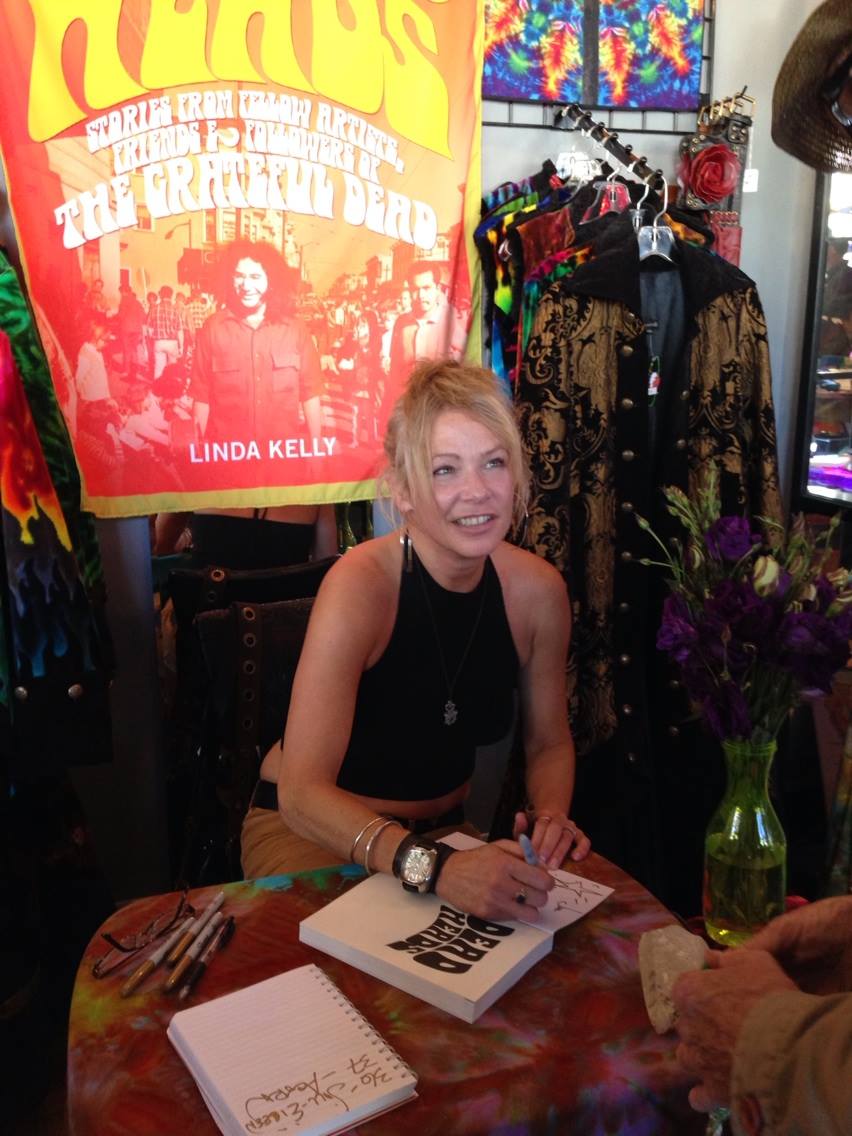
L.V.S.: So, the Sex Pistols was your first concert. That’s pretty amazing! My first concert was Jefferson Starship & Heart in 1976. My dad took me; I was 11. After your first show were you hooked on live music? What type of shows did you attend after the Pistols?
L.K.: TOTALLY hooked! My mama was very sick with cancer (for 5 years) and my older sisters took me to the Sex Pistols to try and cheer me up. Amazingly, it did as it made me forget about my sadness for a good couple of hours. All live music for me creates a sacred space where we can let go and connect to the energy of the cosmos, collectively. It’s very much to me like a vision quest or deep meditation.
Other shows: Tom Petty at Winterland, 1978, lots of shows at Mabuhay Gardens on Broadway (DEVO, Blondie, local punks), The Police, Iggy Pop, U2, Echo & the Bunnymen, so many amazing bands at the iBeam and Nightbreak on Haight … also the Kabuki Theater (now a real movie theater).
L.V.S.: When you met Jerry Garcia in New York were you already familiar with the Dead’s music?
L.K.: Yes, but when I was here in SF, before I split to NYC, I couldn’t stand the GD and all that damn hippie crap LOL. As mentioned in my book, I was dragged to my first GD show in 1985 by Blair Jackson (Dead enthusiast) at the Henry J. Kaiser, cuz he saw how depressed I was. Those shows DID make me happy for a bit. Coulda been the MDMA!
L.V.S.: That’s funny because I hated all of that hippie crap, too! I was into the Goth music scene right before my first Dead show. A friend of mine was a Deadhead and he kept raving on and on about them. He stuck a live cassette recording, a New Year’s Eve show, but I don’t remember from what year or where, into my tape player in my VW Bug and it got stuck in there! I couldn’t eject it and it kept playing in my car. I hated the music and yet I was forced to listen to it endlessly until I finally got the tape out of my deck. It was a precursor of days to come, I suppose!
L.V.S.: Reading your book, I just kept nodding my head along with these people’s experiences and descriptions. Although I was only a Deadhead for a couple of years, I really threw myself into the whole thing. We saw as many shows as we could in CA (north & south-52 in total). I remember the parking lot scenes, the whole process for getting the online tickets (3 x 5 card ONLY!!), driving either my ’68 Bug or my roommate’s ’71 Bus. I could particularly relate to the feeling of family and doing things that you wouldn’t normally do, like picking up hitchhikers or staying with strangers. Why do you think that Deadheads were so trusting within the community?
L.K.: The lyrics! They suggest that we all have ups/downs, we are all human, we all have a dark/light side — so there is a common understanding, a knowing that Deadheads all share.
L.V.S.: What elements do you think have helped maintain the Dead’s ongoing dedication from their fans? The community at large isn’t necessarily “there” anymore, but when you meet another fan generally something clicks between you.
L.K.: Again, the lyrics, the vibe, the whole experience. It’s a tribe. It’s a communal, loving, accepting, anything-goes environment. Take care of each other, be kind, love one another.
L.V.S.: Yes. I remember in particular a concert at Henry J. Kaiser Convention Center in Oakland. There was a nice man that we ended up sitting next to up in the bleachers. He got up to leave before the show ended and we were shocked. He explained that if he didn’t leave right then he would miss the last bus back to San Francisco where he lived. We had set up camp earlier in the day in the hills above Oakland but felt a really creepy vibe up there and weren’t sure that we were going to return that evening. The man, who was a little older than us, offered to let us stay at his apartment if we would drive him home after the show. We did and he saw us off the next morning, taking us to breakfast first. Later he came down south for some event and we met him for dinner. People were like that within the community. You could trust them.
L.V.S.: Do you think that there are other bands that generate a similar dedication, community and family scene? I recently became a big Ween fan and I have been stunned by the similarities within their fan community and the Dead’s. I feel like a gained a country-wide family within the Ween community. People open their hearts and homes and are so kind and dedicated. It’s very similar.
L.K.: I LOVE Ween!!!!! Yes, same vibe. I’d say perhaps Patti Smith fans, again, people KNOW her songs, her words, her message.
L.V.S.: So, tell me a little about your current project, Haight Street Voice. You’re back living in your native San Francisco, in the Haight. What do you hope to accomplish with your magazine and other projects?
L.K.: Community. Shining a light on EVERYONE who wants to be heard. A voice for the people. It’s AMAZING to come full circle after 7 years in NYC and live right here in the Haight where I lived when attending SF State and studying journalism with Ben Fong-Torres (who just last week gave me and HSV a shout-out on Moonalice Radio!). Connection. Creativity. There is nowhere like this place in the world. It’s magical and deserves to be documented. And to be working with Dr. David E. Smith of Smith Family Foundation is just beyond amazing. And? Stanley Mouse is coming down for an art exhibit in June in “my” pop-up space! Full circle with some of the people who were THERE when it all exploded in 1965. Grateful indeed!
You can follow Linda on Facebook at https://www.facebook.com/HaightStreetVoice and subscribe to Haight Street Voice Magazine online at https://www.patreon.com/haight_street_voice/posts. Her book, Deadheads, is available on Amazon but you can buy autographed copies directly from the author along with groovy trucker hats at haightstreetvoice@gmail.com! Linda’s website is http://www.haightstreetvoice.com. Please contact her for more information!
A Short Talk with Linda Kelly, Author of the book, Deadhe...
A Short Talk with Linda Kelly, Author of the book, Deadheads
My first New Year’s show!Just yesterday I found out that a new independent documentary is coming out about the Deadhead community. San Francisco director Lonnie Frazier’s movie, “Box of Rain”, is available to watch by streaming it on Vimeo and tells the story of the Grateful Dead fans through her own experiences and those of her friends and others in the community.
Not long ago I read Linda Kelly’s book, Deadheads. Kelly herself wasn’t a Deadhead in the sense that some people view them. She attended some shows but didn’t follow the band around. She did, however, click with the vibe of the music, musicians and community so much so that she decided to gather memories, information, stories and more from people who either were Deadheads in the real sense of that term or served the group in some way (musically, providing food, drugs, etc. or simply by being friends with them).
I was a Deadhead for a brief period. I first saw them in 1985. I was twenty years old and like Linda had no prior interest in the band. However, it only took that first show to make me realize that there was something going on there, not only with the music but within the fan base. A late bloomer, I also smoked my first joint at that show even though I didn’t get high. Undeterred, I proceeded to immerse myself in the Grateful Dead and drug experience. Only two weeks after my first show (at Irvine Meadows in Irvine, CA) I was on my way to Palo Alto for two shows at the Frost Amphitheater. And just like that I was a Deadhead.
With the third and final book in my trilogy completed and being readied for release I realized that I had several characters who might qualify as Deadheads or at least dedicated Grateful Dead fans. In the second book a group of friends travel to Berkeley for a six show run to celebrate a marriage. In the third book many of those same friends gather in Golden Gate Park to mourn the untimely death of Jerry Garcia. Although I only spent a short time as a Deadhead myself, the band, the music, the atmosphere and vibe and the community left a lasting impression on me and I think of those years as some of the best of my life.
INTERVIEW WITH LINDA KELLY, AUTHOR OF DEADHEADS
L.V.S.: So, the Sex Pistols was your first concert. That’s pretty amazing! My first concert was Jefferson Starship & Heart in 1976. My dad took me; I was 11. After your first show were you hooked on live music? What type of shows did you attend after the Pistols?
L.K.: TOTALLY hooked! My mama was very sick with cancer (for 5 years) and my older sisters took me to the Sex Pistols to try and cheer me up. Amazingly, it did as it made me forget about my sadness for a good couple of hours. All live music for me creates a sacred space where we can let go and connect to the energy of the cosmos, collectively. It’s very much to me like a vision quest or deep meditation.
Other shows: Tom Petty at Winterland, 1978, lots of shows at Mabuhay Gardens on Broadway (DEVO, Blondie, local punks), The Police, Iggy Pop, U2, Echo & the Bunnymen, so many amazing bands at the iBeam and Nightbreak on Haight … also the Kabuki Theater (now a real movie theater).
L.V.S.: When you met Jerry Garcia in New York were you already familiar with the Dead’s music?
L.K.: Yes, but when I was here in SF, before I split to NYC, I couldn’t stand the GD and all that damn hippie crap LOL. As mentioned in my book, I was dragged to my first GD show in 1985 by Blair Jackson (Dead enthusiast) at the Henry J. Kaiser, cuz he saw how depressed I was. Those shows DID make me happy for a bit. Coulda been the MDMA!
L.V.S.: That’s funny because I hated all of that hippie crap, too! I was into the Goth music scene right before my first Dead show. A friend of mine was a Deadhead and he kept raving on and on about them. He stuck a live cassette recording, a New Year’s Eve show, but I don’t remember from what year or where, into my tape player in my VW Bug and it got stuck in there! I couldn’t eject it and it kept playing in my car. I hated the music and yet I was forced to listen to it endlessly until I finally got the tape out of my deck. It was a precursor of days to come, I suppose!
L.V.S.: Reading your book, I just kept nodding my head along with these people’s experiences and descriptions. Although I was only a Deadhead for a couple of years, I really threw myself into the whole thing. We saw as many shows as we could in CA (north & south-52 in total). I remember the parking lot scenes, the whole process for getting the online tickets (3 x 5 card ONLY!!), driving either my ’68 Bug or my roommate’s ’71 Bus. I could particularly relate to the feeling of family and doing things that you wouldn’t normally do, like picking up hitchhikers or staying with strangers. Why do you think that Deadheads were so trusting within the community?
L.K.: The lyrics! They suggest that we all have ups/downs, we are all human, we all have a dark/light side — so there is a common understanding, a knowing that Deadheads all share.
L.V.S.: What elements do you think have helped maintain the Dead’s ongoing dedication from their fans? The community at large isn’t necessarily “there” anymore, but when you meet another fan generally something clicks between you.
L.K.: Again, the lyrics, the vibe, the whole experience. It’s a tribe. It’s a communal, loving, accepting, anything-goes environment. Take care of each other, be kind, love one another.
L.V.S.: Yes. I remember in particular a concert at Henry J. Kaiser Convention Center in Oakland. There was a nice man that we ended up sitting next to up in the bleachers. He got up to leave before the show ended and we were shocked. He explained that if he didn’t leave right then he would miss the last bus back to San Francisco where he lived. We had set up camp earlier in the day in the hills above Oakland but felt a really creepy vibe up there and weren’t sure that we were going to return that evening. The man, who was a little older than us, offered to let us stay at his apartment if we would drive him home after the show. We did and he saw us off the next morning, taking us to breakfast first. Later he came down south for some event and we met him for dinner. People were like that within the community. You could trust them.
L.V.S.: Do you think that there are other bands that generate a similar dedication, community and family scene? I recently became a big Ween fan and I have been stunned by the similarities within their fan community and the Dead’s. I feel like a gained a country-wide family within the Ween community. People open their hearts and homes and are so kind and dedicated. It’s very similar.
L.K.: I LOVE Ween!!!!! Yes, same vibe. I’d say perhaps Patti Smith fans, again, people KNOW her songs, her words, her message.
L.V.S.: So, tell me a little about your current project, Haight Street Voice. You’re back living in your native San Francisco, in the Haight. What do you hope to accomplish with your magazine and other projects?
L.K.: Community. Shining a light on EVERYONE who wants to be heard. A voice for the people. It’s AMAZING to come full circle after 7 years in NYC and live right here in the Haight where I lived when attending SF State and studying journalism with Ben Fong-Torres (who just last week gave me and HSV a shout-out on Moonalice Radio!). Connection. Creativity. There is nowhere like this place in the world. It’s magical and deserves to be documented. And to be working with Dr. David E. Smith of Smith Family Foundation is just beyond amazing. And? Stanley Mouse is coming down for an art exhibit in June in “my” pop-up space! Full circle with some of the people who were THERE when it all exploded in 1965. Grateful indeed!
You can follow Linda on Facebook at https://www.facebook.com/HaightStreetVoice and subscribe to her newsletter online at https://www.patreon.com/haight_street_voice/posts. Her book, Deadheads, is available on Amazon but you can buy autographed copies directly from the author along with groovy trucker hats! Please contact her for more information!
February 9, 2021
Black History Month: Celebrating the Black Characters in My Trilogy

In honor of Black History Month I thought I’d highlight the black characters in my novels. Many people might not be aware that there are black characters in my novels, and that is intentional. My stories are about the fabric of our country and that includes people of all backgrounds, races, religions, sexual orientation and more. This mirrors my own life and so I have never thought it extraordinary to include a wide variety of characters in my stories.
If you pick up my first novel, “Red, White & Blues: Book One”, and read the synopsis you will see that it does mention Native American characters. This is an exception and the reason that I did so is because the journey of my character, Mike Blackhorse, from a reservation life in northern Wisconsin to owning his own business and raising his family in Monterey, California is central to the overall story.
However, it is also in this first novel that the first of my black characters are introduced, the most prominent and important being Louise Sinclair (later Louise Powell and still later Louise Booth). Louise is a young woman of nineteen or twenty when we first meet her, a transplant from Georgia who, like others of her generation, makes her way to San Fransisco during the early 1960s. Sandy Porter is the first to encounter her and they forge a lifelong friendship, often living and working together in various situations. Sandy is a white girl from an upper middle class family in nearby Boulder Creek, CA and the two young women bond quickly despite their different upbringings. When Sarah Somerton is picked up hitchhiking by Mike Blackhorse and they make their way to San Francisco, it is she who really finds an extraordinary friendship with Louise. Sarah had been born and raised in rural Louisiana and had experienced the prejudiced attitudes of her friends and family toward non-whites, mainly from her father, Quentin. However, Sarah did not share these views and her own sense of wanderlust coupled with a need to get away from the deep south made her an ideally open person. As time goes by we see the friendship of Louise and Sarah blossom through their southern roots, their love of cooking and their strong spirits and devotion to their families.
Of course there are a few incidents where the prejudice of others play into the lives of not only Louise, but her first husband, Cain Powell, a fiercely proud and intelligent black man who grew up in the low income neighborhood of Oakland, CA. When Martin Luther King is assassinated, Cain begins to question both his and Louise’s friendships with their white friends, including Sarah and Sandy and their boyfriends, Mike and Pete respectively. However, Louise, while devastated and scared by King’s death, quickly realizes that the path forward is to preserve those friendships. And she does. After Cain is killed in the line of duty as an Oakland police officer, Louise and their young son, Micheaux, make a critical move to San Francisco where she purchases an old bookstore formerly run by an old friend. Louise never lets adversity keep her down and she makes the bookstore into a successful business, where in the 1980s, it also becomes a hub of support for the gay community, which is being battered by the AIDS crisis.
Some years after Cain is killed, Louise meets a black photographer named Avery Booth. Booth had lived in London for several years, was married to a white woman and had a daughter, Iris, who remained in England with her mother when he moved back to San Francisco. When Louise introduces Avery to her white friends of so many years, there is a moment when Avery worries about what they will think of him, how they will perceive him as a black man. However, he needn’t worry because, just as in my own life, the friends that Louise has had for so many years do not judge people based on their skin color.
Louise’s son, Micheaux, decides to visit his mother’s relatives back in Georgia for a summer after high school graduation. There he not only has his first sexual experiences, but is for the first time really confronted with prejudice. It is indirect, but it is there in the Confederate flags and culture, which is still deeply rooted in the south in some respects. These observations were based on my own experience living in Georgia for three years. I, like Micheaux, was born and raised in California and was rarely exposed to prejudice in any serious form in my own life. I guess I should mention that yes, I am white, but my meaning here is that no one I knew was prejudice against anyone else. I have always had friends from all walks of life and in my novels, so does not only Micheaux (or Mikey as he is called), but everyone who is in my stories regardless of their race, religion or sexual orientation. Everyone gets along. Call me a dreamer if you like, but that is how I have always lived my life; so do my characters. There are exceptions, of course. There is one particular character who is prejudice against nearly everyone who isn’t like him, but he, again, is the exception.
Although Louise meets an untimely demise, she nevertheless stays a positive and strong force until the very end and her legacy leaves its mark not only on her son, but Sarah, Sandy, Mike and most forcefully a woman named Maura who had initially met Louise in San Francisco during the Sixties and who’s fate becomes utterly tied up with Louise’s wisdom, strength and acceptance of all of those she comes in contact with.
In my novels, race is discussed, but it is never dwelled upon. Race makes the characters who they are to some extent, but it never defines them. I have made every effort to weave all of these people together be they white, black, Asian, Hispanic, Native American or gay.
In a review of my first novel David Willson (VVA) expresses exactly what I always try to convey:
“Sage brings to life a huge multiracial cast of characters who are skillfully individualized. The author presents us with lives in America that are rarely seen in serious fiction, and these lives are portrayed in an evenhanded, non-judgmental, non-sensational manner.” (excerpt)
October 6, 2020
Twenty-one Year Old Tragedy: In Remembrance of Matthew Sheppard
In 1999, Matthew Sheppard was murdered, his body displayed on a fence. His offense: being a young gay man in rural Wyoming.
In the forthcoming third installment of my historical fiction series, “Red, White & Blues”, gay characters Asher, James, Luke and Toby are living in Laguna Beach and the news of the hate crime hits them hard.
Following is an excerpt from “Red, White & Blues: Book Three”:
It is early October. Delightful Diversions is in full party planning mode for the upcoming Halloween, Thanksgiving, Hanukkah, Christmas and New Year’s Eve party season. James and Luke are working closely with one another; there is a lot to prepare for and do. With just a couple of weeks before Halloween and five parties to plan, there doesn’t seem to be enough hours in the day. Often working late to ensure everything gets completed, both James and Luke are aware of their respective partner’s suspicions. They had denied the accusations of their affair, but both Asher and Toby seemed unconvinced. In truth, James found Luke very attractive and vice versa. In truth, they had a strong attraction to one another and had acted on that attraction on more than one occasion, even after Asher’s fiftieth birthday party when they were both asked if anything was going on.
Further complicating the issue, especially with Toby, is the hate crime death of college student Matthew Shepard in Wyoming. The young man had been pistol-whipped and set on fire, then tied to a wooden fence where he was left for dead. Found by a cyclist who initially thought Shepard was a scarecrow, he was barely alive when he was taken to a local hospital in a coma where he died six days later, October sixteenth, which was yesterday. The story obviously brought back memories of Luke’s very similar experience and in turn, the fact that he had been cruising the park for a blow job when he was beaten.
The atmosphere in the gay community in Laguna Beach is understandably somber. And angry. Would hate crimes never cease? It was troubling, disheartening and sad.
That evening, a group of friends meets up, including Asher and James and Toby and Luke. The fall season in southern California equals summer weather elsewhere, so the evening is warm enough for the group of about twenty young men to head down to the beach to relax and watch the sun set over the Pacific Ocean.
Spread out over several blankets, the group enjoys concealed beers, shots of tequila and crab meat sandwiches, pickled eggs and giant chocolate chip cookies while trying to blot out the feelings of continued persecution, lack of understanding and hatred for their community.
“I can’t get the image out of my head,” says Greg, Toby’s best friend. “I mean, of course I didn’t actually see him, but I can imagine what that poor boy looked like hanging on that fence, beaten and burned beyond recognition. Not only because of who he was, but what he was.” He shakes his head. “I just don’t understand,” he says quietly.
“Well, it doesn’t do you any good to think about that,” Asher says. “It’s more important that we continue to fight these bastards, continue to call them out for the ignorant assholes that they are.”
“Right!”
“I can’t believe fucking redneck hillbilly assholes like that still exist!”
“They do,” Asher says, and tosses back a shot of tequila. “And they always will. And it’s not just rednecks out in the middle of nowhere. Let’s not forget about those lunatics that went on a gay-bashing spree right here in Orange County back in ninety-three or when that idiot beat that Huntington Beach High School track star, leaving him with a steel plate in his jaw.” Asher stops, shakes his head. “And the goddamn principal called it a ‘game’. What we need to do is make sure that they know that we’ve got our eyes on them and we’re not going away anytime soon.”
Once again, James feels a rush of pride toward Asher. His dalliances with Luke seem petty and stupid when he thinks about all the years that he and Asher have spent together. Living in San Francisco and fighting for gay rights and dignity, making a real difference in the community and the lives of those around them had been an experience that shaped who he had become and they had done that together. Contemplating leaving him, however idly, was selfish and stupid. Besides, the Viagra has really been helping. James could tell that Asher’s confidence was back and in turn, he was happier, more positive about life in general.
He looks over at Luke and they hold a quick glance. Toby is a good man, too. He deserves a loyal and loving companion. Suddenly feeling protective of his friend, James makes a decision to not let his desires get the better of him anymore where Luke is concerned. It isn’t fair or right.
The news of Matthew Shepard had had a similar effect on Maura, Dan and their friends in the gay community in San Francisco. Although it was a tight squeeze, Maura managed to pull together a fundraising event in honor of Matthew Shepard the weekend before Halloween. With the help of Rusty and Lawrence, word quickly spread and a decent turnout was expected.
August 18, 2020
A Story in Memory of Woodstock, Fifty-One Years Ago
[image error]
Going to the Woodstock Music festival was always a fantasy of mine, but since I was only four years old at the time, it wasn’t in the cards! However, when I wrote the first book in my trilogy, I sent several characters to upstate New York to experience it for me!
In honor of that most important festival and cultural event, here is an excerpt from Red, White & Blues: Book One…
Woodstock Music Festival, New York. Pete and Sandy, Haven and Julie and Sarah have abandoned Haven’s car somewhere out on the long stretch of road leading into the festival. They carry blankets and bags of food, water and clothing as they walk with the hundreds of others who have done the same.
The long drive from California to New York has afforded Sarah a lot of time to think. She hadn’t realized how oppressive Mike had become or how on edge she was. He actually made her nervous and she feels more relaxed being away from him despite the guilt she feels for leaving him alone with Maura and Toby.
Her life has taken such a strange path since she had met Mike in Wyoming. It had only been two years, but so many things have happened, that she hasn’t been able to stop and think about any of it until now. Her feelings for Mike have changed, she realizes. She feels more like his wife of ten years than someone who had barely gotten to know him before the war. She knows now how exhausted she has become. Mike is draining her both physically and emotionally.
She thinks about the dreams she had had before getting onto the back of Mike’s motorcycle two years earlier. Many of them have been realized: the separation from her family and the South; the autonomy of living the way she wants; her job at the bookstore; the parties, friends, drugs, sex and concerts. But her relationship with Mike seems to be creating a life that is the opposite of all that. It seems that they are heading down a path that she could follow almost instinctively but is fighting desperately to resist. She doesn’t want to end up like her mother, taking care of a drunken man, feeling afraid of saying or doing the wrong thing, feeling alone all the time.
By the time they all arrive within the festival limits, it is late Friday night. They have missed most of the acts for the day but spread their belongings out and stake an area of ground as their own.
In the morning, Sandy arises, a sleeping bag wrapped around her body.
“Wow,” she yawns. “We’re actually here!”
Pete smiles, runs a hand through her mess of blond curls.
“It’s beautiful, isn’t it?”
“Creedence plays today,” Haven says. “Too bad Mike isn’t here.”
Sarah winces. She really has been trying to forget all about Mike for the weekend. She slides out her sleeping bag and rolls it up.
They all decide to try and get closer to the stage today, but as the sun rises, so does the humidity. Many people have stripped down to their underwear or nothing at all to cool off in a nearby pond. Pete and Sandy decide to do the same. They remove their clothes and trot down to the water. Many people ask Sandy when her baby is due and she fills with happiness. Pete beams with pride before dunking his head under the cool water.
“Well! Well! Fancy meeting you here!”
Sandy turns and sees Keith Burke, the owner of Moonstone Books, standing on the shore. Suddenly, she is embarrassed, and drops down into the water.
“Keith! Hi!” Sandy calls, and then turns to Pete. “Pete! Look who’s here!”
Pete waves. “Keith! Wow, man! It’s a small world even out here!”
Completely unashamed, Pete walks over and shakes Keith’s hand.
“So,” Keith says, looking over at Sandy. “Is it yours?
“Yeah! She’s due in November.”
Keith, seeing that Pete is happy about says, “That’s great, man! Really!”
Sandy continues to stay submerged. It is different to be naked among acquaintances.
“Where are you guys camped out?” Keith asks.
“Nowhere,” Pete says. “Anywhere!”
“Well, we’ve got some tents near here and plenty of room. Who else is with you?”
“Haven and Julie,” Pete says. Keith knows that Sarah has come. He is her boss, after all.
“It’s up to you, but we’ve got the room. I mean, you’d all have to share a tent, so if you don’t mind balling in front of your friends, then you’re welcome to it!” Keith laughs.
The tent camp that Keith’s group has set up is small and comforting. Although they had initially come for the music, the communal feel of the entire event, and especially Keith’s group, feels so good that Pete and Sandy, Haven and Julie and Sarah end up spending most of their time listening to the music from a distance. Occasionally, a small band of people will walk up closer to the stage area, but there is always a nice group back at the camp. They smoke dope, cook up vegetable stew, play with the dogs and the few small children and make love in the surrounding tents.
Sarah is glad that Keith has found them. He has become a good friend to her over the last two years. With Santana playing in the distance, she and Keith sit by the fire and talk.
“I didn’t know you were gonna come,” she says. “You didn’t say anything when I told you I was goin’.”
“I know. It was really last minute. My friend over there, Alison, was going and she talked me into it. I locked up the store and jumped in their bus!”
“I’m glad ya did!”
“Me, too! Hey! How come Mike didn’t come? You two break up or something?”
“No. He just didn’t want to. With his cane and all, I guess he thought it’d be too much for him.”
Keith nods. “It must be hard, huh? How’s Mike doing?”
“Okay,” Sarah sighs.
Someone comes by and hands Keith a joint. He takes a hit, and he and Sarah pass it back a few times.
“Mike drinks a lot,” Sarah confesses. “I think he might be an alcoholic.”
“I guess I’d be drinking a lot, too, if I’d just come back from Vietnam,” Keith says. “Does he ever talk about it?”
Sarah shakes her head. “I don’t think he wants to.”
“Probably just wants to forget about it. Probably why he drinks so much.”
Sarah stares into the flames. “He’s a different person now. I think he’d be happy just to be alone. Maybe I shouldn’t go back.” She laughs to soften the sting.
“It’s that bad?”
“Oh, he’ll probably be fine in a while,” Sarah smiles. “He’s only been back for a few months.”
Keith pushes a strand of hair from Sarah’s face. “You wanna go in one of the tents?”
Sarah nods and follows Keith. They lie down on a bed of sleeping bags. He kisses her, runs his hands over her breasts. She does not stop him. She rubs his cock through his jeans while he unbuttons his shirt. In a minute, they are fucking. Sarah urges him to move faster, deeper. She and Mike have only had sex a few times since he has returned. It is an increasingly unpleasurable experience as she can feel Mike’s resistance and lack of interest.
When she and Keith finish, he pulls a joint from his shirt pocket and they smoke again.
“I needed that,” Sarah laughs.
Keith smiles. He has developed strong feelings for her.
“Just let me know when I can be of service,” he says.