Thomas A. Knight's Blog
August 22, 2022
What it Means to be RAW
RAW is an acronym frequently used in tabletop role playing games that means “Rules as Written”. It describes any rules for a game, as they are written in a rule book or manual. This is how most people start with tabletop role playing games. You pick up a player’s handbook, read through the rules (or at least part of them) and then get a group of friends together, make characters, and play.
This is where things get murky, though. Almost nobody plays these games one hundred percent RAW. Groups are filled with little quirks or modifications to the rules. Game masters tweak the rules to their liking, or fill things in when RAW has a gap. The truth is, because of the frequent use of house rules in these types of games, almost nobody plays them RAW.
Admittedly, I’m a bit of a rules lawyer. I’m the type of game master who leans heavily on RAW. I find that the more I stray from RAW, the greater the chance that I’m potentially going to make the wrong call or a controversial call on a rule while playing. I like to be fair with my players, and the goal, first and foremost, is to have fun. Consistent rules means that player expectations get met, and it’s rare that somebody is unhappy to see a rule as written in a book.
Lately though, there’s been a trend. I’ve seen heavy criticism against game publishers who don’t fully flesh out every nook and cranny of their rules system so that every possible situation can be handled. I think this is unrealistic and has the chance to make things un-fun very quickly. Too many rules in a game makes things overly complex. It means players spend more time hunting through rule books trying to find just the right rule to handle a specific situation than actually playing the game.
The goal is to have fun, after all.
I think if a publisher can give a framework for a system, and fill in some of the details, or give examples, it leaves a lot of flexibility open to the game master to decide how to handle things. So long as the game master doesn’t have to basically invent the whole rule system themselves, I think this makes for a decent system. Give the high-level overview of the rules, and enough detail to run a smooth game without getting mired in the details. Then let the game masters fill in the rest. In my experience, that’s what good game masters do anyway.
As a player, trying to insist that every game master adhere strictly to the rules as written can lead to arguments, and potentially robs the game of its fun. Most tabletop systems specify that it’s ultimately up to the game master to decide what rules they do and don’t follow, and many systems offer optional rules that game masters can choose to use. It’s about flexibility, because not every player and game master experiences the game in the same way.
One of the first questions I ask game masters when I join their group is: are there any house rules I should know about? I don’t like surprises, and finding this out up front means that I can be comfortable when I want to try something, or use a specific attack or ability, and won’t get blindsided by a house rule that could derail my attempt to play my character the way I want to play them.
Ultimately, players and game masters find a balance. Some groups are very strict with RAW, and others are very loose. Making sure your players have appropriate expectations means fewer surprises during game play, and less potential for hurt feelings when things inevitably don’t go their way. The dice are sometimes cruel.
Always remember: no matter what, the goal is to have fun, and if you’re a game master, to make sure your players are having fun. Whether you follow RAW, or make it up as you go, I hope all of your die rolls end up in your favor.


September 14, 2017
Growing Up
This was going to be a very different post, but I'm not sure I'm ready to post anything like that just yet.
As a writer, I hold myself accountable for the work I do (or fail to do), but honestly, I haven't been doing that lately. Loads of people know that I write. Not everybody knows the honest status of my current projects.
Them: "How's the writing going?"
Me: "Oh it's fine. I'm getting through it."
Lies. I'm not getting through it. I've been having a lot of trouble focusing on writing, and part of it is just the nature of how my mind works. It likes to focus on one thing at a time. The sad curse of it is that it doesn't always focus on one thing to completion. Sometimes it gets distracted and decides it wants to focus on something else for a while.
I hate that.
What it means is this: all I can focus on is what my brain tells me it wants to focus on. Sometimes it's card games, sometimes it's a particular video game, and sometimes it's writing. But lately, it's been mostly not writing.
I have to work hard to stay focused on things that aren't what my mind wants to focus on. Everything is a distraction. Everything else becomes more interesting than what I'm choosing to work on, and then that's not interesting any more either, until I get back to what my mind wants to do. It's a genuine struggle.
So there hasn't been much from me lately.
There's probably a name for what I have. Ask my wife, and she'll express her frustration at a husband who can be so focused on something trivial like reading an article or playing a game, that nothing else penetrates that shell. But what's worse, is that a subconscious part of my brain tries to shield me from the outside world by providing meaningless responses to external stimuli.
Her: Says something important that I should really be listening to.
Me: "Okay."
Her: "Are you even listening?"
Me: "... OMG I'm sorry."
It requires effort to shift my focus, and then effort to shift it back.
Thing is, you� my loyal subscribers. My fans. The people who support me. You deserve better. My wife and family deserve better as well.
I'm trying.
NaNoWriMo is coming up soon. This will be my 8th year attempting it. Last year I barely scraped in, but I managed to finish. This year? I haven't the slightest idea what I'm going to write. I've barely even given it any thought. Heck, I've barely thought about the writing projects I have going on already.
So here's my commitment to you, as an author: There will be something new published by me in 2018. And it will be my best yet.
For your support, for your patience, and for all you've done for me, you deserve it.
Time to bleed.
September 6, 2015
Breaking out of a Slump
I'm coming out of an epic two and a half year slump, and trying to recharge some of the things I used to do. This happens to everyone at least once in their life, and sometimes more than that. Slumps (or unproductive, often depressing periods of time) can be very demotivating, and require tremendous strength to pull yourself out of. Here are some of the things I tried when I was at the worst of mine.
Change the Scenery
Sometimes, something as small as a new paint color on the walls is enough to make you feel better about your work. For writers, it's important to do your work in a place where you're comfortable, and the color on the walls affects you and your mood more than you might realize. Other ways to change the scenery would be to go to a local coffee shop to work, or just change which room you're in. A change in scenery can make a big difference in your mood, and subsequently improve your productivity.
Work on Something Else
I know we all have projects to get done, but forcing yourself to work on something won't do you any favors, nor will it do your work justice. Writing (and other academic activities) requires a clear head, and novels require a certain mindset. The characters need to speak to you, and if that isn't happening, you'll frustrate yourself. So switch gears. Write a blog post, or do something non-writing related. I started playing Magic: the Gathering again, and though this does take up some time, I find devoting some time to a leisure activity can help bring your mind back to a productive place.
Take a Break
I released my last book in spring of 2014, and though I participated in NaNoWriMo last fall, I pretty much tossed everything I wrote then. I've also been trying to get The Spell Breaker done, but I needed to back away from everything writing and just focus on sorting out my life. This should definitely not be a permanent situation though. Taking a break from your work, and coming back to it when you start to feel better can help lift you up even higher, and you might just find that it was just what you needed in order to finish that big project.
Get Help
Talk to somebody about what's bothering you. I'm a very lucky person in that I have a very understanding wife who listens to me, and helps me through this stuff. I don't know what I would do without her. Find somebody to talk to. It doesn't have to be your spouse, or even a family member. It could be a friend, coworker, or even a complete stranger. Seeking professional help is also helpful, especially if you find yourself falling into a deep depression. Luckily, my slump never went that far, but it could have, and it does for some people. If this is happening to you, you're not alone; there are loads of people who are willing to listen. Give them a chance.
Don't Give Up
Whatever you do, don't ever give up on yourself. It's challenging to break out of a downward spiral, but it can be done, and you definitely don't have to do it alone. Keep telling yourself that you can do it, and keep looking for a way out of the depression. If none of the things in this post work for you, search for other answers, or try them again. Yesterday's setbacks can become tomorrows gains. Above all else, know that you and your work are worth it. Success leaves you with a very good feeling, no matter how small the success may be. If you've been having trouble just getting up in the morning, and you're out of bed now, that's a win.
If you have any other suggestions as to how to break free from the slump, please share them below in the comments. You never know when your suggestion could help get somebody else's life on track.
August 30, 2015
Going Through Changes
Change is something that's as constant and ever-present as death and taxes, though in the last couple years, it's been much more prominent in my life than before. Most of it has been for the better, but there have been a few hiccups. I'll start at the beginning, and hopefully by the end, you'll have forgiven me for my lack of presence on my own website.
Two and a half years ago, at the beginning of 2013, I stepped on our trusty bathroom scale, and nearly had a heart attack. The scale read 253 lbs. This was the first of my epiphanies that led to a large amount of change in my life. Since then, I've taken control of my life, and lost almost 80 lbs, and am still working on the last little bit. I look better, I feel better, and I'm no longer afraid that I won't be around to see my two daughters grow up.
A little over a year ago, I realized that I was very unhappy with my employer. This was my second big epiphany. I had been working for a local company, maintaining their custom ERP system, and I learned and grew a lot in that position. Alas, that company was taken over by a much larger corporation, and their new way of doing business didn't jive with me. So I made the difficult decision to leave them and take a job with a company that is an hour drive away. Fortunately, the commute is actually the worst part of my job. I now work for a company called IGLOO Software, doing database development. I'm happier than I've ever been in a job, and just celebrated my one-year anniversary there.
With all this change going on, I realized today, that for a writer, I don't seem to be doing much writing lately. After analyzing my web stats, which I haven't looked at in forever, I realized that my numbers have been dropping steadily month over month. This leads me to my third major epiphany... in order to call myself a writer, I need to actually write. My hope is that writing on the blog again will help me declutter my head, and lead to some more creative thoughts that will help me get my next book done, which I've been having a lot of trouble with. The good news is I'm back on track, and have a good idea of how to round out the book and finish the story.
All told, this has been some very positive change. I'm happier, healthier, and am going to start producing again. I have a pretty good idea of what I'm going to do for NaNoWriMo this year, and will be attending a local comic-con in October. With any luck, I'll have the new book ready by then, and will be able to launch it at the event. Stay tuned for more details on that.
As always, thanks for reading, and thanks for hanging around. I hope you'll come back and see what else pops up on here in the coming weeks/months, and hey... if you have any ideas that you'd like to see explored here, leave them in the comments below.
October 12, 2014
Choosing NaNoWriMo
Hey all! It's been a while since I've posted anything here, and that's a shame. I'm sorry about that. I'll try to be more regular about it in the future. Life has been crazy, and hasn't allowed a lot of time to do writerly things. Even my writing has suffered.
This leads me to the purpose of this post, and something different that I've never tried before. National Novel Writing Month (NaNoWriMo) is right around the corner, but I have a problem. My latest book, The Spell Breaker, isn't finished yet. Normally, I would start the next book in the series during NaNoWriMo, but I can't very well do that, now can I? This means I have to come up with another idea.
Well, my brain has been on overdrive, and now I have two ideas, both of which I am keen on trying out. I like them equally, and have been unable to decide which to take on. Luckily, I have a fantastic group of friends and fans who are always willing to give me feedback, so now here's your chance.
Over the next week, I'll collect votes from you all on the ideas posted below, and then decide based on that feedback which one I want to write. All feedback will be considered, but there will be an informal poll at the end of this post where you can simply vote for one idea or the other. At the end of the day, it will still be my decision as to which one I will write, but your feedback could shape my next novel, and I may decide (based on the feedback received here) to give you additional opportunities to decide how the plot unfolds.
So... without further ado, here are my ideas:
1) A break away from my usual fantasy into a more drama/thriller type story. This idea revolves around a character named Jack Craze, who is the CEO of Craze Pharmaceuticals. He worked his way up from nothing after his mother died of a rare and aggressive form of lung cancer. Not only is he the CEO of the company, he's also a genius who has developed some of the world's biggest breakthroughs in cancer treatments, even going as far as eradicating some kinds with new drugs he helped develop.
Now he has a wife, a son, a great job, and everything he ever dreamed of. Until of course his son develops the same aggressive lung cancer his mother died of. This is a cancer his company hasn't been able to come up with a treatment for yet. It doesn't respond to any known treatments, and his son is fading fast.
Mr, Sharp is a mystery. He appeared one day on Jack's doorstep with a proposition: Give up everything, including his name, fame, fortune and family, and Mr. Sharp will provide the cure for Jackie Jr.'s cancer. Jack can save his son's life, but in the process, he must lose everything he's worked his entire life for.
2) This idea continues a side story that began in my first trilogy, The Time Weaver Chronicles, and is more of an urban fantasy. Earth has never known magic, until Seth regained his powers and learned how to open his father's book. Trouble is, before he learned what the book was for, his friend Dave copied a few pages of it and posted them on the Internet for his crypto friends to look at. Now random people around the world are dying of accidents, or gaining strange powers that range from flight to throwing fireballs, to the ability to heal people with just a touch. Magic is alive and well, and now it's spreading.
The US Military doesn't like this, and is fighting to contain it. With Dave's help, they will develop something new that will merge magic and technology. Something that will help them fight the new crop of criminals that will eventually come out of the woodwork with powers they can't hope to control.
The real danger comes when an old friend of Dave's discovers how to use magic, and begins to build an army of his own. With them on one side, and Dave and the military on the other, the resulting war could change Earth forever.
There you have it. My two possibilities for this year's NaNoWriMo. I look forward to reading your feedback and seeing how the votes go. One idea will challenge my skills and push my limits as a writer, the other will advance the series I'm already writing!
survey services
JavaScript is disabled!
June 23, 2014
Summer Reading
Fantasy is not a genre usually associated with summer reading, so I've devised a treat with a twist. I've teamed up with some other lovely authors to bring you a range of books in a range of genres, all on sale this week for the U.S. market.
Here are the details:
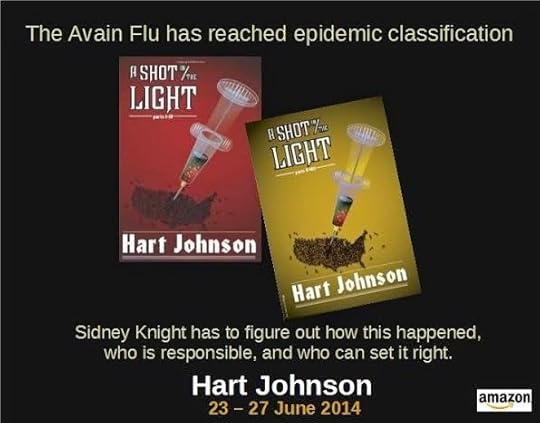
Hart Johnson
Hart has her books, A Shot in the Light I-IV, and A Shot in the Light V-VIII on sale this week for $0.99. These books are thrillers about an avian flu outbreak. You should check them out!
Lynette Ferreira
Lynette brings to the table two vampire books that will knock your socks off. Both for $0.99 each.

William The Damned (A Vampire Pirate)
Jade C Jamison
Take a walk on the wild side with Jade's entire sexy collection, all on sale until the release of her next novel, Finger Bang.

Find all of Jade's novels at her Amazon Author Page
Don't Forget About Me!
All three of my epic fantasy novels are on sale all this week for $0.99 each. If you're looking for a great fantasy adventure, you've come to the right place. Don't believe me? Check the reviews on my Amazon page for each book.
Thanks!
I appreciate every single person who comes to visit this site. If you like seeing deals like this, or know of any other deals going on right now, let me know in the comments!
March 16, 2014
The Search for Round 2
I've never felt anxiety like this before. I've always had total confidence in my work. Even when I've failed, I knew I could pinpoint what I did wrong, and work harder to improve myself.
So why is this year's Amazon Breakthrough Novel Award contest any different?
Perhaps a little background on the contest, for those who don't know. The Amazon Breakthrough Novel Award, or ABNA as most people call it, is held every year by Amazon to find the best and brightest new authors and books in the industry. I entered the contest for the first time in 2011 with my debut novel, The Time Weaver, and didn't make it past the first round.
The pitch round.
That is the source of my anxiety. A 300-word pitch that gets judged by Amazon editors, and only two thousand out of ten thousand entrants will move on to the second round. Why should I be so confident that I will make it? Because for the last four years, I've spent time helping countless writers hone their pitch for this contest. Many of them have made it through.
I haven't.
Three years I've entered ABNA, and three years I've failed to move on. I try to put on a happy face and cheer on my other friends, but there's always a part of me that burns up inside, wondering what I did wrong, or how I could have written a better, stronger pitch, so that it would make it through along with my friends.
Amazon gives us no feedback on the pitch. Either you make it through, or you don't. So I'm left a veritable expert on how to write a great pitch for a story who can't come up with something to get my own book through the first round.
This brings me back to the source of my anxiety.
I've entered The Time Weaver one last time. Fourth time's a charm, right? Thing is, if it doesn't make it through this year, it will likely be the last time I attempt it for The Time Weaver. Because what's the point of beating a dead horse? When the contest comes around again, I'll have The Spell Breaker ready to enter, and maybe have a better chance at coming up with something great to get it through.
In the meantime, ABNA 2014 is under way. My entry is in, my pitch is written, and I've done everything I can in order to get it through this year. All I can do it sit around and wait in an ever-building pool of anxiety for March 18, and then search for my name on the list of those who made it through.
Wish me luck.
March 2, 2014
The End Begins with Reprisal
I have a confession to make: I haven't posted here in a very long time, and I'm really, really, REALLY sorry. I have no excuses.
But... I do have some happy news to share today.
The third and final book in The Time Weaver Chronicles, Reprisal, is now live on Amazon. Today is release day, and a very happy day for me.
A little over three years ago, I started writing. Back then, I never would have imagined that what came out of my imagination would become three full length novels. With the help and support of many friends and family, I've published them and become a reasonably successful independent author. I could never have done this alone.
So what is this new book about? Here's the description:
Galadir is in trouble...
Their hero is missing in action, and the trouble isn't over yet. The remnants of the Findoor army, led by Malia, flee into the west after the dark wizard Grian usurps the throne.
Grian is the most dangerous threat the people of Galadir have ever faced. With a massive army of undead, he invades a kingdom to the west. Narshuks to the south are dying of a disease unleashed by Grian. Wizards to the east struggle against his wraiths to hold on to their stronghold and the libraries within.
Hope comes from an unlikely source, as one man hatches a plan that will show Galadir they can fight for themselves. But Grian has finally found what he's been looking for, and as he prepares for his final assault on the east to capture what he seeks, all of Galadir confronts him, brought together by a mysterious force.
All of the pieces are in place, but nobody can be sure if the resistance will be enough to defeat Grian once and for all.
The battle for Galadir has begun.
Can you feel the excitement? I know I can.
If you've never read The Time Weaver Chronicles, start here with The Time Weaver. Then move on to Legacy.
Finally, finish off with Reprisal.
So if you're looking for a good book to read, I've got three now available. And if you're looking for more tips, tricks, and publishing wisdom, I'll start making regular posts again, just for you.
Thanks for being part of my journey, and I hope you'll stick around to see what happens next.
October 20, 2013
Playing God, Part I - Basics
There's a little part of all of us that wishes we could change the world. It's the gamers, role-players, and writers who have figured out a way. We are the architects of worlds, and though I'm calling this series Playing God, it's hard to describe us as gods, since even the deities bend to our wills when creating a new world. World building is one of the toughest, most monumental tasks that any writer or role-player can take on, and it's my hope that this series will not only help existing world-builders improve their craft, but perhaps even get some new people involved.
What's it All About?
Building a world or universe is a massive undertaking. Consider our own universe from the top down: The universe is made up of empty space, interspersed with galaxies, which in turn are made up of billions of stars, each of which might have one or more orbiting bodies that make up a solar system. Each planet has its own conditions: gravity, atmosphere, weather, land masses, water, life, economics, religions, races, animals, microbiology, geology, technology, and maybe even a little magic. Crafting all the intricacies of a world down to the finest details can take years.
You don't have to do it all at once though. I've spent the last twenty years building worlds and writing stories for games, and I have yet to come to a point where I would consider my world-building to be done. The thing is, once you get started you'll realize that if you focus too much on getting every detail right, the world will feel less organic. Living worlds are always in flux, so it's really hard to get the details down before they change again.
The Reason
There are many published settings and worlds out there for you to choose from, so why build one of your own? Actually, you may find that using a published system is right for you. That's perfectly fine. Some of us just can't. We need the control, and the reward that comes from starting with a blank sheet of paper and making something beautiful out of it.
Start at the Beginning
World building needs to start somewhere, and this is where a division begins to form. There are two types of world-builders: writers and thinkers. Whether you are one or the other will depend a lot on how you process information. Writers will jot everything down, and will likely have binders or notebooks packed with notes, sketches, stories, tables and anything else they need to make the world run. Thinkers, on the other hand, will have very few notes, and will keep a large portion of their world in their head. Personally, I'm a thinker.
Whatever your process is, the start of world building should be a goal. What are you trying to accomplish by building the world? Is it for a game with a small group of players? Are you trying to create something that you can publish for the world to use? Are you writing a novel which is set in your world? Once you figure that out, the goal is simple: build as much as required to accomplish your purpose, and nothing more.
That's the deadly secret of world building: you don't need to flesh out every detail of a world in order to make it feel real. You only need to fill in the details required to accomplish your goal. The thing is, if you are filling in details that will never be read or used, what's the point? You can drive yourself mad trying to fill in every detail. It would take you a lifetime, and you still wouldn't get it done. Once you have enough detail in your world to satisfy your goal, stop.
Choose an Approach
How to actually go about starting your world will depend a lot on what kind of personality you have. You can start with the high-level concepts and then break them down into details (a top-down approach), or you can start with the details and work your way up from there (a bottom-up approach). Both approaches have their merits, and will both produce a usable world.
Using a top-down approach is better suited to building a world that you plan to publish. It will produce a world that is broken down into details that all support the high-level concepts. Some people work better this way, and can produce a nicely meshed, believable world using this approach. The downside to this approach is that it's a lot of work before you have something that is usable in a game or story.
The bottom-up approach is what I use, because that's how I think. I have details that I know I want to include, and so I start from there and work my way up. This approach tends to work better for stories or novels, as there is less work up front in order to create a functioning world. It's faster than the top-down approach, but can leave you filling in a lot of details on the fly, and can create some consistency problems if the details you want don't work well together.
What's Next?
As you get further into world building, you'll discover new things about your world, and new techniques that can be used to make that world run smoother and feel more realistic. In the coming weeks, I'll be posting additional world-building articles about geography, landmarks, cities, history, races, religions, deities, magic, politics, and much more. I hope you'll stick with me, as I have a lot more to give.
Playing God, Part I - Basics
There's a little part of all of us that wishes we could change the world. It's the gamers, role-players, and writers who have figured out a way. We are the architects of worlds, and though I'm calling this series Playing God, it's hard to describe us as gods, since even the deities bend to our wills when creating a new world. World building is one of the toughest, most monumental tasks that any writer or role-player can take on, and it's my hope that this series will not only help existing world-builders improve their craft, but perhaps even get some new people involved.
What's it All About?
Building a world or universe is a massive undertaking. Consider our own universe from the top down: The universe is made up of empty space, interspersed with galaxies, which in turn are made up of billions of stars, each of which might have one or more orbiting bodies that make up a solar system. Each planet has its own conditions: gravity, atmosphere, weather, land masses, water, life, economics, religions, races, animals, microbiology, geology, technology, and maybe even a little magic. Crafting all the intricacies of a world down to the finest details can take years.
You don't have to do it all at once though. I've spent the last twenty years building worlds and writing stories for games, and I have yet to come to a point where I would consider my world-building to be done. The thing is, once you get started you'll realize that if you focus too much on getting every detail right, the world will feel less organic. Living worlds are always in flux, so it's really hard to get the details down before they change again.
The Reason
There are many published settings and worlds out there for you to choose from, so why build one of your own? Actually, you may find that using a published system is right for you. That's perfectly fine. Some of us just can't. We need the control, and the reward that comes from starting with a blank sheet of paper and making something beautiful out of it.
Start at the Beginning
World building needs to start somewhere, and this is where a division begins to form. There are two types of world-builders: writers and thinkers. Whether you are one or the other will depend a lot on how you process information. Writers will jot everything down, and will likely have binders or notebooks packed with notes, sketches, stories, tables and anything else they need to make the world run. Thinkers, on the other hand, will have very few notes, and will keep a large portion of their world in their head. Personally, I'm a thinker.
Whatever your process is, the start of world building should be a goal. What are you trying to accomplish by building the world? Is it for a game with a small group of players? Are you trying to create something that you can publish for the world to use? Are you writing a novel which is set in your world? Once you figure that out, the goal is simple: build as much as required to accomplish your purpose, and nothing more.
That's the deadly secret of world building: you don't need to flesh out every detail of a world in order to make it feel real. You only need to fill in the details required to accomplish your goal. The thing is, if you are filling in details that will never be read or used, what's the point? You can drive yourself mad trying to fill in every detail. It would take you a lifetime, and you still wouldn't get it done. Once you have enough detail in your world to satisfy your goal, stop.
Choose an Approach
How to actually go about starting your world will depend a lot on what kind of personality you have. You can start with the high-level concepts and then break them down into details (a top-down approach), or you can start with the details and work your way up from there (a bottom-up approach). Both approaches have their merits, and will both produce a usable world.
Using a top-down approach is better suited to building a world that you plan to publish. It will produce a world that is broken down into details that all support the high-level concepts. Some people work better this way, and can produce a nicely meshed, believable world using this approach. The downside to this approach is that it's a lot of work before you have something that is usable in a game or story.
The bottom-up approach is what I use, because that's how I think. I have details that I know I want to include, and so I start from there and work my way up. This approach tends to work better for stories or novels, as there is less work up front in order to create a functioning world. It's faster than the top-down approach, but can leave you filling in a lot of details on the fly, and can create some consistency problems if the details you want don't work well together.
What's Next?
As you get further into world building, you'll discover new things about your world, and new techniques that can be used to make that world run smoother and feel more realistic. In the coming weeks, I'll be posting additional world-building articles about geography, landmarks, cities, history, races, religions, deities, magic, politics, and much more. I hope you'll stick with me, as I have a lot more to give.