
Polly Iyer's Blog - Posts Tagged "diana-racine"
Finishing a Difficult Novel
Finishing a Difficult Novel
I wrote this blog for Blood Red Pencil Blogspot on August 15, 2014, about six weeks before I released Backlash, the third book in the Diana Racine Psychic Suspense series. I've had some time to think over some of the thoughts I had back then. I noted the changes at the end of the post.
Getting to the end of the first draft of your book is a major accomplishment for any writer. Getting to the end of the first draft of Backlash, the third book in my Diana Racine Psychic Suspense series, was flat-out torture. I’d never struggled to finish a book before. As a typical pantser—one who writes by the seat of her pants—I write a chapter at a time, with only a glimpse in my brain to where I’m going with the story, possibly two or three chapters ahead at most. So why was this book giving me so much trouble?
Expectations. Both mine and my readers.
Over the past year, people wrote to ask me when the next Diana Racine novel was coming out. OMG, people were waiting for it. Those readers had obviously liked the first two well enough to look forward to the third. I published the last one, Goddess of the Moon, in October of 2012. That was almost two years ago. I published one other standalone in between.
Though the first book, Mind Games, wasn’t published until March of 2012, I wrote it way back in 2003 or 2004. My agent spent a couple of years trying to sell it to a publisher, with no success. Then I got distracted writing a few erotic romances under a pen name, published by two very good e-publishers. With no large or small press interested in Mind Games, I decided to self-publish it and the other suspense books I’d already written. At the time, I had no intention of writing a series until I had an idea for a second book, and Goddess of the Moon was born.
Both books received pretty good reviews. How could I possibly live up to them with a third book? I didn’t want to rely on the same formula―I hate that word when it applies to books―that I used in the first two books, namely, Diana in trouble to be rescued by New Orleans police lieutenant, Ernie Lucier, the love of her life. Was there enough excitement? Suspense? Humor?
One of the main criticisms in longtime series is keeping the characters from becoming stale and repetitious, thereby relying on contrived storylines to make up for the lack of characterization. Since Mind Games was written as a stand-alone, I had to dig deep to advance my main characters in Goddess of the Moon. What was left to know about them? How could I keep them fresh in the third book without losing the traits I had worked so hard to cultivate? Does the relationship between the two protagonists evolve naturally?
You see where I’m going? I began to second-guess myself, fearing Backlash wasn’t up to the two that preceded it. I agonized, edited, rewrote, and in the process lost my objectivity.
I always knew the ending, but getting there took every bit of perseverance I could muster. I’m reading it aloud now, patching inconsistencies, and will send it to a beta reader for her opinion and to my editor for her superb editing skills. My brilliant critique partner has already given it her stamp of approval, surprised by a twist at the end. I’ve announced a September publication date because I think on the whole it’s as good as I can make it.
But what a trip.
Writing a series, though popular with readers, adds extra pressure for me as a writer. Maybe I put that pressure on myself, but I’ve read so many second and third books of a series that can’t hold a candle to the first one. Don’t ask how I feel about the tenth or fifteenth book in a series. I admire those authors who can pull off a long series without disappointing his or her readers.
Will I write a fourth? My original answer to this when I wrote the blog was no, but I've changed my mind. Backlash has so far garnered good reviews. Some claimed it to be the best book of the three. Again, I can't agree or disagree because I don't know. But readers weren't disappointed, and that's the best part so far. I do know that there will be a new permanent character in the fourth book. And that's all I know right now. First to finish Indiscretion, then on to Diana Four.
I wrote this blog for Blood Red Pencil Blogspot on August 15, 2014, about six weeks before I released Backlash, the third book in the Diana Racine Psychic Suspense series. I've had some time to think over some of the thoughts I had back then. I noted the changes at the end of the post.
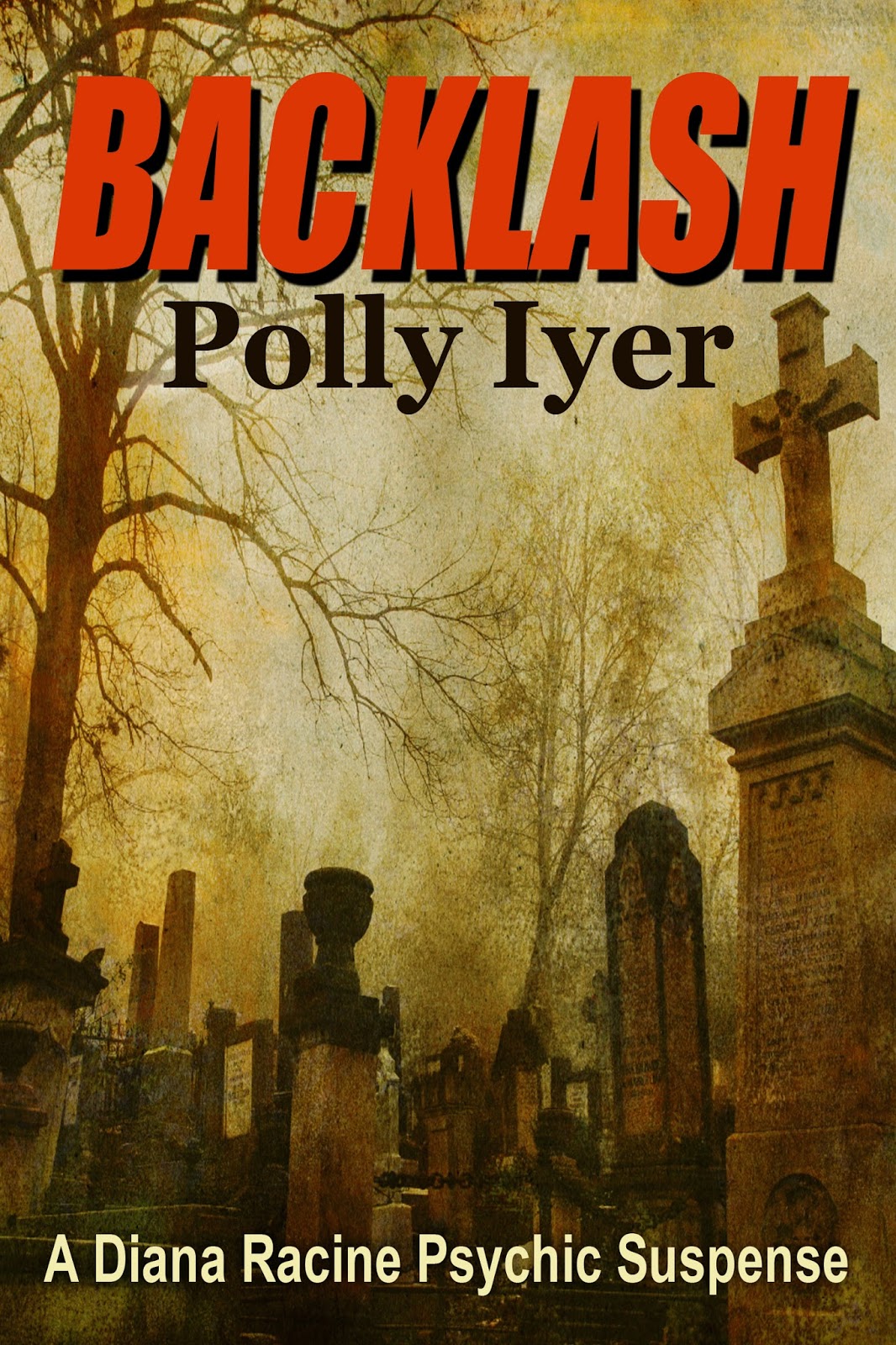
Getting to the end of the first draft of your book is a major accomplishment for any writer. Getting to the end of the first draft of Backlash, the third book in my Diana Racine Psychic Suspense series, was flat-out torture. I’d never struggled to finish a book before. As a typical pantser—one who writes by the seat of her pants—I write a chapter at a time, with only a glimpse in my brain to where I’m going with the story, possibly two or three chapters ahead at most. So why was this book giving me so much trouble?
Expectations. Both mine and my readers.
Over the past year, people wrote to ask me when the next Diana Racine novel was coming out. OMG, people were waiting for it. Those readers had obviously liked the first two well enough to look forward to the third. I published the last one, Goddess of the Moon, in October of 2012. That was almost two years ago. I published one other standalone in between.
Though the first book, Mind Games, wasn’t published until March of 2012, I wrote it way back in 2003 or 2004. My agent spent a couple of years trying to sell it to a publisher, with no success. Then I got distracted writing a few erotic romances under a pen name, published by two very good e-publishers. With no large or small press interested in Mind Games, I decided to self-publish it and the other suspense books I’d already written. At the time, I had no intention of writing a series until I had an idea for a second book, and Goddess of the Moon was born.
Both books received pretty good reviews. How could I possibly live up to them with a third book? I didn’t want to rely on the same formula―I hate that word when it applies to books―that I used in the first two books, namely, Diana in trouble to be rescued by New Orleans police lieutenant, Ernie Lucier, the love of her life. Was there enough excitement? Suspense? Humor?
One of the main criticisms in longtime series is keeping the characters from becoming stale and repetitious, thereby relying on contrived storylines to make up for the lack of characterization. Since Mind Games was written as a stand-alone, I had to dig deep to advance my main characters in Goddess of the Moon. What was left to know about them? How could I keep them fresh in the third book without losing the traits I had worked so hard to cultivate? Does the relationship between the two protagonists evolve naturally?
You see where I’m going? I began to second-guess myself, fearing Backlash wasn’t up to the two that preceded it. I agonized, edited, rewrote, and in the process lost my objectivity.
I always knew the ending, but getting there took every bit of perseverance I could muster. I’m reading it aloud now, patching inconsistencies, and will send it to a beta reader for her opinion and to my editor for her superb editing skills. My brilliant critique partner has already given it her stamp of approval, surprised by a twist at the end. I’ve announced a September publication date because I think on the whole it’s as good as I can make it.
But what a trip.
Writing a series, though popular with readers, adds extra pressure for me as a writer. Maybe I put that pressure on myself, but I’ve read so many second and third books of a series that can’t hold a candle to the first one. Don’t ask how I feel about the tenth or fifteenth book in a series. I admire those authors who can pull off a long series without disappointing his or her readers.
Will I write a fourth? My original answer to this when I wrote the blog was no, but I've changed my mind. Backlash has so far garnered good reviews. Some claimed it to be the best book of the three. Again, I can't agree or disagree because I don't know. But readers weren't disappointed, and that's the best part so far. I do know that there will be a new permanent character in the fourth book. And that's all I know right now. First to finish Indiscretion, then on to Diana Four.


Do You Expect Certain Things to Happen in Genre Fiction?
Though things are changing, there have always been certain “requirements” of a particular genre of fiction. In romances, the hero and heroine ride off together into the sunset, otherwise called the HEA or Happy Ever After. If the book doesn’t meet that criterion, it is no longer considered a romance. Now, Romance Writers of America has a mystery sub-genre in their contests called Romantic Elements that releases the author from the hard and fast HEA. Sometimes a couple needs time to develop their relationship because relationships can be complicated. (See my book Hooked.)

Many readers don’t like graphic romance scenes mixed in with their mystery and suspense novels, even if they’re classified as romantic suspense. I always have at least one romantic scene in my books and some language that fits with the characters and the situations, so after a bunch of negative comments, I now have a disclaimer attached to all my book blurbs clarifying a reader will find both. Enough with lowering my book rankings because I have a cuss word or two. Readers, you know who you are.
Mysteries have a crime, usually a murder, and the sleuth, who’s either an amateur or a professional, must find the killer by the end of the book. Exceptions take place in a series—think Sherlock Holmes’s ongoing nemesis, Professor Moriarty, or Kyle Craig/The Mastermind, in a bunch of James Patterson’s Alex Cross books. Jeff Lindsay and Chelsea Cain have popular books with main characters who are serial killers who get away with their crimes. Cozy mysteries have nothing to offend anyone. Murders aren't gory, romance is behind closed doors. Sometimes the heroine (usually) has a craft or profession or culinary skill. There's an animal or two. Or three.
The plots of thrillers are usually a race against time, and the hero or heroine has to thwart the evildoer’s plan to destroy or control the world or to kill a bunch of people. Ian Fleming’s books, Goldfinger and Doctor No are two examples. Frederick Forsyth, and just about any book by Robert Ludlum are others.
So what if these things that classify a particular genre don’t happen? What if the evildoer’s plan isn’t thwarted at the end of a thriller and there’s semi-destruction? What if the villain succeeds in crashing the economy? What if a murderer gets away? What if the hero of a series isn’t a hero this time?
 Backlash While writing Backlash, the third book in my Diana Racine Psychic Suspense series, I decided I didn’t want to do what the reader expected: put Diana in mortal danger so that the hero could swoop down and rescue her. Don’t get me wrong, she is put in danger, twice—sorry, predictable—but that’s not the crux of the story. This time the hero is in danger. Very serious danger that could affect his career―he’s a New Orleans police lieutenant―his relationship with Diana, his life. Though he’s a big part of the book, he’s effectively taken out of her part of the story, unable to help her, unable to help himself.
I gave great thought about deviating from the expected, but there’s nothing more irritating than reading the same book by different authors over and over again because they adhere to formula.
Diana’s life is put in danger, and she doesn’t do anything “to stupid to live” to wind up under the villain’s control. (I’ve been guilty of writing one scene like that in another book. Once is enough.) She is neither Wonder Woman nor Lara Croft. She’s five-two and weighs a hundred pounds soaking wet, and the bad guy is a tough cop (that’s not a spoiler, by the way). There is no hero to help extricate her from the bad guy’s clutches. Brute force won’t work, so whatever happens has to be realistic, believable, and, hopefully, clever.
Writers need to take chances with their storylines, need to do the unexpected. It may not always work, readers might be disappointed, but I think it’s worth a try.
Next time: Major surgery
Many readers don’t like graphic romance scenes mixed in with their mystery and suspense novels, even if they’re classified as romantic suspense. I always have at least one romantic scene in my books and some language that fits with the characters and the situations, so after a bunch of negative comments, I now have a disclaimer attached to all my book blurbs clarifying a reader will find both. Enough with lowering my book rankings because I have a cuss word or two. Readers, you know who you are.
Mysteries have a crime, usually a murder, and the sleuth, who’s either an amateur or a professional, must find the killer by the end of the book. Exceptions take place in a series—think Sherlock Holmes’s ongoing nemesis, Professor Moriarty, or Kyle Craig/The Mastermind, in a bunch of James Patterson’s Alex Cross books. Jeff Lindsay and Chelsea Cain have popular books with main characters who are serial killers who get away with their crimes. Cozy mysteries have nothing to offend anyone. Murders aren't gory, romance is behind closed doors. Sometimes the heroine (usually) has a craft or profession or culinary skill. There's an animal or two. Or three.
The plots of thrillers are usually a race against time, and the hero or heroine has to thwart the evildoer’s plan to destroy or control the world or to kill a bunch of people. Ian Fleming’s books, Goldfinger and Doctor No are two examples. Frederick Forsyth, and just about any book by Robert Ludlum are others.
So what if these things that classify a particular genre don’t happen? What if the evildoer’s plan isn’t thwarted at the end of a thriller and there’s semi-destruction? What if the villain succeeds in crashing the economy? What if a murderer gets away? What if the hero of a series isn’t a hero this time?
Backlash While writing Backlash, the third book in my Diana Racine Psychic Suspense series, I decided I didn’t want to do what the reader expected: put Diana in mortal danger so that the hero could swoop down and rescue her. Don’t get me wrong, she is put in danger, twice—sorry, predictable—but that’s not the crux of the story. This time the hero is in danger. Very serious danger that could affect his career―he’s a New Orleans police lieutenant―his relationship with Diana, his life. Though he’s a big part of the book, he’s effectively taken out of her part of the story, unable to help her, unable to help himself. I gave great thought about deviating from the expected, but there’s nothing more irritating than reading the same book by different authors over and over again because they adhere to formula.
Diana’s life is put in danger, and she doesn’t do anything “to stupid to live” to wind up under the villain’s control. (I’ve been guilty of writing one scene like that in another book. Once is enough.) She is neither Wonder Woman nor Lara Croft. She’s five-two and weighs a hundred pounds soaking wet, and the bad guy is a tough cop (that’s not a spoiler, by the way). There is no hero to help extricate her from the bad guy’s clutches. Brute force won’t work, so whatever happens has to be realistic, believable, and, hopefully, clever.
Writers need to take chances with their storylines, need to do the unexpected. It may not always work, readers might be disappointed, but I think it’s worth a try.
Next time: Major surgery


