Frederic S. Durbin's Blog
July 8, 2023
A Pilgrimage to the Wade Center
I was astonished to learn of a great treasure that can be found right here on American soil in an attractive but quiet and unassuming building at Wheaton College in Wheaton, Illinois. My wife and I visited the place on July 7, 2023–the annual Star Festival of Tanabata in Japan.
The Marion E. Wade Center is chiefly a research facility dedicated to the work of seven writers and thinkers: J. R. R. Tolkien, C. S. Lewis, G. K. Chesterton, Dorothy L. Sayers, Charles Williams, Owen Barfield, and George MacDonald–as well as Lewis’s wife, the poet Joy Davidman. It houses at least one copy of every book written by these authors as well as reams upon reams of their correspondence, much of which was written to and about one another. The center reportedly offers the world’s most comprehensive collection of Sayers’s work. Scholars and enthusiasts from around the world come and have access to these materials in the Reading Room. There are also relevant pieces of furniture, artwork, 3-D models, photographs, and many other artifacts. I would never have expected to find such items outside of England, let alone a day’s drive from home.
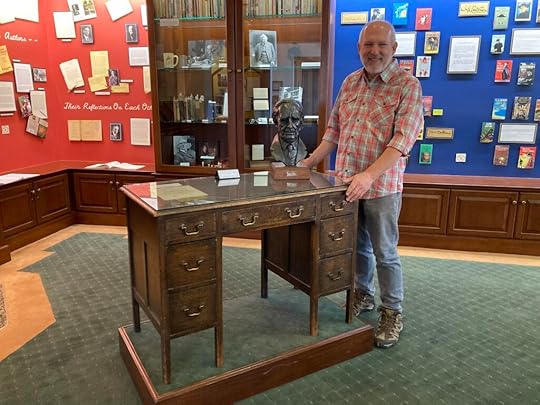
On this desk, Tolkien wrote, typed, and illustrated The Hobbit.
With my own hands, I touched the wood and opened the desk drawers that Tolkien touched and opened. The desk was given to him by his wife in 1927; he sat at it to write The Hobbit in its entirety.
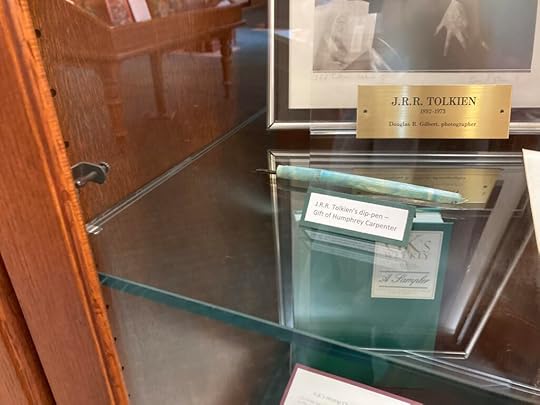
J. R. R. Tolkien’s dip pen.
Tolkien most preferred this dip pen as his writing instrument, favoring it over cartridge pens or a typewriter. A close look reveals that the back end of the pen is charred and melted because of Tolkien’s habit of using it to tap and clean out the pipe he puffed as he wrote.
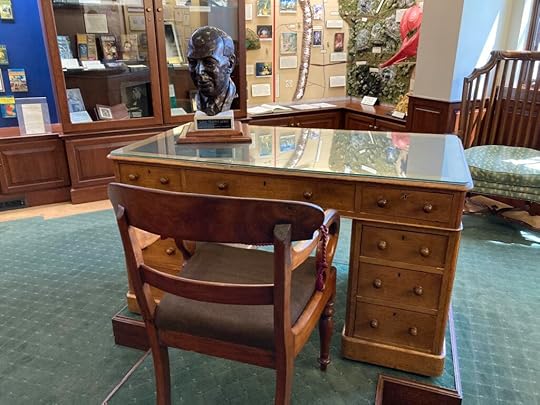
The college desk of C. S. Lewis.
Lewis used this desk and chair in his college office.
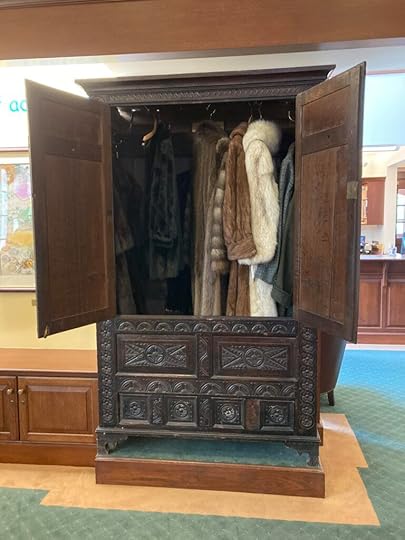
This wardrobe inspired the one that opens into the land of Narnia.
Pictured above is the wardrobe built by Lewis’s grandfather. In the world of Lewis’s fiction, it became the basis for the wondrous wardrobe that opens into Narnia. Most of the coats inside it now are props, but one of the tweeds at the far right belonged to Lewis’s brother.
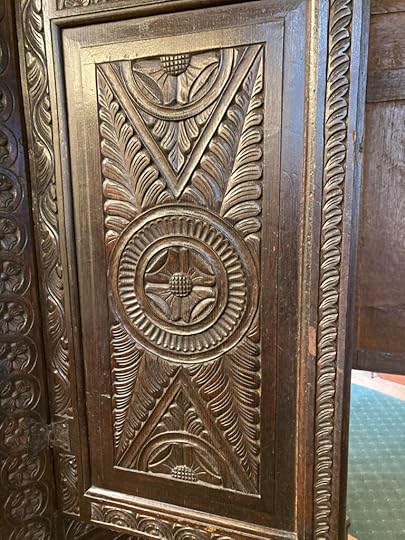
The door of the Narnia wardrobe.
Reaching inside, we stretched out our arms as far as we could . . .
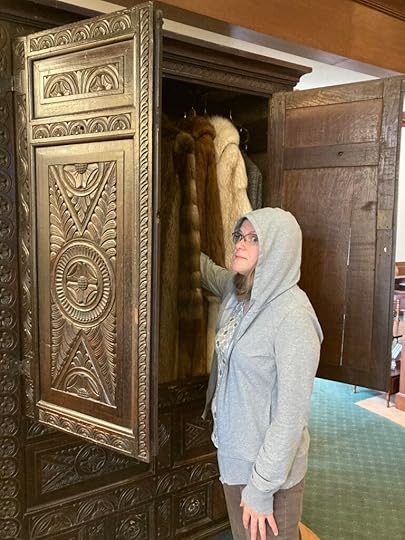
One hand in Narnia.
Perhaps through the complexities of coats rerouting our hands’ paths, we had the curious sense that we were reaching farther than where the wardrobe’s back wall should be. Or maybe, somewhere beyond our fingertips, snow was falling around a glowing lamppost . . .
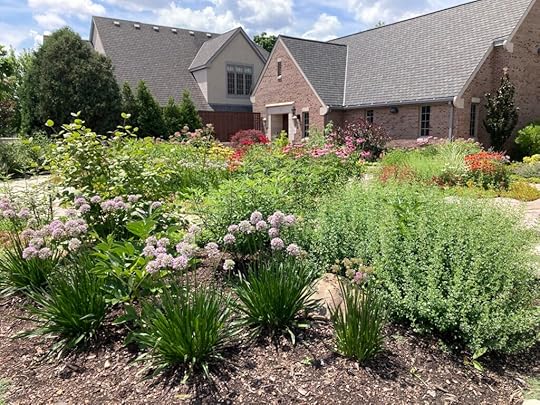
Outside the Wade Center, a lovely garden invites restful contemplation.
Dorothy Sayers’s eyeglasses are there, a trunk that belonged to Charles Williams, and we bought some cards and books at the gift shop. Outside the center, a beautiful garden afforded a chance to sit on a bench and absorb the warmth of a fine July day as we watched the bees busily subcreating, taking pollen from the flowers to be made into honey.

The “archbee.”
Hovering and buzzing among the blossoms was a denizen of the garden that we could not at first identify. “What’s that?” my wife asked, to which I replied, “I think it’s an archbee.” Seeing the photograph later, we concluded that it seems to be a small hummingbird.
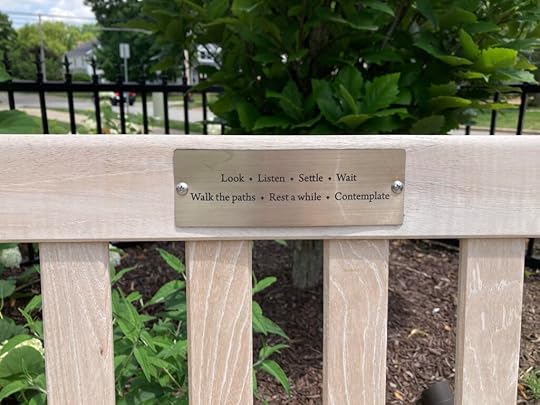
Invitation on the garden bench that reads like a poem.
Lingering in the garden, not wanting to leave, we felt we had made a pilgrimage to the very heart of the humanities. There is goodness, inspiration, and restoration at the Marion E. Wade Center.


November 13, 2017
Gathering
One weekend last month, I attended an amazing gathering so ultra-nerdy that, according to someone living with me who will remain anonymous, “it makes the World Fantasy Convention look cool.” Hmm . . . Well, I’m talking, of course, about the Annual International Gathering of Typewriter Collectors. I don’t think anyone really knows what the proper name of it is. It’s commonly referred to simply as “Herman’s” — “Are you going to Herman’s this year?” — because Herman is our gracious host, the owner of the museum where it’s held each fall, where something like nine hundred (900) rare, vintage, and antique typewriters and related paraphernalia are on display. Nearly a hundred of us gathered this time — my first time, in fact — some from as far away as Italy, South America, Toronto, and the West Coast, as well as from points all across the U.S. And it is a GATHERING!
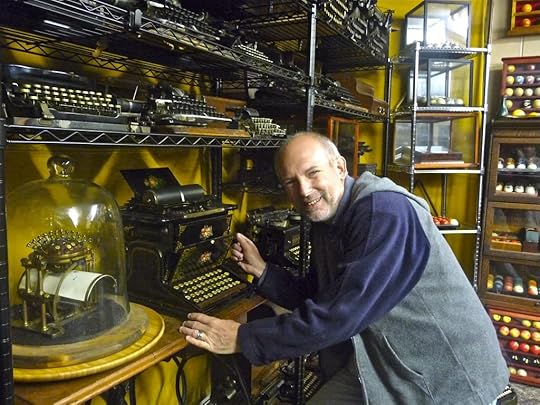
I am pictured here with a working Sholes & Glidden Type Writer, first manufactured by the Remington Arms Company and sold commercially beginning in 1874.
In the above photo, to the left of the Sholes & Glidden is a replica of the Malling-Hansen Writing Ball, patented in 1870, a machine famously used by Friedrich Nietzsche.
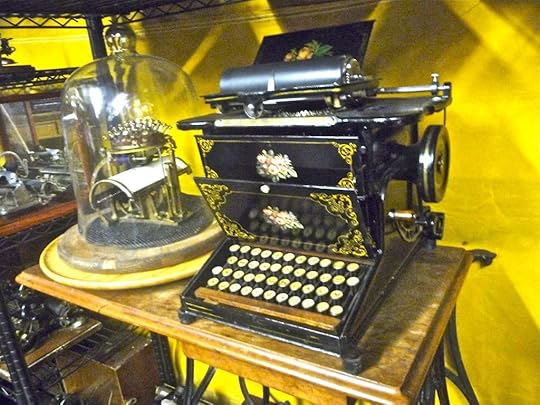
Here’s a better look at the Sholes & Glidden Type Writer. Christopher Latham Sholes — or perhaps a close relative of his — created the QWERTY keyboard; it appears on this machine and is still the keyboard layout most common today.
It was a weekend filled with activity: lots of buying, selling, and trading . . . presentations on typewriter history . . . typewriter repairs and consultations . . . lively discussions . . . speed-typing contests . . . merry eating and drinking . . . a typewriter beauty contest . . . two screenings of the fantastic new documentary California Typewriter, starring typewriter enthusiast Tom Hanks . . . and best of all, the conversations, from early till quite late — the kindling and rekindling of friendships.
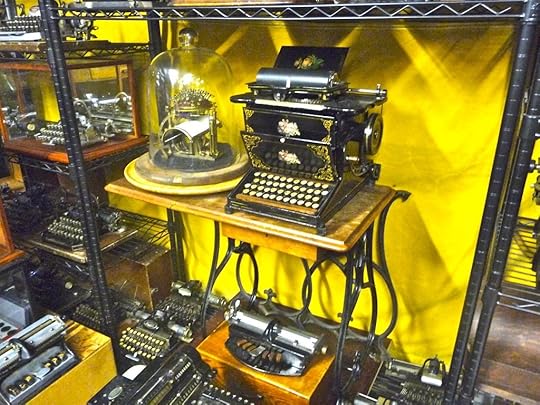
The Sholes & Glidden was mounted on the Remington sewing machine table; the foot treadle operated the carriage-return mechanism. With the Civil War over and the demand for firearms greatly decreased, Remington had to find something else to produce — and they found typewriters!
It was great to meet many friends I’d previously known only through correspondence.

One event was a silent auction, with typewriters to bid on lined up here. (No, I didn’t buy any . . . of these.)
Here’s a Hammond, the kind of typewriter that J. R. R. Tolkien particularly favored, perhaps because it doesn’t matter how hard or softly you tap the keys — you get a nice, uniform print:
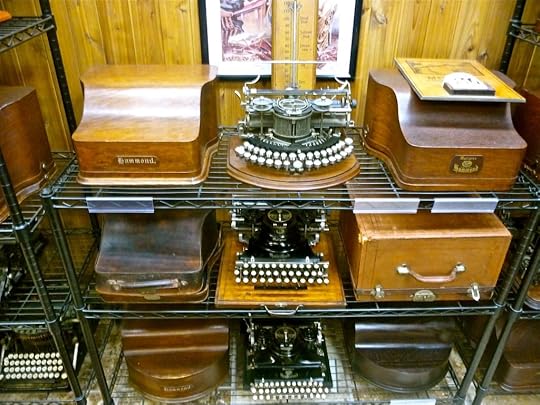
Hammond: with its type shuttle (as opposed to typebars), it was a kind of forerunner of the much later IBM Selectric.
The museum goes on and on . . .
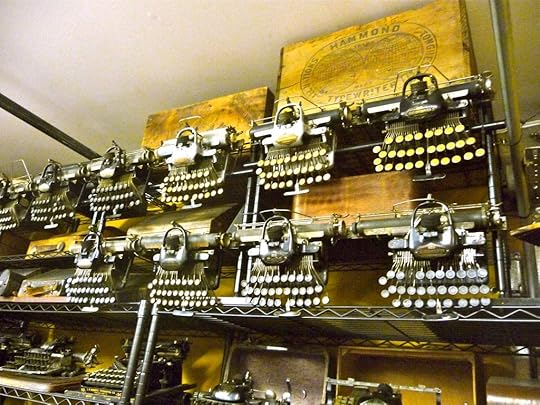
The Wall of Blickensderfers
And on and on . . .
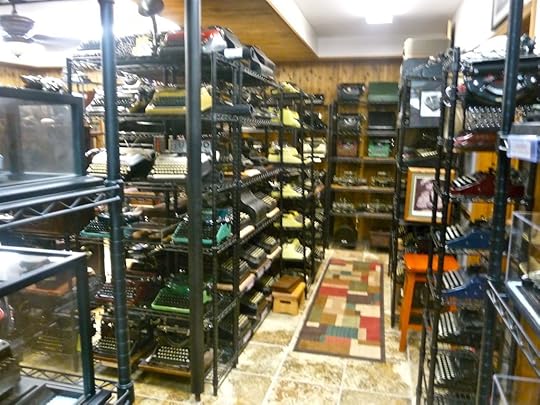
Shelves and shelves of history
Some from Japan . . .
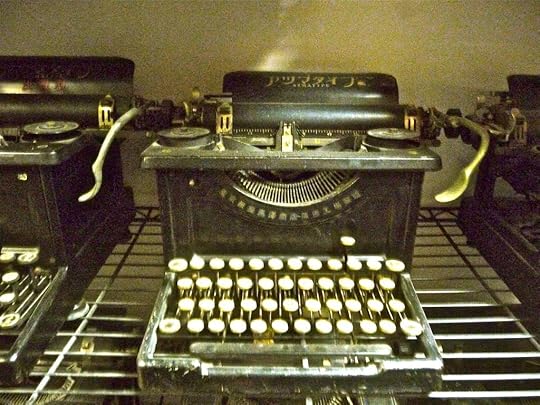
Azuma Type
Some pretty silly . . .
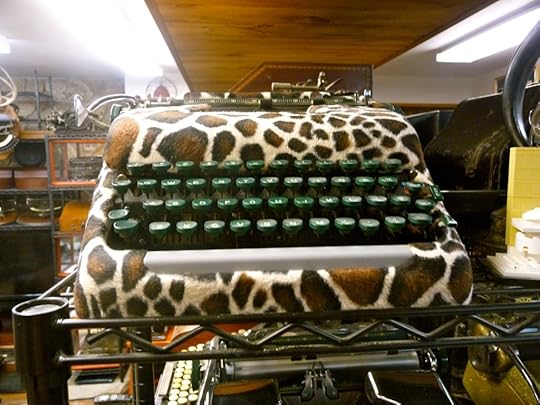
Fur-lined Smith-Corona portable
Some sillier still . . .
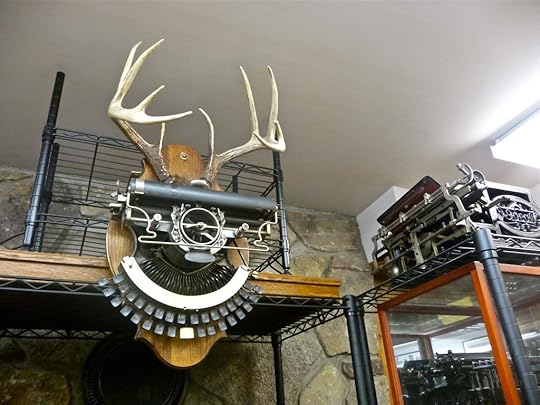
Is that ten-point type?
Some silver-plated . . .
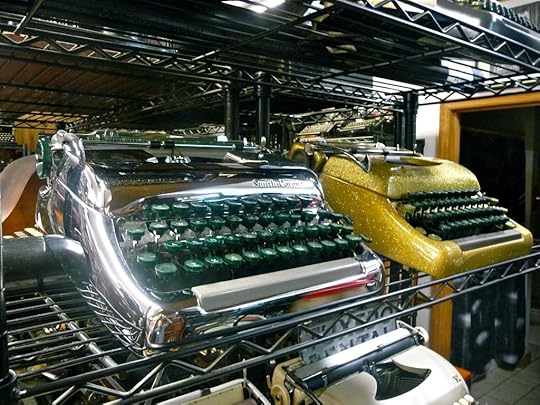
When writers need to reflect
‘Twas a wonderful time had by all.
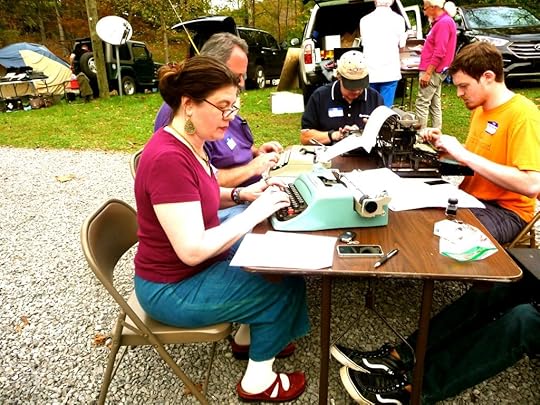
Anyway — I had to prove to my friend Mr. Brown Snowflake that typewriters don’t hinder blogging at all. Sometimes they provide grist. We had fun taking some into my wife’s classrooms, too, for students to use in creative writing assignments:
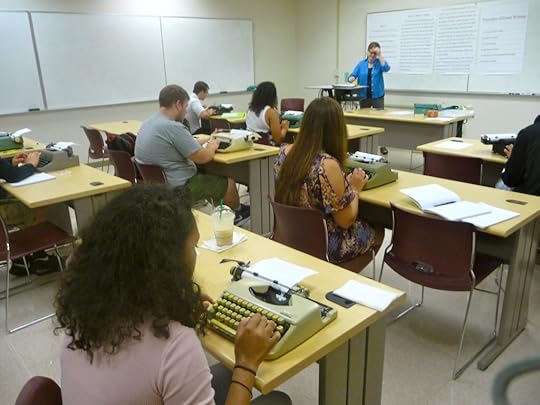
Typewriters in the college classroom — students loved them!
Then there were the poems-on-demand I typed for customers on the spot at the recent local BookFest:
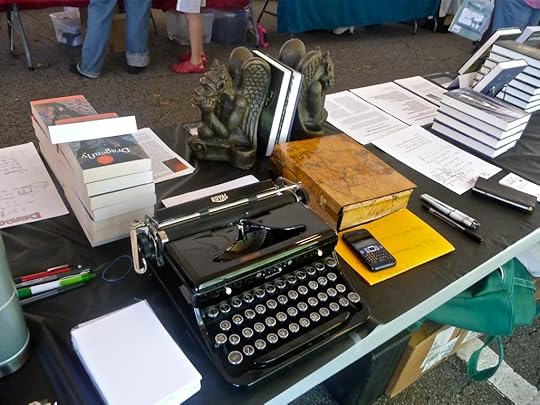
Royal Model O, 1930s
I may not manage to post as often as in the old days, but I’m still here. The lights are on, and there’s coffee.