Maura Casey's Blog
September 9, 2026
Who would I be without Gloria?
“The truth will set you free, but first it will piss you off.” That’s long been one of my favorite quotes from the great Gloria Steinem. I wish it were chiseled in granite somewhere. Maybe it should be in skywriting.
Steinem’s passing last week brought back memories that I have not thought about for years. One was how privileged I feel to have met her several times when I was on the editorial board of The New York Times, and had the chance to engage in conversation with her. She was kind, always, and a good listener. She was just, well, nice.
Her passing also reminded me of how much has changed since I was born nearly (yikes!) 69 years ago. How women once faced obstacles at every turn because of their gender. And how Steinem’s sense of injustice and determination to work for change made the world better.
Obviously, we do not live in a perfect world. And yes, there is more to do.
But then, barriers were everywhere.
In childhood I was desperate to get a job to loosen the control of my tight-fisted father and have more options over my life. So I spent part of my 14th birthday in 1971 at Buffalo City Hall, getting “working papers,” the only way one could get a job so young. I got my parent’s signatures and returned to hand it in and obtain a stamped work permit.
Then began the task of seeking a job, mostly by looking through the extensive classified ads in the newspaper, printed in tiny agate type under “WANTED.” Except that the ads were divided into two categories “Men’s jobs” and “Women’s jobs.” The want ads for men’s jobs sometimes went on for pages. Women’s jobs were far fewer, mostly for secretarial work.
Even before I turned 14, I looked into delivering the newspapers like my brother Seamus had. There were two daily newspapers in Buffalo then, morning and evening, and they were always looking for teenagers to deliver the papers. But both banned girls from the job. The term “paperboy” meant just that.
Steinem and other feminists questioned and argued, protested and pushed back at every turn. It wasn’t long before it became illegal to forbid women from applying to jobs just because they were considered “male jobs,” or for that matter, keeping men from applying to an occupation like nursing, thought of as a “woman’s job.”
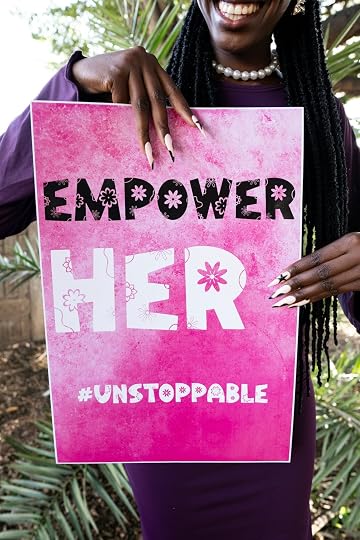 Photo by Dwayne joe on Unsplash
That and a lot of other things changed.
When I was in graduate school at The American University in the early 1980s, the journalism department chair, Laird Anderson, recalled for me how his marriage sparked a legal fight with the state they lived in. He and his wife, Florence Ashby, married in their 30s. They both had established careers, she as a college professor of mathematics at Montgomery College in Maryland, he as a journalist.
Yet the state required Laird’s wife to take his name. Without it, she might not have been able to vote or to apply for credit. This was not uncommon at the time and was a throwback to common law practice of “coverture,” where a married man and woman were considered one person: that of a man. Ashby objected. So did Laird. Together they went to court. The judge granting Ashby the right to keep her name marveled that any husband would request such a thing.
The with such laws was Hawaii, which changed them in 1976 (NY Times article; gift link). By the time I married n 1983, few questioned my decision to keep my name. (After I told my then-fiance, Pete, I had no intention of taking his name, he gamely said, “You’ll always be Maura Casey to me.”)
Finally, I was reminded of how such laws and customs denied women the ability to be “seen,” even by their descendants. I read my grandmother’s 1963 obituary this week and was struck by the headline: “Mrs. William Casey, Leader in Women’s Activities, is Dead,” The first line did mention her name, Elizabeth, but in the list of her children, only my father’s name belonged to him. His sisters were listed as “Mrs. Paul R. Locke and Mrs. Robert L. Davis.” Had my children read it, they would not have the foggiest idea that the names referred to their late great-aunts, Margaret and Joanna.
Steinem helped change laws, traditions, expectations, society - and me. I’m not sure what kind of a person I would be today had she not been born. The changes she and other women helped foster allowed me to have a journalism career beyond my imagination when I was a teenager desperate for a job.
And my search for work? I couldn’t find a job until I was 15. At the age of 16 I got training and worked as a nurses aide for five years while putting myself through college.
But, I always dreamed big dreams. Steinem helped me realize them.


August 26, 2026
We should all aspire to be a Dolly
One of the best headlines I scanned after Dolly Parton’s death sounded like it came from The Onion, the famous satirical news site: “Apocalypse Draws Near As Last Remaining Universally Beloved Human Being Passes Away.” In fact, it was from another satirical news site, The Babylon Bee, published out of Jupiter, Florida.
Successful satire always has a ring of truth. For one moment, nearly everyone (including me) applauded a single decision of Donald J. Trump: that all flags be flown at half-mast for a week in a nationwide sign of mourning. Great Britain’s King Charles asked the troops at the Changing of the Guard to play Dolly’s feminist anthem, “9 to 5.” New York’s Empire State Building gleamed in pink in tribute to her, as did landmarks in her native Tennessee.
Please consider becoming a free or paid subscriber.
There is a simple reason that nearly everybody loved Parton. It wasn’t just that she was a generous multimillionaire. It was that she was kind. And she pulled off something most people (including me) find difficult: She had a moral compass, but avoided being judgmental.
She was the fourth of a dozen children and when asked about anti-trans legislation, she said, “I’ve got transgender people. I’ve got gays. I’ve got lesbians. I’ve got drunks. I’ve got drug addicts all within my own family. I know and love them all and I do not judge… that is God’s business.”
 Photo by Wes McFee on Unsplash
After Whitney Houston’s rendition of Parton’s, “I will always love you,” earned her millions, Parton quietly invested in a Black section of Nashville that developers had ignored. Calling it “the house that Whitney built,” she said, “I am just going to be down with her people, who are my people as well.”
And her 31-year literacy project, the Imagination Library, has resulted in the monthly distribution of more than 300 million books to children from newborns to age 5. It has been one of the single greatest efforts to encourage reading the country has ever seen.
Yet what her death made me think about wasn’t just Parton, whom I admired but never met. I began to think about other Earth angels, other “Dollys” that I have been blessed to know.
We all have met them.
For example, I have a Dolly in my life, a fellow journalist named Roberta. (I’m not using her last name because she would hurt me. but, YOU KNOW WHO YOU ARE.) I met her at a journalism conference in 2008. Upon meeting me, she decided that we would have to be friends. I thought her intention was a little bizarre, but later it felt more like divine intervention.
The New York Times was about to eliminate my job, and I didn’t know what would come next. I blurted out the news to Roberta, who waved her hand dismissively and said, in essence, “We got this!” Then she rolled up her sleeves. Roberta is a natural networker, and over the following four years just from the personal contacts she had and the phone calls she made on my behalf, I got enough writing and editing jobs to replace my Times salary.
A Dolly also appeared in my life when I was driving, late on a cold, damp night on Route 495 in Massachusetts. I had my sleeping 2-year-old daughter Anna in the car when I heard the sickening thump of a flat tire. As I pulled over. I tried to quell a sense of panic. Rain poured down in sheets. Then headlights appeared in my rearview mirror above a Georgia license plate. “The axe murderer has arrived,” I thought, but such was not the case. A man appeared at my locked door, and said, “If you will just pop open the trunk, I’ll change your tire.” Ten minutes later the spare tire was on. As he waved goodbye, soaked through, and I rolled down my window to thank him, I asked why he stopped on such a terrible night. “Because whenever I needed help, someone was there to help me,” he said, smiling.
A Dolly passed our house one day when my husband and I were trying to cope with a tree that had unexpectedly toppled in our yard. He parked, introduced himself as Steve, took a good look, and said, “I’ll be right back.” He came back with a huge chain saw and helped us all afternoon with the chore of cutting and stacking wood. And refused payment.
Dollys are kind. Dollys are helpful and thoughtful when they don’t have to be.
Dollys make the world better and make us feel better about the world.
The best thing to come out of the truly awful loss of our national treasure, besides donating to Parton’s Imagination Library, is this conviction: We can each be a Dolly, too. No big hair needed.
Any aspiring writer, or any current writer who wants to recharge skills and meet great people in a beautiful setting, should join me at the Okoboji (Iowa) Writers’ and Songwriters’ Retreat Sept. 27-30. The retreat takes place on beautiful Lake Okoboji, an 8-mile long bit of heaven in the Great Lakes region of Iowa. It offers dozens of different workshops and although I have taught memoir writing and opinion writing at previous retreats and will so again this year, I love filling gaps in my schedule by taking classes from inspiring teachers. Come one, come all!
August 16, 2026
A return to my beloved island...
Two weeks ago, I drove 450 miles to the island and area around Lake Ontario where I spent portions of every summer between the ages of 8 and 22. In my book, “Saving Ellen: A Memoir of Hope and Recovery,” I renamed my beloved island East Cliff Island precisely because if you google it, absolutely nothing, zero, nada will come up. (Since there are over 13,000 islands in the United States, it was no easy task to make up a name that hasn’t already been taken!)
Please consider becoming a free or paid subscriber.
As I explained to a crowd of 30-35 people for a book reading at the Wilson Community Library on the mainland, I renamed some places in my memoir as a protective gesture. I have seen so many corners of New England change, and not for the better, after publicity.
I also slightly altered some names of neighbors in my book because I wasn’t sure, for example, that Grace Cone’s descendants wanted to hear that their great-great grandma used to sunbathe in the nude when she was 89, or that the descendants of old Charlie McGahon would want to know that he used to spike my lemonade with gin when I was 10.
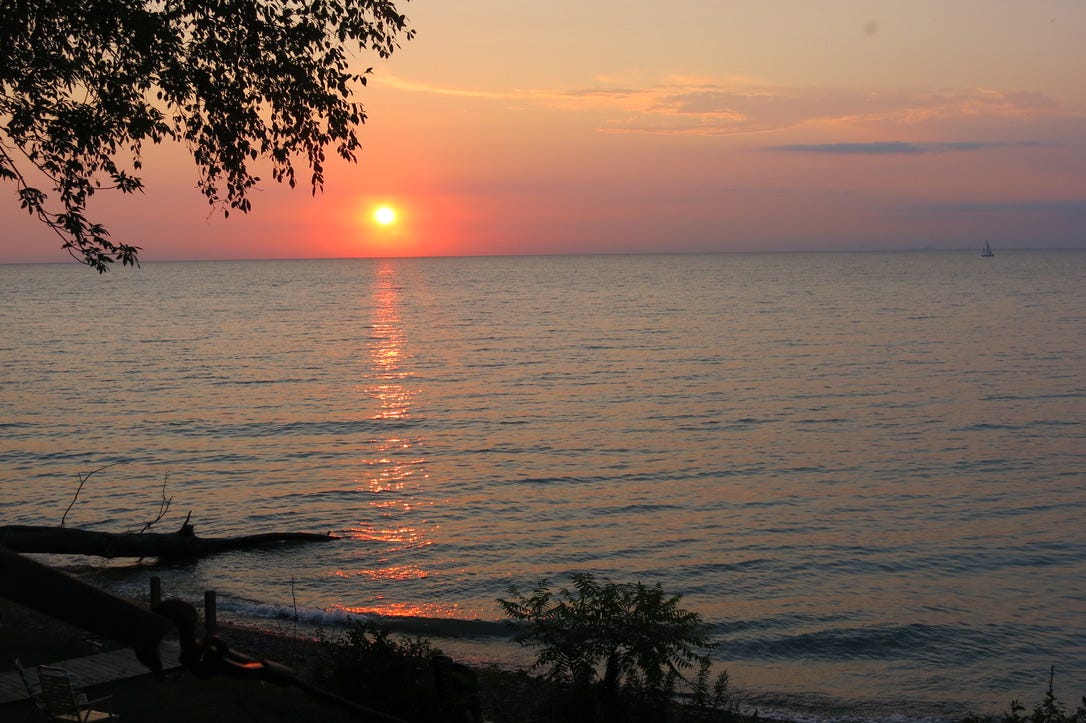 An island view of sunset on Lake Ontario
Despite my attempts at camouflage, residents of the island and on the mainland alike figured out exactly who and what I was writing about. I wrote about them, about our shared beloved island and town. And about a time and place decades ago when my family found peace around the vast and beautiful freshwater sea that the Haudenosaunee (Iroquois) appropriately called, “The lake of shining waters.”
I’ve lived in New England for more than four decades, far from where I grew up in Buffalo, New York. I rarely experience being among people who knew my family from years ago or who knew me as a teenager. The gift of the evening was speaking before members of an audience who could nod when I recalled my mother’s sense of humor, or my sister Ellen’s determination.
But the experience of staying on the island for several days, of renting a lakeside cottage my kind friend Marge had arranged, was also moving. I spent my formative summers on the island with my mother. During that time before the responsibilities of adulthood, of long and languid days, Mom and I would talk and talk. Sadly, I can remember few specifics from all those conversations. But I remember very clearly how they made me feel - supported, encouraged and loved. So as I walked around the tiny island with no roads or stores, with just a sidewalk going down the middle and scattered cottages on either side, the years fell away. I could almost hear my mother’s voice as the wind rustled the leaves of the trees.
My book also indirectly provided an answer this summer to a decades-old mystery that my mother and I regularly puzzled over.
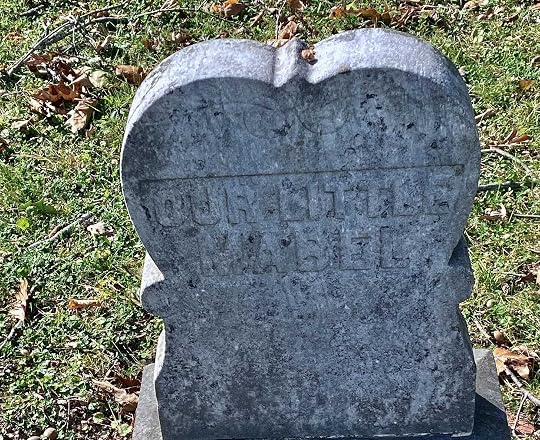
Before Mom’s heart trouble made it impossible for her to walk too far, sometimes we would take our boat to the mainland, tie it up and drive or walk the mile or so into town for groceries or books from the library. When we went back, we would often cut through the old part of the town cemetery, where we would always pause by a grave that my mother had first noticed and pointed out to me.
It was an old. heart-shaped tombstone with just three words: “Our Little Mabel.” That was it. No dates. No names of parents. No hint as to when little Mabel had died, or the struggle that took her young life. The pain of those three words made a deep impression. So Mom and I never passed by without stopping to straighten out the grave a little, and say a prayer for Mabel and her family.
After Mom died, and was buried in the same cemetery, I continued our tradition. I rarely visited Mom without visiting little Mabel. I wrote about it in my book, “Saving Ellen.”
I never thought the mystery would ever be solved. But then I got an email whose address I didn’t recognize. It was from a member of Mabel’s family, her great-nephew, Tom Kay.
“I nearly dropped my Kindle when I read that line in your book,” about his grandmother’s sister, Mabel Wilson. “Thanks for taking care of the gravesite,” Kay wrote.
Mabel, Kay wrote, died of pneumonia in 1905, at the tender age of 2. The heart-shaped tombstone that always tore at the heartstrings of my mother, and still does of me, is more than 100 years old.
He, too, was driving to the area, but was sorry to say he would miss my book reading by a week. He sent me a picture of Mabel as a baby, before her passing would break her parents’ hearts - and any who stopped by her grave. A crack had formed on one part of the grave, Kay said, and he and his brother had plans to fix it.
It was a fitting ending to an emotional visit for me. On the island I could feel the presence of my mother once more. And, at last, I knew the identity of sweet little Mabel, who is still loved and remembered after all these years.
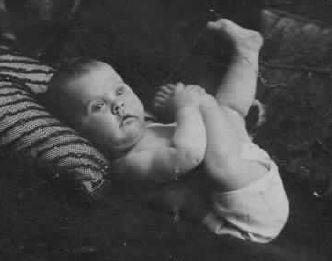 Mabel Wilson
August 9, 2026
A new label for the Trump White House
I learned a marvelous word the other day that exactly describes the American leadership in Washington. The word is new for me, and it is wonderful because it offers one succinct definition showing why America is weaker today than it was on Jan. 19, 2025. It shows why President Donald Trump is not just the termite-in-chief gnawing at the very foundations of our democracy and American leadership. He isn’t simply running a kleptocracy, a form of government in which those in power, particularly him, use a position to steal for personal gain.
That’s far too limiting.
To read my latest and support my work, I would so appreciate it if you became a free or paid subscriber.
No, my friends, the word of the week is kakistocracy: Government run by the least qualified people, in this case almost all men, most of whom are also the most unscrupulous.
Kakistocracy: Government run by the least qualified people who are often also unscrupulous.The word fits exactly the circus happening in the Trump Administration. Exhibit A is the Iran war, which lately reminds me of a story a friend told me last month about her first teaching job 50 years ago, in a poor Arizona school.
During class one day, a black widow spider dropped on a student’s desk. The student smacked the black widow with whatever he had at hand to to kill it. Mission accomplished, but the spider had an egg sac. Hundreds of baby black widows erupted from it and began crawling everywhere.
Iran is the black widow. Trump is the clueless student who thought he could finish off the spider in one blow, only to face consequences he never expected, but should have - like venomous spiderlings crawling everywhere.
Iran’s theocratic, dictatorial regime is far stronger today than it was before Trump ordered our military to attack Feb. 28. The fact that the Israeli and U.S. military killed its senior leadership did nothing to weaken Iran. Instead, Trump’s act motivated Iran to exercise control over 20 percent of the world’s oil by taking control of the Strait of Hormuz; it exposed how weak our hugely, even insanely expensive military is; and sparked Iranian determination to torment one more American president.
Which Iran is an expert at doing.
 Public portrayal of Trump in Iran.
 And there isn’t much Trump can do about it without enormous humiliation or prolonged cost: Give up or send in ground troops.
All the repercussions from this war were obvious to anyone who wasn’t an idiot, which Trump and his misogynous Defense Secretary, Pete Hegseth, appear to be. Hegseth thought the war was a fabulous idea. But he apparently doesn’t know how to count and has probably fired anyone who did, particularly if they had the misfortune of being female or black, since Hegseth has repeatedly nixed promotions of female or black officers.
Now, incredibly, the American military is running low on long-range, precision missiles. When Trump confronted Hegseth about the issue, Hegseth, like the weasel he is, blamed others.
Late last week and over the weekend, after Trump once again claimed, for the umpteenth time, or maybe pleaded, that the Strait of Hormuz was about to be reopened, Iran released a list of demands.
They included releasing billions of dollars in frozen Iranian assets, a total withdrawal of forces, paying for all the damage our bombs have created, lifting the US naval blockade, ending aggression against Iran and its allies in Lebanon, Palestine, Yemen and Iraq…. AND…AND…. Agree never to insult Iran again.
Asking Trump to stop insulting anyone is like asking him to stop breathing. Or, maybe, to give all his money to the poor and become a hermit. Not gonna happen. Immature name calling, bluster, attention-seeking and playground behavior is the way this 80-year-old juvenile makes his way in the world. He won’t stop insulting people until he can no longer speak or has departed this mortal coil.
In a list of unreasonable demands, this one is the dealbreaker for the Blatherer in the Oval Office.
And in a country and culture that craves respect as much as Iran does, this is the one condition the leadership may want the most.
They also want Trump to shut his mouth. Good luck with that.
I don’t know where living in and observing our American kakistocracy leaves those of us who, like me, feel their heads explode when we read the daily news. I am burdened with compulsively reading three or four newspapers every day. It would help my mental health a lot if I could stop and ignore the whole thing. But it feels irresponsible to walk away.
Instead I take deep yoga breaths, walk our two dogs, dig up more potatoes (Pete absolutely planted too many this year), pick flowers for the kitchen and try to find moments of serenity.
And, at the very least, get a belly laugh at the idea that serious negotiators amidst a war would demand that Trump stop hurling insults.
July 31, 2026
Digging potatoes, a ritual of midsummer
At the end, they were clearly worn out, tattered remnants of what they once were.
They had bloomed only six weeks or so ago, white flowers wafting in the breeze. But now, the stems were yellow and the leaves were as ragged as the ears of an alley cat.
We could delay no longer. It was time to harvest the potatoes, a sign that midsummer is upon us.
My farmer husband Pete and I had planted the fingerlings in May, taking a chance on a spate of good weather - although, truth be told, spring had been a bit cold.
Pete knows his Irish wife loves potatoes, so he always obliges me. Besides, they sell well at farmers markets. He chose several kinds from the Maine Potato Lady, the company where he usually orders his tubers. Some were repeats. Magic Mollies, the purple potatoes that are a perennial favorite of customers, arrived in all their deep violet glory.
They delighted a customer a few years ago at the market, where she lifted the potatoes and said they reminded her of home. And where was home? “Peru,” she said, smiling, where the oldest archeological record of potatoes exists, dating from 2500 BC. But they were cultivated long before then, and astonishingly, her country is home to more than 3,000 varieties of tubers.
Thank you for becoming a free or paid subscriber.
Fortunately for me, Pete just chose four kinds, and beside Mollies, he chose Red Thumbs, which look exactly as the name implies. He also ordered Organic Banana potatoes, with a rich yellow skin, perfect for mashing. Then my favorite, Pinto Gold, a cross between yellow and red potatoes, with mottled red and gold skin, looking a lot like Peruvian varieties.
When we planted them all, they rested snugly in the narrow ditches Pete dug before we carefully covered them with soil.
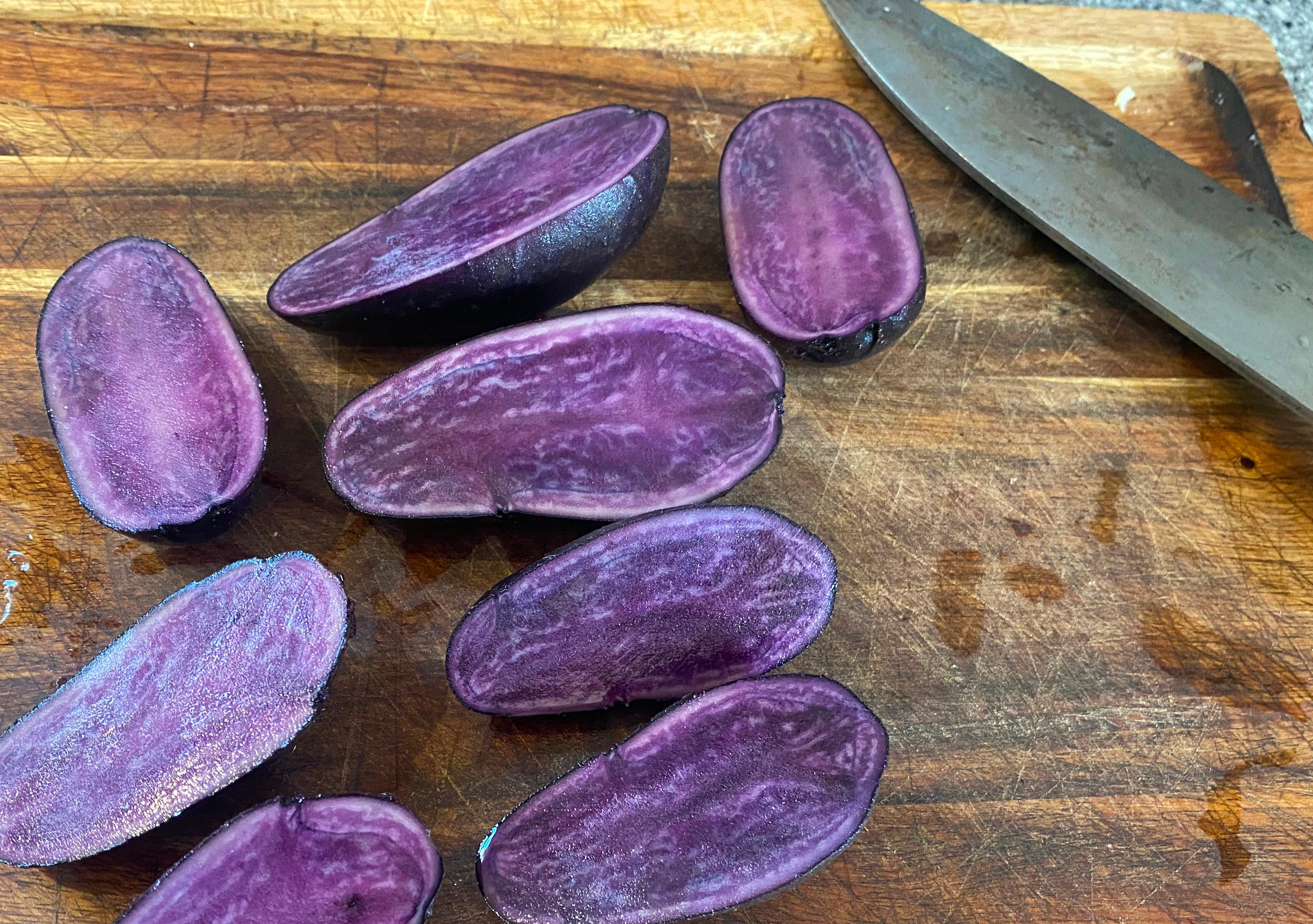 Magic Mollies. Aren’t they gorgeous?
Now it was time for them to roll out of their warm, dirt beds and all I could think of was the work that awaited us. What can I say? I may be descended from Irish peasants, but I’m a writer. The only calluses I have come from typing.
I’ve pulled back from farming in recent years. It’s Pete’s thing, really, and I do wonder sometimes about a second career that seems to use up every single minute of the very nicest months of the year from May to October. Still, it keeps him moving. And occasionally he could use a little help.
Like the task of digging potatoes.
It never seems to matter that I stay active in walking three to five miles a day, or that I work out in karate class twice a week. Farming - the digging, the pulling, the carrying, the grunt labor of it all - always seems to use different muscles. Pete is out in the fields for hours. His stamina astonishes me. I can’t possibly keep up with him. So it takes me awhile to get into the routine of things.
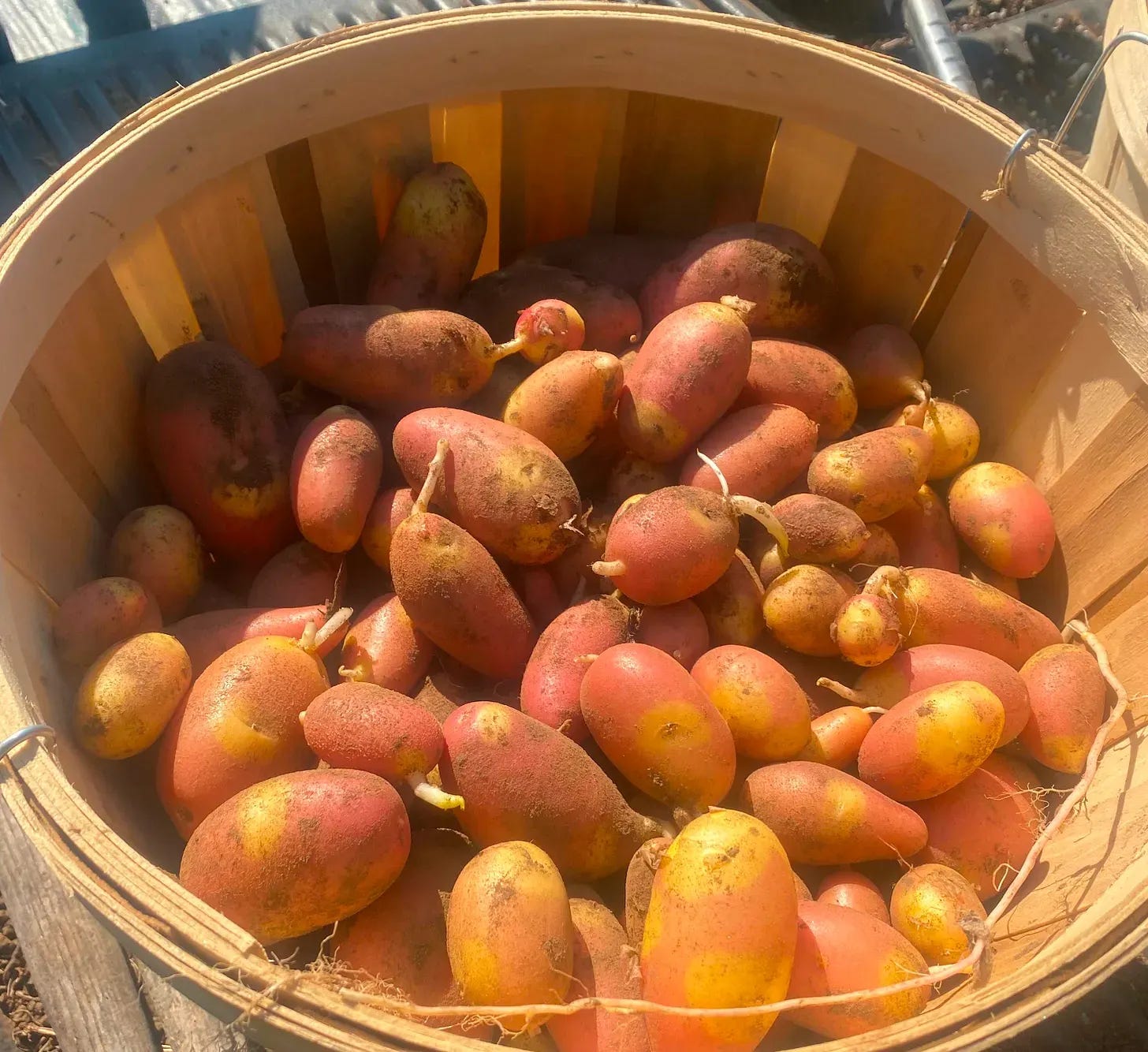 Pinto Golds
Sometimes, the weather doesn’t help. Two weeks ago, I dug up half of one row of Magic Mollies. It wasn’t long before I felt utterly beat, but the humidity and heat were both high that day. After awhile, I gave up, put my pitchfork to one side, hauled the full bushel baskets to our barn and dove in our pond. The pond, 15 feet deep, is always cold from its many springs and felt delicious. Plus, it’s a great way to get the dirt out from under one’s fingernails. Not to mention the dirt on my arms and legs. Ferreting out potatoes is not a white-collar job.
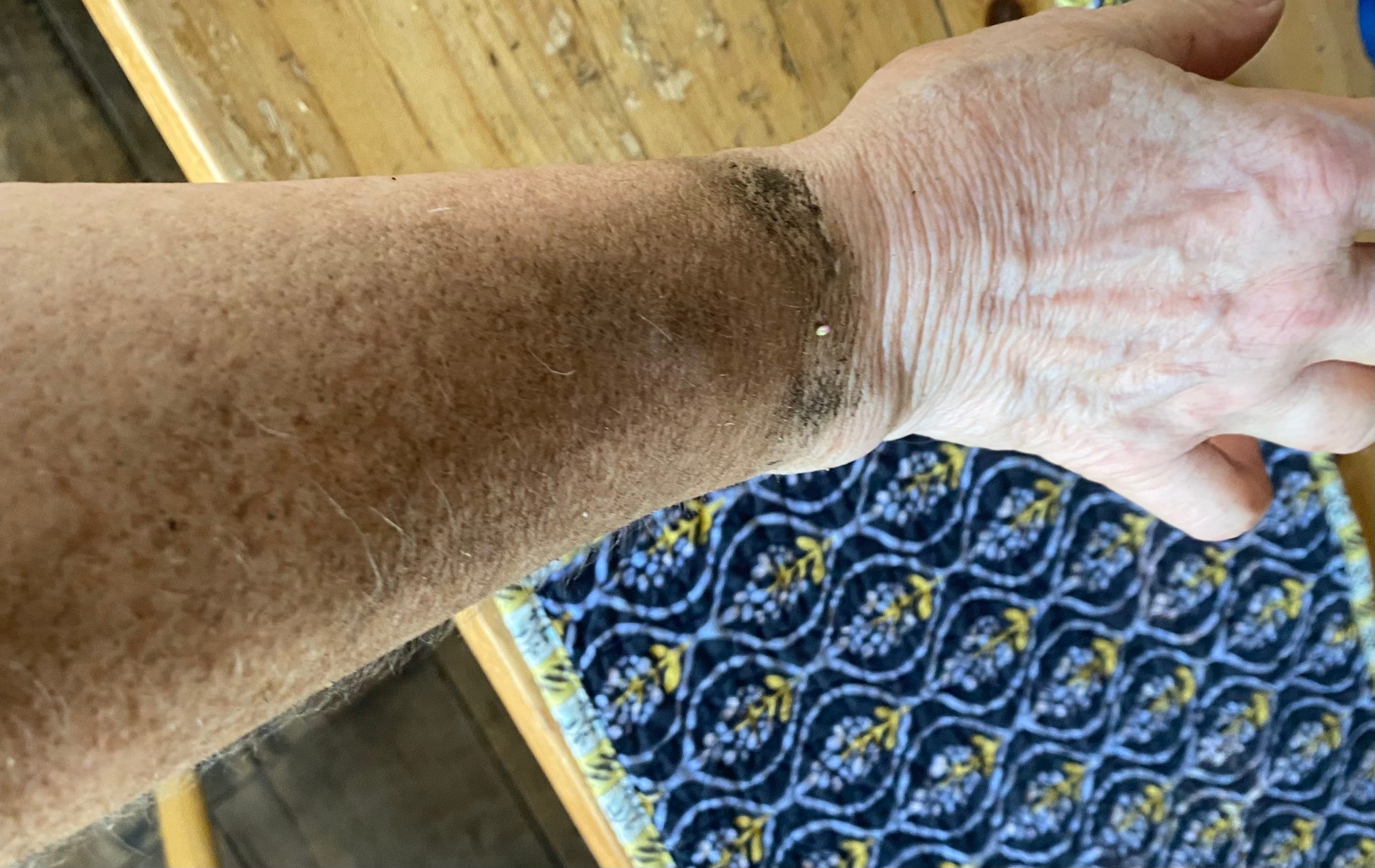 I was glad I wore gloves when I got done digging.
 So I wondered how long my energy would hold out last week when I began to turn over a row of Pinto Golds, pulling up the wilted plants and shaking off the loose earth. But the weather was sweet, with low humidity and a good breeze, and I soon made headway.
I was amazed at how prolific the potatoes were. Unlike the other varieties with a more modest harvest, the Pinto Golds had 20 potatoes or more attached to each plant. If they were teenagers, I would tell them to use birth control. But the potatoes were gorgeous, and I filled one bushel basket after another. After two hours I had finished the row and filled five bushel baskets. And I was utterly filthy. But the pond was waiting, and as I put away the pitchfork, I had to admit, farming gives me a sense of accomplishment that few tasks do.
Don’t tell Pete.
Two announcements: For those interested, particularly my Buffalo peeps, I will be at the Wilson Community Library, 265 Young Street, Wilson, NY, this coming Tuesday, August 4, at 6:30. There I will do a reading from my memoir and among other things, explain why I renamed the town “Newcott” in my book, “Saving Ellen: A Memoir of Hope and Recovery.” (I promise I had a good reason). I’d love to see you there! RSVP to the library at 716-751-6070.
And any aspiring writer, or any current writer who wants to recharge skills and meet great people in a beautiful setting, should join me at the Okoboji (Iowa) Writers’ and Songwriters’ Retreat Sept. 27-30. The retreat takes place on beautiful Lake Okoboji, an 8-mile long bit of heaven in the Great Lakes region of Iowa. It offers dozens of different workshops and although I have taught memoir writing and opinion writing at previous retreats and will so again this year, I love filling gaps in my schedule by taking classes from inspired teachers. Come one, come all!
July 12, 2026
What's the matter with paper, anyway?
I am being forced to join a paperless society. I don’t like it one bit.
There. I’ve said it. Yes, I know it’s good to save trees from being mowed down. I agree that using less paper spares landfills mountains of trash.
Please consider becoming a free or paid subscriber.
But I miss reading newspapers on, well, paper, instead of squinting at my phone.
And I would rather not rely on the internet alone to get my bills. I am beginning to long for the day that I could hold a bill in my hand. Write a check. Put a stamp on an envelope and mail it.
I spent an hour of my life recently that I will NEVER get back fighting with my wireless phone service provider. The bill is in my name. Despite this, when there is an issue, the wireless company, Verizon, texts my husband, who texts me. Absurd. The few times I have tried to sign in to get information on the bill I get a message saying that I need the permission of the “administrator” – my husband. This is maddening. He has a long, melodious Italian name; I have a short, sprightly, Irish name. The bill is addressed to me, not him. I do not seek his permission on this or anything I can think of.
A few days ago, Verizon texted my husband, who texted me, that we hadn’t paid our bill on time.I then called the company. I told them I hadn’t gotten a bill that month. “Your bill is now online,” the company representative said. I told her the company needed to take my husband off the bill as the “administrator” and by the way, I wanted to keep getting a paper bill. The woman on the phone clucked sympathetically and said, in so many words, if I wanted to continue the quaint habit of getting a paper bill it would now cost me an extra $5 a month.
Seriously? So I have to read my bill on the internet or pay for the privilege of getting it the old-fashioned way?
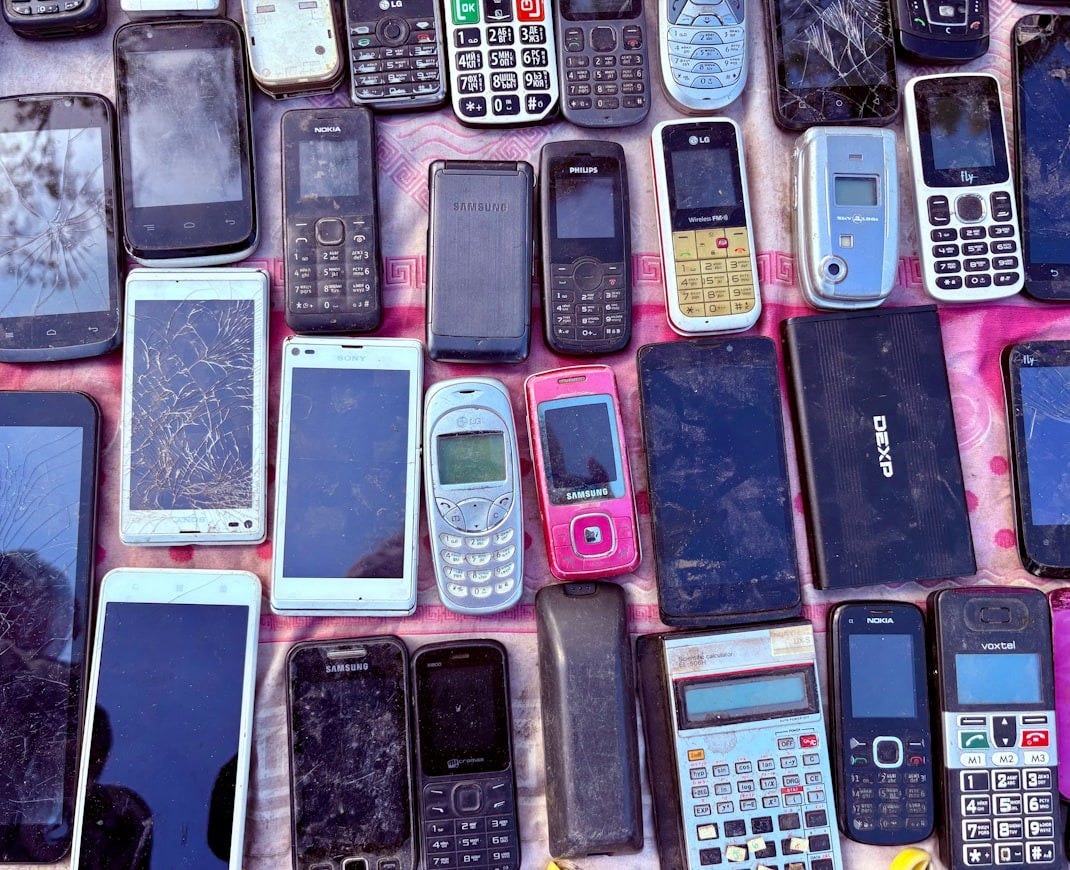 Photo by Tasha Kostyuk on Unsplash
I pointed out to the company rep that reading my bill online would require the permission of my husband, like this is some techno-version of the 1850s where married women didn’t even have the rights to the 20 pounds of clothes they were often compelled to wear. She tried to fix the problem, to no avail. Then another representative tried, too. How complicated could this be? Frustrated, I hung up, still wondering why I couldn’t still get a paper bill in the mail as I always had.
It turns out that this is a thing. There’s no law against companies charging to send paper bills. More and more businesses are turning to it as a way to cut costs and milk customers even more. Banks, credit card companies and other wireless phone companies are in on the act.
The movement to drop paper has even affected my husband’s transactions at the farmers market, now in full swing as we approach the middle of summer. Our state used to distribute coupon books to the elderly at senior centers to give them more to spend at farmers markets. Each small booklet held five $3 coupons. Customers could use the coupons like cash to purchase fruit and veggies. They got fresh food; Pete deposited the coupons like checks in his farm account.
A few years ago the state forced customers to use a mobile app to get the same benefits the paper coupons once provided. Which, to me, begged the question. What if you can’t afford a smartphone? Or get confused about how to download yet another app? Eventually the state offered the option of getting a plastic card with the benefits loaded on. But it is clear that technology is herding us all in the same direction - more apps, more staring at computer screens, more passwords to remember and email spam to delete.
More living life online.
Last year, on an out-of-state business trip, I ordered breakfast at a diner which offered a variety of local and national newspapers for customers to read while waiting to be served. It was a dimly remembered, but entirely relaxing few minutes to leaf through pages of a sports section or an editorial page rather than peering at my phone. It spared me the irritation of trying - again - to remember one or more obscure passwords for a website, or navigate the occasional, dreaded, two-factor sign-ins that make me want to pitch my phone out the nearest window, wondering whether I own it, or it owns me.
It was a 1990s experience and no permission was needed.
After hanging up on Verizon, I wormed into the corners of the company website to figure out why my husband was affixed as the lord of a cell phone bill that has always been addressed to me. I finally found the problem. Turns out that it wasn’t an anti-feminist plot; someone checked the wrong permissions box when we signed up for our plan years ago. I unchecked the box. Now, rest assured, I can read the bill without Pete’s imprimatur. The marriage is saved.
But I still can’t get a paper bill in the mail for free.
July 3, 2026
A marker, and a warning, from Paris
I was in Paris last week. The city vibrated with heat. Temperatures for a few days rose to about 39 degrees Celsius/102 degrees Fahrenheit.
Yet, “no whining on the yacht,” as my friend Connie says. It was Paris, after all, and I was thrilled to be there. The temperatures took away some choices and offered others. No bicycle tour of the city for me. On the plus side, the lines to the Cathedral of Notre Dame were short or nonexistent so I was able to go to that beautiful landmark twice, once hearing Mass.
I also wanted to wanted to take the World War II tour, which showcased settings of the city’s darkest hours, during Nazi occupation between 1940 and 1944. Alas, the tour required two hours of walking, so that, too, was off the table.
Instead, one thought-provoking sign of those difficult years found me.
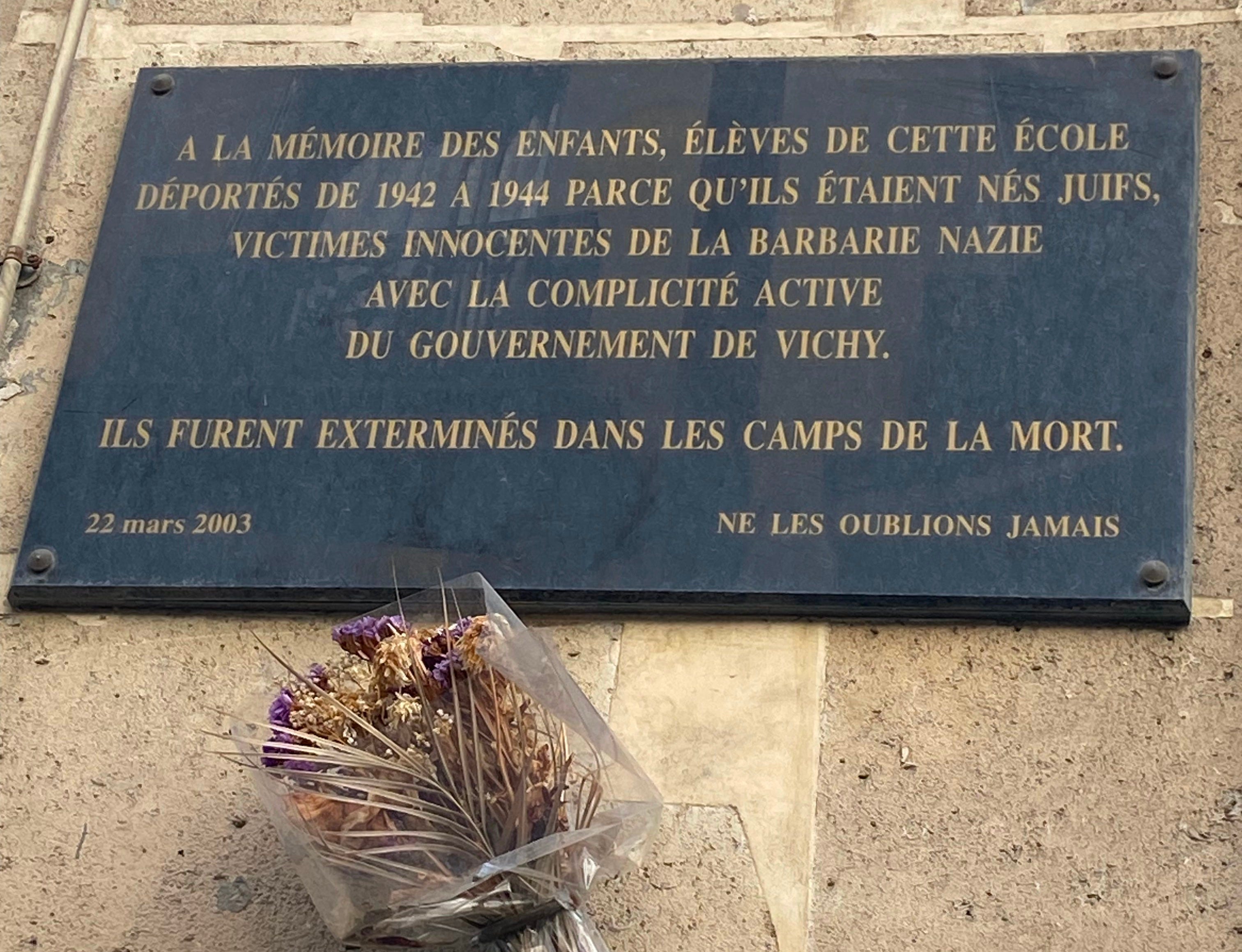
One afternoon I noticed flowers sticking out of the wall of a building. Upon closer inspection, I saw that the small bouquet was very deliberately fastened below a plaque attached to the stone wall. I remembered just enough college French to be able to translate:
In memory of the children, students of this school deported from 1942 to 1944 because they were born Jews, innocent victims of Nazi barbarism, with the active complicity of the Vichy government. They were exterminated in the death camps. Let us never forget them.The Vichy government began after the Nazi takeover and collaborated with German rule. They did the Nazis’ work for them. Vichy France targeted Jews in increasingly harsh ways, stealing their property, arresting and imprisoning them. In 1942, roundups began, and of the 76,000 Jews sent to concentration camps during the following two years (mostly Auschwitz-Birkenau), only about 2,500 survived.
The memorial plaque on the outside wall of an elementary school is one of a number of similar such markers in Paris, I discovered later. But in the present, gazing at the words, I had three reactions:
Good for the French to mark the terrible occurrences that took place here.
Yet how easy it is to mourn injustice that took place more than 60 years in the past.
Who are the Vichy-type collaborators in America?
Of course we have them, I realized instantly as I stared up at the marker. Our very own Vichy branch of government can be found in the conservative majority of our Supreme Court, which has imposed one loathsome decision after another.
There wouldn’t even be a six-to-three conservative majority on the court without Republicans smashing through legislative procedures in unprecedented ways. The Senate confirmed President Trump’s pick, Justice Neil Gorsuch, in 2017 only after Republican Senate Majority Leader Mitch McConnell blocked President Barack Obama’s nominee for 10 months, arguing the vote should not take place in a presidential election year. Then, when another vacancy opened six weeks before the 2020 presidential election, in a move of staggering hypocrisy, McConnell rammed through hearings and a vote on Justice Amy Coney Barrett, whisking her onto the court a mere week before the election of Democrat Joe Biden.
There is enough in the conservative majority’s latest opinions to rail against - lifting virtually any regulations on gun use, and opening the floodgates even more to big money in political campaigns.
But I’ll mention just one Supreme Court decision that is eerily similar to the manner in which Jews were smeared in early 1930s Germany. In Mullin v. Doe last month, the six-member majority said that President Trump could end Temporary Protected Status for Haitians and Syrians brought into America.
Congress passed the TPS program in 1990. It is a temporary status of immigration extended to specific countries that are unsafe to live in due to armed conflict or extraordinary circumstances. The U.S. State Department has maintained its highest level-four warning against travel to Haiti and travel to Syria because of “rampant, violent crime,” widespread kidnapping, terrorism and armed conflict. The warnings are extraordinarily blunt. Before traveling to Syria, for example, travelers are advised to update their wills.
To end TPS, the Department of Homeland Security secretary is compelled to consult with other departments of the federal government, which Secretary Kristi Noem did not do. The law mandates that the decision to terminate could not be made out of discriminatory intent. Both conditions should have been enough to continue the program.
Donald Trump has been repeatedly vitriolic and crude in his characterization of the 330,000 Haitians in the United States under the program, railing against them during his presidential campaign and spreading the lie on national television that they eat their neighbors’ pets. Yet Justice Samuel Alito airily stated in his majority opinion that Trump’s statements were not “overtly racial.”
So Justice Elana Kagan stated, in an extraordinary dissent, just what Trump said: Haitians “probably have AIDS.” Haiti is a “shithole country,” which is “filthy, dirty, disgusting.” Haitian immigration is “like a death wish for our country.” Haitians are “poisoning the blood” of the nation. “The references — of filth, disease and primitiveness — are shot through with racial stereotypes and tropes,” she wrote.
Kagan is right. Moreover, the things Trump said about Haitians sound exactly like what the Nazis said about Jews. And the actions of the Supreme Court sound like the Vichy government to me.
I don’t mean to make a false equivalence here. Nobody is marching Haitians off to extermination camps. But forcing more than 300,000 of them to go back to their country is a death sentence for many, if not most. It is the equivalent of emptying the population of Orlando, Florida, or Cincinnati, Ohio. It’s four times more than the number of Jews the Vichy government of France deported during World War II.
And if Alito sees no overt racism in Trump’s statements, what would he consider evidence of bigotry? Would he see a gathering of the Ku Klux Klan as the equivalent of a Rotary meeting?
The marker in France felt like a warning. Are we doomed to have markers placed decades from now mourning this cruel and inexplicable decision because of the likely, devastating result if thousands are sent away?
June 21, 2026
A reunion, a memory, and a beloved dog
Some meetings are so long overdue that we feel extraordinarily lucky when they finally occur. That was the case with my reunion with Dr. Mary Hawking last week at her home north of London.
Mary was my sister Ellen’s brilliant, young physician when Ellen was critically ill with kidney disease. (She ended up having a kidney transplant in 1970.) Unlike American physicians at that time, who were invariably male and often had a distant professional demeanor, Mary stuck out, and not just because she was female and from Great Britain. She was always kind and willing to get to know her patients and their families She came to our family cottage on an island on Lake Ontario. She hired me to walk her dog, Bran. When I was 12, she took me to my first opera.
After five years in the United States, Mary moved back to her native United Kingdom. We exchanged a few letters, but contact diminished and then dropped off. And that was that.
That is, until I decided to write a memoir about my sister’s illness and how it shaped my childhood and our family. As I began to write “Saving Ellen: A Memoir of Hope and Recovery” during the COVID-19 pandemic six years ago, I knew I needed to try to find Ellen’s doctor. As Mary is the sister of the late physicist Stephen Hawking, it took me about five minutes to find his foundation and send an email to Mary through the organization. She replied within hours.
So began a period of multiple interviews over the time it took me to write my book.
When we began the interviews in June 2020, there were questions about my sister Ellen, who, God rest her kind heart, has been dead for nearly 35 years. And of course about my mother, with whom Mary had extensive discussions over the risk of donating a kidney to Ellen. (Mom won that argument, though it shortened her life.)
But one of Mary’s first questions was about Bran, her gigantic German shepherd, who looked fierce, even terrifying, but who had the sweetness of a Krispy Kreme doughnut.
“What happened to my dog?” Mary asked.Before Mary came to the United States from the United Kingdom, she weighed the high crime rate and decided she had to either buy a gun or get a dog. She decided that the safer choice was a dog and picked Bran, who even as a puppy promised to grow to be one very large German shepherd. When either Mary or I walked him, oncoming pedestrians would often cross the street to avoid us.
But as Mary prepared to move back to the United Kingdom, she knew she had to leave Bran behind. British law then mandated that pets like Bran had to be quarantined for six months. It was a deal breaker.
My mother reassured her. She knew of a good family, a couple, Joe and Barbara, who had two teenaged boys. They would be glad to have Bran.
After Mary asked about Bran, I contacted Barbara’s sister, Judy, as Barbara had passed away. “Bran?” Judy said. “The family adored him. My sister had land with room for him to roam. He had a great life.”
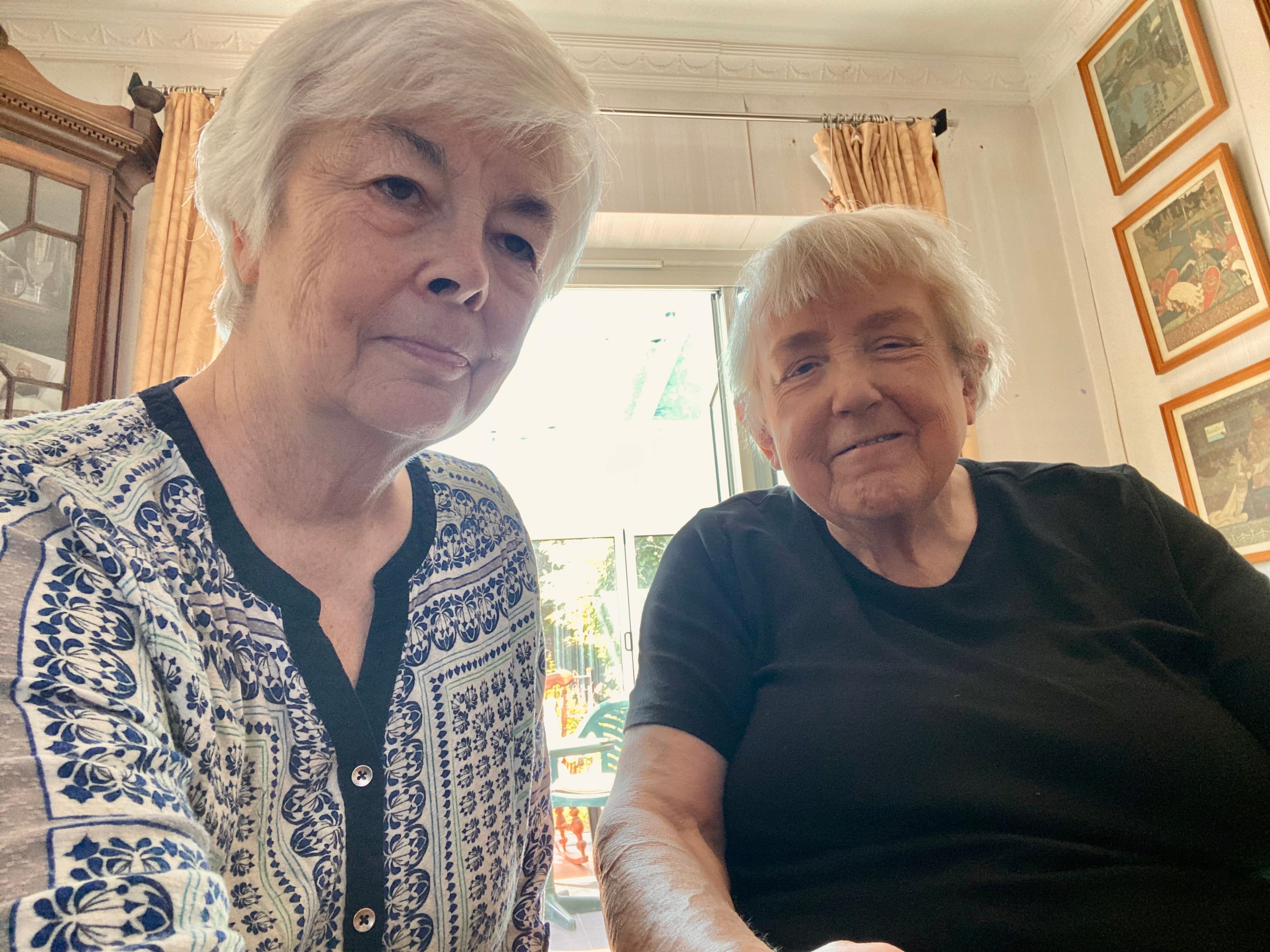 Dr. Mary Hawking, right, and me last week. Sorry I don’t have a picture of Bran!
This past week, when Mary and I were in the same room for the first time in 50-plus years, we talked about many things, but lingered on our memories of Bran and the day that he had the last bark.
Before she returned to the United Kingdom, Mary visited us at our island cottage one more time. The island was separated from the mainland by a harbor and narrow channel less than 200 yards wide.
That day, Joe and Barbara had business at a marina directly across the channel from our cottage. They brought Bran along for the ride.
Bran jumped out of their truck and his ears perked up. He stared at our cottage across the channel. With his acute hearing, he detected the voice of his beloved former owner, Mary.
He barked once, and immediately bolted to the end of a dock and made a flying dive. Looking like a canine sea monster with his big head and broad paws cutting a swath through the water, Bran swam across the channel, scrambled up on solid ground and bounded up 27 steps to see Mary.
I was a teenager and I watched, open-mouthed, along with others, at the big dog’s determination. Bran was happy with his new home, with land to explore and boys to roughhouse with. But he was delighted to see Mary again.
Decades later, at her home in Dunstable last week, of all the many things we talked about, Mary and I both marveled at that shared memory.
The big German shepherd never saw Mary again, or me, for that matter. But he did, indeed, have a great life. Everybody loved him. And blessedly, he died of old age.
June 12, 2026
The art, cult of picking strawberries
We have a strawberry field that looks like rubies are scattered everywhere. There are so many strawberries it is hard to avoid stepping on some.
The field is near a small forested area on our property. Early in the day it is in complete shade - a blessing since the weather is hot by noon. So I was out there the last few mornings. The air was sweet and cool. I listened to the birds, the flute-like call of a wood thrush and a particularly loud Carolina wren, and felt like I was in Eden.
Please consider becoming a free or paid subscriber.
But harvesting is labor intensive, one reason why Pete made the field a “Pick your own” operation. People can buy the strawberries at a reduced rate, as long as they do the bending and picking on their own.
That’s when I realized that for some, strawberry picking isn’t a mere tradition.
It’s a cult. But a really, really nice one.
Whole families sometimes arrive armed with sun hats and baskets. With laser focus and military precision, they work their way through the rows and finish, content, having guaranteed dessert for days.
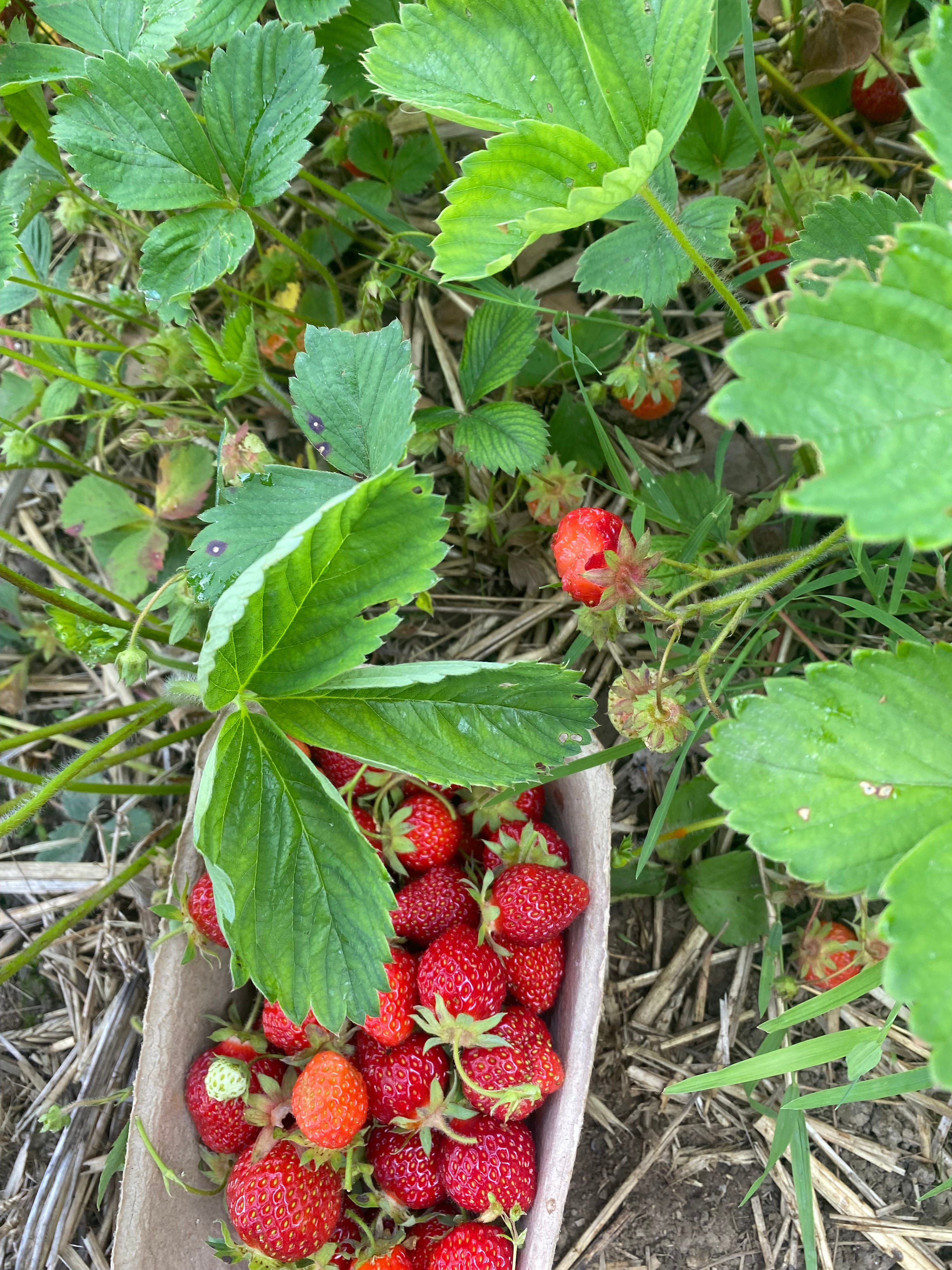 This morning’s view
And still the fruit proliferates. Which is a good thing. Since Pete doesn’t spray any chemicals on them, we share the fruit with critters once in awhile.
Last year Pete got elaborate towers of pots so we could grow strawberries not just in our fields, but our back deck. The idea was that in the morning we could pick strawberries for our cereal or pancakes, instead of walking through grass and dew 200 feet from the house to grab a few berries.
Ha.
We may have harvested a handful before a chipmunk set up shop nearby.
He got so fat on strawberries I thought he was going to need insulin shots or Chipmunk Weight Watchers. It’s a wonder he could waddle up the stairs to grasp the objects of his desire.
The strawberries are growing in towers again this year. I haven’t seen him, so maybe we’ll have a better chance of grabbing the fruit for our cereal after all.
Meantime, I am content to make my great-grandmother’s strawberry shortcake recipe for dessert, even though if I keep this up I will be as fat as our chipmunk friend.
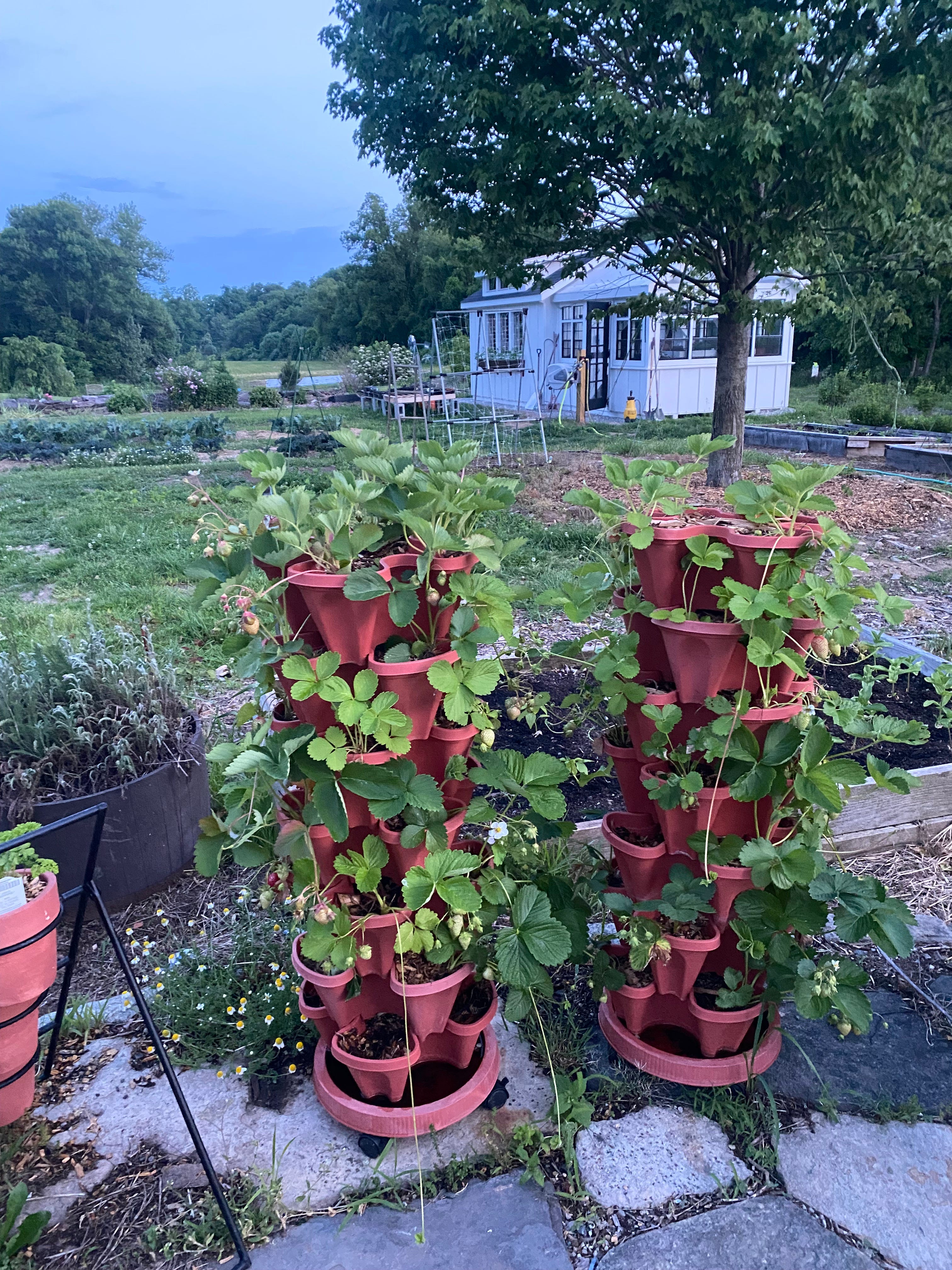 Towers of strawberries. Not quite ripe yet.
 My great-grandmother, known to all as Nana, was what I think of as a take-no-prisoners woman. Stories about her abound. Although she died in 1952, she is still a legend in our family.
She and her daughter, my grandmother, survived the Titusville (Penn,) Flood of 1892, a terrifying disaster in which hundreds died. She raised her daughter on her own after her husband sought his fortune working on the Panama Canal and soon died there, presumably from disease. Nana was small, blunt, and forthright. And she had a recipe for strawberry shortcake that she stole when a neighbor refused to share it with her, Nana waited until her neighbor left her house, then walked in, helped herself to her recipe box, found the recipe and copied it. Lucky for her that few locked their doors in those days.
Lucky for us, too. All of her descendants have baked it for decades. I published this recipe three years ago, but it’s worth reprinting. Enjoy this product of Nana’s life of crime!
Nana’s Stolen Shortcake
Grease a square pan, or a muffin tin, and preheat the oven to 375 degrees fahrenheit/190 degrees celsius
Combine in a large bowl:
2 cups flour
2 teaspoons baking powder
1/2 teaspoon salt
1/4 cup of butter cut in pieces (1/2 stick)
(either room temp which makes this easy or cut in cold butter with two knives).
Mix.
Beat in:
One egg, slightly beaten
1/3 cup sugar
1/2 cup milk
(I often throw in some cinnamon)
One teaspoon vanilla
Bake, 30-35 minutes.
The top should be golden brown.
Serve warm, with melted butter. Drench with strawberries, cut up, mashed, with some sugar added. Enjoy!
June 2, 2026
Memories in bloom
Every year in late spring, my mother would walk into the house from our backyard and say with satisfaction, “The bride is in bloom.”
The bride was not a person, but a bush heavy with white flowers that would appear as the weather warmed in our tiny, urban backyard. Also called the pearl bush, the flowers cluster on branches which bend downward, looking like a bridal veil.
Please consider becoming a free or paid subscriber.
My mother was a skilled gardener, but the location of our house on the west side of Buffalo fought her at every turn. When she and my father bought the Victorian-era structure the yard ended at the red brick wall of a movie theater behind our house. Yet the wall lent the plot of land an intimate feel, like a hidden courtyard. It muffled the constant traffic noise of nearby Elmwood avenue, with its wheezing buses and shrieking ambulances.
Alas, in less than two years the Elmwood Theater was torn down to make way for a bank parking lot. The brick wall was replaced by a chain link fence. The view was unremittingly ugly. In summer the asphalt radiated heat. In winter it was covered in drifts of snow that eventually became black with dirt, salt and sand.
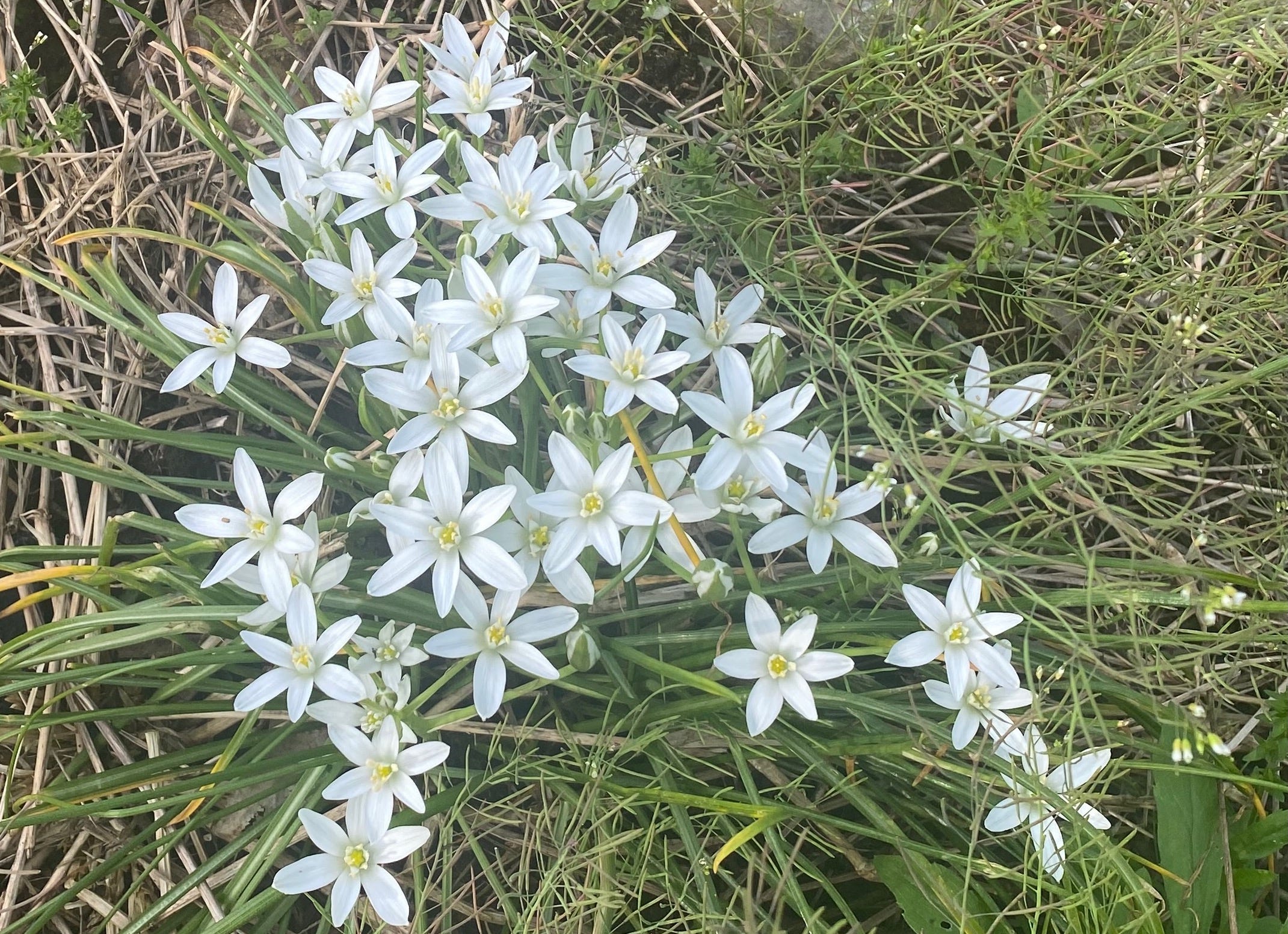 Stars of Bethlehem, running amok in our yard
Still my mother tried to wrest some beauty from the yard. She had my two brothers and our father get flagstones from a dilapidated mansion a few blocks away that itself was slated for the wrecking ball. They did, but the flagstones mostly sat in piles at the end of the driveway. None of us made it a priority to help her complete her vision for the yard. But she persisted in her efforts. She planted tulips, lilies of the valley and hyacinth. Together she and I went into the backyards of once-grand homes, now abandoned and falling apart, and dug up bulbs of Stars of Bethlehem, replanting them in the yard. Mom planted two Kwanzan cherry trees. In spring, their branches were covered in double pink blossoms, reaching up like they were glad to see us.
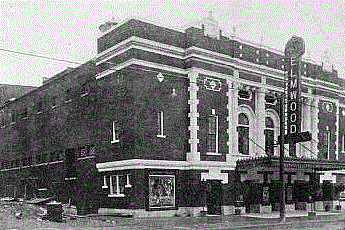 The Elmwood Theater before it was torn down.
 Yet we kids never used the yard much. It was too small for games. The view was grim.
The years passed. So did my mother, then my dad. My sister Ellen insisted on buying the house when Dad died. It was a money pit. Dad never maintained it. That neglect showed. I always thought Ellen bought the place because she wasn’t ready say goodbye to our parents. But in four years she would see them again. When Ellen’s estate sold the house it was slated to be torn down for yes, another parking lot, this time for a nearby bar. I visited the house once again to dig up some bulbs before the entire lot was paved over.
That’s when I could see it, in the spring sunshine, from an upstairs window: The outline of a Japanese rock garden. Mom must have planned it all along and there it was: The Japanese cherry trees, a riot of pink; the bride in full bloom, blossoms cascading and nearby, the stacked-up piles of flagstone. Why hadn’t we made it a priority to take an afternoon, buy some sand, do some digging and imbed the flat stones in the garden? Mom asked nothing for herself and it would have given her so much joy. The thoughts haunted me as I dug up the Stars of Bethlehem. The flowers could not quell regret, but they had become a form of remembrance.
I planted the Stars of Bethlehem around our rural home, but to my disappointment, they never bloomed. A few months later I suffered a miscarriage. It was spring. I bought the biggest bleeding heart bush I could find and planted it to comfort my own bleeding heart. The bush grew bigger every year.
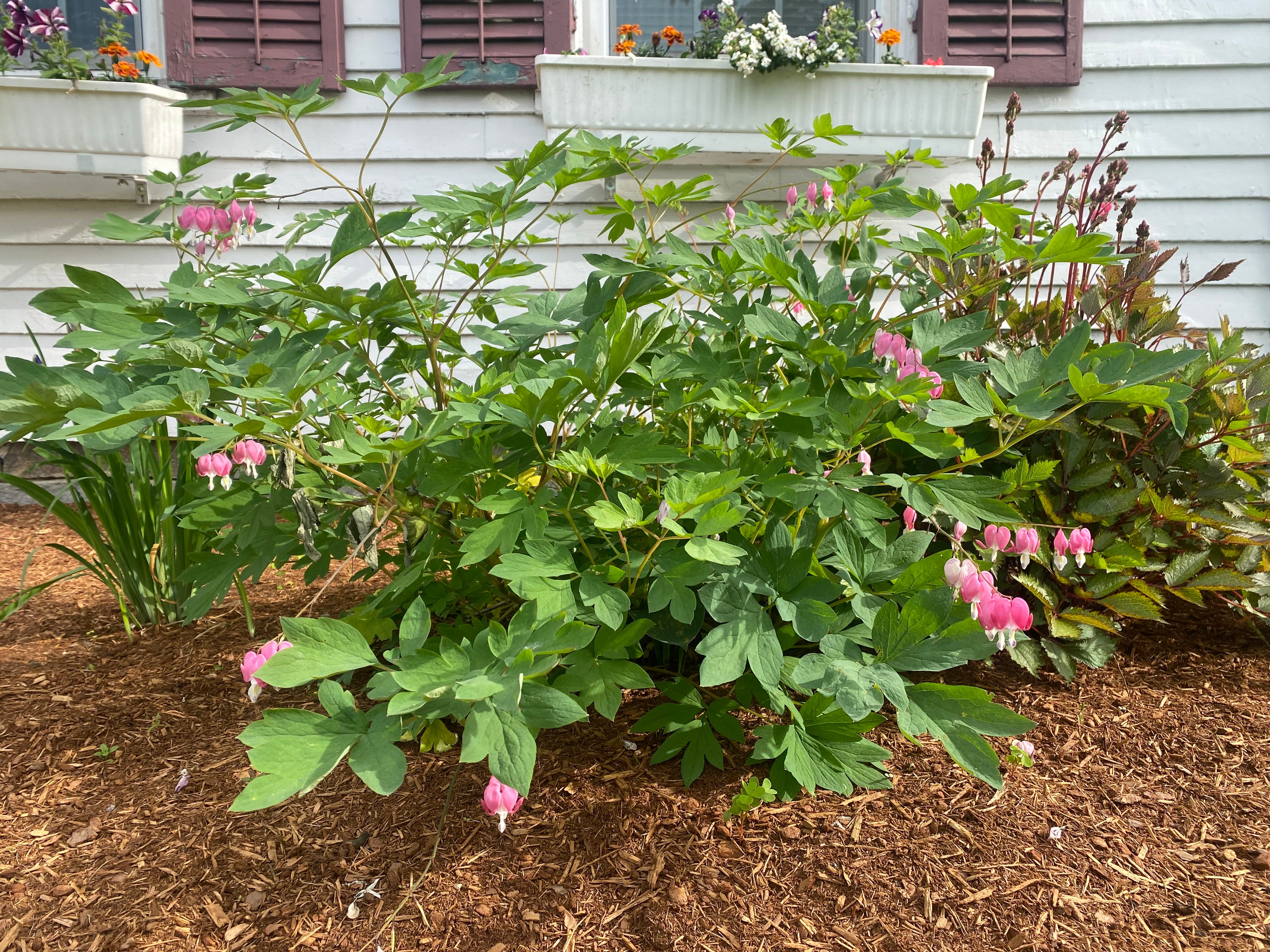 Bleeding hearts in front of our house
When we sold our house and moved midwinter, I dug up the bush and the soil around it, and replanted it at our new home on a quiet country lane.
As the weather thawed, the bleeding heart branched out and bloomed, content in its new environment. And, somehow, the Stars of Bethlehem appeared, too, as if my mother wanted to send comfort.
Every spring, scattered in the grass, Stars of Bethlehem now bloom in unexpected places. I think of them as my mother waving to me. “Hi, Mom!” I say, as I admire them.
And the bleeding heart? I have split and replanted the original many times now, dividing it in fall and giving some away to friends. This month, all the bushes in front of the house and in our backyard bloomed once again. There are six of them now, 34 years after I brought the mother plant home.
When I see them, I smile, touch the delicate flowers and I whisper, “Hello, love. I haven’t forgotten you.”