
Alan Bilton's Blog
November 11, 2020
Impossible Fictions:
Share this Post
Impossible Fictions:Writing/Reading Magic Realism and the UncannyBy Alan BiltonMagic Realism, the Fantastic, the Marvellous, the Uncanny: while literary critics adore squabbling over taxonomies and definitions, creative writers tend to prefer more lyrical language. John Banville talks of the “invasion of the dreamlike”, André Breton of a “convulsive shudder”, “a crack” opening up within “the carapace of normality” (Brandon 1999: 218), Salman Rushdie of “the commingling of the improbable and the mundane” (Warnes 2009: 32), Umberto Eco of a “universe of hallucination” (Brandon 1999: 218). What links all of these ideas is the notion of two contradictory and mutually exclusive worlds – the ordinary and the impossible – somehow crossing a philosophical border to exist in the same fictional space.
In some models, these two states of being, one subject to scientific rules, the other in some sense supernatural, remain like oil and water, refusing to mix, but instead existing in opposition: this is the modus operandi of Surrealism, where the eruption of the irrational is registered as a kind of jolt or shock, a disorientation of the mind. Other commentators speak (perhaps less attractively) of a seepage of the magical or miraculous, a kind of contamination or infiltration, whereby the so-called real world becomes progressively more extraordinary or ridiculous or bizarre. And still others, following the Latin American model of Magic Realism, explore a mode of writing where the real and the fantastic are so intermingled that it is impossible to tell where the frontier might lie, or whether ancient folk lore or modern science is the most incredible.
Whether one sees the Fantastic as a genre, an aesthetic, or a philosophical statement of intent, the purpose of this essay is not to argue over definitions or manifestoes, but rather to suggest ways in which Creative Writing teachers might encourage their students to explore the narrative possibilities of the marvellous, that shot-gun wedding between the mundane and the hallucinatory whose very illegality (or hybridity) is ultimately its greatest strength. To this end, this essay will sketch out a kind of continuum or bridge between realism and fantasy, inviting students and authors to situate themselves somewhere along the span. A warning, though: this horizontal model is also prone to sudden shifts and disruptions, a dizzying and delirious verticality, and the traffic between the plausible and the dreamlike is strictly two-way.
The Two Banks of the River.
Although we’re chiefly interested in the construction spanning the two sides, it’s also important to take a moment to size up the two opposite ends of the channel. On one shore lies realism. Here the irrational or outlandish can be explained by relatively straightforward narrative means: the narrator might be crazy or deranged, drunk or ill, high as a kite on drugs or simply dreaming. In all of these cases, the apparently magical or numinous is ultimately a mistake, a mis-reading. The impossible is subjective rather than objective, a sign that the narrator has it wrong: that isn’t really a ghost, but rather a curtain billowing in the wind, not an angel but a trick of the light. In short, the impossible (by definition) could not really have happened.
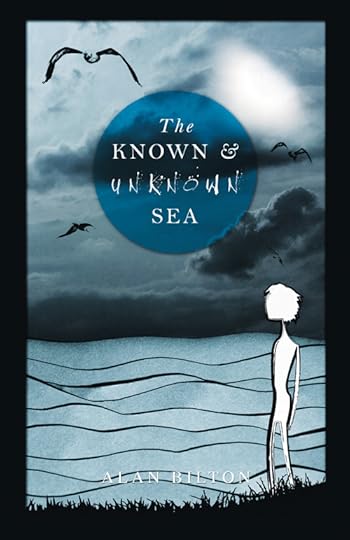
On the other bank lies the enchanted realm of fantasy, fable and fairy tale. In this world, magic is both real and an integral and accepted part of the genre. Wizards can cast spells, animals can talk, elves fix shoes, and none of this contradicts any of the laws of the land; in short, this is a magical realm – Middle Earth, Narnia, Oz – that the reader knows is profoundly separate from their own. Close to this lies The Boringly Literal Lands of Allegory: here, the meaning of any supernatural occurrences can be quickly grasped as a means of instruction, education or other didactic intent. Everything here has a clean meaning and purpose, generally with the purpose of enlightening impressionable young minds. There’s nothing wrong with either the rational solution or life in Toyland, of course: nevertheless these are the two shores that we’re intent on leaving. Or rather, it is the means of getting from one world to another, the scaffolding that will transport us from the known to the unknown, which we’re interested in. In my novel, The Known and Unknown Sea, the inhabitants of a small Welsh town receive mysterious tickets promising them free passage to the mysterious other-side of the Bay: when they arrive there they find themselves on a papier-mâché moon which resembles nothing so much as a child’s model or drawing of their world back home: wonky lines, badly drawn houses, the art-room smell of glue and paint. Likewise, in my first book, The Sleepwalkers’ Ball, a mundane Scottish town turns inexplicably silent, insubstantial and black and white. The ‘other’ thus turns out to be a crazy mirror version of the ordinary, or rather, the line between the two becomes increasingly erased.
Exercise One:
From the mysterious opening at the back of a wardrobe, to the train waiting at platform nine and three quarters, many of the most popular fictions are based around a portal or passageway between the ordinary and the extraordinary, this world and the other side. The Surrealists too were fascinated with the idea of trap doors, secret passages, mysterious pathways hidden among the familiar. Think about a geographic space that you know very well – this might be your home, workplace, college or school – and describe something there that might serve as an opening to another realm. How does it work? Who finds it? What lies on the other side?
Uncanny Valleys, Mysterious Shapes
The term’ Magic Realism’ was first used by German Art Historian Franz Roh in an article on Central European Art in 1925. Roh was interested in paintings by artists as diverse as Otto Dix, Georg Schrimpf, Christian Schad, and Alexander Kanoldt, which he saw as breaking with the central tenets of Expressionism. Unlike Expressionism – where vivid colours, savage, irregular brush strokes and deliberately crude compositions seek to capture extreme states of mind in pictorial form – the so-called Magic Realists, at least on first glance, seemed to be much more conventionally realistic or mimetic, aiming for the flat objectivity of photography. However, on closer inspection, Roh argued that something much stranger and more mysterious was going on, am indefinable otherness haunting these apparently straight forward landscapes, still lives or studio portraits, “a mystery that does not descend to the represented world, but rather hides and palpitates behind it” (Bowers 2004: 3). For Roh, beneath the surface of these apparently commonplace paintings lurked something strange, bewildering and disturbing, as if the curtain of reality had been pulled back just a quarter of an inch. Viewers felt as if there was something wrong with this picture, an eeriness or alien quality glimpsed from the corner of one’s eye. Either the angles did not quite match, or the light sources were wrong, or the scale and perspective were subtly out; in each case, the ordinary seemed estranged from itself, defamiliarized, in that ugly but highly charged phrase, othered. Unlike the exaggerated and heightened ‘savagery’ of Expressionism, Magic Realist paintings, Roh argued, were painted in a deliberately flat and sober manner: the strangeness lay in which something estranged could be glimpsed within the very fabric and texture of the humdrum everyday.
Italian critic Massimo Bontempelli subsequently applied this idea to literature, exploring the idea that miracles might appear in the midst of the banal or boring (indeed, both writers can be linked back to a long tradition of Romantic Idealism: the existence of spiritual elements discernable beneath the thick crust of matter (Warnes 2009: 20)). Both Roh and Bontempelli were interested in works of art or literature that seem inexplicably transparent, allowing another, magical world to peek-through. The silent partner in all of this thinking is, of course, Sigmund Freud, whose 1919 essay ‘The Uncanny’ argues that that which is most truly ‘other’ or aberrant is to be found in the home rather than in some exotic, or far flung location (Freud 2003: 123). Thus while the Gothic sought out sites of otherness in ruined castles, haunted moors or sublime mountain peaks, Freud argues that the truly strange hides among the familiar, when an everyday thing is suddenly seen in a new light. For Freud – and Surrealist artists such as Max Ernst which followed him- the face glimpsed among the wallpaper, the bulge in the curtain, or the shadowy shape hiding under the bed are ultimately far weirder (in the true sense of the word) and terrifying than any vampire’s tomb: the horror of the everyday turned radically, ontologically, unknown (Freud 2003: 130).
For Freud, this bewildering phenomenon could be explained by the functioning of the unconscious mind. In psychoanalytic theory, the pleasure principle (as opposed to the reality principle) fails to differentiate between what is really happening, what might happen, and what one fears or wishes at any given moment (young children are particularly bad at discriminating here). Thus in the unconscious mind, the real and the imagined or fantasised are placed on the same plane of reality: the logical part of brain is switched off, allowing the inexplicable free rein (Gay 1989: 80). Of course the scientist Freud sees this as a misapprehension, whereas both Roh and Bontempelli discern hidden yet real spiritual forces: nevertheless all of this school of thought grows out of a Germanic tradition rooted in a denial of Kant’s separation of existence into the phenomenal (physical things, matter) and the numinous (the realm of the divine, the spirit, the Ideal) (Warnes 2009: 23). Suddenly the distinction between subject/object, spirit/matter and reality/vision all seem to collapse: but what should be our response?
Exercise Two:
Describe either a character gazing out of their upstairs window (they might be at home, at work, or in some other intimately familiar place) or idly watching TV, when they suddenly catch sight of something impossible, something that does not fit with this everyday world. Describe this impossibility in as realistic yet unemotional a manner as possible. Flatten your prose so that the alien feels as if it is made of the same material as everything else in your world. Your character does not register any surprise and seems unperturbed by what they see: nevertheless, what do they do?
Seasick on the sea of dreams
Bontempelli’s essay proved extremely influential, blending with a parallel interest in psychoanalysis and surrealism, and reaching an audience as far a field as Alejo Carpentier in Cuba and Miguel Ángel Asturias in Guatemala. And yet at this point we reach a parting of the ways, along with the suggestion that there may be more than one way to reach the other shore.
For Andre Breton’s Surrealists – following from Freud – the penetration of the impossible within the real is felt as “convulsive”, “the marvellous” as “the eruption of contradiction within the real” (Breton 2011: 453). Central to this idea is an assumption that we are naturally conservative, conformist creatures, ruled by habit, repetition and convention. We do the same things, talk to the same people, and go to the same places, without ever so much as looking up from the ground. For Breton, this is the tyranny of the habitual: the inability to escape one’s mundane groove. However, the Surrealists believed that if we stepped off the well-worn path, turned left instead of right, caught the train before ours, or followed a stranger down the street, then we might find ourselves somewhere very different, turning the corner into a very different realm.
Moreover, Surrealism preached that there were signs and maps indicating this other world – X marks the spot. Incongruous street signs, objects in store windows, shadows on the wall, stains on the floor: all these were omens, symbols, either arrows pointing the way, or tools to dig ourselves out of our bourgeois hole. The key to Surrealist art is that you don’t make it, but find it: hence the search for magical objects in junkshops, weird fetish objects in flea markets, secret doors in funfairs or at the back of the circus. This magical exit door was to be found in precisely those places where the mechanised rule of law and order were at their weakest: cinemas, toyshops, junk yards, seedy run-down arcades. Here, amongst the erotic postcards and broken toys, one might find a picture of some imaginary city, a peculiarly suggestive item of clothing, a torn book in a foreign language. For Breton, the ‘marvellous’ is always to be found among that which society discards, the trash and the litter, rummaging in the debris of the worthless. The ‘marvellous’ must be sought out therefore, as our rational, positivist society had consigned it to the rubbish pail: it was always hidden, camouflaged, disguised, just like the spiritual energies Roh detected in Magic Realist Art.
Not that the marvellous is always positive or sacred in Breton’s eyes: on the contrary, its presence is always upsetting, confusing and inescapably alarming. It might be likened to wandering away from the beaten path into an endless, awful labyrinth, or digging up a doll or statue whose shape or visage both fascinates and appals. The marvellous intrudes on our world – it does not belong here. Its pimple-like eruption manifests itself as a threat to the established order, to reason or logic or morality. It cannot be assimilated into our everyday lives: it is scandalously, shockingly, irredeemably other. In the title story of my 2016 collection, ‘Anywhere Out of the World’, the postman Urbino searches for a Parisian address which does not, cannot exist: when he eventually finds the way in (via a strangely three dimensional painting), there is no way back.
Exercise Three:
Think of the places you have been to where you have felt the farthest from home, either in a positive or negative sense. It may be an exotic escape from the everyday or an environment where you felt you really did not belong. It may be the language or the customs that seemed so bewildering, or a sense of being lost, alienated, or unable to make sense of the sights, activities or people around you. Try to list the key elements that accounted for this profound sense of otherness, what Kafka called “sea-sickness on dry land”. Now try to apply this sense of estrangement to a place you know very well – your workplace, old school, local pub. Write a short piece of prose win which the commonplace or domestic takes on something of the texture and nature of the utterly strange.
On Farther Shores
As much as Latin American writers such as Carpentier were drawn toward the possibilities of Surrealism, ultimately Breton’s ideas seemed at once too abstract, too limited, too (paradoxically) middle class (Schroeder 2004: 6). The surrealists needed to have the leisure and means for their games of metaphysical hide and seek, searching for that four-leaved clover among the boulevards and cafes of Paris. Moreover, the assumption that the rational and mechanical was the norm from which the marvellous was implicitly an escape simply didn’t square with the Latin American experience. Rather than something to be sniffed out by sophisticated European noses, for Carpentier, lo real maravilloso was a constituent part of the Post-Colonial experience, as real – and as local – as the climate or the soil (Schroeder 2004: 6).
Indeed, for Carpentier, Magic Realism is best understood as a uniquely Latin American phenomenon, the product of “a juxtaposition of circumstances unimaginable in other places on the planet” (Schroeder 2004: 3). The fiction most closely associated with the Magic Realist ‘boom’, all draw upon the region’s rich and heterogeneous culture: indigenous Mayan or Aztec culture, Afro-Caribbean folk magic, Catholicism and the European Baroque. This ethnic mixture of indigenous people, slaves and settlers, inter-mingles Shamanism, voodoo, and Catholic superstition to create a mythic folk culture defined by a belief in the permeability of the barrier between this world and the next, a world where an acknowledgement of the existence of angels, ghosts and evil spirits appears as part of the very nature of the real. Here the magical is less an intruder, than a tax-paying citizen: indeed, in the work of Gabriel Garcia Marquez, it is the scientific and the modern which is seen as the ‘other’ and whose presence is most keenly felt as a disturbance in the fabric of life. Thus rather than an antagonistic element (as we have seen with the Surrealists), in the South American tradition, magic is normalised and integrated, the supernatural recorded in deliberately flat, non-judgemental prose. Carpentier believed that the Surrealists “turned their back on reality”, looking for some kind of escape tunnel from an over bureaucratic and mechanised world (Schroeder, 2004: 6). By way of contrast, the Latin American writers embrace reality, the reality that, in Garcia-Marquez’s words, “is also the myths of the common people … their beliefs, their legends; these are their everyday lives and they affect their triumphs and failings” (Schroeder 2004: 6). Surrealism is the avant-garde cocking a snoot at the everyday; Magic Realism is folk art, the art of the people, not hidden in the dusty corner of a library, but right here, directly to hand.
Exercise Four:
Think about what vestiges of folk culture or magical thinking still exist in our world today. This can range from urban legends – of ghosts, serial killers, haunted buildings – to ancient folklore, or different forms of non-scientific belief. Where do we find these patterns of other, non-empirical ways of looking at the world? We might think of the Internet and conspiracy theories or playground tales or religious belief or astrology columns or New age mysticism or the kind of superstitious thinking we’re all prone to: the belief that stepping on a crack or saying a forbidden name three times will have mysterious consequences. Write a first person piece of work from the perspective of a character for whom these beliefs are an integral part of daily life. How do they reconcile the mythic and the mundane? How does this alter how they see, and how you write about, the world?
Dreams for sale
While all of this may sound attractive and convincing, it also sets up a whole series of literary problems. One is the question of how portable a Magic Realist aesthetic might be. If the form is rooted in a specific and highly complex culture, then can the recipe be duplicated elsewhere, except in a bland, or watered down form? Moreover, this model also sets up a number of quandaries concerning the implied reader. A visitor from outside this culture will interpret the various fantastical events – the levitations, ghosts, visions and so on – as literally impossible (which is to say, outside of the realm of scientific possibility) and therefore read the book as an example of the exotically primitive, a colourful fairy tale of poor folk from a country far, far away. Although the prose might work hard to normalize the impossible, the reader will continue to register key events as outside of realism, even if they have tangible effects in the text (or in other words, they actually happen). Hence Jean Franco’s dismissal of the term Magic Realism as no more than a “brand name for exoticism”, an out-sourcing of poor-people’s fantasy (Warnes 2009:1). The brand’s patronising view of the poor and marginalised as irrational children thus continues the colonial project under another name: gap year literature for the globalized literati.
The Margins and the Centre
In all of this, we should remember that Carpentier and Marquez were self-consciously setting out to differentiate their work from the dominant European model (associated with colonialism) and to define a movement that both legitimizes and lionises the Latin American experience. Central to both writers’ thinking is the assumption that Magic Realism blooms on the margins of the known world, on the periphery, or the border. Hence, Marquez’s seminal One Hundred Years of Solitude (1967) is set in the fictional town of Macondo on the isolated Caribbean coast of Columbia, far from a European centre, Europeans seen as the foci of power, authority and meaning, those who determine what is and is not real. The idea that ‘realism’ is the norm is itself ideologically loaded, of course, assuming that there is some kind of consensus as to what reality is. The greater the distance from the centre, the more reality becomes subject to local pressure: hence as a genre or movement, Magic Realism always exists far from the centres of administrative control, on the edge of (so-called) civilization.
As a model, at first sight this doesn’t seem to fit in with European examples very well at all. After all, the Surrealists were chiefly busy in Paris – the epicentre of modernity – while the most famous European practitioner of the weird, Franz Kafka, worked as an insurance agent in a major city at the geographic heart of the continent. If one digs a little deeper, however, then similar patterns emerge. As a German-speaking Jew, Kafka felt himself as estranged from the newly formed Czechoslovakia as from the Austro-Hungarian empire, while the repetitive and somnambulant nature of his work allowed time and space for his imagination to ferment. Likewise, and as we have already seen, the Surrealists were drawn to precisely those things that the modern managerial, pragmatic, ends-orientated sensibility most disdains: the broken, the useless and the discarded. In this sense, a feeling of occupying the margins can be experienced almost anywhere: again, we might think that while the Gothic privileges lost or wild places, the Uncanny exists within the local.
This marginal status, however, gives room to escape the constrictions and commandments in force elsewhere, and thereby to question exactly what constitutes reality anyway. As Maggie Ann Bowers argues, Magic Realism is a disruptive form, blurring the distinctions between fantasy and reality, indeed questioning the very distinction in the first place, “a description of life’s many dimensions, seen and unseen, visible and invisible, rational and mysterious” (Bowers 2004: 82). For the critic Christopher Warnes, Magic Realism either expands existing categories of the real (the path of faith: we believe in the unseen) or ruptures them altogether (the path of irreverence: all systems of order are prone to collapse (Warnes 2009: 48). Whichever model an individual author is drawn to, it is a narrow, functional, capitalist notion of meaning being linked to purpose which is being challenged here: the margins writing back.
Exercise Five:
Think of a successful, accomplished, well-connected character, who is very much at home in the contemporary world. Then think of a scenario in which they are displaced into a place or situation far removed from this. This ‘fish out of water’ scenario is much beloved staple of Hollywood script-writers, but think about its deeper implications; what beliefs, assumptions or expectations will this jump in time or space serve to challenge? What happens when we find ourselves in a place where very different rules or ways of seeing the world apply?
The Real, the Fantastic, and the Cordon Sanitaire
While in literary theory the wall between fantasy and reality might seem very well policed, ‘twas not ever so. Indeed, if one goes back in literary history far enough, the idea of an antinomy between the realistic and the spiritual appears virtually incomprehensible, the chivalrous knight existing in the same world as ogres and dragons because the categories of the real and the fantastic simply did not exist (Warnes 2009: 32). For Fredric Jameson, the ‘disenchantment of the world’ is linked to the creation and growth of capitalism, a mercantile, secular world in which the real is defined by use or productivity – the very world the surrealists sought to flee (Warnes 2009: 34). This is the world of middle management: quantifiable, empirical, and rationalised for maximum efficiency. Any tradition which can’t be fed into this commercial algorithm, from myth to idle daydreams, is re-classified as worthless or unreal, the whole tradition of ‘romance’ becoming hopelessly archaic. The work that captures this moment best is, of course, Cervantes’ Don Quixote (1615); our befuddled hero might think that he’s jousting with giants, but, like Sancho Panzo, we know that he’s really just tilting at windmills. Thus does Romance disappear from the world; with the invention of modern spectacles we now all see the world for what it truly is.
In his famous essay on the book though, Carpentier stresses that he, for one, is on the Don’s side: he has faith that the giants are real, arguing that the purpose of literature is to challenge this very hierarchy of what is real and what is not (he also adds that Cervantes isn’t so sure either). In his fiction, Carpentier uses the romanticized accounts of the first European explorers – the idea of Latin America as an exotic, enchanted land – as a weapon against European rationality and empiricism, reclaiming these tropes to attack the notion that only the productive is true, his critique of realism simultaneously a rebuttal of colonial authority (Warnes 2009: 37).
Attractive as this idea might be, we might also at this point take issue with Jameson’s assertion that we live in a disenchanted, profane world. Rather than manufacturing a ruthlessly mechanistic and stable world, capitalism is awash with enchanted objects (just think of the role of advertising in consumer culture), mythical creatures (or celebrities, as we call them), mysterious cults (via the internet) and pre-fabricated fantasies of escapism. Indeed the ways in which the formal provocations of surrealism have been co-opted by Hollywood and Fifth Avenue suggest that late capitalism actively encourages the deconstruction of any distinction between who we really are and our fantasies of who we might be. The invention of CGI, virtual reality and our almost constant immersion in technology and social media all suggest that unreality is now our natural environment – or rather that our definitions of reality are as old fashioned as The Matrix (1999).
In this online environment, our bridge between reality and the fantastical threatens to collapse, the two banks becoming hopelessly confused. Magical thinking – and the saddling of political unicorns – now seems commonplace in our post-Truth world, Umberto Eco’s characterisation of the Middle Ages as a “universe of hallucination” eerily similar to our hyper-real, simulacra-infested world. As such, Magic Realism, which explores the multi-dimensional nature of the real without flattening or diluting it, may well be seen as the form best placed to explore this. After all, its creation of a third space between reason and the irrational, the material and immaterial, the known and the unknown now feels like our home – and as such the natural habitat of the uncanny.
But perhaps I exaggerate – and certainly, we’re not there yet, whatever some Postmodernists might tell you. Rather, I agree with Wendy Faris that the aura of the miraculous never fades away entirely, even in the most culturally rooted of Latin American texts (Faris 2004: 8). Disruption and instability follow the uncanny wherever it goes, whether in terms of our bridge across the waters, or our very understanding of the two countries involved. Indeed, as I argued at the start, this may well be its greatest strength. Encouraging students to write in a Magic Realist mode also encourages them to rethink categories of realism, fantasy, the imagined and the everyday, to find their arching bridge transformed into a perilous tight rope, or a narrow line of prose. As the tour guide in my novel, The Sleepwalkers’ Ball says, “hold on tight, ladies and gentlemen, hold on tight…”
Exercise Six:
How might the fantastical or uncanny be manifested in our technology-obsessed, online, computer-generated world? Write a piece in which the inexplicable or supernatural exists not in a dusty mansion or haunted castle, but in the devices and systems all around us – the ghost in the machine.
References
Bilton, A (2009) The Sleepwalkers’ Ball, Aberystwyth: Alcemi.
————- (2014) The Known and Unknown Sea, Manchester: Cillian.
————- (2016) Anywhere Out of the World, Manchester: Cillian.
Bowers, M.A (2004) Magic(al) Realism, Oxford: Routledge.
Brandon, R (1999) Surreal Lives, London: Macmillan.
Breton, A (2011), What is Surrealism?, New York: Path-Finder.
Faris, W.B (2004) Ordinary Enchantments: Magic Realism and the Remystification of Narrative, Nashville: Vanderbilt University Press.
Freud, S (2003) The Uncanny, London: Penguin.
Gay P (1989), Freud, New York: W.W. Norton.
Schroeder, S (2004) Rediscovering Magical Realism in the Americas, Westport: Praeger.
Warnes, C (2009) Magical Realism and the Postcolonial Novel, Basingstoke: Palgrave Macmillan.
Zamora, L.P, and Faris, W (1995), Magical Realism: Theory, History, Community, Durham: Duke University Press.
The post Impossible Fictions: appeared first on Alan Bilton.


March 2, 2017
Review: The Traitor’s Niche, Ismail Kadare
Review: The Traitor’s Niche, Ismail Kadare, Harvill Secker, 2017.
Although newly translated by John Hodgson, The Traitor’s Niche was written between 1974 and 1976 and published in Albania in 1978: which is to say, in the cold, dead winter at the height of Enver Hoxha’s totalitarian rule. Indeed, while engaged with this cruel, absurd, terrifying vision of political horror, Kadare was also commissioned to write a glowing portrait of Albania’s tyrannical head of state – probably the only national leader to have condemned Stalin and Mao for their lily-livered leniency – entitled appropriately enough, The Great Winter. Could he have refused? Only if he was prepared to face imprisonment, exile or, most likely, the firing squad. As Kadare has wearily explained to Western journalists, there was no such thing as a ‘dissident writer’ in Albania: enemies of the people were swiftly tortured and then killed. Still, the relationship between Kadare and Hoxha is teasingly ambiguous, and not entirely dissimilar to that which existed between Stalin and Bulgakov in the Soviet Union. Hoxha privately adored Kadare’s work, even while censors, the critics, and party officials publicly attacked it. What then would Hoxha have made of The Traitor’s Niche, which concerns an all-powerful imperial state (the Ottoman Empire in the novel) which places the heads of its enemies on display in a special plinth in the capital city, marinated in honey with their eyes prised open? The knee-jerk reading is to interpret the book as a direct indictment of authoritarian power; from Hoxha’s point of view though, you might well say that the book demonstrates that absolute power only functions through absolute fear – and the irrationality and absurdity of the horror only serves to make the fear universal.
Everybody in Kadare’s novel is in fear of losing their head – from the guardian of the niche, to the doctor who tends to the decaying tufts, to the courier who transports them, to the warriors who behead the ‘traitors’ in the first place. They dream about heads, fantasise about heads, imagine their own heads drifting free from their torsos, fall in love with heads, display heads, hide heads, check their own necks and throats obsessively. Who knows which mug will wind up on a dish of honey next? The Department of Psst-Psst sweep up rumours and muttered asides, the Palace of Dreams (the subject of another Kadare novel) classifies a nation’s nocturnal fantasies, and the secret police are everywhere: little wonder Kadare’s characters are always rubbing their necks, pulling down on their hats, clearing their throats. Bodies in the novel come apart as easily as the scarecrows with which the Sultan’s army march into conflict: the fear that one of these days you’re going to forget your head is here elevated to a universal principle. Failure is punished by beheading, but so is standing out: in Kadare’s annihilating vision (and here we might again think of him writing his book about Hoxha) there’s nowhere to lay your hat.
Of course the narrative could also be spun as a tale of plucky Albania threatened by an evil empire – Hoxha had, after all, fallen out with China, Yugoslavia, and Russia by now, his paranoid realm ringed by great stone bunkers, its school children taught to carry guns. The larger empire exterminates the smaller by eliminating its language, folklore, and memory; some of the most surreal passages in the book describe the nameless frontier lands where colours have been banned, words have decayed into grunts, the people reduced to cattle. The ugliness, the cold, the nothingness: Kadare’s vision is so bleak as to constantly tip over into absurdity, but the humour brings no relief: every new block of madness or horror adds to Kadare’s edifice, b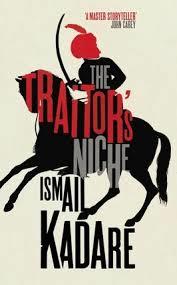 ut there’s little sense of it crumbling: in Albania’s dead of winter, evil always wins. Hoxha, you get the impression, would have approved.
The post Review: The Traitor’s Niche, Ismail Kadare appeared first on Alan Bilton.
September 6, 2016
Interview: Alan Bilton and Jon Gower
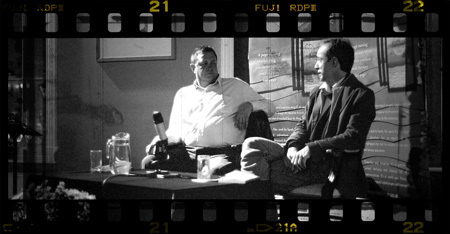 Alan Bilton interview at book launch for second novel The Known and Unknown Sea
Jon Gower speaks with Alan Bilton and attempts to unravel the mysteries of Bilton’s latest book The Known and Unknown Sea.
Filmed in 2014 at The Dylan Thomas Center Swansea, UK
The post Interview: Alan Bilton and Jon Gower appeared first on Alan Bilton.
August 30, 2016
Essay: SUNRISE, AMERICA AND THE OTHER SIDE
by Alan Bilton
Share this Post
I
In classical myth, the journey into the west is also the journey toward death, the westward horizon marking the setting of the sun and thus man’s own inevitable twilight. Whilst in American mythology the western frontier suggests the inexhaustible nature of the continent, an enchanted site of infinite promise, in the classical European tradition the west denotes the passing away of all things, the mysterious border between this world and the next. For Freud, dreams about journeys are ultimately dreams about death, especially any that involve the crossing of water. The far shore is always an unknown, spectral land, a valley of shadows, vacant and insubstantial; navigating there involves a passage between different states of being, a fording of mortal streams. This essay explores these themes in relation to F.W Murnau’s silent classic Sunrise (1927), focusing in particular on the concept of ‘the other side’ and the role it plays in terms of the binary opposition constructed in the film between American and Europe. The very first title card of the movie informs us that this is a tale of “no place and every place”, and these ideas of absence and presence, there and not there, are central to the film’s exploration of a specifically American utopia – a term which, of course, derives from the Greek for ‘no place’ itself.
The central, fairy-tale conceit of the film is that an archaic pre-modern Europe – never identified but akin to the Bavarian town of Murnau from which the director (real name F.W Plumpe) took his name – exits just across the water from a fantastical, futuristic America 1, an expanse narrow enough to permit day-trippers to cross by paddle-steamer, the short span allowing even a rowing boat passage to the other side. Although the basic narrative components of the drama are taken from one of Hermann Sudermann’s Lithuanian Stories, ‘The Excursion to Tilset’ 2, for Sunrise Murnau and scriptwriter Carl Mayer transformed the basic relationship between ‘village’ and ‘city’ into a much more fundamental syzygy. Here the distance between a European past and an American future is shrunk to that of a slender channel, the other shore able to be glimpsed from time to time amongst the ever-present mist, vaporous and ghostly. Whilst in Sudermann’s text, the city is a day’s journey by boat, Sunrise collapses time and space so that the modernist city seems to be both contiguous and yet occupy an entirely separate temporal and ontological plane altogether.
Although our first glimpse of the waterway is wholly benign, with cheerful and carefree holidaymakers (in contemporary dress) crowding onto the ferry, subsequent crossings in the film are marked by a morbid stress upon the deathly. On the journey out, ‘the man’ of the film (for no characters in the film are named) attempts to murder his wife; on their return home, after the husband has repented of his sin and the couple are once again reconciled, a sudden storm once again threatens their lives. Moreover, whilst in the first scene the waters glisten and the waves bob enticingly, in the two dramatic crossings, the channel shades from bone-gray to a bottomless black, its brief span overwhelmed by an awareness of its fathomless depth. Everything about the passage is ominous, from the shadowy cross that frames the couple’s bedroom before their departure to the sudden eclipse of the sun mid-way. “We’re going on a trip across the water”, the wife (played by Janet Gaynor) tells her maid. “I may not be back for some time.” The journey, Murnau implies, will be her last, a terminal crossing from this world to the next. As she leaves, her faithful dog tries to raise the alarm, escaping from its leash and swimming out to the boat in an attempt to save her. Bells toll on the synchronized Movietone soundtrack as the leeward shore slips out of sight, her husband’s bulk louring over her like the shadow of a cliff. Murnau famously issued actor George O’Brien with lead-lined boots for the role, and we are aware throughout the first part of the movie of his terrible heaviness and mass, his character weighed down by the unbearable burden of his sin. Amongst the mud of the swamp and shore he staggers like the living dead, his footprints great holes in the slime; indeed, with his sunken eyes and stumbling gait, O’Brien seems more like a sleepwalker or golem, some kind of animated clay brought to life by the seductive enchantment of the villainous ‘woman from the city’. Ultimately though, and despite the temptations of Margaret Livingston’s “catlike” vamp (Wood, 1998, 42), he cannot go through with his wife’s murder. Defeated he slumps down in the boat like Frankenstein’s Monster with the power turned off (we can see water filling up the bottom of the boat), his immense back threatening to block out the frame entirely³. The second half of the film then deals with his transformation from lumpen human dough to moral being, but though the film shifts disconcertingly from European melodrama to American comedy, something of the deathly nature of the film’s crossing still remains – we have indeed crossed over to the other side, albeit an American heaven rather than the abysmal depths the first half of the film seemed to auger.
Indeed, although separated by only a hop, skip and a jump, the two shores occupy wholly different, indeed diametrically opposed, states of being. As Lucy Fischer has argued, the film is structured dialectically in terms of a whole series of oppositions – America/Europe, City/Country, Stasis/Movement, Poetry/Narrative, Objective/Subjective – and to these one might add that of Weight and Lightness. Indeed, in many ways it is this seemingly secondary polarity that lies at the thematic heart of the film: whilst the American metropolis occupies a dizzyingly space of shimmering light, constant movement and infinite extension, the Bavarian village squats balefully upon the earth, solid and palpable. Its mostly elderly inhabitants (for the archaic village is always metonymically associated with the past) seem crooked and bow-legged, stooped over with endless bundles and baggage, burdens that fix them to the ground. Giant close-ups of earthen bowls or great metal lanterns stress their heft and bulk; as lit by Charles Rosher and Karl Struss, even the shadows seem to posses weight and mass, solid blocks of blackness, heavy as the lid of the sky. The editing, unlike the second half of the film, is slow and stately, Murnau’s frozen images almost as static as woodcarvings. Only the man’s dreams and fantasies seem animated, presented by way of a spectral superimposition; one might think of the ‘Woman from the City’ appearing ghost-like above his bed, or the murder plot opening up like a guilty thought bubble as he sleeps. Elsewhere, tacky mud from the swamp seems to stick to everything. All movement is ponderous and difficult. When the man and his lover meet for a clandestine tryst they do so by a swamp, every footstep rooted in the mire. Indeed, all of the film’s cinematography is marshaled to suggest the tangible or corporeal. Part of this of course is down to the astonishing set Murnau had built on the shores of Lake Arrowhead, a full size village, with real, solid buildings, actual trees and a genuine transplanted swamp – the latter so large that it caused real mist to form under the artificial. Everything in the European section suggests weight – from Hugo Risenfeld’s oppressive score to its inhabitant’s somnambulant movement, to Janet Gaynor’s enormously heavy wig, sitting on her head like some kind of hat or knitted cake.
All of which, of course, contrasts strikingly with the ethereal American future that awaits them just across the water. Whilst the village is connected with the palpable and real, Murnau frames his images of the city in terms of the artificial. We first glimpse the city as it emerges from behind a poster of a train pulling into a vast glass-domed station; and the first montage (with its distorted shot of an over-sized Amazonian bather) is composed to look like a tourist postcard, a modernist collage denoting sleekness, speed and scale. Later, when the woman from the city attempts to lure the husband to join her there, images of urban living appear above them like a movie screen or department store window: toy-like jalopies race across an illuminated thoroughfare, a jazz band plays to endlessly gyrating couples, and images of animated light burst and fade like fireworks.
Moreover the city itself seems strangely unreal and immaterial; unlike the lumpen reality of the village, the city is part film-set, part painted backdrop, part plasterboard model, less a place than an enormous special effect. Like our present-day shopping malls, notions of inside or outside become confused here; walls are made of glass or steel, the nighttime exteriors every bit as brightly lit as the restaurants, stores and amusements. Here, everything is illuminated: the gleaming tables in the nightclub, the bulbs ringing the entrance to the funfair, the spotless surfaces of the hairdressers and café. Lamps wink, mirrors gleam, streetlights dazzle. This luminescence is also strikingly mobile, from the spotlights above the theatres to the headlights of speeding automobiles to the shifting lights of Luna Park itself, entered via a great revolving circle, through which the mobile camera seems to float in, a tracking shot which seems to denote ingress within another world entirely, the very gates of paradise.
Whilst the editing in the European sequence seems to transform everything into a series of still tableaux, modeled on Vermeer and Brughel, Murnau shoots the American section with the aid of a constantly moving camera, suspended on railway lines or attached to elevated platforms. Nothing stays still: the effect is like a Joseph Stella’s Battle of Lights, Coney Island (1907) come to life – vertiginous, hallucinatory, dizzily uncertain. Particularly effective are the distorted Expressionist sets, constructed using forced perspective so that they seem to stretch on into infinity, an effect in part created by Murnau employing real extras in the foreground, children in the background, and puppets in the far distance. Space itself seems unfixed, uncertain – the film is full of double exposures, out-of-focus shots and startling spectral superimpositions, none more striking than the scene where the lovers taste wine for the first time – the camera spins, the image blurs, and mysterious figures (presumably angels) whirl in ecstasy. In short, everything here is light, phantasmal, immaterial. For all its size, the city at night is no more real than a trick of the light, a montage of images, projected via flickering lights: in short, cinematic.
Indeed, Mary Ann Doane has argued that this is a film all about film, a kind of summary of the history of film thus far (Doane, 1977, 74). In this sense, the moving advertisements for big city life projected above the darkness of the swamp suggest the first intimations of an American modernity framed by the new medium: after all, the city-space is self-consciously a peasant’s view of the big city, an urban environment that is part film-set, part department store, and part playground. Moreover, with a bit of imagination, one can also draw other parallels to patterns of early film-going. The funfair, for example, suggests the traveling fairs and amusements arcades that preceded the Nickelodeons, fairs where many in the crowd would have seen their first moving pictures and intimations of the America city both. Likewise one can compare the shot from the tram that takes the couple to the city with the vogue for ‘Phantom Rides’ at the turn of the century, the view from the moving vehicle a metaphor for a new, mobile, modernist vision, the jolting of the tram “expressed by bright flashes reflected on the faces of its passengers” (Eisner, 1973, 171). Over and over again in the film, Murnau transforms movement into light – early one precursor might be Edwin S. Porter’s Pan-American Exposition By Night (1901), whose rotating camera, (combined with, for the time, revolutionary, time-lapse photography), turns day into night and the exposition into a spinning fairground ride. Nor is this the only way in which Sunrise seems to make reference to its own cinematic roots. One might also think of all those strange, sadistic instructional films made around 1900, films such as They Found the Leak or A Fatal Mistake, which portray hapless new arrivals to the city being run-over by trolley-cars, electrocuted by faulty light-switches or gassed in their beds (in Another Job for the Undertaker (1902) a bunch of rubes in nightshirts search for a gas leak by candlelight with spectacular results), dark fantasies supposedly screened in order to warn immigrants of the dangers of the new world, but also, as Noel Burch argues, a reflection of both xenophobia (a nativist revenge on immigrant newcomers) and deep-rooted anxieties about city-living (Burch, 1990, 112). Indeed the more one looks at it, the more one finds in Sunrise echoes of moving picture’s recent past – the drunken pig sequence referencing early chase films, the peasant dance sequence similar to the type of novelty act filmed by Thomas Edison in his Black Maria studios, the silhouetted figures illuminated in the gypsy camp akin to shadow puppets or something from a Magic Lantern show. And what do the couple buy as a memento of their trip to the city? A photograph staged in a manmade studio, moreover a photograph which is itself a till from one of the movie’s most celebrated images – the lovers’ kiss in the middle of the intersection, when the frenetic, overheated city streets disappear to be replaced by an Arcadian back-projection of an idyllic flower-framed grove.
Hence, the America of Sunrise is cinematic to the core. In one telling sequence, the husband and wife stare in through the huge glass windows of a nightclub as if watching a movie-screen, transfixed by the glamorous couples, the sophisticated dancing, the luxurious clothes. When later they discover a couple from the night-club canoodling together in the funfair, the camera seems to do a double take. It is as if the figures from the film have magically come to life – or else, as if somehow they have joined them on the movie screen, crossing over that border from what is to the world of their dreams. Hence whilst the film might toy with the romantic assumption that the village stands for regenerative nature whilst the city is artificial and thus false, such Manichean certainties swiftly fall apart as the film progresses. In America what starts as tragedy ends up as romantic comedy. Fording the monochrome waters between the two shores is also to somehow cross over into the screen.
And yet for all that, something eerie and phantasmal about the city remains. Indeed, for all its enchantment, Murnau’s metropolis remains strangely weightless, shadowy, somehow fleeting – as demonstrated by the storm which clears the city streets and leaves the city unmasked as the deserted back-lot it really is. When the lights are switched off, there is as if there is nothing there – a void, an absence. Which is more real then – the ponderous darkness of the village or the ethereal fairy lights of the city? In his 1998 essay Robin Wood connects Sunrise to Murnau’s seminal 1922 vampire film Nosferatu, drawing attention to the motif of a deathly passage across water (a caption in Nosferatu announces that “when he had crossed the bridge the phantoms came to meet him”), as well as Murnau’s visual stress on shadows and silhouettes, and the transformation of ‘The Woman from the City’ into a vampiric creature, associated with the night, the erotic, and an irresistible hypnotic power (Wood, 1998, 33). Like her undead predecessors, Murnau’s Twentieth Century ‘vamp’ is a creature of the night, only appearing in daylight after she has been expelled from the village at the movie’s end; elsewhere she is visually connected with the moon, darkness, fog, appearing as a kind of spectral uncertainty, her shape spontaneously manifesting itself amongst the mist and shadows or glimpsed crawling catlike amongst the twisted branches of a pitch-black tree. She is both there (her high heel sinking into the mud, her body dragging the man down into the swamp in a passionate physical embrace) and not there (a bewitching phantasm or mirage, her pallid skin ghostlike in the darkness) and thus linked to the cinematic ‘reality’ of the modern and all the ontological uncertainty this implies.
As we have already seen, the passage to the other side is also associated with the deathly, a vale of shadows. Again and again early commentators on film drew attention to the suspicion that the flickering figures were shades, apparitions from the great beyond; one might think of Maxim Gorky’s 1896 essay ‘In the Kingdom of Shadows’ (“It is not life but its shadow, it is not motion but its soundless spectre”(Adair, 1999, 12)) or early Parisian newspaper reports which stressed film’s uncanny to bring the dead back to life (“death would cease to be absolute” (Christie, 1993, 111)), the camera’s capacity to save or preserve animated life. But what kind of life was this? Mute, bodiless, the ghost of life rather than the real thing. Christian Metz has argued that film, like a phantom limb, always signifies the absence of something alongside its illusion of presence (Metz, 1982, 70), film the ghostly visual trace of that which isn’t. In this respect, of course, silent film, appears particularly insubstantial or phantasmal, the absence of sound suggesting other absences and negations, it’s hallucinatory hypnotic state interpreted by many commentators as a kind of waking dream (Eberwein, 1984, 82). In this context, the ‘other side’ appears as both deathly and desirable, a dream and the afterlife; the particular fascination of Murnau’s film is that he transposes these ideas to the relationship between Europe and America and the feelings of anxiety, desire and uncertainty which serve to characterize the immigrant experience.
II
Throughout Sunrise, Murnau toys with the idea of America and Europe as mirror images of each other, darkness and light, mass and ethereality, one predicated upon the absence of the other, as if the two continents inhabit inimical states of being. Indeed, although separated by a mere strip of emptiness, it is as if each occupies a kind of negative space, the one made possible only by the vacancy of the other. For the inhabitants of the Bavarian Village, America can only exist as a kind of mysterious subjunctive, the country of what might be, a realm of American possibility rather than Central European fatalism and doom. In the village, the man lacks even any semblance of free will, possessed by the femme fatale to the extent that he can responds like an automaton to her every whistle and call. In the American section however, the narrative rids itself of such pitiless inevitability and instead gives itself up to a sense of play (the drunken pig, the fooling around with the debutante’s straps, the comic scenes in the photographer’s studio or the hairdressers), each self-contained ‘novelty’ modeled more on a sense of the early “cinema of attractions” than classical narrative structure.
Such notions are of course in keeping with the idea of America as a synonym for freedom, the unbound continent seeming to occupy what Rob Kroes terms an empty, vacant and open space (Kroes, 2000, 14). As Kroes notes, the idea of American Exceptionalism is bound up with the concept of American space as the philosophical antithesis of European history (Kroes, 2000, 14). As in Sunrise, Europe is associated with the unchangeable solidity of the home – la Patrie, die Heimet – America with a kind of universal mobility, free from all national borders, unfixed from narrative destinies, whilst at the same time separated from Europe by the most fundamental border of all – that between different worlds and thus different states of being.
What lies across the water is thus (to the European mind) a kind of negative space, a continent suspended at the vanishing point, conceived of (whether positively or negatively) in terms of the negation of the Europe that is. Franz Kafka wrote an entire American adventure between 1911 and 1913, mixing up some of the geography (San Francisco ends up on the East Coast, and an enormous bridge connects Manhattan not to Brooklyn but to Boston) whilst basing his fantasies on the immigrant stories of other family members who had emigrated there, Karl May’s cowboy stories (alongside rather more reliable sources such as Arthur Holitscher’s America Today and Tomorrow) and his own feverish cinema-going. However, Kafka’s own title for the project (which, like all of his works was never finished) wasn’t Amerika, as it is usually referred to, but rather The Man Who Disappeared. As with Murnau’s film, Kafka’s America is connected with negation, the vanishing of the known and an overwhelming sense of nonexistence.
Guarded by a Statue of Liberty who disconcertingly wields a sword rather than a torch (Kafka, 1996, 3), (an ominous gatekeeper suggestive of the Biblical angel who blocks the way back to the Garden of Eden), the continent is immediately demarcated as wholly separate from what came before, accessible only through the narrowest of gates. As Anne Fuchs notes, ‘Amerika’ in the novel occupies “a space which is neither real nor wholly imaginary” (Fuchs, 2002, 59) what one might term a cinematic space. “From the very moment of his arrival in the new world, he [the protagonist, Karl] perceives unstable images which are simultaneously both vivid and blurred, hyper-real and anti-mimetic” (Fuchs, 2002, 26), she writes. As in Sunrise, the naïve European’s sense of disorientation is suggested by means of a dazzling display of images and light, an overwhelming sense of visual crisis. As his young hero looks down upon the luminous metropolis from the perspective of the sixth floor of his uncle’s house, Kafka writes;
Seen from above, it appeared to be a swirling kaleidoscope of distorted human figures and the roofs of vehicles of all kinds … penetrated by a mighty light, that was forever being scattered, carried off and eagerly returned by the multitudes of objects, and that seemed so palpable to the confused eye that it was like a sheet of glass spread out over the street that was being continuously and violently smashedKafka, 1996, 28
“Seen from above, it appeared to be a swirling kaleidoscope of distorted human figures and the roofs of vehicles of all kinds … penetrated by a mighty light, that was forever being scattered, carried off and eagerly returned by the multitudes of objects, and that seemed so palpable to the confused eye that it was like a sheet of glass spread out over the street that was being continuously and violently smashed” (Kafka, 1996, 28).
One cannot help but think of the mutable, mobile light of Murnau’s film, all those blurred, superimposed or rotating images, bathed in ripples of light. In this new world, Kafka writes, “the sunlight had suddenly become stranger” (Kafka, 1996, 9). Here there is “movement without end” (Kafka, 1996, 41), a destabilized space, suggestive (in Kafka’s famous phrase) of seasickness on dry land. Interestingly, whilst the immediate effect is manifested as a kind of ocular excess, Kafka’s city, like Murnau’s, is also prone to sudden gaps and absences, dark caesura opening up within its visual texture. Again and again in the novel, Karl finds himself lost in a labyrinth of “empty darkness” (Kafka, 1996, 50), endless dark corridors opening up onto more and more nothingness. As Fuchs suggests, a dynamic of appearance and disappearance is central to the novel (Fuchs, 2002, 26), Karl’s “journey further and further into an unknowable underworld” (Spiers and Sandberg, 1997, 32), flickering somewhere between light and dark as if somehow akin to film itself. Like Murnau’s metropolis, Kafka’s New York appears like a hologram projected over a void; it would take only the merest flick of a switch to plunge all into darkness. Fuchs in particular draws attention to the fact that the literal translation of Kafka’s title Der Verschollene carries with it connotations of the English phrase, ‘Missing, Presumed Dead’ (Fuchs, 2002, 26). She writes, “As long as we read about him [Karl] he has not gone missing. However, on the other hand, this presence is always predicated upon a significant absence, a pervasive lack” (Fuchs, 2002, 33) which Fuchs connects to a collapse in the whole chain of Patriarchal signification. However it is also possible to suggest a more elemental interpretation, one continuously hinted at throughout the text: has Karl died, his journey across America (like Murnau’s) linked to what are essentially metaphysical ideas of ‘the other side’? “The first days of a European in America were like a new birth”, writes Kafka (Kafka, 1996, 29), but the imagery in the novel is repeatedly deathly. In particular, Karl’s induction within the mysterious ‘Great Theatre of Oklahoma’ (Kafka, 1996, 202) (mis-spelt Oklahama in the original manuscript) is immediately suggestive of some kind of burlesque paradise, the only time in the novel when Karl isn’t banished from an adopted family unit – albeit at the cost of his name and identity. Here ‘heaven’ is a distinctly second-rate stage set erected haphazardly on a racecourse (itself suggestive of chance rather than destiny), angels and devils in threadbare costumes standing precariously atop distinctly wobbly plinths. “We shut down at midnight, never to reopen! Accursed be anyone who believes us!” proclaims a poster, mimicking the Final Judgment; for Karl however, today is still a day of grace, for “All [are] welcome”, (Kafka, 1996, 202), the antithesis of the exclusion and abandonment he experiences elsewhere in the novel. Indeed, whilst on one level the theatre suggests all that Karl longs for – acceptance, admission, forgiveness for the (sexual) sin which saw him cast out of his familial paradise in the first place – at the same time the very artificiality of the stagecraft undercuts any sense of satisfying wish-fulfillment. Moreover, other ominous insinuations also question Max Brod’s blithe assertion that The Man Who Disappeared ends on a positive note of salvation (Spiers and Sandberg, 1997, 60). After all, the fact that Karl has been re-christened ‘Negro’ hardly bodes well for his future safety (as Michael Hofmann notes “one of Kafka’s sourcebooks had a photograph labeled ‘Idyll in Oklahoma’ of a lynched black man surrounded by happy white faces”(Kafka, 1996, ix)), whilst the ‘theatre’ itself appears modeled on the sanitarium where Kafka was been treated for the tuberculosis that would eventually kill him. Indeed, with the benefit of hindsight, the final image of the novel, with its Jewish hero crammed onto an over-crowded train transporting him to an unknown future (“the chill breath” of the dark valleys “making their faces shudder” (Kafka, 1996, 218)) suggests a fate even its author could scarcely have conceived of.
With this fade-out (although in actual fact, The Man Who Disappeared, like all of Kafka’s full length works, was abandoned rather than completed), Kafka conflates the cinematic and the deathly in a manner strikingly akin to Murnau’s Central European vision, some thirteen years later. In a fascinating series of letters translated in Hans Zischler’s study, Kafka at the Movies, Kafka writes of his fascination with what he calls “invisible sights” (Zischler, 2003, 90) at the movies, the unseen spaces between shots or beyond the frame, a blindness he invests with terrible longing. Later he connects this with Palestine, describing it as “an unreachable terrain, the ground he was never able to tread, never enough to touch and far away – an imaginary space, a film” (Zischler, 2003, 115) Palestine here functions like ‘Amerika’ in his earlier novel – a metaphysical vacuity that Kafka fills with his own longing. Like his luckless protagonist Karl, he writes, “I have left home and must constantly write home, even if all home should have long since drifted away to eternity” (Zischler, 2003, 113). The cinematic space of this promised homeland thus flickers between there and not there, life and death; it is an absence which the viewer must themselves come to occupy – a projection rooted in the very nature of silent film.
In a stimulating essay on Nosferatu, Gilberto Perez draws attention to Murnau’s own concern with the border between the visible and the invisible, drawing attention to his oeuvre’s eerie sense of a hollow or negative space, dark matter. “What is hidden from view in off-screen space and the depths, recesses and shadows of the image haunts Murnau’s compositions”, he writes “and colours them with foreboding” (Perez, 1998, 138). For Perez, the dark spaces within the mise-en-scéne – the occluded views, dark gates and hollow windows – suggest the gaping emptiness of the grave, a sense of disappearance engrained within the shimmering but transient lights that flit across this void. He speaks of the “ghostly aura of Murnau’s films”, the sense of appearances becoming apparitions, phantoms of themselves. “The image in Murnau becomes charged with the emotional colouring of a shadow, with a poignant and disquieting sense that what we watch moving on the screen is the world’s ghost” (Perez, 1998, 148), he concludes. Before the digital age, audiences sat for half the time in complete darkness, only the phenomenological curiosity of the persistence of vision tricking their brains into believing that images still played across the screen; Murnau’s films, with their sense of an encroaching darkness residing both just off-screen and between frames, thus “hover on the brink of nothing, spectrally suffused with what Heidegger calls ‘the indefinite certainty of death’” (Perez, 1998, 142) This dualism between night and day is central to both Nosferatu and Sunrise; beyond the play of light suggested by the film’s title, there is nothing – a void both films seek to simultaneously represent and suppress.
III
In his famous essay on ‘The Problem of Nothingness’ in Being and Nothingness, Jean-Paul Sartre sketches out a short philosophical history of the concept, in particular focusing upon the idea of “non-existence”, which he describes as “the negation of being” (Sartre, 1992, 36). Existence, he argues, is defined at least partly by what it is not; ‘being’ denotes what is, and outside of this, like a great dark sea, lies the infinite nothingness of everything that isn’t (Sartre, 1992, 38). But what exactly is this nothingness and is it possible even to conceive of it – especially if nothingness can only be defined in terms of the negation of all that is? Nothingness is not an abstract emptiness Sartre concludes, but rather the implied absence of something – a void that exists (Sartre uses the word “haunts”) within our very understanding of being. For Heidegger, the world as we know it is suspended in an endless dark ocean of nothingness, the world around us (what is) a mere part of the totality of existence. Beyond the shores of our world, we are surrounded by infinite other possibilities, the vast realm of what might be; indeed, Heidegger concludes, it is only through this sense of alterity that that which is receives any sense of contour or notion of form. In Heidegger’s universe this ‘otherness’ is always located on the farther shore, outside the frame as it were. Sartre however, argues that this sense of negation is already amongst us, penetrating everything. “Man is always separated from what he is by the breath of what he is not”, he argues (Sartre, 1992, 51), not in the Hegalian sense of being and non-being as making up two complimentary components of the real (as with, say, darkness and light) but rather in the sense that “non-being is a perpetual presence in us and outside of us” (Sartre, 1992, 43). Just as film constantly replaces one still image with another, so each moment of being is annihilated and replaced by another. “Consciousness constantly experiences itself as the nihilation of its past being” writes Sartre (Sartre, 1992, 64), but we are no more aware of this than we are of the illusion of cinematic illusion. Only in the ‘flicker’ when the projection falters do we sense the outer darkness in the auditorium; so too are we rarely aware of the cleavage between what is and what isn’t in our own lives, that moment when “nothingness slips in between this state and another state” (Sartre, 1992, 63), a nothingness that abides within the very heart of something.
The narrative structure of Sunrise thus seems founded upon Heidegger’s concept of otherness, Europe and America standing for opposing shores and philosophical states. From the one coastline, one can make out the horizon of the other and it is this sense of externality that provides each side with a sense of self-definition. The mise-en-scéne of Murnau’s work however also embodies Sartre’s concept of negation; the luminescence of Murnau’s images are always fleeting, always glimpsed at the vanishing point, motes of light dancing within a greater darkness. This motif occurs again and again in Sunrise: in the shimmering beam of light that illuminates the altar in the church scene, the reflection of the peasants’ torches as they search the black waves for the woman’s body, or the moonlight which illuminates the couple’s homeward journey. Sunrise is a film composed of light moving across darkness, whether in the modernistic setting of the moving tram or the shadowy lanterns which trace the peasant’s hovels at night; as such we are faced again and again with the transience of things, objects appearing and disappearing within the darkness, the flicker of being and non-being.
Indeed, of all films, it is perhaps Sunrise that most penetratingly captures this strange sense of absence and presence, film’s propensity to be both palpably real and yet simultaneously spectral, there and not there at the same time. After all, in many ways it enacts the entire history of silent film, but also acts unconsciously as a valentine to its passing, a kind of cinematic memento mori, denoting a cinematic passing away of all things. Not that any of those involved in its production could have known this at the time, of course. When Murnau was first invited to come to America by William Fox in 1926, and given carte-blanche to make any film of his choosing, it must have seemed like the most auspicious of beginnings, sunrise indeed. Alas however, Sunrise opened in the US just days before The Jazz Singer effectively consigned silent films to history. Never again would Murnau be in control of production – indeed, in four years he would be dead, killed in a car accident. Given this, it’s hard today to see Sunrise as anything other than the end of something, and in this the final images of the film seem particularly paradoxical. As the sun rises over the reunited couple, the wife miraculously brought back to life from the waters of Lethe, for the first time the solid image of the village starts to dematerialize, vanishing into mist and fog before the newly risen art-deco sun (an illustration rather than the real thing) fades out entirely. Sunrise thus simultaneously becomes sunset – an almost perfect summary of the film’s poetry, and of its strangeness.
BibliographyAdair, Gilbert, ed., Cinema, London: Penguin, 1999.Christie, Ian, The Last Machine, London: BBC/BFI, 1993.Doanne, Mary Ann, ‘Desire in Sunrise’, Film Reader 2, (1977).Eberwein, Robert T., Film and the Dream Screen, Princeton: Princeton university Press, 1984.Eisner, Lotte, Murnau, Berkeley: University of California Press, 1973.Fischer, Lucy, Sunrise, London: BFI, 1998.Fuchs, Anne, ‘A Psychoanalytic reading of ‘The Man Who Disappeared’’ in Julian Preece (ed.), The Cambridge Companion to Kafka, Cambridge: Cambridge University Press, 2002.Kafka, Franz, The Man Who Disappeared (trans. Michael Hofmann), London: Penguin, 1996.Kroes, Rob, Them and Us, Urbana: University of Illinois Press, 2000.Metz, Christian, Psychoanalysis and Cinema: The Imaginary Signifier, Basingstoke: Macmillan, 1982,Perez, Gilberto, The Material Ghost: Films and their Medium, Baltimore: John Hopkins University, 1998.Petrie, Graham, Hollywood Destinies: European Directors in America, 1922-1931, London: Routledge & Kegan Paul, 1985.Sartre, Jean-Paul, Being and Nothingness (trans. Hazel E. Barnes), New York: Washington Square Books, 1992.Spiers, Ronald and Sandberg, Beatrice, Franz Kafka, Basingstoke: Macmillan, 1997.Wood, Robin, Sexual Politics and Narrative Film, New York: Columbia University Press, 1998.Zischler, Hans, Kafka Goes to the Movies (trans. Susan H. Gillespie), Chicago: University of Chicago Press, 2003.
It should be stated that the film never formally identifies the city as American, and that the city does at times resemble Berlin of the twenties as much as New York – a fact at least partly attributable to the fact that sketches of the futuristic metropolis were produced by art director Rochus Gliese long before he ever stepped foot on American soil for real. Nevertheless, the film’s thematics are clearly based upon the idea of a European past and an American future, and also mirror Murnau’s own move to Hollywood.
For more on the source text see Lotte Eisner, Murnau, Berkeley: University of California Press, 1973, p.168.
Lotte Eisner notes how Murnau made O’Brien “act with his back”. See Eisner, 183.
See Lucy Fischer, Sunrise, London: BFI, 1998, p.8. In his novel, The Unbearable Lightness of Being, another Central European work that deals (albeit tangentially) with the relation between Central Europe and the West, Milan Kundera concludes his discussion of Parmendian opposites by concluding that “the lightness/weight opposition is the most mysterious, most ambiguous of all” – see Milan Kundera, The Unbearable Lightness of Being, London: Faber, 1985, p.6.
For a discussion of phantom rides see Ian Christie, The Last Machine, London: BFI/BBC, 1993, pp.15-20.
See, for example, Graham Petrie, Hollywood Destinies: European directors in America 1922-1931, London: Routledge & Kegan Paul, 1985, pp.40-44).
The term was first coined by André Gaudreault and Tom Gunning, and refers to early cinema’s stress upon visual display rather than on what we would recognize as coherent narrative. See Tom Gunning, ‘Now you see it, Now you don’t: The Temporality of the cinema of Attractions’ (1993) in Lee Grieverson and Peter Kramer (eds.), The Silent Film Reader, London: Routledge, 2004.
This is also true of many other Central European narratives about traveling to America, from Robert Walser’s Jakob Von Gunter (1909) to Joseph Roth’s Job (1930).
Share this Post
The post Essay: SUNRISE, AMERICA AND THE OTHER SIDE appeared first on Alan Bilton.
Review: All for Nothing, Walter Kempowski
Share this Post
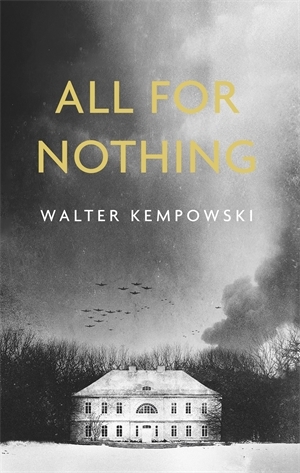
All for Nothing is the final piece of work by Walter Kempowski, the German novelist and historian, best known for his monumental and overwhelming collection of documents of ordinary life in Germany during WWII, Das Echolo, The Echoes. All for Nothing is monumental and overwhelming too, but in an emotional sense – an almost unbearably affecting tale of a middle class Prussian family caught up in the invasion of the Russian Army in January 1945. Not that Kempowski’s masterpiece is in any way sentimental or emotionally manipulative; quite the reverse. The opening sections of the book are written with a deadpan absurdism which seems to owe more to Beckett or – to choose a more Germanic example – Gert Hoffman, that great poker faced comedian of non-events. Despite alarming reports of the advance of the Soviet troops life goes on as before, as regulated and monotonous as a cuckoo clock. The boy, Peter, plays with his microscope, Frau von Globig plays melancholy music in her room, ‘Auntie’ grumbles over the food. From time to time strangers cross the threshold, bringing terrifying news of events in the East, but nothing can be allowed to disturb the equilibrium, whose repetition becomes more dreamlike and uncanny the more the external world intrudes. Like a wind-up toy, the inhabitants of the old aristocratic estate go through the same motions – until the mother makes a wildly out of character decision to shelter a Jewish ‘criminal’ for the night, and the whole House of Cards collapses.
It’s difficult to quite say why Kempowski’s work is so devastating. The tone is even, restrained, subdued, the characters neither unsympathetic nor in any way admirable, the historical details subtle and beady eyed. And yet I’ve never read a more powerful, poetic invocation of impending doom, the final moment of hush before the true horror begins. When events do happen, they happen swiftly and arbitrarily: few people act selflessly, and those who do don’t always come well. The scenes of displaced refugees echo Nemirovsky and Suite Francaise, but also possess an eerie contemporary relevance as well, the transformation of a country’s citizenry into a great grey wave of loss. Who can choose between them? Good and bad, Nazi and non, rich and poor, the disaster overwhelms everyone, like death. This is one of the great German novels written by a very specific generation, still struggling with guilt, horror and the end. It’s publication in Germany a year before Kempowski’s death was a major event: from this side of the continent, it’s hard to imagine a more harrowing, humane and clear-sighted piece of work.
Of course this notion of ‘the other side’ has other, more supernatural connotations as well. For Freud all dreams about journeys are really dreams about death, and the journey west, in particular, as always been seen as a metaphor for mortality. Here, for example, is the great Central European writer Danilo Kis discussing his strange vision of Ireland as
Share this Post
The post Review: All for Nothing, Walter Kempowski appeared first on Alan Bilton.
August 22, 2016
Essay: On writing The Known and Unknown Sea
Share this Post
Novelist Alan Bilton gives us some insights behind his second novel The Known and Unknown Sea.
As a long time resident of Swansea, readers often ask me “Wherever did you come up with the idea of a rain-drenched, wind-swept Welsh town looking out across the bay into endless mist and fog?” To which the answer is, of course, the 1926 silent movie, Sunrise. The fantastical conceit of F.W. Murnau’s great classic, is that you can have two different worlds separated by a tiny channel of water; on one side lies a Gothic Bavarian village, straight out of a Grimm fairy tale, on the other, a futuristic art deco version of New York. To cross the water – which the characters do by rowing boat – is to ford time, space and even different kinds of reality. Sunrise is all about crossing over to the ‘other side’ – which is, in many ways, the key idea behind the novel.
Of course this notion of ‘the other side’ has other, more supernatural connotations as well. For Freud all dreams about journeys are really dreams about death, and the journey west, in particular, as always been seen as a metaphor for mortality. Here, for example, is the great Central European writer Danilo Kis discussing his strange vision of Ireland as
“the land on the other side of language, the last land to see the fading light of day … A realm of fog and darkness, the boundary of the known world. And on the other side, the dark sea in which the dead once again find their land of eternity – dreams without shores, without return”Danilo Kis
The ‘other side’ in my novel isn’t the after-life, but images of the spectral and otherworldly cling to it like cobwebs. Here/There, Home/Away, Known/Unknown: the demarcation between these lands is central to so many fairy tales, from The Wizard of Oz to Jack and the Beanstalk, and indeed forms one of the fundamental building blocks of literature. What stories did ancient hunters bring back to the cave with their kill? Why, stories of the land beyond, what lies outside the familiar and ordinary, yonder from the cave, images and pictures they daub upon the walls. The model of the journey is a fundamental component of art – a metaphor the passage of life, of course, as well as the shift from innocence to experience. Indeed, it’s almost impossible to conceive of the novel without it.
So: my novel would be about a family booking passage on a mysterious vessel to the other side. But whose story was this? 
I decided on Alex, the child-narrator of the book, whose voice remains sunny, optimistic and playful, no matter how strange or unsettling the things he comes across or the horrors he meets. Children can cope with the unfamiliar much better than adults – everything is unfamiliar to start with – and the naivety of his tone allowed me to play games with mood: like many unreliable narrators, Alex gets things comically wrong, even as the reader/adult can (I hope) discern the much more upsetting truth. Alex was thus my comic life buoy: he would always bob to the surface, no matter how terrible things became. The book is about the worst things that a child can imagine – being alone, being away from home, the loss of family and friends – but the mood is antic and pantomime, a slapstick comedy rather than the tragedy which the material suggests.
In this TKAUS is both a self-consciously comic novel and a kind of anxiety dream or nightmare – not unlike my first book, The Sleepwalkers’ Ball. The world Alex discovers is the world a child might create: messy, sticky, badly painted and only just glued together, a set knocked together in a primary school art lesson on a wet and windy afternoon. In this I’ve always been interested in Art as a thing rather than a mirror: a self-contained construction, which doesn’t really rely on the way things are. Alex’s little mitts are all over this world – clumsy, crude, messy, disorderly – and this is also my ideal: the novel as a distinct voice or creation, a thing as unique as your fingerprints. For me, literature is less to do with how things are then how they might be – the contingent, the provisional, even the impossible. In some ways, Art seems to me to be predicated on its distance from the real rather than its closeness – as Sergei Dovlatov writes “What would be the point of dreaming, if dreams came true?” Art transforms the world, re-enchants it, provides us with vitamins we can’t find in everyday life. In this the book’s credo is similar to that of Bohumil Hrabal – “The world is maddening beautiful – well, it isn’t really, but that’s how I choose to see it”. Freud knew that books come from day dreams and wish fulfilment – but, of course they van also come from anxiety dreams and nightmares too.
Like a tightrope walker, Alex’s blithe narration is suspended above a bottomless pit of unhappiness, disappointment, disquiet and misery: in this the book offers a kind of lightness, pleasure and beauty as an attempt to counter the tragic currents of life. Not that the void can be wholly ignored or discarded: rather Art’s beautiful lie must also acknowledge the ugly truth, the real world howling back at us down below. Freud saw the beauty of art as a bribe to try and win us over, Kurt Vonnegut saw it as the sugar coating of an unpleasant pill. I’m not sure that I agree with either of these – but the relationship between the real and the imaginary, the light and the heavy, the impossible and the mortal, is essential to the book.
“I am a writer, and as such I have not only the right, but also the duty to raise the level of reality, as I see it, to the very point where it threatens to tip over into the unbelievable” Gregor Von Rozzoni
Although TKAUS is some ways a dream book, the dreams have to matter, they have to have weight. Therefore, even the imaginary has to have consequences, to play a role in cause and effect. Dreams – central to Surrealism, Absurdism, and Magic Realism – need to be tangible and tactile if they’re to work in literature: you need mud as well as fog. They suggest the idea of stepping out of this world and into another: an idea I come back to again and again.
“And, as it often happened with him – though it was deeper this time – Fyodor suddenly felt, in this glassy darkness, the strangeness of life, the strangeness of its magic, as if a corner of it had been turned back for an instance and he had glimpsed its unusual lining”Nabakov, The Gift
Share this Post
The idea of turning a corner into the impossible – finding a trap door, a portal, a means of passage – is inescapable in everything I’ve written so far. It’s an infantile idea, of course, but that doesn’t make it any less powerful. It’s linked to escapism, but not quite the same: the unknown doesn’t make any sense unless you compare it with the everyday. It’s the connection between Here and There, Home and Away, which is central: a connection I wanted to explore in the book.


The post Essay: On writing The Known and Unknown Sea appeared first on Alan Bilton.
Alan Bilton's Blog

- Alan Bilton's profile
- 8 followers

