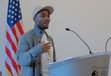
A.D. Carson's Blog
June 25, 2023
Samuel J. Bush Memorial | Decatur, Illinois – June 3, 2023
130 years ago, today—that’s six and a half score—our fathers murdered our fathers in this new nation, purportedly conceived in liberty and dedicated to the proposition that all men are created equal.
In the 13 decades since the racist, criminal, terroristic lynching of Samuel J. Bush, here in Decatur, Illinois, on June 3rd, 1893, I imagine folks would like to spend a lot of time trying to convince us how much has changed. And I’m not one to deny obvious things. Change is constant and inevitable, so we can all rest assured and certain that some things have, indeed, changed. But…as is true with everything, context is important. It seems that many of us would like to believe that we’ve arrived at some desired place on the broad beating wings of unavoidable change. And many others would like us to believe that that place we’re at is on the other side of what was so frequently described as “the race problem.” Folks love to ask, “How do we solve it?”
It’s an interesting question. And I might be tempted to try to offer a response, except I don’t think we have ever fully reckoned with the questions that should precede it, “How have we lived with it?” “How do we live with it?” and the multitude of questions that might implicate us in the perpetuation of the problem that we all claim to want solved.
Like all kinds of technologies, race has manufactured products and conditions from which people have, and continue to, benefit. And race might be a more brilliant technology than the automobile. Its invention was also, unfortunately, the invention of the automobile accident, which is a leading cause of death every year. In the analogy to race, some people might think that an unintended consequence of its invention was racism, but if we asked ourselves those questions, “How have we lived with it?” and “How do we live with it?” I imagine we’d recognize that a lot of the answers will lead to those products and conditions some folks have and are still benefiting from. And as long as those folks continue to benefit, a question like “How do we solve it?” will ring hollow because people are not at all invested in “solving” things from which they benefit.
And this is a country not just deeply steeped in race, but built on soil stained by it, with labor powered by it, on laws that weaved race into its very fabrics. And hardly anybody asking “How do we solve it?” is interested in undoing this country if we come to the collective conclusion that that might be the necessary solution. So, what do we do?
I suppose we could pretend. We could all agree that this marker, or the changing of names on buildings, the removal of a couple of offensive statues and editing some history books are our contributions to the work we tell ourselves is necessary, while understanding its futility. But we aren’t even good at this kind of collective pretending.
William Faulkner famously wrote, “The past is never dead. It’s not even past.” I don’t believe the questions, “How do we live with it” and “How have we lived with it?” are separate questions from one another.
How did Decatur and Mt. Zion live with the lynching of Samuel J. Bush? How have these communities lived with it?
The following year, 1894, I’ve read, there was another attempted lynching. A porter named James Jackson, was accused of the attempted rape of a white woman. Rather than depend on legal protections and run the risk of seeing Jackson lynched like Bush, the Black community engaged in a strategy more akin to what the Decatur pressman and militant activist Everret Edward Jacobs had previously advocated when Bush was lynched. The historian Sundiata Cha-Jua describes it as “a warlike demonstration.” He writes of the community taking up arms in defense of Jackson, “Blacks controlled the streets surrounding the jail. They could be seen in doorways, under stair wells and behind wagons, armed and ready for action. Other African-Americans patrolled the streets scrutinizing whites who happened to be out at that late hour.”(4) Cha-Jua also writes that the Bush lynching “sparked a five-year battle between militant African-Americans and Decatur’s white Republican party leadership,” as Black leaders continued their protests into the 1898 congressional and county sheriff electoral races.
“How have we lived with it?” “How do we live with it?”
Well, I never heard or read this history as a student in Decatur’s public schools.
It was other things that dredged up these histories for me, and being the kind of kid I was, it was appalling enough for me to want to make art to make sure people found out what I found out. It became the kind of thing I would mention in passing to anyone remotely interested in having a conversation about education or history or what’s happening in town presently. Because those things—especially what we’re doing presently—show the community and the world how we are living with it, how the past is not even past.
Stories about Samuel J. Bush, James Jackson, and Everret Edward Jacobs predate the so-called “war on drugs,” but theirs, too, are stories about restrictive control of Black people and about resistance to and refusal of such that might be instructive to us now.
In what ways are our communities still engaged in these battles from 130 years ago, the warlike posture on either side of this technology called race that some folks benefit from and causes others to suffer? How has this affected our ability to reckon with not just what happened in the past, but what continues to happen daily?
This marker, to my mind, is not the end. It isn’t the goal. It won’t solve a problem. It’s here to remind us that there is a problem. And that we are living with it. It’s here to prompt us to ask ourselves, our communities, and our elected officials, “How do we live with it?” “How will we live with it?” with expectations of real responses because we are definitely still living with it. It should also prompt us to ask who is benefiting from it, what they are getting, and at what cost to the rest of us?
This marker is a challenge. History doesn’t just happen. It’s made by people living. It’s documented by people watching and listening. It’s sometimes taught by people, and it’s often ignored or suppressed by people who see it as a challenge to the way things are or the way things could be.
These are reasons I’m so invested in history, even, maybe especially, as an artist and professor of hip-hop—because if the past is not even past, perhaps we might be the people living history or watching and listening to document history or teaching history or calling out those instances when history is being ignored or suppressed, and asking those necessary questions that need to be asked, the unfinished work of living with what we’re living with, full of hopes of getting to what lies on the other side of those questions.
So my challenge to you, now, is to ask how each of you have lived with it, how you are living with it, and how you will live with it…and to ask you if that living will honor the memory and the legacy of Mr. Bush and our communities, and what we say are our collective goals as a city or as a country, trying our best not to perish from this earth.


December 8, 2022
It’s Okay to Tell People to STFU.
It’s okay to tell people to shut the fuck up.
July 19, 2022
Dr. A.D. Carson on “Tavis Smiley”
Dr. A.D. Carson – Assistant professor of Hip-Hop & the Global South at the University of Virginia and award-winning performance artist and educator. His work focuses on race, literature, history, rhetorics & performance. Since the rise of Hip-Hop in the early 1980s, critics of Rap sought to tie the music to violent crime. He joins Tavis to break down how Rap is oftentimes used as a scapegoat for many issues, especially in recent mass shootings.
View this post on InstagramA post shared by A.D. Carson (@aydeethegreat)
July 8, 2022
Roe v. Rap: Hip-Hop Artists Have Long Wrestled With Reproductive Rights
A.D. Carson, University of Virginia
Hip-hop culture is often recognized as being born on Aug. 11, 1973. That was about seven months after Roe v. Wade, the landmark decision that protected the right to choose to have an abortion.
Accordingly, reproductive rights have long been part of the discourse in rap music, which has always sought to hold a mirror to society to reflect its realities, values, ambitions, fantasies and taboos. With the U.S. Supreme Court having ruled that there is no constitutional right to an abortion, rap lyrics will undoubtedly reflect this new reality.
What follows is a sampling of rap songs from the past several decades that have dealt with the subject of abortion and reproductive rights in the era of Roe v. Wade. The list is by no means exhaustive.
Collectively, the songs represent a diversity of viewpoints and are written from a variety of perspectives – from guilt-ridden, would-be mothers and apprehensive fathers to the imagined vantage point of the unborn themselves.
‘La Femme Fétal,’ by Digable Planets (1993)This song actually presages a time when Roe v. Wade would no longer be the law of the land and even mentions Justice Clarence Thomas, who wrote in favor of the decision that overturned the case. It features a narrator who recounts a story of a friend who attempts to get an abortion but is harassed at the clinic.
If Roe v. Wade was overturned, would not the desire remain intact / Leaving young girls to risk their healths / And doctors to botch, and watch as they kill themselves / I don’t want to sound macabre / But hey, isn’t it my job / To lay it on the masses and get them off their asses / To fight against these fascists
‘La Femme Fétal,’ by the Digable Planets, (1993)‘My Story (Please Forgive Me)’ by Jean Grae (2008)This song takes listeners into the mind of a young woman who experiences guilt and remorse after having had an abortion. The song even unmasks the grim realities of undergoing the procedure.
They put you in a room, where you can change into / Your gown and shower cap, shaking as a fiend would do / And that’s when you think of leaving, fleeing the building / and then they call you and you hear the call of your children
‘My Story (Please Forgive Me),’ by Jean Grae, 2008.‘80’s Baby,’ by CyHi The Prynce featuring BJ The Chicago Kid (2017)CyHi raps from the perspective of an unborn baby who asks his mom – based on the things she does while pregnant – whether she’s prepared to be a mother.
You don’t know it kills me when you taking them pills / But see how it scars me and all the pain that I feel / I’m just here starving, you haven’t gave me a meal / Ma, you think you ready to have this baby for real? / ‘Cause I’m on the way
‘80’s Baby,’ by CyHi The Prynce featuring BJ The Chicago Kid (2017)‘Keep Ya Head Up’ by 2Pac (1993)Tupac has dealt with the plight of single mothers since his 1991 debut album, which featured “Brenda’s Got a Baby,” the story of a 12-year-old girl who is molested by a relative who gets her pregnant and then abandons her. In “Keep Ya Head Up,” from his sophomore album, Tupac defends a woman’s right to choose the circumstances under which she wants to give birth.
And since a man can’t make one / He has no right to tell a woman when and where to create one / So will the real men get up / I know you’re fed up ladies, but keep your head up
“Keep Ya Head Up,” by Tupac (1993)‘You Vs. Them’ by Jhene Aiko (2011)Aiko, mother to a daughter named Namiko, told VIBE magazine how her song “You Vs. Them” was about her conclusion that it was a false choice to have to choose between having a child and her career. “I was like ‘should I be a mom or should I be a singer?’ But found that I could be both.”
‘Cause if I never had you / Then I could never lose you / Do you know what might happen / If I decide to choose you? / Then the world may just stop spinnin’ / It may just well be the endin’ / Talkin’ all about existence / Who knows? / But I cannot see tomorrow / If you’re not in my tomorrow
“You Vs. Them” by Jhene Aiko, (2011)‘Retrospect for Life’ by Common featuring Lauryn Hill (1997)This song speaks to the misgivings and strife that couples can experience when their union results in an unplanned pregnancy.
I wouldn’t choose any other to mother my understanding / But I want our Parenthood to come from Planning / It’s so much in my life that’s undone / We gotta see eye to eye, about family, before we can become one
‘Retrospect for Life,’ by Common featuring Lauryn Hill, 1997.‘To Zion,’ by Lauryn Hill (1998)
Lauryn Hill pregnant with Zion. pic.twitter.com/9TRDJmP4yC
— Christina
(@ChrissyHussle) August 29, 2021
In this song, Lauryn Hill sings in a soul-stirring voice about how she resisted suggestions to terminate the pregnancy that brought her son Zion.
Woe this crazy circumstance / I knew his life deserved a chance / But everybody told me to be smart / “Look at your career,” they said / “Lauryn, baby, use your head” / But instead I chose to use my heart / Now the joy of my world is in Zion
‘To Zion,’ by Lauryn Hill, 1998.‘Abortion’ by Doug E. Fresh & The Get Fresh Crew (1986)In this song, Doug E. Fresh – a beat boxer who regarded himself as “the world’s greatest entertainer” – depicts abortion as “mind distortion” and casts women who seek an abortion in a negative light.
Girl, you must be crazy to kill a newborn baby / Sitting on your ass all day so lazy.
‘Abortion,’ by Doug E. Fresh & The Get Fresh Crew (1986)‘What’s Going On’ by Remy Ma featuring Keyshia Cole (2006)In this song, Remy Ma tells the story of a young and poor mother who wrestles with whether to abort the life growing inside of her.
It’s a life living in my body / But it don’t gotta to live / It’s up to me, but if I keep what the fuck I got to give / I mean, I’m still young and I don’t really have shit / And if this nigga decide to leave then my child a be a bastard / It’s drastic / Nobody really understands me / My mom don’t give a fuck and neither does the rest of the family / They like “Remy, you can’t afford it you expect us to support it” / I feel my seeds apart of me and I don’t want to abort it, so
‘What’s Gong On,’ by Remy Ma featuring Keyshia Cole, (2006)‘If These Walls Could Talk,’ by Gat Turner and Viva Fidel, (2014)In this song, Milwaukee rap artists Gat Turner and Viva Fidel give listeners a glimpse at the struggle of a mother who doesn’t want to be pregnant from the vantage point of her unborn child.
Shook like an unborn, man, my life in danger / cause first sign of trouble mama looking for the hanger / shook like an unborn, mama trying to murder me / first degree abortion, devil call it surgery
‘Shit, Man!’ by Skylar Grey featuring Angel Haze (2018)In the sole rap verse on this track, rapper Angel Haze speaks as a mother deciding to keep a child despite the child’s being conceived in a rocky relationship.
This ain’t what I expected / It ain’t happenin’ like I thought it / And if they say, ‘Love is free’ / Then tell me why the fuck it’s costin’ / And yes, it happens often / And I should cope with my losses / And you say you’re not ready / I don’t believe in abortions
‘Shit, Man!’ by Skylar Grey featuring Angel Haze (2018)‘Lost Ones’ by J. Cole (2011)J. Cole raps from the perspective of parents having a discussion about something that could become increasingly rare in the post-Roe v. Wade era: their options.
I’ve been giving it some thought lately and, frankly / I’m feelin’ like we ain’t ready and it’s – hold up now, let me finish / Think about it baby me and you we still kids, ourself / How we gon raise a kid by ourself? / Handle biz by ourself
‘Lost Ones,’ J. Cole (2011)‘Autobiography’ by Nicki Minaj (2009)In this song, Minaj speaks from the standpoint of a remorseful mother who hopes to be reunited in the afterlife with the child she aborted.
Please baby, forgive me, mommy was young / Mommy was too busy tryna have fun / Now, I don’t pat myself on the back for sending you back / ‘Cause God knows I was better than that / To conceive you, then leave you, the concept alone seems evil / I’m trapped in my conscience / I adhered to the nonsense, listened to people who told me / I wasn’t ready for you / But how the – would they know what I was ready to do?

A.D. Carson, Assistant Professor of Hip-Hop, University of Virginia
This article is republished from The Conversation under a Creative Commons license. Read the original article.
Scapegoating Rap Hits New Low After July Fourth Mass Shooting
A.D. Carson, University of Virginia
When local police named 22-year-old Robert E. Crimo III as “a person of interest” in the July 4 mass shootings in an affluent Chicago suburb, several news outlets described him in headlines as a “rapper.”
A Washington Post headline read “Robert Crimo III, ‘Awake the Rapper,’ arrested in Highland Park shooting.” A Vice News headline read “Police Arrest Local Rapper in Connection to Highland Park Mass Shooting.”
NEW: Police have named a local rapper as a 'person of interest' in the Fourth of July mass shooting in Illinois. His social media show he went by the name Awake the Rapper. Several of the music videos featuring him contain references to mass shootings.https://t.co/v6R87STdLe
— VICE News (@VICENews) July 4, 2022
In addition to the headlines, media outlets noted that Crimo had musical references to mass shootings on his social media accounts as well as crude drawings depicting violence.
But none of these justify the use of “rap” or “rapper” in describing Crimo’s alleged criminal behavior — and everything to do with criminalizing rap and rappers.
In my view, referring to this genre of music and those that make it is a racially loaded signal to readers that Crimo’s musical interests are a significant part of the mass shooting and somehow led to the crimes of which he is accused.
Those crimes include at least seven counts of first-degree murder which, if he’s convicted, carry a maximum sentence of life without parole. Crimo is scheduled to appear for a preliminary hearing on July 28 and is being held in detention without bail.
As far as I can tell, none of those alleged crimes had anything to do with Crimo’s career as a rapper.
But rap is an easy target.
Scapegoating rapRap has long been used to conspicuously stereotype, caricature and reinforce mythologies about Black people. As a rapper and scholar, I wrote about this scapegoating in a chapbook, “Rap & Storytellingly Invention,” published with the peer-reviewed album I released in 2020.
i used to love to dream by A.D. Carson
Since the rise of hip-hop in the early 1980s, critics of rap sought to tie the music to violent crime.
One of the first targets was Run-DMC, the rappers from Queens, New York, given credit for bringing hip-hip to mainstream music and culture.
During the group’s 1986 “Raising Hell” tour, police and journalists blamed its music for violence that occurred in towns it visited. At its show in Long Beach, California, gang violence in the crowd also was blamed on rap.
In the 1990s, politician and civil rights activist C. Delores Tucker became one of the most outspoken anti-rap voices, focusing her ire on Tupac Shakur and the “gangsta rap” subgenre.
The finger-pointing against rap – or some version of it – continues to this day.
The latest target is drill rap, a hip-hop subgenre that originated in Chicago and has since spread across the world.
New York City Mayor Eric Adams condemned drill rap on Feb. 11, 2022, after the murders of two Brooklyn rap artists, Jayquan McKenley and Tahjay Dobson.
Adams said the violence portrayed in drill rap music videos was “alarming” and that he would sit down with social media companies to try to remove the content by telling them they “have a civic and corporate responsibility.”
“We pulled Trump off Twitter for what he was spewing,” Adams said, “yet we are allowing music, displaying of guns, violence. We’re allowing it to stay on these sites.”
“We pulled Trump off Twitter … yet we are allowing music displaying of guns, violence.”
— NYC Mayor Eric Adams (D), after his son sent him drill rap videos, says he will try to get the videos banned from social media. pic.twitter.com/ATGmhpi4Bo
— The Recount (@therecount) February 11, 2022
Similar tactics have been employed in the past to shut down drill music.
London drill rappers have been targeted since 2015 by the Metropolitan Police’s Operation Domain, a joint effort with YouTube to monitor for “videos that incite violence.”
It’s as if politicians and police don’t understand that the music emerging from these places is a reflection of crisis, not the source of it.
Tragic myths and realitiesDespite the immense popularity of hip-hop, the culture and the music continue to be portrayed as a cultural wasteland in both subtle and explicit ways.
Worse, in my view, these harmful assumptions affect the ways ordinary people who experience tragedies are described.
The word “rapper” is used to conjure negative imagery. It leaves hollow expectations in its place, to be filled with the specter of death and the spectacle of violence. The person described by it becomes a boogeyman in the public imagination.
In the most unjust of circumstances, “rapper” has become a social shorthand for presumptions of guilt, expectations of violence and sometimes worthiness of death.
Such was the case with Willie McCoy. In 2019, the 20-year-old was killed by six policemen while he slept in his car at a Vallejo, California, Taco Bell. The officers claimed they saw a gun and tried to wake him. When McCoy moved, the officers fired 55 shots in 3½ seconds.
While rap music appears to have had nothing to do with the tragic events of his death, descriptions of McCoy as a rapper were reported more prominently and consistently than the 55 shots police fired at him while he slept.
Even playing rap music might result in death. In 2012, a 17-year-old named Jordan Davis was shot and killed by a man who complained about the “loud” music Davis was playing in his car at a Florida gas station.
During the proceedings, dubbed “the loud music trial,” Michael Dunn testified that the music Davis and his friends were playing in Davis’ car was “thug music” or “rap crap.”
Dunn’s defense depended on his victims’ being viewed as thugs by association with rap.
In jail, Dunn was recorded on the phone speculating whether Davis and his friends were “gangster rappers.” He claimed he’d seen YouTube videos.
In describing these tragedies, the words “rappers” and “rap music” are code for “Black” and “other,” meant to elicit fear and justify violence. There’s no question in my mind that they would have been perceived differently if the words “poets” or “poetry” had been used instead.
Moral decline blamed on rap
We don't kill poets in the USA. Unless they are rappers.
We only kill poets who are rappers in the USA.
But then we don't call them poets. @aydeethegreat said this over at Fulcrum https://t.co/bSOiF90xRl
— Cy (@JillianWeise) November 13, 2020
The day after the May 24, 2022, mass shooting at an elementary school in Uvalde, Texas, U.S. Rep. Ronny Jackson promptly blamed the violence on rap music and video games.
“Kids are exposed to all kinds of horrible stuff nowadays,” the Texas Republican told Fox News on May 25, 2022. “I think about the horrible stuff that they hear when they listen to rap music, the video games that they watch … with all of this horrible violence.”
Ronny Jackson says it’s “unfortunate” that the media is going to focus on guns, since the real cause of school shootings is rap music and video games. pic.twitter.com/pjydr3zrpB
— Ron Filipkowski
(@RonFilipkowski) May 25, 2022
For Jackson and other critics, rap seems to explain criminal behavior and signal moral decline. In the eyes of Georgia’s Fulton County District Attorney Fani Willis, rap might be something else as well – evidence.
Atlanta rappers Young Thug and Gunna were among 28 defendants charged under Georgia’s Racketeer Influenced and Corrupt Organizations Act in May 2022 with conspiracy and street gang activity.
They are now in jail in Atlanta awaiting trial.
In the indictment, prosecutors cite lyrics from Young Thug’s songs as “overt acts in furtherance of the conspiracy.”
Several tracks are quoted, including “Slatty,” on which Young Thug raps: “I killed his man in front of his mama /
Like f–k lil bruh, his sister, and cousin.”
Free speech has its limits.
“The First Amendment,” Willis explained, “does not protect people from prosecutors using [lyrics] as evidence if it is such.”
Made in AmericaIndeed, violence perpetuated by people who rap is as real any other American violence.
Young Thug, Gunna or any other rapper accused of crimes is not exempt from accountability. But, in my view, assuming people are criminals simply because they rap – even if they rap about violence – is wrong.
Admittedly, throughout hip-hop history, rappers have constructed personas as antiheroes. Performances of masculinity, violence, intimidation, gun ownership and misogyny are meant to signal a kind of authenticity.
In her 1994 book “Outlaw Culture,” bell hooks included a chapter on “gangsta rap.” Hooks explained that the abhorrent behaviors scrutinized and highlighted in rap are American values that people living and surviving here adopt.
In his December 1986 story on Run-DMC, Rolling Stone writer Ed Kiersh said out loud what many were thinking.
“To much of white America,” Kiersh wrote, “rap means mayhem and bloodletting.”
Perhaps.
But those who still seek to vilify rap might do well to focus on the sources of the crisis of violence in America rather than blaming the music that reflects it.
A.D. Carson, Assistant Professor of Hip-Hop, University of Virginia
This article is republished from The Conversation under a Creative Commons license. Read the original article.
June 22, 2022
Hip-hop professor’s new “Ghosts” release honors losses that shape us
JANE DUNLAP SATHE jsathe@dailyprogress.com
5-6 minutes
Many voices clamor for attention in modern life. A University of Virginia professor’s latest album reaches for ways to honor the voices that influence our lives from a distance.
The isolation of pandemic lockdown gave A.D. Carson time to think about people he has loved and lost who shaped his life and conscience, particularly his grandmothers.
“I love the fact that both my grandmothers’ voices live in my head,” he said with a warm chuckle.
In “iv: talking to ghosts,” released April 12, Carson uses the structures of rap and essay as a framework for processing a simple conversation with his cousins back home in Decatur, Illinois, and other moments of ephemera, heartache and simply living life.
What started as lighthearted reminiscing with his cousins about hours of carefree fun on a basketball court that used to be on property once owned by their grandparents became a time capsule of connection once one of those voices was stilled before its time. The pandemic happened, traveling and gathering with others got complicated and soon forbidden — and then one of his cousins died.
The final conversation that no one realized would be a final conversation ended up in Carson’s new collection.
“There’s actually a portion of the album when me and my cousins are standing in front of my grandmother’s land,” Carson said. “We were in southern Illinois for a funeral and did not realize that the pandemic would not afford us an opportunity to be together again.”
Carson is assistant professor of hip-hop and the Global South in the UVa’s Department of Music. He first united academia and hip-hop by earning his doctorate in rhetorics, communication and information design at Clemson University by writing a rap album; a mastered version of his peer-reviewed “Owning My Masters: The Rhetorics of Rhymes & Revolutions” is under contract to be released by an academic publisher.
The pandemic shutdown afforded time to stop and reflect that normally wouldn’t have been available.
“It was pressing on me really heavily during the lockdown,” he said. “How do I honor the really heavy losses — the ones that aren’t from COVID?”
Carson, who brings a scholarly approach to hip-hop and rap and a hip-hop sensibility to academic pursuits, realized that his search for elusive peace during the tension of the pandemic would resonate with others. The timeless wisdom of listening to the voices of the ancestors felt new, and more necessary than ever.
“How do we honor the people who are with us, but who are no longer living?” Carson asked. “If it’s anything, it’s listening and being receptive. You want the grounding in the midst of the chaos. The way to get that grounding, for me, is to listen.”
When he first started working on his new album, Carson was using an essay approach, and he was considering a different thematic direction.
“I thought the album would be something about breathing and relishing the moment, and the incredible opportunity we have,” he said. “The talking-to-ghosts thing really snuck up on me. I paused and really heard it.
“This album is receiving that call and responding in kind.”
Listeners who spend time with “iv: talking to ghosts” are encouraged to explore their reactions to see where their emotions and reflections lead them. And as the arts, especially music, can invite conversations not only between performers and perceivers, but also between perceivers and their own inner listeners, try not to edit or sanitize your responses. Sit with them, acknowledge them and see what insights they may reveal.
“My hope is that folks listen and respond in kind,” Carson said. “They paint about it, or write about it, or listen to the music and sit and sway about it.”
His own reaction to finishing the album?
“I wanted to drive to Illinois and knock on my mom’s door and give her a hug,” Carson said.
“I wish I had another conversation with my cousin. What also needs to be done is take the time to sit with family. There’s no replacing it. I feel I got the kind of recharge I needed for all the heaviness I felt.”
That sense of recharge and reset can keep people going in the midst of troubling times, and one track from the new album already has offered solace in the face of tragedy and outrage.
When a gunman shot and killed 10 Black shoppers and injured three others at a Buffalo, New York, grocery store on May 14, “I posted the lyrics to ‘Good Mourning’ on Instagram,” Carson said.
It wasn’t long before a listener responded with, “ ‘Thank you for putting words to the way I felt,’” Carson said.
June 14, 2022
When all else fails to explain American violence, blame a rapper
A.D. Carson, University of Virginia
The day after the May 24, 2022, mass shooting at an elementary school in Uvalde, Texas, U.S. Rep. Ronny Jackson promptly blamed the violence on rap music and video games.
“Kids are exposed to all kinds of horrible stuff nowadays,” the Texas Republican told Fox News on May 25, 2022. “I think about the horrible stuff that they hear when they listen to rap music, the video games that they watch … with all of this horrible violence.”
Ronny Jackson says it’s “unfortunate” that the media is going to focus on guns, since the real cause of school shootings is rap music and video games. pic.twitter.com/pjydr3zrpB
— Ron Filipkowski
For Jackson and other critics, rap seems to explain criminal behavior and signal moral decline. In the eyes of Fulton County District Attorney Fani Willis, rap might be something else as well – evidence.
Atlanta rappers Young Thug and Gunna were among 28 defendants charged under Georgia’s Racketeer Influenced and Corrupt Organizations Act in May 2022 with conspiracy and street gang activity.
They are now in jail in Atlanta awaiting trial.
In the indictment, prosecutors cite lyrics from Young Thug’s songs as “overt acts in furtherance of the conspiracy.”
Several tracks are quoted, including “Slatty,” on which Young Thug raps: “I killed his man in front of his mama /
Like f–k lil bruh, his sister, and cousin.”
Free speech has its limits.
“The First Amendment,” Willis explained, “does not protect people from prosecutors using [lyrics] as evidence if it is such.”
Scapegoating rapRap has long been used to conspicuously stereotype, caricature and reinforce mythologies about Black people. As a rapper and scholar, I wrote about this scapegoating in a chapbook, “Rap & Storytellingly Invention,” published with the peer-reviewed album I released in 2020.
i used to love to dream by A.D. Carson
Since the rise of hip-hop in the early 1980s, critics of rap sought to tie the music to violent crime.
One of the first targets was Run-DMC, the rappers from Queens, New York, given credit for bringing hip-hip to mainstream music and culture.
During the group’s 1986 “Raising Hell” tour, police and journalists blamed its music for violence that occurred in towns it visited. At its show in Long Beach, California, gang violence in the crowd also was blamed on rap.
In the 1990s, politician and civil rights activist C. Delores Tucker became one of the most outspoken anti-rap voices, focusing her ire on Tupac Shakur and the “gangsta rap” subgenre.
The finger-pointing against rap – or some version of it – continues to this day.
The latest target is drill rap, a hip-hop subgenre that originated in Chicago and has since spread across the world.
New York City Mayor Eric Adams condemned drill rap on Feb. 11, 2022, after the murders of two Brooklyn rap artists, Jayquan McKenley and Tahjay Dobson.
Adams said the violence portrayed in drill rap music videos was “alarming” and that he would sit down with social media companies to try to remove the content by telling them they “have a civic and corporate responsibility.”
“We pulled Trump off Twitter for what he was spewing,” Adams said, “yet we are allowing music, displaying of guns, violence. We’re allowing it to stay on these sites.”
“We pulled Trump off Twitter … yet we are allowing music displaying of guns, violence.”
— NYC Mayor Eric Adams (D), after his son sent him drill rap videos, says he will try to get the videos banned from social media. pic.twitter.com/ATGmhpi4Bo
— The Recount (@therecount) February 11, 2022
Similar tactics have been employed in the past to shut down drill music.
London drill rappers have been targeted since 2015 by the Metropolitan Police’s Operation Domain, a joint effort with YouTube to monitor for “videos that incite violence.”
It’s as if politicians and police don’t understand that the music emerging from these places is a reflection of crisis, not the source of it.
Tragic myths and realitiesDespite the immense popularity of hip-hop, the culture and the music continue to be portrayed as a cultural wasteland in both subtle and explicit ways.
Worse, in my view, these harmful assumptions affect the ways ordinary people who experience tragedies are described.
The word “rapper” is used to conjure negative imagery. It leaves hollow expectations in its place, to be filled with the specter of death and the spectacle of violence. The person described by it becomes a boogeyman in the public imagination.
In the most unjust of circumstances, “rapper” has become a social shorthand for presumptions of guilt, expectations of violence and sometimes worthiness of death.
Such was the case with Willie McCoy. In 2019, the 20-year-old was killed by six policemen while he slept in his car at a Vallejo, California, Taco Bell. The officers claimed they saw a gun and tried to wake him. When McCoy moved, the officers fired 55 shots in 3.5 seconds.
While rap music appears to have had nothing to do with the tragic events of his death, descriptions of McCoy as a rapper were reported more prominently and consistently than the 55 shots police fired at him while he slept.
Even playing rap music might result in death. In 2012, a 17-year-old named Jordan Davis was shot and killed by a man who complained about the “loud” music Davis was playing in his car at a Florida gas station.
During the proceedings dubbed “the loud music trial,” Michael Dunn testified that the music Davis and his friends were playing in Davis’ car was “thug music” or “rap crap.”
Dunn’s defense depended on his victims’ being viewed as thugs by association with rap.
In jail, Dunn was recorded on the phone speculating whether Davis and his friends were “gangster rappers.” He claimed he’d seen YouTube videos.
In describing these tragedies, the words “rappers” and “rap music” are code for “Black” and “other,” meant to elicit fear and justify violence. There’s no question in my mind that they would have been perceived differently if the words “poets” or “poetry” were used instead.
Made in America
We don't kill poets in the USA. Unless they are rappers.
We only kill poets who are rappers in the USA.
But then we don't call them poets. @aydeethegreat said this over at Fulcrum https://t.co/bSOiF90xRl
— Cy (@JillianWeise) November 13, 2020
Indeed, violence perpetuated by people who rap is as real any other American violence.
Young Thug, Gunna, or any other rapper accused of crimes are not exempt from accountability. But, in my view, assuming people are criminals simply because they rap – even if they rap about violence – is wrong.
Admittedly, throughout hip-hop history, rappers have constructed personas as antiheroes. Performances of masculinity, violence, intimidation, gun ownership and misogyny are meant to signal a kind of authenticity.
In her 1994 book “Outlaw Culture,” bell hooks included a chapter on “gangsta rap.” Hooks explained that the abhorrent behaviors scrutinized and highlighted in rappers are American values that people living and surviving here adopt.
In his December 1986 story on Run-DMC, Rolling Stone writer Ed Kiersh said out loud what many were thinking.
“To much of white America,” Kiersh wrote, “rap means mayhem and bloodletting.”
Perhaps.
But those who still seek to vilify rap might do well to focus on the sources of the crisis of violence in America rather than blaming the music that reflects it.
A.D. Carson, Assistant Professor of Hip-Hop, University of Virginia
This article is republished from The Conversation under a Creative Commons license. Read the original article.
May 13, 2022
Peer-Reviewed Rap Album Wins Research Award
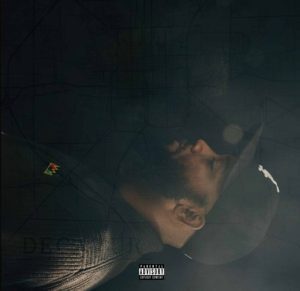 A.D. Carson’s mixtape/essay, “i used to love to dream,” released in 2020 by the University of Michigan Press, was the first peer-reviewed rap album, and was published with an academic publisher.
Carson meets the challenge of offering hip-hop composition and production as academic knowledge-making practice and scholarly inquiry, as well as personal reflection. His public-facing hip-hop scholarship (music and prose) confronts and changes the politics of knowledge production that often treat hip-hop producers as secondary or tertiary, rather than primary, contributors to academic discourse in and around the field.
“By rejecting the proposition that hip-hop music requires translation to make it suitable for an academic context, Carson offers us a new paradigm for scholarly work in which musical Blackness is not reduced to metaphor but remains a salient part of the intellectual and artistic encounter,” said Loren Kajikawa, chair of the music program at The George Washington University.
May 20, 2021
Hip-hop professor looks to open doors with world’s first peer-reviewed rap album
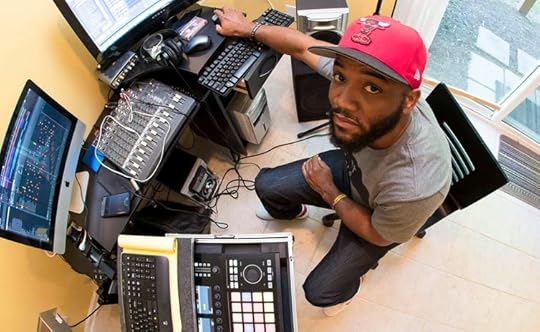 Hip-hop professor A.D. Carson.
Dan Addison, CC BY
As a rap artist who is also a professor of hip-hop, I always make it a point to have my songs reviewed by other artists I admire.
So when I released “i used to love to dream” – my latest album – in 2020, I turned to Phonte Coleman, one half of the trailblazing rap group Little Brother.
“Just listened to the album. Shit is dope!” Phonte texted me after he checked it out. “Salute!”
I responded with sincere appreciation for his encouraging words. I told him they meant a lot to me, especially coming from him.
“Nah, bro. The bars are on point,” he replied. “Much love and respect.”
This informal conversation with a highly esteemed rapper – one whose work I’ve studied and hold in high regard – is perhaps the most resounding affirmation I can ask for as an artist.
The situation is similar in academia. That is, in order to establish oneself as a serious scholar, an academic must get their work – typically some sort of written product – published in a peer-reviewed journal, which is a journal in which works are evaluated by others in a given field to ensure their relevance and quality.
As a rap artist and academic, I wondered if I could do the same thing with my new album. Could I get my album “published” through an academic press?
Thankfully, I have discovered that the answer was “yes.”
In August 2020, my album became what Michigan Publishing described as the “first ever peer-reviewed rap album published by a university press.” This is a development that I believe could open doors for scholars from all kinds of different backgrounds – including but not limited to hip-hop scholars – to contribute new forms of knowledge.
“With this new form of scholarship comes a new approach to the peer review and production process,” the University of Michigan Press stated in an article about my work.
But in order to get a peer-reviewed rap album, it’s not like I just went into the studio, rapped over some beats and hoped for the best. I presented liner notes and created a documentary about how I made the album, which I refer to as a “mixtap/e/ssay” – an amalgamation of the words “mixtape,” which is a sampling of an array of select songs, and “essay.” I also submitted articles that help explain how the music relates to certain academic conversations, events in society and my own life.
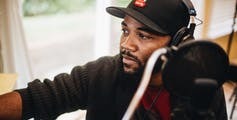 ‘i used to love to dream’ is a semi-autobiographic take on Carson’s life growing up.
Amy Jackson, CC BY
For instance, since the album is semi-autobiographical and I am from Decatur, Illinois, I note how in May 2020, my hometown was listed as America’s third-fastest shrinking city. Since my album deals with Black life, I note how USA Today ranked Decatur as one of “the 15 worst cities in America for Black people” in terms of various metrics, such as household income, educational attainment, homeownership, incarceration and life spans.
My album – which is free and open access – deals with topics that range from race and justice to identity and citizenship.
‘i used to love to dream’ by A.D. Carson.
Confronting societal illsIn the lyrics, I reflect from where I am now – in my career as an assistant professor of hip-hop at the University of Virginia in Charlottesville – on my memories growing up and living in the central Illinois town.
The content of the album demonstrates this, covering issues like the war on drugs and its legacy in the 1980s and 1990s and contrasting it with the current opioid crisis on the song “crack, usa”; the seeming inevitability of police killings of Black people and how we might prepare ourselves and our loved ones on “just in case”; and the trap of incarceration and institutionalization presented on “nword gem.” It also provides space for processing mental health matters like trauma, alienation, alcoholism and depression with tracks like “ampersand,” “stage fright” and “asterisk.”
I published my album with University of Michigan Press because I believe it’s important that hip-hop – and hip-hop scholarship – occupies a space that’s not an “exotic other” and, instead, functions as a way of knowing, similar to, but distinct from, other resources such as a peer-reviewed paper or book.
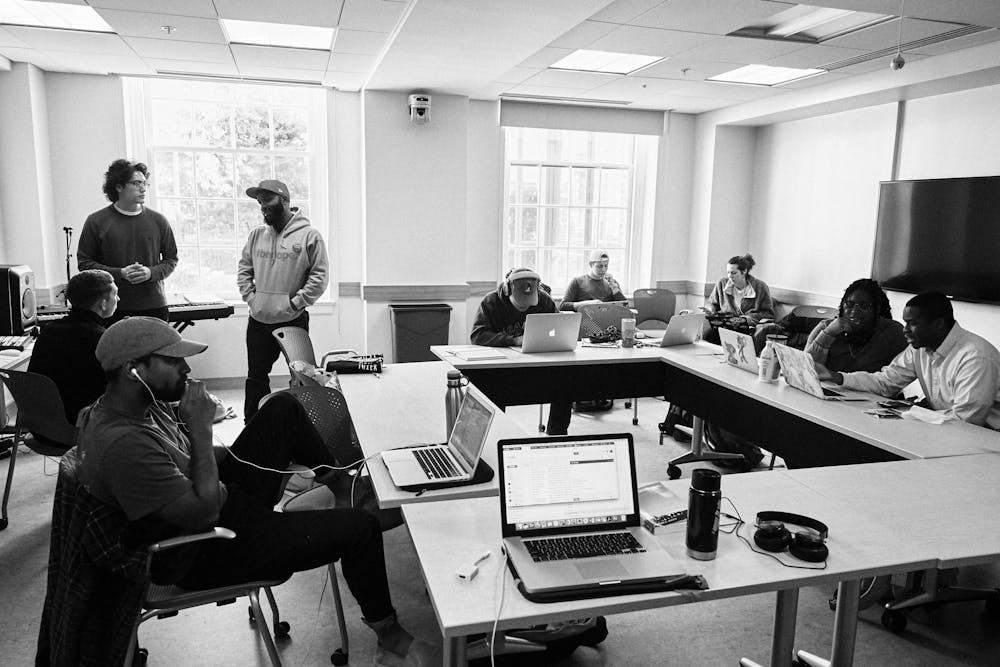 Professor A.D. Carson and students in the Rap Lab at the University of Virginia.
Miguel ‘MiG’ Martinez, CC BY
In order to review my album as an academic work, the academic publisher had to “come up with appropriate questions for the evaluation of a sonic, rather than written, work.”
“The press’s standard peer review questions consider purpose, organization, and audience,” the University of Michigan Press has stated. “While many of those general themes were captured in the questions developed for ‘i used to love to dream,’ the process for coming up with new questions was much more collaborative.”
Is higher ed ready?I must admit – both before and during my doctoral studies – I was skeptical of the formal peer-review process. My thought was, what is the university to ask hip-hop to prove itself?
But my skepticism faded once I saw the responses from the anonymous scholars who reviewed my album. Based on their insightful feedback, I got the sense that they truly understood Black music and Black rhetoric. They encouraged me to consider how to present the album online in a way that would help audiences better understand the content, which is part of the reason I included the short documentary about the making of the album.
[Get the best of The Conversation, every weekend. Sign up for our weekly newsletter.]
This is not my first academic foray using rap. I actually earned my Ph.D. for writing a rap album.
I appreciate that hip-hop is sometimes celebrated in the academic world, but it seems to me that a lot of the excitement focuses on hip-hop as a particular kind of content rather than what it teaches people about other things in the world, many of which aren’t hip-hop.
For me, hip-hop is like a telescope, and the topics I discuss are like celestial bodies and galaxies. Taking that astronomical analogy a step farther, I would ask: Does it make sense to spend more time talking about the telescope that brought those faraway objects into focus and a sharper view? Or should more time be devoted to discussing the actual phenomena that the telescope enables people to see?
I can fully understand and appreciate how hip-hop – being not just a telescope but a powerful telescope – would generate a fair amount of discussion as a magnifier. At the same time, at some point society should be able to both focus on the potency of the lens of hip-hop and also concentrate on what hip-hop brings into view.
A.D. Carson, Assistant Professor of Hip-Hop, University of Virginia
This article is republished from The Conversation under a Creative Commons license. Read the original article.
January 28, 2021
“i used to love to dream” wins a Prose Award from the Association of American Publishers
“i used to love to dream,” by A.D. Carson, was named a 2021 Prose Category Award Winner (Best eProduct).
Read the full list of winners here.
“the good folks at @uofmpress informed me that “i used to love to dream”
has been named a prose #categorywinner by @americanpublish!
many thanks to them & congrats to the other winners! listen to the album if you haven’t. if you have, listen again & share with friends!” pic.twitter.com/qMuhjeN5mC
— A.D. Carson (@aydeethegreat) January 28, 2021