
Meredith Henne Baker's Blog
August 17, 2015
Genealogists: New Sources on Fire Victims Added!

Joseph Gallego, whose wife Mary Gallego and daughter Sally Conyers both perished in the fire. He survived. From The Valentine collection, Richmond, VA
Are you related to a Theater fire victim or survivor? Do you want to dig in and start researching their lives? I have a few recommended places for you to start!
First, check out my victims list with its new bibliography addendum at the bottom of the page. Next, check out the survivors page, which is a recent addition. Information about both victims and survivors is updated and added on to whenever I have a few minutes, so check back for more information.
You can also do as other readers have, and contact me directly about certain people connected to the fire. I might have the information you need or can point you to a resource or archive that may help you. I can be reached at meredith @ theaterfirebook.com and will do my best to help answer your questions!
–Meredith

Where should you start researching? Let me help!



August 14, 2015
Early Republic Spots to Visit on Capitol Hill

Christ Church Washington Parish (620 G St SE)
Are you a history enthusiast and/or Regency Society of Virginia member who is coming into D.C. for my Regency Society talk on August 22nd?
First of all, thanks!
Secondly, there are some places you may want to visit while you are here.
credit: http://www.williammaloney.com/aviatio...
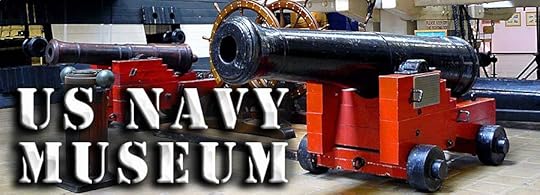
1. The National Museum of the US Navy has an 1812 exhibit up and is interesting and under the radar. It’s open 10 to 5 on weekends, has parking, and is only about 6 blocks from Christ Church. The Washington Navy Yard is historic itself (that’s where the museum is located), but visitors do have to present ID at the 6th St./M St gate if they don’t have a military ID. Vehicles may be brought in and there is a parking lot right across the street from the museum.
2. This free walking tour of the Eastern Market/Barracks Row/Navy Yard neighborhood is also a fun one and spans a few centuries of history. You can DIY and stop anywhere that looks interesting along the way.

3. Congressional Cemetery is about a mile east near the river. This link has a variety of downloadable guides on over a dozen themes, including Building the Federal City, the War of 1812, and the Burning of Washington DC!
4. One more thing–The Library of Congress is less than a mile away and has an exhibit on reassembling Jefferson’s original library.
You’ll certainly enjoy the location of the talk as well: Christ Church Washington Parish. The National Park Service website on the early days of Washington D.C. tells the history of this building:
Christ Church, the city’s first Episcopal parish, is a Gothic style church extraordinarily rich in both cultural heritage and visual beauty. Several early Presidents worshiped here such as James Madison and James Monroe, as did the U. S. Marines who lived at the nearby Marine Barracks. Thomas Jefferson regularly attended services at the old tobacco warehouse church where services were held until 1807, when the present site near the Navy Yard was donated by William Prout. Although there is some debate, Benjamin Latrobe, one of 19th-century America’s greatest architects, is generally attributed with the design of the church. Latrobe is also well known for his contribution to the construction of the Capitol. One of Christ Church’s most prominent recent members was John Philip Sousa, the celebrated bandmaster and march composer. He was married here, and is now buried in the Church’s cemetery, Congressional Cemetery, which is the unofficial resting place for members of Congress.
The rental of pews provided the parish’s chief source of income. Three free pews were regularly reserved: one for the President of the United States; one for the donor of the land, Mr. Prout; and one for the rector’s family. When the first service was held on August 9, 1807, the church was known only as the “New Church in the Navy Yard.” The vestry formally adopted the name “Christ Church” on August 20, 1807. The church’s first rectory was built in 1824. The bell tower, added in 1849, was used as an observation post during the Civil War. The present Parish Hall was built in 1874. In 1924, the first rectory was razed and the present one was built on the same site. The Crucifixion window at the end of the chancel, a memorial to mothers, dates from 1927. In 1966, a two-story addition to the Parish Hall was constructed and dedicated to the memory of Rev. Edward Gabler, the priest and rector from 1928 to 1944. This architectural treasure is still dedicated to public worship.
Thinking about sticking around for dinner? The food scene here on the Hill is fabulous, with Bon Appetit’s Best 2014 New Restaurant (Rose’s Luxury), the historic Eastern Market grocery and food extravaganza (with its weekend flea market), and loads of specialty eateries at all price points provide loads of options for lunch or dinner.
Enjoy!
July 21, 2015
Upcoming Regency Society Talk in Washington, D.C.

The Regency Society of Virginia is hosting my lecture on the Richmond Theater Fire next month on Capitol Hill. The RSV is an organization that keeps the history of the Early Republic alive in many interesting ways. (Check out the RSV Facebook page for more information and photos from their events!) The event is free. More information to follow!
August 22, 2015 – Richmond Theater Fire Lecture
Washington, DC
If you are an adult, chances are that you can recall a tragic news story in your lifetime that you are not likely to ever forget. For many in the early republic, that news item was the Richmond Theater Fire. The December 26, 1811 tragedy claimed the lives of over 70 men, women, and children–including the Governor of Virginia–and yet few are aware that it even happened today. Join us at historic Christ Church in Washington, DC to hear Meredith Henne Baker, author of the award-winning book, The Richmond Theater Fire: Early America’s First Great Disaster, tell us the stories of tragedy and heroism of this often overlooked event. Further details and registration information will be posted soon.
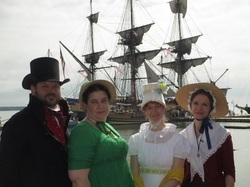
RSV members greet the L’Hermoine in Yorktown, 2015
June 4, 2015
RTF Book in Latest Issue of Marquee Magazine!
The T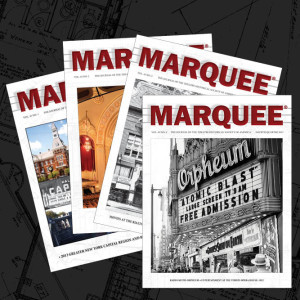 heatre Historical Society of America‘s quarterly journal, Marquee, focuses its latest issue on Richmond Theaters. Of course you can’t write about Richmond Theater without mentioning the 1811 Theater fire, and they give it its due in a very nice article. The author features a quote from me and very graciously directed her readers to my book and website for more information on the event. Thank you, Theatre Historical Society!
BTW, their annual “Conclave” meeting will be held in Richmond this month (6/23-28), and you can find more information about it here. They host a Virginia theater tour over several days that ventures to sites of dramatic importance from Staunton to Norfolk to Washington, D.C.
Have some more questions about what the Theatre Historical Society does? Based in Elmhurst, IL, they do a great deal to preserve the historical record, and have an archive (partially online) composed of “photographs, negatives, slides, postcards, artists’ renderings, scrapbooks, books, periodicals, business records, blueprints and architectural drawings, supplier and trade catalogs, architectural artifacts, theatre furnishings, ushers’ uniforms, and numerous other items our collections relating to theatre buildings and their cultural and social history.” They host educational programs and tours, fund fellowships, give a book award, and collaborate on museum exhibits.
March 30, 2015
A 9-day Governor, Famous Painter Thomas Sully, and the Richmond Theater: Art & History Intersect!
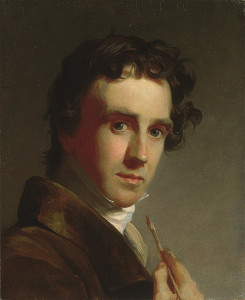
Self-Portrait of Thomas Sully, Metropolitan Museum of Art
Artist Thomas Sully was one of the most sought-after portrait painters in America in the early 19th century. (His painting of Andrew Jackson is on that $20 in your wallet.) What connection did this famous artist, based in Philadelphia, have with Richmond and the 1811 Theater Fire? As it turns out, an interesting connection indeed!
Thomas Sully’s parents, Matthew and Sarah Sully, emigrated from England with their nine children, joining the West & Bignall company in 1792 at a time when the fledgling touring troupe needed to expand and add more talent. (Matthew Sully’s sister Margaret had married W&B’s manager/actor Thomas Wade West, and this provided their connection to this particular troupe, which was the predecessor for the Placide & Green touring troupe which was performing the night of the fire in 1811.) West & Bignall were renowned for the quality of their actors, which included Eliza Arnold Poe, mother of Edgar Allan Poe.

The Green Room Backstage at the old Richmond Theater by Benjamin Henry Latrobe
Unlike other companies that relied on stock scenery, this was a design-conscious company with artistically thought-out shows, elaborate scenery, creative special effects, and custom-designed costumes for productions. The exhibition Thomas Sully: Painted Performance, hosted by the Milwaukee Art Museum, claimed that his “lifelong love of the theatre and performance …permeates all his works.”Perhaps his experience in Richmond among the novel scenery and props provided the inspiration for some of these paintings?
While in Richmond, the Sullys performed at Quesnay’s Theater, a vast warehouse of a building originally intended to be an academy. It was prone to break-ins and drafts, and burned in 1798. The Wests later created a more appropriately sized (but cheaply constructed) performance space when they built the doomed Richmond Theater in 1806.
The Sullys included their young ones in their traveling and performing lifestyle, and spent the seasons of 1792 (August through December) and the 1793 season (Sept – Dec) in Richmond. Theater historian Martin Shockley writes, “I imagine little Sullys peering from the wings as their elders trod the boards or flew through the air with agility and grace, while the youngest fell asleep backstage. I hope there was a governess, but I fear there was not. I put Mrs. Sully down as a gallant lady and a great Trouper.” (The Richmond Stage, 1784-1812, p. 75) Mom Sully was not among the performing Sullys in the 1793 season according to newspaper cast lists, and by July of 1794 had died. The Sully family then relocated for a time to Charleston, S.C.
So we have here a connection between the child Thomas Sully and the Richmond stage, but how was he connected to the later Theater fire? Through his painting, naturally.
As a young man, Thomas Sully studied under several artists in the South before establishing a studio in Philadelphia. He opened his first studio in Richmond in 1804, but had to leave Virginia after marrying his brother’s widow–an act considered immoral under the law at that time. (So let’s review early 19th c. Virginia morality: selling human beings = socially acceptable, marrying your widowed sister-in-law = a shocking disgrace.)
In the city of brotherly love, Sully became a successful painter, teacher, and entrepreneurial businessman who regularly painted favorite actresses and actors as well as wealthy and fashionable citizens. One of the two thousand portraits he created was a handsome oil painting of Peyton Randolph, a scion of the prominent Virginia family, in 1806.

And here comes the Richmond Theater connection: Randolph would serve as the interim governor of Virginia for a week and a half after the Richmond Theater fire of 1811 killed Governor George Smith.
Who was Randolph? Peyton Randolph (1779-1828) was a lawyer, married to Maria Ward and father of 10 children. A Democratic-Republican on the Council of State from 1809-1812, he later became a reporter of the Virginia Supreme Court of Appeals and wrote a 6-volume record of all the cases heard in the VA Court of Appeals from 1823-1832. Does his name sound familiar? Well, he was NOT the Peyton Randolph with the marvelous red house in Colonial Williamsburg. That Peyton Randolph was his uncle and the president of the first Continental Congress. The elder Peyton Randolph was brother to Edmund Jennings Randolph, father to the Peyton Randolph in Thomas Sully’s portrait. All three gentlemen served as Virginia governors. Again, very prominent family, these Randolphs.

Old Uncle Peyton Randolph of Williamsburg, VA… NOT the Peyton Randolph painted by Sully in 1806! Picture courtesy Colonial Williamsburg
After George Smith’s death in the the blaze on December 26th, 1811, this governorship was thrust upon Peyton Randolph who was the senior member of the Executive Council and only 32 years old. He served for about nine days. It seems it didn’t go very well.
During his brief term, on December 31st, 1811 Randolph submitted a strained memo to the legislature. “This unhappy occurrence [of Smith’s demise]…has left the Executive Department in such a state of disorganization as to create serious doubt whether under the existing laws, there is any [one] competent to discharge the important duties which belong to that branch of the government. Feeling myself great reluctance to exercise powers which are in any degree doubtful, it will not be deemed improper of me to suggest the expediency of supplying the vacancy, as soon as possible.”
One of the reasons for the turmoil was an excessive churn of Governors in 1811—the position had changed hands 4 times that year alone! Now poor Randolph was a hamstrung interim leader and he wanted out. On January 3rd, 1812, the House of Delegates elected Speaker of the House James Barbour, a wealthy Presbyterian lawyer and the Delegate from Orange, to take Smith’s place. (Barbour would be the first to live in Virginia’s Executive Mansion.) Not a month previously, Smith had defeated James Barbour in the gubernatorial election by joint ballot of both houses of the Legislature.
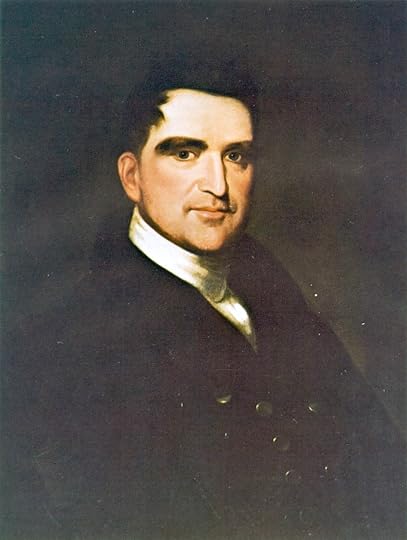
James Barbour, Governor of Virginia from 1812-1814. Owner of a very imposing set of eyebrows.
Few of Sully’s early works, such as the Randolph painting from his days in Virginia, survive. Chairman of the Wilton House Museum Board, Brenda Parker, says “We are thrilled to welcome Peyton Randolph home to Wilton and to share this important example of Thomas Sully’s portraiture with our museum visitors.” Go visit Peyton Randolph, on display in the second floor of the Wilton House Museum if you have a chance, and enjoy seeing a portrait by an artist who knew both Richmond and the stage: Thomas Sully.

Wilton House
March 2, 2015
Wilton House Symposium Photos

The Wilton House in Richmond, VA: a historic residence of the Randolph family and a Colonial treasure in the West End! On February 6, 2015 it hosted the Thomas Sully and Early Republic Richmond Symposium, which I will allow them to introduce: “One of America’s greatest portrait painters, Thomas Sully (1783 – 1871) spent formative years painting in Richmond receiving commissions from some of the Old Dominion’s most prominent citizens such as Governor Peyton Randolph (1779 – 1828) until a romance with his sister-in-law forced the artist to leave the state. Noted speakers from across the country will present a cross-disciplinary exploration of the nineteenth-century artist and his times, a twentieth-century collector, and twenty-first century conservation challenges.”

Meredith Henne Baker (me), Scott Nolley, Craig Reynolds, William Rudolph, and Mary Levkoff
I had the good fortune to be one of the speakers and gave a talk on early 19th century Richmond and the Theater fire. This fantastic artist, Thomas Sully, came to America with his parents, who were gifted actors, in the late 1700s. The Sullys immigrated to be part of a troupe based in Richmond (and their many children performed too). Later, Thomas Sully, child of the stage, would paint Peyton Randolph’s portrait. Randolph was the Governor of Virginia for about 9 days after the Richmond Theater fire killed Gov. George Smith on Dec. 26th, 1811. Certainly an interesting connection: the Richmond stage brought Sully to American shores and also propelled one of his portrait subjects into the Governor’s seat.
The other presenters were Craig Reynolds (architectural history), Scott Nolley (restoration), William Rudolph (Chief Curator, San Antonio Museum of Art), and Mary Levkoff (Hearst Castle Museum Director). If you have a chance to hear any of them give a talk, you should. The food was plentiful, the participants had great questions, and Wilton House staff & supporters proved gracious hosts. Looking forward to their next symposium (and their forthcoming exhibit of St. Memin portraits)!
In his new home at Wilton House: Peyton Randolph, the 9 day governor of Virginia (he temporarily took over after the sitting governor was killed in the Richmond Theater fire in 1811). Newly restored, he is looking quite dashing in his portrait by Thomas Sully!

This house has amazing paneling. (Also thoughtful storage, which is not usually the strong suit of a colonial home…)

A stunner of a staircase.
January 26, 2015
Historic Night Revisited: Henley Street Theater Performance at Monumental Church

Imagine yourself in a box seat hearing the lines from “Our American Cousin” performed at Ford’s Theater in Washington D.C. Are you sitting forward, listening with gravity (and nagging fear), knowing that these lines were some of the last words that Abraham Lincoln would ever hear?
That thrill is the kind of feeling over 200 Richmond theatergoers experienced last week, on Tuesday, January 20th, when the Henley Street Theater performed two shows in Richmond –“The Father, or Family Feuds” by Diderot and the melodrama “Raymond and Agnes, or the Bleeding Nun.” These shows together have not been performed on a Richmond stage in 200 years–since the night of the deadly Richmond Theater fire on December 26th, 1811. To add to the historical interest, the event was held at Monumental Church, the memorial to the Theater fire victims, which was built directly over the grounds of the old Richmond Theater and the crypt which contains the remains of the 72 victims.
This performance, which was well attended by over 200 people, was part of a historic play reading series, and the plays were abridged (the originals were hours long!) and re-enacted with minimal props and scenery. (You may hear some of the performance here: WVTF NPR Charlottesville’s Arts and Culture beat.)
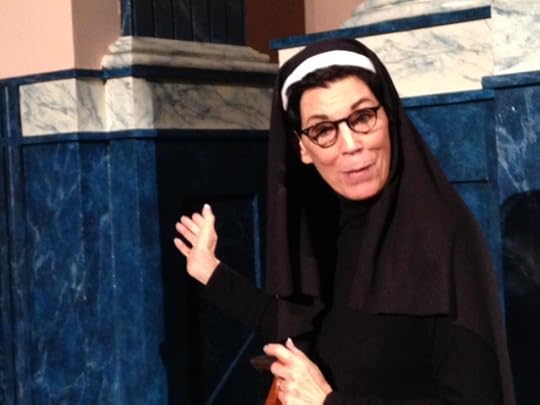
WVFT Charlottesville, Actress Mollie Ort
Jacquie O’Connor, managing director of Henley Street/Richmond Shakespeare described in Richmond Magazine how the company chose to conclude the performance: “The readings will actually stop at the exact same place that the people in the Richmond Theatre noticed the fire back in 1811.” This was surprisingly moving. Shortly into the second act, the lights began to turn red, one by one. The players slowly walked to the front of the stage and stood in silence. The actor playing the part Hopkins Robertson played in 1811 stood in disbelief, like Robertson had, and said in amazement and horror, “The theater is on fire!” Curtain.
Style Weekly reported: “We’re trying to make that moment as historically accurate as possible,” says Melissa Rayford, who directs both plays. “It gives me chills to think about it, and how all those people who perished in the fire will be underneath our feet and haven’t heard those words since it happened in 1811.”

I was honored to be part of the panel discussion which followed the show, along with the Library of Virginia’s Gregg Kimball, Olivier Delers of the University of Richmond, Emily Davis of Historic Richmond, staged reading director Melissa Rayford and the cast. (Virginia audiences have the best questions.)
And what about the plays? The content was a bit beside the point, at least for me, and it was very melodramatic–lots of “I shall perish with love!” sorts of discourses and maudlin characters. The company absolutely made the best of it, though, and the audience sat rapt, erupting in laughter and applauding enthusiastically for the clever and engaging performers. I was talking afterward with Harry Kollatz, who does a fine one-man performance about the night of the fire, and he made the point that the upstairs/downstairs nature of the plots, with spying servants and nobles marrying below their station was no more far-fetched and goofy than your average episode of “Downton Abbey!” True.
Thank you, Henley Street Theatre, Historic Richmond Foundation, and all audience members (especially those from the Virginia Regency Society who came in historically accurate garb!) for making this a historic night to remember. I was so grateful for the opportunity to share in the experience and hear these readings. Remembering with empathy the actual people behind any disaster, historic or current, is always a challenge. This production called to mind not only that December night–a turning point in Virginia history–but also the human beings present that evening: the actors who trod the boards and the audience in their box seats, leaning forward to hear Diderot’s lines in their last night on earth.

January 5, 2015
January 20th, 2015: Richmond Shakespeare/Henley St Theatre to Perform Plays from 12/26/1811
Henley Street Theatre and Richmond Shakespeare will be performing readings from the set of plays that were heard the night that the Richmond Theater burned in 1811 on Tuesday evening, January 20th at 7pm.
That historic night in 1811 was a turning point in Virginia history and the greatest urban tragedy of that time. Now those interested in Virginia’s fascinating past can experience the sounds of that evening on the very site of the fire. The readings will be performed at Monumental Church on Broad Street, which was constructed over the remains of the theater fire victims. The last time I know of one of these plays being performed in Richmond was 1933, so this is truly a once in a lifetime event!
Join us for the performance and a discussion afterwards, featuring Gregg Kimball of the Library of Virginia, Emily Davis of HRF, the director Melissa Rayford, and the cast. I will also be on the panel and can’t wait for this incredibly unique and historic performance!
Press release here: Henley Street Theatre and Richmond Shakespeare – The Theatre Fire

November 20, 2014
New 2015 Events Booked!
How wonderful to be invited to participate in two fantastic Richmond events related to Early Republic Richmond! I’m in! The Wilton House Symposium and the Henley Street Theatre’s Historical Play Readings Series have asked me to join them for events in January and February of next year. Details may be found on the events page of the website or below.
Both are tremendously exciting: the Wilton Museum will be showing a newly-acquired portrait by Thomas Sully which I am eager to view. I am also looking forward to a tour of this important museum. Henley Street Theatre will be giving readings of the two plays performed the night of the Theater Fire in 1811–this has never been done before to my knowledge, and is an amazing opportunity for Richmond history or theater history fans.

courtesy http://www.wiltonhousemuseum.org/
courtesy http://rvanews.com/
Wilton House Museum Symposium: Thomas Sully and Early Republic Virginia
The Wilton House Museum, Richmond, VA
February 6, 2015
In celebration of Wilton House Museum’s
Recent Acquisition. Friday, February 6, 2015
One of America’s greatest portrait painters, Thomas Sully (1783 – 1871) spent three formative years painting in Richmond, receiving commissions from some of the Old Dominion’s most prominent citizens such as Governor Peyton Randolph (1779 – 1828) until a romance with his sister-in-law forced the artist to leave the state. Noted speakers from across the country will present a cross-disciplinary exploration of the nineteenth-century artist and his times, a twentieth-century collector, and twenty-first century conservation challenges.
$45 Symposium fee includes the presentations, coffee, boxed lunch, and optional tour of Wilton House Museum.
Find the program for the day-long symposium here and register at this link.

The church beautifully lit at night.
Henley Street Theatre / Richmond Shakespeare 2015 Historical Play Reading Series
The Father, or Family Feuds by Denis Diderot and Raymond and Agnes, or The Bleeding Nun by Matthew Gregory
Presented on Tuesday, January 20, 2015 at 7pm at Monumental Church.
Scandals and Tragedies: Theatre in the Headlines of History
Join us for this thrilling new series of four captivating and entertaining plays rooted in the history of Richmond, the U.S., and the world – from 9/11, to the Richmond theatre fire, to late 19th century riots in Paris, to Lincoln’s assassination! We’ll have RVA’s finest directors and actors bringing these rarely-produced gems alive on our stage, joined by some of the area’s most respected scholars and theatre artists for lively and illuminating talkbacks following each production. As a historian of Early Republic Richmond and the Richmond Theater fire, Meredith Henne Baker will be part of the panel following this performance.
The Father, or Family Feuds by Denis Diderot and Raymond and Agnes, or The Bleeding Nun by Matthew Gregory Lewis. On December 26th, 1811, an excited crowd of theatergoers had packed themselves into the Richmond Theatre to see a double bill of a play and a pantomime. The play was The Father, or Family Feuds, a translation from French comedy by Diderot, about a young nobleman who falls in love with a poor girl. His family threatens to send her to a convent—and much hilarity ensues. The pantomime that followed it was Raymond and Agnes, or The Bleeding Nun—a Gothic story of the Bleeding Nun who haunts the castle of Lindberg.
On that fateful night, 518 adults and 80 children were enjoying the performance in the Richmond Theatre on Broad Street, when a chandelier in the theatre started a fire. The flames were fed by the hanging drops on the stage and soon roared out of control. The audience panicked and stampeded the doors. 72 died in the fire: 54 women and 18 men, including Governor George William Smith, and former Senator Abraham Venable. It was the worst urban disaster of all time in the country.
We will present our reading at the Monumental Church, which was built on the grounds of the theatre as a memorial to commemorate the 72 people who died on the site.
Tickets may be purchased here.
October 24, 2014
Fire Victim Benjamin Botts: a Virginian of Distinction
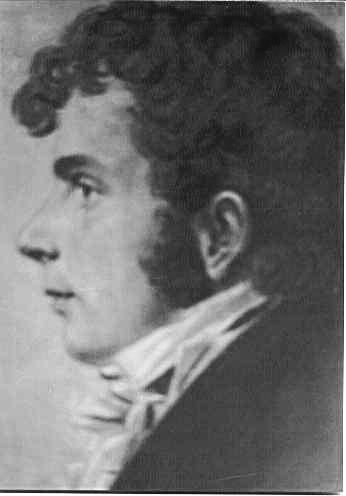
Benjamin Botts from findagrave.com
I have just updated the list of victims with more information about the fascinating Botts family. Benjamin Botts, who perished in the fire with his wife Jane, was a prominent member of the Richmond bar and served as the defense for Aaron Burr in his 1807 treason trial, which was held in Richmond before Chief Justice John Marshall. Botts’s lengthy obituary from the Richmond Enquirer is below. (They certainly don’t write ’em like they used to!)
Richmond Enquirer, Jan. 4, 1812 [my transcription]: “When he died, he was in the 36 or 37th year of his life. He was the father of four sons, and one daughter, who, at the same moment, were deprived of both their parents. Their mother and their father perished together. From a short sketch of his life young men may learn a valuable lesson: from the manner in which he was deprived of it, all of us are admonished that “in the midst of life we are in death,” and to act accordingly. Benjamin Botts was born in obscurity—Poor and friendless, he had not the advantage of a liberal education. His grand-father had taught him to read and to write.—Fortunately for himself, and for his family, he wrote well. Chance brought this talent, within the view of a merchant, who wanted at that moment the services of a youth like him. He was taken into a store, where he performed his duty with a firmness of fidelity, which strange as it may seem, obliged his merchant to dismiss him. But, altho’ dismissed, he carried with him the confidence and approbation of his employer Conscious of his own energies, he turned his attention to the law, and found an asylum in the family of Gert. Minor. Under the patronage and direction of this most worthy and benevolent man, he prosecuted his studies, and about the year 1794 commenced the practice. His integrity, his industry, & his talents soon became conspicuous; and in a few years. He was ranked among the most respectable members of his profession. In the year 1809, he removed from Fredericksburg to this City, and here he resided until his death, prosperous in his affairs, happy in his family, beloved by many, and respected by all. Possessed of health, preserved by undeviating temperance, of unexampled equanimity, acquired and preserved by unceasing watchfulness over his feelings, and of independence obtained by his own individual exertions, he had reason to expect and his friends to anticipate for him, and long and complete enjoyment of every blessing that could arise from causes like these, and from the daily exercise and indulgence of the best and tenderest affections of the human heart. If the friends of Mr. Botts have cause to lament his untimely death, how much more reason have his relatives and connections to deplore it forever! He was their friend, their benefactor. An aged mother, a widowed sister, with many helpless children looked to him only for protection and support. As a son, he was most dutiful, as a brother affectionate, as a kinsman most friendly and liberal. Let it be remembered too that his delicacy was equal to his generosity. But for the event of the 26th of Dec. his friends, here at least, would never have known, the extent of his benevolence, and the number of those who depended upon it, for the principal comfort of their lives. Benjamin Botts was eminently distinguished for his firmness and self possession. He would not suffer himself to be excited. An incident, which took place while he was yet very young, had taught him the wisdom of self-control and it was one great object of his temperament. By unwearied labor & attention he did acquire it. This unmitigated effort had stamped upon his features a gravity which belonged not to his period of life, the real state of his feelings, or his own condition, domestic, professional, or social. Always [?] deliberate, and attentive, his estimate of men and things, was almost inevitably correct….No man of his age was a better adviser. Tho [?] of society, and always disposed to participate in conversation, his composure and gravity were seldom laid aside. When he spoke, he seemed always to communicate the result of previous reflection. This circumstance gave him great advantage in colloquial debate. He appeared to be convinced that he was in the right: and so imposing was his manner, that those who were not informed upon the point under discussion, generally took it for granted that he was so. Steadfast and persevering in the support of his opinions, he encountered with equal composure, the strength of argument and the dexterity of wit. Mr. Botts was a man of sound judgment and a good lawyer. Indefatigable in his pursuits, he had acquired great knowledge in his profession, and was particularly distinguished for his skill in the management of a cause preparatory to its final decision. He was not an orator. He had not the advantage of figure, of gesture or of voice. His stature was low, his action slow and feeble, his voice shrill, solemn, monotonous. In addition to this, his style, peculiar to himself, was not happily constructed. His sentences were sometimes long, involved, and therefore somewhat embarrassing to all but an attentive auditor. Yet he was always heard with respect by the Court, and with interest by the bar. The cause is obvious. He seldom if ever failed to investigate with diligence the subject which he proposed to discuss: and having the benefit of a tenacious memory, his understanding naturally acute, and rendered still more so by perpetual exercise, enabled him to proceed with ease to himself, and pleasure to his hearers, through all the mazes of the most subtle and intricate discussion. The above is an outline of the character private and professional of Benjamin Botts. It is roughly but faithfully drawn. At least it was intended to be so. In speaking of the dead, we commonly consult our feelings more than our understanding, and say what we wish to be believed, rather than what we know to be true. Thus the faults of old friends are generally buried in the same grave with themselves. This species of moral interment is, perhaps, what charity requires, & it is not clear that justice forbids it. But the fault, if this be one, does…stop here. Seduced by tenderness for the dead, or sympathy for their surviving relatives, we too often ascribe to them talents which they never possessed, and virtue which they seldom practised [sic]. However common this error may be, this writer thinks that he at least has kept himself beyond its reach… Let it be believed, then, that the writer though he may be partial, is at least, unconscious of being so, and that in the duty which he has just performed, he has felt and spoken as if giving testimony, before the world.”
You can learn more about Burr’s trial here.


