Leslie Helm's Blog
June 16, 2023
Fukushima blog Yoichi Tao unlocks and raises the steel ba...
Fukushima blog
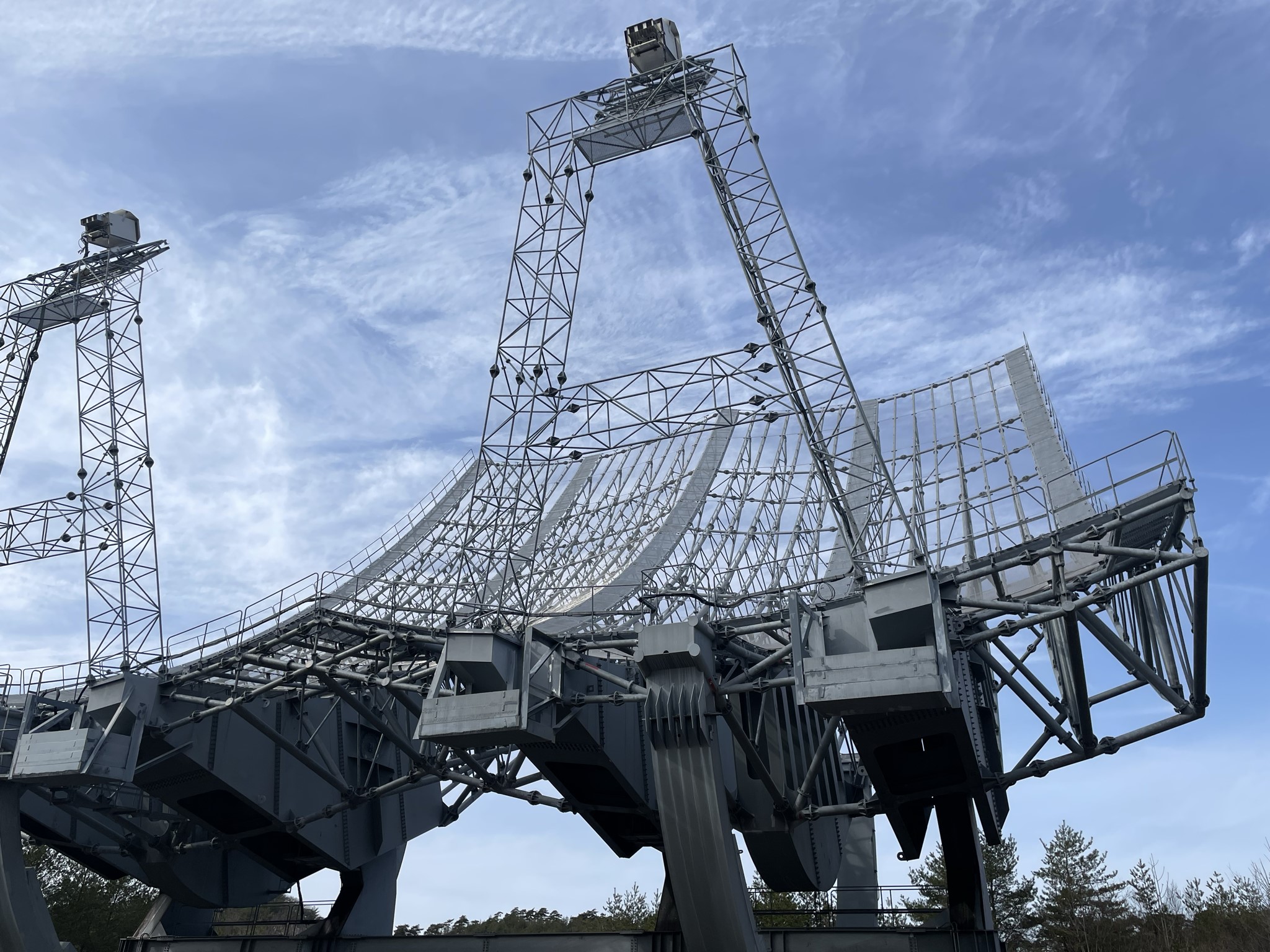
Yoichi Tao unlocks and raises the steel barrier blocking the dirt road. “This area Is off limits, but they let me have the keys,” he says. A few minutes’ drive through dense jungle where monkeys scamper across the road, we reach the hilltop home of the Iitate Planetary Radio Telescope. It was built in 2000 to measure solar flares. A massive radar shaped like a cupped hand still towers over the facility, but the telescope had to be moved in 2011, when radiation from the meltdown of three nuclear reactors along the coast drifted here, making it dangerous for scientists to continue their work here.
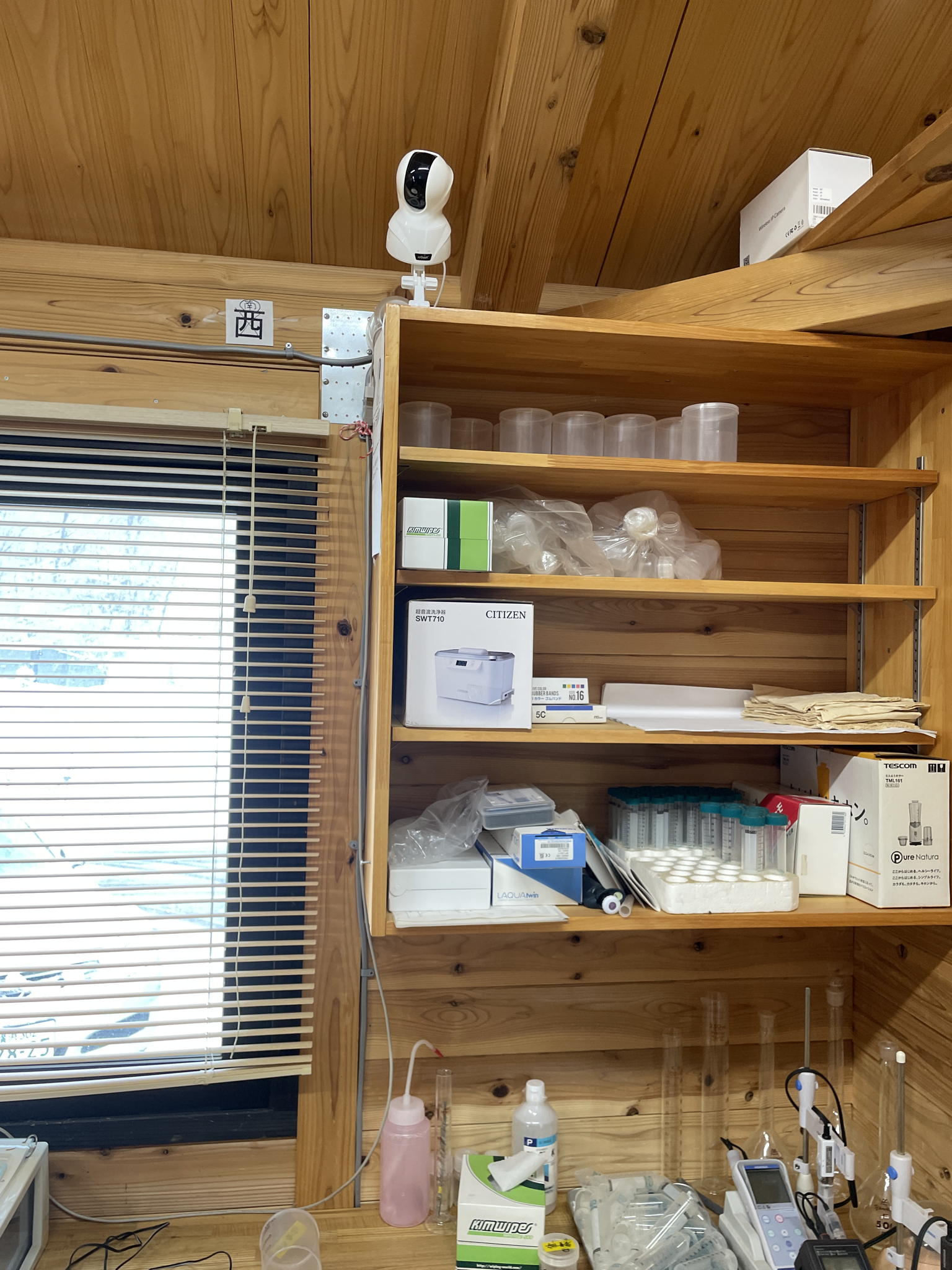
Tao pulls out his Geiger counter to show me that the radiation level remains high today 12 years later, because it snowed that day bringing the radiation down to the ground and into the region’s rivers and lakes. But Tao gets angry at those who say the region should be abandoned. Although mushrooms foraged in the surrounding forests still contain unhealthy amounts of radiation, vegetables, meat and other food products from the region are tested regularly and have been healthy to eat for years.

Tao is founder of the Fukushima Sansei no Kai, whose goal is to promote the revitalization of Fukushima. It’s a challenging task. On the one hand, he wants to lure people back to the sprawling village that has shrunk to less than 2,000, one third the size it was before the accident. On the other hand, he wants to underscore the harm the nuclear accident caused the entire region so that the government will spend more money to support efforts to revive the region.
Tao moved to the region in 2017, when the government announced it was safe to return. Tao who grew up in Hiroshima where the first atom bomb fell, says has felt a kinship to those in IItate whose lives have been disrupted by radiation. A former physics student who was expelled from Tokyo University for participating in demonstrations, and later became a top executive at Secom, the nation’s leading security services provider, Tao tapped his extensive contacts in Tokyo to help recruit health workers, scientists and agricultural experts to the region to help establish necessary facilities including equipment for testing food for radiation so villagers could feel safe eating the rice and vegetables they grew. Although such tests did find some elements of cesium in early tests, he says that with the exception of the food foraged in the forests, all food is grown in the region is now safe to eat.
Tao says the nuclear meltdown should not be seen as an accident. It was the result of a series of poor decisions Japan made to prioritize rapid growth and heavy energy use over health and safety. The 2011 nuclear meltdown occurred when a massive earthquake launched a tsunami that flooded a nuclear facility along the shore cutting off its power supply. The backup generators for the plants had been placed in the facility’s basement in line with a General Electric design whose goal was to protect the power supply from tornados. There was little concern about tidal waves because the utilities believed any threat from the sea would be stopped by the 19-foot seawall they built nearby. They never expected there would ever be a 42-foot wave like the one that crashed over the seawall in in 2011, flooding the nuclear reactor, flooding the back-up power plants below, and making it impossible to shut down the plants in time to prevent three of six nuclear reactors in the facility from melting down. An emergency center established a few miles away was also cut off from power, leaving the center unable to access a special computer that was supposed to tell authorities in which direction the radiation would go.
As bad as the original design of the nuclear plant was, Japan’s response was equally poor. The tidal wave that washed over the sea wall and onto the nuclear power plants also swept through the nearby Ookawa Elementary School. Teachers at the school had received a tsunami warning but couldn’t make up their minds as to whether to evacuate. Their indecision contributed to the death of a 100 people, the first of some 2,000 people who would die as a direct result of the tsunami and the nuclear accident. The ravaged remains of the school have been preserved as a memorial to the students and a reminder of the many poor decisions that magnified the impacts of the Fukushima disaster.
In the first days after the disaster, neither the utilities nor the Japanese government shared with the public the extent of the danger they faced engendering deep distrust. And when the nuclear facility started releasing radiation to prevent the reactor from exploding, the Japanese government told residents to move away at first three miles, then 15 and finally 30 miles. Tens of thousands moved to distant towns and cities. But many residents initially evacuated to the hills in nearby Iitate, 15 miles away. Only later did they learn they had moved to the very area where the wind was taking the radiation.
“The radiation released by the nuclear plants was swept by the wind up here against the mountains,” says Tao. The snow then carried the poison cesium into the soil, the region’s rivers, and its lakes. “The government had supercomputers measuring the weather; they knew which direction the radiation was going,” says Tao. “They should have been warning people to avoid the Iitate area.”
Tao is one of dozens of idealists who have moved into the Fukushima area with the hope of bringing life back to a village that has shrunk to less than 2,000 residents, a third the population it had before the nuclear accident. Tao, who studied physics at Tokyo University, was expelled from the prestigious school for engaging in protests. Later he worked as a successful executive at Secom, Japan’s largest security services provider. Now he is using his vast contacts to bring scientists, medical personnel and activists to the village to help in the rebuilding effort.
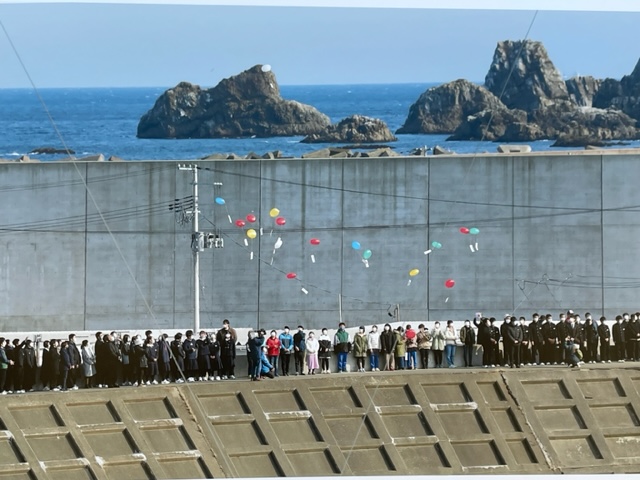
While the government has poured tens of billions of dollars to help revive the region, as with so many government responses to crisis, much of Japan’s effort has focused on pouring concrete, including more than $12 billion on a massive new seawall that residents complain cuts them off from the sea on which they depend for fishing.
Although Iitate had three good schools and very few children, the government spent $40 million on a new elementary school. It now must bring children from distant villages to try to fill the classrooms, says Tao. Other pointless projects include a new town hall that holds 300 people. Japan tends to support large construction projects for the immediate jobs they create and because construction companies contribute campaign funds to politicians.
Similarly, the Japanese government has provided funds for a massive facility called the for testing robots, including drones with the hope that more robotics experts would move to the area allowing it to become a robotics center.
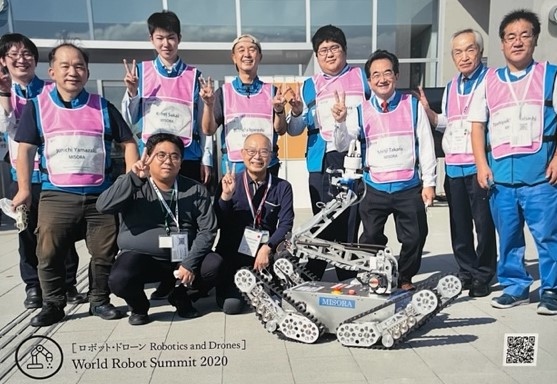 While the center hosted a robotics conference recently, and the facility has been used to test drones and other devices, but there is no evidence that robotics experts have any interest in doing any robotic research and development in the area.
The Japanese government has also moved forward on some projects without consulting locals. They used heavy equipment to scrape radioactive soil from the fields, for example, crushing the network of clay pipes that are so critical to draining water from the fields. “You shouldn’t call them the Environmental Protection Agency; they are the environmental destruction agency.” The scraped radioactive soil from affected areas of Fukushima have been placed in one square meter black bags that each hold about 35 square feet (about the area of a queen-sized bed) of soil. There are an estimated 14 million of those bags scattered across the prefecture. The Japanese parliament passed a measure some time ago in which it agreed that the burden of storing those bags would be shared by the entire country with every prefecture taking their share. Understandably, the prefectures have refused to accept the bags, so Fukushima has no choice but to store them temporarily in trenches.
Where there has been limited success, it has been in some more distributed approaches that he supports. Under one program, for example, the government has offered $100,000 grants to young people with ideas for businesses. His daughter received one such grant. He takes me to a warehouse-like space in a former big-box store that his daughter is turning into a facility to encourage invention. “It’s like an inventor’s garage,” says Tao. There are various projects in the works, including one for a system to grow wasabi and another an approach to reusing waste products as insulation.
Odaka, a town closer to the nuclear disaster area, has developed an approach that has been successful in launching new businesses. Several young entrepreneurs participating in the “Next Commons Lab,” a venture capital group of sorts subsidized by the federal government.
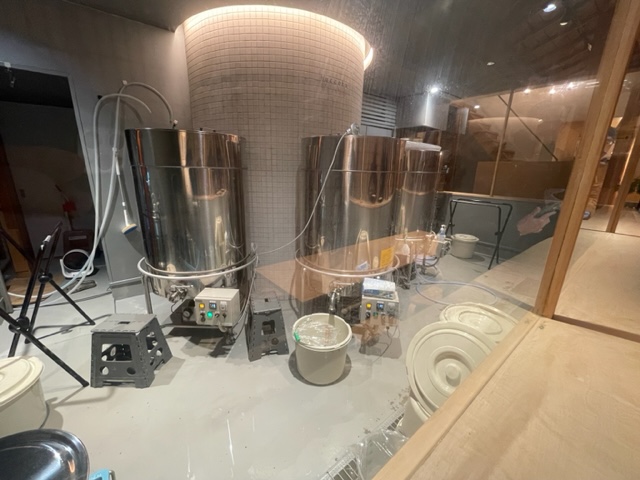 It has launched startups including haccoba, which is successfully selling sake with unusual flavors. The company says it benefits from a law the requires sake brewers to stick to simple ingredients when making sake. By calling itself a “Craft sake brewery,” the company has the freedom to add other ingredients including hops, fig leaves and grape skins. The sake has proved so popular that several restaurants in Tokyo have become customers and the rest of the several hundred bottles per batch quickly sell out online. The company now plans to triple production.
One reason for the success of Odaka is its active local community. One center for that community is the Futabaya, an inn that suffered flooding from the 2011 Tsunami. Inn owner Tomoko Kobayashi and her husband had to leave the area following the nuclear meltdown, but returned in 2013, using government compensation to rebuild the inn, which reopened in 2016 when it quickly became a favorite hangout for researchers and activists.
As tragic and difficult as that period was, Kobayashi remembers it as an exciting time. “I felt so free,” she says. Every week she would have BBQs or dinners and everyone from aid workers to scientists would gather and talk about all the work that needed to be done.” When trains finally started to pass through the area again, it was Kobayashi who planted flowers in front of the train station to brighten up what had become a bleak landscape. Kobayashi has become a networker. She helped launch a museum in a home offered up by a friend where local artists could display their work.
Kobayashi felt a kinship to Ukraine, which had suffered from the Chernobyl nuclear meltdown. She visited Ukraine five times and came to develop many friends in the area. Now, despite the challenges that continue in her own hometown, she has worked with young people in the area to raise money to contribute to Ukraine’s war effort. A young man who would like to see the region’s watch-making expertise be better utilized, has started manufacturing a special watch. Earnings for the sale of the watch are donated to nonprofit groups operating in Ukraine. Meanwhile, her husband, Takenori, volunteers at a local fire station where equipment was installed to allow people to check food for radiation.
Others have also pitched in to bring life back to Odaka. Down the street from the Inn, Miri Yu, a Korean novelist and playwright born in Japan. She moved to Odaka in 2015 and launched a radio show to focus attention on the concerns of 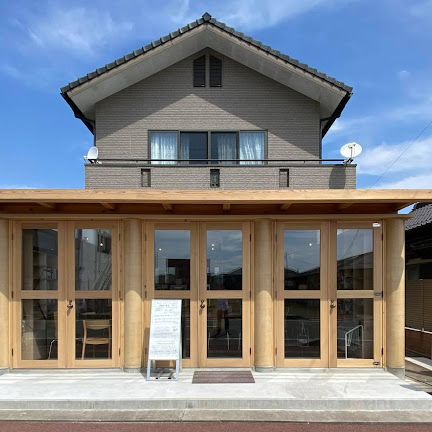 residents in the community. In 2018, she remodeled her home to create a small bookstore and coffee shop called Full House that remains one of the few commercial establishments open in the neighborhood.
Although Odaka has benefited from government compensation schemes, the subsidies have also had the perverse effect of discouraging people from returning and investing in their communities. Many prefer to continue to receive the government compensation rather than try to rebuild their businesses. Odaka’s population is now 3,000, down from 13,000 before the nuclear accident. In nearby Namie, the town has seen its population drop 90% to 2,000. Former residents who rebuilt their lives elsewhere don’t want to be uprooted again.
Although Futaba, in a different area from the Futaba Inn, opened to returnees in the summer of 2022, for example, it still has only 50 residents, down from 9,000 before the accident. Many homes in the neighborhood have caved in roofs 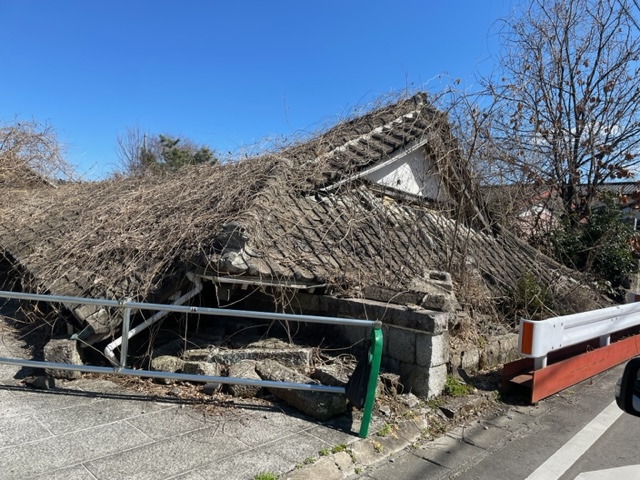 caused by the original 2011 earthquake. Even those returning to work at Futaba’s city hall are commuting from outside the area.
Although the land along the ocean has been scraped of topsoil and can now be farmed, many landowners are choosing instead to lease their land to utilities who are using the land for solar farms. Fukushima has decided to depend on renewable sources for 100 percent of its energy including solar power and hydrogen. But the rest of Japan, which had temporarily shut down its nuclear plants, is restarting them and is even planning to build two new nuclear facilities to the north in an area also famous for its earthquakes. One farmer, however, returned to his land and is growing flowers and vegetables. Although he might have made more money leasing the land for a solar farm, he says, “I want to move. I don’t want to sit around at home.”
Another problem with the way compensation was handled was that it was typically paid to the man in each family, many of whom squandered the money at pachinko parlors that were quickly established to suck up the large sums these men suddenly found themselves with, says Karin Taira, who works for “Real Fukushima” leading tours of the areas affected by the earthquake, tsunami and nuclear meltdown.
Another obstacle to development has been the high rents that remain in the region despite the many empty homes. Former residents are reluctant to rent out their homes in part because of a sense of obligation to their ancestral ties, but also because strict tenant protection rules make it difficult to evict tenants. Consequently, even if a new business does have a successful launch, the companies have trouble finding employees who are reluctant to move without affordable housing. Taira, the tour leader, says she was lucky that Kobayashi, the inn keeper, was willing to rent her space behind the inn.
Many efforts have fallen short. The notion of Futaba as an arts center isn’t anywhere close to being realized, though there are some interesting murals. 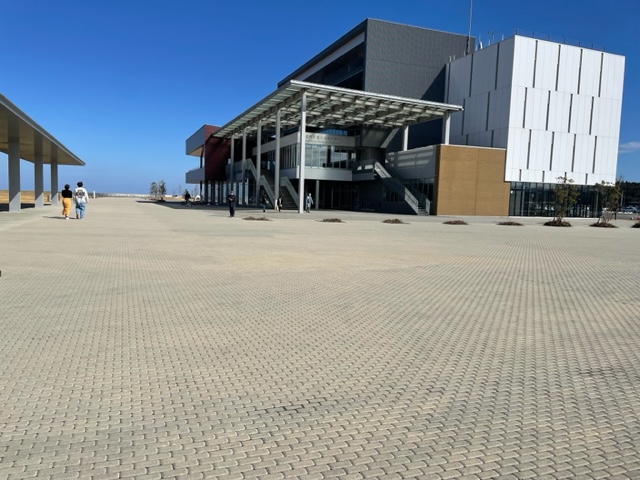 And the nuclear disaster museum offers a broad picture of the disaster, although it doesn’t do enough to pin the blame on bureaucrats and utilities officials who made bad decision. The government has spent far too much money on concrete and not enough on helping to make the affected areas better places to live. That’s the area in which community activists are hoping to make a difference.


April 9, 2023
Helm Dock
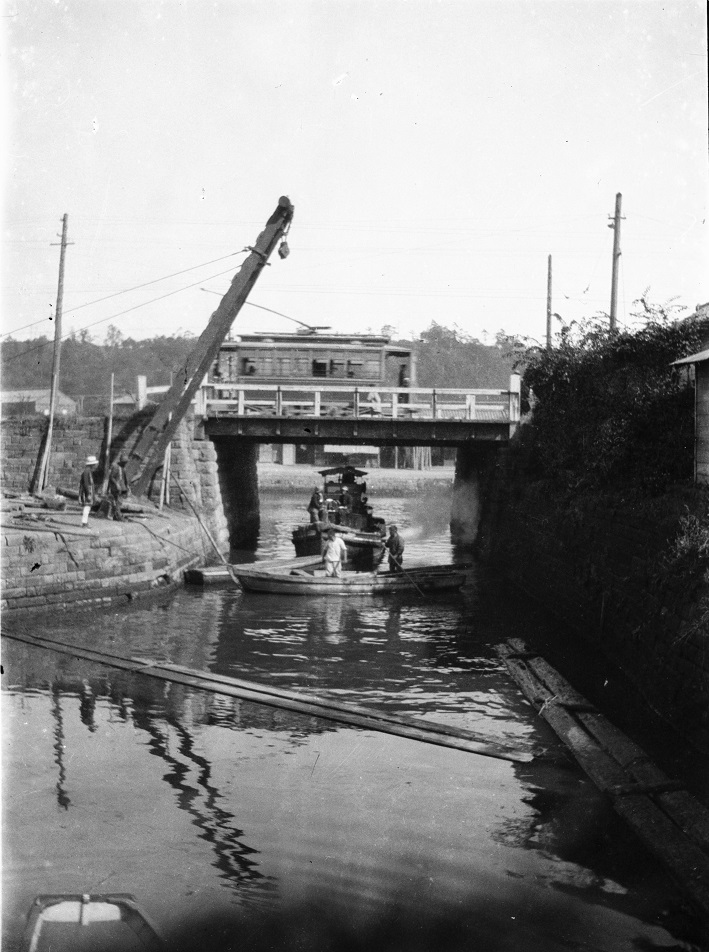
I had long heard stories about a site in Yokohama where Helm Brothers built its barges and tugboats. At the turn of the century, in the late 1800s or early 1900s, my great grandfather, Julius Helm, would go with the company’s carpenter into the woods outside of Yokohama to help him select the best trees to cut to build the ships.
Then some years ago, Toshiko, my father’s second wife, who lives near Negishi station in Yokohama, sent me a clipping about a sign on a bridge that marked the location of Helm Dock. The story didn’t say where the bridge was so I never bothered to follow up.
But then I came across some pictures my Uncle Ray had taken in the early 1950s when he had been stationed with the U.S. Army in South Korea and had visited my parents in Yokohama during a break.
He had taken a picture of my grandfather, Julie Helm, looking on as a barge was under construction.
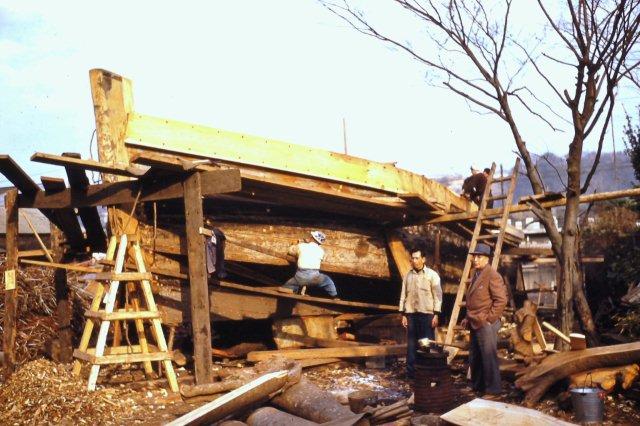
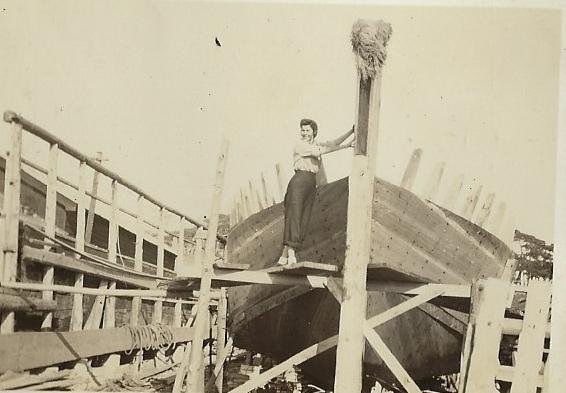
Now suddenly this picture of my mother made some sense. I had Long assumed she had visited some shipyard, but now it seems likely this picture was taken at Helm Dock.
Then something else slipped into place. When the Japanese version of my book came out, Joji Tsunoda reached out to me. I have written about him on this blog before. Joji told the story he heard from his uncle. Shortly before his father married, Joji’s uncle was walking passed the dock when he heard a large Danish gentleman screaming at some Japanese workers.
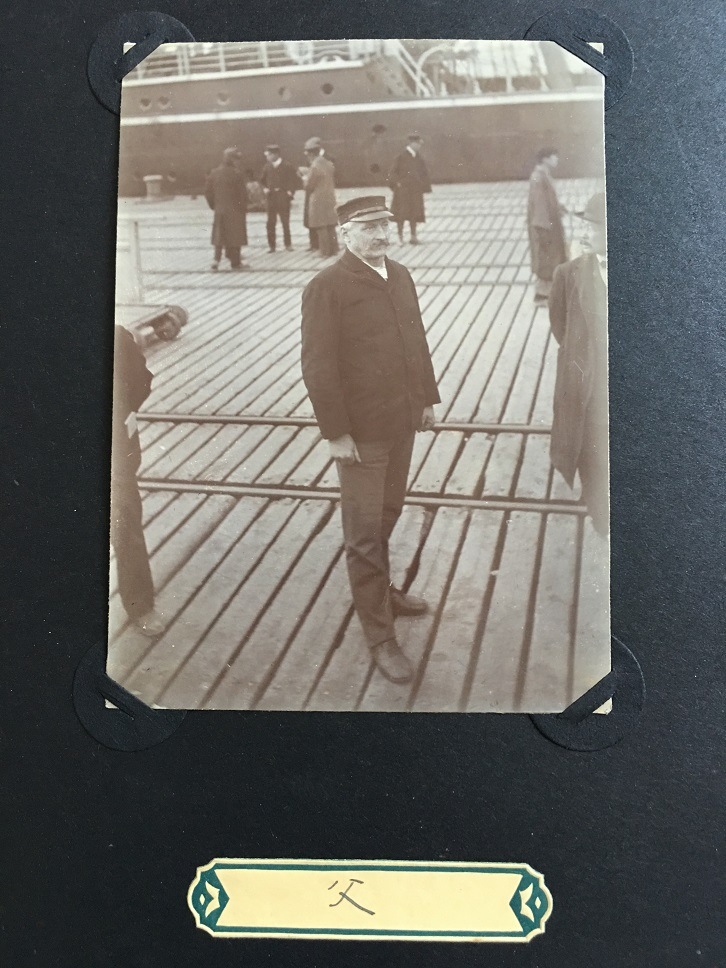
The Danish man, Wolff, had been Joji’s grandfather, who worked for Helm Brothers. Joji’s uncle went home and told his sister, who was engaged to be married to Joji’s father, that she was about the marry the son of a devil. At the time, seeing the picture above, I assumed that Wolf had managed Helm Brothers operations at Yokohama harbor, but Joji later told me that Wolff had been manager of Helm Dock. And as I was going through Joji’s father’s treasure trove of Yokohama pictures, I came across one taken about 1919 that I thought could be a picture in the vicinity of Helm Dock.
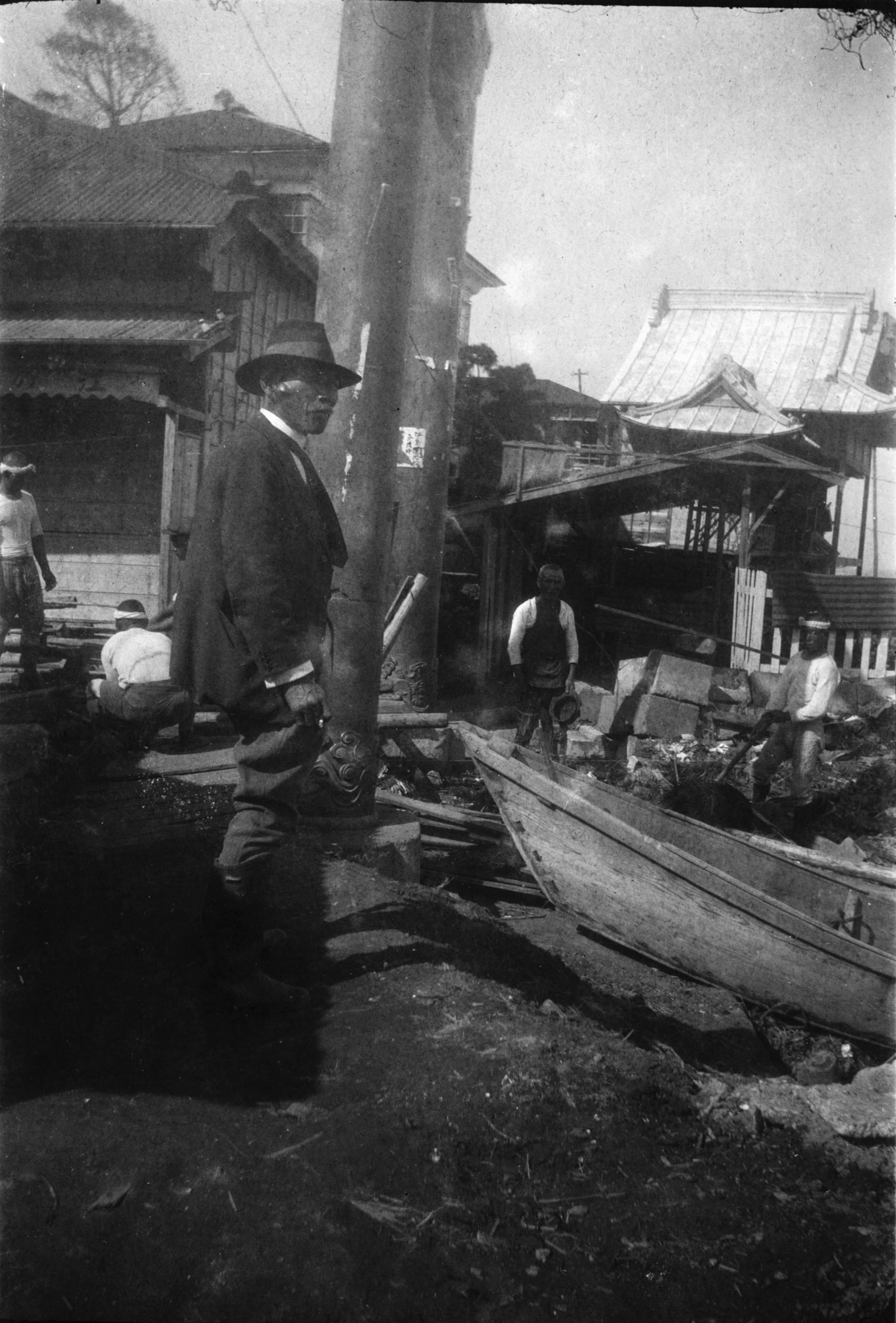
Now I was truly curious. I went through records of properties in Yokohama that the Helms had once owned. On the list was a very large property at 200 Takegashira, Negishi. That must be it, I thought. On this day, Japan was playing the United States in the World Baseball Classic. Everyone’s eyes would be glued to their television sets. It would be a good day to explore. I took the train to Negishi Station and asked a policeman for directions. Go to the river then turn right before crossing the bridge, he said. He warned me that Takegashira was on the other side of the river, but that there was no sidewalk on either side of the road and the traffic was heavy.
I thanked the kind policeman and walked the half a mile through a rather bleak landscape toward the river. Then I spotted a sembe, rice cracker, store. The lady was making her own rice crackers on an electric grill and they looked delicious. She said her husband used to make the crackers but she had taken over and was experimenting with different recipes. Fortunately most were the classic soy sauce and sesame sembe I like best. I wanted two gift boxes and she let me select my favorites for each box. I could tell she was listening to the baseball game on the radio. Every now and then she would go back into the store and pause for a couple of minutes. She was going to put my two gift boxes in two separate bags, but I asked her to consolidated them since I would be walking for a while. She folded up one of the bags and slipped it into the one bag with the two large boxes of sembe and I was on my way. She recommended that if I had time I should see the sakura at the park nearby. I thanked her and went on my way.
Carrying my large boxes of sembe I walked along that wide ride until I finally reached the river. I walked along the river, checking each bridge for signs that might say Helm Dock. There was nothing for two bridges. As I approached the third bridge, I looked across what the policeman had described as a river, but I now realized, was more like a canal. This is what I saw.
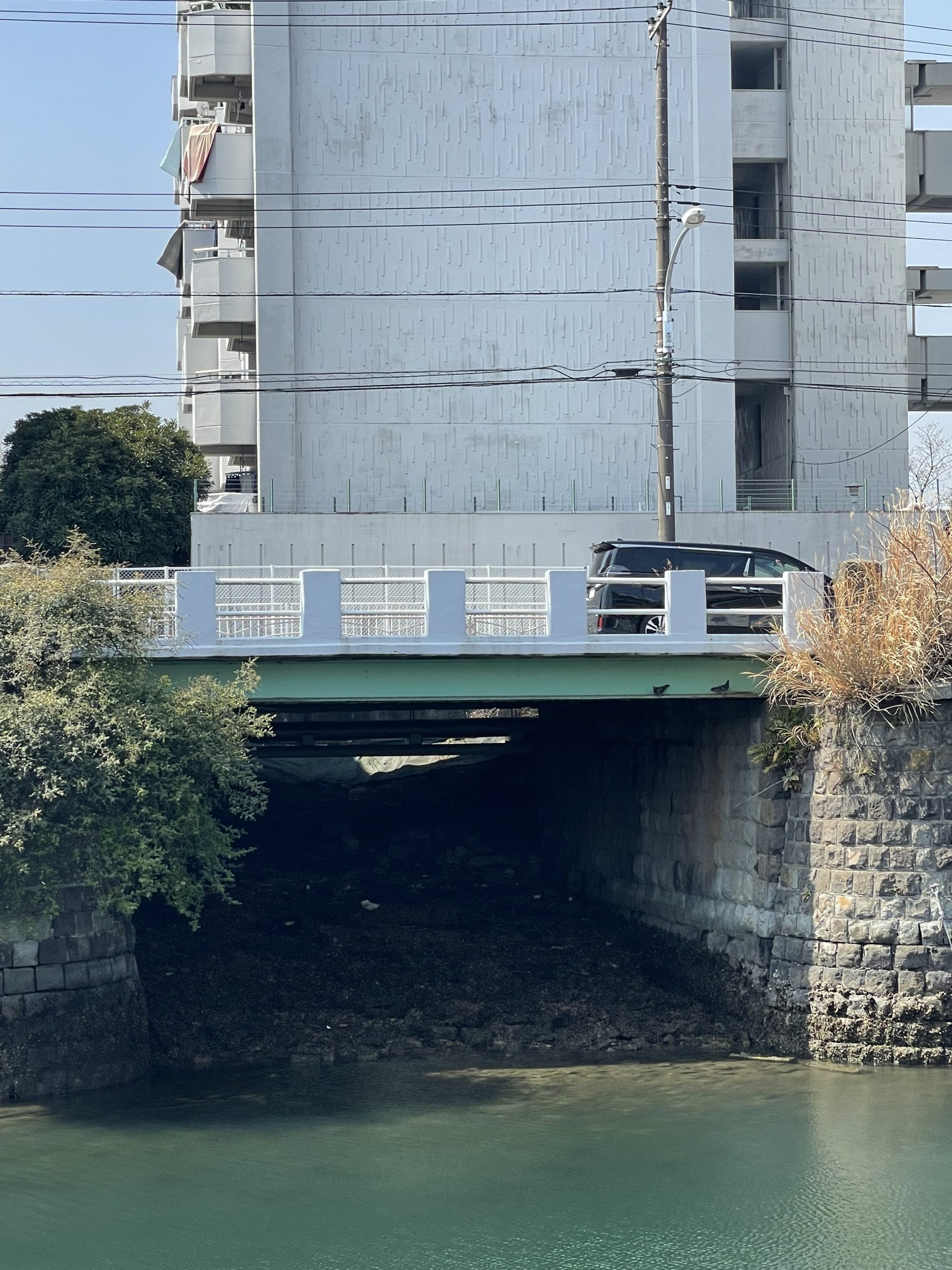
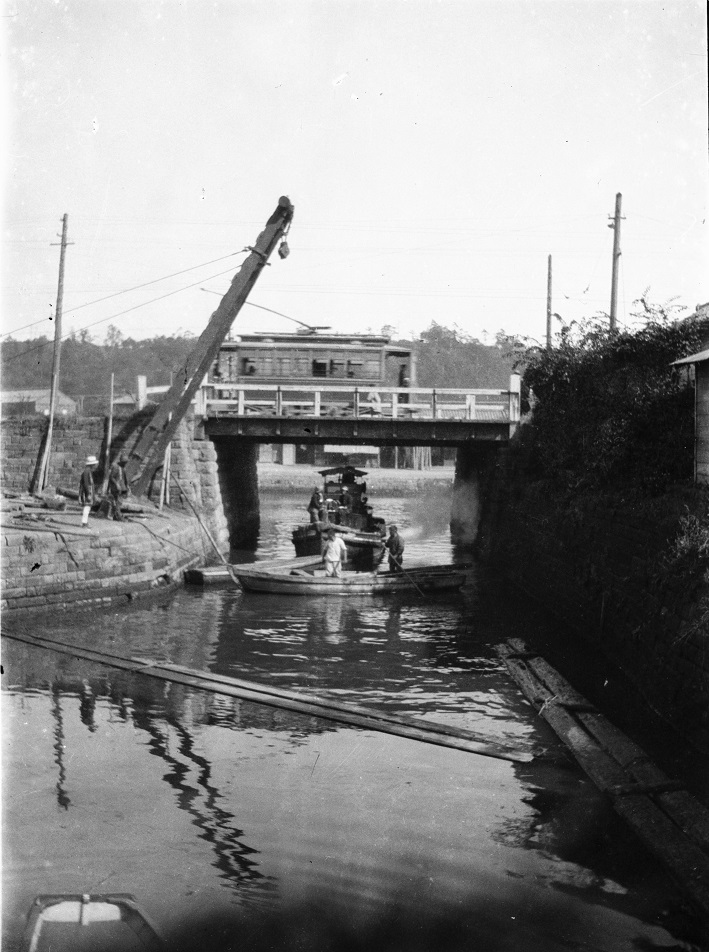
There was a tiny bridge, under which was a stone ramp–what could well be the remains of the Helm Dock. I crossed the canal, and walked along the side of the bridge looking for a Helm Dock sign. There was none. Meanwhile, big trucks were speeding past awfully close to the railing–one came within a few inches of me. I gave up on my search for the sign. Why would they put a sign in such a dangerous place anyway! I crossed a bridge and found a side entrance to the building sitting atop the bridge. I saw a lady with a bag of groceries headed for the apartment building. I told her I was looking for Helm Dock. “That’s it right there,” she said, pointing to the narrow space between the apartment building and the tiny bridge. The apartment building had been built right on top of where the ship-building site had once been. When I tried to ask more questions she shook her head: “The final game of the world baseball tournament is about to start. I nodded my head. I understood. The streets were empty and I had nobody else to ask. I didn’t know how to get to the hilltop park the sembe lady had recommended so instead I took a bus to Sankeien, a beautiful garden park in the neighborhood where my great grandfather had once summered. I still have a cousin who lives on what locals sometimes called Helm hill. I was hungry so I went into a soba shop in time to see the patrons celebrating Japan’s victory over the United States. Batting and pitching star Ohtani had come in a relief pitcher in the final inning to strike out his Angels teammate and the stadium had erupted with cheers. The old men in the soba shop quietly cheered too as the broadcast station kept repeating the best plays of the game. “Japan is not doing so well these days but at least were at the top of the world in baseball,” said one old man. You know, it’s not well known, but Ohtani’s father worked at a Mitsubishi Heavy factory in this neighborhood. Spread the word. He’s really one of ours.” I was happy for Japan, and happy that these men were adopting Ohtani as a local boy. The economy was weak, salaries had hardly budged in three decades and the recent Olympics had been a disaster. Now, finally, Japan had something to celebrate. Meanwhile, I was pleased by my own little discovery. I had found the Dock. On closer examination, it seems clear that the photo from Joji was taken from Helm Dock on the other side of the same bridge!
January 2, 2023
Three Gaijin Letters from Yokohama in the aftermath of WWII
Park Hotel, Gora, Hakone Japan Sept 15, 1945
Dear Brother John Kessler,
Finally the World War has ended, and we are all still alive. Who would have believed it? We are profiting by the kindness of Archbishop Spellman, Archbishop of New York, who honored us today with one of his pleasant visits, and who took it upon himself to carry our correspondence to America. Mail in Japan is not functioning as yet for foreigners. (Mssr. Spellman gave us a gift of $250 and instructed Captain Cyril Curtis, an Australian, to buy us supplies. It was this Captain who flew the Archbishop here. Incidentally, he is one of our old boys. And now I am going to begin to relate a few of the vicissitudes of war we underwent.
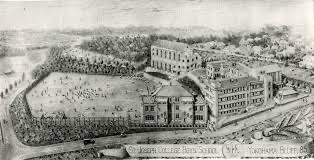 St. Joseph College, established 1901
In the month of September,1943, the 29th, I believe, the police came to tell us that all the foreigners on the Bluff in Yokohama must evacuate. We immediately searched for a desirable and convenient place. We discussed for quite some time whether should move to the seashore or take up new quarters somewhere on the Tokyo plain. Finally we decided, after the New Year 1944, to live in the mountains. We were able to rent St. Joseph’s College for 12,000 yen a month. This allowed us to move into the hotel in the Hakone mountains at the bottom of “Big Hell” [a hot spring.] We used thirty and a half trucks to transport the most necessary and important things to Gora. These trucks went irregularly from the 20th of February 1944 to the end of March. The first time I went along in a truck. I almost had an accident. The roads here, as you know, are very steep and our truck didn’t use gas. It was one of those charcoal burners you no doubt remember. Well, the one I was on stopped and almost rolled into a ravine.
Finally, one after another, we all arrived for good on the 17th of March. Living here was very trying because in the month of March it was very cold, with much snow, and there was no furnace installed. As the hotel had been neglected during the war, the windows and doors didn’t close very well. By the followings winter we were able to install a stove in the study room and it was O.K. One of the best things about the hotel was the fact that there were warm baths of mineral water coming from one side of Big Hell (which you know.) Unfortunately, it is only from time to time that we have this warm mineral water.
Toward the end of April 1944, we started school with seven pupils. Now we have forty boys and girls. At the present, I have 14 pupils taking music lessons, most of whom are girls. They are using three of our five pianos. I left one piano in Yokohama, taking a chance on it; the fifth was taken to Tokyo and fortunately was not burned. The little organ we had in the second parlor at Yokohama was sent to the Gyosei (Morning Star School) and burned there.
In Tokyo, the building at the Morning Star School was not bombed, but four buildings caught fire and burned. Fire from our neighbors spread to the large school constructed of reinforced concrete, then to the Brothers’ house then to the science building, and finally to the tailor shop, kitchen and refectory. We especially regret the loss of our rich and valuable library and the wonderful museum, which took go many years to develop.
At Kobe our school building was bombed and burned, but our Brothers had already moved to the country. Father Fage(Benefactor and Affiliated Member of the Society) was caught in his burning church and trapped by falling debris. He was burned to death while trying to save the Blessed Sacrament. What a beautiful death for a missionary after having been at the post in Kobe for fifty years.
At Osaka the Meisei (Bright Star School) suffered great damage due to incendiary bombs. All was burned except the building constructed of reinforced concrete.
At Nagasaki, the Kaisei (Star of the Sea School) suffered damages due to the atomic bomb, the new weapon which Hitler hoped to use to crush the allies.
Star School at Sapporo was spared as also our school at Yokohama. But our neighbor, the sisters [St. Maur’s], were burned out at Yokohama, Tokyo and Shizuoka. The third story of the main school building at Yokohama caught fire by accident, and that on Christmas Eve 1944. We still own our school in Yokohama and will come back if there are pupils. We will return there, soon, perhaps. In the meantime thieves have not scrupled to steal many things, among them curtains from the windows and the large drop on the stage in the auditorium. Today, two of our brothers , Bros. Crambach and Gessler, received an obedience to return to Yokohama to watch over St. Joseph College.
You did well to leave for America because the internees of your [American]concentration camp were moved to our old country house near Yamakita [in the mountains outside Yokohama.] They were not well treated especially towards the end. One man (Emery Jones) died of hunger. American fliers let fall 40 sacks of supplies for them. One sack went through the window of the old confession room.
Now you see, I am writing my old pupil and walking companion to return old favors and to acquaint you again with the French language. When are we going to take our next walk together. Here in the country near the Grand Fujiya Hotel it is very beautiful. The big shot of the American military authorities have taken over the Fujiya Hotel as their quarters. On the 6th of Sept we received our first visit from American soldiers and drank to their health. The next day they took many photographs and some movies of our Brothers and pupils for American papers. If you watch carefully you many see them. They also promised to send some to Dayton University. We are now 24 brothers. Bro. Gerome left here last spring to die in Tokyo of an ordinary sickness.
Bro. Bertrand.
2) Tales of a Mixed Race Teenage Survivor
Letter from John Schultz — Jan 8, 1946
Dear Ray[image error],
I thank you very much for your nice letter which I received it yesterday. I reached San Francisco on 18th of December last year. It was lucky for me that I have found two American Red Cross men on the ship. When the ship reached San Francisco, these two men brought me to the American Red Cross in the city. The lady in there was very kind to me. On the first day, I slept in the Y.M.C.A. But it is the first time for me in United States since 18 years that I don’t know where to go. I even don’t know how to go to the restaurant. So I did not eat anything on that day. The lady in the Red Cross worried [image error]about me and put me in the Buddhist Church in S.F. because there are lots of Japanese people, and I am used to it with Japanese character.
On the second day, I went to see Bro. Tribull. He was very glad when he saw me and at the same time he was laughing because she put the Catholic boy in the Buddhist Church.
At his place, I was told about your telephone number. So when I went back to Church, I have phoned you, but you were not there. I heard that you went to Jujitsu lessons. On the third day, I went to see him again and he introduced me to other brothers. I will tell you an interesting thing that those Japanese people in the Church don’t believe that Japan was really defeated. On the same day, at half past six, I took a train from Oakland and went to Corvallis, Oregon. It took me 21 hours. I met my father at Albany. He was very glad when he saw me. I went to my uncle’s house. I spent my Christmas at his house. After three days of staying in Corvallis,1 took a bus and came to Olympia. 0lympia is a small town, but it is very beautiful. Perhaps I can say that it is one of the most beautiful town I have ever seen since I came to United States. I used to live near the Capitol Bldg, but it was raining all day that I had no chance to go and see it. After three days I took a bus and came to Renton. First 1 got off at Seattle (my home town) and took another bus to
Renton. I am in my aunty,s house now. She is very kind to me. I am in here for ten days already. That means I have traveled three states in ten days. Even the circus cannot travel three states in ten days.
I am very glad to hear that you are attending to school. I have wasted three and half years of school, because when the war broke out, our source of money from America was cut off. Afterwards, Mr. Haegeli told me to come to school, so went, but two months after, school was closed because Bluff was in the fortified zone. After the school was closed, all the teachers went to Hakone and opened the school there, but the police did not permit me to go there.
When Japan declared war against America on 8th of December (7th in U.S.) I was only 15 years old, so the police did not say anything to me. But on the first and second day, I did not go out anywhere, because I was afraid of the police. 1 have gone to the school for a month after the war was started. After that, I went out to work in the typewriter company in [image error]Tokyo. They paid me only 15 yen ($1) per month. With that much money, I helped my mother.She was her very glad much when I sent so much with the money, but I helped her quite much with other thing, because I lived in Tokyo and ate the meals at the company.
The government and the people were very kind to me at the beginning of the war, because they were winning all the time. But when they were defeated at the Island of Guadal Canar (crossed 1) and lost the way to go to Australia, the government began to talk bad thing about America to the people, and they forbade to use the enemy people in the company. So ten months after, I was out of job and I came back home again. After that, my uncle used to give us little money, and we made the farm on the back of our house to raise the vegetables. The government even tell the people to give out all the Jazz records. Persons who did not give out these records were be punished. They said that they cannot fight against America when they are listening to the American music. After I was back from Tokyo, I was at home for about ten months. Afterward, Mr. Haegeli told me to come to school, so I went into 1st High School class from Sept 16, 1943. It was too difficult for me and Mr. Grosser taught the Algebra, which we have to learn in one year, he taught in two months, so I don’t even know the addition of the algebra. The school was closed on the 22nd of Dec 43, and all the foreigners have to move out from the Bluff. Honmoku was also the fortified zone. It was lucky for us that we were out of the zone. After the school was closed, the government made more strict law against the American people who was not interned. I was not permitted to go out from my house unless if it is not necessary. Even they don’t permit me to go out to the town to buy something. I was only allowed to go around my house and I could go as far as Sagiyama. I was not permitted to pass the tunnel and go to the other side of the town. Once, I went to the shore, secret,and on the way back home, I was caught by the police. He took me to the police station, and did not let me go out for half a day (I was not in the jail) That day, I don’t know how many slaps and kicks I got. After I came back home in the evening, I got sick, and I went into the bed for eight days. Then I came back home and sat down,that was the end for me. I could not even stand up on account of the kicks I got. It was 15th of February 1944. I will never forget this day. This is secret to everybody except you. Even Donker doesn’t know about this. After that, I was strictly guarded by the police, I have to write the diary and bring to the police station every week. I have done this till the date of the air raid. After that, what I can do was just stay home and help my mother. When the B29 begin to appear on the sky of Tokyo, most of the rich Japanese and all the foreigners except the enemy people had gone to the country. We could not go because we are enemies of Japan. That is why, on 29th of May 1945, we were burnt out. Donker Curtius , Mr. Mayes, Eddie Duer, Bryden, Gomes, and rest of other enemy people were also burnt out. The air laid began at nine o t clock in the morning, and finished at eleven o’clock. Two hours after, there is no more fire. At the same time, there is no more Yokohama left. [image error] used to say “Gone with the fire” for Yokohama, Americans dropped average of two bombs to every people of Yokohama (including small and big bombs) Believe it or not, but it was written in the Japanese newspaper. For me I got one extra[image error] bomb than other people, we got three of hundred pounds incendiary bombs into our house, I think you know how small my house was. The air-raid siren alarmed, when I was still in bed. That time, the planes are over our house already. Whenever they bomb Tokyo, they use to fly over our house. That is why, [image error] thought they are going to bomb Tokyo again. I was counting the planes in the bed. First line was with ten planes, but they did not drop any bombs. Second line was twenty planes. Third was thirty three, fourth was fifty two. And with the fifth line of hundred one planes they dropped the bombs around your house and Honmoku. I will not forget that noise, when the bombs are coming down from the sky, I cannot remember anything but, when the bombs came into my house, it made a big noise, and at the same time, what I can see was only the black smoke and the red flames of the fire. At this time, I got a burn on my hand and on my leg. It was the hottest and the coldest day I ever had in Yokohama. During the fire it was very hot and in the evening it was very cold, because I have no more house and clothing, I came out with on gray short pants and one [image error]pink sweater. I came out with no underwear, no underpants, no shoes and no socks. I was wondering what shall I do this winter when the war does not finish: but luckily the war is over and we won the war, so the army supplied me with the clothing. After the air-raid, I walked around my house, but I could not find my mother and sister. On the next day, I found my mother and sister’s body in the canal. Both suffocated to death by smoke. That day, I can’t even understand what the people are talking about, because I lost my mother and sister at once, word that I cannot forget was: the neighbor told me that mother and sister must be glad because they were killed by the American bombs. Two days after, I made a small shack with burnt tin and burnt wire. During the war time, we could not get any wires and nails; but after the airlaid you could find the tins, wires, and nails in everywhere, but they are all burnt ones; I used to live in this small shack for two and half months. On 15th of August, Japan surrendered and there was a negotiation that the US Army is going to come into Japan on the 26th of August. But they postponed till 28th because there was a typhoon, my shack was blown away. After that I used to live in the air laid shelter, because even I rebuild my shack, it [image error]was in the typhoon season. Three days after, I met one captain and I begin to work for him as an interpreter. I worked for him for three weeks. After that I was sent to Manila as a recovered personnel. I got on C54 from Atsugi and went to Manila via Okinawa. It took only ten hours. I was in 29th Replacement Depot (25 miles south of Manila) for four weeks I used to get better food and better treatment than the ordinary soldiers, because I was a recovered person, I was in there from October 2nd to October 30th. Afterwards, they sent me back to Japan, because I was civilian. They told me to go to Tokyo and go through the American Consulate in Yokohama. It was not my fault. It was the army who made the mistake. I have landed on Atsugi Airfield on 1st of November. I was in Tokyo for one month. During that time I went through the American Consulate, and the army put me on the ship called LT. S.S. Leonard Wood. They know that I am going to Seattle, and they put me on the ship that goes to San Francisco. But it was lucky for me, because the ship that goes to Seattle left Yokohama game time with us, and this ship went into the storm and lost all the lifeboats and one man.
I left Yokohama on the 4th of Dec. and reached San Francisco on 18th. Donker Curtius was interned three days after the war started. When I went to his house to see Bouldwin and Henry on the 8th of Dec., he was very intoxicated, because he was so discouraged by the outbreak of war. But he came back from the camp in the end of 1944, because he got sick. After he came back, they have moved to the back side of the Honmoku middle school. During the war time, I did not visit him so many times, because we were both enemies of Japan. Maybe I didn’t even visit him ten times, after the war was started.
I myself was told by the police not to visit the enemy people of Japan. On 29th of May, he was also burnt out. His house was burnt and his neighbors were not burnt. Afterwards they have rent the room from the neighbor and they are still there. Since Jimmy and Joyce were Japanese citizen, they could go any place they want to go. His grandfather was interned when the war was started, but he came back home three weeks after, because he was too old. He died in 1942. After the school was closed, Jimmy was just playing around the house, but Joyce was attending to Koran Gakko till the date of air raid, Jimmy is still small but Joyce is very big now. She is only little bit smaller than I. On 29 of May, his house was also burnt down, and they are living in the air-raid shelter now. I saw both of them once after I came back from Manila. His father is working as an interpreter now. When 11th Airborne Division occupied Sendai, he also went to Sendai. He is still there now.
Japan had a short of food during the war time. I think you know that. The time when you left Japan, the sugar and the rice was already rationed. After the outbreak of war, the food condition became worse and worse. In 1942, even the fish and the vegetables became rationed. In the same year, the fuel like charcoal and wood became rationed. In 1943, they used to give us half of the food what we need. In 1945, we could not get anything. The fishermen does not go out to fish, because they were afraid of the submarine and the sea planes. After the air raid, the food what they gave me for 20 days was just enough for me for only four days. They used to give a little bit of rice and hard soy beans and some shoyu. They gave me only 2 sen worth of salt per month. Vegetables once in about three weeks; frozen fish, once in about three months. I did not see the meat for three years.After Saipan was taken by the Americans, we could not get any sugar. In 1945, eight pounds of sugar cost 5000 yen in the black market. So I got sick after U.S. soldiers came into Japan, because I took too much sweet at once. When the army came into Japan, I was weight only 85 lbs., (only three times as heavier as a turkey) and I am 135 lbs now. The day when I went to Manila, I weighed 110 lbs. That means I have gained 50 lbs in 4 months.
In Washington, we have “liquid sunshine” every day. These few days, we have frost in the morning, but usually it is very warm. (Much warmer than Yokohama) If it is fair weather, we could see Mt Rainier from our house.
I’ll close here, otherwise there will be no limit. Please give my best regards to your parents and Larry. Shultz
3)
Oct 24, 1945
Letter from Willie Helm, addressed to Mr. and Mrs. Julius Helm and Ray and Larry
533 Boulevard Way, Piedmont, Calif.
Authorities ordered all foreigners to clear out of Honmoku and Bluff. Most went to Hakone and Karuizawa orders came March 1944.
Willie’s family went to Karuizawa after having taken most of the clothing and some old furniture to Karuizawa. The good furniture as well as baby grand, phonograph, Frigidaire, washing machine, sun lamp, were placed in go-downs [warehouses] in the settlement no. 90. Which was burned down.
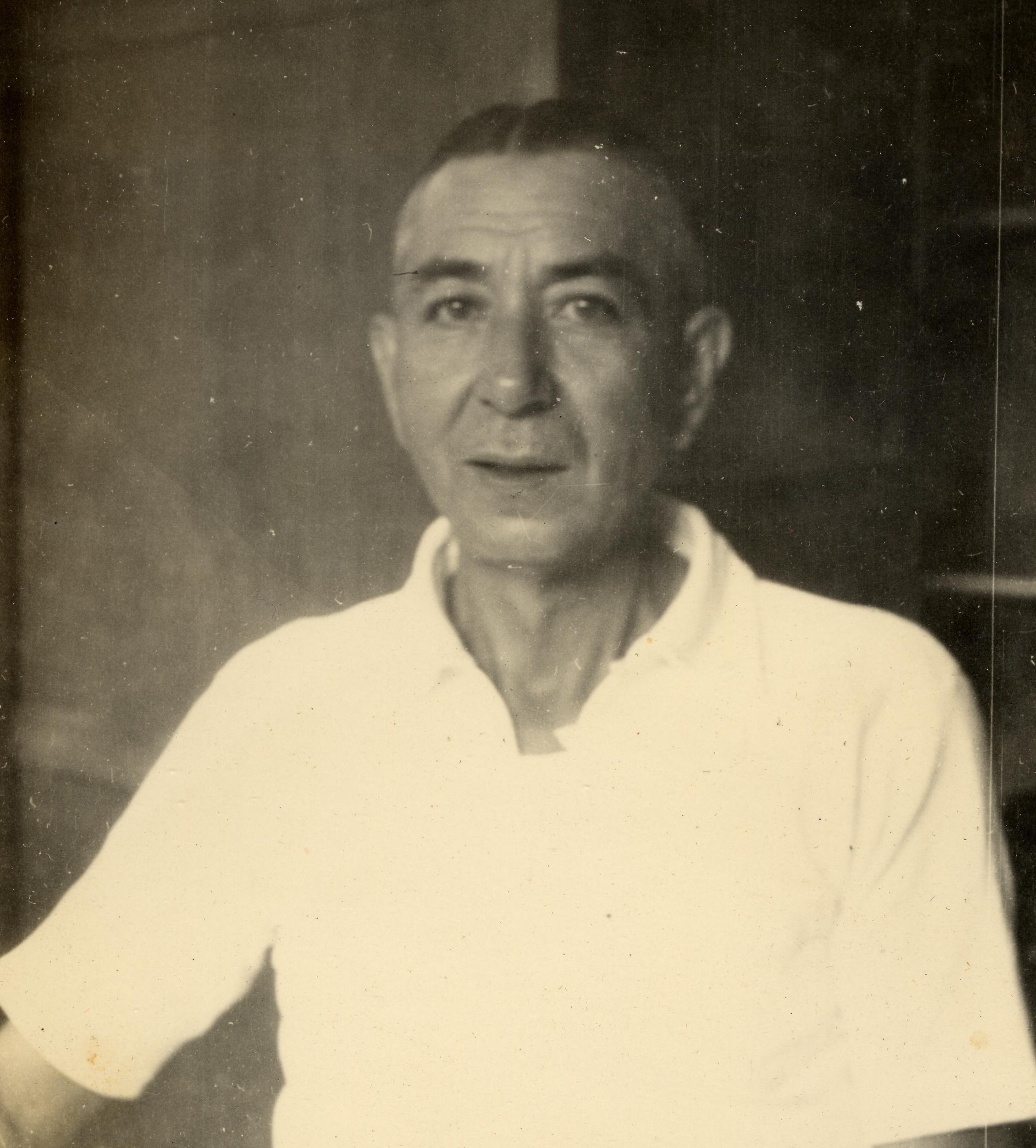 Willie Helm Born: Yokohama 1891; Died: Germany 1951
Agnes, Veronica and Richard were in Karuizawa and still there.
Willie lived half time in Karuizawa and half time with Bud.
Bud purchased 804 [Julius’s house?] with all contents. We thought it a good idea instead of any Nip getting it. But now it’s no use as all burnt out together with contents.
In the excitement, Bud only rescued his tuxedo, swallow tail suit, hard form shirts, still with New York laundry labels and 85 cents alarm clock. All the rest of his stuff is gone.
Butter is now 100 to 150 yen a pound but impossible to get. Potatoes 20- 30 yen a kwan. Rice 60- 80 yen a sho. Agnes still has kidney trouble.
After the fire, Willie moved to a room in helm house. On the morning of the 29th of May practically all of Daijinguyama went up in smoke up to former mis ross’s house. Same day all of Motomachi, Isezakicho, Honomku were gone.
What is left of Honmoku near our place, just a couple of Japanese houses, all our houses—Willie’s Gomei, Bernard-Bells houses broken up through bombs.
Although [Japanese]soldiers are back it’s impossible to get carpenters.
The Nips seem to be dazed that they lost the war—how long they will be like that we do not know—they ought to work since they have no food to eat but even if they had money what could they buy.
When 804 burned on the 29th, Bud shared Willie’s room in the Helm House. Everybody being very nervous before they left Willie’s place. Agnes and they were no more on speaking terms—Willie also got somewhat fed up—outside of these there were another two burnt out people put into the house. Four guests at one time for such a long period was too much. (E+L
[sisters Eloise and Louisa] were staying there during that time)
On the 24th of August Nip authorities gave orders for all people living in Helm House to clear out within 24 hours as the place had to be made for sleeping quarters for U.S. officers. Nips would not even allow Bud and Willie to stay there so had to find quarters.
Katchan lost all her stuff, went to the country and now came back two weeks ago and working for Walter—she has only one dress what she has on. Walters leg at last better, had been bad for over two years.
Bernards living in servants rooms of Barney’s place, old man now 92 years old they were interned up to the end of war. Total eyesight, 98 percent hearing gone but brains working normal and good appetite.
Would appreciate very much if you could do something if any way possible—victuals as well as money—Willie will repay when he can—nothing can be done from here. Would be nice if they could be brought to your town.
Three Gaijin Letters from Yokohama after Japan’s Surrender
As I began scanning documents I gathered for my book Yokohama Yankee, I came across three letters that I reference in my book, but that I thought some Hamakko might find interesting. All three were written by Yokohama residents soon after Japan’s surrender following WWII, and describe their experiences during the war. Not surprisingly, they all reference the devastating impact of American fire bombing of Japanese cities. And, in a way only letters can do, they capture very personal reflections on the hard times each of them experienced in the past and, in all but one case, a sense of optimism about the future.
A Marianist Brother’s Perspective: The first letter is by Xavier Bertrand, a French teacher at the Marianist school, St. Joseph College, whose student body drew largely from the expatriate community as well as from among mixed-race families. St. Joseph and its faculty of Brothers avoided the worst of the war by moving the school into the mountains, although many other Marianist schools in Japan suffered much worse fates.2) A Teenage Survivor: The second letter is from John Schultz who had been a classmate of my Uncle Ray at St. Joseph until the war began and ended the flow of money from his father in the United States. He was 15-years old the time, and lived with his single mother and sister. It is hard not to be moved by his story.
3) Playboy of the Eastern World: The third letter is from Willie Helm, my grandfather Julie’s youngest brother. He was always one to take risks and somehow always ended up okay. He took his inheritance early and invested it in failed ventures in the Japanese colony of Manchukuo, yet when he returned, his oldest sister took pity on him and left him with her fortune. Although his mother was Japanese, during World War I he went to war to protect German’s Chinese colony from the Japanese army. He suffered a head wound but survived and was sent to a prisoner of war camp. When World War II began, my American grandfather had to leave Japan for California, so Willie, a German, was put in charge of the family company, Helm Brothers. Willie made a great deal of money working with the German navy, which was based in Helm House. It is said he operated a lucrative black market out of the apartment building’s basement. But when U.S. forces arrived after the Japanese surrender, Willie’s luck had run out. His assets were frozen by U.S. occupation forces, and not long after he wrote the letter, he was deported to Germany. Before the trip, Willie put all his family jewelry and other valuables in the safekeeping of a German diplomat. The valuables were never returned.
A Marianist Brother’s Perspective: This letter was written by Brother Francis Xavier Bertrand of Japanese vice province of the Society of Mary, and a French teacher at St. Joseph College, a Marianist school established on the Bluff in Yokohama in 1901 and closed in 2000. The letter, delivered “through the kindness of Archbishop Spellman” of News York, was translated from the French and distributed to friends and former students of St. Joseph in the United States, including my grandparents, then in Piedmont, California, who copied it and passed it on to friends and relatives on October 9, 1945Park Hotel, Gora, Hakone Japan Sept 15, 1945
Dear Brother John Kessler,
Finally the World War has ended, and we are all still alive. Who would have believed it? We are profiting by the kindness of Archbishop Spellman, Archbishop of New York, who honored us today with one of his pleasant visits, and who took it upon himself to carry our correspondence to America. Mail in Japan is not functioning as yet for foreigners. (Mssr. Spellman gave us a gift of $250 and instructed Captain Cyril Curtis, an Australian, to buy us supplies. It was this Captain who flew the Archbishop here. Incidentally, he is one of our old boys. And now I am going to begin to relate a few of the vicissitudes of war we underwent.
St. Joseph College, established 1901In the month of September,1943, the 29th, I believe, the police came to tell us that all the foreigners on the Bluff in Yokohama must evacuate. We immediately searched for a desirable and convenient place. We discussed for quite some time whether should move to the seashore or take up new quarters somewhere on the Tokyo plain. Finally we decided, after the New Year 1944, to live in the mountains. We were able to rent St. Joseph’s College for 12,000 yen a month. This allowed us to move into the hotel at in the Hakone mountains at the bottom of “Big Hell” [a hot spring resort.] We used thirty and a half trucks to transport the most necessary and important things to Gora. These trucks went irregularly from the 20th of February 1944 to the end of March. The first time I went along in a truck. I almost had an accident. The roads here, as you know, are very steep, and our truck didn’t use gas. It was one of those charcoal burners you no doubt remember. Well, the one I was on stopped and almost rolled into a ravine.
Finally, one after another, we all arrived for good on the 17th of March. Living here was very trying because in the month of March it was very cold, with much snow, and there was no furnace installed. As the hotel had been neglected during the war, the windows and doors didn’t close very well. By the followings winter we were able to install a stove In the study room and it was O.K. One of the best things about the hotel was the fact that there were warm baths of mineral water coming from one side of Big Hell(which you know.) Unfortunately, it is only from time to time that we have this warm mineral water.
Toward the end of April 1944, we started school with seven pupils. Now we have forty boys and girls. At the present I have 14 pupils taking music lessons, most of whom are girls. They are using three of our five pianos. I left one piano in Yokohama, taking a chance on it; the fifth was taken to Tokyo and fortunately was not burned. The little organ we had in the second parlor at Yokohama was sent to the Gyosei (Morning Star School) and was burned there.
At Tokyo, the building at the Morning Star School were not bombed, but four buildings caught fire and were burned. Fire from our neighbors spread to the large school constructed of reinforced concrete, then to the Brothers’ house then to the science building, and finally to the tailor shop, kitchen and refectory. We especially regret the loss of our rich and valuable library and the wonderful museum, which took go many years to develop.
At Kobe our school building was bombed and burned but our Brothers had already moved to the country. Father Fage(Benefactor and Affiliated Member of the Society) was caught in his burning church and trapped by falling debris. He was burned to death while trying to save the Blessed Sacrament. What a beautiful death for a missionary after having been at the post in Kobe for fifty years.
At Osaka the Meisei (Bright Star School) suffered great damage due to incendiary bombs. All was burned except the building constructed in re-enforced concrete.
At Nagasaki, the Kaisei (Star of the Sea School)suffered damages due to the atomic bomb, the new weapon which Hitler hoped to use to crush the allies.
Star School at Sapporo was spared as also our school at Yokohama. But our neighbor, The sisters, were burned out at Yokohama, Tokyo and Shizuoka. The third story of the main school building at Yokohama caught fire by accident, and that on Christmas Eve 1944. We still own our school in Yokohama and will come back if there are pupils. We will return there, soon, perhaps. In the meantime thieves have not scrupled to steal many things, among them curtains from the windows and the large drop on the stage in the auditorium. Today, two of our brothers , Bros. Crambach and Gessler, received an obedience to return to Yokohama to watch over St. Joseph College.
You did will to leave for America because the internees of your [American]concentration camp were moved to our old country house near Yamakita. They were not well treated especially towards the end. One man (Emery Jones) died of hunger. American fliers let fall 40 sacks of supplies for them. One sack went through the window of the old confession room.
Now you see, I am writing my old pupil and walking companion to return old favors and to acquaint you again with the French language. When are we going to take our next walk together. Here in the country near the Grand Fujiya Hotel it is very beautiful. The big shot of the American military authorities have taken over the Fujiya Hotel as their quarters. On the 6th of Sep5t we received our first visit from American soldiers and drank to their health. The next day they took many photographs and some movies of our Brothers and pupils for American papers. If you watch carefully you many see them. They also promised to send some to Dayton University. We are now 24 brothers. Bro. Gerome left here last spring to die in Tokyo of an ordinary sickness.
Bro. Bertrand.
2) Tales of a Mixed Race Teenage Survivor
Letter from John Schultz — Jan 8, 1946
Dear Ray[image error],
I thank you very much for your nice letter which I received it yesterday. I reached San Francisco on 18th of December last year. It was lucky for me that I have found two American Red Cross men on the ship. When the ship reached San Francisco, these two men brought me to the American Red Cross in the city. The lady in there was very kind to me. On the first day, I slept in the Y.M.C.A. But it is the first time for me in United States since 18 years that I don’t know where to go. I even don’t know how to go to the restaurant. So I did not eat anything on that day. The lady in the Red Cross worried [image error]about me and put me in the Buddhist Church in S.F. because there are lots of Japanese people, and I am used to it with Japanese character.
On the second day, I went to see Bro. Tribull. He was very glad when he saw me and at the same time he was laughing because she put the Catholic boy in the Buddhist Church.
At his place, I was told about your telephone number. So when I went back to Church, I have phoned you, but you were not there. I heard that you went to Jujitsu lessons. On the third day, I went to see him again and he introduced me to other brothers. I will tell you an interesting thing that those Japanese people in the Church don’t believe that Japan was really defeated. On the same day, at half past six, I took a train from Oakland and went to Corvallis, Oregon. It took me 21 hours. I met my father at Albany. He was very glad when he saw me. I went to my uncle’s house. I spent my Christmas at his house. After three days of staying in Corvallis,1 took a bus and came to Olympia. 0lympia is a small town, but it is very beautiful. Perhaps I can say that it is one of the most beautiful town I have ever seen since I came to United States. I used to live near the Capitol Bldg, but it was raining all day that I had no chance to go and see it. After three days I took a bus and came to Renton. First 1 got off at Seattle (my home town) and took another bus to
Renton. I am in my aunty,s house now. She is very kind to me. I am in here for ten days already. That means I have traveled three states in ten days. Even the circus cannot travel three states in ten days.
I am very glad to hear that you are attending to school. I have wasted three and half years of school, because when the war broke out, our source of money from America was cut off. Afterwards, Mr. Haegeli told me to come to school, so went, but two months after, school was closed because Bluff was in the fortified zone. After the school was closed, all the teachers went to Hakone and opened the school there, but the police did not permit me to go there.
When Japan declared war against America on 8th of December (7th in U.S.) I was only 15 years old, so the police did not say anything to me. But on the first and second day, I did not go out anywhere, because I was afraid of the police. 1 have gone to the school for a month after the war was started. After that, I went out to work in the typewriter company in [image error]Tokyo. They paid me only 15 yen ($1) per month. With that much money, I helped my mother.She was her very glad much when I sent so much with the money, but I helped her quite much with other thing, because I lived in Tokyo and ate the meals at the company.
The government and the people were very kind to me at the beginning of the war, because they were winning all the time. But when they were defeated at the Island of Guadal Canar (crossed 1) and lost the way to go to Australia, the government began to talk bad thing about America to the people, and they forbade to use the enemy people in the company. So ten months after, I was out of job and I came back home again. After that, my uncle used to give us little money, and we made the farm on the back of our house to raise the vegetables. The government even tell the people to give out all the Jazz records. Persons who did not give out these records were be punished. They said that they cannot fight against America when they are listening to the American music. After I was back from Tokyo, I was at home for about ten months. Afterward, Mr. Haegeli told me to come to school, so I went into 1st High School class from Sept 16, 1943. It was too difficult for me and Mr. Grosser taught the Algebra, which we have to learn in one year, he taught in two months, so I don’t even know the addition of the algebra. The school was closed on the 22nd of Dec 43, and all the foreigners have to move out from the Bluff. Honmoku was also the fortified zone. It was lucky for us that we were out of the zone. After the school was closed, the government made more strict law against the American people who was not interned. I was not permitted to go out from my house unless if it is not necessary. Even they don’t permit me to go out to the town to buy something. I was only allowed to go around my house and I could go as far as Sagiyama. I was not permitted to pass the tunnel and go to the other side of the town. Once, I went to the shore, secret,and on the way back home, I was caught by the police. He took me to the police station, and did not let me go out for half a day (I was not in the jail) That day, I don’t know how many slaps and kicks I got. After I came back home in the evening, I got sick, and I went into the bed for eight days. Then I came back home and sat down,that was the end for me. I could not even stand up on account of the kicks I got. It was 15th of February 1944. I will never forget this day. This is secret to everybody except you. Even Donker doesn’t know about this. After that, I was strictly guarded by the police, I have to write the diary and bring to the police station every week. I have done this till the date of the air raid. After that, what I can do was just stay home and help my mother. When the B29 begin to appear on the sky of Tokyo, most of the rich Japanese and all the foreigners except the enemy people had gone to the country. We could not go because we are enemies of Japan. That is why, on 29th of May 1945, we were burnt out. Donker Curtius , Mr. Mayes, Eddie Duer, Bryden, Gomes, and rest of other enemy people were also burnt out. The air laid began at nine o t clock in the morning, and finished at eleven o’clock. Two hours after, there is no more fire. At the same time, there is no more Yokohama left. [image error] used to say “Gone with the fire”for Yokohama, Americans dropped average of two bombs to every people of Yokohama (including small and big bombs) Believe it or not, but it was written in the Japanese newspaper. For me I got one extra[image error] bomb than other people, we got three of hundred pounds incendiary bombs into our house, I think you know how small my house was. The air-raid siren alarmed, when I was still in bed. That time, the planes are over our house already. Whenever they bomb Tokyo, they use to fly over our house. That is why, [image error] thought they are going to bomb Tokyo again. I was counting the planes in the bed. First line was with ten planes, but they did not drop any bombs. Second line was twenty planes. Third was thirty three, fourth was fifty two. And with the fifth line of hundred one planes they dropped the bombs around your house and Honmoku. I will not forget that noise, when the bombs are coming down from the sky, I cannot remember anything but, when the bombs came into my house, it made a big noise, and at the same time, what I can see was only the black smoke and the red flames of the fire. At this time, I got a burn on my hand and on my leg. It was the hottest and the coldest day I ever had in Yokohama. During the fire it was very hot and in the evening it was very cold, because I have no more house and clothing, I came out with on gray short pants and one [image error]pink sweater. I came out with no underwear, no underpants, no shoes and no socks. I was wondering what shall I do this winter when the war does not finish: but luckily the war is over and we won the war, so the army supplied me with the clothing. After the air-raid, I walked around my house, but I could not find my mother and sister. On the next day, I found my mother and sister’s body in the canal. Both suffocated to death by smoke. That day, I can’t even understand what the people are talking about, because I lost my mother and sister at once, word that I cannot forget was: the neighbor told me that mother and sister must be glad because they were killed by the American bombs. Two days after, I made a small shack with burnt tin and burnt wire. During the war time, we could not get any wires and nails; but after the airlaid you could find the tins, wires, and nails in everywhere, but they are all burnt ones; I used to live in this small shack for two and half months. On 15th of August, Japan surrendered and there was a negotiation that the US Army is going to come into Japan on the 26th of August. But they postponed till 28th because there was a typhoon, my shack was blown away. After that I used to live in the air laid shelter, because even I rebuild my shack, it [image error]was in the typhoon season. Three days after, I met one captain and I begin to work for him as an interpreter. I worked for him for three weeks. After that I was sent to Manila as a recovered personnel. I got on C54 from Atsugi and went to Manila via Okinawa. It took only ten hours. I was in 29th Replacement Depot (25 miles south of Manila) for four weeks I used to get better food and better treatment than the ordinary soldiers, because I was a recovered person, I was in there from October 2nd to October 30th. Afterwards, they sent me back to Japan, because I was civilian. They told me to go to Tokyo and go through the American Consulate in Yokohama. It was not my fault. It was the army who made the mistake. I have landed on Atsugi Airfield on 1st of November. I was in Tokyo for one month. During that time I went through the American Consulate, and the army put me on the ship called LT. S.S. Leonard Wood. They know that I am going to Seattle, and they put me on the ship that goes to San Francisco. But it was lucky for me, because the ship that goes to Seattle left Yokohama game time with us, and this ship went into the storm and lost all the lifeboats and one man.
I left Yokohama on the 4th of Dec. and reached San Francisco on 18th. Donker Curtius was interned three days after the war started. When I went to his house to see Bouldwin and Henry on the 8th of Dec., he was very intoxicated, because he was so discouraged by the outbreak of war. But he came back from the camp in the end of 1944, because he got sick. After he came back, they have moved to the back side of the Honmoku middle school. During the war time, I did not visit him so many times, because we were both enemies of Japan. Maybe I didn’t even visit him ten times, after the war was started.
I myself was told by the police not to visit the enemy people of Japan. On 29th of May, he was also burnt out. His house was burnt and his neighbors were not burnt. Afterwards they have rent the room from the neighbor and they are still there. Since Jimmy and Joyce were Japanese citizen, they could go any place they want to go. His grandfather was interned when the war was started, but he came back home three weeks after, because he was too old. He died in 1942. After the school was closed, Jimmy was just playing around the house, but Joyce was attending to Koran Gakko till the date of air raid, Jimmy is still small but Joyce is very big now. She is only little bit smaller than I. On 29 of May, his house was also burnt down, and they are living in the air-raid shelter now. I saw both of them once after I came back from Manila. His father is working as an interpreter now. When 11th Airborne Division occupied Sendai, he also went to Sendai. He is still there now.
Japan had a short of food during the war time. I think you know that. The time when you left Japan, the sugar and the rice was already rationed. After the outbreak of war, the food condition became worse and worse. In 1942, even the fish and the vegetables became rationed. In the same year, the fuel like charcoal and wood became rationed. In 1943, they used to give us half of the food what we need. In 1945, we could not get anything. The fishermen does not go out to fish, because they were afraid of the submarine and the sea planes. After the air raid, the food what they gave me for 20 days was just enough for me for only four days. They used to give a little bit of rice and hard soy beans and some shoyu. They gave me only 2 sen worth of salt per month. Vegetables once in about three weeks; frozen fish, once in about three months. I did not see the meat for three years.After Saipan was taken by the Americans, we could not get any sugar. In 1945, eight pounds of sugar cost 5000 yen in the black market. So I got sick after U.S. soldiers came into Japan, because I took too much sweet at once. When the army came into Japan, I was weight only 85 lbs., (only three times as heavier as a turkey) and I am 135 lbs now. The day when I went to Manila, I weighed 110 lbs. That means I have gained 50 lbs in 4 months.
In Washington, we have “liquid sunshine” every day. These few days, we have frost in the morning, but usually it is very warm. (Much warmer than Yokohama) If it is fair weather, we could see Mt Rainier from our house.
I’ll close here, otherwise there will be no limit. Please give my best regards to your parents and Larry. Shultz
3) Playboy of the Eastern World
Oct 24, 1945
Letter from Willie Helm, addressed to Mr. and Mrs. Julius Helm and Ray and Larry
533 Boulevard Way, Piedmont, Calif.
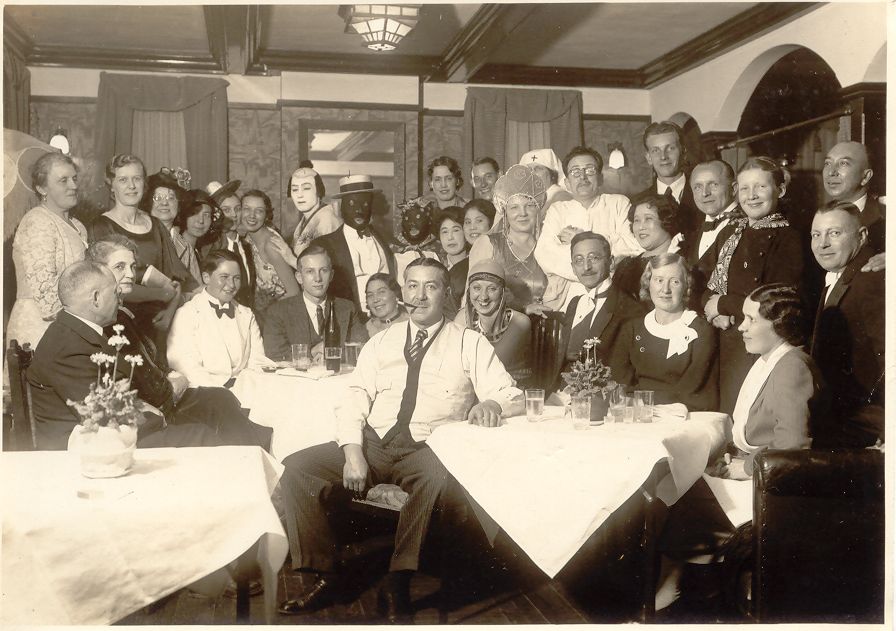 Willie Helm at center, a playboy and black sheep of the family.
Authorities ordered all foreigners to clear out of Honmoku and Bluff. Most went to Hakone and Karuizawa orders came March 1944.
Willie’s family went to Karuizawa after having taken most of the clothing and some old furniture to Karuizawa. The good furniture as well as baby grand, phonograph, Frigidaire, washing machine, sun lamp, were placed in go-downs [warehouses] in the settlement no. 90. Which was burned down.
Agnes, Veronica and Richard were in Karuizawa and still there.
Willie lived half time in Karuizawa and half time with Bud.
Bud purchased 804 [Julius’s house?] with all contents. We thought it a good idea instead of any Nip getting it. But now it’s no use as all burnt out together with contents.
In the excitement, Bud only rescued his tuxedo, swallow tail suit, hard form shirts, still with New York laundry labels and 85 cents alarm clock. All the rest of his stuff is gone.
Butter is now 100 to 150 yen a pound but impossible to get. Potatoes 20- 30 yen a kwan. Rice 60- 80 yen a sho. Agnes still has kidney trouble.
After the fire, Willie moved to a room in helm house. On the morning of the 29th of May practically all of Daijinguyama went up in smoke up to former mis ross’s house. Same day all of Motomachi, Isezakicho, Honomku were gone.
What is left of Honmoku near our place, just a couple of Japanese houses, all our houses—Willie’s Gomei, Bernard-Bells houses broken up through bombs.
Although [Japanese]soldiers are back it’s impossible to get carpenters.
The Nips seem to be dazed that they lost the war—how long they will be like that we do not know—they ought to work since they have no food to eat but even if they had money what could they buy.
When 804 burned on the 29th, Bud shared Willie’s room in the Helm House. Everybody being very nervous before they left Willie’s place. Agnes and they were no more on speaking terms—Willie also got somewhat fed up—outside of these there were another two burnt out people put into the house. Four guests at one time for such a long period was too much. (E+L
[sisters Eloise and Louisa] were staying there during that time)
On the 24th of August Nip authorities gave orders for all people living in Helm House to clear out within 24 hours as the place had to be made for sleeping quarters for U.S. officers. Nips would not even allow Bud and Willie to stay there so had to find quarters.
Katchan lost all her stuff, went to the country and now came back two weeks ago and working for Walter—she has only one dress what she has on. Walters leg at last better, had been bad for over two years.
Bernards living in servants rooms of Barney’s place, old man now 92 years old they were interned up to the end of war. Total eyesight, 98 percent hearing gone but brains working normal and good appetite.
Would appreciate very much if you could do something if any way possible—victuals as well as money—Willie will repay when he can—nothing can be done from here. Would be nice if they could be brought to your town.
December 7, 2022
Art and Railway: Celebrating the150-year history of railroads in Japan
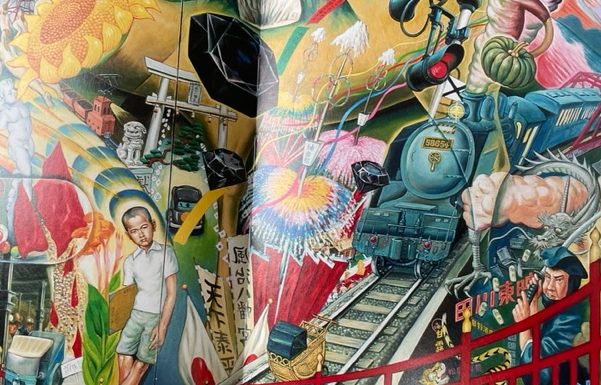 The Black Diamond and the Sunflower
I’ve never been much of a fan for art exhibits in Japan. Too often they throw together a bunch of stuff without any rhyme or reason. But this exhibit at the Tokyo Station Gallery uses woodblock prints, oil paintings, photographs, textiles and even an image of a bathtub installation to offer deep insights into the myriad of ways in which railroads have had a deep and enduring impact on Japanese culture, labor practices, social behavior and urban developments. Here are just a few examples.
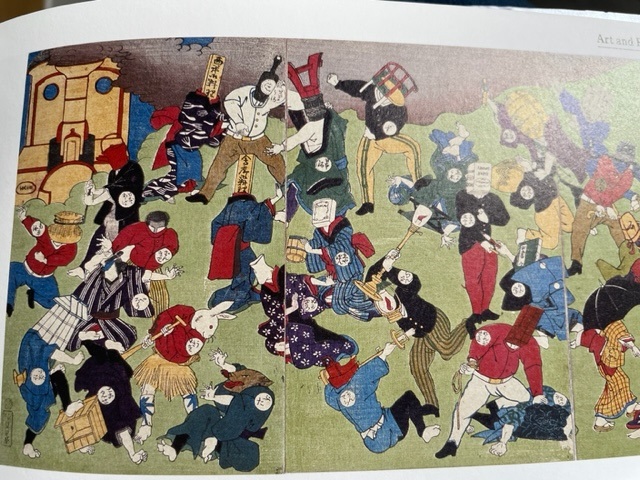 The Rise and Fall of a New Age by Shosai Ikkei
This image doesn’t contain any images of trains, but it established the context for the train’s introduction, by illustrating the many areas in which the arrival of westerners posed a challenge to Japanese tradition. The people in western dress are shown beating up on people in traditional dress. The heads represent the challenges. On the bottom right is brick, and to the left is a lamp. Further to the left is a rabbit, which is beating on a wild boar.
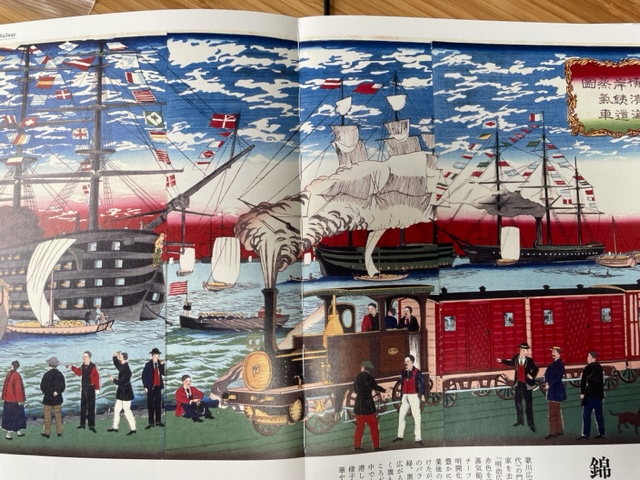 Steam locomotive in transit by Utagawa Yoshitora
This is one of many classic woodblock prints that show “black ships,” which brought the westerners to Japan, and the trains hey introduced.
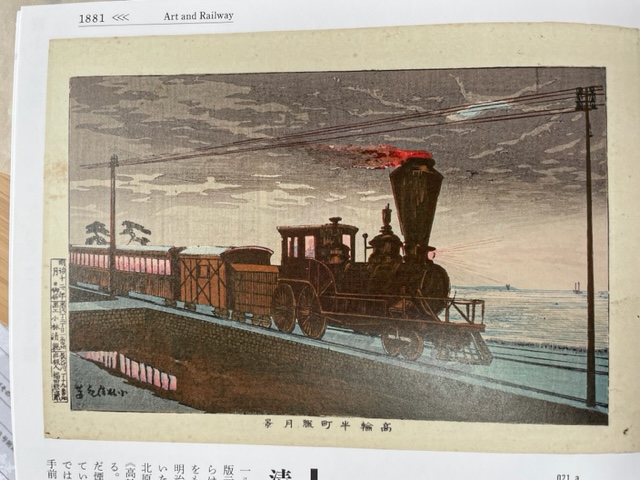 View of Takanawa Ushimachi beneath ashrouded moon.
 This woodblock print by Kobayashi Kiyochika is from 1879. It’s only been seven years since the first train traveled from Yokohama to Shimbashi, but already the train, while fierce with flames coming from its locomative already seems somehow romantic and very much a part of the Japanese landscape.
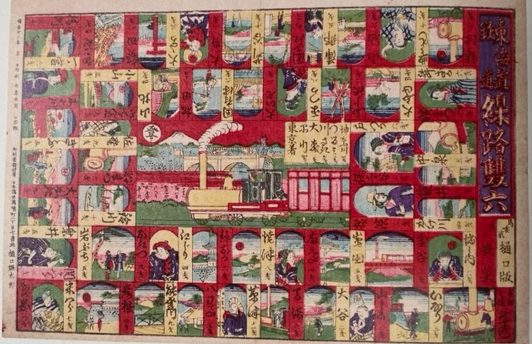 Tokaido Railway Board Game
Rail lines are being laid at a furious pace along the Tokaido, long a traditional route to walk between Kyoto and Tokyo. In this traditional board game image created in 1889, each box represents a train station on the Tokaido Railway.
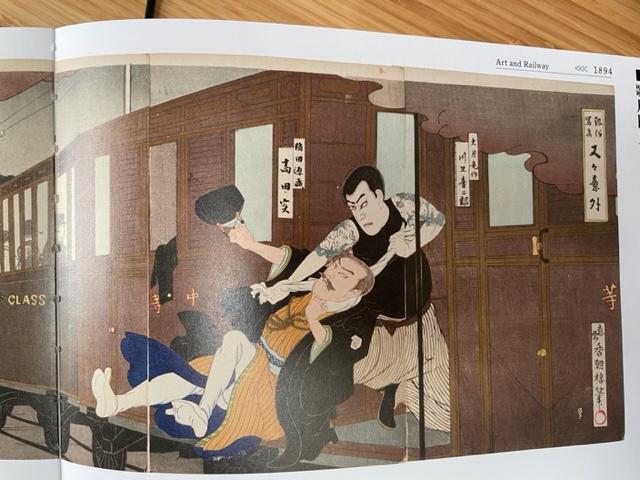 Murder on the orient express
You know trains have become a part of every day life when an image comes out illustrating a murder that took place on a trains, as was this 1994 image by Utagawa Kunisada III.
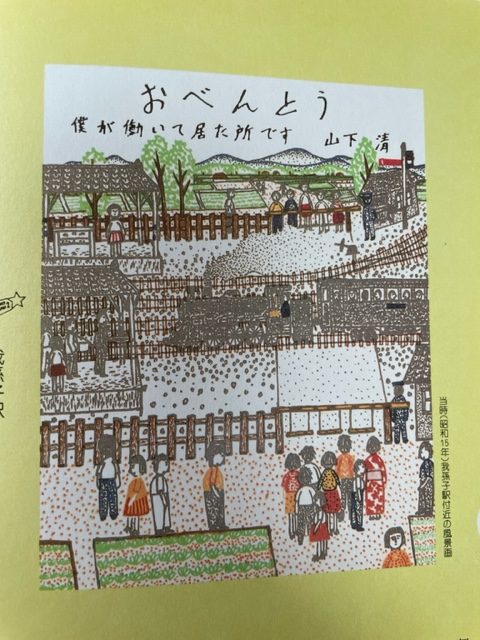
By 1940, the railroads are deeply imbedded in Japanese society and Japan is making its own contribution to train travel: bento boxes that include regional specialties. This is the light hearted side of the Japan experience, but there are many more dark images representing labor strife during the early 1930s. Their are designs for the special train cars built for occupation authorities after the war[
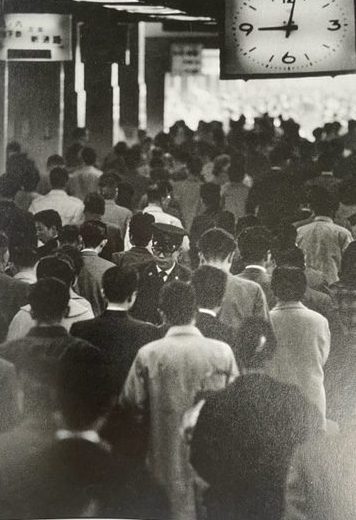
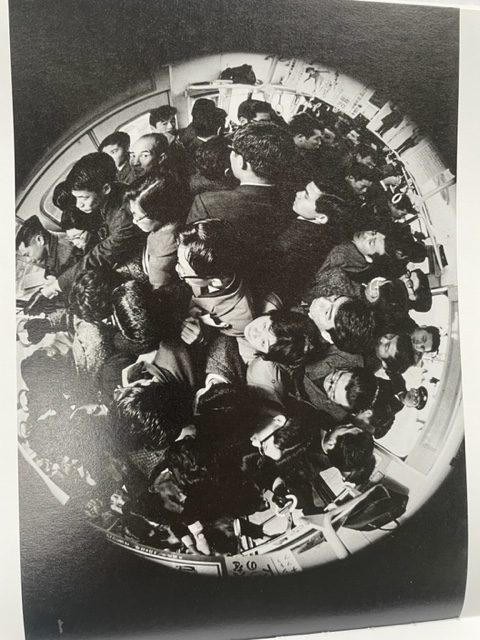
To many westerners, the image we have of Japan today are the faceless crowds best represented by images of people pouring into train stations. It sometimes feels as if that image of blank, inscrutable faces says something about the culture. But it’s easy to forget that this image, is to a great extent, a product of Japanese railways, not something that was part of traditional Japan. When you are crushed in a train, you need to put on that mask to hide yourself.
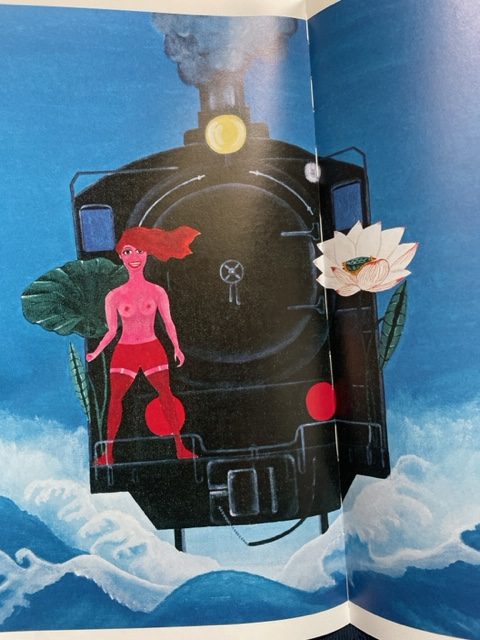 A comparison of Eros and Thanatos or “Aesthetics of the End” by Yokoo Tadanori 1966
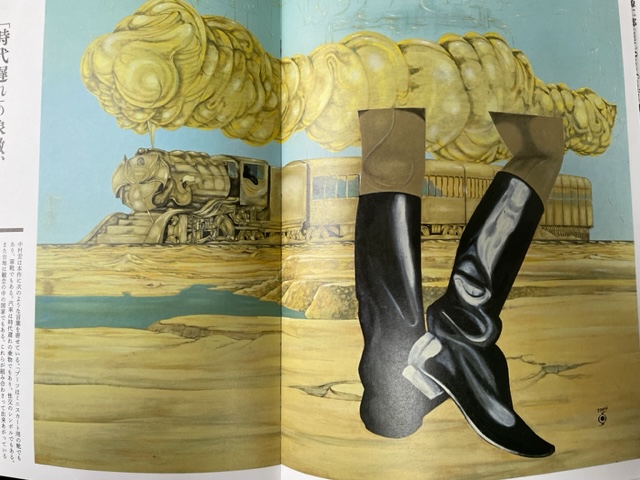
Of course there are flights of fancy and other paintings that are Daliesque
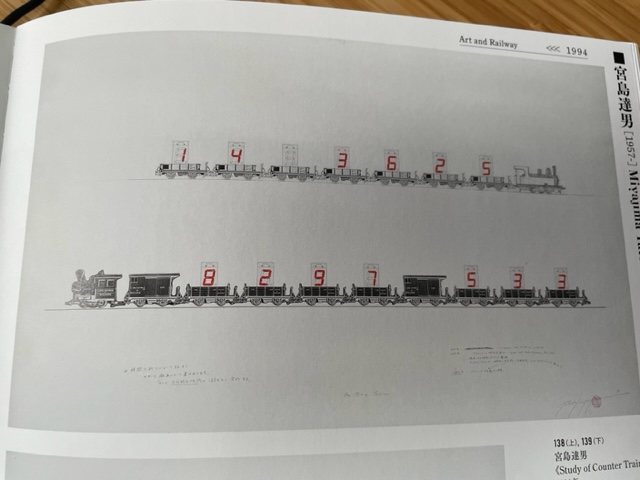 Trains as a metaphor for life moving in a single direction.
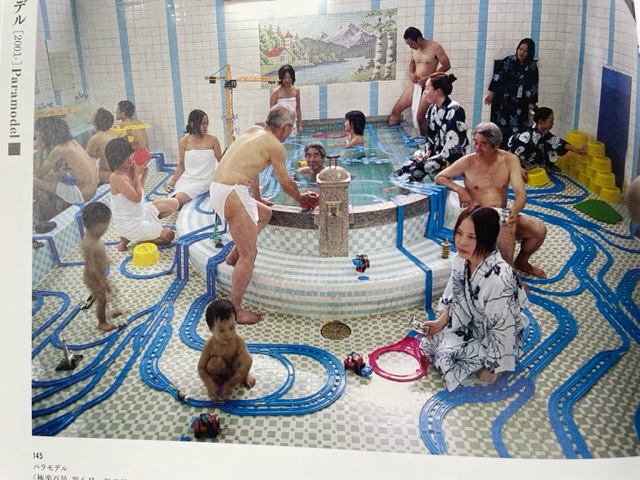 And then installations like this in 2007 that you just have to think about. There is just so much to love, think about and appreciate in this exhibit. Don’t miss it. It closes on January 9th.
June 3, 2022
The Binswangers, Freud and my Jewish Ancestors
In 2016, I gathered in Kreuzlingen with some 120 relatives were from Britain, South Africa, Germany, Switzerland, the United States and Canada. We were there to hear about the history of the Swiss Binswangers, a family that for four generations operated the Bellevue Sanatorium that treated patients who could afford psychiatric treatment in a lavish environment.
Next week, I will visit Augsburg, Germany for a reunion not just of the Swiss Binswangers, who converted to Christianity about 1850, but of all the descendants of Moses Binswanger, our common ancestor.
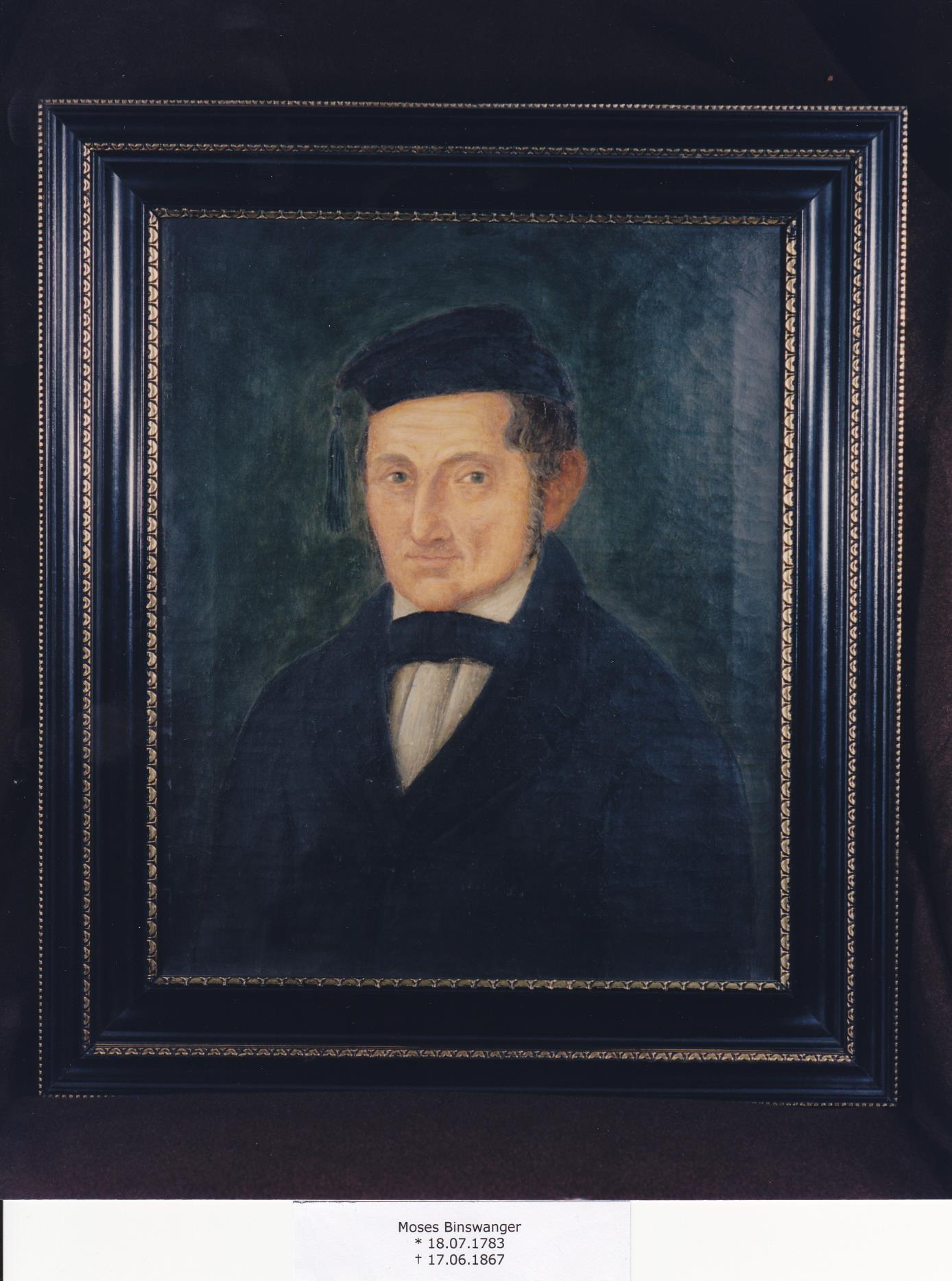
In doing so, I came across an illustrated history of the Binswangers by Richard Binswanger that I will borrow heavily to talk about the history of this interesting family. I will also draw from extensive research provided by Andreas Binswanger, the family historian.
Moses Binswanger was a Jewish peddlar who was born in 1783 in Huerben, not far from Munich. His grandparents lived in Binswangen, 33 miles away, and they probably took the name of that village as their last name when they moved to Osterberg and then Huerben. Jews had lived in Huerben since 1518 when they had been driven out of Donauwoerth, where they had controlled much of the trade in salt.
In 1670, Count Maximilian of Liechtenstein asked the emperor for permission to expels the Jews from Huerben but his request was denied, and five years later the count allowed the construction of a synagogue and a house for the rabbi. Ritual slaughter of animals was allowed, and for each cow or large animal slaughtered, its tongue had to be delivered to the manor, although in 1717 a fee of 15 Kreutzer could be substituted for the tongue. For small animals, a fee of 5 Kreutzer was charged.
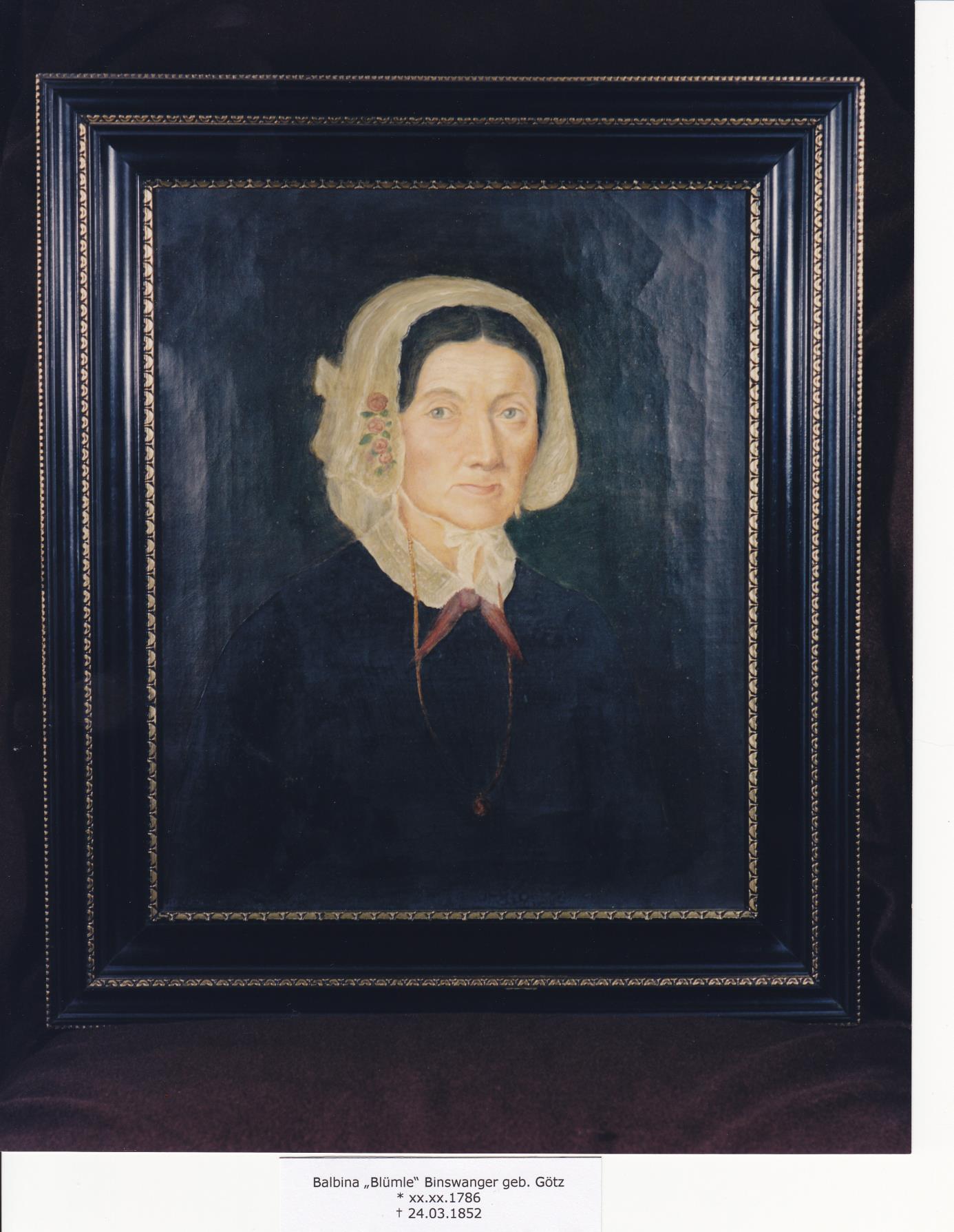
Moses married Bluemle Goetz from the village of Fischach, about 14 miles away. It was a town where Jews had lived since about 1570. The Jews of Fisbach were moneylenders and also traded horses and cattle. Farmers in the area today still tell stories of how the Jews were the most honest people. During the 30-years-war, which lasted until 1648, the Jews fled to Augsburg. Although they were allowed to return to Fisbach after the war, they were told they could only live in five houses. They moved in, and expanded each house until, by 1743, there were 113 people living in those five houses. Neighbors complain constantly and finally, in 1802, they were allowed to build more housing.
A Jewish synagogue was built in 1739, and a cemetery in 1774. Today, one memorial carries the inscription: “Dedicated to the victims of the racial persecution 1933-1945. In Memory of the Dead: An Admonishment for the Living.”
After Moses and Blumle married, they moved to Osterberg where Moses worked as a peddler selling textiles and glass door-to-door. He traveled to villages as much as 45 miles away, most likely on foot.
Moses had nine sons of whom four went to the United States. One of those sons founded Binswanger Glass, which would develop into one of the country’s largest window makers. Another son would stay in Germany and develop a large vinegar and beer brewing company. Yet a third son, Ludwig born in 1820, was trained in Germany as a doctor and moved to Kreutzlingen to take a job in a psychiatric hospital.

Seven years later, he married Jeannette, a very wealthy woman, and with her money opened a private psychiatric clinic, the Bellevue Asylum, in Kreutzlingen, Switzerland, right on Lake Constance on the border with Germany.
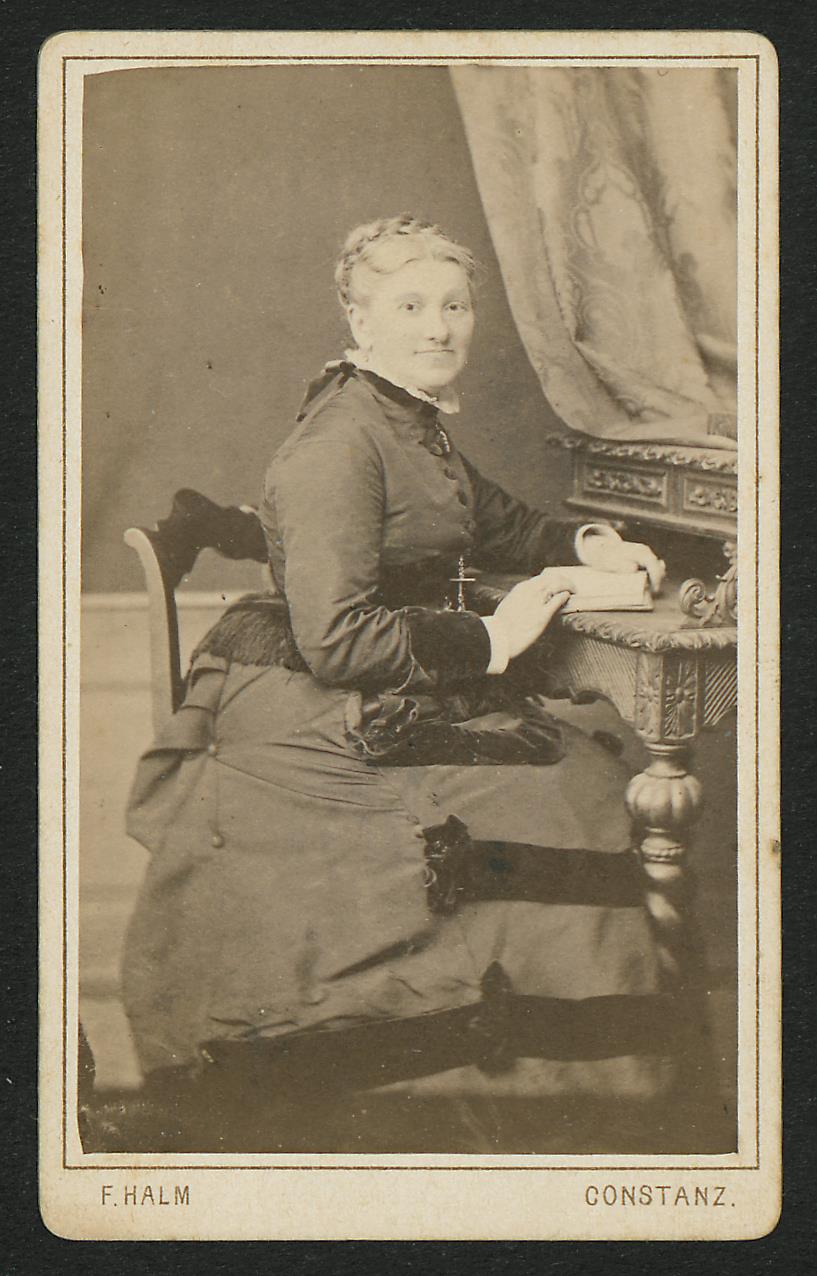
As Richard Binswanger writes in his short history of the family: The asylum was founded in what was originally a convent and later became the publishing house “Belle-Vue”, which had become very well known for publishing liberal literature and promoting progressive ideas, written by German political refugees. The publishing house was not regarded favorably in Germany, and with the conservative backlash in Europe after [the revolution of]1848, the publishing house lost its economic foundation and was sold to the Binswangers.
When the Asylum opened, it ran the following advertisement showing the view that Belle-Vue had of Lake Constance.
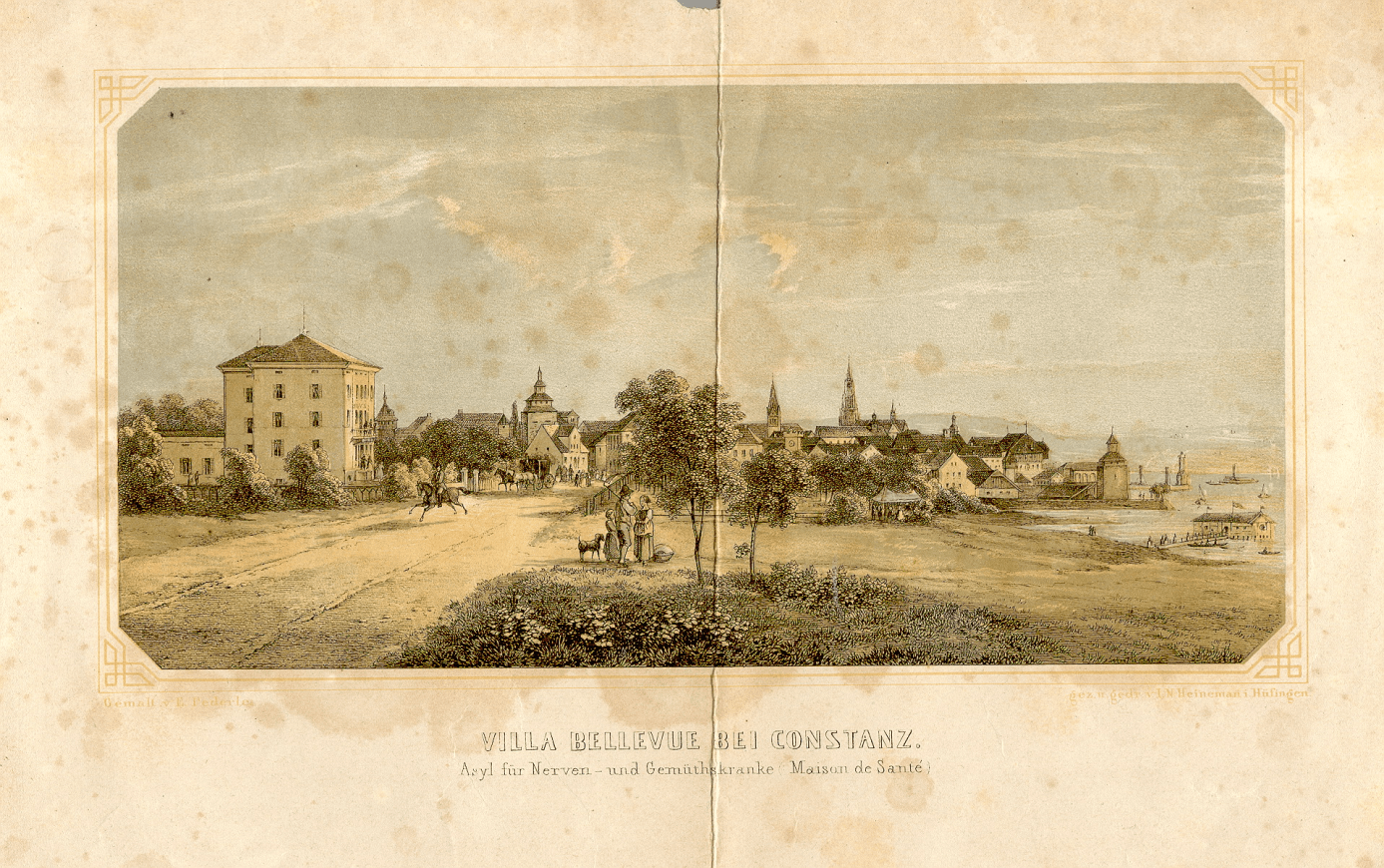
Ludwig and Jeannette’s idea was to allow patients to move freely on a campus shared with the staff and the doctors. Once a week the patients dined with Ludwig’s family. This approach came out of the reform movement in psychiatry in the mid 19th century. They believed that the patient’s needs should always come first, and that approach was followed right until the sanatorium closed in 1980.
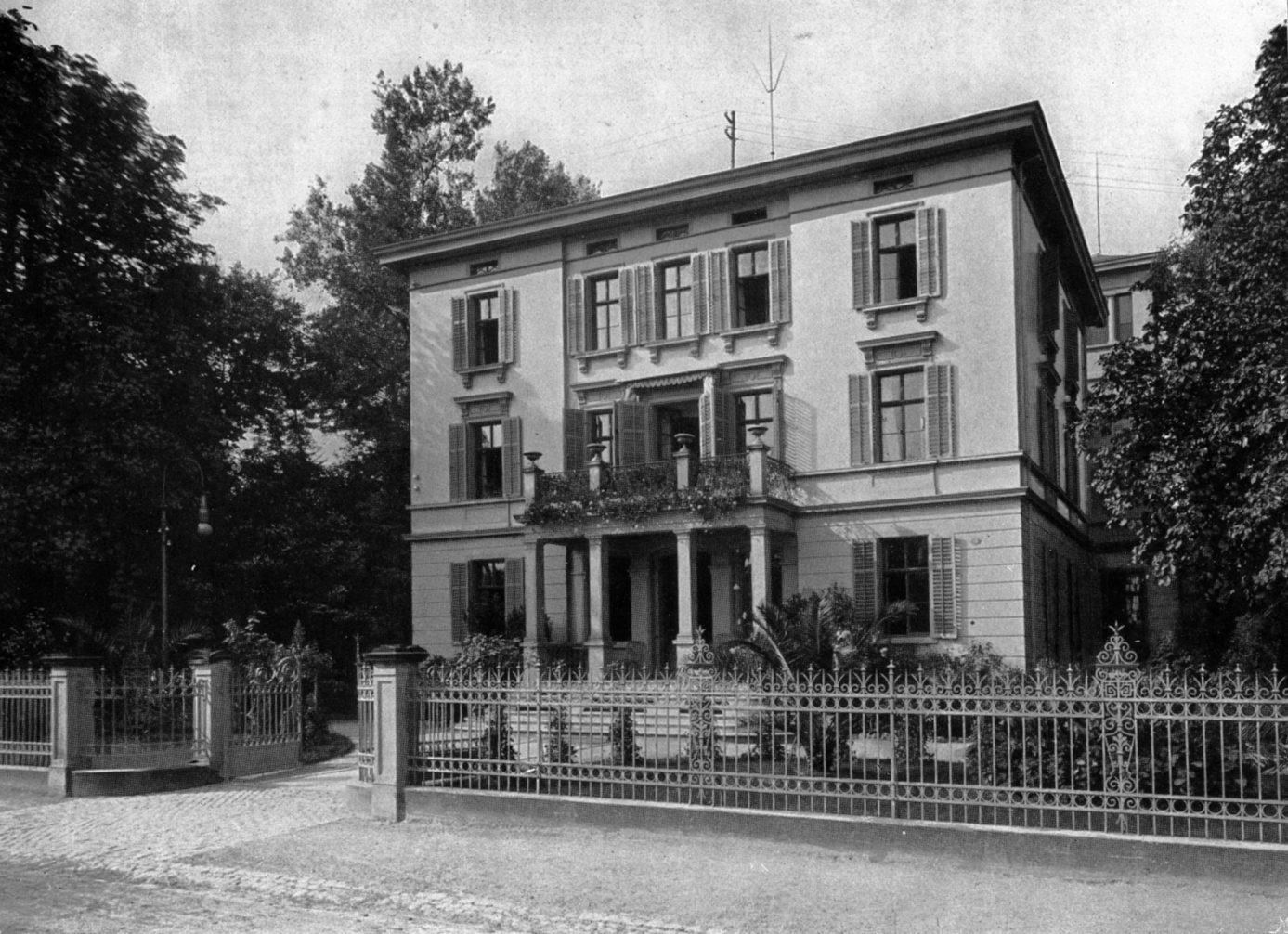 Villa Belle-Vue
The Asylum was successful, and they gradually added elegant homes to house their wealthy patients.
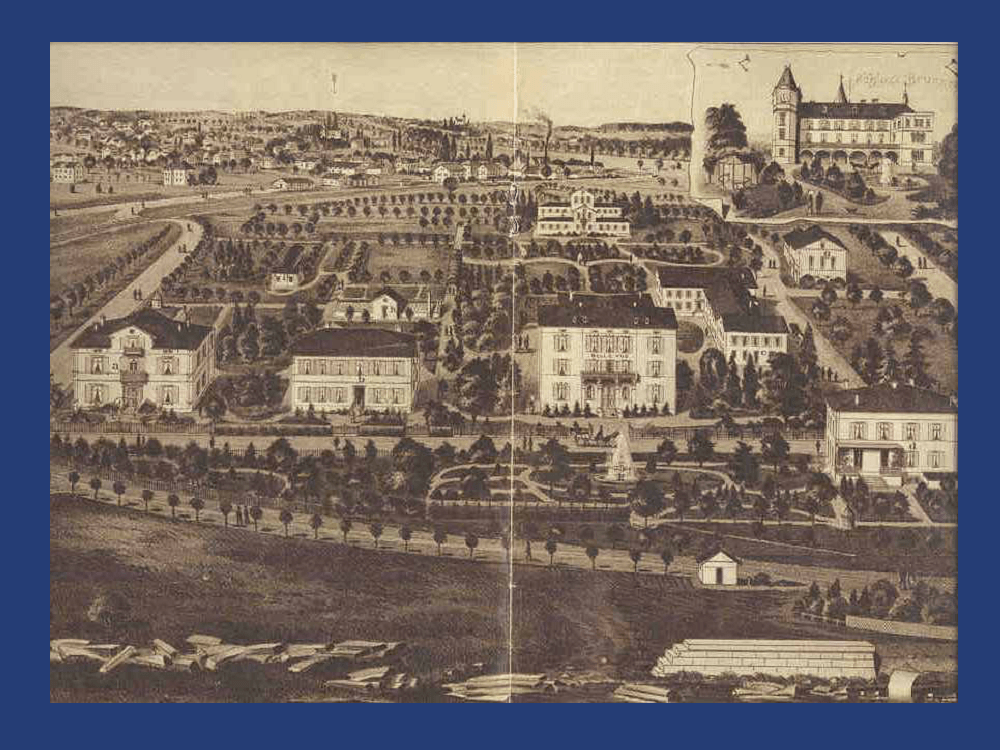
Ludwig had never been a very religious Jew, although in 1848 “he made a blazing speech for the emancipation of the Jews in Munich.” Although he had once observed Kosher, when he moved to Konstanz, a German city on the border with Switzerland, that became more and more difficult. Konstanz had expelled Jews from the city 400 years before and there was no Jewish community. Since Ludwig wanted to participate in political life and in the community, he converted to Christianity and joined the church at Kreuzlingen, a Swiss town nearby. His Jewish family was unhappy with that decision and when his mother died, members of Ludwig’s family were not permitted to go to her deathbed. When Ludwig’s siblings created the Moses and Blumle Binswanger Foundation in the 1900s to provide scholarships for members of the family, Ludwig was not part of that effort.
Ludwig was successful, and bought a rural estate, the castle Brunneg in 1874, which became the family’s home for more than a century. (The building is now the Schloss Brunnegg Hotel.) Andreas and his brother Hans Christophe recall how there were two living rooms. All the living room furniture would be moved to the “winter house” the south side of the castle in the winter and back to the north side of the house in the summer. Hans Christophe Binswanger, later a World Bank economist, remembers the attic being full of cushions and large suitcases with drawers where the kids enjoyed playing. It would be the home of Ludwig 1, Ludwig II, Robert I (my great, great grandfather) and Otto ll. Since the Binswanger philosophy was that patient needs always came first, there was little border between the patients and the family. Patients often ate with the family and the kids often spent time in the Asylum. Some of the kids were fine with it and loved running around the asylum. One Binswanger, however, was less enamored of the experience and wrote a book based on his memories growing up on the Sanatorium.
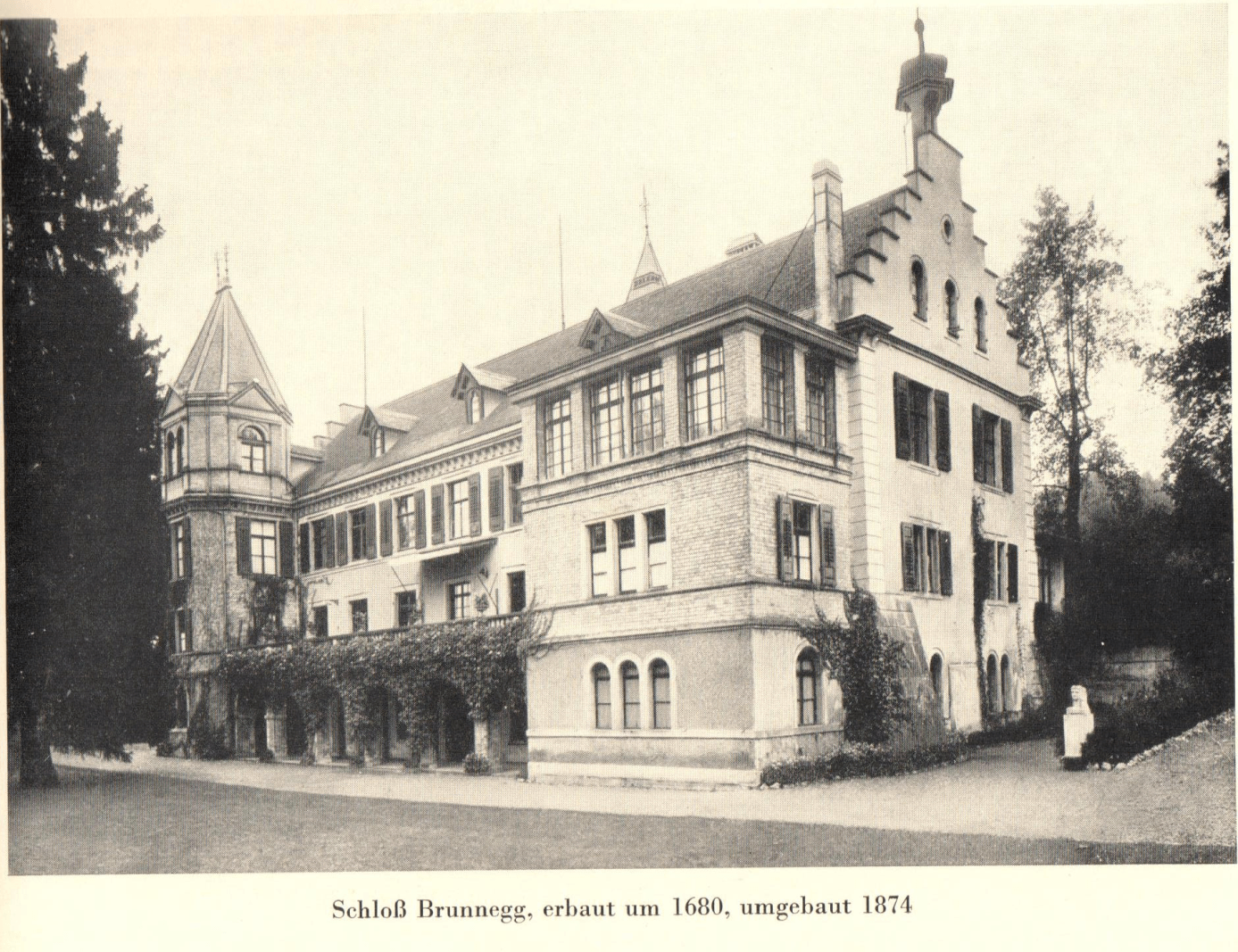
Ludwig I and his son Robert I bought the surrounding land, establishing a modern farm that provided the market in Constance with dairy products among other farm products. The family had 100 cows and family members recall drinking milk directly from the teets of the cows. Later, when there was a tuberculosis epidemic among deer that was infecting cows in the alps, Otto became concerned and sold all his cows. Visiting the farm in 2016, I thought it looked more like a castle than a farm with its elegant barns and stables. The hay was stored in the barn below. There were also silos to store the grass. It was mixed with salt to feed cows in winter. The pigsty was built of brick. When the government planned to build a tunnel under the farm for a highway, the family objected on the grounds that the noise would disturb the pigs.
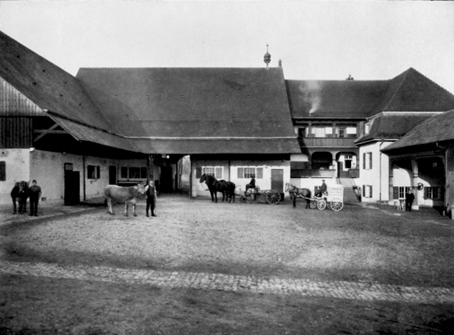 The Brunnegg Farm
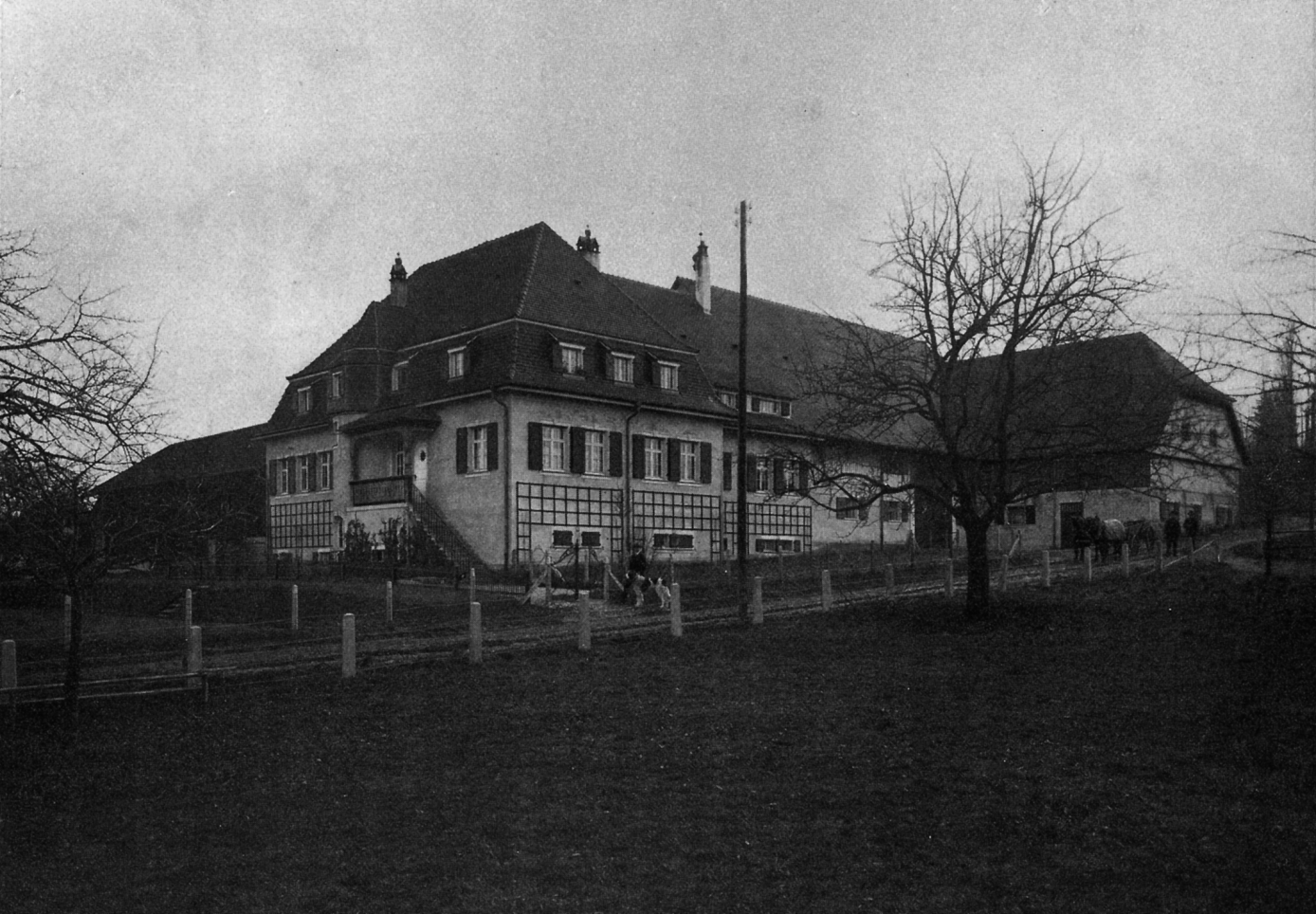
Robert Binswanger, my great great-grandfather, took over as head of the sanatorium in 1880. He married Bertha Hasenclever, who came from a wealthy Dutch family and whose riches help to continue to finance the expansion at Bellevue.
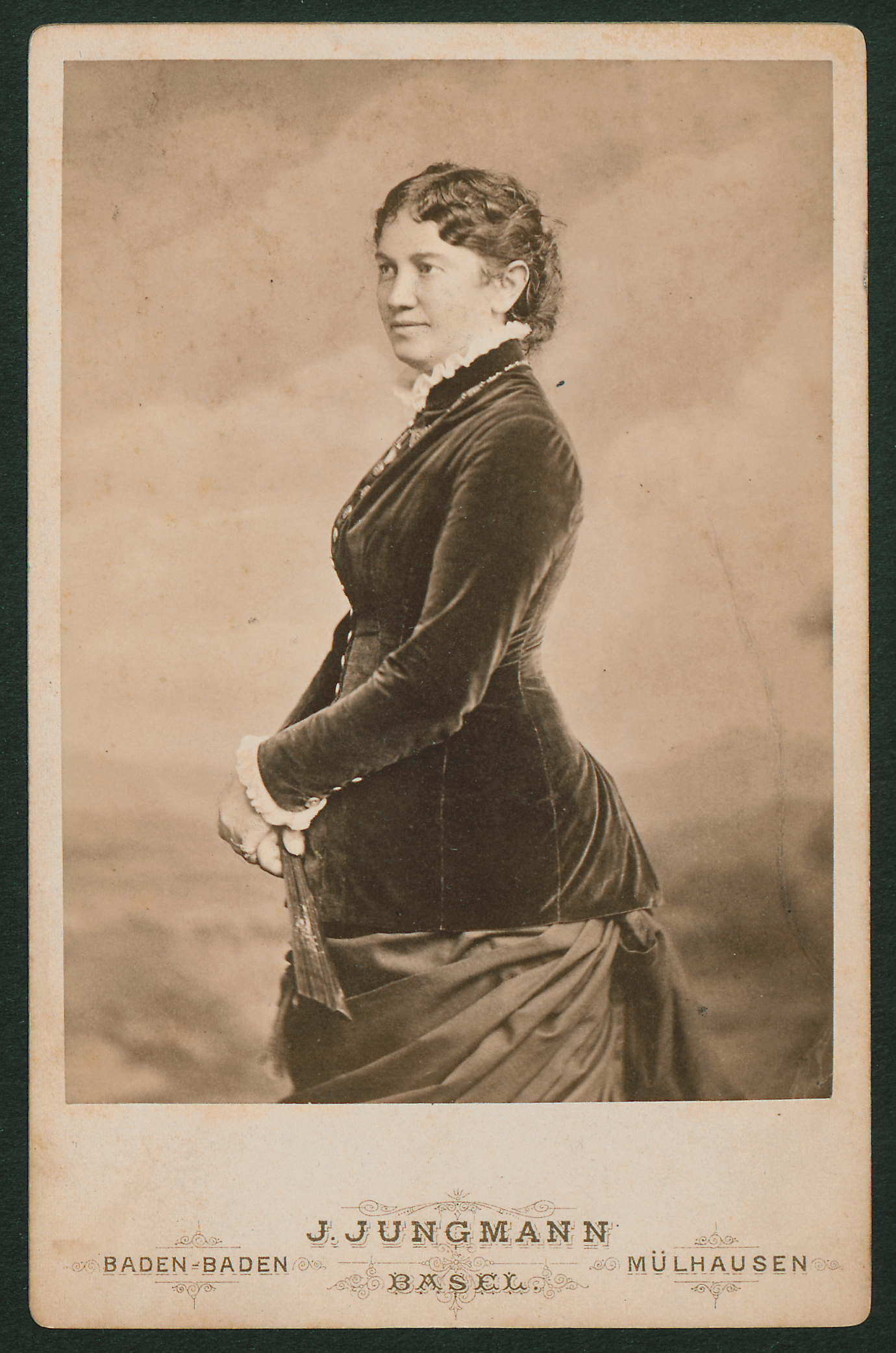 Robert Binswanger’s wife Bertha Hasenclever, wealthy Dutch woman, provided the wealth for much of Bellevue’s expansion.
 Robert and Bertha had five children including Ludwig 1881-1966, who would become the next head of Bellevue and a famous psychiatrist in his own right, my great-grandmother Anna, 1877-1941, Otto ll 1882-1968 and Robert II, 1892-1963 and Anna.
According to Richard Binswanger:
During Robert’s lifetime, Bellevue expanded and flourished. He created a magnificent park of around ten hectares with 15 houses for only 60 patients, where they lived, sometimes only one individual in a house together his staff. In one of these villas. I spent the first happy twelve years of my life. This “Bauwut” – building obsession – of Robert was one of the causes of the later decline of Bellevue, as the preservation and upkeep of the architectural substance far exceeded the financial capacities of the sanatorium. But until that point, almost sixty years would pass. Under the leadership of Robert I, Bellevue had the greatest economic success in its whole history.
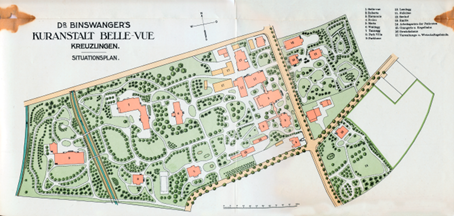 Map of the Belle-Vue campus under Robert Binswanger
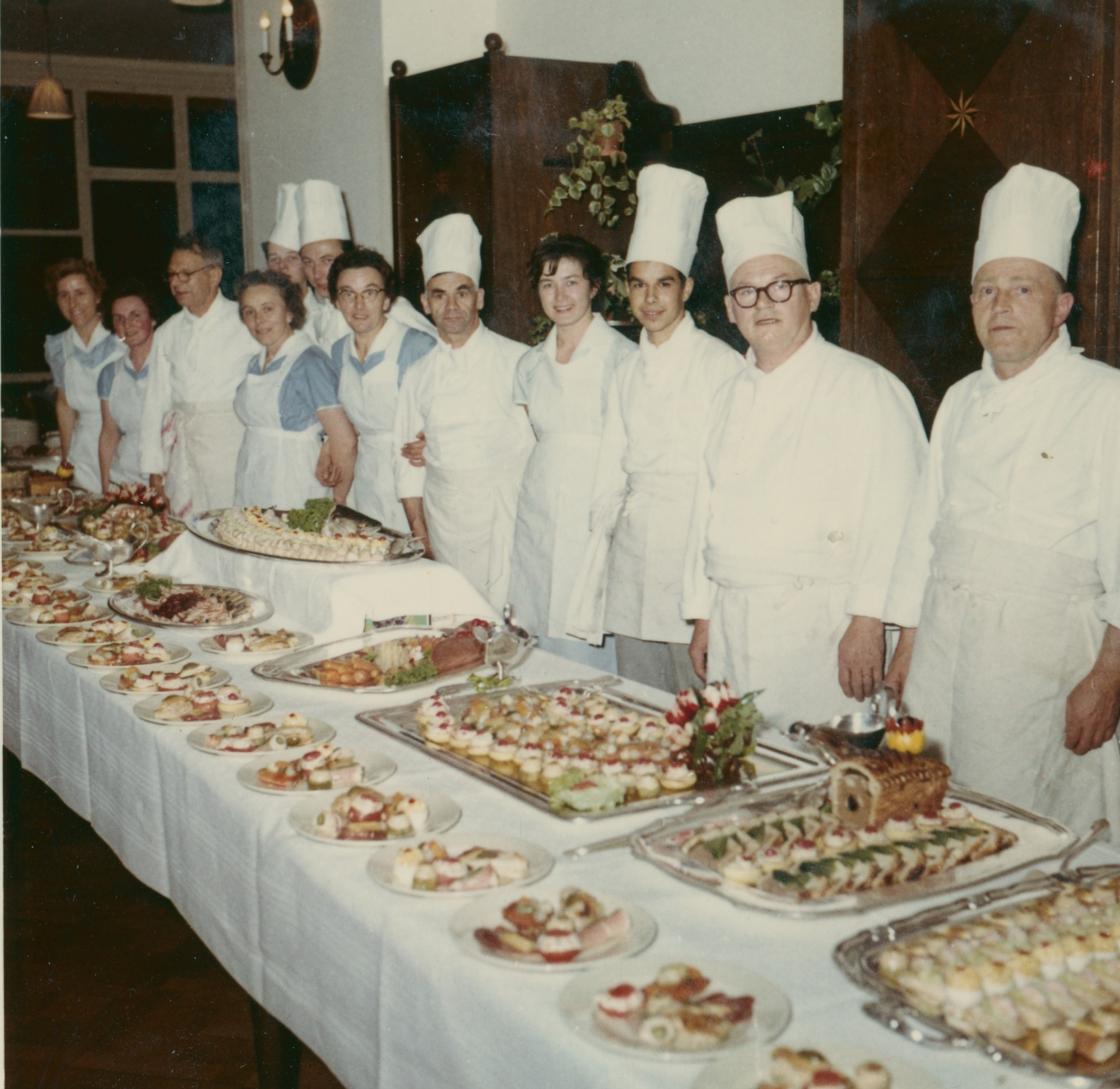 The Bellevue Kitchen Staff
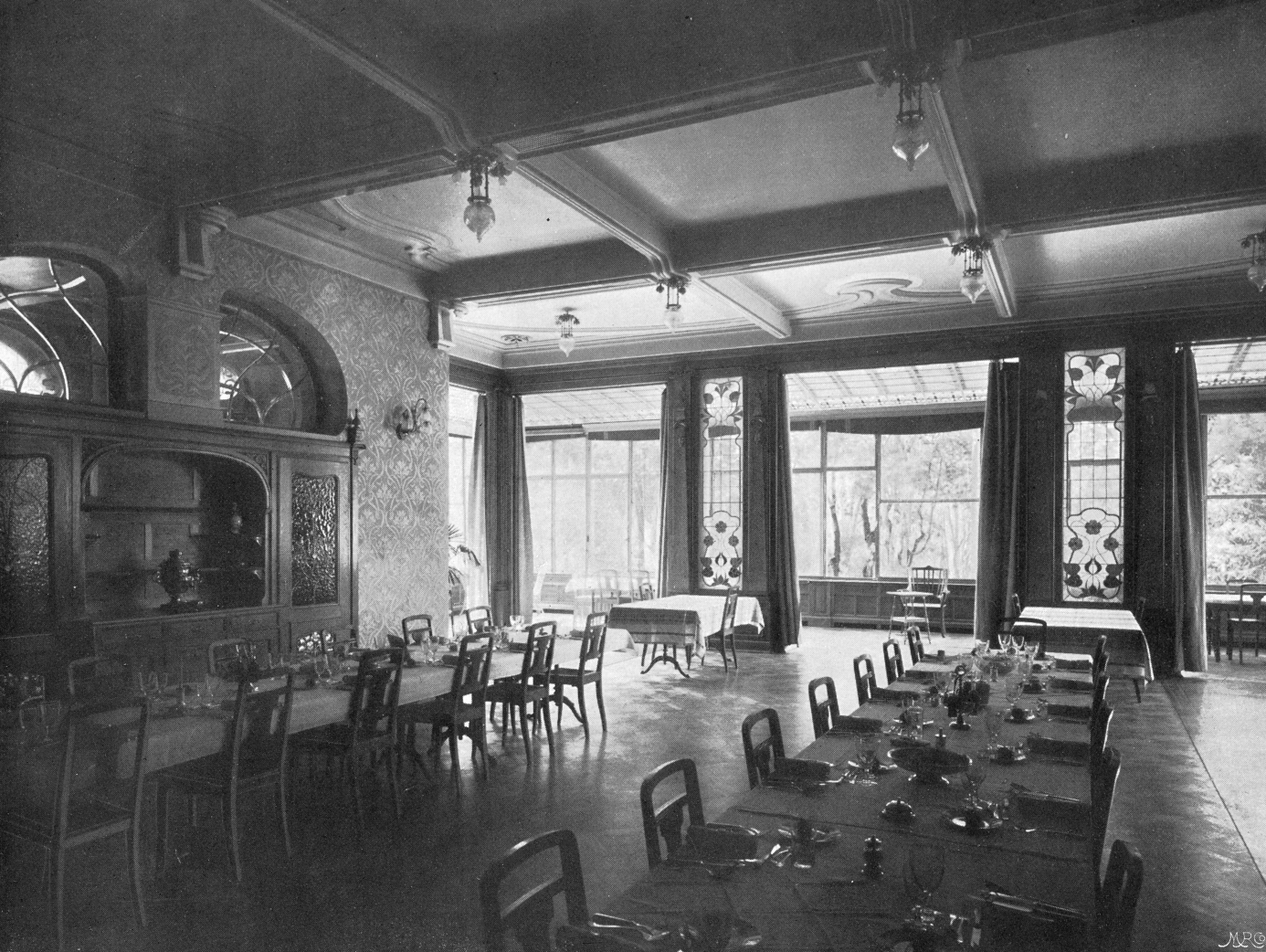 The Dining Hall
There was an engine building that housed what looks like two generators to power the electricity on the campus.
 The Generator Room
The asylum was now a massive facility. The administration and kitchen facilities alone required a large building.
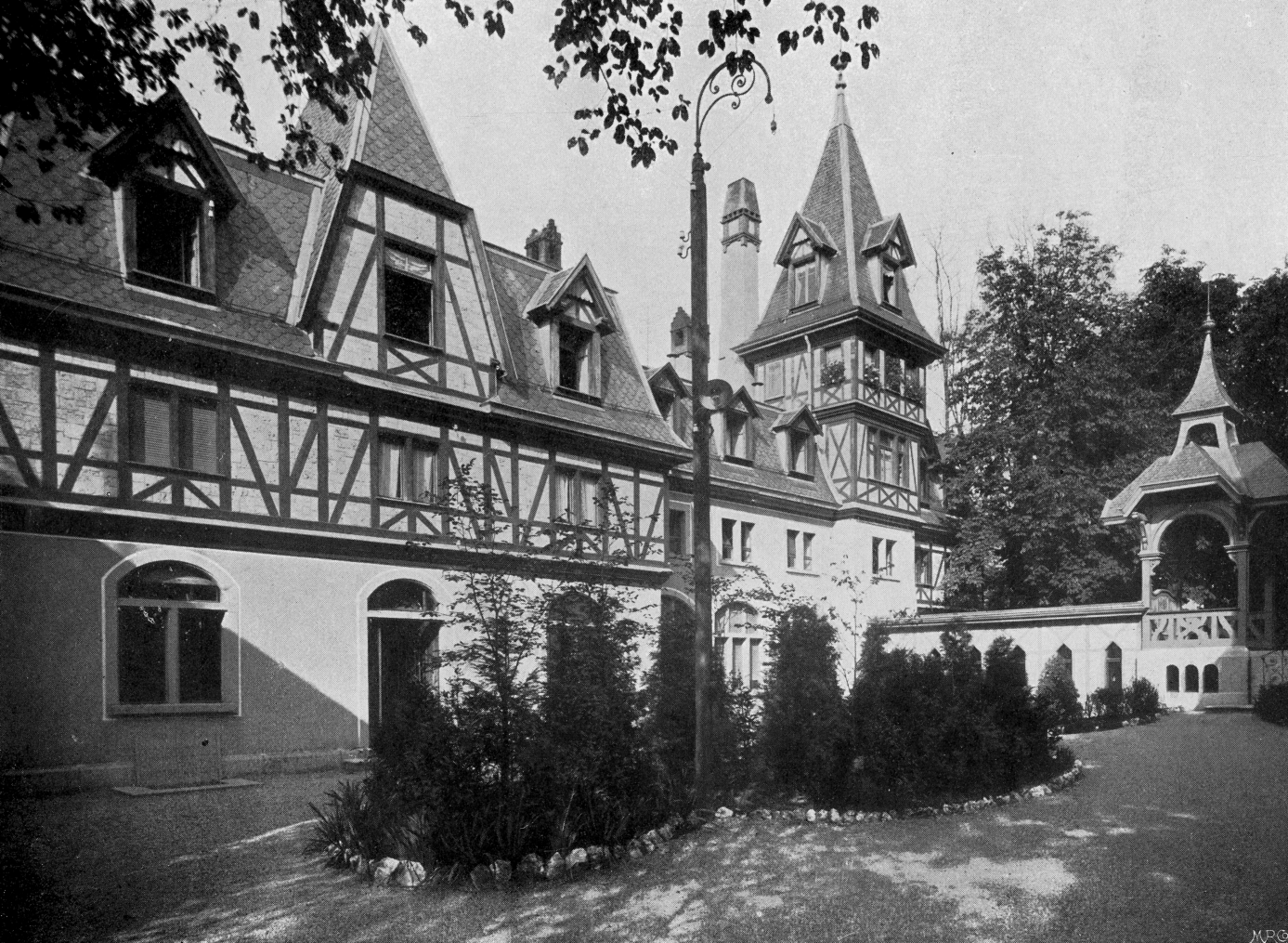
There was a large dining hall for both the 60 patients and another 40 or so staff.
A large, high-ceilinged central kitchen produced food that was prepared in iron cookware that was then taken by car to each patient’s house. Richard remembers his father would alternate his fare between food cooked for the employees and that prepared for the patients so that he knew what everyone was eating. Once a week his parents had meals with the patients. That included the countess of Bern, a Miss Kernix who was bipolar.
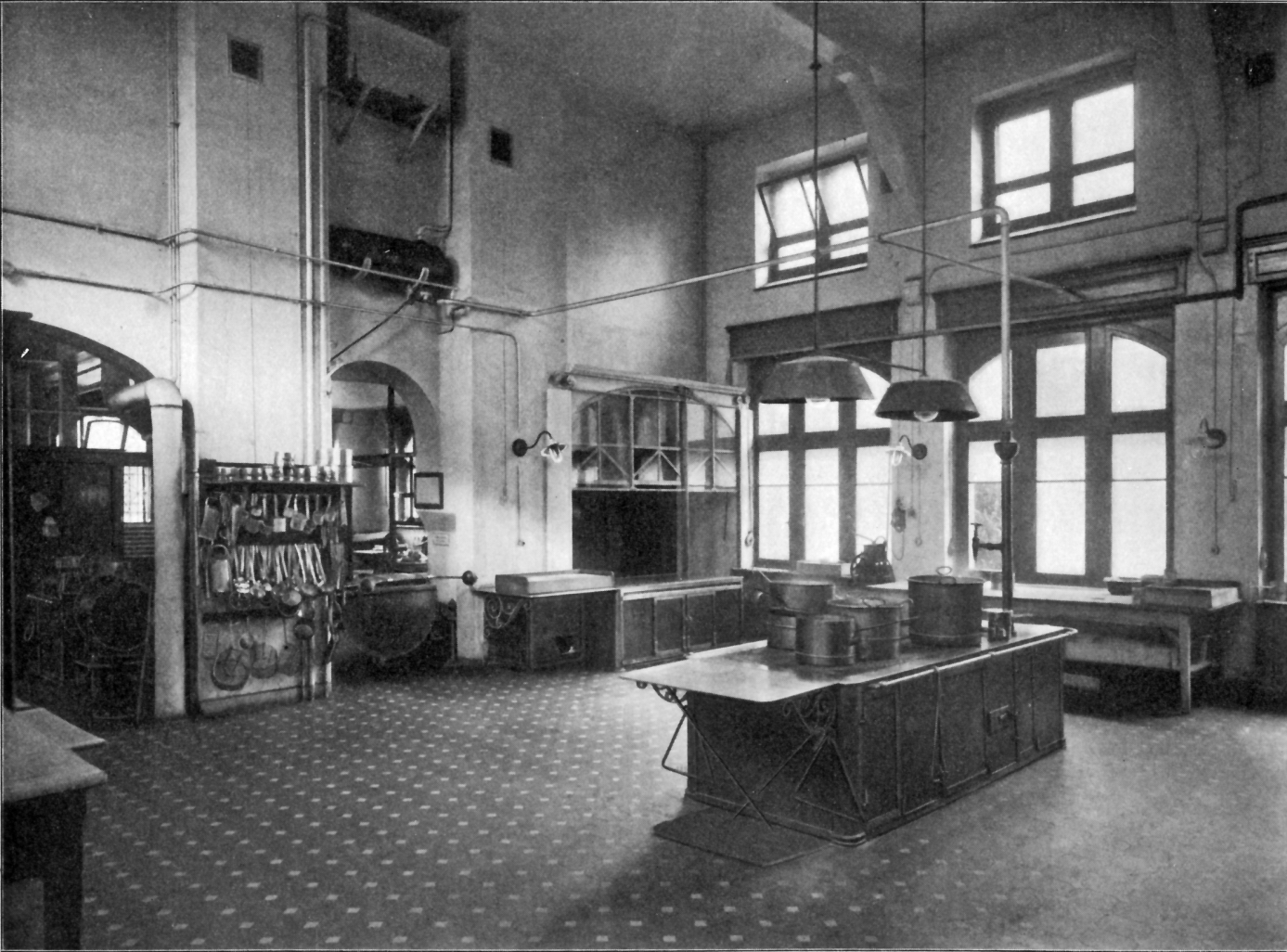
There was a butchery in an annex of the kitchen. “We all loved the kitchen,” Richard recalls. The parents would complain, but the cooks would always give us something to eat. There was a Mr. Raas? Who educated the cooks. He had an unlimited supply of ice at a time when that was rare.
More modest was the “Middle Building” where the Physical therapist and housekeeper lived. The ironing was also done here and there was a big stove on which the flat irons were heated.
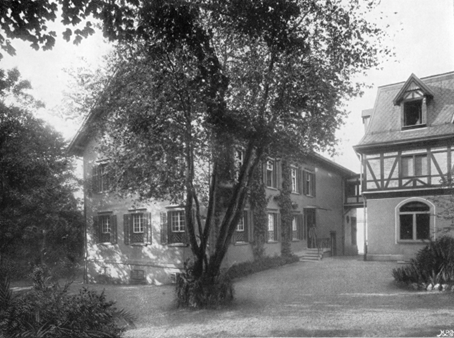 Middle Building
While most patients were given a lot of freedom, there was also Parkhaus, a special facility for patients with more severe problems.
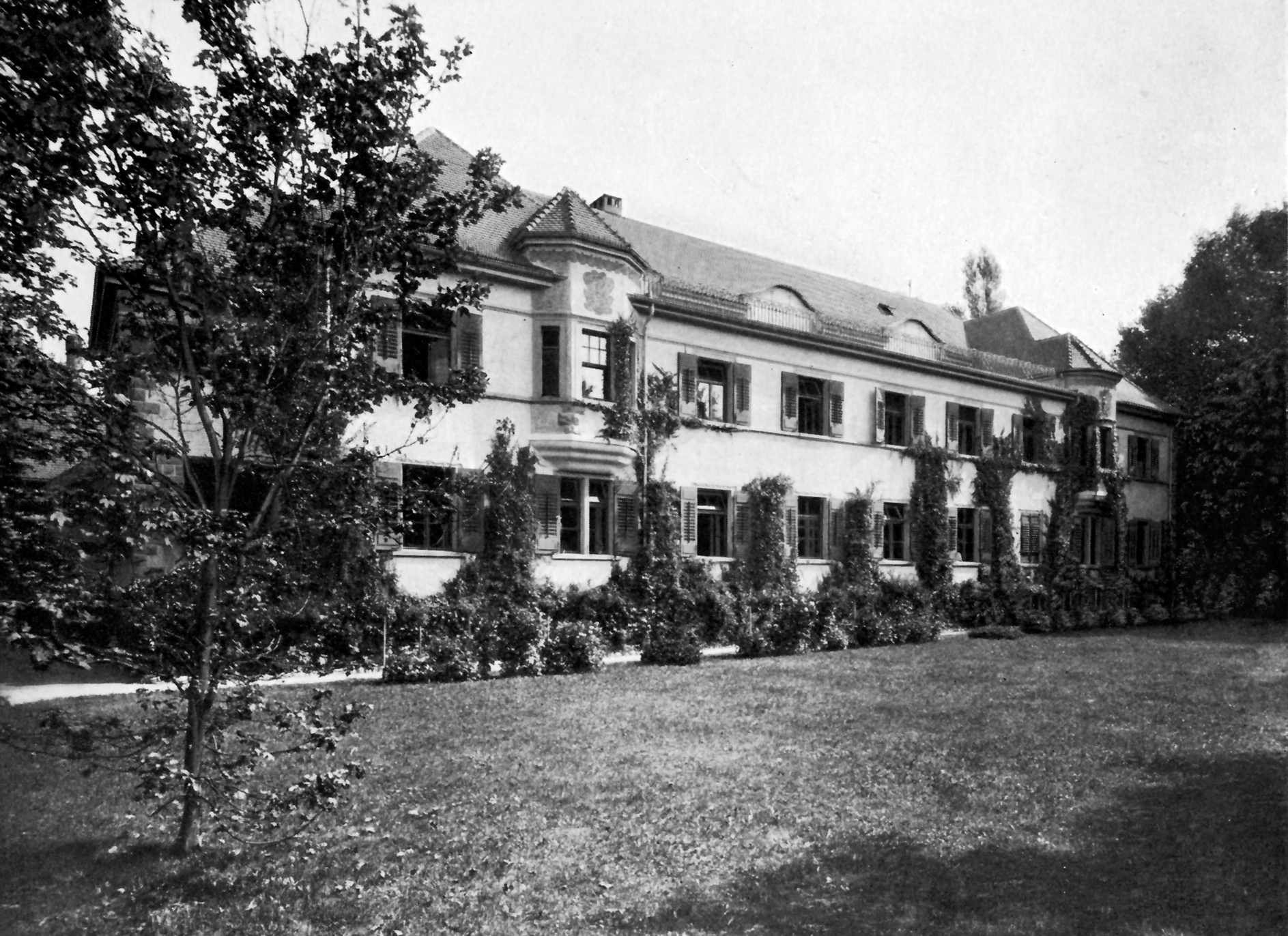 Parkhaus was a special facility for patients requiring more acute care.
Many patients were housed in elegant homes.
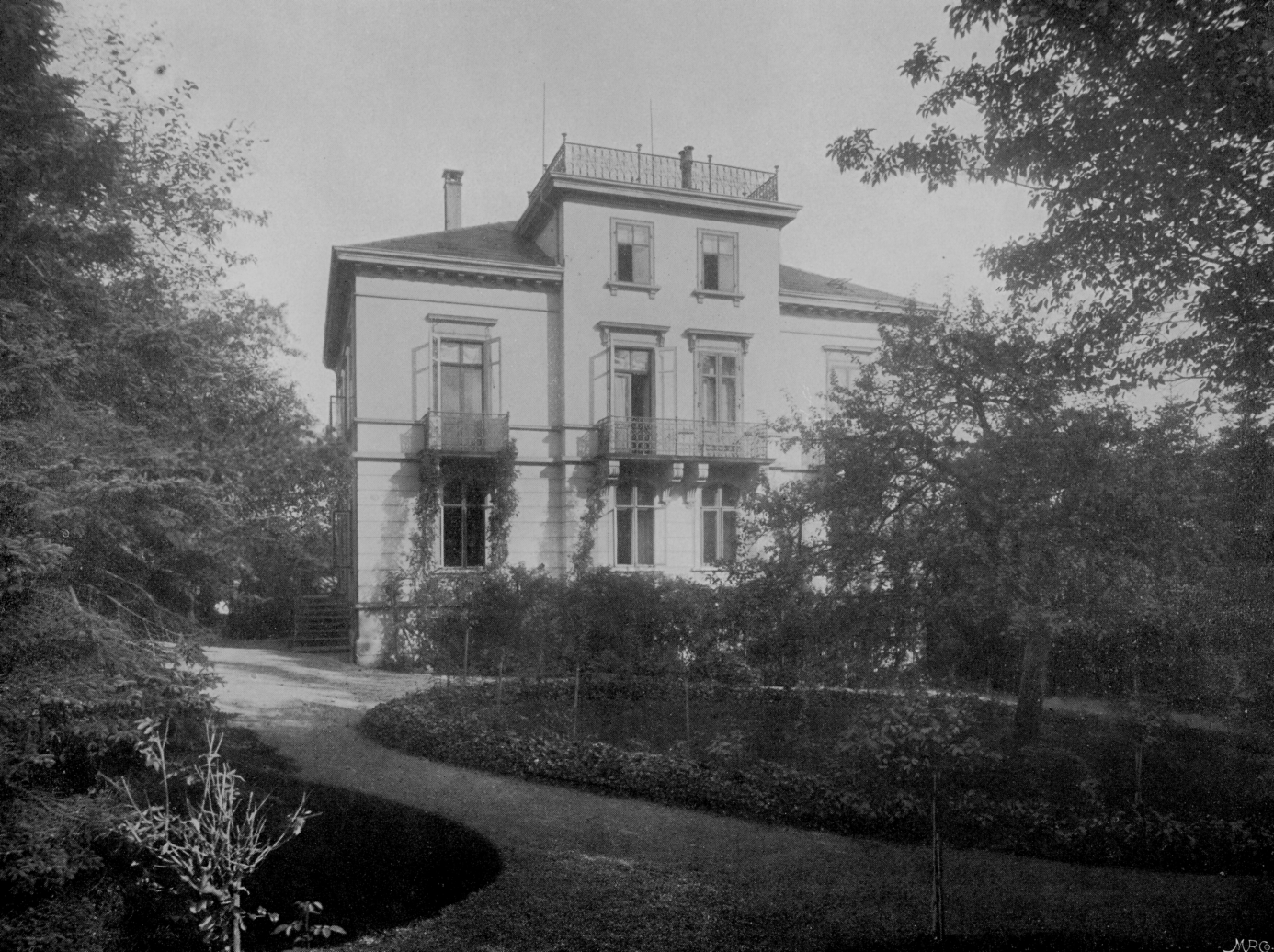 Villa Felicitas
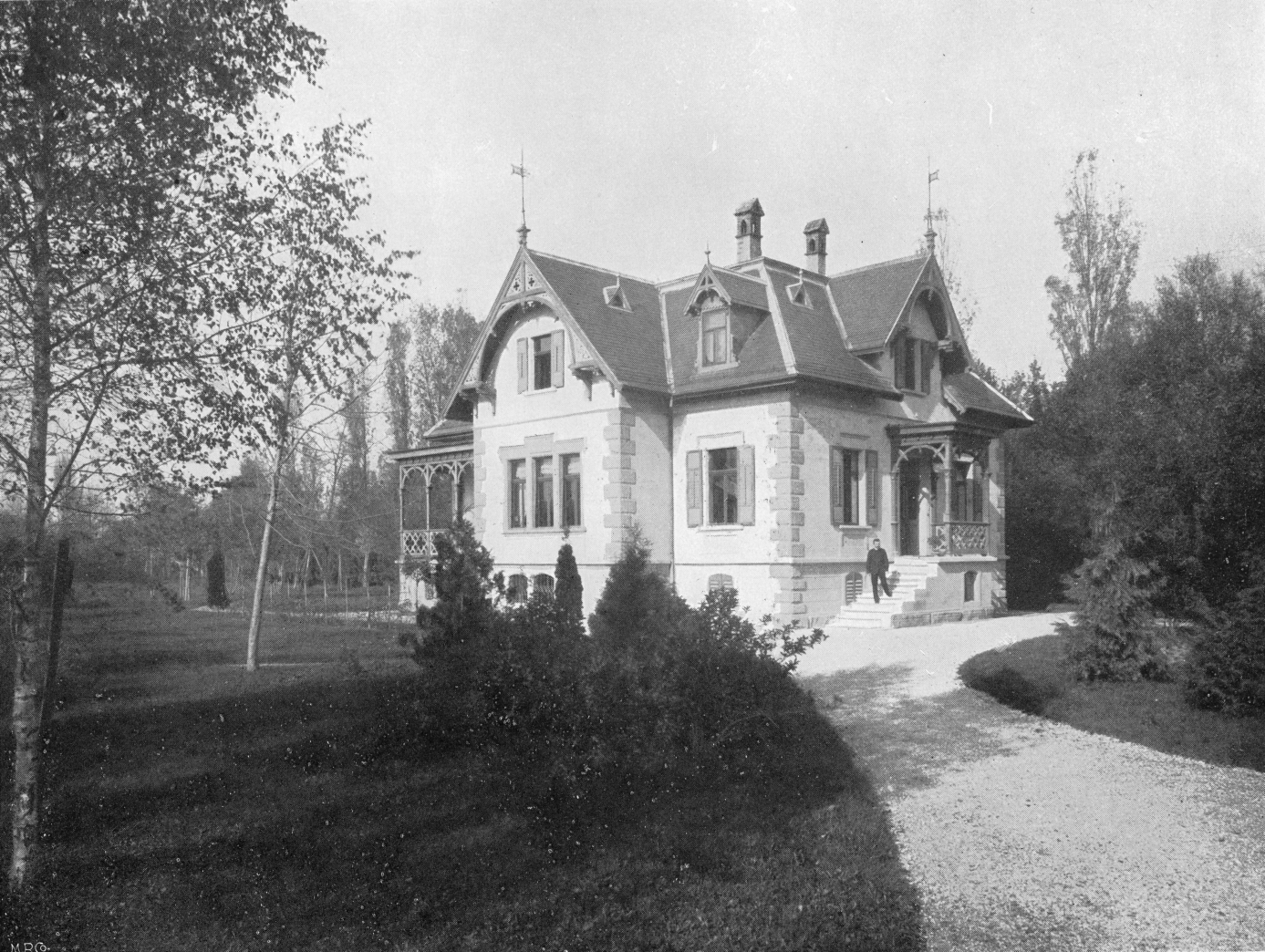 Park Villa
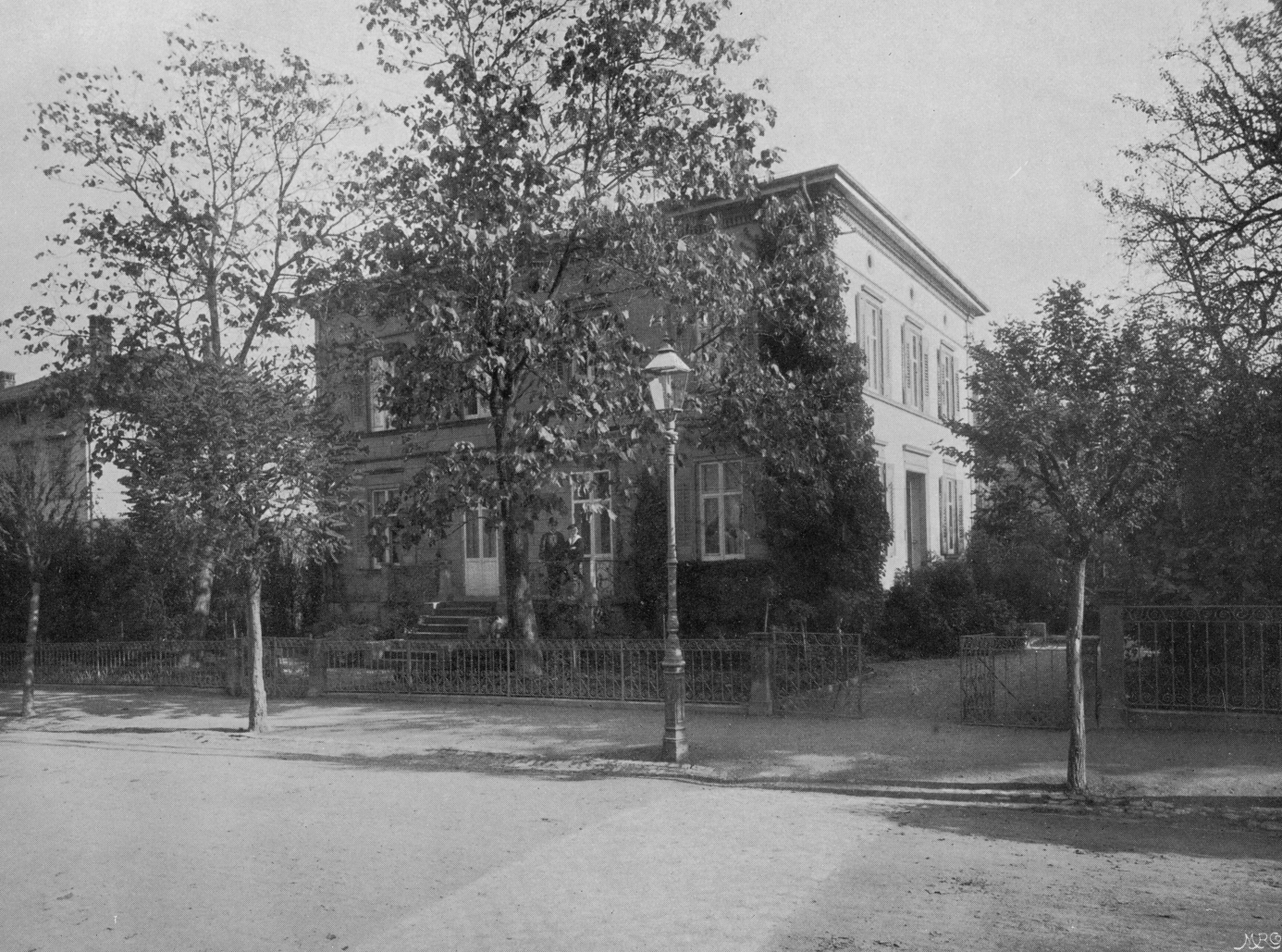 Villa Landegg
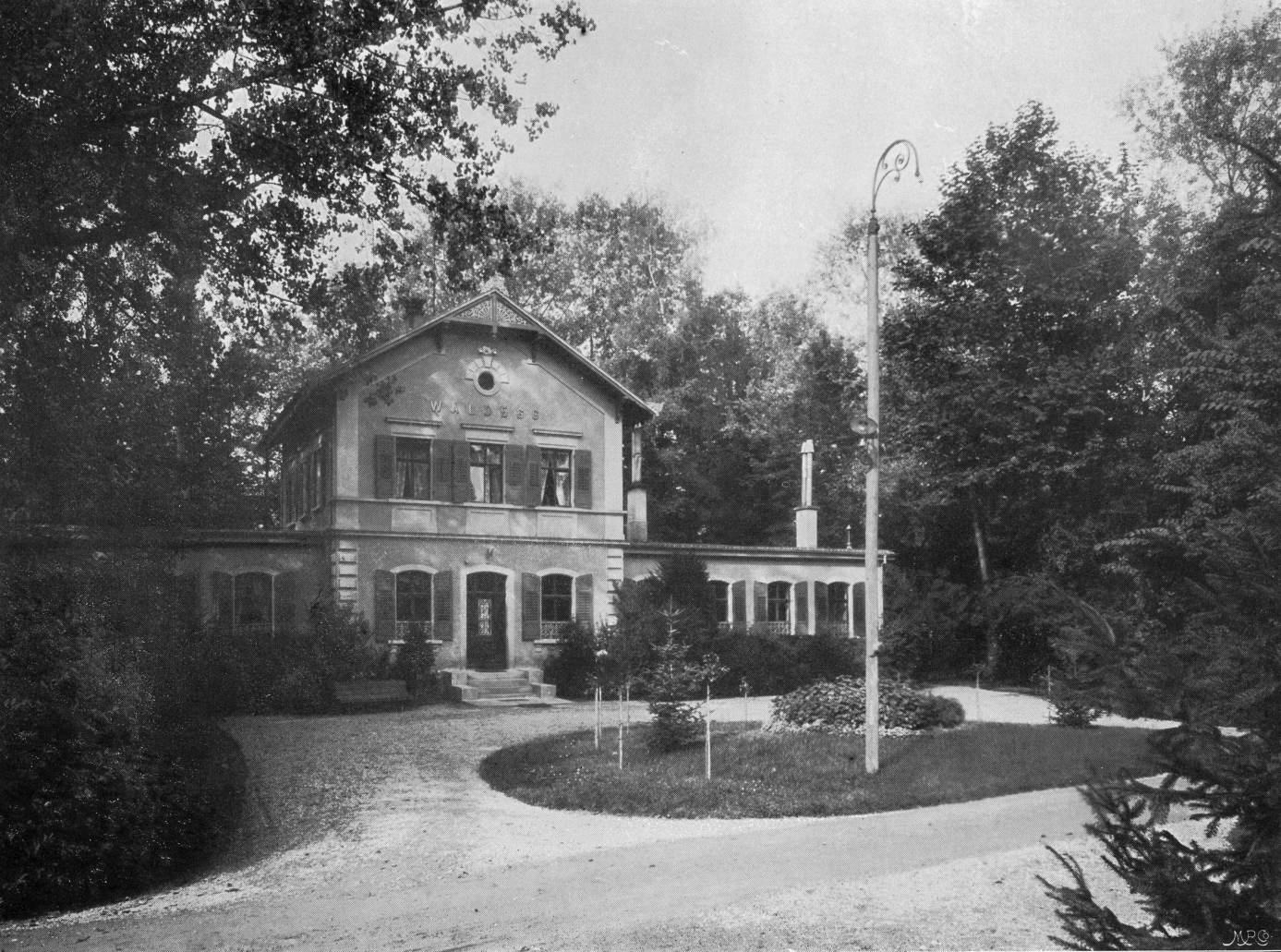 Villa Waldegg
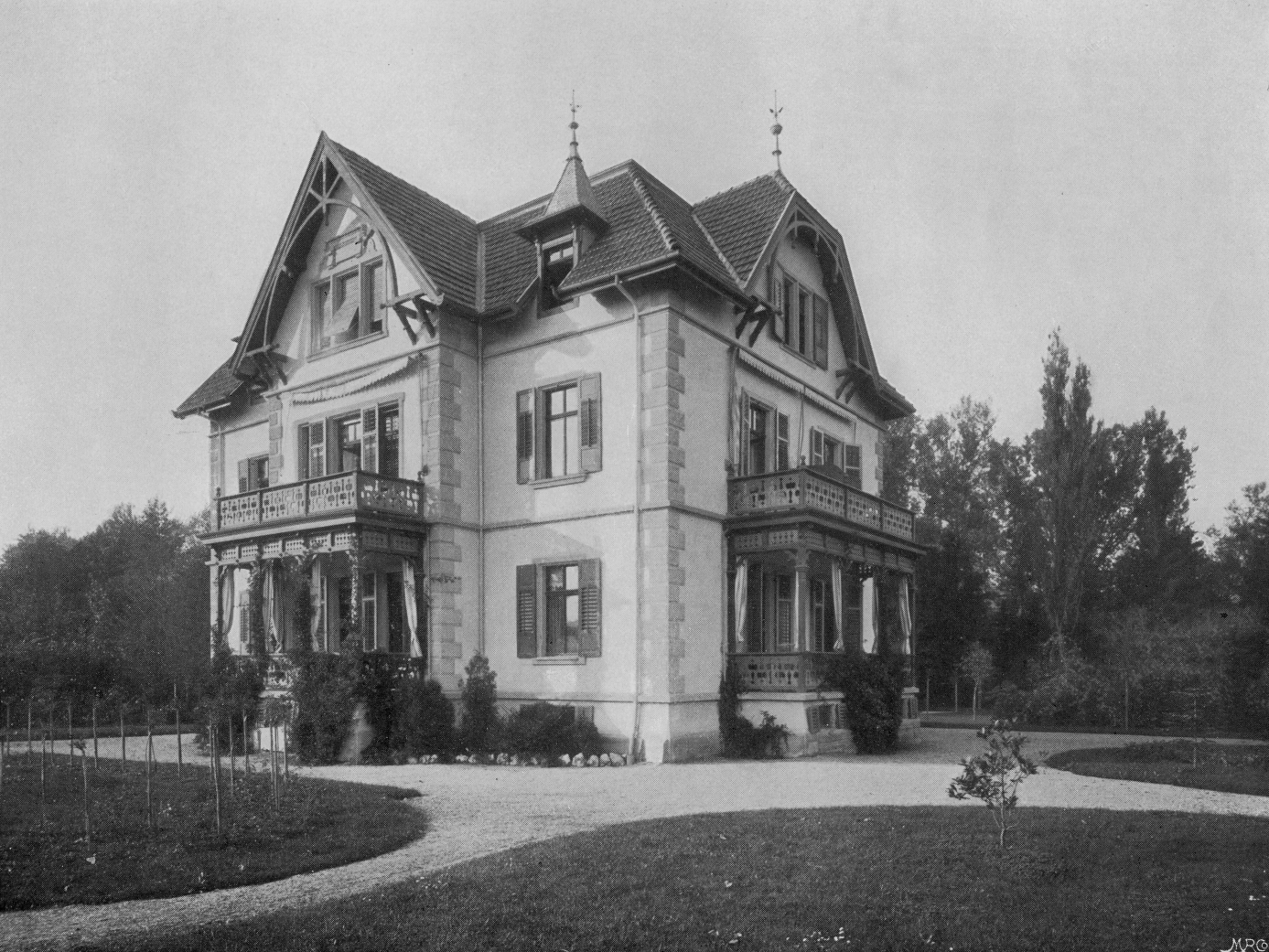 Villa Marika
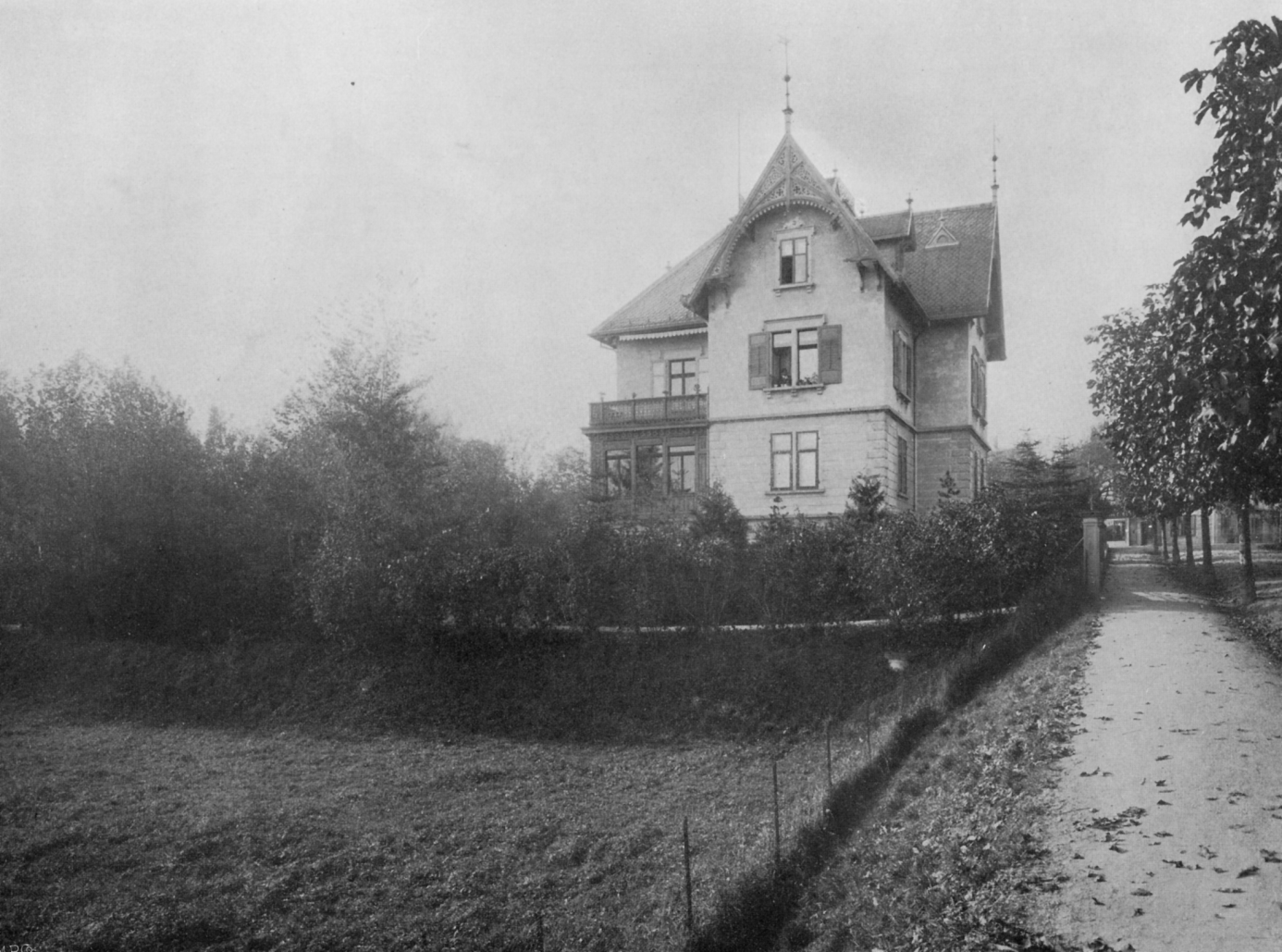 Villa Emilia
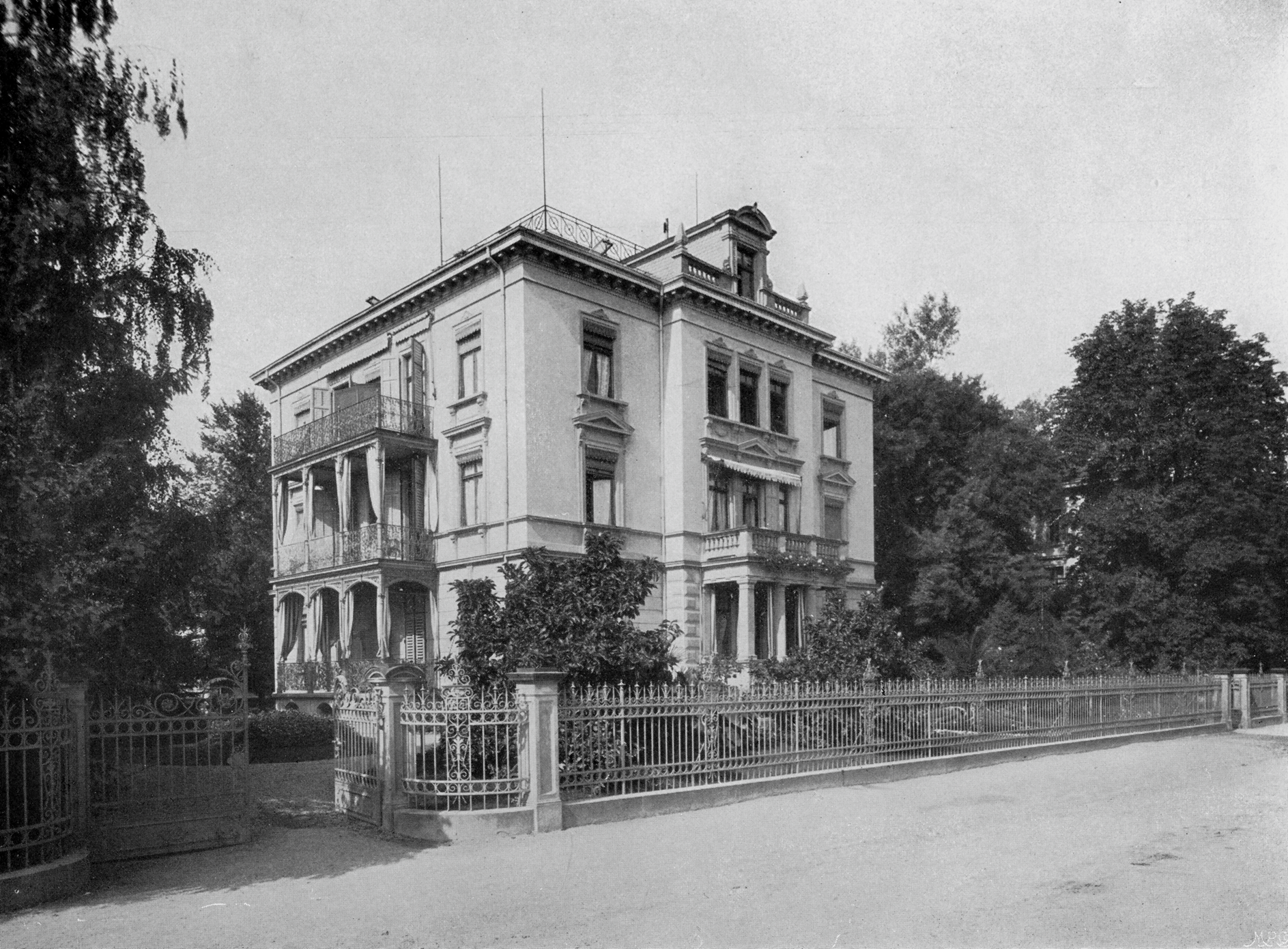 Villa Roberta
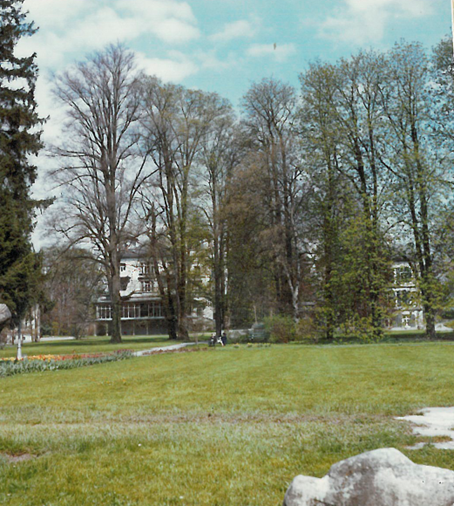 Villa Harmonie
Not included among the houses above are the villas Bodan, Tannegg, Seehof and the Orangerie, which had a bowling alley and the building for the gardeners.
The villas were built to house the many wealthy patients Bellevue catered to. Among the patients was Hellene Muller who came from one of the wealthiest families in the Netherlands. Her family owned Muller and Co. Helene, studied art under H.P. Bremmer and began collecting art. She was one of the first European women to put together a major art collection and among the first collectors to recognize the artistic genius of Vincent vanGogh. She ultimately collected 97 paintings and 185 drawings by van Gogh. She and her husband donated their entire collection to the state along with their 75-acre forested estate, which is the site of the Kroller-Muller Art Museum.
Robert’s brother, Otto, also made his mark. He married Henriette Baedeker 1859-1941. According to Richard’s history, Otto “was professor at the medical faculty of the University of Jena GE and Chief of its Psychiatric University Clinic for several decades, which under his leadership became one of the most famous in Europe.
He treated many famous figures of his time, among others Friedrich Nietzsche. He was one of the first psychiatrists of his era to recognize the importance of Sigmund Freud and was considered a scientist and clinician of the same significance as Alois Alzheimer. He was the first to describe hypertensive vascular encephalopathy, a form of dementia, named “Binswanger’s disease” by Alzheimer himself. His children were Reinhard 1884-1939, Margaretha 1885-1931, Amelie 1887-1977, and Lilly, known as Hertha 1892-1966.
The sanatorium’s solarium that was a popular gathering place.
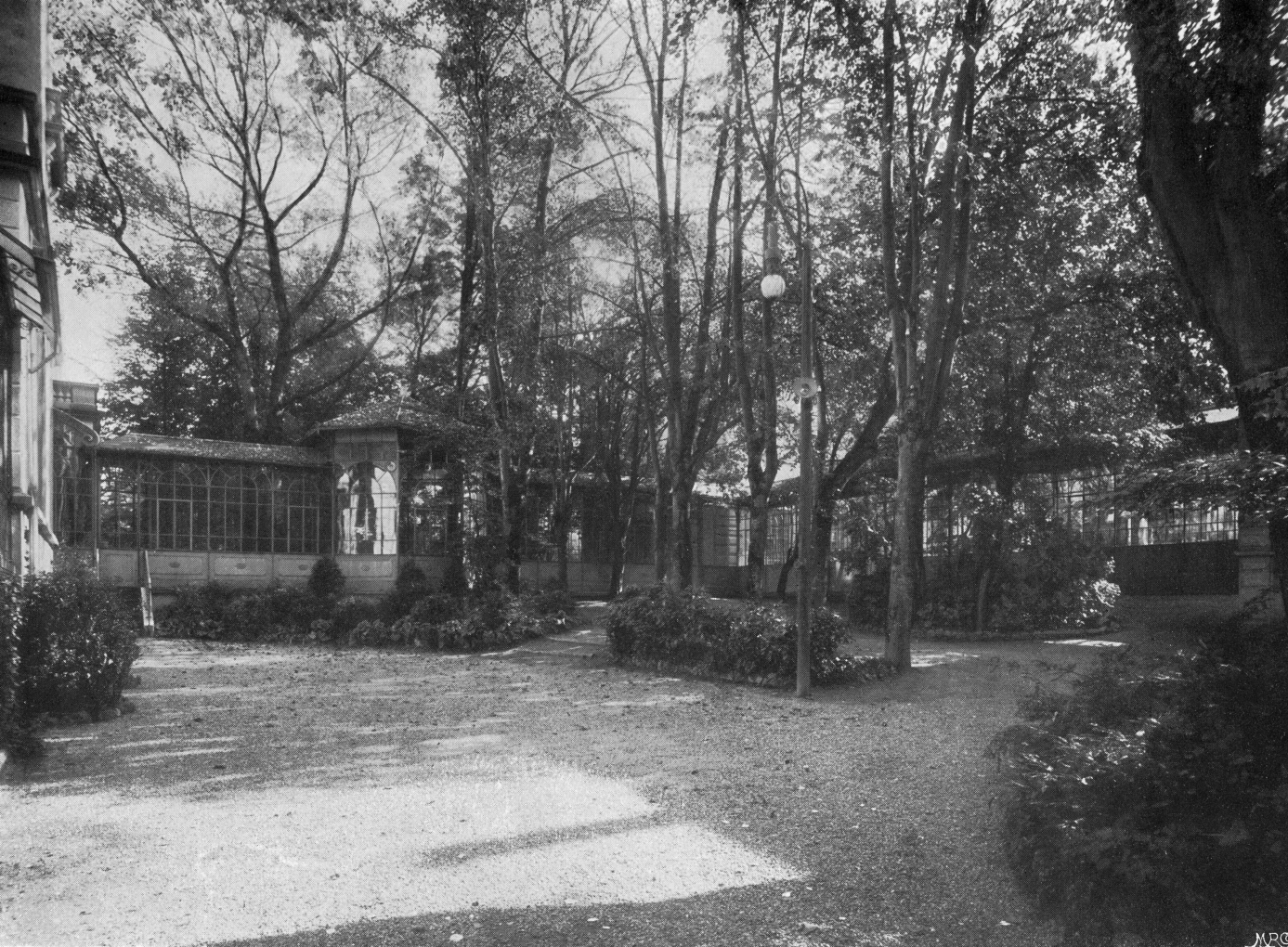 The Solarium
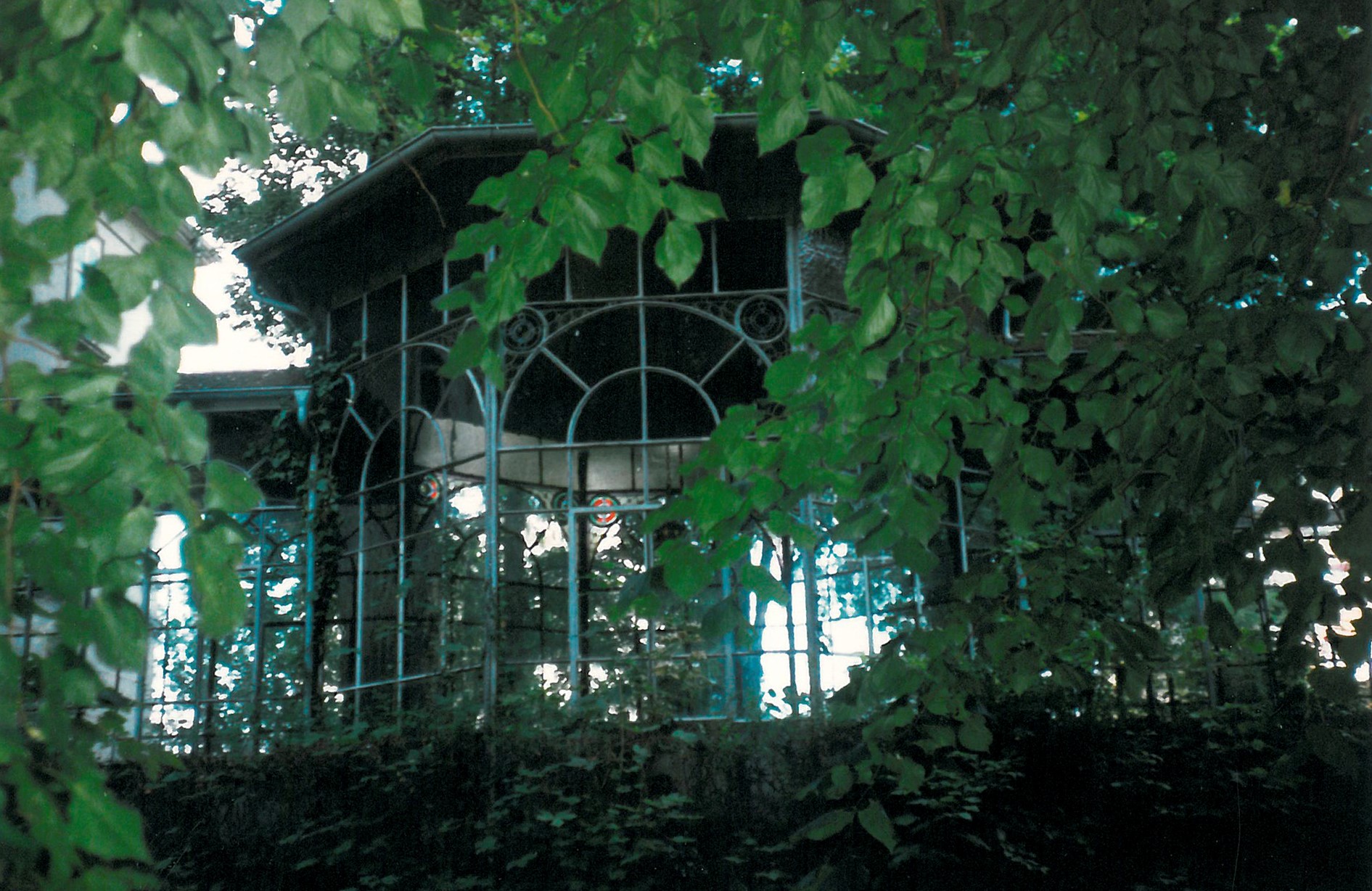
The solarium was a glass hallway that extended out from the main building and wrapped around the entry to the sanatorium. The sunlit glass hall, glassgung as it was called, was art nouveau, perhaps designed by the architect Heinrich Jurgensen, a German architect who spent much of his career in Denmark. It was often used for entertaining.
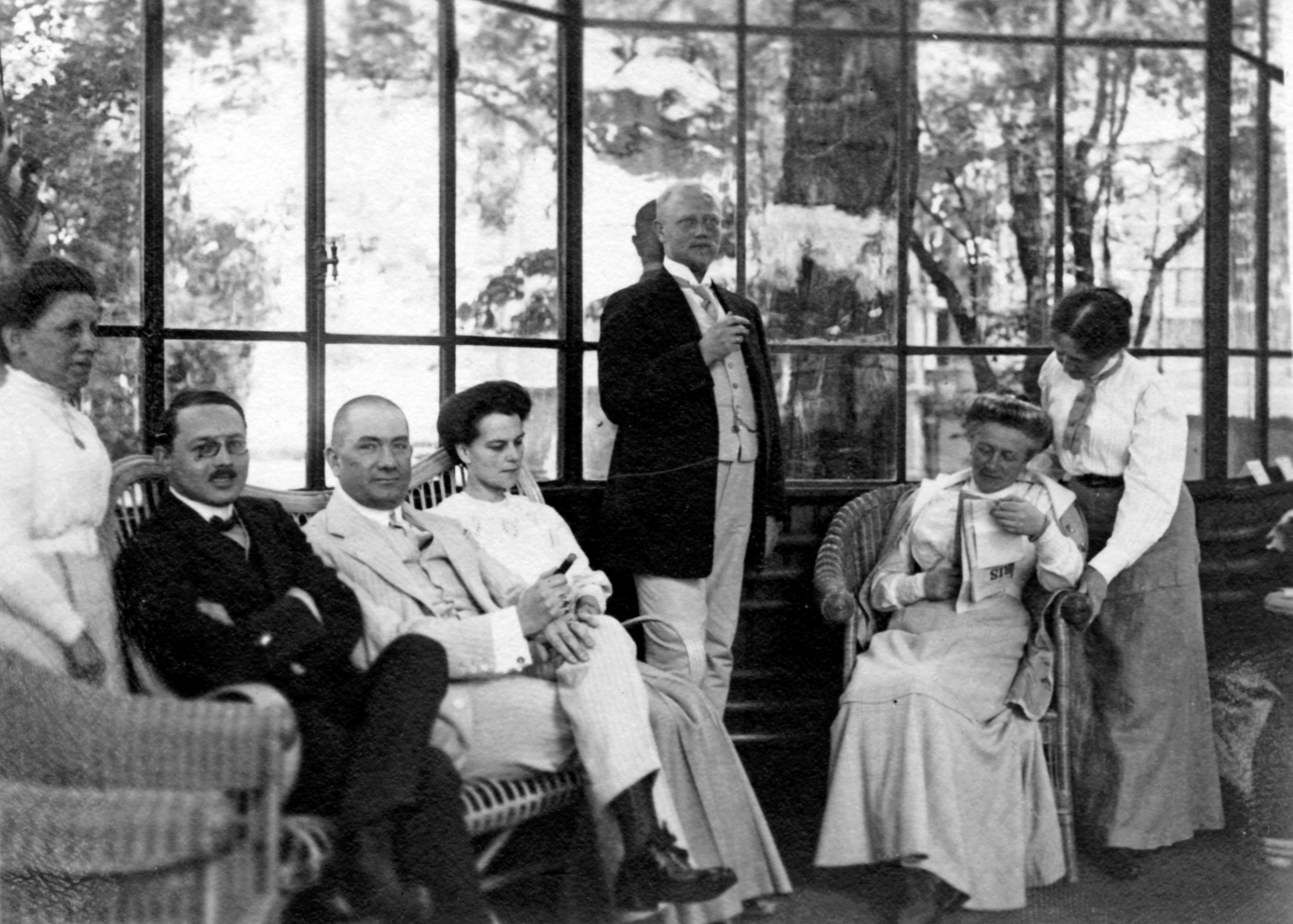
The glassgung was used for the filming of Martha, a critically acclaimed drama by Reiner Werner Fassbinder made for German television that came out in 1973.
Robert’s second wife was Marie-Louise Meyer, called Mietzie, 1871-1941. The couple had two sons: Paul Eduard, called Edu, 1898-1959 and Herbert, called Hebi, 1900-1975.
Marie-Louise was a beautiful and charming woman, and when her husband died, she left their home at Schloss Brunnegg and moved into her house in Uttwil on the Swiss side of the Lake of Constance. There she gathered many artists and writers.
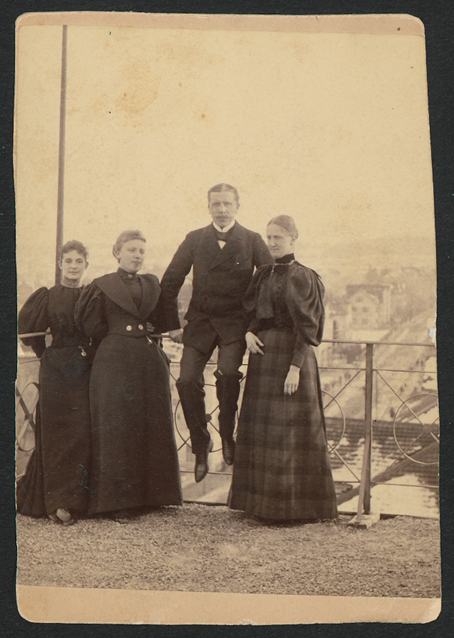
Ludwig Binswanger ll followed his father Robert as chief medical director of Bellevue in 1911. He lived on the Bellevue campus in the Gartenhaus pictured below.
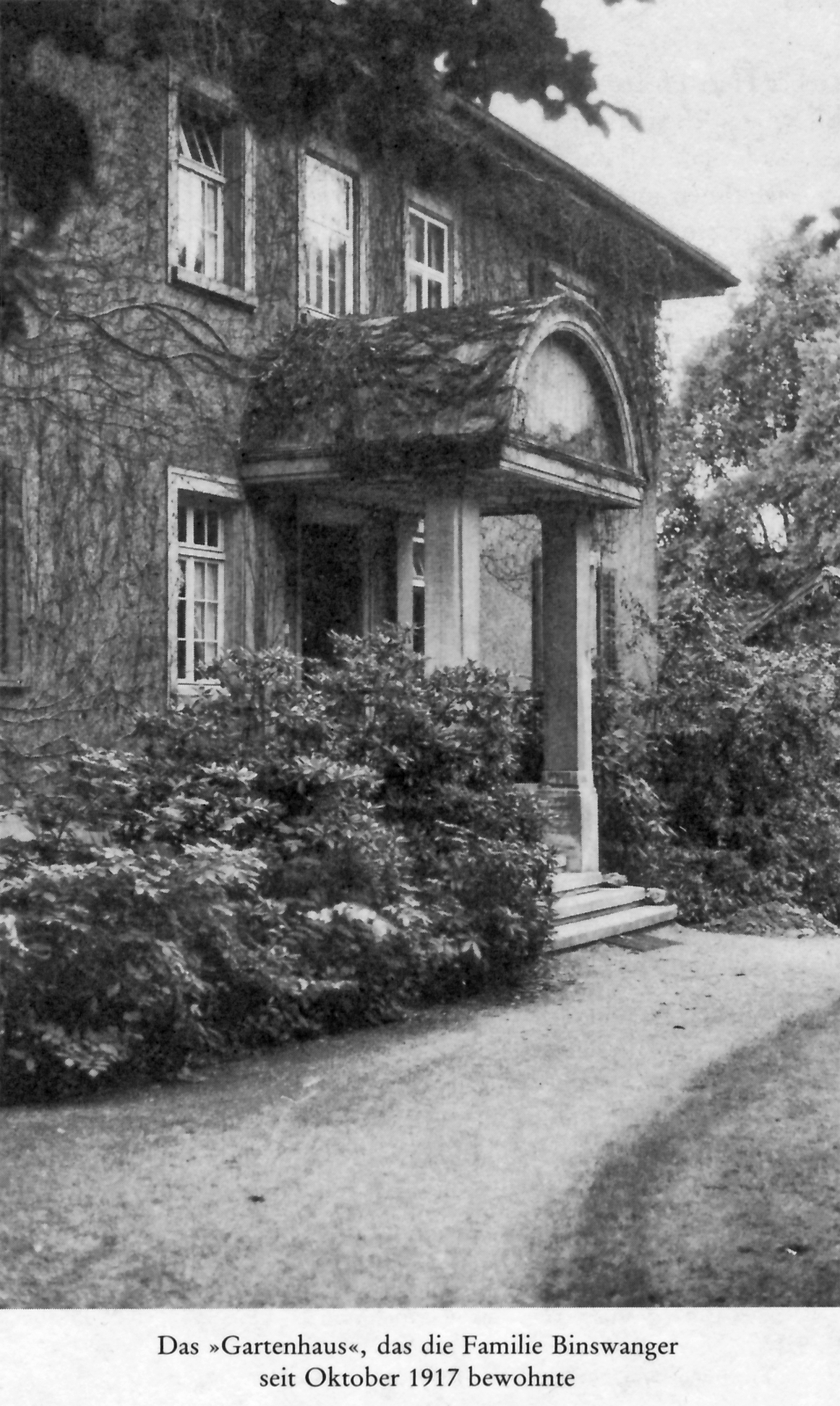
In retrospect, those were good years. Bellevue became one of the most famous private psychiatric clinics in the world, receiving patients from all continents. Patients included princes, the mother of Queen Elizabeth II and captains of industry. Many famous artists also spent time at Bellevue, including the painter, Ernst Ludwig Kirchner, the dancer, Vaslav Nijnsky, the actor Gustav Gründgens and the art historian Aby Warburg.
But those good times would not last. First there was World War I. During the war, the sanatorium faced economic difficulties because foreigners, who accounted for 90 percent of its patients, had to leave Bellevue amid the rise in nationalism. “We never recovered from the crisis,“ says Richard, the historian.
Even so, the Sanatorium remained a center of social and intellectual activity. Ludwig Binswanger studied under Jung. Jung had introduced Binswanger to Freud in 1907, and the two had become good friends. A collection of their correspondences was collected in a book some years ago that has been translated into English. When Freud became ill, he left Vienna to visit Binswanger. Freud also referred many of his patients to the Sanatorium.
The two remained friends even though they differed in many of their views. Binswanger, for example believed in existential therapy. Binswanger uses a German term “Dasein,” which means literally “being there.” Some translate it as human existence, or a sense of moving beyond oneself. Heidegger translated Dasein as an openness, as a meadow is an openness in a forest. Sartre calls it “nothingness.” There is also this concept that you can extend yourself into the world as with a telephone or telescope and the world can come into you, as in an artificial hip, or the society and cultural order into which we are born.
When we are enslaved by social norms there is a condition called “falleness.” Following Martin Buber, Binswanger adds the more positive notion of “we-ness” for love and an openness to each other. Binswanger sees this as “being-beyond-the-world.” Existentialists recognize that life is hard. You never have enough information to make a decision. And you will die. We can’t choose not to choose. We feel anxiety or dread toward the future. Anxiety is a condition of being human. We are not like a table, eternal. We are always about to slip off into nothingness. If we do not do what we know we should, we feel guilt. We feel regret over past decisions that hurt us. We feel regret when we choose the easy way out. When we lose our nerve, there is a focus on being authentic, which is to be aware of yourself and your circumstances, your social world, the inevitability of anxiety of guild and death. It means involvement, compassion and commitment. The ideal of mental health is not happiness. The goal is to do your best. If you trade possibility for actuality, you are inauthentic. You have given up. Each person is unique, so each person has a different way to be authentic. If you are too busy to notice the moral decisions you must make, you are living in what Sartre calls bad faith. The neurotic person is aware of the choices that have to be faced and is overwhelmed by them and so freeze or panics. Or they find something small, a phobic object or compulsion, a target of anger or a pretense of disease. Although you can address the symptoms of all this, an existential psychologist says you need to face the reality of Dasein. The existential psychologist tries to discover the client’s world view. Their everyday lived world. Your physical world, your social relations, your culture. What is it that is most central to your sense of who you are? Binswanger wants to know your view of your past, present and future. Are you forever trying to recapture golden days? Do you live in the future always hoping for a better life? Is life a complex adventure or here today and gone tomorrow. How do you treat space? Open or closed? Cozy or vast? Warm or cold? Is life a journey or is there an immovable center? The existential psychologist allows the patient to express the full richness of their lives in their own words and in their own time. If there are dreams, the EP wants to know what you think they mean? Therapy involves an encounter, an opening up. It’s a dialogue between psychologist and patient. The goal is the autonomy of the client. Like teachiing a child to ride a bicycle, you can only help people become more fully human if you are prepared to release them. This approach is considered unscientific by most psychologists today. Proponents say it offers a better, more refined way toward understanding human life.
There is a famous case of Ellen West who as a teenager would say “either Ceasar or nothing.” At 17 she writes a poem asking the Sea-King to kiss her to death. When a friend comments on her weight, she begins to obsess about being fat. When parents interfere with an engagement, she becomes despondent. She marries her cousin in hopes of changing the trajectory of her life. But over time she becomes anorexic and twice attempts suicide. She is finally sent to Kreuzlingen where she lives comfortably with her husband. She is put under the care of Ludwig Binswanger. She writes a poem about her condition:
I’d like to die just as the birdling does
That splits his throat in highest jubilation;
And not to live as the worm on earth lives on,
Becoming old and ugly, dull and dumb!
No, feel for once how forces in me kindle,
And wildly be consumed in my own fire.
She had divided life into the ethereal, pure world of the soul, writes Dr. C. George Boeree, and the “tomb world” tied to a bourgeois, corrupt society and a body with its base needs. Her anorexia, which reduced her body to a skeleton moved in that direction. The case is famous because Ludwig Binswanger chose to listen to her and let her express her perspective.
Because she continued to attempt suicide, she was given a choice: She must be committed to a special ward for serious patients where she would probably continue to deteriorate, or she should be released, in which case there was a high likelihood she would commit suicide.
Back in the real world she does better. She eats chocolates and writes letters. But then she takes a lethal dose of poison.
Under the final medical director, Wolfgang Binswanger, the philosophy of the sanatorium moved more toward the self-actualization philosophy of Carl Rogers. Wolfgang even experimented with drugs according to his wife.
The sanatorium gradually fell into decline following the retirement of Ludwig ll. The family faced many sorrows that also weakened the institution.
Robert III, the son of Ludwig II committed suicide as did Beat, son of Eduard. There seems to have been a tendency toward depression. My great-grandmother, born Anna Binswanger, attempted suicide in 1929. But there were other tragedies as well including the death of Peter, son of Kurt in a military aircraft crash as well as the early death of Werne, who the family had hoped would restore and revitalize Bellevue after the Second World War. There were also severe economic crises after both World War I and II, followed by the decline in the wealth of the aristocracy and the broader economic decline that gradually wore away at Bellevue.
The farm survived for a while. Andreas Binswanger, the historian, took over the farm from his father in 1968 and introduced computer systems to optimize the production of grain, apples and other products. He figured out that the cows were losing money and persuaded his father to sell the cows. Richard, who lived in the main house with his father, Otto, remembers waking up to a big fire at the barn. When Andreas retired, there was nobody to take over the farm and so it was sold to become a school for adolescents with learning disabilities.
I was 12 when I visited the sanatorium with my family. We had dinner with Wolfgang Binswanger and his wife and children. We received a tour of the sanatorium and I remember the patients painting in what must have been the glassed-in halls of the solarium. The campus was pretty and park- like. It may have had as many patients as it did earlier in the century, but they were probably less wealthy and that must have made it harder to charge high fees. The aristocracy that wase so important to Bellevue’s prosperity, was much in decline after World War I and all but gone by the end of World War II. The property was sold to a developer in 1980.
I look forward to learning more about this amazing family next week when I leave for Europe.
February 15, 2022
A letter from Russell Kuefler offers a reader’s perspective on Yokohama Yankee and adoption in Japan.
I recently finished your book, “Yokohama Yankee,” and wanted to let you know how much I truly loved it! I was only a few chapters in when I decided to buy a copy for a friend and colleague, Andy Kimura. Even though I’ve lived in Japan, am married to a Japanese woman, and consider myself knowledgeable about all aspects of Japan, you taught me things about Japanese culture that I had never considered.
We are a childless couple. I’ve never felt particularly compelled to be a father, but accepted that I must, because it was what my wife wanted, and because I wanted someone to be there for us as we grew old. For medical reasons, mostly mine, we never conceived. We spent a year in our attempt. Every month we went to our fertility clinic for another round of sperm collection, washing, and artificial insemination. When we finally had to admit we would remain childless, my wife Hitomi was heartbroken and sobbing. “We could adopt,” I suggested. She answered in one word, “No.” We never spoke of it again. Now I understand.
“There’s nothing to writing. All you do is sit down at a typewriter and open a vein.” Usually attributed to sports writer Walter Wellesley “Red” Smith, but according to my quick search, that may or may not be true. I kept thinking about it as I read your book. I appreciate that you shared not only your family’s victories and achievements, but also their losses, pain, anxieties, and vulnerabilities. Thank you for sharing those things not only about your family, but about you personally. Thank you for bleeding onto paper for us.
I mentioned my friend Andy Kimura. Andy and I bonded over my love of Japan and his interest in learning his cultural history. His father Taky Kimura was Bruce Lee’s most senior student and best friend. Andy carries on that martial arts legacy. His father’s story is a fascinating one, but it’s not my place to tell it. As soon as Andy received his copy of “Yokohama Yankee,” he wrote to tell me how much he was enjoying it. I can never really convey how thankful I am for your hard work, and for having stumbled across it in the downtown Seattle Kinokuniya bookstore. Blessings to you and your family.
October 26, 2021
The Double Suicide: A true Japanese ghost story.
Only Here
(Note: This story was written by my mother about 1965 not long after the event. I was about 10 at the time, and I remember clearly the night our landlord came by our remote summer place and told us this story. Leslie Helm)
By Barbara Schinzinger Helm
Sit with me by the window — lean your elbows on the sill
and breathe the cold fresh morning air. The lake is still–s mooth like a mirror. In the distance mountains peak like gold. That long tongue of land that made our bay lies dark and slumbering across from us. The rest is shadow, promises of color.
[image error] [image error] I hear the squeaking of an oar — a man stands upright in his fishing boat, gently rocking with the rowing; fishing line is trailing. Ripples form a V behind the boat — the mirror and the silence broken. Elegant Mt. Nantai looms at right, somewhere beyond the dark expanse of Lake Chuzenji, a tiny village at its foot.
Look to the left: the gentle curve of bay, a narrow, shallow sickle of a beach, the fisherman’s boat riding si1ently at anchor. Trees leaning over water, rocks reflected in its cold.
This is our side of the lake: rocks, a stoneretaining wall, a level piece of ground, a tiny house, the dirt road and the mountains in the back.
Hold your breath – when sunlight touches leaves across the bay, the colors will explode. Glowing, flaming reds; yellows soft, so gentle; oranges and browns; greens too, so light, so airy, thick, dark, saturated. Spots and splotches, dabs and swirls of color. You have never seen the like. I haven’t either. Only here!
“Yeah, that was a good one,” sighed Julie. The children had spent the afternoon with my Japanese stepmother while I had taken a long walk with my father where he lived far away at the other end of the lake. My stepmother had read them a ghost story about a woman who turns into a snake in the middle of the night, steals raw eggs from the fridge and then searches for children to eat. The story had affected them strongly, and it had taken quite a while to reassure the children when we returned. We had looked out at the tranquil lake, and I had pointed out to them how calm, how beautiful and lacking in malevolence nature was. I had told the children that there was no such thing as a ghost. The only threat to us, I said, would be a burglar, and no burglar would venture out to our little house, the only house for miles around, aside from the old house next door where a very old fisherman and her wife lived. (note: Though we never saw the old fisherman in those early years, there was a huge large trident leaning against his house, and we assumed he must be fierce.) Looking from our beds at the clear light of the stars, we had fallen asleep.
Tonight, an autumn storm was blowing in bringing more anxiety. Earlier in the afternoon, I had asked the boys to pull the boat up higher on the sand so it wouldn’t drift away. They had also put away folding chairs and any other light items that might be picked up by the wind and blown into the windows of the house.
Now the oil lamp swung gently, and our shadows on the wall shifted as the draft played with the flame. Chris had a blanket draped over his shoulders against the chill, and as another gust of wind blew through the room and made the shadows jump, he drew it more tightly around himself. Leslie gave a start and quickly looked over his shoulder at the window, making sure that nobody noticed [image error]his uneasiness. The curtain billowed and sank back.
[image error]Suddenly the dogs, who had been lying quietly in the hall gave a low, menacing growl. Julie pulled her head under her covers. Her voice came, soft and frightened: “Mother, do you think there is such a thing a hebi-onna (snake woman.)
I laughed with a heartiness I did not quite feel, “Of course not, Julie.”
The dog growled again, a long, low rumble. Chris, his arm clasped around his legs, his chin on his knees, gave me a quick glance. Then we heard the footsteps, and a knock on the glass door.
A movement like an electric current went through the group. The glass door rattled again. Someone was trying to open it.
I looked at Chris: “Please go and see who is there.” He seemed reluctant to get; up and go into the dark hall, go I called out:
“Who is there?”
“Hiraishi” came the faint reply through the doors. I took the flashlight from the wall and went out into the dark. When I opened the sliding door, the wind blew rain into the house.
At the door stood young Hiraishi. His short, stocky figure looked even smaller as he stood bent against the wind and rain. Water dripped from his cap, and his black slicker and black rubber boots glistened wet in the beam of my flashlight. His round, usually so cheerful face was pale and his dark eyes were frightened. His mouth worked as if he were trying to say something. Wet hair streaked his forehead.
“Please come in,” I said, hoping he would close the door quickly. He stepped into the hall, bending to pat the dog, who was sniffling his boots. The dog, who was usually so friend1y, wag growling softly, and the hair on his back was bristling. Hiraishi-san turned and closed the door, muting the wine of the wind and rain. “Come in and warm yourself,” I said. He had to steady himself as he slipped out of his boots and onto the boards of the hallway. His face was drawn, and his hands shook as he took off his wet raincoat. “I’ll get you some beer,” I said as I opened the sliding door to the living room.
Finally I had Hiraishi—san settled. He was sitting tailor—fashion at the low table, a blanket covering his knees. He was sipping his beer, and his hands were steadier. He even attempted a smile at the children whose eyes were fixed on him expectantly, and with curiosity.
After the obligatory small talk I finally felt free to ask: “What happened?” I immediately noticed a general tensing, a rearranging of positions, and an anticipatory intake of breath from the children. Hiroshi’s face changed again; the fear was back.
He lowered his eyes and looked down at his tight1y clasped hands. “I saw them!” he said finally.
“Whom?” I asked, thinking back to the many stories he had told us on summer evenings in this room, at this table.He stammered “The…the…the couple who committed suicide last summer!”
“That’s impossible!” It was almost a cry that came from Chris. Leslie looked pale as he said, frowning, “That can’t be. They’d be dead if they committed suicide.
I felt Julie shiver as she said in a quavering voice “You mean you saw dead people?”
“Or their ghosts,” added Leslie, as if explaining that dead people don’t walk about.
Hiraishi read the disbelief in our faces, and nodded emphatically. “Yes, I really saw them. Do you remember the story?”[image error]
I remembered the story. A young man, a college student, had fallen in love with the young wife of “one of his professors. They had started seeing each other, arranging to meet at one or another of the innumerable small coffee houses which can be found all over Tokyo. The young woman goon found that she had fallen in love with the young man. She knew it was impossible for her to leave her husband and bring disgrace on both their families. Preferring to die together rather than to live without each other, the young couple had decided to commit double suicide. On a beautiful, clear fall day last October, they took the train and bus to the lake. They walked to our bay, which is particularly beautiful in autumn. At the shallow beach on the far end of the bay they walked into the water together. The lake had claimed their bodies, and they had never been found. They had left a note on the sand, and that was all. Their pictures had been in all the papers. But how could Hiraishi—san possibly have seen them now? Today?
The children,too, remembered the story.
“How could you have seen them?” asked Chris. “They have been dead a long time.”
“Maybe he saw two shadows on the water,” suggested Leslie hopefully.
“Maybe he saw the hebi-onna,” mumbled Julie from the depths of her shelter.
Leslie turned toward her, “Don’t be silly. You know there is no such thing as a hebi-onna.”
“But Fusaesan’s grandmother saw one.”
“That was just her imagination,” said Chris firmly. Then he turned to Hiraishi—san again who was staring ahead without paying attention to us. When Chris persisted, “What do yod mean, you saw them?” he rubbed his hand across his forehead and sat quietly for another few moments. Then he turned to Chris, turned to me, and said, “I had decided to drive here to see whether you were alright in this storm, and to check on the boats[image error]
[image error]I thought how typical it was of him to show so much concern for us. The drive along the narrow, winding road is not easy under the best of circumstances, but under today’s conditions it must have been a tremendous strain. On one side, the road ends abruptly with a steep drop to the lake. On the other side the mountains come right down to the edge of the road. When two cars meet head on, one has to back up to the last turnout. I imagined his car creeping along the road, the headlights dimmed by the rain, lighting up low—hanging branches and dripping undergrowth. The road is full of potholes and rocks. The lights would be wavering, as the car bumped along.
Hiraishi-san continued, “Because of the rain, I was driving very slowly. Suddenly I saw two figures in the middle of the road. ‘Some foolish hikers caught in the rain,’I thought. When I got closer, I noticed that it was a young couple in city clothes.
They looked as if they might have set off from one of the many hotels, before the rain for an evening stroll and had gotten lost.
They had no coats or umbrellas, and their hair and clothes were streaming wet. I stopped the car and spoke to them, ‘Can I give you a lift?’ ‘Yes, please,” answered the young man in a curiously hollow voice. ‘We are going in the direction of the campground.” It never occurred to me at the time to wonder what they might want at the campground at night, in these clothes, without any equipment. I was just so concerned with their condition that I said, ‘jump in’ and opened the door for them. As they got in, I noticed how pale they were. The young woman’s black hair hung wet and heavy on her shoulders. Around her neck she had a long, bright red scarf that set off her pale skin. Somehow I had the feeling that I had seen them before. But as I drove on, I figured that they looked like so many other young couples who come to the lake in such great numbers.”
Hiraishi—san shook his head as if amazed at his own stupidity. Suddenly he turned to me, “Do you know that a part of the road, just before you get to the house, is under water and impassable? That spot is usually like a creek when it rains, but today it is like a raging river. When I got there, I realized I wouldn’t be able to drive on. I decided to leave the car and to try scrambling over the rocks to get the few yards to your house. I was sure you would be willing to give shelter to the young couple, at least until they were somewhat dry. They had been quiet since they had got into the car. I thought, they must be dead tired….” He shuddered as he said that and hunched his back as if to protect himself. I felt sorry for him. He was so obviously upset and disturbed. What had happened? Where was the young couple now? Why hadn’t they come with him? Were they hurt? Were they waiting in the car?
“Go on,” said Chris. “Tell us! What happened? Where are they now? Why didn’t you bring them with you?”
“Well…” Hiraishi-san turned his head and looked at us pleadingly, I don’t know!” His pale face twitched; his dark eyes swept the room; he looked at the window behind Chris, turned to look at the window behind his own back, and shuddered again. With shaking hands he pulled a pack of cigarettes out of his pocket. He lit a match, and as he bent toward the light, a gust of wind swept through a crack in the wall and blew it out, Hiraishi—san shot up and looked around him wildly. When he saw that everything was all right he sat back again. Chris involuntarily moved away from the window and sat leaning against the door to the bedroom. Leslie followed Julie’s example and pulled his blanket over his head. “Best protection against ghosts,” he said with a crooked grin, and an unsuccessful attempt at nonchalance.
The wind blew a sheet of rain against the window. I heard the crunch of the boats on the gravelly beach as the wind rocked them on their keels. Did I hear footsteps? Was that the sound of voices? Nothing. The spring gurgled on. The waves kept on crashing against the rocks. The wind was whining.
Hiraishi-san was making a big thing of this incident I thought. And yet, his fear was genuine. I poured him another beer and he gulped it down. He pulled a big, white handkerchief out of his pocket and folded it carefully. Then slowly wiped his ace with it. He folded it again and put it but in his pocket. Then he picked up his cigarette, took one deep drag from it, and crushed it out in the ashtray. He pulled himself up straight and said determined to get it over with, “When I stopped the car and turned back to the couple they were gone. They weren’t in the car. All there was, were two [image error]puddles of water on the seats.”
A heavy silence fell over the room, The dog stirred, gave a soft yelp and settled down again. Even the wind had died down, and the rain had stopped. l heard the plunk, plunk of the water dripping from the roof into the puddles below. Suddenly I heard a soft moaning; then quiet again. I strained to hear, but everything was silent.
Finally Chris couldn’t stand the suspense any longer: you mean the couple just disappeared?”
Hiraishi nodded. “Yes, suddenly, without a sound.”
“Couldn’t they have opened the door and jumped out while you were concentrating on the road?” Chris kept trying to be realistic; and I must admit that I too was trying hard to think of a plausible explanation.
“But they couldn’t have! Not without my noticing it,” Hiraishi persisted, “1 have a two-door car. They couldn’t have gotten out without my knowing it.”
Again the dog yelped. Again we heard a soft, prolonged moaning. I felt cold and uncomfortable. The children were drawing closer together. We were no closer to solving the mystery of the vanished couple, and I decided to break the spell cast over us by Hiraishi-san’s story by announcing firmly, “Time to go to bed.”
“Awww, not now.”
“Not until we have figured out what happened. “
The children were excited and disappointed. Julie. sounding very tired, said, “Oh, Mother, I won’t be able to sleep a wink. It’s too spooky!”
“We’ll all sleep together in this room,” I announced, as I went into the next room to get another oil—lamp. Then I went into the hall to light the lamp there. The dog was shivering, and he came up to me to lick my hands.
Back in the living room I turned to Hiraishi, asking whether he felt all right about driving home tonight. He hesitated briefly, and then said courageously, his honest face serious and intent, “Yes, thank you. But are you sure that you will be all right by yourselves?” When I assured him that we could look after ourselves, he picked up his cap and got up slowly. “Well,” he said a bit reluctantly, “I’m warm again, and now that the rain has stopped the drive home will be much easier.”[image error]
[image error]In the hall, he slipped into his boots and pulled on his slicker. The moon had appeared from behind the clouds, and a soft light showed shimmering puddles on the road. Hiraishi turned in the door, “Thanks again. I feel much better now. He lingered in the doorway for a few moments and then stepped into the night. Pretty soon we heard the roar of his engine, his headlights briefly outlined the tall trees and he disappeared around the curve.
While Chris and Leslie laid out the bedding on the tatami mats in the living room, I heated some milk. We all had a cup of hot chocolate, sitting on, and in the case of Julie in, our beds.
“Ha! There are no ghosts,” said Leslie firmly, as he put his cup on the table and crawled into bed.
Chris was still very thoughtful. “I wonder what he did see though.” Then he, too, slid under the covers.
Julie hadn’t moved from her spot all night. I decided to let her sleep where she was. When I got up to put out the light, she raised her head and said pleadingly, “Can’t we leave the light on tonight?”
“Sure!” I knelt down beside her and put my arms around her.
“Sleep tight, sweetheart.” She gave me little smile, and as she cuddled up under the comforter, “I’m sooo tired.”
Thank God for that, ‘I thought,’ as I pulled up my covers and stretched out on my hard bedding.
After a brief goodnight, we all fell silent. We were too occupied with our own thoughts and too exhausted to talk.
All night I heard the children stirring restlessly in their sleep. Julie sat up once and cried out loudly in Japanese, “Go away! Go away! ” Finally, toward dawn, they fell into a deep sleep.[image error]
When we awoke the next morning, the tips of the mountains yere bathed in gold. Their outlines were reflected in the lake which was as smooth and clear as a mirror. The trees and bushes looked as if they had been washed clean, and their lush, green leaves shone. The sky was a deep, brilliant blue, and a few small white clouds hung around the top of Mt. Nantai.
I was sitting at the open window, breathing in the fresh air. Breakfast had been tense and quiet. The children spoke little. Julie looked pale and tired. The boys were deep in thought. And yet the events of the night before seemed unreal, almost as if they had never happened; almost as if it had just been bad dream. I decided to take the children to town today. A boat ride on this beautiful day, and a tasty Japanese lunch of fresh lake trout would dispel any lingering fears
As I looked down at the beach to see if our boat was still there, I saw something red amongst the pieces of wood and broken branches which the storm had washed onto the sand. It looked like a long strip of cloth, wound around a branch.Suddenly I heard the sputtering of an engine, and a boat rounded the promontory and entered our bay. It was the water police boat; the police were obviously checking on the effects of the storm. I waved at the two men in the boat, and they waved back. The boat chugged along, past our house, past the sandy beach, and stopped. The men bent over the edge of the boat. I saw them straighten up, talk excitedly, and look into the water again. Then they circled the area a few times, headed the boat toward town, and took off at full speed I wondered what had happened, but I knew that I would find out as soon as I got into town.A few minutes later we were on our way. As we got into the boat, I noticed the red cloth again. I bent down to look at it and found that it was a long, red scarf that had become entangled in a branch. It was worn and torn. Where had I recently seen or heard of a red scarf? The question didn’t bother me particularly, and soon we were tying up our boat at a pier in town.
As we stepped onto the sidewalk, we heard sirens screaming, and soon an ambulance speeded past us followed by two police cars. We watched them until they disappeared around a corner. People were stepping out of stores to look up and down the street. Not much happens here in Chuzenji, and every little happening causes great excitement.
Since we were near the ferry landing, we decided to look in on Hiraishi—san. Maybe he would know what had happened; and anyway, we wanted to hear how he had got home last night. But Hiraishi-san was not there, his boat had just left the pier a few minutes earlier.
Since it was such a gorgeous day, we decided to visit my father and join him and his family on their daily walk. They had gotten through the storm alright except for a few leaks in the roof, and we found my father emptying a bucket of rainwater which had been sitting in the middle of the bedroom.
We took a long, leisurely walk along the lake. The path was washed out in spots, and we had to climb over rocks and a few uprooted trees. The air smelled of fir trees, moss and damp wood, of wet ferns and bamboo grass.
Tired but exhilarated we returned to the waterfall where my father stays every summer. We were looking forward to a hot bowl of noodles at the souvenir shop by the falls. When we walked the few steps up to the waterfall viewing pavilion, we saw groups of people talking excitedly. We went up to Murone—san, my father’s landlord, and the owner of the souvenir shop. He saw us coming and walked toward us. “They have found them,” he said importantly. “The couple who committed suicide last summer. You remember the story, don’t you?” Our mouths must have dropped open, or we must have shown our shock and excitement in some way for my father looked at us in surprise. We were speechless so my father turned to Murone-san and said, “Yes, I do remember what happened. The young people were never found were they?”
Chris added hastily; “You mean they were found alive?” Alive, it shot through my mind, alive That would explain everything. I gave a sigh of relief; no ghosts after all.
But Murone-san was continuing excitedly, impatient with our stupidity: “Of course not alive. They committed suicide. There was no question about that. No, no! Their bodies were found this morning by the police in a patrol boat. They were over there in your bay near the sandy beach. Their bodies were clearly visible in the clear water. They looked as if they had just died—the cold of the deep water must have preserved them. They still had their arms about each other, and her long hair was entangled in the branches of a submerged tree. The storm must have broken loose the tree and brought the bodies to the surface. Yes. That must have happened last night in the storm.”
The Double Suicide: A Halloween story by Barbara Helm Schinzinger
Only Here (Note: This story was written by my mother about 1965 not long after the event. I was about 10 at the time, and I remember clearly the night our landlord came by our lonely house and told us this story.
By Barbara Schinzinger Helm
Sit with me by the window — lean your elbows on the sill
and breathe the cold fresh morning air. The lake is still–s mooth like a mirror. In the distance mountains peak like gold. That long tongue of land that made our bay lies dark and slumbering across from us. The rest is shadow, promises of color.
[image error] [image error] I hear the squeaking of an oar — a man stands upright in his fishing boat, gently rocking with the rowing; fishing line is trailing. Ripples form a V behind the boat — the mirror and the silence broken. Elegant Mt. Nantai looms at right, somewhere beyond the dark expanse of Lake Chuzenji, a tiny village at its foot.
Look to the left: the gentle curve of bay, a narrow, shallow sickle of a beach, the fisherman’s boat riding si1ently at anchor. Trees leaning over water, rocks reflected in its cold.
This is our side of the lake: rocks, a stoneretaining wall, a level piece of ground, a tiny house, the dirt road and the mountains in the back.
Hold your breath – when sunlight touches leaves across the bay, the colors will explode. Glowing, flaming reds; yellows soft, so gentle; oranges and browns; greens too, so light, so airy, thick, dark, saturated. Spots and splotches, dabs and swirls of color. You have never seen the like. I haven’t either. Only here!
“Yeah, that was a good one,” sighed Julie. The children had spent the afternoon with my Japanese stepmother while I had taken a long walk with my father where he lived far away at the other end of the lake. My stepmother had read them a ghost story about a woman who turns into a snake in the middle of the night, steals raw eggs from the fridge and then searches for children to eat. The story had affected them strongly, and it had taken quite a while to reassure the children when we returned. We had looked out at the tranquil lake, and I had pointed out to them how calm, how beautiful and lacking in malevolence nature was. I had told the children that there was no such thing as a ghost. The only threat to us, I said, would be a burglar, and no burglar would venture out to our little house, the only house for miles around, aside from the old house next door where a very old fisherman and her wife lived. (note: Though we never saw the old fisherman in those early years, there was a huge large trident leaning against his house, and we assumed he must be fierce.) Looking from our beds at the clear light of the stars, we had fallen asleep.
Tonight, an autumn storm was blowing in bringing more anxiety. Earlier in the afternoon, I had asked the boys to pull the boat up higher on the sand so it wouldn’t drift away. They had also put away folding chairs and any other light items that might be picked up by the wind and blown into the windows of the house.
Now the oil lamp swung gently, and our shadows on the wall shifted as the draft played with the flame. Chris had a blanket draped over his shoulders against the chill, and as another gust of wind blew through the room and made the shadows jump, he drew it more tightly around himself. Leslie gave a start and quickly looked over his shoulder at the window, making sure that nobody noticed [image error]his uneasiness. The curtain billowed and sank back.
[image error]Suddenly the dogs, who had been lying quietly in the hall gave a low, menacing growl. Julie pulled her head under her covers. Her voice came, soft and frightened: “Mother, do you think there is such a thing a hebi-onna (snake woman.)
I laughed with a heartiness I did not quite feel, “Of course not, Julie.”
The dog growled again, a long, low rumble. Chris, his arm clasped around his legs, his chin on his knees, gave me a quick glance. Then we heard the footsteps, and a knock on the glass door.
A movement like an electric current went through the group. The glass door rattled again. Someone was trying to open it.
I looked at Chris: “Please go and see who is there.” He seemed reluctant to get; up and go into the dark hall, go I called out:
“Who is there?”
“Hiraishi” came the faint reply through the doors. I took the flashlight from the wall and went out into the dark. When I opened the sliding door, the wind blew rain into the house.
At the door stood young Hiraishi. His short, stocky figure looked even smaller as he stood bent against the wind and rain. Water dripped from his cap, and his black slicker and black rubber boots glistened wet in the beam of my flashlight. His round, usually so cheerful face was pale and his dark eyes were frightened. His mouth worked as if he were trying to say something. Wet hair streaked his forehead.
“Please come in,” I said, hoping he would close the door quickly. He stepped into the hall, bending to pat the dog, who was sniffling his boots. The dog, who was usually so friend1y, wag growling softly, and the hair on his back was bristling. Hiraishi-san turned and closed the door, muting the wine of the wind and rain. “Come in and warm yourself,” I said. He had to steady himself as he slipped out of his boots and onto the boards of the hallway. His face was drawn, and his hands shook as he took off his wet raincoat. “I’ll get you some beer,” I said as I opened the sliding door to the living room.
Finally I had Hiraishi—san settled. He was sitting tailor—fashion at the low table, a blanket covering his knees. He was sipping his beer, and his hands were steadier. He even attempted a smile at the children whose eyes were fixed on him expectantly, and with curiosity.
After the obligatory small talk I finally felt free to ask: “What happened?” I immediately noticed a general tensing, a rearranging of positions, and an anticipatory intake of breath from the children. Hiroshi’s face changed again; the fear was back.
He lowered his eyes and looked down at his tight1y clasped hands. “I saw them!” he said finally.
“Whom?” I asked, thinking back to the many stories he had told us on summer evenings in this room, at this table.He stammered “The…the…the couple who committed suicide last summer!”
“That’s impossible!” It was almost a cry that came from Chris. Leslie looked pale as he said, frowning, “That can’t be. They’d be dead if they committed suicide.
I felt Julie shiver as she said in a quavering voice “You mean you saw dead people?”
“Or their ghosts,” added Leslie, as if explaining that dead people don’t walk about.
Hiraishi read the disbelief in our faces, and nodded emphatically. “Yes, I really saw them. Do you remember the story?”[image error]
I remembered the story. A young man, a college student, had fallen in love with the young wife of “one of his professors. They had started seeing each other, arranging to meet at one or another of the innumerable small coffee houses which can be found all over Tokyo. The young woman goon found that she had fallen in love with the young man. She knew it was impossible for her to leave her husband and bring disgrace on both their families. Preferring to die together rather than to live without each other, the young couple had decided to commit double suicide. On a beautiful, clear fall day last October, they took the train and bus to the lake. They walked to our bay, which is particularly beautiful in autumn. At the shallow beach on the far end of the bay they walked into the water together. The lake had claimed their bodies, and they had never been found. They had left a note on the sand, and that was all. Their pictures had been in all the papers. But how could Hiraishi—san possibly have seen them now? Today?
The children,too, remembered the story.
“How could you have seen them?” asked Chris. “They have been dead a long time.”
“Maybe he saw two shadows on the water,” suggested Leslie hopefully.
“Maybe he saw the hebi-onna,” mumbled Julie from the depths of her shelter.
Leslie turned toward her, “Don’t be silly. You know there is no such thing as a hebi-onna.”
“But Fusaesan’s grandmother saw one.”
“That was just her imagination,” said Chris firmly. Then he turned to Hiraishi—san again who was staring ahead without paying attention to us. When Chris persisted, “What do yod mean, you saw them?” he rubbed his hand across his forehead and sat quietly for another few moments. Then he turned to Chris, turned to me, and said, “I had decided to drive here to see whether you were alright in this storm, and to check on the boats[image error]
[image error]I thought how typical it was of him to show so much concern for us. The drive along the narrow, winding road is not easy under the best of circumstances, but under today’s conditions it must have been a tremendous strain. On one side, the road ends abruptly with a steep drop to the lake. On the other side the mountains come right down to the edge of the road. When two cars meet head on, one has to back up to the last turnout. I imagined his car creeping along the road, the headlights dimmed by the rain, lighting up low—hanging branches and dripping undergrowth. The road is full of potholes and rocks. The lights would be wavering, as the car bumped along.
Hiraishi-san continued, “Because of the rain, I was driving very slowly. Suddenly I saw two figures in the middle of the road. ‘Some foolish hikers caught in the rain,’I thought. When I got closer, I noticed that it was a young couple in city clothes.
They looked as if they might have set off from one of the many hotels, before the rain for an evening stroll and had gotten lost.
They had no coats or umbrellas, and their hair and clothes were streaming wet. I stopped the car and spoke to them, ‘Can I give you a lift?’ ‘Yes, please,” answered the young man in a curiously hollow voice. ‘We are going in the direction of the campground.” It never occurred to me at the time to wonder what they might want at the campground at night, in these clothes, without any equipment. I was just so concerned with their condition that I said, ‘jump in’ and opened the door for them. As they got in, I noticed how pale they were. The young woman’s black hair hung wet and heavy on her shoulders. Around her neck she had a long, bright red scarf that set off her pale skin. Somehow I had the feeling that I had seen them before. But as I drove on, I figured that they looked like so many other young couples who come to the lake in such great numbers.”
Hiraishi—san shook his head as if amazed at his own stupidity. Suddenly he turned to me, “Do you know that a part of the road, just before you get to the house, is under water and impassable? That spot is usually like a creek when it rains, but today it is like a raging river. When I got there, I realized I wouldn’t be able to drive on. I decided to leave the car and to try scrambling over the rocks to get the few yards to your house. I was sure you would be willing to give shelter to the young couple, at least until they were somewhat dry. They had been quiet since they had got into the car. I thought, they must be dead tired….” He shuddered as he said that and hunched his back as if to protect himself. I felt sorry for him. He was so obviously upset and disturbed. What had happened? Where was the young couple now? Why hadn’t they come with him? Were they hurt? Were they waiting in the car?
“Go on,” said Chris. “Tell us! What happened? Where are they now? Why didn’t you bring them with you?”
“Well…” Hiraishi-san turned his head and looked at us pleadingly, I don’t know!” His pale face twitched; his dark eyes swept the room; he looked at the window behind Chris, turned to look at the window behind his own back, and shuddered again. With shaking hands he pulled a pack of cigarettes out of his pocket. He lit a match, and as he bent toward the light, a gust of wind swept through a crack in the wall and blew it out, Hiraishi—san shot up and looked around him wildly. When he saw that everything was all right he sat back again. Chris involuntarily moved away from the window and sat leaning against the door to the bedroom. Leslie followed Julie’s example and pulled his blanket over his head. “Best protection against ghosts,” he said with a crooked grin, and an unsuccessful attempt at nonchalance.
The wind blew a sheet of rain against the window. I heard the crunch of the boats on the gravelly beach as the wind rocked them on their keels. Did I hear footsteps? Was that the sound of voices? Nothing. The spring gurgled on. The waves kept on crashing against the rocks. The wind was whining.
Hiraishi-san was making a big thing of this incident I thought. And yet, his fear was genuine. I poured him another beer and he gulped it down. He pulled a big, white handkerchief out of his pocket and folded it carefully. Then slowly wiped his ace with it. He folded it again and put it but in his pocket. Then he picked up his cigarette, took one deep drag from it, and crushed it out in the ashtray. He pulled himself up straight and said determined to get it over with, “When I stopped the car and turned back to the couple they were gone. They weren’t in the car. All there was, were two [image error]puddles of water on the seats.”
A heavy silence fell over the room, The dog stirred, gave a soft yelp and settled down again. Even the wind had died down, and the rain had stopped. l heard the plunk, plunk of the water dripping from the roof into the puddles below. Suddenly I heard a soft moaning; then quiet again. I strained to hear, but everything was silent.
Finally Chris couldn’t stand the suspense any longer: you mean the couple just disappeared?”
Hiraishi nodded. “Yes, suddenly, without a sound.”
“Couldn’t they have opened the door and jumped out while you were concentrating on the road?” Chris kept trying to be realistic; and I must admit that I too was trying hard to think of a plausible explanation.
“But they couldn’t have! Not without my noticing it,” Hiraishi persisted, “1 have a two-door car. They couldn’t have gotten out without my knowing it.”
Again the dog yelped. Again we heard a soft, prolonged moaning. I felt cold and uncomfortable. The children were drawing closer together. We were no closer to solving the mystery of the vanished couple, and I decided to break the spell cast over us by Hiraishi-san’s story by announcing firmly, “Time to go to bed.”
“Awww, not now.”
“Not until we have figured out what happened. “
The children were excited and disappointed. Julie. sounding very tired, said, “Oh, Mother, I won’t be able to sleep a wink. It’s too spooky!”
“We’ll all sleep together in this room,” I announced, as I went into the next room to get another oil—lamp. Then I went into the hall to light the lamp there. The dog was shivering, and he came up to me to lick my hands.
Back in the living room I turned to Hiraishi, asking whether he felt all right about driving home tonight. He hesitated briefly, and then said courageously, his honest face serious and intent, “Yes, thank you. But are you sure that you will be all right by yourselves?” When I assured him that we could look after ourselves, he picked up his cap and got up slowly. “Well,” he said a bit reluctantly, “I’m warm again, and now that the rain has stopped the drive home will be much easier.”[image error]
[image error]In the hall, he slipped into his boots and pulled on his slicker. The moon had appeared from behind the clouds, and a soft light showed shimmering puddles on the road. Hiraishi turned in the door, “Thanks again. I feel much better now. He lingered in the doorway for a few moments and then stepped into the night. Pretty soon we heard the roar of his engine, his headlights briefly outlined the tall trees and he disappeared around the curve.
While Chris and Leslie laid out the bedding on the tatami mats in the living room, I heated some milk. We all had a cup of hot chocolate, sitting on, and in the case of Julie in, our beds.
“Ha! There are no ghosts,” said Leslie firmly, as he put his cup on the table and crawled into bed.
Chris was still very thoughtful. “I wonder what he did see though.” Then he, too, slid under the covers.
Julie hadn’t moved from her spot all night. I decided to let her sleep where she was. When I got up to put out the light, she raised her head and said pleadingly, “Can’t we leave the light on tonight?”
“Sure!” I knelt down beside her and put my arms around her.
“Sleep tight, sweetheart.” She gave me little smile, and as she cuddled up under the comforter, “I’m sooo tired.”
Thank God for that, ‘I thought,’ as I pulled up my covers and stretched out on my hard bedding.
After a brief goodnight, we all fell silent. We were too occupied with our own thoughts and too exhausted to talk.
All night I heard the children stirring restlessly in their sleep. Julie sat up once and cried out loudly in Japanese, “Go away! Go away! ” Finally, toward dawn, they fell into a deep sleep.[image error]
When we awoke the next morning, the tips of the mountains yere bathed in gold. Their outlines were reflected in the lake which was as smooth and clear as a mirror. The trees and bushes looked as if they had been washed clean, and their lush, green leaves shone. The sky was a deep, brilliant blue, and a few small white clouds hung around the top of Mt. Nantai.
I was sitting at the open window, breathing in the fresh air. Breakfast had been tense and quiet. The children spoke little. Julie looked pale and tired. The boys were deep in thought. And yet the events of the night before seemed unreal, almost as if they had never happened; almost as if it had just been bad dream. I decided to take the children to town today. A boat ride on this beautiful day, and a tasty Japanese lunch of fresh lake trout would dispel any lingering fears
As I looked down at the beach to see if our boat was still there, I saw something red amongst the pieces of wood and broken branches which the storm had washed onto the sand. It looked like a long strip of cloth, wound around a branch.Suddenly I heard the sputtering of an engine, and a boat rounded the promontory and entered our bay. It was the water police boat; the police were obviously checking on the effects of the storm. I waved at the two men in the boat, and they waved back. The boat chugged along, past our house, past the sandy beach, and stopped. The men bent over the edge of the boat. I saw them straighten up, talk excitedly, and look into the water again. Then they circled the area a few times, headed the boat toward town, and took off at full speed I wondered what had happened, but I knew that I would find out as soon as I got into town.A few minutes later we were on our way. As we got into the boat, I noticed the red cloth again. I bent down to look at it and found that it was a long, red scarf that had become entangled in a branch. It was worn and torn. Where had I recently seen or heard of a red scarf? The question didn’t bother me particularly, and soon we were tying up our boat at a pier in town.
As we stepped onto the sidewalk, we heard sirens screaming, and soon an ambulance speeded past us followed by two police cars. We watched them until they disappeared around a corner. People were stepping out of stores to look up and down the street. Not much happens here in Chuzenji, and every little happening causes great excitement.
Since we were near the ferry landing, we decided to look in on Hiraishi—san. Maybe he would know what had happened; and anyway, we wanted to hear how he had got home last night. But Hiraishi-san was not there, his boat had just left the pier a few minutes earlier.
Since it was such a gorgeous day, we decided to visit my father and join him and his family on their daily walk. They had gotten through the storm alright except for a few leaks in the roof, and we found my father emptying a bucket of rainwater which had been sitting in the middle of the bedroom.
We took a long, leisurely walk along the lake. The path was washed out in spots, and we had to climb over rocks and a few uprooted trees. The air smelled of fir trees, moss and damp wood, of wet ferns and bamboo grass.
Tired but exhilarated we returned to the waterfall where my father stays every summer. We were looking forward to a hot bowl of noodles at the souvenir shop by the falls. When we walked the few steps up to the waterfall viewing pavilion, we saw groups of people talking excitedly. We went up to Murone—san, my father’s landlord, and the owner of the souvenir shop. He saw us coming and walked toward us. “They have found them,” he said importantly. “The couple who committed suicide last summer. You remember the story, don’t you?” Our mouths must have dropped open, or we must have shown our shock and excitement in some way for my father looked at us in surprise. We were speechless so my father turned to Murone-san and said, “Yes, I do remember what happened. The young people were never found were they?”
Chris added hastily; “You mean they were found alive?” Alive, it shot through my mind, alive That would explain everything. I gave a sigh of relief; no ghosts after all.
But Murone-san was continuing excitedly, impatient with our stupidity: “Of course not alive. They committed suicide. There was no question about that. No, no! Their bodies were found this morning by the police in a patrol boat. They were over there in your bay near the sandy beach. Their bodies were clearly visible in the clear water. They looked as if they had just died—the cold of the deep water must have preserved them. They still had their arms about each other, and her long hair was entangled in the branches of a submerged tree. The storm must have broken loose the tree and brought the bodies to the surface. Yes. That must have happened last night in the storm.”
April 9, 2021
Yokohama’s Accidental Visitors
Louise Saal, 85, remembers the morning in Yokohama that the bombers came and her parents rushed her and her two brothers into the underground bomb shelter behind the house. When the bombs fell, their house exploded into flames along with the trees around the property. Her parents knew the bomb shelter was no longer safe.
They took old clothes stored in the bomb shelter with the intention of donating them to an orphanage. They soaked the clothes in water then ran outside to a clearing at the top of the hill created by bombs dropped some days earlier. Then her parents lay her and her two brothers in the shell of a downed water tank where they lay as they watched the bombers continue to fly by dropping the bombs that floated down before releasing dozens of milk-jug sized fire bombs onto the city.
Saal, who is doing research for her memoir, looked up Yokohama on the web to learn more about the city that had been her home for six years. She read Yokohama Yankee and contacted me. I called Louise at her New Hampshire retirement home. Shut in by a heavy snow, she spent several hours talking about the strange circumstances that led her to Yokohama.
 Inside my grandfather’s house at 78 Nishinoya-cho
In an amazing coincidence, it turns out that Louis lived for much of her time in Yokohama at 78 Nishinoya-cho in the house that my grandfather Julius Helm had built and that my father and his two brothers grew up in.
My father and his family vacated the Nishinomiya-cho house when they left Japan in August 1941 after numerous warnings from the American embassy that the family should leave to avoid a coming war. Right about the same time, Louise’s family was moving in the opposite direction.
 Another view of the Nishinoya house
Louise’s father, Alois Stockinger, left his home in Bavaria in 1923 at age 19 to immigrate to Chicago. At the time, German was in a recession, and the only jobs available to him were in the coal mine in Penzberg, the town where he lived. Alois was particularly sad to leave behind a twin sister, Therese, with whom he was very close.
In Chicago, Alois worked hard and built a good life as a machinist for Nabisco. He married Maria Brokamp, also from Germany, and had two children. Rudi was born in 1935 and Louise, the following year, in 1936. While he was happy with his life in Chicago, Alois desperately missed his twin sister Therese. He had repeatedly written to her asking her to join him in Chicago, but his mother, whose two sons had already immigrated to America, refused to allow her to leave. Consequently, in 1941, even as war was raging in Europe, Alois decided to return to Germany to visit his twin.
Crossing the Atlantic to Europe was too dangerous at the time, so in the summer of 1941, Alois decided to take the long route home to German. He set out by train to San Francisco, then across the Pacific to Yokohama, Japan with the intention of taking the Tran-Siberian Railroad across Russia to reach Germany. Alois took with him his wife Maria, his five-year-old son Rudi and his daughter Louise, who was then four.
When they arrived in Yokohama, they decided to do a little touring before taking the train and ferry to Russia to take the train. They traveled to Karuizawa then Kamakura where the family stayed at the Kaihin-in, an elegant old hotel on the beach. “My father was a great swimmer and he would take these long swims far out into the ocean,” recalls Louise. “He would be gone so long I was afraid he would never come back.”
A few days after their arrival in Kamakura, Louise recalls her parents becoming quite upset. Only later did she learn that Japan had just bombed Pearl Harbor and was now at war with the United States.
Her parents were advised that it would now be too dangerous to travel to Russia to catch the Trans-Siberian Railroad. Meanwhile, returning to the United States was now impossible. The family decided to move to Yokohama where there was a large German community. The German consul in Yokohama introduced Alois to the Helms, and the family then moved into my grandfather’s home at 78 Nishinoya- cho. “It was a nice house with a large, nicely landscaped garden, a large pond with big coy fish and a swing. There was a big iron fence that was more than eight-feet-tall that was later taken down to use for the metal for war production, though the metal was never collected.” Next door, she says, was another Helm home. It was occupied by a tall man who was a Helm but was Japanese. Up the hill, on the right side, at 66 Nishinoyacho lived the Horios. Louse remembers Mrs. Horio as being named Martha. She had German and Japanese blood and spoke both languages. She later used the name Masako, perhaps because foreigners were less welcome as the war dragged on. “My best friend was Trudy Paul,” Louise recalls.
As it became clear the family would be in Yokohama for a while, the children were sent to local schools. “We went to the German school in Yokohama. I loved the singing and the arts and crafts. It just opened the world to me to be with other children,” Louisa recalls. “Once I went with my mother to visit someone at Helm House. It seemed very modern.”
When the Doolittle raid came in April 1942, an American effort to shake up the Japanese, the planes flew low and machine gunned the area. “In the house behind us, a bullet went through the roof and stuck in the wall,” says Louise. “They were shooting the Japanese to try to scare them.”
In February 1943, Louisa’s brother Siegfried was born at the Bluff Hospital, which was then operated by nuns. He was a handful. Once, when he as two and a half, he climbed onto a toy truck and escaped his playpen and walked all the way to the Horio’s to visit Mrs. Horio and her son.
In September 1943 there was a big explosion in the harbor. Nobody was sure, but there were many German ships in the harbor at the time and some people thought it might be sabotage. Louisa recalls being in the dining room at the time. Her Dad thought Rudi had slammed the door, and told Rudi to go out again and come back, this time closing the door quietly.
After the bombing, without their ship, a large contingent of German soldiers were stuck in Yokohama. “We took in three German soldiers,” recalls Louise. “Thanks to them we had a very special Christmas. At the time there were no Christmas trees available. The soldiers took pine branches, made holes in the trunk of tree and created a nice tree. One of the soldiers carried my brother around.
In March 1945 the American bombers appeared. “We would watch them. When a plane was hit, they would head in our direction as they tried to reach the ocean. They would often drop their remaining ammunition on the hill above us before heading to the ocean so we would see them. Once, five houses on top of our hill were hit. We watched the bombs hit and explode. Everything on top of the hill was reduced to rubble.
One morning, the warnings came again, and, as usual, the parents rushed the family into the small bomb shelter behind the house. “When the trees above us started burning, we knew it wasn’t safe to stay in the shelter,” says Louise. “There were some old clothes that my mother had stored in the shelter planning to give them away. My parents wet the clothes and wrapped them around us and we rushed [through the fire] to the clearing [by the earlier bombing at the top of the hill.] There was a big metal tank that was empty. We lay down in the tank and the airplanes dropping their bombs.
“The next morning we went to our house. One bomb had landed in the kitchen and the motor from the refrigerator was at the other end of the house. Everything had burned except one chicken. Our father caught the chicken and put it in the garage, which had survived the fire.
“Two days later, the trucks came to evacuate us. My older brother went to that garage and got the chicken. He carried it in a helmet he had found as we got on the truck. As we drove away we saw burned bodies lined up along the street. At one house, the family had stayed in the air raid shelter and they had all died. We were thankful that we had parents who knew how to do the right thing. We were thankful that we survived.”
“The trucks took us to Hakone. At first we stayed at a house near a golf course. They brought injured military horses to the golf course to recuperate. My brother went there a lot, and the workers gave him a horse to take care of. Later we stayed in a village that [they said] had been built for the Olympics (originally planned for October 1940 but then cancelled.) The Rilings who had lived in Indonesia, the husband was a German businessman, lived there. The husband was later sent back to Germany to fight in the war.”
In April 1945 when Roosevelt died “we thought it would be the end of the war,” recalls Louise. “What did we know.”
In Hakone, there was a one-room German school in a hotel for 12 kids. Sometimes, we got salmon, canned tuna and lard that was distributed to the German community. “Towards the end of the war we ran out of food and my father and brother set traps to catch rabbits,” says Louise.
“When the war ended a U.S. Army captain and a soldier came in on a Jeep. My brother spoke English and Japanese so he went with the soldiers to help them with translation. They saw we didn’t have food, so they brought us flour and Crisco. Mother made crullers–like donuts. They all loved her food so they often visited. The pilots admitted they had bombed Yokohama. But they didn’t hate us and we didn’t hate them. One pilot wanted to adopt my 3-year-old brother, Siegfried. He said, ‘my wife and I can give him a great life.’ Mother said ‘no I won’t give him up.’ The American soldiers came on day trips for recreation. White and black soldiers always travelled separately.
In 1947, when Louise was eleven, the family was sent back to Germany on a U.S. troop transport ship along with many others in the German community. “We went through the Suez Canal, around Gibraltar, and then when we got to the North Sea, we had to follow an ice breaker [to the German port.] We spent 35 days on that troop transporter in very bad weather. Once they held a concert on deck, and everybody fell over with their instruments and all.”
“The family was placed in a large camp at Ludwigshaven. Everybody was required to stay in the camp. My brother bribed someone to send a telegram to my uncle. My uncle was in the Bavarian police force, and arrived with my grandfather in a police car. As we were preparing to leave, my uncle put his foot on the running board of the car while he rolled a cigarette. My mother said to me ‘go get a pack of cigarettes.’ Mother had bought several cartons of camel cigarettes on the ship. When my uncle saw that pack of cigarettes, he really lit up. He would say, ‘Maria, do you have another pack.’ She would say no, but then whenever uncle would do us a favor, she would give him more cigarettes.
“There was a housing shortage in Germany at the time, so we lived with my grandfather for five years until 1952. The apartment was on [one floor of]a three-story building built for employees of the local coal mine. The apartment had two bedrooms and a kitchen and that is where our family stayed. It was pretty tight.
“We spoke high German, but in Bavaria they spoke differently so sometimes they would make fun of us and throw rocks at us. One boy called me “American whore.” My big brother beat him up and then there was peace. In school, I found most students and teachers supportive. We didn’t have much, but we didn’t have television, so we didn’t know what the rich people had, and we were happy. We had parents who loved us, and that was the most important thing. I had a wonderful teenage time.
“In 1952, when my parents said we would return to the United States, I didn’t want to go. I was in a commercial school and I was happy. But we moved back to the United States and went to live in Union City, in New Jersey. We were near New York City, and I spent a lot of time there. We skated in Central Park and went to Radio City. After my sophomore year in high school, I felt very accepted. I spent more time looking up words in my dictionary than doing my homework. After high school, I took a job at Chase Manhattan bank in Wall Street. At night I studied accounting at NYU. When I got married I quit, but I finished my degree [when the kids were in high school] and graduated [college] at the same time as my younger son.
“In the United States, I was always more comfortable with people of German descent. In [Manhattan] around 86th street was Yorkville. It was a very German section where there were establishments that had German music. My boyfriend and I went dancing there. Union city also had some German Clubs. We had a sense we were different from others. We [German-Americans] had different rules. The culture was a little different. I married another German in 1957. We took a trip to Germany and I got the approval from his mother. When I was raising my children we felt different. We [German-Americans] were stricter. We had two sons and a daughter. We moved to Cramford, New Jersey where I raised my children. After that, we didn’t see many other Germans and we stopped speaking German.”
“The children always asked me to talk about the war days. But my biggest tragedy was what happened to my daughter. While she was away in college, a friend called asking to buy the extra car my daughter had used [before she left for college.] I thought my daughter didn’t need it so I sold it. When my daughter came home from college [one weekend,] she was invited to a party. She didn’t have a car so a friend took her to the party. Afterward, a young man offered her a ride home. After the party, the two parked in front of the house and talked. When we woke up in the morning, the two were dead from carbon monoxide poisoning. The boy had a new muffler in the trunk. He knew about the leak in the muffler and was planning to fix it. If I hadn’t sold the extra car, my daughter wouldn’t have died.”
“When my husband died two years ago, I sold the house and moved to this retirement home [in New Hampshire.] My son is in Birmingham, north of London. He is an economics professor. I was on the computer and reading about Yokohama and came across your book [Yokohama Yankee.] I mentioned it to David, and he bought it on Amazon and sent it to me. It reminded me of my good times in Japan.
“Your stories about the Helm stevedoring business reminded me of my husband. He worked as an electrician for an overhead handling company that built cranes for moving heavy things in warehouses. Later he designed and built lifting systems for moving moving boats and large crates in factories and warehouses. He met Malcom McLean, an American truck driver who would drive cargo to the waterfront where it would take two days to move the cargo from the truck to the ship. Then unions would strike and the work would be put on hold.” McLean came up with the idea of packing cargo in uniform containers so that cargo could be quickly loaded and unloaded from ships. Later he started SeaLand, which would develop into a the giant stevedoring and shipping company.
“I’ve had a very good life,” says Louise.