
Harma-Mae Smit's Blog
June 4, 2024
What’s the Point of Blogging? (in 2024)
I experienced the height of the blog, back when everyone had their own personal blog and some people were making a six-figure income from it. If someone went on a trip, they might create a blog to share pictures. People created blogs to document their baby growing up, or their home renovation progress, or whatever. At the time, blogs were really seen as a kind of personal diary, and when some people made fun of them they’d mock “people who publish their diary online for strangers.” Everyone online would read them.
Nowadays, blogs are still being created. But instead of being seen as a window into someone’s personal life, they’re instead seen as a tool to increase website visibility through SEO. Or, to raise someone’s profile as a “thought leader.” Is this what blogs should be for—just another marketing tool? A slightly out-of-date tool at that?

I think we lost something when we lost the blog. We lost the voice of real people sharing real opinions, often in a messy, non-linear way. This blog was created after the peak of the blogsphere, in 2011, and after that social media really took over. The things people created began to be hidden in these private networks owned by giant corporations, networks you had to create an account (and hand over your personal info) to see inside. Anything diary-like migrated over to Facebook, and after the scandals about the use of private information by social media companies, people have mostly stopped sharing personal information even there.
Platforms like Instagram and TikTok are not about keeping up with people’s lives, but about creating “content” for an audience to consume. Social media has drifted into becoming all about performance, and the reason behind the performance is to create a platform. And why create a platform? Ultimately, to make money off it.
There’s a reason kids nowadays want to be an influencer, or a YouTube star. These are seen as great opportunities for fame and money.
So yes, maybe it’s the internet as a whole that’s drifted into performance, away from authenticity and sharing for the joy of it. We know too well what will feed into the trends, and what will provoke an emotional reaction and capture engagement. We can’t turn back the clock and create stuff just for fun.
I think we lost something, and I also think we can’t recreate that early-ish internet again. But here’s what I think a blog can do, especially for anyone who cares about writing in some way. It can be more than a tool, to raise our profile. It can be a place where we rediscover the fun of sharing for fun again.
Create for the Sake of CreationBlogs are not “art.” Most of my posts on this website are not quite up to the quality of my long-form, heavily researched, in-depth articles that I publish elsewhere. But I have the space here to explore fleeting ideas. I have the space to talk about things I haven’t fully formed an opinion on yet, and start a conversation where I hopefully can continue on the journey of forming an opinion. I can say, “I don’t know.”
When you write more formally, you need to have “point,” which often means you have to take a side and state an opinion. Blogs are also better if you have a “point,” but it’s freeing to be able to write without one if you like. You’re set free from having to be polemical, having to create engagement bait, having to demonstrate your allegiance to some tribe. You can just write. You can experiment and see if others connect with your experiments, and then build on that. You can just be passionate, even if you don’t quite know why you’re passionate about something. Which leads me into my next point.
Dive into Passion, and Be Human, Not AIBlogs are a space to just be passionate. When I dive into a topic I’m interested in (and I tend to go down a lot of internet rabbit holes, it’s a bit of a habit of mine), I find that much of the best opinions are buried in blogs from ten years ago. Someone was on fire about a particular topic, and they really explored it. Not always neatly, like you would find in a textbook or an academic article. But with random detail that fascinates and makes something come alive.
If you want to use blogs to boost SEO, you can probably write blogs with AI (ChatGPT, etc.). Yes, Google says they penalize you if they detect it, so I wouldn’t recommend it… I’m just saying, the process of stringing words together in sentences that have meaning is becoming automated nowadays. It’s not that hard to generate paragraphs of text about some topic. Stringing words in a row is easy.
Sure, you might have to tweak it so you don’t get penalized for using AI, but overall you can speed up the process of blog creation if you really want. You can come up with a thousand ideas to share so you can present yourself as a thought leader (and after all, don’t most inspirational speakers repeat the same inspirational thoughts over and over?) The functions blogs are used for nowadays can somewhat be replicated by computers, and this will probably continue to get better.
But think about it. What do you do when you start to realize whatever you’re reading is written by AI?
That’s right, stop reading.
It’s the uncanny valley effect, the weird feeling where something looks human but not quite. When we want a human connection and we get a computer instead, it makes us feel kind of bad. Like we’re not worth the effort.
And what’s one thing a computer can’t do? That’s right, feel genuine passion and interest in a subject. Of course, it can try to fake it. I find ChatGPT loves to add exclamation points and a thousand adjectives to convey excitement. And it could get better at sounding enthusiastic. But it’s not going to go on deep dives that bring up irrelevant details that are still fascinating. It’s not going to rant about something in a way that makes you laugh. It’s just never going to feel passion.
And in a blog, you can embrace that passion. Especially if you write for interest, if you write because you love it, and not purely for SEO or to create a platform. A blog gives you a space to be unpolished (and AI tends to be quite polished). It gives you space to leave in the silly, stupid quirks that reveal you’re human. It gives you a space to be yourself.
Remember What’s Fun About Writing/CreatingThe best thing about blogging is that it reminds you to just have fun. Write about the things you care about that you couldn’t really publish anywhere else. Write without the pressure of an enormous audience. Write when it’s fun—and if it’s no longer fun, stop writing.
A blog to me is that happy medium where you can write about WHATEVER catches your attention, but you still have to pay a little bit of attention to demonstrating to others why you’re interested in it. This makes it different from a personal diary—you are sending it out into the world and starting a conversation. But you’re not as as tied to format. You get freedom to play
On your blog, not every post needs to be earth-shattering. I write a ton about books, about writing, about finding my way in life, and I don’t know if any one post turned anyone’s life upside-down. But I enjoy writing about this stuff, and the joy gives me motivation to write more about things that go a little deeper. So blogging can put you in touch with the fun of writing without pressure again!
Ironically, today I’m about to attend a workshop about The Art of Blogging. I’m curious what their opinion on blogs will be. What about you—do you miss the old days of the blogosphere? Or perhaps you don’t remember those days and are curious about them (or maybe they just sound boring to you!) What will the future of the internet look like, and will there be space for real humans, and human creation? Or will everyone continue to pursue monetization at all costs? Let me know below!
Want more from me? Enter your email to get my author newsletter–it takes a monthly deep dive into different topics of Christian faith. Or check out a sample issue here.
Join my Mailchimp audience
By clicking submit, you agree to share your email address with the site owner and Mailchimp to receive marketing, updates, and other emails from the site owner. Use the unsubscribe link in those emails to opt out at any time.
Processing… Success! You're on the list. Whoops! There was an error and we couldn't process your subscription. Please reload the page and try again.

May 14, 2024
Why Writers Should Exercise: Cycling in Order to Write
I just got back from cycling to an appointment. The strangest thing is how good it can feel to rush through the cool air while exerting to get some place… for some reason, exertion to get anywhere doesn’t sound like fun. If I just sit back and think about it, I’d rather drive and let the car do the work. But I never, never feel happy after driving, and I usually do after I cycle.

So exercise is good for mental health. It’s also good for creativity, as Ryan Holiday argues:
“[I]n my experience, the physical practice is actually quite kind to the mind. Some days, it turns it off in a very restorative way. Other days, it lets it wander and work on things. I can’t tell you how many times I’ve thought of a great line or solved an intractable writing problem after I stopped writing and went for a run or swim. I even had the idea for this article while on a run through the sleepy afternoon streets of Bastrop, Texas near my bookstore. In any case, it’s a break from screens, from most inputs, and from other people.”
I used to have to walk to the bus to get to university, and those were some of the more productive writing years of my life. In addition to writing for school (and I did a history degree, which involved long paper assignments), I kept up this blog, and worked on fiction on the side. I absolutely did get ideas and inspiration while I walked home. I think the forced break of my commute, and the forced activity, did help calm my mind in a busy time, in a way that I struggled to achieve later when driving to work every day.
Recently I had a few tumultuous months, and I wanted to write more but my mind was quite burnt out. Stress had taken my thought patterns captive. The usual advice–eat well, sleep more, talk to professionals, do things you enjoy—didn’t reset my thoughts until I added the last piece: exercise. One afternoon I cycled to an appointment, and then on the way home I cycled and cycled and cycled along the river until I wasn’t thinking anymore. I was merely taking in my surroundings.
This certainly hasn’t worked for me every time, but it worked for me this time, and I’m grateful!
Now I’m trying to get more writing done again. I’ll update you on what I get out there!
Want more from me? Enter your email to get my author newsletter–it takes a monthly deep dive into different topics of Christian faith. Or check out a sample issue here.
Join my Mailchimp audience
By clicking submit, you agree to share your email address with the site owner and Mailchimp to receive marketing, updates, and other emails from the site owner. Use the unsubscribe link in those emails to opt out at any time.
Processing… Success! You're on the list. Whoops! There was an error and we couldn't process your subscription. Please reload the page and try again.April 16, 2024
Why “Just Do It” is Terrible Advice AND the Best Advice You Can Give
There’s a self-help book called Girl, Wash Your Face, that I haven’t read. But the title says it all, doesn’t it—just take that step. Get to work! Do something! When I say it to myself (even thought I haven’t read the book), I’m telling myself to get on with my day, to get moving. Or take one of the most famous of Jordan Peterson’s 12 Rules For Life: “Clean your room.” When you boil most advice down, it ends up at the same thing: Just do something. Take a step. Yet anyone who is paralyzed by depression or anxiety knows how movement of any sort can feel impossible.

The idea of pulling yourself up by your bootstraps—fixing your own life—is laughed at nowadays for several good reasons. Your situation is not always entirely the result of what you’ve done, and it’s not always entirely in your control to fix. To look at someone who’s suffering and tie up this burden of, well, you just haven’t done this thing that you should’ve been doing, is cruel.
And yet, at the same time, so much of life does boil down to, “just do it.” We say it because it’s true. I even said it in my blog of advice on doing things that scare you… because there was no better way to say it. It’s brutal advice, and if you look at it with the wrong perspective, it will hurt you. It will make your situation worse because it beats you over the head when you’re vulnerable. But at the same time, it’s also true that if you can twist your mind around to be open to hearing it, you’ve begun your journey out of your paralysis.
“Just do it,” is clichéd advice, or in other words, a platitude. Platitudes can hurt because they’re easy to say, and when people say them, it sounds like they don’t care to really think about what advice might help you in your situation. However, sometimes there is something in them that you should listen to. Take this quote from Leon Garber, about how he views therapy can help us: “That’s what therapy does. It will grant you a platitude and won’t leave you alone until it discovers why you won’t embrace it.”
After all, if there were no truth behind a platitude, it wouldn’t catch on. “The platitudes, more often than not, represent reality,” Garber goes on to explain. “People aren’t terribly articulate and, therefore, use platitudes as a way to express something important in an easy way, which doesn’t necessarily discredit the clichéd comments.”
This is why self-help books all end up in the same place, urging you on to step forward, making you do something in the face of what looks like meaninglessness and suffering. Sometimes they try to help you by casting a happy, positive veil over the world, a positive spin where if you dream it you can do it. Sometimes they accept the world is cruel and challenging, but suggest by taking action in the world you’ll find yourself coping with the suffering of living in a better way. But in the end, the advice boils down to—you’ll feel better if you do something within your control. And this advice works because in the end, that’s really all you can do.
So what do we do when “just do it” isn’t enough? When we have tried and tried and tried and everything still fell apart? (I started this blog with, “Girl, wash your face,” and the author of that sentence can be seen as a shining example of someone who decided to make her life into what she dreamed of, and had to watch that dream fall apart). There’s a lesson I’ve been learning, and for me it’s been a hard one. The lesson is, you do have a responsibility, and you do have the ability to be effective on an individual level. But you don’t have control outside of that. When I worry, it’s about what I can’t control, but somehow feel like I should. Things that I do not have responsibility for, but which I try to control anyway. And my inability to control these things makes me paralyzed in the smaller areas that are within my control—because everything else looks so big and scary, the little things seem impossible too.
We both have agency, and we don’t have agency. And we have to grow to accept both sides of that coin. I’ll let you know if I ever get there 
Let me know if you’ve found ways that work for you!
Want more from me? Enter your email to get my author newsletter–it takes a monthly deep dive into different topics of Christian faith. Or check out a sample issue here.
Join my Mailchimp audience
By clicking submit, you agree to share your email address with the site owner and Mailchimp to receive marketing, updates, and other emails from the site owner. Use the unsubscribe link in those emails to opt out at any time.
Processing… Success! You're on the list. Whoops! There was an error and we couldn't process your subscription. Please reload the page and try again.April 9, 2024
Why Aren’t There More Novels Set in Montreal?
I’ve never read a book set in Montreal.
There’s many books set in Montreal. There’s movies set in Montreal. I just can’t think of any. I haven’t heard anyone recommend any, or read any myself. This is in contrast to that other famous French city, Paris. Sometimes I just go to the library and search the catalogue for “Paris,” and read whatever book comes up (they tend to be fluffy romances). But when I do the same for Montreal, I get travel guides or books in French. There just isn’t that same long list of novels set in the city. You’d forgive me for thinking Montreal must have less “magic” than Paris, right?
I went to Montreal last September and Montreal absolutely does have magic. I thought it must be “not quite” Paris, not as interesting but good enough for a Canadian city. I thought it would have that bland non-atmosphere that most Canadian cities have, but with more historic buildings downtown and maybe some more appreciation for art and culture. If it had atmosphere and character, wouldn’t it have been a setting for more things I’d read? But it turned out that did have that magic!
It’s expensive to go to Paris from North America, so why on earth don’t we set more books in the French-est place on this continent? Especially romances.

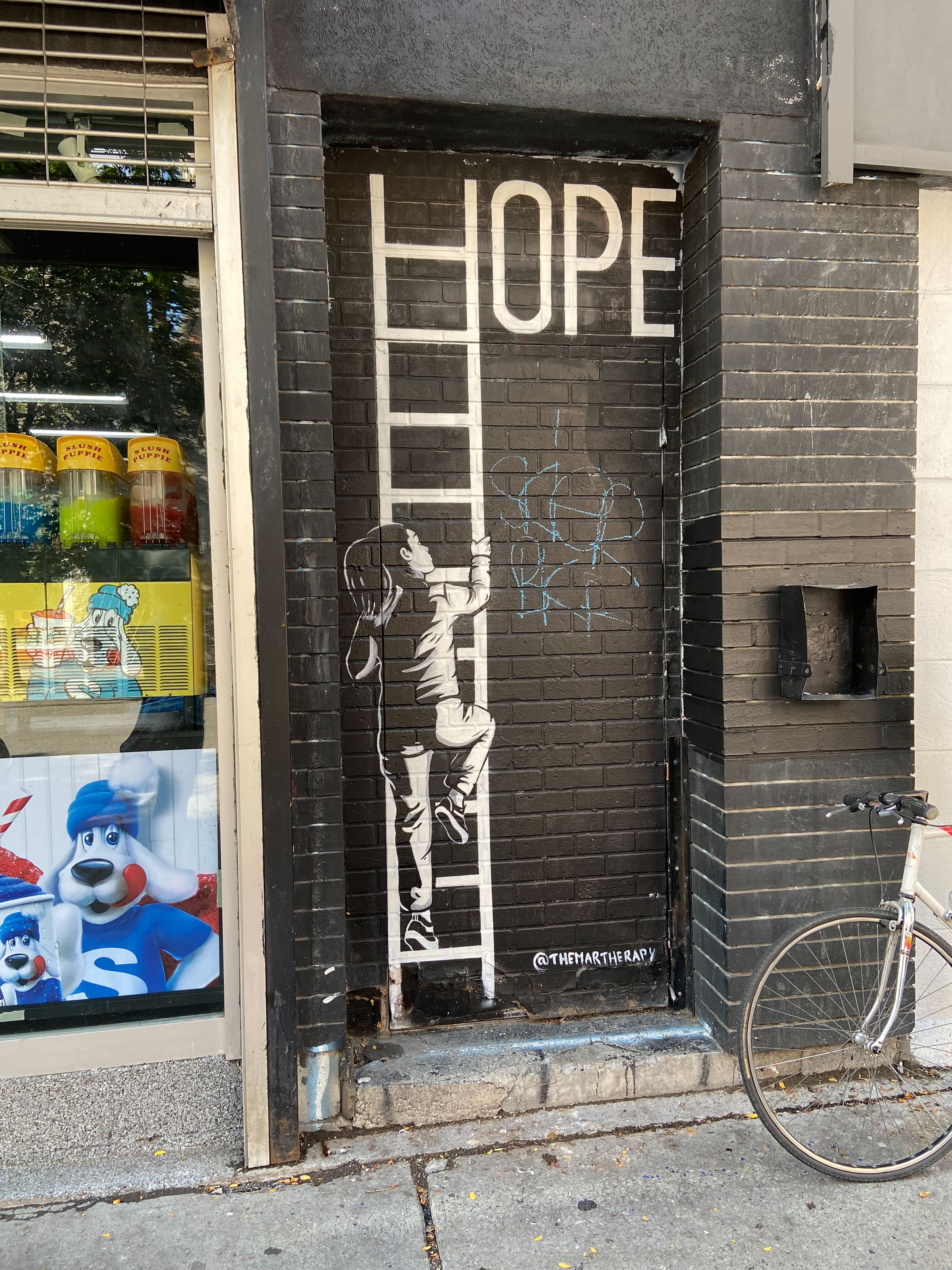
Montreal isn’t the same as Paris. It’s self confident about its character in the same way Paris is, but it feels rougher and grittier. Paris somehow conveys and convinces its own elegance. If Paris is an impressionist painting, Montreal feels more like street art in a classical frame. But Montreal is romantic—romantic in a way that suits the rest of us.
If you wrote about Montreal, here’s a few things your characters could do:
EatYou could convince yourself you were in France with some of the food—little bakeries will absolutely display croissants and macarons. Maybe this is for tourists who expect that sort of thing. But if you want a more Montreal taste, you’re digging into something more solid. It could be a bagel (Montreal-style bagels…) It could be Montreal smoked meat. Or it could be the absolute pinnacle of Québécois cuisine—a poutine. Fries dripping with gravy and cheese curds is hard to square with Parisian elegance, but it fits right in in Montreal. The French-Canadians who invented this dish were not thinking of serving it to aristocrats.
Food can be a window into a person’s soul, and is deeply tied to the way they experience a place. I’d give better guidance to exactly what to try in Montreal but I’m limited by my experience of celiac disease. And this shaped my experience of the city deeply, in my relief at how much I could eat, how good what I could eat was, and what I couldn’t eat (not the bagels or the smoked meat sandwiches). Sharing and exploring food for characters in a novel could reveal a lot about how they live and what they expect in life too. For example, the absolute best thing I ate in Montreal was buckwheat crepes drowning in maple syrup—I thought I knew how good maple syrup can be, but this was even better. And yet buckwheat crepes are more a staple of Brittany in northern France than Quebec. Maybe this is just to demonstrate yet again that both types of French resonate with me in different ways!
 Explore Montreal Vibes
When I wrote about Paris, the best feedback I received about the manuscript was to inject more of the feel of the city into the story. This meant dredging my memories for every detail of the sights, sounds and smells and putting them in my characters’ minds when it made sense for them to experience them. Montreal has its own vibe, distinct from Paris, and this would be its own challenge to translate into prose. Like I said, it feels grittier (and I was not surprised to hear it was once a major centre of mafia activity—or possibly still is). It’s beautiful to look at, but not as tidy. Paris gets its own complaints over dog poo on the sidewalk and overflowing garbages, and yet it has a European-city tidiness that for whatever reason I don’t see here in Canada. I think it’s the winter, when the freeze-thaw makes everything crack up and break down a little, and as a result things don’t line up properly. But Montreal still has a lot of that European flavour, in the way you can turn a corner down a little street and it’s a pleasant walk, not a slog through a suburban wasteland, or a wind tunnel made of skyscrapers.
But what is Montreal’s character? It has an old historic centre, it’s true, and the medieval feel (it’s not actually medieval, just so you know) gives it a lot of that “European” flavour. But in my head, the style of Montreal is very much tied to the style of art and design that was tied to Expo 67, the world’s fair it hosted in 1967. I’m sure this style of design wasn’t invented in Montreal. But it expresses something about the city—the interest in design, its ties to the New World rather than the Old, and a unique concern with progress, humanity and the future. Montreal feels like a city with a heyday in the 60s, but not in a way that suggests it is in any way dead today. It’s not like Venice, which people complain is a museum and no longer a city. The vibrancy of its past lives in conjunction with the vibrancy of its present, and buildings like Habitat 67 are buildings that people do live in.
A few things that give Montreal its vibes: the metro, the streets that are full of people and cafes where patrons sit in the sun, the street art, the old mixed with the newer, the high front stairs going up to the second story of most houses, its walkability, and the streets that are restricted to cars. And the wide St Lawrence River, and of course, Mont Royal.


 Climb Mont Royal
If I wrote a story about Montreal, I think the characters would climb Mont Royal. One reason is simply that Mont Royal is what Montreal is named after, so it’s an obvious thing to do. Another is that from that point, Montreal truly spread itself out before you. Another is that after the exertion of walking up so many stairs, to emerge at the top and be rewarded the wide open view and the St Lawrence River beyond is a perfect capstone to the experience.
 Talk to People
I wrote a novella about Paris (called Paris in Clichés) and in that story my character meets another traveller and explores some of Paris with him. This was simply an element to create more of a story, but it also underlines how much connecting with other perspectives enriches your experience of a place. You could write a purely introspective novel, but if you went yourself you’d enjoy hearing from residents, business owners, café waiters, interns at the hostels and fellow travellers about their impressions of the city. Being able to meet and mix with strangers, and finding it possible to do, is one of the joys of travelling, because we don’t often think to have these random conversations with people we don’t know in our normal everyday life. If you go, take a moment to risk chatting with someone you meet. If you write about the city, tell us whether your characters love or hate the place.


Well, that was my own experience, as well as some thoughts on how Montreal could be a fun, different backdrop for a novel! I hope you enjoyed these thoughts, and if you’ve read something excellent set in Montreal, do let me know! I know it features in many literary works, it has just never come across my path in the same way Paris did. But I know there should be great works about this city out there!
Read my posts about Paris here:
Paris is Still Always a Good IdeaShakespeare and CompanyBerthillon: An Astonishing Ice Cream Shop on the Île Saint-LouisBateaux Mouches on the River SeineDon’t Miss the Eiffel TowerGet Lost in the LouvreTake in the View from the Sacré-CœurWant more from me? Enter your email to get my author newsletter–it takes a monthly deep dive into different topics of Christian faith. Or check out a sample issue here.
Join my Mailchimp audience
By clicking submit, you agree to share your email address with the site owner and Mailchimp to receive marketing, updates, and other emails from the site owner. Use the unsubscribe link in those emails to opt out at any time.
Processing… Success! You're on the list. Whoops! There was an error and we couldn't process your subscription. Please reload the page and try again.August 1, 2023
Freedom to Fail
It’s been a long time since I shared a “Quotables” post. But I came across a quote this week that reminded me of another quotable I wrote on years ago, about failure. That old post was about the incisive power of “what would you do if you knew you could not fail?” to clarify what you really wanted to do. The quote I came across this week is – rather than what would you do if you could not fail, it should be what if you were free to fail.
“When you’ve been found, you’re free to fail.”
On the Road with St. Augustine , James K.A. SmithWhen you’re young, life is more about you trying to make choices about what you want to do, and that must’ve drawn me to the old quote years ago. Maybe I’m drawn to this new quote more now as I’m older and navigating the result of my own and other people’s failures. Here’s the full quote in context (and a heads up, it’s a religious quote):
“Resting in the love of God doesn’t squelch ambition; it fuels it with a different fire. I don’t have to strive to get God to love me; rather, because God loves me unconditionally, I’m free to take risks and launch out into the deep. I’m released to aspire to use my gifts in gratitude, caught up in God’s mission for the sake of the world. When you’ve been found, you’re free to fail.”
I think whether or not you’re religious you can connect to the need to be free to fail. Whether or not you understand the idea of resting in the love of God, it makes sense to long for rest, to seek the peace that comes with your fire and ambition being accepted even if objectively they never amount to much.

Humans judge on achievements. Humans can’t help but compare. We compare each other, and we compare ourselves to each other, and in the age of social media it doesn’t take long to see how much we lack in comparison to everyone else.
But if life is about about we produce, what we show, whether we’ve made good on the promise or potential we showed at one point, how can we ever find peace?
What would you do if you knew you could not fail is for young people deciding what to do with their lives. They’re making decisions about paths to take. They’re trying to diagnose their passions.
What if you’re free to fail is for when you get a little older. It’s for those days when you’re dealing with the knowledge you have failed at various things. You DID fail. What does that mean? How do you handle it?
And this is not about a failure you can learn from. It’s not the kind of “failing so you can do better next time.” Not the kind of failing that life coaches advise you is good for you (“fail fast and fail hard!”). No, this is the kind of failing that seems completely futile, that seems to have no meaning and no lesson to learn. The kind of failure that can crush you and make you too paralyzed to do anything more.
You need the promise you’re accepted no matter what.
More than that, you need the hope that life is not futility. That your failures don’t mean life is futile. That doing things does have meaning. Putting one foot in front of the other does matter on a cosmic level, even if you can’t see the point.
Anyway, that’s why I’m sharing this Quotable today.
June 27, 2023
On Doing Things that Scare You
“Just because something scares me, doesn’t mean I won’t do it,” I told a friend of mine the other day, as a way of explaining myself—explaining why I might push back against an idea and make it look objectively from an outside perspective like I don’t want to do it—and yet I do it anyway. The truth is, almost everything scares me, and if I’d never learned to do things anyway I would never do anything at all.
This doesn’t mean I always make good decisions about what to do. Part of why I have a fear response is because I’ve done things that scared me and those things made me miserable. I picked some jobs that made logical sense for my future, which left me as a trembling bundle of nerves that couldn’t find calmness for months afterwards. I’ve gone out with people who hurt me badly. I’ve made friends with people who weren’t trustworthy. Things scare me because bad experiences CAN happen.
But what I’ve learned over the years is that I really don’t have a good way of knowing in advance whether something that scares me will make me miserable or not. So many things surprised me by being enjoyable, and I would’ve never known if I hadn’t done them. Jobs that terrified me and I thought I’d hate, I turned out to love. Talking to new people turned out to be fun. And so on. Just because something scares me, doesn’t mean it won’t become one of the deepest joys of my life. Therefore, trying a lot of different things that I’m not sure about feels like a risk worth taking.
It’s really hard to predict if you’ll love something without taking the leap to do it. When I decided to go off to study theology in 2017, my mom asked me if I thought I’d like it. And I had to say I honestly didn’t know, and wouldn’t know until I did it. This actually held me back for a long time—I’d been warned by well-meaning people that most people who thought they liked theology actually found it tedious, and that I needed to know why I wanted to study it before I took such a big leap. (Turns out I still don’t know “why” but it didn’t stop me from enjoying it).
And when I was in seminary to study theology, several people told me they couldn’t imagine moving across the country, and that they could never do it. Well, a part of the reason I had done it was to prove to myself I could. I knew the only way to find out if I could was to do it. The agony of loneliness and the lack of a supportive community when my life there was overturned felt worse than I could’ve predicted, and was exactly the sort of scenario that my brain frightened me with before I left—and yet I wouldn’t have known you get through these things if I hadn’t experienced that. Life can be more painful than your brain tells you, so fear is a totally appropriate response—and yet, by living through life experiences, your brain also begins to accept that you survive and these things don’t kill you.
That said, I absolutely struggle with paralysis! It’s exhausting when so many daily activities terrify you and you have to find the courage to keep going anyway. A lot of times I run out of energy to get stuff done. It also means I rely a lot on other people to tell me things are ok, and to encourage me. It makes me rather tiring to be around!
Anyway, it makes sense to wrap this post up with some advice about doing things that scare you. I’m no sage, but here are some thoughts:
Be open to things! Try to believe the chances you’ll love something you’re not sure about are at least equal to the chance you’ll hate it. The chances are probably higher, honestly.If you’re miserable, change something. This is easy to say and hard to do. When you’re miserable, you have even less resources to face things that scare you. Also, many times you’re miserable because you feel stuck—or you feel hopeless that change will do any good. But if you can, make a change in some area. This will help give you a feeling of control over something. (Note: if your misery is tied to depression, you probably need more help than this blog post.)Accept that “just do it anyway,” is the best explanation for how to do things that scare you. It’s the only explanation I’ve read, and it sounds super unhelpful. But somehow it does all come down to leaping out into the unknown.Sometimes you can’t “just do it”—but you can the next week or the next month. Don’t beat yourself up at not being able to conquer your fear in the moment, and celebrate it when you do find a way to wrap your brain around it.For me, spontaneity is a big thing that helps me to do things I’m scared of—just taking advantage of the moment and doing the thing now (like talking to someone who intimidates me). The more time I have to think about my decision, the more fear builds up. Maybe spontaneity will work for you too.Sometimes baby steps is the best way—going out to a restaurant alone rather than moving across the country, to face a fear of loneliness. But sometimes a “flooding” or “exposure” to a fear is better than tip-toeing up to your fear and letting yourself overthink it. It’s ok to switch up your strategies. Try figure out what will work for you.Don’t go against your gut. You do know some things are just not for you. Don’t date a guy you dislike, for example, or do a job you’re not suited for. This advice of doing things that scare you is for the things that scare you because the outcome is unknown.Some things that scare you are harder to undo than others. You can quit a job. You can come home from a trip. You can move back if you hate a new place. You can break up a relationship. But you can’t get back money you’ve lost. You can’t easily restore bridges you’ve burned. You can’t end a marriage without a lot of pain. Know what you’re willing to lose when you try something. Things with more permanent impacts are legitimately scary.Nassim Nicholas Taleb has a great quote about this in his book Skin in the Game , where he apples this to finances:“[N]o individual can get the same returns as the market unless he has infinite pockets and no uncle points. This is conflating ensemble probability and time probability. If the investor has to eventually reduce his exposure because of losses, or because of retirement, or because he got divorced to marry his neighbor’s wife, or because he suddenly developed a heroin addiction after his hospitalization for appendicitis, or because he changed his mind about life, his returns will be divorced from those of the market, period.”You can’t actually keep experimenting with life because eventually you run out of runway. But if you don’t experiment at all, you restrict yourself. It’s finding that balance between being open to learning what you can be, without blowing yourself up in the process.Deciding to do something that scares you teaches you about yourself—facing it often involves facing the why behind it. And navigating whatever it is—underlying feelings of inferiority, underlying discomfort at spending time with yourself, underlying distrust in the rest of humanity—is part of the journey of living better.After reading this, you might be like—she’s so brave! But I bet if you looked at my life, you wouldn’t think that at all. It’s not about making yourself try skydiving or travel to North Korea or start a business It’s about finding the strength to take a step towards something you do want to do, to be there kind of person you do want to be. Keep at it! You will find your way.
Join my Mailchimp audience
By clicking submit, you agree to share your email address with the site owner and Mailchimp to receive marketing, updates, and other emails from the site owner. Use the unsubscribe link in those emails to opt out at any time.
Processing… Success! You're on the list. Whoops! There was an error and we couldn't process your subscription. Please reload the page and try again.August 23, 2022
My Frustrations Upon Rereading Sense and Sensibility
I was rereading Sense and Sensibility the other day, and suddenly realized it’s not my favourite Jane Austen novel. Any Jane Austen novel is a novel of the highest quality, so to say “not my favourite Austen novel” still means I love this book. But in the past I’ve found I keep forgetting to mention this one when listing off why I love Jane Austen’s works, and now I’ve realized why. The characters are hard to connect with, the relationships aren’t as fully fleshed out as in some of her other novels, and she glosses over some frustrating male behaviours.
What do you think? Let me make my case below. When I ranked Austen’s novels in the past I think I put Sense and Sensibility fourth–here’s what I found on my latest re-read.
The Main Characters Are Hard to Connect With_(14760455121).jpg)
First, all the characters have something that makes them a bit irritating. Irritating characters aren’t always bad, because flaws need to be overcome in order to have characters that develop over the course of the story. But sometimes characters with certain types of flaws are harder to read about than others. The example brought up most often in Jane Austen’s works is Fanny Price, since her passivity and quietness can be frustrating, but I think there are examples in Sense and Sensibility as well. Just like Fanny, the characters in this novel spend a lot of time just enduring.
Elinor is calm and composed throughout the novel, which is admirable except when it sometimes prevents her from taking any action, reducing her from an active character to a passive character (it’s admirable she endures, but sometimes the reader wants her to just do something). It also prevents her from having some of the emotional reactions we, as readers, would relate to. Her love, Edward, is obviously flawed, being utterly passive for most of the novel despite loving Elinor back. Marianne is active in contrast, but in a way that is often unfeeling to the characters around her and to herself as well (a point which seems to be one of Austen’s messages in this novel). She is not active in a “likable” way. And lastly, everyone respects Marianne’s match, Colonel Brandon, aside from the slightly squicky implications of him being 35 and her being 17, and the fact Marianne reminds Brandon of the girl he was in love with before (making the reader wonder if she just a replacement of her for him?) Other than that, he is unfailing kind and thoughtful throughout the novel, so I feel if Austen gave us just a little more insight into the interactions between Marianne and Colonel Brandon (other than him staring at her from afar), we could be reassured that their relationship is somewhat healthy.
I used to think I was quite like Elinor, in being very composed and unruffled on the surfaceand not necessarily wanting other people to see when they hurt me. I still do share some similarities with her. But this time upon rereading it there were several things I realized I would never do–like pretend to be friends with Lucy. There’s a large amount of social decorum I would find pointless, which probably says more about me as a modern person than it really says about Austen. But I just don’t value holding up a social convention at the expense of being honest. I have no objections against being polite, but I believe it’s possible to be polite and honest and direct (well, this may be my modernity, or it may the Dutch in me). I wouldn’t necessarily feel bad about being honest that I didn’t find Lucy’s company interesting, at least.
I also wouldn’t hold back on asking Marianne if she was engaged to her initial love, Willoughby, just because Marianne would be offended. I wouldn’t refrain from admitting I was suspicious of Willoughby, or really feel bad about being suspicious about him as Elinor seems to feel bad–I just don’t feel the same compulsion as Elinor does that I “should” think well of everyone who hasn’t absolutely proven with evidence to be a bad person. Which is fine–I read books to experience life from a different perspective. But on this rereading, it really underscored why I don’t personally approach life this way.
The characters do develop over the novel, which is why this novel is a classic and why the story as a whole holds interest. Elinor demonstrates she does have emotions, Edward learns to take action to make his life more like what will make him happy, Marianne learns to be nicer to others and take care of herself, and Colonel Brandon–well, doesn’t change, but behaves honourably until he gets his reward. But overall this time I was struck by how uninteresting I found the four core characters of this novel. The side characters are very well fleshed out, some in a very short number of sentences (such as Mr. Palmer), which shows Austen’s ability at characterization. Their quirks lightens up the mood of the novel and keep you reading. Sometimes I felt like spending more time with some of them, which led to my reflection on what I found less than enticing about the characters I was supposed to be most interested in.
The Main Couples Could Use More ChemistryJane Austen ends several of her novels hastily matching up her characters, without showing an in-depth scene of how exactly the conversation went. This includes Fanny and Edmund in Mansfield Park, and Reginald and Frederica in Lady Susan. And in this novel, it’s Marianne and Colonel Brandon who get this treatment, whereas Elinor, as the primary character, has her scene with Edward fleshed out. However, Elinor and Edward’s relationship overall isn’t that fleshed out, and they spend much of the novel in different parts of the country.
Many have pointed out that Elinor and Colonel Brandon interact far more than Colonel Brandon and Marianne. These interactions demonstrate how much Colonel Brandon and Elinor could likely be a good match if they weren’t both in love with other people, and because of this I feel the novel could be improved it there were more evidence for the pairing of Elinor and Edward, and Colonel Brandon and Marianne, to counteract this impression that Colonel Brandon and Elinor could work well. Overall, it made me wonder what Elinor saw in Edward that made her hang onto her feelings for him for so long–if this had been demonstrated somewhere at the beginning of the novel when she first meets him, I would have understood it better. (It’s implied to be the fact Elinor sees the potential in Edward despite his passivity and unhappiness, which is romantic, but we as readers really struggle to see this potential that she sees in him). Most of Elinor’s interactions with Edward are deeply awkward. He’s always interacting with her under the awareness he’s engaged to another girl, and she is always holding back her deep feelings for him and wondering why he’s so awkward.
Colonel Brandon is very popular with readers and it’s not hard to see why. He’s one of the only male characters who is honourable throughout. He is incredibly likable, but the age gap between him and Marianne makes me uncomfortable in a way I guess Jane Austen wasn’t. As mentioned above, if we were given some insight into his head in a way that reassured us he appreciates Marianne for Marianne rather than an incarnation of his dead lover, it would help a lot. Marianne’s flaw is idealism, and there’s not a lot of evidence in the novel that Brandon isn’t idealizing her as she once idealized Willoughby. I feel it would also help a lot if it was fleshed out a bit more as to why Marianne eventually fell for him, because it does feel like he was a bit of a consolation prize for her in the last paragraphs of the novel. To see her start to appreciate what everyone else admires in him would flesh out this relationship a bit, and move his position a bit deeper from “talking to Elinor while staring at Marianne” the whole time.
Frustrating Male Behaviour_(14781686701).jpg)
And lastly, it’s surprising how much Austen softens and apologizes for the actions of the male characters in this book. I don’t think this struck me in my previous readings, but this time I wondered why she went as far as she did. The obvious example is Edward, whom she describes as “very wrong” first for getting secretly engaged to Lucy and then for spending time with Elinor despite his engagement, but she adds a lot of circumstances to excuse his behaviour, and makes it clear Elinor forgives him. The overall implication is somewhat that though his behaviour made people around him so miserable and put Elinor in incredibly uncomfortable situations (like having to be nice to Lucy), he should be forgiven because he starts to take more action and stops wallowing in his misery by the end. It’s fine that Elinor forgives him–we can all be clueless. It just doesn’t feel reassuring that he wouldn’t be clueless about hurting her again later in their marriage. Her ability to hide her feelings and her willingness to think well of him even when he’s careless with her emotions, doesn’t provide much reassurance here.
The other example is Willoughby, Marianne’s first love who ghosts her and marries another woman. When I was younger I was very excited to see Willoughby’s slight redemption arc, when he shows up when Marianne is almost dying and admits to Elinor that he regrets ghosting her and will always have feelings for her. To my younger self, this was romantic. It was also interesting to see in contrast to Wickham in Pride and Prejudice, who gets no redemption and is just implied to be a scoundrel (though he isn’t punished for being a scoundrel). But now I am older I feel more surprised Austen softened his bad character, and basically made it necessary for Marianne to start feeling better to know that he had truly loved her at one point–for her to know he had some good intentions in him towards her. The second thing that is awkward is that he seduced Colonel Brandon’s ward and his defence is basically that the ward wasn’t totally innocent either. Austen positions this as lighting the blackness of his behaviour somewhat, whereas taking advantage of a very young girl in that way in inexcusable no matter how you phrase it. It may be for this reason that the scene where he admits his regret to Elinor was left out of the 1995 movie version.
I guess his regret is Austen’s way of punishing him a bit, since otherwise he doesn’t really suffer for what he does to Marianne. (And it’s true that Austen’s awful characters frequently avoid any punishment). But this regret is paired so much with lighting all the characters’ impression of his behaviour, since I guess they feel sorry for him? Perhaps it is his charm that realistically prevents the characters from judging him as harshly as he deserves, but I found it interesting that Austen even made this narrative choice.
Anyway, on this rereading I was struck that Austen even bothered to soften these male characters’ behaviours. She must have felt charitable when revising this book–more than one character’s behaviour is first described as foolish and then softened later. Some minor characters that get this are Mr. Palmer, who at first appears stuck up and later is revealed to care at least a little about Elinor and Marianne’s wellbeing when Marianne is deathly ill, and Mrs. Jennings, who is introduced as someone very vulgar but whose kindnesses to Elinor and Marianne keep the plot going and helps them out at various points. Possibly after entering her characters’ heads for the length of time it took to write this novel, Austen found she had sympathy for their points of view–who knows!
Anyway, that was my recent impression after my latest reread. Another reading might bring more things to mind–or change my mind! Let me know your thoughts below.
__ATA.cmd.push(function() { __ATA.initDynamicSlot({ id: 'atatags-26942-630552a1e0ce7', location: 120, formFactor: '001', label: { text: 'Advertisements', }, creative: { reportAd: { text: 'Report this ad', }, privacySettings: { text: 'Privacy', onClick: function() { window.__tcfapi && window.__tcfapi( 'showUi' ); }, } } }); });January 22, 2022
Looking Back on 2021: Author Update from Harma-Mae Smit
Do what you love and you’ll never work a day in your life. Well, it’s not exactly true, but if there’s something you’re passionate about and you can channel your creativity towards that, then you are really making the most of your time. It’s work, yes, but you also get to explore what you love. Over the past year, I had two different projects that really hit the sweet spot between my interests and opportunities to write, and so I thought I’d share them with you here.
Besides writing, I have strong interests in both history and theology. And in 2021, I accomplished two projects, one that exercised my historical research skills, and one that required my knowledge of theology and faith. (I completed a few other projects as well, including another ebook and a monthly newsletter, but these are the two “passions” I thought I would highlight for you today.)
History: Sam the ShoemakerMany years ago, I wrote about why a history degree was a useful education for a writer to pursue. I still agree with that, and this piece from this year is further evidence!
For this piece, I got to flex my historical research muscles. I also got to interview my dad as part of the process of investigation.
This was a local history piece I did for Edmonton City as Museum Project, about the neighbourhood shoemaker that I always used to hear stories about growing up. I don’t know why, but the art of shoemaking always interested me. It’s a skill that’s fading away to some extent, as most shoes are mass-produced and not repaired, and yet shoemaking is a useful skill that can really keep your shoes looking beautiful for a long time. I wanted to know more about shoemakers in Edmonton, and the shoemaker that my dad knew when he was growing up in particular. And so I wrote this!
 Theology: Christians and Fast Fashion
The theology project I worked on this year was a two-part article for Ad Fontes Journal (website) about fashion and theology. I have always loved fashion, and because I believe theology can touch on every area of our life, I thought it must be possible to write about theology and fashion together. The angle I took was to look at the waste of fast fashion more closely, and see if there were theological reasons to value well-made, beautiful clothes. The obvious reasons to be against fast fashion are the effect of fast fashion on the industry workers, and the effect of fast fashion on the environment. But I thought these two critiques were missing something. I thought there should be reason to value excellence in clothing whether or not there were ethical issues—the cheap and transitory nature of fast fashion wasn’t something to be celebrated from a theological perspective either. So I wrote about that.
You can find the two articles below:
Christians and Fast Fashion Pt. 1: More Than Ethics
Christians and Fast Fashion Pt. 2: Pursuing Virtue Through Dress
Well, there you have it! Those are some of the things I worked on in 2021.I’m always surprised at how opportunities come up to integrate my writing and my other passion in life, and I’m excited to see what ideas might come together next. What are you excited about in 2022? Take a moment to comment below!
Join my Mailchimp audience
By clicking submit, you agree to share your email address with the site owner and Mailchimp to receive marketing, updates, and other emails from the site owner. Use the unsubscribe link in those emails to opt out at any time.
Processing… Success! You're on the list. Whoops! There was an error and we couldn't process your subscription. Please reload the page and try again.March 24, 2021
Why Tour Paris? Reason No. 7: Take in the View from the Sacré-Cœur
Where can you get a lovely view of Paris? From the Eiffel Tower, is one obvious answer (another landmark you can climb is the Arc de Triomphe). But there is another viewpoint that you do not have to pay to go up, where you can sit and enjoy for as long as you wish (perhaps with a bottle of wine). And that is on the steps of the Sacré-Cœur.
The Sacré-Cœur is a church on top of the hill of Montmartre. It is the second most visited church in Paris, after the Notre Dame, but it is not nearly as ancient—it is visited less for its historical significance and more because after climbing to reach it you are greeted with a striking view of its white domes and greenish bronze statues, and after that a great view of Paris and the neighbourhood of Montmartre behind you.


It was actually only finished in 1914. It’s quite interesting to me that monumental churches were still built long after the radical forces of revolutionary France reduced the power of the Roman Catholic Church in France. But it does go to show that simplified narratives of history never quite capture what actually happened in the past: the Roman Catholic Church still played a big role in French society. In fact, the building of the Sacré-Cœur needed both government support to secure the location, and individual donations from Christians to fund the construction, in order to be built.
Its location on the butte of Montmartre is a place that, for most of Paris’ history, stood just outside of the city limits of Paris. This also explains why the neighbourhood of Montmartre retains its own unique character in the city. Despite being outside Paris, this hill was inhabited for centuries, and the hilltop was known as the place St Denis was beheaded as a martyr. After one of France’s numerous political upheavals in the 1800s, one of the archbishops had a vision of building a church on Montmartre to remember the martyrs and to beckon the people to find protection in the reign of the heart of Christ.
It is a striking building—five white domes topping the hill, with numerous steps before it threading the hill to reach its feet. Its location means it is visible from many streets and alleys of Paris—you can turn a corner and run into another view of it in the distance. It stays strikingly white, made of a specific white limestone that actually interacts with rainwater in order to stay white. While it is very popular with tourists, the look of it is controversial as many Parisian landmarks are: some think it looks like big dollops of meringue on top of Montmartre.
Apparently at one point, opponents to this church even proposed obstructing the view of it with a twin of the Statue of Liberty being given to the U.S! The idea was to symbolize that the separation of church and state that existed in the U.S. should be imitated in France. Obviously this idea did not succeed—it certainly would’ve spoiled the view!
My personal experience of the Sacré-Cœur is as a sanctuary. When I went to visit Paris by myself, I found myself in the awkward scheduling situation of flying overnight, and arriving in Paris several hours before I could check into my AirBnB. I left the airport exhausted from the flight, but with nowhere to go for several hours. So I went to Montmartre, since my AirBnB was in that neighbourhood there anyway. And then I went into the church to rest with my suitcase in the cool quietness while I waited.
In Canada, the churches frequently are locked to visitors when not in use for services, but not in Paris, and the fact there was somewhere in the city I could sit and feel relatively secure while I waited was a relief. Even if you are not in need of a quiet space to rest and wait, the interior is worth taking a look at.
If you want to hear more about Montmartre, stay tuned for a future episode! Make sure you follow this blog so you don’t miss the next landmark.
***
My novella set in Paris, Paris in Clichés, can be found here.
***
Want more from me? Enter your email to get my author newsletter–it takes a monthly deep dive into different topics of Christian faith. Or check out a sample issue here.
Join my email list
By clicking submit, you agree to share your email address with the site owner and Mailchimp to receive marketing, updates, and other emails from the site owner. Use the unsubscribe link in those emails to opt out at any time.
Processing… Success! You're on the list. Whoops! There was an error and we couldn't process your subscription. Please reload the page and try again.Posts in this series:
Paris is Still Always a Good IdeaShakespeare and CompanyBerthillon: An Astonishing Ice Cream Shop on the Île Saint-LouisBateaux Mouches on the River SeineDon’t Miss the Eiffel TowerMacarons at Ladurée on the Champs-ElyséesGet Lost in the LouvreFebruary 24, 2021
Why Tour Paris? Reason No. 6: Get Lost in the Louvre
In my novella, Paris in Clichés, the characters “race from the Winged Victory to Venus de Milo to the Mona Lisa in the Louvre, with barely half a glance at everything in between.” This is the only glimpse they have of the famous Louvre Museum, and it’s very similar to what many tourists see when they visit Paris, especially if they’re in a rush. But do I recommend experiencing the Louvre this way? No, no I do not.
Some guide books recommend caution when visiting the Louvre, describing it as overwhelming. They recommend you ease into it–decide ahead of time what you must see, and planning out your steps. They sometimes recommend just a few hours, rather than a day, in order to feel less deluged by all there is to see.
But I’d recommend you treat it the way I recommend you treat Paris itself–just wander. Have a vague idea of what there is to see and what broad categories are contained within it, but otherwise just treat it as an adventure. Who knows what you’ll stumble across? If you treat it as an enormous background to the Mona Lisa, you will likely find it a bit of a letdown. If you run through its halls just to see her and get out of there, you might not quite catch its atmosphere.

Yes, I spent quite a bit of time staring at hallways of broken Grecian pottery before I realized I did not have enough context about Grecian pottery or the significance of any of the types to get much out of it. So yes, it can be overwhelming. It does contain more than you can likely see in one day. But are any wanderings down an unplanned corridor a waste of time? Or are they part of the experience? Well–how often to you come face-to-face with tableware that someone related to Plato or Aristotle might’ve used?
Aside from the Greek pots, I stumbled across hallways of Egyptian antiquities, standing before the steady stone gazes of people who lived thousands and thousands of years ago–or, at least before their representations in stone. It’s rather startling, to think you might have met someone who looked somewhat like this stone face, if you had lived back then.
I also stumbled across the stone foundations of the original Louvre, which was first a castle and then a palace, and only eventually a famous museum. The building itself could be a museum to its own history, and in some respects it is, even without any other art inside it. The ceilings in many of the rooms are awe-inspiring too–nothing like the stark blank walls of some modern museums. Crumbling marble statues plucked from ancient temples vie for your attention with the ornate decoration of the building itself.
And lastly, yes, the often-mentioned treasures are in these halls as well: the Mona Lisa, the Winged Victory, and Venus de Milo. Most famous of all is the Mona Lisa, and you might as well take a look at her while you’re here. Across from her is a gigantic canvas called The Wedding Feast at Cana, and it is worth looking at while you’re waiting in line to see the Mona Lisa a bit closer (there’s always a line). Apparently there’s an hourglass somewhere in this enormous painting, so you can hunt for that while you wait.
There’s also Winged Victory, which has an ideal location over a grand staircase. The drapes of her robe look more like fabric than marble, and the wings rise up over the tourists below. Another treasure is Venus de Milo, and this armless white figure is the graceful centerpiece of a tour through Greek and Roman statues.
The one thing that you should plan, however, when you go is getting in. As with many other famous museums, the lineup to get in can be loooooooooooong. Look into the best way of getting in before you go–when I went last, the lineup was much shorter at one of the alternate entrances rather than in the main entrance under the glass pyramid. But it’s been a few years, and things always change, so look into what’s recommended before you go! Otherwise your day at the Louvre might be spent more in standing in line in the atrium than in the museum itself.
After that–go ahead, get lost in there!
If you’re interested in the story of the glass pyramid in the Louvre courtyard, this is a fun article: https://www.architectmagazine.com/awards/aia-honor-awards/louvre-pyramid-the-folly-that-became-a-triumph_oMy novella set in Paris, Paris in Clichés, can be found here: https://books.harmamaesmit.com/collections/print-books/products/paris-in-cliches

 Some sights at the Louvre
Want more from me? Enter your email to get my author newsletter–it takes a monthly deep dive into different topics of Christian faith. Or check out a sample issue here.
Email Address:
Follow
Posts in this series:
Paris is Still Always a Good IdeaShakespeare and CompanyBerthillon: An Astonishing Ice Cream Shop on the Île Saint-LouisBateaux Mouches on the River SeineDon’t Miss the Eiffel TowerMacarons at Ladurée on the Champs-Elysées

