Gavin Bell's Blog
April 10, 2026
Writing a first draft
 Photo by Daniel McCullough on Unsplash
One of my writer friends, Steve Mosby, calls the first draft his vomit draft, and ever since I heard that, that’s the way I’ve thought of it too. The goal of the first draft is to get the ideas out, no matter how much of a mess it makes. You can worry about clean-up later.
Having written more than ten novels, I’ve worked out some things do to ahead of that first draft to make my life easier.
The first thing I do is to start listing all of the ideas I have about the new project and start trying to get a very basic plot outline scribbled out. It’s always interesting looking back once I’ve finished a book to see how different the final product is from the first few ideas, but there are always some good scenes or characters or even lines of dialogue that make it through from inception to completion. From experience, that initial outline can change a lot as I write, but it’s important to fool myself into thinking I know what I’m doing.
Thanks for reading The Basic 500! Subscribe for free to receive new posts and support my work.
I do a little bit of research before starting, but just enough to give me something to go on. The fine detail, if I need it, will come later. I like to ground my novels in reality as far as possible to balance out the more outlandish thriller elements. I don’t like to overdo advance research a) because it’s a great excuse for procrastination, and b) because the temptation to dump all the research you’ve done into the book is strong. I try to write as much of the book as possible and then research the gaps in my knowledge… which will be numerous. The good thing about research is it will often give you a great idea for a new plot twist, or a solution to a story problem you’d been struggling with.
Like most writers these days, I do a lot of Googling. The internet is an incredible resource for lots of things, from the minutiae of firearms to flight schedules to street views from all over planet Earth. I also read factual books and newspaper or magazine articles about topics that are relevant to whatever I’m writing. It’s always helpful to visit the place you’re writing about (assuming it exists), but even when you’re writing about somewhere you know well, you can always learn more by reading about it too.
So, once I’ve exhausted every other avenue, I get to the writing part of writing the draft.
There’s no magic bullet for this. I just try to keep going, knowing that it isn’t going to be perfect or pretty, but that the job of a first draft isn’t to be good, it’s to exist. The Basic 500 method helps with this - setting a manageable daily goal and sticking to it.
It’s like working on any sizeable project, from planning a wedding to renovating a house – you have good days and bad days, and you’re probably going to need a spreadsheet at some point.
Sometimes you’ll make a breakthrough and get a lot of words out and they seem to be reasonably good words. Other days you’ll be spinning your wheels, wondering if you should just give up on the whole thing. On those days, it’s important just to get some words down, no matter how clumsy, and trust that you’ll be able to fix them later on.
Where do I get these words down? I have an office at home, but I’m fortunate in that I can write anywhere. If I’m travelling I can write on trains, on planes, in libraries, coffee shops, park benches, wherever. Sometimes even if I’m working at home it helps to get a change of scene, so I’ll slope off to a coffee shop or a quiet pub.
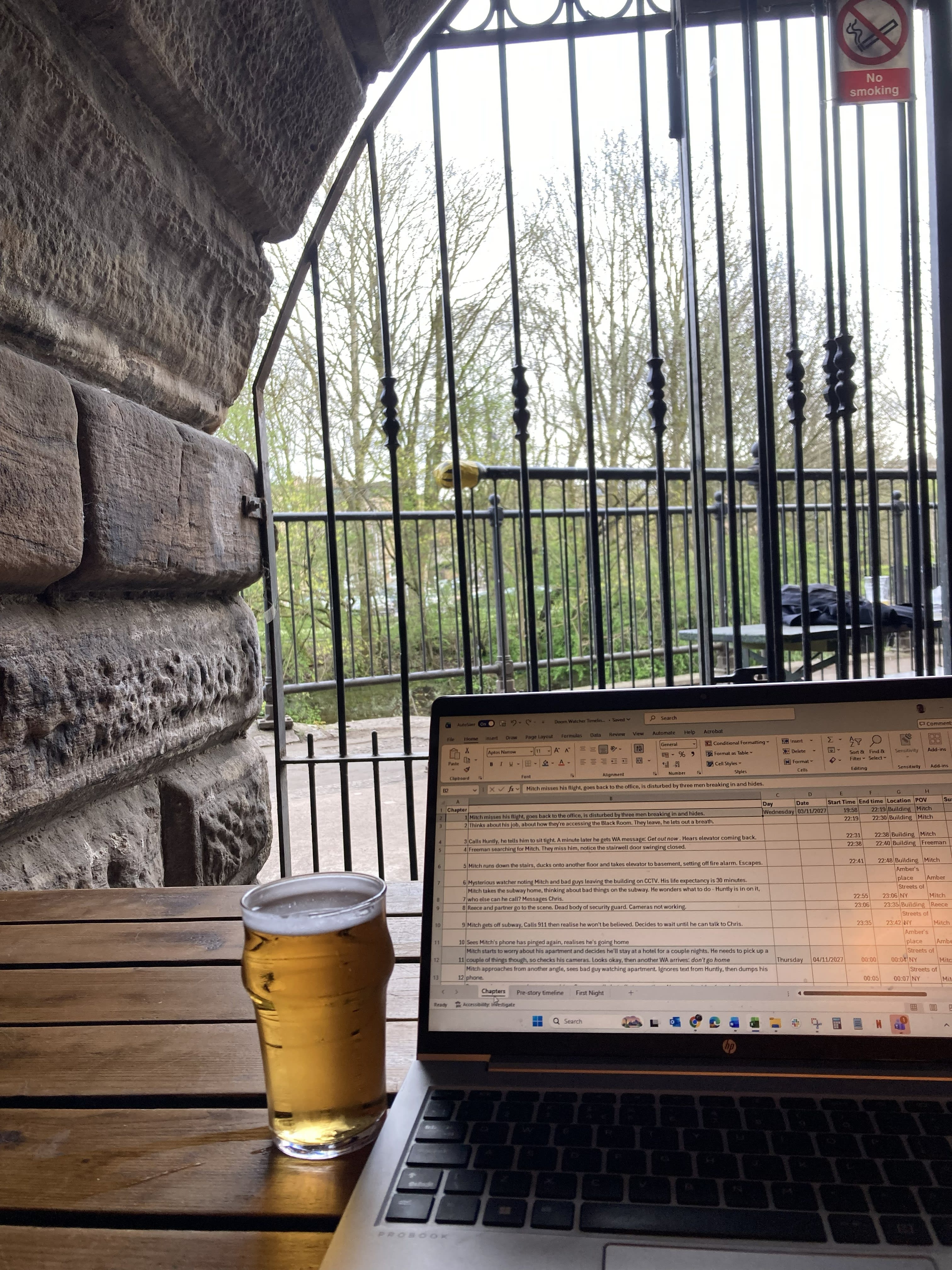 My most recent writing session in a pub: Inn Deep
Some authors edit as they go. Personally, I tend to plow ahead without looking back. Occasionally, if I have a really bright idea of how to fix an earlier scene I might go back and tweak a little, but mostly it’s about gritting my teeth and focusing on the finish line.
It takes me four to five months to get a rough draft completed, but that’s very rough indeed. After that it’s usually another month or two to get it in a good enough shape to send to my publisher. 138 Main Street took a little longer than that, because it’s my most ambitious and sprawling novel to date, and it took more time to whip into shape.
Ideally, I take a break for a few weeks and come back to it fresh, but the available time doesn’t always allow that. When I come back to the draft the first thing I do is print it out and go through with a pencil and a notebook and lots of different coloured highlighters working out everything that needs to be fixed. There’s always a lot that needs fixed. I find the paper stage indispensible. For some reason you miss the mistakes more easily on a screen.
I actually find the next stage, the editing, more creative: taking that first draft and turning it into a book. I’ll talk about that next time.
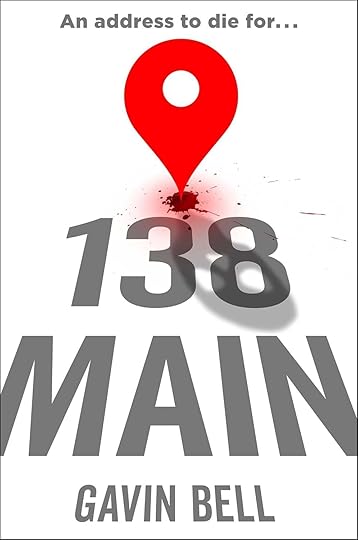
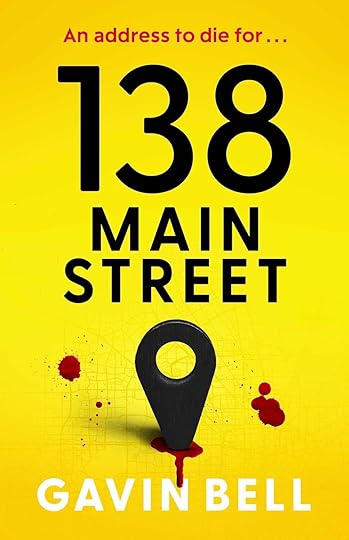
Pre-order my new novel 138 Main here.
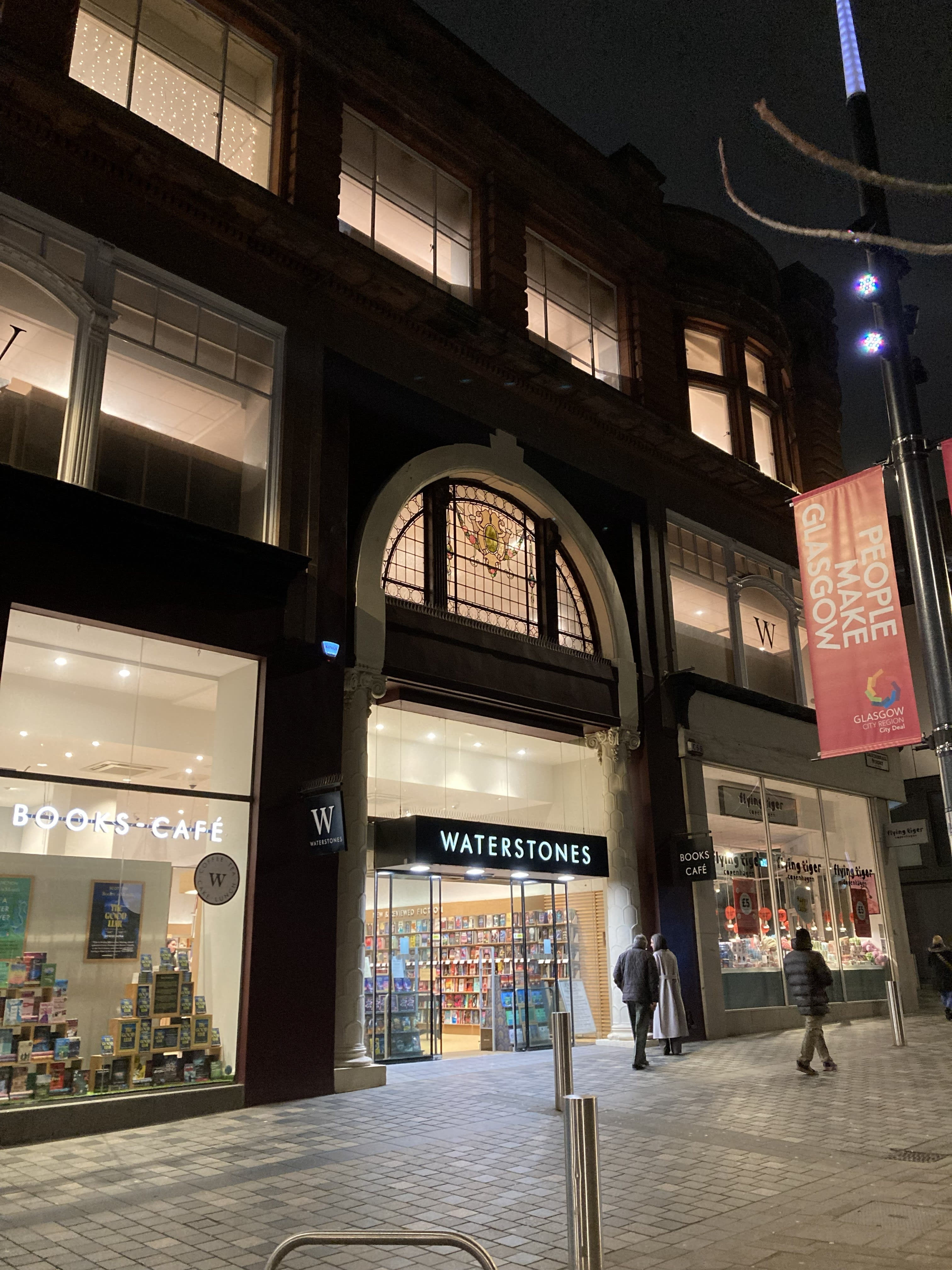 Walking pic of the week - Waterstones Sauchiehall Street, where my book launch is going to be on 6th MayReading
Just started an advance copy of CB Everett’s meta-thriller The Final Chapter. I’m looking forward to being on a panel with CB (aka Martyn Waites) at Capital Crime in London this June.
WatchingProject Hail Mary was really good, even though I generally take a dim view of any movie over two hours. I also caught Ferris Bueller on the big screen for the first time, which is well worth doing if you get the chance. Love that museum scene.
WritingDeep in edits on the new book, and I’m off to New York next week to do some of that in-person research. Yes, I’ll be writing on the plane, in the hotel room, and hopefully in one of my favourite spots: the Rose Main Reading Room of the New York Public Library.
ListeningI’m keeping quiet about the details of the new book for now, but I can tell you that this is on the playlist:
See you in fourteen…


March 27, 2026
Grizzly murders and Springsteen
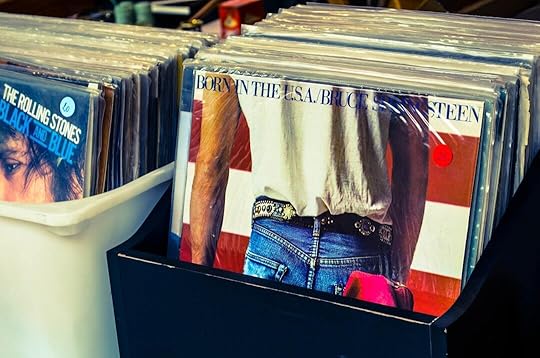 Photo by Jose Antonio Gallego Vázquez on Unsplash
A couple of weeks ago I signed off on the final page proofs of 138 Main Street, which means, terrifyingly, that the book is now pretty much set in stone.
For those unfamiliar with the publishing process, the page proofs (also called galleys) are the the manuscript typeset and laid out exactly as it will appear in the physical product, and it’s the author’s last chance to change anything.
At this stage, the publisher definitely does not want you to change anything major, like renaming a character or adding a new chapter, but it does let you catch the odd typo or clunky line, or suggest a different font for emails etc.
This is the [thinks] eleventh time I’ve done this, so I know the ropes by now. It took me back to the first time I had to go read the proofs for my first novel written as Mason Cross, The Killing Season (still available, and pretty good if I say so myself. You can buy it here, and because it earned out, I even get royalties).
One of the few advantages of not having a publishing deal back in the day was that it meant I could really take my time over my first novel and make as many changes and tweaks as I liked en route to what I amusingly believed was a final version.
I probably went through five or six drafts of Killing Season before it got to the point where I was happy to send it off to my agent. After that, it went through another couple of rewrites with him, and a further version with my editor. It was then read by a copyeditor and a proofreader. A bunch of my friends read it, and even some advance reviewers. All of these people fed back on the book and helped to point out the little mistakes (as well as the not-so-little ones). All in all, you'd expect that it would be polished within an inch of its life by the time it got to page proofs, but when I read them over, I still managed to find a couple of dozen new things I decided needed changing.
This ranged from minor continuity mistakes (such as referring to a 'cold October noon' which falls at the beginning of November) to minor formatting glitches to one embarrassing spelling mistake - on page 152 I found a reference to a 'grizzly' manner of death. Since there were definitely no bears involved, I was glad to have caught this one at the last moment.
Thanks for reading The Basic 500! Subscribe for free to receive new posts and support my work.
One of the final changes was to remove a number of song lyrics. Another advantage of blasting out a publisher-less novel is the fact that you operate in a bubble of blissful ignorance of things like copyright law, and specifically how it gets complicated around song lyrics. Naively, I'd assumed you could quite reasonably include a line or two from a pop song in your book and it would be covered under fair use.
Not so. Quotations from song lyrics don't work quite the same way as literary quotations. For a start, nothing from the modern era (actually since 1923 or so, which is pretty much everything, pop-music-wise) is in the public domain. There is no fair use limit, so any part of the song other than the title is copyright. Which kind of sucks, since a songwriter could use a line from one of my books and it would be fine by me and by the law.
To add to the confusion, the rights may be held by more than one party (songwriter, dead songwriter's estate, publisher etc). There's an informative article on the whole thing here, summed up by the author's advice: Don't ever quote lines from pop songs.
My then-publisher flagged this up to me at the contract stage, and kindly offered to chase down the rights-holders to see how much it would cost to use the five or six song quotes I'd blithely tossed into The Killing Season. None of them were cheap.
So part of the process of finalising that book was to surgically remove these expensive little samples and instead try to allude to the songs without directly quoting. There was one Bruce Springsteen lyric, however, that I couldn't bear to lose: a line from the song 'Nebraska' from the album of the same name. I quoted it in the epigraph and I liked how it sets the tone for the book, so I decided that one was worth keeping. It worked out about the cost of an iPhone for two lines at the end of the song. Given the low-fi nature of that particular album, I've probably covered the production costs all by myself.
So the typos were fixed and the song lyrics were mostly been excised and the next time I saw The Killing Season, it was in a bookshop. I’m at that stage now with 138 Main (or 138 Main Street as it will be in the UK), and I can’t wait to pick up that hardcover and leaf through. It always comes as a pleasant surprise that a book exists entirely filled with stuff I made up.
And yeah, I cut some Springsteen lyrics from new one: the line about the dogs on Main Street, from ‘The Promised Land’.
Pre-order my new novel 138 Main here.
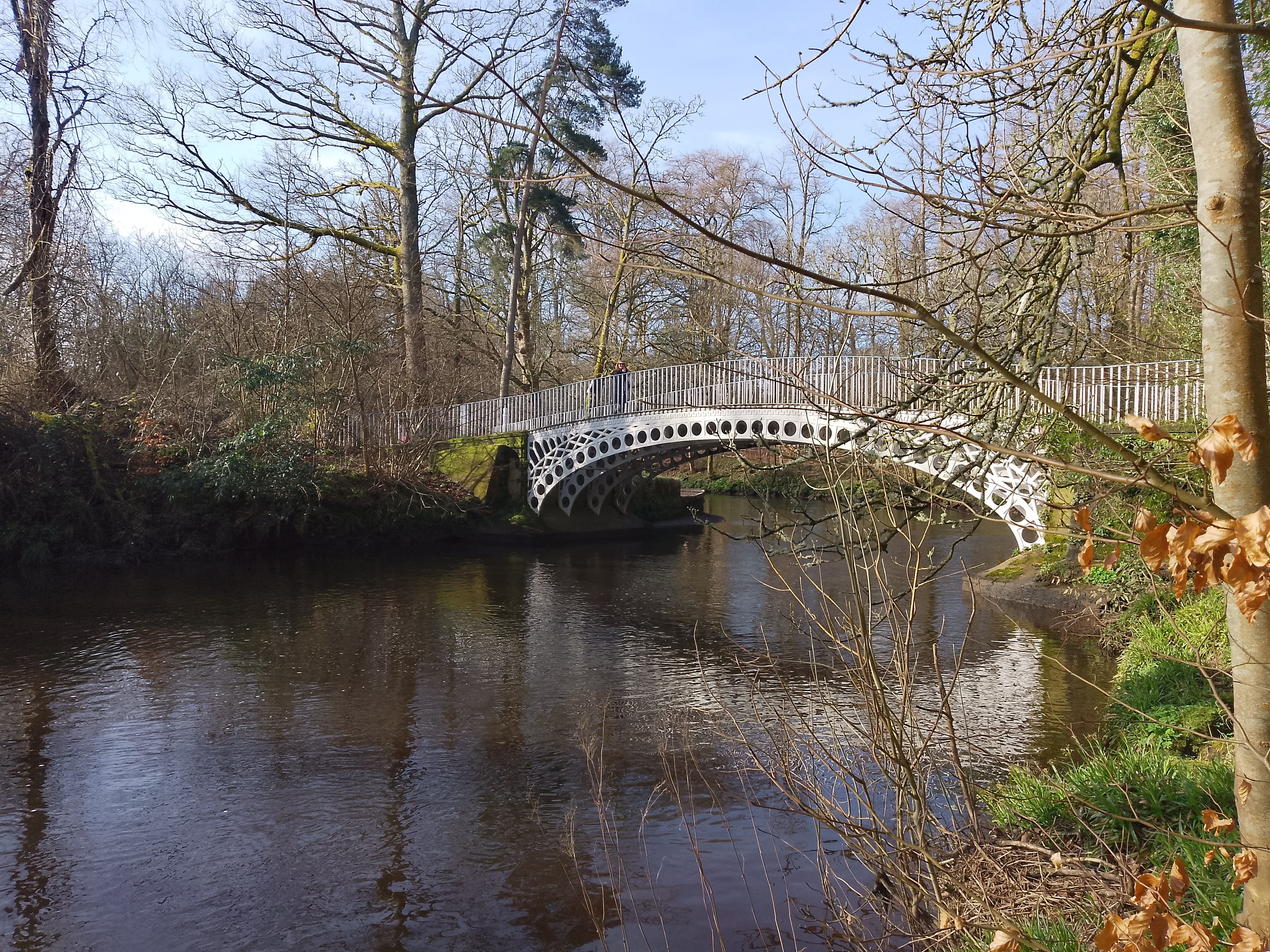 Walking pic of the week - the White Bridge, Linn ParkReading
I’m giving a talk on writing a crime novel at the weekend, so I went back to the Governor for inspiration - Stephen King’s On Writing. This time I’m listening to the audiobook, which has the bonus of being narrated by Mr King.
WatchingHow To Make A Killing was better than I expected, though I have to sheepishly confess I’ve somehow never seen the classic it’s based on: Kind Hearts and Coronets.
WritingI’m editing book two, and filling in some of the connective tissue that makes the plot properly hang together. Next month I’ve got a slightly more fun job - location research in New York City.
ListeningMy current writing music is Nicholas Britell’s score for season one of Andor, which is setting the mood nicely for menace. When the franchise was so inextricably associated with one composer (John Williams), it was a savvy idea to zag instead of zig with a more electronic score for this show. But let’s finish with the Boss instead…
See you in fourteen…
March 13, 2026
Formatting a manuscript in Word
 Photo by Jake Walker on Unsplash
The aim of this newsletter is to talk about what goes into writing a novel from start to finish. Sometimes that’s about ephemeral concepts like how ideas float into your head and finding your way to the soul of a book, sometimes it’s more nuts and bolts.
This is very much a nuts-and-bolts entry. In fact, I suspect this will be the most nuts-and-bolts entry I will ever post.
So, fair warning: if format, structure and the intricacies of Microsoft Word bore you, probably best to skip this one. Come back in a couple of weeks and I promise not to mention sequencing fields.
Okay? Still here? Don’t say you weren’t warned.
 Photo by Rubaitul Azad on Unsplash
A while ago, I was chatting to some other writers, comparing notes on how we write our novels. Being writers, we weren’t talking about the ephemeral, arty stuff that you tend to get asked about at events...
What inspires you?
Do you base any of your characters on real people?
and the ever popular
Where do you get your ideas? 1
No, we were talking about the mechanics: how we structure our books as we’re writing and how we alter that structure when we’re revising and editing.
It can be a major pain to restructure your book during edits, particularly when you have to move one chapter to a different place, or insert a whole new chapter. Either way, you’re going to have to go through and renumber all of your chapters, and hope that this will be the last time you’ll decide to mess with the running order (it usually isn’t).
Thanks for reading The Basic 500! Subscribe for free to receive new posts and support my work.
Quite a few of the writers I know use Scrivener, because along with some other cool features, it lets you do stuff like this automatically. However the problem is you still need to get the novel back into Word, which is the industry standard, when you start the back-and-forth process with your editor.
It occurred to me that Word might be able to do some of this stuff by itself. Microsoft is great at including all sorts of advanced functionality and then not really telling people about it. After little of Googling, I discovered that I was right.
Disclaimer: this is how I do it, not necessarily How It Should Be Done. Also, this works on standard versions of Microsoft Word for PC, but I’ve been told the same technique doesn’t work on Word for Mac, presumably because Apple revels in making life difficult for deviants who like to experiment. However I’m sure someone out there will have a Mac-hack.
Using Headings to structure the documentFirst of all, use the Heading format to structure your document. This only takes seconds, and will save you a ton of time later.
To do this, click on your chapter name, whether it’s ‘Chapter 1’, or simply ‘1’, and format it as a Heading. Word lets you have a hierarchy of headings, but I only ever use H1, because in my book(s), all chapters are created equal:
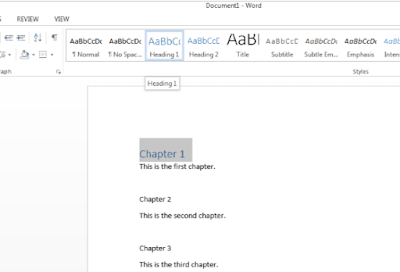
(My chapters are normally longer than this, by the way. Although sometimes not by much.)
If you keep formatting each chapter title as a heading, you’ll quickly notice that each one appears in the navigation pane (usually on the left hand side of the document). If you can’t see the navigation pane, Hit CTRL+F as though you were trying to find a word or phrase in the document, and then click on HEADINGS:
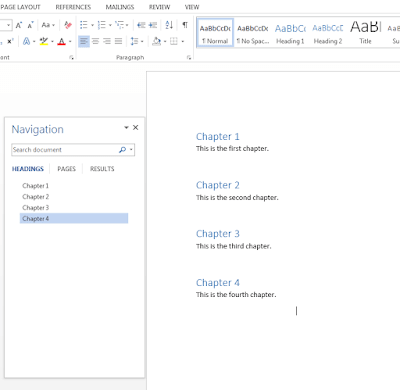
You’ll notice an immediate benefit: if you click on any of these chapter numbers formatted as a heading in the navigation pane, you’ll jump straight to that part of the book - no interminable scrolling required.
Using a sequencing field to automatically renumber chaptersThe next tip is a little more advanced, but only a little.
It involves using a field instead of text to number your chapters. This means you can tell it to number each chapter in sequential order.
1. To insert the field, delete the chapter number, leave the cursor in the same place, and press CTRL+F9 to insert curly field brackets:
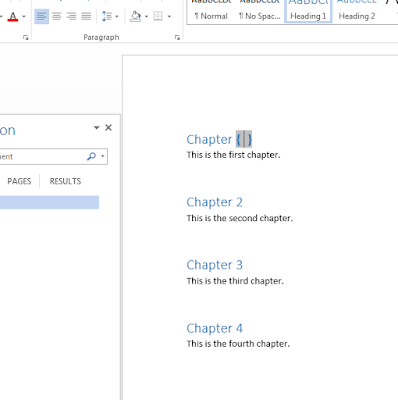
2. Then, type the phrase “seq NumList“ (without the quotes) between the curly brackets
3. Repeat for all chapters:
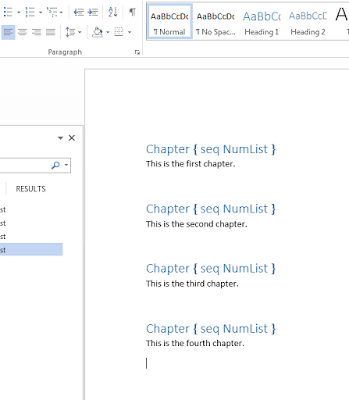
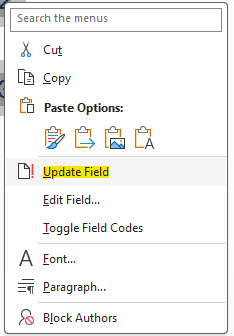
4. Select All and then right-click on any part of the selected text and then choose ‘Update Field’.
The chapter numbers will automatically update sequentially (both in the document and on the navigation pane):
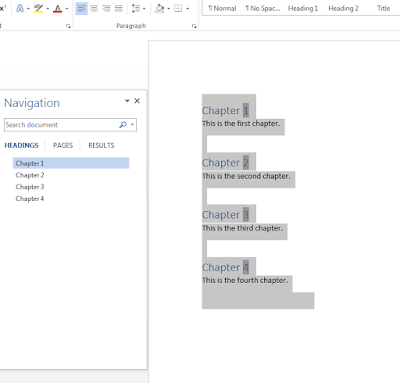
The great thing about this is, you’re not forced to give any chapter a number. So if, like me, you have occasional interlude chapters outside of the regularly-numbered chapters, you can make them part of the chapter structure with the Heading format, but you don’t have to include them in the numbering sequence. So you can have 1, 2, 3, FIVE YEARS AGO, 4, 5, 6...
Here’s the cool part.
5. If you decide Chapter 4 should really be Chapter 2, just click and drag in the navigation pane, and the entire chapter will move position in the document:
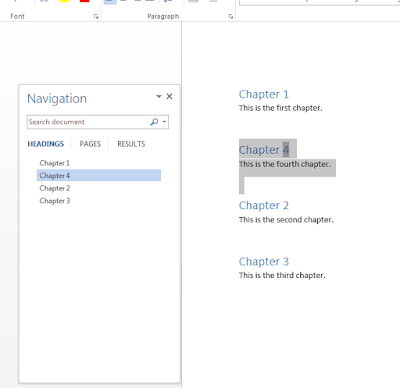
6. Select All2, click on Update Field, and because you’ve used fields for the chapter numbers, the chapters automatically renumber in sequence, as if by magic:
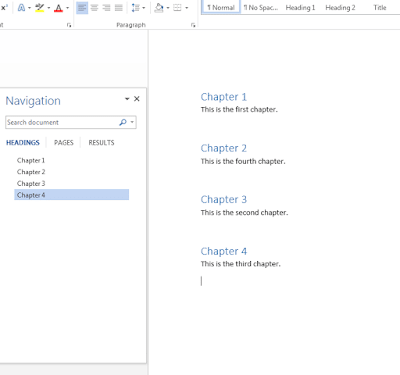
If you want you can download this template with the formula field already in.
Final thought: does any of this actually help, other than the obvious time saved copying and pasting things around and renumbering chapters? Yes, I think it does, because it lets me sit down and look at the book from a god’s eye view.
I can have a chapter breakdown on hand and immediately jump straight to the chapter I’m interested in. If I decide the prologue should really go at the end, I can do it in a couple of seconds, click and drag.
It gives me a bit more of the illusion that I’m in control, and if you ask any writer, they’ll tell you that you can’t put a price on that.
Pre-order my new novel 138 Main here.
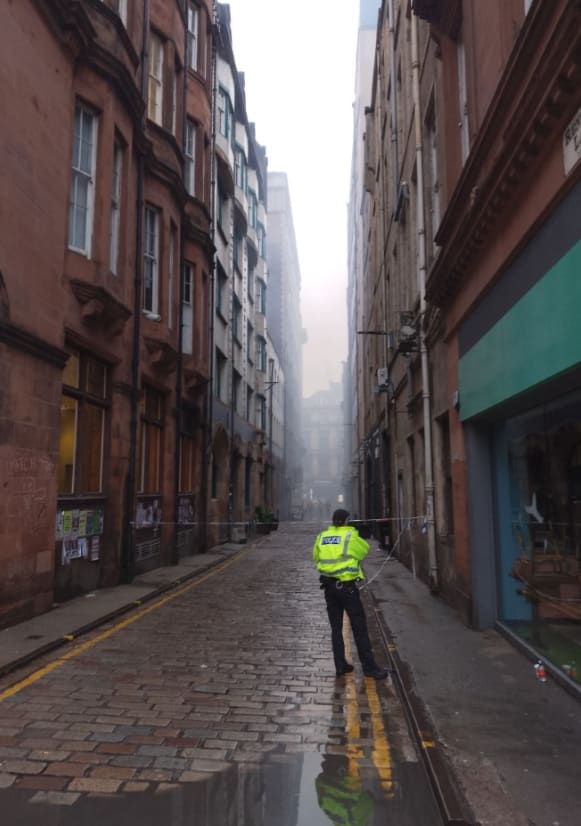 Walking pic of the week - bit of a sad one, looking down one of the sealed off alleys the day after the fire outside Glasgow CentralReading
I read Alex Gray’s latest Blood on Old Stones in preparation for chairing her launch at Waterstones, and I picked up an excellent Batman collection reprinting Son of the Demon by Mike Barr and Jerry Bingham, which has held up well, especially the art.
WatchingWe binged The Lincoln Lawyer in about a week, and I’ve also belatedly gotten around to Andor, which is fantastic.
WritingI’m editing the next book, and at that stage where you take everything apart and are wishing there was an instruction manual to put it back together. Unfortunately, that’s what this part is about - writing the manual. And the manual will only work for this book, not the next one.
ListeningI know this will not be a revelation to anyone else, but I listened to Fleetwood Mac’s Rumours from start to finish for the first time and damn, that is a well-put-together album. I went with the deluxe version, because it includes ‘Silver Springs’.
See you in fourteen…
1I always liked Harlan Ellison’s response to that one: he simply explained to people that he orders them from a company in Schenectady, New York.
2Important: don’t do what I did when I first experimented with this and accidentally delete your entire 100,000 word novel while in Select All, then panic and close the document after it had saved. Thank God for backups.
February 27, 2026
Visuals
 Photo by Mizanur Rahman on Unsplash
Visuals have always been a big part of my writing process.
When people enjoy my work, one of the things they often say is that the books feel very cinematic. I take that as a compliment, because when I’m writing a scene, at the back of my mind I’m always thinking about what it would look like in a movie.
Action sequences, yes, but also more atmospheric scenes: when somebody stumbles on an overgrown cemetery in the middle of the woods, or wakes in the night to neon light filtering through venetian blinds, or walks into a bustling office on the 22nd floor of a building in Lower Manhattan. I always know if it’s raining, if there’s a full moon, if there’s a stained glass panel in a door casting coloured shapes on the floor.
Maybe that visual thinking is because I’m a movie fan, or because I’ve been a comic book reader all my life, but I’ve never had a problem “seeing” the locations my characters find themselves in.
When I interviewed the author JD Kirk a while ago, he talked about having Aphantasia, a condition which means he’s unable to visualise mental images. He thought it actually helped him write quicker, because he thinks exclusively in words. He’s insanely prolific, so he might be onto something.
After that, I had an interesting discussion with some other writers after that about what we all mean when we talk about seeing things ‘in our mind’s eye’, and how varied that seems to be.
Thanks for reading The Basic 500! Subscribe for free to receive new posts and support my work.
When I’m writing a scene and have to describe a location, I never have to consciously stop and think about what it looks like. It’s more like the point of view character walks into a room and all I have to do is transcribe the image in my head.
But, weirdly, that’s not the case with characters. I only have a vague idea of what the main characters in my books look like. If you ask me who could play one of the leads in my new book in a movie1, for example, I could give you a list of actors who look absolutely nothing alike, but might share a general vibe.
Often, the visuals will come to me before almost anything else; like the full moon over rows of fields in Killing Season, or the ghost town in the desert in Don’t Look For Me.
When I’m planning a new book, I like to gather images together that will help me get a handle on the place, characters and story I’m dreaming up.
It’s really helpful for starting to visualise the locations and the world in which the book takes place. Also, it’s a lot easier than writing, and I’m always on the lookout for productive ways to procrastinate.
I’ve always done this, but it used to be with a mixture of old-fashioned clippings and pics saved in Word docs. For the last few books, I’ve created Pinterest boards as part of the brainstorming process. Sometimes, I’ll get an idea for a new story strand from an arresting image.
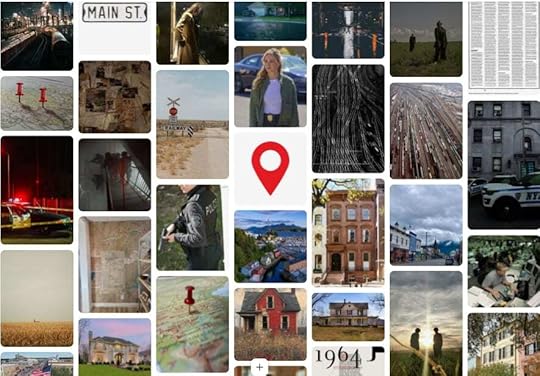
Here’s my board for 138 Main. I hope it gives you a flavour of the book.
How do you approach the visual side of a novel?
Pre-order my new novel 138 Main here.
 Walking pic of the weekReading
I just started reading The Hiding Season by A.C. Glass, which publishes next month and is a thriller about a caretaker being menaced in an exclusive Montana ski resort. Only a few chapters in, but it’s gripping.
WatchingI’ve been revisiting and discovering for the first time some classic 70s conspiracy thrillers, partly because the book I’m currently writing feels like something of a throwback to those. 3 Days of the Condor, The Parallax View and Marathon Man, of course, but also some lesser known contributions to the subgenre like The Domino Principle and Telefon. When every third post on my feed is someone being very proud of the awful AI superhero battle they made in 5 minutes, it’s nice to watch some films that feel tangibly real.
WritingI have a (very) rough draft of the new one. I’m now at the stage I like best - ripping it apart and building it back up better.
ListeningWhen I finally fot around to unpacking all of my CDs after the move, I discovered I was missing Last Spash by the Breeders, which is one of my favourite albums. I rememedied that by ordering a new one and it arrived today, so I’ve been listening to that today, particularly the prettily offbeat country of ‘Drivin’ on 9’.
See you in fourteen…
1“Who would play x in a movie?” is a question that always comes up at events, incidentally, so I’ll need to think more about this over the next couple of months
February 13, 2026
Everyone hates writing a synopsis
 Photo by Art Institute of Chicago on Unsplash
Last time, I talked about how I like to write the back cover first, before I do anything else.
This post is about the next stage, which is fleshing out that blurb into an outline. I use the terms outline and synopsis pretty interchangeably, but whichever you prefer, this is the first stage where you go beyond the one-line idea or the short pitch and start to build the structure of the book as a whole.
A lot of authors absolutely hate writing a synopsis. I’m one of them. But I acknowledge I can’t hate it as much as some, because there are authors who literally cannot map the whole story out before they start drafting the book.
Thanks for reading The Basic 500! Subscribe for free to receive new posts and support my work.
And okay, the headline above is an exaggeration, because at the other end of the scale, there are authors who actually love this part of the process. We call this kind of writer ‘A Freak’. It’s important to them to know every nook and cranny of the story before they start writing.
I’m probably somewhere in the middle. I need some idea of where the story is going otherwise I end up writing rambling nonsense, but I always deviate a lot from the initial synopsis. I guess I look on it as a path from which to wander. Somebody more poetic than me came up with that line, I can’t remember who, and Google isn’t telling me.
Anyway. The outline/synopsis/blueprint.
This is the document I’m most likely to show my editor ahead of writing a book. It’s usually 2-4 pages, written in the present tense, laying out everything that’s going to happen in the book (until I change it during the writing).
Whenever I read advice on writing a synopsis, the person giving it is always at pains to remind us not to hide the ending. The idea is to lay out the whole plot, not entice the editor into having to know what happens (that’s what the blurb is for).
Writing the ending is a problem for me, because I always come up with crappy endings at this stage, and they only improve when I’ve written the book. If I could get away with it, I would just make the last paragraph:
“and then something awesome [tbc] happens. The end.”
The problem with that is, future me is going to hate present me’s guts for that abdication of responsibility, and my editor is going to want something more concrete than “vaguely awesome”.
And the truth is, it helps me a lot to come up with some kind of ending, even if I know I’ll have to fine-tune it later, or perhaps replace it entirely. If I’ve had to think up something servicable at this stage, then at least I can write the book knowing it’s going somewhere. Usually, I’ll come up with a better or more developed ending by the time I get there. Something about having the weight of the book behind me helps.
So… tips on writing a synopsis? Bad news: I really don’t have anything like a magic bullet. You just have to write the damn thing, even if you’re hating it and even if it feels like you’re strangling the book at birth. Resign yourself to going over it again and again, and trust that it will get a little better each time.
It will probably help to remind yourself that you’re saving yourself pain later on, and that you’re just setting up the scaffolding for the book. The bricklaying and the stone masonry and nailing the slates on the roof is going to be more fun.
The one new trick I discovered when coming up with ideas for my next book was to try to produce a finished document that runs to exactly three pages. To do that I would write a long document that covered as much of the story as possible in five or six pages, and then go back and whittle it down to fit on three sides (no, changing the font size to 6 is not allowed).
I found this helped me to focus on what was really important and what was extraneous. It also let me start to see if the book will have a classic three act structure, with a page for each act, or if it’s going to be more awkward than that.
Anyway, when you’ve got this part out of the way, you can get to work on the actual writing. And for a while, compared to the task you’ve just completed, it might even seem like fun…
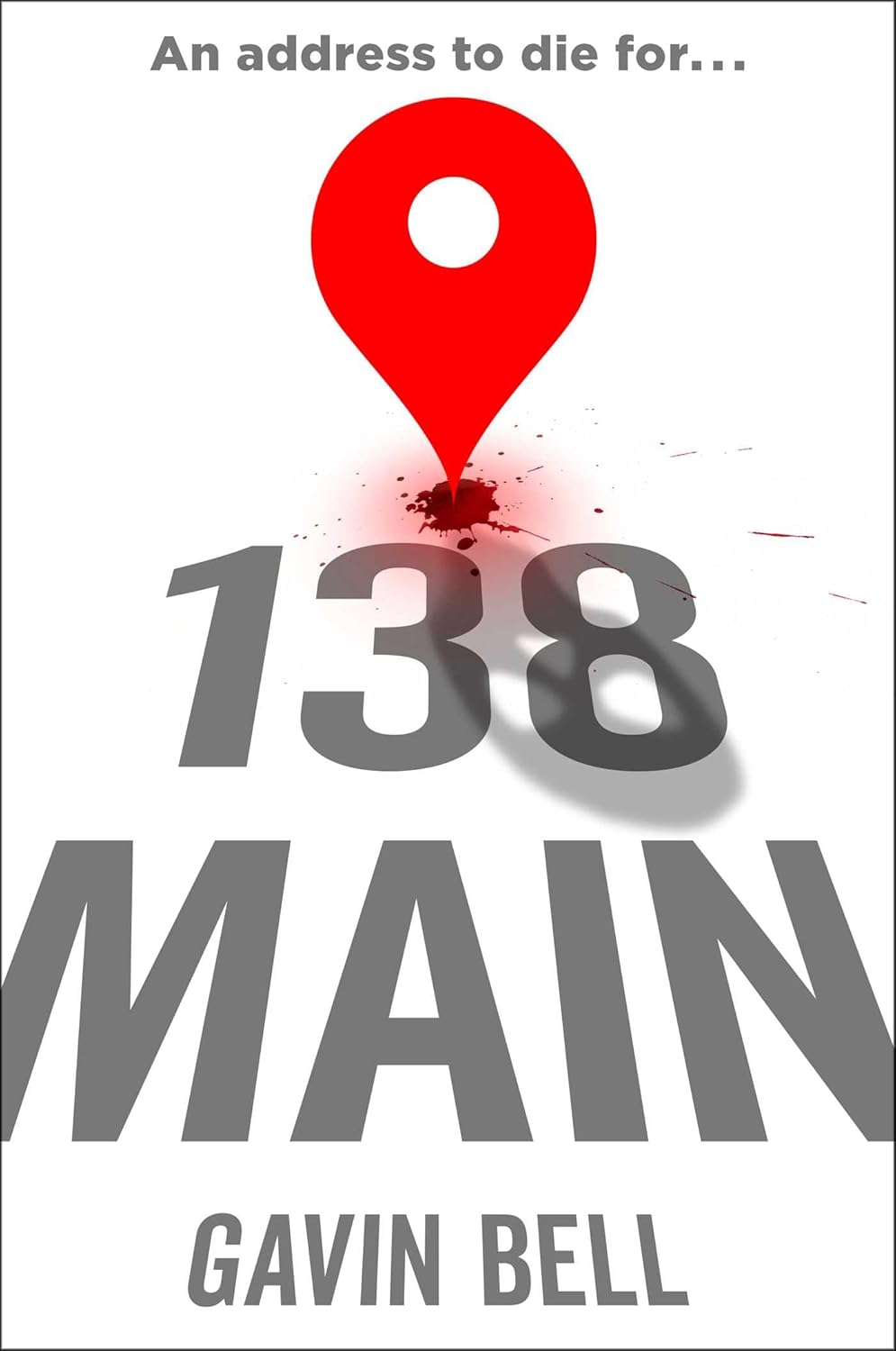
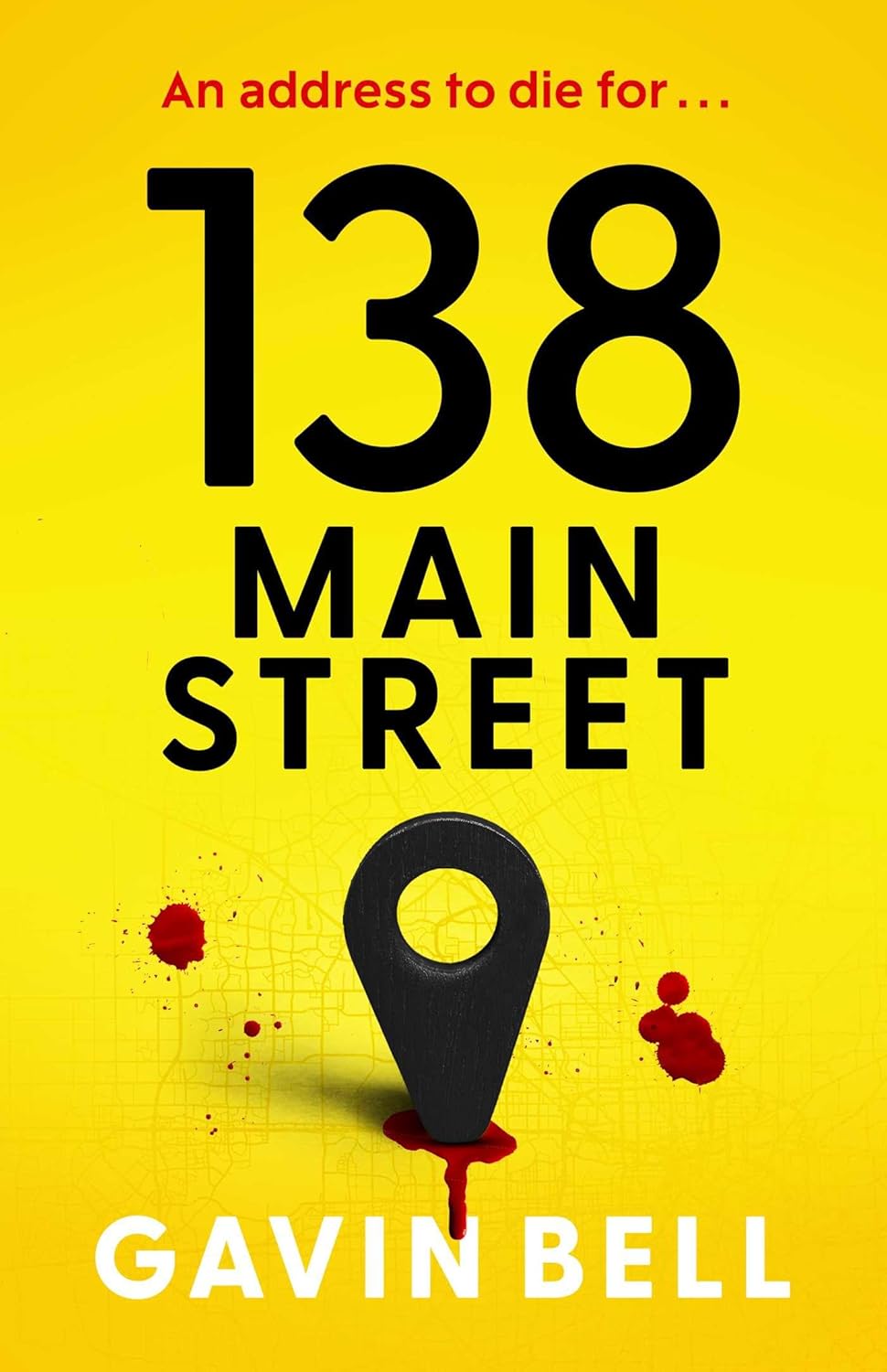
Pre-order my new novel 138 Main here.
ReadingI’ve been doing a lot of work in the back garden, and for the kind of monotonous manual work I hate, it’s a lifesaver to have an audiobook on the go. This week I’ve been listening to Precipice by Robert Harris, which is a political drama set against the backdrop of WWI and a change of pace from the thrillers he’s more famous for. No less of a page-turner, however.
WatchingThe Lincoln Lawyer is back on Netflix. I don’t know how Michael Connelly manages to keep so many streaming shows going at once, but they’re all extremely watchable. I loved the 2011 McConnaughey film, but Manuel Garcia-Rulfo does his own thing as TV Mickey and it works.
WritingI’m in the home stretch of the first draft, and just hit the 80,000 word mark. I’m about to go off to an Airbnb by the sea for a few days to, hopefully, get it finished. Yes, like James Caan in Misery. Then it’s the hard but rewarding part: the edit.
ListeningDan Golding of the late, lamented Art of the Score podcast presents a weekly two-hour movie music radio show for ABC in Australia, but we can all listen to it via the magic of the internet. This week’s focused on James Horner. A good recommendation for background music on a Monday writing session.
See you in fourteen…
January 30, 2026
Write the back cover blurb first
The short blurb on the back of a novel is the single most important element in a book’s product design after the front cover.
The cover is what makes a prospective reader pick up a novel from a pile in Waterstones or Barnes & Noble and flip it over. The pitch on the back is what seals the deal.
 Photo by Peter Ivey-Hansen on Unsplash
In the long process of producing a book, it’s one of the final things to be signed off. It’s not unusual for the back cover copy to be tweaked right up until the moment the book goes to press.
Therefore, you might be surprised to hear it’s one of the first things I write.
“What?” you might say. “Does the author actually write the blurb? I thought somebody at the publisher would do that?” Well yes, you’d be exactly right. But this has been part of my process since at least the second novel I ever wrote. Once I’ve started playing around with an idea for a new book, the first thing I do is write the back cover blurb.
It’s an exercise I always recommend to new and aspiring writers when I’m teaching a class. It doesn’t have to take a lot of time, but I’ve found it’s massively helpful when it comes to nailing the tone of the book and thinking about why someone would want to read it, before you spend months of your life writing tens of thousands of words.
Thanks for reading The Basic 500! Subscribe for free to receive new posts and support my work.
Everyone knows what the text on the back of a book looks like, and what it’s for. Three or four short, punchy paragraphs telling a busy book-browser about the plot, the setting, the characters and the stakes, and, if the blurb does its job right, enticing the reader to buy the book.
Writing the back cover first means I know why someone would want to read this book before I even get to the stage where I write page one, line one.
The title of this newsletter is The Basic 500, but in this case we’re going for something more like the basic 150. My format for my ‘pre-blurbs’ is usually three paragraphs, and in those paragraphs I have to set up:
Who the protagonist is
Where the story takes place
The inciting incident or narrative hook
And usually also…
The antagonist
The stakes
A question that the book promises to answer
In a couple of hundred words, you’re laying out the spine of your novel.
Here’s the blurb I wrote for my upcoming thriller 138 Main, back in the spring of 2021:
A vicious killer is stalking unremarkable small towns across America, striking with impunity and choosing his targets almost at random. Almost, except that he picks the same address every night: 138 Main Street. The problem for those on his trail is, there are over seven thousand Main Streets in the United States of America.
No sooner is Special Agent Ben Somerville assigned to the task force than the latest body is discovered in a small rural town in the Midwest. Murders are rare in Washington, Illinois, and Officer Zoe Hill is stunned to discover that this is part of something much bigger.
As the bodycount rises, Hill and Somerville have to find out who is behind the killings and bring the reign of terror on Main Street to an end.
It’s rough, but it hits all six of those points above in three paragraphs and 130 words. Now, here’s my publisher’s blurb as it appears on the online stores:
There’s a killer on the loose. And he’s targeting one specific address—138 Main Street. The problem? There are over 7,000 Main Streets in the USA. And the police and FBI have no clue which one will be next.
For FBI Special Agent Ben Walker and his rookie colleague, Officer Zoe Hill, the pressure to solve the case is unimaginable. There aren’t enough police officers to cover every house, and vigilante residents are attacking anyone who rings their doorbell. Main Street might be one of America’s most popular addresses, but for those living at number 138, it comes down to fight or flight.
Then a manuscript is sent to the New York Times, purporting to be the manifesto of the “Main Street Killer” and demanding radical social change. As the effect of the terror campaign takes hold across the nation, Walker and Hill find themselves in a race against time to stop the killer. But with their target always several steps ahead, and almost 3,800,000 square miles of ground to cover, they’ll have to find him first…
So the second one is better-written, and Agent Ben has changed his last name, and there’s a little more meat on the bones of the plot, but the broad strokes are pretty consistent from soup to nuts.
Sometimes I’ll send a few back cover pitches to my agent or editor to see which ones they like, but even if no one sees them, they’re useful to me. The first step in the process of fleshing out the idea that will lead to a synopsis, then a longer outline, and then the book itself.
If you’re wrestling with a new idea for a book, give it a try: write the back cover first. If it would make you want to buy the book, it’s probably a solid idea.
And hands down the best thing about writing the blurb first is this: you don’t need to know the ending yet.
Pre-order my new novel 138 Main here.
 Walking pic of the weekReading
I’ve been reading comics lately. I’m of the opinion that the 80s/early 90s era of comics can’t be beat, but Mark Waid and Chris Samnee’s Batman and Robin Year One is recent and brilliant.
WatchingThe Night Manager season 2 doesn’t live up to the quality of the original, but it’s fun. And the (re)introduction of a particular character at the end of the third episode gives the show a much-needed shot of adrenalin. I also caught The Housemaid, which is the kind of shamelessly entertaining 90s-style psych thriller I thought they’d stopped making.
ListeningMovie scores with the occasional foray into jazz or classical for writing, as always. Bowie and Soundgarden in the car this week.
WritingI’m getting pretty deep into the first draft of the next book, and managing to keep to at least a thousand words a day. I’ve been finding it helps to decamp to a different pub on a quiet night of the week. You can follow my bar-hopping travels over on my Instagram.
And, excitingly, the UK proofs of the new book arrived this week. Don’t they look great? These are the advance reading copies that go out to reviewers, bloggers and booksellers.
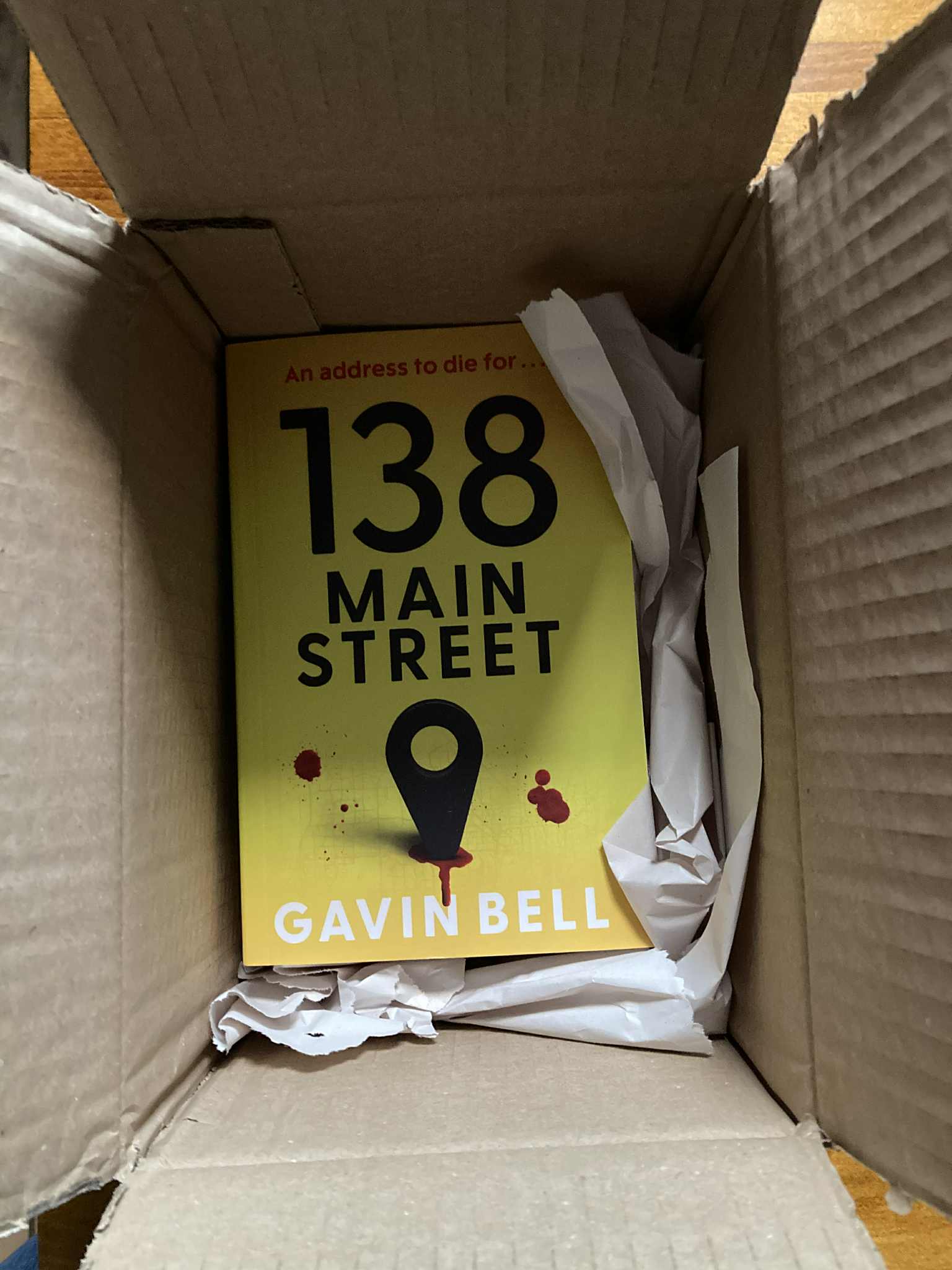
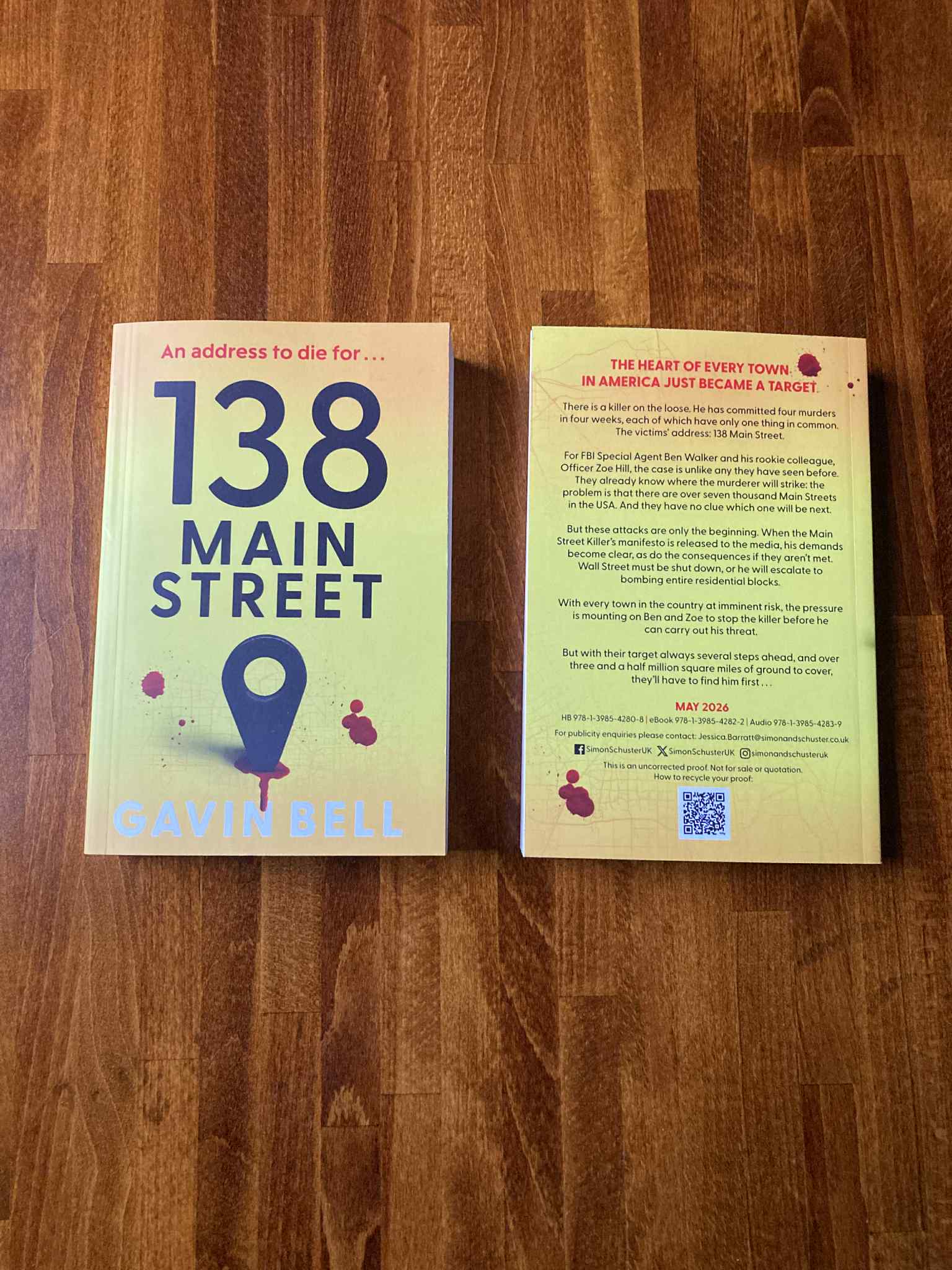
Did I mention it's available to pre-order?
See you in fourteen…
January 16, 2026
What's the big idea?
The concept behind this newsletter was, among other things, to look at every stage of writing a book and the tools and techniques I use to get a novel down on paper. There’s the Basic 500, of course, but essentially that’s just turning up every day. There’s a whole lot of other infrastructure I have in place to project manage a book. Some of it is niche or perhaps even unique to me, some of it is what everyone does.
But every novel starts in the same place: with an idea.
Famously, most writers hate being asked where they get their ideas. We hate being asked that because we hear it so often, and because there’s no a satisfactory answer.
I thought it might be useful to talk a little about about something slightly different: how I wrangle the ideas, and more importantly, how I work them up into a book.
I spoke in the previous newsletter about how I developed my new book 138 Main from a kernel of an idea to a full novel (which is available to pre-order now).
So to deal with the ‘where do you get your ideas’ question at face value: I get ‘em from lots of places. News stories, magazine articles, other books, life, overheard comments in a restaurant, daydreaming on a platform waiting for a late train. Ideas are a dime a dozen - it’s knowing which ones have legs that takes work.
Thanks for reading The Basic 500! Subscribe for free to receive new posts and support my work.
To do that, it’s often important to give your ideas some time and distance and then come back to them with fresh eyes. Which, come to think about it, is one of the literal answers to ‘where do you get your ideas’ - why, from my ideas file.
I used to jot down story ideas in notebooks. Still do, sometimes. The problem with that is that I have at least half a dozen half-filled notebooks on the go at any one time. And often, none of them are to hand, so I have plenty of ideas written down on the back of the agendas from boring meetings, on hotel notepaper, and yes, sometimes even on the back of an envelope.
I’m not the first to observe this, but writing an idea down before it floats away into the ether is important. Sometimes they don’t go anywhere, but sometimes you’ll come back to it and see an angle of attack.
These days, for that quick get-it-down moment, I use my phone, specifically the Google Keep app. A phone is, for better and worse, always close to hand, so that’s a good way to do it.
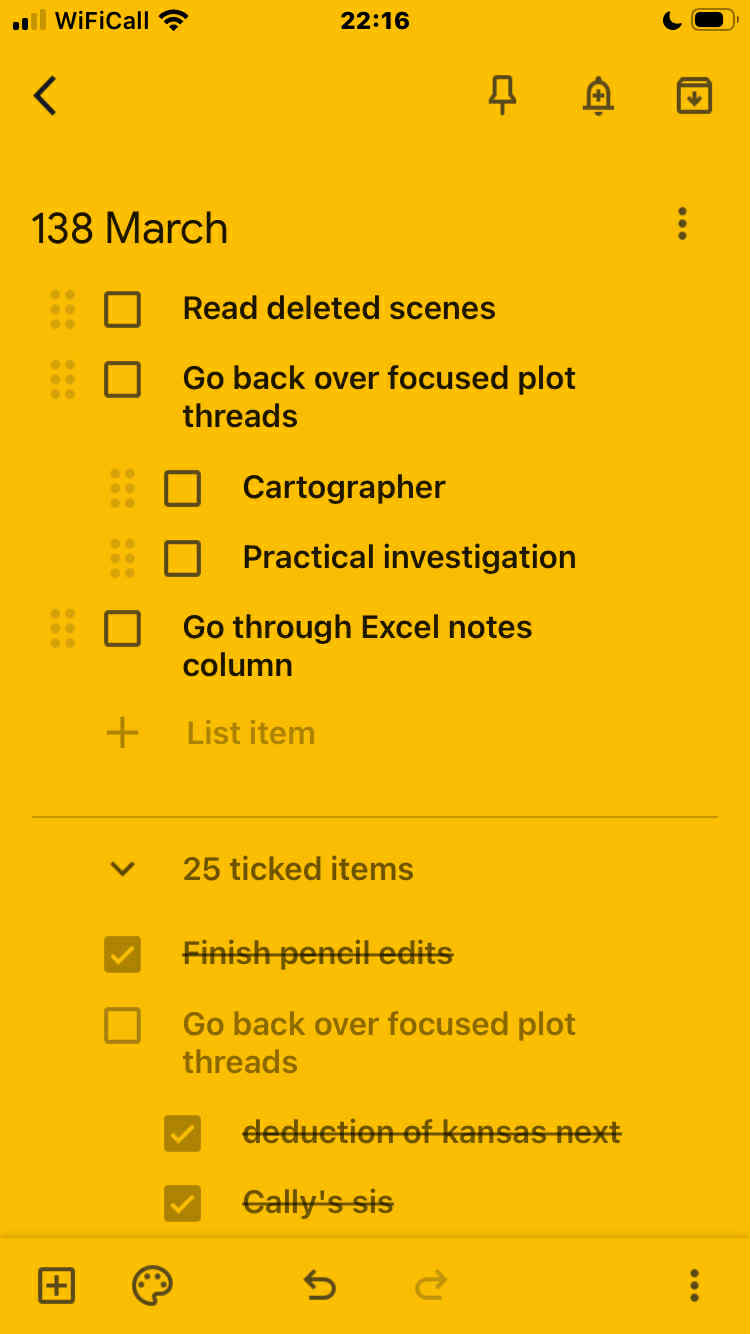
Using a notes app like Keep has many advantages over paper - it’s all in one place, it’s immediately backed up and accessible from other devices, and it’s searchable. I like Keep because it’s a bit like having lots of Post-It notes in front of you, but without the mess.
I have an ongoing note where I can add single-line bullet point ideas and refer back to it for inspiration. While I’m working on a novel, I’ll have notes to work out specific ideas on that book. I can categorise, save photos, add links to relevant web pages, make each project a different colour. When I’m working through an edit, I make a new note that’s a checklist of major points to address and check them off as I fix each one.
I still use paper notebooks, but more for the structured brainstorming part - when I’m starting to flesh out an outline, or when I’m stuck at 60,000 words and need to write myself out of a corner. Pen and paper definitely engages a different part of your brain from keys and screen, and I find the tactility helps me to break down problems more easily. You also get a real-life Track Changes function by looking at what you’ve scribbled out or drawn a line through.
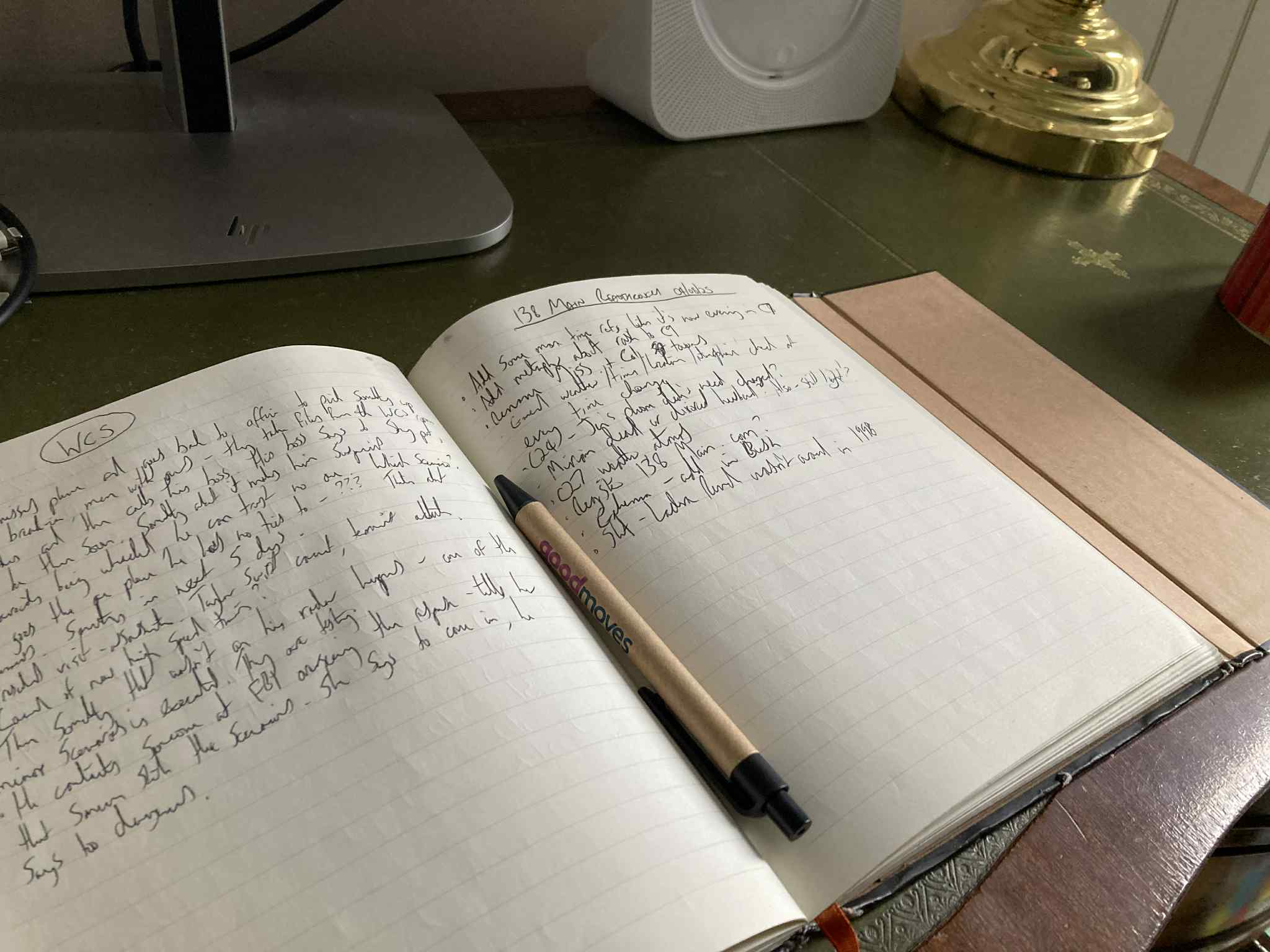
Often, you really get somewhere by mixing and matching different ideas that you might have jotted down years apart. I referred earlier to getting an idea for my latest book, 138 Main, but as I discussed last time around, it was really two ideas that fit together: an intruder targeting unremarkable suburban dwellings, and the problem of knowing which address you want to protect when there are over 7,000 homes sharing that address.
Two ideas fitting together has been the genesis of several of my books - a professional people finder who has to find one of his former colleagues went together nicely with an idea about a serial killer who causes cars to break down on isolated roads. Together it gave me a great setup for The Samaritan.
Those unlikely chance encounters where you run into someone you haven’t seen in years in an unlikely location meshed with a new spin on a witness protection thriller in Darkness Falls.
It doesn’t always happen that way, but it’s something that works for a lot of writers. Ideally, what you want is for the two ideas to contrast, but complement each other, giving you a uniqe angle on a story that anybody else might have come up with.
So if you’re struggling for ideas for a new project, go back to your list of random thoughts and see if two or three of them might go together.
And write stuff down, so you have that list in the first place.
Pre-order my new novel 138 Main here.
 Walking pic of the weekReading
Stuart Neville’s Blood Like Ours is the second in his noir-road-movie-vampire trilogy. It’s taken me since the summer to get to this, but it was worth the wait.
WatchingI was about to start watching the new season of The Night Manager when I realised I couldn’t remember much about season one, other than I enjoyed it. This isn’t my fault, because taking ten years between seasons is going a bit far even by the leisurely standards of the Stranger Things showrunners. Anyway, I thought I’d watch episode one of the original again and binged the whole thing in a couple of days. Interesting to revisit it after reading the original novel by John Le Carre a couple of years ago.
WritingBack into the swing of the new novel following the Christmas break. I made sure I got the basic 500 down most days last week, and now I’m aiming for at least 1,000 words plus a day. All being well I’ll have a draft by February which I can then go back and rip apart. You can fix a draft, you can’t fix a blank page.
ListeningI’m always on the lookout for music to write books to. Mark Isham’s hybrid orchestral/synth score for Point Break seems to be impossible to buy physically, but it’s on YouTube, and I love it. The most underrated aspect of a classic film.
See you in fourteen…
January 2, 2026
Welcome to Main Street
 Photo by Skyler Gerald on Unsplash
Happy New Year!
I’m quite looking forward to 2026, not least because my first novel under my own name will be published by Simon & Schuster on May 7th in the UK and June 2nd in the USA.
It’s called 138 Main1, and here’s the pitch:
AN ADDRESS TO DIE FOR
The heart of every town in America just became a target.
There is a killer on the loose. He has committed four murders in four weeks, each of which have only one thing in common. The victims’ address: 138 Main Street.
For FBI Special Agent Ben Walker and his rookie colleague, Officer Zoe Hill, the case is unlike any they have seen before. They already know where the murderer will strike: the problem is that there are over seven thousand Main Streets in the USA. And they have no clue which one will be next.
But these attacks are only the beginning. When the Main Street Killer’s manifesto is released to the media, his demands become clear, as do the consequences if they aren’t met.
With every town in the country at imminent risk, the pressure is mounting on Ben and Zoe to stop the killer before he can carry out his threat.
But with their target always several steps ahead, and over three and a half million square miles of ground to cover, they’ll have to find him first . . .
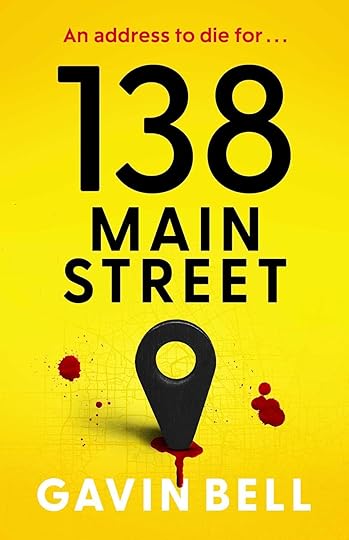
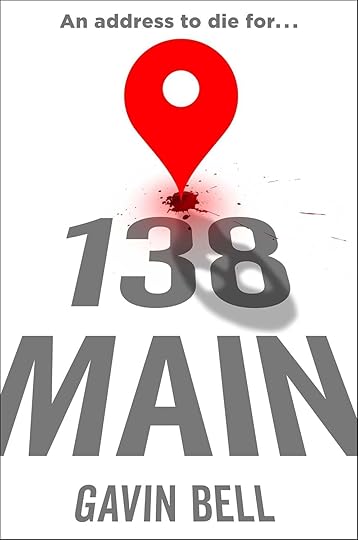
Intrigued? If so, you can pre-order the book in the US here and in the UK here.
I hope you’re at least moderately intrigued, because after writing ten novels, I think this is far and away my best hook. It’s also, I hope, my best book to date.
I’m going to talk in more general terms about coming up with ideas for novels in the next newsletter, but this one grew out of a couple of concepts that had been floating around in my mind for a while.
I can’t remember exactly when the first idea popped into my brain, but it was during the time I was living in one of those very isolated new-build estates at the farthest reaches of suburbia. The kind of place where nothing much ever happens and you have to drive 20 minutes to get absolutely anywhere. It was on the edge of the woods, at the top of a very steep hill, two miles from the nearest train station.
Shortly after we moved in, a typically blunt taxi driver commented approvingly on our new neighbourhood: “The scumbags can’t be bothered walking up that hill.” It was a nice place. The most dramatic thing that happened in five years of living there was a squirrel incursion in the loft. It was the kind of place where people forget to lock their doors at night. Even a crime writer with the requisite combination of overactive imagination and paranoia would occasionally forgot to lock the door at night2.
I started to wonder if there were people who might walk quiet neighbourhoods like this one for just this reason, trying the odd door handle. What happened when they found an unlocked door? What if they didn’t merely want to steal your car keys?
Thanks for reading The Basic 500! Subscribe for free to receive new posts and support my work.
The second idea, I can remember exactly where I was. I was sitting in front of my laptop writing a book, sometime in late 2020, deep into the pandemic. The protagonist finds a scrap of paper with an address on it, which happens to be a Main Street. That doesn’t narrow things down of course, because there are… wait, how many Main Streets are there in America?
Never one to risk the call of procrastination, I immediately tabbed out of the Word document and googled it.
7,664 Main Streets. Huh.
That sounded like an interesting idea for a serial killer modus operandi. Or maybe something about domestic terrorism.
I filed the idea away and I finished the book I was writing, which was the last book in my contract for my old publisher.
The world started opening up again. We moved, much closer to the city, to an old Victorian house that needed a lot of work. I was out of contract. I didn’t have a lot of time to write. But the Main Street idea kept percolating away in my mind, along with the thoughts of the man who looks for unlocked suburban doors at night. Or perhaps they don’t need to be unlocked. Perhaps locks won’t stop him.
For the first time in a few years, I had no deadline. No one was waiting for me to write a specific book. So I decided to write something I wanted to write.
I thought about an address on Main Street. The same address, but in lots of very different places. East coast, west coast, everywhere in-between. The people who lived there were very different too. I thought about how almost everyone has a Main Street, and the effect on the national psyche if that familiar place suddenly became a source of dread.
I also wanted to explore how a divided society responds to a threat that doesn’t discriminate between victims. How that threat motivates some people to work together, but how some become more polarised. How an overload of information fosters conspiracy theories, which in turn make everything worse. The importance of effective people who can tune out the noise and Get Shit Done.
It’s a murder mystery, but it’s also a book about existing in the 2020s.
 Walking pic of the week - evening on my local main streetReading
I’ve just started Michael Connelly’s Nightshade, which is the first in his new Catalina-set series, and, being Connelly, is predictably excellent.
WatchingOver the holidays I saw Marty Supreme, which I liked a lot - it has a very 70s sensibility matched to a frenetic 21st century pace. And a festive viewing of Die Hard on the big screen, which needs no more plaudits from me.
WritingI took a break from the new book over Christmas and used it to take stock. I printed out my long outline for the new book and read over it, and I think I’m starting to get my head around the plot.
ListeningJohn Barry is one of my go-tos for listening while I write, and the On Her Majesty’s Secret Service score is his best, as well as being seasonally appropriate. It also includes this underappreciated festive gem.
See you in fourteen…
1Actually, it’s called 138 Main in America and 138 Main Street in the UK, but as diverging titles on different sides of the Atlantic go, that’s not so bad
2After writing a 100,000 word thriller on this theme, you better believe I triple check the doors are locked every night these days
December 19, 2025
The Basic 500
 Photo by Christin Hume on Unsplash
My first novel was published in 2014, which already seems a long time ago in a galaxy far away. Over the past decade and change, I’ve written eight published novels and ghost-written two and a half.
A big part of being a writer in the modern era is doing events: literary festivals, library talks, book groups, writing classes. I love doing events not just because they’re a break from writing and a chance to catch up with other writers and readers, but because you always get at least one or two questions that nobody has asked before.
I also hear some questions again and again, which I don't mind in the least, because firstly it's natural that there will be some aspects of being a writer that everyone is interested in, and secondly answering the same question multiple times gives me a chance to really think about the answer.
One of the questions I'm consistently asked, whether at events or just when people find out I'm a writer in conversation, is: “How do you find the time to write a novel?”
I think there are two main reasons people always ask this: either they're awestruck about how anyone could sit down and write enough words to fill an entire book, or they're aspiring writers who would like to give it a go, but don't know how they can fit in the time to do all that writing. A mainstream commercial novel these days is usually somewhere between 80,000 and 120,000 words. Whichever way you cut it, that's a lot of words. I can completely understand why the size of the task intimidates people, because it intimidated the hell out of me before I gave it a try.
All writers are asked the “How do you find the time?” question. The glib answer is “One word at a time.” The answer that's closer to the truth for me is “Five hundred words at a time.”
When I first thought seriously about writing a novel, I realised that I would have to structure my time so that I could write every day (or as near as I could manage). I read a lot of advice that suggested I'd need to aim for a thousand words a day. Hell, Stephen King does at least two thousand a day, seven days a week. That freaked me out. For me, sitting down at the desk after a long day in the real world, in the knowledge that I'd have to write such a big chunk of words, would be a one-way ticket to writer's block.
My turning point was talking to a friend at work and bemoaning the fact that, with a full-time day job, a part-time night job and a young family, it would be tough to find the time to write a thousand words a day. His advice was simple: “Could you write five hundred words a day.”
I thought about it. Five hundred seemed a little more doable. But it couldn't really be that simple, could it?
I did some calculations. Five hundred a day, six days a week, makes 3,000 words a week. That's over 12,000 words in a month, which would be close to the word count of the longest story I'd ever written at that point. In six months, at that pace, I'd have around 80,000 words, which is a novel. I remembered John Grisham saying he wrote his first novel at the rate of one page a day until it was done. Suddenly, the impossible undertaking seemed almost... possible.
So I tried it out. Every night, I sat down with the intention of writing five hundred words. Most nights, I didn't stick to that. Most nights, once I got started, I wrote more than five hundred words. Sometimes a lot more. Freed from the pressure of having to meet a high word count, I relaxed and got into the daily routine. The other thing it did was get me in the habit of being able to write anywhere. If I had a half hour in a coffee shop or on a train journey, it was an opportunity to get my words for the day done. If I had my laptop, great. If not, I could write longhand and type it up later.
It doesn't take long to write five hundred words. When I put my mind to it, I can get the basic five hundred down in fifteen or twenty minutes. Even with some procrastination time and wasting a while on socials or ‘research’ when I first sit down, I can get it all done in an hour, no problem. If you have time to walk the dog, go jogging, or commit to a half-hour soap opera, you have time to write a book.
To this day, I still rely on that method. Even though I have deadlines now and I know I'll need to average quite a bit more than five hundred a day in order to hit them, I can always fool myself into getting started by promising myself I can stop at five hundred. Occasionally I do, but more often than not, I'll be walking away from the keyboard with another eight hundred, a thousand, even two thousand words in the bank.
If you're reading this and you've been trying to find the time to write a novel, stop thinking about that mountain of words you need to climb.
Just think about the basic five hundred.
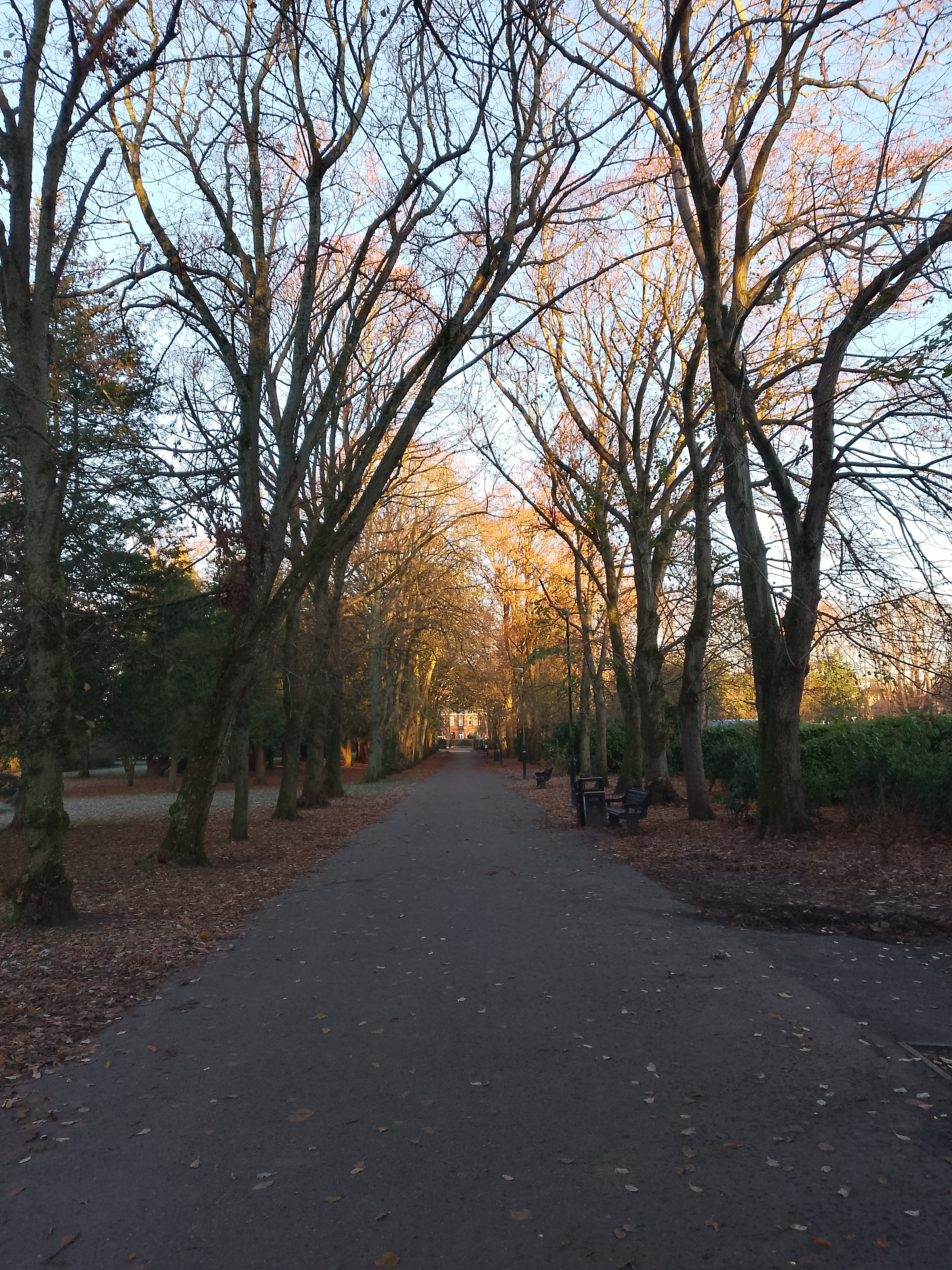 Walking pic this week - Overtoun Park
My new thriller, 138 Main, comes out in the spring, and you can pre-order it here.
ReadingI’ve been dipping into Shirley Jackson’s Dark Tales, which is appropriately dark and atmospheric for the season.
WritingGetting back into my first draft of book two, which is going… well, it’s going. I also received the first pass page proofs of the new book. Which is exciting.
DoingI hung out at the inaugural Venice Noir in November and caught up with some author buddies like Anna Mazzola, Ian Rankin and Erin Kelly as well as meeting some new ones like Philip Gwynne Jones and Effie Merryl. Aside from that I did as you would expect: ate a lot of pasta, took pictures of canals, and kept a wary eye out for small red-coated figures.
I also chaired Neil Lancaster at Waterstones Newton Mearns for the paperback publication of his excellent thriller When Shadows Fall.
ListeningI tend to write to instrumental music (the subject of a future installment, no doubt). In more lyrical moments, I’ve been listening to A Life Less Ordinary after seeing Ash at SWG3, and Pure Shores by All Saints, motivated by belatedly catching up on the excellent Girlbands Forever on iPlayer.
See you in fourteen…
Welcome to The Basic 500
 Photo by Reina Lovefull on Unsplash
Yeah, I know, another Substack. But if you’re a writer, you know that no two writers go about this job the same way. So if you’re interested in how I go about it, sign up now. 1
It’s called The Basic 500, a reference to my own breakthrough moment when I worked out I could fit writing around a busy life in daily five-hundred-word building blocks. More about that in the first regular missive.
Thanks for reading The Basic 500! Subscribe for free to receive new posts and support my work.
Join me as I gear up for publication of my first novel in a while (the first ever carrying my real name) and as I write the next book.
Every couple of weeks I’ll be posting about a different aspect of my writing process, from plotting to building characters, from chairing events to ghost writing. I’ll update on how the new book is going, and share interesting things that I’m reading, watching or listening to.
I’ll send a new email every two weeks, and I like to keep things reasonably concise, so I hope I can be a worthwhile yet low-maintenance addition to your subscription list.
The first instalment proper goes out this evening. I’m starting out with: how to write a book when you don’t have time to write a book.
1Disclaimer: how I go about writing a book changes from book to book. And indeed, from week to week.