Ellie Potts's Blog
April 26, 2026
The Book Witch’s Reading Altars: Where Stories Become Spellwork

There are witches who stir cauldrons, witches who whisper to the moon, witches who charm their gardens into riotous bloom… and then there are Book Witches; the ones who treat stories as sacred texts, paper as talisman, and reading as a ritual older than firelight.
If you’re the kind of witch who hoards bookmarks like sigils, who believes every book has a soul, who rearranges shelves according to mood rather than logic, then it’s time to build yourself a Reading Altar; a place where your stories can breathe, your magic can settle, and your imagination can unfurl like smoke.
Below are altar styles for every flavor of Book Witch, each one a doorway into a different kind of enchantment.
1. The Classic Book Witch Altar
For the witch who believes books are familiars and libraries are temples.
Core elements:
– A stack of your current reads, arranged like a miniature tower
– A candle (LED or flame) to “wake” the stories
– A small bowl of bookmarks—your divination tools
– A cozy textile: a shawl, scarf, or scrap of velvet
– A charm object: a key, a feather, a pressed flower
Ritual:
Light the candle, place your hand on the top book, and whisper:
“Open for me.”
Then read until the world falls away.
2. The Moonlit Fantasy Altar
For the witch who lives half in this world and half in the realm of dragons, fae, and forgotten gods.
Core elements:
– Moonstone or selenite
– A silver or iridescent cloth
– A fantasy book displayed open like a spellbook
– A tiny creature figurine (dragon, unicorn, fae, serpent)
– A sprig of rosemary or lavender
Ritual:
Turn to a random page and let the first line you see be your omen for the night.
3. The Dark Romance Altar
For the witch who reads with her heart in her throat and her soul in her teeth.
Core elements:
– Black lace or velvet
– A single red rose (fresh or dried)
– A candle in deep crimson or obsidian
– A playlist card or lyric snippet
– Your favorite morally gray love story front and center
Ritual:
Before reading, touch the rose and say:
“Let me feel everything.”
4. The Rock‑Star Romance Altar
For the witch whose heart beats in basslines and whose books smell like backstage secrets.
Core elements:
– A vinyl record or guitar pick
– Metallic accents—gold, chrome, or holo
– A candle that smells like smoke or leather
– A stack of your music‑kissed romances
– A scribbled lyric or setlist tucked under the candle
Ritual:
Tap the vinyl three times to “call the muse,” then dive into the chaos.
5. The Paranormal Witch Altar
For the witch who reads about witches, ghosts, vampires, and things that go bump in the night.
Core elements:
– A small cauldron or incense burner
– Amethyst or obsidian
– A candle in purple or midnight blue
– A book with magic at its core
– A tarot card pulled for the story (The High Priestess is always a good start)
Ritual:
Pull a card before reading and let it shape your mood.
6. The Cozy Cottage Witch Altar
For the witch who reads with tea, blankets, and the soft hum of domestic magic.
Core elements:
– A teacup or mug
– A candle that smells like baked goods or herbs
– A knitted or quilted cloth
– A gentle, heartwarming book
– A tiny basket of snacks or sweets
Ritual:
Stir your tea clockwise and whisper gratitude for the quiet.
How to Activate Your Reading Altar
No matter which style you choose, the activation is simple:
1. Clear the space with intention.
2. Place your book at the center—your altar’s heart.
3. Add your chosen objects with care.
4. Take one deep breath.
5. Begin reading as if you’re stepping through a doorway.
Because you are.
Why Book Witches Need Altars
A reading altar isn’t decoration—it’s devotion.
It’s a way of saying:
“Stories matter. My imagination matters. My magic matters.”
And when you treat reading as ritual, the books respond. They open wider. They speak louder. They linger longer.


April 25, 2026
Updating Your Writing Altar for Beltane and May
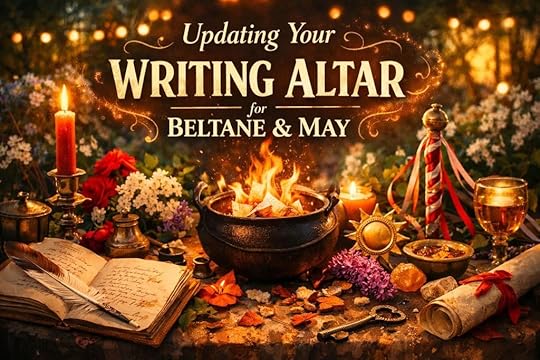
Kindling creativity at the turning of the season
Beltane arrives like a spark in the dark — the midpoint between spring and summer, when everything hums with heat, growth, and possibility. For writers, it’s the perfect moment to re‑ignite the altar, to shift from quiet incubation into bold creation.
The Energy of Beltane
Beltane is about union and vitality — the dance between fire and bloom. It celebrates passion, fertility, and the courage to bring ideas fully into the world.
In creative terms, it’s the season of commitment to the work: the draft you’ve been flirting with, the project that’s ready to bloom.
Refreshing the Altar
Think of your writing altar as a living space that mirrors your creative rhythm. For May, invite warmth, color, and movement.
Add or swap:
– Candles in red, orange, or gold — symbols of ignition and confidence.
– Fresh flowers (hawthorn, lilac, rose) or petals scattered across your workspace.
– A charm or token representing partnership — a quill tied with ribbon, two stones side by side.
– Seasonal scents: honey, sandalwood, or citrus to awaken focus.
– A flame‑safe bowl for burning old drafts or doubts — literal release before new work begins.
Writing Rituals for May
– Morning spark: Light your candle and write one sentence that feels alive.
– Midday offering: Step outside, breathe, and let the world’s color refill your language.
– Evening reflection: Read aloud something you’ve written this month — honor its voice.
Let your altar remind you that writing is a living ritual, not just a task.
Closing the Circle
As Beltane’s fire fades into summer, carry its energy forward.
Keep one symbol — a petal, a ribbon, a candle stub — as a charm for sustained creative heat.
Your altar doesn’t just mark the season; it marks your evolution as a writer.
A Writer’s Guide to the Different Dystopian Genres

How to choose the right flavor of ruin for your story
Dystopian fiction isn’t one monolith. It’s a whole ecosystem of fears, each subgenre shaped by a different “what if” that spirals out of control. For writers, understanding these branches helps you sharpen your worldbuilding, clarify your thematic spine, and choose the kind of pressure cooker your characters will be trapped inside.
Below is a craft‑oriented guide to the major dystopian genres; what defines them, why they work, and how to write them with intention.
1. Totalitarian / Political Dystopia
Core question: What happens when the state becomes the only voice?
Writer tools:
– Build systems of control: surveillance, censorship, propaganda.
– Show how ordinary people adapt, comply, or rebel.
– Use language as a weapon — banned words, rewritten history, ritualized speech.
Why writers choose it:
It’s perfect for stories about identity, resistance, and the slow erosion of truth.
2. Techno-Dystopia / AI & Surveillance
Core question: What if the tools we built decide they know better than us?
Writer tools:
– Explore the tension between convenience and autonomy.
– Let technology become a character — benevolent, indifferent, or predatory.
– Show how data replaces humanity: metrics over morality.
Why writers choose it:
It’s ideal for stories about dependency, dehumanization, and the illusion of progress.
3. Eco-Dystopia / Climate Collapse
Core question: What does humanity become when the planet stops forgiving us?
Writer tools:
– Use setting as antagonist: storms, droughts, poisoned air.
– Build societies shaped by scarcity — water, food, safe land.
– Explore migration, borders, and the ethics of survival.
Why writers choose it:
It’s emotionally rich for character-driven stories about hope, grief, and rebuilding.
4. Bio-Dystopia / Genetic & Medical Control
Core question: Who owns the human body — the individual or the system?
Writer tools:
– Create rules around reproduction, modification, or medical access.
– Show how biology becomes currency or punishment.
– Explore bodily autonomy, identity, and the ethics of “improvement.”
Why writers choose it:
It’s powerful for intimate, character-focused narratives about agency and violation.
5. Post-Apocalyptic Dystopia
Core question: What remains of humanity when the world ends?
Writer tools:
– Focus on survival, community, and moral compromise.
– Use ruins as emotional landscape — grief made physical.
– Let characters rebuild culture from scratch.
Why writers choose it:
It’s perfect for stories about resilience, reinvention, and the fragile line between hope and brutality.
6. Socioeconomic / Class-Based Dystopia
Core question: What happens when inequality becomes law?
Writer tools:
– Build rigid class systems: districts, castes, corporate tiers.
– Show how wealth shapes morality, opportunity, and violence.
– Use contrast — luxury vs deprivation — as thematic fuel.
Why writers choose it:
It’s ideal for stories about justice, rebellion, and the cost of privilege.
7. Media & Spectacle Dystopia
Core question: What if entertainment becomes the leash?
Writer tools:
– Turn media into governance: reality TV, influencers, curated narratives.
– Explore how spectacle distracts from suffering.
– Use satire to sharpen the blade.
Why writers choose it:
It’s great for fast-paced, high‑tension stories with sharp cultural commentary.
8. Philosophical / Social Experiment Dystopia
Core question: What if one idea — purity, efficiency, perfection — becomes the entire world?
Writer tools:
– Build societies engineered around a single principle.
– Show how ideology shapes relationships, rituals, and punishments.
– Use your protagonist as the “glitch in the system.”
Why writers choose it:
It’s perfect for cerebral, theme-heavy stories that ask big questions.
How to Choose Your Dystopian Subgenre as a Writer
Ask yourself:
– What fear is at the heart of my story?
– What system is my protagonist trapped in?
– What pressure will force them to change?
– What warning or question do I want the reader to walk away with?
Your subgenre isn’t just a setting — it’s the engine of your narrative.
April 24, 2026
A Risk I Took That I Don’t Regret
Describe a risk you took that you do not regret.
Some risks don’t look cinematic. They don’t come with dramatic music or a sweeping montage. Sometimes they look like sitting in your car before a shift, staring at the building, and realizing you can’t keep walking into a place that’s slowly hollowing you out.
Quitting my toxic job was one of those risks.
It wasn’t glamorous. It wasn’t easy. It wasn’t even planned the way I thought “big life decisions” were supposed to be. It was just a moment of clarity—sharp, undeniable—where I finally admitted that staying was costing me more than leaving ever could. I walked away without a perfect backup plan, without a safety net, without the certainty that everything would magically fall into place. But I walked away anyway.
And I don’t regret it.
Switching positions later was another gamble. Reinventing yourself inside the same world you escaped from is its own kind of courage. It meant learning new skills, trusting my instincts, and proving to myself that I could thrive somewhere healthier. It meant choosing growth over comfort, even when comfort was familiar.
And then there’s writing.
Putting words on a page—my words, my voice, my stories—felt like stepping onto a stage with the lights too bright and my heart too loud. It was vulnerable. It was exposing. It was risky in a way that had nothing to do with money or jobs and everything to do with identity. But I did it anyway. I keep doing it. Because every time I choose to write, I choose myself.
Anything worth doing is a risk. Leaving what hurts. Reaching for what calls. Becoming someone you haven’t met yet. None of it comes with guarantees. But regret doesn’t come from the leaps we take—it comes from the ones we talk ourselves out of.
I’ve learned that the life I want is always on the other side of a risk. And I’m done choosing the version of me who stays small just to stay safe.
And if you need that push. You can do it! And if you need to talk I’m here to listen. 
April 23, 2026
The Enjoyment of Holding Your Finished Work
After you finish something you’ve been working on for ages. A story, a chapter, a whole book, a piece of art, a project that ate your evenings and your patience. It doesn’t matter what form it takes. What matters is the weight.
Because when you finally hold your finished work, it has weight.
Not metaphorical weight. Actual, physical, “oh wow, this exists now” weight. The kind that settles into your palms and your chest at the same time.
It’s strange how quiet the moment is. You expect trumpets or confetti or at least a dramatic gust of wind. But instead, it’s this hush. This breath. This gentle click inside your ribs that says, Yes. You did it.
Holding your finished work feels like:
– picking up a stone that used to be a mountain you climbed
– touching something that used to only live in your head
– meeting a creature you summoned from nothing but stubbornness and hope
It’s warm, even if the pages are cold. It’s alive, even if it’s just ink and pixels. It’s yours, even if you’re already thinking about all the things you want to fix.
And the best part is that your hands remember. They remember the nights you almost quit. They remember the drafts you deleted. They remember the days you wrote one sentence and called it a victory. They remember the version of you who started this whole thing — nervous, hopeful, a little chaotic, but determined.
When you hold your finished work, you’re holding every version of yourself who showed up along the way.
You’re holding proof.
Proof that you can finish things.
Proof that your ideas deserve space.
Proof that your imagination can take shape in the real world.
And yes, the work will change. You’ll revise. You’ll polish. You’ll grow. But that first moment — the moment you hold the thing you made — is a kind of magic you only get once per project.
So enjoy it.
Let it glow a little.
Let yourself glow a little.
You made something.
And now it’s real.
April 22, 2026
What Makes You Nervous?
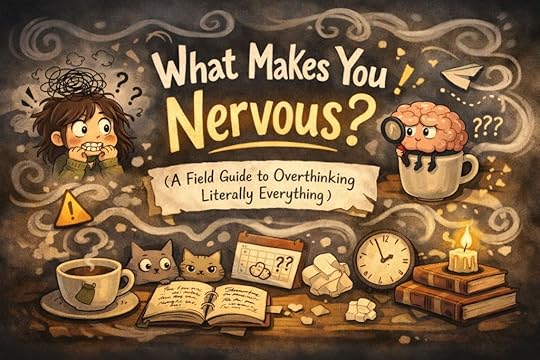
What makes you nervous?
(A Field Guide to Overthinking Literally Everything)
Some people get nervous before big things like job interviews, first dates, public speaking, tax season.
Me?
I get nervous before existing.
I’m the kind of person who can overthink a thumbs‑up emoji. The kind of person who says “you too” to the waiter who told me to enjoy my meal and then spends the next three hours replaying it like a crime documentary.
If there is a way to catastrophize a situation, I will find it.
If there is no way to catastrophize a situation, I will invent one.
The Everyday Olympics of Anxiety
Here are just a few of the things that make me nervous:
– Walking into a room where people already exist
– Sending a text that says “ok”
– Not sending a text that says “ok”
– Someone saying “can we talk” in a neutral tone
– Someone saying “hey” in a cheerful tone
– Someone saying nothing at all
– The sound of my phone ringing
– The sound of my phone not ringing
– The possibility that I misread a vibe from 2014
My brain is basically a 24/7 improv troupe performing “What If Everything Goes Wrong” with no intermission.
The Overthinking Spiral (A Love Story)
I don’t just think.
I think about thinking.
I analyze my analysis.
I zoom out, zoom in, rotate the thought like a 3D model, and then wonder if I should’ve just stayed home.
It’s not that I want to be nervous.
It’s that my brain is like, “Oh, you’re trying to relax? Cute. Here’s a memory from middle school.”
The Human Part
But here’s the thing:
Being nervous doesn’t mean something is wrong with me.
It means I care.
It means I’m paying attention.
It means my brain is trying, in its own chaotic way, to keep me safe.
And honestly?
That’s human.
Deeply, painfully, hilariously human.
The Soft Landing
So what makes me nervous?
Everything.
But I’m learning to treat that nervousness like a skittish cat; approach gently, offer snacks, don’t make sudden movements.
Because underneath all the spirals and overthinking, there’s a heart that just wants to do well, connect well, and not accidentally embarrass itself in front of strangers.
And that’s kind of sweet.
Mapping Your Novel With a Calendar: How I Turned Chaos Into a Story Blueprint
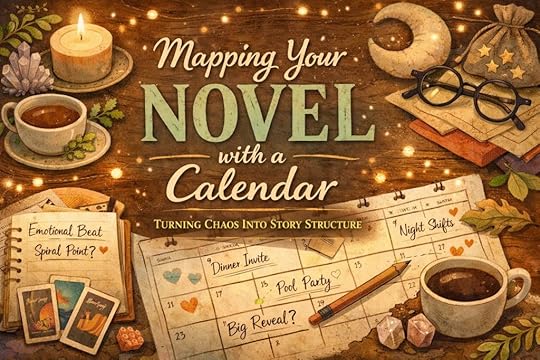
Some writers outline with spreadsheets.
Some use color‑coded index cards.
Some summon a corkboard that looks like a detective’s fever dream.
Me?
I use a calendar.
Not because I’m organized (I’m absolutely not).
But because my story lives in days, rituals, and emotional weather patterns. A calendar lets me see the whole emotional arc at a glance.
If your book unfolds over a tight timeline, or if your characters’ spirals depend on when things happen, a calendar becomes less of a tool and more of a story compass.
Here’s how I use it.
Step 1: Treat Each Day Like a Chapter Container
Instead of starting with plot points, I start with days.
Every day gets a little box.
Every box gets a vibe.
Not a full outline — just the emotional temperature:
– “Tuesday: awkward tension, something shifts.”
– “Friday: pool day, too much sun, too many feelings.”
– “Sunday: coffee + comfort show = intimacy creeps in.”
This keeps me from over‑explaining the plot before I’ve even written it.
It also keeps the story grounded in time; which matters when your characters are spiraling at different speeds.
Step 2: Add the Chaos Events
Once the emotional beats are in place, I layer in the chaos events, the things that disrupt the characters’ routines.
For example, in my current project:
– A dinner invitation that seems harmless
– A pool party that becomes a turning point
– A yoga session that accidentally becomes intimate
– A contractor showing up unannounced
– A kiss that shouldn’t have happened
– A week of night shifts that leaves someone emotionally stranded
These aren’t “plot points” so much as pressure points.
They’re the moments that tilt the characters off balance.
Seeing them on a calendar helps me space them out so the story breathes instead of collapsing into a single week of emotional whiplash.
Step 3: Track the Emotional Weather
Every day gets a tiny emotional note:
– “Eve: overwhelmed, overstimulated.”
– “Adam: guilty, drawn in, avoiding.”
– “Paul: oblivious, chaotic energy.”
– “Mary: scheming, enthusiastic, unpredictable.”
This is where the calendar becomes magic.
Because when you zoom out, you can see:
– who is rising
– who is unraveling
– who is lying to themselves
– who is about to break
It becomes a heat map of the story’s tension.
Step 4: Add the Big Reveals Where They Hit Hardest
Once the emotional map is visible, I place the big reveals where they’ll land with maximum impact.
For example:
– A disturbing comment from a family member
– A request that crosses a boundary
– A moment of intimacy that shouldn’t have happened
– A discovery that shatters the main character’s sense of reality
These moments don’t just need to happen — they need to happen when the character is least equipped to handle them.
A calendar makes that obvious.
You can literally see:
“Oh.
This reveal hits ten times harder if it happens on Thursday, when she’s already emotionally raw and the person she trusts is suddenly unavailable.”
That’s the kind of clarity a calendar gives you.
Step 5: Let the Calendar Show You What’s Missing
When you look at the month as a whole, you’ll notice:
– days that feel too empty
– days that feel too crowded
– emotional beats that need more space
– spirals that need a trigger
– quiet moments that need to be protected
A calendar outline isn’t rigid but it’s a living document.
It shows you where the story wants to breathe and where it wants to break.
Why This Works
Because stories aren’t just events.
They’re timing.
A kiss on a Tuesday is different from a kiss on a Sunday.
A betrayal hits differently after a week of emotional distance.
A discovery is more devastating when the person you’d normally turn to is suddenly gone.
A calendar lets you see all of that at once.
It turns your book into a season, not just a sequence.
Final Thought
If your story is character-driven, emotionally messy, or built on slow-burn tension, try mapping it on a calendar.
It doesn’t have to be pretty.
It doesn’t have to be color-coded.
It just has to exist.
Because once you can see the month your characters are living through, you can finally understand the story they’re trying to tell you.
Tell or show me how you outline your stories.
April 21, 2026
How I Unwind After a Demanding Day
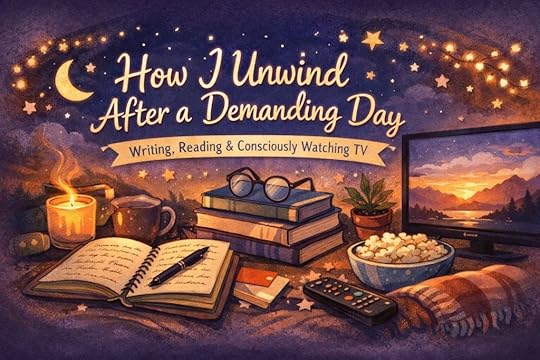
How do you unwind after a demanding day?
Writing, reading, and consciously watching TV as a soft landing ritual
There’s a moment at the end of a long day when my brain feels like an overworked laptop—too many tabs open, fan whirring, one rogue program refusing to close. That’s usually when I slip into my evening ritual, the one that reminds my nervous system that it’s allowed to unclench.
Writing: The Gentle Brain-Drain
Some people journal.
I… empty my brain like I’m shaking crumbs out of a tote bag.
Writing at the end of the day isn’t about crafting something brilliant. It’s about letting the static settle. I let the words wander, spill, contradict themselves, or spiral into tiny poetic nonsense. It’s a way of saying, “Okay, thoughts, you’ve done enough. Go play outside now.”
Reading: The Soft Escape
Then there’s reading; the quiet teleportation device.
A book doesn’t demand anything from me. It just opens a door and waits.
Some nights I want something lush and atmospheric. Other nights I want something that reads like warm soup. Either way, reading slows my pulse. It’s the one place where time stops trying to sprint.
Conscious TV Watching: The Art of Being Deliberately Horizontal
And then there’s TV.
Not doomscrolling.
Not background noise.
Not “I guess I’ll put something on.”
I mean conscious TV watching; choosing a show on purpose, settling in, letting myself be fully present with the story. It’s a tiny act of rebellion against the idea that rest has to be productive. Sometimes I want comfort rewatches. Sometimes I want something new. But always, I want the feeling of sinking into a world that isn’t asking me to solve anything.
The Thread That Ties It Together
Writing clears the clutter.
Reading softens the edges.
TV wraps me in a familiar glow.
Together, they turn the end of my day into a ritual—a slow descent from “functioning adult” to “cozy creature who deserves softness.”
April 20, 2026
How I Use Social Media (Without Losing My Soul) to Advertise My Books
How do you use social media?
Social media is a strange little forest. Some days it feels like a cozy cottage full of readers sipping tea and swapping book recs. Other days it’s a carnival where everyone is shouting into the void. And if you’re an author trying to promote your books, it can feel like you’re supposed to be doing everything at once — posting, filming, hashtagging, dancing, summoning the algorithm gods.
I don’t do all that.
I use social media the same way I write: with intention, curiosity, and a little bit of magic. Here’s how I approach it — not as a salesperson, but as a storyteller inviting readers into my world.
Happy 4/20 — Celebrate the Unofficial Stoner Holiday With a Free Copy of My Cannabis Grimoire
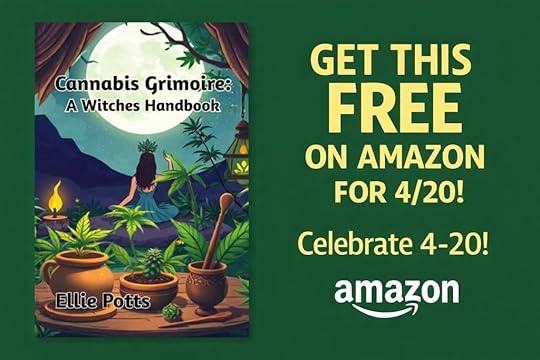
4/20 isn’t a sabbat, a moon phase, or a cosmic alignment — it’s the unofficial stoner holiday. A day for chill rituals, creative sparks, communal laughter, and the collective exhale heard ’round the world.
And because the vibes are perfect today, I’m giving you something special. My Cannabis Grimoire is FREE for 4/20.
A cozy, creative, cannabis‑friendly spellbook you can download and keep forever.
What’s inside
–  Low‑pressure rituals for grounding, cleansing, and relaxation.
–  Strains and their magic.
–  Divination.
– Magic.
It’s witch‑adjacent, vibe‑forward, and designed for anyone who treats cannabis as part of their creative or self‑care ritual.
Why it’s free today
Because 4/20 is about community, generosity, and the joy of passing something good around.
Because everyone deserves a little magic in their downtime.
Because sharing is the whole point of the holiday.
Grab your free copy Download it on Amazon today Keep it forever Let it become part of your chill‑ritual toolkit
Spark up, settle in, open your grimoire, and let your 4/20 be cozy, creative, and delightfully green.