Rob Lopez's Blog
May 29, 2026
Wuthering Heights, Heathcliff and Class
 Photo by Author
I read Wuthering Heights by Emily Bronte recently for the first time. Yes, one of the most famous novels in the English language and I'd only just gotten around to reading it.
I'd mostly been put off by its reputation. I remember Kate Bush's song of the same title from when I was young, and it evoked dreamy girls in love on a windswept moor and the passion of a tragic romance that, in spite of all that kept them apart, was always meant to be, and would continue even unto death. Romeo and Juliet. Gone With The Wind. Twilight. The ultimate teenage girl's (and the odd teenage boy's) fantasy: To be loved with a ferocity like no other. Because it would prove their worthiness to be loved.
Mentions of Heathcliff, the love interest in the story, evoked images of a dark, rugged, handsome stranger whose cool exterior barely masked an untamed and unrestrained passion that would make any woman's heart beat faster. The Ultimate Bad Boy. Bad enough to be wild in bed, but not bad enough to be repulsive.
There have been so many other Period Romance Dramas brought to the screen since, each one earning the journalistic title of 'bodice-ripper', and each iteration featuring more sex as the years went on until that became its defining feature. It kind of became a genre.
So I lost interest quickly as I wasn't the target audience and I had no posh friends I wanted to impress with my reading of such a classic.
A new version of Wuthering Heights has just come out recently, and once again I was not interested. But an internet comment about what this new version failed to include intrigued me, and since the kindle version of the book is almost free, I decided to read it. I didn't expect to like it, but I had nothing to lose, and at least it would answer my curiosity.
Turns out the book was nothing like I expected. And it's nothing like the image I portrayed above.
It's not a romance at all. It's a horror story.
I expected the book to be heavy going, but it's not. It doesn't wax poetic about the Yorkshire moors. In fact, it barely mentions them at all, which is odd, because that's the feature that many commentators mention. Emily Bronte doesn't care about the moors or the outdoors. It's just there. Sometimes it rains. Then it doesn't. Sometimes it's cold. And sometimes it's not. That's it. She doesn't waste too many sentences describing the two houses where all the action takes place either. Are they Tudor houses? Queen Anne style? Size? Colour? Doesn't matter. Not important.
What is important to Emily Bronte are the characters, and these get lavish attention. Their appearance, the thoughts that can be read on their faces, their motivations and machinations. These are the real landscapes of the book, these are where the storms are kept. The entire story takes place within the two houses, and it could easily be turned into a play. You can substitute the moors of Yorkshire for the steppes of Russia, the mountains of Japan or the forest of the Amazon. It wouldn't matter. But you wouldn't be able to change the characters without losing the whole point of the story.
The story moves along at a brisk pace, too. I've tried twice, for instance, to read Titus Groan, by Mervyn Peake, which, despite being written only 80 years ago, and also featuring a story heavily reliant on the characters, drags and wanders around in circles. The descriptions of characters felt tedious rather than informative, and it got to where I hated all of them until I quit reading about them. Compared to that, Wuthering Heights feels very modern, with something inserted at the end of each chapter that makes you want to read the next. There's a list of victims, I felt for them all, and the stakes grew as the story progressed, until I just had to know what happened. That's the very definition of a page-turner. This book is easier to read for a modern audience than most others of its time.
Spoilers will follow, which normally wouldn't be necessary for a 200 year old book, but the movies and the story's reputation so little resemble the original, that I feel duty-bound to add this, in case you want to read this classic and see what all the fuss was about.
I don't want to go into too much detail. I just want to focus on some key aspects of the characters. Let's start with Cathy, the bewitching protagonist of Kate Bush's song.
Cathy is a narcissist. There's no two ways about it. As a child she was wild and spent most of her time outdoors with Heathcliff, her adopted brother. Then she became a teenager and experienced the polite advances of Edgar Linton, from the grand house four miles down the road. She grew besotted with life in that house, loving the flattery and the sense of being doted on as a lady. This put her at odds with Heathcliff, who wanted to stay wild, but she wanted to have it both ways. To stay wild at heart with Heathcliff, who was a soulmate by this point, whilst also getting the benefits of a lady's life with Edgar. She's torn by the two existences, but she remains adamant about clutching everything to her, rather then let anything, or anyone, go. She wheedles, she plots, she puts on a fake act for Edgar and beseeches Heathcliff to stick with her. Everything is about her and what she feels, and she has tantrums if she doesn't get her way. I don't know why nobody mentions Cathy's narcissism in comments about this book. Maybe they think this is a woman's default setting. The story's narrative doesn't think so, however, and it is made very clear to the reader that Cathy is self-centred, a manipulator and a drama queen. Eventually she declares out loud that she is only with Edgar for his money, which she hopes to use to raise Heathcliff's status. Unfortunately, Heathcliff overhears Cathy's statement that marrying Heathcliff would 'degrade' her, which is why she chooses to marry Edgar instead. Heathcliff goes off in a huff and disappears for three years, and it's when he comes back that all the trouble starts.
At this point it could be argued that Cathy was bound by the fate of a 19th century woman, unable to steer a life of her own, so if she didn't want to live a life of poverty (for Heathcliff had nothing) she had to choose Edgar. This is in fact her own argument. But the book proves it wrong twice. Firstly when Heathcliff returns with wealth and learning. He got it from somewhere. He could have got it when he was with her. The second time was when Edgar's sister is forced to run away (more on that later) with no money and ends up in London, bringing up her son, who is given a gentleman's education. Clearly, in the book's world, there were options for women. Cathy really should have just followed her heart and chosen Heathcliff. But that would have been hard work and she wouldn't have been pampered.
Cathy really cannot comprehend why Edgar should mind Heathcliff's presence and her obvious infatuation for him. And she doesn't understand why Heathcliff cannot be more patient and less irritable at seeing her at Edgar's side. She's not stupid. She's just narcissistic to the point where everything is about her and everybody else should really be more understanding.
And then she dies. Halfway through the story.
Yes, halfway. Literally. The story carries on without her, because the story is not really about her and Heathcliff. It's about Heathcliff.
Heathcliff's got a chip on his shoulder the size of the Empire State building. And a fearsome temper, with a strength to match. He has dark hair and is ruggedly handsome. He's also a cunt.
No other way of describing him, really. Let me give you some examples.
When he returns from exile he imposes himself on Edgar so he can see Cathy. Eventually he gets a chance to bully Edgar in his own parlour and has to be chased off by the hired help. He fumes out loud that Edgar should let him see Cathy if that's what made her happy, because that's he would do if he was in Edgar's shoes (yeah, right).
He revenges himself on the stepbrother who treated him badly when he was younger and who owns the house of Wuthering Heights. He gambles with him, making him lose all his money, then accepts the mortgage of the house as payment of debts. The stepbrother falls ill and is found in a room by Heathcliff and a servant. Heathcliff sends the servant off to get a doctor, then claims the stepbrother was dead when he found him. The servant mutters that the master (the stepbrother) was still alive when he left the room, implying that maybe Heathcliff ended his hated enemy's life.
Okay, nothing salacious yet, and all explained by the circumstances of Heathcliff's miserable upbringing and love for Cathy. But there's more.
His stepbrother had a son, whom Heathcliff adopts as his own. He then goes out of his way to make sure the boy receives no education and is put to work as a farm labourer. Because he has no education Heathcliff lets him know how stupid he is, and how useless. Basic child abuse. The boy grows up but cannot read the inscription of his own surname carved above the main door, which would have told him that the house was his by right, stolen by Heathcliff. Every time we see him he looks awkward and miserable. Heathcliff laughs whenever he mentions his fate.
Heathcliff loathes Edgar, obviously, but he also hates Edgar's sister, Isabella. He thinks they're both frail and pathetic. After Cathy informs Heathcliff that Isabella is the actual heir to the estate and therefore wealthy, Heathcliff seduces Isabella in a brief illicit romance and elopes with her. On the night they run away, he makes a point of taking Isabella's little dog and hanging it by its neck in the courtyard. After marrying Isabella he takes her back to Wuthering Heights and lets her know how much he actually despises her, mocking her for actually believing him to be a romantic figure, and teasing her own inaction when he tried to kill her dog in front of her. Now that he has her inheritance he has no use for her and keeps her in the house, unable to go out. Eventually she escapes, pregnant (not likely a consensual conception) and lives alone with her son far away.
Isabella eventually falls ill and dies (a lot of people fall ill and die in this story - a common occurrence for this period, no doubt). The son, now fourteen, is frail and sickly. Edgar wants his sister's son to live with him and be cared for, but Heathcliff catches wind of this and demands that his son live with him at Wuthering Heights. Everybody fears the boy, named Linton, will suffer the same fate as the other boy Heathcliff adopted, except that Linton likely wouldn't survive the rough treatment. Heathcliff seems to think so too and announces that he'll bring Linton up as a gentleman, with a proper education. He does this because he has a plan for Linton.
Cathy died giving birth to her daughter, Catherine. Edgar dotes on Catherine. Heathcliff has plans for Catherine and Linton to get together and get married, thus giving him all of Catherine and Linton's inheritances, and spiting Edgar. He openly despises Linton for being so sickly and frail, and puts the fear of god into him. Linton befriends Catherine and is told to lure her into Wuthering Heights (with terrifying consequences if he doesn't), which he eventually does. Heathcliff then imprisons her in the house and declares that she cannot leave until she has married Linton. Linton is ill and near death, but Heathcliff only cares that he live long enough to be married and waves away any thought of getting him a doctor. Catherine pleads with him to let her go because her father Edgar is also ill and dying, but Heathcliff refuses until she marries. When she tries desperately to get the key off him he savagely beats her. Forced to marry Linton, Catherine escapes to see her father just as he dies, but afterward is forced back to Wuthering Heights. Heathcliff has now taken revenge on both his stepbrother and Edgar and is in possession of both estates, but still treats everyone around him horribly and has them walking on egg shells in his presence, because everyone is so afraid of him and his violence.
Does Heathcliff sound like a dark and romantic enigma to you? Critics at the time of Wuthering Height's publication certainly didn't think so. Many were shocked at the cruelty on display, which indicates that this sort of behaviour wasn't okay back then, any more than it would be now. Heathcliff is a monster. He may initially have had reasons to be a monster, but a monster he is. He abuses three young people who never did anything to him. And the narrative makes it clear that Heathcliff is the villain. He is routinely described as a fiend.
But that all changed. In 1939, a movie adaptation of Wuthering Heights was produced, starring Lawrence Olivier. Interestingly, it only adapted half the novel, ending with Cathy's death. Thus the entire movie was only about Cathy and Heathcliff's romance. If you read the plot of the movie, you can see how it veered away from the essential conclusions of the book. This was likely the birth of Heathcliff's reputation as a sexually appealing bad boy, not to mention the darkly attractive appeal of the Yorkshire moors. Most subsequent adaptations, and there have been many, focussed only on Cathy and Heathcliff, and ignore Heathcliff's actions after Cathy dies. Heathcliff the abuser became Heathcliff the tragic lover. His ghost, therefore, enjoys a better reputation than he did in his day.
If you were to put the real Heathcliff on the screen, it would be the equivalent of showing James Bond drowning a bag of kittens. It's understandable, therefore, that they had to sanitise him.
But if Heathcliff is the villain of the book, then who is the hero? It is certainly not Cathy. Nor is it Edgar, who maintains only a passive resistance to Heathcliff's designs. No, to my mind, the hero of the book, and obviously so, is Ellen, the housekeeper.
Ellen is the one who tells the story to the guest who narrates the story. Ellen grew up with Heathcliff and Cathy, and nursed two of Heathcliff's victims. It is she, with the limited powers available to her, that resists Heathcliff's designs, passively and actively. She is the one who tries to warn and advise Heathcliff's victims before they are ensnared, except they do not fully listen. Hampered by her station as a servant, she nevertheless does her best. She is the epitome of working-class common sense. Maybe this is why she has been downgraded today.
In the 1950's some critic wrote a book claiming that Ellen was the real villain of the story. And in the latest movie she is shown to be the manipulative one, not Cathy.
Critics claim that, among other things, Wuthering Heights explores the theme of class in Britain. I think the real symptom of class warfare is the fact that Ellen has consistently been brushed under the carpet or dragged through the mud, while a narcissist and a sadist have been elevated to mythic status. They had status and power, while Ellen did not. They were pretty and handsome, she was not. They got the Hollywood treatment, which appealed to people's own narcissistic natures. Ellen was removed from the top step of the podium and essentially kicked out of the back door.
Ellen is the real hero of the story. Heathcliff's just a dick.


May 26, 2026
There and Back Again: A Tale of Returning
 Photo by Author
There's no tale to tell, to be honest. At least not one I want to say out loud. But circumstances have kept me away from writing, and from this blog. My last novel was published three years ago. I was halfway through writing the sequel before I had to stop. And then stuff happened.
It's been a dark time, and that's all I'll say.
But I'm slowly creeping back. I've resumed the sequel to The Operator, and I hope to have it out this year. I will also write more in this blog. Not too much, and I never really wrote many posts, but I shall be adding more now. They're not so frequent, but I hope they're worth the time to read.
I'm mulling a couple of other changes, but if I actually do them I'll announce them at the right time. Because they might not happen.
But the writing will happen, and I'm looking forward to finally publishing again.
November 1, 2023
Sorcerer: Lessons For Writers

I watched Sorcerer yesterday. I'd never heard of the movie, but I read a commentary suggesting that this was an overlooked masterpiece. It was released the same month as Star Wars, back in 1977, and pushed to the sidelines by George Lucas's blockbuster and quickly forgotten.
Roy Scheider was in it. He was the star of Jaws two years prior. I liked Jaws, so I watched Sorcerer. What follows is a writer's view of a movie. It contains my opinions on what makes a story work, with insights into structure, characterization and even marketing.
It also contains spoilers.
First off, I'd just like to say how awesome the movie poster is. That image is taken directly from a scene in the movie. More on that later. But it's a beautiful image.
The movie is about four men from different backgrounds who are stuck in poverty in a small village in Colombia. The four men need money to get out, so they volunteer to transport a load of unstable dynamite through jungle and rough terrain to a mine where the explosives are needed.
Not that compelling a premise, to be honest, but there have been many movies about average characters from comfortable backgrounds who are forced to work together to survive in some harsh wilderness setting. From that era I can remember The Flight of The Phoenix and Deliverance. These kinds of movies work best when highlighting the interactions and conflicts between the characters and how they cope with being tested by their environment. Get that right and you've got a good story.
Sorcerer doesn't get it right. Here's why.
ProloguesAmateur writers love prologues. Professional writers discourage their use. Why? Because prologues are hard to get right and often unnecessary.
Why use a prologue? Well, some stories start slow and take a while to build, so a prologue can be inserted with, say, an action scene, to spice things up prior to the actual story. That way they serve as teasers, promising readers, or an audience, that things will get exciting later on if they stick with it.
The question to be asked is: why not make the story more interesting from the get-go and hook the reader with that instead? You don't need a prologue then.
A prologue that exists simply to provide backstory is the kiss of death. Readers will just skim past that.
What does this have to do with the movie Sorcerer? Well, Sorcerer has four prologues.
Yes, you read that right. The first three prologues are not even in English. This caused moviegoers to walk out of theaters, thinking they'd accidentally walked into a foreign movie without subtitles.
Very avant-garde.
The film makers had to display a disclaimer in theaters to clarify the confusion. When you have to explain something to an audience that isn't readily obvious with mere viewing, you know you've done something wrong.
The prologues take up the first twenty minutes of the movie.
How essential are they? Not very. They exist to explain why the four characters are in Colombia to begin with. You don't need prologues for that. A skilled writer or director can extract that information from the characters themselves. Bring it out in dialogue and let the actors act. Removing the prologues would allow for more screen time to actually explore this and develop the characters better.
Characters, what characters?For this kind of story, the interaction between actors is key, and for that you need complex and fully fleshed out characters.
Sorcerer gives you question marks instead.
First, we have the Assassin. He shoots a man. Why? We have no idea. He flies to Colombia, stopping by in the village where the story takes place. He's only in transit, but he decides to stay instead. Why? No idea. When the call comes for volunteers to drive the trucks, he puts his hand up. Why? No idea.
There could be some compelling reason for why he does these things, but we never find out what they are. He dies and takes his secrets with him. He didn't need to be in the movie.
Then we have the Terrorist. A radical young Arab who plants a bomb in Jerusalem. His friends are killed by Israeli security forces while he alone escapes. Why did he choose to go to Colombia when he had a dozen Muslim countries to hide himself in? No idea. He works at the mine. He volunteers to drive one of the trucks. Why? No idea. Later, he gets to use his unique knowledge of explosives to clear an obstacle that prevents the trucks from reaching the mine. That's his one contribution. He has a potential humanizing moment when one of the other characters talks about a wife in Paris. Does this make the terrorist wonder about his own relatives back home? The friends he lost? The innocents he killed with his bombs? We'll never know because he dies abruptly the following minute.
So how do the other characters feel about having a terrorist in their midst? They don't know and we don't know, because the characters barely talk to each other the entire movie. Almost no conversations. The characters just don't matter to each other. And they won't matter to you either.
The Frenchman is the only person we ever understand. In his prologue we see him with his wife. They share moments in their rich life. Their relationship is strong. But he's a businessman and his business is in trouble. A prosecutor is on his case for something illegal that happened regarding finances, and the Frenchman is forced to leave the country. In Colombia we see him working as an engineer at the mine and fixing truck engines. Does he have a background in engineering? No idea. Maybe sipping champagne in Paris gave him that insight. He remains the most likable character. He never killed anyone that we know of. He could be the main character of the group. The leader. Alas, he dies abruptly and that's the end of him.
The Gangster is the main character. He's played by Roy Scheider, the only recognizable name on the billing. His gang raids a stash in New Jersey that belongs to a more powerful gang. The gangster has to flee the country to avoid the hitmen. He lives in the Colombian village next to the mine. What does he do for a living there? No idea. We never see him work.
The arrival of the assassin could have been interesting. Maybe he was a hitman sent to kill the gangster. That would have been worth exploring, and added something to the story. Or something to keep us guessing with.
Nope. It's never used. Another opportunity missed.
The director described Roy Scheider as an 'everyman' type of character. He was also described as that in Jaws. What that really means is that Scheider is a bland actor. He's supposed to be a hard-bitten gangster, but he's no De Niro and he doesn't really convince. His leadership is not pivotal to the success of the mission, he doesn't show any special skills that make him indispensable, and he remains gruff and unlikable.
At the end of the movie, when the gangster receives his reward from the mining company, two obvious American hitmen step out of a taxi and walk into the bar where the gangster is. It looks like the Mafia found him after all, and there's no happy ending.
That's a neat twist. Unfortunately, we don't really get enough from the character to care about him, so his end doesn't matter. The movie ends with a shrug.
The bonesThe problem with the movie's plot is that it's a skeleton with no flesh on it. This is what a first draft looks like. Great potential, but in need of more to fill in the gaps and strengthen the story.
It's weak and watered down. Conflicts between the characters? Wasted. Motivations? Not explored. Development? Doesn't happen. Exploration of the local situation? Only hinted at.
The entire movie is a teaser trailer for a movie that never got made.
The detailsIt's not a lazy movie. There really is attention to detail. Like the scene in Jerusalem. And the angry revolt near the mine. Setting the valve clearances on an engine while it's running (how many writers would know that?). The nitroglycerin leaking from the dynamite. The ingenious method used to improvise a trigger for the explosives. There's a ton of details such as these that imply serious research.
And the crossing of the rope bridge with the vehicles is easily the most amazing scene in the movie. It may be worth the price of admission alone.
But details and scenes of suspense don't make a great story. They are what you hang the story off. On their own they are just the framework. But where's the story?
The characters are the story. They always are. Nobody, for instance, creates a story about rocks. Not unless they make the rocks talk. In which case, they are no longer rocks.
What's with the title?Titles are important. They are the first thing you market. The Shawshank Redemption was a box-office flop. It grew via word-of-mouth to become a much-loved classic. But it was a box-office flop. Because nobody could tell from the title what it was about.
A title should give you some information about what you are going to get.
My first ever novel was titled Even The Dead Dance To Live. Cool sounding title, right? Can you guess what kind of novel it was? What genre? Whom the intended audience was? I'll give you a moment to figure it out.
Got it yet? That's right, it was a science fiction space opera. Did you get it?
No. Who would? It was a terrible title. Cool doesn't mean good, not in this game.
So the movie is called Sorcerer. Have you read anything in my review so far to indicate why it was called that? No. The director/producer called the movie that because one of the trucks in the story bears that name. Is it obvious in the movie? No. Is it referenced within the movie? No. Is that particular truck - the one in the poster actually - pivotal to the plot or a character in its own right? No. The truck doesn't make it to the end of the movie. Nor does the star of the movie even drive it. He drives the other truck.
It's an arbitrary name that makes no sense. The movie was based on the book called The Wages Of Fear. That's a better title. But they chose Sorcerer. Like The Shawshank Redemption, the movie was D.O.A.
ResponsibilityThe movie bombed in 1977 and lost a ton of money. Many people weren't aware of its existence. Most people forgot about it. Nowadays, critics are trying to revive its reputation. It was misunderstood. It was experimental. The audience were too stupid to appreciate it. The movie was shot in a French New Wave style similar to The Battle of Algiers.
When I watched it I too was reminded of The Battle of Algiers. But The Battle of Algiers was a dramatization of actual events, with many key players, none of whom can be stars, because that's real life. Sorcerer was fiction, much smaller in scale and ambition. The nouveau style didn't suit it, and made it look silly instead.
The director defended the movie, claiming it was a metaphor. He referenced a single line by the Frenchman's wife as justifying the entire plot. It doesn't, because it was easily forgotten, and he hadn't added enough elements to truly frame the metaphor. Simply saying it afterwards doesn't make it so.
He said he wanted to make a movie without melodrama, sentiment or heroes to root for. He succeeded and produced something bland, pointless and not worth getting out of bed for.
Critics like to laud experimental flops as being brave and therefore deserving of praise merely for existing. In this case they forget that Sorcerer was beaten by another experimental movie. That movie was Star Wars. It's hard to understand these days the risks that George Lucas took with that movie. Sci-fi movies were meant to be B-movies at that time. No one was supposed to take them seriously. George Lucas took his B-movie seriously. He was also lucky that he had a wife who was an excellent editor. She at least had the basic elements that she could work with.
It's unlikely she would have been able to save Sorcerer.
Lessons for writersSorcerer was a movie. Movies aren't books. But stories are stories and lessons can still be learned. Especially when it comes to trying to sell those stories.
Look at the image in the movie poster. Now look at the title. Do they fit with each other?
Titles and book covers draw attention and lead a reader to the description. Together, these things create expectations. Will those expectations be met once the reader begins reading the story? If not, how willing are you to test a reader's patience?
How necessary for a story is a scene? If it's not really that necessary, consider scrapping it. The same goes for characters. Either make them more necessary or get rid of them. You can always give their lines or actions to another character instead.
Love a character or hate a character. Just don't make them indifferent. Characters need weight. Flimsy and weightless characters float away, never to be remembered again. Leading characters need more weight.
Don't get caught up in research at the expense of the story. Cool details are secondary, not primary.
Breaking accepted story rules takes skill. Following accepted rules is easier. Check your ambitions. Experimental stories or techniques crash and burn with only the slightest of mistakes. Standard stories are more resilient. Understand what you're doing.
Everyone makes mistakes. Just don't blame your readers.
October 31, 2023
Updates and Housekeeping
The Operator has been out for about a month now, and while it hasn't broken any records, it's doing better than I expected considering this is my debut in the Thriller genre. I've been busy with deliveries at work as orders ramp up for the Christmas season, but I've been sketching out and outlining the next book in the series, with a couple of scenes being drafted already. Matt Beach's next adventure will be more of a spy thriller, and will thus be a little more complicated and subtle. Up to a point. But I'm tossing ideas around and setting things up ready to begin writing properly in January. In the meantime I still need to figure out a few more ideas for the plot.
Before that happens, however, I need to get the paperback of The Operator out. Fortunately I've booked a week off next month to sort out the formatting and the cover for the size I need, then I'll order a proof copy. If it is to my liking, then I'll publish the paperback on Amazon by late November of early December.
The eagle-eyed among you will notice that my Science Fiction Space books have been removed from my Amazon catalog. Shakespeare's Requiem wasn't doing so well - nobody was reading it - so I've retired it to focus on expanding my Thriller catalog. Hell's Gate, which wasn't doing so badly, has been suspended from publication while I figure out what to do with it. It was Book 1 of a series, but Book 2 fell apart in the making. Unfortunately, the way Hell's Gate ended made it clear there would be a follow-on. I may change the ending to make it more a stand-alone book and republish it. I'd like to continue the series, but I'm focused on Matt Beach for the moment, and will be for a couple of years I think, so it may be a while before I produce a sequel to Hell's Gate. Or it may not happen. It's hard to tell.
October felt like a long month. Let's see how November pans out. And no, I'm not thinking of Christmas yet. That still feels far off, even though people are saying it's just around the corner. It's not.
And I've just realized that I'm writing this on Halloween, which is fairly significant across the pond. It's growing in significance here in the UK too. But I don't give a crap about it, and never did. It wasn't part of my childhood. If it was part of yours, I'd like to hear it.
September 4, 2023
The Operator

I'm pleased to announce that my new novel, The Operator, is now out on pre-order at Amazon. It goes live on September 8th, 2023.
FormerNavy SEAL Matt Beach runs a bar in the Bahamas. He’s living thelife. Then a stranger comes into his bar and offers to recruit himfor some shady purpose, saying he was sent by an old buddy of Matt’s.When that same buddy winds up dead, south of the border, Matt setsout to find out why.
Pursuedby mysterious assailants and stonewalled by corrupt officials, Matt’sinvestigation takes him from the swamps of Florida to the jungles ofGuatemala. What he uncovers gets more sinister the deeper he goes.
Asthe danger grows and the stakes rise, Matt will need to use all hisskills just to survive.
99c on pre-order, $2.99 once it goes live.
June 28, 2023
Rogue Timetable
 There's a new hero in town, and his name's Matt Beach. Coming to a book near you.Eventually.
Remember when I said I'd be writing when I can, sometimes in the van during work breaks? I did that. And the results were ... not quite what I hoped.
I finished the first draft in March this year, and I hoped that the draft could be polished into a final book, ready for release by Easter. Yeah, no. Turns out the first draft was pretty bad, and needed more than just polishing. It needed a complete rewrite.
So that's what I've been doing, and I'm about 75% of the way through it. It's a lot tighter and more professional now, but these things take time. It's looking more like a summer release now. Maybe even fall.
What can you expect from this offering? Well, it's definitely a thriller. You can call it a spy or action thriller. Or action mystery. I'm up in the air about that, as I am about the title. But it is an old-school thriller, set in modern times. Inspired by the likes of Alistair Maclean, Len Deighton, Martin Cruz Smith and Jack Carr, to name just a few. It will follow the adventures of an ex-Navy SEAL investigating the death of a friend, and will journey from the swamps of Florida to the jungles of Guatemala.
Fast paced? Action packed? Very much so. It will also be the beginning of a series. Possibly a long one. I think this character can carry it. I'm already sketching ideas for the sequel.
I'll post again when I have a definite release date.
October 31, 2022
A Complete Change Of Course

I'm beached. I was sailing merrily along after publishing Solar Storm, and things looked good. The sea was flat calm and life was almost easy. Then Covid hit. Clouds had already been gathering before then, for no sea remains calm for long, but after that it was a full-on storm. The sequel to the Solar Storm series, Into Darkness (an apt title if ever there was one), didn't do so well. In music-industry parlance, it failed to chart. Loneliness and depression were already lashing at me, and financially things were looking grim. With no demand (seemingly) for any more of my post-apocalypse books, I tried a science fiction book, writing a story that had been with me for some time. It was actually the last of the stories that had been in my head for years.
It flopped. I thought it was a great story, with possibly the best cover I've ever done, but nobody cared. By then I'd reached the end of my tether, and I'd also run out of money. I got a job delivering groceries for a well-known UK supermarket chain. I'm still there.
It's given me a lot of time to think. There's an unmistakable beauty to driving a delivery van to villages in South Shropshire and the Welsh hills. I see the dawn mist in the valleys, and sunsets over distant mountains. It's been very therapeutic, which is pretty rare for a job. I get to see great places and I get paid for it. I cannot complain.
The science fiction sequel I've been writing this year kind of sputtered out and died of apathy. I used to put my heart and soul into my books. I have neither now. I used to be a seat-of-the-pants type of writer, what we in the trade call a pantser, and it's an approach that involves me getting lost in the story to the point of actually living it. I would start with a vague idea, maybe something for an ending, then I would wing it, wandering through the story and seeing where it would take me. It's a very undisciplined way of writing a novel, but it also creates more of an experience - almost like a drug trip - which enters the story itself.
Unfortunately, pantsing requires a lot of time getting into the role - a bit like being a method actor. And writing when I'm not in the mood it produces writer's block. Or some forced drivel that later gets deleted. Now that I don't have so much time - and being easily distracted by my various troubles - it's a style of writing I can no longer sustain. So I'm left with a choice: find another way to write, or quit.
The opposite of pantsing is plotting. Plotting is logical - you write out the plot beforehand, so that when you start the story, you know exactly what to write next, because you know the plot. I could never get this method to work for me, however. I get my story ideas when I'm in the story. In the zone, so to speak. Out of the zone, I'd stare at the page, just not feeling it, and the page would stay bare, the ideas failing to materialize. But as I said, I'd reached a dead end with my normal style of writing, and while it had a good run, it couldn't continue. So last month I set about constructing a plot for an action thriller, scene by scene.
Perhaps I hadn't persevered enough in trying to write plots before, but this time I managed to create a full scene-by-scene synopsis. Does it have the same soul as my past works? Possibly not, but those stories are written now, and my bank is dry, so I need to make new stuff up. That is a writer's job after all - to make stuff up. A bit like journalism, but without the immorality (and no, I don't buy that crap about journalists writing The Truth. I read their stuff and, as a writer, I see right through that crap. I see the manipulation of emotions and the attempt to lead the reader, because that's exactly how it works in fiction too. Just for different reasons).
And why an action thriller? For the money. I'd been watching Amazon's The Terminal List, and found it to be better than I expected (seeing what streaming services had been putting out recently kept my expectations in the basement). And I used to read thrillers. Plus I always like to include action in my stories, and military or ex-military characters. So I thought it would be a good test for me.
It's a nakedly commercial enterprise, written by hand on paper, often during breaks in my van as I watch sunsets over the hills. I can't say where this is going to go, or whether it will come to anything, but I'm giving it a shot.
February 2, 2022
A Series Name Change
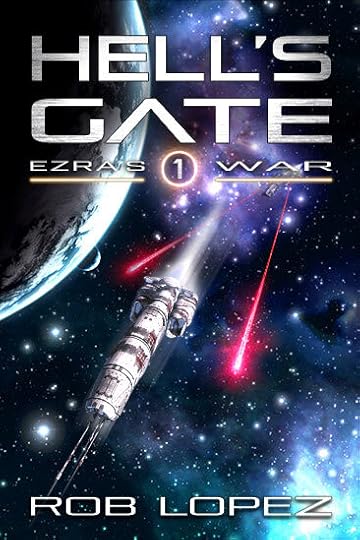
When I first released Hell's Gate not long ago, it was to be the first book in a series known as Gene War. That's bugged me since, because that's a dumb name for a series. In fact, it was a last minute change, as it was meant to be Ezra's war. So I changed it back to what it always should have been. This suits the series better, as it really does revolve around the title character.
One reviewer has already described Ezra as mentally ill. That's not correct, but clearly Ezra's not going to everyone's cup of tea. As an author, that's a risk, but anybody who's read my books should know that I'm not really into vanilla characters. Or vanilla stories, for that matter. Well, each to their own.
Circumstances in my personal life have also changed, leaving me less time to write than before. I already wrote slow, so this pushes any timelines out into the weeds. I could even have a George R.R. Martin moment.
I do my best with what I've been given, but I am working on Book 2. It'll just take time. But Ezra's War promises to be as intriguing as the character himself. With a whole galaxy to play with, I hope this will be as exciting to read as it is to write. It should be worth the wait.
January 1, 2022
Asimov's Foundation and Climate Change

In Isaac Asimov's book, Foundation, a character named Salvor Hardin says the following:
"We're receding and forgetting, don't you see? Here in the Periphery they've lost atomic power. In Gamma Andromeda, a power plant has blown up because of poor repairs, and the Chancellor of the Empire complains that atomic technicians are scarce. And the solution? To train new ones? Never! Instead they're to restrict atomic power ... Don't you see? It's Galaxy-wide. It's a worship of the past. It's a deterioration - a stagnation!"
Asimov's Foundation chronicles the decline and fall of the Galactic Empire. If that sounds familiar to you as a Star Wars plot, it's because it is. George Lucas stole the idea wholesale, as have many others. And Asimov himself stole it from the historian Edward Gibbons, who wrote the famous The History of the Decline and Fall of the Roman Empire, first published in 1776.
Curiosity at what makes a great civilization decline and fall has only recently interested Western thinkers. Before the 17th Century, the Roman ruins that lay scattered and crumbling throughout Europe didn't really concern many people. Peasants broke them down for stone to build their houses and wells, and Lords showed scant regard for their preservation. Nobody cared. In Britain folk were either focused on day-to-day survival or making war on the French.
It was only in the 17th and 18th Centuries, when Britain found itself creating the largest empire that had yet been amassed, that certain thinkers began to wonder what exactly happened to the Romans. After all, if the mighty Roman Empire could fall, maybe the British Empire could too.
As unthinkable as that was at the time, serious intellects began to look into it. This was a time when Roman ruins became quite faddish. Rich nobles built ruined follies on their estates, and young gentlemen and their ladies traveled to Italy to marvel at the decrepit ruins that local Italians had never given much thought to. Theories abounded on the symptoms and causes of the rise and fall of civilizations, and it was sobering to think that every civilization that had existed before ours had fallen. Not just a few. All of them. It seemed clear that every civilization had an expiry date, and after the disaster of WW1, thinkers like Oswald Spengler and Arnold Toynbee gained prominence as they delved deeper into the subject.
After WW2 the fad faded. The United States was the new superpower, the new empire of sorts, and a period of hope prevailed that took us eventually to the moon. Asimov, however, had not forgotten his pre-war influences, and the thinking that went before. The passage he wrote above illustrates the dying phase (the decadent phase) of a civilization, where the optimism has faded and civilizations get buyer's remorse.
They stop thinking outside the box and instead retreat to more familiar territory, both figuratively and literally. They play safe and circle the wagons. Religion becomes mysticism and critical thinking becomes pessimism.
Hardin's quote illustrates perfectly, during the different phases of rise and fall, how a civilization solves its problems. Because there are always problems to solve, even when one has become dominant. A failing civilization, however, having sat on its laurels for too long, is unwilling to expend the same amount of effort to solve a problem as they had done when they were a rising, hungry star. In Foundation, the galactic empire is more willing to silence warnings than to heed them, because solving problems is hard. The elites prefer to focus on keeping their power and their wealth, even as they are being warned by the doomsayer Hari Seldon that they will lose both.
We are not short of doomsayers here at the beginning of the 21st Century, and it's tempting to think that Hari Seldon, if he was real, would be one of them, with Climate Change being uppermost in his mind. If it were turned into a very simple contemporary movie, it would have the politicians and business elites all disbelieving the scientist and his young and ardent followers, thus bringing calamity down upon humanity. In fact, I've just described the plot of the new Netflix movie, Don't Look Up (watched it last night, very funny).
But Hardin's quote reminds us that it's not simply a matter of believing in the science and getting the message out, as some in the climate-change movement believe, and I'll give you an example of why, and what it means for the rise or decline of our own society.
Full Disclaimer: I believe Climate Change is real. Despite the subject having been heavily politicized here in the west, with a lot of media and social-media hype, there is, for me, a clear sign that it's not all hype, and that is the fact that Russia and China are spending millions to begin exploring and exploiting the melting Arctic regions, with plans to protect their investments by military means. They see the Arctic as an important geopolitical region of the future, and these are not the type of governments to be swayed by Greta Thunberg throwing a tantrum at the United Nations, or climate activists gluing themselves to the pavement as they block roads or runways to protest government inaction. In Russia or China, that kind of action would see them thrown into a dark prison, with little chance of getting out again. No, these governments have compelling reasons to do what they do, and they have their own scientists. If they believe Climate Change is real, then my guess is that it is.
It's possible you don't believe Climate Change is real, and that's fine, but for this particular example, let's just accept that the climate activists and their supporters claim that they believe in Climate Change, and follow that claim to its natural conclusion to see where it takes us.
And this wasn't originally intended to be a long post, but bear with me on this.
So climate activists, and their media and political supporters, are saying that our industrial societies, with our carbon emissions, our deforestation, consumerism and meat-eating habits are harming the planet, which will lead to global temperatures getting high enough to cause us real harm, and possibly even extinction-level catastrophe.
Fair enough. So what are their solutions? Cut back on industrialization, consume less, eat less meat, fly less and recycle more. And build more wind farms and solar panels.
That's about it. There might be slightly more complex engineering solutions around the edges, like clean-hydrogen engines and the like, but those proposals don't get shouted as much, nor funded much. Now if you look at the above paragraph, do you see how closely it resembles Hardin's quote at the beginning of this article? "Do less and return to the windmills of the past." It's not really a solution. Wind farms and solar panels don't provide enough base load to run a civilization, and are less efficient than the fossil-fuel powered stations they are supposed to replace. Recycling won't cut down on carbon in the atmosphere, because recycling requires energy itself. And cutting back on energy consumption in our societies means willingly adopting austerity, like monks entering a holy order. It should be obvious that people won't do that, no matter what they might say to pollsters. Many societies have had their ascetic types who lived on sand and locusts and practiced soulful meditation. Many still have those who live a simpler life off the grid, returning to traditional methods of living. But these people have always been a minority. Even when called upon by a powerful church to give up worldly pleasures, people rarely do. The Catholic Church could not even get its young men to cease masturbation. Just because someone asks people to do something, doesn't mean they will.
The alternative to asking, of course, is simply to coerce people. Police them. Tax the hell out of them. Make them poor. They'll consume less, then. One doesn't need to be a historian to know how that ends. Remember when I mentioned earlier about the regrowth of mysticism in declining civilizations? Most of the loudest climate activists, including Ms. Thunberg, are gripped by some mystical vision of a very unreal society that, enmasse, willingly chooses eco-piety, and doesn't need to be forced.
And the politicians who now tow the ecological line? How realistic are they? Let me give you an example from my own country of Britain: Our Prime Minister has announced that all new cars after 2030 will be electric. Thereafter the number of polluting internal-combustion engines on our roads will be phased out (helped no doubt by punitive tax tariffs). On the face of it, this could be a good thing. Less pollution, better air quality, less reliance on volatile petroleum markets in geopolitical hot spots, less reliance on fuel that we know will run out someday anyway, and quieter traffic flows. It sounds like the future, right?
Well, it's kind of a lop-sided future, because while the Prime Minister announced these measures over a number of years, I don't recall a speech where he would authorize the mass building of nuclear power stations to cope with the massive ramp up in power use. I also don't recall green activists criticizing him for that. Their only complaint, indeed, is that they don't think Boris is moving quickly enough. They want mandatory electric cars a lot sooner. And electric public transit systems.
It's almost like everyone thinks that electricity is magic, and doesn't need to be produced by industrial means. This is why I sometimes think that activists who claim to be worried about climate change and its effect on people, can't actually be that worried. Because if they were, they would be more serious about solving the problem, rather than just offering faddish lifestyle choices.
Ah, but that's because they are not worried, and it's all just really a conspiracy to deprive people of their freedoms, and ... give power to elites, who can ... do stuff that they can't already do ... for some reason.
No, it's not a conspiracy. It's exactly the kind of thinking that Asimov's character outlined in the book, and it fits with the inadequate problem-solving metrics present in declining societies.
To be sure, nuclear power is only a limited answer. Make no mistake, we are a fossil-fuel civilization. One only needs to look at 17th Century life to see what fossil fuels lifted us out of. More will be needed to move on to the next phase of energy production if we are not to slide backward to being at the mercy of mother nature. Without the fossil-fueled industrial revolution, we would not have the longer lives, education, healthcare, information technology, food production or government systems we enjoy now. Or the individual rights and freedoms that are simply not possible in harsher times or places. So there's a lot at stake.
But if we're not looking at radically new and scalable forms of energy production, then we're not serious about avoiding catastrophe. Largely because people, including college-educated activists, don't understand the sheer amount of effort needed to keep a civilization going. Because our ancestors made it all look so easy. It will take more than windmills and personal guilt-trips to keep civilization going in the face of continuous challenges.
In China, they recently tested a full-sized Thorium reactor. Thorium reactors are safer than nuclear, with more fuel available for them in the world, and produce much less radioactive waste. Why China? We've actually known about Thorium reactors and their benefits for over sixty years now, and programs to test and develop them existed in the US. But they were closed down. We should be building a ton of them now. We have the knowledge, and we were ahead of China in the science. But we gave up.
Now that would have been a serious solution. Another would be Fusion power. Again, the Chinese are ahead in developing this. It requires ridiculous amounts of money in research, but we haven't been willing to commit, and so Fusion power remains science fiction, at least here in the West. Again, another serious solution left hanging.
Do you see what I mean about us not really being serious about solving that which we claim to be afraid of? Instead we make performative gestures, promote lifestyle choices and complain about a lack of piety among the masses. If those don't sound like the actions of some out-of-touch, decadent, self-satisfied aristocracy, then I don't know what does. This is how societies fail.
Hari Seldon would not have been fooled by the climate treaties, play-acting, crocodile tears, messianic rhetoric and mystical movements. He would still have recognized an empire that, whatever it might say, did not really want to survive. And he would have moved his Foundation to China.
November 23, 2021
Cowboy Bebop - My Thoughts

I like it.
I watched the first five episodes of the Anime version a while back. It was okay but it didn't grab me and I never went back to watch the rest. So when I heard Netflix were releasing a live-action version, I got interested. Seeing all the negative reviews by fanboys of the original interested me more. I'm weird like that.
So far, about ten episodes in, I'm finding this live-action version more accessible. It's gorgeous to look at, tightly scripted and the actors do a really good job. The show's got a lot of heart, I love the chemistry between the main characters and even the side characters do a great job. The world it's set in is a strange blend of sci-fi and old world tech, and the retro elements add to the charm. I'm getting strong Firefly vibes from the characters and story so far, and that can only be a good thing. It's a lot of fun to watch.
Unlike Joss Whedon's Firefly, I hope it gets a second season. And I hope I haven't jinxed it with the comparison. It's obvious that a lot of money and work has gone into making this new version of Cowboy Bebop, and I, for one, want to see it rewarded. It's one of the few things released this year that's actually worth watching.