Jenna Moquin's Blog
October 20, 2026
My Bookish Weekend
The third weekend in October was a lovely bookish weekend.
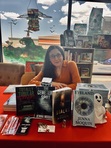
On Friday, a fellow book lover and I went to see Stephen Graham Jones speak at the Beverly Theater in Las Vegas alongside up-and-coming author Nicholas Russell. They discussed SGJ’s new book Off the Reservation, and all things horror, including their favorite X-Files episodes. I was fortunate enough to meet Stephen Graham Jones and got two of my favorite novels of his signed: My Heart is a Chainsaw and The Buffalo Hunter Hunter. What I loved about this event was seeing how humble and down-to-earth SGJ is. When he talked about the types of stories he loves to write, and I saw his face light up, I felt a kinship with my fellow author. Horror fans really do make some of the best writers.
On Saturday, I joined my book club friends at the Las Vegas Book Festival, which was great. We visited some author panels, picked up some great books to read, and chatted with local authors. The weather was lovely for a change; the last two years I practically melted under the sun at the book festival, but this year the clouds were in our favor.
Then on Sunday, I went with my movie buddy to see Whalefall, an adaptation of a novel I really loved. I also loved seeing the movie theater sell books at the concession stand! They had copies of Whalefall, Sense and Sensibility, Dune, and Incidents Around the House (Other Mommy), all completely overpriced, but that’s beside the point—how ironic would it be if movies based on books got people to read more?
Whalefall was a solid adaptation, but the book, as always, was better. I’m wondering if we will ever get to see a film adaptation of a Stephen Graham Jones novel. I believe the filmmakers would have a hard time, since his writing is so immersive, but the settings he creates in his stories would make fantastic horror movie sets. They would need the same kind of special-effects team that did John Carpenter’s The Thing.


September 24, 2026
The Three Big Books
This year, I decided to make it the year of big books. Not intentionally; the only big book that I’d really intended to read was The Count of Monte Cristo. But sometimes books simply fall into your lap, at the right time, and that’s how I came to read the other big books I read this year:
King Sorrow by Joe Hill, and Dune, by Frank Herbert.
My mom sent me King Sorrow after she’d read it and loved it; this was her first Joe Hill book, whom she was wary of reading because she assumed he was only popular based on who his father is (I’ve been telling her for years that’s not the case at all… he’s an amazing writer, one of the best living horror authors). And she loved King Sorrow so much that she sent it to me to read. Even though every Joe Hill book is technically on my TBR pile, this one was so new that I figured I’d read it at some point, but it wasn’t on my 2026 TBR list. So, since my mom sent it to me, I figured I should read it.
And I absolutely loved it.
There were some fantastic elements in this story that made it a standout horror, one of the best of the 21st century. From King Sorrow himself, to iconic terms like Scatterday, and a nail-biting scene on a plane mid-book that had me glued to the page, I thoroughly enjoyed my first big read of the year.
The second big book I read, another that sort of fell into my lap when I saw it on sale at a thrift shop, was Dune. I saw the David Lynch film years ago, and I remember the story intriguing me so much I made a mental note to read the novel it was based on at some point. Since this year started out with me reading a 900+ page book, and a paperback copy of Dune showing up during a random bookstore browse for $1.99, it felt like the right time to read this book, so I did.
And I was blown away.
Not only did I feel the dryness in my skin and the thirst in my mouth while the characters were moving through the desert planet (I mean, I do live in Nevada so that could have contributed to the visceral reactions), but I felt the weight in my gut at the decisions the characters had to make. Herbert did an amazing job bringing a sense of human spirit to the not so human characters in this book. And the way he described the cunning of the Bene Gesserit, and how he represented strength and intelligence in his female characters, I was amazed that a man had written this book.
Coming from Dune, to reading my bucket list book, The Count of Monte Cristo, and feeling an amazing sense of empowerment with women characters, needless to say, it was quite a let down to read my third big book of the year.
It started off so good…. A tragic story about wrongful imprisonment, with the hope of retribution and revenge. Only to see it catapult into one of the most depressing stories I’ve heard since The Book of Job.
****SPOILERS AHEAD****
This is one of the most harrowing, saddest tales I’ve read in a long, long time. I suppose the point Alexandre Dumas was trying to make (how revenge is a dish best served cold) is astute; but what becomes of the Count of Monte Cristo is hardly a cold dish. He in fact ends up with a hot dish, Haydee.
I hated that Haydee, a child, ended up with the Count, a man who bought her as a slave, and whom Haydee said she loved “as a father, a brother, and a husband…” That’s really gross... I also hated that Haydee, although described in a regal manner, was basically a one-dimensional character who’s only motivation was to keep her master happy. And the Count just used her as a pawn in his revenge plot—there was no real love there.
The one female character who I think was written well was Eugenie Danglars, and I was quite happy with her story in the end.
The fact that Mercedes’s fate was so bleak makes me think that Alexandre Dumas had been scorned by a woman he loved who ended up marrying a man he considered to be his rival, because her fate felt like punishment. For doing absolutely nothing wrong but marrying a man who aided in the downfall of Edmond (which Mercedes knew nothing about until he showed up years later as The Count of Monte Cristo).
If a woman had written this book, the ending would have been Edmond marrying Mercedes after all these years, and taking on her son, Albert, as his own, after what he did to their family. I don’t understand why Dumas gave innocent people such terrible fates, only to give the Count, a narcissist with a God complex, a happy ending.
In my humble opinion, a better fitting end for the Count, if the lesson truly is that revenge is a dish best served cold, would have been death, or ending up alone, after enacting his revenge and using innocent people in his plot. Although I enjoyed the book while reading it (some chapters tougher to get through than others…), and I’m happy I finally read it, overall I wasn’t as satisfied with the ending as I would have hoped in a 1200+ page novel.
Out of the three big books I read, I do have a favorite, and that is Dune, and not because it was the shortest. It was just the best story, with wonderful characters I adored, and a satisfying ending. The Lady Jessica and Alia were fascinating. I may read the rest of the series at some point, and I’m definitely rewatching the David Lynch film and the remake.
July 24, 2026
Social Media and the Starving Artist
Some writers I know hate social media, but sadly, it’s become a non-negotiable for anyone who wants people to read their books.
Growing up, I dreamed of being an author. I thought all I had to do was write a great story, send it to a publisher, and let them handle the rest from promotion to printing to getting my book on bookstore shelves.
Back in the analog days, this might have actually been true. I remember reading about authors getting advances from publishers just to finish their books. They didn’t even have to submit a completed, professionally edited manuscript before getting signed. But then the internet was invented when I was in high school. And the whole world changed.
These days you don’t just need a fully polished manuscript, that’s been through developmental and line edits. You also need a massive social media following or thousands of independent sales before many traditional publishers will glance your way.
Even after landing a contract, there is a lot of expectation on the author’s part to promote themselves. One of my fellow authors had a bit of sticker shock when her publisher instructed her to link her book to her Goodreads author account, and this author didn’t even have a Goodreads account. Like my younger self, she assumed getting signed meant the hard work was over.
I saw the writing on the wall years ago and realized how crucial social media would be for self-promotion. That was around the time I created my Twitter account—back when it was still a wonderful community for writers and artists (spoiler: it’s not anymore). Before that, I was only on Facebook to look at photos of my nephews. Now, I’m on far too many social media platforms. I figured it was good business to claim my name across Twitter, Tiktok, Instagram, etc. I’ve seen enough handles burdened with extra numbers or prepended with “the real…” to know I wanted to avoid that headache. Not that I expected to get wildly famous, but if there is another Jenna Moquin out there, I beat her to the punch, ho ho.
The real issue with social media, in my humble opinion, is how much creative energy it drains. Brainpower that should be poured into perfecting my craft. Because I have to be online to build an audience, I log on to post, check likes, and inevitable fall into the doomscrolling trap. I scroll for “just a minute” and before I know it, an hour has evaporated and I’m too mentally drained to write.
Studies say that scrolling on social media for more than a couple hours a day physically affects your brain’s gray matter (much like binge-watching hours of television). I completely believe this. Because it’s so hard to stop scrolling. It creates a dopamine effect that makes you think you’re happy, which is why it’s so hard to put down the phone sometimes.
Social media is quite literally starving this artist from creating more stories. There is a cruel irony in the fact that "stories" are a feature on social media platforms for promotion. I create stories to promote my stories, but creating stories on social media takes away the time and energy that should be spent creating actual stories.
July 21, 2026
The Lucas Girl
If you’re a Xennial like me, you probably grew up watching a movie called Lucas starring the late Corey Haim. The movie centered on a young, smart, and sweet, outcast boy named Lucas. He was the kid in school everyone picked on and bullied, and he had trouble finding friends.
Growing up, I identified with Lucas deeply. Until I reached high school and found my fellow freaks and geeks in the drama club, I was a Lucas Girl.
From first through eighth grade, I was a constant target. To this day, I still don't fully understand why. I was quiet and kept to myself, preferring to spend recess reading under a tree rather than playing kickball or dodge ball. Maybe that was the problem—I didn’t blend into the crowd. People fear what doesn't conform, and kids especially bully what they don't understand.
My biggest bully was a girl named Margie. She was vicious—she would push me, trip me, kick me on a regular basis, and this was in the 1980s when teachers did nothing about bullying. It got so bad that she actually broke my arm when I was twelve. She got one of her accomplices to drop onto all fours behind me while she confronted and shoved me—a tactic I later learned is called “table-topping.” She pushed me so hard I landed on my left arm and the upper bone snapped in two.
I still lack full mobility in that arm, and the muscle doesn’t develop evenly when I work out. But the physical damage my bully caused me is nothing compared to the psychological damage bullying can do to a person. From coworker cliques to friend groups, I have a hard time trusting people; it almost feels as if I walk through life with a “Kick Me” sign tattooed on my back. The harsh truth is that bullies don't vanish after graduation, they just move into corporate boardrooms and adult social dynamics. I often still feel like an outsider, perhaps because I recognize bullies immediately and refuse to play into their games. I even feel like an outsider within my own family at times, standing out as the "black sheep" who took the road less traveled by staying single and childless.
Or maybe it has something to do with relationship dynamics. I heard a perspective recently that in relationships, you are either the controller or the one being controlled. Submission goes against every fiber of my nature—I simply cannot be controlled, but I also don’t want to control others. Maybe that's why bullies target me, and why I end up on the outer circle. Just like at recess all those years ago, I refuse to move with the herd.
Writers tend to see the world differently; we tend to be introverted (or introverted extroverts); we like to observe instead of participate. We don’t always follow the masses, but we observe them, analyze them, write about them; and certain people don’t like having light shined on their dark traits. And I know I’m not the only writer who has experienced this in life. W. Somerset Maugham wrote a novel, Of Human Bondage, where he talked about feeling outcast among people. There was a wonderful paragraph where he made this metaphor to honeybees that stayed with me:
The new-born child does not realise that his body is more a part of himself than surrounding objects, and will play with his toes without any feeling that they belong to him more than the rattle by his side; and it is only by degrees, through pain, that he understands the fact of the body. And experiences of the same kind are necessary for the individual to become conscious of himself; but here there is the difference that, although everyone becomes equally conscious of his body as a separate and complete organism, everyone does not become equally conscious of himself as a complete and separate personality. The feeling of apartness from others comes to most with puberty, but it is not always developed to such a degree as to make the difference between the individual and his fellows noticeable to the individual. It is such as he, as little conscious of himself as the bee in a hive, who are the lucky in life, for they have the best chance of happiness: their activities are shared by all, and their pleasures are only pleasures because they are enjoyed in common; you will see them on Whit-Monday dancing on Hampstead Heath, shouting at a football match, or from club windows in Pall Mall cheering a royal procession. It is because of them that man has been called a social animal.
April 7, 2026
My thoughts on content warnings
A few years ago, I scoffed at the idea of content warnings. I thought putting them on my stories would ruin the suspense, the plot, the “aha” moments.
But then, after I lost someone suddenly in 2024, I realized how necessary they are…
Some context: I love horror movies. Love them. They’re my favorite movies to watch because they always give me everything I’m looking for in entertainment: thrills, goosebumps, suspense and tension, and then sweet relief when the killer is taken down and the final girl wins. It’s a wild ride, especially in a movie theater.
But after my cousin died, I couldn’t watch them anymore.
His death was a shock, nothing like I’ve ever experienced in my life before. I’ve lost loved ones, but losing someone to cancer or aging isn’t the same as having someone young ripped out of your life with no notice. The trauma of that did something to my heart, and my brain, and I’m still in repair.
I tried watching some horror movies last year, movies I’d been looking forward to like the adaptation of The Long Walk. And it was hell sitting in a theater watching young men die on screen. I’d thought I was ready, but I was not.
Now, whenever someone dies in a movie, specifically a young person (which happens a lot in horror), I can’t take it. My wound reopens and I feel the pain that their loved ones are going to feel, I feel it in my bones, the loss, the guilt, the lost chances of everything. Even though they’re just characters in a movie, I feel it. It’s rough being an empath sometimes.
So, I had to stop watching horror movies for a while. Which was a bummer because I used to consider them comfort movies, as weird as that sounds, but I know I’m not alone in that feeling. I really do prefer reading horror over watching it, because I have more control over the images that appear in my mind, instead of the images someone else chose for me to see.
This is what led me to start using content warnings and trigger warnings in my short stories and novels. Because I get it now. I understand why they are necessary. It was selfish of me to only care about whether a content warning would give away my plot, instead of potentially causing someone to read something they weren’t ready to experience, sending them into a hellish place that’s hard to climb out from.
And, now that I’ve started to use them, I actually like the teasers they give for my stories. I’m working on a collection of short stories right now, a blend of previously published work that I now have the rights to republish, and stories I’ve been querying for years but haven’t yet found a home. I think they fit in nicely in this new collection.
The content warning is actually a great way to entice readers. I mean, just look at the content warning I'm putting into the new collection:
Doesn’t that make you want to read it?
But then, after I lost someone suddenly in 2024, I realized how necessary they are…
Some context: I love horror movies. Love them. They’re my favorite movies to watch because they always give me everything I’m looking for in entertainment: thrills, goosebumps, suspense and tension, and then sweet relief when the killer is taken down and the final girl wins. It’s a wild ride, especially in a movie theater.
But after my cousin died, I couldn’t watch them anymore.
His death was a shock, nothing like I’ve ever experienced in my life before. I’ve lost loved ones, but losing someone to cancer or aging isn’t the same as having someone young ripped out of your life with no notice. The trauma of that did something to my heart, and my brain, and I’m still in repair.
I tried watching some horror movies last year, movies I’d been looking forward to like the adaptation of The Long Walk. And it was hell sitting in a theater watching young men die on screen. I’d thought I was ready, but I was not.
Now, whenever someone dies in a movie, specifically a young person (which happens a lot in horror), I can’t take it. My wound reopens and I feel the pain that their loved ones are going to feel, I feel it in my bones, the loss, the guilt, the lost chances of everything. Even though they’re just characters in a movie, I feel it. It’s rough being an empath sometimes.
So, I had to stop watching horror movies for a while. Which was a bummer because I used to consider them comfort movies, as weird as that sounds, but I know I’m not alone in that feeling. I really do prefer reading horror over watching it, because I have more control over the images that appear in my mind, instead of the images someone else chose for me to see.
This is what led me to start using content warnings and trigger warnings in my short stories and novels. Because I get it now. I understand why they are necessary. It was selfish of me to only care about whether a content warning would give away my plot, instead of potentially causing someone to read something they weren’t ready to experience, sending them into a hellish place that’s hard to climb out from.
And, now that I’ve started to use them, I actually like the teasers they give for my stories. I’m working on a collection of short stories right now, a blend of previously published work that I now have the rights to republish, and stories I’ve been querying for years but haven’t yet found a home. I think they fit in nicely in this new collection.
The content warning is actually a great way to entice readers. I mean, just look at the content warning I'm putting into the new collection:
Content Warning: The following stories contain depictions of kidnapping, home invasion, flight terror, self-harm, suicide, murder, domestic abuse, and entomophagy.
Doesn’t that make you want to read it?
March 18, 2026
The Machiavellian Character
Some of us have had the misfortune of meeting a Machiavellian character (or more than one), and letting them in. They’re very good at what they do between the flattery and generosity and making you feel welcome and loved.
But then this person will say or do something that makes your head tilt. A quiet, internal 'Huh. That’s weird…” and you will wonder about their motivations. Then a casual lie is thrown in, or perhaps they play dumb about an issue once confronted, and are apologetic, so you let it slide.
Most people let these things slide, that’s why narcissists and Machiavellians get away with it for so long. Most people, when they’re being gaslit, will question their own memories instead of the person gaslighting them, that’s why gaslighting is so effective—it turns your own mind against you.
Yet, if you’re the type of person who’s been victimized by people like this throughout your life, it really doesn’t work as well. In fact, the very first casual lie or act of playing dumb will put you on your guard, and your trust already begins to wane. You’ll want nothing to do with this person; it’s like a switch has been flipped on, shining a light on the dark soul who tried to victimize you, revealing their ugliness.
Once you see the pattern, you can’t unsee it, and the more it happens, the harder it gets to trust people. Every new person starts behind a wall they didn't build. For me, writing is a very therapeutic method of dealing with it. You know what they say: Take your broken heart, and turn it into art. The one great thing about the Machiavellian, is that they make great characters. Maleficent was most likely someone’s evil stepmother in real life, and Cruella de Vil was probably based on a toxic boss. Mean girls are real, and they exist outside of high school.
I’m getting better at dealing with these villains, because once you break free from a toxic relationship and realize your worth, their tactics no longer work. I just wish there weren’t so many of them out there… but I think that’s why I prefer staying single, keeping people at a safe emotional distance. Happy to live in my ice fortress like Elsa, finding peace in the silence.
February 3, 2026
The Year of New Releases
2026 is going to be a prolific year for me.
My psychological horror Eyeland just released. This is a book I’ve been working on for years. It’s not going to be a crowd favorite, and I knew that when I decided to publish it. But it’s been a pet project of mine for some time, and there’s a lot of content in the book that’s relevant and I think it will resonate with readers.
My next release will be with Baynam Books Press, UK, and this is another book that’s very special to me, The Red Possession. It’s sort of a modern-day Exorcist, featuring a middle-aged protagonist going through perimenopause. I’ll share the cover once I have the full one from the publisher.
I’m also planning to release the audiobook for my debut thriller, Stalks, alongside the long-awaited (by my small fan base, at least) sequel. I’m still working out the proper title. I just don’t think “Stalks II” works for me.
And stay tuned for an upcoming book of short stories, and a suspense novella.
I really do hope people enjoy Eyeland, which was mostly inspired by the British show The Prisoner. If you’re not familiar with the show, you’ll probably say, “What the hell am I reading?” and that’s a fair reaction. That show was unhinged, and so is this book.
January 8, 2026
Re-reading the story
Years ago, a friend of mine asked me to read and critique a novel she’d written, and I happily agreed. About a year later, the same friend approached me and asked for another critique of the same story that she had revised, and I was hesitant.
Would I be able to give her a proper critique for a story I’d already read? I was worried, but agreed to do it. And it was a strange experience, re-reading a story that had changed.
Between certain characters dying and new plot points, and a different ending, she had changed a lot in the story. The characters weren’t doing the things I expected, and changing course made everything change for the story, and it just felt… wrong, somehow. It was like I kept waiting for the original story to surface, and it never did. That experience made me realize that re-reading a revised story isn’t really re-reading at all—it’s encountering a different version of something that already lived rent-free inside of me.
I’ve re-read books before; some of my favorite re-reads were The House on Haunted Hill by Shirley Jackson and Mary Shelley’s Frankenstein. I’ve also technically read Stephen King’s The Stand twice, having read the originally released version and the unabridged one years later. Aside from the additions in The Stand, these stories hadn’t changed, so re-reading them was like binge-watching a favorite show. Reading the unabridged version of The Stand was like watching the extended cuts in movies. Even with the expanded scenes, epilogue, and additional characters, the gist of the story was basically the same.
Re-reading a favorite book years later, a book that hasn’t been revised or changed, is actually a great experience. You catch things you didn’t notice on the first read; knowing the ending makes it easier to find the Easter eggs the author left in the pages, and it’s a lot of fun.
But re-reading a story that’s been revised is a strange experience. It’s interesting to notice the changes made, although sometimes you don’t like them, and it effectively changes your experience with the story. It was tough to admit to my friend that I didn’t really enjoy the revisions she’d made, but I stressed that it was only because the original story had a place in my heart, and the changes were much like the changes made in a movie adaptation. The first time you experience a story is sublime, only to you, and trying to morph it in some way makes a dent in the sacred place the tale holds in your heart. Any changes to it can feel somewhat wrong, even if the changes make sense for the big screen, and they typically do.
Perhaps this is why, when I read the book before seeing the movie, I prefer the book, but if I happen to see a movie that was adapted from a novel, and then read it afterward, I tend to prefer the movie. Because it’s the first time I’ve experienced the story.
I think asking someone for a second critique after multiple revisions can give the writer a mixed bag of suggestions, and it’s not always a great way to get an impartial critique. A fresh set of eyes on the revised manuscript can produce better results.
However, it is a great way to get a comparison on whether the changes made were the right way to go. Sometimes, as authors, we over-write our novels, which can be a mistake if we end up changing something that worked really well before. So, there are advantages to having someone re-critique a story after revisions, because the changes may not be the best course. Sometimes the hardest revision lesson is learning which parts of the story never needed changing at all.
December 26, 2025
The Cruelest Christmas
I wrote a little holiday novella called The Cruelest Christmas. It was somewhat inspired by The Help, as the worst character in that book, Miss Hilly Holbrook, reminded me of someone I used to work for. She had a lot of power in that company, and made my life miserable. Unfortunately, there are a lot of people with power who shouldn't have it because they're terrible people.
Her management style toward the high-volume team I was on, was akin to someone sitting on a lifeboat watching people drown, and instead of jumping in to help them swim, tells us how badly we're doing the breaststroke. And if you dared point out any errors on her part (which were vast), you were speaking to her disrespectfully, and there would be hell to pay in terms of project workload and hyper-criticism.
This woman, like Hilly Holbrook, was a narcissist. I know them all too well. My ex-husband was a narcissist, who also had a habit of gaslighting and manipulating me. It worked for a while because love is blind, but once the veil lifted, I saw what he was doing and it stopped working.
I think the reason there was friction between me and this woman is because I saw right through her. Someone who remembers every little thing, and can't be manipulated, is a toxic boss's worst nightmare.
The day I left that job I deleted her as a contact from my phone, and it's felt cleaner since. Writing this novella was a cathartic experience for me, and I can put that chapter of my life behind me.
December 24, 2025
The Holidays
When I was younger, I loved Christmas. It was my second favorite holiday (Halloween being the first), and I looked forward to the holiday season every year starting with Halloween.
The reason Christmas was so magical for me, the same reason it is for most kids, is that my parents made it magical. They decorated the house beautifully, and made it festive throughout the season. They hosted Thanksgiving with delicious food, and our tradition was to put up the Christmas tree and start decorating the house the day after Thanksgiving. We had candle lights in every window, to make sure Santa Claus would find our house, and I got excited to turn them on every night, just like my siblings. My brother, sister, and I would take turns (sometimes fighting) over who got to move the little mouse in our Advent calendar every day, counting down the days til Christmas.
My parents (mostly my mother, as it usually is) went all out on Christmas mornings. I held onto the belief that there was a real Santa Claus for as long as I could; I think I knew, in the back of my mind around age 7 or 8, that it couldn’t possibly be true. The apartment we lived in until I was 9 didn’t have a fireplace, so how could Santa get inside?
Having younger siblings helped me keep up the façade, since having children around you will always aid in believing in magic. But it was still fun, even when all three of us gave in and admitted we knew there was no such thing as Santa, and that it had been Mum and Dad all along.
Christmas began to lose its magic when I reached my mid-twenties, and I spent my first Christmas away from home in the apartment I rented with my boyfriend. We had just moved in together, and for our first Christmas, he got me a 3-foot bong.... A gift that was for him, not me. I felt very much like Marge on The Simpsons when Homer bought her a bowling ball, with his name on it.
I couldn’t tell my parents what he really bought me for Christmas, but of course, they wanted to know what my boyfriend got me, and I made something up. I think I said he got me a bunch of CDs or DVDs or something. But the fight we got into after that definitely made its mark, as he did much better for Christmases after. We even spent the night at my parents’ house on Christmas Eve a couple of times during our relationship, which eventually turned into a marriage that didn’t last.
My sister moved south and my brother followed soon after, and my parents flew down every year to spend Christmas with their grandchildren. The first Christmas I spent alone was the year after my husband and I divorced. And I didn’t mind it at all. I slept in, something I never got to do as a kid since my brother always woke us up at the crack of dawn. I ate delicious carbs and sweets and got drunk on wine watching holiday movies. I had fun opening the presents my mother stockpiled for me before flying south.
Over the next few years, I would occasionally spend this holiday alone. After my parents retired, they moved south and now live around the corner from my sister and not far from my brother. I’ve flown south a few times myself and it’s always nice to see my nieces and nephews; though now that they’ve grown older, they seem a bit less interested in hanging out with their auntie, and that’s okay.
Christmas is, in so many ways, a kid’s holiday, and once you lose the magic of being a child, Christmas can lose its magic, too.
Last Christmas was the worst one of my life. I flew down south, and was so excited to see my family. But the mood in the car when they picked me up was somber, and I couldn’t figure out why. Once we reached my sister’s house, my mother gave me the terrible news that my cousin Brian, only 47 years old, was found dead in his apartment. He was post-double-bypass, and the physician suspected it was a clot that took him.
I felt the world drop underneath me when she told me he died. I crumpled to a ball on the floor in tears, but didn’t want to upset my niece and locked myself into the bathroom, and took a shower, trying to wash the guilt away.
The guilt I felt over not checking in on him more, not calling or texting him more, not telling him enough how much I loved him, and how important he was to me. Why do we never appreciate something we have until it’s gone?
Grief is one of the worst emotions to deal with because it’s so unpredictable. The up and down feelings, the desperate need to go back to feeling like you felt before the terrible news and everything changed. We not only grieve the person we lost, but we grieve the person we were before this. Because I am not the same. There’s this austere seriousness in me that wasn’t there before December 22, 2024. Certain things that used to make me happy, silly, mundane things, just don’t do it for me anymore. The heavy feeling in my heart when it broke last year is still there, it’s just a bit dulled, easier to deal with every day.
So, this Christmas, I decided to stay put and lay low, not fly south and find myself getting triggered, reliving the darkest moment in my life when I stepped inside my sister’s kitchen and got the news about Brian. My family has been wonderful in understanding, and my mother and sister have shipped me a stockpile of gifts to open on Christmas.
I really do envy the people who love Christmas. I miss the magic it used to have—the kind that felt effortless and guaranteed.
But this year, I’m learning that it doesn’t have to look the same to still be meaningful. It can be quiet. It can be low-key. Maybe the magic comes back one day in a different form. Or maybe it doesn’t, and that’s okay, too. For now, I’m allowing myself to meet this Christmas where I am, not where I wish I were. And maybe that, in its own small way, is enough.
And maybe, just maybe, 2026 will be the greatest year of my life.