
Seth Lewis's Blog
November 26, 2025
Some Of Our Favourite Teen Fiction Books
A friend asked our family recently for recommendations for their teenage daughter, who’s an avid reader. She knew that our children are voracious readers, as well. The trouble with teenage bookworms is how quickly they devour books, and the trouble with the modern world is that so many of the books currently being written and marketed for teens are rubbish. As we compiled a list of some of our family favourites to share with our friends, we thought there might be other families that could benefit, as well. Our teens are still moving through books fast, so we’d love to hear any recommendations you have—if you leave them in the comments, we’d be grateful!
I’ve posted previously about some of our favourite children’s picture books, as well as some recommendations for older children.
Some of our family’s favourite teen fiction books:
The Lord of the Rings trilogy & The Hobbit by J.R.R. Tolkien
If there’s a better fantasy series in English, I don’t know what it is.
Narnia series by C.S. Lewis
Another classic series, for good reason.
The Screwtape Letters also by C.S. Lewis
Short, unique, and powerful.
The Wingfeather Saga series by Andrew Peterson
A newer fantasy series with well-crafted lore and characters.
The short stories of O. Henry
The king of clever twists.
The Green Ember series by S.D. Smith
Rabbits with swords.
All Creatures series by James Harriott
This isn’t technically fantasy as it’s based on true stories from a vet in the Yorkshire dales around WWII. It still had to go on the list, though.
Sherlock Holmes series by Sir Arthur Conan Doyle
Elementary, my dear Watson.
The Penderwicks series by Jeanne Birdsall
Fun, sweet stories of family, friendship, and growing up.
Anne of Green Gables series & Jane of Lantern Hill & The Blue Castle by L.M. Montgomery
Anne is the famously precocious orphan, but don’t miss lesser-known Jane of Lantern Hill and Valancy of the blue castle.
The Scarlet Pimpernel by Baroness Orczy
Adventure and rescue in the French Revolution, with magnificent plot twists.
The Phantom Tollbooth by Norton Juster
Warning: Don’t read this unless you appreciate puns.
A Man of Means by P.G. Wodehouse
Wodehouse was a prolific writer with many great books. He was a master at creating memorable characters and fun, clever plots.
The Mysterious Affair at Styles by Agatha Christie
She really is the queen of mysteries.
Number the Stars & The Giver by Lois Lowrey
The first is set in WWII, the second in a future dystopia, and both are excellent.
What would you add to the list?


November 19, 2025
The Other Side Of Human Rights
Some of the most common language in cultural and political debate these days (besides comparing people to Nazis) is the language of rights. In the Enlightenment era, philosophers began to lay a particular emphasis on the idea that humans have natural rights, and this concept has driven social change ever since. The idea was not invented by the philosophers, it was only rediscovered. It was already built in to the Christian foundations of their civilisation. As the U.S. Declaration Of Independence put it, “We hold these truths to be self-evident, that all men are created equal, that they are endowed by their Creator with certain unalienable rights”.
Our ancestors’ emphasis on rights was a new and necessary correction to a social order that was terribly out of balance. Their culture needed to remember that every human is valuable beyond calculating because every human is made in the image of God himself, and because of this, every human has a right to be treated with respect and fairness by their fellow humans. We, the children of our enlightened forebearers, no longer find concepts like equality and fairness difficult to accept. These values are no longer revolutionary. They are the basic assumptions we grow up with. But I’m afraid our emphasis on rights has led us to a different kind of imbalance.
We’ve forgotten something our ancestors knew: there is a necessary flip-side to human rights. If I have the right to be treated fairly and respectfully, then that means you have the responsibility to treat me that way. It also means that I have the responsibility to treat you that way. And just like that, another R word has slipped in beside our golden rights: responsibility. Responsibility is not a popular word. It sounds like duty and obligation, and those concepts aren’t trending right now. But if you look closely, every single right we claim has responsibility attached to it. Do we have a right to life? Then we have a responsibility not to murder, and an obligation to promote the well-being of others. Do we have a right to own things? Then we have a responsibility not to steal, or cheat. Do we have a right to hear the truth? Then we have a responsibility to speak it. Every right brings responsibilities. The two are inseparable. Without responsibilities, rights become meaningless.
In ages past, our ancestors measured their lives primarily by their responsibilities to others, not their rights for themselves. Through most of history, the lives of humans have been shaped on the basis of their responsibilities to family, community, nation, world, and God. This emphasis taught people to live for more than just themselves, and encouraged them to work for the needs of others rather than simply demanding that others work for them. Unfortunately, balance was not maintained. When human responsibilities were emphasised without reference to human rights, they often became a cynical tool used to keep people in line under oppressive systems. This is what made corrections like the Enlightenment necessary. The tables needed turning. So we turned them—but we turned them too far. Our ancestors, at times, demanded that people uphold their responsibilities, while refusing to recognise their rights. We live in a time when people demand their rights, while refusing to accept their responsibilities. It’s no wonder our world feels more and more fractured, angry, and selfish. It’s high time we dusted off our responsibilities and stopped talking as if our rights could survive without them. Don’t wait for the politicians and influencers to get on board. Responsibility doesn’t start with someone else. It starts here. Now. With you, and me.
November 12, 2025
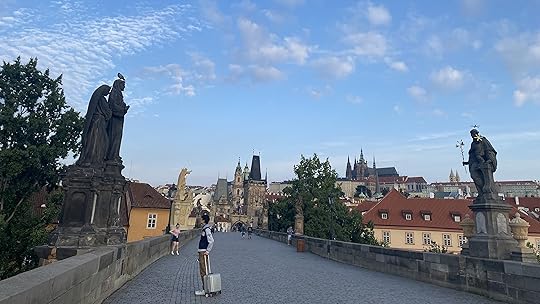
A Bridge Through Time (a poem)
This poem is inspired by a man I once saw on Charles Bridge in Prague.
Statues line a bridge
in Prague
looking down on
morning jogs
and walking dogs
and passing crowds
of selfie-takers
using all these
ornate wonders
as a way to
set the scene
without a thought
for what they mean
as pigeons sit
on chiselled heads
a man pulling his
his suitcase
Pauses
Stops at each
to soak them in
to hear them speak
the voice of artists
long deceased
connecting through
the centuries
with stone
A bridge
A suitcase stopped
and now it’s rolling on
November 5, 2025
The Loneliness Of Being Rejected
Loneliness doesn’t wait for an invitation. Sometimes, it doesn’t even wait for you to be alone. Quietly, it can gnaw on you, even in a crowd. It could be in a thousand stony eyes that look through you, in feet that automatically move around you, or in heads that nod polite acknowledgement and move on quickly because your existence didn’t matter enough to engage their conscious thought. The solitary loneliness of the wilderness would be kinder. Fresher. But the worst kind of loneliness of all is the loneliness of rejection. To be known, and seen, and still cast aside. To be intentionally marooned. At least with a crowd you can imagine that maybe if you had the right opportunity and started the right conversations the strangers around you might eventually become friends. Not so with the rejection. The betrayal. The abandonment. They did know. And you’re still alone.
I’ve felt the cold wind of a literal door slamming in my face, the sudden full stop ending what I had thought was a good story. I’ve heard the accusations ringing in my ears—if I listen I can hear them still—and I’ve seen the wavering doubt in the eyes of people I trusted as they weighed up the case against me. I’ve been marooned in rooms full of people. I’d rather be dropped in the desert. It wouldn’t be as lonely. And I know I’m not the only one. I thank God that this is not my current experience of life, but even in a world full of people the truth is that every one of us feels alone sometimes.
Even God has felt it. When Jesus became a man, he took on the fullness of our humanity—including our loneliness. Isaiah 53:3 summarises his experience:
“He was despised and rejected by mankind,
a man of suffering, and familiar with pain.
Like one from whom people hide their faces
he was despised, and we held him in low esteem.”
Despised. Rejected. Betrayed by one of his closest friends. Abandoned by all the rest. Hated without cause. Condemned without justice. Mocked. Shamed. Publicly executed in the most cruel manner humans could conceive with all their perverted genius. Even heaven itself was silent to his cries—“my God, my God, why have you forsaken me?”
Jesus died completely alone. He died under the weight of all our sin, all our wrongs that separated us from God, and separated us from each other. Under the sin that built all these walls and barriers and brought all of this isolating loneliness into our world in the first place. He did it on purpose. He knew that only his willing sacrifice could break the awful separation our sin had caused. He knew that only his resurrection could win a place of belonging in God’s home, God’s family, forever, for anyone who puts their trust in him and receives his forgiveness. Have you? The one who faced loneliness in the most extreme form possible has promised his people, “I will never leave you”. Never. You may still feel lonely in the company of others, and still be rejected by some of them, but if you have given your life to Jesus, then you have a home where you will always belong. He sees. He knows, and understands. With him, you are never—ever—alone.
October 29, 2025
The Never-Ending Novelty Of Staying With The Same Person
Love songs will never go out of fashion. But have you noticed that most love songs are limited to the very first stages of love? They’re almost always about two specific topics: either the excitement of meeting someone new, or the sadness of breaking up. It’s rare to hear love songs that focus on love in the decades after the “I do’s”. They’re out there, certainly, but they don’t make the top twenty lists.
It makes sense—by sheer numbers, there are a lot more relationships that start and end than relationships that go the distance. Perhaps the excitement of meeting someone new seems more interesting than the settled daily living of established relationships. There’s an appearance of novelty to it, except that when every song on the radio is about the same kind of novelty it doesn’t quite feel as novel anymore, does it?
It’s not just the radio. The powerful initial excitement of a new relationship really does bring a novel dimension to real life in the real world. But if you only ever experience that one kind of novelty, it quickly begins to wear thin. The same kinds of first dates with the same conversations where you bring out your five best funny stories and impressive tidbits. The getting to know each other’s history, getting to know each other’s preferences, and getting to know each other’s irritations—which leads to getting into the first fights, built on the same kinds of disappointments you’ve both had before, leading to another breakup. And repeat. And repeat.
It might seem counterintuitive, but I’m convinced that the only way to consistently experience true novelty in romance is to stick with one person for the rest of your life. I’m not saying the initial newness will last forever. Of course it won’t. Jessica heard all my best funny stories ten times over in the first years of our marriage. She knew all the impressive facts about myself I could produce (there weren’t many) by our third date. And it wasn’t long before she got to see the unimpressive facts, too. If you stay with one person long enough they’ll see you at your best and your worst. Those irritations that cause the first fights don’t go away with time. But if you can stick with it and find a way through with humility, forgiveness, and grace, then you’ll begin to discover a new, deepening and expanding kind of love that grows slowly over time, changing over seasons like a tree changing colours and budding all over again and every year becoming just a little bit stronger as it reaches for the sky. There is a constant newness and novelty that only comes as you adjust to one another’s differences and begin to bring out the best in each other. When the “first best” stories are worn out and the first dates are over you’ll have to work harder to find new ways to connect. You’ll have to build new stories together, and the effort will stimulate and deepen you. It will expand and improve you both as your relationship breaks new ground, in new directions, through the ever-changing seasons of life.
Love may begin with a flash of excitement, but it grows strong in the ordinary rise and fall of sunshine, rain, and passing days. Each stage of life together brings its own new joys, its own new challenges. Each new experience reveals more about yourself, and the one you love. No matter how well you get to know each other, there are always new depths to discover—each and every human being is a whole world with oceans and ecosystems and jungles and ruins and wonders and even if you had a thousand lifetimes dedicated to the task, you’d never get to the end of discovering them fully.
Looking back, my life with my wife Jessica is very different now from the way it was the day we first met. I’ve grown, and she’s grown, too, and we’ve both grown together. We might be the same people living out the same promises we made so long ago, but there’s a never-ending novelty in staying together that we could never have if we just repeated the same firsts over and over again with different faces.
October 22, 2025
Clouds (a poem)
As clouds diffuse
the sun’s great light
and drain the world of colour
my restless thoughts
have covered up
your glory and your power
at times a ray—or two—breaks through
at times I think I’m glimpsing you
and suddenly the world explodes
in living colour I behold
all things as they were meant to be
(it’s in your radiance I see)
and then my anxious thoughts return
and then my anxious heart unlearns
the beauty of your majesty
the goodness of your plan for me
and in the clouds (the glory-thieves)
I cry, “Lord, help my unbelief!”
October 15, 2025
The Little Weeds
It used to be a vacant lot, in the middle of town. Over months and seasons the grass and weeds have slowly given way to rows of potatoes, apples, carrots, pumpkins, onions, and more. This is our local community garden. We even have a poly-tunnel that fills up with tomatoes, lettuce, and courgettes that grow bigger than my forearm. Some of our volunteers are keen gardeners with plenty of knowledge and experience, and then there are people like me and my wife, ready to do as we’re told. This year, I’ve spent a lot of my time in the garden on one job in particular: killing things.
It’s funny, isn’t it, that in a place devoted to growing and caring for plants, one of the most consistent jobs of all is killing them? But it must be done. The weeds are relentless. If we didn’t kill them, they would overwhelm our vegetables, our paths, and everything we’ve worked to develop. They have to die, so the garden can live. Yet no matter how many times we kill them, we know one thing for certain: they’ll be back.
In fairness, there is something satisfying about pulling up a big, established weed. It feels like significant progress. It instantly changes how everything looks, noticeably shifting the garden away from chaos, towards order. Pulling up the little weeds isn’t nearly as gratifying—they’re fiddly and small, and they feel insignificant because even if you pull up a bunch of them the look of the garden stays pretty much the same. It’s easy to ignore them, but this summer I started focusing more of my attention on them for one simple reason: little weeds don’t stay little.
A big weed might be more satisfying to tackle, but it also takes more work. The roots are more established, thicker, and harder to fully remove. In the process of growing large, the weed also does more damage—potentially stealing resources from our plants, or spreading more weed-seeds across our cultivated land. A small weed, in contrast, is much easier to remove—and every time you remove a small weed, you’ve also removed the large weed that it would have become.
As I was pulling up fiddly little weeds in the garden one evening, I thought about how easily the weeds of sin and selfishness spring up in the garden of my heart. As many times as I fight against pride and greed and discontentment, I still constantly see them (and so many others) springing up fresh all over again, threatening to choke out my best intentions and my most fruitful labours with their noxious, tangled tendrils. And while big, destructive sins can’t be ignored, I do confess that sometimes I’m tempted to leave the little ones alone. They don’t seem to be doing much harm. They aren’t very noticeable. They haven’t done much damage. Yet. But I’m learning that this is exactly the best time to fight them—and fight them hard—before they become established. Before they grow the thick roots that tangle up in everything and start to feel so comfortable and hurt so much to pull out. Before they go to seed and start growing all kinds of other sins like self-justification, manipulation, cover-up, and deception. Yes, God has the power to conquer every sin our hearts can grow if we bring them to him, but the process won’t be pretty, and quite often the larger they grow, the more reluctant we’ll be to come to him for help. The very best time to kill a weed will always be the very first moment we see it. As soon as we’re convicted by God’s word, or a trusted friend, or by noticing the damage we’ve done to others—that’s the time to act. When you remove a little weed, you’ve also removed the large weed it would have become.
October 8, 2025
I Miss The Stars
One of the advantages of growing up in the country in Alabama was the clear view I had of the night sky. As a child, I got used to seeing billions, maybe trillions of stars—I don’t really know, there were far too many to count. Stars were a given for me, along with the noisy nighttime chorus of cicadas, crickets and frogs. Now I live in Ireland, where most nights the clouds pull themselves over me like a duvet. Under these covers my town is equipped with rows of man-made lights that imitate and compete with the stars, so even when the duvet is lifted, I might—on a good night—be able to count a dozen stars. But I know better. I know what’s really out there in those seemingly dark, empty spaces—I’ve seen it with my own eyes. I remember the sparkling host, the glittering crowd, the innumerable army of light with its clustered regiments and flag-bearing constellations. Can I be honest? I miss them.
I should not be able to count the stars on a clear night. It should not be possible. Stars were never meant to be countable. They’re meant to overwhelm us, to remind us of how big the universe is and how small we are down here on our wet little garden rock. They’re meant to “declare the glory of God” (Psalm 19) and make us wonder, like King David, “what is man, that you are mindful of him?” (Psalm 8), and marvel that he really is mindful of us. The few pinpricks of light I see are not very overwhelming, but I still find them useful. I use them to pin up the map of remembered majesty in my head. I start from what I have and fill in the empty gaps between them, reminding myself of all the invisible realities I’m no longer able to observe. It’s better than nothing. But it still makes me sad. Isn’t it odd that we, who know far more about the universe than any of our ancestors, actually see far less of it?
We’ve erased so much of the wonder from the night sky, drowning it in the haze of our electric imitations. I know we can’t go back. It’s too late for that, and I really am thankful for electricity. But we ought to at least recognise the loss. I’m convinced it’s a bigger loss than we think. Disconnecting ourselves from the grandeur of the universe inside our cozy little light-up cocoons is a dangerous position to put ourselves in. We could forget what the world is. We could forget what we are. We could forget our Maker. Being able to count the stars feels like a metaphor for all the ways we distract ourselves from God’s overwhelming glory with all manner of clever little haze-inducing imitations. We do it all the time. And yet, for all that, reality remains.
Don’t let the streetlights blind you.
October 1, 2025
Dappled Glory (a poem)
Our world is full of wonderful things, and life here is brightened with moments of grace and happiness so powerful it almost hurts. And then they pass. Like sunlight through the leaves, these moments cannot last, but our longing for more directs our hearts upward, to where these glories come from. That’s what I was thinking about when I wrote this poem.
Dappled Glory
There’s a kind of beauty that
makes the heart ache
that makes the heart long
that makes the heart break
to be bigger and wider
and stronger to take
in the glory
of one single
moment
There’s a kind of summer
that makes the heart sing
and still
somehow
you miss the spring
and long for autumn
as wonders move
like sun-beams
across the grass—
dropping dappled glory
as they pass
September 24, 2025
Why I Will Never Use AI For Writing
You will never read an AI generated word on this blog or in anything I write. Not in a sermon. Not in a book. Not even in an email. I claim each and every word and sentence, every comma and dash—I am fond of dashes—and every careless error as entirely my own. I know AI is becoming a popular tool for writers. I know AI can do in a heartbeat what can sometimes take me hours of work (although I comfort myself that at least I have a heart to beat in those hours). I’ll take the time. There are more important things than efficiency, and the brain is a muscle. The labour of collecting thoughts, choosing words, and cementing them into sentences keeps my mind strong, engaged, and growing. I dare not relinquish it. I know that AI is good, and getting better every day, at mimicking human logic, emotion, and eloquence. I understand fully that it is progressing far more quickly than I am. It could easily outpace me, and in some ways I’m sure it already has, at being interesting, informed, persuasive, and inspiring—but it can never outpace me at being me.
Words are personal. Without communication, our thoughts would be hidden, our hearts and souls would be trapped in perpetual solitude—but words release us. What a glorious gift! Perhaps we undervalue words for their sheer multitude. Perhaps we lose sight of each other speaking in the distance of pages and operating systems. We certainly cheapen words with our thoughtlessness, cynicism, lies, and inanity. But the fact still remains: words from a person are always a personal revelation. When I write, I open a public window into a piece of my soul, my thoughts, myself, and I welcome you to look inside. Poke around. Criticise the wallpaper if you like, but please engage with the thought on the table. It may be imperfect and incomplete, but it is freely given. If you’re reading this, please know that I take your willingness to pause and engage your own mind with mine very seriously. I will never share that privilege with a machine, no matter how insightful and helpful it may sound.
This is personal.


