
Kristen Den Hartog's Blog: The Cowkeeper's Wish
November 21, 2024
Mr Isbister’s Marvellous Ride
More happy book news!
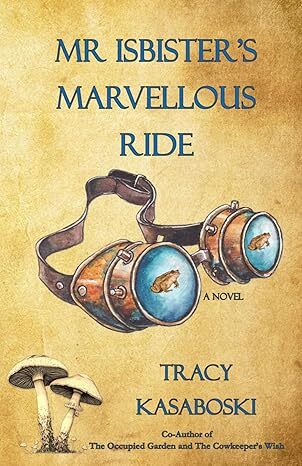
I’m excited to share that after years of work (and giggling to myself as I wrote and rewrote and imagined), my new novel, Mr Isbister’s Marvellous Ride is published and has gone forth into the wide world! While working for the last number of years on non-fiction was addictive and fascinating, creating a story simply for the joy of writing was liberating and exciting. I hope you will read it and enjoy. Here’s the blurb from the back cover:
“It’s 1922, and Mr Roderick Throckmorton Isbister is an earnest, unassuming fellow whose life in a house of privilege in the quiet English countryside is mundane and unfulfilling. Since coming to Sowerby Grange some twenty-five years earlier as a reluctant groom to his wife Alice’s equally reluctant bride, things had fallen rather short of his expectations, although not for a lack of interests. And his are an eclectic mix: art, fungi, amphibians.
His wife has never understood his fascination with art and the woodland world, so to avoid her disapproval, Mr Isbister indulges his pursuits surreptitiously. The chance to transform his unhappy existence comes about after he makes an inebriated purchase of a 1917 “Trusty” Triumph motorcycle from a dubious characters with multiple guises.
The bike and the discovery of his wife’s tryst with an old flame are the catalyst for Mr’s decision to go adventuring. He’s accompanied, on a whim, by his resourceful and enigmatic housemaid, Eliza, riding along in the sidecar, but when he finds an anonymous note in his haversack warning him of her suspect past, our protagonist finds himself questioning his choices, struggling with his failings, and navigating the rocky road of trust and friendship.
Endearing, big-hearted, humourous, Mr Isbister’s Marvellous Ride is a delightful voyage of self-discovery, and storytelling at its best.”
There will be a book launch, graciously hosted by the Deep River Public Library, on lucky Friday, December 13 at 7 PM in the Program Room downstairs. I hope you can make it! But if not, the book is available at Amazon, and at the Valley Artisans’ Co-op if you’re in Deep River, Ontario, and at other independent bookstores like the wonderful Take Cover Books in Peterborough. However you get your copy, I hope you will settle in for a good read, a cup of tea and a chuckle. Enjoy!


August 29, 2023
The Roosting Box

I’m thrilled to report that after many fascinating years of research and writing, my forthcoming book, The Roosting Box: Rebuilding the Body After the First World War, will be published in February 2024 by Goose Lane Editions. You can visit their website to pre-order. Here’s the jacket description:
In the aftermath of the First World War, a cash register factory in the west end of Toronto was renovated to treat wounded soldiers returning from war. From 1919 to the 1940s, thousands of soldiers passed through its doors. Some spent the remainder of their lives there.
The Roosting Box is an exquisitely written history of the early years of the Christie Street Hospital and how war reshaped Canadian society. What sets it apart from other volumes is the detail about the ordinary people at the heart of the book: veterans learning to live with their injuries and a world irrevocably changed; nurses caring for patients while coming to terms with their own wartime trauma; and doctors pioneering research in prosthetics and plastic surgery or, in the case of Frederick Banting, in a treatment for diabetes.
Naming chapters after parts of the body, den Hartog chronicles injuries and treatments, and through the voices of men and women, the struggles and accomplishments of the patients and staff. The cast of characters is diverse — Black, female, Indigenous, and people with all sorts of physical and mental challenges — and their experiences, gleaned from diaries, letters, service records, genealogical research, and interviews with descendants, are surprising and illuminating.
An unusual mix of history and story, The Roosting Box offers deeply personal perspectives on healing in the aftermath of war.
April 8, 2023
Revisiting The Occupied Garden
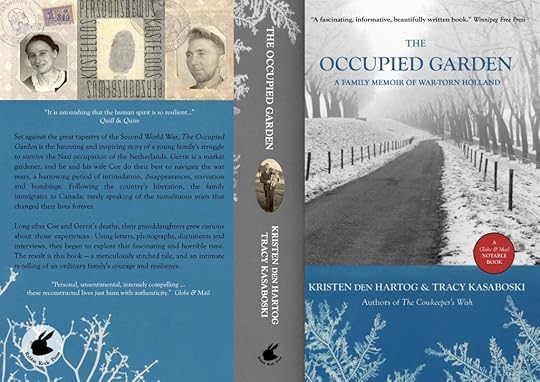
The day has arrived! After much hard work the brand new, revised paperback version of The Occupied Garden has been released! Tracy and I are pleased to present it with a beautiful new cover that incorporates a photograph taken by our Dad, and that we feel truly captures the essence of the story. We’re also excited to share that the new version includes maps of Leidschendam, hand drawn by our Aunt Rige, as well as detailed maps created by my friend, Marcel Fortin, plotting sites in the story that are further afield. Please feel free to share the news far and wide!
March 11, 2023
Digging Up Stories
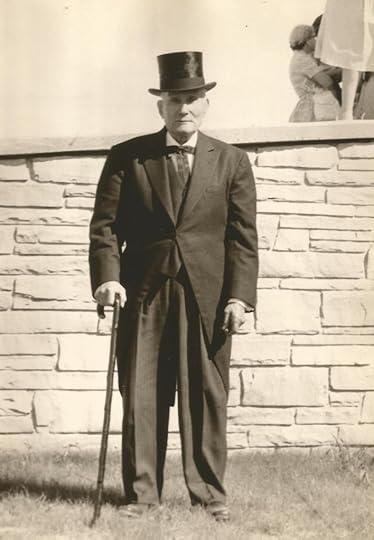 Tracy’s husband’s ancestor, Polish immigrant Simon Kasaboski, will feature in our talk. This image shows Simon at age 100 in Renfrew, Ontario.
Happy to be traveling to my hometown of Deep River this coming week, where I’ll be doing a presentation with sister and co-author Tracy. What with COVID wreaking havoc, it’s been a long time since we’ve had the chance to talk to an audience about our books and our love of weaving social history with family history. The event is part of a larger program called “Not Born From a Virgin Forest,” which aims to explore the history of the Deep River area before the nuclear research plant moved in in the 1940s. Here’s a description of our event, which takes place at the Deep River Public Library on March 17:
Sisters Kristen den Hartog and Tracy Kasaboski are the co-authors of two highly acclaimed social histories told in the form of family memoir. The sisters will discuss the nuts and bolts of researching their family’s past, and share the possibilities for local history research using specific examples from the Ottawa Valley long before the town of Deep River came into existence.
This discussion will appeal to anyone interested in family and local history, and will demonstrate how to look behind the dry facts for a glimpse into the real lives of people long gone.
Free Program, no registration. This event is part of the project: “Not Born From a Virgin Forest: Deep River & Area’s Earliest History” in partnership with the Laurentian Hills Public Library and the School House Museum.
Funded by the Government of Canada’s New Horizons for Seniors Program.

February 14, 2023
Valentine’s Day in The Occupied Garden
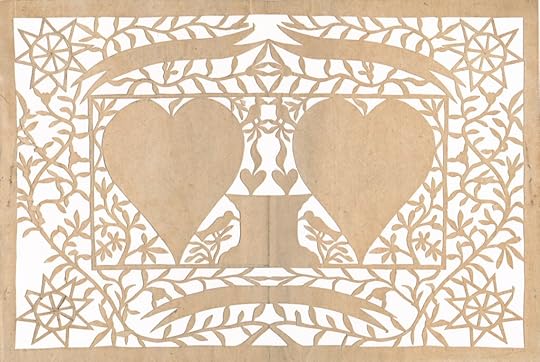
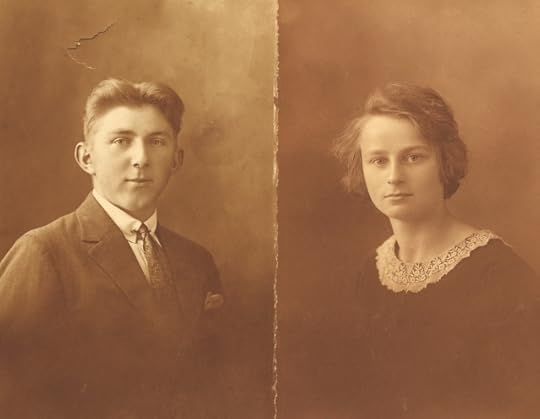
We are still working away on the new paperback edition of The Occupied Garden and promise it’s coming very soon! It’s been so fun examining the old photos again, and reconnecting with the story of our oma and opa, Cor Post and Gerrit den Hartog. Recently on a visit to our aunt, who features prominently in the story, I noticed Cor and Gerrit’s engagement portraits on her wall, together in a frame. I’ve always loved these pictures — but what I hadn’t noticed before was an intricately cut paper tucked behind the photos, forming a pretty backdrop for their likenesses. Papercutting, or papierknipkunst in Dutch, is an old art form that has evolved all over the world in varying ways. My aunt doesn’t think my oma made this piece, but it’s certainly very old, and may have been made for her by a sister or a friend. In any case, with its mirror-image pattern of hearts and birds and twisting vines, it makes an appropriate backdrop for Cor and Gerrit, and a fine offering for Valentine’s Day.
January 21, 2023
The Occupied Garden: a brand new edition
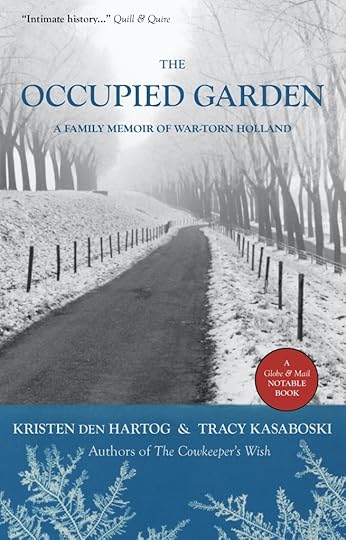
Fifteen years after its original release, my sister/co-author Tracy Kasaboski and I are delighted to present our very own new edition of The Occupied Garden: A Family Memoir of War-Torn Holland. The book was published to enormous critical acclaim in 2008, and we still hear from readers who are moved by this intimate account of an ordinary family living under occupation in WW2. The e-book is ready now, and you can purchase it here. The paperback – unique for its inclusion of hand-drawn maps of the town where our family lived – is coming very soon.
Here’s a description of the story from the back jacket:
Set against the great tapestry of the Second World War, The Occupied Garden is the haunting and inspiring story of a young family’s struggle to survive the Nazi occupation of the Netherlands. Gerrit is a market gardener, and he and his wife Cor do their best to navigate the war years: a harrowing period of intimidation, disappearances, starvation and bombings. After liberation, the family immigrates to Canada, rarely speaking of the tumultuous years that changed their lives forever.
Long after Cor and Gerrit’s deaths, their granddaughters grew curious about those experiences, and using letters, photographs, documents and interviews, began to explore that fascinating and horrible time. The result is this book: a meticulously stitched tale, and an intimate re-telling of an ordinary family’s courage and resilience.
I’ll post again when the paperback is ready. Until then, here are a couple of excellent reviews that commend our ability to tell this story, and make us proud of our connection to the people who lived it:
“The authors interpret so harmoniously, are so guided by respect and common sense, that these reconstructed lives just hum with authenticity.” Read Ernest Hillen’s Globe and Mail review of The Occupied Garden here.
“This is intimate history: the writers recover not only the facts, but the tastes, smells, and lived experiences of events that today almost defy belief. … It is astonishing that the human spirit is so resilient.” Read Maureen Garvie’s Quill & Quire review of The Occupied Garden here.
October 5, 2022
Guest Post: The Home Child’s Secret
A little while ago I was scrolling the Facebook page for my hometown high school in Deep River, Ontario, where I often see great old pictures of the town where I grew up or catch up on news from people I knew long ago. This time, to my surprise, I noticed a post about “British Home Child Day.” After I read the story, I wrote to its author, Ron Baker, and asked if he’d allow me to publish it here. So thanks to Ron for this touching piece about his dad Edwin Matthew Baker, a home child who came to Canada in the 1920s.
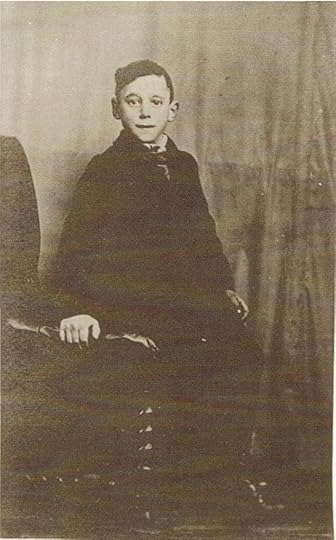 Edwin Baker when he was first put into care. Ron received the picture from the Church of England Children’s Society years after his dad’s death.
For decades, I and my brothers and sister believed that our father Edwin was an American born in Boston, USA; in fact, in 1970, I actually wrote letters to the City of Boston archives and to the Boston State House seeking information on my father. They replied that they had no records of him or his mother, Rachel Rebecca. I chalked it up to possibly poor record keeping back in 1913, the year my father was born.
That all changed on August 15, 2008, when I came across an old torn envelope addressed to my late father at the Gibbs Home in Sherbrooke, Quebec, sent from India. I googled ‘Gibbs Home’ and a couple of emails later, I discovered a whole new chapter of my father’s life that was previously unknown to me and the rest of my family.
Yes, my father was born in Boston, but it was actually the Boston in Lincolnshire, on the east coast of England. What I discovered was the quintessential story of the British home child.
At the age of ten his mother Rachel Rebecca died in a workhouse, probably of tuberculosis, according to a file sent to me from the Church of England Children’s Society, formerly Waifs and Strays. My father was placed into care by his grandfather Charles, age 60. (See Leicester Home for Boys.)
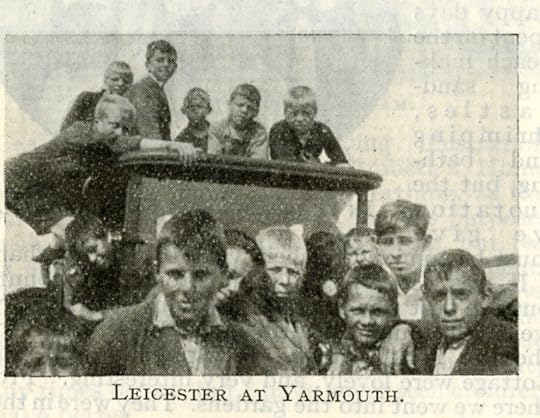 This clipping was among the items sent from the Church of England Children’s Society when Ron inquired about his father Edwin. Edwin is pictured lower right.
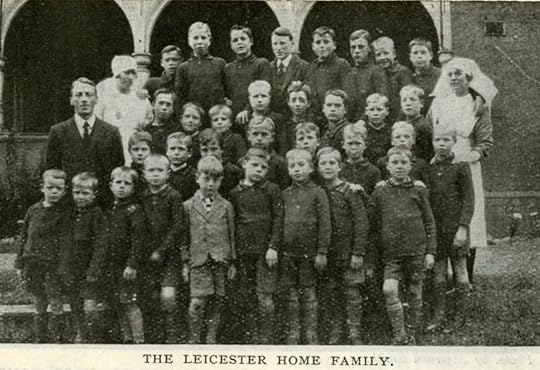 Another image sent to Ron from Edwin’s file. Edwin is at left in the back row.
Later, at almost 15, my father was given the choice of coming to Canada or going to Australia. He chose Canada because some of his friends were going there. After farming training at Stoneygate Farm School, he was sent to Canada on the SS DORIC along with 32 other boys. He arrived at Quebec City on July 7, 1928, and went from there to the Gibbs Home in Sherbrooke, under the watchful eye of Thomas Keeley. He worked at several Quebec farms in Bulwer, Eaton, Ayer’s Cliff, Bromptonville and Lennoxville.
My father was like many of the home children, who did everything they could to distance themselves from their past to eliminate the bullying. They disposed of their trunks and their English accents. My father’s trunk was found at the first farm he worked at, the Gallup Farm in Bulwer. The trunk was returned to me by Sarge and Pauline Bampton (Bampton Home Children Collection), original members of Home Children Canada, Quebec Branch.
 Edwin’s trunk, which traveled with him to Canada back in the 1920s and eventually made its way to his son Ron decades later
After marrying and serving in the military, my father worked at a munitions factory in Valleyfield, Quebec, before moving to Deep River, Ontario, to work at the newly established Atomic Energy plant, where he worked in the Chemical Extraction Division.
He successfully shed his English accent and never spoke of his native country, even in spite of the fact that we had English neighbours in Deep River. It amazes me to this day that there were no slip-ups when speaking with the neighbours.
This discovery doesn’t really change anything about the relationship my siblings and I had with our father, but it does give us a whole new appreciation for his ability to keep a secret. I am sure that sometimes he probably really wanted to tell us his story.
The Church of England Children’s Society did send me details of my father’s stay with them, which included details of his mother’s struggles, where he was born and baptised, his level of education, the names of aunts and uncles, and the fact they maintained some contact with him at the Gibbs Home, however briefly. More recently, I have discovered one of my father’s first cousins and his family in and around Boston, England. We have exchanged messages and pictures and visited.
—Ron Baker
June 22, 2022
The Insulin Soldiers
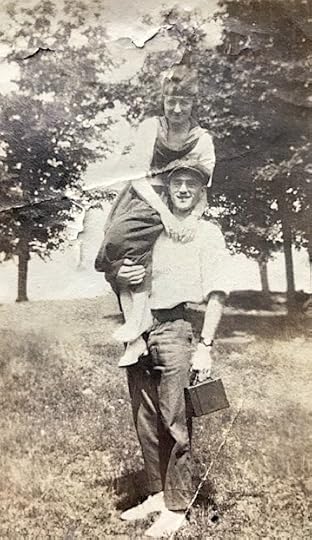
Just a short post today, to share with you an article published recently in Geist magazine, called The Insulin Soldiers. It’s about a group of WW1 veterans who were patients at the Christie Street hospital in Toronto, and underwent the earliest trials for insulin back in the 1920s. As always, it was a fascinating journey to discover the soldiers’ stories. The image at left shows one of the men featured in the piece, Jim Ostrom, with his fiancee Grace, in about 1920. I hope you’ll enjoy the read.
May 27, 2022
Red Cross Neighbours
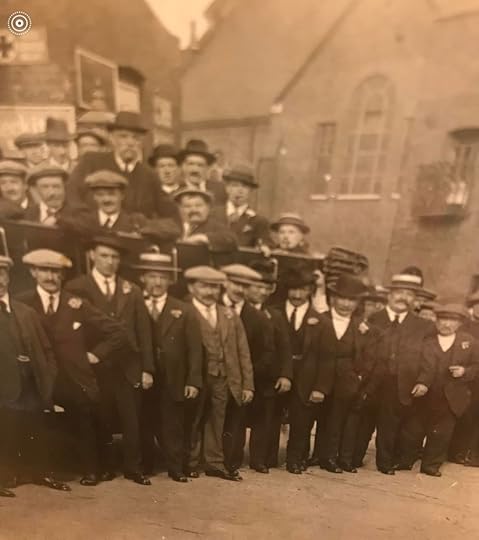 Men of the Borough, Southwark, courtesy Dean Kenny
It’s been a while since I investigated the black and blue streets of Victorian Southwark, where our story is set. But I was prompted to revisit when a follower of this blog sent a photograph taken in the same neighbourhood where our cowkeeper family lived from the 1830s to the 1900s. How fun to be corresponding with someone whose ancestors were neighbours of our own, and to think that perhaps they even knew each other. When he sent me the image, Dean Kenny wrote:
Attached is the photo of what looks like the start of a “boys’ day out.” I can’t imagine what state they might have been in on their return! In the background is Red Cross Court, Southwark. My great grandfather William TOAL was born at 1 Red Cross Court in 1871. He’s in this photo, the rather large man wearing the straw boater on our right of the photo. I don’t know the year the photo was taken.
William worked in a local stables as a labourer and the family were described as being very poor.
Familiar territory for sure. Our own family, chronicled in The Cowkeeper’s Wish, lived on Red Cross Street, near the intersection of Red Cross Court, and just around the corner from Dean’s family’s address on that dark little alley. The whole area was known for its crime and poverty, but Red Cross Court, especially, was notorious for decades — it had “the most undesirable reputation of any slum in London,” according to the South London Chronicle, which published many articles about Annie Bennett, “Terror of the Borough,” who apparently broke out of prison to see her “beloved slum” one last time before it was torn down.
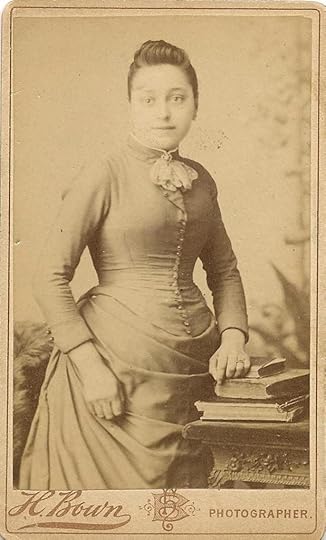 William Toal’s neighbour and our great grandmother, Mary Anne Evans, taken around the time of her marriage in 1895
Born in the early 1870s, Dean’s great grandfather William was close in age to our great grandmother, Mary Anne. They were infants one winter night when screams of “Murder” burst through the window next door to the Toals’ place. According to the Lloyd’s Weekly Newspaper report on the trial that followed, a 45-year-old labourer named John Casey had come home drunk after New Year’s Eve celebrations, grabbed a razor, and attacked his wife Hannah, half asleep in their darkened bedroom. She put up her arms to protect her neck as he came at her, and her fingers and forearm were badly slashed. She jumped out of bed, rushed to the window and called out for help, and soon police arrived; John was taken into custody, and Hannah to nearby Guy’s Hospital. In the retelling at court a week later, John gave a different version: Hannah had been drunk “all the day and night, and had broken all the crockery and thrown the chairs out of the window. She attacked him as soon as he got into bed, and must have cut her arm falling against the fender.”
It’s impossible to know now whose version was true, or what crucial details were missing entirely, but what’s certain is that troubling stories of domestic violence — as well as theft, drunkenness, and general thuggery — were common in the neighbourhood, where poverty was the prevailing theme.
William Toal and our Mary Anne grew up among these dramas, and would have had an entirely different perspective than the ones largely available to us now — after all, the journalists and the anti-poverty activists of the day were all outsiders looking in on the area. Reporting on the proposed demolition of some of the Borough’s worst slum buildings in 1901, the South London Press wrote that: “There are also being demolished a number of courts which lie hidden behind Borough High-street, and which are associated with many of Dickens’s works … but, apart from fiction, one court alone, Redcross-court, once tenanted by the worst of London’s living population, was the scene during the last century of no less than 12 or 13 murders, whilst the charges of manslaughter that arose out of fights over the division of the spoil of robberies could not be counted.”
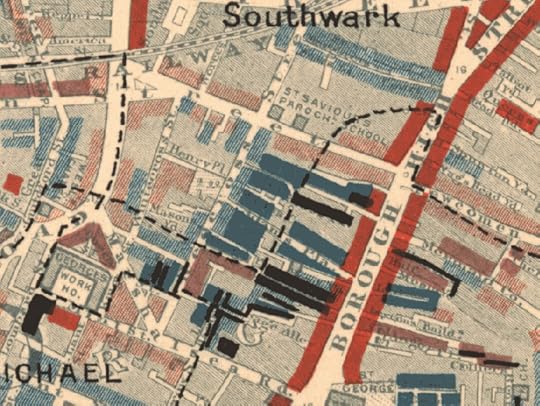 Charles Booth’s map, colour-coded to show poverty levels. Red Cross Street runs diagonally through the centre, parallel to Borough High Street, and Red Cross Court is the black and blue section left of the GH in Borough. Notice St. George the Martyr Workhouse in the lower left corner. See https://booth.lse.ac.uk/for more about the Booth’s work documenting poverty in London.
The philanthropist Charles Booth and his “social investigators” spent plenty of time in the area when they compiled their massive poverty study in the 1890s and early 1900s. A map accompanied the work, colour-coded to show poverty levels, with Black being the poorest of all. The reason you can’t quite see Red Cross Court in the Booth map below is precisely because it has been blackened to convey the deep level of poverty that existed there. Not for the first time I find myself wishing I could rub away the black to see these streets more clearly, and to know how people like William Toal and Mary Anne would have described their neighbourhood. How it might surprise them to know we are curious about them now, all these years later.
April 4, 2022
Woodwriter
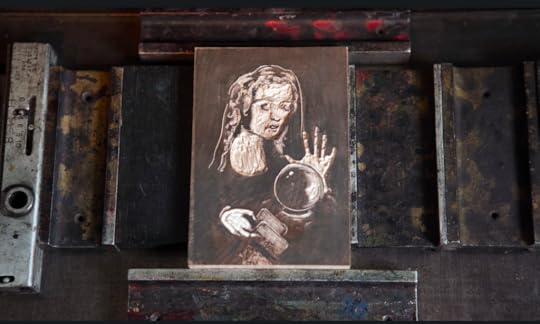 A wood block of Mary Pickford sits on George Walker’s press, ready for printing
It’s been a long time since I posted. In part, I’ve just been busily working on my new book, but to be honest I’ve also been a bit dejected — I haven’t been able to find out anything more about the mystery baby I was researching late last year, though I still haven’t given up that more information will surface. I often wonder what makes me so obsessed with the past, and finding clues to old mysteries that, for many people, just don’t matter anymore. But I’m overjoyed when I find kindred spirits (like my sister and co-author, and so many of the readers here) who share the same curiosity. I also love to learn about other approaches to investigating the past, and over the last many months I’ve had a close-up view, since my husband Jeff Winch has just finished his documentary Woodwriter: The Wordless Art of George A. Walker. It’s about a book artist and wood engraver who makes “wordless biographies” about such fascinating subjects as Tom Thomson, Pierre Trudeau, and Leonard Cohen. His latest chronicles the life of silent screen star Mary Pickford.
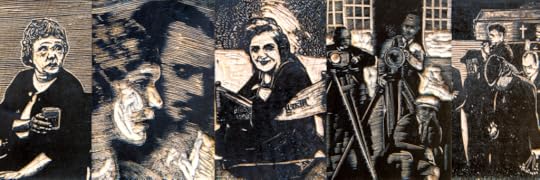 Some of George’s Mary Pickford blocks
 I think Jeff and I both fell a little bit in love with Mary via George, and she makes numerous appearances in Woodwriter, lighting up the screen each time with her funny facial expressions and her ability to say so much without talking. I guess that’s why she’s such a perfect subject for George’s books — a muse, in a way. Being behind the scenes during the making of Woodwriter has been like being in a little chain of creators inspired by creators: me watching Jeff film George make a book about Mary making films!
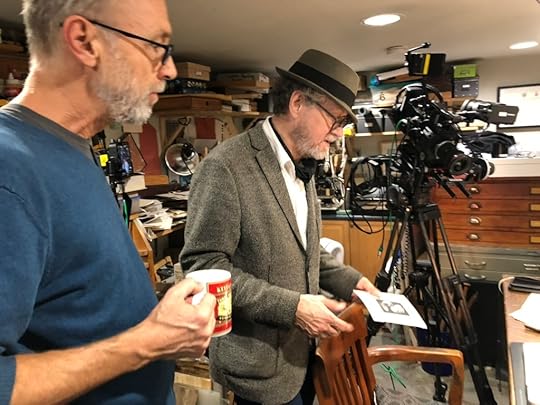 Jeff, left, and George on set in George’s studio
But the film is about more than Mary Pickford and George’s other subjects. In my mind, it’s really a film about creativity. It follows George through his process, starting with a blank wood block and ending with a gorgeous hand-made book. Throughout the film we see his craft close up: the old-fashioned tools he uses for engraving, and the hand-fed, Vandercook Press that dominates his charming back-yard studio. But we also hear George’s thoughts about his work — what moves him, why he chooses certain subjects, what he loves about the black-and-white form and about books and art and history. Living with the filmmaker, I had the added luxury of watching Jeff’s process as he captured George’s work, using “rotoscoping” to make footage of George look like his engravings; and through tricks of technology, sending George back in time to be a character in Mary Pickford’s films.
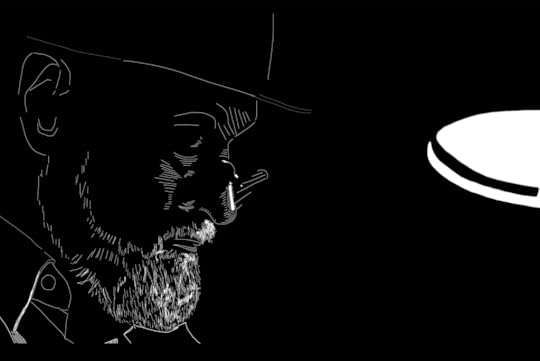 George engraving: a rotoscoping still from Woodwriter
Though my own process is so different from Jeff’s and George’s, for me the film underscores the beauty of creating, and the power of reaching back in time to tell stories. As Jeff says in his description of the film, “the past and present never stop talking to each other – even if it’s without words.”
I’ll post again whenever there are screenings for the film. For now, you can visit the Woodwriter site and watch the trailer below:
The Cowkeeper's Wish

- Kristen Den Hartog's profile
- 33 followers

