
Barry Eisler's Blog: The Heart of the Matter
April 1, 2026
How Much Worse Will It Get?
Of course it’s extraordinary that Trump launched a war to stop the Iranian government from acquiring nuclear weapons it had already committed not to have via an agreement Trump himself had previously ripped up. It’s extraordinary that this war will almost certainly result in Iran developing and deploying the nuclear weapons it had previously and verifiably foresworn. And it’s extraordinary that a primary aim of Trump’s war is now to reopen the Strait of Hormuz, which was open before Trump started the war and that the war itself has closed.
Obviously no one knows how the war will end, and there are plenty of plausible scenarios where it won’t end until its regional nature has gone global, with more damage to the global economy, widespread food shortages, and the use of nuclear weapons. And even if Israel and America stopped the madness today, what they’ve already done is like an undersea earthquake, the resulting tsunami of which is on its way and impossible to stop.
The Heart of the Matter is a reader-supported publication. To receive new posts and support my work, consider becoming a free or paid subscriber.
All that said, I think there’s one possible path by which the war could end with not too much more than the current amount of death, grief, agony, and waste its architects have already unleashed. It’s a narrow path, but I wouldn’t call it far-fetched, and though it’s hopeful, I don’t think it’s purely the product of hope.
The hope lies in two elements: first, Trump’s apparent belief that reality is whatever he says it is (and his supporters’ inclination to share that belief). Second, in the restraint and rationality of the Iranian government. Both elements are required, because no matter how many times Trump declares victory, whether he gets to leave is, as it was in A Bronx Tale, entirely up to how and even whether Iran lets him.
I think it’s fair to say that in his previous life as a real estate developer, Trump developed a taste for bullshit. “We finished construction three days ago with 100 luxury units available and only seven of them are left!” “The opening is gonna be unreal, every A-list celebrity has been trying to get an invite!” In real estate this is generally just harmless business puffery, the kind of gum-flapping that the carnival barker behind it hopes will bring about a self-fulfilling prophecy.
Of course, bullshit can take you farther in real estate than it can in a war, and even in the best of times Trump seems not to realize this. But this isn’t the best of times, and more and more it seems that Trump’s ability to distinguish bullshit from reality—probably never that great in the first place—seems to be disintegrating as he nears his 80th birthday.
Ordinarily, having a president who can’t distinguish between his own bullshit and external reality is not a good thing, and indeed is part of what caused the current utterly insane war in the first place. But ironically, Trump’s disintegrating brain is critical to any hope of mitigating the current catastrophe. A president less capable of massive self-delusion would be more likely to continue to escalate, Friedman Unit by Friedman Unit—which is what, as the Pentagon Papers showed, Johnson and Nixon did in Vietnam, and what Bush 2, Obama, and first-term Trump did in Afghanistan, where they all knew the war was lost but kept it going so they could hand it off to the next Oval Office occupant.
So whereas most presidents continue to escalate lost wars for years, even decades, to avoid having to acknowledge defeat, there’s probably a better chance that Trump will short-circuit the Denial, Anger, Bargaining, Depression, Acceptance cycle by jumping straight from Denial to Acceptance. Only a chance, of course, but given the costs and the stakes, a chance is better than nothing.
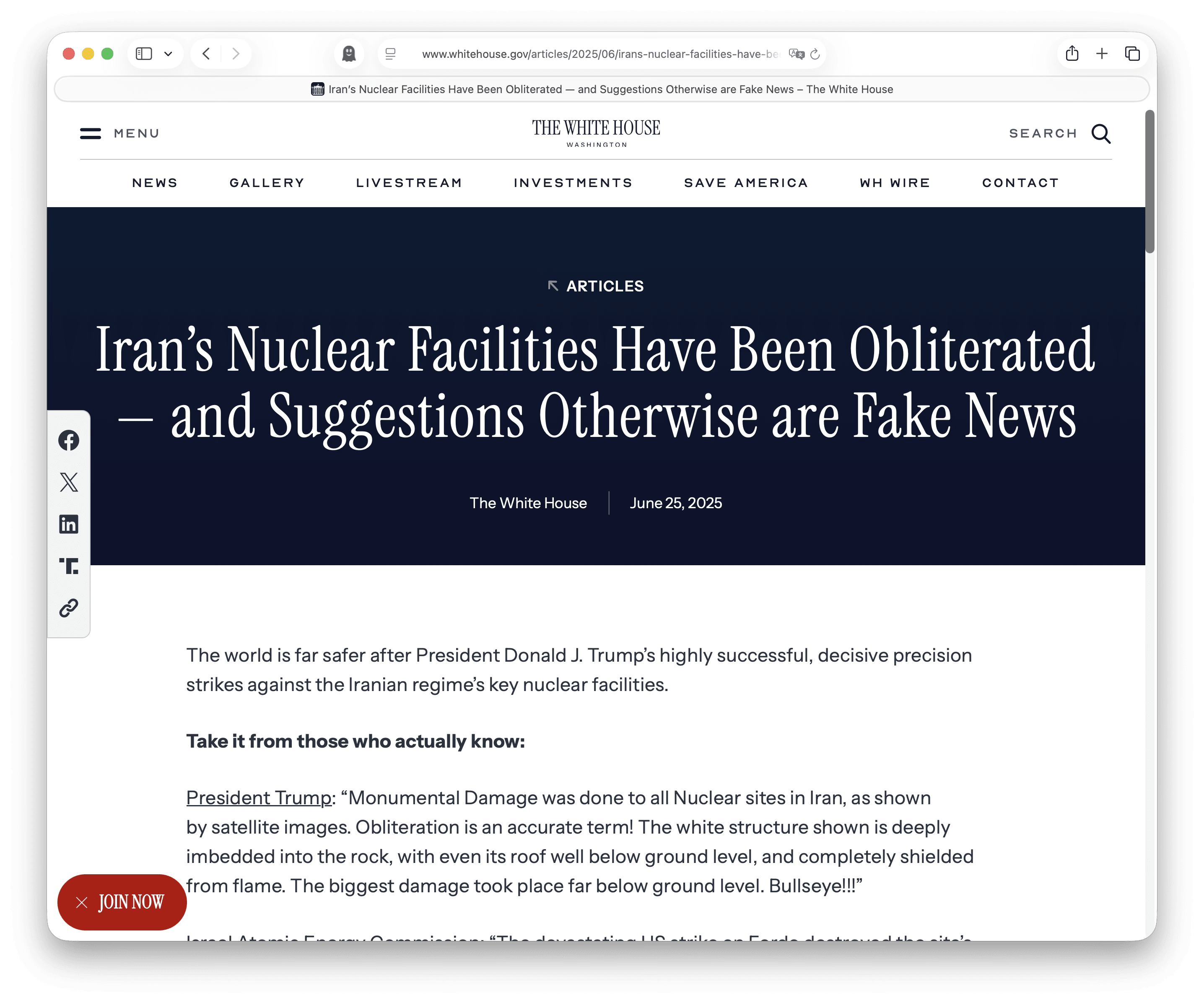
As I write this, it seems Trump has announced an address to the nation for 9:00 pm east coast time today, April 1 (also known as April Fool’s Day). Maybe this will be his chance to claim that he’s dropped more bombs, sunk more ships, blown up more infrastructure, killed more theocracy death cult regime Death-to-America mullahs, and taught these sick Nazi butcher deranged scumbags a lesson they’ll never forget. Sure, the Strait of Hormuz will now be an Iranian tollbooth, but America doesn’t need it and besides at some point it’ll self-open anyway. And this time Trump will have double completely and totally obliterated the nuclear weapons program the White House website still claims Trump completely and totally obliterated as of June 25, 2025—the one anyone who says he didn’t completely and totally obliterate is fake newsing. It’ll be Mission Accomplished all over again, though even for Trump and his supporters, the delusion will be hard to maintain.
WARNING, GRAPHIC: Video above is of a regime death cult military commander
Or maybe all the bragging about destroying this and that in Iran, reminiscent of the Body Count in Vietnam, is just Trump blurting out whatever is on his mind in any given moment. If he has even a tenuous connection with reality, at this point he must be feeling desperate. And it’s clear that one of his fundamental drives is to have people looking at him, thinking about him, talking about him, and keeping people uncertain about his intentions and what action he’ll announce if you Tune In At 9:00 is a great way to be sure you have people’s constant attention. Or maybe “We’re on the verge of stopping this lunacy” is another feint, intended to distract from some upcoming further act of insane violence. That’s the thing about Trump. If he doesn’t know what he’s going to do himself, no one else can know either.
(Note that Netanyahu might also be preparing to declare victory, facts be damned.)
Of course, even if Trump does boast that he ended yet another war (even if he started it, reminiscent of “No, it’s true, I read it somewhere. Okay, I wrote it down first”), the next step is up to Iran. Despite the war crimes and atrocities America has committed, I expect the Iranian government might give a de facto decent interval to encourage Trump to withdraw US forces and let him start campaigning again for a Nobel Peace Prize. But at that point, Israel, its defensive capabilities exhausted, will be wide open to Iran’s missiles and drones. And after the barbarism Israel has visited upon Iran, even the most rational and restrained Iranian leadership has got to be pissed.
At this point Iran could probably hit Israel hard enough to end it as a functioning nation-state. Before being snuffed out, Israel would doubtless exercise the Samson Option and hit Iran with nuclear weapons. Of course, if Iran really were an apocalyptic death cult—the “regime,” as we’re trained to think of it—its leadership wouldn’t care. But the truth is that contrary to the nonstop deluge of western propaganda, the Iranian government has behaved for decades with notable rationality and restraint. They agreed via the JCPOA to foreswear nuclear weapons. When Trump ripped it up, they tried to negotiate something new. When Netanyahu and Trump bombed them in the middle of those negotiations, they barely hit back and tried negotiating again. At which point Netanyahu and Trump bombed them yet again. And ever since Israel and America launched this war, it’s been Israel and America escalating it. Iran by contrast has been playing tit-for-tat.
Ironic, then that Trump has declared “No deal with Iran except UNCONDITIONAL SURRENDER!” He was right of course, though mistaken about who would be offering the surrender in question. Because no matter how much escalation precedes it (and if I had to bet, I’d bet Trump will indeed escalate before finally giving up), in the end, short of resort to nuclear strikes, Trump will have to declare victory and end his “lovely stay” in Iran— leaving the Iranian government (sorry, “regime”) still in charge, newly in control of the Strait of Hormuz, possessing a vast conventional missile and drone deterrence force, and newly determined to join Israel as a nuclear power. How else to describe this other than as Unconditional Surrender by another name?
And it will hardly be the first time. Though the US government didn't call it that, there was an unconditional US surrender in Vietnam (“Peace With Honor”); in Afghanistan (“Operation Freedom's Sentinal”); and in Iraq (“Mission Accomplished/Operation New Dawn”). Recognition of reality has followed metastatic self-inflicted catastrophe before. If we’re extremely lucky, it could happen this time, too. Strange that such a thing is now the world’s best and only hope. But the alternatives are almost too horrific to contemplate.
The Heart of the Matter is a reader-supported publication. To receive new posts and support my work, consider becoming a free or paid subscriber.


March 17, 2026
Will the Real Death Cult Please Stand Up
Recently I was ruminating about what’s left of America’s brand—that is, the essence of America, what America stands for, what America represents to the world.
(Note this question is related to but different from, “Why is America the greatest country in the world?” which is at best neurotic jackoffery.)
The Heart of the Matter is a reader-supported publication. To receive new posts and support my work, consider becoming a free or paid subscriber.
The reflex response—the story that gets implanted in our brains when we’re children—is typically some version of Liberty. Individuality. Opportunity.
But the stories we tell ourselves about ourselves are always bound to be distorted by ego, in-group favoritism, and the fundamental attribution error. For a variety of reasons, it’s hard for us to see ourselves clearly, and certainly there’s always a gap between the way we see ourselves and the way others do (and vice versa). As Orwell said: “To see what is in front of one’s nose needs a constant struggle.”
So the stories we tell ourselves about ourselves are always inherently suspect—precisely because the need to self-flatter is always in the mix. Which makes the new stories our rulers have been telling the more remarkable. These stories aren’t about liberty, or individuality, or opportunity, or lights unto nations or cities on hills or anything remotely like any of that. What makes America special in these stories boils down to one fundamental thing.
Killing.
Here’s Secretary of Defense (who prefers Secretary of War) Pete Hegseth, advising media on what it should cover:
“How many stories have been written about how hard it is to, I don't know, fly a plane for 36 hours? Has MSNBC done that story? Has Fox? Have we done the story how hard that is?”
[Editor’s note: government and media should never be a “we”]
“You're undermining the success of incredible B-2 pilots and incredible F-35 pilots and incredible refuelers and incredible air defenders who accomplished their mission.”
“How about we talk about how special America is, that only we have these capabilities?”
Here’s Alex Karp, CEO of Panantir, a huge military and intelligence contractor:
“What makes America special right now is our lethal capacities. Our ability to fight war.”
It wasn’t always like this. Setting aside the substance of America’s first invasion of Iraq, here’s the story President Bush 1 told before a joint session of Congress about the end of the war:
“I’m sure that many of you saw on the television the unforgettable scene of four terrified Iraqi soldiers surrendering. They emerged from their bunker broken, tears streaming from their eyes, fearing the worst. And then there was an American soldier. Remember what he said? He said: ‘It's okay. You're all right now. You're all right now.’ That scene says a lot about America, a lot about who we are. Americans are a caring people. We are a good people, a generous people. Let us always be caring and good and generous in all we do.”
Of course the speech itself was about a war and how beneficent America was for waging it. Plenty of self-flattery, even Niebuhrian* self-deception, to be sure. America has always pretended to cherish peace while in fact loving war.
But as self-justifying as American hypocrisy has always been, it has also signaled something positive, as Arnaud Bertrand recently pointed out: “Hypocrisy—the gap between ideal and reality—is the proof that the ideal still has a hold on you, that you can still be called back to it.”
That sort of hypocrisy now seems mostly to have evaporated, revealing the Thanatopic substrate.
Even the have changed. Not long ago, we had Enduring Freedom, Iraqi Freedom, Freedom’s Sentinal, Prosperity’s Guardian...now it’s Midnight Hammer and Urgent Fury, the first sounding like a porn movie and the second a straight-to-streaming action flick.
A simple test of the degree to which the current stories seem uninterested in hypocritical fig leafs: can you imagine a “Death, Fire, and Fury Will Reign Upon Them” Trump, or a “Death and Destruction From the Sky all Day Long” Hegseth, or a “Scare Our Enemies and on Occasion Kill Them” Karp , telling a story—accurate or inaccurate is beside the point—about being caring, or good, or generous as characteristics that make America special?
Whatever the truth of the self-flattering stories we tell ourselves, they’re always reflections of what we want to believe, what we want to be the truth. It used to be that what we wanted to be the truth were characteristics that almost anyone would agree are positive, regardless of what people or cultures or countries these characteristics might be found in. Today, it seems what we want to be the truth is death, and dominance, and cruelty.
Of course, as the parasitical military-intelligence-security-industrial complex gets ever more grotesquely greedy and bloated, and as life gets harder and harder for ordinary Americans, our rulers will need greater degrees of repression to maintain domestic order. It might be that why they want to see themselves as wielders of the absolute unanswerable power to mete out death on a whim is because they want us to see them that way, too.
******************
*Perhaps the most significant moral characteristic of a nation is its hypocrisy. We have noted that self-deception and hypocrisy is an unvarying element in the moral life of all human beings. It is the tribute which morality pays to immorality, or rather the device by which the lesser self gains the consent of the larger self to indulge in impulses and ventures which the rational self can approve only when they are disguised. One can never be quite certain whether the disguise is meant only for the eye of the external observer or whether, as may be usually the case, it deceives the self. Naturally this defect in individuals becomes more apparent in the less moral life of nations.
—Reinhold Niebuhr, Moral Man and Immoral Society
The Heart of the Matter is a reader-supported publication. To receive new posts and support my work, consider becoming a free or paid subscriber.
March 4, 2026
The Plan Is Just To Wreck It
The more I listen to our rulers’s ever shifting attempts to come with a reason for the the billion-dollar-a-day (and trillions of other costs) apocalypse they’ve unleashed on tens of millions of people, the more confident I become that the objective they (and their partners in Israel) have arrived at is simply to wreck Iran, to replace a functioning nation-state with civil war, chaos, and permanent anarchy.
If they can do this—if they can turn Iran into a giant version of Libya, Syria, and increasingly Lebanon, if they can sufficiently repress the Iranian ability to respond to attacks with missiles and drones (not likely; for example, it never worked with the Houthis in Yemen), I expect Trump will say something like, “We have ended an evil regime and its ability to threaten the world with nuclear weapons, and we gave the Iranian people a chance to determine their own destiny. You're welcome and now we’re done.”
The Heart of the Matter is a reader-supported publication. To receive new posts and support my work, consider becoming a free or paid subscriber.
The sorts of refugee flows something like this will cause are presumably intended to be Europe’s problem. And on the plus side, if Iran maintains any ability to hit back, there will money to be made in permanent periodic bombing sorties. There will be blowback, of course, in the form of terrorism, but there’s a lot of money to be made in the ever-expanding fight-fire-with-fire-so-the-flames-never-go-out security racket, too.
If however, Israel’s ability to shoot down missiles is more degraded than Iran’s ability to fire them, and Trump goes home, Israel—a country with an unknown number of nuclear weapons and missiles and with a policy called The Samson Option—will be in a desperate situation.
But whatever.
Leave aside how infamously evil something like is. Leave aside what it means to wantonly kill and immiserate untold numbers of people in pursuit of your alleged geopolitical goals. Leave aside that “Iran’s Nuclear Facilities Obliterated” is still on the White House website, having been posted there on June 25, 2025.
Leave aside that the Iranian president our rulers just murdered had long since decreed a fatwa against Iran having nuclear weapons; leave aside that Iran is a signatory to the Nuclear Non-Proliferation Treaty, by which their government agreed not to develop nuclear weapons; leave aside that Iran was also a signatory to a separate agreement with America, the JCPOA, by which Iran further agreed to foreswear nuclear weapons; leave aside that by all accounts Iran was complying with all its obligations when Trump ripped up the JCPOA in 2018.
Leave all that aside. Go ahead and assume the Iranian “regime” is evil incarnate. Repressive. And desirous of nuclear weapons.
First, I assure you, any government watching the current American government is desirous of nuclear weapons. France is building more. Poland says it likely will. Realizing that American “protection” is not only nonexistent, but in fact an acute danger, Saudi Arabia will likely reconsider, too. Etc. Whatever the Iranian government’s nuclear hopes, they’re going to be a fraction of the proliferation this latest insanity has now fomented.
Yes, leave all that aside, too. Ask yourself this. If our rulers can get along famously with the repressive theocracy in Saudi Arabia, if they manage to coexist with the repressive, nuclear-armed government of North Korea, if Kim Jung Un himself is not an “imminent threat,” what is it about Iran that justifies reducing an ancient civilization, a country of 93 million people, to an apocalyptic Hobbesian state of all against all, a 646,000 square-mile real-world version of Cormac McCarthy’s The Road?
There is no way to calculate the cost of this hideous thing—in human misery, in money, in lost opportunities. And the risks are equally unthinkable. You can’t keep stressing a system the way ruling western clowns and lunatics have been stressing the world without eventually miscalculating in a way that gets beyond anyone’s ability to control. Think WW1 and the Cuban Missile crisis combined.
How is any of this better than the JCPOA Trump tore up? We’re safer now, as our rulers keep assuring us? The world is more stable? War is peace?
* * * * *
Postscript…
If you want a sense of where I’m coming from in my opinions about this latest US-instigated war, the following is an excerpt from my Facebook response to a guy criticizing me for not giving adequate weight to the “complex feelings” of “Iranians both inside and outside the country who have suffered terribly under this regime,” a failing that revealed my “devotion to a particular ideological bent”:
“The bombing we both deplore murdered a school full of children and is grossly unjust but”
Someone murdered 165 schoolchildren “but”?
Wait, no, seriously… “but”?
And an unimaginable horror, an atrocity, is merely… “grossly unjust”?
Do you hear yourself?
“but to fail to understand the complex feelings many Iranians have—when they are telling you directly in their own words—reveals not so much a great understanding of human nature as a devotion to a particular ideological bent.”
Whoever these people are whose complex feelings you say are a “but” to the murder of 165 children, I wonder how those children would feel, if they hadn’t been blown into bloody scraps of brain and meat and bone, most before they were even teenagers. Well, I suppose you could still ask their mothers and fathers and brothers and sisters, and maybe the burned and blinded and brain-damaged and crippled and maimed and traumatized classmates who survived, about their complex feelings.
It could be that the overwhelming weight I assign to the horror of this totally unnecessary and insane way of allegedly helping people is all just a mistaken outgrowth of my “supposed great understanding of human nature.” That’s possible. Besides, feelings. “Complex” ones.
But don’t you think all this “but” stuff is just a reinvention of the wheel? Couldn’t we simply use the tried and true “Can’t make an omelet without breaking a few eggs”? “Freedom isn’t free”? “War is hell”? That sort of thing. There are so many readymade ways to say “but” in these circumstances.
As for the particular ideological bent I’m devoted to: If I haven’t already been clear enough, I’m not terribly interested in people who want my government to use my tax dollars to blow up their countries, no matter how complex their feelings.
I know this must all sound terribly unsophisticated to you, and probably callous, too. The complexities!
But have you watched videos of this apocalypse? Seen the photos that accompany articles with headlines like “Tehran an ‘apocalypse’ of hospitals in flames and children buried beneath rubble”?
“Children buried beneath rubble.” There’s a “but” that comes after that?
Spending even a word on this “Yeah, but the regime” talking point, no matter how sophisticated, well-educated, and insightful it might make you feel (actually, especially if it makes you feel that way) is morally repugnant. Beyond which, you’re amplifying regime (the US regime) propaganda and making yourself complicit in this absolute infamy.
Yeah, yeah, I know I’m not treating you with the respect you feel you deserve. I engage with a lot of callous people on social media and sometimes it wears me down. And the worst are the ones who tell themselves their callousness is in fact sophistication—and worse even that that, tell themselves it’s compassion.
The Heart of the Matter is a reader-supported publication. To receive new posts and support my work, consider becoming a free or paid subscriber.
March 3, 2026
Notes On the Insanity
Listening to Vance and Rubio narrowing alleged war aims to Iran’s nonexistent nuclear weapons program and its missiles, it seems that (at least for the moment) Trump is looking for a way out from this insanity he started. But what is Netanyahu going to do if Trump declares “Double secret nuclear program complete and total obliteration, Mission Accomplished” and walks away?
Israel, a nuclear-armed theocracy, can’t stop Iranian missiles alone (they’re getting hammered even with help). This dynamic our rulers have created is unbelievably dangerous. And for what?
The Heart of the Matter is a reader-supported publication. To receive new posts and support my work, consider becoming a free or paid subscriber.
And even aside from the murder/suicide “Samson Option,” if Trump tries to walk away from the insanity he's unleashed, expect Israel to do increasingly desperate things, including false flags, to try to draw others in to fight against Iran.
Listening to the ever-shifting administration attempts to articulate a rationale for why this insanity is preferable to the nuclear treaty Trump unilaterally tore up in 2018, I’m reminded of Firefly’s Jayne. I couldn’t find the video, but:
“Hell, I’ll kill a man in a fair fight...or if I think he’s gonna start a fair fight, or if he bothers me, or if there’s a woman, or if I’m gettin’ paid—mostly only when I’m gettin’ paid…”
(Even if you love this war, you have to admit, “We don’t want the smoking gun to be a mushroom cloud” was better propaganda.)
But I’m not saying there’s nothing to the notion that we should all be worried Iran might be getting nuclear weapons! After all, they’ve been weeks away from it for decades.
On the plus side, the regime change element does seem to be succeeding…in Bahrain. Think of it as a terrific bank shot (h/t John Weeks).
* * * * * *
It’s the same triumphalism in the early days every time. Afghanistan—Taliban deposed! Iraq—Saddam captured! Libya—Qaddafi dead! Syria—Assad fled! America is like an organism that responds to a vicarious pleasure stimulus but has no capacity for memory, so can’t learn what follows.
* * * * * *
It’s astonishing how many people really, earnestly believe the government continually bombs other countries because it wants to help foreign peoples. And more—that the bombings really do help, that the people being bombed are grateful. Now they can be free of this repressive regime, courtesy of American freedom bombs!
Could it be more obvious that our rulers—to quote George Carlin—don’t give a fuck about you? They don’t care about ordinary Americans at all, and yet they’re supposed to care deeply about ordinary foreigners?
There must be something in our nature that renders us so susceptible. So ready to absorb and regurgitate the most obvious absurdities as long as they can help rationalize the horrific violence I guess a lot of people secretly long for and cherish when it’s their tribe doing it.
But think about it. Even if you hated your government, would you want a foreign army to bomb your country?
That’s what our rulers want us to believe about ordinary Iranians. They long to be bombed by a foreign army. And you know, if one of the freedom bombs happens to land on a school, and blow scores of little children into bloody scraps of brains and bone and meat, hey, we understand, don’t worry about it, after all we hate the regime, collateral damage, war is messy, freedom isn’t free, you can’t make an omelet without breaking a few eggs, all good, thank you again for bombing us.
Most of what you need to know about people in other countries and from other cultures you can figure out by asking, “If I were this person in an analogous situation, what would I want?” We humans have far more in common than we have differences.
So think of how many Americans hated the Bush/Cheney regime and even believed it stole the 2000 election. Did that mean they wished a foreign army would bomb America? Did they welcome 9/11? The opposite: Bush’s approval ratings went to 90% after the attack.
Yes, there are inevitably a few locals in every such situation who perceive they will benefit if a foreign army bombs their country. They’re always spotlighted by war lovers and propagandists as though they’re a meaningful gauge of ordinary sentiment.
The thing is, if you’d want your country to get bombed by a foreign army, you are not remotely typical. And your neighbors would rightly see you as a traitor.
But even aside from all that, it’s wild how people talk about this fantasy of “But they want to be bombed, they’re grateful, now they can have the freedom our freedom bombs bring” as though it would be relevant even if it were true. Look at it as an organizing principle, where does it take you? A few people in a country with a population of 93 million want their country bombed, so I guess the US government is obliged to bomb it? Or at least it would be unethical not to. And if anything goes wrong, it was the Iranians’ fault for wanting to get bombed in the first place. Weren’t they asking for it?
If Bob asked you to murder his cousin Jimmy because it would make Bob better off, would you even contemplate it? Is it your responsibility to help people by meting out violence? Then why is it the responsibility of your government to “help” people—even if those people want it, which other than a few irrelevant charlatans and malcontents, they don’t—with bombs?
Anytime a politician proposes an infrastructure or social uplift program at home, a chorus of establishment voices bleats in unison: “But how are we going to pay for it?”
But bombs to help foreigners? No problem, freedom isn’t free but freedom bombs sure are, you’re welcome!
I think it’s Matthew 25:35-40 where Jesus says:
For I was hungry and you gave me something to eat, I was thirsty and you gave me something to drink, I was a stranger and you invited me in, I needed clothes and you clothed me, I was sick and you looked after me, I was in prison and you came to visit me.
But that sounds like a lot of work. Really, it’s much easier to help people just by bombing them.
Well, as Anaïs Nin said, “We don’t see things as they are; we see them as we are.” So much of life is just a giant Rorschach Test.
* * * * * *
War and military spending have become the foundational organizing principles of our politics, economy, and culture. It won’t get better—in fact, it will continue to get worse—until more ordinary people realize what a racket it is.
Or until our rulers spin the war roulette wheel one time too many and it finally comes up nuclear. Nothing to worry about, though. Nuclear bombs are freedom bombs too.
The Heart of the Matter is a reader-supported publication. To receive new posts and support my work, consider becoming a free or paid subscriber.
February 28, 2026
These Wars Are Not "We" or "Us"
Congress had nothing to say about this latest war (shame on them). Polls show ordinary Americans don't want it.
It's inaccurate and misleading to use plural pronouns when describing the imperial wars of our rulers. "They" are doing this. "We" are not. We will only suffer from it.
The Heart of the Matter is a reader-supported publication. To receive new posts and support my work, consider becoming a free or paid subscriber.
February 20, 2026
Another Day, Another War
How has America reached the point where the president can unilaterally launch a massive attack on Iran while barely even offering a reason? There are a lot of factors of course, any one of which would warrant a separate post. But among them is a simple ratchet effect.
In a sense, what Trump seems to be planning for Iran is really just a bigger version of what successive US administrations do every day, Trump being only the most recent. Obama bombed seven countries during his eight years in office, never involving Congress and indeed claiming that his war in Libya didn’t constitute “hostilities” and therefore wasn’t subject to the War Powers Act. Biden managed to bomb three countries in as many days. Bush 2 and Clinton liked bombing, too. On any given day, America’s government is conducting “counterterrorism operations” in something like 85 countries.
The Heart of the Matter is a reader-supported publication. To receive new posts and support my work, consider becoming a free or paid subscriber.
(None of this includes covert operations like Timber Sycamore in Syria or the US government’s sanctions regime, which kills even more people than its bombings.)
In 2025, Trump attacked Iran, Iraq, Nigeria, Somalia, Syria, Venezuela, and Somalia, without involving Congress or making any kind of coherent case for war (mostly no case at all) to the public. In fact, Trump bombed Somalia over 100 times in 2025, and remains on pace in 2026—bombings I’d bet most Americans don’t even know about.
If none of those other wars—including the June 2025 war on Iran—count as “wars” for purposes of Article I, Section 8, and none required Congressional involvement or public support, why would Trump feel any constraints about another, albeit bigger attack?
By contrast, in 2003, Bush 2 understood that he needed some kind of Congressional buy-in to launch an invasion and occupation involving 150,000 American troops, intended to replace a government and install and prop up a new one. In other words, America’s second war in Iraq “felt” qualitatively different from all the routine bombings the American public has become habituated to (this was true too for Bush 1’s invasion of Iraq, which involved something like a half million American troops).
To put it another way: Bush 2’s war in Iraq was depraved and destructive but the goal involved building something. But if the goal itself is destruction…well, that’s just what successive US administrations do pretty much every day without ever paying any political or other apparent price.
Granted, what Trump seems to be planning for his second attack on Iran will be his biggest gamble yet. Iran is the second largest country in the Middle East after Saudi Arabia, borders seven countries, has 92 million people of multiple ethnicities, and sits alongside the Strait of Hormuz, through which 20% of the world’s oil flows. The Iranian government* showed extraordinary—and probably tactically mistaken—restraint during the June 2024 attacks. It has now learned that restraint leads only to more threats and more and bigger attacks. It’s therefore likely to respond differently this time.
But if you were lucky in your previous gambles…and started to get addicted to the rush of push-button destruction…and virtually no one in Congress ever tried to do anything meaningful to stop you…and for whatever reason you were committed to always doing the bidding of the Israeli government and its supporters…and you detected no real political costs to your behavior…and you wanted to distract from various political problems such as all things Epstein (for which you might also release some “news” about UFOs, a favorite government distraction technique)…why wouldn’t you attack Iran again?
Congress’s power to declare war is practically dead at this point, affecting presidential behavior to about the same extent it would if it didn’t even exist. In threatening his largest and largely unexplained unilateral war yet, Trump could be said to be choking the last life out of Article I, Section 8. But it took successive administrations, and successive generations of cowards and frauds in Congress, to reduce the Constitution to this state.
*Yes, I know we’re supposed to call it a regime but I try not parrot western propaganda. See also, Russia’s “Unprovoked” War on Ukraine.
The Heart of the Matter is a reader-supported publication. To receive new posts and support my work, consider becoming a free or paid subscriber.
January 27, 2026
There Are No Privacy Advocates--Only Privacy Defenders
A month or so ago, I was lucky enough to score an advance copy of Guy Kawasaki's and Madisun Nuismer’s new book, Everybody Has Something to Hide: Why and How to Use Signal to Preserve Your Privacy, Security, and Well-Being. It’s a great book, and currently available for only 99 cents (Kawasaki and Nuismer are more interested in privacy than profits). Here’s my review:
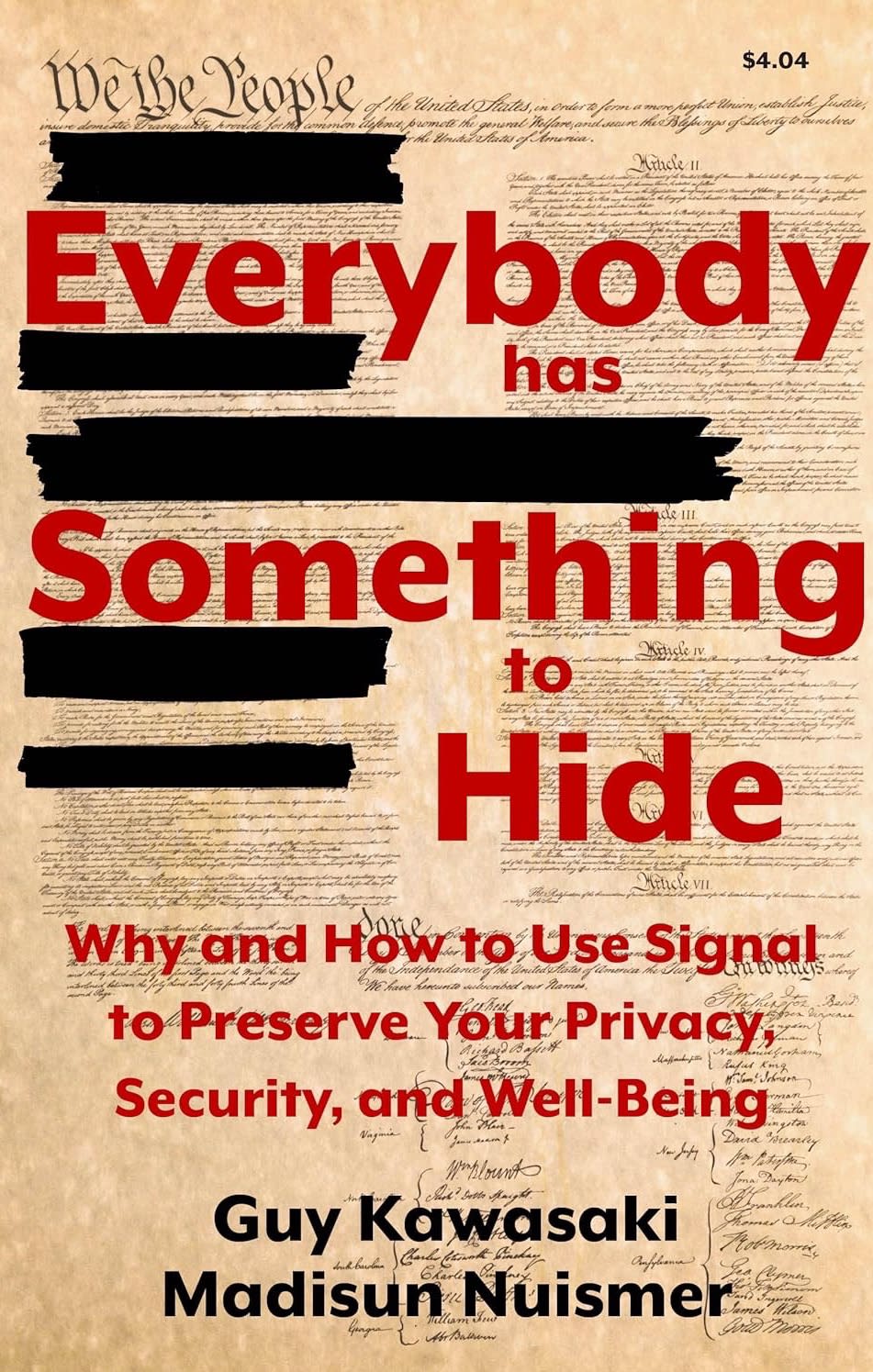
Just as you don’t need to be a John Rain-level operator to make yourself safer in the world by using basic tools like putting yourself in the shoes of the opposition, you don’t need to be Edward Snowden to use a calling and messaging app like Signal. And Guy Kawasaki and Madisun Nuismer have written a wonderfully engaging and approachable guide to how.
The Heart of the Matter is a reader-supported publication. To receive new posts and support my work, consider becoming a free or paid subscriber.
The book’s title is right on point. Spies, politicians, and our tech overlords would have us believe that “If you have nothing to hide, you have nothing to fear.” A lunacy Glenn Greenwald likes to expose by asking, “Oh, really? That’s great, let me just put this dictaphone on the table while we’re talking so I can record everything you say, and you can give me all your passwords, and by the way, how about if we set up some video cameras in your bathroom and bedroom?”
Even the people who want you to believe you don’t need privacy--Scott McNealy, Eric Schmidt, Mark Zuckerberg, to name a few--live in walled mansions and buy up adjacent properties. Privacy for me but not for thee.
The assault on privacy is a technology/government tag team. Once upon a time, we the people knew a lot about the government while the government knew little of individual people. That script has now been flipped--via secrecy metastasis, the people know less and less about the government, while via increasingly sophisticated surveillance technology, the government knows more and more about you and me. This perverse asymmetry--private citizens have no privacy, but public officials do?--is incompatible with freedom and democracy, or even with fundamental human nature.
As Snowden himself said, riffing on Thomas Jefferson’s view of the role of the Constitution: “Let us speak no more of faith in man, but bind him down from mischief by the chains of cryptography.” Unfortunately, the Bill of Rights is a static defense, while technology is ever evolving. Fortunately, what technology can threaten, technology can also protect. Signal is a welcome part of that protection--as is this book.
The Heart of the Matter is a reader-supported publication. To receive new posts and support my work, consider becoming a free or paid subscriber.
December 10, 2025
Two Conversations, Two Narratives About Ukraine
Recently I realized something that in retrospect is obvious and that I wish I’d been able to articulate sooner. But as Orwell pointed out, sometimes “to see what’s in front of one’s nose needs a constant struggle.”
Regarding the war in Ukraine, there are two conversations in play: one focusing on what should be; the other focusing on what is. The first is about fairness, principles, and aspirations; the second is about the actual costs and risks of this war.
The Heart of the Matter is a reader-supported publication. To receive new posts and support my work, consider becoming a free or paid subscriber.
Without consciously intending to, I’ve been focusing mostly on the latter. Yes, it would be nice if all nations could exercise full autonomy to do whatever they want to do and join whatever military alliances they want to join (a matter of should). But as my The System character Montie Cranston has observed, “the humans are mostly just monkeys who’ve learned how to talk.” Meaning among other things that nations, like people, have to be mindful of how other powerful actors might react to their behavior, reasonable or unreasonable, fair or unfair. We all engage in such implicit, unconscious calculations every day, and nonetheless manage to live full lives. As a friend of mine likes to point out, you may have the legal right to cross the street at a crosswalk. But when a truck is barreling down, you wait and let it pass. The exercise of your right would be too costly.
Recognizing that there are trucks out there, I tend to focus more on what will happen, less on what should be.
But that’s just me, and many people approach Russia’s invasion of Ukraine as something that should not be happening and should not be allowed. And when I make a point about what is happening—“Ukraine is losing and it’s going to get even worse”—many people respond with arguments about what should be happening—“We cannot reward land-grab aggression,” “Rules-Based International Order (RuBIO),” etc.
And so we wind up talking past each other.
I’m going to try to keep this dichotomy in mind I as engage on this topic, and hope my awareness will improve the conversational heat-to-light ratio. But the truth is, the conversational dichotomy isn’t terribly important, because one way or another reality will eventually assert itself, albeit at additional horrific cost and waste. If it were otherwise, there’d be no need for an expression like Denial, Anger, Bargaining, Depression, Acceptance.
No, what’s more important than the two competing conversations is the existence of two competing narratives.
The first narrative attributes Russia’s 2022 invasion to Putin’s Hitlerian lebensraum lust, hatred and fear of democracy, delusions of being the reincarnation of Peter the Great, dream of reconstituting the Soviet Union, etc. The second narrative attributes the invasion to 30 years of NATO metastasis, culminating in an ever-increasing de facto (and promised de jure) NATO incorporation of Ukraine—the “brightest of all red lines” not just to Putin but to the entire Russian establishment, as warned by Bill Burns, then America’s ambassador to Russia and later director of the CIA.
People who adhere to the first narrative believe Russia can be defeated. People who adhere to the second believe that if Russia ever begins to lose, the Russian government will escalate, up to and including resort to nuclear weapons.
To put it another way: adherents to the first narrative believe the Russian government looks at this war as a nice-to-have—a simple cost/benefit equation Russia will abandon if NATO sufficiently increases the pain. A similar dynamic to America in Vietnam or Russia in Afghanistan.
Adherents to the second narrative recognize that from the standpoint of the Russian government, this is an existential war forced on Russia by a west determined to destroy Russia. It doesn’t matter if that belief on the part of the Russian government is wrong, paranoid, insane, delusional, or whatever. What matters is whether it is genuinely held. If it is, and Russia ever starts to lose, far more than just Ukraine will be destroyed. Because as Obama noted in 2016, “Ukraine is a core Russian interest but not an American one, so Russia will always be able to maintain escalatory dominance there.”
Obviously I believe the second narrative is correct, and that adherents to the first one are therefore pushing the world to the edge of the abyss. Which is why I spend a fair amount of time on this topic.
I would urge adherents to the first narrative to examine it with exceptional care. Are you sure Putin is the New New Hitler? Are you sure the war was unprovoked? Are you sure the only way, or even the best way forward is continued western escalation? How do you know these things, what history are you drawing on (please try to make it more than just Chamberlain Hitler Munich Appeasement, CHiMA, as other things have happened in history besides WW2), what patterns, what observations about human nature are your conclusions based on?
Because if you’re wrong, whatever principles you might be defending might be like the principle of entering the crosswalk with the truck—but unimaginably worse.
The Heart of the Matter is a reader-supported publication. To receive new posts and support my work, consider becoming a free or paid subscriber.
December 9, 2025
"Talking Points" and Other Such Duckspeak
If someone offered you an opportunity to wear a blinking red neon sign declaring, “I’m a thoughtless imbecile,” you’d probably decline, right?
Of course you would! So then why do so many people respond to contrary views on the war in Ukraine by Duckspeaking the functional equivalent: “You are parroting Kremlin talking points!”
The Heart of the Matter is a reader-supported publication. To receive new posts and support my work, consider becoming a free or paid subscriber.
I’m not only referring to your average person, either. Listen to this debate by Norwegian political scientist Glenn Diesen and a guy from a podcast called Silicon Curtain. I couldn’t find the guy’s name, but he speaks with a posh British accent and was able to marshall a few facts—and yet in the first 15 minutes alone, he found a way to say three times that Diesen’s arguments align with the dreaded Kremlin Talking Points.
Let’s pause before going further to appreciate the impressive irony at work here. Because of course, “You are parroting Kremlin talking points!” is a classic NATO talking point. It has all the earmarks and everything!
But that’s just funny. What matters is less the irony, and more the dumb-as-a-rock notion that we should evaluate views entirely or even primarily based on whatever third-party views they might track with.
I’ve tried discussing this on social media. People don’t get it. When I observe that Kremlin Talking Points is itself a NATO talking point, the response is typically some version of “NATO talking points are better.” Yes, they really do say that. People get so occluded by the presence of this fallacious, distorted approach to reality that the only question they might be capable of is which talking points feel more appealing.
Spoiler alert—the more appealing ones will be coming from your own side.
After all, what’s more likely—and more common? That a person’s views are influenced by the views of her own in-group, her own tribe, her own government, by the domestic propaganda that’s pumped out ceaselessly into the domestic ecosystem?
Or by the views of a foreign government?
The first is easy to understand. Mostly it’s a matter of tribalism, group-think, exposure, osmosis. But the second requires some pretty way-out theories to explain, generally having to do with other manifestations of Duckspeak such as Useful Idiot and Unwitting Asset and Getting Paid in Rubles.
But really, how likely is any of that compared to plain old, garden-variety tribalism, group-think, exposure, osmosis?
Wanting to discuss these matters in ways that are more likely to produce a favorable heat-to-light ratio, I generally don’t accuse other people of parroting NATO talking points or CIA talking points or whatever—even though many times what I hear being produced by ordinary people’s larynxes is verbatim what’s spouted by Jens Stoltenberg Or Mark Rutte or whoever. What good would come from pointing this out? Instead I try to get people to consider the actual origins of this war, to consider its costs and risks along with whatever they think are its benefits, and if I can’t do that, what difference does it make how they form their opinions or where those opinions come from? Would it change their minds if I observed aloud that every time they reflexively attach the adjective “unprovoked” to “Putin’s war of aggression,” for example, that this phrase is indistinguishable from what NATO bureaucrats and US warmongers bloviate every day (the Economist is the best at this. I don’t think they’re capable of referring to the war without blurting out “unprovoked” along with it)? Or would it just irritate them, because even the most propaganda-soaked people alive are certain they’ve arrived at their opinions via a rigorous, independent, free-thinking and fair-minded analysis of all the relevant data?
So here’s a better idea. Assume good faith—in your conduct, if not in your private thoughts. Engage people on a level more sophisticated than “You are useful idiot for Putin/NATO/whoever.” Focus more on what than on who. This requires some actual thought, but once you get the hang of it, you’ll see that it’s far more satisfying than mindless accusations and other forms of Duckspeak, just as reading a book is more satisfying than sucking on a pacifier.
Related:
You can tell that Ukraine’s “supporters” recognize the war is lost by how their narrative is shifting. It’s increasingly “The west forced Ukraine to fight with one arm tied behind its back,” “America didn’t deliver the right weapons fast enough,” and straight-up verbatim “Ukraine was stabbed in the back” (SITB—it’s not just for Nazis anymore!).
There won’t be one war cheerleader in a thousand who honestly grapples with how insane and unnecessary this NATO-provoked war always was. It’ll only be about who to blame for the predictable and widely predicted inevitable outcome.
Plus ça change. See also Korea, Vietnam, Iraq, Afghanistan…the war was always a good idea, always just and necessary, always someone else’s fault, always it was actually winnable until the thing and the reason and the blah blah blah, coulda woulda shoulda but the next war will for sure be better.
I know, I know, I’m just parroting Kremlin Talking Points. And so it goes.
BTW, here’s Duckspeak in Chapter 5 of Orwell’s 1984. Does it sound familiar?
“For the rest it was just a noise, a quack-quack-quacking. And yet, though you could not actually hear what the man was saying, you could not be in any doubt about its general nature. He might be denouncing Goldstein and demanding sterner measures against thought-criminals and saboteurs, he might be fulminating against the atrocities of the Eurasian army, he might be praising Big Brother or the heroes on the Malabar front—it made no difference. Whatever it was, you could be certain that every word of it was pure orthodoxy, pure Ingsoc. As he watched the eyeless face with the jaw moving rapidly up and down, Winston had a curious feeling that this was not a real human being but some kind of dummy. It was not the man’s brain that was speaking, it was his larynx. The stuff that was coming out of him consisted of words, but it was not speech in the true sense: it was a noise uttered in unconsciousness, like the quacking of a duck.”
The Heart of the Matter is a reader-supported publication. To receive new posts and support my work, consider becoming a free or paid subscriber.
December 7, 2025
War Lovers Love Polls
I just saw Mike Pence (if you remember who that is) hawking a poll claiming to prove that 62% of Americans want to continue diverting US tax dollars to fuel an already lost foreign war and continue to kill and immiserate thousands of people a day and further increase the risk of nuclear war.
You’ll never guess who the poll’s funders are! Yep, Palantir, Boeing, Booz Allen, SAIC, Anduril, BAE Systems, BE Aerospace, Kratos Defense, Lockheed Martin, RTX, and scores of other such. What a coincidence!
The Heart of the Matter is a reader-supported publication. To receive new posts and support my work, consider becoming a free or paid subscriber.
Here’s another poll: Ukrainian Support For War Effort Collapses.
Weird that Mike Pence didn’t think to cite that one. It’s almost like he doesn’t actually care about polls. He wants war. If he can find a poll to keep the war going, polls become an important principle. If polls interfere with prolonging the war, he’ll reach for something else. War is the point. Everything else will be reverse engineered from that.
Beyond which, when did it become the obligation of American citizens—something like 37 million of whom live below the poverty line—to determine American foreign policy based on the views of foreigners, whatever those views might be?
War is a racket. It’s a scam. The sickest ripoff ever invented and profited by. And the war lovers who want more and more and more and more and more of it need you to believe it’s good for you, that they’re good for you. They count on people not even bothering to check on who pays for these polls they use as an excuse for more profit from misery. They need us to be that stupid.
The Heart of the Matter is a reader-supported publication. To receive new posts and support my work, consider becoming a free or paid subscriber.
The Heart of the Matter

- Barry Eisler's profile
- 3069 followers

