
Sharon Lathan's Blog
January 12, 2023
Miniature Portraits: Another Alternative
A while back I posted a blog on the history of silhouettes, or shadow portraits. As I noted in that post, while some silhouettes were proportional or close to the actual size of the person whose profile was being traced, as an artistic form with affordability a major contributing factor, most silhouettes were small. Many were so tiny they could be placed into jewelry.
Silhouettes: A Portrait Alternative with a Dark History (pun intended)
In contrast, painted portraits were almost exclusively life-size or gigantic (as seen in the “painting of paintings” down below). Understandably, this meant portraits were extremely expensive due to the cost of materials and the commission for the artist. With these facts in mind, it would be logical to deduce miniature portraits appeared as a unique cost-cutting art form. Not in the least, as it turns out.
 1660s “Picture Gallery of the Archduke Leopold Wilhelm in Brussels” painted by David Teniers the Younger.
The first tiny paintings arose from the medieval illustrations in hand-written books. The colorful decorations known as illuminated manuscripts became fancier and increasingly more colorful during the 1460s in order to compete with the new printed books (thanks to Johannes Gutenberg). Interestingly, the term “miniature” originally didn’t refer to being small. The word derives from the Latin miniare, meaning “to color with red lead” and minium for “red lead paint” as this was the preferred color used for capital letters and highlighted text in ancient manuscripts.
 From the Missale Cisterciense (Wolfgang Missale) in the Rein Abbey Library from Austria, 1493 (Wikipedia)
Wikipedia has a great article: Miniature (illuminated manuscript) and this one on Europeana is, well, illuminating: Lighting the Way
As printed books gained in popularity, certain artists adapted the techniques they used in illuminated manuscripts to produce small portraits using watercolor or enamel painted on vellum, copper, plumbago, card paper, or ivory. The technique was called limning, or “painting in little” and the term held until the 18th century when miniature entered the vernacular.
Early artists of note, known as a limner, included:
Jean Fouquet (1420-1481)Lucas Horenbout (1490-1544)Hans Holbein the Younger (1497-1543)Jean Clouet (1480-1541) and his son Francois Clouet (1510-1572)Simon Bening (1483-1561)These small paintings first gained prominence in the French and English courts by Jean Clouet for Francis I, and Lucas Horenbout for Henry VIII. Monarchs and the aristocracy adored the tiny paintings which could be bestowed as gifts to those whom they favored. They were seen as tokens of affection, the unframed likeness placed in a locket and carried wherever one went. They could be kept secret as a symbol of a private love or worn against the skin to feel close to one who was far away.
Miniature portraits were also used as a declaration of one’s political loyalty. During the reign of Oliver Cromwell, for instance, those loyal to Charles I carried mourning portraits to show their solidarity with the Crown. Previously, during the tumultuous reign of Elizabeth I (who was a passionate fan of miniatures), wearing her image was a sign of support against threats by Catholic Spain.
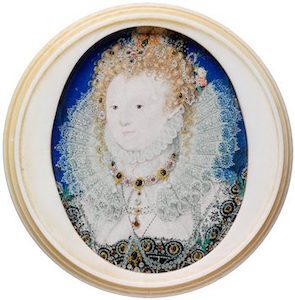 Elizabeth I miniatures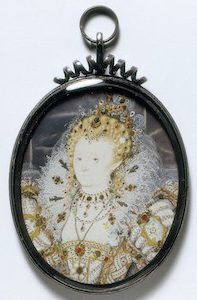
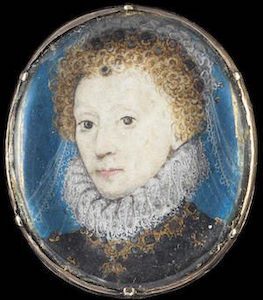
James I, who inherited the English throne in 1603, continued the trend of his illustrious predecessors, using the power of miniatures as a royal gift. Nicholas Hilliard (1547-1619) and Isaac Oliver (1565-1617), two of the greatest limners of that period in England, produced many miniature portraits of the King and his family, just as they had for Queen Elizabeth. Hilliard contributed to the understanding of the methods and materials used in 16th to 17th century miniatures with his c.1600 publication Treatise on the Arte of Limning. The six examples shared above and below are Hilliard’s work for the English royals.
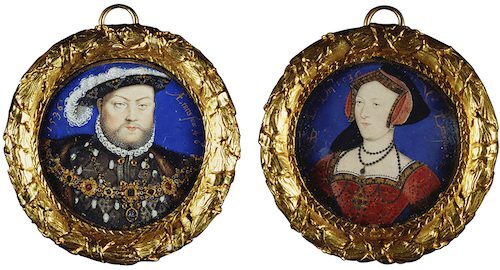 Henry VIII and third wife Queen Jane Seymour
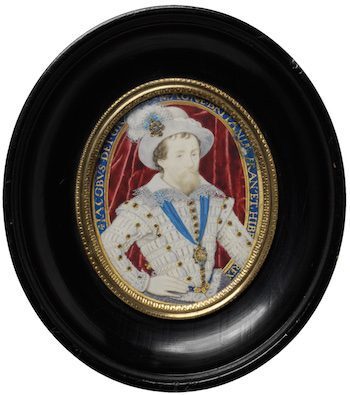 James I miniature by Nicholas Hilliard
By the late Georgian Era, miniature painting had evolved into an established profession with true masters in the art apprenticing talented young artists. In 1754, drawing master William Shipley founded an arts society in London. His desire for a serious school for artists began as a modest drawing school in The Strand called “Shipley’s Academy” and would later be known as “Ackermann’s Repository of Arts” (A name we who love the Regency are very familiar with!) and then later it became the Royal Academy of Arts. Amongst Shipley’s classes was the drawing of miniatures, and three young boys who were students during the 1760s became the famed miniaturists Richard Cosway, John Smart, and Richard Crosse.
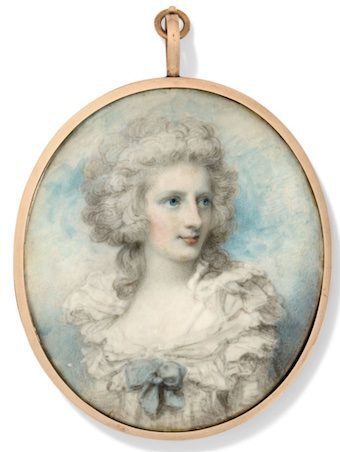
Elizabeth, Countess of Derby by Richard Cosway
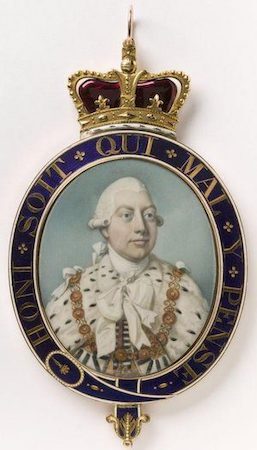 King George III by Richard Crosse, 1793
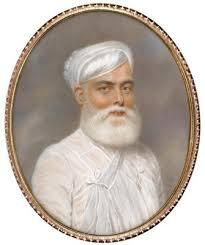 Muhammad “Ali Khan, Nawab of Arcot and Prince of the Carnatic” by John Smart, 1791
As a specialized art, miniature painting would continue well into the late 1800s, aided to a degree by the establishment of the Royal Society of Miniature Painters in 1896. However, the last great miniaturists of note are Alfred Edward Chalon and Sir William Charles Ross (Queen Victoria’s miniaturist).
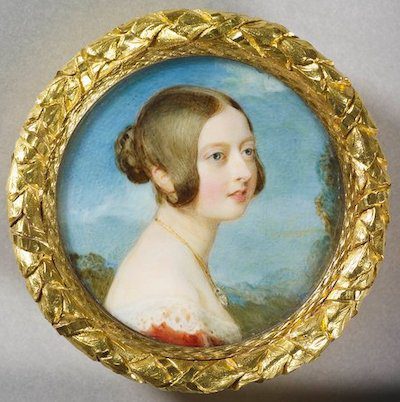 Queen Victoria, by Sir William Charles Ross, 1840
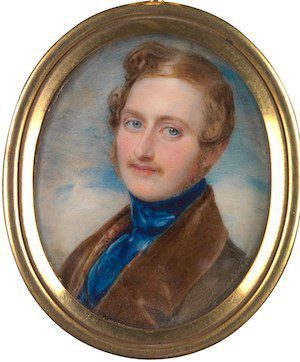 Prince Albert, by Sir William Charles Ross, 1840
The 18th and especially the 19th centuries saw advanced techniques and improved materials for creating miniature paintings far superior to anything done in previous centuries. As with silhouettes, portraits of all sizes would remain a popular method of immortalizing one’s likeness well into the 19th century. Sadly, also as with silhouettes, the improvements in artistry and lowered costs of supplies could not contend with the glory of photography, which was invented in the mid-1800s. By the 20th century, the flame of miniature portraits, a four hundred year tradition, was essentially extinguished.
The links below are to articles exploring the history of miniatures in greater depth and the great artists who created them over the centuries.
LinksA History of the Portrait Miniature on the Victoria and Albert Museum website
Windows Onto Lost Worlds, a History of Portrait Miniature Painting on Sotheby’s
Collecting Guide: Portrait Miniatures at Christies
Best Miniature Portrait Painters (c.1300-1850)
The post Miniature Portraits: Another Alternative appeared first on Sharon Lathan, Novelist.


January 10, 2023
Classic Recipes Flavored by New Cooks
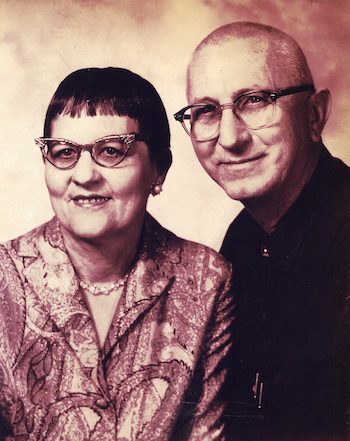 My grandparents Joe and Lucille Underwood.
My family has a unique casserole dish created by my maternal grandfather when he worked as a short order cook during the Depression. The recipe consists of hot dogs, tomato sauce, spices, onions, and cheese baked together. My wonderfully humorous grandpa named it King’s Delight, an ironic moniker due to the basic, cheap ingredients. Despite the simplicity of the recipe, the dish is amazingly tasty!
My two siblings and I begged our mom for King’s Delight over any other meal in her repertoire of excellently created dishes (she inherited her father’s culinary skills). We brought the casserole to our families, where it has now trickled down as a favorite to two more generations, becoming a certified Underwood clan classic.
Over the generations the recipe has altered slightly. For instance, I use Hebrew National All-Beef Kosher dogs and Velveeta cheese instead of the cheaper varieties. My mom preferred tomato soup and tomato sauce, while I am a tomato paste kind of gal. I’ve long ago memorized the recipe and never measure anything, thus, each time I make it, the ratio of spices and garlic and cheese will vary, giving the finished King’s Delight a unique taste that is never precisely duplicated. Nevertheless, the basic foundation established by my grandfather remains.
In other words, the classic entrée has the same edible components. They are merely flavored by a different cook’s hand.
This is exactly like writing a story based on a classic novel. Similar to my grandfather some eighty years ago, over two-hundred years ago Jane Austen invented six rich, delicious stories inhabited by a mix of succulent characters. Tales so zesty that two centuries later they continue to fill the hearts of readers with a deep feeling of warmth, satiation, and satisfaction. The connection to how a fine culinary meal makes us feel is obvious.
Reading a beloved novel is akin to a favored dish in that once is rarely enough. We soon hunger to taste an excellent dish again and revisit the delightful sensations evoked, so we return to the restaurant or dig out the recipe. In both instances, our anticipation and preference is for the novel or dish to be exactly the same. We never tire of eating a favored meal or re-reading a beloved novel, the familiarity a major aspect of the joy.
Yet we also know that the same book might connect in a different way throughout our lives or depending upon our mood. Similarly, the same dish might tickle our taste buds differently. In the case of food, slight ingredient changes or cooking techniques can improve the taste (or, to be fair, maybe make it worse).
To sum up, variety IS the spice of life, as the saying goes. Humans instinctively long to have their literary and culinary taste buds stimulated by a new sensation, particularly if reminiscent of the original. This hunger ofttimes ignites a fervor for cuisine with a similar ethnic quality or particular ingredient. Same applies to our taste in reading material. In essence, we relish having more of what tickled our fancy to begin with, but with a unique twist.
I wish our family had that very first recipe of King’s Delight my grandfather whipped up in his cafe. I bet he altered the ingredients just as we did over the decades, meaning that what he cooked for his children and grandchildren probably tasted different from the original. This fact does not mean later incarnations were necessarily better, although they might well be. I personally prefer my rendition to my mom’s, albeit only minimally.
Lucky for us, unlike that long-forgotten first batch of King’s Delight, Austen’s superb classic novels are unchanged and available for everyone to read. Furthermore, no one will claim that any fan-fiction is better.
Taking on the characters of Jane Austen is not a task for the faint of heart. People often erroneously believe we are attempting to improve on the original or that we are somehow messing up the classic by going in a different direction with our stories. If written with integrity, true passion, and respect for the original, nothing could be further from the truth.
Contemporary Austenesque authors mix up the characters, add in unique plot spices, utilize modern techniques and utensils, place everything into a shiny new pot, and serve them to hungry readers. All the while, the cooked masterpiece sitting on the shelf with “Jane Austen” on the spine remains intact.
Perhaps in a hundred years my novels will be in a library section for classic literary Austen-fiction. I girl can dream, right? Even if that happens, I have no doubt the section inhabited by Jane Austen’s novels will be far more prominent and heavily visited. For the present, those of us who write within the genre are content knowing we are contributing to the heritage of Jane Austen in our humble way. I think she would be smiling with pleasure, just as I know my grandfather would flash his mischievous grin if he saw his recipe pleasing his great-great-grandchildren. After he cracked a joke in fractured German, that is.
 King’s Delight, served with scalloped potatoes (the perfect, traditional tasty duo)
The post Classic Recipes Flavored by New Cooks appeared first on Sharon Lathan, Novelist.
January 5, 2023
Women and Music in the Early 19th Century
I would be lying if I claimed to be a Classical music aficionado. Unless chatting about 1970s and 1980s rock-and-roll, I am clueless. For this reason, when I decided to write Georgiana Darcy as a gifted musician and composer for Miss Darcy Falls in Love, I was almost biting off more than I could chew. Luckily there is Google, and in my case a dear friend who is a highly trained pianist and composer. For months I kept him on speed-dial!
But before the technicalities of musical theory and correct terminology came into play for writing the novel, I needed to discover if my hazy idea of a future for Georgiana in the professional world of music was remotely possible. For many years after this kernel of an idea sprang into my head, I honestly did not think it was feasible.
As we all know, women in the past, particularly within the upper classes, had few acceptable options at a career or profession. It wasn’t impossible, of course. Look at Jane Austen. There were many famous female painters and sculptors, for instance, as well as other authors. Even a dubious career in theatre worked for Sarah Siddons, just to name one of dozens. “So why not music?” I asked myself. Seems reasonable enough but an author needs facts to write a logical, plausible storyline.
Delving into the evolving history of music would take too much time. To sum up, the shifting styles and compositions within what is generously termed “Classical Music” dramatically changed over the Baroque decades of the 1600s to the true Classical period beginning in the 1750s, and then the Romantic era of the 1820s. The late-18th to early-19th centuries, particularly, were periods of intense change in the musical arts. Freedom of expression burst forth, primarily due to musical composition no longer being under the tight control of wealthy patrons, the aristocracy, and the Church. Artists were unafraid to experiment and break established rules, adding their unique twists and embracing the emotional elements of music. England tended to move slower than the rest of Europe, as is evidenced by the preponderance of Italian, French, German, and Austrian composers versus English ones. The influence was certainly felt in merry ole England and the compositions crossed the Channel to be enjoyed by audiences large and small.
 Two Women Making Music by Casimir Van Den Daele (1818-1880)
 The Music Lesson (1871) by George Goodwin Kilburne
A female of Georgiana’s class would have begun studying music at a very young age. Probably from her mother at first and then from a governess and tutors. If she showed a greater aptitude and the desire, she might be allowed to receive instruction from a “master”— an educated man (typically) with experience as a practicing musician. She would attend the opera, symphony, and concertos while in London, expecting to be knowledgeable on music as well as all the topics encompassing the arts. Books on musical theory were also plentiful.
At the end of the day, while an accomplished woman with talent was immensely respected and valued — and her ability to converse with men on varied acceptable subjects was expected — her intelligence and skills need only be adequate enough to entertain her husband and guests. Of course, in an age long before recorded music, radio, or cinema, being skilled with instruments was not a frivolous, inconsequential capability. Music in every variety was the prime form of entertainment at gatherings and quiet family nights at home, as evidenced by the thousands of paintings of women and men with instruments and/or singing to rapt onlookers.
 The Music Party by Louis Rolland Trinquesse (1774)
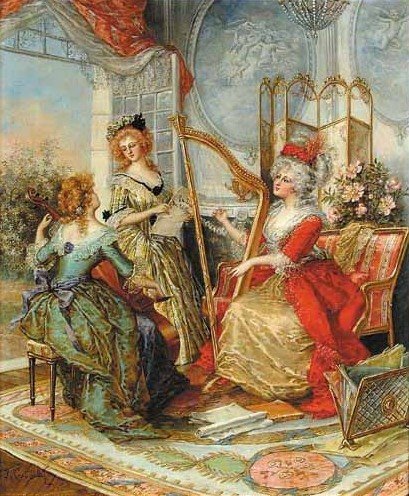 The Music Lesson by J. Gougelet (19th century)
To our modern eyes this appears to be a sexist attitude, and I suppose there is some truth in that presumption. In any event, the tide was gradually turning, even if England took a bit longer to catch up with the more liberal countries on the European continent when it came to education for the gentler sex. During the previously noted decades of rapid change, institutions for learning music (and all the arts) were established across Europe for men and women to study and enhance their talents, no matter their class or finances.
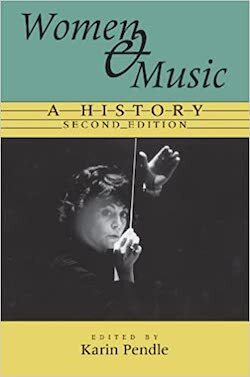 *click for Amazon purchase
While it would be well into the 20th century before all the barriers were broken, females as singers, composers, and performers on instruments were not only accepted in most of the top institutions in Europe but encouraged and, in a few cases, exalted. Women and Music: A History by Karin Pendle is a wonderful book giving an exhaustive history on the subject.
Vienna in the 17th century had four conservatories that offered education to girls with musical talent. France was by far the front runner with women trained for sacred chorus and opera for over two centuries. A number of musical institutions came and went, but women always participated to some degree.
In 1789 Bernard Sarrette established the Ecole gratuite de Musique de la Garde Nationale (Free School of Music for the National Guard). The main goal was to organize music for the army, but in 1795 the institution was changed with the prime goal being to embrace all branches of music. It was renamed the Conservatoire de Musique under the presidency of Sarrette, who “extended to 125 professors and 600 pupils of both sexes to receive free instruction” with the purpose of “teaching and performance in public celebrations” for national holidays.
Instantly, the Conservatoire became the leading school for singers, musicians, and composers. The Conservatoire grafted onto the existing Academie de Musique — the over two-century old Imperial company performing all of the arts in Paris — swelling the troupe’s number to 250 persons. Theatre dominated Parisian life during the rule of Napoleon, the brilliant epoch lasting until his overthrow in 1814. Political upheaval nearly saw the demise of the arts, but luckily Louis XVIII was a restorationist and lover of theatre. The Paris Conservatoire de Musique persevered, thrived, and to this day is considered one of the largest and most prestigious conservatoires in Europe with branches for dramatic arts and dance added to the established foundation of music.
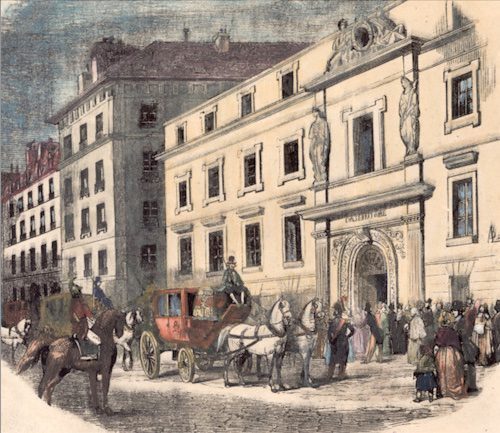 Entrance of the Paris Conservatoire de Musique et de Declamation, rue Bergere. From a wood carving c.1850.
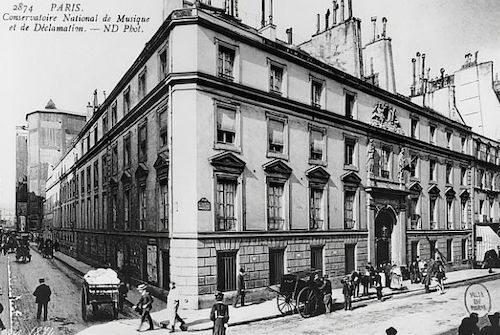 Entrance of the Paris Conservatoire de Musique, a photo from 1906.
How many women were enrolled at the Conservatoire in 1820 when Miss Darcy Falls in Love is set? The truth is I do not know. If precise records exist online, I could not find them. There is no doubt whatsoever that male students, teachers, and performers vastly out numbered the women. Was this strictly due to antiquated beliefs in a woman’s inferior capabilities? To some degree I am sure it was, but to solely claim misogyny as the cause is to forget that the overwhelming majority of women freely chose time-honored paths of marriage and motherhood. A female with a career or a higher education was essentially unheard of, in any country or in any field. It also appears certain that those passionately driven females who passed the rigorous testing for admission into the Conservatoire de Musique were not treated quite as equally as the male students, and they were not allowed to advance as far or to study certain subjects. As with many areas of women’s liberation, equality would be a slow process over the subsequent decades. This reality had to figure into the storyline for Georgiana if I wished to maintain historical accuracy.
Another hurdle in plausibility for my novel’s plot was that the Conservatoire prized French nationality almost as highly as musical talent. In other words, non-French students or teachers were rare until the latter half of the 1800s. Fortunately, I did uncover a handful of historical references for both female and non-French students.
Composer Louise Farrenc (1805–75) was appointed professor of piano at the Paris Conservatoire in 1842, noted as “one of the first female instrumental professors in Europe.”Julie Dorus-Gras, born in Belgium, was an operatic soprano admitted into the Conservatoire in 1820.Alexandrine-Caroline Branchu, born in former French colony Saint Dominique, was an opera soprano and one of the first students at the Paris Conservatoire after it opened in 1795.English composer and organist Edward Chadfield, born 1825 in Derby, studied at the Conservatoire for years before his 1861 appointment as the head organist at St Werburgh’s Church, Derby.In 1852, Camille Urso became the first female student to win a prize on violin.Not too surprisingly, the names of female operatic singers and actresses are extensive. Also, in any list of Conservatoire alumni, only those who acquired a measure of fame in their respective fields are recorded. It is logical to assume not every student completed their education and that the majority weren’t standouts worthy of historical note.
As for writing my novel, with at least a few examples and a wee bit of “creative license” I felt comfortably within the realm of reality for Georgiana Darcy and her love-interest Sebastian Butler to become students at the Paris Conservatoire de Musique.
Reference SourcesThe Paris Conservatoire in the Nineteenth Century by D. Kern Holoman
Women Composers – as Emerging from the Shadows, by Karolina Kizinska
Conservatoire de Paris, on Wikipedia
Historic Women Performers: the Sisters Milanollo, by Alessandra Barabaschi
The post Women and Music in the Early 19th Century appeared first on Sharon Lathan, Novelist.
January 3, 2023
Strange Pets in History. Support Animals gone too far?
We have all seen the stories of bizarre so-called “support animals” brought (or attempted to be brought) onto airplanes or into public places such as restaurants. A rapid Google search yields dozens of reports and photos of reptiles including snakes, potbellied pigs, assorted birds (ducks and turkeys seem popular), miniature horses, kangaroos, various rodents, monkeys, and others that owners classify as an essential-to-life companion. No offense intended as I love all animals (yes, even reptiles and rodents, many species of which I have owned over the years). I do believe animals of all kinds can bring us great joy and entertainment. That said, I confess to not comprehending how a cold-blooded snake, as awesome as they are, can be so necessary to one’s emotional stability as to not be parted from for a few days!

Leaving the what-is-a-support-animal debate aside, the inclusion of unusual animals as a devoted pet does seem to be a modern phenomenon.
Or is it?
Dogs have been domesticated for millennia, of course. Dogs in the past were mostly utilized as working animals rather than pets. Depending upon the situation, the master-dog bond varied in intensity and it was rare for larger, working dogs to be brought into the house as a companion. Smaller dogs could also be put to work, most notably terriers and spaniels as retrievers when hunting. These working small dogs were kept with the other working dogs in the kennels maintained by the estate gamekeepers.
Some smaller breed canines, even if useful in some capacity, do have a long history of being chosen as strict in-house pets for pleasure and comfort. As a proud mom to my two miniature poodles, I can fully relate to how these furry canines burrow into your heart and soul. While my sweet Olivia and Audrey are not registered support animals, they have dramatically improved our lives. For us, that is purpose enough, although if either of them sniffed out truffles in our Kentucky backyard (as poodles were originally bred for), that would be quite cool!
To answer the question I posed in the title, I did a bit of digging and found that today’s generation is not unique in picking odd animals as pet companions. Sorry to burst any bubbles for those who like to be trend setters, but here are a few names from history with their unusual pets.
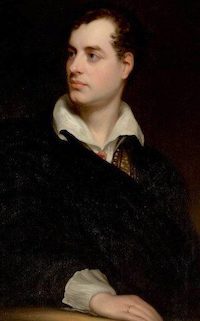 Lord Byron (Newstead Abbey; Supplied by The Public Catalogue Foundation)
GEORGE GORDON BYRON, known famously as the romantic poet Lord Byron, was a deep lover of animals. Over his lifetime he kept a countless number of dogs and cats, as well as a variety of exotic animals, including a monkey, a crocodile, a fox, peacocks, and a number of badgers.
His favorite pet was a Newfoundland dog named Boatswain. When Boatswain got sick from rabies, Byron personally nursed him back to health without any fear of becoming infected himself. Byron loved Boatswain so much that when he prepared for his years at Trinity College, Cambridge (from 1805 to 1808) he wanted to bring his companion along. Unfortunately, according to the college rules, dogs were not allowed on the grounds. Angry with the rules and out of sheer rebellion, Byron acquired a tame bear since the statues only mentioned dogs as forbidden. An argument ensued, but without concrete rules to back them up, Trinity College authorities had no legal right to expel the bear or Byron. It is unknown where Byron got the bear, and its name is not recorded, but the bear went with him everywhere, walked as a dog with a collar and chain. When Byron left Cambridge in 1808, the bear retired to his estate in London where it roamed free with several other exotic animals, including a wolf!
“I have got a new friend, the finest in the world, a tame bear. When I brought him here, they asked me what to do with him, and my reply was, ‘he should sit for a fellowship’.” ~Lord Byron to Elizabeth Pigot in a letter dated October 26, 1807
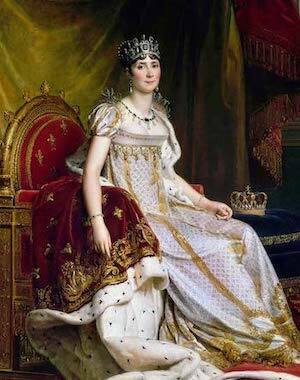
EMPRESS JOSEPHINE, wife of Napoleon I of France, was also a collector of exotic animals. Amongst her menagerie kept at Versailles were black swans, emus, and kangaroos.
Josephine’s favorite was an orangutan she named Marie-Rose (the Empress’ name before she married Napoleon). Affectionately called Rose, the orangutan shared a special relationship with the Empress. Josephine dressed Rose in white frilly dresses, and taught her to use a knife and fork so she could sit at the dinner table as a guest. It is said that Rose had excellent table manners and a particular fondness for turnips. There were also rumors of Rose sleeping in bed with Josephine and Napoleon! Sadly, while pampered and loved, Rose did not adapt well to the climate of France and indulgent lifestyle. Within a year of residence in the Bonaparte household, Rose died.
Josephine mourned the death of her companion, but desiring to aid in the understanding of the species, she donated Rose’s body to French scientist Georges-Frederic Cuvier. He published Description of an Orangutan and Observation of Its Intellectual Faculties based upon his examination of little Rose’s body. Unfortunately, there were never any portraits of Rose commissioned.
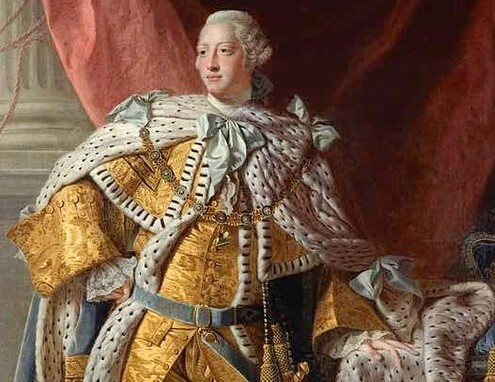 King George III
Rulers were frequently gifted exotic and priceless items, including animals. GEORGE III of England, known for his eccentricities, was no exception. In 1764, Sir George Pigot, the outgoing Governor of Madras in India, returned to the United Kingdom with a collection of “wild beasts and curiosities.” Tragically, most of the animals perished during the eight-month sea voyage, but a gorgeous mature female cheetah survived and was presented to King George. The cheetah was named Miss Jenny and while not a “pet” in the typical definition of the word, as the first of her species seen in the UK, she was very special.
George III’s uncle, William Augustus, Duke of Cumberland (a victor of the Battle of Culloden and known as “Butcher Cumberland”) was especially fascinated by Miss Jenny and the tales of cheetah’s used as hunting animals by Mogul Emperors for hundreds of years. The king gave the cheetah to the duke, who arranged a demonstration of the animal’s prowess at Windsor Great Park. A stag was placed within the royal paddock while the cheetah was “hoodwinked” with a scarlet blindfold, similar to how falcon’s are hooded. When ready, the two Indian servants holding Miss Jenny released the blindfold. The story is related fully at this link: Cheetah and the Stag but in summation, the stag proved stronger than the cheetah, however, a nearby herd of deer were not so fortunate!
George Stubbs, the famed Georgian Era painter of animals, was commissioned by Pigot for £120 to immortalize Miss Jenny and her encounter with the stag. The painting (see below) was completed in 1765, and while not precisely correct (for instance, the stag was not literally standing a few feet away) Stubb’s detailed precision captured the fine figure of the “she-tyger” and her two Indian handlers, one of whom is known to be an Indian Lascar named John Morgan. In fact, the painting is praised for “rendering without a trace of superstition or European condescension” the two Indian servants.
“They are perhaps the finest rendering of Indians in British painting and reflect the deep sincerity of Stubbs’ own nature free from all preconceived… notions of the Indian character.” ~Mildred Archer, 18th Century English Art Historian
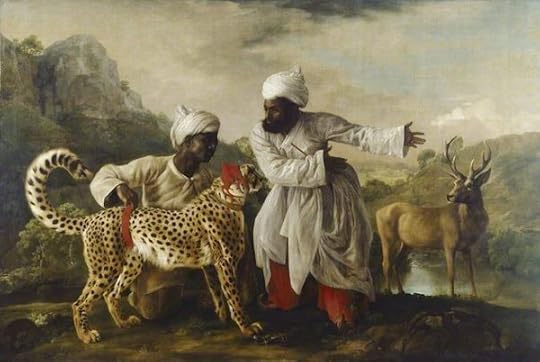 George Stubbs, “Cheetah and Stag with Two Indians” 1765.
 Manchester Art Gallery
The three above are the most famous exotic pet stories from the Georgian/Regency Era, but there are many others from history. Honorable mentions–
The alligator pet of the French Marquis de Lafayette, who ended up a joint pet of American President John Quincy Adams, living for a time at the White House.French Romantic poet Gérard de Nerval had a pet lobster named Thibault, who wasn’t confined to an aquarium but was walked around the public gardens of Paris on the end of a blue silken leash.It is believed that Romans were the first to domesticate dogs as household pets, but the ancient rulers were also very fond of moray eels. Consul Licinius Muraena (who got his name from the fish he reared) is said to have kept around 6000 of them in special pools on his property. Quintus Hortensius and Lucius Licinius Crassus were said to have wept upon the deaths of their fishy friends, with Crassus having apparently adorned his favorite eel with a necklace and earrings “just like it was some lovely maiden”.US President Andrew Jackson, a rather colorful character, had a gray-colored pet parrot named Polly who had a notoriously foul personality. Those up on their history can easily deduce from whom she learned her vocabulary of sailor-worthy swear words, many of which she loudly let loose at her master’s funeral.Amongst the English royals of the past, the list of unusual pets is long. Here are a few of several known examples–
Elizabeth I had a pet guinea pigKing Henry III (1251) had a pet polar bear gifted to him by the King of NorwayKing Henry VIII owned a marmosetCatherine of Aragon, Henry VIII’s first wife, had a beloved pet monkey that was painted with her in several portraits (see one below)Catherine Parr, Henry VIII’s seventh and final wife, kept several parrots I hope this look at pets of the past has been fun.
Now, share with me some of the unusual pets y’all have had!
The post Strange Pets in History. Support Animals gone too far? appeared first on Sharon Lathan, Novelist.
December 4, 2022
Christmas Season 2022 is Upon Us!
Over the years I’ve written a bunch of blogs dedicated to my favorite holiday season. This year will be no different as I always manage to uncover more fun facts, history, recipes, and carols to highlight. In the days ahead leading up to Christmas Day more entertaining and educational blogs will post. Be sure to come back!

This is also the perfect time to shine the spotlight on my Christmas novella. Based on The Darcy Saga, of course, A Darcy Christmas was published in 2010 as part of an anthology with Amanda Grange and Carolyn Eberhart. Then, in 2012, the three individual novellas were released as ebooks. Full information, including excerpts and reviews, are on the novel page HERE. To purchase on Amazon, click the image to the right.
In between new blogs to be posted throughout the month, check out my past Christmas-themed articles for additional joys of Christmas. All of them are linked in the Pemberley Library, but here are some of my favorite posts from years past.
Most Iconic and Dazzling Christmas Trees Around the World
Poinsettia, the Christmas Flower
Queen Charlotte’s Christmas Tree ~ O Tannenbaum
Retro Americana Christmas Cards
Turn of the Century Christmas Cards
Fun and Fascinating Christmas Trivia
Christmas Trivia from the USA, and move tidbits…
Snippets from Washington Irving’s “Old Christmas” Essays
More Snippets from Washington Irving’s “Old Christmas” Essays
Fruitcake ~ A Beloved Christmas Dessert
Launching the Christmas Season with Gingerbread
Deck the Halls With Boughs of Holly
Brief Histories of Common Christmas Traditions
Washington Irving ~ Christmas in the Regency
The Centerpiece: Christmas Plum Pudding
Mincemeat Pies ~ A Regency Christmas Essential
Fowl for Christmas Dinner, in History and Today
More Than One Way to Cook a Turkey
The Controversial “X” in Xmas: What is the Truth?
I love Christmas and I love The Muppets!
From Bizarre to Sexist to Bad: Christmas Ads of the Past
Celebrate Christmas Any Time of the Year
A Visit from Saint Nicholas (‘Twas the Night Before Christmas)
What Makes a Christmas Movie? A Listing of the Classics.
Is “Die Hard” a Christmas Movie? You Betcha!

The post Christmas Season 2022 is Upon Us! appeared first on Sharon Lathan, Novelist.
December 2, 2022
Infant Feeders and Bottles
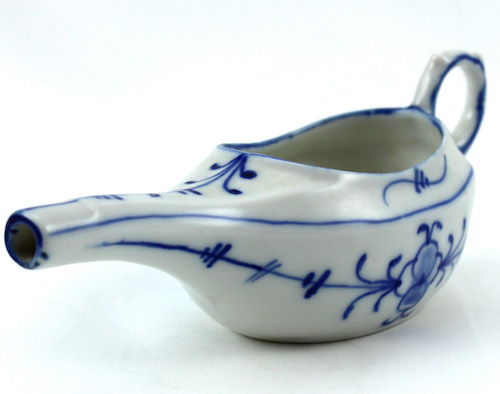
The need to supplement or substitute breast milk is not a modern problem. For a host of reasons, the functioning breasts of a mother (or wet nurse) were not always immediately available. What was one to do for the hungry baby? Infant feeders and bottles!
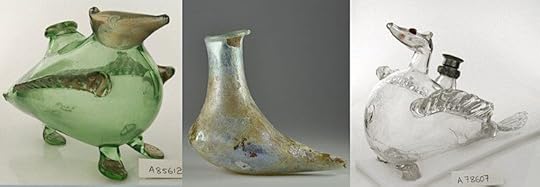 Infant Feeders
FEEDERS (examples above) and BOTTLES (examples below) designed specifically for babies date as far back as 2000 B.C. and have been found all over the world. The colorful glass feeder in the middle above dates to 1st century Rome. Early feeders were made from terra-cotta and other pottery until the 300 B.C. Egyptians began making glass. Pewter and silver were later common materials used in both feeders and bottle.
Feeders came in all shapes, designs, and sizes, the universal trait to distinguish from a bottle being a narrow outlet with a small hole allowing the fluid to drip into the infant’s mouth. Also called nursers and pap boats, among other names. The featured image at the top is an infant feeder/pap boat of porcelain ceramic stamped with the date 1733. Pap boats of this type with larger openings were also used to administer medications and liquid/soupy foods to ill adults.
Bottles shared a similar slim shape, usually with only one opening, and included some type of nipple meant to be inserted inside the infant’s mouth to suck on. In most examples, the nipple was the same material as the bottle and attached as a screw-on cap or stopper. Other bottle nipples were made from softer materials, such as cloth and gum.
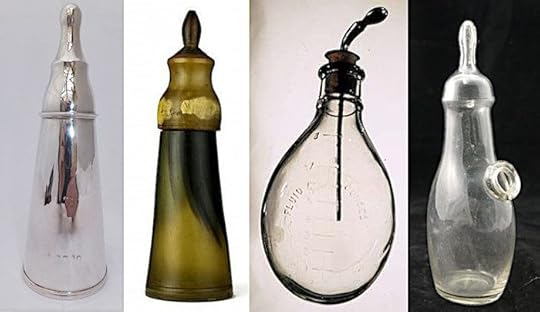 Infant Bottles
Recipes and theories of what to feed a baby varied widely, although milk (cow, goat, donkey, sheep, etc.) was typically the main ingredient. Additives to the milk base included wine, honey, mead, and egg, as well as breadcrumbs and thinned gruel or porridge.
As can be imagined from the examples shared here, cleanliness was a major problem. Instinctively, people understood the importance of sanitation (yes, even before the discovery of bacteria) albeit not to the same degree we do. Nevertheless, how to adequately clean the inside when the openings are so small presented a challenge to be sure. How many infants suffered an infection due to deficient cleanliness creating contaminants? No data exists, obviously, but one can imagine it occurred. On the flip side, how many babies were saved from starvation due to the use of a feeder? Again there are no statistics but my guess is the number is far greater.
For more extant examples of feeders, as well as other historical objects designed for children, visit my PINTEREST board dedicated to the topic. While there, check out the other boards!
The post Infant Feeders and Bottles appeared first on Sharon Lathan, Novelist.
December 1, 2022
Spit Jacks and Bottle Jacks
The low-tech and most common method for roasting meat was to hang the haunches and poultry from metal hooks over the flames. (see image below left) The cook or assistant cook manually turned and moved the meat to the desired temperature zones as needed. More commonly, however, young servant boys or girls would be tasked to stand by the fire and manually turn the hand crank for hours on end. The much busier and more important cook and assistant cook oversaw the process, leaving the physical work to the child.
The most infamous type of early method was the turnspit dog (see drawing below right). A wall-mounted circular cage secured a small dog (usually a terrier mutt) who would run akin to a hamster in a wheel, providing the power source turning the roasting spit. The poor animal would run as long as was required to fully roast the meat. This was a pre-industrial device considered an improvement over exhausting a young child. Thankfully, both methods were obsolete by the end of the 18th century.
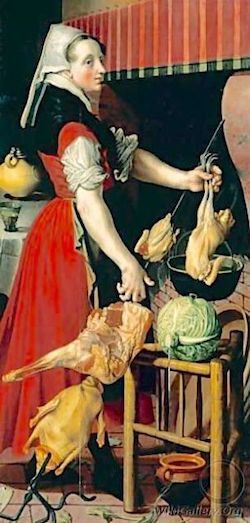 Basic cooking hooks
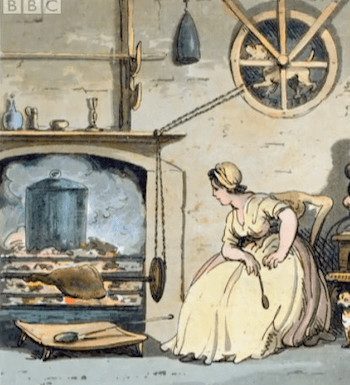 Drawing of a “turnspit dog” from the book Remarks on a Tour to North and South Wales, published in 1800
Far superior was the invention of devices known broadly as roasting jacks. These devices turned the meat in some sort of automated fashion and were not only fabulous time and labor savers, but also evenly cooked the meat. There were a variety of roasting jack types: hand crank, clockwork jack, bottle jack, spit-jack. Some of these were quite simple, while others were huge and complex.
The clockwork spit-jack (four examples below) was a vast improvement in technology. A weight attached to a string worked by gravity and needed to be re-wound periodically using a hand-crank. By far the most common automated jack, there were dozens of makers with a wide variety of styles.
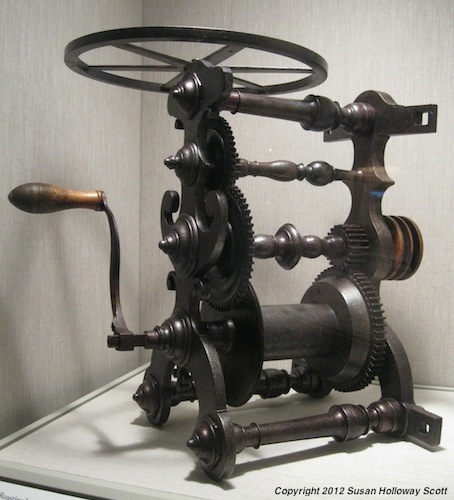 Spit or Roasting Jack, wrought iron, maker unknown but probably English, 1720-1760.
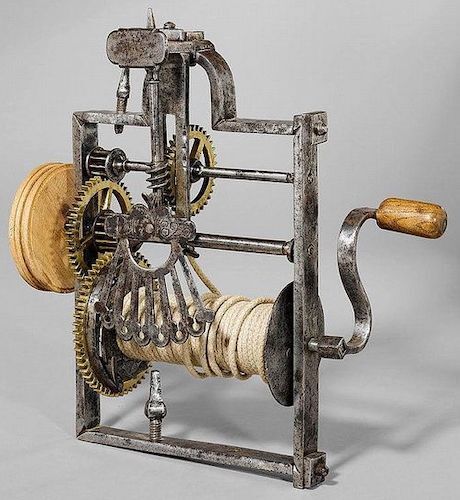 French wrought iron spit jack, monogram PL and dated 1825.
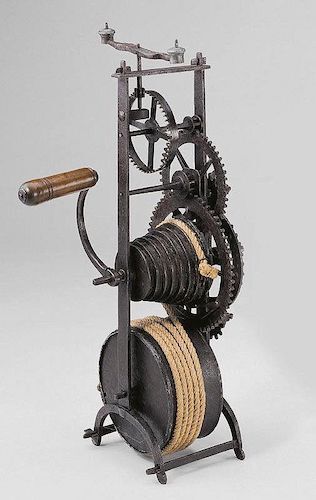 18th c. spit jack, French
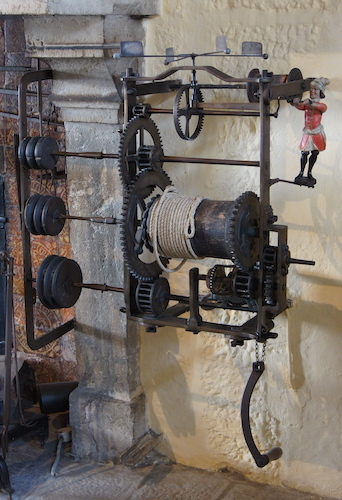 Rotative kitchen spit in Hôtel-Dieu de Beaune, France
A far better option was the bottle jack (example below left) which derived its name from the shape: the mechanism is housed inside a brass cylinder shaped like a bottle. It was an improvement over the clockwork jack-spit because it was spring driven, wound by a key, and ran for a longer length of time before needing to be re-wound.
The meat swung in a gentle clockwise and counterclockwise rotation, and if used in conjunction with a half-barrel, metal reflecting-oven or screen (example below right) facing the fire, an even heat radiating from several sides resulted in better roasting in a shorter amount of time. The latter meant it was also an efficient use of fuel.
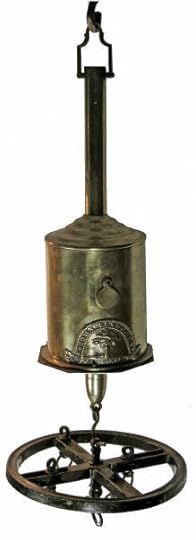 Brass bottle jack by John Linwood.
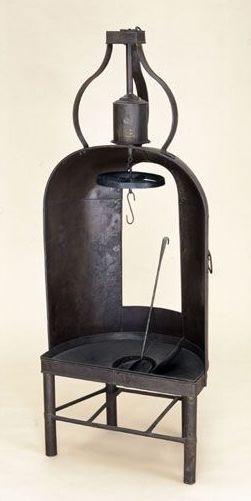 Bottle jack metal screen
The larger the fire area, the more roasting racks and spits there would be. In the image below from a historic house in Bristol, the spit-jack is the brass object mounted in the upper right corner of the fireplace mantle, the dangling weight pulley turning the meat in the metal rack inside the fireplace and over the flames (if there were flames). Off to the right is a bottle jack mounted on a black metal half-barrel screen.

The post Spit Jacks and Bottle Jacks appeared first on Sharon Lathan, Novelist.
November 29, 2022
Regency Era Charades ~ Test Your Riddle Solving Skills
Even if one has never played charades, the game of mime and acting skill is familiar. We can all envision a person standing silent before his/her fellow players as the mystery word or phrase is conveyed with dramatic performance. Not an easy game to be sure and the biggest challenge is to remain close-lipped. Speaking would make guessing a breeze, right? Don’t answer with a YES too fast!
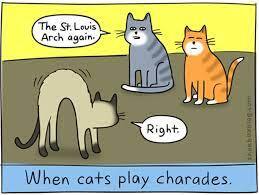
Literary riddles were a common entertainment in England, France, and other European countries. Charades, as invented by the French somewhere in the early 18th century, fell into this category. As with all variations of word games—riddles, conundrums, enigmas, rebuses, forfeits—charades involved speaking aloud. Are you surprised?
Unlike modern charades, rather than cleverly acting out the word or short phrase answer, it was separated into syllables or portions which were described verbally and enigmatically. The challenge was not in assessing gestures and facial contortions, but in deciphering tricky language and comprehending vocabulary. Adding to the difficulty in constructing a perfect charade, the verse had to rhyme.
Word games were an important part of Jane Austen’s family life. The image below is a book on display at the Austen House Museum in Chawton. In a letter to Cassandra dated September 8, 1816, Jane Austen wrote:
Our day in Alton was very well pleasant-Venison quite right-Children well-behaved-& Mr. and Mrs. Digweed taking kindly to our Charades & other Games.

Games of all sorts were written into Austen’s novels. Charades featured prominently in Emma, including the following. Try to guess it before reading on for the answer.
“My first doth affliction denote,
Which my second is destin’d to feel
And my whole is the best antidote
That affliction to soften and heal.”
The first word is WOE and the second is MAN, meaning the whole word answer is: woe + man = WOMAN.
See how that works?
One point to remember in solving a charade is to look for the clues “my first – second – third” to indicate the sections, and “the whole” or “united” or other similar terms for the complete word. Additionally, when attempting charades (or any riddle games of the era) set your mind back 200 years. Words had different meanings, for instance, and the charades included frequent references to contemporary people, literature, places, and so on.
Charades as a parlor game were extremely popular during the Regency. Intelligent, witty players wrote their own charades, but they regularly appeared in magazines and in published books of compiled brain teasers. At the end of this post, I include links to five publications on Google Books.
Dramatic performances gradually crept into playing charades, the gestures augmenting the fun of the game and spoken verses, but acting was not a universal tactic for most of the 19th century. Not until well past the first decades of the 20th century would the silent version of charades supplant the verbal, and in time the original rules of play were forgotten.
In my novel Darcy and Elizabeth: Hope of the Future, Lizzy, Jane, and Mr. Bingley secretly plan a celebration for Mr. Darcy’s twenty-ninth birthday. Along with blindman’s bluff and twenty questions, the quartet plays charades. As I have written the character of Mr. Darcy, he possesses a hidden talent for drama. So hidden, in fact, that when he chooses to unleash his skill by added vocal intonations, facial expressions, and gestures to his charade, the others are astounded!
I’ll keep that enticing visual as an inducement to buy my novel, and for the same reason, I am not revealing Mr. Darcy’s cheeky charade amongst the eight Regency era samples in this post. Give them a go (answers in the spoiler at the end) and let me know how well you did. Good luck!
#1 —
My first is in harvest rarely known,
Nor would it welcome be.
My next in country or in town,
Each miss delights to see.
And when drear winter’s dress is shown,
In joyous play my whole is thrown.
#2 —
My first dispels the darksome gloom;
You love my next wherever you roam.
My whole with cheering ray from far,
Gives comfort to the wandering tar.
#3 —
My first a blessing sent to earth,
Of plants and flowers to aid the birth.
My second surely was designed
To hurl destruction on mankind.
My whole a pledge from pardoned Heaven,
Of wrath appeased and crimes forgiven.
#4 —
My first, all sabled over with gloom,
Shuns the effulgent light of day;
My second, formed on fashion’s loom,
Gives female dress a neat display;
And in the embraces of my whole I’m blest,
While through my first I seek oblivion’s rest.
#5 —
A mischievous urchin may soon do my first,
If he meets with a teapot or ewer.
My second bring on us both hunger and thirst.
My whole thirst and hunger will cure.
#6 —
My first’s a word comedians dread to hear;
My next gives charms to the revolving year.
My whole’s the joy of many a happy pair,
Yet ofttimes brings them misery and care.
#7 —
My first is an animal’s coat;
Many trees in my next you may place.
My whole, to your grief, will denote
That time has made work with your face.
#8 —
Hail! Glorious first, whose beams resplendent rise!
Thou, with my next, art welcome to the skies.
My hallowed whole calm consolation brings,
And relaxation from all earthly things.
#1 — SNOW + BALL = SNOWBALL
#2 — LIGHT + HOUSE = LIGHTHOUSE
#3 — RAIN + BOW = RAINBOW
#4 — NIGHT + CAP = NIGHTCAP
#5 — BREAK + FAST = BREAKFAST
#6 — OFF + SPRING = OFFSPRING
#7 — FUR + ROW = FURROW
#8 — SUN + DAY = SUNDAY
A New Collection of Enigmas, Charades, Transpositions (1791)
Riddles, charades, and conundrums. (1822)
The post Regency Era Charades ~ Test Your Riddle Solving Skills appeared first on Sharon Lathan, Novelist.
November 27, 2022
Darcy Saga Characters: The Marquis of Orman
Continuing on with the series delving into the many secondary characters inhabiting the nine novels and one novella comprising The Darcy Saga. It is fun for me to revisit the plethora of pivotal, important characters interacting with the main characters. Hopefully it is a fun endeavor for all of you too!
These introspective and excerpt laden posts are publishing in order, more or less, based on when the characters are introduced in the novels. If the previous four posts were missed, I encourage reading them first.
Darcy Saga Characters: The Lathrops
Darcy Saga Characters: The Vernors
Darcy Saga Characters: The Hughes and The Sitwells
Darcy Saga Characters: The Fitzherberts and The Drurys
For an overview of the vast number of characters within The Darcy Saga, visit the Characters page for lists for each novel and the extensive family tree I created. Additionally, the Portrait Gallery has images for each principle character.
 *click for Amazon
The majority of the characters I created over the course of writing the ten volumes of The Darcy Saga were friends and extended family members, along with a couple of future spouses for the unattached Bennet sisters, staff and servants. Not all were fleshed out and aside from a handful of notable exceptions, they were presented as decent people harboring no ill intentions or nefarious plans. I rather like it that way, what with being the “happily-ever-after” gal that I am. Nevertheless, I am a realist so well aware that not all people are good. In fact, far too many are downright evil, at least to some degree. Moreover, no matter the desire for saccharine sweet, a story really needs a villain or two to enhance the excitement and realism.
Marquis of Orman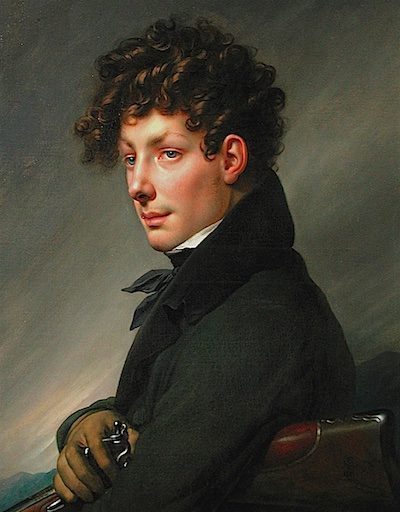 My chosen vision of the Marquis of Orman
“Portrait of a Young Man as a Hunter” by Anne-Louis Girodet de Roucy-Trioson (1767-1824)
Way back in 2006 when I began writing, I knew my story would lean heavily toward the sweet side. The goal of presenting a fulfilling marriage and realistic life for the English upperclassman during the Regency period has always been my top priority, and let’s face it, even today most people go through life facing mundane challenges without anything truly horrible happening to them. Praise God! And by “truly horrible” I mean the ultra dramatic, world-ending trials that make for an awesome action flick and edge-of-your-seat thriller novel. I didn’t want to write that kind of story for Darcy and Elizabeth, so to be honest, adding a life-and-death situation wasn’t high on my list.
Eventually, however, I came to the realization that my story did need a bit of heightened drama. Moreover, and perhaps more importantly, I wanted to stretch myself as an author. Could I write an intense scene and delve into the dark turmoil that ensues? I shall let others judge the scenes for themselves and how well I succeeded, but I think I did a fabulous job!
Now, while maybe a tad cliché, in my mind a dramatic event needed a villain. Using Mr. Wickham was too obvious, IMO. I ended up going that route in later books as Wickham is too important within Austen’s canon to ignore completely, but for my first foray I wanted someone new. I no longer remember where his name came from, although I do know I chose the French “marquis” as opposed to the English “marquess” because I wanted him to be mysterious and pretentious. It is historically accurate, by the way, as the French spelling wasn’t unusual in the UK.
In the fifteenth chapter of Mr. and Mrs. Fitzwilliam Darcy: Two Shall Become One – titled “Twelfth Night” – Darcy and Elizabeth attend the annual masquerade ball hosted by Sir John Cole at Melcourt Hall. This happens to be Lizzy’s first formal introduction to Derbyshire Society (not counting a few private dinners with Darcy’s close friends), so naturally an important occasion. She meets Lord Orman during dinner, the designated seating arrangement placing her diagonally across from her husband and beside the Marquis, who is described as, “a handsome man perhaps a year or two older than Darcy, unmarried and charming.” Initial conversation between Lizzy and Orman is light and engaging, a positive Lizzy appreciates. The first unsettling glimmer is shared in the excerpt below.
“Mrs. Darcy,” Lord Orman said, “I understand you are from Hertfordshire?”
“Yes, My Lord, you have heard correctly. Are you familiar with the region?”
“Not much, I confess. I have traveled through on my way to London; however, I have not tarried in the area. Do you miss your home?”
Lizzy smiled. “I miss my family somewhat, but Pemberley and Derbyshire are my home.”
“Of course. Forgive me, Mrs. Darcy, I meant no offense.”
“None taken.”
“Did you leave a large family behind?”
“Four sisters and my parents, as well as cousins. Fortunately, Meryton is not a great distance, and it is the lot of us women eventually to leave our parents for our new families. I am content.” Lizzy glanced at Darcy, who was apparently absorbed in his plate, but she noted the tiny crease between his brows and well knew what it signified.
“Of course.” Lord Orman continued. “Still it must be difficult to leave what you have always known for the unknown.”
“You would be mistaken, My Lord. It has not been difficult in the slightest. I am exceedingly comfortable here. The scenery and natural formations are widely diverse and majestic here in Derbyshire. Far more so than Hertfordshire, which is pastoral. Unfortunately the weather has not been kind enough to allow me the opportunity to explore as I would wish; however, this will be remedied in the spring.”
“Do you appreciate the out of doors then, Mrs. Darcy?”
“Oh yes, very much.”
“You ride, I presume.”
“Actually, not at all. I prefer to walk.”
He was taken aback, “How odd. A Darcy who does not ride. Who would have believed it? I would rather have imagined horsemanship a prerequisite for matrimony amongst the Darcys.” He seemed to be teasing but Lizzy found the comment a trifle rude. Apparently, her husband did as well.
“I fear you are hasty, Orman, in forming assumptions regarding the character of the Darcys.” He spoke softly but with an edge that Lizzy recognized as irritation and his eyes were a flinty blue. “A person’s caliber is not dependent on a particular accomplishment, nor can a host of accomplishments accurately illustrate one’s quality.”
It was a true statement voiced in a flat tone, but Lizzy, who knew her husband so well, understood he was casting aspersions. Orman knew it also, and there was a moment of silence before he laughed, “Touché, Darcy.”
As they stood to leave the table, Lord Orman leaned close to Lizzy and said softly, “I hope I did not offend, Mrs. Darcy. You appear an intelligent young woman and I enjoyed our conversation. I would like to be counted a friend.”
Lizzy was terribly uncomfortable and momentarily at a loss. Darcy, she noted quickly, was on the other side of the table speaking with his aunt, apparently unaware of Lord Orman’s attention. Lizzy took a step backwards, smiled pleasantly, and met his eyes frankly. “Thank you for the compliment, Lord Orman. I can assure you that whomever my husband counts as a friend is also a friend of mine. As I am a new inhabitant of the area, I am leaving these decisions to him. It is far too easy to arrive at swift and errant judgments.”
Lord Orman bowed and retreated slightly but continued undeterred, “Would I be too bold to ask if I may secure your hand for a dance set, Mrs. Darcy? Or does Mr. Darcy make those decisions for you as well?”
Lizzy was stunned, a ready retort on her lips, but they were both startled by Darcy’s deep voice. “Mrs. Darcy is free to fill her dance card with whomever she chooses.” He stood next to her, towering over Orman by at least five inches, calm, and impassively gazing at the Marquis as he offered his arm to Lizzy.
Lizzy smiled brightly at her husband as she placed her hand on his arm, and then turned to Orman. “Thank you, Lord Orman; however, all dances are promised to my husband, by my choice.” She curtseyed and he bowed.
“Perhaps another time then, Mrs. Darcy. Mr. Darcy.” He bowed again and moved away.
“Interesting man,” Lizzy commented sardonically.
“He is a scoundrel, Elizabeth. I cannot fathom what Sir Cole was thinking to seat him at the head table, and close to me. He knows we despise each other.”
“As bad as all that?” She said with an arch smile. “You must fill me in, William! I am becoming quite enamored with the local gossip.”
He looked at her in shock and then, seeing a feigned vapid expression on her face, he laughed. “Perhaps, darling, you should steer clear of Mrs. Cole and her cronies for the remainder of the evening. They are corrupting your good sense.”
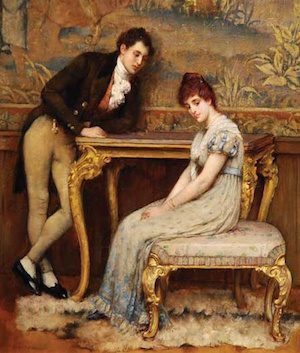 Orman bothering Elizabeth
Later that evening, a second encounter with the Marquis of Orman did not end as politely. After several turns on the dance floor with her husband, Darcy went in search of refreshments, leaving Elizabeth resting on a seat in a quiet corner.
“You dance the waltz as if born to do so, Mrs. Darcy.”
The voice jolted her out of her reverie and she looked up into the eyes of the Marquis of Orman. “My Lord, forgive me. I did not see you approach.”
“It is I who should beg forgiveness, Madame. I believe I interrupted your rest. You must be fatigued after such a vigorous dance.” He was smiling strangely and peering at her far too boldly for comfort.
“This would be twice tonight you have been mistaken, sir. I am not fatigued. Merely catching my breath and capturing a moment of solitude until Mr. Darcy returns with our refreshments.”
“Ah, so he is to return. Pity. I was rather hoping he had deserted you. May I?” He indicated the empty side of the sofa, but without waiting for an invitation, he sat and leaned toward Lizzy. “Are all the women of Hertfordshire as beautiful as you, Mrs. Darcy? If so, I must travel there immediately. Perhaps I shall be as fortunate as Darcy.”
Lizzy recognized with alarm that the Marquis was inebriated. She did not wish to make a scene nor to have Darcy discover him here. She glanced around quickly and did not see her husband’s towering form anywhere near. “I appreciate the compliment, Lord Orman. However, I believe it improper for you to offer it and to be sitting so close to me. Please stand a pace away, sir.”
“Beautiful and spirited, too. I can understand why Darcy married you. The Monk of Pemberley found his match, and the heart of every young maiden in England was broken.”
Elizabeth was furious. “Marquis, I will overlook this hideous breach of manners for the sake of peace at these festivities and because I deem you are not fully in charge of your faculties. I will not, however, sit here and listen to you any further. Please excuse me.” She stood to leave but he grasped her wrist tightly.
“Orman! You will unhand my wife this instant, or I promise you will not live to see the light of day.” One glance at Darcy’s enraged face and Orman flinched, releasing Lizzy’s hand as if it were on fire. Darcy was livid, visage dark and perilous, flinty eyes boring into Orman with a chilling intensity. Without blinking or removing his glare, he handed the cups to Elizabeth. “My dear, take these and find Lady Matlock. I will join you momentarily.” His voice was calm but colder than Lizzy had ever heard it. She took the cups and left without a word. A backward glance revealed Darcy firmly and ruthlessly propelling the unresisting Marquis out of the hall.
Fortunately, Darcy managed the situation without creating an uproar, the entertaining night ending peacefully. Weeks passed into months, neither of them wasting a moment thinking about the rude marquis. As it turns out, Lord Orman had not forgotten, and when chance presented the opportunity, he pounced. On a beautiful day in April, Lizzy set out on a quest to pick early-season dewberries, and on the way back to Pemberley she crossed the main road at the same time as the Marquis drove by. After a very brief exchange of pleasantries, Lizzy’s attempt to resume her walk was forestalled.
 discarded bucket of dewberries
“Mrs. Darcy, may I offer the services of my carriage? It is warm today and you appear quite flushed.”
“I assure you I am fine and, if you remember, I revealed to you that I enjoy walking, so thank you, but no.” She took several steps before she realized that he was alighting from his vehicle.
“Mrs. Darcy,” he called to her and she stopped, “I would like to take this opportunity, if you will allow, to apologize for my behavior at the Masque. It was inexcusable and I am deeply remorseful. Can you find it in your heart to forgive me?”
She glanced at him, flushing at the reference to that horrible event, and extremely uncomfortable. Nonetheless, Lizzy was by nature a forgiving person and, despite Darcy’s assertions as to the exact nature of Orman’s character, she wanted to believe he was truly repentant. She smiled slightly and again briefly met his eyes. “Let us not speak of that occasion, My Lord. It is best to put such unpleasantness behind us.”
“Excellent!” he exclaimed cheerfully, “Then, as all is forgiven, you can accept my offer for a ride. Come, Mrs. Darcy.”
“Again, thank you, sir; however, I honestly do prefer to walk. Good day, Marquis.” She curtseyed yet again and began to turn, flabbergasted afresh when he grasped her elbow firmly.
“I must insist, dear lady. Your feet are drenched with mud and your face is ruddy and perspiring. You appear unwell. What manner of a gentleman would I be to leave an ailing woman stranded on the roadside?” His smile was lecherous, and Lizzy was seriously apprehensive but also angry.
“Lord Orman, unhand me at once and leave me be. I wish to walk, and Mr. Darcy would certainly not be pleased to hear of your attentions.” She shook her arm but he tightened his grip painfully.
“Is Darcy the only man worthy of your attentions, Mrs. Darcy?” He roughly pulled her toward him while leaning into her body and she realized with dawning horror that he intended to kiss her! Without conscious contemplation, Lizzy acted. She resisted forcefully and swung the wooden bucket with astonishing velocity and accuracy, smashing it into his head. He yelled and released her elbow. Lizzy spun and bolted into the woods without a backward glance, dropping her bucket of purple berries on the road.
Now, I don’t want to spoil the story completely, but will give a wee hint: duel with swords. YES! Boy, was that fun to write! I encourage anyone who hasn’t read my novels to click over to Amazon (link above) to read the thrilling conclusion to this particular interaction with the dastardly Marquis of Orman.
For several reasons, I opted to leave the terrible Orman alive after the duel with Mr. Darcy. I did not have any idea of why, how, or when he would return —or even IF he would return— however I figured it was a waste of a good villain to take him out of the picture entirely!
Orman did, in fact, return and what happened the second time around was far, far worse than the first. These events are told in The Trouble With Mr. Darcy, the fifth novel in The Darcy Saga series. I shan’t give many details here, but the snippet below is his reintroduction, so to speak. After an unpleasant conversation with Mr. Wickham, Lizzy experiences a strange incident while on a walk with her sisters in Hertfordshire. Later that evening, she shares the troubling mystery with her husband.
Oh my! What happens next?
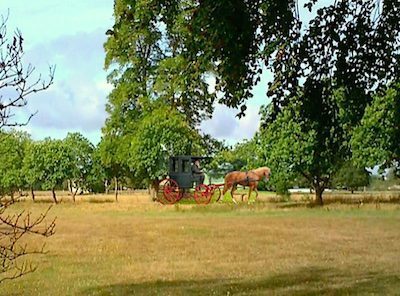
“It is like a dream that seems so real when you first awake with heart pounding and the sensations vivid. But then the more you try to bring the images into precise focus they become hazier still and slither away until all that is left is an impression that lacks clarity or power. This is like that. I looked across the meadow to a parked carriage. It was just sitting there, alone, not ominous in the least. Then, for a breath of time only, I imagined I saw a face.”
She was staring into the distance, brows wrinkled with concentration. Darcy examined her closely, but she did not appear to be anxious. Rather she looked confused and mildly irritated. “I cannot think for the life of me why I would imagine him at that moment. There is no connection whatsoever, except that they are both men who have caused us pain in profound ways.”
“Who? Who did you imagine?”
She turned back to him, peering unblinkingly into his baffled eyes. “The Marquis of Orman.”
Darcy drew in a sharp breath, lips pressing together until nearly invisible, and the spasm that jerked through his jaw was marked. “Are you sure?” He choked out in a low growl.
“No! William that is the point! I am the exact opposite of sure. I could not describe what I think I saw if my life depended on it! That is what gave me a headache and has distracted me all night. Not Mr. Wickham, but the struggle to bring coherency to what is now only a vague impression of a person we shall never forget. I knew I had to tell you, but it does seem rather stupid since I cannot recall the tiniest detail that lends credence to speaking his name.”
“Yet his is the name that surfaced in your mind when you saw… whatever it is you saw. Why?”
“I do not know! Except that, if you examine it from a certain perspective, they are, as I said, men who have caused us pain. Perhaps on some unconscious level dealing with Mr. Wickham has unearthed frightening memories of Lord Orman.”
“Tell me what you saw, as much as you can recall.”
“A carriage, plain and nondescript, sitting on the road some distance away. No movement from the coachman. I did not think much of it initially. Then I detected movement from within. A hand, I think, holding a walking stick and tapping on the ceiling to alert the coachman. William, it truly was the barest glimpse. Perhaps not even that. Did I see a face? I want to say I did, but all I remember is pale flesh holding a cane, a flash of gold, and dark eyes. Orman’s name seared through my brain and I doubled over in pain. That part was real. The pain. But Alexander was there with dandelions, and Mrs. Hanford and Jane expressing concern, and as quickly as it was there it was gone. The carriage too. Lost in the dust and I saw nothing else.”
Darcy had risen from the sofa and was standing stiffly before the fire, his face etched with perturbation and fingers fidgeting. “You may judge it nothing of import, Elizabeth, but I do not. It has been years since your last nightmare of Orman. There is no logical reason for you to conjure his name or image unless something you saw in those fleeting seconds reminded you of him. Granted, that is not proof it was him, but I will not assume it of no consequence either. You are not typically a fanciful woman.”
I hope y’all have enjoyed these tasty treats and
will rush out to buy the books and read the full story.
The troubles caused by the nefarious marquis are merely a small portion
of the epic life lead by the Darcys within The Darcy Saga!
The post Darcy Saga Characters: The Marquis of Orman appeared first on Sharon Lathan, Novelist.
November 23, 2022
HAPPY THANKSGIVING 2022
 American novelist Jonathan Safran Foer
Thanksgiving is the holiday of peace, the celebration of work and the simple life…
a true folk-festival that speaks the poetry of the turn of the seasons,
the beauty of seedtime and harvest, the ripe product of the year
— and the deep, deep connection of all these things with God.
~ Ray Stannard Baker, Pulitzer Prize winning author
As we express our gratitude, we must never forget that the highest appreciation is not to utter words, but to live by them.
~ President John Fitzgerald Kennedy
 Congregational Minister and novelist Edward Payson Powell (1833-1915)
There is one day that is ours.
There is one day when all we Americans who are not self-made go back to the old home
to eat saleratus biscuits and marvel how much nearer to the porch the old pump looks than it used to.
Thanksgiving Day is the one day that is purely American.
~ O. Henry
Ah! on Thanksgiving day….
When the care-wearied man seeks his mother once more,
And the worn matron smiles where the girl smiled before.
What moistens the lips and what brightens the eye?
What calls back the past, like the rich pumpkin pie?
~ John Greenleaf Whittier
 Edwin Arlington Robinson (1869-1935), three-times Pulitzer Prize winning poet, four-times nominated Nobel Prize in Literature
Let us remember that, as much has been given us,
much will be expected from us,
and that true homage comes from the heart as well as from the lips,
and shows itself in deeds.
~ President Theodore Roosevelt
“If you think Independence Day is America’s defining holiday, think again.
Thanksgiving deserves that title, hands down.”
~ Tony Snow, American journalist
 Marcus Samuelsson, Ethiopian born acclaimed celebrity chef
Almighty God, who hast given us this good land for our heritage;
We humbly beseech Thee that we may always prove ourselves a people mindful of Thy favor and glad to do Thy will.
~ President Franklin D. Roosevelt
“When I started counting my blessings, my whole life turned around.”
~ Willie Nelson, country singer and songwriter
 W.T. Purkiser, American preacher and author
The post HAPPY THANKSGIVING 2022 appeared first on Sharon Lathan, Novelist.


