J. Wesley's Blog
April 6, 2026
Painting Mirrors (Love Over Fear)
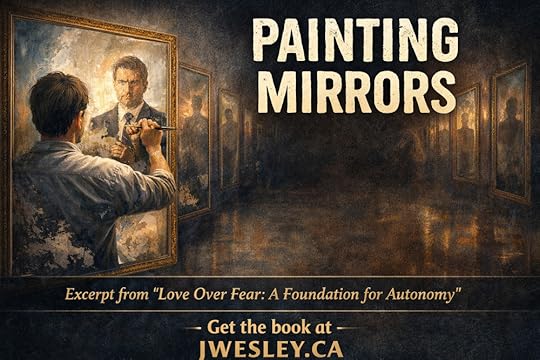
When we first start building our cohesion of the nature of reality, we see a mirror of ourselves in reality. We ask our first questions in regard to why we see what we see in this mirror. As children, we depend on others' input, they define what we see, so we paint that image on the mirror, covering the true image of our reflection to have a dependable, unchanging idea that fits with other’s beliefs and we go on to the next mirror.
The next mirror, we may be taught in school, the Newtonian law, “Consciousness is in the brain. Your body is solely physical matter.” So we paint over our mirror of what our human nature is. We use our imaginative wonder-filled minds as children and see a magical world around us, in us. We dream up possibilities, and share them with others who tell us that what we are telling them isn’t real, or impossible. So we paint over that mirror, limiting ourselves to not think further on the reflection in our own mirrors of reality. In the end as adults, we look down our hallway of mirrors of what our reality consists of, our experiences, and see no genuine reflections of our own experiences, thoughts, and beliefs anymore. In place are lifeless paintings, constructions of general consensus, beliefs that do not belong to us, and we accept them as reality. Some may be somewhat close to the reflection, some may be far away from what reality truly is, but all are incorrect; reductions of the intricacy, complexity, and infinity of our reality. You may learn about quantum mechanics, and have to go back and clean your mirror of what nature even is at the core, but it’s a messy job and you don’t know where to start. You’ve already painted over hundreds of mirrors with the reality of that first mirror that you’ve painted over.
Now you feel the need to make sense of an overwhelming heap of unknowns or otherwise recognize what you see as an individual is truly a mystery, cannot be defined and learn to embrace that notion. Cognitive freedom truly comes from accepting and relishing the unknown, the mystery. Rekindling and applying that childhood sense of wonder, erasing many mirrors and accepting that it's ok to not know everything but to learn to be content with your interpretations and experience as your reality, even if it is different from everyone else’s.
Excerpt from, “Love Over Fear: A Foundation for Autonomy”. Get the book!


Contentment of Curiosity

In a world focusing so hard on empowerment and confidence, I'm truly pushing for something different. It's great if you're confident and empowered but it doesn't provide direction whatsoever. Contentment is also a great thing but ignorance is bliss and as such, contentment can be a dangerous focus in itself. It's too passive to stand alone as a driving force. I strive to instill inspiration for contentment of curiosity; an active positive skepticism. Life is going to be full of imperfections and we're always going to be imperfect. Focusing on becoming a confident, empowered, and content imperfect person leaves out a critical part of the puzzle, curiosity.
Curiosity in itself is not even enough direction for us to base our lives around. I feel we need contentment closely paired with curiosity so that we are inquisitive as to why we are content, why we are seeking contentment, and why we are curious in the first place. It's a really beautiful thing to be content with your imperfect self. That's doing the best they can, but at the same time it's a double-edged sword that invites complacency. Self-acceptance is not necessarily self-improvement. Contentment should be directed more towards being at peace with your process of growth rather than satisfied with the results. We need to be curiously striving to better ourselves consciously. That involves instilling a rather oddball almost paradoxical feeling of being happy with being wrong. Taking that and running with it, being content and curious with finding out your own weaknesses. Weaknesses in your patterns of behavior, with your mindset, with your interactions with the world, and most importantly, with your beliefs that underlie all of these things.
To see how this feels in the heat of the moment, let's apply a friction point. Picture this: you get offended. It happens all the time. Someone says something, you see something controversial, somebody cuts you off in traffic. Except this time you observe the event happening from a place of contentment of curiosity. Instead of looking at the observation that you've witnessed as a formula, you look at it as multiple questions. Why is this occurring? Why am I feeling offended or triggered by it? What are the underlying implications? What are the environmental factors that have influenced this to happen? Now instead of seeing something and being reactive to it, you're exercising your free will and looking deeper to give yourself a more well-rounded perspective. This gets you out of a reactive mindset and puts you in the role of the content and curious observer.
In the state of friction, the question arises, what now? What decision do I make? Within the contentment of curiosity we must ask: Why does a decision need to be made at all? While a decision can be made, but it doesn't always need to be made. We may feel drawn to “solve” the problem in the moment or “fix” the offense, but the main goal is the observation itself. Learning to understand with greater depth isn't an action to do, it's the destination we journey towards. By choosing to follow the questions it shifts us from a transactional mindset to an existential one, where the search for truth is the highest endeavor.
Not only does this ease the blow to your self-importance, with habituation of this practice you'll begin to hone your self-importance on a regular basis. It doesn't truly matter that you've been offended by it. It matters that you learn and grow from it; that you learn to understand and gain knowledge from the occurrence that you observe.
Integrating this into social dynamics opens more opportunity for empathy and intellectual humility. You're not just helping your own frame of mind, you're allowing others more freedom of expression without becoming reactive or stepping into their framework.
One of the most powerful pieces of knowledge that you can use with this is good old Socrates’ concept of knowing that you know nothing. If we're content with knowing nothing then we're more than happy to be curious and to learn. When embody knowing nothing, we have nowhere to base our judgements and biases to create a negative situation. True empowerment isn't having confidence in your current perspective but having the contentment to continue openly searching for answers.
Fear of Our Own Minds

Talk about something that someone doesn't know and maybe even be skeptical about without any understanding or knowledge of it and they'll commonly say something like, “Oh I don't know about that.” Which isn't an egoless statement of unknowing, nor is it a statement that's open to learning anything about it, but it's a diminution without contemplation, education, knowledge, or reason.
For instance, if you're scared of something, regardless of what it is, learn about it, familiarize yourself with it, realize what that thing's role is in nature, why it exists, what its potential could be, and you will find yourself far less judgmental from a fear-based standpoint. Fear is not just an intelligent reaction, but also an intellectual reaction. Fear arises from over-conceptualization, reaching conclusions that do not exist in nature.
Limiting our infinite selves to a confined prison of our own mental construction causes us infinite suffering. Without the fabricated dangers we integrate into our very beings, fear has no power. We fear failure, we fear mistakes, when those are our best and only experiences available to observe the cause of consequences and alter our behavior to reach the desired outcome.
Excerpt from, Love Over Fear: A Foundation for Autonomy - jwesley.ca
GET THE BOOK NOW!
Love Over Fear
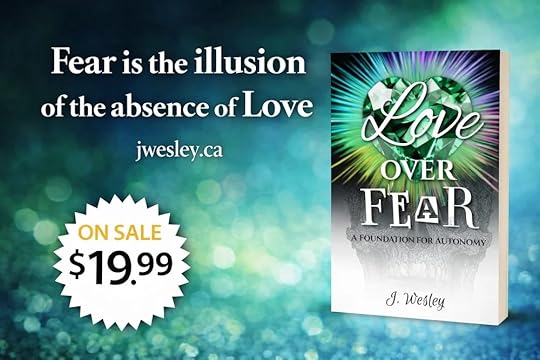
Love Over Fear is about seeing Love everywhere, identifying fear as a messenger of Love that's projected to us in the form of the illusion of the absence of Love. This allows us to mindfully identify what thoughts, behaviors, patterns, and ways we communicate and operate are fear-based and which are Love-based. We essentially have two ways of operating, all the way from a psychological down to a biological level. As intellectuals this applies right down into our belief systems that we inherit through our environmental surroundings.
The Love Over Fear philosophy is impactful for our relationship with our self, identifying our own fear-based beliefs that reflect scarcity, deficiency, protection, where abundance, inspiration, collaboration, and growth can prove much more effective. Love Over Fear dives deep into how this methodology looks for real world application in your intrapersonal relationship, social dynamics, belief systems, and revealing your own personal freedom. This is highly effective work for alchemizing past trauma, fostering healthier relationships, unlocking self-discovery, inspiring creative expression, and creating an inspiring life. The significance of this work lies in its ability to break down complex philosophical and sociological concepts into a practical, accessible, and deeply personal roadmap for individual and collective transformation.
Focuses on Cognition:
-Identifying that the "dominator" is not just an external system but a fear-based cognition that we have all inherited. This shifts the focus from external political revolution to internal cognition.
-Providing clarity and utility. In a world of overwhelming complexity, it provides a universal toolkit that allows individuals to immediately categorize their motivations and choose a different path.
-A Non-Dogmatic Bridge: This work serves as a bridge for those who have left traditional religion but still seek a profound, sacred foundation for their lives.
Love Over Fear is a wake-up call that challenges the normalization of violence, competition, and control. It is significant because it offers a positive alternative, not just a critique of what is wrong, but a tangible vision of what is possible when we build our lives on a foundation of Love.
This book stands as a significant contribution to the contemporary landscape of psychology, self-help, and spiritual literature. It effectively synthesizes the sociological critique of "dominator culture" with empowering, reality-shaping principles that overlap into New Thought and the introspective wisdom of modern Gnosticism and Transpersonal Psychology. By grounding these diverse influences in a personal narrative and a clear separation, the book offers an accessible and actionable roadmap for individuals seeking to cultivate self-sovereignty and contribute to a more cooperative, Love-based world. This work encourages readers to engage in a conscious evolution, moving beyond inherited limitations and societal conditioning to embrace an authentic, unpredictable, and Love-fueled existence.
See what this book has in store for you and YOUR LIFE HERE
Shadows that Destroy Relationships: Subtle Intimacy Killers
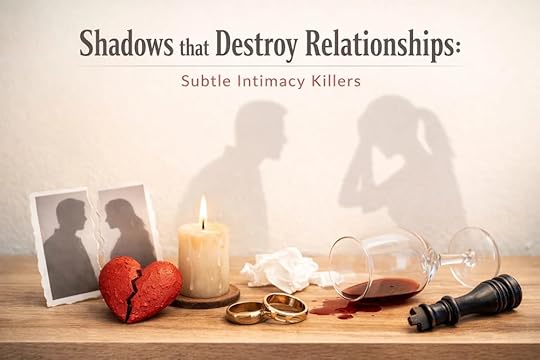
There’s many red flags that we can all plainly see as obvious “get out” signals or “must address” things in a relationship: lack of respect, avoidance, lack of accountability, lack of effort, transactional mindset, triangulation, and manipulation are some common ones. Some signals aren’t so easy to spot. What's more concerning is when these issues are played off as “expressing authentically”, which demonstrates an unhinged, emotion driven, and thoughtless communication of one’s feelings. Here’s some of the signals that can commonly get overlooked or played off like they’re no big deal but are truly devastating to relationships under the surface.
Bringing up Ending it
When they get offended, go through a hard time, when you have a fight, they talk about moving out or ending the relationship. This can be common early on, but if you’re trying to fix a relationship where the other party keeps bringing up ending it entirely, you’re on two completely different paths… away from each other. Ultra-red flag if they bring up ending it over petty affairs or a bruised ego. This is absolutely devastating as it shows that while you are grounded on a level of commitment to see things through, they don't see or feel the same way and convenience will always be valued over cooperative evolution. Your mistakes are seen as reasons to leave, not places for communication and improvement. Thoughts of “what if” are perfectly normal. It doesn't mean you should go planting “what if” seeds in your most important relationship of your life just because the thoughts cross your mind. Save those thoughts for a therapist.
Unending Doubt
Early on it’s common to have doubts but as the relationship comes to fruition if there isn’t a reciprocal commitment made then there will be doubt. A solid relationship NEEDS a foundation of loyalty and trust, which doubt is the mortal enemy of. They may never have had a relationship that they can relate to as a safe place, so any hiccups of human error or dysregulation are seeds of doubt that grow quickly.
Non-Reciprocal Grace
You hold space for them, they don’t hold space for you. You give them leeway when they’re going through a hard time, and they pin down every detail of what you do, regardless of the circumstance. You have an understanding for what they’re going through, and they may claim to, but show no grace for any mistakes you make. This can look like being given an opportunity to vent, but once you do, being told what your feeling is wrong. They claim to be there for you to express yourself, but are overstimulated and stressed when you share and panic to hastily end/fix your issue as fast as possible.
Adamancy of Independence
Despite shared goals, shared endeavors, shared space, they crave independence. No matter how much space they get, no matter how far apart you get, they are still craving more space, more independence. This is someone who at their core, isn't ready for an intimate relationship and doesn't quite grasp the functionality of sustainability in a reciprocal relationship, but enjoys being taken care of.
Need for Control/Forced Hyper-independence
They make efforts to exert their independence and control, even if it’s at your expense, or completely illogical. They are stuck in a mindset of “mine and yours” and the concept of “ours” doesn’t really register on a deeper level. Shared spaces, items, routines, habits, are either “put up with” and resentment builds, or they will have ongoing issues with your things and how you choose to live your life. Signs can be seen of this when the relationship has no visible issues, they're willing to let you take care of them, but when they are angry, they will get very petty and showcase a forced, unnatural portrayal of hyperindependence. Your gifts will be returned, destroyed, your favors will be denied, your contributions will be pushed back at you… until the dust settles at least.
Vindictive
Everything they SHOULD take accountability for has an explanation that you show respect for, while everything YOU do are nails in your coffin. Anything they do that’s against you has a vindictive motivation behind it and to them it excuses their behavior however they see fit. What should be a minor grievance easily turns into vengeful behavior. Underneath, they believe that punishing you will turn you into the person they want you to be, or they truly have no awareness of what they're doing and are unconsciously ruining the relationship.
Victim Mentality
The main danger with a victim mentality, is they need to identify an oppressor to fulfill their victim mindset. That’s YOU. This turns every day squabbles, arguments, disagreements, fights, or nervous system regulation into unforgivable abuse that builds resentment and will end the relationship sooner or later.
Unforgiving/Lack of Empathy
Despite identifying as the victim themselves, they're firmly on the mindset that you AREN’T a victim…. Ever… No matter what they do to you. With the vindictive mindset they are in a constant state of retaliating. You make a mistake and they focus on not forgetting it, highlighting the part that made them feel triggered and purposefully forgetting the important defining factors of your experience; your environmental circumstances, your intentions, your true feelings, or your apologies.
Commitment to the Divide
Lines like, “I’ll never forgive you” show they are actively seeking a reason to separate. It's a threat to state that they are actively choosing to never have respect for you. Also common is an unwillingness to treat your communicated experience as legitimate so they’re always confused. Always trying to understand why you did or said what you did, despite you thoroughly explaining every step behind why. It’s not that the event is truly an anomaly… it’s that they’re committed to the occurrence as a useful piece of ammunition to their agenda of furthering division.
Cheap Talk
They say all the right things, it SOUNDS good. It SOUNDS like love… but their actions seem… rushed. They can talk you up all day, but when it’s time to come through with action for their partner, the talk changes and turns into excuses. They'll always claim to be doing their best, and may be telling the truth but their willingness to talk the talk doesn't mean they'll walk the walk. They may say they appreciate you, what you do, but when it comes time to SHOW the appreciation, it's nowhere to be found.
Obsession with fairness and equality (When it's convenient)
Equity is perfectly fine when it’s needed in a relationship. In fact, equity is a key characteristic in what we use to identify what makes a civilization or community CIVIL. There’s no perfectly equal relationship. It's unavoidable that one party or the other will face challenges that the other doesn't. A healthy partnership strives for a balance of both equality AND equity. If it's always one way or the other, there isn't enough grace for the chaos of life to be able to unfold with thoughtful dynamic shifts that adapt to the challenges in life.
General Non-Reciprocity
You do this, you do that, they… don’t. You think of them. Try to make their lives easier, and in turn your requests that make your relationship or cohabitation easier for you are treated as threatening or condescending. Your requests aren’t truly valued so any excuse under the sun will come up to put down anything you request and no amount of kind wording will be able to communicate it properly.
The Ever-Changing Story (Circulating Excuses/Complaints)
They said they just needed leeway during this one time. There is just this circumstance to why they’re needing special treatment. And the one time passes, and the circumstances change, and there’s a new story to why they need this special treatment. This builds up until you’re walking on eggshells and incapable of making any progress towards communicating your truth. The space for communication is held hostage with their constant needs creating an imbalance.
Denial of Your Accountability
No matter how much responsibility you take, how much you admit your faults, explain your triggers, take accountability, make progressive plans to evolve, they'll still seem hellbent that you haven't taken accountability or want to work together. Likely because they don't.
Patterns of Self-Prioritizing
If you want something and they want something else, their request typically prevails. Their pet peeves are communicated aggressively while your pet peeves are disregarded and/or invalidated. When both parties are struggling with a challenge, they expect special treatment even if it's at the expense of the other party, or at an inopportune time. This commonly shows up as one partner consistently trying to take care of the other by being thoughtful, while the other partner sees more and more deficiencies rather than focusing on shifting their priority to the party trying to take care of them.
Repressed Aggression
They work very hard to appear to be calm. This gives them a superiority complex. While you authentically express frustrations, they back away, highlighting your actions or words as unacceptable; invalidating your communication unless it's wrapped up in a neat package. They express their anger through passive aggressive or more sentimental, deeper ways rather than express their frustration. Instead of focusing on the frustration at hand, they will take much more aggressive steps to guilt, shame, hurt you, and dismantle the relationship. Aggression HAS to be expressed in productive and/or healthy ways because it will ALWAYS come out one way or another.
While it's true that people can change, multiples of these characteristics make for an emotionally challenging relationship that is more or less doomed if these issues are not prioritized and collaboratively dealt with. Things may be fine now, but when there are challenges, watch for these shadowy aspects to show up and do your best to call them out in a way that demonstrates your commitment to them and a healthy relationship dynamic. When dysregulation and emotional flooding occurs, our true nature is exposed. There is a certain degree of tolerance; space holding that is imperative for any successful relationship. Ask a couple that has successfully been together for decades and you'll be sure that many of these issues once had a negative effect on their relationship. The main difference is that they were able to navigate through, stay loyal, stay cooperative enough to share the common goal of healing their relationship dynamic.
Head vs. Heart: The Two Party System

Why is there almost always a great point on both sides of an argument? There are infinite opportunities for conflict from the vantage point of opposite sides of the superimposed polarity. Humans are prone to following a binary system of thinking, as it reduces complexity and inner conflict. Just like the two party system, but vastly less intricate. It's a head vs heart battle. Economics vs Ethics. On one end, the logic would be both economic and evolutionary logic; efficacy and utility rules. On the other, humanitarianism and environmentalism are the priority; compassion, liberty, and sanctity. Technically, both are systems of morality and logic, but in their own respective ways as they see through different lenses, and have their own priorities.
The utilitarian end of the spectrum is like the tough Love that we need to be able to utilize, protect, and economize our surroundings for survival. Morality would be the soft Love; acceptance, forgiveness, and unity. Where the utilitarian logic falls short is immoral logic: overusing resources, prioritizing the physical qualities over the ethics of the matter.
Its counterpart, the ethical standpoint, would see its weakness in illogical morality: oversight of utilitarian opportunities, telling the truth when the truth may cause harm to another, sticking to your values but making survival more difficult.
The time-scale also heavily comes into effect in this predicament. Head-oriented perspectives focus on short-term problem solving while heart-oriented perspectives focus on long-term sustainability. Cause and effect need to be looked at with both perspectives to find the proper policy.
This dualistic conflict is a core part of the beauty of our human nature. We look at a field and the head sees inventory, efficiency, and usefulness where the heart sees beauty, natural order, and sentimental value. When survival gets involved, that's where both sides are trying to solve the same problem but they disagree on what's causing it, and have different priorities. One side wants to farm for maximum yield and will be susceptible to endorse exploitation while the heart may want to leave it untouched even amidst a food shortage. The effects of both soil mineral depletion and social unrest both need to be taken into account.
Balance is needed so that a society doesn't turn into a soulless calculating machine of consumption nor a system of chaos that enables mercy on the merciless, thriving psychologically while issues of survival are abundant. The head lacks compassion and the heart lacks structure. The head tells us what constraints and challenges we need to overcome and the heart leads us to do it with awareness of the bigger picture. Leaning excessively towards either side of the spectrum inevitably results in fragility. Too much head and you get authoritarian technocracy, too much heart and you risk instability and exploitation of naïveté.
It's not a matter of which is right and which is wrong, but a matter of where one is disconnected from the other. Disconnection versus integration. We need to constantly seek a third option that takes into account the initial resiliency of the body, survival, and also follows the pursuit of meaning, and evolving sustainable, peaceful civilizations.
Identifying with Traits, Experiences, and Trauma

You can build a whole identity around the characteristics you give yourself from your experiences and trauma. You can construct a whole sense of being based on what you allow your limitations to be as you label yourself different things. On one end of the spectrum, you can label yourself a sensitive person, highly sensitive, intuitive, an empath and you can label yourself as an asshole, strict, ruthless, and other unsympathetic terms. These can apply to how you treat yourself, and how you treat others.
These labels are harmful because they are limitations that are either self-imposed from experience, or externally influenced and accepted as your truth. These labels come with an energetic agreement that you will uphold, whether you consciously see them, or unconsciously do not see them. Just because you see the validity in feeling, respecting, and expressing feelings doesn't mean you need to label yourself as sensitive. Just because you value accountability, work ethic, and progress doesn't mean you need to label yourself as strict.
When we experience a challenging situation, or more so a pattern of challenging situations, it's easy to put ourselves in a category and give ourselves a label. It seems legitimate for the time and place more than likely. It creates a familiarity that makes the next scenarios easier to treat in a pattern-based manner rather than holding space and feeling into every scenario as the unique occurrence that it is. The issue is that it freezes you in that time and space, repeating the same cycle rather than being able to observe new situations and credit them as unique and evolve yourself.
Imagine for a second that you lived two different childhoods, one being told that you were sensitive, empathic, passive, and non-confrontational. Non-confrontational. The other being told that you were tough-as-nails, devil-may-care, aggressive, and confrontational. And let's say in these childhoods you fully believed it, really took these labels and ran with them, even made them your own. You developed your personality around these traits over the course of decades. Your friends, coworkers, and family all get reminded of these traits with how you carry yourself, how you interact with everyone in your life. How would your life be different in these two different scenarios? Undoubtedly the “sensitive” you would be more shy, more reserved, more cowardly, less eager to overcome obstacles, and would likely be more prone to wallowing in self-pity, and pity of others. The “tough” you would be more outspoken, more bold, easily ready for a fight, eager to bash through obstacles by whatever means necessary regardless of who may get hurt, and wouldn't spend too much time worrying about your feelings or the feelings of others. This place in time or phase of being, all of a sudden is copy and pasted on to the rest of your life and interactions. That's not individuation nor evolution, that's letting yourself be turned into a pattern.
These labels shape our perception, our emotions, our nervous system, our character, our entire lived existence in so many different ways. There is no one size fits all when it comes to personal traits. Becoming attached to one trait gives us the false sense of comfort that we have a specialty or permanent character trait and blinds us from the limitations that we are truly putting on ourselves.
Let the qualities that you bring to each and every scenario ebb and flow with whatever means necessary so you can treat every moment and every situation with the presence that it deserves. Don't be the same way and enable yourself to always be one way. Practice demonstrating the traits that are impactful when you see the opportunity. You’d be surprised how infinite you truly are without limitations.
Effective Help: Support without Control

You can’t fix someone. You can’t heal someone who needs to find their own way. You may play a vital role, but only when you let the healing happen and stop trying to force it to happen. You may think, “If they don’t want my help, they must not want to evolve.” That’s the ego; fighting for control, projecting its fix-it-all, savior mentality. It says, “If you won’t fix your problems my way, then you don’t want them fixed.” This leads to a resentful martyr mindset. You are there helping and it feels like they don’t want to be helped. The thing is… that’s perfectly fine. If we don’t have a drive to fix our problems for ourselves, we aren’t very evolved. If you don’t want someone to depend on you to be fixed, why would you create that very dynamic? Someone showing they don’t want help doesn’t always mean they are avoiding evolution. It shows you that they are working on it themselves. If you actually succeeded to change someone, you’d skip them ahead to a place they didn’t arrive at themselves, actually stealing their opportunity for organic growth.
If you were making changes within yourself that were difficult to see for others, when you finally got the chance to put your inner work to the test and that moment comes where you demonstrate overcoming that behavior in the heat of the moment, what would have a more positive outcome, having your growth seen and validated or having your inner work go unacknowledged? If you showed growth in behavior or emotional intelligence, it would likely be so inspiring to have it seen rather than the progress you made go unnoticed. In fact, if our progress isn’t acknowledged it more so feels dismissed or invalidated which takes away our main motivational feedback. If you’re working hard on something to show someone and they won’t see it, what’s the point? It’s possible that we don’t give proper credit out of fear that the effort will cease once we show our appreciation. Unfortunately, this is a manipulation tactic that many are unconscious of, that is an attempt to control someone’s ongoing efforts. It’s a short term, materialistic approach to a highly-personal and valuable scenario in which the proper communication dynamic is cut off short once the goal is achieved, never resolving fully. In psychology, this is sometimes referred to as “moving the goalpost”. Once the “goal” is achieved, the person who achieved it is presented with a new goal in lieu of any acknowledgement of the original goal being achieved. Wanting to change someone is an invasion of personal boundaries, of their sovereignty. They will be what they will be, ever-changing.
If you actually want to be a positive catalyst for change for someone, show them that you trust them to do it and pay attention to every bit of evolution you CAN see. Inspiration leads to motivation for authentic change. The best way to do this is to lead by example and be kind to their shortcomings. We all make mistakes and fall into old behavioral patterns. One thing that eases conflict during times where change is being pursued is being gracious. Not just “letting it slide”, but acknowledging the behavior in a Loving and kind way that says, “It's ok that you did that. I know you're still trying and I Love you.” Then we don't have to depend on shame as the fuel for change which just creates inauthentic behavior or “acting.” Then we have a safe place, to stretch out our authentic selves, feel accepted, supported, and inspired to keep evolving.
March 12, 2026
Sobriety, Psychoactives, and the Mechanics of Consciousness

Are we sober when we dream? Are we sober when we meditate? Are we sober if we’re angry or dysregulated? If we enter into a trance-like state through breath work or shamanic drumming, are we sober? Does sobriety include or exclude the traces of psychoactive tryptamines, alkaloids, phenethylamines, opioid peptides, terpenes, cholinergic compounds in our everyday foods? The very consciousness you experience is so heavily impacted by the foods you eat that we can't even tell the difference. Our entire conscious experience is affected by the chemical reactions of what we ingest. We draw a line only where we notice a difference, not where there truly is one.
We are typically subconsciously relating sobriety to a perceived narrowed field of vision due strictly to a non-endogenous substance. True sobriety has more to do with awareness than external components. If you've helped a loved one through an emotional tough time or calmed a friend’s nerves or frustration, you've essentially assisted them through a mind-altering experience. Our mind is CONSTANTLY altered. You’re late for work so everything feels frantic and rushed. You’re angry so you fumble with your keys, uncoordinated. You’re tired so you exhibit drowsy, spacey, dissociative behavior. You have too much sugar so you run around wired, full of energy and crash and burn in an hour. You have a cup of tea and get a relaxed-focus effect. You eat high amounts of tryptophan and get tired. You’re a walking chemical reaction, constantly having a psychedelic experience that's depending on your environment.
So why do we shy away from the “noticeable” mind-altering chemicals? Why do we rely on a conscious threshold that only shows us more and more how influenceable we truly are to our environment? Group consensus is likely one of the largest factors. The efficacy and safety of plant medicines are generally looked down on as an archaic belief inherited from the colonialist and Christian mindset. Only when science proves an irrevocable conclusion through reductive methods do people begin to doubt their conclusion. That’s just a scratch on the tip of the iceberg though. Even if science proves something, it doesn't mean people just jump on board. The people who once scrutinized others for cannabis use, now take derivatives of it daily, and hold investments in the cannabis industry. Hypocrisy runs rampant in the field of pharmacology. For decades, studies of the benefits of psilocybin for mental health, cognitive rewiring, neuroplasticity, have proven time and time again that mushrooms can help people with complex trauma, PTSD, anxiety, stuck belief patterns, and increase longevity for mental health and brain function. Studies have proven the safety and non-toxicity of said mushrooms. One could easily say they are one of “God’s gifts to mankind”, even citing global spiritual and religious importance for millenia. Yet they’re discredited, passed over, scoffed at, abused, misunderstood, and of course, illegal.
On one wavelength, it’s probably a similar scenario to how meditation has been studied thoroughly for decades, proving health benefits, mental clarity, nervous system regulation, and greater depth and insight, yet many people choose to not find the time to do it. We have an unconscious resistance to growth due to our doubts. If we don’t get immediate gratification and see results instantly, we get distracted easily.
On another wavelength, we don’t understand what we don’t know. What we don’t understand comes with an anxiety of lacking reason or logic. We can shy away from uncomfortable scenarios, or even euphoric, pleasurable acts of connectedness and vulnerability. We get in touch with a child-like, primitive aspect of ourselves and the contrast to the standard of our modern societies are vast.
At the core of it, psychoactive chemicals show us that our mind is constantly evolving; running on whatever is fueling it. Our consciousness is like this active projection that this motor churns out. A motor that’s fueled by our emotions, environment, experiences, beliefs, and the things we consume. There are so many things that affect this motor. Countless. Even ones that give us wildly limiting experiences; the ones that obviously tighten our experience through a pinhole, tunnel vision effect, are looked at and treated as “sobriety”. I would posit that the term itself SHOULD reflect a level of adaptability. Basically, if you’re showing an observable level of dissociation and disconnectedness with your present moment and environment, if you can’t interact, communicate, learn, and show responsive awareness to your surroundings, you aren’t sober.
By this alternative definition, the consciousness altering substances in your body, BOTH endogenous and non-endogenous, are still the actors in the play, but don’t define whether you are “sober”. The only defining factor of sobriety in this definition is your level of awareness and ability to respond and interact with the environment consciously.
Where this gets interesting is how experiences CAN be dissociative. Dreaming, meditating, day-dreaming, and out-of-body-experiences happen naturally. You can be aware and interact with a scenario and environment that isn’t visible by the naked eye to others.
You could almost describe it as attention held hostage. Say you’re conducting an erratic and non-compliant orchestra. They’re not picking up the cues. Timing is off. They aren’t sticking to the notes in the music. You’re doing your damndest to orchestrate and communicate with this unruly mob. Then you notice someone in the front row dancing, smiling, enjoying the music. You’re so invested in the structure of the synchronistic output of the music that you hear it in fragments, not as a whole. You may feel like the dancer is on an entirely different wavelength, like they’re drunk; unable to pick out all the chaos and impromptu variations of the agreed upon music. You catch eyes with the dancer and you realize they’re looking at you bewildered. The look in their eyes shows you right away that they are seeing you amidst this passion, this beauty, the soul of the frequencies coming to life, and that they aren’t landing for you. Their face is portraying the shock that the source of the orchestration seems lifeless and disconnected. While they’re in the thick of the feels, they look at the leader of the melodies and rhythms and see a robot frantically trying to line up binary patterns. You became so invested in the mechanics of the moment, that you lost the ability to feel it. Both parties are witnessing the same happenings but through wildly different lenses, all while entirely sober as per the traditional Western definition.
Another example, you meet up with a friend at a coffee shop. You have a calming chamomile tea, they get an espresso. Two of your other friends show up and see you, come in and strike up a conversation. One of them is energetic, discombobulated, and expressive, the other serene, observational, and quiet. You notice the chaotic energy to be “a bit much” and appreciate the groundedness of the other. Once they leave, your caffeinated friend expresses how they resonated with the energetic friend but felt hesitant and reserved about the calm friend, like they had something to hide or they were “too quiet”. Here’s a scenario where all parties are essentially sober, yet the energies at play are extravagantly divisive or attractive. On one hand we could put the blame on the beverages, saying that they caused the narrowing of consciousness; highlighting the synchronous frequencies. On the other hand, we could dismiss the contribution of the mind-altering substances as so “mild” that they aren’t factors whatsoever and the individuals bear the credit of their cognitive sovereignty and conscious awareness. The tricky part is that both hands hold correct answers.
This breaks down one of the most rigid societal constructs that we have: the definition of sobriety. We are experiencing our perception independently. At the same time we are at the mercy of our environment and biological chemical reactions; what we witness, think, consume, and feel. Sobriety at its deepest layer is a culmination of infinite variations that impact awareness and responsiveness. True sobriety is a spectrum of awareness, not a binary switch of “drugs vs. no drugs.” Our default state is a stew of chemical concoctions of food, stress, hormones, and environmental factors. Illuminating Cognitive Sovereignty needs to reflect the idea that we are always under some influence, and the real question is that of our ability to be present. Our current definition of sobriety rewards dissociation and punishes presence. We have a definition reflecting chemical purity rather than responsive awareness. Someone who is dysregulated and frantically attempting to adhere to a binary system at their own expense is deemed sober while someone who is grounded and present on a low dose of psilocybin is deemed not sober. The former would arguably have more “blind spots” in their consciousness and the latter would be more grounded and exhibit more responsive awareness.
This is a part of a greater redefinition of the “self” where we should stop fearing “mind altering” substances and focus more on awareness altering factors. If sobriety includes this level of awareness and adaptability, the goal isn’t to attempt to stay free of anything that affects the mind but to stay connected and responsive. It’s not solely about what you took, it's how you are.
February 23, 2026
What “Love Over Fear” Cost Me…
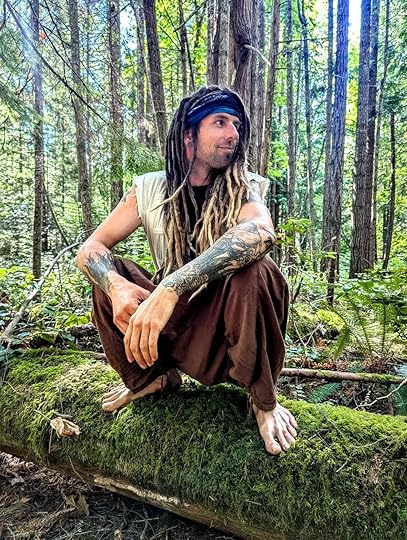
Writing Love Over Fear cost me a lot. May have cost me my relationship, lost an old part of myself, lost my familiar comforts in life, and most of all it cost me my excuses, assumptions and delusions I had. All of the sudden all of my ambiguous beliefs were grounded in an unshakable foundation. The run-around ways of making excuses for this and that crumbled around me. All of the sudden, what was right, meaningful, fulfilling was attractive to me. I actually felt excited to make the changes in my life that I had always just dreamed about making with no follow through. I found a place of contentment in an extraordinary motivation of betterment.
Slowly but surely, I kept on eating with intention, writing with intention, conversing with intention, exercising and moving with intention, and breathing with intention. My habits became places of growth rather than stagnancy. My nervous system regulation evolved more and more to be able to shed the qualms of the minute daily annoyances and crummy behavior of others. My perception opened more and more, experiencing unexplainable things. My dreams became more and more an intimate and conscious part of my daily experience of growth, observation, and learning. My familial trauma, religious trauma, financial trauma, and triggers became more and more observable from a non-reactionary state. I learned more and more, that I know less and less. The mystery of this wonderful universe and reality widened and excited me more and more. I started observing everything that came into my perception as flowing emanations that I didn't need to pay attention to, worry about, and started finding humor and forgiveness in some of the darkest places. I wrote for myself. To bring a grounded dimension into reality that staves off the ambiguous, confusing, directionless, and overtly manipulatable truths that I had seen others follow to the ends of the earth without thinking for themselves. I saw more and more places in the human psyche that opened the way to bypassing.. and exposed it, popping the bubble of lying to myself or taking the easy way out. It brought such clarity that conversations with others who sought such clarity but had never been able to commit because of a fragile sense of attachment to external influences would lose nervous system regulation, and I had to learn to communicate slower, softer, and on a level that relied on their curiosity rather than explaining something one didn't have the bandwidth to hear.
I compiled everything that I learned; glimpses of truth, synchronicities that couldn't be ignored, messages from nature, social dynamics, culture that opened up new ways of thinking, and I put it in this book, “Love Over Fear: A Foundation for Autonomy”. This is a path of individuation. A path of personal freedom. A path with the most steadfast and reliable grounding that you can really make your own, and run with. A tool to promote self-reliance as well as creating community. If I believed in such a thing as pride, I would be proud of what I had accomplished, but I don't, so my joy, contentment, and excitement foots the bill there plenty and leaves the room for me to continue my work in my new content.
Wrapped in an non-confrontational and seemingly agreeably package, “Love Over Fear”.. It makes sense. It seems so simple. Yet it's the most confrontational piece of literature that I've ever seen because it strips away all the nonsense, all the perfectly logical explanations and asks, “Where does Love play the role here?”. I invite you to embark on this journey of Love, by yourself, with me, with others, however you may do it… and see where it takes you. See what new piece of your universe is opened up. Love is truly infinite and the glimpses of that infinity that have surfaced through this journey have been life changing for me and many others.
Most of all the costs, Love Over Fear cost me my chains. My limitations of my own mind and heart. It freed me to be able to have a reliable sense of self and a detachment of self. It has cost me my unconsciousness and replaces these unseen parts of the world with new insights and observations that further progress my consciousness the more I walk this path.
Early on in my writing, someone asked me how I knew the difference between what was right or wrong? To them, any sort of non-dogmatic spirituality was easily molded to find any narrative. Which it can be absolutely. Without this. So I responded, “Love Over Fear. I ask myself and observe whether something is rooted in Love or fear and the truth is revealed.”
Get Love Over Fear