
Eric Gjerde's Blog
December 29, 2019
Berlin workshops at Berlinische Galerie Jan 05 & Jan 12
Hello all! just a quick note that I’ll be visiting Berlin these next two weeks giving workshops at the Berlinische Galerie – the first workshop is sold out but I believe there are still a few seats for the second one on January 12th.
This is a series of workshops called “Vorkurs üben” organized by the Bauhaus Archiv as part of the “Original Bauhaus” exhibition.
I’m looking forward to presenting these workshops on behalf of the Bauhaus Archiv – I’ve done several things for them over the last two years and this is a great closure to the 2019 Centenary year of the Bauhaus for me!





September 23, 2019
Upcoming workshops in Minneapolis and Berlin
[image error]
Hello all – I have three upcoming workshop dates to announce, for my series “Paper Engineering from the Bauhaus: Josef Albers to the Modern Day“.
Paper artist Eric Gjerde leads a course of experimentation and discovery in the spirit of Josef Alber’s preliminary course, using historical paper art exercises and creations from the Bauhaus School as well as modern designs and ideas that build on the original concepts.
Students will take techniques and create their own works within various design constraints, in line with Bauhaus methodology. Our intent is to open minds and expand horizons (while also having a lot of fun playing with paper!) In line with the original Bauhaus workshops we will be working with our hands and basic tools only in an entirely analog format.
Course Languages: English
November 14th, 2019: Minnesota Center for Book Arts, Minneapolis, MN, USA
January 5th, 2020: Berlinische Galerie, Berlin, DE
January 12th, 2020: Berlinische Galerie, Berlin, DE


April 16, 2018
Reverse-engineering Bauhaus paper designs (part two)
My Bauhaus reverse-engineering work has been continuing this chilly springtime, and I wanted to share a few new pieces. (New to me, anyway, but definitely not new in any sense of the word!)
There’s three different items here. One is a cone-shaped structure – part of a large, extensive family of expanding cuts (See some interesting usage of this concept by Haresh Lalvani). I’ve just started digging into this – and each tiny tweak I make changes the results dramatically. Differences in cut length, spacing, width of rings, how many of them there are, the tensile strength of the paper… there’s a lot of factors to contend with! But I keep finding interesting new behaviors so this is certainly worth more exploration.
Another model is an elegant twisting spiral – a tiny version of a larger recreation of this original piece:
[image error]
I’ve been entranced with this design since I first saw it 3 years ago, and I’m very glad to have finally figured out how to recreate it! There is currently a large version of this (1m / 3 feet) hanging in the middle of our family room, where it gets much attention from our young son.
The last piece is a fairly simple set of alternating papercuts, but it creates quite a lovely effect. I re-created this using the same proportions as one used in the MoMA 1938 Bauhaus exhibition. Of course, like any of these other models, one could use an endless variety of cuts and spacing, but this particular one is a slavish reproduction of the original (to my best ability). On my refrigerator at home I have a photo magnet I picked up last year at the Bauhaus Dessau gift shop, featuring a photo of the balconies of the Dessau building. I have to say I see a lot of similarities between this paper model and the building itself… I wonder which one came first?
If you’re interested in making some of these creations, consider signing up for my summer course – at a Bauhaus UNESCO world heritage site just outside of Berlin. Well worth it, in my opinion
March 29, 2018
Paper Engineering from the Bauhaus: Josef Albers to the Modern Day
I am teaching a week-long intensive paper engineering course this summer (July 23-28) at the International Summer School, taking place in the UNESCO World Heritage site Bauhaus Denkmal Bundesschule Bernau (DE). This is my second year at the Summer School, and my first time teaching a standalone paper course there. I’m super excited to be returning and I’ll have suitcases full of crazy paper art to share with my students. You should come be a part of it!
[image error]
My course, titled “Paper Engineering from the Bauhaus: Josef Albers to the Modern Day“, will draw upon my research into the preliminary course of Josef Albers as well as my own practice as a paper artist. Students will spend 5 days exploring a number of different forms of paper engineering, culminating with a presentation to the school of their collective works.
Here’s the course descriptive text, with more info:
One of the mainstays of the Bauhaus preliminary course for first-year students was working with paper – to make something more with it that still spoke to the essential qualities of the paper itself. These exercises led them on a path of self-discovery and observational “learning through doing.”
Paper artist Eric Gjerde leads a course of experimentation and discovery in the spirit of Josef Alber’s preliminary course, using historical paper art exercises and creations from the Bauhaus School as well as modern designs and ideas that build on the original concepts. Paper architecture, pop-up structures, origami tessellations, kirigami, and complex crumpling are some of the techniques students on this course will explore.
In this course we will follow a Bauhaus / Black Mountain College style form of discussion, open exercises and experimentation, and constructive group critique. Students will take techniques and create their own works within various design constraints, in line with Bauhaus methodology. Our intent is to open minds and expand horizons (while also having a lot of fun playing with paper!)
Eine der Hauptsäulen des Bauhaus-Vorkurses in den ersten Semestern war die Arbeit mit Papier – eine Auseinandersetzung mit den wesentlichen Qualitäten des Materials und allem, was sich darüber hinaus aus dem „flachen“ Papier ergeben kann. Die Übungen sollten den Studierenden einen Weg der Selbstfindung aufzeigen und waren ein wichtiger Impuls für das „Lernen durch Tun“.
Der Papierkünstler Eric Gjerde führt – ganz im Geiste des Vorkurses von Josef Albers – einen Experimentier- und Forschungskurs durch, bei dem historische Papierkunstübungen und -kreationen des Bauhauses sowie moderne Entwürfe und Ideen, die auf den ursprünglichen Konzepten aufbauen, zum Einsatz kommen. Papierarchitektur, Pop-Up-Strukturen, Origami Tessellations, Kirigami und komplexes Crumpling sind einige der Techniken, die die Teilnehmer/-innen dieses Kurses erforschen werden.
In diesem Kurs werden wir – wie am Bauhaus oder Black Mountain College – diskutieren, offene Übungen und Experimente durchführen und uns einer konstruktiven Gruppenkritik stellen. Die Teilnehmer/-innen werden neue Techniken erlernen und anwenden und ihre eigenen Arbeiten im Geist der Bauhaus-Methodik erstellen. Unsere Absicht ist es, den Horizont zu erweitern und eine neue Sicht auf das Material Papier zu ermöglichen.
I’ve been going pretty deep into researching paper artworks at the Bauhaus – from my time working at the American Craft Council, with their wonderful reference library containing many books on the subject, to an upcoming visit I’m making at the end of April to the Albers Foundation in Connecticut. I now have a dedicated bookshelf to my Bauhaus reference material in my office, which is groaning a bit under the weight of all these thick tomes. But all of this has been a fantastic journey, discovering pieces of the pedagogical puzzle of Josef Albers, and working to re-create many of the artistic tasks he set his students to explore.
I look forward to sharing these with my own students this summer and seeing what interesting results they discover.
[image error]


January 23, 2018
Bauhaus Foundation Course instructional booklet
Here’s a PDF of my Bauhaus Foundation course handout from 2017; it’s been sitting here on my computer for months now and it seems high time to share it. This is all based on my research into the preliminary course / foundation course work of Josef Albers, and the folding exercises he taught his students at both the Bauhaus and the Black Mountain College in Asheville, NC.
It’s a few simple models, including the Hypar (as shown above), a herringbone corrugation pattern, a basic Floderer-esque crumpling piece, and a pleated wave (from Goran Konjevod). We touched on more work during our course but these needed the most instruction, so they were diagrammed.
All that being said, I vastly prefer to walk students through folding, crumpling, and cutting things by hand without instructional sheets – I don’t want them to just follow a handout and duplicate what they see. I want them to experience the process and think about it so they may find new ways of doing it in their own style. They are learning exercises, after all!
There’s two versions to download: one is in A5 booklet format, the other the same content but as separate pages. I’d recommend the booklet PDF for printing, and the other for digital viewing.
Bauhaus Foundation Course instructions (A5 booklet) PDF
Bauhaus Foundation Course instructions (individual pages) PDF


September 28, 2017
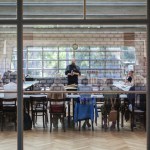
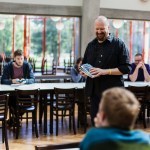
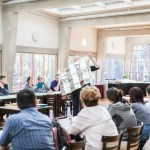
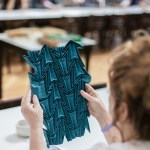
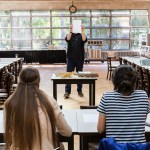
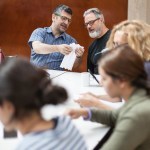
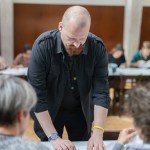
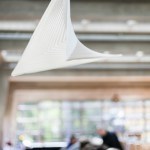
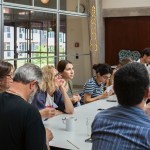
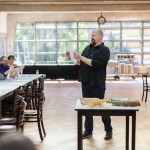
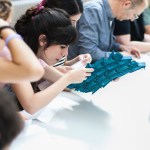
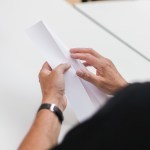
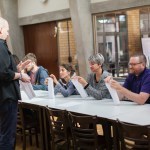
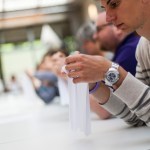
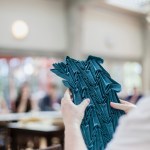
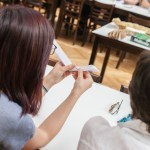
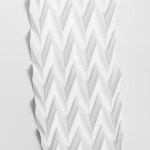
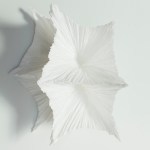
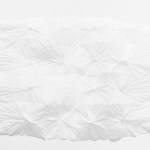
Photos from International Summer School Bernau – Preliminary Course
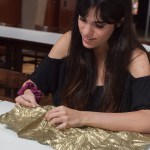
I had a fabulous time teaching at the International Summer School Bernau, at the famous Bauhaus Denkmal Bundesschule Bernau in (wait for it) Bernau, Germany. It was an eye-opening experience and a real joy to teach something new to both the attendees and to people from the local public.
More on this to come, but here’s some photos of the experience, compliments of the talented photographer Victoria Tomaschko.





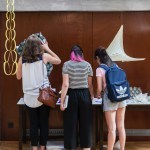
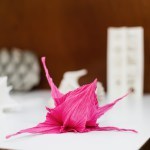
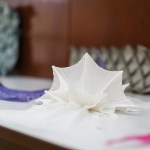



August 8, 2017
Teaching at the International Summer School in Bernau
Josef Albers instructs a class in paper folding.
I am teaching a Preliminary Course for the next two weeks at the International Summer School at the Bauhaus Denkmal Bundesschule Bernau, in Bernau bei Berlin, Germany.
Very excited to be doing a specific program focusing on the teachings and instruction of Josef Albers (pre-eminent teacher at the Bauhaus, and later the Black Mountain College in N.C. and then Yale). I’ve been studying his works and historical materials for several years now, and it intersects nicely with my origami work. Most of my classes and instructional sessions over the last few years have centered around the work of Albers, so actually teaching his material in a Bauhaus-built school feels like everything coming full circle.
Here are more details on my Preliminary Course program; I will post images from the event later on and share the booklet I have created for the course as well.
My morning sessions are open to the public, from my understanding, so if you are in the Berlin area and have an interest in folding some Bauhaus creations, please do come visit!


June 26, 2017
Voronoi tessellations and origami
photo credit: Christine Daniloff, MIT
http://news.mit.edu/2017/algorithm-origami-patterns-any-3-D-structure-0622
Some amazing work from the extremely talented Tomohiro Tachi, together with Erik Demaine, our origami community’s resident origami genius.
While we’ve long watched and admired Tomohiro’s work with Origamizer (rendering 3D models as crease patterns using some complex mathematics) it appears they have taken this further to help simplify the process as much as mathematically possible. That’s a pretty huge step and has lots of ramifications for the future.
Tomohiro’s work uses Voronoi tessellations in it’s calculation of things – that’s one of the underlying principles behind topological manipulation of polygons on a single surface, when calculating pleats and folding – so as an aficionado of this process, I’m happy to see this coming to real fruition.


October 31, 2016
my new show opening November 11th at Minnesota Center for Book Arts
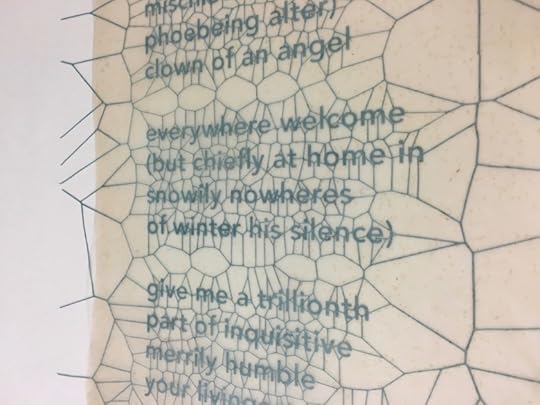
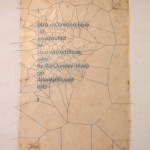
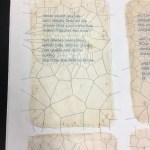
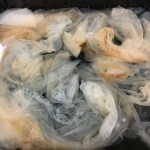
Close-up of finished pressed page. Laser cut text pressed within 5 layers of bio-paper to form one large single sheet.
My new work, Specimens, is one of three pieces on show at the Minnesota Center for Book Arts as part of the 2016 Jerome Foundation Book Arts Fellowship. The opening for the exhibition is on November 11th, starting at 6 PM.
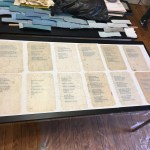
The pages will be displayed in sandwiched plexiglass frames, to allow light to pass through and permit the audience to see them floating in space – very much the way the paper looks and feels when handled.
Here’s my artist statement from the exhibition:
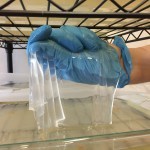
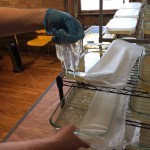
Specimens is the first of its kind: a book created with a new bio-paper medium made entirely from bacterial cellulose. Its pages were once alive.
The quality of this new paper, which I developed over the past seven years, is its unparalleled strength and transparency. Each sheet is grown in a vat and harvested after several weeks. After processing, many layers – five or more – are laid on top of one another with the text block carefully placed within. Then the entire stack is pressed. The act of pressing these sheets is what gives them their strength.
Trapped forever within the thin lamina of Specimens’ pages is the poetry of e.e. cummings. The challenge of retaining the poet’s complex typographic wordplay required a new approach for placing text. Drawing upon my fascination with Voronoi tessellations – the natural pattern of cell structures in all living things – I created custom software to generate a Voronoi framework that would hold the text in place. The text block was then laser-cut from Korean hanji.
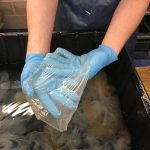
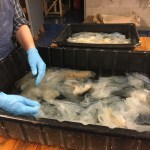
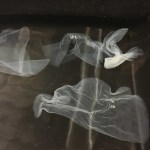
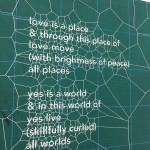
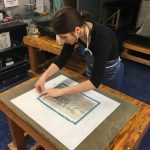
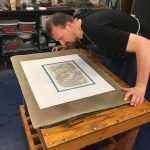
You may also be interested to watch my 15 minute presentation from earlier this year, talking about my plans for the project and some of the science behind it. Some of the plans changed- many things were tried and discarded, as working with this medium at scale presented some new challenges. Overall I am very pleased with the results and look forward to sharing more photos of the installed work in the next week or two!


March 17, 2016
Making any shape using origami corrugations
A fantastic tidbit that popped up in my facebook feed today:
http://www.kurzweilai.net/how-to-make-almost-any-shape-out-of-a-flat-sheet-of-paper
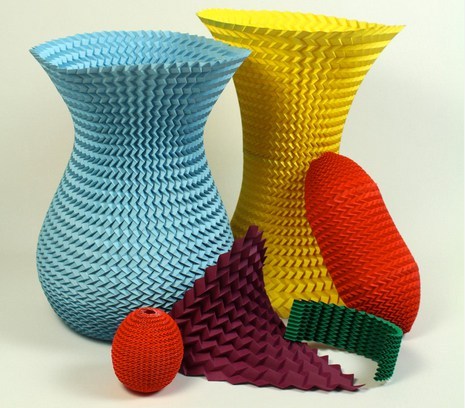
Mahadevan and his team have characterized a fundamental origami fold, or tessellation, that could be used as a building block to create almost any three-dimensional shape, as seen above (credit: Mahadevan Lab/Harvard SEAS)
This comes partially from Tomohiro Tachi, an origami friend, and one of the top people worldwide working with computational/mathematical origami tessellations and corrugations.
If you look further at his Flickr page you can find beautiful examples of 3D constructs and controlled folding mechanisms. It’s very exciting work!


Eric Gjerde's Blog

- Eric Gjerde's profile
- 2 followers

