
Sean Jacobs's Blog
October 23, 2026
How a child inherits care
We are sitting at Gallal. It���s in Madinaty, on the edge of Cairo where the buildings are all new and the streets are too wide. The tea is too sweet the way Sudanese tea is supposed to be too sweet when someone else makes it for you. Mahmoud is across from me.
I don���t remember either of us standing up. Only the hug itself, which went on long enough that an Egyptian girl at the next table put down her phone and started crying. She didn���t know us. She cried because whatever passed between two men holding on to each other in the middle of that cafe was apparently visible even to a stranger who had no context at all.
Mahmoud went red immediately����� a Sudanese man has no idea what to do with a stranger���s tears����� so he pulled out his phone, opened Facebook, and muttered that she was probably crying over some relationship, while the screen in his hand played footage of Khartoum burning. We���re good at that silence now. The silence of being physically tethered to one place while completely living inside another. I kept thinking: Does everyone I love do the same? Carry so much that they stop feeling it, until a stranger has to cry for them?
The screen lights up. The wallpaper is a photo of my grandfather���s class in Wadi Halfa, built after the water took Halfa Dagheim. The first time my grandmother told me about it, she didn���t say ���displacement.��� She said, ���We left the house, and the water took it.��� Halfa Dagheim was going to drown for the High Dam����� a decision made far away by people who would never bear its cost. When they moved to Wadi Halfa, there was only dust. The first shared project families built was a school. The teacher was my grandfather Ahmed, an English teacher. He gathered children under a tree and started. I inherited that before I understood it. Not money. Not land. The habit of starting under a tree when the official map says your town should no longer exist.
The waitress calls me ya walad even though I am 29. That word makes me think of my mother. Her father died during her certificate exams. She carried grief silently and kept studying until she earned admission to veterinary school at the University of Khartoum. She graduated while pregnant with me. I came from that lineage of exhausted people who kept choosing endurance.
When I entered the University of Khartoum in 2015, I thought I was entering a sanctuary. The conversations that shaped us happened beside roads, under trees, around tea stalls that surrounded campus from every direction. The women who ran them knew who was always late, who never had money, who argued too much, who quietly listened. They knew us better than the administration.
For a long time I thought we had to be hard to win. I thought we had to stop feeling to keep going. I was wrong. The only thing that ever saved us was the opposite. The tea. The sitting together after. The hand that was out before you asked. They can turn violence into money. They can turn gold into weapons. They cannot turn care into money. Care refuses to be bought. That is why they fear it.
In the republic of the unimportant����� at the tea stalls, in the resistance committees, in the unions that kept meeting in borrowed rooms after being banned����� we kept a different ledger. Not gold. Who was missing, who needed medicine, who hadn���t eaten. That ledger didn���t make anyone rich. It kept people alive.
At Gallal, Mahmoud orders a second tea without asking me. He knows I will want it. We have this habit from Khartoum����� you order for the other person before he finishes, so he doesn���t have to say he wants more but has no money. He pushes sugar toward me. That small push is the whole essay. You notice who needs sugar and you push it without making a speech.
And finally����� to the child walking into a school that hasn���t been built yet, with a notebook slipping against his arm. Inside, a poster on the wall is crooked. Someone taped it in a hurry and left one corner hanging. He will stop, shift the notebook to the other arm, and straighten it without thinking. He learned that from someone who sat next to him when he cried. That is ordinary. That is how a child inherits care.


Why does Tunisia become African only when Europe needs it to be?
Tunisia is an African country that has spent much of its modern political imagination looking north. That sounds like a question of identity. In reality, it is a question of power����� and more precisely, a practice of domination through classification.
For decades, Tunisia has imagined its economic future through the Mediterranean: European markets, French education, tourism, and European investment. Africa has often appeared somewhere beyond the Sahara, associated with instability, migration, and security.
Europe, however, possesses its own geography of Tunisia����� one that shifts depending on what Europe needs from it. When Brussels discusses trade, investment, and political cooperation, Tunisia is a Mediterranean neighbor. When Europe discusses migration, border control, Libya, or the Sahel, Tunisia becomes something else: an African frontier state.
This is not a mere contradiction. This is a deliberate mechanism of geopolitical subordination through classification. Europe does not need Tunisia to be culturally European; it needs Tunisia to be strategically African when African space becomes relevant to European security.
The economic relationship makes this asymmetry impossible to ignore, revealing a genuine policy cage. The European Commission identifies the EU as Tunisia���s largest trading partner. In 2025, the EU accounted for 59.5% of Tunisia���s total trade. Some 73.2% of Tunisian exports went to the EU, while 49.6% of imports came from the European market. The EU is also Tunisia���s largest foreign investor, holding 85% of the country���s foreign direct investment stock.
These figures do not merely describe a successful trading relationship; they reveal an extraordinary concentration of Tunisia���s external economic relations in Europe. When three-quarters of a country���s exports depend on one economic space, that relationship ceases to be mere commerce and becomes an instrument of control, shaping industrial priorities, investment decisions, and the political imagination of what is economically possible.
Europe consequently becomes not simply Tunisia���s largest market, but its economic horizon����� where economic dependence transforms into geographical dependence. Africa becomes secondary, not because it is irrelevant, but because Tunisia has spent decades learning to imagine prosperity through a northern market. As Kwame Nkrumah warned in 1965, the most insidious form of domination is control through financial and structural instruments, not direct conquest.
The contradiction becomes sharper when migration enters the picture, exposing the biopolitics of European border management. The EU���s relationship with Tunisia increasingly includes border management, migration control, and the fight against migrant smuggling. European support has included equipment, training, and operational assistance to Tunisian security and coast guard structures.
From Brussels��� perspective, this is cooperation. From a geopolitical standpoint, it is the externalization of Europe���s borders. Europe is not merely helping Tunisia secure its own territory; it is moving part of Europe���s migration-control architecture southward, closer to the routes through which migrants attempt to reach European territory. This is the essence of extraterritorial sovereignty as described by Giorgio Agamben in 2005: the European state exercises its power over human bodies beyond its borders.
This changes the meaning of Tunisia���s geography. Tunisia is no longer simply a neighbor across the Mediterranean; it becomes part of a European security perimeter without becoming part of Europe itself. Tunisia consequently occupies a peculiar geopolitical position: its economic relationship with Europe is framed as partnership, while its position on migration is treated as strategic infrastructure. The Mediterranean neighbor becomes the African frontier.
Yet another geography is beginning to emerge����� one that challenges the idea of Tunisia as merely Europe���s southern security buffer. In June 2026, AfCFTA Secretary-General Wamkele Mene visited Tunisia. The visit concluded with an agreed action plan aimed at deepening Tunisia���s trade across Africa.
This matters because it offers Tunisia a role fundamentally different from that assigned to it by the European migration agenda. The African Continental Free Trade Area offers Tunisia the possibility of becoming an economic actor within Africa, rather than a buffer between Europe and Africa. The African Development Bank is pursuing a similar regional logic. In June 2026, the Bank held consultations in Tunis for a new North Africa Regional Integration Strategy designed to deepen economic integration within North Africa and between North Africa and the wider African continent.
This is a radically different understanding of Africa. Africa is not merely the place from which Tunisia receives migrants, security risks, or instability. It is a market. It is a network of cities. It is a space for investment, industrial partnerships, logistics, technology, and political influence. The question is whether Tunisia will treat this geography as a strategy, or merely as an alternative whenever its relationship with Europe becomes difficult. There is a danger in treating Africa as a Plan B, because if Tunisian policymakers look south only when European markets become restrictive, African integration will remain a reaction rather than a strategy.
The choice is not Europe or Africa. Tunisia does not need to abandon its European relationship; its economic links with Europe are too deep, and its geography makes the Mediterranean an unavoidable part of its foreign policy. But Europe cannot be Tunisia���s only horizon.
The real choice is between being an object in someone else���s geography and becoming an actor in one���s own. If Tunisia is African only when Europe needs a border guard, its Africanness has been reduced to a function. If Tunisia discovers Africa only when it needs new markets, Africa becomes a fallback rather than a strategy.
Europe does not merely change Tunisia���s label; it confiscates Tunisia���s agency. By defining Tunisia as Mediterranean when it needs a market and African when it needs a buffer, Europe ensures that Tunisian sovereignty remains conditional����� subject to the external power���s geopolitical needs. This is not partnership; it is strategic subordination. Africa is too often presented in European policy as a space from which problems arrive: migrants, instability, terrorism, trafficking, and energy insecurity. But Africa is also a political and economic project being built. The AfCFTA is an attempt to create a continental market; regional integration initiatives are attempting to connect North Africa more effectively with the rest of the continent.
Tunisia is already inside this geography. The question is whether it will remain inside it mainly as a recipient of European security policy, or whether it will begin to act as an African state pursuing its own economic and geopolitical interests. The problem, therefore, is not that Tunisia has forgotten that it is African. The problem is that Tunisia has not yet decided what being African is for����� and has allowed external powers to determine when each geography is politically useful.
October 21, 2026
Deported to Liberia, again
In 1816, a group of white people in the US created the American Society for Colonizing the Free People of Color of the United States (later simply the American Colonization Society), aimed at resolving the ���problem��� of a growing population of free black people in the country. Both slave owners, fearing that large numbers of free black people would lead to slave uprisings, and some white abolitionists, who viewed their presence as either a security threat or a barrier to emancipation, joined hands in a plan to quite literally deport free black Americans and freed slaves to a settlement they hoped to create in the African motherland.��
This is the origin story of the African state of Liberia, one where race, racism, and anti-black slavery meet yet another type of forced movement: deportation. And in a continuum with centuries past, the African continent, which had solved a problem of lack of (free) labor for white US elites and landowners, now solved yet another perceived problem for their descendants: a population of free black people they considered undesirable. As Jonathan Ort has shown, today���s deportation system revives that colonial blueprint.
A little more than 200 years later, an overwhelmingly white US executive power again uses Liberian territory as a deposit for its undesirables, with one difference: the constructed enemy deported from the white nation is another racialized figure, the immigrant. The US has historically applied a racialized migratory policy, restricting on racial and class grounds those welcomed into the nation while profiting from the cheap undocumented labor those restrictions produce. Many of these workers are non-white immigrants from Latin America, a pattern shaped by geographical proximity and by a long US imperial presence in the region. Continuous political and economic interventions have fueled conflicts, generalized violence, and socioeconomic chaos in Latin America while enriching the US, and those fleeing have formed a cheap workforce in the north as temporary laborers, undocumented workers, and asylum seekers. However, migrants have become the scapegoats for everything that challenges the US���s self-perception of ���greatness.��� And while the US has long detained and returned Latin Americans, the current government has not only entered a new era of interventions in the region but also further escalated forced returns.
Thus far, the second Trump administration (Trump 2.0) has signed largely secretive bilateral agreements for (forced) returns with at least 35 countries, overwhelmingly in the Global South. Migrants, including asylum seekers and people whom US judges have protected from return to their home countries, are the bargaining chips in these unequal agreements. Partner countries end up taking part in one of the cruelest return practices the US has used: removing people with almost no warning and little chance of defense to countries where they have no ties and may face inhuman treatment or torture, as UN human rights experts warned in September.
In a chilling roundabout way, Liberia once again becomes a place where unwanted deportees arrive on its shores, with little to no say in the matter, and with no medium-term plan for their protection and well-being, or that of local communities. On August 18, 2026, Liberia���s government announced that it would accept up to 1,200 third-country nationals, one of the largest agreements struck by Trump 2.0. Two days later, about 20 people landed at Roberts International Airport; 14 stayed, from Cameroon, Eritrea, Venezuela, Honduras, Colombia, Brazil, and Guatemala. Most had won US court protection against return to their home countries because they faced persecution or torture there, and some only learned their destination mid-flight. None of the Latin Americans interviewed wants to remain in Liberia. Housed in a hotel and fed by the International Organization for Migration, free to apply for asylum but unable to work, they have been separated from their families and long for a safe place with ties, a shared language, the right to work, and a community. Is Liberia that place? And what does their arrival mean for Liberians?
The imbalance of power between Liberia and the US is part of the answer. In June 2025, a State Department memo placed Liberia among 36 countries facing a possible US travel ban and suggested accepting deportees as a way out. Washington had already cut aid, and the health compact that replaced USAID provides US$124 million over five years, roughly 63 percent less than before. Since signing the deal in September 2025, Liberia has received US$5 million to manage third-country nationals and an extension of Liberians��� US visitor visas from 12 to 36 months.
Focusing only on US leverage obscures the choices of Liberia���s own government. Officials insist there is ���no quid pro quo��� and describe the arrangement as humanitarian. However, Liberian scholar Robtel Neajai Pailey argues that the executive bypassed the legislature, which the Constitution requires to ratify such agreements, and kept the terms from the public. This also raises the question of how the benefits and costs are distributed. Easier mobility and closer ties with Washington serve the state and Liberians who travel, while the immediate consequences fall on deportees separated from their families. If arrivals approach 1,200, accommodation, health care, and access to work will become questions for Liberian communities too.
Liberians have raised concerns about the agreement from the outset, especially its secrecy and the implications for local communities. Many first learned about it through the media. William Sando, president of the University of Liberia Student Union, told Al Jazeera that he first encountered the news on Facebook and questioned where the deportees would live and whether those who remained would be allowed to work. In Monrovia, food vendor Yarssah Jallah described the arrangement as ���risky for us,��� citing concerns about drug use and the lack of information about those being received. Clara Mallah of the Center for Transparency and Accountability in Liberia questioned why the US could not accommodate the deportees itself, while Senator Samuel Kogar asked whether the agreement had been presented to both Houses of the Legislature, describing it as ���not a small issue.��� All of this points to a lack of transparency, the bypassing of democratic procedures, the passivity with which Liberians are treated by their government, and how little warning they were given����� warning that might have helped ease some common misconceptions and stereotypes about migration and migrants.
These concerns extend to Liberia���s capacity to accommodate the arrivals. Eddie Jarwolo of the civil society organization NAYMOTE Partners for Democratic Development criticized the lack of a publicly available plan explaining how the government would provide accommodation without further pressuring public services. Similarly, Representative Anthony Williams raised questions about housing, health care, and screening. At the same time, opposition politician Joshua Tom Turner warned that the arrival of large numbers of deportees could place additional pressure on employment and heighten social tensions without adequate public consultation and safeguards. These are reasonable concerns in a country already facing unemployment and reductions in US development assistance.
Although the government maintains that the US and an international partner will cover accommodation, food, and onward travel, questions remain about the duration of that support and the arrangements for those who eventually remain in Liberia. This is a particular concern given that these Latin American migrants may have specific needs due to language, cultural differences, and a lack of social support����� a whole ocean of distance separates them from Liberians, which in turn shapes needs that Liberia may not be able to meet. There is also a risk that public frustration over an agreement reached without adequate consultation could be directed toward deportees who had no say in their transfer. For now, both Liberians and those sent to the country are left confronting the consequences of decisions over which they had little influence. In this game between one nation-state and another, Latin American deportees, on the one hand, and Liberians, on the other, stand at the margins of decision-making, in a process that structurally silences them and renders them invisible, while asking them to bear the direct consequences of those decisions.
Liberians know this uncertainty from their own experience. When refugee status ended for Liberians across West Africa in 2012, many who stayed in countries such as Nigeria were promised residence papers by the Economic Community of West African States that never fully arrived. Liberia itself ended refugee status for the Ivorians it hosted only in 2022, and the UN Refugee Agency, according to Third Country Deportation Watch, is not currently operating there. An offer of asylum without the institutions to deliver it risks repeating a past pattern of protection promised on paper, with nothing secure to follow.
The past is close at hand. Under an 1819 law, the US sent Africans rescued from illegal slave ships to Liberia, whatever their origin, and settlers built on land coercively obtained by a US naval officer from a local ruler, facing armed resistance from autochthonous communities for years. Christina Sharpe calls this living in the wake of slavery. Two centuries on, deportees from Latin America and Liberians asked to receive them live in that wake together, bridging past and present, the Americas and Africa, through the experiences of people whose lives are being shaped by decisions made elsewhere.
October 20, 2026
What Nollywood owes the ancestors
In June 2025, in Lagos, I sat down with custodians of Yoruba masquerading traditions, and I asked each of them a version of the same question: ���What do you think about masquerades appearing in Nigerian films?��� Each time, the answer was a flat no.
I grew up in Lagos and have spent years studying Yoruba masquerading traditions, particularly Eyo and Igunnuko. With support from the Ebrahim Hussein Fellowship and the Aliko Songolo Award, I conducted formal interviews at the Bajulaye and Alagbeji palaces and at the Igunnuko shrines in Epetedo and Alaguntan to understand where this resistance comes from. More importantly, I sought to know what it means for Nollywood to keep returning to these figures despite the pushback.
Foundational cultural theorists of the 1930s and 1940s grappled with a similar question of what happens when a sacred or ritual object is copied, restaged, or transferred into a new medium. In 1944, Theodor Adorno and Max Horkheimer believed that mechanical reproduction drains ritual objects of their meaning, while Walter Benjamin had argued the opposite about a decade earlier. For Benjamin, reproduction could free art from ritual���s grip rather than hollow it out. The reality of this tension is a concept that my fieldwork explores.
To understand the resistance to masquerade remediation in film, you first have to understand what a masquerade is to its custodians. In Yoruba tradition, the egungun is not a costume design. It���s what a family member becomes after death, made visible. Ile, the family compound and infrastructure of domestic life, is what produces a person worth remembering. A properly raised person becomes, after death and burial within that same compound, an ancestor (alaale or babanla). The cloth used to bury them, ago or eku, is equal to the same cloth a masquerade wears.
Therefore, a masquerader is not an actor playing an ancestor; the masquerade is treated as an ancestral presence, returned. These masquerades are called ara orun (heaven dwellers), and their presence has two faces: the ancestral side is what is made public, danced and seen at a festival, while orisa is the sacred essence beneath it, hidden and guarded. None of this starts on the day a masquerade appears. It starts with the ile, a life, a death, a burial, a cloth. Once you skip that, what is left on a screen is the shape of a masquerade without the systems that make one real.
Interestingly, motion has always been the story of Yoruba masquerades. Scholars trace the tradition from the Nupe to the Oyo, who developed traditions like Ololu, still performed in Ibadan today. From Oyo it moved south, reshaped by Ijebu, home to the Agemo and Eyo masquerades. Historical accounts credit two Ijebu brothers, Malaki and Ejilu, with carrying Eyo onward to Eko, old Lagos, where it grew into the festival celebrated today. Therefore, studying masquerade in Lagos already means studying something remediated many times over, long before a camera entered the picture.
Following this trajectory, screen media is the newer remediation, and it works differently. Abba Makama���s The Lost Okoroshi (2019) turned a security guard into a purple ancestral spirit, putting a masquerade at the center of a very modern Lagos story. Jagun Jagun (2023), the Netflix epic produced by and starring Femi Adebayo, leaned hard on Yoruba spiritual and masquerade imagery and became one of the biggest Yoruba-language releases in years. Gangs of Lagos is another Nigerian film that significantly employs the image of a masquerade tradition. Masquerades also appear constantly in music videos, almost always as background texture, with no voice of their own.
The rare film attempts have drawn public criticism and lawsuits from masquerade societies and state authorities, as in the case of Gangs of Lagos. However, nothing comparable has happened to a music video. The traditional masquerade falls under the supervision of a secret cult called awo, which sets the pace and protects orisa, the sacred core of the tradition. A film crew doesn���t move at that pace, and it certainly doesn���t answer to that authority.
Furthermore, the filmmakers see it differently. In my interviews with them, both Adebayo and Makama were clear that they aren���t trying to reproduce a masquerade as it exists. They���re making something new, despite drawing on existing traditions. Makama has said plainly that he wants Nigerians, especially younger ones, to reconnect with traditions that colonial-era religion spent decades demonizing. However, that doesn���t necessarily mean consent from the people who consider these figures sacred.
Film isn���t the only place where masquerades reappear. I spent time at the John Randle Centre for Yoruba Culture and History, the National Museums in Onikan and Ibadan, and the Nike Art Gallery, all of which hold masquerade pieces. These vitrine spaces offer another kind of remediation, arguably a stranger one than film. It removes a masquerade from ile entirely and places it in a non-performative state. There is no dance, no voice, no direct exchange with the living, which is the entire point of a masquerade at a festival. No lawsuits follow a museum acquisition in Lagos. If the objection to film is about skipping the machinery that makes a masquerade real, a glass case skips all of it. In fact, it rarely draws any objection. This evidences the tension I raised earlier.
As I wrapped up the interviews, I realized it might be useful to revisit the classical debate among Frankfurt School scholars. I think Adorno and Horkheimer would read the custodians��� ���no��� as evidence that mechanical reproduction erodes what makes a masquerade real. Benjamin would push back, insisting that sacrificing authenticity at the altar of accessibility is fine. My take on this is simple. If masquerading traditions have never stood still, then the question is not whether they should be remediated. Perhaps the more important question is how screen remediation can demonstrate genuine care and respect for tradition while remaining committed to social function.
October 19, 2026
The radical openness of the popular economy
Urban Africa is constantly finding ways to thicken urban life with new resourcefulness: from makeshift maker labs to the vast associations of traders with their own home-grown, expansive financial systems����� where remittances circulate alongside locally generated credit and savings����� to self-generated webs of electricity and water provisioning under the radar, to neighborhood investments in shared containers of imported goods, to local circuits of production and distribution of foodstuffs, intermingled with diverse labor arrangements across regions and borders. These are what we call popular economies.
Residents inhabit environments replete with different land statuses, regulatory frameworks, histories of economic specialization, repositories of cultural memory, behavioral styles, and social arrangements. Urban popular economies entail how these various components of an archive are pieced together and interrelated to produce specific mobilities and access to resources and opportunities. It is a move toward an expanded diversification of how accumulation, social reproduction, and livelihood get built. African cities are renowned for their informal sectors, self-built neighborhoods, as well as histories of piracy, brigandage, circumvention, smuggling, and subversion. The popular economy intersects with these elements in a continuous unfolding and elaboration of more overarching efforts to create distinctive processes of urbanization within and outside the hegemonic structures of capital accumulation and political domination.
In April 2026, researchers and activists from various African cities gathered in Nairobi to reflect on the popular economy. They explored questions related to orientations, practices, political engagements, and spatial arrangements that might offer ways to inhabit contemporary urban conditions differently. If the future, as a horizon of multiple disjunctions and possibilities, is captured by the reign of probabilities and adversarial networks, then what is the terrain of the improbable? Given the multiple temporalities that characterize territorial operations underpinning popular economies, can we think of a way of life not indebted to calculation, redemption, or culmination?
Popular economies and their various forms of organization seek different ways of inhabiting the present and thus recuperating the insurgencies of both pasts and futures. Euro-American notions of the human have long emphasized a progressive, developmentalist trajectory of improvement and enhanced capacity: a life moving toward a straight timeline, toward the fulfillment of unbounded human potential. This has intensified global turbulence, unsettled ways of living among the majority, and withheld the time needed for society to be a living force in itself����� generating vulnerabilities and fragmentation on a planetary scale.
As Timothy Mitchell argues in his book The Alibi of Capital: How We Broke the Earth to Steal the Future on the Promise of a Better Tomorrow, this temporal movement acts to constitute a future from which a wide range of payments can be extracted; a future already encumbered by debts continuously owed to those who acquired, at a discount, the rights to those payments. This is a violence done to time itself, one that limits future dispositions to a mere surplus of the present. The future is foreclosed, not primarily through the threat of extinction, but rather through an investment in what can be extracted from that future and monetized now.
This same logic operates at the level of knowledge. Dominant knowledge functions as information: in Achille Mbembe���s terms, a juxtaposition of words stripped of ambiguity, which reduces the capacities of all localities when circulated and imposed. Pattern recognition becomes geared toward preemption; time is reoriented to the number of steps a program needs to reach completion, and space to the memory required to scale a specific function to execute a program����� all of this coupled with increasingly enormous expenditures of energy, as Wolfgang Ernst and Rob Kitchin have shown. Localized knowledge has been generalized to the scale of what Bernard Stiegler called a biospheric locality, an upscaling made possible by reducing knowledge to data amenable to computation and by eliminating whatever resists that reduction. Localities become points along the same line, subject to measures of comparability and proportion����� the more or less����� with the subsequent fight to become more than what is lesser. Understanding one���s place in the world increasingly means referring to that with which one is apparently not.
Under such urban conditions, the ���popular��� takes place as a fundamental displacement, a shifting of what is vital, valued, and necessary into something besides these attributions. It entails a mode of conveyance, a leap that extends the efforts of survival into uncharted terrain and relations that are pursued opportunistically. It involves people using the terrain, institutions, networks, and other resources available to them as a means of piecing together a territory of operations that takes the stuff of the city����� its materials, events, bodies, and spaces����� and associating them, moving through them in unconventional and improbable ways.
When one navigates diverse urban spaces, it is evident how people spend time in seemingly useless activities and groupings. They may have their stores, jobs, houses, and responsibilities, but spend time in conversations and exchanges that seemingly produce nothing. But it is within these thousands of micro-exceptionalities to productive behavior that capacities for a cross-fertilization of knowledge and transactions off the map are forged; capacities that, in many cases, are translated into enhanced provisioning of various urban services and logistical actions. This creates new spaces that move beyond social and material boundaries. Itineraries take precedence over location, redefining entangled geographies around restive temporal lines and generating forms of extension through which residents stretch their life-worlds across circuits legible only in fragments.
What takes shape in these territories of operation will often remain opaque, indeterminate, but generative of tensions that provisionally resolve themselves through unanticipated breakthroughs and messy negotiations. What ensues is an always-new logistics of urban living, a way of decoupling the future from capitalist logics of foreseeability and from knowledge reduced merely to authoritative or actuarial information. These operations may or may not endure, may or may not produce something substantial, but they provide important knowledge and confidence for subsequent efforts. It is this mutuality, never depending on any one person alone, that gives the city its ���popular way,��� where everybody counts for something, and no one is left to carry that weight through individual agency alone.
The continuous mutating experiments of popular economies always take place within new forms that extract the energies, times, and hopes of the urban majority. Ways of life and survival practices become market frontiers through means that move across legality and plunder, law and crime, deals and the use of force, as research on informal real estate in S��o Paulo���s peripheries has shown. In part, this is precipitated by the attainments of popular economies themselves in terms of significant increases in the accumulation and diversification of wealth. These attainments might not mitigate precarity at all and instead open the way to new forms of capture: predatory real estate markets and forms of entrepreneurialism that fracture webs of social intimacy. Belonging or exclusion are violently imposed through discriminatory legal and political frameworks that sort ���insiders��� from ���outsiders��� within popular territories. These practices of delineation fall hardest where urban popular economies operate, where goods, money, and people move interdependently.
In addition, generalized militarization across urban territories is not only an intensification of domination, but also continuously transforms what people desire and how, targeting the capacity for innovation and adaptation that makes popular economies vital. Contemporary modalities of territorial control and articulation take on diverse forms of rentier extraction and management of circulation. They increasingly rely on nebulous borders among legal and illegal, public and private, formal and informal spheres. They function more as markers to navigate divergent flows of authority and resources, where the assemblage of efficacy requires not consolidation but excess, the capacity to go beyond what is inscribed as normative protocols, standards, and operating procedures. As urban governmentality becomes the ���curation��� of multiple knowledge resources, technological innovations, military logics, and continuously refigured alliances among different financial and political resources, do popular economies still manage to simultaneously circumvent, appropriate, and transform these logics?
Popular economies are centered on a necessary shared practice, rather than adherence to a specific, consensually agreed-upon protocol. Sharing means not the conjoined implementation of a specific task with a clear meaning, but a sense of the task derived in the performance of doing together or just being on the same beat of time. Within the processes of self-built urban neighborhoods or extensions, the mobilization of labor, the acquisition of materials, the designation of a plot, the articulation to sources of needed inputs, the modalities and rights of access, the curation of what is to be visible and sayable, the explicit and tacit responsibilities of each to each other, the deflections of interference or scrutiny����� none of these were separate tasks available for a division of labor, but were worked out in terms of each other, generating an archive of localized meaning continuously updated as the implementation of these different ���tasks��� generated both anticipated and unanticipated implications. This is where the radical openness of the popular economy lies: things and people unpredictably brought together around a shared meal, on the market, in the street.
And yet this continuous sharing is under threat of fracturing. Popular economies have always been heterogeneous; at times, these heterogeneities operate as fractures. Take the various forms of self-valorization ranging from the demonizing of one���s peers to the indifference toward any form of collective progression. Take the lures of inhabitants into various security apparatuses, and, at the same time, the intensification of counterattacks, where conflict and violence become the very modality of popular endurance, while wars, genocides, extreme forms of violence, and sieges stretch the lifelines of many people. It is important, then, to think and work through these contrasting, often contradictory forms of self-valorization, especially as the fault lines become increasingly racialized.
This is the task we set ourselves at the end of our week in Nairobi: not to resolve these fractures, but to hold them alongside the radical openness from which they emerge, to expand our understanding of popular living and its territories, and of their unraveling into ever-changing constellations.
October 16, 2026
Is "khawa khawa" a North African myth?
In the haze of el ghorba����� the strangeness and alienation of living abroad����� I gravitate toward the Maghrebi diaspora. For a moment, we relax our tongues from the unnatural twists of Arabic dialects foreign to us and speak in the Maghrebi darijas. Desperate to latch onto whatever whispers of home exist elsewhere, we claim that we are khawa khawa.
Among the Algerians, Moroccans, and Tunisians, khawa khawa is an official nod to an unofficial alliance, loosely translating to brotherhood. It is an ode to our shared cultures and history in the face of North African identity discourses.
But what began as a salve for colonialism was lost in the monotonous chants for brotherhood.
Before the 19th century, North African states were ���undefined��� to European cartographers and authorities alike. Hence, like the concept of the Middle East and the Sahel, the Maghreb was prone to imperial invention. Unsurprisingly, this coincided with the Scramble for Africa����� when the insatiable greed of European colonial powers took interest in dividing the African continent among themselves.
Encompassing other colonial legacies, the borders born out of the Scramble engineered the ethnic rivalries that persist in Africa today. Through the newly devised borders and the infamous ���divide and conquer��� regimes, the Maghreb was branded as distinct.
Despite the existing racial diversity of the region, the French colonial regimes rebranded the Maghreb as a biracial society: Amazigh or Arab. While the Amazigh identity was mislabeled in proximity to the whiteness of Europe, the Arab identity became an accusation of settler colonialism. North Africa became a geographic body for the Francophonie world, distanced from its neighboring regions��� cultures, politics, and society.
In 1962, Algeria����� the last of France���s Maghrebi colonies����� declared independence. In the years that followed, the Maghrebi people looked inwards and toward rebuilding the identity of North Africa. Thus, khawa khawa was born and reinforced by the diaspora that fled their homes in the wake of political instability. It became a card dealt in moments of desperation to bond to something, or someone, that vaguely resembled home.
Khawa khawa, and the brotherhood that blossomed with it, became the means to redress an identity obscured by European colonialism.
True khawa khawa culture demands communal harmony void of ego. But when politics becomes inevitably entangled in the national identity of communities, the culture of Maghrebi brotherhood falls flat.
Shortly after 1962, newly independent Algeria and Morocco fell into border disputes. The following decades spiraled into attempted land grabs, fits of cultural monopolies, and accusations of expansionist ambitions. In response, the people cried out khawa khawa; our governments do not define our brotherhood!
But too often, the politics override the social bonds of Algerians and Moroccans (and occasionally, Tunisians). With the rise of the internet, discourse shifted, and social media became a useful mirror for the abstractions of the Maghrebi identity.
Most recently, the khawa khawa culture was dramatically pronounced dead on social media platforms, following the 2025 African Cup of Nations (AFCON). Almost overnight, the football tournament became a litmus test for Algerian-Moroccan relations and spiraled into a warped perception of North African relations. A futile online back-and-forth that began as shared banter turned into personal attacks and political scrutiny.
The post-AFCON guerre between Algerians and Moroccans����� which coincided with the recent UN support for Moroccan plans over the Western Sahara, disapproved by the Algerian government����� is a recurring phenomenon of how Maghrebi culture wages war parallel to the political tensions of its respective countries. Despite the adamant denial, online Maghrebi communities fall into the habit of using our governments to verify the authenticity of khawa khawa.
The problem rests in the fact that both communities����� Algerian and Moroccan����� fall into the habit of claiming the minority of hateful comments as the consensus among the entirety of both nations. We see assertions made that we cannot prove, except that they are too insulting and their wounds far too inflicting to recover from. It has become a pattern of malice between both nations that resurfaces regardless of how loudly khawa khawa is chanted.
Perhaps the fault is also in the fragility of how we materialize our cultural bonds. We claim that khawa khawa is an Islamic brotherhood, yet some grow secular. In the absence of religious backing, khawa khawa becomes a proverb of the old world. Then, we claim that khawa khawa is a call for pan-Arabism, yet some grow weary of Arabization. In the face of the Amazigh renaissance, khawa khawa becomes a proverb of the imperial world.
Perhaps, much like the colonists, we, too, have confined the Maghrebi identity to arbitrary borders of existence, repackaged in the khawa khawa culture, while we feed into the delusions of European-drawn borders. And so, khawa khawa becomes a hollow reminder of colonial fractures.
While we cannot divorce our identities from politics, the Maghrebi community must forgo the egos that are founded in political symbolism. We should understand that an enforceable unity can exist if we acknowledge that each community upholds legitimate, separate interests.
As long as we treat khawa khawa as nothing more than a symbolic slogan that dissipates under the legacy of French colonialism and the futility of online disputes, Maghrebi relations will live on as a North African myth of brotherhood.
Khawa khawa is a brotherhood that encompasses the lived and nuanced identities of the Maghreb; let us not reduce it to mere grounds of conflict for North African communities.
Alas, in el ghorba, it is always among the Maghrebi diaspora that I find remnants of my home.
October 15, 2026
Reading List: Anooradha Iyer Siddiqi
We are taught to think of a refugee camp as an object produced in an instant, only in response to an emergency����� one brought on, perhaps, by those seeking refuge. We are taught that refugee environments are provisional and abject, moreover, to be naturalized as such within the African landscape����� as the African landscape. We are taught to misread migrant spaces as lacking history or architectural expression. To counter these misdirections, Architecture of Migration: The Dadaab Refugee Camps and Humanitarian Settlement looks closely at the complex settlements, ecologies, domesticities, archives, and material aesthetics. In Ifo, Dagahaley, and Hagadera camps, established in 1991 by the Kenyan government and the United Nations High Commissioner for Refugees at Dadaab, Kenya, in lands shared with Somalia and Ethiopia, the book finds African, Muslim, and Afro-Asian aesthetic worlds and a historical repository of partition, sedentarization, and migration. Dadaab forms a material afterlife of events long unfolding, through colonial and postcolonial time and space, and in multiple registers, aesthetic as well as social.
My book is grounded in 14 years of feminist and critical collective practice and research (see Cohabitations, Dadaab Commons, Feminist Architectural Histories of Migration, Insurgent Domesticities, and Settlement). While researching in dozens of archives and libraries in Africa, Asia, and Europe, and interviewing hundreds of women practicing architecture and art, representing governments, cultural institutions, and nongovernmental agencies, or living life in refugee camps, I read many books! If the anticolonial thought in Frantz Fanon���s Black Skin, White Masks and Walter Rodney���s How Europe Underdeveloped Africa anchored my work, its everyday tugs and buoying came from feminists.
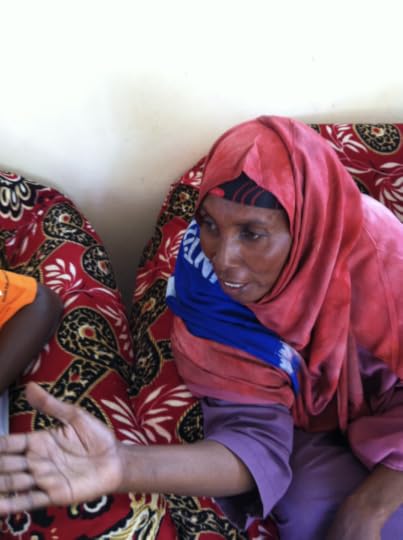 Ifo camp Chairlady Isnina Ali Rage. Photo by author, 2011.
My study of the handcrafted acacia camp environments and interviews with many of their builders����� including Ifo Chairlady Isnina Ali Rage and shopowner Shamso Abdullahi Farah, and Dagahaley farmer Maganai Saddiq Hassan����� gave shape to a consciousness rooted in the social and ecological worldmaking of African, Muslim, and Global South feminists. Let me begin with three. Sylvia Tamale not only insists on decolonizing master narratives that suppress multiplicity in Decolonization and Afro-Feminism, but through her years of activism in Uganda and beyond, plants the working and thinking of African feminists on the ground, in the natural environment. This perspective is hardly limited to African feminists, as Radha D���Souza demonstrates in the Court for Intergenerational Climate Crimes����� based on her book What���s Wrong with Rights?: Social Movements, Law and Liberal Imaginations����� which foregrounds the workhorse labor and the place of the indigo plant (Comrade Indigo) within majority-world feminist intellectual commitment; she dispenses with reductive ���West versus Rest��� critiques through the perspectives of European underground and Third World intellectuals in the co-edited Decolonizing Knowledge: Looking Back, Moving Forward (open access). Further articulating the vitality of social difference to inform constructions of knowledge, Saba Mahmood argues that those constructions must assert against universalizing epistemes, secular as well as religious, in her foundational work on Cairo���s women, Politics of Piety: The Islamic Revival and the Feminist Subject.
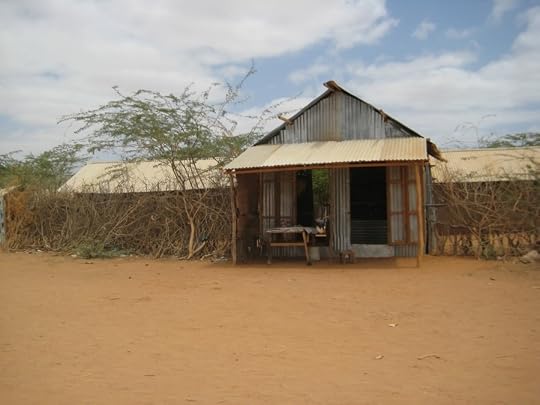 Store and shelters designed and built by Shamso Abdullahi Farah, Ifo camp. Photo by author, 2011.
From there, global Black feminisms were my north star. Yvonne Adhiambo Owuor���s Dust dwelt within the landscapes of Kenya���s Northeast, the erstwhile colonial ���frontier��� constituted of migratory lifeways and marabou storks; her habitations haunt my book���s histories of land, emergency territory, and sedentarized pastoralists. Lose Your Mother: A Journey Along the Atlantic Slave Route, Saidiya Hartman���s attempt to fill in the blank slate of the historical record and her own life, helped me think with the stories of enslaved children freed from Indian Ocean dhows, raised near Bombay, and resettled near Mombasa: the negotiation between rescuer and rescued in the East African abolitionist settlement of Freretown that forms Dadaab���s prehistory. My book stands on the shoulders of Mabel O. Wilson���s work on: (1) spatial agency, as rooted in the bodies of builders and the physical labor of construction, in an essay on the ���provisional demos��� of the African American protest camp in Design, Displacement, Migration: Spatial and Material Histories, and (2) the inseparability of racial thought from modern subjecthood and the architectural discipline, which grew together out of Enlightenment reason and abstraction, in Negro Building: Black Americans in the World of Fairs and Museums and the co-edited Race and Modern Architecture: A Critical History from the Enlightenment to the Present.
 ���Frere Town,��� courtesy of National Museums of Kenya, Nairobi. Sibbie (n��e Bazett) Burns Photograph Album, Album II, c. 1892���late 1890s.
My book argues that the humanitarian environment, intended as temporary, paradoxically affects settlement. Architectural historians develop a feminist provincialization of their field in grappling with migration���s immanence to settlement. In Fallow Fields: The Remnant Landscapes and Residual Architectures of Imperial Germany���s Settler Frontier, Hollyamber Kennedy articulates the displacement and unsettlement of people in German South West Africa (Namibia) and Eastern Prussia (Poland) together, within the nineteenth-century development of state policy to sedentarize and fix populations, eradicating migratory ways of life. Open Architecture: Migration, Citizenship, and the Urban Renewal of Berlin-Kreuzberg by IBA-1984/87, Esra Akcan���s study of the International Building Exhibition (a historical landmark of both architectural modernism and social housing), is a story of migrant inhabitation. In The Remittance Landscape: Spaces of Migration in Rural Mexico and Urban USA, Sarah Lynn Lopez tracks economic flows in built environments on either side of a fraught border.
My book argues that longstanding refugee settlements����� aid environments long utilized to slowly confine migrants and police the border����� are not de facto architectures to be understood teleologically, as if brought by people upon themselves, but instead predicated upon foundational partitions. This thinking draws on Vazira Fazila-Yacoobali Zamindar���s positioning of partition not as an event but as a concept, in The Long Partition and the Making of Modern South Asia: Refugees, Boundaries, Histories. In it, the violence of a partition is not a vague consequence of border conflict, but the direct result of bureaucratic shaping, as states attempted to resolve political uncertainty����� debunking the myth that India and Pakistan somehow emerged fully formed as partitioned states, but rather, partitioned through a process of urban shaping. This is so with Palestine, Ireland, and Somalia itself. Safia Aidid���s Pan-Somali Dreams: Ethiopia, Greater Somalia, and the Somali Nationalist Imagination shows a political imaginary of possible futures based on territorial unification, conceived in reaction to a colonial present; Greater Somalia was not merely a nationalist movement but, following Raymond Williams, ���a structure of feeling.��� My book argues in favor of such feeling, which overcomes the partitioning principle, toward a straddling collectivity.
October 14, 2026
Death as liberation
Death as liberation is hardly a comfortable political proposition to digest. In a world where Black death is often the common condition, there is a well-established insistence on our living. So what do we make of two of Africa���s greatest filmmakers, Ousmane Semb��ne and Souleymane Ciss��, whose earliest cinematic visions, expressed through their respective debut features Black Girl (1966) and Den Muso (1975), center on the suffering, alienation, and eventual deaths of Black women?
Semb��ne���s Black Girl is preoccupied with racial violence and the economic exploitation that continues to structure relations between Senegal and France. The film follows Diouana, a young Senegalese woman who accepts employment with a white French family and travels to Antibes believing she is embarking on a new life. While Ciss�����s Den Muso, turns inward, examining interpersonal violence and the ways patriarchal power consumes family life and communities, weakening the broader social fabric of a nation. The film follows Tenin, a mute young woman who becomes pregnant after being raped, exposing the brutal underbelly of the patriarchal violence imposed upon her. Despite the differences in their circumstances, both films position death as a troubling possibility of liberation for their central characters.
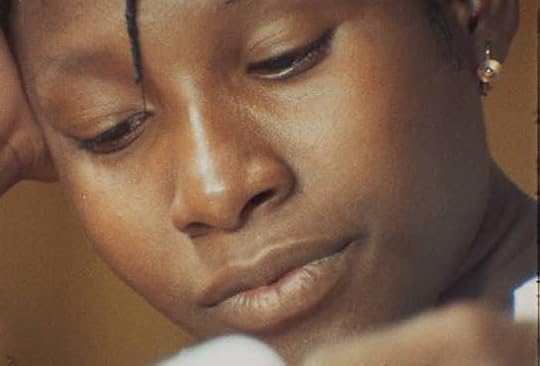 Tenin (Dounamba Dany Coulibaly) in a still from Souleymane Ciss�����s Den Muso (1975).
The history of Black resistance has not solely been confined to the preservation of life. From enslaved Africans who leapt from ships during the Middle Passage, to those who faced death in the fight against their oppression, It is true that to rather die than to endure is not a popular or digestible form of liberation. Although these acts are not equivalent, nor do they carry the same weight as the deaths of these fictional characters, Semb��ne and Ciss��, raise an uncomfortable question: what does life mean for a person stripped of agency, recognition, and self-determination?
For Diouana and Tenin, freedom remains out of reach because of the structures governing their everyday lives that continually deny these women full humanity: Tenin���s father and her rapist, Diouana���s white employers. This sustained stripping of humanity produces what I would argue is already a death, albeit a social one, that precedes their physical endings. Semb��ne and Ciss�� challenge audiences by asking what is living for the dehumanized. Diouana travels to France only to find her livelihood replaced by isolation and unpaid, alienated labor, while Tenin���s body becomes a site upon which familial and communal shame, punishment, and control are dumped. Death, therefore, is at the core of both films from the outset, existing not only as a shocking culminating event, but as a condition of violence. By the end of each film, Semb��ne and Ciss�� are not arguing over whether death is a worthy or noble choice for self-liberation; rather, they position the act of self-annihilation as the only remaining form of control available to their characters, and as an indictment of a society in which death is the only option.��
It is understandable to recoil at the self-inflicted violence that ultimately claims both Diouana and Tenin. One might ask why their rage is not directed solely towards those who harmed them. Why does Tenin���s retaliation extend beyond her rapist? Why doesn���t Diouana exact revenge on her employers and flee France? These questions linger because death feels like an unsatisfying conclusion, one that denies us, as audiences, the catharsis of resistance. We want these women to fight back and survive. We want their suffering to lead somewhere other than death. Yet perhaps the more daunting question is not why these women die, but whether we find their deaths more difficult to accept than the suffering that precedes them. What is ultimately more uncomfortable to confront: their deaths, or the conditions that made life itself unbearable?
Neither film offers an uncomplicated answer. To read Diouana���s and Tenin���s deaths as acts of liberation is not to suggest that their deaths resolve the violence they endure, or that self-annihilation is freedom in any complete sense. Their deaths do not dismantle the structures that dehumanized them. What death offers these women, perhaps then, is not freedom but a final assertion of agency within those systems. This is what makes their endings so devastating: the possibility of control emerges only when the possibility of living on their own terms has been all but extinguished.
Decades later, Black Girl and Den Muso remain essential viewing, not only for their place in the landscape of African cinema, but for their boldness in confronting the most uncomfortable, divisive, and difficult questions surrounding post-independent life. Both films position death as a troubling yet legible response to systems that make life itself untenable, refusing a comforting resolution. Semb��ne and Ciss�� began their careers with audacious visions and hard questions, a truth that held throughout their working lives.
Long live the giants of African cinema, and may their audacious clarity continue to shape how we see, think, and imagine our world.
October 13, 2026
Forward, but for whom?
I have spent this week reflecting on African football. Qualifiers for the next Africa Cup of Nations (AFCON) have begun, the identity of the reigning champions still awaits a ruling from the Court of Arbitration for Sport, and Nigeria begins its campaign without a federation board, after its president and executive committee resigned in August����� a rare case of Nigerian football administrators paying a price for failure, though, as I will argue, not quite the accountability it first appears. None of it can be separated from the politics and money that will shape next year���s FIFA presidential election.
Weeks after the 2026 World Cup in North America, FIFA unveiled a plan to sell a stake in the tournament���s commercial rights to private investors. The proposal would have seen a new entity, FIFA Forward Enterprise (FFE), take over FIFA���s broadcast, sponsorship, ticketing, and licensing operations. FIFA would keep control and sell minority stakes to outside investors, raising up to $4.2 billion against a $20 billion valuation. The lead investor was reportedly Thrive, a firm founded by Joshua Kushner, whose brother Jared is US President Donald Trump���s son-in-law. To win the member associations��� approval, FIFA promised to raise each one���s development allocation for 2027���2030 from about $8 million to $20 million, with an optional further $20 million paid up front. But the backlash, largely led by UEFA, the European confederation, was swift and relentless. Within days, FIFA president Gianni Infantino withdrew the plan and has spent the weeks since trying to salvage his presidency and avert a challenge that previously seemed impossible.
During this period, Africa���s confederation stood firmly with Infantino. Several federation presidents backed him publicly, and Samuel Eto���o, the Cameroonian legend who now runs his country���s federation, went further, arguing that the plan could have done a great deal for smaller federations. FIFA���s crisis meeting was held in Rabat rather than Zurich, and the executive committee of the Confederation of African Football (CAF) later met there and unanimously reaffirmed its support for him. Much of the commentary has cast this as a deferential, even subservient, relationship, with Africa as a continent unable to stand up for ���true footballing values��� once money is on the table.
But Africa���s relationship with FIFA did not begin in deference. UEFA may have threatened a boycott this summer, but in 1966 it was African federations, led by Ghana���s Ohene Djan and Ethiopia���s Yidnekatchew Tessema, that boycotted World Cup qualifying ahead of England ���66 because they had been made to share a single qualifying place with Asia and Oceania, while Europe had 10 of the 16 spots. The boycott worked: Since the next tournament, in 1970, Africa has had at least one guaranteed place. In 1974, the same bloc helped the Brazilian Jo��o Havelange defeat Stanley Rous for the FIFA presidency. Rous had spent years trying to keep apartheid South Africa, already shut out by CAF, inside world football.
However, Havelange���s victory set the terms of the bargain that has governed FIFA-Africa relations since. He campaigned on the promise of expanded tournaments and development for the Global South. He delivered them, but he also brought a culture of patronage that defined his 25 years in power. Sepp Blatter, his long-serving general secretary, inherited the same structure when he succeeded him in 1998, and used it to peel away African federations even though CAF officially backed UEFA���s Lennart Johansson. In 2002, when CAF���s own president, Issa Hayatou, contested the presidency, he was beaten heavily, deserted by members who preferred the patron they had to the African they might have had.
Under Infantino, FIFA has become even more involved in Africa���s management. In 2017, Madagascar���s Ahmad Ahmad unseated Hayatou as CAF president, a result Infantino reportedly supported, and in 2018 Ahmad declared Africa���s support for Infantino���s re-election a year early. In 2021, Infantino cast a long shadow as rivals stood aside and endorsed Patrice Motsepe, the South African mining billionaire, as new CAF president, after FIFA had sent its own secretary-general, Fatma Samoura, to run CAF���s affairs for six months in 2019, and after Ahmad was banned by FIFA���s ethics committee. Motsepe���s tenure has recorded successes, but critics still cast him as Infantino���s puppet in Cairo.
The politics of football on the continent have changed too. Back then, many political leaders saw football as yet another theater of development and anti-imperialist engagement. Now the game has been ceded to career football politicians, who have mostly traded votes for development money and loyalty. That may sound like an indictment, but the trade is also pragmatic: African federations need FIFA���s money more than most, and a grant that more than doubles is a powerful inducement. Spread across the continent, that money can also reorder established hierarchies and make African football more competitive, which is the strongest case for the bargain. The deeper issue is what the game���s surplus is made of. Africa develops talent and exports it, with the value mostly realized in Europe by the clubs that buy and sell it, and the leagues that broadcast it around the world.
The 2026 World Cup puts that case to the test. Nigeria and Cameroon, with eight AFCON titles between them, failed to qualify. This followed repeated challenges within Nigeria���s football management, including three coaches in a single qualifying campaign, several disputes over unpaid wages and bonuses, and a security agency investigation into how a ���17 billion government fund meant to settle them was spent. That investigation is also why the board���s resignation is not quite the accountability it looks like. Ibrahim Gusau and his colleagues stepped down after weeks of reports that they were being pressured to go, and the National Sports Commission promptly suspended the election to replace them. FIFA treats government interference in federations as grounds for suspension, leaving Nigerian fans caught between administrators no one can remove and a state that removes them through pressure. Eto���o, Cameroon���s federation president, has fought openly with the sports ministry, including over who should coach the national team. Their size, pedigree, and economic weight ought to make them less dependent on FIFA���s money than most, which makes their loyalty harder, not easier, to explain.
Compare them with Comoros, a two-time AFCON qualifier, and Cape Verde, whose debut World Cup run to the round of 32, unbeaten in a group with Spain and Uruguay, won over neutrals everywhere. The president of the Comoros federation has told reporters that his federation has struggled to make ends meet, while FIFA���s own announcement of the plan held up Cape Verde as an example of how a decade of Forward funding enabled the debutants to qualify for the tournament.
Infantino���s strongest ally remains Morocco, whose federation president, Fouzi Lekjaa, was one of the first to pledge his support. Rabat will host the next FIFA presidential election, and Morocco has lobbied hard to stage the final of the 2030 World Cup, which it cohosts with Spain and Portugal. Morocco has gone from missing four straight World Cups to reaching a semifinal in 2022 and a quarterfinal this year. It is also, for now, Africa���s champion, though not because of anything that happened on the pitch. Senegal won the Cup of Nations final in Rabat in January, but CAF���s appeal board later ruled that Senegal had forfeited the match because its players left the field in protest at a late penalty, and recorded a 3���0 win for Morocco. Senegal���s appeal goes before the Court of Arbitration for Sport on October 8, and this contested status does not help change the impression that FIFA���s most important African ally holds the continental title by an off-pitch decision.
These examples seem to make a neat case for either prudent FIFA-backed spending, like Cape Verde���s, or prudent football management, like Morocco���s. But the binary does not hold. Cape Verde may owe some of its success to FIFA funding, which supported pitch infrastructure and coach-training courses, but it also owes much to its strategy of building a national team from its diaspora in Portugal and the Netherlands. Morocco���s state-of-the-art Mohammed VI Football Complex, along with its recruitment from the diaspora, has also enabled it to field competitive teams across genders and age groups, culminating in last year���s men���s U-20 World Cup title. Neither project was authored by FIFA, and FIFA cannot take credit for either.
What African football actually shows is that competence and patronage are not opposites. They can work together. Morocco���s long-term planning has bought it leverage, and this summer it spent that leverage on loyalty. Nigeria and Cameroon, their administrations in disarray, needed the grant too badly to spend their votes on anything else. The strong and the struggling ended up in the same place, and none of them used their position to ask FIFA for anything. Cape Verde and other emerging football nations face a different test: whether they can turn a diaspora-built national team into lasting domestic pipelines. This complicates any simple reading of the $20 million grant as a bribe, and shows how one continent���s support can conceal very different interests and motivations.
None of this makes UEFA football���s moral arbiter. It saw off the Super League in 2021, then catered to the whims of its super clubs by expanding the Champions League to 36 teams. Europe���s biggest clubs, meanwhile, are represented by a body led by Nasser Al-Khelaifi of Paris Saint-Germain and Qatar Sports Investments. Gulf money sat on both sides of this fight. Africa has no more reason to trust European piety than FIFA���s generosity.
The FFE plan was, in effect, a scheme to sell the rights to that flow of value. African federations were right to take its money seriously, and they do not deserve to be tarred as sellouts for doing so. They went wrong by handing over their votes without asking for anything in return.
An Infantino re-election would cement a FIFA politics built on courting Africa���s substantial 54 votes. Leverage of this kind is not a problem in itself: UEFA leverages its markets, Asia leverages its growing investment and viewers, and South America has long utilized its marketable stars. The question is whether Africa uses its own leverage for anything that lasts. Infantino has proposed an independent review of FIFA���s governance, to go before the FIFA Council on October 15, and has assured every association that its treatment will not depend on its position on any proposal. The fact that he felt the need to say so is telling.
Africa���s football leaders could spend this leverage on loyalty or, as they did in 1966, to build something more structural. They could press for more independently audited development funding that avoids pitches built as political enterprises, seek larger shares of transfer fees for academies that produce players, and assert a real voice over a calendar that caters to Europe and is not truly global. None of these would come as a gift from a patron; they would have to be demanded.
Football���s capacity to do good in harsh economic conditions is undeniable. But there is a difference between development that is authored and owned on the continent and development handed down as patronage. The question African fans and the administrators who answer to them should be asking is how to make those administrators start asking for something in return that no one in Zurich can simply give as a gift.
October 12, 2026
We are not a novelty
Trans and gender-diverse people are routinely told that what they are is new����� a sudden emergence, a recent contagion. In South Africa, this claim circulates with increasing force: In the surge of Christian fundamentalist organizing against trans rights, in the transphobic slurs directed at a trans contestant on Big Brother Mzansi earlier this year, and in the pronouncements of prominent political figures who have characterized transgender rights as a form of ���woke��� ideology. The implication is always the same: that we are a novelty. And novelties do not deserve the weight of rights.
The historical record tells a different story.
In 1815, a young British military surgeon arrived at the Cape Colony. James Barry was cantankerous, flamboyant, and conspicuously short. During his time at the Cape, he performed what is believed to be the first cesarean section in southern Africa in which both mother and child survived. The child was named after him: James Barry Munnik, who would grow up to become the grandfather of J. B. M. Hertzog����� founder of the National Party in 1914 and one of the principal architects of apartheid.
J. B. M. was also the namesake of the hertzoggie, the apricot-jam-filled tartlet. When he reneged on promises, the Cape Malay community responded with the twee gevreetjie: a coconut-topped protest cookie whose name means, in Afrikaans, ���two-faced��� or ���hypocrite.��� On the eve of his death, Barry made one request: that no clothing be removed and that he be buried as is. The request was not honored. It was discovered that Barry was what we might now understand as a man of trans experience. His legacy is deeply ambivalent����� he was a colonizer, an agent of empire. But his presence in the historical record asks us to complicate our timelines.
In 1966, Joan Kruger, Edna Hobles, and Sonia Kola were arrested under legislation known as the Disguises Acts����� a set of pre-Union laws dating back to 1891 that criminalized ���masquerading as women.��� The three were well known enough to have been featured in Drum magazine that same year. Joan and Edna were eventually released. Sonia was charged. The distinction was this: Joan and Edna had no prior arrests. Sonia did. And she would not stop wearing dresses. S v. Kola (1966) became the case that set the precedent for what would later be amalgamated into the Prohibition of Disguises Act (1969).
Access to alternatives was starkly racialized. Gender-affirming surgery had been available to white people in South Africa since at least the early 1950s, and by 1974 the state had become directly involved����� funding reassignment surgery under the belief that it constituted a cure for homosexuality. For Sonia, as a South African of color convicted in 1966, none of that access was available. She had her dresses.
What the case produced was a legal trace that ran forward through decades of jurisprudence����� cited by Edwin Cameron in arguments that extended constitutional protection of sexual orientation, and by Justice Laurie Ackermann in the majority judgment that gave that protection a broad reading. A case about a woman who would not stop wearing dresses became part of the constitutional fabric of the new South Africa.
In 1992, Michelle Emmerich����� a trans woman, an ANC member, and a civil servant����� faxed a proposed Gender Rights Article to the Convention for a Democratic South Africa (CODESA), hoping it would be included in the Bill of Rights. No one responded. She was told she was too emotional and should tone it down. In her own words: ���I for one sticks out like a sore thumb. I have decided to call it a day. Just imagine, being the only [transgender] human rights activist in the ANC.��� And so she quit, leaving almost no trail. That unanswered fax, now archived at Constitution Hill in Johannesburg, is a marker in the record, evidence that the argument for an expansive understanding of gender was already being made in 1992, long before it found a hearing.
Before any formal trans organization in South Africa, there was a small group known as the Phoenix Society����� founded in the 1980s and composed of white transvestites, crossdressers, transsexuals, and those who called themselves ���transgenderists.��� They communicated through veiled messages in magazines and their own publication, FanFare. A short documentary about the group was made for the South African Broadcasting Corporation program 50/50����� and never aired. Some members believe this was the result of an intervention by the apartheid security police.
The Phoenix���s membership is largely lost to history. But one name has survived: Charl Marais, who in his own words was ���the only female to male person that they knew of and also, in that day and age, I was the only Coloured there.��� Charl would go on to become a pioneering writer and editor of Trans: Transgender Life Stories from South Africa����� one of the first works to put trans South African lives on the record, in their own words.
These are not the famous names. They are not the landmark cases. They are not even necessarily people with uncomplicated politics. But here is what their stories show: trans and gender-diverse people in South Africa have not merely survived its history����� they have shaped it. The claim that trans identity is new is not only historically inaccurate; it erases a history of people doing the quiet, stubborn, necessary work of existing, and who, in doing so, shaped something larger than themselves.
Sean Jacobs's Blog

- Sean Jacobs's profile
- 4 followers
