Nick S. Nicholas's Blog
June 25, 2024
For Writers: Handling Rejection Letters from Literary Journals


May 25, 2024
For writers: Creating mental muscle memory for writing
May 20, 2024
Beta Readers and Phases of Manuscript Development
 Is your book ready for a beta reader? Let’s discuss the phase of your manuscript…
I’ve been a beta reader for some time, and many people who ask me to beta read their work are not yet at the stage where it’s ready. So, depending on the manuscript’s development phase, there are different ways to approach it, especially if you are seeking to pay for a service to help. (Yes, professional beta readers are a thing!)
Here is my approach to manuscript development and when to engage different kinds of people for particular types of feedback.
These are my interpretations of the different phases of manuscript development. Others may have different interpretations, so use what is best for you. My process works for me, and that is what I share here.
Phases of manuscript development
Write the story—The author writes a complete story. The output is typically a rough draft, but they get the whole thing down on paper (or computer file.) A complete story has a start, a middle, and an end.Self-Editing—The author edits their own work. They refine the rough draft through self-editing into a first or maybe a second draft. Depending on how much effort is put into self-editing, it could be a third draft, but the author should not get stuck in a never-ending self-editing loop.
Peer Critique—Typically, when the manuscript is out of the rough draft and maybe after a self-edit or two, an author can circle their work for peer critique. Peer critique is when others (typically works best with other writers) help an author review their work and go through different technical aspects of writing. Maybe they help with basic edits, i.e., obvious spelling and grammar issues. Perhaps they can identify various plot, POV, voice, tense, character, and setting issues. The manuscript at this phase most likely requires more development. This usually can produce a second or third draft beyond the self-editing draft.
NOTE:
There are various ways to participate in peer critique: You can sign up for a peer critique website, such as Critique Circle or Scribophile (see footnote below), or join an in-person critique exchange group, such as one at a local library.
However, it is critical to understand that the output from peer critique websites or any peer critique relationship, which may include several rounds of peer critique resulting in edits and manuscript updates, does not mean a manuscript is ready to publish. It’s just further along in the manuscript development process.
Alpha Reader — The author sends copies of the manuscript to friends and family who typically are not authors. This phase helps tell an author how well a true reader’s perception is and what works or doesn’t work, what makes sense, what is unclear, etc., from a reader’s perspective. This typically doesn’t identify technical issues of the writing craft but the perception of a consumer reading a book. Some don’t go through alpha readers at all, but it can provide valuable insight to an author.
Beta Reader — The beta readers don’t generally perform a regular peer-type critique; that should happen earlier in the manuscript development process. Instead, beta readers aim to provide feedback to the author and validate that the story’s plot makes sense. They identify plot holes, evaluate pacing, identify character inconsistencies, and help to validate that the required parts of a story (such as exposition, inciting incident, rising action, climax, falling action, resolution, and denouement) are present and occur at the at reasonable places in the manuscript.
Professional Editing—An author either works with their agent/publisher’s editor or hires a professional editor to edit their work and revise it to a polished stage, ready for publication.
ARC Reader—At this phase, the manuscript is nearly finished. Here, the author solicits a pre-release review in exchange for an “advance reader copy, i.e., ARC.” Not much editing/polishing is needed at this point—mainly tweaking small items for that final polish before the manuscript is sealed for publishing.
I have been approaching it this way: When would I engage a beta reader? First, I would ensure my manuscript is ready as described above. Sending a manuscript to a beta reader prematurely can waste much time (and money if a paid professional beta reader is hired.)
I’m more likely to accept a beta read request if the author can honestly state that their entire manuscript has undergone several rounds of self-editing and peer critique.
Footnote
Critique Circle – www.critiquecircle.com
Scribophile – www.scribophile.com
May 6, 2023
Resources for Writers
Over the years, as I have improved my writing skills, I’ve looked up sites repeatedly to keep me honest in my craft and to ensure I remember things correctly regarding grammar, punctuation, formation of prose, etc.
I also try to use the same methods when critiquing others’ writing techniques; I’ve made a small collection of bookmarks for various sites on the internet that are helpful, so I thought I’d share them here. I also include links to basic guides on how to write a short story or a piece of flash fiction.
I hope many of you may find these websites as useful as I have.

Enjoy!
Nick
Useful Reference Websites for Writers.
How to Write Flash Fiction:Basic elements to form flash fiction stories
https://self-publishingschool.com/flash-fiction/ 2How To Write a Short Story in 6 Simple Steps:
A simple howto guide to writing a short story
https://blog.reedsy.com/guide/short-story/how-to-write-a-short-story/ 1Nine Key Elements of a Short Story:
What elements are essential for a short story
https://thewritepractice.com/elements-of-a-short-story/Plot holes:
Describes what plot holes are and how to fix
https://www.studiobinder.com/blog/what-is-a-plot-hole-definition/ 2Point of View:
Proper usage of PoV – consistency and how to add multiple ones properly
https://www.litcharts.com/literary-devices-and-terms/point-of-view 2Word economy:
Every word counts. If a word doesn’t add meaning, delete it
https://www.reed.edu/writing/grammar_review/word_economy.html 3Writing Dialog in prose:
How to punctuation, tag (or not tag) dialog propely
https://www.grammarly.com/blog/writing-dialogue/ 2
Books I have used as textbooks in various writing courses.
Keys to Great Writing Revised and Expanded: Mastering the Elements of Composition and Revision Second Edition by Stephen WilberShowing & Telling: Learn How to Show & When to Tell for Powerful & Balanced by Laurie AlbertsWord Painting Revised Edition: The Fine Art of Writing Descriptively by Rebecca McclanahanThe Fiction Writer’s Guide to Dialogue: A Fresh Look at an Essential Ingredient of the Craft by John HoughWriting the Mystery: A Start-to-Finish Guide for Both Novice and Professional by G. Miki HaydenFiction Writer’s Workshop Second Edition, Kindle Edition by Josip NovakovichThe Elements of Style by William StrunNovember 19, 2022
No longer making use of Twitter
@NickNicholas on Twitter is no longer in use. We have abandoned the platform due to the takeover of Elon Musk. We will try to remove any links or references to Twitter in our blogs, websites, and books, but if any still exists, you end up trying to find out why now you know!

November 17, 2021
A descriptive passage of items from a favorite hobby
I love my vintage comic books. When reading vintage comics, the first thing I notice is the sweet aroma rising from the pages. The distinctive odor does not occur with modern paper comic books. Vintage comic books are lighter when held in the hands. The paper is thinner and easily flexes as I turn the pages. The chemicals and compounds in the paper show their age by the square edges surrounding the graphics and text yellowing. Sometimes, the bark-like brown paper turns brittle, and I must carefully handle my comic books. Breathing in the acrid scent while turning the pages brings me childhood memories of my first experiences reading comic book stories of my favorite heroes’ grand adventures and fantastic journeys.
Over time, vintage comic books age, much like I, with creases and wrinkles on the exterior. Minor defects, like pockmarks and dents, may appear. Sometimes, the vibrant colors that once popped from the cover lose their glossy sheen-like varnish that has dulled over time. The edges lose their sharpness, and the corners become blunted. The outward appearance often is falsely restored by placing the comic in a shiny Mylar enclosure, which tricks the eye and bends the light to restore the vibrancy the comic initially had. But this restoration is only temporary, for when you remove the comic book from the protective sleeve, it returns to its finely aged state. Still, my love for these vintage treasures grows more potent despite the aged appearance, again, much like myself.
Redeeming Ugly
I once knew a dog named Apollo who looked nothing like his namesake, the most handsome Greek God with long locks of golden hair, a muscular build, and above-average height. This Apollo, an English Bulldog, was round as could be with folds upon folds of furry mass, a scrunched up face with a tongue that lolled out the side of his mouth with ever-present doggy drool constantly flowing over his jowls. He was, however, the sweetest animal I have ever known. His eyes radiated nothing but unconditional love. He was very attentive to his humans, and if ever you felt sad or lonely, you could find Apollo right by your side, nudging you with his head and tail wagging endlessly.
This massive beast with a face only a mother could love would sit on your lap, mistakenly thinking he was a small toy breed. That adorably ugly face would peer up at you, eyes begging for a scratch behind the ears or a rub on the rump, all love and drool at the same time. The ever-demanding need radiating from this sweet animal was irresistible. Petting his short, finely textured brindled coat was pleasing for both of us. Apollo enjoyed belly rubs the most, loose skin folding over but soft and warm. He would close his eyes and fall asleep like a baby- an ugly baby at that, but also God’s gift to humanity.
January 4, 2019
The Making of a Short Sci-Fi Story. “Sporelings” – Part II – 1st draft
Hello, everyone! Happy New Year! Whew! The Holidays sure blew by very fast! But I, like most people, got caught up in all the things we get caught up in over the holiday time and am a bit late on this second installment of “Sporelings.”
As I mentioned in my last post, I am taking an online class about writing short stories and am developing one as part of the class assignments. I plan to post this short story as it develops and also the revisions based on the feedback to show how piece changes based on input from editing, critique utilized, etc.
If you missed this first post in this series, Part I – 1st draft of the story is located here: Sporelings – Part 1 of 3 – First Draft.
I decided to post Part II as written- in other words before edits or revisions to Part I took place because at this stage potential revisions to Part I don’t affect Part II. I’ll continue this idea with Part III, then we’ll go back to Part I with the revisions stage. This should give us a clear understanding of how the piece develops through the revision, critique, and editing process. The last post in this series will be the final draft.
Just to recant a bit from the last post, this short story is a work of science fiction. It will be written in three parts. Part I will introduce a grim future. where some cataclysmic event will change the world. This will be a world-building setup and quick character introduction. Part II will cover the last few minutes of. In other words, what happens as a result of this drastic change. Part III is what comes next. How does this world continue after a cataclysmic event? What does the future now have in store?
The working title is “Sporelings” and the first draft of Part II is presented below.
“Sporelings” – Part II – 1st draft
Three months later.
Nathan pressed his cheek against the car window and strained to look up at the sky as high as possible with the windows rolled up. He saw nothing unusual, just blue sky. Something caught his attention out of the corner of his eye. All the color drained from Nathan’s face when he saw the side of a large mountain fast approaching in the middle of the road. The car was racing straight into what he could only describe as a huge mountain of rock where the road suddenly turned into a dead end.
Nathan’s mouth gaped open in an almost scream and just before panic set in, the car deaccelerated for a few brief moments as a twelve-foot area of concrete began to separate. Instead of dead-ending into the large mountain, Nathan realized the road they were driving down led to an underground government facility. As the car moved closer to the mountain it passed through an automatic chain-link gate speeding between the opening as thick concrete doors slowly parted and with just barely enough room, the car flew through. Nathan looked back and saw the caravan follow them.
After Nathan inadvertently released the sporelings several months ago, the first thing he did was contact the British Ministry of Defense. Minister Kettle did not know what to do so he immediately called the U.S. Department of Defense at the Pentagon in Washington DC. As the world started to crumble and cities started to fall the US government was still able to secure passage for Nathan and his crew, the British leadership as well as leaders from a few other European countries to come to the Pentagon. Nathan’s face twitched, and his eyes became unfocused at the memory of the debriefing, no the god damned interrogation by the US officials.
#
“Tell me again, Mr. Gray. What happened when you touched the golden scarab?” Agent Wilson asked.
“I told you, Agent Wilson. Hundreds of little black things came out of it. They started swarming around my head,” said Nathan in a monotone voice. This had been going on for hours now.
“Hundreds?” questioned Agent Wilson. “How is it possible that hundreds of those things came from that tiny scarab? It seems impossible to me,” said Agent Wilson, flatly.
“I told you. I don’t know how it happened. But it did.” Nathan was at his wit’s end, answering the same questions repeatedly.
Agent Wilson shook his head. “All right, Mr. Gray. We’re done for now,” he said.
Nathan watched Agent Wilson as he turned and left the room. Sweat was pouring from Nathan’s face.
“What have I done?” he asked nobody, his voice cracking. “If only…. If only I didn’t investigate that damn pyramid, none of this would be happening. Good god, what have I done? How could I be responsible for all of this devastation?” He began to weep.
The door opened, and Alec entered the room. The agent that escorted him pulled the door closed and it shut with a loud thud. Alec spotted Nathan weeping and ran over to him.
“Nathan. Are you ok?” he asked.
“Alec. Oh, Alec. This is all my fault,” cried Nathan.
“What? What’s your fault? I don’t understand?” said Alec.
“This. All this. The spores. The destruction. The trouble we’re in. It’s all my fault,” Nathan said, despair in his voice.
“Nonsense, mate. You couldn’t have known there were those… those things in the queen’s chamber. There’s no way, any of us would have even dreamed that,” said Alec.
“But it was me. I was the one who…” Alec cut Nathan off, sharply.
“I said nonsense! There was no way any of us would have known. Stop this. Pull yourself together, man. We’ve got more immediate things we need to worry about!” said Alec.
Just then the door opened again, and Agent Wilson walked through the door.
“Mr. Gray. I need you and your team to immediately pack your things and get ready to leave,” said Agent Wilson.
“Leave? What do you mean leave? Where are we going?” Nathan asked
“Just pack your things and get ready,” commanded Agent Wilson. After a short pause, he added, “The President would like to speak with you.”
Nathan and Alec just looked at each other. Neither one of them said anything.
#
Alec shook Nathan’s shoulder and said, “Snap out of it, mate. We need to pay attention here.”
Nathan shook his head slightly and noticed everything become dark as the car continued down into the core of the mountain facility.
“It’s a bloody underground bunker,” said Alec.
“I’m surprised it still standing,” said Nathan. “Everything the American’s build is rubbish.”
“Well, Nathan, you’d better hope this place was built by foreigners. This whole damn planet is going to shit,” said Alec.
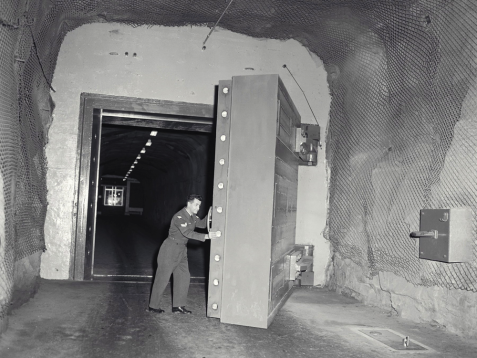
The car finally came to a stop in front of another set of doors. These were not made of concrete but metal, presumably steel perhaps even titanium. The huge metal door looked something like a bank vault door with a big wheel attached to the front of it, but also with a pair of electronic keypads, one on each door. The door was obviously unlocked as it was open wide enough for at least two men to pass through, shoulder to shoulder.
Agent Wilson was the first to get out of the car and walk back to the rear car door to let Nathan and Alec out. He opened the door. “Gentlemen, please follow me,” he said.
Nathan and Alec got out of the car and followed Agent Wilson. Others from the cars in the caravan that followed them also got out of their cars and began to follow too. They walked past the vault-like door and entered a long hallway. About a hundred paces there was another set of doors which resembled the entrance to an elevator, but there wasn’t any call button, just a black panel with a circular lens in the middle and a keypad at the bottom, about head height on the right-hand side of the wall.
Alec looked at Nathan and then at Agent Wilson, then back at Nathan. Nathan shrugged his shoulders. Agent Wilson stepped up to the panel on the wall. Nathan and Alec watched as he placed his face closer to the panel. It lit up with a bright, thin beam of red light and scanned Agent Wilson’s eye. A computer voice spoke from a speaker on the wall panel in response to Agent Wilson’s actions and said, “Identification scan. Special Agent, Harold Wilson, Secret Service.” After a short pause, the computer said, “ Identity Confirmed. Entry is permitted.” The elevator doors slid open.
Agent Wilson stepped back from the wall panel and motioned for everyone to enter the elevator. Nathan took a deep breath and followed Alec into the elevator, which was larger than he expected. Agent Wilson stepped into the elevator and looked at the floor selector. There were only two buttons. He pressed the bottom button, the elevator doors closed and they began to descend.
Nathan felt his stomach rise toward his chest as the elevator moved rapidly downward, faster than any elevator he’d ever been in before. Everyone was quiet for the ride down, so much so that he could hear himself breathing rapidly and realized he was nervous. On the way down from Washington, Agent Wilson told Nathan that not only did the President of the United States want to speak with him, but also the British Prime Minister, the German Chancellor, the French President and the Australian Prime Minister. No wonder I’m sweating he thought.
The elevator came to a halt and after a few seconds, the doors opened into a large control room. Nathan scanned the room with his eyes and noticed there were huge TV screens at the far end of the room all showing some horrific scene from different parts of the world. About two-thirds of the way in he saw a large oval conference table with finely dressed men and women sitting around the table. There were also heavily armed soldiers between where they stood now and the people at the table.
As Nathan and the rest of the party started to walk out of the elevator, Agent Wilson held his hand up indicating they should halt. The soldiers didn’t move, but it wasn’t because they were ignoring the group coming out of the elevator, it was more like they were coiled up and ready to strike at will. Agent Wilson cleared his throat. “Excuse me, Mr. President,” he said.
A man in a dark blue suit, white shirt and red tie stood up. All the people sitting at the oval table turned their heads and all eyes seem to be glaring right at Nathan. The room fell silent for only a moment, but it seemed like an eternity to Nathan.
“Agent Wilson. Is that him?” asked the President.
“Yes, Mr. President. I have brought Mr. Nathan Gray and his team, just as you requested,” said Agent Wilson.
“Good. And just in time too. We had a new development in just the past few minutes,” said the President, gravely.
Nathan’s nose crinkled in confusion. “a new development, Mr. President? What… what new development?” he asked.
“Yes, a new development, Mr. Gray. Just look behind me at the screens,” said the President. He motioned to the large monitors in the back of the room.
Nathan’s eyes widened, and his mouth fell open, speechless. On all the monitors, he saw the same thing. Reporters of every nationality all pointed their camera’s up toward the sky. On every screen in every location across the globe, the scene was the same. Massive large, black sleek alien ships hovered over Earth’s remaining major cities.
“It appears, Mr. Gray, that we have made first contact,” the President said.
End of Part II
That’s all for now folks. Please feel free to like, comment or share our journey! Let’s see how this story develops in our next installment, Part III which I will post next week!
Happy New Year!
Advertisements
December 13, 2018
The Making of a Short Sci-Fi Story. “Sporelings” – Part I – 1st draft
I am currently taking a short story fundamentals class online. I decided to write about this experience in a series of blog entries that will document my journey as I develop a short science fiction story as part of my class experience.
I plan to the blog everything from the first drafts, to the revisions, and edits to the eventual final draft as I work through the process and learn the art of writing short stories. This particular short story will be approximately 5000 words.
This story itself will be written and revised over the course of the next few weeks! I decided to tackle this story in three parts and model it off of an anthology idea that I was once a part of but never got to finish because the anthology group fell apart and everyone went their separate ways.
This short story is a work of science fiction. It will be written in three parts. Part I will introduce a grim Future. Some cataclysmic event will change the world. This will be a world-building setup and quick character introduction. Part II will cover what happens in the last 5 minutes in this word that has a grim future. In other words, what happens as a result of this drastic change. Part III is what comes next. How does this world continue after a cataclysmic event? What does the future now have in store?
I haven’t decided on a title yet. The working title is “Sporelings.” As the story develops and as I go through short story fundamentals class, we’ll see if there is a need pick a more descriptive and appropriate title.
All right then, let’s get right into it!
[image error]
“Sporelings” – Part I – 1st draft
For thousands of years, mankind has been driven by insatiable curiosity to study the great pyramids of Egypt. What secrets hide inside these ancient wonders? Could they hold the key to mankind’s future, or perhaps missing links to the past? The quest continues…
#
Present day—El Giza, Egypt— The Great Pyramid
After eleven previous investigations over the past decade, Archaeologist Nathan Gray and his team once again entered the queen’s chamber of the Great Pyramid. This time they were equipped with the excavation robot, SARTI (Standard Archaeological Robotic Technology Inc.). A small remote-controlled robot, SARTI was able to scale narrow shafts and scan targets with infrared and ultrasonic waves.
“Alec,” Nathan said. “The target is above the queen’s chamber. That two-meter slab is where I need the bloody robot.”
Alec Cooper, the team’s chief engineer, tapped on the computer interface. “We’re ready, Nathan.”
SARTI began the ascent.
As the monitors came to life, the team eagerly watched the robot climb to the top of the shaft. A few minutes later, SARTI rotated and began a heat scan.
Twenty minutes passed, and a frustrated Nathan glared at Alec. “Oh, for crying out loud, that godforsaken thing is bloody useless. There’s nothing but rock.”
“Hold on,” Alec said. “Give it another few minutes. Let SARTI run the full program.”
The screen went dark. A scan using low-frequency waves began, followed by one with ultrasonic waves.
Nathan watched the screen for a few minutes more, then scowled, impatient with the lack of progress. “Still nothing? How much did the bag of bolts cost us anyway?”
“Bloody hell, Nathan, give it a few minutes, man!”
The computer signaled a target, displaying the ultrasonic image of a dark oblong shape in the center. Alec pointed to the monitor. “Look, there, SARTI found something.”
“Brilliant!” Nathan couldn’t turn away from the screen. “Well, get a move on,” he said. “Go! Go! Tell that idiotic robot to bring it here!”
#
Several hours later
Once SARTI had brought the artifact from the queen’s chamber, Alec put on protective gloves and reached inside the specimen tray. Carefully, he picked up the object. “Outstanding,” he said. “It’s a golden scarab. You suppose it’s some type of jewelry?”
Rubbing his chin with his fingers, Nathan stared at the scarab in Alec’s hand for a few moments. Puzzled, he reached for the shiny golden bug. “Jewelry?” he repeated Alec’s question, pausing for a moment, contemplating on an answer. “Hidden between the queen and king’s chamber. I wouldn’t think so.” He gently picked up the scarab and rolled it over in his hand. Look here, there’s something more!” He pressed his finger down lightly on the scarab’s head.
It snapped open.
Nathan’s eyes widened with awe. Darkness rested in his palm, an empty void, as though he peered straight into a black hole from the deepest space.
“What is it?” Alec asked. “What do make of that?”
Nathan didn’t answer. He couldn’t take his eyes away from the darkness inside the scarab. What have we found? he thought, full of wonder. A dark, bottomless, pit … inside a golden scarab? “It can’t be,” he whispered.
The scarab began to grow hot in his hand. “Damn!” He dropped it, the palm of his hand blistered.
“What the hell?” Alec said, slowly backing away. His gaze remained locked on the dusting of dark, odorless material rising from the scarab. “You think it could be a type of fungus maybe, or spores?”
“Yes,” Nathan whispered. “They… they look like tiny… sporeling” The name just came to mind. As he watched, the dark mass pulled into a tight circle, then pulsed. Nathan jumped when the circle loosened and doubled in size above his head. Seconds later it repeated the process. It’s breathing, he thought. But getting bigger on every exhale. The first twinges of unease tickled at his mind.
The sporeling were multiplying at an alarming rate!
“Let’s get out of here!” Alec yelled. “Nathan, we don’t know what it is!” He turned to run from the room, not waiting to see if Nathan followed.
But Nathan hadn’t heard him, too mesmerized by the growing void of darkness above him … so much like the one he’d viewed inside the scarab. A black hole being birthed into a gateway in the ceiling.
Terror struck Nathan at the thought; it tore through his guts, a cramping, almost crippling pain. What if the black swirl above him pulsed again and sucked him in?
He didn’t wait around to find out.
Nathan ran.
#
In less than a week, the sporelings Nathan accidentally released from the scarab had spread across the planet. It didn’t take long because every time they pulsed, the dark cloud doubled in size, releasing more of their progeny into the air. At the end of the tenth day, the swirling mass floated down and settled into the soil. It attached to all plant life and began to manipulate their basic structure on a cellular level. Fragile flora, green stems, leaves, and flowers were transformed, turned black and indestructible. Botanists learned the shiny obsidian material affected every variety: cacti in the hottest desert, worldwide forests and jungles, and algae and seaweed in the deepest oceans.
Nothing was spared.
#
It took only ten days to send the world into chaos. As the plants continued their metamorphosis, they began to pulse, releasing more toxins into the environment. Desperate scientists searched for ways to combat them but were defeated at every turn. Volcanoes erupted, earthquakes rumbled, tornados and hurricanes wreaked havoc. The land waged war against man, destroying everything in its path.
Cities crumbled.
People died.
Then Botanist learned the new species of obsidian plants absorbed the sun’s energy at fifty times the level of their native species. The added warmth quickly raised surface temperatures. Polar caps melted, but the newly released water evaporated almost immediately—along with the water in every river, lake, and ocean. It soon created a canopy of water in the stratosphere causing a greenhouse effect below. The increased atmospheric pressure made the oxygen and carbon dioxide richer.
But would anyone be left to reap the potential rewards?
#
On the twelfth hour of the twelfth day after Nathan released the sporeling, the alien plants reached maturity. Almost as one, the shiny obsidian leaves turned upward toward the heavens and began a rhythmic pulse. The few people still left watched, worried it might be a signal of some kind, a beacon.
But a signal to whom?
Or what?
End of Part I
Ok! Now, as I submit my work in the class and as I get feedback, I’ll post revision, edits and of course when it’s time, Part II or what happens int he last 5 minutes in this grim future!
November 12, 2018
Quick Scenes, Sierra Jones- No Better Way To Start The Day
Startled awake from a pleasant dream of a naked Jennifer Lawrence handing her a fruity frozen daiquiri, Sierra snuck her arm out from under the covers and blindly slapped at the nightstand to catch the snooze button on the alarm clock. Sadly, she couldn’t fall back asleep and resume the encounter with Jennifer and the daiquiri.
She lay there for exactly seven minutes until the snooze timer ended and the alarm blared again. Reluctantly, she stumbled out of bed and headed toward the bathroom to take a shower.
Sierra pulled the ends of the knotted drawstring loose on her pajama bottoms, which then slid down the curve of her hips and puddled on the floor around her ankles. Stepping out of the small cotton heap now gathered on the floor, she grabbed the bottom edge of her pajama top and in one swift motion pulled it over her head and shucked it to the floor.
Staring at her naked reflection in the mirror, Sierra mentally compared herself to the stunning image of Jennifer Lawrence from her dream. Sierra’s breasts were larger and her hips a bit curvier, but Jennifer was taller and prettier, and let’s face it, she had a movie deal and Sierra didn’t.
Sierra reached into the shower and turned on the water. Once it was hot enough, she stepped into the shower. Instead of dispelling the comparative thoughts of Ms. Lawrence and all her beauty, she decided to hold the image in her mind as she began lathering herself up. Having this object of beauty before her was a better way to start the day.