_Anonym's Blog - Posts Tagged "embraching-obscurity"
"Embracing Obscurity"
Bear with me, I have to put this out there.
Not long ago a book caught my attention, odd and uninviting as it was. It was called Embracing Obscurity and in it a Catholic priest extolls the godliness of anonymity. It is signed "anonymous."
Here, at length, is an excerpt.
"A lot of us are caught up in this religious version of the American dream, even in the church. For example, a friend of mine wanted to be a career youth pastor. But that aspiration didn't jive with his "higher ups." In fact, he was looked down on because of his lack of ambition! To be a success in the local church, apparently, you need to go to school to get your bachelors, M.Div., and possibly doctorate. Then you work your way up the ranks of the church, from youth pastor to assistant pastor, and eventually to lead pastor. Once you're on top, your job is to grow your church to a successful number. One hundred will never turn heads, so you're encouraged to "think big" and implement a "growth strategy." You're going to need at least four-digit Sunday attendance to be taken seriously at pastor's conferences. then, once you have a few thousand in attendance and blog, Facebook, and twitter platforms, you can go on to write books. Once you have a book or two on your resume, you can speak on invitation outside your flock. If you work hard enough, you can eventually retire and enjoy all the luxuries you've accumulated through your had work and revel in your five-star reputation.
Are the similarities between the world's and the church's "business models" as startling to you as they are to me?"
As one who checks the "spiritual but not religious" box, with no illusions what the church is in capitalist culture, my answer is no, not startled at all, but thank you indeed for making the observation and asking the question. Embracing Obscurity is not a book I could recommend to any but proud, ambitious priests, but it does throw a welcome light on the subject of anonymity in general and anonymous authorship in particular, and touches my own reasons for signing anonym.
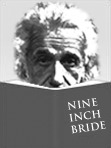
I wrestled with the question of signing Nine Inch Bride. None of the options were appealing. Each had more downside than up. Using my own name and identity was least appealing of all. The interview I gave for the reading group guide explored my reasons, and I thought it an unimportant question among those asked. Recently though, I was shocked to be made aware that to some readers nameless was a deal breaker: they would not read a book by an anonymous author. I admit that looney tunes was my first thought, but I was assured there were perfectly sane people who would not even consider reading a book thus signed. No reasons were given for this strange and unexpected reaction, and I was left to guess what they might be.
Silliness behind the Guy Fawkes mask and the used-to-death "anonymous" rubric online came to mind as a possible reason. Or was it a consumer reaction where the branding bond with anonym could not compete with "Penelope Frickles?" Neither of these explained how all without a name could be tarred out in the same brush stroke. Why would this not apply as well to the ubiquitous pen name?
As I considered deeper, it struck me that I had never really cared who authored the books I loved. I recalled how in school I had argued it was a useful identifier, but had no bearing, or should have no bearing, on their individual works, some of which were far better than others, and some quite awful. I knew Shakespeare from Brecht and had some expectation from their names, but I went so far as to prefer to know no more about them, their individual lives, their background, and least of all, how these supposedly explained why they thought this, or wrote that. In literature class it invariably seemed, "everything found about you as an author can and will be used against you."
Powerful writers especially were routinely dismissed by some "influence" or psychological conditioning in their lives. Why would any writer willingly hand such ammunition for diminution or aggrandizement over to their critics? Why provide "love handles" to their dearest followers for that matter? Was it pride and egotism? Desire for love and renown that leads authors to expose themselves in the commercial limelight? Sure, it was. It was the very human thing the obscure priest was talking about among his fellow clerics in the church, the dream of bourgeois success.
I have always understood the benefit of fortune sufficient to continue one's work, but I confess I have never understood the benefit or desirability of fame. Fame has always seemed to me a prison, a case of mistaken identity concerning artists, who are not and can never be the work they share with the world no matter what of them is in it. Egotism is not the artist's vantage point to begin with, to me it is obvious the opposite is true. How could the heady drug of fame, like excess of power or fortune, fail to corrupt the artist? I was back again to the broken culture in which we find ourselves, where even the "servant of god" is pushed to become self-serving and ambitious, and celebrity is the sine-qua-non for survival in the arts.
A false name then, a pen name? I toyed tongue-in-cheek with signing myself An Onym or Uomo Sapiens, let those who cared call it hokey. Or John Salt. The latter would at least be a part of the Nine Inch Bride story, just as anonym is in a less direct way. But even a pen name imprisons you in one sex or the other and ultimately requires an identity fleshed out behind it with all therein circumscribed--this age, that background, the other "influence." A pen name was also a lie in a way that nameless was not, and no less diminishing or aggrandizing of the work than a real name and identity would be. No matter how I angled the question, author identity seemed to me more obscuring than revelatory or even relevant. Surely the work is what matters, either contains its own authority in art and truth or has none.
Anonym seemed to have the smallest downside. Unlike anonymous, it could be distinguished from foolery hiding behind the Guy Fawkes mask yet still connect to its values. If there was no humble godliness to it, at least there was not a me-me clamor in conflict with the story and the message of the heroine Sahar, who makes a like choice with celebrity one easy step away. "As a practical matter I am overqualified for the idle stardom job." Indeed, unlike a priest, the choice for me has little enough to do with religious self-effacement or humility or obscurity at all. As a practical matter, and the anonymous priest-author would argue as a spiritual matter, we are all overqualified for our name, condition and worldly circumstance, whether these are obscure or glowing in the limelight. Certainly in the writing I am more than my self. I feel I am beside my self, less artisan than instrument of our times.
Plain and simple, thank me for sparing you overmuch of me, and directing your attention to the work I would rather you know and love than me. To me the ideal face for an author would be a mirror. What more could a writer ask than that every reader see themselves when they look to you? We are all Uomo Sapiens, An Onym--to a tree.
Deus ex machina. Strangely enough, I no sooner reached this wrap up than my email chimed. I had a new follower on twitter: @gonz009
"Talking about myself limits my potential as a human being..."
A mere coincidence, of course.
And in the end I am left still asking, what is in the mind of the reader who would dismiss all literature for which there is no author name? I'd love to understand this.
Not long ago a book caught my attention, odd and uninviting as it was. It was called Embracing Obscurity and in it a Catholic priest extolls the godliness of anonymity. It is signed "anonymous."
Here, at length, is an excerpt.
"A lot of us are caught up in this religious version of the American dream, even in the church. For example, a friend of mine wanted to be a career youth pastor. But that aspiration didn't jive with his "higher ups." In fact, he was looked down on because of his lack of ambition! To be a success in the local church, apparently, you need to go to school to get your bachelors, M.Div., and possibly doctorate. Then you work your way up the ranks of the church, from youth pastor to assistant pastor, and eventually to lead pastor. Once you're on top, your job is to grow your church to a successful number. One hundred will never turn heads, so you're encouraged to "think big" and implement a "growth strategy." You're going to need at least four-digit Sunday attendance to be taken seriously at pastor's conferences. then, once you have a few thousand in attendance and blog, Facebook, and twitter platforms, you can go on to write books. Once you have a book or two on your resume, you can speak on invitation outside your flock. If you work hard enough, you can eventually retire and enjoy all the luxuries you've accumulated through your had work and revel in your five-star reputation.
Are the similarities between the world's and the church's "business models" as startling to you as they are to me?"
As one who checks the "spiritual but not religious" box, with no illusions what the church is in capitalist culture, my answer is no, not startled at all, but thank you indeed for making the observation and asking the question. Embracing Obscurity is not a book I could recommend to any but proud, ambitious priests, but it does throw a welcome light on the subject of anonymity in general and anonymous authorship in particular, and touches my own reasons for signing anonym.
I wrestled with the question of signing Nine Inch Bride. None of the options were appealing. Each had more downside than up. Using my own name and identity was least appealing of all. The interview I gave for the reading group guide explored my reasons, and I thought it an unimportant question among those asked. Recently though, I was shocked to be made aware that to some readers nameless was a deal breaker: they would not read a book by an anonymous author. I admit that looney tunes was my first thought, but I was assured there were perfectly sane people who would not even consider reading a book thus signed. No reasons were given for this strange and unexpected reaction, and I was left to guess what they might be.
Silliness behind the Guy Fawkes mask and the used-to-death "anonymous" rubric online came to mind as a possible reason. Or was it a consumer reaction where the branding bond with anonym could not compete with "Penelope Frickles?" Neither of these explained how all without a name could be tarred out in the same brush stroke. Why would this not apply as well to the ubiquitous pen name?
As I considered deeper, it struck me that I had never really cared who authored the books I loved. I recalled how in school I had argued it was a useful identifier, but had no bearing, or should have no bearing, on their individual works, some of which were far better than others, and some quite awful. I knew Shakespeare from Brecht and had some expectation from their names, but I went so far as to prefer to know no more about them, their individual lives, their background, and least of all, how these supposedly explained why they thought this, or wrote that. In literature class it invariably seemed, "everything found about you as an author can and will be used against you."
Powerful writers especially were routinely dismissed by some "influence" or psychological conditioning in their lives. Why would any writer willingly hand such ammunition for diminution or aggrandizement over to their critics? Why provide "love handles" to their dearest followers for that matter? Was it pride and egotism? Desire for love and renown that leads authors to expose themselves in the commercial limelight? Sure, it was. It was the very human thing the obscure priest was talking about among his fellow clerics in the church, the dream of bourgeois success.
I have always understood the benefit of fortune sufficient to continue one's work, but I confess I have never understood the benefit or desirability of fame. Fame has always seemed to me a prison, a case of mistaken identity concerning artists, who are not and can never be the work they share with the world no matter what of them is in it. Egotism is not the artist's vantage point to begin with, to me it is obvious the opposite is true. How could the heady drug of fame, like excess of power or fortune, fail to corrupt the artist? I was back again to the broken culture in which we find ourselves, where even the "servant of god" is pushed to become self-serving and ambitious, and celebrity is the sine-qua-non for survival in the arts.
A false name then, a pen name? I toyed tongue-in-cheek with signing myself An Onym or Uomo Sapiens, let those who cared call it hokey. Or John Salt. The latter would at least be a part of the Nine Inch Bride story, just as anonym is in a less direct way. But even a pen name imprisons you in one sex or the other and ultimately requires an identity fleshed out behind it with all therein circumscribed--this age, that background, the other "influence." A pen name was also a lie in a way that nameless was not, and no less diminishing or aggrandizing of the work than a real name and identity would be. No matter how I angled the question, author identity seemed to me more obscuring than revelatory or even relevant. Surely the work is what matters, either contains its own authority in art and truth or has none.
Anonym seemed to have the smallest downside. Unlike anonymous, it could be distinguished from foolery hiding behind the Guy Fawkes mask yet still connect to its values. If there was no humble godliness to it, at least there was not a me-me clamor in conflict with the story and the message of the heroine Sahar, who makes a like choice with celebrity one easy step away. "As a practical matter I am overqualified for the idle stardom job." Indeed, unlike a priest, the choice for me has little enough to do with religious self-effacement or humility or obscurity at all. As a practical matter, and the anonymous priest-author would argue as a spiritual matter, we are all overqualified for our name, condition and worldly circumstance, whether these are obscure or glowing in the limelight. Certainly in the writing I am more than my self. I feel I am beside my self, less artisan than instrument of our times.
Plain and simple, thank me for sparing you overmuch of me, and directing your attention to the work I would rather you know and love than me. To me the ideal face for an author would be a mirror. What more could a writer ask than that every reader see themselves when they look to you? We are all Uomo Sapiens, An Onym--to a tree.
Deus ex machina. Strangely enough, I no sooner reached this wrap up than my email chimed. I had a new follower on twitter: @gonz009
"Talking about myself limits my potential as a human being..."
A mere coincidence, of course.
And in the end I am left still asking, what is in the mind of the reader who would dismiss all literature for which there is no author name? I'd love to understand this.