David Clive Price's Blog
October 14, 2014
ON THE TRACK OF THE PAST IN SEOUL
 I was recently back in Seoul after publishing
Phoenix Rising: A Journey Through South Korea
and like all authors after publishing a book, I wanted to find out if what I had discovered and written about almost a year ago still held true.
I was recently back in Seoul after publishing
Phoenix Rising: A Journey Through South Korea
and like all authors after publishing a book, I wanted to find out if what I had discovered and written about almost a year ago still held true.Was This Really Seoul?
I stayed in a 4-star hotel in Myeongdong, near the Cathedral where all the riots and protests against the military government took place in the 1980’s but also very close to the largely middle class shopping district.
The middle-class atmosphere of the shopping avenues hadn’t changed much, except perhaps the district looked even more like an upscale shopping quarter in any country of the world: designer shops, boutiques, Starbucks, international labels, department stores. What seemed to be missing was the feel of the traditional, rather eccentric, do-it-yourself Seoul I knew when I first lived there – and on many subsequent visits.
It was the same in the hotel. A sort of international, airport-style architecture and design had taken over. The tourist services were in place but they were perfunctory and utilitarian.
There was a distinct lack of character in the business lounge or hotel lobby and much less of the rather nutty, barely English speaking character of the Koreans I used to know in my traditional inns (yogwan) of the past with their bedding on the heated floor and their often uproarious maids and tipsy male porters.
To sum up, this area of Seoul had become not so much cutting edge (the Seoul portrayed in many Korean movies and TV dramas) as boring. There was an old-fashioned theatre, yes, offering a Korean ‘entertainment’ show for tourists in English. There were Korean-style barbecue restaurants. But the prices were very high for food that looked, frankly, like barbecued meat anywhere in the world.
Searching For The Authentic Korea
On that first day I wandered around the area looking for something authentically Korean – a real hot springs/spa and massage place, for example, of the kind I used to frequent or perhaps a lively local bar offering soju (potato liquor), makkolli (cloudy rice wine) and leek pancakes (jon), or a Buddhist-type restaurant with vegetarian side dishes (namul) and kimchi.
But I drew a blank. And so I took a deep breath and did what I always do in similar situations. I went on a hunt for the authentic.
And thank goodness it was still there!
Not very far away from the dull hotel and sleek avenues of Myeongdong with its perfectly turned out, white suit wearing shoppers and moisturized young people with their cosmetically enhanced faces, we found the traditional Korea-style street market of Namdaemun (South Gate).
All sorts of useful things for personal health or home use were on sale at Namdaemun. I bought a shopping trolley and a wooden back pounder with spikes from a very friendly, amused woman who showed me how to use it on various parts of my body to increase circulation.
I bought T-shirts and cheap jeans. I ate Korean street snacks sitting on a low stool at a table in the middle of the road. I found a wonderful Korean medicinal shop with reasonably priced Korean red ginseng paste to take home.
Beneath The Surface
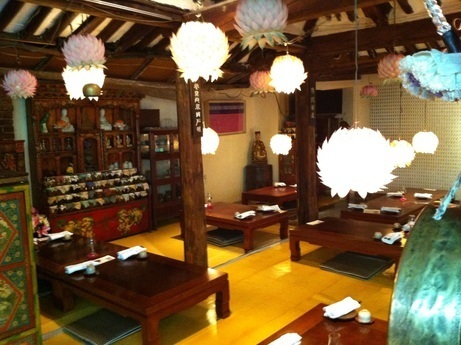
Later, I went to one of Seoul’s most famous Buddhist restaurants hidden in a back street near the Insadong arts and crafts center. Here I was served twenty-eight vegetarian dishes in a traditional inn stuffed with historical and artistic Koreana (and a bit of Myanmarana in the shape of Burmese puppets!). The dishes were exquisite and included my favorite spicy todok root – like marinated ginseng - and a sour plum wine that I ordered twice.
Continuing on my Buddhist way, I found the main Chogye temple of Seoul in its dusty courtyard where I went and prostrated myself many times in front of the golden shining face of Buddha – alongside many female supplicants.
They didn’t bat an eyelid at the presence of a white foreigner in their midst. They made smiling room for me on the matted floor as the priest intoned the sutras and the bell rang out in rhythm with Buddha’s teachings.
What a relief! Seoul still existed beneath the veneer of international sophistication and the heavy mantle of being Asia’s most innovative capital for fashion, IT and design.
Yes, it has all these things – as I say in my book – but as I also say in Phoenix Rising that the most extraordinary characteristic of South Koreans is their ability to look both forward and back simultaneously. They do not to forget where they come from.


August 22, 2014
Interview: LEADING YOU INTO UNEXPLORED TERRITORY
 David Clive Price has been at various times a wine and olive farmer in Italy, a Renaissance scholar, speechwriter for one of the world’s leading banks, a strategic adviser to Asian multinationals, and an explorer of the unknown corners of South Korea, Japan, China, the Philippines, Taiwan and Myanmar (Burma), to name just a few of his ‘unexplored territories’.
He has written books on the ‘lost civilization’ of rural Italy, music and Catholic conspiracies in Elizabeth I’s England, Buddhism in the daily life of Asia, the secret world of China’s Forbidden City, the intricacies of corporate life in London and Hong Kong, off-the-beaten track Seoul and South Korea, and the underworld of 1980s New York.
INTERVIEW WITH DAVID CLIVE PRICE BY ERIC WENG FROM WWW.UNEXPLOREDTERRITORY.NET
Q: What really floats your boat? Why did you go to the Far East and why now publish all these books about Asia business cultures, along with novels and travelogues set in Asia?
I have always been attracted by other cultures and what lies beyond. It’s like an instinctive reaction to any new place. I get a sort of obsession with the idea of a new and strange experience – a world I have never set foot in before, an adventure, something with risk involved, something that may or may not make me money but that promises to be in some way revelatory – or shall we say spiritual.
Q: What do you mean spiritual?
I don’t mean anything particularly holy (even if I have become a Buddhist on my travels). It means discovering something about the world that suggests other dimensions, like all those spirits and demons and Taoist or Shinto gods of nature in various Asian cultures.
Of course, it can be something quite banal like lighting incense for the God of Prosperity or choosing the lucky number 8 for your mobile phone and house numbers, as almost all Chinese do. But it can also be the discovery of religious rituals or simple domestic and family customs that make life seem so much richer and full of wonder.
Q: When did you first discover this about yourself?
It’s hard to say exactly when. I was a precocious schoolboy with a penchant for entertaining my classmates with ironic pop songs (Tom Jones, for example) and little skits that made the class fall about before the teacher arrived. I played Hamlet at school, fell of the stage at a school play competition and discovered my ability to be resilient by just carrying on. I recited Keats and Wordsworth to myself in my bedroom mirror or in the local woods. I loved to be independent.
Later I won a choral scholarship to Cambridge after the tutor got me completely drunk on sherry because of my nerves. The common thread in all this was a belief in my self and readiness to take on the new in order to learn. I was always in the library and I date my passion for the German, Italian and French languages from my time at school.
Q: You seem to have had everything necessary to pursue a successful career. What happened? Your career is not exactly a straight line.
Every time I have been set up with what seems a conventional career, I have taken a calculated risk and broken free to pursue something entirely different, something that is often diametrically opposed to the world in which I have been trained to excel.
When I finished my PhD on ‘Music and Patrons of the English Renaissance’ (the History Faculty at first refused the subject) I didn’t wait to receive my doctorate. I headed straight for Switzerland and my first big love affair, living in a tiny rooftop atelier in the old town of Zurich.
However, while I was there the British Academy offered me a fellowship to do postgraduate research at Bologna University for a book on the Italian Renaissance. So I continued on to Italy (my second great love) and pursued this research diligently in the archives of various north Italian cities. But after a year of being a professor, I jacked it in and went over the Apennines to search for a cheap place to live and lead a completely different kind of life.’
Q: Where did you end up?
My partner and I found an old farmhouse in an Etruscan hilltop town, perched on the side of a valley with a lovely tower for my study. To the accompaniment of sparrows in the roof eaves, I translated a book on India by the poet and film director Pier Paolo Pasolini and then considered what kind of book I might write myself.
I was farming wine and olives and vegetables. I had entered full scale into local country life. My own mezzadro (share cropper) was teaching me all about binding vines and pruning olive trees so I ended up writing a book about Italian rural life called The Other Italy. It’s still in print on Amazon. And then I began a novel.
Q: Why a novel? What was the inspiration?
I decided to shake up my comfortable rural existence. I went to New York for a year and lived in the most ‘edgy’ neighbourhood possible: Alphabet City, or Avenues A to Z. Nowadays it’s very gentrified but back then it was a hotbed of creativity, drugs, prostitution, gay and lesbian life, and contained a fascinating mix of blacks, whites, Puerto Ricans, Ukrainians, Russians, Jews, every race under the sun.
So I began the novel from my ringside seat on the Lower East Side – a dirt-cheap apartment on a very risqué street opposite a walled up drug den. I then finished the novel back in the soothing tranquillity of the Tuscan countryside.
Q: Do you like extremes? Is that what makes you a writer?
I’m not an extreme person in that sense. But I love a challenge. Almost instinctively I try to get right under the surface of the prevailing culture. In this sense, all the books that have followed including my recent novel Chinese Walls, about love and corruption in London and Hong Kong, as well as Phoenix Rising; A Journey Through South Korea, are attempts to get beneath the surface of other worlds (London politics, Northeast Asia, imperial Beijing, post-colonial Hong Kong).
Q: Is that what your business books are about? I see they are called the Master Key Series.
Yes, the business books and the Asia fiction/travel are two sides of the same coin. I like to dive deep, learn from the clash of cultures, try everything. That’s the methodology I teach my business clients: be patient, observe, adopt a new way of thinking. The Master Key to Asia and The Master Key to Asia offer a system for getting into these other worlds – in this case Asian business – by assimilating other cultures and being imitative.
Q: Is that also your technique as a writer?
You could say that. When researching my CUP book on Elizabethan musicians and courtiers, I was intrigued by how much they had to dissemble and hide up their Catholic sympathies. Many of them led double lives but they still managed to merge seamlessly into Elizabethan society.
They were successful because they learned how to disguise themselves. In terms of daily habits, this often meant that they had to lurk in strange places to meet fellow Catholic sympathisers. A chronicler of the time described William Byrd, the Queen’s composer, as being 'seen in lurcking sorte' in Deptford.
Q: Is this something important to you? Being a kind of spy?
Yes, I rather see myself as a 'lurker'. My novelistic technique is to hang around at street corners, go to places in a town where no one else goes, sit at the wheel of my car in a supermarket car park and watch what other people are doing. Novelists are always like that, looking over their shoulder or from a distance, merging into the background even when their immediate environment is entirely foreign to them.
That’s why I advise my business clients to become ‘Chinese’ or ‘Korean’ or ‘Indonesian’ as much as they can, to try everything local and not be put off, to get out of the expat ghetto in the cities of Asia and discover the real world beyond. The best way to do that is to be a spy.
Q: Finally, what came first for Chinese Walls or Phoenix Rising – the plot, the main character or the idea?
I usually start with a feeling inside, which evolves eventually into a starting point for a plot. The main character slips onto the stage. Then as I develop the plot and structure, I slowly start to get a feeling for what the book is about. After a few attempts at an opening chapter, it starts to flow. If it doesn’t, I put it away – perhaps for years – and work on something else.
Q: Are there any other books in your 'Unexplored Territory' trilogies that are waiting for the light of day?
The next novel in the Unexplored Territory series is called Last Train to Mandalay and is entering the final edit. The next travel book in the series, Glimpses of Snow Country: Travels in Japan, is largely written but awaits 2-3 extra chapters on particular areas of Japan’s Snow Country, such as Hokkaido, which I am visiting in the near future. I think a travel book on Japan will complement my adventures in South Korea and provide an interesting comparison of two very different cultures.
Q: What is the message you’d like to share with the world?
“Cultivate a sense of wonder”
____________________________
All David Clive Price’s books are available as Amazon paperbacks and Kindles.
Author website: http://www.davidcliveprice.com/books
Author blog: http://unexploredterritory.net
Amazon Author page: http://www.amazon.com/author/davidcliveprice
August 6, 2014
Chinese Walls
#wsite-video-container-714946119830544605{ background: url(//www.weebly.comhttp://www.unexploredte... } #video-iframe-714946119830544605{ background: url(//cdn2.editmysite.com/images/util/video... } #wsite-video-container-714946119830544605, #video-iframe-714946119830544605{ background-repeat: no-repeat; background-position:center; } @media only screen and (-webkit-min-device-pixel-ratio: 2), only screen and ( min-device-pixel-ratio: 2), only screen and ( min-resolution: 192dpi), only screen and ( min-resolution: 2dppx) { #video-iframe-714946119830544605{ background: url(//cdn2.editmysite.com/images/util/video... background-repeat: no-repeat; background-position:center; background-size: 70px 70px; } } 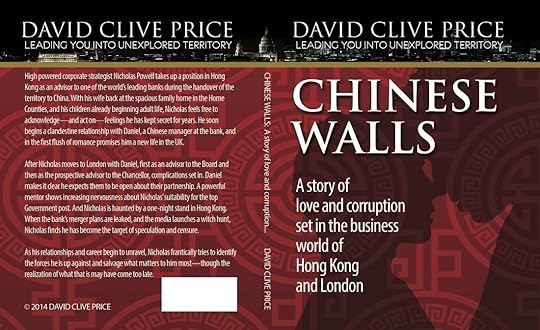 My novel Chinese Walls has been published, a story of love and corruption set in the business world of Hong Kong and London.
Following on the success of The Master Key to Asia and The Master Key to China, my new novel (mystery & detective genre) reflects the themes of intercultural relationships and the need for transparency that I have encountered in my professional life in Asia.
THE ILLUSION OF FREEDOM
High-powered business strategist Nicholas Powell takes up a position in Hong Kong as an advisor to one of the world’s leading banks during the handover of the territory to China. With his wife back at the spacious family home in the Home Counties, and his children already beginning adult life, Nicholas feels free to acknowledge – and act on – feelings he has kept secret for years.
He soon begins a clandestine relationship with Daniel, a Chinese manager at the bank, and in the first flush of romance promises him a new life in the UK.
After Nicholas moves to London with Daniel, first as an advisor to the Board and then as the prospective advisor to the Chancellor, complications set in. Daniel makes it clear he expects them to be open about their partnership. A powerful mentor shows increasing nervousness about Nicolas’ suitability for the top Government post. And Nicholas is haunted by a one-night stand in Hong Kong.
When the bank’s merger plans are leaked, and the media launches a witch-hunt, Nicholas finds he has become the target of speculation and censure.
As his relationships and career begin to unravel, Nicholas frantically tries to identify the forces he is up again and salvage what matters to him most – though the realization of what that is may have come too late.
The novel is published as an Amazon paperback and as an Amazon Kindle (e-book).
My novel Chinese Walls has been published, a story of love and corruption set in the business world of Hong Kong and London.Following on the success of The Master Key to Asia and The Master Key to China, my new novel (mystery & detective genre) reflects the themes of intercultural relationships and the need for transparency that I have encountered in my professional life in Asia.
THE ILLUSION OF FREEDOM
High-powered business strategist Nicholas Powell takes up a position in Hong Kong as an advisor to one of the world’s leading banks during the handover of the territory to China. With his wife back at the spacious family home in the Home Counties, and his children already beginning adult life, Nicholas feels free to acknowledge – and act on – feelings he has kept secret for years.
He soon begins a clandestine relationship with Daniel, a Chinese manager at the bank, and in the first flush of romance promises him a new life in the UK.
After Nicholas moves to London with Daniel, first as an advisor to the Board and then as the prospective advisor to the Chancellor, complications set in. Daniel makes it clear he expects them to be open about their partnership. A powerful mentor shows increasing nervousness about Nicolas’ suitability for the top Government post. And Nicholas is haunted by a one-night stand in Hong Kong.
When the bank’s merger plans are leaked, and the media launches a witch-hunt, Nicholas finds he has become the target of speculation and censure.
As his relationships and career begin to unravel, Nicholas frantically tries to identify the forces he is up again and salvage what matters to him most – though the realization of what that is may have come too late.
The novel is published as an Amazon paperback and as an Amazon Kindle (e-book).
August 5, 2014
ALPHABET CITY
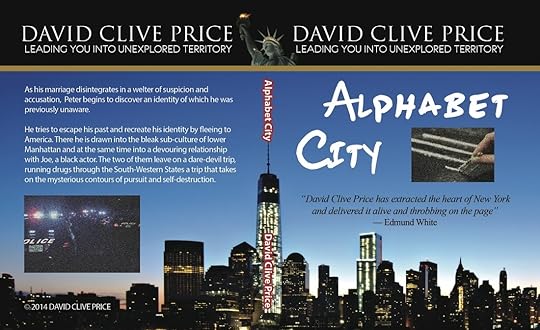 As his marriage disintegrates in a welter of suspicion and accusation, Peter begins to discover a homosexual identity of which he was previously unaware. He tries to escape his past and recreate his identity by fleeing to America. There he is drawn into the bleak sub-culture of lower Manhattan and at the same time into a devouring relationship with Joe, a black actor. The two of them leave on a daredevil trip, running drugs through the Southwest, a trip which takes on the mysterious contours of pursuit and self-destruction.
 David Clive Price has extracted the heart of New York and delivered it alove and throbbing on the page. this is the underworld that few tourists ever see... David Clive Price has seen it with great clarity. - Edmund White
The novel's core of a man launching out in search of transcendent passion is winningly and sharply presented. - Time Out London
By any account, this novel marks a distinguished debut. - Him Gay Times
"The novel is published as an Amazon paperback and as an Amazon Kindle
(e-book)."
August 3, 2014
Have Talent, Will Travel (Global Business Star Academy)
Have Talent, Will Travel: David Price, Asia expert, on capturing hearts and minds.
By Wendy Kendall On July 30, 2014 · Add Comment · In global talent
Tell us something by way of introduction about yourself. How would you describe your career now? What brought you to this point – the main steps of your journey to where you are now?
I think it all started at college in Cambridge. I was drawn like a magnet to Italy – Italian music, Italian history, the Renaissance above all. I wanted desperately so speak Italian. So I think the courses I chose were all skewed in that direction: Renaissance thought, Tudor history (papacy struggles, influence on Italian music and thought on English courts). I was in the college choir and we sang lots of Italian music. I then wrote my PhD thesis on music at the courts and country houses on England 1560-1630. When I finished it I was off to Switzerland (first lover) and then on to Italy. A British Academy Travel Fellowship allowed me to study Italian court music in Bologna for two years, and then I said bugger all this academic stuff it’s not for me, my book on English Renaissance music was published by CUP, so I took off over the Apennines and found a very cheap ‘casa colonica’ (villa farmhouse) in the Etruscan hilltop town of Volterra, and translated Italian Literature into English, wrote my first novel (fruit of a New York sojourn in the multi-ethnic Lower East Side of Manhattan) and farmed wine and olives.
After about five years, when I had perfected my Italian and learned all I could about Italian rural life (another book), I got the bug for the Far East, I knew there were many more cultures and languages over there, more to learn, and I needed a new partner after a civilized ‘divorce’. I was already thinking of an Asian partner, not another version of me.
After a sticky year in Japan, where I loved the culture but felt alone and not competent enough in Japanese, I was urged by friends to go to Hong Kong. They came to the airport to collect me in a big car and among them was a Hong Kong Chinese who more than caught my eye. We clicked in the car, I fell in love with my other half on the way from the airport, and that was it. We’ve been together 28 years.
The importance of that meeting was that I could join in Chinese local life. We lived together in a one-room apartment in a Kowloon housing estate for one year, together with mother, sister, and nephew. I’ve written about the experience in my newly published novel, Chinese Walls (also about Hong Kong and London professional life). I had to do everything differently, I had to fit in, I constantly had to learn not to reject strange foods like durian,1000-year-old egg, chicken claws, pig intestines, and customs such as incense worship of ancestors, piles of votive fruit, temple visits, lucky numbers, money giving in red packets at Chinese New Year etc.
I drew from all this experience when I worked at HSBC as speechwriter for Asia and the handover of Hong Kong to China, and then as boss of my own strategic communications company in various Asian countries. I evolved my own system to join the business networks – say yes to everything, join in karaoke (I hate it), eat 12-course banquets (ditto), pretend to get drunk in China, Korea and Japan to please hosts etc. I teach and coach that same system in my Asia workshops and Masterminds for Western companies: ‘courage’,’ empathy’ and ‘resilience’ are the watchwords. Oh and learn at least some phrases in every language to become friends. They love it, even in Burmese or Mongolian.
What does having a ‘global career’ mean to you? How has it changed your life or your perspective?
It’s given me a window on the world: on geo-politics, on social and cultural differences and in what resides our common humanity. It’s allowed me to be a bit of flirt in every language (not a seducer, just a flirt), to empathize with emotions, to solidarize with the poor and underprivileged, and above all to make lasting friends, relationships and contacts.
Did you ever think you would have a global career? Was it one of your aspirations?
I’m not sure that the career side of it was an aspiration. That sort of crept up on me. Each new country I added to my portfolio of business or travel writing became another part of my ‘globalised’ business experience. Three years ago I found myself with books on several Asia countries (and Italy and New York), and was advised by a digital marketing guru friend that I was in the perfect position to convert my ‘Asia expert’ status into ‘world expert status’ on the internet. The idea was and is that I have a lifestyle of my choice eventually (peace, nature and writing books) but a constant cash flow for this ‘retirement’ from a global digital business, with occasional lucrative speaking engagements and interviews if and when I wanted them. I am about 70% of the way down that path.
Your challenges and difficulties
What did you struggle with most when you moved your career abroad and how did you overcome that? Fear of dipping my toe into the cultural waters and looking a fool, being rejected, not finding any job fulfilling enough to warrant taking such a huge risk (eg jumping from Italy to Japan), loneliness and possible failure. My biggest dread was going back to the UK with my tail between my legs and telling my friends and family it had all been a big flop.
What did you learn about yourself as a result of growing your global career?
I learned that the greatest joy in life is making connections. EM Forster said ‘Only Connect’ and he was absolutely right (he went to India to do it). Once you have made that essential connection, you are ready for what is almost a love affair with the country or foreign situation of your choice. I learned that courage and risk-taking (calculated) were vital to experience new worlds and succeed in them. I also learned you have to be both patient and resilient when things don’t go your way (as they often won’t). ‘Go with the flow’ is not such a bad motto!
Do you have any regrets about moving abroad with your career? Would you do anything differently in future?
I have absolutely no regrets. Going abroad has defined my life, and eventually you find out that you haven’t lost your own country, you’ve just gained many more. In fact, overseas postings make you look with more interest on your own country, as if it were one of those foreign lands in which you had to study the citizens and their customs. I’ve gained the knowledge for many books, and now more novels from being often overseas and travelling. The sheer curiosity and excitement have kept me constantly young both in mind and in outlook. They’ve also kept me inspired with new ideas.
Just now I’m about to publish a novel in Amazon paperback and Kindle about love and corruption in the corporate world of Hong and London (Chinese Walls), and in September a Journey Through South Korea from 1988 to today (Phoenix Rising). This is in addition to my recently published cross-cultural introductions to Asia business, Master Key to Asia and Master Key to China, which are basically the fruit of my Asia business and life experience.
Your Strengths and Talents:Which of your top 5 signature strengths do you think you use the most in your global career at the moment?Love of learning (no.4)
“You love learning new things, whether in a class or on your own. You have always loved school, reading, and museums-anywhere and everywhere there is an opportunity to learn”.
Which of your top 5 signature strengths would you most like to develop further over the coming year and why? Zest (no.2)
“Regardless of what you do, you approach it with excitement and energy. You never do anything halfway or halfheartedly. For you, life is an adventure”.
I would like to embark on even more ventures in the form of JVs with countries like Australia and New Zealand, US and Canada. I want to bring a lot of energy to these new markets.
How has moving abroad helped you to develop your talents and abilities overall?It’s given me the key to countless cultures and religions, languages and extraordinary spiritual customs and traditions.
In summary, what encouraging thought sums up everything you think about having a global career?Go Global, Think Local.
David’s website is at: www.davidcliveprice.com
David’s podcast link (Asia Business Network)
https://itunes.apple.com/gb/podcast/asia-%20business-network-podcast/id842765731?mt=2
NEW BOOKS
Introducing My New Novel Chinese Walls To Be Published 23 July 2014
http://davidcliveprice.com/introducing-my-new-novel-chinese-walls/
Master Key to China
http://www.davidcliveprice.com/master-key-china
By Wendy Kendall On July 30, 2014 · Add Comment · In global talent
Tell us something by way of introduction about yourself. How would you describe your career now? What brought you to this point – the main steps of your journey to where you are now?
I think it all started at college in Cambridge. I was drawn like a magnet to Italy – Italian music, Italian history, the Renaissance above all. I wanted desperately so speak Italian. So I think the courses I chose were all skewed in that direction: Renaissance thought, Tudor history (papacy struggles, influence on Italian music and thought on English courts). I was in the college choir and we sang lots of Italian music. I then wrote my PhD thesis on music at the courts and country houses on England 1560-1630. When I finished it I was off to Switzerland (first lover) and then on to Italy. A British Academy Travel Fellowship allowed me to study Italian court music in Bologna for two years, and then I said bugger all this academic stuff it’s not for me, my book on English Renaissance music was published by CUP, so I took off over the Apennines and found a very cheap ‘casa colonica’ (villa farmhouse) in the Etruscan hilltop town of Volterra, and translated Italian Literature into English, wrote my first novel (fruit of a New York sojourn in the multi-ethnic Lower East Side of Manhattan) and farmed wine and olives.
After about five years, when I had perfected my Italian and learned all I could about Italian rural life (another book), I got the bug for the Far East, I knew there were many more cultures and languages over there, more to learn, and I needed a new partner after a civilized ‘divorce’. I was already thinking of an Asian partner, not another version of me.
After a sticky year in Japan, where I loved the culture but felt alone and not competent enough in Japanese, I was urged by friends to go to Hong Kong. They came to the airport to collect me in a big car and among them was a Hong Kong Chinese who more than caught my eye. We clicked in the car, I fell in love with my other half on the way from the airport, and that was it. We’ve been together 28 years.
The importance of that meeting was that I could join in Chinese local life. We lived together in a one-room apartment in a Kowloon housing estate for one year, together with mother, sister, and nephew. I’ve written about the experience in my newly published novel, Chinese Walls (also about Hong Kong and London professional life). I had to do everything differently, I had to fit in, I constantly had to learn not to reject strange foods like durian,1000-year-old egg, chicken claws, pig intestines, and customs such as incense worship of ancestors, piles of votive fruit, temple visits, lucky numbers, money giving in red packets at Chinese New Year etc.
I drew from all this experience when I worked at HSBC as speechwriter for Asia and the handover of Hong Kong to China, and then as boss of my own strategic communications company in various Asian countries. I evolved my own system to join the business networks – say yes to everything, join in karaoke (I hate it), eat 12-course banquets (ditto), pretend to get drunk in China, Korea and Japan to please hosts etc. I teach and coach that same system in my Asia workshops and Masterminds for Western companies: ‘courage’,’ empathy’ and ‘resilience’ are the watchwords. Oh and learn at least some phrases in every language to become friends. They love it, even in Burmese or Mongolian.
What does having a ‘global career’ mean to you? How has it changed your life or your perspective?
It’s given me a window on the world: on geo-politics, on social and cultural differences and in what resides our common humanity. It’s allowed me to be a bit of flirt in every language (not a seducer, just a flirt), to empathize with emotions, to solidarize with the poor and underprivileged, and above all to make lasting friends, relationships and contacts.
Did you ever think you would have a global career? Was it one of your aspirations?
I’m not sure that the career side of it was an aspiration. That sort of crept up on me. Each new country I added to my portfolio of business or travel writing became another part of my ‘globalised’ business experience. Three years ago I found myself with books on several Asia countries (and Italy and New York), and was advised by a digital marketing guru friend that I was in the perfect position to convert my ‘Asia expert’ status into ‘world expert status’ on the internet. The idea was and is that I have a lifestyle of my choice eventually (peace, nature and writing books) but a constant cash flow for this ‘retirement’ from a global digital business, with occasional lucrative speaking engagements and interviews if and when I wanted them. I am about 70% of the way down that path.
Your challenges and difficulties
What did you struggle with most when you moved your career abroad and how did you overcome that? Fear of dipping my toe into the cultural waters and looking a fool, being rejected, not finding any job fulfilling enough to warrant taking such a huge risk (eg jumping from Italy to Japan), loneliness and possible failure. My biggest dread was going back to the UK with my tail between my legs and telling my friends and family it had all been a big flop.
What did you learn about yourself as a result of growing your global career?
I learned that the greatest joy in life is making connections. EM Forster said ‘Only Connect’ and he was absolutely right (he went to India to do it). Once you have made that essential connection, you are ready for what is almost a love affair with the country or foreign situation of your choice. I learned that courage and risk-taking (calculated) were vital to experience new worlds and succeed in them. I also learned you have to be both patient and resilient when things don’t go your way (as they often won’t). ‘Go with the flow’ is not such a bad motto!
Do you have any regrets about moving abroad with your career? Would you do anything differently in future?
I have absolutely no regrets. Going abroad has defined my life, and eventually you find out that you haven’t lost your own country, you’ve just gained many more. In fact, overseas postings make you look with more interest on your own country, as if it were one of those foreign lands in which you had to study the citizens and their customs. I’ve gained the knowledge for many books, and now more novels from being often overseas and travelling. The sheer curiosity and excitement have kept me constantly young both in mind and in outlook. They’ve also kept me inspired with new ideas.
Just now I’m about to publish a novel in Amazon paperback and Kindle about love and corruption in the corporate world of Hong and London (Chinese Walls), and in September a Journey Through South Korea from 1988 to today (Phoenix Rising). This is in addition to my recently published cross-cultural introductions to Asia business, Master Key to Asia and Master Key to China, which are basically the fruit of my Asia business and life experience.
Your Strengths and Talents:Which of your top 5 signature strengths do you think you use the most in your global career at the moment?Love of learning (no.4)
“You love learning new things, whether in a class or on your own. You have always loved school, reading, and museums-anywhere and everywhere there is an opportunity to learn”.
Which of your top 5 signature strengths would you most like to develop further over the coming year and why? Zest (no.2)
“Regardless of what you do, you approach it with excitement and energy. You never do anything halfway or halfheartedly. For you, life is an adventure”.
I would like to embark on even more ventures in the form of JVs with countries like Australia and New Zealand, US and Canada. I want to bring a lot of energy to these new markets.
How has moving abroad helped you to develop your talents and abilities overall?It’s given me the key to countless cultures and religions, languages and extraordinary spiritual customs and traditions.
In summary, what encouraging thought sums up everything you think about having a global career?Go Global, Think Local.
David’s website is at: www.davidcliveprice.com
David’s podcast link (Asia Business Network)
https://itunes.apple.com/gb/podcast/asia-%20business-network-podcast/id842765731?mt=2
NEW BOOKS
Introducing My New Novel Chinese Walls To Be Published 23 July 2014
http://davidcliveprice.com/introducing-my-new-novel-chinese-walls/
Master Key to China
http://www.davidcliveprice.com/master-key-china
August 2, 2014
Phoenix Rising: A Journey Through South Korea
 Want to discover more of East Asia?
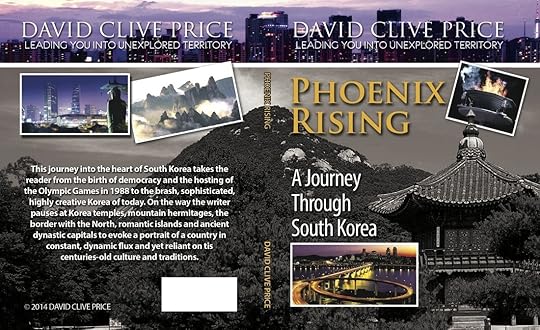
Check out Phoenix Rising: A Journey Through South Korea , a new book in my ‘Unexplored Territory’ travel trilogy that takes the reader from 1988 through the struggles of recent decades to modern times.
After the excellent reception of my novel Chinese Walls: a Story of Love and Corruption in London and Hong Kong (5* reviews on Amazon), and the publication of my bestselling cultural business guides The Master Key to Asia and The Master Key to China , my new book aims to guide readers around this fascinating East Asian country, home to Samsung, Hyundai, and LG, to name just a few of its globally recognized enterprises.
Almost unnoticed by the countries of the west, South Korea has risen like a phoenix spreading its wings throughout the world after the fire, destruction and suffering wrought by the Korean War and the long period of military rule that followed until 1988.
And yet the country is offside for many Western businesses and even for those who have traveled in Asia. Everyone knows something about China and Japan, but very few know about South Korea (except perhaps for its fiery kimchi pickle). This is a serious oversight.
A HUGE FAMILY
South Korea is one of the most exciting countries in the world, with a rich culture based on passion for learning, Confucian values and respect for the family. In many ways, South Korea resembles a huge family, and this sense of unity and purpose is fed by a long series of invasions and the ongoing threat from North Korea. The country moves with extraordinary cohesion at critical moments.
My voyages into every corner of the country reveal a nation on the crest not only of an economic but also of a creative wave that has enormous resonance for the peoples of Southeast and Northeast Asia – and also for the economies of the US, Australasia and Europe.
THE NEW SPRINGING FROM THE OLD
It is a country that is rich in Confucian heritage, ancient traditions and Buddhist devotions. It is also increasingly renowned for cutting-edge movies, theatre, pop music, fashion, and indeed performance of Western classical music. Korean classical performers are to be found all over the world.
If you watch a Korean movie (as I often do), you can be sure that it will push the boundaries of every genre and offer much richer and riskier content, cinematography and acting than movies from almost any other nation in Asia.
This journey into the heart of South Korea takes the reader from the birth of democracy and the hosting of the Olympic games in 1988 to the brash, sophisticated, innovative South Korea of today.
On the way I pause at Korean temples, mountain hermitages, the border with the belligerent North Korea, romantic islands, and ancient dynastic capitals to evoke a portrait of a country in constant, dynamic flux and yet reliant on its centuries-old culture and traditions.
The book is available at http://www.davidcliveprice.com/books, on Amazon and in all good book stores for order (ISBN 9781500451462)