
Jane Friedman's Blog: Jane Friedman
April 22, 2026
How Faire Fills a Distribution Gap for Publishers
Faire is a tech wholesale B2B marketplace built for the gift, jewelry, and home goods market, but increasingly used by publishers and bookstores.
This premium article is available to paid subscribers of Jane's newsletter. Here's what subscribers get:
Publishing industry news that includes Jane’s reporting and analysis (weekly)Access to more than 3,000 premium articles on this site, all searchableAccess to Jane’s private resource guides, continually updated Subscribe today.Or login below if you're already a subscriber.
Wondering why some content isn't free? Did something change? Here's an explanation.


Small Press Insights: bestseller tracking site
Author Jim Hanas has launched a website called Small Press Insights that reveals which small-press books are selling on Amazon.
This premium article is available to paid subscribers of Jane's newsletter. Here's what subscribers get:
Publishing industry news that includes Jane’s reporting and analysis (weekly)Access to more than 3,000 premium articles on this site, all searchableAccess to Jane’s private resource guides, continually updated Subscribe today.Or login below if you're already a subscriber.
Wondering why some content isn't free? Did something change? Here's an explanation.
New cookbook imprint at Skyhorse
Skyhorse Publishing has launched new cookbook imprint Golden Grove Publishing with Culinary Book Creations CEO James O. Fraioli.
This premium article is available to paid subscribers of Jane's newsletter. Here's what subscribers get:
Publishing industry news that includes Jane’s reporting and analysis (weekly)Access to more than 3,000 premium articles on this site, all searchableAccess to Jane’s private resource guides, continually updated Subscribe today.Or login below if you're already a subscriber.
Wondering why some content isn't free? Did something change? Here's an explanation.
New agent at Mansion Street Literary Management
Katie Ferriello has joined as literary agent, focusing on romance, fantasy, and children’s literature.
This premium article is available to paid subscribers of Jane's newsletter. Here's what subscribers get:
Publishing industry news that includes Jane’s reporting and analysis (weekly)Access to more than 3,000 premium articles on this site, all searchableAccess to Jane’s private resource guides, continually updated Subscribe today.Or login below if you're already a subscriber.
Wondering why some content isn't free? Did something change? Here's an explanation.
Links of Interest: April 22, 2026
The latest in traditional publishing, bookselling, culture & politics, and AI.
This premium article is available to paid subscribers of Jane's newsletter. Here's what subscribers get:
Publishing industry news that includes Jane’s reporting and analysis (weekly)Access to more than 3,000 premium articles on this site, all searchableAccess to Jane’s private resource guides, continually updated Subscribe today.Or login below if you're already a subscriber.
Wondering why some content isn't free? Did something change? Here's an explanation.
Username or E-mail Password * function mepr_base64_decode(encodedData) { var decodeUTF8string = function(str) { // Going backwards: from bytestream, to percent-encoding, to original string. return decodeURIComponent(str.split('').map( function(c) { return '%' + ('00' + c.charCodeAt(0).toString(16)).slice(-2) }) .join('') ) } if (typeof window !== 'undefined') { if (typeof window.atob !== 'undefined') { return decodeUTF8string(window.atob(encodedData)) } } else { return new Buffer(encodedData, 'base64').toString('utf-8') } var b64 = 'ABCDEFGHIJKLMNOPQRSTUVWXYZabcdefghijklmnopqrstuvwxyz0123456789+/=' var o1 var o2 var o3 var h1 var h2 var h3 var h4 var bits var i = 0 var ac = 0 var dec = '' var tmpArr = [] if (!encodedData) { return encodedData } encodedData += '' do { // unpack four hexets into three octets using index points in b64 h1 = b64.indexOf(encodedData.charAt(i++)) h2 = b64.indexOf(encodedData.charAt(i++)) h3 = b64.indexOf(encodedData.charAt(i++)) h4 = b64.indexOf(encodedData.charAt(i++)) bits = h1 << 18 | h2 << 12 | h3 << 6 | h4 o1 = bits >> 16 & 0xff o2 = bits >> 8 & 0xff o3 = bits & 0xff if (h3 === 64) { tmpArr[ac++] = String.fromCharCode(o1) } else if (h4 === 64) { tmpArr[ac++] = String.fromCharCode(o1, o2) } else { tmpArr[ac++] = String.fromCharCode(o1, o2, o3) } } while (i < encodedData.length) dec = tmpArr.join('') return decodeUTF8string(dec.replace(/\0+$/, '')) } jQuery(document).ready(function() { var el = document.getElementById("mepr_math_captcha-69e9c8c94e69e") el.innerHTML = mepr_base64_decode("OSArIDEgZXF1YWxzPw=="); }); Remember Me Forgot PasswordApril 21, 2026
Giving Your Characters Serious Challenges May Give Them Delightful Strengths
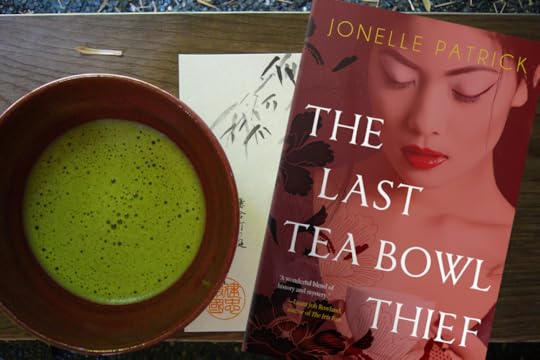
Today’s guest post is by author Jonelle Patrick, author of The Last Tea Bowl Thief.
Drinking problem, bad childhood, dirt poor—nearly all of literature’s most interesting characters have some sort of personal challenge to overcome. It is, after all, the easiest way to get inside readers’ hearts and start them cheering for a character from page one.
But what about characters with more serious physical challenges? Or psychological issues that can’t be “cured” or ignored?
Yes. But—no surprise—few writers dare to try, because great reward also comes with great risk. There are the obvious thin-ice issues of writing a character whose daily experience is so different from your own, but it also requires commitment. Even the most mundane tasks performed by your character require that they adjust themselves to a world not designed for them. That can be hard to keep up for 350 pages, let alone a series.
But this is the stuff of which compelling novels are made, so start by asking yourself these three questions.
1. What can your character do that ordinary people can’t?When I started writing The Last Tea Bowl Thief, I wasn’t asking myself if one of the main characters should be blind. I was asking what missing Japanese art object might inspire a centuries-long hunt, with the power to change the life of whoever finds it. A calligraphy scroll? Nah, too fragile. A Buddha statue? Too awkwardly shaped and hard to hide. What about a tea bowl? Yeah, what about one of those super-expensive pieces of pottery designed for tea ceremony?
Turns out, what makes a tea ceremony bowl priceless rather than just pretty is the experience it delivers while drinking the tea. Okay, good, the main character can be an artist who’s not merely focused on how a tea bowl looks. In fact, what a pleasure it would be to write one who’s exquisitely aware of how a tea bowl feels in his hands, how it focuses the scent of the matcha, how sipping from it makes the angel choirs sing!
But wait, how can an artist not be focused on how his work looks? Unless…he can’t be. What if he’s blind? But how can an artist be blind?
And therein lies the tale that became the heart of The Last Tea Bowl Thief. The character’s lack of an ability that the rest of us rely on not only shaped the kind of person he was, it freed a character with the training and talent to become a major artist from a boring, predictable life of following in his father’s footsteps. It put him on a path to a life that was not only far more interesting to write and read about, it changed other characters’ lives in the parallel timeline, centuries later.
Which leads us to question number two:
2. How can your character’s differences be a talent that gives them the power to see unique solutions instead of a roadblock that needs to be overcome?Nita Prose’s main character in The Maid is proud of being the absolute best at a job most readers might think is beneath her. But she’s a little too neurodivergent to be comfortable doing any job that relies on reading social cues for success. As her inability to sense that she’s being set up and lied to ratchets up readers’ anxiety, her job as a cleaner gives her an inside view of what goes on behind closed hotel doors, and her perpetually analytical way of thinking points to a culprit dismissed by more average investigators.
In the same way that a blind potter can be sensitive to things a sighted person experiences far less acutely, Nita Prose’s maid notices details that ordinary people take for granted, and puzzles out the solution without the assumptions and prejudices that cloud others’ judgment.
Which brings us to the third question.
3. How does your character interact with the world in ways that surprise and delight?Nothing pleases readers more than being shown something familiar in a whole new way. And characters with major differences do experience the world in new and different ways. It’s fun to read and can be a joy to write.
The Last Tea Bowl Thief’s potter, for example, is in love with the most beautiful woman in the world. He knows this for a fact because her voice is so lovely, and she smells like flowers after the rain. Ordinarily, a mere artist’s son would have no a chance to win a high-ranking samurai’s daughter, but he has an advantage over other potential suitors because he’s not handicapped by the gift of sight. They care far too much that she was disfigured by fire when she was a child, so they’re blind to the beauty that only he can see.
If you’d like to try supercharging your creativity by giving a character a bigger challenge than a martini addiction or a mean mom, try this: Dig out that unfinished manuscript you just couldn’t sell. Which character would change in the most interesting (and useful) ways if they were neurodivergent or coping with an ongoing physical challenge? Now rewrite the first chapter where they appear and see where it takes you. You might be surprised.
April 20, 2026
AI and Libraries: Why Librarians May Become Arbiters of Reality
 Photo by Julio Lopez
I’ve written a lot for my newsletter The Bottom Line about AI and publishing—the copyright lawsuits, the controversy over AI detection and disclosure, the new AI-based editorial services—but a recent Book Industry Study Group webinar offered specific insights I hadn’t heard before: librarians as the publishing industry’s early warning system. Librarians are not working in the realm of “what if” when it comes to AI; they’re managing the real-world effects right now.
BISG executive director Brian O’Leary presented survey data about libraries and AI, followed by a conversation with R. David Lankes, a library scholar who has conducted research in the field.
BISG’s survey on AI and what it says about librariansBISG conducted a survey on AI use across the publishing supply chain, drawing responses from publishers, librarians, and industry partners. The full dataset was presented in an earlier webinar; this session focused specifically on the library segment.
The library respondents skewed toward those with experience and working with larger institutions (100+ employees). More than half reported 11+ years working in the field, with the largest single group falling in the 15 to 25 year range. The headline finding: librarians have a notably higher rate of resistance to AI. About a third reported not using AI and having no plans to do so. (Across the full dataset, it was 20%.)
Less than half of library respondents said their institution was actively using AI. Thirty-one percent said they were unsure, a figure O’Leary said may reflect the reality of working in larger institutions where not everything happening organizationally is visible to individual staff. The most common response to a question about institutional AI policy wasn’t encouragement or discouragement but no policy at all.
Librarian objections to AI included catalogs increasingly filled with low-quality AI-generated work, staff time consumed by identifying and removing “slop,” and the burden of countering false or misleading information—that is, dealing with work that runs directly counter to librarians’ core mission.
About 34% of librarians described themselves as ethically opposed to AI use, quite significant when you consider who is responding.
Librarians resist AI not out of ignorance but skepticismThe BISG session highlighted distinct conversations about AI playing out simultaneously across publishing and libraries alike, conversations in which people are often talking past one another.
One conversation relates to AI literacy. Some argue that AI is a tool and information professionals should understand tools, therefore librarians should learn to use AI and help patrons navigate it. Versions of this argument come along with every major information technology shift, and it carries an implicit assumption: that resistance is unfamiliarity, and education will resolve it. It’s how the field responded to the internet, to mobile, to social media.
But Lankes argued this model doesn’t so far fit what’s happening in the library community. The resistance isn’t coming from people who haven’t engaged with the technology. It’s coming disproportionately from people who have. When he conducted focus groups with librarians in the “never AI” camp, he found people who could explain large language models, discuss retrieval-augmented generation, and articulate technically why they considered the tools unreliable. They’ve concluded that a library’s adoption of AI would send the wrong signal about what a library fundamentally is.
Nonetheless, AI can obviously aid in libraries’ missionLankes offered an example that shows, despite skepticism, there is a clear role for AI to support libraries’ work. A collection of music materials at the University of Texas—thousands of albums and recordings—was effectively invisible to users because it had never been fully cataloged. The resources to do so through traditional means simply weren’t there. So a team developed a solution: use AI to create stub records, each tagged with a confidence factor indicating how certain the AI was about its own identification. The least-certain records could be flagged for future human review and high-use materials prioritized for fully human-generated cataloging.
This is not an AI literacy question but a mission question. Can AI help librarians do what they exist to do? There are, of course, parallels to publishing. In conversations I’ve reported on around accessibility, without AI tools, certain backlist titles might not receive alt text, metadata, and formatting updates needed to serve readers with disabilities. The choice isn’t necessarily between AI and a better alternative, but AI and nothing.
AI and the scalability problemOne of the more fascinating parts of the conversation came near the end, in relation to peer review. Peer review is foundational to academic publishing and, more broadly, to the mechanisms by which society establishes what is known and credible. Until now, that system has functioned because the rate of human knowledge production and the rate of human capacity to review it have been roughly matched. AI is breaking that equilibrium.
As Lankes put it, peer review is simply not scalable given the volume AI can produce. We can’t use the same AI tools that are accelerating content creation to evaluate that content’s credibility, because the trust isn’t there. The result is a genuine threat not just to publishing workflows but to the broader infrastructure by which society determines what is true.
I find this problem is often overlooked in discussions about AI: the question isn’t only what AI does to writing and publishing, but what it does to the information environment our industry depends on. You can see it clearly right now in how much authors worry that declining page reads in Kindle Unlimited may be tied to a greater glut of titles—a result of AI-assisted and AI-generated works entering the Amazon marketplace. If readers have less trust that unfamiliar books will meet their needs or be trustworthy, they’re more likely to stick with what they know and not take a chance on something new.
Libraries as arbiters of realityLankes suggested that libraries may be moving toward a new function that I would describe as “arbiters of reality.” He described librarians as serving as “trusted humans” in the loop, or people who can vouch for a source because they have it in their collection, know where it came from, and can go look at it. The trust that librarians have maintained over decades, even as institutional trust has declined in our society, gives them something AI systems don’t have: credibility with the people they serve. When a student gets an answer from AI, Lankes noted, they’ve been trained to be skeptical. When it comes from the library, they tend to believe it.
I imagine that’s why 34% of library respondents are ethically opposed to AI. They’re trying to protect something real. Lankes suggested that AI literacy—teaching people to be appropriately skeptical of AI-generated content—may be hitting a psychological ceiling. If people are required to question everything they encounter, the cognitive burden becomes unsustainable. He suggests that what’s needed isn’t more instruction but something closer to a wellness intervention: relief from constant epistemic vigilance.
April 16, 2026
Ghosting Your Own Book: How to Cross the Finish Line When You Want to Run Away
 Photo by Muhammad Saidul Islam
Today’s guest post is by coach, author, and speaker Anne Marina Pellicciotto.
I’d labored over my memoir for more than a decade when, last January—after two rounds of beta reads, a professional developmental edit, and years of critique sessions with my beloved writing group—I finally completed my seventh (and final) draft. My book was done; it was time to put it out into the world.
I’d even gotten as far as to pitch my book at a couple virtual pitch-the-agent events, and received a single response of interest. What’s more, I had an inside connection with an author-heroine who’d graciously read my entire manuscript and liked it. She then offered to refer me to her agent—if I could please send her an itty bitty three-page summary.
Then I hit a wall.
I toiled for a month. I forced myself to remain at the desk for five straight days, yanking out gray hairs until I’d boiled-down my 350-page masterpiece to 10 ugly pages. Pure torture. Jane Friedman, publishing industry expert, agrees: “It’s probably the single most despised document you might be asked to prepare: the synopsis.”
Though, turns out, the resistance wasn’t to the writing assignment per se.
Reliving my dark, dramatic coming of age story all over again—in a kind of high-speed time-lapse—got my scoliosis spine all flared up. Knots in my lumbar and hips made it excruciating to walk, much less sit in my chair any longer.
So, for the sake of my health, I shelved it. That’s just what I told my writers group one recent Monday over Zoom, when they asked, out of the blue: “What’s happening with the memoir?”
I’d moved on to a new book project, I explained—one more present and prescient and rosy than the story that kept me trapped in my transgressive past.
“But, Anne,” they pushed back. “You’re sabotaging yourself. We’ve all been there.”
“Promise I’ll come back to it.” I sounded upbeat, though tears glossed my eyes as I stared back at them in their Zoom squares. I’d worked with these women for years, receiving their poignant and loving critiques. They helped me write the darn book. They wanted to see it out in the world. But something inside me was making sure it never got out there.
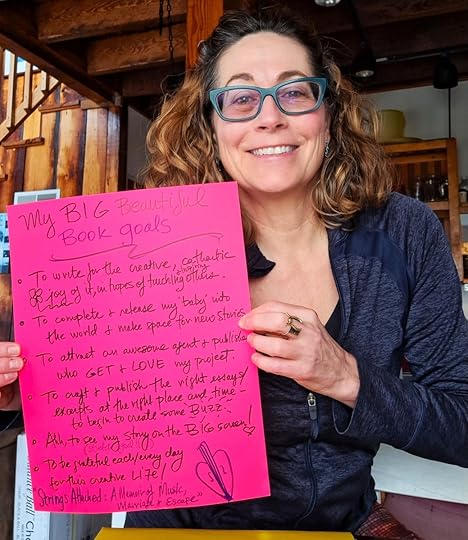
The next morning, when I showed up at my desk, dread infusing me, I caught a glimpse of My Big Beautiful Book Goals posted in neon on my office wall. Number 1 on the list of faded magic marker dreams: “To write for the creative, cathartic joy of it in hopes of touching and inspiring others.”
How could I touch or inspire anyone if the story remained trapped in computer files?
It was time to reach out to my therapist for an emergency session. She’d been with me through the protracted completion of the manuscript. The challenges were obviously not over.
“Of course not; you’re scared—not just of the rejection; what if it’s accepted?”
“I’ll have to keep reliving it—every pitch, every query—over and over. And a book tour?” I felt my chest tighten with panic at the thought.
“Who’s talking?” the therapist asked.
I understood what she was referring to. Based on our year together doing parts work—a therapeutic approach that recognizes we all have different inner selves with distinct voices and needs—she’d helped me address unresolved conflicts between my various parts, especially the ones wounded and unseen from childhood.
I shut my eyes and repeated my words: I’ll have to keep reliving it. The voice was teen me, the character who’d lived through the abuse and eventually escaped. The heroine of the story. She needed acknowledgment—she’d given me the story. She needed to feel safe. Could she trust me to protect her through the publishing process?
The writer me just wanted the book out in the world after decades of labor—completely understandable.
“What if they call me a liar—a drama queen? What if they criticize the writing—and me?”
It wasn’t safe to speak truth back then, the therapist reminded me. But I’m older and wiser now. That hindsight narrator—my true Self—the one who has painstakingly healed, in part through the writing—she could lead with curiosity and compassion. She could listen to the scared one when fears arise, reassure her that it’s safe now. This Self knows: birthing the book into the world won’t keep us trapped in the past—it will free us, all the parts unified.
With this new sense of clarity—with the triumvirate of Selves behind me—plus the nudge from my writing group—I felt ready to face the synopsis again.
As a creative writer, memoirist at that, it goes without saying: I am staunchly against employing AI to generate anything original. But a task like this, where analytical dispassion was needed—and, when it came to my delicate story, I had none—this felt like a job for Claude. So, with some trepidation, I began to test the waters.
I had various artifacts at my disposal: the horrible 10-page draft, some relevant excerpts I’d included in essays, a one-page agent pitch. All my own words, my own story—I just needed help seeing the shape of it. Within seconds, the bot spat out a terrible but intact 1500-word attempt. Everything was out of order. The bot had missed key beats, including the turning point death of my father. But the plot-driven just the facts, ma’am blueprint was a place to begin.
At the end of one long day at the desk, writer self focused and determined—character self allowing and curious—wise self-encouraging—I had taken the AI sow’s ear and spun it into a silk purse: an accurate and what seemed like a compelling synopsis ready to share with the writing group.
I was nervous, adrenaline coursing as I gazed back at the screen of friendly faces. I cleared my throat. Within a paragraph or two, as I read the summary aloud for the first time, I could hear the power in my voice. I registered more than mild surprise at how dramatic, how cohesive, how poignant this story sounded. In this compressed version of events—and perhaps after the backburner time away—it seemed like a story somewhat separate from me. In a positive—not dissociative way.
Excitement bubbled. The young one in me, hovering behind the scene, wasn’t ashamed, but the slightest bit proud, remembering: this is a heroine’s story with a happy ending. This was an important shift.
The group’s silence, at first, alarmed me. But it turned out they were concentrating. Like me, none of them had ever seen the story laid-out fully. They were taking it all in.
“Wow, Anne, great job,” one member eventually piped up.
Their feedback was poignant and encouraging. “You got it; you did it. Every woman has been through a version of this abuse. They need this story.”
Relief swirled with elation. Yes, there were edits to make, more trimming and nuance to be added. Most certainly, a long, laborious process of outreach stretched before me—one replete, no doubt, with rejection.
But there was momentum.
April 15, 2026
Links of Interest: April 15, 2026
The latest in viral news, trends, AI, Amazon, and culture & politics.
This premium article is available to paid subscribers of Jane's newsletter. Here's what subscribers get:
Publishing industry news that includes Jane’s reporting and analysis (weekly)Access to more than 3,000 premium articles on this site, all searchableAccess to Jane’s private resource guides, continually updated Subscribe today.Or login below if you're already a subscriber.
Wondering why some content isn't free? Did something change? Here's an explanation.
New imprint: Caleb and Kyle Publishing
It will focus on English-language originals with previously unpublished English translations of successful German titles.
This premium article is available to paid subscribers of Jane's newsletter. Here's what subscribers get:
Publishing industry news that includes Jane’s reporting and analysis (weekly)Access to more than 3,000 premium articles on this site, all searchableAccess to Jane’s private resource guides, continually updated Subscribe today.Or login below if you're already a subscriber.
Wondering why some content isn't free? Did something change? Here's an explanation.
Jane Friedman

- Jane Friedman's profile
- 1895 followers

