
Uri Gordon's Blog
February 15, 2013
Islamophobia and Anarchism – call for articles
(English and French version below – contact dysophia~at~riseup.net
ديصوفيا هي مجلة أناركية مستقلة وذات ميزانية قليلة تنوي متابعة بحثها الناجح في موضوع معاداة السامية وذلك من خلال استكشاف قضايا حول الإسلام والعنصرية المعادية للإسلام من منظو أناركي. نحن على وعي كناشطيين مقرهم في المملكة المتحدة أن هناك الكثير من النقص لنقاش ذا نطاق أوسع وهناك حاجة لتحليل مفصل ودقيق.
بالتحديد نحن نود ان نكتشف كيف يمكن لأناركيو الغرب (وذلك بالمجتمعات التي تسودها المسيحية):
إظهار التضامن مع من يتعرض للعنصرية المعادية للإسلام
إظهار التضامن مع الرفاق اللذين يسكنون في مناطق يسود فيها الإسلام كنظام أيديولوجي
التقرب من التحديات التي تلقى من قبل الأصولية الإسلامية من غير لعب دور في الأغراض العنصرية الإمبريالية الحالية التي تشوه صورة المجتمعات المسلمة في الغرب بالإضافة على التأكيد على سياسة إثارة الحرب الإمبريالية الحالية
نحن نأمل أن يفتح هذا الإصدار الأبواب لنقاش نقدي ويأخذ بالحركة الأناركية للأمام. وبالتالي نحن نحث الأناركيين الذين يعيشون في مجتمعات يسود فيها الإسلام كقوة مسيطرة على تقديم أوراق بحث تناقش كل أو أحد المواضيع التالية:
تواصل الأناركييون في المجتمعات الإسلامية مع الإسلام ذاته وكيفية تأثير ثقافة مجتمعاتهم على تشكيل توجهاتهم الاناركية
كيفية فهم ال-إسلاموفوبيا (الخوف من الإسلام) والتعصب ذات الصلة في الغرب
كيف يمكن للأناركييون في الغرب مناصرة رفاقهم من البلدان ذات الأغلبية المسلمة (من ضمنها كمثال التدخلات الغربية وتصوراتها في الربيع العربي)
إمكانية الاناركيين الذين يقطنون في الغرب مناصرة المجتمعات المسلمة هناك وبنفس الوقت مواصلة مناصرهم للسياسات المناهضة للتمييز كتللك التي تتمحور حول الجندر والجنسانية وغيرها (على سبيل المثال: كيفية التجاوب مع المظاهرات المناهضة لقانون الشريعة وتركيز التيار اليميني على الجوانب الأصولية للدين وتبرير الإعتداءات بالإضافة الى تشويه صورة السكان المسلميين ومن ضمتها الكاريكاتور المسييء للرسول محمد)
تأثير ” الحرب على الإرهاب” على نشاطهم السياسي
المنظور الأناركي للطبقية والجندر والجنسانية في السياق الإسلامي
ثانيا نحن نود أن نسمع من الأناركيين الذين يعّرفون أنفسهم بأنهم من خلفية مسلمة والذين يعيشون في الغرب ومن يودون إيصال تجاربهم حول السياسات وال-إسلاموفوبيا (الخوف من الإسلام). نحن مهتمون أيضا بالسماع من أناركيين يعّرفون خلفيتهم الثقافية كغربية ولكنهم يمتلكون منظورا يودون المشاركة به.
وأخيرا نحن مهتمون بسماع وقائع من مجموعات اناركيية من دول أغلبيتها العظمى مسلمة وذلك لإتاحة فرصة التعلم عن نشاطاتهم التي لا تصل أخبارها لإولئك المهتمين في الغرب. في حال وصلنا العديد من هذه الوقائع سيتم نشرها في إصدار منفصل.
يمكن أن يصل حجم المقال الى حد 3000 كلمة ونحن نبحث عن أعمال سهلة اللغة للجميع بدلا من أوراق أكاديمية ملأى بلغة صعبة. نحن نرحب بأي مواد تصويرية أيضا. نحن ننشر إصداراتنا باللغة الإنجليزية ولكن في حال كانت كتاباتكم بلغات أخرى أو أنكم تجدون صعوبة باللغة الإنجليزية الرجاء الإتصال معنا بأقرب فرصة وذلك لبحث إمكانية توفر ترجمة من قبلنا. سيتم حماية السرية في حال تم طلب ذلك ومن خلال نماذج اتصال آمنة مثل (pgp/gpg). نود أن تصلنا كافة الأوراق بتاريخ 31 آذار كحد أقصى.
في حال وجود أي أسئلة الرجاء الإتصال بنا للإجابة عليها. الرجاء أيضا نشر هذا الإعلان لمن تجدوه مهتما.
محررو ديصوفيا
Dysophia, an independent anarchist zine, is planning a follow on from its successful look at antisemitism by exploring issues around Islam and anti-Muslim racism from an anarchist perspective. We are aware that, as UK-based activists, much is missing from the wider discussion and more nuanced analysis is needed.
In particular, we would like to explore how anarchists in the ‘West’ (that is, Christian-dominated societies) can:
* show solidarity with those experiencing anti-Muslim racism;
* show solidarity with comrades who live in places where Islam is a dominant ideology; and
* approach the challenges thrown up by Islamic fundamentalism without playing into current imperialist / racist tendencies that demonize Muslim communities in the West and underscore current imperialist warmongering.
We hope that this publication will open up critical discussion that can take the anarchist movement forward. Thus, we are soliciting articles from anarchists living in societies where Islam is a dominant force, which discuss all or some of the following issues:
i) how they relate to Islam itself and how the culture of their society affects and shapes their approaches to anarchism;
ii) how they perceive Islamophobia and related racisms in the ‘West’;
iii) how anarchists in the ‘West’ can show solidarity with comrades in Muslim-majority countries (including, for example, during Western states’ interventions in and portrayals of the ‘Arab spring’);
iv) how anarchists living in the West can demonstrate solidarity with Muslim communities here, while sustaining anti-discrimination politics such as that around gender, sexuality, etc. (for example, how could we respond to protests against sharia law, right wing focusing on fundamentalist elements of religion as an attack on all, demonisation of Muslim populations, cartoon images of the Prophet Mohammed).
v) how the ‘War on Terror’ has affected their political activity;
vi) anarchist perspectives on class, gender and sexuality in the context of Islam.
Secondly, we would like to hear from anarchists who identify as having a Muslim background who live in the West and would like to communicate their experiences and politics around islamophobia. We are also interested in hearing from anarchists who cultural identification is Western, but feel they have a perspective they would like to contribute.
Finally, we are interested in hearing accounts from anarchist groups in Muslim-majority countries so that others can learn about their activities, as often those in the West do not get to hear about them. If there are enough of these, we will turn them into a separate publication.
Article size can be up three thousand words, and we are looking for pieces that are accessible to everyone rather than not jargon-heavy academic tracts. Images gratefully received. We will be publishing in English, though if you have writings in another language, or will struggle with English please get in contact first as we may be able to sort out translations. We will protect anonymity whenever requested and have secure forms of communication if desired, including pgp / gpg. We would like to get submissions in by 31st March if possible.
If you have any questions then do not hesitate to ask. Please feel free to forward on.
The Dysophia Editors
dysophia~at~riseup.net
http://dysophia.wordpress.com
————————————————————————–
L’APPEL (version française):
Suite au succès de son numéro sur l’antisémitisme, Dysophia, un zine anarchiste indépendant en anglais, a désormais décidé d’explorer la question de l’Islam et du racisme antimusulman d’un point de vue anarchiste. Nous sommes en effet conscients des limites du débat sur cette question au sein des cercles militants au Royaume-Uni, ainsi que de la nécessité d’une analyse plus nuancée.
Tout d’abord, nous tenons à poser la question de la possibilité pour les anarchistes des pays occidentaux (c’est-à-dire de sociétés influencés par le christianisme) de :
* Faire preuve de solidarité envers ceux qui sont victimes de racisme antimusulman ;
* Faire preuve de solidarité envers nos camarades qui vivent dans des lieux où l’islam est l’idéologie dominante ;
* Répondre aux défis posés par le fondamentalisme islamique tout en s’opposant aux tendances impérialistes et racistes qui diabolisent les communautés musulmanes en occident et qui apportent leur soutien au bellicisme et aux guerres impérialistes.
Nous espérons que cette publication ouvrira une discussion critique afin de faire avancer le mouvement anarchiste. Ainsi, nous souhaitons recevoir des articles écrits par des anarchistes qui vivent dans des sociétés où l’Islam est une force dominante et traitant des points suivants :
i) leur relation à l’Islam en soi, et la façon dont la culture de leur société modifie et façonne leurs approches de l’anarchisme ;
ii) la façon dont ils perçoivent l’islamophobie et le racisme lié a l’Islam en « occident » ;
iii) comment, selon eux, les anarchistes en « occident » peuvent faire preuve de solidarité avec leurs camarades dans les pays à majorité musulmane (y compris, par exemple, lors d’interventions militaires
occidentales ou par rapport aux représentations du « Printemps Arabe » par les médias et Etats occidentaux) ;
iv) comment les anarchistes peuvent faire preuve solidarité envers les communautés musulmanes en « occident », tout en conservant une ligne politique d’opposition à toute discrimination sur la base du sexe, de la sexualité, etc. (par exemple, comment réagir aux manifestations contre la loi de la charia, comment s’opposer au discours de la droite qui assimile toute la communauté musulmane à ses éléments les plus fondamentalistes, que faire face à la diabolisation des populations musulmanes ou encore
face aux dessins représentant le prophète Mahomet ?).
v) comment la « guerre contre le terrorisme » a-t-elle affecté leurs activités politiques ;
vi) le point-de-vue des anarchistes sur les problèmes de classe, de sexe et de sexualité dans le contexte de l’Islam.
Deuxièmement, nous recherchons des contributions d’anarchistes se considérant comme d’origine musulmane et vivant en «occident». Nous sommes intéressés par leurs expériences de l’islamophobie et leur action
politique en réponse. Les contributions d’anarchistes se considérant avant tout comme d’affiliation culturelle « occidentale » mais qui désirent proposer leur point-de-vue sur ces questions sont également bienvenues.
Enfin, nous sommes intéressés par des récits d’expériences de groupes anarchistes dans les pays à majorité musulmane afin que d’autres puissent découvrir leur activités, puisqu’il est rare que les anarchistes en «occident » aient l’occasion d’en entendre parler. S’il nous recevons suffisamment de contributions dans ce domaine, nous en ferons une publication séparée.
Les articles peuvent aller jusqu’à trois mille mots et doivent être rédigés de manière accessible à tous et dans la mesure du possible sans jargon académique. Les images et illustrations sont appréciées. *La
publication finale sera en anglais*, mais si vous écrivez dans une autre langue, contactez nous à l’adresse ci-dessous et nous essayerons d’organiser une traduction de votre article.
Provisoirement, la date limite d’envoi des contributions est fixée au 31 mars. Toutefois, contactez nous si vous avez l’intention de contribuer mais ne pouvez pas le faire pour cette date.
Nous protégeons l’anonymat de tous ceux qui le demandent et disposons également de moyens de communication sécurisés, y compris PGP / GPG, si nécessaires.
Si vous avez des questions, n’hésitez pas à nous contacter et n’hésitez pas à faire circuler cet appel.
Merci par avance,
Les Editeurs de Dysophia
dysophia~at~riseup.net
http://dysophia.wordpress.com
The post Islamophobia and Anarchism – call for articles appeared first on Anarchy Alive!.


January 2, 2013
The Zapatista Army of National Liberation Announces Next Steps
reposted from My Word is My Weapon
– translation by Kristin Bricker
Mexico
December 30, 2012
To the People of Mexico:
To the Peoples and Goverments of the World:
Brothers and Sisters:
Compañeros and compañeras:
This past December 21, 2012, in the pre-dawn hours, tens of thousands of indigenous Zapatistas mobilized and we took over, peacefully and in silence, 5 municipal seats in the Mexican southeastern state of Chiapas.

San Cristobal, Chiapas. December 21, 2012
In the cities of Palenque, Altamirano, Las Margaritas, Ocosingo, and San Cristobal de las Casas, we watched you and we watched ourselves in silence.
This is not a message of resignation.
It is not one of war, death, or destruction.
Our message is one of struggle and resistance.
After the media-driven coup d’état that exalted a poorly concealed and even more poorly disguised ignorance to the federal executive branch, we made ourselves present so that you would know that if they never left, neither did we.
Six years ago, a segment of the political and intellectual class went out in search of someone to blame for its loss. At that time we were in cities and communities, struggling for justice for an Atenco that was not fashionable at that time.
On that yesterday first they defamed us, and then they wanted to shut us up. Too incapable and dishonest to see that within themselves they had and have the seeds of their own destruction, they tried to make us disappear with lies and complicit silence.
Six years later, two things remain clear:
They don’t need us to fail.
We don’t need them to survive.
We never left, even though media from all over the spectrum have dedicated themselves to making you believe that, and we are reemerging as the indigenous Zapatistas that we are and will be.
In these past years we’ve strengthened ourselves and we have significantly improved our living conditions. Our standard of living is superior to that of the indigenous communities that are linked to the governments in power, that receive charity and squander it all on alcohol and useless things.
Our homes improve without hurting nature by imposing roads upon it that are foreign to it. In our villages, the land that was previously used to fatten estate owners’ cattle is now used to grow the corn, beans, and vegetables that brighten our tables.
Our work has the double satisfaction of providing us with what we need to live honorably and to contribute to the collective growth of our communities.
Our boys and girls go to a school that teaches them their own history, that of their fatherland and of the world, as well as the sciences and techniques they need to grow without no longer being indigenous.
The indigenous Zapatista women are not sold as merchandise. The indigenous PRI members go to our hospitals, clinics, and laboratories because in those provided by the government there are no medicines, nor equipment, nor doctors, nor qualified personnell.
Our culture florishes not insolation, but rather enriched by contact with the cultures of other peoples of Mexico and the world.
We govern and we govern ourselves, always seeking agreement before confrontation.
All of this has been achieved not only without the government, the political class, and the media that accompanies them, but also while resisting their attacks of all kinds.
We have demonstrated, yet again, that we are who we are. With our silence, we were present.
Now, with our word we announce that:
First: we reaffirm and consolidate our membership in the National Indigenous Congress [CNI],a space for meeting with the original peoples of our country.
Second: we will resume contact with our compañeros and compañeras who are Adherents to the Sixth eclaration of the Lacandon Jungle in Mexico and around the world.
Third: we will try to construct the necessary bridges towards the social movements that have arisen and will arise, not to lead them or take their place, but rather to learn from them, from their history, from their journeys and fates.
For this we have achieved the support of individuals and groups in different parts of the world who comprise the support teams for the EZLN’s Sixth and International commissions, so that they will become communication links between the Zapatista Support Bases and the individuals, groups, and collectives that are Adherents to the Sixth Declaration in Mexico and around the world who still maintain their conviction and dedication to the construction of a leftist non-institutional alternative.
Fourth: our critical distance from the Mexican political class will continue; they have done nothing but prosper at the cost of the necessities and the hopes of humble and simple people.
Fifth: regarding the federal, state, and municipal bad governments–executive, legislative, and judicial–, and the media that accompanies them, we say to them the following:
The bad governments from all over the political spectrum, without exception, have done everything they can to destroy us, buy us, and make us give in. The PRI, PAN, PRD, PVEM, PT, CC, and the future RN party have attacked us militarily, politically, socially, and ideologically.
The corporate media tried to make us disappear, first with servile and opportunistic slander, later with cunning and complicit silence. Those whom they served and whose moneys breastfeed them are no longer around. And those who have taken their place won’t last longer than their predecesors.
As was evident on December 21, 2012, they’ve all failed.
It remains to be seen if the federal, executive, legislative, and judicial government decides to once again resort to the counterinsurgency policy that has only achieved a rickety farse clumsily based on media management, or if it recognizes and fulfills its duty and raises indigenous rights and culture to constitutional ranking as established by the so-called “San Andres Accords,” signed by the federal government in 1996, which was ruled by the same party that now controls the executive branch.
It remains to be seen if the state government will decide if it continues its dishonest and despicable strategy of its predecesor which, in addition to being corrupt and deceitful, used the Chiapan people’s money for his own enrichment and that of his accomplices and set about openly buying voices and pens in the media, while he heaped misery upon the Chiapan people, at the same time that he was using police and paramilitaries to try to stop the organizational advance of the Zapatista villages; or if it will instead, with truth and justice, accept our existence and the idea that a new form of social life is blossoming in Zapatista territory, Chiapas, Mexico. Blossoming that draws the attention of honest people all over the planet.
It remains to be seen if the municipal governments decide to keep swallowing the millstones that the anti-Zapatista or supposedly “Zapatista” organizations use to extort them to attack our communities, or if they instead use that money to improve the living conditions of their constituents.
It remains to be seen if the people of Mexico who organize themselves in electoral struggle and resist decide to continue viewing us as the enemies or rivals upon whom they can unload their frustration about the frauds and attacks that, in the end, all of us suffer, and if in their struggle for power they continue to ally themselves with our persecutors; or if they finally see in us another way of doing politics.
Sixth: in the coming days the EZLN, through its Sixth and International commissions, will announce a series of initiatives of a civil and peaceful nature, to continue walking together with the other original peoples of Mexico and the whole continent, along with those in Mexico and around the whole world who resist and struggle down and to the left.
Brothers and sisters:
Compañeros and compañeras:
Before, we had the good fortune of honest and noble attention from various media outlets. We thanked them for it then. But that was completely erased with their later attitude.
Those who bet that we only existed in the media and that with the siege of lies and silence we would disappear were wrong.
When there weren’t cameras, microphones, pens, ears, and looks, we existed.
When they defamed us, we existed.
When they silenced us, we existed.
And here we are, existing.
Our pace, as has been demonstrated, does not depend upon our impact in the media, but rather upon the world’s and its parts’ understanding, upon the indigenous wisdom that dictates our steps, upon the unflinching courage that comes from below and to the left.
From now on, our word will begin to be selective in its recipient and, with the exception of a few occassions, will only be understood by those who have walked and walk with us without giving in to the media and current trends.
Here, with not a few errors and a lot of difficulties, another way of doing politics is already a reality.
Few, very few, will have the priviledge of knowing it and learning from it directly.
Nineteen years ago we surprised them by taking over their cities with fire and blood. Now we’ve done it again, without weapons, without death, without destruction.
That is how we differentiate ourselves from those who, during their administrations, delivered and deliver death to their constituents.
We are the same from 500 years ago, from 44 years ago, from 30 years ago, from 20 years ago, from just a few days ago.
We are the Zapatistas, the smallest, the ones who live, struggle, and die in the last corner of the fatherland, those who don’t give up, those who don’t sell out, those who don’t give in.
Brothers and sisters:
compañeros and compañeras:
We are the Zapatistas, and we send you a hug.
Democracy!
Freedom!
Justice!
From the mountains of the Mexican southeast,
For the Indigenous Revolutionary Clandestine Committee — General Command of the Zapatista Army of National Liberation.
Subcomandante Insurgente Marcos.
Mexico. December 2012-January 2013.
In Spanish: EZLN Anuncia sus Pasos Siguientes
Translation: Kristin Bricker
December 9, 2012
Review in Dutch
The Dutch anarchist magazine and blog Libertaire orde has published a review of the French translation of Anarchy Alive! written by Thom Holterman.
Het voorgaande maakt duidelijk dat op het ‘oude’ anarchisme wordt voortgebouwd, waarbij er tevens een nieuwe invulling ontstaat, die zich als hedendaags anarchisme laat herkennen. Daarbij geeft Gordon aan het boek niet te hebben geschreven als een pleidooi voor het anarchisme. Zulke boeken bestaan er al genoeg. Hij probeert dan ook niet wie dan ook te overtuigen dat anarchie mogelijk of wenselijk is, zoals hij zegt. Hij wil juist nadenken, vanuit de vertrouwde thema’s over de dilemma’s waarmee activisten (overigens een deel van zijn eigen levensgeschiedenis) worden geconfronteerd.
November 19, 2012
Daoism and Anarchism out now
Just received my two copies of Daoism and Anarchism – Critiques of State Autonomy in Ancient and Modern China by John Rapp, the latest in the Continuum series Contemporary Anarchist Studies which I’m co-editing. Advance praise hass referred to this volume as “magnificent and insightful scholarship”. Please consider ordering for your library! 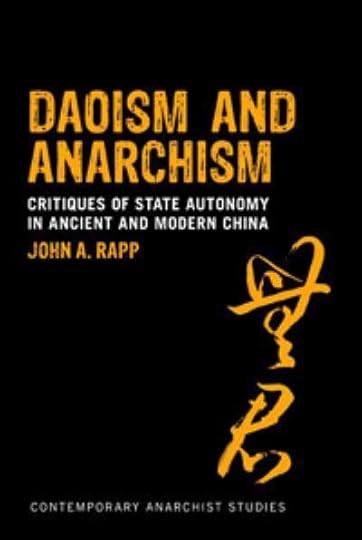
September 14, 2012
Social Movement Studies on Occupy movement
Free access to new issue of Social Movement Studies on the global Occupy Movement (got a piece in there)…

September 13, 2012
James Horrox on A. D. Gordon and anarchism
There is very little good material online about A. D. Gordon, even less in English, and none that discusses his anarchism. So I am very pleased to be able to post the following essay, adapted by James Horrox from his book A Living Revolution (AK Press, 2009), on the inspiring life and ideas of this unique figure.
====================
A. D. Gordon
by James Horrox
Doyen of the early kibbutz communards and an important, yet largely forgotten figure in the history of utopian thought, Aaron David (A.D.) Gordon (1856-1922) was one of the most influential ideologues of the early twentieth century Jewish labour movement in Palestine. Gordon’s agrarian philosophy – which he himself refused to speak of in terms of ‘socialism’, ‘anarchism’, “or any other isms”[1] – was rooted in a deep-seated reverence of the natural world, which appeared to him driven by organic non-hierarchical principles in which he saw a model for the reorganisation of human society.
Born into a middle class, orthodox Jewish family in Podolia in 1856, Gordon was raised in the heart of the Ukrainian countryside where his father worked in the management of agrarian estates. An early member of the Hibbat Tziyon (Love of Zion) movement, he proved himself a charismatic teacher and local community activist, and by the time he arrived in Palestine in 1904 at the age of 48, thanks to his upbringing he had a knowledge of agriculture and the natural world uncommon among the Jewish émigrés of that era, most of whom came from sedentary urban lifestyles. After working for brief periods at the First Aliya settlements at Petah Tikvah and Rishon Le-Zion Gordon eventually settled at Kibbutz Degania. Though he never became a permanent member of the kibbutz it was there that he spent most of his working life in Palestine, lived out his last years, died and was buried. In his memoirs, one of Degania’s founding members, Joseph Baratz, eulogised Gordon as “the most strange and wonderful figure in our kvutza”[3]. He “had a great love of manual labour”, Baratz writes, “and he thought everybody should work with his hands – teachers, writers, administrators. One day, he was explaining this to [Chaim] Arlosoroff, the President of the National Fund, who had come to see him. He was spreading manure with a pitchfork in a field. ‘You see’ he said’, when you stand in a field and you use your pitchfork like this….and this….you feel well and you feel you have a right to live.’ He used to say that by work a man is healed”.[3]
This love of manual labour and the natural world lay at the heart of Gordon’s writings. Influenced by Kabbalistic and Hassidic mysticism, Nietzschean existentialism and Tolstoyan agrarian anarchism, Gordon held that manual labour was not only essential for the regeneration of the Jewish people (it is through labour, he argued, that “a people becomes rooted in its soil and culture”)[4] but also that it held a more holistic value. Physical, and in particular agricultural work, he believed, enabled the human being to connect with nature through creativity, and it was therefore through a return to the land that individuals, peoples and humanity would be able to find spiritual succour and a more meaningful way of life:
“Man’s life has been cut away from its source. Naturally, it has become narrowed, impoverished, meagre, hollow, empty, uninteresting, vain. On the one hand, this results in a feverish pursuit of a life of pleasure, of sickly passion, of grasping at anything in the dregs of life that still has pungency… On the other hand, there follow perplexities, barren spiritual confusion, sterile scepticism, aimless wandering, vacillation, mystic fancies, useless despair. The light in life has been lost; its zest has gone; the talent for understanding life is wasted; in short, the talent to live has been destroyed.”[5]
Gordon echoed the Tolstoyan argument that human beings are at our best when and if we reject the mechanical artifices of civilisation and live our lives in an organic relationship with other people and with nature. It was largely through his influence that agricultural labour came to be seen by the early kibbutzniks not just as a means for the satisfaction of human needs, but as an end in its own right. Although he himself never actually used the phrase Gordon is credited as the founder of the “religion of labour” that became a “surrogate moral code”[6] for the early kibbutzniks: a secular religiosity, akin to Tolstoy’s notion of seeking “the Kingdom of God not without, but within ourselves”.
Gordon’s Zionism was staunchly pacifistic and anti-militarist, and the idea of creating a Jewish state is never once mentioned in his entire body of work. While he believed in the Jews’ historical right to live in Palestine, he viewed the Arabs as an organic nation living in harmony with the land, from whom the Jews should take an example. At the same time he was not naïve about Arab resistance to Zionism, which he saw as a natural reaction to Jews’ westernised and rootless lifestyle, and he thus envisaged the future of Jewish-Arab relations as one of peaceful competition at best – at least until the Jews fully reconnected with the land and earned the respect and cooperation of their neighbours.
While opposed to capitalist forms of labour exploitation, Gordon also rejected “socialism” – by which he always meant Marxism – with its emphasis on class struggle for changes in economic relationships as the key to overcoming capitalism and alienation. In Marxism he saw merely a continuation of the reigning mechanistic conception of the human being and of society, an expression of alienated thought rather than a response to it, and argued that since class is itself nothing more than an artificial organisation of human beings, an edifice of industrial capitalism, the proletariat could hardly be expected to serve as an agent of human transformation. Instead he believed that the nation – an organic collection of individuals based on the principles of kinship and shared cultural values – was the only agent capable of heralding such change. Rejecting the Marxist emphasis on changes in economic organisation as a privileging of form over content, the understanding that society would not change unless the individual changed was central to his thinking. It was through the self-improvement of each and every individual, within the context of a revival of organic national life, by which mankind – and in this setting Diaspora Jewry – would be able to achieve renewal.
It is in this context that Gordon emphasises the spiritual value of labour. Since human beings were deteriorating in proportion to the degree that they became alienated from the natural world, and since the Jewish people in the Diaspora had been affected more than any other in this respect, doubly detached from the cosmic flow of creativity by being both away from their homeland and occupied primarily in trade and sedentary urban professions rather than in agriculture, Gordon viewed a return to nature and a life of physical, and especially agricultural work as essential. This reconnection between man and land through agricultural labour was for him the sine qua non of the spiritual and political reawakening of humanity, hence the centrality of kibbutz in the regeneration of the Jewish people.
Although he never elaborated in much detail on the minutiae of social or political arrangements, Gordon had clear ideas about the form and function of the kibbutz. He argued that small, rural communities are a scale of human living preferable to modern urban civilisation, and that infrastructure and sociopolitical systems should be reorganised along these lines. The basic molecular unit of human society was to be the kvutza, a communalism which should not only subvert the alienation inherent in capitalist production, but which must act also as a family, a vector for the extension of familial bonds outwards into the wider social space. Humanity’s natural bonds of fraternity and empathy, in other words, corrupted by capitalist modernity, need to be restored, and from there a new society can arise.
“The basic idea of the kvutza” Gordon wrote, “is to arrange its communal life through the strength of the communal idea, through aspiration and the spiritual life, and through communal work, so that the members will be interdependent and will influence each other along their positive qualities”:
“The kvutza….can and must work on two fronts. On one side – that of work and nature, the person must be free and must reform him or herself through work and through nature. The individual must associate with the very work and the very nature wherein he or she labours and lives. On the other front, there is the life of the family in the kvutza. The kvutza must serve as a family in the finest meaning of the term. It must develop its members through the strength of their mutual, positive influence….As soon as [individuals] draw together and begin to associate with one another, they become a family as though they had already passed through the sacred rites of marriage.”[7]
Gordon’s writings were mainly published in the magazine of the Hapoel Hatzair workers’ party, which he founded in 1904, alongside articles by and about well-known anarchists of the time, including Kropotkin, Landauer, Proudhon and, later, Hapoel Hatzair theorist Chaim Arlosoroff (the latter strongly influenced in his youth by fin de siècle European anarchist thinkers, in particular Kropotkin). Among the kibbutz founders there was a broad consensus that creating a new kind of society entailed the creation, first, of a new kind of person, and Gordon’s philosophy of spiritual regeneration was one to which the young idealists of the Second Aliya could readily subscribe. Following his death in 1922, Gordon’s ideas continued to tower over the kibbutzim. Hapoel Hatzair continued to look to him as their spiritual leader, and the early groups of Hashomer Hatzair who arrived in Palestine from 1919 and subsequently evolved into the Kibbutz Artzi federation, were strongly influenced by his thinking (Kropotkin, Proudhon, Buber and Landauer were also required reading for Hashomer Hatzair members). In 1923-24, Hapoel Hatzair supporters in Galicia, led by Pinhas Lubianker, founded the Gordonia youth movement, which adopted Gordon’s philosophy and acted as a counterbalance to the Marxisms that were by then beginning to appear in the politics of other Zionist pioneering groups. In the decades following his death, however, Gordon’s subversive ideas would be muddled and eventually forgotten in the process of Zionist myth-making, which ultimately retained only his personal example of dedication to agricultural labour and Jewish renewal for the Israeli historical narrative.
Given the mythological status ascribed to him in this narrative it is perhaps par for the course that Gordon has become a target for attack in recent leftist academia. He has become a prominent feature in particular in liberal historians’ explanations of why Zionism, irrespective of its secular claims, is indeed religious, and even a classically nationalist monism. Some have argued that it was precisely para-religious spiritual socialisms like his that laid the groundwork for a conciliation of Judaism and Zionism, and ultimately the far right national-religious ideology of the contemporary settler movement.
This argument, elaborated at length in Ze’ev Sternhell’s book The Founding Myths of Israel, holds that mystical naturalism of the kind Gordon espoused, European romanticism and hostility to industrial capitalism fuse in the Zionist context to become compatible with a classical nationalist outlook. Gordon’s pacifism, communitarianism and silence on the question of statehood on this view do not necessarily mean that his philosophy did not contain the same ingredients as European integral nationalism.
Gordon is a key illustration in Sternhell’s contestation of the idea that a synthesis of socialism and nationalism was ever an objective of the kibbutz pioneers. Sternhell argues that the ideologues of Labour Zionism realised early on that the two objectives were irreconcilable, and that the pursuit of egalitarianism was really only ever a “mobilising myth…a convenient alibi that sometimes permitted the [Zionist] movement to avoid grappling with the contradiction between socialism and nationalism”.[8] He presents Gordon as the exemplar of this contradiction, dissecting his philosophy so as to rebrand him as a proto-fascistic figure who, “in his rejection of the materialism of socialism, employed the classic terminology of romantic, volkisch nationalism”.[9] The ontic-religious content of Gordon’s nationalism is presented as evidence of how Zionism expressed its religious character, undermining its self-image as a secular endeavour opposed to the ‘slave morality’ of Diaspora Judaism; Gordon’s positive attitude toward “the traditional requirements of religion”, and “the historical manifestations of tradition”[10] in Sternhell’s view affirm his consistency with integral nationalism, which also held religion, tradition and ritual to be core components of national identity. The “paradox of religiosity without belief in God” in Gordon’s writing is thus for Sternhell an index of his congruence with integral nationalism’s “affirmation of religion as a source of identity [which] had no connection with metaphysics”.[11]
Leaving aside the larger question of whether the Gordon Sternhell is analysing is actually Gordon the myth rather than Gordon the writer, the problem with this critique is that it rests on the erroneous assumption that the volkisch romanticism of Herder, in which Sternhell traces Gordon’s intellectual lineage, has no other descendants than the xenophobic views of writers associated with integral nationalism – a specious teleological view of European political romanticism that leads to an understanding of romanticism exclusively in terms of a simple unilinear development to fascism. Since Sternhell fails to acknowledge that Gordon’s repudiation of “socialism” was in fact solely a rejection of Marxism, the question of parallels with other contemporaneous branches of socialist thought is an avenue he completely neglects to explore. In making this leap he overlooks an entire history of left-wing, democratic, humanitarian incarnations of volkisch romanticism, his reassessment of Gordon thus failing to examine links between Gordon’s philosophy and similar imbrications of volkisch thought, secular spiritualism and antipathy to capitalist modernity found in the works of certain European anarchists of the era.
Returning to Palestine from a conference in Prague in 1920, Gordon himself claimed to have ‘found his ideas’ in the writings of the German anarchist Gustav Landauer who, like him, drew together the secular spiritualism of Spinoza and Tolstoy, the existentialism of Nietzsche and the ideas of the volkisch thinkers into an antiauthoritarian and obsessively pacifistic left-wing volkisch romanticism. At the heart of Gordon’s philosophy is a synthesis of antiauthoritarianism, anticapitalism, anticlericalism, secular spirituality and mystical belief in land as source of creativity strikingly similar in its central qualities to Landauer’s anarchism. Indeed, though he may have suffered at the hands of Sternhell, the consistency between Gordon’s philosophy and that of Landauer and other anarchists in this tradition, most notably Tolstoy and Proudhon, has led to an alternative view of Gordon as one of the kibbutz movement’s early anarchist ideologues. Some have identified his pacifist, anti-statist naturalism and anti-Marxist critique of modernity as anticipating contemporary eco-anarchisms specifically. Even the most perfunctory assessment of Gordon’s writings in the context of the anarchist thinking of his own time is more than enough to base an argument that it is in fact to the antiauthoritarian tradition that Gordon rightfully belongs.
NOTES
[1] Baratz, J. A Village by the Jordan, London: Harvill, 1954, 82
[2] Ibid., 79
[3] Ibid.
[4] Gordon, A.D. “Thoughts and Letters”, Yassour, Avraham (ed.), The History of the Kibbutz a Selection of Sources – 1905-1929, Israel: Merhavia 1995, 143
[5] Gordon, A.D. “Man and Nature”, A.D. Gordon: Selected Essays, Burnce, F. (trans.), New York: League for Labour Palestine, 1938, 205
[6] Warhurst, C. Between Market, State and Kibbutz: The Management and Transformation of Socialist Industry, London: Mansell, 1999, 132
[7] Gordon, A.D “Thoughts and Letters”, 143
[8] Sternhell, Z. The Founding Myths of Israel, Maisel, D. (trans.), Princeton University Press, 1998, 3
[9] Ibid. 60
[10] Schweid, quoted. in Sternhell, The Founding Myths of Israel, 57
[11] Sternhell, The Founding Myths of Israel, 57
May 16, 2012
Frankfurt Update: Individual bans withdrawn, Actions start
from http://www.globalinfo.nl/tag/frankfurt/
Blockupy-actions are starting now. Police have announced to want to evict (‘temporarily’, but if they do not collaborate it might be for good) the occupy camp in front of the ECB that has been there since October 15 last year. Occupiers have declared that they will ‘resist peacefully’ and Blockupy called for solidarity. On Tuesday police started to surround the camp with fences.
Also the surroundings of the neighbouring ECB has been fenced off with barbed wire.
Latest newsletter with handy info (in German)
There is also (more) good news: police decided to withdraw the ‘personal bans’ that more than 400 people got sent home, forbidding them to be in the Frankfurt area from May 16-20. The reason to withdraw the ban is the fear that the bans might not hold in court.
Meanwhile many meanstream media report that the blockades are already functioning. The ECB is organising police escort for some of their personnel, and changing venues for some of their activities (Reuters: – The European Central Bank plans to hold its mid-month policy meeting early, move staff out of its headquarters and shift a farewell event for one of its board members out of town, all to avoid clashes with anti-capitalist ‘Blockupy’ protesters.
(…) The ECB has also shifted a farewell event for outgoing board member Jose Manuel Gonzalez-Paramo, due to be attended by policymakers from around the world. It was originally to be held at one of Frankfurt’s plushest hotels, just a stone’s throw from the ECB’s headquarters. Instead it will now be held out of town with guests to be told the exact location only hours beforehand.
Other banks decided to close down completely
The Commerz Bank is closing its offices from Thursday on
Others are boarding up, or removing signs from their buildings, in the hope that demonstrators don’t recognize them. Some smaller businesses have declared to be on the side of the demonstrators and to have made good business with demonstrators. One of the occupy-activists appears to be a trader himself.
Then there is this hilarious report that bankers have been instructed to ‘dress casually’ and not come to work in their usual dress (= suit and tie for men, women can be a bit more frivolous) but wear ragged jeans instead.
In an interview with two activists from an antifascist organisation we can also read about the propaganda from the side of the authorities. One of the arguments for all the repressive measures, is the fact that an anti capitalist demonstration on March 31 turned violent. One police officer was hospitalised, as media don’t stop repeating, claiming that he was ‘severely wounded’. He was, but it turned out that it was mainly pepper spray he got, and he could leave the hospital the next day after they examined him and had that outcome. Police sprays pepper spray on demonstrators as a habit almost, and in large quantities, but not one of the victims got any media attention.
John Holloway in the Guardian: Blockupy Frankfurt is a glimmer of hope in times of austerity (Popular protests such as Blockupy offer an alternative to capitalism for those facing a life hunting through garbage cans)
As the famous folksinger B.Dylan once wrote: You don’t need to be in Frankfurt to block a bank
More information:
http://www.blockupy-frankfurt.org
http://17to19m.blogsport.eu/
http://notroika.linksnavigator.de/
http://de.indymedia.org/
https://linksunten.indymedia.org/
http://www.ea-frankfurt.org/
March 26, 2012
Nice review in Capital and Class
David Bell from the University of Nottingham has published a positive review of Anarchy Alive! in the journal Capital and Class. Quite nice for a Marxist journal! Here it is:
In 2004, David Graeber (2004: 2) noted that although ‘anarchism is veritably exploding right now’, academia has failed to keep up, offering little other than caricatured understandings of a complex movement. Whilst he was perhaps overstating his case a little, even then, Uri Gordon’s Anarchy Alive! Anti-Authoritarian Politics from Practice to Theory shows that a thoughtful, nuanced understanding of contemporary anarchism is not an impossibility in the university. Developed from his Ph.D. thesis (written at Oxford University, no less) it offers a compelling vision of an ideological movement whose relevance now is even stronger than it was in 2004.
The subtitle of Gordon’s work talks of a move ‘from practice to theory’, inverting the more standard approach of books which proclaim the relevance of a particular political ideology. Yet Gordon’s book actually goes further, undermining the dichotomy between practice and theory: it is perhaps best thought of as a work of praxis, in which theory and practice are irreducibly bound together in a mutually reinforcing relationship. It is a work which puts ‘organisation, action and lifestyle on the same footing with ideas and theories’ (p. 27), and what results is that each of these facets of anarchism asks awkward questions of the others such that a precise definition of ‘anarchism’ can never be established. Any initial fears that encoding key issues in anarchist practice into a work of theory might bring about an ossification of the movement are thus unfounded, and despite a cautiously optimistic tone throughout, Anarchy Alive! is bookended with assertions that its purpose is to ask ‘relevant questions’ (p. 7), and that ‘there are more questions than answers’ (p. 164). Indeed, the book’s refusal to fix the meaning of anarchism once and for all – and the liveliness of the debates it draws on – perhaps offers an answer to the questions Sartre posed in Critique of Dialectical Reason, where he wondered how it was possible for revolutionary politics to avoid ossification into bureaucratic forms of organisation, killing its vitality (Sartre, 2004).
It may seem odd, then, that Gordon considers anarchism an ‘ideology’ – a concept often seen by many anarchists as the site of precisely such ossification (see McQuinn, 2011; Landstreicher, 2001). Yet drawing on the work of his Oxford supervisor Michael Freeden, Gordon instead argues that ‘ideologies are not irrational dogmas or forms of “false consciousness”’ but rather are ‘paradigms that people use … to handle ideas that are essentially contested in political language’ (p. 20). This view of ideology poses no threat to Rudy Rocker’s understanding of anarchism (which Gordon quotes approvingly) as offering ‘no patent solution for human problems … It does not believe in any absolute truth, or in definite final goals for human development’ (p. 43).
It is to the current framing of the paradigms central to anarchism that Gordon turns in Chapter 2, where – as throughout the book – he draws predominantly on his experiences in anarchist struggles across Europe and the Middle East, and on the literature developed from these struggles: webzines, photocopied pamphlets, Indymedia postings and diy documentary films. From this, he argues that the three core concepts for the ideology of anarchism are domination, prefiguration and diversity/open-endedness, but that the meanings and relationships of these ‘are constantly reframed and recoded in response to world events, political alliances and trends in direct-action culture, evolving through intense flows of communication and discussion, and through innumerable experiences and experiments’ (p. 28).
Gordon’s familiarity with the multifarious debates of contemporary anarchism means that his work is imbued with an intrinsic understanding of the subtleties of anarchism that is lost in the caricatures of which Graeber speaks sorrowfully. In Chapter 3, ‘Power and Anarchy’, for example, he notes that ‘anarchists are hardly “against power”’ (p. 49), and continues to explain how anarchism seeks to maximise the individual’s ‘power-to’ by developing the communal ‘power-with’ (p. 50, 54-5). The complexities of this process are then examined with reference to anarchist practice of groups including Food not Bombs (p. 58) and Reclaim the Streets (p. 72-3), where factors not traditionally considered in works of ‘political philosophy’ must be considered: sparse finances, the self-confidence of activists, a lack of equipment and so on. Equally nuanced is Gordon’s argument that anarchism must not be seen as the logical conclusion of democracy, since it is philosophy that lacks the ability to force decisions upon others (p. 68-9); although, whilst he makes a compelling case here, it is one of the rare occasions on which his reflections are grounded in abstract theorising rather than in the movement itself. I am sympathetic to his claims, but would argue that it is for the movement to decide whether the term ‘democracy’ should be dispensed with or not – perhaps it is a concept that can be remade, rather than rejected.
The second half of the book sees Gordon apply his approach to a number of key issues of debate in contemporary radical politics and features chapters on the role of violence, technology, and the politics of Israel/Palestine. This section of the book, I wish to suggest, is particularly fruitful, both for those involved in the movement and those seeking an understanding of how it operates. The former can take inspiration for Gordon’s call for a ‘diversity of tactics’ (p. 78) and the unstinting tolerance for a diversity of opinions which is a frequent marker of this book. For the latter, it helps to flesh out how the machinations of anarchism play out on a ‘day-to-day basis’ far more effectively than any work grounded solely in theory ever could. I do not always agree with Gordon’s pronouncements (I think he is too pessimistic about the radical potential of technology, for example); others I found persuasive (his claim that no form of politics can escape violence, and that anarchism needs to bear this in mind when debating when violent struggle is ethically acceptable): but to take debate at length with these in this review would miss what makes this book so vital, for Gordon is not limiting anarchist theory to his beliefs on these issues, but rather showing how anarchism is ‘a dialogue’, which discusses real people’s ideas and practices with them: which ‘speak[s] – not from above, but from within’ (p. 9). These chapters should rather be read as invitations to reflect on and engage with Gordon’s claims from within the movement, using the same generosity of spirit Gordon shows in developing his arguments.
That is not to say that this book is beyond reproach, and I have concerns that the vision of the anarchist ‘movement’ Gordon offers (unintentionally) sets up a dichotomy between the ‘inside’ of that movement and the ‘outside’: with the inside appearing somewhat intimidating to penetrate. ‘Our archetypal anarchist’, we are told, ‘could pull up genetically modified crops before dawn, report on action through emails and independent media websites in the morning, take a nap, and then do a bit of allotment gardening in the afternoon and work part-time as a programmer in the evening’ (p. 109). Inspiring stuff, undoubtedly, but due to issues such as childcare, timidity, depression, disability, imprisonment or financial woes – not to mention a whole host of other late-capitalist anxieties – not an approach that is open to all. I worry that setting up such an intense body of activity as ‘anarchism’ risks alienating people who cannot offer that much to the movement. It might, perhaps, be more productive to think of anarchism as a culture which, at times, we all embody – the approach taken by Colin Ward (1982) (and which Gordon himself acknowledges: 41). Yet this is not perfect either, and runs the risk of depoliticising anarchism, reducing it to a series of generous gestures and leading to a situation in which ‘your archetypal anarchist helps an old lady across the street in the morning, illegally downloads some music all afternoon and then dumpster dives with his mates in the evening’. To avoid potential activists succumbing to this rather individualised fate, the anarchist movement must display not only the internally generous spirit exemplified by Gordon’s book, but also appear outwardly attractive to those who have much to offer the movement.
If the anarchist movement can find a way to solve this conundrum and move forwards with the clarity, honesty and enthusiasm that Gordon’s book displays then I would be tempted to share the optimism with which it closes and agree that many of the questions anarchists must now face are indeed ‘new questions … questions about winning’ (p. 164).
References
Graeber D (2004) Fragments of an Anarchist Anthropology. Ceros Press.
Landstreicher W (2001) How then do we go wild? Anarchy: A Journal of Desire Armed 52.
May M (1994) The Political Philosophy of Poststructuralist Anarchism. Pennsylvania State University Press.
McQuinn J (2011) Post-left anarchy: Leaving the left behind. Online at www.theanarchistlibrary. org, accessed 14 June 2011.
Sartre J-P (2004) Critique of Dialectical Reason, vol. 1: Theory of Practical Ensembles, trans. Smith A. London: Verso.
Ward C (1982) Anarchy in Action. London: Freedom Press.
Author biography
David Bell is a writer, artist, educator and musician. Drawing on radical political theory, poststructuralism and works of musicology and art theory, his work seeks to reimagine utopia as a space of non-hierarchy and becoming. He is currently studying for a Ph.D. at the Centre for the Study of Social and Global Justice (cssgj) at the University of Nottingham.
March 13, 2012
French translation out now!
Just received a few copies of the French translation of Anarchy Alive!, translated by Vivien Garcia and published by Atelier de Creation Libertaire. Hopefully we’ll be able to arrange a book-tour in France for the summer/autumn.
From the back cover:
Non seulement l’anarchisme est bien vivant, mais il est en bonne forme. Uri Gordon le proclame dès le titre de son ouvrage. Qui pourrait n’y entendre qu’une vaine allégation trouvera dans cette lecture de quoi dissiper ses doutes. Elle lui offrira d’abord un instantané présentant une bonne part des pratiques libertaires en vigueur aujourd’hui. Elle l’introduira ensuite à quelques débats qui en sont issus et les accompagnent. La vie dont il est ici question prendra tout son sens. Elle a si peu à voir avec la perpétuation de fonctions qui, essentielles dans la seule mesure où elles évitent le trépas, ne préservent en rien de la répétition mécanique, des rituels vides et de l’ennui généralisé. Cette vie se dévoile au contraire sous les traits d’une multitude en mouvement qui, luxuriante, brille d’inventivité. Et le livre qui se loge entre vos mains, en même temps que d’en offrir un panorama encore sans égal, y contribue pleinement.
January 24, 2012
New Book Series: Contemporary Anarchist Studies
Anarchism and Political Modernity by Nathan Jun is the first offering in the new book series “Contemporary Anarchist Studies” from Continuum Books. Over the coming years, the series will be publishing the best new scholarship on anarchist politics and history, bridging theory and practice, academic rigor and the insights of modern activism.

Anarchism and Political Modernity looks at the place of “classical anarchism” in the postmodern political discourse, claiming that anarchism presents a vision of political postmodernity. The book seeks to foster a better understanding of why and how anarchism is growing in the present. To do so, it first looks at its origins and history, offering a different view from the two traditions that characterize modern political theory: socialism and liberalism. Such an examination leads to a better understanding of how anarchism connects with newer political trends and why it is a powerful force in contemporary social and political movements.
This first volume in the Contemporary Anarchist Studies series offers a novel philosophical engagement with anarchism and contests a number of positions established in postanarchist theory. Its new approach makes a valuable contribution to an established debate about anarchism and political theory. It offers a new perspective on the emerging area of anarchist studies that will be of interest to activists, students and theorists.
Nathan Jun is Assistant Professor of Philosophy and Philosophy Program Coordinator at Midwestern State University, USA. He specializes in Social and Political Philosophy, and his research interests include the history and philosophy of anarchism, left-socialism, and left-libertarianism. Dr. Jun has published two books, Deleuze and Ethics (ed. with Daniel W. Smith, 2010) and New Perspectives on Anarchism (ed. with Shane Wahl, 2009).
Further titles slated for publication in the series include:
John Rapp, Anarchism in Ancient and Modern China
Laura Poretwood-Stacer, Lifestyle as Radical Activism
Magda Egonoumides, Philosophical Anarchism
Jason Lindsey, The Concealment of the State
Kristian Williams, The Anarchist Philosophy of Oscar Wilde
Peter Ryley, Anarchism in Turn-of-the-century Britain
Praise for Anarchism and Political Modernity
“This book stands out among works of the emerging new generation of anarchist theorists. Unlike much of the trendy “post-anarchism,” it is firmly grounded in political philosophy and the history of anarchist thought. Jun shows that ideas often seen as bold new “post-modern” innovations — above all, the critique of representation — are in fact deeply rooted in the anarchist tradition. He debunks the equation of classical anarchist theory with the weakest aspects of modernism and shows anarchism to be a powerful radical tradition that goes beyond the limits of conventional liberalism and socialism. Jun presents strong evidence that anarchism is now becoming most the promising theoretical alternative within the dissident academy.”
– John P. Clark, Gregory Curtin Distinguished Professor of Humane Studies and the Professions and Professor of Philosophy, Loyola University
“Nathan Jun argues the concerns we identify as “post-modern” have already been theorized and integrated into an- archist thought, indeed, that anarchism’s project has always been to escape the limitations of modernity through radical political action. This is a provocative book, sure to spark debate.”
– Allan Antliff, Canada Research Chair, University of Victoria
“Feisty,opinionated and well-argued this is both a powerful defense and explanation of the complexity and ex- citement of anarchist thought and practice.Jun offers a rich examination of how ideas have developed and in doing so provides a compelling history of oppositional thinking that frames those moments in time when another world seemed possible.”
– Barry Pateman, Associate Editor, The Emma Goldman Papers, University of California at
Berkeley
Uri Gordon's Blog

- Uri Gordon's profile
- 10 followers

