
Gordon Brown's Blog
November 26, 2025
The abolition of the two-child benefit cap is a decisive stand in favour of childhood equality
Writing in the New Statesman he said:
“In one short budget intervention this afternoon, Chancellor Rachel Reeves has done more to transform the lives of 450,000 of Britain’s poorest children than any of the seven previous Conservative chancellors, who, in 14 long years, did nothing but harm to the lives of vulnerable children.
“The measure that lifts so many out of poverty at a stroke is the abolition of the two-child benefit cap. Ending the two-child rule is more than securing the immediate release of children from poverty. It is an invest-now-save-later policy designed, as an excerpt from the soon-to-be-published Child Poverty Review says, “to help people succeed”, with improved educational outcomes and greater adult earnings, which will ultimately pay for itself with higher tax receipts.
“I thank the Chancellor for her decisive stand in favour of childhood equality.”
You can read Mr Brown’s article in the New Statesman clicking here:


November 6, 2025
Gordon Brown calls for a new Four-Nation, all-party, coalition to combat child poverty
Former Prime Minister Gordon Brown has called for the formation of a permanent Four-Nations, all-party anti-poverty alliance of charities, foundations, businesses, faith groups, and civic society, working with all tiers of government to tackle the evil of rising child poverty.
He issued his appeal in a speech this morning in central London to mark the 60th anniversary of the Child Poverty Action Group, in which he cited new polling revealing that a majority of voters in every one of Britain’s 632 parliamentary constituencies are in favour of a gambling levy to fund relief measures for the 4.5 million UK children growing up in poverty.
The poll, conducted on behalf of campaign group 38 Degrees by Survation, showed that voters across the UK supported raising gambling taxes by a margin of 4:1 — 64 percent to 14 percent — in order to directly fund measures to reduce child poverty by abolishing the controversial two-child benefit limit, which has driven up child poverty figures and pushed Britain to the bottom of European child poverty league tables.
Standing at a 60-year high, the 4.5 million children growing up in poverty now rank alongside the 7.4 million people on NHS waiting lists as an issue of public concern, according to a separate YouGov poll for PersuasionUK. Its results showed that reducing these numbers is regarded as a litmus test of political fairness.
Mr Brown backed proposals for a combination of actions — securing more jobs for the unemployed, better pay for the low-paid, more Sure Start centres, breakfast clubs, and free school meals. He also supported the full abolition of the two-child benefit cap, which the Resolution Foundation said would result in 480,000 fewer children growing up in poverty by 2029–30.
Abolition, he argued, is also necessary to meet the government’s objective that 75 percent of children be school-ready at age five. Brown disputed George Osborne’s claim that those affected by the two-child benefit cap are work-shy, indolent, or feckless, citing figures demonstrating that the majority are in work or about to enter work.
He cited today’s 38 Degrees poll results as evidence that British voters “want us to do right by all our children and ensure that all children have the basics they need for a decent start in life.”
A Hope Not Hate poll found that if a levy on banks were also needed, there was 87 percent support for raising the 3 percent bank levy to pay for child poverty relief.
“We need a new coalition of compassion for children that will create a chain of hope for children right across our country,” Brown said. “This is urgently needed to take half a million children out of poverty from April next year and to meaningfully tackle Britain’s shameful epidemic of child poverty.”
He warned that “what has become a UK-wide child poverty emergency is not only the biggest cause of social division in our country but — because of the failure to equip young people for future work — it is also the biggest threat to our long-term economic future.”
Brown said he was “optimistic” about the possibility of cross-party political consensus because reducing child poverty is central to the stated aims of all political parties, which are each respectively committed to:
Cutting the cost of living — with anti-child poverty initiatives, Brown said, we can raise living standards for the families hit hardest by the cost-of-living crisis.
Meeting the test of fairness — remedying the reductions in living standards imposed on children born to low-income families in the last decade and a half will bring fairness to those Brown calls “austerity’s children.”
Making the right long-term decisions by investing in young people to guarantee our country’s future — for which, Brown said, there is no better example than the Sure Start evidence, a cost-effective way of planning for the long term that delivered £2 in benefits for every £1 spent.
Mr Brown noted that the child poverty problem, which has exploded in the last fifteen years to engulf a record 36 percent of under-fives, will, on present trends, increase the number of poor children to over 5 million in the early 2030s.
Almost half of children in poverty — 2 million, which is 50 percent more than a decade ago — are now experiencing very deep poverty, with their families living on less than 40 percent of median income.
According to the Joseph Rowntree Foundation, 1 million children are classified as destitute or near destitution, lacking three of six basic essentials such as shelter, regular meals, or basic toiletries.
Britain now lies shamefully near the bottom — 37th out of 39 countries, below Turkey and Colombia — for its failure to help what Brown called “austerity’s children,” the victims of the last decade and a half of austerity policies.
But Mr Brown said that “despite the arithmetic of despair,” he was “optimistic” that new public opinion showing overwhelming support for action on child poverty would lead to a new Four-Nation Alliance Against Child Poverty.
In addition to majority support in every parliamentary constituency, 38 Degrees reported 187 constituencies with nearly 70 percent support for a gambling levy, rising to 75 percent among voters over 65.
And a YouGov/Persuasion UK poll showed that if, by the end of this Parliament, the rate of child poverty has not fallen, voters would be as concerned about that as about the failure to reduce the 7 million–long NHS waiting list (see Note 2).
Brown proposed an urgent overhaul of “the broken, postcode-lottery crisis support system” to ensure that foundations, individual philanthropists, and charities can benefit from reform of the Gift Aid system, which could raise up to £1 billion more for anti-poverty work.
Brown said that “a stated national objective is fairness, and there is no greater threat to fairness — as the polling shows — than denying one-third of our children the best possible start in life.
“A stated national priority is also to cut the cost of living, and no group has been harder hit by reductions in living standards than the poorest families with children — 65 percent of whom have at least one adult in work.
“A national priority is also to banish short-termism with a long-term vision for our future. And there is no better or more cost-effective way of planning for the long term — as the Sure Start evidence shows — than investing in our children’s future, which saves £2 for every £1 spent.
“We need to come together to redress Britain’s lamentable record on child poverty relief in recent years and begin again to ensure every child has the best possible start in life.”
Former Prime Minister Gordon Brown urges world leaders to seize the moment on the eve of Cop 30
A decade on from the Paris Climate Agreement, representatives from every country will meet next week in the Amazon rainforest for COP30. In a piece in The Guardian, former Prime Minister Gordon Brown has urged world leaders to seize the moment and build a coalition of countries committed to addressing the climate crisis by focusing on five key areas.
Firstly, the Paris Accord should not only be defended but accelerated. Secondly, countries should commit to achieving $1.3 trillion in public and private finance for the Global South. Thirdly, support should be given to Brazil’s Tropical Forest Forever facility to halt deforestation. Fourthly, countries, particularly China and India, should sign the Global Methane Pledge. Finally, the focus on the human cost of climate change should be expanded beyond livelihoods and health risks to include the loss of education, which an estimated 40 million children around the world are experiencing.
You can read the piece below or on the by clicking here
With the once-familiar pillars of the old world order crumbling and the US stepping away from action on climate crisis, it falls to others to assume global environmental leadership. Those leaders who understand the urgency should seize the opportunity afforded by Brazil hosting Cop30 this month to build a coalition of committed countries determined to turn back the climate deniers.
Many now see China – the most successful manufacturer of solar, wind, battery and electric vehicle technologies – as the global low-carbon powerhouse. But its national emission goals, recently submitted to the UN, are underwhelming and it is unclear whether China is willing to take up the mantle of climate leadership.
It is the EU, Norway and the UK who have led the west in sustaining green industrial policies through thick and thin, and who are, along with Japan, the main providers of climate finance to the global south. Yet today the EU looks uncertain of itself, under pressure from major sectors lobbying to weaken climate targets and from far-right parties seeking to move the continent away from the once solid cross-party consensus on net zero goals.
The severity of the storms that have hit Jamaica this week will add to the rising frustration felt by the climate-vulnerable states led by Barbados’s prime minister, Mia Mottley. So Keir Starmer’s decision to attend Cop30 and to adopt, with Ed Miliband, a fresh leadership role is highly significant. For it is time to lead in a new way, not just by increasing public and private investment to prevent ever-rising floods, fires and droughts, but by focusing mitigation and adaptation policies on saving and improving lives now. This ranges from increasing the capacity to grow food on the thousands of acres of parched land to preventing the 500,000 annual deaths that excessively hot weather now causes by addressing the poverty-related health problems – intensified for example by floods and waterborne diseases – that contribute to eight million early deaths every year.
A decade ago, the Paris climate agreement committed the international community to holding the rise in the Earth’s temperature to well below 2C above preindustrial levels, and trying to limit it to 1.5C. Since then, successive UN climate conferences have accepted the science and reinforced 1.5C as the agreed target. Progress has been made, especially as renewables have fallen in price. Yet we are very far from being on track. The world is already around 1.5C warmer, and global emissions are still rising.
Over the next few weeks, the last of the high-emitting powers will announce their national climate targets for 2035, including the EU, India and Saudi Arabia. But it is already clear that a huge “emissions gap” between rich and poor countries will remain. Though Paris included a ratchet mechanism – countries agreed to strengthen their commitments every five years – the next stocktaking and reset is not until 2028, and so we are headed for 2.3C-2.7C of warming by the end of this century.
As the World Meteorological Organisation has just reported, carbon dioxide levels in the atmosphere are now rising at their fastest ever rate, with catastrophic economic and ecological impacts. Nasa’s satellites show that extreme weather events are now occurring at double the intensity of the average recorded in the 2003-2020 period. Weather-related damage to businesses and infrastructure cost nearly half a trillion dollars ($451bn) in 2022 and 2023 combined. Allianz’s Günther Thallinger recently warned that “entire regions are becoming uninsurable” as key asset classes degrade “in real time”. Record droughts in Africa caused acute hunger for 23 million people in 2023 – to which should be added the malaria, diarrhoea and other deaths linked to the global rise in temperature.
But countries are not yet on course even to contain the damage. The Paris agreement contains no provisions for national climate plans (they are called “nationally determined contributions” for a reason) to be discussed and revised. Four years ago, at Cop26 in Glasgow, when the last set of plans was pronounced inadequate, countries agreed to come back the following year with stronger ones. But only one country did. Four years on, just 67 out of 197 have sent in plans, which add up to only a 10% reduction in emissions when we need a 60% cut to stay within 1.5C.
This is why Brazilian president Luiz Inácio Lula da Silva’stwo-day leaders’ summit on 6 and 7 November, in advance of Cop30 in Belém, will be so critical. Other leaders should now follow Starmer’s example and lay the ground for a far more ambitious Belém declaration than the one now on the table.
First, the vast majority of countries should commit not only to defending the Paris accord but to accelerating the implementation of their existing climate plans. As innovations transform our net zero options and with green technology costs falling, decarbonisation, which Miliband is proposing for the UK, is possible at speed elsewhere in transport, homes, industry and agriculture. Allied to that, Brazil has called for an expansion of carbon pricing and carbon markets.
Second, countries should declare their determination to achieve by 2035 the goal of $1.3tn in public and private finance for the global south, from where most of future global emissions will come. The leaders should endorse the joint Brazil-Azerbaijan “Baku to Belém roadmap” mandated at Cop29 to show how it can be done: it includes innovative new ideas such as multilateral development bank and climate fund guarantees, debt swaps,and mobilising private capital through “reinvestment”, all of which will allow countries to strengthen their emissions pledges.
Third, countries can pledge support for Brazil’s Tropical Forest Forever Facility, which will halt tropical deforestation while providing employment for Indigenous populations, itself an exemplar for innovative ways the public sector should be mobilising private investment to achieve the sustainable development goals.
Fourth, by China and India implementing the Global Methane Pledge, Cop30 can strengthen the global regime on a greenhouse gas that is still emitted in huge quantities from oil and gas plants, landfill and agriculture
But a fifth focus should be on reducing the human costs of climate inaction – and not just the loss of livelihoods and the risks to health but the hardship of an estimated 40 million children who cannot enjoy an educationbecause droughts, floods or storms have closed their schools.
Leaders are being tested in a moment of geopolitical uncertainty and climate peril, but as recent polling shows, our public and our MPs are aware that not enough is being done to tackle the environmental crisis.
The Belém declaration proposed above would enable leaders to show that the current low-ambition national climate plans are not the last word on emissions. It would demonstrate that they are committed not only to getting the world back on track, but to affirming, as we commemorate the 80th anniversary of the founding of the United Nations, that multilateral rules-based cooperation is still possible. It would prove that prosperity, to be sustained, has to be shared. This month, when both Cop30 and the G20 convene, is the time to remind leaders that future generations will judge them. They will ask whether or not, at this critical moment, when the world faced a choice between progress and retreat, they rose to the challenge of our times and gave people hope.
September 30, 2025
UNGA 2025: UN Special Envoy Gordon Brown and Chair of Theirworld Sarah Brown host Global Education Event in New York
Last week in New York, during the 80th meeting of the UN General Assembly, Gordon and Sarah Brown hosted the annual Global Education event. World leaders, business executives, philanthropists, and campaigners from youth and civil society came together for a dinner highlighting how education can unlock solutions to some of the toughest global challenges we face today.
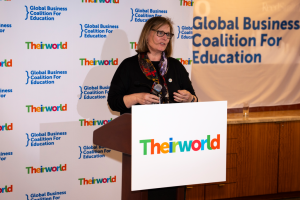
For their lifetime of service to education, the evening recognised Nobel Laureate and Chief Adviser of Bangladesh Muhammad Yunus and UN High Commissioner for Refugees Filippo Grandi with Unlock Big Change Awards, which were presented by two Theirworld Youth Ambassadors.
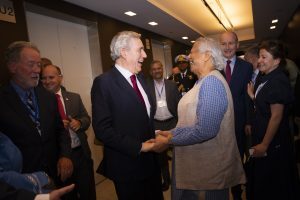
Keynote addresses were given by Her Majesty Queen Mathilde of the Belgians and Managing Director of the World Trade Organisation Ngozi Okonjo-Iweala – a previous winner of the Unlock Big Change Award.
The event continued with a panel moderated by Theirworld Global Youth Ambassador Arpan Patel, featuring the Irish Taoiseach Micheál Martin, UN Under-Secretary-General for Humanitarian Affairs Tom Fletcher, UNICEF Executive Director Catherine Russell, and Global Youth Ambassador Victory Ashaka.
Guests were then treated to a spoken word performance by Victory, highlighting the crucial role education plays in improving life chances.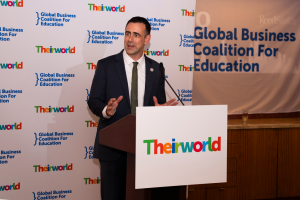
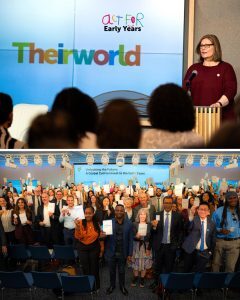
Throughout High-Level Week, Theirworld hosted a number of events which put early years at the heart of global action on education. “It’s time to invest in the world’s youngest children” was the message ringing loud and clear at the Act for Early Years summit launch co-hosted by Theirworld and UNICEF. The event culminated in a powerful moment when leaders held up their signed Act for Early Years Manifestos – a child-sized manifesto demanding big investment for the smallest children.
The event precedes the first-ever International Finance Summit for Early Childhood, which is set to take place in 2027. Theirworld President, Justin Van Fleet said:
“This is a once-in-a-lifetime window to shape a child’s future – their health, their learning and their confidence. If we fail to invest now, the cost is not just for the child, but for whole societies for generations to come.”
August 12, 2025
UK anti-poverty leaders publish joint letter saying “Getting rid of the two-child limit is the most cost-effective way to lift 350,000 kids out of poverty, while reducing the depth of poverty for 700,000 more.”
Just over a year ago, the government made its promise to children living in poverty. The Prime Minister told the nation ‘No child should be left hungry, cold or have their future held back… my ministers will leave no stone unturned to give every child the very best start at life.’
A fortnight ago, the Prime Minister Keir Starmer went one step further, declaring in front of Parliamentary Select Committee Chairs that “I want to get child poverty down”. In doing so, the PM has set out the key test of the government’s much-anticipated child poverty strategy this autumn.
This is the latest in the strengthening of the government’s language on this commitment. The government now consistently describes the forthcoming child poverty strategy as ambitious. The popular and much-needed expansion of free school meals was offered as a ‘downpayment’ of bigger things to come.
If child poverty is to come down, and the government is to deliver a truly ambitious child poverty strategy, we must face facts. Child poverty levels are rising. Last month’s stark findings from England’s Children’s Commissioner show children are facing ‘almost Dickensian levels of poverty’ in the UK today.
It is no secret why. Every day, the two-child limit pulls 109 more kids into poverty, punishing them for having sisters or brothers. After a year of careful inquiry, the government knows there is no route to reducing child poverty unless this policy is scrapped in full.
The government speaks of tackling child poverty as its moral mission. It serves a practical one too. As the PM himself says, tackling poverty is central to his critical priorities on raising living standards, delivering a better NHS, and ensuring people feel safe and secure. Getting rid of the two-child limit is the most cost-effective way to lift 350,000 kids out of poverty, while reducing the depth of poverty for 700,000 more.
The public too wants change. Polling shows widespread support for the government taking more action to tackle child poverty. People agree that families are struggling now and need support, and every child deserves the chance to thrive.
Growing up in poverty scars children’s lives. It means shorter life expectancies, poorer educational outcomes, worse physical and mental health. It means stress and isolation, hungry kids, cramped and damp housing. It’s a day-to-day reality and a future no child deserves. Matching the scale of the Prime Minister’s ambition to reduce child poverty will come with a price tag for the necessary investment. But prioritising policies that will deliver critical change for children is essential to set us on a stronger path.
It’s a prize worth fighting for. Publication of the strategy can’t come soon enough for struggling families in desperate need of action not just words. And for a supportive public ready for change, ‘promise made, promise kept’ on child poverty will be a success the whole nation can get behind.
Alison Garnham, CEO, Child Poverty Action Group
Anna Feuchtwang, Chief Executive, National Children’s Bureau
Baroness Anne Longfield, Executive Chair, Centre for Young Lives
Dame Clare Moriarty, Chief Executive of Citizens Advice
Dr Philip Goodwin, Chief Executive Officer, The UK Committee for UNICEF (UNICEF UK)
Emma Revie, CEO, Trussell
Joseph Howes, CEO of Buttle UK and Chair of the End Child Poverty coalition
Kate Bell, Assistant General Secretary, TUC
Lisa Pearce, Interim CEO, Gingerbread
Lynn Perry, CEO, Barnardo’s
Mark Russell, CEO, The Children’s Society
Moazzam Malik, CEO, Save the Children UK
Paul Carberry, CEO, Action for Children
15 UK anti-poverty leaders publish joint letter saying “Getting rid of the two-child limit is the most cost-effective way to lift 350,000 kids out of poverty, while reducing the depth of poverty for 700,000 more.”
Just over a year ago, the government made its promise to children living in poverty. The Prime Minister told the nation ‘No child should be left hungry, cold or have their future held back… my ministers will leave no stone unturned to give every child the very best start at life.’
A fortnight ago, the PM went one step further, declaring in front of Parliamentary Select Committee Chairs that “I want to get child poverty down”. In doing so, the PM has set out the key test of the government’s much-anticipated child poverty strategy this autumn.
This is the latest in the strengthening of the government’s language on this commitment. The government now consistently describes the forthcoming child poverty strategy as ambitious. The popular and much-needed expansion of free school meals was offered as a ‘downpayment’ of bigger things to come.
If child poverty is to come down, and the government is to deliver a truly ambitious child poverty strategy, we must face facts. Child poverty levels are rising. Last month’s stark findings from England’s Children’s Commissioner show children are facing ‘almost Dickensian levels of poverty’ in the UK today.
It is no secret why. Every day, the two-child limit pulls 109 more kids into poverty, punishing them for having sisters or brothers. After a year of careful inquiry, the government knows there is no route to reducing child poverty unless this policy is scrapped in full.
The government speaks of tackling child poverty as its moral mission. It serves a practical one too. As the PM himself says, tackling poverty is central to his critical priorities on raising living standards, delivering a better NHS, and ensuring people feel safe and secure. Getting rid of the two-child limit is the most cost-effective way to lift 350,000 kids out of poverty, while reducing the depth of poverty for 700,000 more.
The public too wants change. Polling shows widespread support for the government taking more action to tackle child poverty. People agree that families are struggling now and need support, and every child deserves the chance to thrive.
Growing up in poverty scars children’s lives. It means shorter life expectancies, poorer educational outcomes, worse physical and mental health. It means stress and isolation, hungry kids, cramped and damp housing. It’s a day-to-day reality and a future no child deserves. Matching the scale of the Prime Minister’s ambition to reduce child poverty will come with a price tag for the necessary investment. But prioritising policies that will deliver critical change for children is essential to set us on a stronger path.
It’s a prize worth fighting for. Publication of the strategy can’t come soon enough for struggling families in desperate need of action not just words. And for a supportive public ready for change, ‘promise made, promise kept’ on child poverty will be a success the whole nation can get behind.
Alison Garnham, CEO, Child Poverty Action Group
Emma Revie, CEO, Trussell
Dr Philip Goodwin, Chief Executive Officer, The UK Committee for UNICEF (UNICEF UK)
Kate Bell, Assistant General Secretary, TUC
Moazzam Malik, CEO Save the Children UK
Mark Russell, CEO, The Children’s Society
Lisa Pearce, Interim CEO, Gingerbread
Baroness Anne Longfield, Executive Chair, Centre for Young Lives
Dame Clare Moriarty, Chief Executive of Citizens Advice
Joseph Howes, CEO of Buttle UK and Chair of the End Child Poverty coalition
Lynn Perry, CEO, Barnardo’s
Paul Carberry, CEO, Action for Children
Anna Feuchtwang, Chief Executive, National Children’s Bureau
August 6, 2025
PRESS RELEASE: BROWN SUBMITS PROPOSALS TO GOVERNMENT CONSULTATION RECOMMENDING TAX ON GAMBLING TO SOLVE “INTOLERABLE” CHILD POVERTY CRISIS
OFFICE OF GORDON & SARAH BROWNPRESS RELEASE BROWN SUBMITS PROPOSALS TO GOVERNMENT CONSULTATION RECOMMENDING TAX ON GAMBLING TO SOLVE “INTOLERABLE” CHILD POVERTY CRISISBROWN SAYS A FAIRER TAX LEVY ON BETTING AND GAMBLING WILL LIFT 500,000 CHILDREN OUT OF POVERTY5 million children set to be in poverty by 2030’s .Half the children in Manchester and Birmingham will be in poverty next yearTaxing gambling giants could raise the £3billion needed to lift 500,000 children out of poverty.Gambling industry faces lower revenue taxes in UK than other Western countriesPolls show the public overwhelmingly back the child-friendly proposals.
With child poverty rates in Britain the worst in recent memory and rising, the Tories may be out of government but their child poverty legacy remains, says anti-poverty campaigner and former PM Gordon Brown.
Mr Brown is submitting his proposals to the Government’s Consultation on Gambling which explain how ending the the under-taxing of online gambling and betting giants can raise the revenues needed to bring “intolerable” child poverty figures down.
4.5 million children are living in poverty and their numbers will grow every year by 100,000 without serious government action to improve family incomes .
By the 2030s, 5 million British children will be in poverty and, in cities like Manchester and Birmingham, half of all their children will be in poverty.
Brown endorses new reports from the IPPR https://www.ippr.org/articles/reforming-gambling-taxationand the Social Market Foundation which between them show that £3 billion could be raised from reform of gambling taxation to reverse this disastrous poverty epidemic and begin to end the poverty plight of half a million children.
Gambling in the UK is a £11.5 billion industry and one of the biggest in the world but our taxation rates on them is one of the lowest in the West.
With many of them based in tax havens, they escape corporation tax and pay just over 20 per cent in tax where cigarettes are taxed at 80 per cent in the shops and spirits around 70 per cent
Yet a fair levelling up of tax rates would, says Mr Brown, raise the £3 billion needed now to fund a fairer start in life for our worst off 500,000 children.
“The child poverty review has a remit to ensure an enduring reduction in child poverty in this parliament” says Brown. “And the Labour manifesto promised to end the need for food parcels.
“Now for a fraction of the £30 billion spent in tax credits by the last Labour government, the IPPR and SMF evidence-based reports show how we can lift the first 500,000 children out of poverty.
“That so many children are living in penury is intolerable. It is our most profound social crisis, causing us to look like two nations set apart from each other and the best place to tackle poverty is in childhood before its scars debilitate whole lives and communities.”
“The chancellor has inherited a dismal fiscal position and economic conditions are tough.
“But there are ways the Chancellor can start fulfilling her ambition to tackle child poverty without breaking either any of her fiscal rules or any manifesto commitments.
“In responding to the government’s invitation to submit evidence to both the child poverty review and to the recent gambling taxation consultation – supported by recent reports from the Social Market Foundation and the IPPR – a number of sources of revenues have been identified to redress our appalling child poverty rates and fairer taxation of the gaming and betting industry is a good place to start.“We aren’t proposing taxes on lotteries or bingos or stop a flutter on horses, which as an industry would in any case receive £100m on our proposals, so don’t let anyone lobbying for the gambling industry fool you otherwise.“We can and must give all our nations’ children the best start in life that we can. Our country’s future will not be built by the gambling industry. It will be built by our children.“Every one of them deserves the best start in life. Fair taxes on online gambling can be ring fenced to begin that fair start at the budget.”The UK’s £11.5bn gambling industry currently incurs only £2.5bn in tax.Polling shows that if lifting the two-child rule was the most cost-effective measure to cut poverty 77 of the public would support it. https://www.focaldata.com/blog/our-scottish-future-exploring-the-british-publics-view-on-child-poverty
The IPPR report Reforming gambling taxation: How to lift half a million children out of poverty IPPR https://www.ippr.org/articles/reforming-gambling-taxation, published today shows an extra £3 billion could easily be raised by increasing tax rates to international norms.
Remote Gaming Duty is around 40 per cent in Holland and Austria, and over 50 per cent in many US states where it is legal, such as Pennsylvania. In Delaware, which has a reputation for being a tax haven, the tax rate for online casino gaming is 57%.
In the UK online gaming is taxed at just 21% raising only £2.5bn, even though remote gaming yields have grown by 40 per cent after inflation in 10 years.
Applying a 50 per cent levy – much less than the 80 per cent tax on cigarettes sales and the 70 per cent tax on whisky – would raise around £1.6bn, and raising General Betting Duty from 15 per cent to 25 per cent, could raise an additional £450m.
To achieve parity with their online equivalents Machine Game Duty payable on the revenue from in-person slot machines should also rise from 25 per cent to 50 per cent to raise, according to IPPR estimates, an additional £900m.
July 2, 2025
Gordon Brown and Prince William unite in campaign against homelessness in Britain
Former Prime Minister Gordon Brown joined HRH Prince William and entrepreneur Steven Bartlett at a special event in Sheffield to mark the second year of the Prince’s Homewards project to tackle homelessness.
The project, which has been piloted in six locations, takes a Housing first approach and intervenes early to prevent at-risk youth from becoming homeless. The goal of the project is to make homelessness rare, brief and unrepeated, transforming lives one family at a time.
Beneficiaries are also provided with employment pathways from partners such as Hays and Pret A Manger to help break cycles of poverty.
During the event, Mr Brown praised the Prince saying “his passion, his dedication, his commitment shone through”.
Prince William spoke of the importance of working together and giving people optimism: “the power of partnerships gives me hope,” he said.
One such partnerships is that between Homewards and the Multibank charity set up by Mr Brown. Multibanks collect essential and surplus goods from businesses which are then redsistributed to families in need across Britain. As part of the initiative, Multibanks will assist with the furnishing of Homewards properties.
June 3, 2025
Gordon Brown delivers inaugural John Smith Memorial Lecture
Former Prime Minister Gordon Brown has delivered the inaugural John Smith Memorial Lecture to a sold-out audience at Cadogan Hall in London.
The event, organised by the John Smith Centre, was introduced by Lord Kinnock – Labour Leader from 1982 to 1992 and a former colleague of both Gordon and John Smith.
In a wide-ranging speech, Gordon reflected on the shift from a rules-based international order, dominated by American influence, to a more fragmented, multipolar world driven.
He warned that without stronger international cooperation, the world will struggle to address critical global challenges such as climate change, nuclear proliferation, and pandemics.
Gordon also linked the global rise of populist nationalist movements to the erosion of local communities and the privatisation of public space. He cited recent research showing a sharp decline in membership across civic institutions – such as clubs, trade unions, political parties, and charities. Many people, he noted, also report having fewer close friendships and rising levels of loneliness.
“When financial or transport infrastructure breaks down, we are up in arms to rebuild it. But civil society is breaking down—and no one is doing anything,”
He then turned his focus to the rising levels of chlild poverty in Britain. Proposing a range of fundraising measures, including a levy on the highly profitable gambling industry, Gordon argued these revenues could be used to fund policies such as repealing the two-child benefit cap.
The lecture coincided with the release of a special edition of the New Statesman, titled Britain’s Child Poverty Epidemic, which was guest-edited by Gordon Brown.
Baroness Catherine Smith KC, Advocate-General of Scotland and daughter of John Smith concluded the evening by highlight the John Smith Centre’s mission to empower new and diverse voices to engage with and enter UK politics.
May 22, 2025
Gordon Brown publishes new plan to tackle child poverty in Britain
The Child Poverty Emergency, by Gordon Brown has been published today by OGSB.
The booklet sets out the sheer scale of child poverty in Britain: 4.8 million UK children will be living in poverty by 2029, with the number rising by nearly 100,000 each year.
This increase, Brown says, is the direct result of predetermined, post-dated Conservative decisions made over the past decade to drastically cut provision for children which have created what he calls “the long tail of austerity.”
The Child Poverty Emergency shows not only that the divide between rich and poor has widened over the last decade and a half, but that the divide between the lowest-income and middle-income children in the UK has been growing fast with 2 million children now in families with family budgets that are 40% or less of the medium income.
And he proposes a 3 point plan which can raise £9 billion from public and private sources to create a children’s Fairness Guarantee with measures to begin to tackle – within current fiscal rules – the poverty tragedy trapping too many of Britain’s kids.
In cities like Birmingham and Manchester, 46% and 44% of children respectively are already officially in poverty, with some communities seeing rates as high as 85%. That means in some classrooms, 25 out of 30 children are, by the government’s own definition, condemned to live in poverty.
The numbers of children Brown reveals to be going without are stark. Every night one million children are trying to sleep every night without a bed of their own. Every day three million children regularly skip meals because of poverty.
Brown’s £9 billion funding to combat child poverty evidences three practical ways to raise £9 billion to combat child poverty Without breaking the government’s tax promises or it’s for school rules:
£3 billion from highly profitable online gambling via levies – just by matching rates in European countries and U.S. states like New York and Delaware Which could be the result of the government’s welcome review of the gambling industry£3 billion from a tiered interest scheme on commercial bank funds held at the Bank of England. The four biggest UK banks made profits of £45.9 billion in 2024. Positive Money projects these banks stand to make £52.4 billion by the end of 2025, a 14% increase. £3 billion directed to third-sector anti-poverty charities through reforms to Gift Aid, corporate philanthropy, and the creation of a new £1billion UK Social Impact Fund.Brown says these proposals, also detailed across the special edition of the New Statesman, would kickstart a new Childhood Fairness Guarantee.
You can download a copy of the booklet by clicking here
Gordon Brown's Blog
- Gordon Brown's profile
- 30 followers

