Elisabeth Pike's Blog
August 15, 2025
Christopher, Running OUT TODAY
Hello folks!
Sorry I've been a bit MIA on here lately, I've been too busy preparing for the launch of Christopher, Running, which, by the way, IS TODAY! Whoop Whoop!
Miners is a reader-supported publication. To receive new posts and support my work, consider becoming a free or paid subscriber.
As I think I’ve said before, this book has been with me for many years - I first started writing about the fens in year 10 in my English lessons, and this book was first put together during my MA. It was then pulled apart and rewritten many times. So it has been a long long time coming and I am delighted that it is finally seeing the light of day! (If you want to read more about how this book came to be, have a look at this post:
If you haven't heard about it yet (how could you not have..?) here's a little bit about the book:
Christopher, Running is the second novel from Kindle Storyteller Award 2024 finalist Elisabeth Pike.
Lanny meets Sorrow and Bliss in this shattering tale of innocence, loss, and betrayal set in the English Fens.
What if there was no way back from the thing you did? How do you keep on living when the past won't let go?
Christopher and Cassie are the best of friends, but when a tragic accident separates them for good, Christopher can't move on, and his adult life becomes a cycle of breakdowns and recoveries. Years later, seven-year-old Esme comes into his life and reminds Christopher of the friend he once lost.
But when the voice in his head tells him to do the unthinkable, Christopher makes a choice that he can't take back. And when he realises that he has betrayed the trust of the ones he loves most in the world, he goes on the run.
Can Christopher forgive himself for the past and let himself live again?
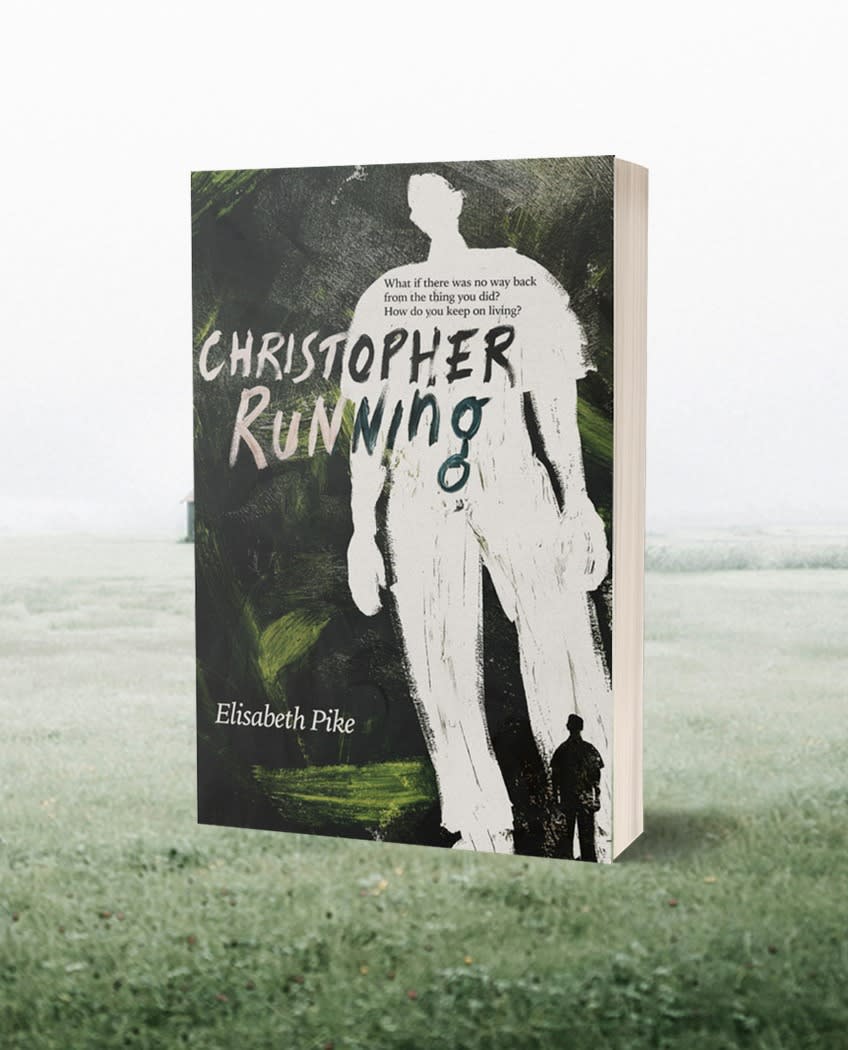 Christopher, Running in a suitably eerie field
Praise for Christopher, Running:
'A brilliant, haunting and gripping novel.' Naomi M, ARC reader
'Magical, with a real sense of place, rootedness and belonging. It speaks of how past events make us who we are and mark out our lives.' Hilary C, ARC reader
'This is a poignant, heartbreaking story. I thoroughly enjoyed this novel, and would recommend it to anyone who loves heartfelt, beautifully written stories.' Laura D, ARC reader
'An extraordinary achievement...The prose is as luminous and lucid as the changing light and reflections in the wild and open Fen landscapes Pike so beautifully describes.' Jenny D, ARC reader
You can buy it here: https://amzn.eu/d/6ykQWtS
or get signed copies here: https://littlebirdeditions.etsy.com/l...
And lastly, I've started a new mailing list that is just for book news, so if you're interested in that, you can sign up here:
https://preview.mailerlite.io/forms/1556505/159822437620385506/share
Thanks so much again – your support really makes all the difference to an indie author!
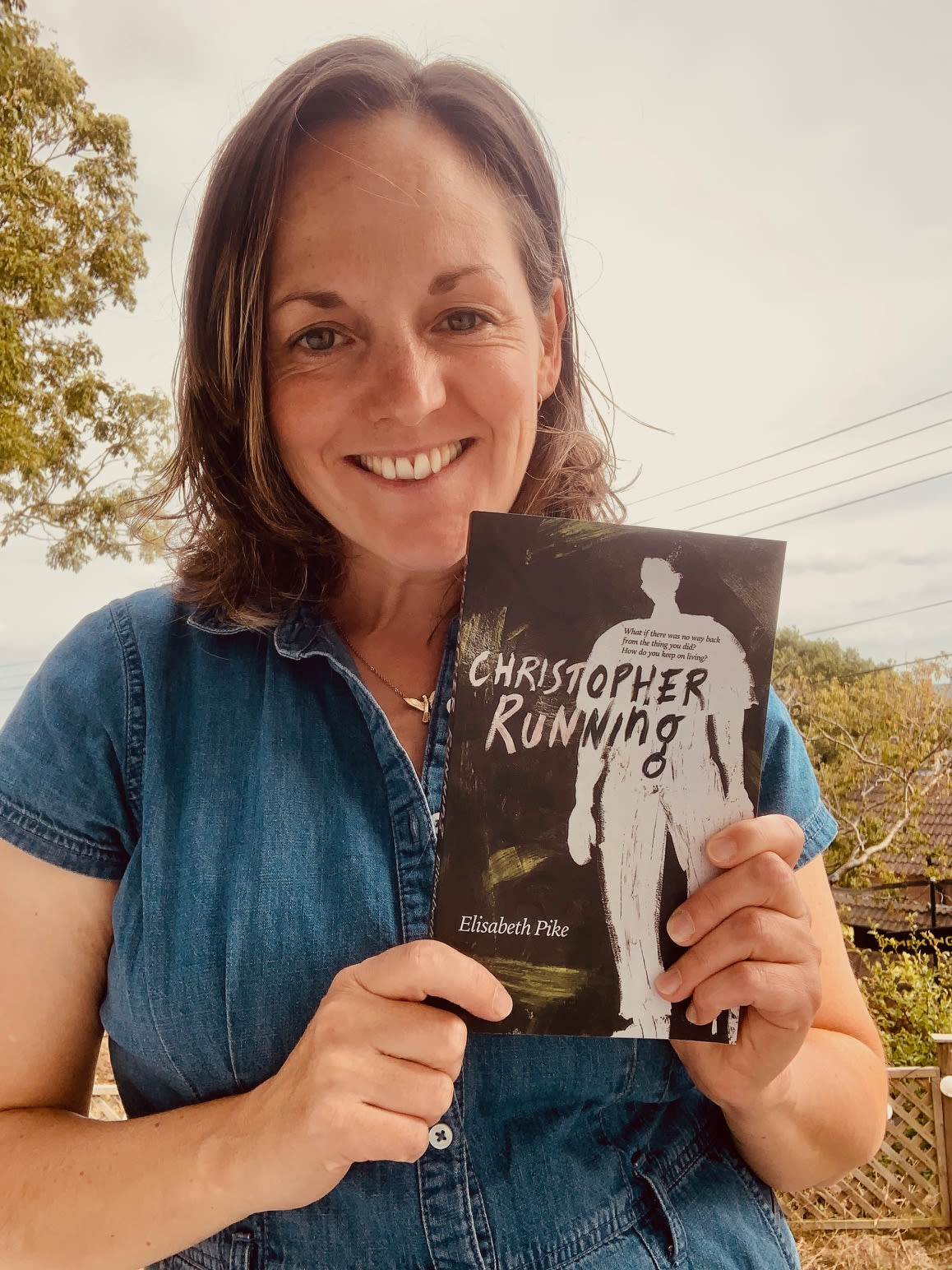 Here I am holding the book that has haunted me for half of my life!
 Thanks for reading Miners,
Elisabeth x
Miners is a reader-supported publication. To receive new posts and support my work, consider becoming a free or paid subscriber.


July 6, 2025
The top 10 things I wish I knew about writing 20 years ago
Over on my TikTok, I've just begun a new series about the things I wish I’d known about writing 20 years ago. It's been a long old journey since I first set my sights on being a writer, and there are definitely some things I wish I'd done differently. So I thought I'd share them over here too, as 20 years slogging away at the same upward path is a long time, and I'm sure I've learned a few things that are worth passing on! So read on for the top ten things I’ve learned…
1. Make time to write every dayYour whole life doesn't have to revolve around writing, but you can squeeze it in at the edges of the way you are living now. At one point in my life, I quit my job at a bookshop to write full-time. I was doing an MA, so I didn't think it would look too bad on my CV, but in retrospect, I was not ready to write full-time and didn’t make the most of it. I like the variety of having a job too, and at the moment I work four days. Even on my writing day, I can't concentrate on writing for the whole day, so I try to get an hour in a few times a week. (When I have a tight deadline, this becomes every night until 2am!)
Miners is a reader-supported publication. To receive new posts and support my work, consider becoming a free or paid subscriber.
2. Not putting things out there will make you illI've talked about May Sarton a lot on here, and repeated her quote, from Journal of a Solitude, that ‘the gift turned inward, unable to be given, becomes a heavy burden, even sometimes a kind of poison. It is as if the flow of life were backed up.’ If you release work, it will make space for the next thing. We don't want to become stagnant ponds as writers, but flowing streams of fresh water!
3. Your MA will teach you nothingI mean, I did enjoy it and it made me think seriously about my writing, but I didn't actually learn the craft of plotting a novel. When I wrote my first book (which became Christopher, Running), I just had a go and emptied my brain on the page, only to be told that my writing was far too depressing and my characters didn’t change at all! It wasn't until I read Save the Cat that I really appreciated all the different parts of a good story. I realised then that it is the transformation of a character that we crave as readers.
4. Don't wait for validationMore than ever, indie publishing is booming. Trad published authors are dipping their toes into the indie waters, and many indie authors are doing a roaring trade. I remember the advice given to me at the Kindle Storyteller Awards by one successful indie author. He said, 'Whatever a publisher can do for you, you can do yourself, but better.' Remember that!
5. My true north is connecting with readersIn The Artist’s Way (I love this book), Julia Cameron asks the reader to reflect on what it is they actually want from their creativity. Is it to be known? Is it to make money? Is it to connect with the reader? For me, personally, knowing that my writing has connected with someone is the reason I write. Hearing back from a reader that my writing has meant something to them is EVERYTHING. Don’t get me wrong - external validation would be great too... but that's not why I write.
6. Writing is a marathon, not a sprintPersonally, I have found it unhelpful to set external goals (i.e., I am going to find an agent before my 40th birthday – yep, I did this only to get a rejection from my dream agent at my 40th birthday party – not even kidding!) I have found it much more helpful to set achievable goals to work towards – for example, I am going to finish this draft before Christmas. Then you can celebrate your wins, and it depends on what you do, not what anyone else does.
7. Learn as much as you can!Always be learning. There is so much to learn, and it can be a little overwhelming, but take each day at a time, and steadily try to grow your audience, whether that is through a mailing list, Instagram, TikTok, or through ads on Facebook or Amazon. Learn from the experts. Find a writer who is doing well on that platform and see what they do. Try things out. What have you got to lose? I still struggle with marketing - ie, knowing who my book is aimed at, so this is something I am aiming to nail within the next year.
8. Write the book you want to writeHaving mentioned how important it is to know your audience so you can market to them, I also think it is crucial to write the book you want to write. Don't water it down to a compromise. If you have a vision for a book, go for it, and then see if there is a market. As Virginia Woolf said, 'So long as you write what you wish to write, that is all that matters; and whether it matters for ages or only for hours, nobody can say. But to sacrifice a hair of the head of your vision [...] is the most abject treachery' (A Room of One’s Own).
9. Write in seriesEspecially in indie publishing. If a reader finds your book and likes it, they can embark on a whole journey of discovery of the rest of the books in that series.
10. Celebrate your winsGiven that choosing writing as a career is a very silly option (I mean, are you really sure that you want to do this…?), it is very, very important to celebrate your wins. Finishing a draft is a big deal! Publication day is a big deal! Reward yourself. It is a long and sometimes lonely journey, so make sure you are taking care of the genius that does all the hard work (i.e., you).
Bits and BobsIn other news, I am starting to put together a books mailing list, which is just book news, as I wanted to separate out creative inspiration, which is what Miners is for, and book news. That should be coming in a few weeks, so watch this space for updates!
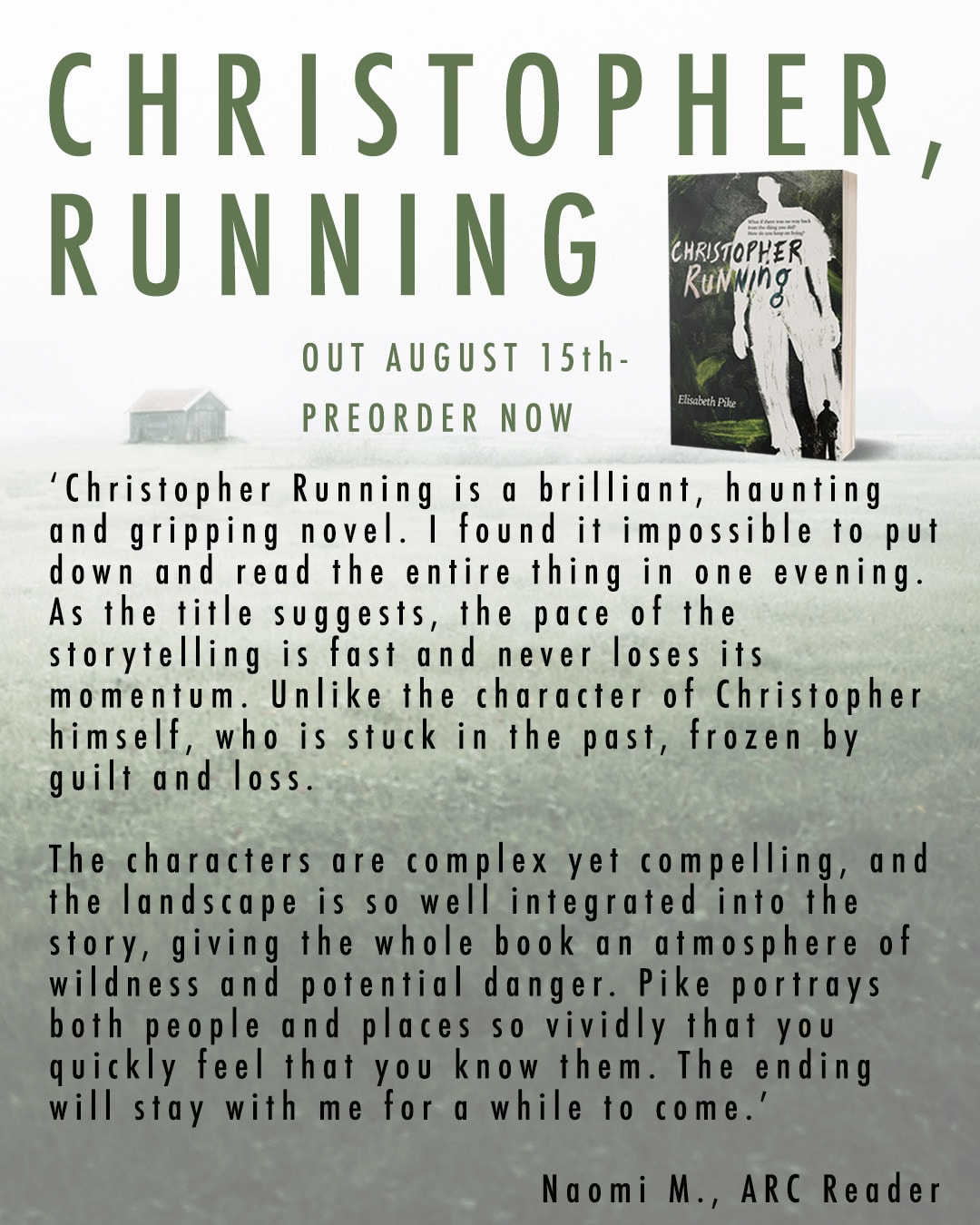
As I’m sure you’ve heard (!), Christopher, Running is coming out on 15th August. The ARCS have gone out, and I am getting some reviews back, which is very exciting! Here is one of them from Naomi M. You can preorder your copy here if you haven’t yet.
That’s all for now!
Thanks so much for reading Miners.
Elisabeth
Miners is a reader-supported publication. To receive new posts and support my work, consider becoming a free or paid subscriber.
June 17, 2025
My writing obsessions
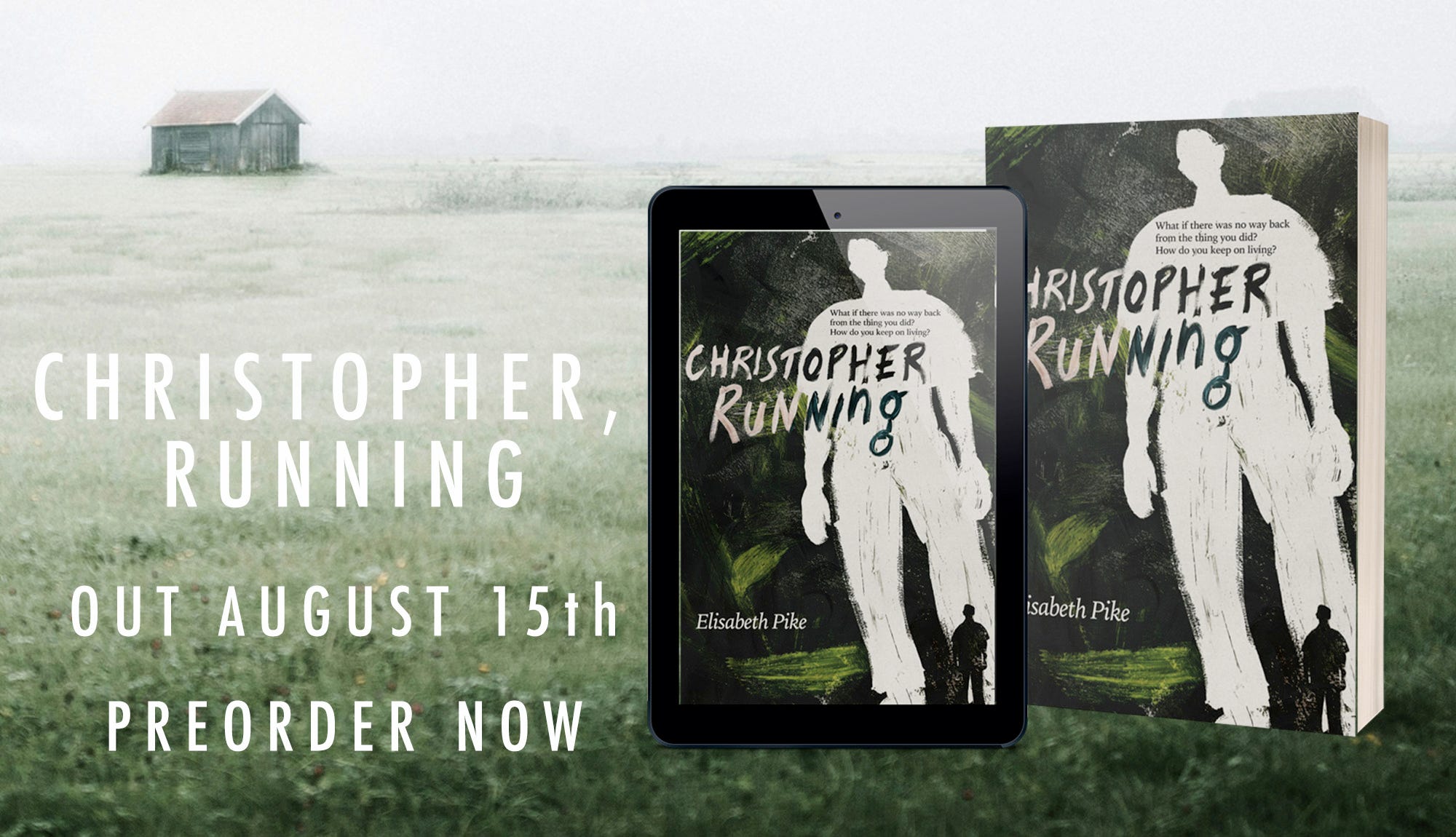
As I have been editing Christopher, Running this year prior to its publication in August, I have been reminded of the similarities between this book and Murmuration, which came out last May.
As writers, I think we have certain themes or obsessions that we keep coming back to. Sometimes we have to write around a subject for a while before we get to the heart of what it is we actually want to say.
Miners is a reader-supported publication. To receive new posts and support my work, consider becoming a free or paid subscriber.
Looking at my books in terms of marketing, they are quite different. One is a YA dystopian thriller and the other is literary fiction/psychological thriller, but I have realised that there are a few things my books both feature...
1. A perceived lapse in caregiving leading to severe consequences: Jay's mum can't forgive herself for what happened to Zoe in Murmuration and there is a similar moment for Alice in Christopher, Running. Having a daughter with Type One diabetes, a lapse in caregiving is one of my deepest fears. If I screw up, her life is at risk. If I miss an alarm she could be in danger. I think this deep fear has made it into both books and probably will make it into many more... Both books also feature people becoming caregivers unexpectedly, something I find interesting as a mother. I am interested how things wash up on the shores of a person's life and sometimes it feels as if there is no choice but to say yes. Both books feature this sort of happening.
2. I used the symbol of a static caravan in both books. In Murmuration, the caravan signifies Jim's temporary existence (Jay's dad). He can't come to terms with the way things have worked out and living in a caravan lends everything a feeling of impermanence, which is the way he lives his life – waiting for something to change. Similarly, in Christopher, Running, Christopher uses the static caravan hidden in the hedge at his parent’s house as a halfway house. A sort of den, a home but not a home, for the man who is still a boy at heart and won't let himself grow up.
3. Both books feature long journeys on foot. Journeys are transformative and in both of my books, the protagonists undertake a long and unfamiliar journey. For both of them, the journey becomes a doorway to a new and bolder self.
4. Mental health issues and the effect of this on the surrounding cast. In both novels, I have explored the impact on the loved ones of the affected person. They see the suffering close up and try their best to help but are out of their depth. I'm thinking of Jay trying to console his parents after what happened to Zoe. I'm also thinking of Ben, Alice and Marjorie, the ones around Christopher, who try over and over again to help him make sense of things.
5. I'm also thoroughly obsessed with closure, that feeling that we crave of having everything neatly tied up when, in reality, life isn't like that. I can't give too much away about Christopher, Running, but Alice and Esme are left with their lives on pause for a long time, and I'm so interested in this. What happens to those left with unanswered questions, those for whom life just keeps on ticking by, day after day, after day? In Murmuration, Jay couldn't find closure after what happened to his mum (if you're intrigued, you'll have to read the book!) and he couldn't really get any kind of closure until he met Fee, and she revealed something to him towards the end of the book that illuminated his questions and gave him peace for the first time in years.
6. Both books are about the protagonist finding their voice. In Murmuration, Jay is duty-bound, trying to keep his promise to his mum to keep his head down, try hard at school, and get off the island. When his life turns upside down, it becomes more important than ever for him to find his inner strength and speak up - for the kids, and wider than that, to the government. In Christopher, Running, the main character, Christopher, grew up weighed down and burdened because of what happened when he was seven years old. As he grew, there were so many voices telling him what to do/what to think/how to get better that he didn't know who to believe, and it was only as he walked out of the village that he started to hear his own voice for the first time.
7. A touch of the supernatural. Obviously, my books all have to have something out of the ordinary! I love to play with possibility. I love things to happen that are otherworldly. I love magic, so you'll find a little of that sprinkled throughout both books.
8. Questioning what was true and what was not true. Both books have central characters questioning the truth of events they actually lived through. This is a result of being told what to think and the necessity of the protagonists to find their inner strength and hear their own voice.
9. Moody setting. I am slightly obsessed with the fens as I went there often as a child (You can read more about this in last week's post.) The flat horizons and rolling clouds have all settled into my subconscious and become a rich seam of memory. Likewise, I knew Murmuration was set on Sheppey before I had even set foot there. I described the setting to a friend who said, 'That sounds just like Sheppey.' When I went to visit, it was wonderfully moody, the cloud clinging to the island as I imagined it would. Picking up the atmosphere of a place is hugely important for me in my writing.
So, you see, there is a little bit of me in everything I write. But this is not autofiction. None of these characters are me, and I have not lived the things they have lived, but when I write their lives, I feel them and feel what they have been through, which is why I believe empathy is the greatest gift of the writer. I feel myself into the character with the greatest joys and deepest fears that I know. And that is why I delight in the calling of writing. I get to put feeling into words. I get to craft with empathy. I get to make magic, and there is no better feeling.
If you're intrigued by the sound of Murmuration or Christopher, Running, go and look them up. Don't forget, ebook preorders are now live for Christopher, Running HERE!
And if you want an ARC, you can apply for one HERE!
Thanks so much for reading Miners, and tell me, what are your creative obsessions?
Elisabeth
x
Miners is a reader-supported publication. To receive new posts and support my work, consider becoming a free or paid subscriber.
June 9, 2025
Christopher, Running ARCS are out!
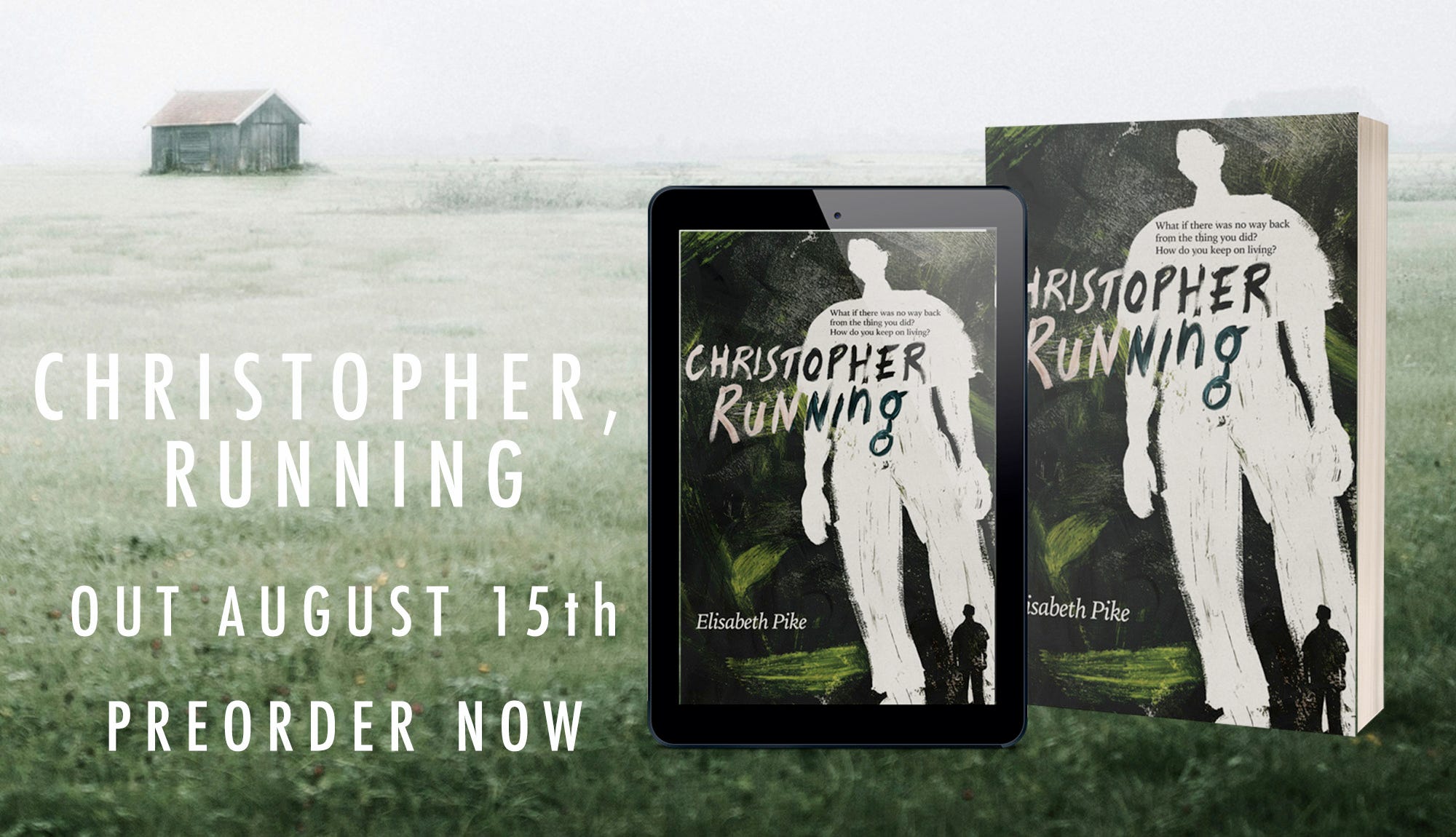
Well, that’s it - the ARCS (advance reader copies) of Christopher, Running are out! It feels momentous and scary to have finally let go of this one. It has been half a lifetime in the making! That’s not to say it is a huge, rambling thing. Instead, it is concise and clean, perhaps because it has been torn apart and rewritten many times.
You see, this is the book that first called me to writing, so letting go of it feels like a big deal. It was in my English class at secondary school that I first started writing about the Fens. It was the place my dad grew up, and we visited many times throughout my childhood. It seemed to me strange and full of interesting people, accents, and habits - a place that I couldn’t fully understand. I didn’t know it at the time, but a rich seam of memory was being laid down in me.
Miners is a reader-supported publication. To receive new posts and support my work, consider becoming a free or paid subscriber.
In a chapter from my book Circles (republished chapter by chapter on Miners last year), I wrote about this:
‘There is always a mixture of things that go into a novel; a culmination of interests, of curiosity from my childhood, strange tales from my father, an attempt to make sense of those things that don’t make sense, especially in the mind of a child, and I think we are drawn to certain things subconsciously and only the unfolding of time will tell us why. Or maybe we will never know why. I remember a piece of writing that I was pleased with at secondary school. It was a description of my grandmother’s garden, the tumbledown sheds, and the willow that you could hide yourself in, and it stayed with me, the mystery of that place. It seemed like something I could write about. There were layers and layers of memories in that garden; tasting juicy apples straight from the tree, learning to roll the old rusty barrel under my feet, my uncle pulling an armchair out onto the lawn in the blazing sun. And those layers have settled down over time to create a rich source of material, of feeling, memory, and detail, which comes back when I start to dig.’
You can find the full post here:
https://minersbyelisabethpike.substack.com/p/letting-go-b11
Learning to WriteThe first time I tried to tell this story, I didn’t have a plan, and the more I wrote, the more I felt I was tying myself in knots. At that point, no one had told me how to write a novel, and I didn’t really know any better, so I just wrote, chapter by chapter. Since then, Save the Cat has shown me the absolute necessity of having a plan to save you from going off track. I received some feedback saying that my book was just a series of events that happened, and none of the characters changed. Save the Cat opened my eyes to the beauty of reading. Because we read for the transformation. We read for the impossible situations that characters get themselves into and out of. We read for resolution, changed lives, and bravery.
So, I unpicked the novel, like a jumper, and kept what I knew were the bones of the story - the story of Christopher and Alice. They were the living threads, with the other stories weaving around them. I cut half of the book out, sat down with my characters, and worked out what it was that they really wanted.
I rewrote Christopher, Running in a difficult year of sending Murmuration off 100 times to agents. It was soul-destroying, and I really needed something to focus on while simultaneously feeling like an abject failure! So it’s very nice indeed to be on the other side of publication for Murmuration, and to have finished this project too.
DiggingThe idea of digging in our writing takes me back to that marvellous essay by Seamus Heaney entitled ‘Feeling into Words,’ from Finders Keepers.
He speaks of writing his poem ‘Digging,’ saying that ‘I wrote it down years ago; yet perhaps I should say that I dug it up, because I have come to realize that it was laid down in me years before that even.’
I love the way that he talks of the seams of memory that are laid down in us, and how, as we start to dig and dig with our pen, we find all these treasures that we were previously unaware of.
We dig also to find ourselves, and this is for sure what I was doing in Christopher, Running. At first, I was digging for mystery, mixing the places I had seen with my father’s tales, and then I dug for myself when I realised that the things I was writing were helping me to answer the questions I had in my own life. I wrote to find the edges of myself. I wrote to hear myself.
Reading it back, recently, I realised that I am Alice, lost in caring for those around her. I am Christopher, searching for his own voice, which has been drowned out in the noise of all those swirling around him. I am Esme, not sure what is true. In a way, I am all of the characters; parts of me have gone into them, and parts of them have merged with me. This is the magic of writing; our writing transforms us as we write.
Although Christopher, Running is quite different from Murmuration, they still feel like brother books in my mind. There is my obsession with static caravans, still! There are unhinged characters who can’t make sense of their past. There are things left open, unfinished stories all over the place. There is a setting of the bleak Fens, wide and windy, not the kind of place to hold you if you were trying to get away. There is coincidence and love, loyalty, and a sort of closure in the end.
So I’m so proud that I was stubborn-minded enough to plough on with this book of my heart. I feel like I’ve dragged this story through twenty years of my life, and now I present it to you!
As I said, the ARCS have landed in inboxes, and I will see what people make of it.
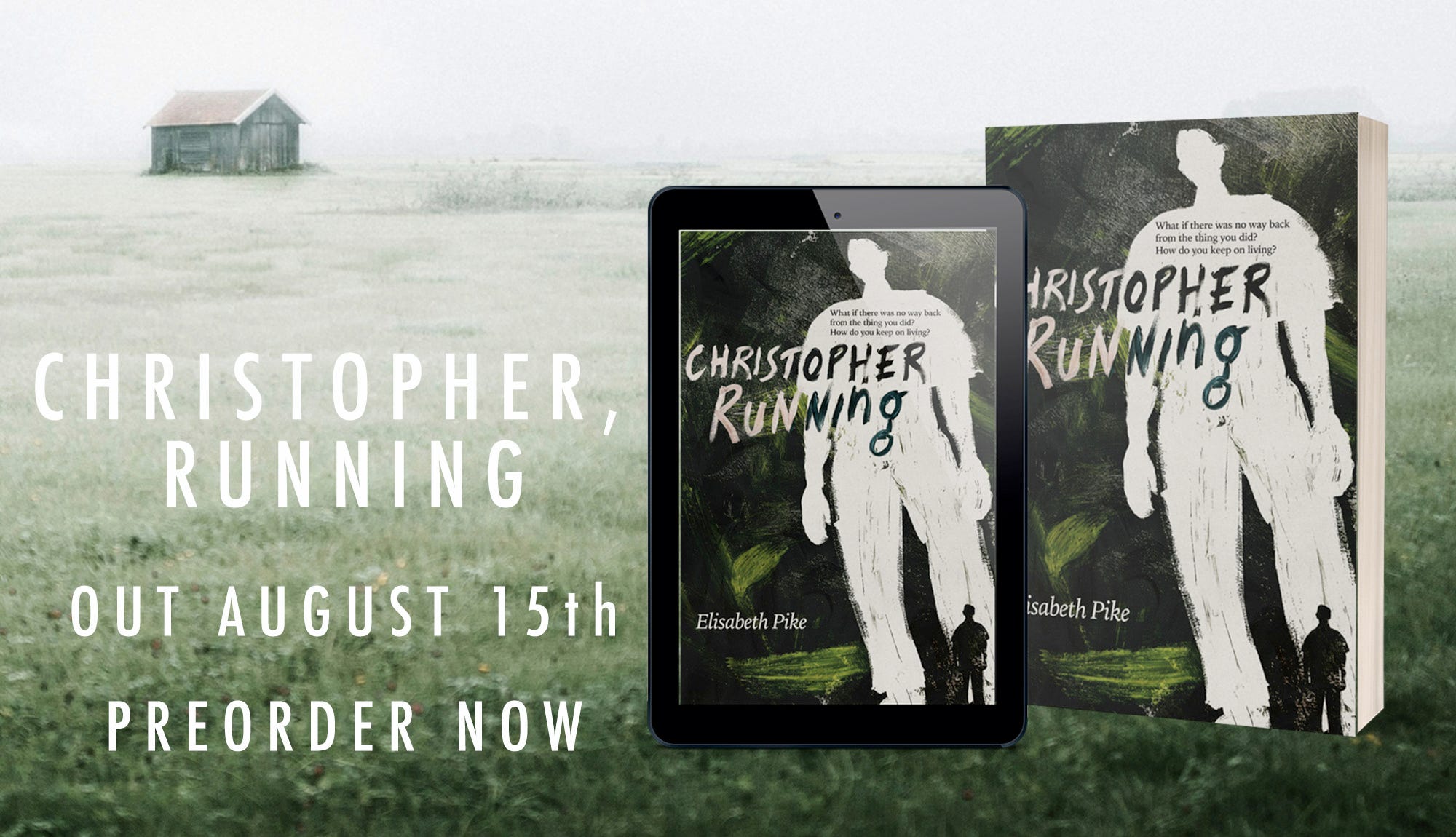
If you’re intrigued, the preorder for ebooks is now live, and you can preorder here.
I’m wondering how I can distill this Miners post into a single lesson, and I think it is this: sometimes we need to hang on to a dream, or a kernel of thought, for a long time before it comes to anything. Sometimes, we have to be that dog with a bone, refusing to let go.
If this is you, don’t give up.
Put things aside for a season, by all means, but don’t give up.
As always, thanks so much for reading Miners,
Elisabeth x
Miners is a reader-supported publication. To receive new posts and support my work, consider becoming a free or paid subscriber.
June 1, 2025
Book News! Searching for a launch team!
I’m excited to finally announce the launch date for my forthcoming novel Christopher, Running! First of all, check out the amazing cover from Mark Swan, full of menace, isolation, and the wild.
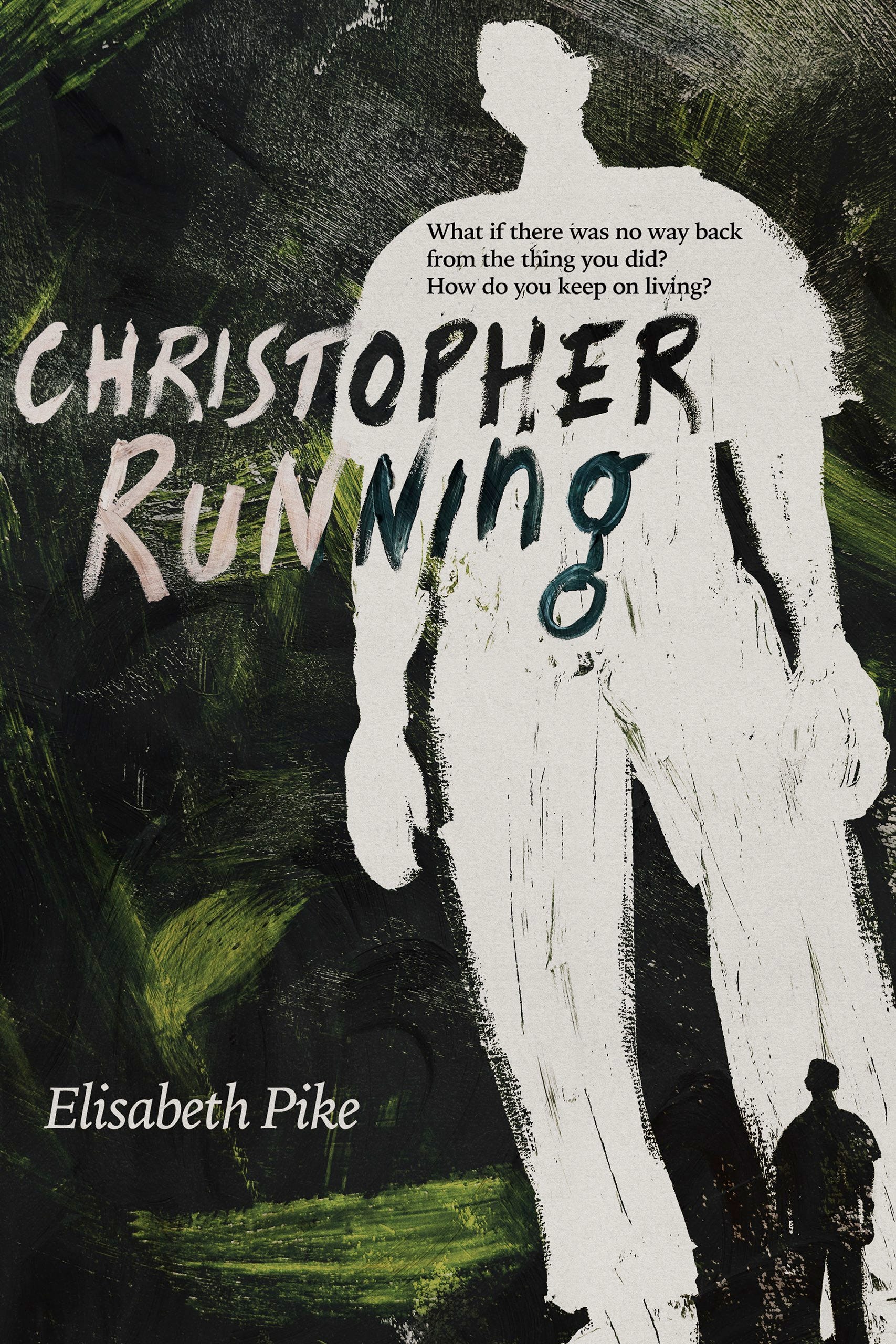 My awesome cover design from Mark Swan
Read on for a little bit about the book…
Miners is a reader-supported publication. To receive new posts and support my work, consider becoming a free or paid subscriber.
Christopher, Running
is the second novel from Kindle Storyteller Award 2024 finalist Elisabeth Pike.
Lanny
meets
Sorrow and Bliss
in this shattering tale of innocence, loss, and betrayal set in the misty and secretive Fens.
What if there was no way back from the thing you did? How do you keep on living when the past won't let go?
Christopher and Cassie are the best of friends, but when a tragic accident separates them for good, Christopher can't move on, and his adult life becomes a cycle of breakdowns and recoveries. Years later, seven-year-old Esme comes into his life and reminds Christopher of the friend he once lost.
But when the voice in his head tells him to do the unthinkable, Christopher makes a choice that he can't take back. And when he realises that he has betrayed the trust of the ones he loves most in the world, he goes on the run.
Can Christopher forgive himself for the past and let himself live again?
Today I am on the lookout for a launch team - so if you like reading and want to get involved, read on!
What is a launch team?
It’s my VIP gang, who will read my book, hopefully love it, and shout about it on launch day!
What do I get out of it?
A free digital copy of Christopher, Running, and that warm, fuzzy feeling that comes from helping out an indie author! The digital copy comes from BookFunnel and can be downloaded onto any ereader of your choice.
What do you want from me?
To be honest, all I want is for you to read the book. And, if you like it, that you tell people about it! A review on Amazon or GoodReads would mean the absolute world, too.
Feeling tempted? Here’s the sign-up button….
(And if that fancy button didn’t work, click here: https://forms.gle/RihDuWJTiY2QjmFH6)
And if that doesn’t work, just reply to this email and I’ll add you to the list.
I’ll tell you more about how Christopher, Running came to be in the next few weeks, but for now, put Friday 15th August in your diaries for it is LAUNCH DAY!
Thanks so much for reading Miners,
Elisabeth x
Miners is a reader-supported publication. To receive new posts and support my work, consider becoming a free or paid subscriber.
May 11, 2025
A self-guided writing workshop: Trees and the Wild
Hello!
Something a bit different from me this week. I thought I’d share one of my writing workshops. This is a shortened version of my workshop all about trees and the wild. So, I invite you this week to block out an hour for yourself. Make a hot drink for yourself and hide yourself away somewhere. It is a self-guided workshop so you can move through the prompts as slowly or quickly as you like.
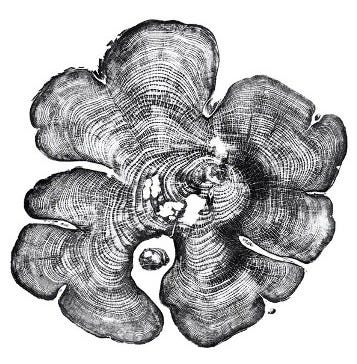 Image: Bryan Nash Gill
 Image credit: Bored PandaTrees and the Wild: A self-guided workshop
Welcome to this self-guided writing workshop about trees and the wild. All you need is a pen, notepad and one gift from a tree (could be a branch, leaf or bud).
It is an ideas generation course, so will hopefully after this workshop, you will have a notebook full of starters that might one day turn into something. Don’t worry about the quality of your writing, just write!
Writers often talk about their ideas settling down and composting. You scribble them down and when you return to them weeks, months or years later, they have turned into something valuable, something that you hadn’t seen before.
‘Our bodies are garbage heaps: we collect experience, and from the decomposition of the thrown-out eggshells, spinach leaves, coffee grinds, and old steak bones of our mind come nitrogen, heat and very fertile soil. Out of this fertile soil bloom our poems and stories.’ Nathalie Goldberg
‘I have always kept notebooks – I have an obsessive devotion to them – and I go back to them over and over. They are my compost pile of ideas. Any scrap goes in and after a while I’ll get a handful of earth.’ Louise Erdrich
 Image credit: Bored Panda
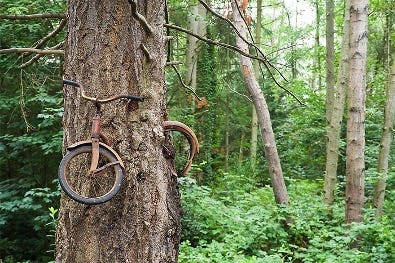 Image credit: Bored PandaStep One
 Take your tree gift, it might be a leaf, a twig, a bud.
Look at it, smell it, touch it.
Now read this from Ted Hughes and then freewrite for five minutes. (Don’t stop writing, don’t edit!)
‘The only thing is, imagine what you are writing about. See it and live it. Do not think it up laboriously, as if you were working out mental arithmetic. Just look at it, touch it, smell it, listen to it, turn yourself to it. When you do this, the words look after themselves, like magic. If you do this, you do not have to bother about commas or full-stops or that sort of thing.. The minute you flinch and take your mind off this thing, and begin to look at the words and worry about them.. then your worry goes into them and they set about killing each other.’ Ted Hughes
Miners is a reader-supported publication. To receive new posts and support my work, consider becoming a free or paid subscriber.
Step TwoRead these quotes about trees and let the words speak to you. Jot down anything that speaks to you.
‘We feel for them [the trees] because we identify with them. Like us, they are small and helpless when they are young. Like us, they take power in their power when they come to maturity. And, like us, they come to a tottering old age when they are once again dependant on others for survival.’
Alexander Van Humboldt
‘For me, trees have always been the most penetrating preachers. I revere them when they live in tribes and families, in forests and groves. And even more I revere them when they stand alone. They are like lonely persons. Not like hermits who have stolen away out of some weakness, but like great, solitary men, like Beethoven and Nietzsche. In their highest boughs the world rustles, their roots rest in infinity; but they do not lose themselves there, they struggle with all the force of their lives for one thing only: to fulfill themselves according to their own laws, to build up their own form, to represent themselves. Nothing is holier, nothing is more exemplary than a beautiful, strong tree. When a tree is cut down and reveals its naked death-wound to the sun, one can read its whole history in the luminous, inscribed disk of its trunk: in the rings of its years, its scars, all the struggle, all the suffering, all the sickness, all the happiness and prosperity stand truly written, the narrow years and the luxurious years, the attacks withstood, the storms endured. And every young farmboy knows that the hardest and noblest wood has the narrowest rings, that high on the mountains and in continuing danger the most indestructible, the strongest, the ideal trees grow.’
‘A tree says: A kernel is hidden in me, a spark, a thought, I am life from eternal life. The attempt and the risk that the eternal mother took with me is unique, unique the form and veins of my skin, unique the smallest play of leaves in my branches and the smallest scar on my bark. I was made to form and reveal the eternal in my smallest special detail.’
‘A tree says: My strength is trust. I know nothing about my fathers, I know nothing about the thousand children that every year spring out of me. I live out the secret of my seed to the very end, and I care for nothing else. I trust that God is in me. I trust that my labor is holy. Out of this trust I live.’
‘When we are stricken and cannot bear our lives any longer, then a tree has something to say to us: Be still! Be still! Look at me! Life is not easy, life is not difficult. Those are childish thoughts. . . Home is neither here nor there. Home is within you, or home is nowhere at all.
A longing to wander tears my heart when I hear trees rustling in the wind at evening. If one listens to them silently for a long time, this longing reveals its kernel, its meaning. It is not so much a matter of escaping from one’s suffering, though it may seem to be so. It is a longing for home, for a memory of the mother, for new metaphors for life. It leads home. Every path leads homeward, every step is birth, every step is death, every grave is mother.’
‘So the tree rustles in the evening, when we stand uneasy before our own childish thoughts: Trees have long thoughts, long-breathing and restful, just as they have longer lives than ours. They are wiser than we are, as long as we do not listen to them. But when we have learned how to listen to trees, then the brevity and the quickness and the childlike hastiness of our thoughts achieve an incomparable joy. Whoever has learned how to listen to trees no longer wants to be a tree. He wants to be nothing except what he is. That is home. That is happiness.’
Herman Hesse - Wandering
‘On its own, a tree cannot establish a consistent local climate. It is at the mercy of wind and weather. But together, many trees create an ecosystem that moderates extremes of heat and cold, stores a great deal of water, and generates a great deal of humidity. And in this protected environment, trees can live to be very old. To get to this point, the community must remain intact no matter what. If every tree were looking out only for itself, then quite a few of them would never reach old age. Regular fatalities would result in many large gaps in the tree canopy, which would make it easier for storms to get inside the forest and uproot more trees. The heat of summer would reach the forest floor and dry it out. Every tree would suffer. Every tree, therefore, is valuable to the community and worth keeping around for as long as possible. And that is why even sick individuals are supported and nourished until they recover. Next time, perhaps it will be the other way round, and the supporting tree might be the one in need of assistance. A tree can be only as strong as the forest that surrounds it.’
Peter Wohlleben, The Hidden Life of Trees
 Image credit: Bored PandaStep three
Think about the life cycle of a tree. Now imagine that your life is a tree. Where are you in your life cycle? Are you a sapling needing protection? Have you suffered a bad storm? Is your growth stunted? Is it winter or spring? Set a timer for ten minutes. Begin your writing, ‘I am a tree..’ Don’t read it back and don’t edit. Just write.
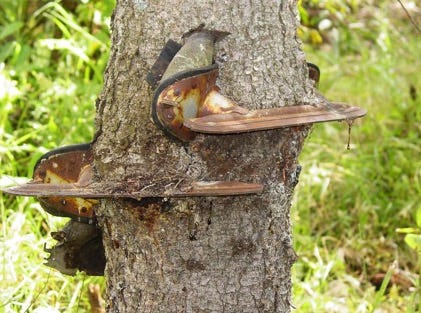 Image credit: Bored PandaStep four
Think about a tree that is special to you. Perhaps it played a role in your childhood? It could be one you climbed, one in your garden, one where you met friends.
Why is it important?
Imagine you are there again as a child.
Who else is there, and what is happening? Set a timer for ten minutes and write.
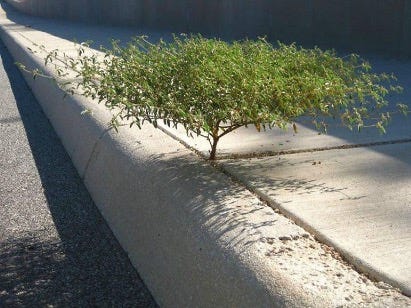 Image credit: Bored Panda
 Image credit: Bored Panda
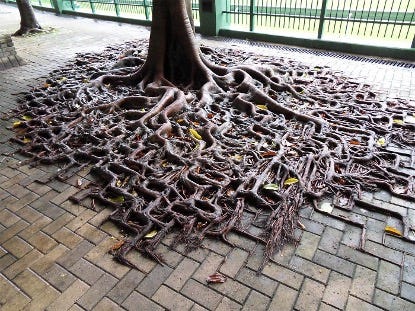 Image credit: Bored PandaStep five
Take a japanese word prompt and use it to spark writing. You could write about when you last experienced this. Use the word as a jumping off point.
1. Komorebi
This word refers to the sunlight shining through the leaves of trees, creating a sort of dance between the light and the leaves.
2. Shinrinyoku
Literally “forest bathing,” shinrinyoku means walking through the forest and soaking in all the green light.
3. Kogarashi
The cold wind that lets us know of the arrival of winter.
4. Wabi-sabi
Although now used as a single word, wabi and sabi used to be distinct words and concepts. Originally, wabi referred to desolation and loneliness, but took on more positive implications around the fourteenth century when spiritual asceticism came to be admired. The meaning of sabi has also evolved from ‘withered’ to the beauty of passing time. These two words are now typically combined and sum up a key Japanese aesthetic rooted in Buddhist teachings—the imperfect, incomplete, and transient nature of beauty. Objects that elicit a sense of quiet melancholy and longing could be defined as wabi-sabi, such as wood that gains a mellow patina over time, falling autumn leaves, or a chipped vase. Wabi-sabi refers to a way of living that focuses on finding beauty within the imperfections of life and peacefully accepting the natural cycle of growth and decay.
5. Kogarashi
Literally ‘leaf-wilting wind’, kogarashi refers to the withering wind that comes at the start of winter and blows the last leaves off of the trees.
6. Mono no aware
This word combines mono, or ‘thing’, with aware, which means sensitivity or sadness, to connote a pathos engendered by a sense of the fleeting nature of life. This gentle sadness accompanied by a sense of the transitory nature of beauty lies at the heart of Japanese culture. Accepting this impermanence can lead to a sense of joy in the present moment, however insubstantial it may be, and even a recognition that beauty and intransience are two parts of a whole.
7. Yuugen
An awareness of the universe that triggers emotional responses that are too mysterious and deep for words.
8. Fuubutsushi
“The things – the feelings, scents or images – that evoke memories of the coming season.” This term is used to describe things like the smell of an Autumn rain, the fondness of running free through a Summer meadow or the freezing appendages brought on by snow.
9. Yugen
“A profound and mysterious sense of the beauty of the Universe, and the sad beauty of human suffering.” This is the feeling that we get when immersed in a forest or when climbing a mountain range. The feeling that you are so small and the Universe is so very large. The deep, emotional and yet often indescribable sense of connection with the Earth.
10. Boketto
“The act of gazing vacantly into the distance.” Perhaps an approximate translation might be ‘gazing enigmatically’. This term describes the look on your face while you are daydreaming or allowing your mind to wander.
Step sixLook at the images of trees in this post. Which one speaks to you and why?
The WildStep sevenMake a list of ten words that you associate with WILD.
Step eightRead these thoughts about wildness, paying attention, and letting ourselves wander.
For context: In Walden, Henry David Thoreau talks about his experience of living in a cabin in the woods that he built with his own hands. He lived off the land and found simple pleasures in nature.
‘Life consists with wildness. The most alive is the wildest…One who pressed forward incessantly and never rested from his labours, who grew fast and made infinite demands on life, would always find himself in a new country or wilderness, and surrounded by the raw material of life. He would be climbing over the prostrate stems of primitive forest-trees.’
‘In short, all good things are wild and free.’
‘We need the tonic of wildness... At the same time that we are earnest to explore and learn all things, we require that all things be mysterious and unfathomable. We can never have enough of nature. We must be refreshed by the sight of inexhaustible vigour, vast and titanic features, the sea-coast with its wrecks, the wilderness with its living and its decaying trees, the thunder-cloud, and the rain which lasts three weeks and produces freshets. We need to witness our own limits transgressed, and some life pasturing freely where we never wander.’ Walden, Thoreau
‘I come to my solitary woodland walk as the homesick go home… It is as if I always met in those places some grand, serene, immortal, infinitely encouraging, though invisible, companion, and walked with him.’ Walden, Thoreau
‘How wild it was to let it be’ Wild, Cheryl Strayed
‘I now walk into the wild.’ Into the Wild, Chris McCandless
‘I chose life over death for myself and my friends… I believe it is in our nature to explore, to reach out into the unknown. The only true failure would be to not explore at all.’ Ernest Shackleton
‘I have never witnessed a sight of the kind, which, in my opinion, was more beautiful that this. The colour of it far deeper and richer than any I have ever before seen. When I look at this, I sometimes wonder how I could ever have thought that beautiful; it seems so insignificant when compared with this. Around all is wild, all is silent. Yet we are in a country with which we are entirely unacquainted, no road, no compass, and at the point of starvation.’ William B. Dewees' Letters From An Early Settler Of Texas To A Friend
Step nineImagine you are out in the wild, alone. Where are you? Is it comforting or scary to be alone? What are you doing? How do you feel? There is a noise and you turn to look. What can you see?
Step ten: Homework1. Try to notice more. Always keep a notebook with you. Use all five senses in your writing.
2. Go on your own to a wild place. Sit and listen. Write a series of Haiku about what you can see or hear. (A Japanese form of poetry, with lines of 5,7,5 syllables.)
3. Go for a walk and be guided by one thing. Choose a colour, for example red. Notice everything that is red and write about it. Or notice things that have fallen to the ground.
4. Ways of seeing. When you notice an object, look at it, turn it around, hold it. Look at it close up and from far away. Think of different ways of seeing an object.
5. Focus on one tree in your neighbourhood. Notice how it changes throughout the year.
6. Make a collection of found objects to celebrate the season. Put them in your home and use them to spark an awareness of the changing seasons and joy.
7. Read The Red Tree by Shaun Tan if you haven’t already - it is wonderful!
I hope you enjoyed this self-guided workshop - let me know if you’d like more of this sort of thing.
Here is a copy of the workshop handout including all the quotes:
Trees And The Wild Handout165KB ∙ PDF fileDownloadDownloadThanks so much for reading Miners, and please forward it on to your friends if you think they would enjoy it too :)
Elisabeth
x
Miners is a reader-supported publication. To receive new posts and support my work, consider becoming a free or paid subscriber.
May 4, 2025
Lean into the crazy
Do you ever get this thing where your brain is fizzing with ideas, and you worry that you won't be able to grasp hold of them before they disappear again?
I have been in a creative slump for a long time. I have projects lined up in my mind, but I also work four days a week and have children. My brain is tired, and, in the evenings, it feels like I have nothing left, so I tend to read and do some journalling before I fall asleep.
Miners is a reader-supported publication. To receive new posts and support my work, consider becoming a free or paid subscriber.
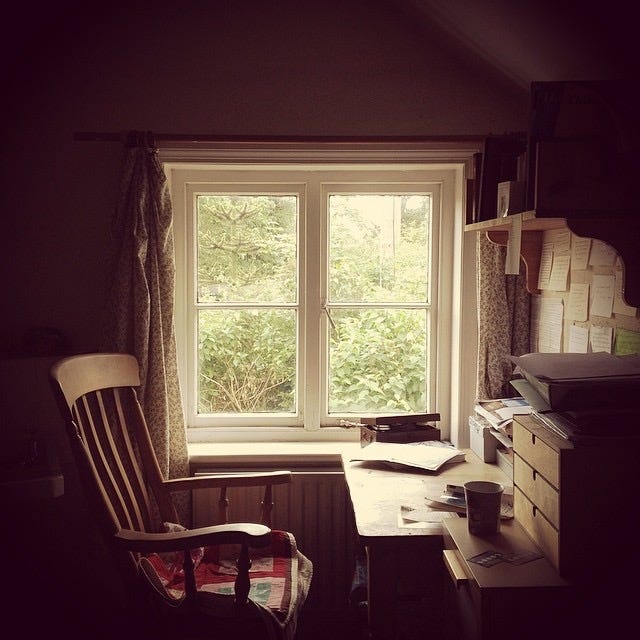 Dreamy writing room in my old house
On my one day off, I get the week's shopping done, fit in a workout, and meet with a friend. But then I also have to get actual writing done, as that is what the day off is for. After this, my Mum comes over for an hour of gardening before I leave to collect the kids again. I sometimes feel like jobs are screaming at me from the sidelines all day, 'Do this! Do this! Pick me! Pick me!'
I have read enough Oliver Burkeman to know that I can't do it all (more on this here). I also talked two weeks ago about the effect ADHD had on my creativity – that sometimes there was a torrent of ideas and not enough time in the world to do them, and other times, even doing the smallest of things felt like trudging up a hill, dragging a large sack of stones.
So, I have come to a new way of defining a day well spent. I go to the supermarket straight after school run (otherwise I dread it for the whole day and clock watch.) Then I prioritise. This week it was one hour of writing and then pack up my Etsy orders. So, I forgot all the other jobs and set a timer on my phone for one hour. (This is a great technique because you don't have to keep track of time, you just keep going until you hear the beep. And then of course, you can still keep going if you want to!)
And another thing, success is not how many words you get done, not for me, not at the moment. Success instead is to spend that hour either writing or staring out of the window, thinking about writing.
And this week, as I was feeling frazzled from trying to squeeze all these extra things into my writing day, I had some realizations. These thoughts kept barging in sideways as I was trying to write.
But what I did this time (Thank you, Alex Partridge) was to be kind to my ADHD brain and let the interruptions come instead of just thinking I had to double down and FOCUS more intensely each time my mind started wandering. What if these random thoughts weren't actually random? What if they were the voice of wisdom after all?
The voice was reminding me of some nitty gritty jobs I had to get done, so I wrote these down. The voice was also speaking to me about a new project which I am going to be starting soon, and some different ways that I could do that, so I wrote down the ideas for that. And then it said to me, 'Don't worry about your Etsy shop, just let it tick over.' Don’t get me wrong, I love running my Etsy shop (which you can see here - 30% off everything at the mo!), but there is always the weight of 'I should be doing more, I could do this, I could try that...' and it NEVER STOPS! There is no end to what I could try. It is a great source of additional funding to help bolster my royalties, but it’s nice to remember that it can exist in service to me, rather than me living in service to it.
It is almost as if the ADHD/ never-switching-off part of my brain is working all these things out for me in the background, while the other part of my brain is trying to write my novel. I mull these things over for a few days, and then all at once, I make four decisions, bam bam bam, and move on to the next thing. This is the benefit of this staring/composting/filtering time. I wasn’t ready for all things to come in, but thankfully, I wrote everything down, so nothing is lost.
I could see interruptions as a waste of time, or I could see them as a sideways use of time.
I watched a video this week where Shaun Tan was explaining his process, and he said this, which stayed with me:
'All the good ideas start life as very small, silly ideas, and often ideas that you don't entirely understand. If you start doing work with the intention of doing something significant, there's a presumption that you're understanding what you're doing and that's not going to lead to anything useful... not in my experience anyway.'
Because this is the life of a creative, isn't it?
Mulling things over, holding space for multiple outcomes, trusting our gut, waiting, filtering ideas the way sunlight falls through trees, some thoughts getting tangled in branches, some finding their way to the bare patch of ground in front of us, where our intuition speaks and says, 'This way.'
Half the time, we don't know what we are doing, half the time, we are lost, but there is one person who is our constant through it all - our dear selves.
So, this week, be kind with yourself. Lean into the crazy, the torrent of thoughts, the boredom, or the emptiness.
Be a friend to yourself and stand back and watch how your brain makes these amazing things. We are all unique.
Lean into the crazy and let the distractions come at you sideways. Leave space for the unexpected. And write all of your ideas down – you never know when you will strike gold.
Thanks so much for reading Miners,
Elisabeth,
x
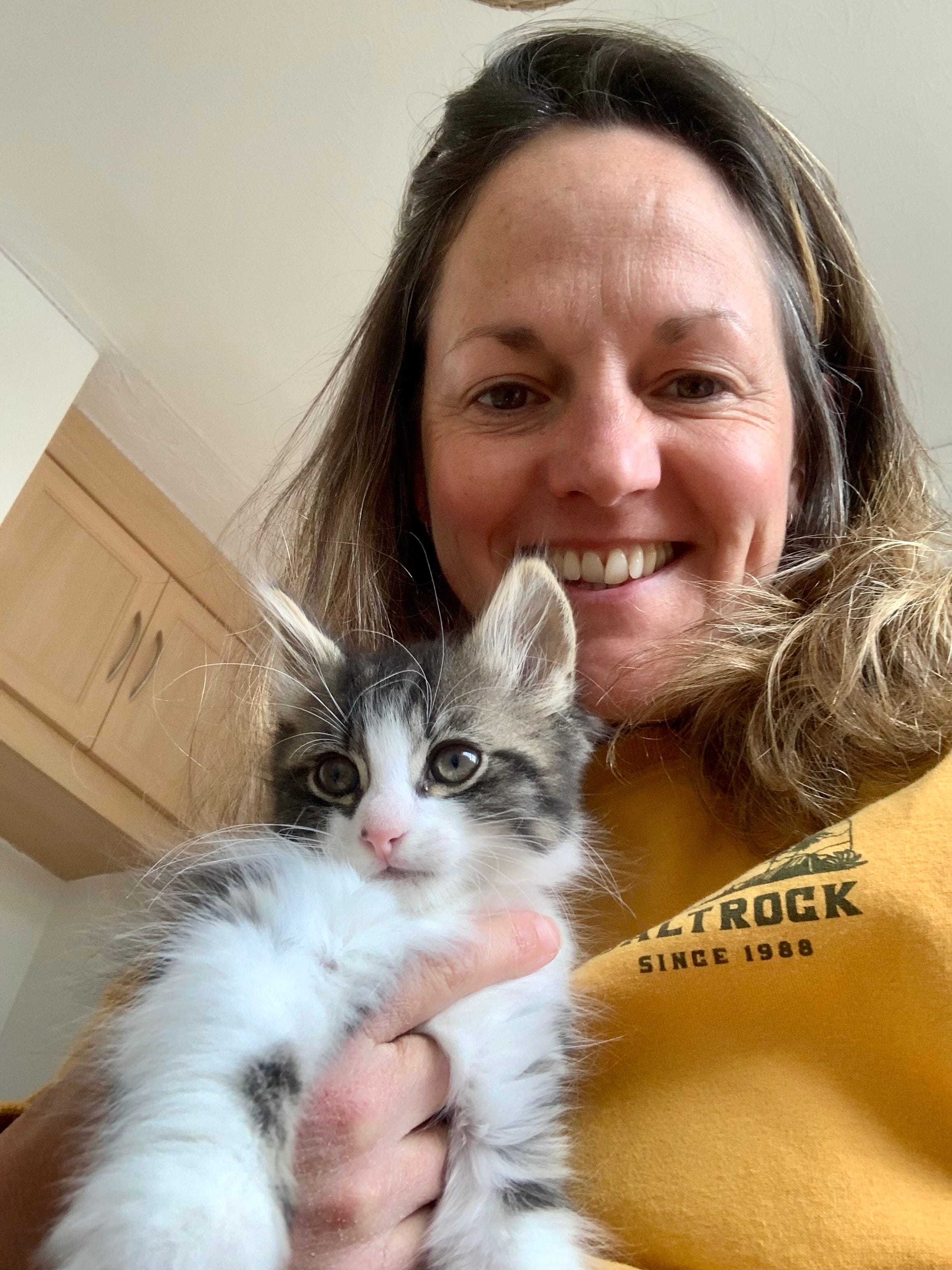 Me and my latest writing distraction..
Miners is a reader-supported publication. To receive new posts and support my work, consider becoming a free or paid subscriber.
April 26, 2025
Sardines
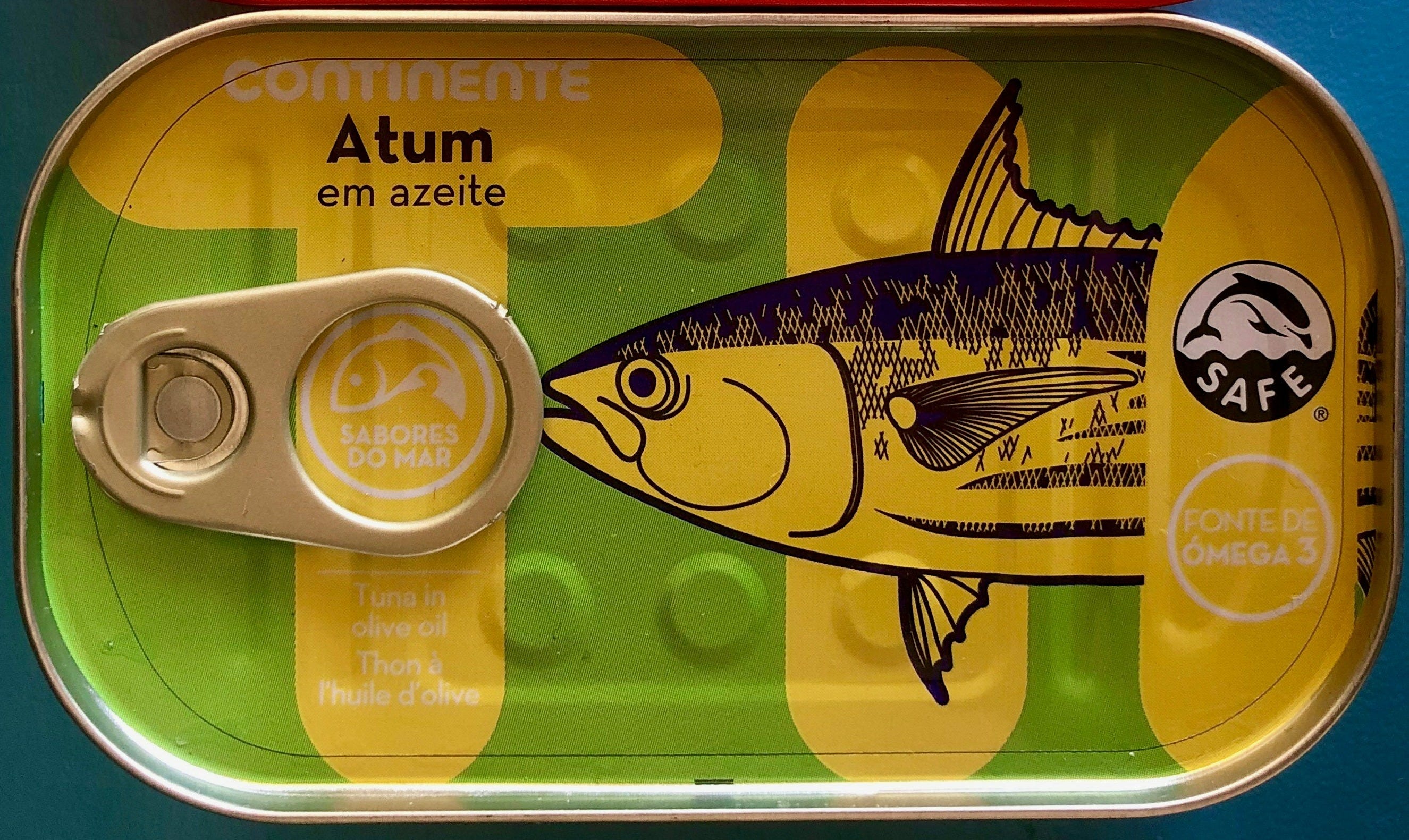 Sardines
This piece was originally published in February 2011 in a magazine called Fractured West which sadly no longer exists. I recently read it again and wanted to share it with you all. For some reason, I am drawn to writing male characters in the first person! Hope you enjoy.
Miners is a reader-supported publication. To receive new posts and support my work, consider becoming a free or paid subscriber.
SardinesAfter they told me that he had died, I went out in the rain. I had to be out of the hot recycled air of the university halls. The rain was heavy; it clung to my forehead and rolled down my neck. I reached my tongue up to my lip and tasted some. It had turned warm against my skin. I walked to the end of the road, my hands in my pockets, my feet shuffling through the puddles. Radiohead played loudly in my headphones.
At the garage I bought brown bread and sardines. I walked back the way I had come, wondering how many times my feet had walked up and down that same road. My trainers were wet through.
Back at the flat, Stu was playing on the PlayStation. There was no lounge, so the university tried to make up for it by putting a grotty sofa and television in the corner of the kitchen. I took out two slices of brown bread and watched them darken under the grill. As if by magic, I used to think, when I was younger. You couldn’t see the heat; it just made the bread change. I peeled back the lid on the tin of sardines and was surprised by its gracefulness. It looked like a metal rose. I mashed the sardines onto the uncooked side of the toast with a fork and returned it to the grill.
‘What the hell are you cooking?’ Stu asked, ‘It stinks.’
I ignored him and took the sardines and toast back to my room.
And there, in the muggy warmth of the halls, feeling like a stranger to everything around me, I ate sardines on toast like Grandpa did after Grandma died. He told me afterwards that he didn’t know what to do, so that’s what he did.
I imagined him in the supermarket, buying his tins and tins of sardines, and the cashier smiling at him, feeling sorry for him, imagining his loneliness. It was all he knew how to cook.
I remember him telling me these things, and then first feeling like a man, sitting across from him at his oak table, putting the world to rights as we ate.
Thanks for reading Miners,
Liz x
P.S. All my books have 25% off at the moment in my Etsy shop - go check it out!
Miners is a reader-supported publication. To receive new posts and support my work, consider becoming a free or paid subscriber.
April 15, 2025
ADHD, a creative superpower
 Photo by Matt Seymour on Unsplash
I have come to realise over the past year that I probably have ADHD. I don't have a formal diagnosis (there is a long waiting list), but the things I have read about it help me to understand my struggles and where I could make life a little easier for myself.
I wanted to share these insights with my Miners readers as I know neurodiversity is common in the creative sphere, and I know that when we accept ourselves as we are, we allow ourselves to shine. So keep reading for some ADHD life hacks.
Miners is a reader-supported publication. To receive new posts and support my work, consider becoming a free or paid subscriber.
The thing that triggered me into researching ADHD a little deeper was some posts on my Instagram about the fact that many female entrepreneurs have ADHD. I hadn't even considered it before this as I am not fidgety, don't miss appointments, and didn't struggle at school. However, I have always had a nagging feeling that I was different from everyone else.
As I have got older, I have become increasingly aware of the ideas shooting off at different tangents, like fireworks in my head. There were other things, like lying in bed with my brain talking so loudly that I couldn't sleep. I would settle to a task and get a hundred thoughts racing through my brain so I couldn't concentrate. I have experienced RSD (Rejection Sensitive Dysphoria) a few times too and it is cripplingly painful. I also recently read that my personality type (INFJ) is neurodiverse, which blew my mind.
But as I've been discovering this, I have been listening to ADHD cheerleaders who present it in a positive light, which means that I really don't see ADHD as something that holds me back. I know it is a superpower. Different is not bad. Different is just different.
In his wonderfully empowering book, Now it all Makes Sense, Alex Partridge talks about the superpowers of his ADHD. It is such an illuminating read. He encourages readers to accept themselves and their wonderful brains and work with them, not against them.
ADHD bonusesPeople with ADHD are amazing – they are resilient, creative, problem solvers, they can hyperfocus, and are calm in a crisis. They are empathetic, intuitive, and can see patterns where others see chaos – this is why I love writing creative essays, delving into my treasury of quotes to link ideas together. They think outside the box, are risk takers, and are courageous, entrepreneurial, and spontaneous. Wow!
I know that my ADHD is why I am so creative.
It is why I started Little Bird Editions, my Etsy shop.
It is also why I can write novels. I can hyperfocus on one thing and get so totally obsessed and immersed in my created world that normal life feels like a nuisance.
ADHD negativesRSD – I struggle hugely with this. Investing in friendships is hard work for me, and I don't understand why people want to abandon them when the hard work has been done and the connection has been made. Rejection can feel intensely painful as an ADHDer.
Overwhelm – A side product of the loads of ideas constantly pouring into our brains. I often have so many ideas that I don't have time to carry out. I often visualise new products that I don't have time to make. I sit and think about making a better profile on Faire, turning all my prints into digital products so I can have a passive income stream, learning how to grow my mailing lists to widen my fan base, write more series so I can attract new readers, learn how to do Amazon Ads. The problem with being an entrepreneur is that there is no end in sight. There is literally no end to the things you could do. So then I just feel completely overwhelmed and don’t know where to begin.
Loud internal monologue (which never stops!)
Feeling different from everyone else – I have had this since childhood – an unshakeable feeling that I was weird, that my family was weird, and that I had to try hard to be normal.
People Pleasers / Fear of rejection – I think this comes from the feeling that we're different. We feel like we must be wrong and everyone else must be right, so we do whatever it takes to keep those around us happy. This can lead to burnout and overwhelm.
Fear of confrontation – This stems from this unshakeable feeling of wrongness and also from people-pleasing.
Intuition – I can feel negative energy in the room. This adds to the feeling of overwhelm and exhaustion.
Success Amnesia – ADHDers can downplay achievements as they tend to focus on the negative and forget to celebrate the positive.
ADHD HacksIn his book, Alex has listed the hacks that help him to live well as an entrepreneur with an ADHD brain, which I found really helpful.
Cleaning quietens the mind – if you are feeling stressed or anxious – clean!
Slow Down – if you are feeling totally overwhelmed, just slow down, and it will help you to regulate your nervous system.
Visual Reminders – Leave reminders of things you are likely to forget. I have a daily to-do list on my phone. Below that, I have a weekly to-do list. If there is something that I really must do today when I get out of work, I write it on my hand. Messy, I know, but it works for me!
Use your night-time brain - Alex explains that for him, his night-time brain is much more efficient than his morning brain. He exploits this by making a to-do list for the next day in the evening.
Write your thoughts down as soon as you have them – they can be nuggets of genius.
Hold a fidget toy when public speaking – it helps you to keep focused on what you are saying.
Take Risks – Alex says the way he became a millionaire was to keep taking risks until one of them worked - one day, one of them did (he is the founder of LADBible). Growing up, he had an entrepreneurial spirit that just kept coming up with new ideas. It may look scatty to others, but it is just trial and error in action.
Combat Success Amnesia by writing a letter of congratulations to yourself anytime you achieve a milestone. You could also keep a file of achievements to remind yourself of when you are feeling overwhelmed or like you can't do something.
Wait 24 hours to say yes or no to something - this can combat the need to people-please.
My TakeawaysAfter having read Alex's book, here are the ways I am going to use this knowledge to nurture myself as a creative:
Use my RSD to make poems.
I feel things very deeply. Some might say I am over the top, but this is just the way I respond to things. As a novelist and a poet, I can use this pain to craft poems and to feel the pain of my characters. I am thinking back to that Susain Cain quote that I love from her book Bittersweet; 'Whatever pain you can’t get rid of, make it your creative offering.'
To-do lists
Knowing that my brain is running on a constant treadmill and that it is easy for me to feel perpetually overwhelmed, I make a to-do list of three things to get done today. This way, I can feel a sense of accomplishment even on mundane days.
Celebrate your wins
Again, due to this treadmill of life that never stops, it can be tempting to never take a break in between tasks. I am trying to be a little more intentional. As it was the last week of term before Easter, I rewarded myself with a little treat on Friday. I am committing to be kind to myself.
And the best advice from Alex?
Stop trying to be normal!
He says; 'The moment I stopped trying to be normal is the moment I started to shine.'
I found Now it all Makes Sense a very encouraging and very practical book, full of tips and ideas to keep your ideas firing, so if you are curious about ADHD, it is definitely worth a read.
What are your thoughts? Do any of you creatives have ADHD? What are your life hacks? I'd love to hear them.
Thanks so much for reading Miners.
Elisabeth x
Disclosure: I am an affiliate of Bookshop.org and I will earn a commission if you click through and make a purchase.
Miners is a reader-supported publication. To receive new posts and support my work, consider becoming a free or paid subscriber.
April 8, 2025
Five pieces of writing advice I ignored
 Photo by Aaron Burden on Unsplash
In my writing journey, I have jumped through hoops to fit the industry standard many times. I have also thought ‘Sod the industry, I'm doing it my way!’ each time I have self-published a book. As creatives craving validation, we will do well to remember that sometimes feedback from peers or professionals is super helpful, but sometimes it is really okay to ignore it.
1. ‘You can’t have dystopia with magic realism’
Miners is a reader-supported publication. To receive new posts and support my work, consider becoming a free or paid subscriber.
I had three manuscript appraisals for Murmuration, my YA dystopia - one when it was at the first draft stage, one after a year of submitting, and a final one before my third rewrite.
When the feedback came through for the last one, my mentee said it was not dystopian enough and that I couldn't have magic realism in a dystopian book. I could kind of see her point with the first one, but with the magic realism, I internally screamed, ‘Whaaat? That's literally the book.’ I might be in the minority, but I’d rather write the book I have in my mind to write than a watered-down version to suit the market. The whole point is that my brain is a crazy place to live sometimes, and I want to get the vision that I have down on paper.
2. ‘That scene doesn’t belong here’
When you get your line edits back from your editor, remember (especially when self-publishing) that it is still your book. Sure, you can take on some of the suggestions, but at the end of the day, the decisions are yours. A line editor suggested I remove the opening scene from Murmuration about the boys on the boat on the lake. Again, I thought ‘But that's the heart of the novel and where the whole story grew from. There’s no way I am removing that scene!’ It’s okay to be stubborn; it is our creative vision, after all.
3. ‘It should be two separate novels’
I entered a novel prize and was told that they loved the human-interest story between the dad and the son but lost interest as soon as the birds were introduced. It should be two separate books, they said. (At this point I started to bang my head against a brick wall…)
And then a few months later, after I finally trusted the story that I had dreamed up, it was picked out of 4000 to be shortlisted for the Kindle Storyteller Award. Can you imagine how bizarre it was after being rejected 100 times, and being told all the ways in which my book was wrong, to be then standing in a room full of people who were saying how much they loved my book and how original it was?
A.MAZ.ING. That’s how! (And very confusing!)
And since then, I've heard that magic realism in YA is really big (eye roll), so do you know what I think?
Write (make, draw, paint) what you want to and see what happens.
Virginia Woolf famously said;
“So long as you write what you wish to write, that is all that matters, and whether it matters for ages or only for hours, nobody can say. But to sacrifice a hair of the head of your vision, a shade of its colour, […] is the most abject treachery.”
― Virginia Woolf, A Room of One’s Own
4. ‘They’re too simple’
For years, I have tried to get my poems published but have had feedback such as 'They're too simple...' and 'I like them but not quite enough' but I have also had many people who have told me that my poetry has touched them or made them cry or spoken truth to them, and for me that is more important. I put my poems out anyway because I know they speak truth to people. The connection to my readers is more important to me than being accepted by the industry.
5. ‘You should start something else’
On my MA in Creative and Life Writing (which I did from 2006-2008), I showed my early writings about the Fens to my tutor. He was quite unenthusiastic about my work and said ‘I think you give up on this and start something new.’ I felt like I had been punched in the gut. What he didn’t realise was that writing about the Fens was to become an obsession that I wouldn’t give up on. Thankfully, I didn't listen to him, and I carried on, digging with my pen, as Seamus Heaney described it, digging up my past to find the true story that was buried in my subconscious.
In The Artist’s Way, Julia Cameron talks about the necessity of protecting our creative projects in their infancy. Those early writings turned into a novel, which I will be self-releasing this year. (Watch this space for updates…) It has taken 17 years for me to give it the time and dedication it needed to turn it into something that I am now immensely proud of. Who knows how long my tutor’s discouragement delayed me, but I’m doing it now, and that is what matters.
So, what have I learned from this?
People will criticize you. Perhaps they are jealous or have nothing better to do.
Perhaps there is truth in their words. Perhaps not. You get to be the judge of that.
Trust yourself. It is your creation.
By all means, seek the advice of others, but in the en,d go with your heart.
Have you been stopped in your tracks in your creativity? Is there advice that you listened to that you wish you had not? Can you take a step forward on your creative journey today? I’d love to hear about how words of advice have helped or hindered you on your creative path.
Thanks so much for reading Miners,
Elisabeth x
Miners is a reader-supported publication. To receive new posts and support my work, consider becoming a free or paid subscriber.