David Prever's Blog
June 24, 2014
Lawrence Dallaglio and Andrew Ridgeley
 Fancy a bike ride?
How about 2,300km through the Italian Dolomites, Swiss and French Alps and Yorkshire moors taking in the climbs and passes of the Tour de France and Gira d’Italia?
Lawrence Dallaglio spoke to me on BBC Radio Oxford,about his third epic charity cycling event, raising money to fund the fund his flagship social inclusion project at www.dallagliofoundation.com and The Teenage Cancer Trust.
Sitting alongside him, was Andrew Ridgeley!
The post Lawrence Dallaglio and Andrew Ridgeley appeared first on David Prever.


June 11, 2014
BBC Radio Five Live’s John Murray, from the Sao Paulo stadium

Less than 24 hours to go, before The World Cup 2014, and when BBC Radio 5 Live’s top notch commentator, John Murray, set up his kit in the Sao Paulo stadium, he spoke first to…me, tonight, on BBC Oxford. Sorry Five Live!
For some great World Cup picture painting and commentary box background, click to listen.
The post BBC Radio Five Live’s John Murray, from the Sao Paulo stadium appeared first on David Prever.
June 10, 2014
Rik Mayall memories
 Like most folks in their mid-forties, I remember watching The Young Ones in 1982 and thinking ‘I probably shouldn’t be watching this, how are they getting away with it?’ This was a time when comedy was good, (make that very good compared to so much of today’s fodder) but formulaic. Along came these four misfits that threw the rule book out of the window. On paper, it shouldn’t have worked. Which usually means that with the right people involved, it probably will. And it did.
In a sense, this was Monty Python for the Thatcher generation. Rik Mayall was the student studying sociology and/or domestic science. I studied both, sort of. I felt his anger and his pain. His genius was that he didn’t try too hard to be funny. Or at least, he didn’t make it look hard. I suspect he worked harder than most.
Max Kinnings knew him well, as uncredited ghost-writer on the 2005 spoof autobiography, Bigger Than Hitler – Bigger Than Christ, which spent six weeks in the Sunday Times bestseller chart in 2005. He shared his memories of Rik with me on BBC Radio Oxford.
The post Rik Mayall memories appeared first on David Prever.
May 28, 2014
Is Europe really lurching to the right?
 Tens of thousands of words have been written since the weekend, on the outcome of the European Elections. Professor Roger Griffin of Oxford Brookes University was on my programme tonight, on BBC Radio Oxford, answering the question: Is Europe really lurching to the right. Here’s a four and a half minute edit of the interview, it’s worth a listen.
The post Is Europe really lurching to the right? appeared first on David Prever.
August 20, 2013
Mark Billingham pays tribute to Elmore Leonard
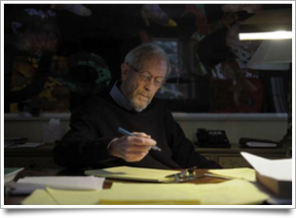 I love this picture. The master at work, carving away at his words. He summed it up best himself, in this quote from an interview with Esquire in 2005:
There’s a scene in my next book in which a character who’s been traveling around with this girl leaves her in a motel room and goes out to see some buddies. The next morning, he comes back and he’s hungover. Terribly hungover. And he says, “I can’t believe what we did with those chickens last night.” And that’s all he says. She wonders what they were doing with those chickens — but it’s left to the imagination.
I spoke to Mark Billingham on my BBC Oxford show this afternoon about the great writer.
The post Mark Billingham pays tribute to Elmore Leonard appeared first on David Prever.
July 15, 2013
How The Sunday Times uncovered the true identity of Robert Galbraith
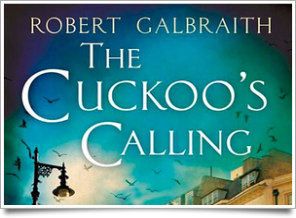 What’s in a name? Plenty, it seems.
With the news that Robert Galbraith wasn’t the man he claimed to be, I spoke to Peter Millican on my BBC Oxford programme. Peter is Gilbert Ryle Fellow and Professor of Philosophy at Hertford College,Oxford University.
He’s responsbile, in part, for helping The Sunday Times reveal mr Galbraith’s true identity.
How did he do it? With software, of course, or to be more precise - The Signature Stylometric System, a programme he wrote himself.
I began by asking him the call from The Sunday Times, was a surprise?
The post How The Sunday Times uncovered the true identity of Robert Galbraith appeared first on David Prever.
February 18, 2013
Sunday evenings in New Zealand, on Radio Live
 It’s been on my list for too many years now, as a country I’d like to visit. New Zealand, one of the last places on Earth to be inhabited by humans, apparently, and an awfully long way from anywhere. At the same time, it’s very British, but better looking and with a lot less concrete and anxiety.
We do wide open spaces and rolling greenery very well in the British Isles. But I suspect that the Kiwis do jaw dropping vistas with an added wow factor. One day, I hope to find out for myself. In the meantime, I’m delighted to be a tiny part of New Zealand life on Sunday evenings, reporting on the week’s news from London, for Graeme Hill on Radio Live, the nationwide talk network based in Auckland. We cover the quirkier side of British life, but it’s a lot fun.
Last week’s report, is here and below.
The post Sunday evenings in New Zealand, on Radio Live appeared first on David Prever.
February 7, 2013
Reality check
You think you’re having a bad day. Life has prodded and poked at you all day long, and you’ve just about had enough.
But have a listen to this. On BBC3CR Breakfast this morning, we talked homelessness. It was minus one last night, with a wind child that made it feel at least three or four degrees colder. This is Gina, 33, from Milton Keynes. She had just left the shelter where she spent last night and was facing a day of “walking around.” She has no home, no possessions and no hope. It’s not often that I struggle to find something to say, but this was one of those occasions.
The post Reality check appeared first on David Prever.
February 4, 2013
A novel by lunchtime
 Some random thoughts for the Huffington Post here, and below, on NaNoWriMo and NaNoWriWee, and other writing contests:
We’re a generation drunk on the need for speed.
Just observe the growth in speed-related events. Speed dating has been joined by speed networking. There are speed presentations – the Japanese Pecha Kucha with 20 slides in 20 seconds; a wet dream for attention deficit junkies.
This month’s Wired magazine has a feature on Zhang Yue, of China’s Broad Sustainable Building. His firm offers a nice line in 30 story skyscrapers, erected in only 15 days. If they knocked it down tomorrow, even Rome could be rebuilt in a day. Or a couple of weeks.
The fast-track even now applies to sport. At the London 2012 Olympics, much was made of Helen Glover’s astonishing success in the rowing, from obscurity to a gold medal in just four years. What took her so long? .
Gordon E. Moore’s famous computing law – which sees processing power roughly doubling every two years – has pervaded every area of our lives. Nothing worthwhile is worth waiting for, which is a dreadful shame, and which brings me to The 30 hour novel and National Novel Writing Week or NaNoWriWee – which should win an award in it’s own right for most annoying acronym of all time.
NaNoWriWee is the brainchild of the folks at Kernel magazine and a spin off from National Novel Writing month - NaNoWriMo - the US festival that encourages attempts to knock out a novel in 30 days. In their defence, the folks at Kernel admit that ‘nothing of serious literary merit’ is likely to come of out of this. And they acknowledge the need for relaxation or reflection in writing. So why bother? It started out as joke, apparently and I suspect it will end up as nothing more than that.
Anything that focuses the mind and forces wannabe authors to sit down and type something, anything, has to be applauded. Dickens was spot-on when he wrote “procrastination is the thief of time, collar him.” Thinking about it, he would have loved NanoWriWee, but for the rest of us, a novel in 30 hours, how is this possible?
It isn’t. Any successful author will tell you a manuscript needs time to breathe. It’s the biggest learning for newbie writers – Ernest Hemingway’s timeless advice that there’s no such thing as writing, only rewriting. The words don’t flow perfectly the first time. They land on the page in an ugly clunky mess, before the idea reveals itself, often weeks or months later, in the same way that a sculptor chips away a block of stone. The analogies with art are endless.
Malcolm Gladwell’s was right about his 10,000 hours – the compelling idea that it takes that long, or thereabouts, to master anything worthwhile. Have we really evolved to a stage where we hope to master everything overnight?
Where does all of this come from? Life expectancy may now be longer than ever, yet we seem desperate to cram more in. But perhaps we need to re-discover the pleasure in the natural order, to embrace the old-fashioned idea that if something is worth doing well, then it’s going to take time. Lots of uncomfortable, unfashionable, waiting for something magical to happen, time.
A novel is no exception. Great writing, a story worth telling, needs to be laid down like a decent wine. A manuscript should to sit in a drawer or on a computer desktop folder for a while before it’s ready to be brought back to life. Those wonderful words that you crafted for Chapter One, can look a whole lot different a few weeks later. The key ingredient that can’t be rushed in writing, is perspective.
With all of this in mind I propose NaNoWriYe. Take a year – take longer if you need to. By all means speed-write some words. But then have the confidence to walk away, live some life and do something different. Then come back to them with fresh eyes and new understanding.
Like so many things in life, great writing always looks different in the morning.
The post A novel by lunchtime appeared first on David Prever.
January 6, 2013
Reading more
A report in The Daily Telegraph last week claimed that ‘read more books’ was the number one resolution for 2013, a story I jumped on during the SKY NEWS paper review.
I always start the year with good intentions to read more, but life – and writing – gets in the way. There’s also the worry that it’s impossible to stay true to your own writing voice, when you’re immersed in someone else’s work. A lot of writers stick to the ‘no reading rule’ while in the middle of their own work. If I followed that idea, I’d never read anything, although there are times during the writing process when it’s impossible to dip into any story, but my own.
On the Kindle at the moment is Robert Ludlum’s ‘The Janus Reprisal’ by Jamie Freveletti (yes, Ludlum died in 2001 but the franchise is still alive). There’s an Ian Rankin book waiting for my attention – ‘The Impossible Dead.’ I’m keen to dive into Tana French’s ‘In the Woods.’ Her name was on the lips of Lee Child, Peter James, Sophie Hannah and John Banville at a session I attended back in November, as a crime writer to watch. Finally,there’s James Becker’s ‘Echo of the Reich’. We had lunch just before Christmas, and I’m determined to finish this one before we meet up again. I first met James when he was a guest on my LBC 97.3 show, nearly a decade ago. He’s a prolific author and fabulous storyteller, both in print and over a good meal!
A big chunk of last year’s precious reading time was taken up with The Novel Prize. Finding the time is never easy, but never wasted. Happy reading.
The post Reading more appeared first on David Prever.