Bob Choat's Blog
February 19, 2023
Influence and Inspire: Mastering the Art of Persuasive Speaking
When was the last time you had to convince someone to see things from your perspective? It could have been a co-worker, a friend, or even a family member. Whatever the situation, one thing is for sure: persuasive speaking is an essential skill to have in life. Being able to persuade someone to agree with you or take action can make a huge difference in your personal and professional life. For me, it’s become a part of what I do and public speaking is one of the things I love to do as well. This is true when I can influence my audiences to become a better version of themselves.
“ Persuasive communication involves enthusiasm, animation, audience participation, authenticity and spontaneity.” -John C. Maxwell
One thing I’ve learned is that the ability to persuade through speaking is an important skill that has many benefits! I’m sure you will embrace this skill more once you understand what it can do for you…
Speak Persuasively and Reap the Benefits
Speaking to influence and inspire can have a range of benefits, including:
Inspiring Action: When you speak persuasively, you have the power to inspire action. You can motivate people to take action based on your message, whether that means buying a product, donating to a cause, or voting for a candidate. By inspiring action, you can create real change in the world.Building Stronger Relationships: Persuasive speaking can help you build stronger relationships with others. When you speak persuasively, you show that you understand and care about your audience’s needs and concerns. This can help build trust and rapport, leading to stronger relationships.Advancing Your Career: Persuasive speaking is a valuable skill in many professions. Whether you’re in sales, marketing, management, or politics, the ability to speak persuasively can help you advance your career. By communicating effectively and persuasively, you can achieve your professional goals and stand out from the crowd.Improving Your Personal Life: Persuasive speaking can also benefit your personal life. By communicating effectively and persuasively with your friends, family, and loved ones, you can build stronger relationships and create more fulfilling connections.Making a Difference: Ultimately, speaking persuasively can help you make a difference in the world. By sharing your message with others and inspiring action, you can contribute to positive change and make a lasting impact.Speaking persuasively is a skill that can be developed and rightly so. It’s something I learned how to do through studying, reading books, taking classes and finally testing what I learned into the real world. I also learned deeper by teaching what I learned, especially as an Neurolinguistic Programming (NLP) Trainer. You too can learn to become a persuasive speaker. Let’s begin…
But what is persuasive speaking, and how can you master it? In this article, I’ll explore the art of convincing others through speech, drawing on a range of sources to provide you with some tips and techniques to help you become a more persuasive speaker.
What is Persuasive Speaking?
Persuasive speaking is the art of using language and delivery to influence people’s beliefs, attitudes, and behaviors. It’s about convincing your audience to see things from your point of view and take action based on your message. Persuasive speaking can be used in a variety of contexts, from sales pitches to political speeches to everyday conversations. As noted by Carnegie and Esenwein (2009), persuasive speaking is all about “winning the hearts and minds of the audience” (p. 210).
What’s it Like to be a Persuasive Speaker?

Persuasive speaking can be likened to a chef preparing a delicious dish. Just as a chef needs to carefully choose the right ingredients, season them appropriately, and cook them to perfection, a persuasive speaker needs to establish credibility, understand their audience, craft a clear message, and use emotional appeals and evidence to make their message more persuasive. And just as a chef’s dish needs to be visually appealing and appetizing to the senses, a persuasive speaker’s message needs to be clear, compelling, and memorable to achieve the desired outcome. In both cases, the key is to know your audience, be creative, and use the right techniques to achieve success. More on how this works, read on…
Establishing Credibility, Understanding Your Audience, and Crafting a Compelling Message

To be an effective persuasive speaker, you need to master a few key elements. These include:
Establishing Credibility: Your audience needs to trust you and believe that you have their best interests at heart. This means presenting yourself as a knowledgeable and trustworthy source of information. As noted by Grant (2018), establishing credibility is essential for building rapport with your audience and making them more receptive to your message.Understanding Your Audience: To persuade your audience, you need to understand their needs, values, and beliefs. This will help you tailor your message to their specific interests and concerns. Cialdini (2008) notes that by taking the time to understand your audience, you can “create a message that appeals to their wants, needs, and desires” (p. 32).Crafting a Clear and Compelling Message: Your message needs to be clear, concise, and memorable. It should be easy for your audience to understand and remember, and should motivate them to take action. Zinsser (2006) emphasizes the importance of clarity and simplicity in communication, noting that “the secret of good writing is to strip every sentence to its cleanest components” (p. 11).Using Emotional Appeals: People are often motivated by their emotions, so incorporating emotional appeals into your message can be an effective way to persuade your audience. Lakhani (2012) notes that “emotional appeals can create a sense of urgency or need, and can help your audience connect with your message on a deeper level” (p. 74).Providing Evidence: Your message needs to be backed up by evidence to be convincing. This could include statistics, personal stories, or expert testimony. According to Cialdini (2008), “evidence is essential for building credibility and persuading your audience to take action” (p. 63).Mastering Techniques for Persuasive Speaking
Now that you know the key elements of persuasive speaking, let’s look at some techniques that can help you become a more persuasive speaker. These include:
Using Power Words: Power words are words that evoke strong emotions or create a sense of urgency. Examples include “urgent,” “critical,” and “important.” Incorporating these words into your message can make it more persuasive. As noted by Grant (2018), power words can “create a sense of urgency or importance, and can make your message more memorable” (p. 97).Using Repetition: Repetition can help reinforce your message and make it more memorable. Repeating key phrases or ideas can help drive your message home. Carnegie and Esenwein (2009) note that “repetition is a powerful tool for enhancing the impact of your message and making it more memorable” (p. 236).Telling Stories: People are often more engaged by stories than by facts and figures. Incorporating personal stories or anecdotes into your message can help you connect with your audience and make your message more persuasive. Zinsser (2006) notes that “stories are a powerful way to communicate complex ideas in a simple, memorable way” (p. 97).Using Visual Aids: Visual aids, such as charts, graphs, or images, can help make your message more persuasive. They can help illustrate your points and make your message more memorable. Carnegie and Esenwein (2009) note that “visual aids can enhance the impact of your message and help your audience better understand your ideas” (p. 259).Using Metaphors: Metaphors are a powerful way to communicate complex ideas in a simple, memorable way. They can help your audience understand your message and remember it more easily. Lakhani (2012) notes that “metaphors can help your audience connect with your message on a deeper level and make it more memorable” (p. 89).Note: I used an analogy earlier in this article where I compared speaking persuasively to what a chef does. Both metaphors and analogies are effective persuasive devices.
Take Action and Speak Persuasively
Persuasive speaking is an essential skill to have in life. Whether you’re trying to sell a product, convince a friend, or make a political argument, being able to persuade others through speech can make all the difference. By mastering the key elements of persuasive speaking and using the techniques we’ve outlined, you can become a more persuasive speaker and increase your chances of success.
Remember, persuasive speaking is not about manipulating or deceiving your audience. It’s about presenting a clear and compelling message that motivates people to take action. By establishing credibility, understanding your audience, crafting a clear message, using emotional appeals, and providing evidence, you can make your message more persuasive and increase your chances of success.
So, the next time you find yourself in a situation where you need to convince someone of something, remember these tips and techniques, drawing on the work of Carnegie and Esenwein (2009), Grant (2018), Cialdini (2008), Zinsser (2006), Lakhani (2012), and others. With a little practice, you can become a more persuasive speaker and achieve your goals. Good luck!
References:
Carnegie, D., & Esenwein, J. B. (2009). The art of public speaking. Simon and Schuster.
Cialdini, R. B. (2008). Influence: The psychology of persuasion. HarperCollins.
Grant, A. (2018). Speak With Persuasion. McGraw Hill Professional.
Lakhani, D. (2012). Persuasion: The Art of Getting What You Want. Wiley.
Zinsser, W. (2006). On Writing Well. HarperCollins.
Further Reading:
“The Art of Public Speaking” by Dale Carnegie and Joseph Berg Esenwein – a classic book on public speaking that includes tips and techniques for persuasive speaking.“Speak With Persuasion” by Anett Grant – a book that provides insights and strategies for effective communication and persuasive speaking.“Persuasion: The Art of Getting What You Want” by Dave Lakhani – a book that explores the psychology of persuasion and provides practical tips for becoming a more persuasive communicator.“The Elements of Style” by William Strunk Jr. and E.B. White – a classic guide to writing that emphasizes the importance of clarity, brevity, and simplicity in communication.“On Writing Well” by William Zinsser – a book that provides practical advice and insights for improving one’s writing and communication skills.“Influence: The Psychology of Persuasion” by Robert Cialdini – a book that explores the science of persuasion and provides insights into the principles and techniques that make messages more persuasive.“How to Win Friends and Influence People” by Dale Carnegie – a classic book on interpersonal communication and persuasion that provides practical advice for building relationships and achieving success.“Words That Work: It’s Not What You Say, It’s What People Hear” by Frank Luntz – This book focuses on the power of language and offers strategies for choosing the right words to persuade your audience.“Pitch Anything: An Innovative Method for Presenting, Persuading, and Winning the Deal” by Oren Klaff – This book provides a framework for crafting and delivering powerful presentations that grab the attention of your audience.“The Power of Persuasion: How We’re Bought and Sold” by Robert Levine – This book explores the many ways that people try to persuade us and offers insights into how we can resist these efforts.“Made to Stick: Why Some Ideas Survive and Others Die” by Chip Heath and Dan Heath – This book provides a framework for creating messages that are memorable and persuasive.“The Science of Influence: How to Get Anyone to Say “Yes” in 8 Minutes or Less!” by Kevin Hogan – This book provides practical techniques for influencing others, based on research in the fields of psychology and neuroscience.“Presentation Zen: Simple Ideas on Presentation Design and Delivery” by Garr Reynolds – This book offers tips for designing and delivering persuasive presentations that engage and inspire your audience.“Speak to Win: How to Present with Power in Any Situation” by Brian Tracy – This book provides a step-by-step guide for delivering persuasive presentations that get results.“Confessions of a Public Speaker” by Scott Berkun – This book provides insights into the art of public speaking and offers practical tips for delivering persuasive speeches that resonate with your audience.By drawing on these resources and others, we can better understand the art of persuasive speaking and become more effective communicators. Most important is that you put into action what you read to help gain a deeper understanding.
“Real persuasion comes from putting more of you into everything you say. Words have an effect. Words loaded with emotion have a powerful effect.” – Jim Rohn


February 13, 2023
Unleash the Power of Zero-Based Thinking: Simplify Your Life, Boost Your Productivity, and Achieve More
Have you ever felt overwhelmed by your to-do list, cluttered with unnecessary tasks, and burdened by a never-ending cycle of work and stress? If so, it may be time to embrace the concept of zero-based thinking.
“Knowing what you know now, what would you do differently, start, or eliminate in your life (or business)?” – Brian Tracy
When I first heard about zero-based thinking from Brian Tracy’s book, Goals!: How to Get Everything You Want — Faster Than You Ever Thought Possible, I thought what an amazing concept. I think each one of us should embrace this way of thinking, including if you’re caught up with certain biases and beliefs of the way things have always been done. I can tell you that it’s happened to me. Nowadays, I challenge my assumptions, biases, and beliefs more often than not. This is key, especially for decision-making, productivity, and wanting to simplify your life.

What is zero-based thinking and how can it help you?
Zero-based thinking is a problem-solving approach that involves starting from a blank slate and evaluating every task, expense, and decision based on its current value and necessity. It’s a fresh start that helps you simplify your life, boost your productivity, and achieve more. Here’s how:
Challenge assumptions: Zero-based thinking forces you to question your assumptions and habits, and to re-evaluate everything you do, from the tasks you perform to the goals you pursue. By questioning the status quo, you can identify and eliminate inefficiencies and distractions that are holding you back.Focus on what matters: By starting from zero, you can prioritize your activities and resources based on their current value and impact, and focus on what truly matters. This helps you avoid wasting time and energy on tasks that don’t contribute to your goals, and to allocate your resources to the things that make a real difference.Be more intentional: Zero-based thinking encourages you to be more intentional about your decisions and actions, and to consider the consequences of each choice. This helps you make better decisions, avoid regrets, and live a more fulfilling life.Improve efficiency: By questioning everything, you can streamline your processes, eliminate redundancies, and optimize your performance. This helps you save time and resources, and to become more productive and effective.Embrace change: Zero-based thinking is a mindset of continuous improvement and growth, and it encourages you to embrace change and to adapt to new situations and challenges. This helps you stay relevant, grow as a person, and achieve more in life.Zero-based thinking is a powerful tool for personal and professional growth, and it’s a habit that anyone can develop. By starting from zero and re-evaluating your assumptions, habits, and decisions, you can simplify your life, boost your productivity, and achieve more.
References:
Tracy, Brian, Goals!: How to Get Everything You Want — Faster Than You Ever Thought Possible. 2010. Berrett-Koehler Publishers“Zero-Based Thinking: A Key to Unlocking Your Potential” by Brian Tracy, Entrepreneur, January 2021“The Benefits of Zero-Based Thinking: How to Get More Out of Life” by James Clear, Medium, December 2020The Habit of Zero-Based Thinking. Brian Tracy. https://www.youtube.com/watch?v=cQu1yA0k87USo, are you ready to unleash the power of zero-based thinking and transform your life? Start questioning your assumptions, re-evaluate your habits and decisions, and simplify your life today!
February 12, 2023
Breaking the Vicious Cycle: The Connection between Victim Mentality and Politicians
After watching the current state of politics, it seems that many politicians have fallen into the victim mentality. It’s crazy to witness, especially their frailty and narcissism combined together. Back in the 90’s when I was involved in politics as a consultant, the victim mentality wasn’t as prevalent as it is now.
Exploring the relationship between victim mentality and politicians can be both confusing and enlightening. As noted by psychologist Brené Brown, politicians often use the victim card to gain empathy and support from the public (Brown, 2018). At the same time, this type of behavior reinforces a negative cycle of blaming others and avoiding personal responsibility. We have seen this with Donald Trump as well as many others. 
It is crucial to understand that victim mentality is defined as the belief that one is a victim of circumstances or events beyond their control (Borum, 2004). This mentality often results in feelings of powerlessness and lack of control. In the political arena, this can show up as a tendency to deflect blame, make excuses, and evade accountability.
For example, a politician may argue that they cannot fulfill their campaign promises due to external factors such as an unfavorable economy or opposition from other politicians. This kind of language shifts the focus away from the politician’s own shortcomings and places the blame on outside factors. This allows the politician to not taking responsibility.
How does this affect the population and especially the constituents of the politician as a victim? Has this mindset increased?
It appears to be more common among many politicians today have used or are using the status of being a victim. They seem to lash out and play the blame game. When these politicians start blaming the system as to why their constituents can’t get a fair share, they project onto them the same victim mentality (Armaly & Enders, 2022). Moreover, the politician as victim elevates themselves “to feel a sense of superiority.”
However, this type of behavior can have severe consequences. By failing to take responsibility for their actions, politicians reinforce the idea that individuals are powerless to change their circumstances (Baumeister & Leary, 1995). This can lead to a sense of hopelessness and distrust among the public, who may come to believe that the political system is rigged against them.
When politicians adopt a victim mentality, they also diminish the experiences of actual victims. By using the language of victimhood to further their own interests, they diminish the pain of those who have experienced real trauma or oppression (Nussbaum, 2000). It’s important to distinguish between an actual victim and the victim mentality.
So, what can be done to interrupt this cycle? The first step is for politicians to acknowledge and address their own tendencies towards victim mentality. This means taking responsibility for their actions and being accountable for the consequences of their decisions (Brown, 2018).
Furthermore, the public can play a role by holding politicians accountable for their language and behavior. By calling out instances of victim blaming and deflecting, we can foster a culture that values personal responsibility and agency (Baumeister & Leary, 1995). This is something we all should be engaged in if we want to change both the culture and mindset of politicians.
Finally, the connection between victim mentality and politicians is a complex and confusing issue. But by recognizing the damaging effects of this cycle and working to break it, we can create a political environment that values accountability and empowers individuals to take control of their own lives (Borum, 2004).
References:
Armaly MT, Enders AM. ‘Why Me?’ The Role of Perceived Victimhood in American Politics. Polit Behav. 2022;44(4):1583-1609. doi: 10.1007/s11109-020-09662-x. Epub 2021 Jan 2. PMID: 33424069; PMCID: PMC7778419.
Baumeister, R. F., & Leary, M. R. (1995). The need to belong: Desire for interpersonal attachments as a fundamental human motivation. Psychological bulletin, 117(3), 497-529.
Borum, R. (2004). Psychological perspectives on risk and safety assessment. Criminal justice and behavior, 31(6), 671-696.
Brown, B. (2018). Dare to Lead: Brave Work. Tough Conversations. Whole Hearts. Random House.
Nussbaum, M. C. (2000). Women and human development: The capabilities approach. Cambridge University Press.
February 10, 2023
Transform Your Life by Mastering the Circle of Concern and Circle of Control
Have you ever heard of the “circle of concern” and the “circle of control”? These two concepts, introduced by Stephen Covey in his book “The 7 Habits of Highly Effective People,” are simple yet powerful in helping you focus your time and energy on what truly matters in life.
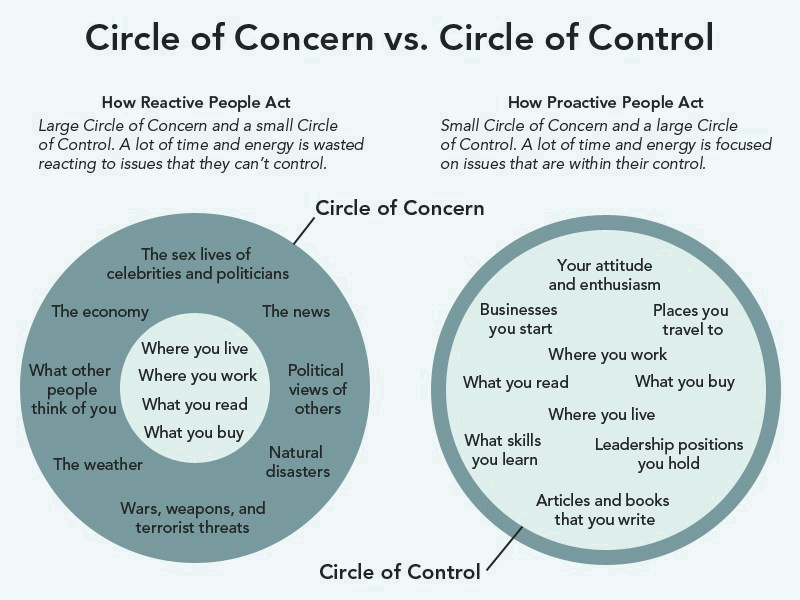
I remember the first time reading about this concept from Stephen Covey’s book. There are many other areas covered in this wonderful book that each of us should read and reread “The 7 Habits of Highly Effective People” and apply it into our own lives.
Let’s start with the “circle of concern.” This refers to all the things that worry us or occupy our thoughts, but over which we have little or no control. For example, natural disasters, world peace, or the economy. These are important things that we may care deeply about, but they are outside of our control. Covey emphasizes that it’s essential to differentiate between the things we can change and the things we cannot, in order to effectively manage our time and energy.
On the other hand, there’s the “circle of control.” This is the smaller circle of things that we have the power to influence or change. For example, our thoughts, emotions, habits, and actions. Covey explains that by focusing on the things within our circle of control, we can actually make a difference in our lives and the lives of those around us.
So, what’s the point of these two circles? Well, the idea is that we should focus our time and energy on the things within our circle of control, rather than getting bogged down by the things outside of it. By doing so, we can increase our sense of personal control and effectiveness.
For example, instead of worrying about the state of the world, we can focus on being a positive influence in our own community. We can volunteer, help out a neighbor, or simply spread kindness wherever we go. These small actions can add up to create a big impact and increase our sense of personal satisfaction and fulfillment.
In my own case, I realized what I couldn’t control, especially when it came to what others did or didn’t do. Once I understood this, I stopped caring what others thought about the things I did or the way I looked (with the exception of dressing for certain events, though not all the time).
It’s important to remember that the circle of control is not static. As we grow and develop, we can expand our sphere of influence. By taking control of our thoughts, emotions, and actions, we can develop new skills, build new relationships, and create new opportunities. Covey explains that this expansion of the circle of control is at the heart of personal growth and development. As I’ve grown older and supposedly wiser, my own growth has multiplied. This article that I wrote is within my circle of control and so is anything I do that moves me forward.
I know that I am not the same brash youngster when I was in the Marines and the LAPD. I’ve surpassed those versions of me. So can you.
In contrast, constantly focusing on the things outside of our control can lead to frustration, stress, and a feeling of powerlessness. So, the next time you find yourself worrying about something outside of your control, try to shift your focus to what you can control. You’ll be amazed at the difference it makes.
To wrap it up, the “circle of concern” versus the “circle of control” is a simple yet powerful concept introduced by Stephen Covey in “The 7 Habits of Highly Effective People.” By focusing on the things within our control, we can make a positive difference in our lives and the world around us. So, start small, and expand your circle of control one day at a time.
Boost Your Brain Power with a Post-Learning Nap: A Guide to Unlocking Your Potential
Are you struggling to retain information as effectively as before? If so, it may be time to take a nap! Research shows that taking a nap after learning can significantly improve memory retention and cognitive function. I wish this was something I knew many years ago, especially as I was learning new things. Though, I am still learning and have adopted naps into my daily routine.
Here are some key benefits of napping, backed by scientific research:
Consolidates memories: Sleep plays a crucial role in consolidating and storing new memories. According to a study published in “Nature Neuroscience” (Stickgold, 2005), sleep helps transfer newly acquired information from short-term to long-term memory.Improves focus and creativity: Napping helps refresh the brain and reduce fatigue, leading to improved focus, creativity, and overall cognitive function. A study published in “Psychology Today” (Dinges, 1995) found that short naps can enhance cognitive performance, especially in tasks that require sustained attention and working memory.Reduces stress: Sleep regulates hormones that control stress and mood, such as cortisol and serotonin. A study published in “Health Psychology” (Spiegel, 2004) found that napping is linked to a decrease in cortisol levels and an improvement in mood.

To make the most of your naps, follow these action steps:
Establish a routine: Try to nap at the same time every day to establish a routine. This will help you fall asleep faster and get the most out of your nap. A study published in “Sleep Medicine” (Wu, 2005) found that napping at the same time every day can improve sleep quality and enhance the benefits of napping.Keep it short: Aim for a 20-30 minute nap. This is the ideal length to maximize the benefits of napping without feeling groggy upon waking. A study published in “Sleep” (Carskadon, 2005) found that 20-30 minute naps can improve cognitive function and alertness without negative effects.Create a comfortable environment: Find a quiet, dark place to nap, and use a pillow, blanket, or eye mask for added comfort. A study published in “Environment and Behavior” (Ellis, 2005) found that a quiet, dark, and comfortable environment can improve sleep quality and enhance the benefits of napping.Finally, taking a nap after learning can have a profound impact on your brain power. As Dr. Sara Mednick, sleep researcher and author of “Take a Nap! Change Your Life,” says, “Napping is like hitting the reset button on your brain.” So, next time you’re feeling overwhelmed or struggling to retain information, take a nap! Your brain will thank you and so will your learning and memory.
References:
Carskadon, M. A. (2005). Sleep patterns and sleep disorders in adolescents. Sleep, 28(10), 1059-1073.
Dinges, D. F. (1995). An overview of sleepiness and accidents. Journal of Sleep Research, 4(S2), 4-14.
Ellis, J.A. (2005). The effects of room environment on sleep quality and well-being. Environment and Behavior, 37(4), 461-475.
Spiegel, K., Leproult, R., & Van Cauter, E. (2004). Impact of sleep debt on metabolic and endocrine function. Lancet, 354(9188), 1435-1439.
Stickgold, R. (2005). Sleep-dependent learning and memory consolidation. Nature, 437(7063), 1272-1278.
Wu, M., & Zee, P. C. (2005). The role of sleep in mood regulation. Sleep Medicine Reviews, 9(6), 491-505.
February 2, 2023
The Alpha Wolf Myth: Busting the Misconceptions
Have you ever heard the saying, “the alpha wolf dominates the pack”? This statement is one of the most persistent myths in popular culture about wolves. But the truth is far more complex and interesting. In this article, we’ll explore the truth behind the alpha wolf myth and what science really tells us about the social structure of wolf packs.
First of all, let’s define what we mean by “alpha.” Alpha is often used as a synonym for dominant or top-ranking, but in the field of animal behavior, it refers specifically to the individual who is highest in the social hierarchy and has priority access to resources like food and mates.
There are so-called “Alpha Males” within a given set of human males. They falsely believe the myth of the alpha so they use this to try to dominate others. This is nothing but bullying in the guise of being this myth of alpha. Let’s look at the reality of wolf packs…

So, do wolf packs have an alpha wolf that rules over the others with an iron paw? No, not exactly. Wolves are social animals and live in packs, but their social structure is much more fluid and dynamic than the old alpha wolf stereotype would have us believe. Instead of a rigid hierarchy with one dominant wolf at the top, wolf packs are more like families, with a complex system of relationships and dynamics that can change over time.
In the past (Schenkel, R., 1947), wolf behavior was often studied by observing captive wolves in zoos and other captive settings, which led to misconceptions about their social structure. More recent studies of wild wolf packs have shown that wolves actually have a flexible social structure based on cooperation and mutual support, rather than a strict dominance hierarchy.
Wolves in a pack cooperate to hunt, raise their young, and defend their territory, and pack members form close bonds with one another. The concept of an alpha wolf is simply not applicable in the complex and ever-changing social relationships of wild wolves.
So why does the alpha wolf myth persist? Part of the reason may be that the idea of a powerful, dominant wolf resonates with people, tapping into our fascination with strength and hierarchy. But it’s also a myth that’s been perpetuated by popular media and misinformation, which can be hard to dispel.
Just to emphasis, the alpha wolf myth is just that – a myth. While wolves do live in packs and have complex social relationships, the idea of an alpha wolf ruling over the others with an iron paw simply doesn’t hold up to scientific scrutiny. The next time you hear someone talking about the alpha wolf, remember that the truth is far more interesting and dynamic than the myth.
Reference: Schenkel, R., 1947, Expression Study on Wolves: Captivity Observations.
January 27, 2023
Becoming a Better Person: A Guide to Developing Courage and Ethics in Your Personal Life
Hi Everyone! Are you looking to become the best version of yourself? Well, you’ve come to the right place. Today, we’re gonna talk about two of the most important qualities you need for personal growth: courage and ethics. And let me tell you, these two things go hand in hand and are essential for living’ a happy and fulfilled life.
First things first, let’s talk about understanding your personal values and beliefs. This is the foundation of developing ethics. Now, I know this might sound a little heavy, but don’t worry, it’s not as difficult as you  might think. This was something that courageous leaders in history had and some still have. Take Nelson Mandela as an example. Despite being thrown into prison for his beliefs where he fought for the marginalized communities in South Africa, he came out of prison stronger and more resilient, with courage.
There are a few things that you can do to start this process…
Take a moment to think about what matters most to you.Identify the causes or issues that you feel strongly aboutDevelop a framework for ethical decision makingFeel confident in the decisions you makeNext, let’s talk about building courage. We all have fears, and that’s completely normal. Fear is a natural part of life. But instead of letting fear hold you back, let’s learn to face it head-on.
Identify your specific fearsUnderstand what you’re afraid ofTake steps to overcome itFeel a sense of accomplishment when you doSo, there you have it. Two simple steps to becoming the best version of yourself. Remember, take it one step at a time and don’t be too hard on yourself. We all make mistakes and that’s okay. Just keep pushing forward, and you’ll get there.
August 6, 2019
Gravity, Beliefs and Challenging Those That Have Kept You Stuck
Standard definition of gravity: Gravity is the force of attraction that makes things fall straight down.” For centuries, we lived by this idea and belief of what gravity is. That was the Newtonian version and while it made sense back then, it is also wrong.
Albert Einstein created a new definition of gravity. His theory was that each object “curves the fabric of space and time around them.” Imagine being in the middle of a trampoline and you’re the largest person there. Around you are children on that same trampoline. Notice how they tend to moves closer to you while also affecting those around them.

Scientists recently was able to prove Einstein right and Newton wrong by looking at what happens when light from S0-2 (also known as S2 is a star in the center of the Milky Way Galaxy) passed a super massive black hole known as Sagittarius A* (four million times more massive than our sun and located in the Constellation Sagittarius at the center of the Milky Way Galaxy). The gravitational event that occurred exactly as Einstein said it would. They looked at the color from the star, which glowed blue. Had the light did as Newton said, the star would have stayed blue. If the light did as Einstein predicted, the star would have changed to red. The star had a gravitational redshift, just like Einstein said it would.
Astrophysicists and astronomers are now seeking to find another definition of gravity. Like any scientist, it is about challenging the prevailing beliefs and theories.
Like the Newton’s Theory of Gravity, many people have a hard time changing their fast-held beliefs. Beliefs are not set in stone, yet most people believe they are. That keeps those people stuck with a fixed mindset.

Over time, people will become blind to new facts (also known as “the ostrich effect”), including the truth about themselves as well as others. That is a reason why we see many older people “stuck in their ways.” It’s easier to do so versus challenging closely held beliefs. This is especially true if they stay in the same communities, they grew up in.
I would ask you to start tearing apart the beliefs you hold so dearly. Test them based on factual evidence, not on ideology or what others (and yourself) say. In order to do so, you have to open yourself up and accept “what if what I believed was wrong?” It’s scary.
When you find evidence that what you believed your whole life was wrong, don’t knock yourself down and instead, embrace the fact that your understanding regarding life grew. This is an essence of having a growth mindset.
One way to start challenging your beliefs is to imagine what you believe is a table with four legs. Each time you try disprove a belief and you have evidence to support your hypothesis, then take away one of the legs. Eventually you have be able to tear apart your strongly help belief, especially those that are disempowering. The goal is to bring in beliefs that are more empowering.
In my programs, I use this method and others to help build my clients so their beliefs are shifted to ones that more supportive towards a higher version of themselves, a new self-image.
Give the above a go and start your journey towards a more powerful belief system.
Enroll in my FREE “7-Day Empower Your Life eCourse“
https://mindhackacademy.tv/p/7-day-empower-your-life-ecourse
References:
Abuter, R., et. al. (2018) Detection of the gravitational redshift in the orbit of the star S2 near the Galactic center massive black hole. Astronomy & Astrophysics (volume 615, L15) retrieved from https://doi.org/10.1051/0004-6361/201833718 on August 6, 2019
Michelle Starr, June 26, 2018, “BREAKING: Einstein’s Theory of Relativity Just Survived an Insane Test” Science Alert retrieved from https://www.sciencealert.com/star-s2-orbiting-sagittarius-a-supermassive-black-hole-proves-einstein-relativity-first-direct-observation/amp on August 6, 2019
February 19, 2018
Don’t Be Fooled By Me
Don’t Be Fooled By Me
by Charles C. Finn
Please don’t be fooled by me. Don’t be fooled by the face I wear, for I wear a mask. I wear a thousand masks, masks that I’m afraid to take off and none of them are me. Pretending is an art that is second nature to me, but don’t be fooled, for God’s sake don’t be fooled.
I give you the impression I’m secure and that all is sunny and unruffled with me, within as well as without, that confidence is my name, coolness my game, that water is calm and I’m in command and that I need no one, but don’t believe me, please don’t believe me.
My surface may be smooth, but my surface is a mask–my every varying and ever concealing mask. Beneath it dwells the real confusion, fear and aloneness. Beneath lies my smugness, my complacently, but I hide this–I don’t want anyone to know it.
I panic at the thought of my weakness and fear being exposed. That’s why I frantically created a mask to hide behind– nonchalant sophisticated facades to help me pretend– to shield me from the glance that knows– but such a glance is precisely my salvation, my only salvation and I know it. That is if it’s followed by acceptance. If it’s followed by love, it’s the only thing that can liberate me from myself, from my own self built prison walls and from the barriers that I so painstakingly erect. It’s the only thing that will assure me of what I cannot assure myself, that I’m really worth while, but I don’t tell you this, I don’t dare–I’m afraid to.
I’m afraid that your glance will not be followed by acceptance and love. I’m afraid you’ll think less of me and you’ll laugh and your laugh will kill me. I’m afraid that deep down, I’m nothing and that I’m just no good and that you’ll see this and reject me.
So I play my game; my desperate pretending; with the facade of assurance without and a trembling child within. And so begins the parade of masks, the glittering, but empty parade of masks and my life becomes a front. I idle chatter to you in suave tones of surface talk. I tell you everything that’s really nothing and nothing of what’s everything and what’s crying within me.
So when I’m through going through my routine, do not be fooled by what I’m saying. Please listen carefully and try to hear what I’m not saying–what I’d like to be able to say, but for survival I need to say, but what I can’t say.
I dislike hiding, honestly, I dislike the superficial game I’m playing, the superficial phony game. I’d really like to be genuine, spontaneous and me, but you’ve got to help me, you’ve got to hold out your hand, even when it’s the last thing I seem to want or need.
You can help wipe away from my eyes–the blank stare of grieving dead. You can help call me into aliveness each time you’re kind, gentle and encouraging. Each time you try to understand because you really care, my heart begins to grow wings, very small wings, very feeble wings, but wings.
If you choose to, please choose to. You can help break down the wall behind which I tremble. You can encourage me to remove my mask. You can help release me from my shadowed world of panic and uncertainty. From my lonely prison.
So do not pass me by– please don’t pass me by. It will not be easy for you. A lone conviction of worthlessness builds strong walls. The nearer you approach me, the blinder I may strike back.
It’s irrational, but despite what books say about man, I am irrational, I fight against the very things that I cry out for, but I am told love is stronger than strong walls. In this lies my hope, my only hope, please help beat down those walls with firm hands, but with gentle hands–for a child is very sensitive.
Who am I, you may wonder? I am someone you know very well. For I am every man you meet and I am every women you meet.
April 9, 2017
Mindset Shift: If You’re Doing Housework, You’re Exercising
Think about it. You’re putting in a lot of physical effort when doing household chores. That effort burns calories and gets your body into good shape. Yet, when you don’t possess that mindset of housework at exercise, then your body will respond in kind.

Photo from NPR
Back in 2007, Dr. Ellen Langer and Dr. Alia Crum conducted a study on 84 hotel maids. They were split into two groups. One group (control) was simply watched and told nothing more, while the other group (experimental) was told that what they were doing was equivalent of exercising at a gym.
After 4 weeks, the group that was informed that what they did was exercise, had a drop in weight, blood pressure, body fat, waist-to-hip ratio and body mass index. The other group had no change at all. There was no behavior change in either group.
I would surmise that the experimental group did have mindset shift and that helped to change what they thought about themselves and their activity. There may have been lower levels of cortisol (stress hormones) that helped them to reduce inflammation and to lose fat. What we think and believe can have a profound affect on our lives and profound effect on our bodies.
How many times have you had a thought it affected how you feel? Heck, what about how you were able to shift your body and it affect your thoughts? It works both ways.
The important thing is that you look at your daily activities and rethink them. If you’re doing household chores, might they simply be physical movement much like going to a gym? Going further, if you’re gardening, the outdoor activity will certainly burn off your body fat and provide Vitamin D from the sun.
I would suggest that you journal your day and compare it with going to the gym. You just may be surprised at what you do, especially if you have children at home. That alone will keep you busy.
Now is the time to get to your home-based workout…
Reference:
Crum, Alia J., and Ellen J. Langer. 2007. Mind-set matters:
Exercise and the placebo effect. Psychological Science 18, no. 2:
165-171 Retrieved from http://nrs.harvard.edu/urn-3:HUL.Inst... on April 9, 2017
Save