Nick Ortner's Blog
April 29, 2026
The Emotional Surprise: What Happens When Tapping Reveals the Real Issue
“I started tapping about work stress. Thirty seconds later I was crying about my dad. I haven’t thought about that in years. How did that get in there?”
We’ve been studying something fascinating across over 30 million measured sessions in our app, a phenomenon we’re calling the Emotional Surprise. And I think it’s one of the most important discoveries we’ve made about how Tapping actually works.
Here’s what it looks like: you sit down to tap on something specific, like stress about a deadline, a conversation you keep replaying, or a tightness in your chest. You think you know what the problem is. You start tapping. But then about a minute in, something shifts.
A memory surfaces. A feeling you weren’t expecting. Maybe your eyes sting and you don’t know why. Maybe a specific moment from years ago just appears — a voice, a room, a version of yourself you haven’t thought about in a long time.
And you realize: the real issue was something else entirely.
Your Body Has a Filing SystemTo understand why this happens, you need to know something about how your brain stores memories. It doesn’t file them by date, or by topic, or by what happened. It files them by how your body felt when they happened.
Neuroscientists call this state-dependent memory, and it’s been well-established since the 1960s. The principle is simple: you’re more likely to access a memory when your body is in the same state it was in when that memory was formed.
So that tight chest you get when you think about your work deadline? Your brain stored it right next to every other time you’ve had that same tight chest. For example, your boss’s criticism last month, a teacher who embarrassed you in fourth grade, the first time someone made you feel like you weren’t good enough… They all have the same body signature, and the same file folder.
Your brain doesn’t search for memories by topic. It searches by body state. Same sensation, same file folder — no matter how many years apart.
When you tap on “I’m stressed about this deadline” and feel that tightness in your chest, your brain starts searching its files, not for “deadline” but for every memory stored under that same body signature. And some of the oldest, deepest entries in that file are often the ones with the most emotional charge. The one that’s been driving the pattern the longest.
Why It Surfaces During Tapping (and Not Other Times)If your body is always filing memories this way, why don’t these deeper issues come up every time you’re stressed? Why does it take Tapping?
Because your nervous system has a safety gate. And the gate only opens under very specific conditions.
When you’re in full fight-or-flight — heart racing, cortisol surging — your brain is not going to serve up a vulnerable memory from childhood. That would be a survival liability. So it locks the deeper material away and keeps you focused on the present threat. You stay stressed about the deadline, because your nervous system decided that’s all you can handle right now.
But Tapping does something unusual. It sends two competing signals to your brain at the same time. Signal one: you name the stressor, feel the feeling, keep the emotional charge active. Signal two: mechanoreceptors in your skin convert the tapping into an electrical signal that travels directly to your amygdala, telling it you are safe.
Your brain gets both messages at once: something hard is happening and I’m safe right now. That combination creates a state that’s rare in everyday life: alert but safe. Activated but not in danger.
Things like deep breathing can calm you down, but they don’t activate the specific stress at the same time. They may create relaxation, but without a target. Tapping creates targeted safety; you’re touching the wound while simultaneously telling your nervous system it’s okay to look at what’s underneath.
In that window of safety, the gate opens. Your brain’s memory networks start lighting up, one connected node after another, rippling outward from the current feeling to every memory filed under the same body state. And the node with the most emotional charge — the oldest, deepest one — is the one that fires loudest.
That’s the Emotional Surprise. Your body finally felt safe enough to show you what it’s been holding.
The Moment Everything ConnectsWhen the deeper material surfaces, what people describe is remarkably consistent. “I didn’t know that was in there.” “Where did that come from?” “I haven’t thought about that in twenty years.” “Oh my god — THAT’S what this is about?!”
The work stress wasn’t random… it was connected to the same feeling you had when your father told you you’d never amount to anything.
The money worry wasn’t about money… it was the same helplessness you felt as a kid when the family couldn’t pay the bills and no one talked about it.
The anger at your partner wasn’t about the dishes… it was a pattern of feeling unseen that started long before this relationship.
This isn’t the kind of insight you arrive at after thinking something through; instead, your body drew a line between then and now, and suddenly the present-day problem makes sense in a way it never did before.
Pull the RootHere’s where it gets really interesting. When you keep tapping (on the real thing now, the deeper thing that surfaced), something happens to the issue you originally sat down to work on. It drops. Not because you addressed it directly, but because the root that was feeding it got pulled up.
Think of it like a dandelion. You can snip the top off as many times as you want, and it keeps growing back. Pull the root, and it’s done.
We see this over and over in our data. A person rates their stress at a 7 out of 10. Then Emotional Surprise happens, and the real issue surfaces. So then, the person taps on that. They rate their original stress again, and the 7 is now a 2.
They didn’t spend the whole session on “work stress.” They spent ninety seconds on the surface and a few minutes on the root. And the surface dissolved, because it was never really the issue.
The presenting problem is often just a symptom. The Emotional Surprise is the moment your body shows you what’s really in need of attention.
What This Means for YouMost of the emotional material driving your present-day stress lives below conscious awareness. Body patterns, emotional reactions, and reflexes stored without a narrative, without a timestamp, without words. You can’t think your way to this material because it was never stored as a thought. It was stored as a body state.
Tapping reaches it because it works through the body, through the filing system where the real answers actually live.
If you’ve experienced the Emotional Surprise, you know how it feels. It can be equal parts unsettling and clarifying.
And if you haven’t yet, here’s what I’d suggest: the next time you tap, pay attention to what happens a few minutes in. If something unexpected surfaces — a memory, a feeling, a wave of emotion that doesn’t match what you were working on — don’t push it away. Follow it. Tap on that, instead. Like pulling a thread from the sweater, keep going until it shows you the way. Your body is showing you the real thing that needs attention.
And if you’re not sure what to tap on in the first place — if you just feel off, or heavy, or stuck, but can’t name it — that’s actually a perfect place to start. We have a session in the app called “I Don’t Know What’s Bothering Me” that was built for exactly this moment. It gives your nervous system the space to surface whatever it’s been holding, without you needing to know the answer in advance.
Tapping Meditations Where the Emotional Surprise Often HappensI Don’t Know What’s Bothering Me — for when something feels off but you can’t name itReleasing Anxiety — our most-played session (1.7 million plays)Help Me Stop Overthinking — for when a thought loop won’t quitEach session is about 10 minutes. You might be surprised what surfaces when you give your body the space to show you.
Open the App →Until next time… Keep Tapping!
Nick Ortner
The post The Emotional Surprise: What Happens When Tapping Reveals the Real Issue appeared first on The Tapping Solution.


April 15, 2026
Around the World in 365 Studies
I want to say that again, because it still surprises people (it still surprises me sometimes): three hundred and sixty-five studies. Randomized controlled trials, meta-analyses, fMRI brain imaging, cortisol measurements, gene expression analyses, the whole lot.
And these are studies conducted by top researchers at universities and hospitals in more than 20 countries.
But almost nobody knows they exist.
I’ve been sharing Tapping for over 20 years now, and the question I still get most often is some version of “But is there actual science behind this?”
I actually love that question. Because the answer isn’t just yes — it’s yes, and the results are staggering.
So let me take you on a quick trip around the world. Each stop is a different study, in a different country, with different people facing different struggles.
What they have in common is what happened when those people started Tapping.
Peru: Sixteen Boys, One SessionIn Lima, a group of adolescent boys ages 12 to 17 were living in a residential facility after being removed from their homes due to physical and psychological abuse. All of them had PTSD, scoring an average of 36 out of 88 on the Impact of Events Scale (a PTSD scoring system), well into the clinical range. [1]
Researchers split 16 boys randomly into two groups. One group received a single EFT session. The other received no treatment as a wait-list control group.
The wait-list group’s scores barely moved: 32 to 31.
The EFT group’s scores went from 36 to 3.
Every single boy in the EFT group dropped below the clinical threshold for PTSD. And remember, that’s after just one session.
This study was published in Traumatology, a peer-reviewed journal from the American Psychological Association’s Division of Trauma Psychology.
Haiti: After the EarthquakeOn January 12, 2010, a 7.0 magnitude earthquake hit Haiti, killing over 100,000 people and displacing more than a million. Among the survivors: 77 seminarians at a theological school in Port-au-Prince.
Researchers assessed all 77 for PTSD. Forty-eight of them scored in the clinical range. They received two days of EFT training, and afterward the number scoring in the clinical PTSD range dropped from 48 to zero. On average, their PTSD scores decreased by 72%. [2]
And that was after just two days of EFT Tapping.
Rwanda: Genocide Survivors at an OrphanageIn 2009, a team of trauma practitioners traveled to Rwanda to work with orphaned survivors of the 1994 genocide. These weren’t children who had heard about it secondhand; they had witnessed it. Many had lost every member of their family and had been carrying this for 15 years.
A group of 48 orphans (now teenagers and young adults serving as heads of their own households) scored in the clinical range for PTSD. Over two days of energy psychology treatment (which included EFT as a primary method), the practitioners worked with them directly. The results were published in the Energy Psychology Journal. [3]
After the Tapping intervention, PTSD symptoms decreased by 18%, on average. 21% of the group dropped below the clinical cutoff for PTSD.
The United States: The Veterans StudyThis is the one that, for me, moved the conversation from “the research is promising” to “the research is clear.”
Fifty-nine U.S. military veterans who met clinical criteria for PTSD were randomized into two groups. One received six one-hour EFT sessions alongside standard care. The other received standard care alone. [4]
After six weeks: 90% of the EFT group no longer met clinical criteria for PTSD. In the standard-care-only group? Only four percent.
And 60% of the veterans had already crossed that threshold after just three sessions — halfway through the protocol. When the wait-list group eventually received EFT, the same pattern held: 86% remission after six sessions. That result held at three months and at six months.
This research was published in the Journal of Nervous and Mental Disease, one of the oldest continuously published medical journals in the world.
Edinburgh: EFT vs. EMDR, Head to HeadIn Scotland, researchers asked a question no one had formally tested before: How does EFT compare against EMDR, the therapy widely considered the gold standard for treating PTSD?
Forty-six patients with diagnosed PTSD were randomly assigned to receive either EMDR or EFT. Both produced significant gains, and both maintained those gains at three-month follow-up. The effect sizes were comparable. [5]
Here’s the difference. EMDR requires a licensed clinician with specialized training. EFT is something you can learn and practice on your own, at home, for free. And in this trial, it performed on par with one of the most established trauma therapies in the world.
The Democratic Republic of Congo: EFT vs. CBTIn eastern Congo, 50 female refugees who had survived sexual violence were enrolled in a randomized controlled trial. Half received Cognitive Behavioral Therapy, and half received EFT. They received eight sessions over four weeks. [6]
Both groups improved significantly, and both maintained those improvements at six-month follow-up.
Here’s why that matters so much. To deliver CBT properly, you need a licensed clinician — someone with a master’s or doctoral degree and years of supervised clinical training. That’s a pipeline that takes six to eight years in the West. Eastern Congo doesn’t have that pipeline.
EFT can be taught to local practitioners in days. Organizations like EFT Global routinely train community health workers in five-day intensive programs, and those workers go on to deliver it independently.
So a technique that can be learned in a week matched the outcomes of a therapy that takes nearly a decade of professional training. And that’s important. Because in places with almost no mental health infrastructure, that’s the difference between people getting help and people getting nothing.
Turkey: An Effect Size That Made Researchers Do a Double-TakeIn Istanbul, 76 nursing students with public speaking anxiety were randomized into three groups: EFT, breathing therapy, or no treatment. [7]
Both interventions reduced anxiety. But looking at score changes on the Speech Anxiety Scale, EFT produced an effect size of d=3.18. Breathing therapy came in at d=1.46.
For some context: in clinical research, an effect size of 0.8 is considered “large.” Anything above 1.0 is enough to get a paper published in a top journal. EFT’s effect was nearly four times the threshold for “large.”
The results were measured using three different validated scales, and the outcomes were published in the reputable journal Explore: The Journal of Science and Healing.
Iraq: Traumatized Students in a War ZoneIn Iraq, 60 male students aged 16 to 19 who met DSM-IV criteria for PTSD were randomly divided into three treatment groups: EFT, Narrative Exposure Therapy (a well-established trauma treatment), or no treatment. [8]
Both therapies worked. But at the 3-month, 6-month, and 12-month follow-ups, the EFT group’s improvements remained stable across all PTSD symptom clusters (intrusion, avoidance, and hyperarousal). The Narrative Exposure Therapy group’s gains were less stable over time.
That’s one of the things Tapping does so well. It doesn’t just produce immediate results; it creates long-lasting shifts that help people feel better over time.
Australia: What the Brain Scans Actually ShowPeta Stapleton at Bond University in Queensland has been doing something nobody else has — testing Tapping under an fMRI scanner. [9]
In one study, 24 adults with chronic pain went through six weeks of online group EFT and had their brains scanned before and after.
After Tapping, pain interference dropped by an average of 21%. Anxiety dropped 37%.
But the brain scans told the deeper story.
After EFT treatment, the scans suggested significantly decreased connectivity between the medial prefrontal cortex and areas of the brain involved in pain catastrophizing and modulation — the posterior cingulate cortex and thalamus.
The brain’s pain-amplification circuit quieted down, not because participants were told to think differently, but because the neural wiring was impacted by the Tapping process.
Australia Again: The Cortisol ReplicationIn a separate study, Stapleton’s team measured salivary cortisol — the stress hormone — before and after a single 60-minute session. [10]
The EFT group showed a 43% drop in cortisol. The psychoeducation group dropped 19%. The no-treatment group dropped 2%.
That replicated and nearly doubled the results of an earlier 2012 study by Dawson Church, Ph.D., which had found a 24% cortisol reduction.
Independent replication is the gold standard of science; it helps us gain confidence that the initial result wasn’t just a fluke. Independent replication that finds an even larger effect? That almost never happens.
These findings published in Psychological Trauma: Theory, Research, Practice, and Policy — an American Psychological Association journal.
Bosnia: Twenty Years of War TraumaNearly two decades after the Bosnian War, civilian survivors were still carrying the trauma. Researchers from Staffordshire University in the UK traveled to Bosnia to work with 18 war survivors through the Healing Hands Network. [11]
After a two-week intervention using EFT and a technique called Matrix Reimprinting, PTSD scores dropped significantly and continued to improve at the four-week follow-up.
Physical, psychological, and emotional improvements were also reported.
Greece: Chronic Headache SufferersAt the Headache Clinic of Korgialenio Benakio Hospital in Athens, 35 patients with frequent tension-type headaches were randomized to either EFT or standard care. [12]
The EFT group practiced the technique twice daily for two months. Looking at the results afterwards, the researchers found that in the group who did EFT, headache pain reduced significantly compared to the control group, along with measurable improvements in headache frequency, perceived stress, and quality of life.
Mexico: Tapping in ClassroomsIn a more recent study published in 2025 in PLOS One, researchers tested what happens when teachers, not therapists, lead acupoint Tapping in classrooms. [13]
In a Mexican community experiencing high levels of violence, middle-school students received a daily ten-minute teacher-led Tapping protocol (Thought Field Therapy, a method closely related to EFT that uses many of the same acupuncture points). A control school did ten minutes of unguided drawing instead.
After five months, the Tapping group showed large improvements in both reading and math scores. The control group showed no change in reading and a moderate decline in math.
Here’s what I take from this; when you bring a kid’s stress level down, their brain has more room to learn.
New Zealand: Fears and PhobiasIn 2003, researchers in New Zealand published the first-ever randomized controlled trial on EFT.
Thirty-five people with specific phobias of small animals (the kind of fear that makes you leave a room if you see a spider) were split into two groups. Half received a single 30-minute EFT session, the other half received 30 minutes of diaphragmatic breathing. [14]
The EFT group showed significantly greater improvement in fear, and those gains held at the six-to-nine-month follow-up.
Remember that was just one session, only thirty minutes long.
That study was conducted way back in 2003. Since then, 364 more studies have followed, building a robust evidence base.
The PatternWhen you step back and look at 365 studies across more than 20 countries, three things stand out.
Speed. One session in Peru. Two days in Haiti. Six sessions for combat veterans carrying years of trauma. Traditional treatments for things like PTSD typically take months to years to work, and many people never fully respond. In study after study, Tapping produces measurable change faster than most clinicians would expect.
Biology. Cortisol dropping 43% in a single session. fMRI scans showing the brain’s pain circuits changing in real time. This goes well beyond people saying they feel better — researchers can see what’s changing in the body, and they can measure it.
Accessibility. EFT matched CBT and EMDR in head-to-head trials — therapies that require years of graduate training and a licensed clinician to deliver. Tapping can be taught to community health workers in days and practiced by anyone, anywhere, for free. The WHO estimates 75% of people with mental health conditions in low-income countries receive no treatment at all. In that context, accessibility isn’t a nice feature. It changes everything.
And the pace of research is accelerating. In the last five years alone, 148 new studies have been published; nearly half of the entire body of research.
As we speak, Tapping is being studied by top universities around the world, with even more groundbreaking results on the way.
Try It for YourselfIf you want to experience what all these studies are measuring, The Tapping Solution App has hundreds of guided sessions you can try right now. You don’t need to understand the science to feel the difference — but it’s always nice to know the science is there to back it up.
Here’s a great session to get started:
Don’t have the app yet? You can learn all about it and download it for free here.
Until next time… Keep Tapping!
Nick Ortner
[1] Church, D., Piña, O., Reategui, C., & Brooks, A. (2012). Single session reduction of the intensity of traumatic memories in abused adolescents after EFT: A randomized controlled pilot study. Traumatology, 18(3), 73–79.
[2] Gurret, J-M., Caufour, C., Palmer-Hoffman, J., & Church, D. (2012). Post-earthquake rehabilitation of clinical PTSD in Haitian seminarians. Energy Psychology: Theory, Research, and Treatment, 4(2), 33–40.
[3] Stone, B., Leyden, L., & Fellows, B. (2009). Energy psychology treatment for posttraumatic stress in genocide survivors in a Rwandan orphanage: A pilot investigation. Energy Psychology: Theory, Research, and Treatment, 1(1), 73–82.
[4] Church, D., Hawk, C., Brooks, A. J., et al. (2013). Psychological trauma symptom improvement in veterans using Emotional Freedom Techniques: A randomized controlled trial. Journal of Nervous and Mental Disease, 201(2), 153–160.
[5] Karatzias, T., Power, K., Brown, K., et al. (2011). A controlled comparison of the effectiveness and efficiency of two psychological therapies for posttraumatic stress disorder: Eye movement desensitization and reprocessing vs. Emotional Freedom Techniques. Journal of Nervous and Mental Disease, 199(6), 372–378.
[6] Nemiro, A., & Papworth, S. (2015). Efficacy of two evidence-based therapies, Emotional Freedom Techniques (EFT) and Cognitive Behavioral Therapy (CBT), for the treatment of gender violence in the Congo: A randomized controlled trial. Energy Psychology: Theory, Research, and Treatment, 7(2), 13–25.
[7] Dincer, B., Özçelik, S. K., Özer, Z., & Bahçecik, N. (2022). Breathing therapy and Emotional Freedom Techniques on public speaking anxiety in Turkish nursing students: A randomized controlled study. Explore, 18(2), 226–233.
[8] Al-Hadethe, A., Hunt, N., Al-Qaysi, G., & Thomas, S. (2015). Randomized controlled study comparing two psychological therapies for posttraumatic stress disorder (PTSD): Emotional Freedom Techniques (EFT) vs. Narrative Exposure Therapy (NET). Journal of Traumatic Stress Disorders and Treatment, 4(4).
[9] Stapleton, P., Baumann, O., O’Keefe, T., & Bhuta, S. (2022). Neural changes after Emotional Freedom Techniques treatment for chronic pain sufferers. Complementary Therapies in Clinical Practice, 49, 101653.
[10] Stapleton, P., Crighton, G., Sabot, D., & O’Neill, H. M. (2020). Reexamining the effect of Emotional Freedom Techniques on stress biochemistry: A randomized controlled trial. Psychological Trauma: Theory, Research, Practice, and Policy, 12(8), 869–877.
[11] Boath, E., Stewart, T., & Rolling, C. (2014). The impact of EFT and Matrix Reimprinting on the civilian survivors of war in Bosnia: A pilot study. Current Research in Psychology, 5(1), 64–72.
[12] Bougea, A. M., Spandideas, N., Alexopoulos, E. C., Thomaides, T., Chrousos, G. P., & Darviri, C. (2013). Effect of the Emotional Freedom Technique on perceived stress, quality of life, and cortisol salivary levels in tension-type headache sufferers: A randomized controlled trial. Explore, 9(2), 91–99.
[13] Connolly, S. M., Menchaca, L. Z., et al. (2025). A teacher-led classroom intervention in an area of Mexico experiencing community violence: A controlled mixed-method feasibility study. PLOS One.
[14] Wells, S., Polglase, K., Andrews, H. B., Carrington, P., & Baker, A. H. (2003). Evaluation of a meridian-based intervention, Emotional Freedom Techniques (EFT), for reducing specific phobias of small animals. Journal of Clinical Psychology, 59(9), 943–966.
@import url('https://fonts.googleapis.com/css2?fam... />.tts-blog-post{--sage:#5B8C7B;--sage-light:#E8F0ED;--sage-dark:#3D5C50;--warm-gray:#6B6460;--warm-cream:#FDFBF8;--text-primary:#2D2A26;--text-secondary:#5C5752;--border-light:#E8E4E0;font-family:'Lora',Georgia,serif;font-size:20px!important;line-height:1.8;color:var(--text-primary);max-width:720px;margin:0 auto;padding:0 1.5rem}<br />.tts-blog-post p{margin-bottom:1.5rem;font-size:20px!important}<br />.tts-blog-post strong{font-weight:600;color:var(--text-primary)}<br />.tts-blog-post em{font-style:italic}<br />.tts-blog-post h2{font-family:'DM Sans',-apple-system,sans-serif;font-size:1.75rem;font-weight:600;color:var(--text-primary);margin:3.5rem 0 1.5rem 0;padding-top:2rem;border-top:1px solid var(--border-light);letter-spacing:-0.02em;line-height:1.3}<br />.tts-blog-post h2:first-of-type{border-top:none;padding-top:0}<br />.tts-blog-post h3{font-family:'DM Sans',-apple-system,sans-serif;font-size:1.35rem;font-weight:600;color:var(--sage-dark);margin:2.5rem 0 1rem 0;letter-spacing:-0.01em;line-height:1.4}<br />.tts-key-insight{text-align:center;padding:2rem 1.5rem;margin:2.5rem 0;background:var(--sage-light);border-radius:8px}<br />.tts-key-insight p{font-family:'DM Sans',-apple-system,sans-serif;font-size:1.25rem;font-weight:600;color:var(--sage-dark);margin:0;line-height:1.5}<br />.tts-cta-box{background:linear-gradient(180deg,var(--sage-light) 0%,#F0F5F3 100%);border-radius:16px;padding:2.5rem;margin:2.5rem 0;border:1px solid rgba(91,140,123,0.2)}<br />.tts-cta-box h3{font-family:'DM Sans',-apple-system,sans-serif;margin:0 0 1.25rem 0;color:var(--sage-dark);font-size:1.1rem;font-weight:600;text-transform:uppercase;letter-spacing:0.05em}<br />.tts-cta-box p{font-size:1.05rem}<br />.tts-button-wrap{text-align:center;margin:2rem 0}<br />.tts-button{display:inline-block;background:#5B8C7B;color:white !important;padding:1rem 2.5rem;text-decoration:none !important;border-radius:50px;font-family:'DM Sans',-apple-system,sans-serif;font-weight:600;font-size:1.1rem;letter-spacing:0.01em;transition:all 0.2s ease;box-shadow:0 2px 8px rgba(91,140,123,0.25)}<br />.tts-button:hover{background:#3D5C50;transform:translateY(-1px);box-shadow:0 4px 12px rgba(91,140,123,0.35)}<br />.tts-signoff{margin-top:3rem;padding-top:2rem;border-top:1px solid var(--border-light)}<br />.tts-signoff p{margin-bottom:1rem}<br />@media(max-width:640px){.tts-blog-post{font-size:1.0625rem}.tts-blog-post h2{font-size:1.5rem}.tts-blog-post h3{font-size:1.25rem}.tts-cta-box{padding:1.75rem}}<br />The post Around the World in 365 Studies appeared first on The Tapping Solution.
April 10, 2026
9 Reasons Tapping Works for Sleep (When Every Other Sleep Hack Has Failed)
You know about the blackout curtains. The magnesium. The no-screens-before-bed rule.
You’ve tried the weighted blanket. The white noise machine. The lavender spray. The melatonin. The meditation app that promised to “guide you into deep rest” while you lay there with your eyes open, heart pounding, wondering why it works for everyone else.You don’t need more sleep hygiene tips. You could give a TED talk on sleep strategies.
So why is none of it working?
The real reason none of it has worked so far isn’t because you’re doing anything wrong. It’s because you’re trying to solve the wrong problem.
At the root of it all is this: you have a nervous system that doesn’t feel safe enough to let you rest.
And until you address that directly, nothing else will truly help.
So here are 9 things we’ve learned about why Tapping works when the rest of it hasn’t.
1. There’s a security guard in your brain — and he works the night shift.In my book REWIRED, I introduce a character named Steve. Steve is your subconscious security guard. His entire job is keeping you safe, and he takes his job very seriously.
Here’s Steve’s logic: sleep means unconsciousness. Unconsciousness means vulnerability. And if there’s any unresolved stress in your system — from the day, the week, the last decade — Steve decides unconsciousness isn’t safe. So he keeps you awake.
Steve is the reason you fall asleep fine at 10pm and then snap awake at 2am with your heart racing. That’s Steve running a security check during the natural cortisol spike that happens between 2 and 4am. Your body goes through a normal hormonal shift, and Steve interprets it as a threat. Suddenly you’re wide awake, your mind is spiraling through tomorrow’s problems, and you’re calculating how many hours of sleep you can still get if you fall back asleep right now.
We call this The 2 am Loop. It’s not insomnia in the traditional sense. What’s happening is your body’s cortisol rhythm is colliding with an overactive threat detection system. It’s a predictable, neurological response.
And it has nothing to do with your mattress or the supplements you take or the temperature of your bedroom.
Tapping works for insomnia because it does something no sleep hack can: it sends a direct message to Steve that says, Hey, we’re actually safe right now. I’ve got this covered, you can have the night off. You can stand down.
2. The harder you try to sleep, the more awake you become.I know we’ve all had some experience like this.
Those nights where you desperately need sleep — before an early meeting, a flight, a particularly big and important day — are the worst. Because trying harder to sleep is the thing preventing it.
There’s a principle in REWIRED I call The Quicksand Rule: when dealing with the nervous system, the harder you fight, the deeper and faster you sink.
Every time you check the clock and think “if I fall asleep RIGHT NOW I’ll get five hours,” your nervous system reads that urgency as a threat signal.
Every time you clench your eyes shut and try to force relaxation, your body feels the tension and senses danger.
Every time you cycle through your entire sleep hack toolkit — the breathing, the body scan, the counting backwards — you’re telling your system: this is an emergency, we have to respond!
And your system agrees. It gives you what emergencies require: alertness. Adrenaline. Eyes open. Ready.
So you end up in that wired, but tired state. Your body is screaming for rest — your eyes burn, your muscles ache, you’d give anything for unconsciousness — but your nervous system won’t clock out.
Unfortunately, your body will prioritize safety over rest, every time.
Tapping breaks you out of this pattern. When you tap on these specific spots on your body, it sends the calming signals your brain and body need to turn down the alarm. To let your nervous system know that there’s no emergency that needs responding to.
So many people tell me: “I fell asleep during the Tapping session.”
I LOVE hearing that. It’s not that they got bored or the session wasn’t effective, but quite the opposite. It worked so well, they didn’t even need the whole session to get the result they wanted. Before the audio ends, their nervous system already gets the signal of ease and comfort it needs.
All without straining, trying too hard, or forcing anything.
3. You’ve forgotten what natural sleep feels like — and that’s the trap.Here’s something we don’t talk about enough: an entire generation has forgotten that sleep is supposed to be effortless.
I call this The Great Forgetting. We’ve normalized bad sleep so completely that lying awake at 2am feels like “just how life is.” We’ve all adapted, and adjusted our expectations. We’ve accepted that being a “bad good sleeper” is a fixed identity, like being left-handed.
And here’s where it gets insidious. Your nervous system will agree with you. It has a deep preference for the familiar, even when the familiar is painful. If you’ve slept poorly for five years, to your nervous system, insomnia is “normal.” Calm, deep sleep is the unknown. And the unknown feels threatening.
We call this the Familiarity Trap: the prison your nervous system builds for you by choosing familiar limitation over unknown possibility.
It feels safe from the inside because you know the boundaries. You know the 2am waking. You know the foggy mornings. You know the Sunday night dread. At least you know what to expect.
And as stuck as you can feel in that familiar place… you aren’t actually stuck. You haven’t lost the ability to sleep deeply. Your nervous system has just been running the same familiar protection program for so long that it forgot anything else was possible.
Tapping doesn’t create something new out of thin air. It reactivates something your body already knows how to do. Every session is a quiet reminder to your nervous system: you know how to sleep. You know how to rest. You know how to relax into a safe place. It’s just been a while, but you’re allowed to do it once again.
4. Your bedroom has become a biochemical battlefield — and willpower can’t win it (but Tapping can).Here’s what’s happening in your body during those sleepless nights, and why Tapping can flip the switch so dramatically:
The Cortisol Conspiracy: When you can’t sleep, cortisol (the stress hormone) starts rising. But here’s the issue—cortisol is supposed to be at its lowest at night. It’s like your body’s internal clock is running on Tokyo time while you’re in Tennessee.
The Melatonin Mutiny: Your pineal gland should be pumping out melatonin (a sleep hormone) when darkness falls. But when your nervous system is in protection mode, melatonin production gets suppressed. Steve the Security Guard has overridden your natural sleep systems.
The Temperature Tango: Your body temperature needs to drop for sleep to occur. But stress keeps your internal thermostat cranked up. It’s like you’re too hot-wired to sleep.
The Brainwave Rebellion: Sleep requires your brainwaves to slow from active beta waves to relaxed alpha, then theta, then deep delta. But anxiety keeps you stuck in high-frequency beta, like trying to park a car while keeping the engine at full rev.
This is why the pillow spray and the weighted blanket and the magnesium aren’t landing. They’re treating the surface. Tips and tricks and willpower can’t override biochemistry. You can’t “just relax” your way through a cortisol spike.
But here’s what Dr. Peta Stapleton’s research at Bond University found: a single hour of Tapping reduces cortisol levels by 43%.
When cortisol drops, all other operations can return to a state of rest and digest—helping you ease into sleep naturally. Every time you tap, you are rewiring your biochemistry back to its natural sleep-wake cycle.
5. Tapping reaches the part of your brain that sleep advice can’t.Every sleep tip you’ve ever received is aimed at your thinking brain (the prefrontal cortex).
“Don’t look at your phone.”
“Write your worries in a journal.”
“Reframe your thoughts about tomorrow.”
These are all rational strategies for an irrational problem.
At 2 am, your thinking brain is offline. The amygdala — your brain’s alarm system — is running the show. And the amygdala doesn’t read journals. It doesn’t respond to logic. It responds to physical input.
Tapping sends a signal through mechanoreceptors in the skin, directly to the amygdala.
A physical counter-signal that says: this body is safe right now.
Your brain needs to shift from high-frequency beta waves — the alert, scanning, hypervigilant state — to slower theta and delta waves for sleep. Sleep hygiene tips don’t shift brainwaves. Telling yourself to relax doesn’t shift brainwaves. Tapping does. It interrupts the neurological pattern that’s keeping your brain locked in alert mode and gives it permission to downshift.
6. Over 32 million Tapping sessions have been completed — and sleep is the #2 reason people turn to it.Sleep and anxiety are the two biggest reasons people come to The Tapping Solution App, and there’s a reason for that.
They’re the same problem wearing different clothes. The anxiety that runs during the day runs the night shift too — it just feels more overwhelming in the dark, alone, without distraction.
Over 32 million guided sessions have been completed through the app. That’s a really big body of evidence, built by millions of real people doing this in real bedrooms at real 2 am moments.
And the results are measurable. Across anxiety sessions — which directly overlap with what happens at night — we’ve measured an average 40% reduction in anxiety levels in just 9 minutes.
There are over 300 research studies published on Tapping. And right now, research teams at some of the most reputable medical institutions in the world are analyzing it even more, on a scale that’s never been done before. The science is catching up to what millions of people have already experienced.
And we’ve got tons of research on Tapping for sleep, specifically.
But here’s the thing I’d rather you hear than a list of specific studies: this has been refined by people who couldn’t sleep. The sessions that work for the 2am spiral were built by the 2am spiral. They exist because people kept telling us what worked and what didn’t.
Real people like you have found success with this technique, in the real moments where they needed it most.
7. Seven minutes before bed can change the entire night.There’s a concept in my book REWIRED I call Neurological Hygiene: treat your nervous system the way you treat your teeth. You don’t wait until you have a cavity to brush. You brush daily. Small, consistent action prevents major damage.
The same logic applies to sleep. A 7-minute Tapping session before bed is the maintenance your nervous system needs to consistently sleep well. It helps you clear out the day’s residue, lower the cortisol that’s been building since lunch, and signal to Steve that the shift is over.
And the accumulation works the other way too. Every bad night deposits more unprocessed stress into your nervous system — what we call Nervous System Debt. The debt builds until 2am feels like the only option. A short daily session is how you stop the deposits, and keep your balance even.
8. It doesn’t just help you sleep tonight. It retrains your nervous system.This is the part that most sleep tools miss entirely. Melatonin helps tonight. A sound machine helps tonight.
And yes, a great Tapping session will help you right now, tonight. But the real shift is what happens over weeks and months.
The first week, Steve might only stand down for a few hours. The 2am Loop might still fire, but it’s shorter. You fall back asleep faster. By the second week, the loop might shift to 3am. Then 4am. Then some nights it doesn’t fire at all.
What’s actually happening is that your nervous system is learning a new pattern. It’s rewiring on a fundamental level.
The Familiarity Trap that made insomnia feel “normal” is expanding. Deep sleep is becoming familiar instead of threatening. Your body is remembering something it forgot — that rest is safe, that unconsciousness isn’t dangerous, that the night doesn’t need a security guard.
And then one morning you wake up and realize you slept through the night. Not because you forced it, but because your nervous system finally got the memo that sleep = safe.
9. You can try it tonight and know by morning if it works.Here’s my honest pitch: Tonight, when you get into bed, do one guided sleep session. Just seven minutes, maybe ten.
If you feel your body soften, even slightly, you’ll know something different is happening. If you notice the grip in your chest loosen, or your mind slow down from a sprint to a walk, or your breathing change without you forcing it, that’s your nervous system responding. That’s the signal you should look for.
And if you wake up at 2am anyway, there’s a session for that too. Tap in the dark, and see what happens.
If it doesn’t work for you, the worst that can happen is you did something kind of interesting and soothing for ten minutes.
One more thing I come back to a lot, and it matters here more than anywhere: your current settings aren’t your permanent settings. Your nervous system learned this pattern. The 2am waking, the racing mind, the exhaustion that doesn’t lead to sleep — those are all learned responses. And what’s been learned can be unlearned.
You’re not a bad sleeper. You’re a person whose nervous system forgot it was safe to rest. Tapping is how you remind it.
Try a free sleep session tonightWe know how important sleep is, and so we always have free sleep support content in The Tapping Solution App.
Give this free session a try tonight:
Don’t have the app yet? You can learn all about it and download it for free here.
You can also find tips and tricks for making the most of our sleep content here.
Until next time… Keep Tapping!
Nick Ortner
P.S. The cortisol research I mentioned with Dr. Peta Stapleton’s at Bond University is peer-reviewed and published. If you’re the type who needs the science before you try something, it’s there. 43% cortisol reduction in a single session. Check it out here.
@import url('https://fonts.googleapis.com/css2?fam... {<br /> --sage: #5B8C7B;<br /> --sage-light: #E8F0ED;<br /> --sage-dark: #3D5C50;<br /> --warm-gray: #6B6460;<br /> --warm-cream: #FDFBF8;<br /> --text-primary: #2D2A26;<br /> --text-secondary: #5C5752;<br /> --border-light: #E8E4E0;<br /> font-family: 'Lora', Georgia, serif;<br /> font-size: 1.125rem;<br /> line-height: 1.8;<br /> color: var(--text-primary);<br /> max-width: 720px;<br /> margin: 0 auto;<br /> padding: 0 1.5rem;<br />}<br />.tts-blog-post p {<br /> margin-bottom: 1.5rem;<br /> font-size: 1.125rem;<br />}<br />.tts-blog-post strong {<br /> font-weight: 600;<br /> color: var(--text-primary);<br />}<br />.tts-blog-post em {<br /> font-style: italic;<br />}<br />.tts-blog-post h2 {<br /> font-family: 'DM Sans', -apple-system, sans-serif;<br /> font-size: 1.75rem;<br /> font-weight: 600;<br /> color: var(--text-primary);<br /> margin: 3.5rem 0 1.5rem 0;<br /> padding-top: 2rem;<br /> border-top: 1px solid var(--border-light);<br /> letter-spacing: -0.02em;<br /> line-height: 1.3;<br />}<br />.tts-blog-post h2:first-of-type {<br /> border-top: none;<br /> padding-top: 0;<br />}<br />.tts-blog-post h3 {<br /> font-family: 'DM Sans', -apple-system, sans-serif;<br /> font-size: 1.35rem;<br /> font-weight: 600;<br /> color: var(--sage-dark);<br /> margin: 2.5rem 0 1rem 0;<br /> letter-spacing: -0.01em;<br /> line-height: 1.4;<br />}<br />.tts-opening-quote {<br /> font-size: 1.375rem;<br /> font-style: italic;<br /> color: var(--sage-dark);<br /> border-left: 3px solid var(--sage);<br /> padding-left: 1.5rem;<br /> margin: 2rem 0;<br /> line-height: 1.7;<br />}<br />.tts-expert-quote {<br /> background: linear-gradient(135deg, var(--sage-light) 0%, #F5F7F6 100%);<br /> border-radius: 12px;<br /> padding: 2rem 2rem 2rem 2.5rem;<br /> margin: 2rem 0;<br /> border-left: 4px solid var(--sage);<br /> position: relative;<br />}<br />.tts-expert-quote p {<br /> font-size: 1.1rem;<br /> font-style: italic;<br /> color: var(--text-secondary);<br /> margin: 0;<br /> line-height: 1.75;<br />}<br />.tts-expert-quote::before {<br /> content: '\201C';<br /> font-family: Georgia, serif;<br /> font-size: 4rem;<br /> color: var(--sage);<br /> opacity: 0.3;<br /> position: absolute;<br /> top: 0.5rem;<br /> left: 0.75rem;<br /> line-height: 1;<br />}<br />.tts-testimonial {<br /> background: var(--warm-cream);<br /> border-radius: 8px;<br /> padding: 1.5rem 1.75rem;<br /> margin: 1.5rem 0;<br /> border: 1px solid var(--border-light);<br /> position: relative;<br />}<br />.tts-testimonial p {<br /> font-size: 1.05rem;<br /> font-style: italic;<br /> color: var(--text-secondary);<br /> margin: 0;<br /> line-height: 1.7;<br />}<br />.tts-testimonial::before {<br /> content: '';<br /> position: absolute;<br /> left: 0;<br /> top: 0;<br /> bottom: 0;<br /> width: 3px;<br /> background: var(--sage);<br /> border-radius: 3px 0 0 3px;<br />}<br />.tts-key-insight {<br /> text-align: center;<br /> padding: 2rem 1.5rem;<br /> margin: 2.5rem 0;<br /> background: var(--sage-light);<br /> border-radius: 8px;<br />}<br />.tts-key-insight p {<br /> font-family: 'DM Sans', -apple-system, sans-serif;<br /> font-size: 1.25rem;<br /> font-weight: 600;<br /> color: var(--sage-dark);<br /> margin: 0;<br /> line-height: 1.5;<br />}<br />.tts-cta-box {<br /> background: linear-gradient(180deg, var(--sage-light) 0%, #F0F5F3 100%);<br /> border-radius: 16px;<br /> padding: 2.5rem;<br /> margin: 2.5rem 0;<br /> border: 1px solid rgba(91, 140, 123, 0.2);<br />}<br />.tts-cta-box h3 {<br /> font-family: 'DM Sans', -apple-system, sans-serif;<br /> margin: 0 0 1.25rem 0;<br /> color: var(--sage-dark);<br /> font-size: 1.1rem;<br /> font-weight: 600;<br /> text-transform: uppercase;<br /> letter-spacing: 0.05em;<br />}<br />.tts-cta-box ul {<br /> list-style: none;<br /> padding: 0;<br /> margin: 0;<br />}<br />.tts-cta-box li {<br /> padding: 0.75rem 0;<br /> border-bottom: 1px solid rgba(91, 140, 123, 0.15);<br /> font-size: 1.05rem;<br />}<br />.tts-cta-box li:last-child {<br /> border-bottom: none;<br />}<br />.tts-cta-box li a {<br /> color: var(--text-primary);<br /> font-weight: 600;<br /> text-decoration: none;<br />}<br />.tts-cta-box li a:hover {<br /> color: var(--sage-dark);<br /> text-decoration: underline;<br />}<br />.tts-cta-box li span {<br /> color: var(--text-secondary);<br /> font-style: italic;<br />}<br />.tts-button-wrap {<br /> text-align: center;<br /> margin: 2rem 0;<br />}<br />.tts-button {<br /> display: inline-block;<br /> background: #5B8C7B;<br /> color: white !important;<br /> padding: 1rem 2.5rem;<br /> text-decoration: none !important;<br /> border-radius: 50px;<br /> font-family: 'DM Sans', -apple-system, sans-serif;<br /> font-weight: 600;<br /> font-size: 1.1rem;<br /> letter-spacing: 0.01em;<br /> transition: all 0.2s ease;<br /> box-shadow: 0 2px 8px rgba(91, 140, 123, 0.25);<br />}<br />.tts-button:hover {<br /> background: #3D5C50;<br /> transform: translateY(-1px);<br /> box-shadow: 0 4px 12px rgba(91, 140, 123, 0.35);<br />}<br />.tts-signoff {<br /> margin-top: 3rem;<br /> padding-top: 2rem;<br /> border-top: 1px solid var(--border-light);<br />}<br />.tts-signoff p {<br /> margin-bottom: 1rem;<br />}<br />.tts-bio {<br /> font-size: 0.95rem;<br /> color: var(--text-secondary);<br /> font-style: italic;<br />}<br />@media (max-width: 640px) {<br /> .tts-blog-post { font-size: 1.0625rem; }<br /> .tts-blog-post h2 { font-size: 1.5rem; }<br /> .tts-blog-post h3 { font-size: 1.25rem; }<br /> .tts-opening-quote { font-size: 1.2rem; }<br /> .tts-expert-quote { padding: 1.5rem 1.5rem 1.5rem 2rem; }<br /> .tts-cta-box { padding: 1.75rem; }<br />}<br />The post 9 Reasons Tapping Works for Sleep (When Every Other Sleep Hack Has Failed) appeared first on The Tapping Solution.
April 9, 2026
Why Your Brain Gets Stuck on a Thought (And What We Discovered About Breaking the Loop)
Once I understood the mechanism behind it, it changed how I think about thought loops entirely.
The Thought Itself Isn’t the ProblemWhen a thought loops, most of us assume the thought itself is the issue, that if we could just resolve it, or figure out the answer, or make a plan, or find the right perspective on it, we’d be free. I thought that for years. But it turns out the thought is almost beside the point.
Your amygdala, the part of your brain that detects threats, has flagged whatever you are thinking about as dangerous. Something you need to pay attention to, or else something bad will happen.
It doesn’t matter whether the threat is real, like a health scare or an unpaid bill, or perceived, like a side comment your coworker made last Tuesday. Your brain doesn’t grade on a curve. It fires the same alarm for all of them, and once that alarm fires, your brain plays the thought on repeat. Because from an evolutionary standpoint, that’s exactly what it’s supposed to do. It’s supposed to keep you safe. If a lion is nearby, you need to keep thinking about the lion.
The problem is that the “lion” might be a text from your ex or a social event you have coming up. Your amygdala doesn’t have a category for “low-stakes emotional discomfort.” It only has two settings: threat and safety.
So when you have looping thoughts, it doesn’t mean you are being neurotic or anxious or weak. It’s your survival brain doing exactly what it was designed to do.
And here’s the part that really changed things for me: the stickiness of the thought, the reason it keeps pulling you back, that isn’t driven by the content of the thought at all. It’s driven by the emotional charge your amygdala attached to it. Two people can have the exact same thought; the one whose amygdala tagged it as a threat will loop on it, the one whose didn’t will move on without a second thought.
The loop runs on the emotional charge, not the thought itself. Remove the charge and the loop has nothing left to run on.
That’s a wild realization when it lands. Because it means all those nights you spent trying to think your way out of a thought with logic, you were working on the wrong thing entirely.
Why Breathing and Reframing Can’t Touch ItThis is the part that frustrated me for a long time, and I think it frustrates a lot of people. You do all the right things, the deep breathing, the meditation, the cognitive reframing, and the thought just keeps coming back. And you start to wonder if there’s something wrong with you.
There isn’t. Here’s what’s happening.
All of those approaches talk to your prefrontal cortex, the rational, planning part of your brain. And your prefrontal cortex hears you loud and clear, it knows the thought probably isn’t worth losing sleep over. But the loop isn’t running in your prefrontal cortex. It’s running in your amygdala, which doesn’t respond to logic, doesn’t respond to reasoning, and honestly doesn’t care what you think about it.
When your rational brain and your survival brain disagree, the survival brain wins every single time. It was designed that way, because in an actual emergency you don’t want your rational brain deliberating while you need to move.
We call this the Law of Somatic Priority: the survival brain always has override authority. Meditation asks the conscious mind to observe, cognitive reframing asks the conscious mind to rethink… but the amygdala speaks a completely different language. It only responds to body-level safety signals.
Which is why you can know a thought is irrational and still not be able to stop it. You’re sending the right message to the wrong address.
So… What Actually Cracks The Code?So if the amygdala doesn’t respond to logic, doesn’t respond to breathing, and doesn’t care what your rational brain thinks, what does it respond to?
Body-level safety signals. Direct, physical input that tells the survival brain: you are safe right now. That’s the only language it speaks.
And that’s exactly what EFT Tapping sends. When you tap on specific acupressure points on your face and body, specialized nerve endings in your skin called mechanoreceptors convert that pressure into an electrical signal. That signal travels through what are called afferent nerve pathways and connective tissue, directly to the amygdala. The message it carries is the one thing the amygdala actually listens to: you are safe.
That’s why Tapping can reach the loop when nothing else can. It’s the only common tool I know of that talks directly to the part of the brain that’s running the loop, in the language that part of the brain actually understands.
But here’s where it gets really interesting, and this is the discovery that changed how I think about everything Tapping does.
Competing Safety Signals: What We Figured OutOver the past few years, we’ve been watching the data come in from millions of Tapping sessions in our app, and there’s this specific moment that kept showing up in what people reported afterward. They’d say some version of: “The thought was there, and then it just… wasn’t. And I don’t know what happened in between.”
That sentence is probably the most common thing people say after their first session. And for a long time we had the data showing the shift was real. For example, after over 225,000 “Help Me Stop…” Tapping sessions completed, we saw an average drop in stress of 44% in about 10 minutes. But we didn’t have a really clean explanation for why. Why does a looping thought just stop mid-loop? How does this Tapping thing work so well?
And here’s what we figured out. It comes down to something we’re calling competing safety signals: two contradictory messages hitting your brain at the same time.
When you tap, two things happen at once. First, you bring up the thing that’s bothering you. You name it, say it out loud or focus on it. For example, while tapping you might say: “Even though I can’t stop thinking about what she said…” This reactivates the thought and the emotional charge attached to it. Your amygdala fires, and the file opens.
Second, while that file is open, you’re tapping. And through that process of stimulating mechanoreceptors, you send those safety signals directly to the amygdala at the exact same time the threat is active.
So now your brain is holding two contradictory signals at once: “this is dangerous” from the thought, and “you are safe” from Tapping. Your amygdala is getting told two opposing things at the same time. And that contradiction is where everything shifts.
The File Gets RewrittenThere’s an established neuroscience mechanism that explains what happens next, and honestly it’s one of the most fascinating things I’ve come across in 20 years of studying this. It’s called memory reconsolidation.
When you reactivate a memory, bring it up and actually feel it again, there’s a brief window where that memory becomes editable. Neuroscientists call it the reconsolidation window. And if, during that window, your brain receives an experience that contradicts the original emotional tag, in this case a body-level safety signal arriving while the “danger” tag is active, it can actually rewrite the charge on that memory.
Think about what that means. The memory itself stays completely intact, you still remember what happened. But the emotional tag, the thing that was making it feel urgent and sticky and impossible to put down, gets updated. The charge releases. And without the charge, the loop has nothing left to run on.
The thought doesn’t disappear. You can still access it whenever you want. But the amygdala’s threat tag gets updated to something closer to “neutral.”
It’s like a song stuck in your head that suddenly stops playing. The song is still on your phone, you could play it again if you wanted to, but it’s not stuck on the “repeat” function against your will.
Why Tapping Shifts Things So QuicklyThis is the part people have the hardest time believing, and I get it. If you’ve been stuck on a thought for years, the idea that it could shift in ten minutes sounds ridiculous.
But here’s what the science tells us. Your brain doesn’t check the timestamp on a memory before deciding whether to update it. A fear you’ve carried for 30 years reconsolidates in the same brief window as something that happened last month. We call this the Velocity Principle: the duration of the problem does not dictate the duration of the healing. The process takes minutes because you’re updating one emotional tag, not somehow undoing decades of thinking.
What Breaking the Loop Actually Feels LikeI want to come back to the experience for a second, because the science is fascinating but this is the part that actually matters.
People describe a physical signature to this moment. Your shoulders drop, your jaw unclenches, there’s this lightness in your chest that you forgot was even possible. Some people yawn, which is actually a vagal release, your nervous system physically letting go. Some people tear up, not from sadness but from something finally releasing. Some people laugh, because the whole thing feels kind of absurd.
And then the real test: the thought doesn’t come back. Not in an hour, not at 2 AM, not the next day. You can think about it the way you’d think about what you had for lunch on Tuesday, neutral, factual, emotionally flat. The song stopped playing. And it stays off.
Here’s what people told us happened during these sessions:
“As the intensity lowered, I got an insight into why the person might have said what they said. That shifted my feelings immediately.”
“I suddenly recognized part of me didn’t want to let the overthinking go — I still have some belief that it will keep me safe. Now that I have this awareness, I can work on it.”
“I have thousands of thought loops over the hurtful things said over my lifetime. They pop in all the time. So in this session I let one go that has looped so many times. What a relief to see I can breathe deeply and my chest relax.”
That last one gets me every time. She didn’t describe the thought going away, she described her chest relaxing and being able to breathe. That’s what the loop break actually feels like in the body. The charge releases, the alarm quiets down, and you can finally breathe.
If there’s something running on repeat for you right now, something from a conversation, something you’re dreading, something that finds you at 2 AM, you can test this in about ten minutes.
Try It Yourself: “Help Me Stop…” Tapping SessionsAs I said, you can test this for yourself in just a few minutes. All it takes is going to The Tapping Solution App (available on mobile or desktop), and press play on a guided Tapping mediation. It’ll walk you through the whole thing, and you can see how it works for you.
The “Help Me Stop…” category is particularly helpful for breaking thought loops. Give one of these sessions a test run now:
Try a SessionHelp Me Stop Assuming the Worst — for the catastrophizing thoughts that won’t quiet downHelp Me Stop Thinking About Something I Did — for replaying those moments you can’t let go ofHelp Me Stop Thinking About Something Someone Else Said — for when someone else’s words are stuck on repeatEach session is about 10-15 minutes. And our users show us that nearly 1 in 4 of these sessions are done between 10pm and 6am, so whenever the loop hits, there’s something here for that moment.
Explore the Full Collection →Give one a try today – I’ll be curious to hear what happens for you!
Don’t have the app yet? You can learn all about it and download it for free here.
Until next time… Keep Tapping!
Nick Ortner
@import url('https://fonts.googleapis.com/css2?fam... {<br /> --sage: #5B8C7B;<br /> --sage-light: #E8F0ED;<br /> --sage-dark: #3D5C50;<br /> --warm-gray: #6B6460;<br /> --warm-cream: #FDFBF8;<br /> --text-primary: #2D2A26;<br /> --text-secondary: #5C5752;<br /> --border-light: #E8E4E0;<br /> font-family: 'Lora', Georgia, serif;<br /> font-size: 1.125rem;<br /> line-height: 1.8;<br /> color: var(--text-primary);<br /> max-width: 720px;<br /> margin: 0 auto;<br /> padding: 0 1.5rem;<br />}<br />.tts-blog-post p {<br /> margin-bottom: 1.5rem;<br /> font-size: 1.125rem;<br />}<br />.tts-blog-post strong {<br /> font-weight: 600;<br /> color: var(--text-primary);<br />}<br />.tts-blog-post em {<br /> font-style: italic;<br />}<br />.tts-blog-post h2 {<br /> font-family: 'DM Sans', -apple-system, sans-serif;<br /> font-size: 1.75rem;<br /> font-weight: 600;<br /> color: var(--text-primary);<br /> margin: 3.5rem 0 1.5rem 0;<br /> padding-top: 2rem;<br /> border-top: 1px solid var(--border-light);<br /> letter-spacing: -0.02em;<br /> line-height: 1.3;<br />}<br />.tts-blog-post h2:first-of-type {<br /> border-top: none;<br /> padding-top: 0;<br />}<br />.tts-blog-post h3 {<br /> font-family: 'DM Sans', -apple-system, sans-serif;<br /> font-size: 1.35rem;<br /> font-weight: 600;<br /> color: var(--sage-dark);<br /> margin: 2.5rem 0 1rem 0;<br /> letter-spacing: -0.01em;<br /> line-height: 1.4;<br />}<br />.tts-opening-quote {<br /> font-size: 1.375rem;<br /> font-style: italic;<br /> color: var(--sage-dark);<br /> border-left: 3px solid var(--sage);<br /> padding-left: 1.5rem;<br /> margin: 2rem 0;<br /> line-height: 1.7;<br />}<br />.tts-expert-quote {<br /> background: linear-gradient(135deg, var(--sage-light) 0%, #F5F7F6 100%);<br /> border-radius: 12px;<br /> padding: 2rem 2rem 2rem 2.5rem;<br /> margin: 2rem 0;<br /> border-left: 4px solid var(--sage);<br /> position: relative;<br />}<br />.tts-expert-quote p {<br /> font-size: 1.1rem;<br /> font-style: italic;<br /> color: var(--text-secondary);<br /> margin: 0;<br /> line-height: 1.75;<br />}<br />.tts-expert-quote::before {<br /> content: '\201C';<br /> font-family: Georgia, serif;<br /> font-size: 4rem;<br /> color: var(--sage);<br /> opacity: 0.3;<br /> position: absolute;<br /> top: 0.5rem;<br /> left: 0.75rem;<br /> line-height: 1;<br />}<br />.tts-testimonial {<br /> background: var(--warm-cream);<br /> border-radius: 8px;<br /> padding: 1.5rem 1.75rem;<br /> margin: 1.5rem 0;<br /> border: 1px solid var(--border-light);<br /> position: relative;<br />}<br />.tts-testimonial p {<br /> font-size: 1.05rem;<br /> font-style: italic;<br /> color: var(--text-secondary);<br /> margin: 0;<br /> line-height: 1.7;<br />}<br />.tts-testimonial::before {<br /> content: '';<br /> position: absolute;<br /> left: 0;<br /> top: 0;<br /> bottom: 0;<br /> width: 3px;<br /> background: var(--sage);<br /> border-radius: 3px 0 0 3px;<br />}<br />.tts-key-insight {<br /> text-align: center;<br /> padding: 2rem 1.5rem;<br /> margin: 2.5rem 0;<br /> background: var(--sage-light);<br /> border-radius: 8px;<br />}<br />.tts-key-insight p {<br /> font-family: 'DM Sans', -apple-system, sans-serif;<br /> font-size: 1.25rem;<br /> font-weight: 600;<br /> color: var(--sage-dark);<br /> margin: 0;<br /> line-height: 1.5;<br />}<br />.tts-cta-box {<br /> background: linear-gradient(180deg, var(--sage-light) 0%, #F0F5F3 100%);<br /> border-radius: 16px;<br /> padding: 2.5rem;<br /> margin: 2.5rem 0;<br /> border: 1px solid rgba(91, 140, 123, 0.2);<br />}<br />.tts-cta-box h3 {<br /> font-family: 'DM Sans', -apple-system, sans-serif;<br /> margin: 0 0 1.25rem 0;<br /> color: var(--sage-dark);<br /> font-size: 1.1rem;<br /> font-weight: 600;<br /> text-transform: uppercase;<br /> letter-spacing: 0.05em;<br />}<br />.tts-cta-box ul {<br /> list-style: none;<br /> padding: 0;<br /> margin: 0;<br />}<br />.tts-cta-box li {<br /> padding: 0.75rem 0;<br /> border-bottom: 1px solid rgba(91, 140, 123, 0.15);<br /> font-size: 1.05rem;<br />}<br />.tts-cta-box li:last-child {<br /> border-bottom: none;<br />}<br />.tts-cta-box li a {<br /> color: var(--text-primary);<br /> font-weight: 600;<br /> text-decoration: none;<br />}<br />.tts-cta-box li a:hover {<br /> color: var(--sage-dark);<br /> text-decoration: underline;<br />}<br />.tts-cta-box li span {<br /> color: var(--text-secondary);<br /> font-style: italic;<br />}<br />.tts-button-wrap {<br /> text-align: center;<br /> margin: 2rem 0;<br />}<br />.tts-button {<br /> display: inline-block;<br /> background: #5B8C7B;<br /> color: white !important;<br /> padding: 1rem 2.5rem;<br /> text-decoration: none !important;<br /> border-radius: 50px;<br /> font-family: 'DM Sans', -apple-system, sans-serif;<br /> font-weight: 600;<br /> font-size: 1.1rem;<br /> letter-spacing: 0.01em;<br /> transition: all 0.2s ease;<br /> box-shadow: 0 2px 8px rgba(91, 140, 123, 0.25);<br />}<br />.tts-button:hover {<br /> background: #3D5C50;<br /> transform: translateY(-1px);<br /> box-shadow: 0 4px 12px rgba(91, 140, 123, 0.35);<br />}<br />.tts-signoff {<br /> margin-top: 3rem;<br /> padding-top: 2rem;<br /> border-top: 1px solid var(--border-light);<br />}<br />.tts-signoff p {<br /> margin-bottom: 1rem;<br />}<br />@media (max-width: 640px) {<br /> .tts-blog-post { font-size: 1.0625rem; }<br /> .tts-blog-post h2 { font-size: 1.5rem; }<br /> .tts-blog-post h3 { font-size: 1.25rem; }<br /> .tts-opening-quote { font-size: 1.2rem; }<br /> .tts-expert-quote { padding: 1.5rem 1.5rem 1.5rem 2rem; }<br /> .tts-cta-box { padding: 1.75rem; }<br />}<br />The post Why Your Brain Gets Stuck on a Thought (And What We Discovered About Breaking the Loop) appeared first on The Tapping Solution.
March 6, 2026
The Science Behind the Core 5 Gestures: Why Every Session Starts and Ends With Your Hands
If you’ve tried the Core 5 Tapping meditations in The Tapping Solution App, you’ve likely noticed something different right away.
Each session doesn’t just start with Tapping. It starts, and ends, with a specific hand gesture.
Blowing warm air across your palms for CALM. Shaking your hands and body for RELEASE. Placing your hand on your chest for CENTER. Soft hands cupping your cheeks for SOFTEN. Rubbing your palms together for IGNITE.
They’re not just extra fluff. They’re not just warm-ups. Every one of these gestures was chosen because of what it does to your nervous system at a biological level, and because of what it becomes over time. Let me walk you through each one.
CALM: Blow Warm Air Across Your Palms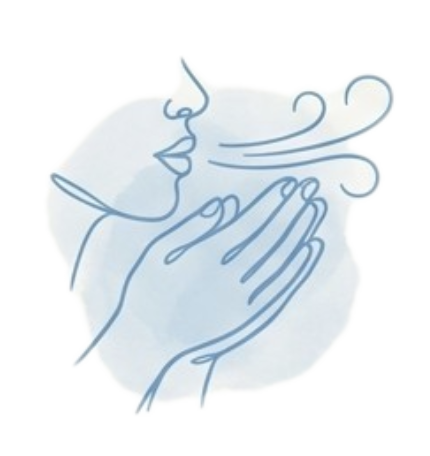
This one looks gentle. And it is gentle. But what it’s doing underneath is powerful.
When you blow warm air across your palms, you’re naturally extending your exhale. That’s not an accident, it’s the whole point.
Your vagus nerve — the main nerve of your parasympathetic nervous system — is most active during exhalation. When your exhale is longer than your inhale, it directly stimulates that nerve, sending a calming signal from your body to your brain. Researchers call this respiratory vagus nerve stimulation, and it’s one of the most well-documented ways to shift your nervous system out of fight-or-flight and into rest-and-digest.
A study published in the journal Frontiers in Human Neuroscience reviewed decades of research on this mechanism and found that slow breathing with extended exhalation consistently activates the parasympathetic nervous system and reduces sympathetic arousal.
Another study found that just two minutes of this kind of breathing significantly reduced perceived stress and improved decision-making.
The warmth matters too. The sensation of warm air on your palms creates a secondary sensory signal, which is something your nervous system can orient toward that isn’t the thing it’s alarmed about. It gives your brain something safe to land on.
So that simple act — cupping your hands, blowing warm air slowly — is simultaneously activating your vagus nerve, extending your exhale, lowering your heart rate, and giving your overactivated system a signal of safety.
That’s a lot of biology packed into something that takes about five seconds.
RELEASE: Shake It Out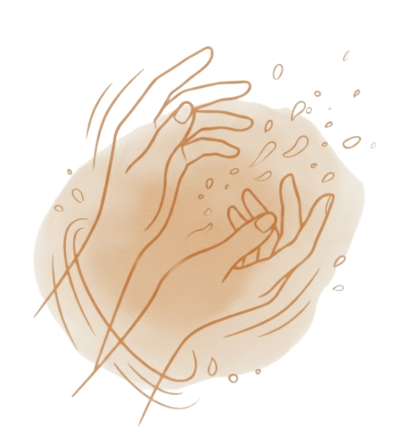
Animals don’t hold onto stress the way we do. A gazelle escaping a predator has been observed to shake, its whole body trembling for a few seconds before it walks away, seemingly reset. Dogs do it instinctively after stressful experiences. This shaking response, coined to be called neurogenic tremoring, may be the body’s built-in way of discharging stored tension and returning to balance.
Humans have the same mechanism. We’ve just been trained to suppress it. We “keep it together.” We hold it in. We power through.
The problem is, when that energy doesn’t discharge, it stays in the body. It becomes the jaw clenching, the tight chest, the irritability that seems to come out of nowhere… the emotional backlog that builds up over days and weeks.
Dr. David Berceli developed an entire therapeutic modality around this mechanism called Tension and Trauma Release Exercises (TRE). His research and subsequent studies have shown that deliberate activation of the body’s tremor response can calm the autonomic nervous system, reduce hypervigilance, and release muscular tension that’s been held for months or even years, without needing to talk about it or even name what’s being held.
Research suggests that activating the body’s natural tremor response may help calm the autonomic nervous system and reduce hypervigilance. A pilot study with caregivers found that just 10 weeks of self-induced tremoring was associated with improved quality of life, emotional resilience, and life enjoyment. Early research with adolescents suggests potential benefits for reducing anxiety and improving coping, with larger clinical trials currently underway.
When you shake it out at the beginning and end of the RELEASE session, you’re activating this same discharge mechanism. You’re telling your body: it’s safe to let go of what you’ve been carrying. The shaking isn’t some random movement. It’s a way to activate your nervous system’s natural release valve, and finally turn it back on.
CENTER: Hand on Chest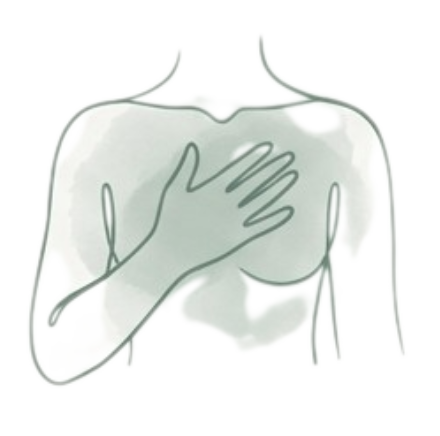
There’s a reason you instinctively put your hand on your chest when something startles you, when you hear unexpected news, when you need to steady yourself. Your body already knows what works to recenter.
Research on self-soothing touch has shown that placing your hand on your own body — especially your chest — activates several regulatory mechanisms at once.
A 2021 randomized controlled trial published in Comprehensive Psychoneuroendocrinology found that self-soothing touch gestures (like placing a hand over the heart) had a measurable buffering effect on cortisol responses to stress. The researchers identified two mechanisms: the tactile stimulation activates C-fiber receptors that stimulate vagal and parasympathetic activity, and the gesture itself creates a psychological signal of self-induced safety.
Separate neuroimaging research has shown that self-touch activates the brain’s descending pain modulatory system, a network involving the anterior cingulate cortex, amygdala, and rostral ventromedial medulla, which suppresses sympathetic nervous system activity and regulates the body’s internal state. This happens even in non-painful, non-stressful situations. The brain recognizes self-touch as a regulatory signal regardless of context.
There may also be an oxytocin component. Touch is associated with increased secretion of oxytocin, the neuropeptide linked to bonding, safety, and stress reduction, and researchers hypothesize that self-touch may trigger similar pathways.
So when you place your hand on your chest during our CENTER meditation, you’re grounding yourself through vagal activation, triggering your brain’s internal safety network, releasing oxytocin, and suppressing the sympathetic overdrive that’s making you scattered. You’re sending a signal of safety from your own body to your own brain.
It’s proprioceptive grounding, and a way for your body to tell itself: I’m here. I’m stable. I can come back to center.
SOFTEN: Soft Hands on Cheeks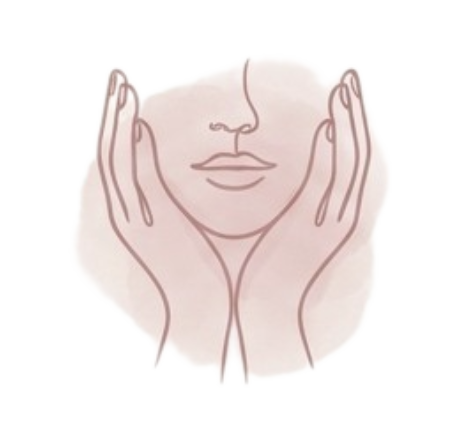
This is the most vulnerable gesture of the five. And that’s by design.
Most people don’t touch their own face gently and intentionally very often. The face is where we perform — where we hold expressions, manage impressions, present ourselves to the world. Cupping your own cheeks with soft hands breaks through that armor in a way that’s hard to achieve with words alone.
The face also has an unusually dense concentration of nerve pathways. Research on spontaneous face-touching shows that humans touch their faces up to 800 times during waking hours, and that this behavior is strongly associated with emotional regulation, self-awareness, and cognitive processing. A systematic review published in Neuroscience & Biobehavioral Reviews found that facial self-touch increases during emotionally and cognitively challenging situations and serves a self-regulatory function, helping to maintain a sense of self and manage internal states.
The dense innervation of the face means that gentle touch there creates a rich sensory signal, one that activates somatosensory processing and the brain’s internal safety system (the same descending pain modulatory network activated by hand-on-chest). But the vulnerability of the gesture adds something else: it bypasses the thinking mind entirely. You can’t cup your own cheeks softly and maintain the inner critic at the same time. The physical gesture is incompatible with self-attack mode.
That friction, the slight discomfort of being that gentle with yourself, is actually part of the mechanism. It signals to your nervous system that something different is happening. That the usual pattern of self-criticism is being interrupted. And it opens a doorway to self-compassion that trying to “think kind thoughts” often can’t.
IGNITE: Rub Your Palms Together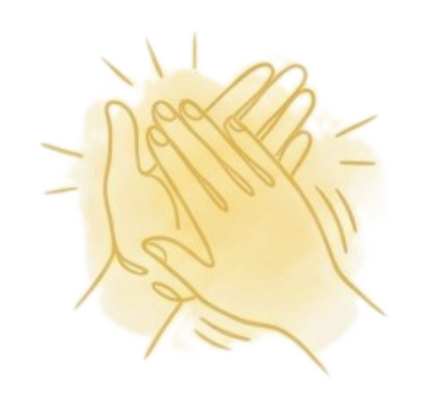
When your nervous system has gone into dorsal vagal shutdown (that flat, foggy, “can’t get going” state) it has essentially conserved energy by pulling you offline. Your system believes you’re under too much load, so it powers down.
To come back online, you need activation. Not aggressive, jarring activation, but gentle sensory input that tells your system it’s safe to re-engage.
Rubbing your palms together creates friction, warmth, and bilateral sensory stimulation. The friction generates heat, which your skin’s thermoreceptors detect and relay to your brain. The bilateral movement — both hands engaged symmetrically — increases proprioceptive input, which can help wake up your somatosensory system and re-establish body awareness.
From a somatic perspective, this warmth can counteract the cold, contracted quality that often accompanies low-energy shutdown states. When your system has gone offline, your extremities may feel cold, your energy flat, your body heavy. Creating warmth with your own hands offers a direct sensory counterpoint — a physical signal that says: wake up. It’s safe to come back.
It’s also active. Unlike the other gestures that are more receptive and still, rubbing your hands together requires engagement, which is exactly what the IGNITE state needs. The gesture matches the intention: generate energy, create movement, build momentum from within.
The Breakthrough: These Hand Gestures Are AnchorsHere’s why all of this matters beyond doing the thing a few seconds once or twice in an individual session.
Every time you repeat a Core 5 session, your nervous system is building an association between that hand gesture and that state. The gesture happens at the beginning when you’re entering the state, and again at the end when you’ve achieved the shift. Over time, through repetition, your nervous system links the two.
This is the same principle as classical conditioning: a physical cue paired with a physiological response, reinforced each time you practice. In the field of somatic therapy, this is called anchoring. You use a specific physical action as a reference point that your nervous system can return to in the future.
The key insight from anchoring research is that these associations get stronger with repetition, and that they work best when the physical cue is unique and distinctive. A generic gesture like crossing your arms is too common; it’s already associated with dozens of other contexts. But blowing warm air across your palms? Cupping your cheeks? These are distinctive enough that your nervous system can build a clean, clear, strong link.
Which means over time, you don’t always need the full session.
You’re in a meeting and your chest is tight. You can’t pull out your phone and tap. But you can place your hand on your chest. And your body remembers CENTER.
The overwhelm is rising while you’re driving. You can’t close your eyes and do a session. But you can blow warm air across one palm at a red light. And your body remembers CALM.
You’re standing in the kitchen and you just can’t get going. You rub your hands together. And your body remembers IGNITE.
The gestures become a shortcut, like a portable reset that travels with you everywhere, available in any moment, even when you can’t tap.
Building the ConnectionThe gestures work on their own; the biological process works regardless of whether you’ve done the sessions. Blowing warm air activates your vagus nerve whether or not you’ve ever heard of the Core 5.
But they work better — significantly better — when you’ve built the association through the full sessions, and through repeat use. That’s because the gesture alone activates the biological mechanism, but the gesture plus the anchor activates the biological mechanism and the full nervous system state you’ve conditioned through practice.
It’s the difference between turning a key in a lock versus turning a key in a lock that’s already been opened a hundred times. The mechanism is the same, but the pathway is smoother, faster, and more reliable.
Even a few sessions with each Core 5 state starts to wire the connection. Your body learns fast — faster than your mind, actually. That’s the whole point of working at the body level instead of just the thinking level.
So the next time you start a Core 5 session and that gesture comes up, pay attention to it. Don’t rush through it. Really feel it. Let your body register what’s happening. Because you’re not just warming up for the session.
Instead, you’re building a vocabulary your body speaks fluently. You’re creating five physical anchors that will travel with you everywhere you go.
And the more you use them, the stronger they get. Pretty cool, right?
Ready to start building your anchors? Open the Core 5 in The Tapping Solution App and try the session that fits how you’re feeling right now.
Don’t have the app yet? You can learn all about it and download it for free here.
Until next time… Keep Tapping!
Nick Ortner
@import url('https://fonts.googleapis.com/css2?fam... {<br /> --sage: #5B8C7B;<br /> --sage-light: #E8F0ED;<br /> --sage-dark: #3D5C50;<br /> --warm-gray: #6B6460;<br /> --warm-cream: #FDFBF8;<br /> --text-primary: #2D2A26;<br /> --text-secondary: #5C5752;<br /> --border-light: #E8E4E0;<br /> font-family: 'Lora', Georgia, serif;<br /> font-size: 1.125rem;<br /> line-height: 1.8;<br /> color: var(--text-primary);<br /> max-width: 720px;<br /> margin: 0 auto;<br /> padding: 0 1.5rem;<br />}<br />.tts-blog-post p {<br /> margin-bottom: 1.5rem !important;<br /> margin-top: 0 !important;<br /> font-size: 1.125rem;<br /> display: block;<br />}<br />.tts-blog-post strong {<br /> font-weight: 600;<br /> color: var(--text-primary);<br />}<br />.tts-blog-post em {<br /> font-style: italic;<br />}<br />.tts-blog-post h2 {<br /> font-family: 'DM Sans', -apple-system, sans-serif;<br /> font-size: 1.75rem;<br /> font-weight: 600;<br /> color: var(--text-primary);<br /> margin: 3.5rem 0 1.5rem 0;<br /> padding-top: 2rem;<br /> border-top: 1px solid var(--border-light);<br /> letter-spacing: -0.02em;<br /> line-height: 1.3;<br />}<br />.tts-blog-post h2:first-of-type {<br /> border-top: none;<br /> padding-top: 0;<br />}<br />.tts-blog-post h3 {<br /> font-family: 'DM Sans', -apple-system, sans-serif;<br /> font-size: 1.35rem;<br /> font-weight: 600;<br /> color: var(--sage-dark);<br /> margin: 2.5rem 0 1rem 0;<br /> letter-spacing: -0.01em;<br /> line-height: 1.4;<br />}<br />.tts-opening-quote {<br /> font-size: 1.375rem;<br /> font-style: italic;<br /> color: var(--sage-dark);<br /> border-left: 3px solid var(--sage);<br /> padding-left: 1.5rem;<br /> margin: 2rem 0;<br /> line-height: 1.7;<br />}<br />.tts-expert-quote {<br /> background: linear-gradient(135deg, var(--sage-light) 0%, #F5F7F6 100%);<br /> border-radius: 12px;<br /> padding: 2rem 2rem 2rem 2.5rem;<br /> margin: 2rem 0;<br /> border-left: 4px solid var(--sage);<br /> position: relative;<br />}<br />.tts-expert-quote p {<br /> font-size: 1.1rem;<br /> font-style: italic;<br /> color: var(--text-secondary);<br /> margin: 0;<br /> line-height: 1.75;<br />}<br />.tts-expert-quote::before {<br /> content: '"';<br /> font-family: Georgia, serif;<br /> font-size: 4rem;<br /> color: var(--sage);<br /> opacity: 0.3;<br /> position: absolute;<br /> top: 0.5rem;<br /> left: 0.75rem;<br /> line-height: 1;<br />}<br />.tts-testimonial {<br /> background: var(--warm-cream);<br /> border-radius: 8px;<br /> padding: 1.5rem 1.75rem;<br /> margin: 1.5rem 0;<br /> border: 1px solid var(--border-light);<br /> position: relative;<br />}<br />.tts-testimonial p {<br /> font-size: 1.05rem;<br /> font-style: italic;<br /> color: var(--text-secondary);<br /> margin: 0;<br /> line-height: 1.7;<br />}<br />.tts-testimonial::before {<br /> content: '';<br /> position: absolute;<br /> left: 0;<br /> top: 0;<br /> bottom: 0;<br /> width: 3px;<br /> background: var(--sage);<br /> border-radius: 3px 0 0 3px;<br />}<br />.tts-key-insight {<br /> text-align: center;<br /> padding: 2rem 1.5rem;<br /> margin: 2.5rem 0;<br /> background: var(--sage-light);<br /> border-radius: 8px;<br />}<br />.tts-key-insight p {<br /> font-family: 'DM Sans', -apple-system, sans-serif;<br /> font-size: 1.25rem;<br /> font-weight: 600;<br /> color: var(--sage-dark);<br /> margin: 0;<br /> line-height: 1.5;<br />}<br />.tts-statement {<br /> font-family: 'DM Sans', -apple-system, sans-serif;<br /> font-size: 1.2rem;<br /> font-weight: 600;<br /> color: var(--text-primary);<br /> text-align: center;<br /> padding: 1.5rem 0;<br /> margin: 1.5rem 0;<br />}<br />.tts-cta-box {<br /> background: linear-gradient(180deg, var(--sage-light) 0%, #F0F5F3 100%);<br /> border-radius: 16px;<br /> padding: 2.5rem;<br /> margin: 2.5rem 0;<br /> border: 1px solid rgba(91, 140, 123, 0.2);<br />}<br />.tts-cta-box h3 {<br /> font-family: 'DM Sans', -apple-system, sans-serif;<br /> margin: 0 0 1.25rem 0;<br /> color: var(--sage-dark);<br /> font-size: 1.1rem;<br /> font-weight: 600;<br /> text-transform: uppercase;<br /> letter-spacing: 0.05em;<br />}<br />.tts-cta-box ul {<br /> list-style: none;<br /> padding: 0;<br /> margin: 0 0 1.5rem 0;<br />}<br />.tts-cta-box li {<br /> padding: 0.75rem 0;<br /> border-bottom: 1px solid rgba(91, 140, 123, 0.15);<br /> font-size: 1.05rem;<br />}<br />.tts-cta-box li:last-child {<br /> border-bottom: none;<br />}<br />.tts-cta-box li a {<br /> color: var(--text-primary);<br /> font-weight: 600;<br /> text-decoration: none;<br />}<br />.tts-cta-box li a:hover {<br /> color: var(--sage-dark);<br /> text-decoration: underline;<br />}<br />.tts-cta-box li span {<br /> color: var(--text-secondary);<br /> font-style: italic;<br />}<br />.tts-button-wrap {<br /> text-align: center;<br /> margin: 2rem 0;<br />}<br />.tts-button {<br /> display: inline-block;<br /> background: #5B8C7B;<br /> color: white !important;<br /> padding: 1rem 2.5rem;<br /> text-decoration: none !important;<br /> border-radius: 50px;<br /> font-family: 'DM Sans', -apple-system, sans-serif;<br /> font-weight: 600;<br /> font-size: 1.1rem;<br /> letter-spacing: 0.01em;<br /> transition: all 0.2s ease;<br /> box-shadow: 0 2px 8px rgba(91, 140, 123, 0.25);<br />}<br />.tts-button:hover {<br /> background: #3D5C50;<br /> transform: translateY(-1px);<br /> box-shadow: 0 4px 12px rgba(91, 140, 123, 0.35);<br />}<br />.tts-signoff {<br /> margin-top: 3rem;<br /> padding-top: 2rem;<br /> border-top: 1px solid var(--border-light);<br />}<br />.tts-signoff p {<br /> margin-bottom: 1rem;<br />}<br />.tts-bio {<br /> font-size: 0.95rem;<br /> color: var(--text-secondary);<br /> font-style: italic;<br />}<br />.tts-gesture-image {<br /> text-align: center;<br /> margin: 2rem 0;<br />}<br />.tts-gesture-image img {<br /> max-width: 280px;<br /> height: auto;<br />}<br />@media (max-width: 640px) {<br /> .tts-blog-post { font-size: 1.0625rem; }<br /> .tts-blog-post h2 { font-size: 1.5rem; }<br /> .tts-blog-post h3 { font-size: 1.25rem; }<br /> .tts-opening-quote { font-size: 1.2rem; }<br /> .tts-expert-quote { padding: 1.5rem 1.5rem 1.5rem 2rem; }<br /> .tts-cta-box { padding: 1.75rem; }<br /> .tts-gesture-image img { max-width: 200px; }<br />}<br />
The post The Science Behind the Core 5 Gestures: Why Every Session Starts and Ends With Your Hands appeared first on The Tapping Solution.
January 28, 2026
2026 Tapping World Summit
2026 marks our 18th Annual Tapping World Summit! It’s been 17 years since we at The Tapping Solution launched our first summit.
Our goal from the beginning was to make each year better than the last. This year is no exception, and we’ve got some special presentations in store for you in a video interview format!
That’s right! We’re continuing with this popular trend, so instead of just listening to the guest interviews, you’ll be able to see Jessica and the presenters in video.
Do you know what makes our Tapping World Summits so popular? It’s because for 10 days out of the year, we bring in some of the TOP MINDS in the fields of EFT and personal development to guide you towards improving nearly every area of your life!
And it’s all FREE!Emotional Freedom Techniques, also known as EFT or simply “Tapping,” has been scientifically proven to provide relief from stress, anxiety, chronic pain, emotional problems, addictions, fears & phobias, PTSD (post-traumatic stress disorder), and so many other conditions.
Tapping is also a very effective tool for attracting abundance, losing weight, manifesting your goals & desires, healing relationships, and attaining inner peace.
If you are asking yourself, “What is EFT Tapping?” or “How can one technique do so much?” then jump on over to our Tapping 101 page to learn some of the basics.
.
What Is the Tapping World Summit 2026?February 23rd, 2026 – March 4th, 2026
The Tapping World Summit 2026 is a Virtual Online Event presented by The Tapping Solution, produced by myself, Nick Ortner, along with my brother Alex Ortner and and my sister Jessica Ortner (also the host).
This incredible online event is about providing you with a better understanding of Tapping while expanding your consciousness to new levels in the areas of personal peace, physical health, abundance, overcoming mental barriers, and relief from the emotional effects of past traumas or events.
Over 3 million people have attended the previous 17 Tapping World Summits, with attendance growing each year, and reaching over 600,000 just last year alone!The event itself will run for 10 consecutive days from Monday, February 23rd through Wednesday, March 4th featuring two 100% content-only presentations each day, along with calming Tapping Meditations and insightful bonuses. All sessions are BRAND NEW!
These free sessions are available for a FULL 24 HOURS after their initial broadcast. The reason I structure the event this way is that I want everyone to be able to access this information, regardless of time zone or financial ability. It’s all available for FREE, with the option to purchase the recorded event sessions for you to watch and tap along with as many times as you want.
Some of these sessions from our Tapping World Summits are SO powerful that I listen to and watch them over and over again! They really are that good!
.
REGISTRATION IS NOW OPENJoin 20 of the world’s leading EFT Tapping Experts in this FREE Online 10-Day Event starting February 23rd, 2026
GO HERE TO LEARN MORE & REGISTER FOR FREE
Until next time…
Keep Tapping!
Nick Ortner
The Tapping World Summit 2026 is a 10-day Virtual Online Event presented by The Tapping Solution and produced by New York Times bestselling authors, Nick Ortner and his siblings Alex Ortner and Jessica OrtnerThe post 2026 Tapping World Summit appeared first on The Tapping Solution.
Related posts: The Links Between Pain, Stress, and Emotions – And How You Can Help Yourself Break Free
 3 Things I Learned from Zach Braff
 Tapping World Summit 2025
January 12, 2026
The Man Who Gave Tapping to the World: Remembering Gary Craig, 1940-2026
I wouldn’t be doing this work if it weren’t for Gary.
How I Found TappingYears ago, I was at a Tony Robbins event when Tony demonstrated this unusual technique, tapping on specific points on your body while saying certain phrases. I was intrigued enough to go home and look it up.
That’s when I found Gary Craig.
His website was a treasure trove. Free manuals. Free videos. Thousands of case studies from practitioners around the world. I devoured all of it. I started using Tapping on myself, then with my brother Alex and sister Jessica, then with friends and family. We saw things happen that we couldn’t explain.
Eventually, we made a documentary about it. Then wrote books. Then built The Tapping Solution App. And now millions of people have experienced what this technique can do.
All of that traces back to what Gary built.
What Gary Actually DidTo understand Gary’s contribution, you have to understand what existed before him.
In the 1980s, psychologist Dr. Roger Callahan developed something called Thought Field Therapy (TFT). Callahan had discovered that tapping on specific meridian points could relieve psychological distress, sometimes in minutes. It was remarkable.
But it was also complicated. TFT required different tapping sequences for different problems. Anxiety had one algorithm. Phobias had another. Trauma had a third. Practitioners had to diagnose the issue, then apply the correct sequence. The training was extensive. The cost was high.
Gary Craig was a Stanford-trained engineer who had studied with Callahan. And his engineering mind asked a simple question: What if you didn’t need different algorithms?
In the mid-1990s, Gary ran experiments. He tried using a single, simplified sequence for everything. Same points, same order, regardless of the issue.
It worked just as well.
This was Gary’s first major innovation: the universal protocol. One sequence that could be applied to anything—anxiety, pain, grief, phobias, trauma. No diagnosis required. No complex algorithms. Just tap.
He called it EFT: Emotional Freedom Techniques. And he released it to the world in 1995.
The Setup StatementGary’s second innovation was the Setup Statement, that phrase we say at the beginning of a Tapping session: “Even though I have this [problem], I deeply and completely accept myself.”
This wasn’t part of Callahan’s TFT. Gary added it.
Why does it matter? Because it addresses the psychological reversal that can block healing. It combines acknowledgment of what you’re experiencing with self-acceptance. It’s a small thing that makes a big difference—and millions of people have said those words because Gary thought to include them.
The Open HandBut Gary’s biggest contribution might not have been technical at all.
It was philosophical.
Gary made EFT free. He gave away The EFT Manual as a downloadable ebook. He encouraged people to share it, teach it, build on it. He called this his “open hand” policy.
This was radical. Callahan’s TFT training cost thousands of dollars and came with strict requirements. Gary said: take it, use it, spread it.
Please know that the contents of the Palace of Possibilities website remains my personal gift to everyone interested in the official form of EFT. It contains the entire body of my EFT work — decades of exploration, refinement, and love.
That generosity is why Tapping spread. It’s why there are now over 300 peer-reviewed studies on EFT. It’s why millions of people around the world have found relief from anxiety, pain, trauma, and stress.
Gary gave his creation away so it could reach the people who needed it.
My GratitudeI’m grateful Gary existed. I’m grateful he found Callahan’s work and asked “what if it could be simpler?” I’m grateful he chose generosity over gatekeeping. I’m grateful for what that simple sheet of Tapping instructions set in motion — for my family, for our community, and for the millions of people who’ve found relief.
Per Gary’s request, there will be no formal ceremony. But his daughter shared how he’d want us to honor his memory: continue to “stretch,” to look deeper, ask better questions, and help one another.
Every time you tap, you’re honoring Gary Craig.
Thank you, Gary, for giving this to the world.
Until next time… Keep Tapping!
Nick Ortner
The post The Man Who Gave Tapping to the World: Remembering Gary Craig, 1940-2026 appeared first on The Tapping Solution.
Related posts: What’s Possible for 2012? What if…
 What’s Your Relationship With Sleep?
 EFT and TFT: From Complex Origins to Simple Solutions with Tapping
January 8, 2026
The Science of Breaking the Loop: What 225,000 Sessions Taught Us About Rumination
“Rumination occurs when self-reflection goes awry and it becomes very negative and vicious.”
That’s how Dr. Sharmin Ghaznavi—a Harvard psychiatrist and one of the world’s leading rumination researchers—described it when we spoke recently.
I’d asked her about the thing so many of us do: replaying conversations, going over something someone said, turning it around and around like thinking about it one more time will finally make it stop.
The clinical term for this is rumination—and it turns out it’s one of the most important things to understand about your mental health.
So back to what Dr. Ghaznavi told me. This truly changed how I think about those late-night thought spirals:
Rumination occurs when self-reflection goes awry and it becomes very negative and vicious. It’s where people go over all of the things they think they did wrong and the problems that they feel badly about without actively trying to problem-solve.
That last part is key: without actively trying to problem-solve.
Because here’s the trap: rumination feels productive. You feel like you’re working on something. But real problem-solving moves you forward—you weigh options, make a decision, find some peace. Rumination just keeps you on the same track, running the same loop, arriving nowhere new.
And the research shows it’s not just uncomfortable. Rumination is actually part of the pathway that can lead to depression and anxiety.
In fact, longitudinal studies show that rumination doesn’t just accompany these conditions—it predicts them. People who ruminate more are significantly more likely to develop depression and anxiety, even if they don’t have symptoms yet.
It’s not just a symptom. It’s a risk factor.
Which means interrupting the loop isn’t just about feeling better in the moment. It might be one of the most important things we can do for our mental health.
So how do you actually break it?
Why “Just Stop Thinking About It” Doesn’t WorkHere’s the problem: when you’re stuck in rumination, your brain is already overwhelmed. The usual advice—”just let it go” or “try to think about something else”—requires cognitive resources you don’t have in that moment.
You can’t think your way out of a thinking problem.
That’s why we built a collection of Tapping sessions specifically designed for rumination—the “Help Me Stop…” sessions in the app. Over 225,000 sessions have been completed, and on average, people’s stress dropped 44% in about 10 minutes. For context, that’s roughly 3x the improvement most digital wellness tools show in research studies.
But what interested me most wasn’t the numbers. It was what people said about what happened.
When we analyzed hundreds of written responses, five distinct patterns emerged. These aren’t clinical abstractions—they’re what real people experience when the loop finally lets go.
5 Patterns We Found Across 225,000 Sessions on Rumination1. The Loop Actually BreaksPeople describe rumination using circular language: “loops,” “cycles,” “spiraling,” “going around and around.” And they describe the shift after Tapping in equally vivid terms—the pattern “breaking” or “interrupting.”
But here’s what’s interesting: they don’t describe suppressing the thoughts. They describe a shift in their relationship to them.
“I have thousands of thought loops over the hurtful things said over my lifetime. They pop in all the time and are so hurtful. So in this session I let one go that has looped so many times. My breathing has been affected and my chest gets so tight when these loops run through. What a relief to see I can breathe deeply and my chest relax.”
“Something happened yesterday that I was rapid cycling through my brain. I used this to break the pattern and get myself back in check.”
The thoughts don’t disappear. But something about the grip loosens. The loop that felt impossible to escape suddenly… stops.
2. You Come Back Into Your BodyThis one surprised me at first, but it kept showing up: people describe the shift in physical terms. Changes in breathing. Muscle tension releasing. A sense of “coming back” into their body.
The somatic experience isn’t a side effect—it seems to be part of the mechanism.
“It was as if the tapping was acting as a distraction for the fear triggers in my body so the words my mouth and mind produced had a clear path… Before my emotions could even come up with a counter attack, only tranquility remained and held me safely.”
“I am back in my body and sinking into the bed, breathing and still, and my consciousness is able to view things as though I’m the main character of my own life again.”
This makes sense when you understand how Tapping works. By engaging the body—through the physical act of tapping on acupressure points—you’re giving your overwhelmed mind an alternative pathway.
You’re not asking it to think differently. You’re giving it something else to do.
3. Insight Shows Up (Without Trying)Here’s where it gets really interesting.
Traditional approaches to rumination often ask you to cognitively reframe—to challenge your thoughts, find a different perspective, think your way to a new conclusion. But that requires mental bandwidth you don’t have when you’re stuck in a loop.
What people describe with Tapping is different. They’re not trying to find insight. The insight just… shows up. Once the nervous system calms down, the mind can finally do what it was trying to do all along.
“I love that there are 2 rounds where we are led to ‘just’ tap without saying anything as it gave me enough time to feel and acknowledge my feelings and as the intensity lowered, I got an insight into why the person might have said what they said. That shifted my feelings immediately.”
“I suddenly recognized part of me didn’t want to let the overthinking go as I still have some belief that it will keep me safe! Wow, now that I have this awareness, I can work on it.”
“I realized in this meditation that I hold a belief that my worry is the only thing I can do to save her is to worry. This is a life long pattern I want to overcome.”
That last one stopped me. I believe my worry is the only thing I can do. How many of us have that same unconscious belief running in the background?
This is the difference between rumination and resolution. Rumination spins without arriving anywhere. Resolution is when you finally land somewhere new—a realization, an acceptance, a way forward. Tapping seems to create the conditions for that landing.
4. Your Brain Gets the “Safe” SignalSome responses—particularly from people with trauma histories—describe something specific: the intervention communicating safety to their nervous system.
“I was raised in an abusive home and I can tell you that the mind does not ever relax in that setting, that the mind and body are always on alert in order to read the room and stay out of harm’s way. I can tell you that sometimes it’s a revelation that it is safe for the mind to relax. This feels uncertain and uncomfortable but SO welcome.”
“Love the validation as to why I engage in overthinking. A way of telling myself I am safe, it is okay… put down the shield.”
This maps to what researchers call the “safety signal” hypothesis. When your nervous system is in threat mode—which is essentially what’s happening during intense rumination—it can’t let go until it receives signals that it’s okay to stand down.
Tapping, through the combination of physical touch and verbal acknowledgment, may function as that signal. It’s not telling your brain to stop being afraid. It’s showing your brain that right now, in this moment, you’re safe.
5. It’s There When You Need It MostOne finding from our data stood out: 24.2% of these sessions happen between 10pm and 6am. If you’ve ever been awake at 2am with a brain that won’t quit, you’re not alone.
“I was having trouble sleeping about what a family member had said to me that was unkind and very hurtful. I found this tapping and wow, I loved that it was so powerful in releasing the negative energy from the hurtful words.”
This is something traditional therapy can’t offer: an intervention you can access at 2am, when you’re in it, without having to explain yourself to anyone. Just press play and be guided through.
The Bigger PictureHere’s what all of this adds up to:
Rumination isn’t just annoying. It’s a mechanism—part of the pathway that can lead to depression and anxiety over time. And interrupting it isn’t just about feeling better in the moment. It might be one of the most important things we can do for our long-term mental health.
One response has stayed with me:
“I have worried heavily my whole life, and I’m almost 69 years old. I’m tired of worrying all the time and the limits that worrying has placed on my life. I would like to live more instead of mostly just existing, trying to stay alive and fighting these internal battles constantly.”
That’s what unchecked rumination does over a lifetime. It shrinks your life. It keeps you existing instead of living.
The good news: it can be interrupted. Not by trying harder to stop thinking. Not by forcing yourself to “reframe.” But by giving your brain and body a different way through.
That’s what these sessions are designed to do.
If You Want to Try ItThe “Help Me Stop…” CollectionHelp Me Stop Overthinking — for when your brain won’t stop spinningHelp Me Stop Thinking About Something Someone Said — for words you can’t shakeHelp Me Stop Thinking About Something I Did — for regret and self-criticismHelp Me Stop Worrying — for the “what ifs” that won’t quitHelp Me Trust My Decisions — for second-guessing yourselfEach one is about 10 minutes. Pick the one that matches where you’re stuck and start tapping along.
Open the App →You might be surprised what shifts when you give your brain a different way through.
Until next time… Keep Tapping!
Nick Ortner
Nick Ortner is the founder of The Tapping Solution and NY Times bestselling author. He’s spent 20 years studying why tapping works—and helping people use it to find relief.
The post The Science of Breaking the Loop: What 225,000 Sessions Taught Us About Rumination appeared first on The Tapping Solution.
Related posts: Multiple Sclerosis Fatigue Can Be Helped by Tapping – A Look at the Research
 Embracing the Slow Dance of Life: Wisdom from David L. Weatherford and Wayne Dyer
 EFT and Chakras: Unlock Your Energy Centers with EFT Tapping
December 1, 2025
5 Surprising Ways Winter Affects Your Nervous System (And What You Can Do About It)
Have you ever noticed how you feel just a little bit… heavier once the days get shorter?
Last week, I caught myself sighing for what felt like the hundredth time that afternoon. I was staring at out my window at 4:30 PM (already dark otuside) wondering why I felt so blah.
Nothing was actually wrong. I’d had a productive day, my family was healthy, things were generally going well. And yet, there I was, feeling like I was dragging around an invisible weight.
Then it hit me: It’s the season.
Winter doesn’t just change the weather, it alters how our brains and bodies function.
Our nervous systems respond to shorter days, colder temperatures, and less sunlight in ways that are mostly unconscious and can catch us by surprise.
The good news? When you understand what’s actually happening in your body, you can work with it instead of against it. And that’s exactly where Tapping becomes so powerful; it helps your nervous system recalibrate when winter has knocked it off balance.
Let’s explore five surprising ways winter affects your nervous system (and what you can do about it).
5 Surprising Ways Winter Affects Your Nervous System
When sunlight reaches your eyes, it influences serotonin activity in your brain. Serotonin is that “feel-good” neurotransmitter that regulates mood, appetite, and motivation. Research shows that serotonin turnover in the brain is lower in winter, and it makes sense. Sunlight influences serotonin production, and we get less sunlight in the winter.
Think about that for a moment. Your brain’s neurochemistry actually changes with the seasons.
How this shows up: You might feel less motivated, even for things you normally enjoy. Small tasks may feel overwhelming. You might crave comfort foods, especially carbs and sweets. Your mood could feel flatter, like someone turned down the brightness on your emotions.
Tips to help: Get outside during daylight hours, even for just 10-15 minutes. Light exposure matters, even on cloudy days. Sit near windows when you’re indoors (that counts, too!). And be gentler with yourself about productivity expectations. Remember, your brain chemistry has actually shifted.
Tapping helps here by reducing the self-judgment that compounds the low mood, while signaling safety to your nervous system. It’s also a great tool to use to give yourself a boost of energy, positivity, and joy.
#2. Reduced movement creates a feedback loop of sluggishness
In summer, movement happens naturally: walks, gardening, playing outside. In winter, it’s more likely you’ll drive everywhere and the couch probably looks infinitely more appealing than a cold, wet walk. The problem? Movement is one of the primary ways your nervous system processes and releases built-up stress.
How this shows up: You might feel increasingly sluggish and heavy. Your energy may drop throughout the day. You could experience more brain fog and difficulty concentrating. Physical aches and tension probably seem more pronounced, and everything just feels harder.
Tips to help: Start small. Even 5 minutes of movement counts. Dance to one song in your living room. Do gentle stretches while watching TV. Walk around your house or office a few times during the day. ANY movement will signal safety and regulation to your nervous system.
Try tapping for 2 minutes before you move to motivate yourself to get going (“Even though I feel so sluggish and don’t want to move…”). Tapping can be so powerful to help discharge the resistance and make that first step easier.
#3. Social isolation compounds nervous system dysregulation
In summer, you spontaneously meet friends for coffee, chat with neighbors, strike up conversations at outdoor events, etc. In winter, we tend to hunker down. We text instead of calling. We skip social events because “it’s too cold and rainy.” But here’s what’s happening beneath the surface: Human connection literally calms your stress response through something called “co-regulation.” And when we have less connection, our nervous system feels it.
How this shows up: You may notice yourself withdrawing or canceling plans more often. You might start feeling lonelier, even when you’re around people. Minor interactions could feel more effortful and draining. Anxiety or low mood may increase without clear reasons, and you might not quite figure out why you feel so off.
Tips to help: Schedule regular coffee dates or phone calls with friends. Put them on your calendar like any other appointment. Join an indoor activity or class where you’ll see the same people regularly. Video chat instead of just texting when you can. Even brief positive interactions count: chat with the barista, smile at a neighbor, strike up a conversation in line. Think of connection as nervous system medicine, not a luxury.
When you notice yourself wanting to cancel plans, tap on the resistance (“Even though I don’t want to go and just want to stay home…”) to help dissolve the inertia.
#4. Lack of sunlight disrupts your body’s natural rhythm
Sunlight doesn’t just affect your mood; it regulates your entire circadian rhythm, which controls when you feel alert, hungry, when your body temperature rises and falls, and even when your immune system is most active. When you go to work in the dark and come home in the dark, your can body become rhythmically confused.
How this shows up: You might feel disconnected from your body’s natural cues. You might not be sure if you’re hungry, tired, or something else entirely. Your energy could feel flat rather than having natural peaks and valleys throughout the day. You might struggle to know what you actually need in any given moment because your internal signals are scrambled.
Tips to help: Get outside during your lunch break, even briefly. 10 minutes makes a difference! Open curtains and blinds during daylight hours to maximize natural light exposure indoors. Eat meals at consistent times to help anchor your circadian rhythm. Create a consistent sleep schedule, even on weekends. Use dim, warm lighting in the evening to signal to your body that bedtime is approaching.
Set a timer to check in with yourself a few times a day, and spend 60 seconds Tapping while asking, “What does my body actually need right now?” This helps quiet the mental noise and reconnect you with your body’s wisdom and natural rhythms.
#5. Your nervous system mistakes “busy” for “warm”
Do you find that you chronically overschedule yourself in winter? Not because you are feeling particularly ambitious, but because staying busy creates an illusion of warmth and energy? When your nervous system is depleted and running on fumes, it might reach for anything that feels like aliveness: caffeine, sugar, drama, busyness…
How this shows up: You might say yes to everything even though you’re exhausted. You might create unnecessary urgency around tasks that could easily wait. You might find yourself picking fights or getting caught up in drama that doesn’t serve you. You could feel simultaneously wired and tired, buzzing with anxious energy on the surface yet completely depleted underneath.
Tips to help: Start asking yourself: “Am I actually energized by this, or am I just trying to feel less numb?” Give yourself permission to do less (not just move tasks around). Build in actual rest time, not just “busy rest” like scrolling or binge-watching TV. Focus on activities that genuinely warm and nourish you from the inside out.
When you notice yourself reaching for stimulation or about to say yes to another commitment, pause and tap: “Even though I feel this need to stay busy, and I’m afraid of what will happen if I slow down…” This can help you feel safe enough to actually slow down and truly rest.
Why Tapping Works So Well for Winter Struggles
Here’s what makes Tapping particularly powerful for seasonal nervous system challenges: It works directly with your body’s stress response system. When anything has thrown your nervous system off balance (winter included), Tapping sends calming signals to your amygdala—the part of your brain that registers threat—while you acknowledge what’s actually happening.
You’re not trying to force positivity or pretend you feel fine. You’re helping your body feel safe enough to relax, even when everything around you has shifted and changed. That’s the key.
In The Tapping Solution App, we have several sessions specifically designed to help your nervous system regulate and return to a balanced state:
Releasing Winter BluesFeeling Blah Quick TapEmotional Balance and Ease: Vagus Nerve ToningSafe and Grounded Quick TapInstant Boost of EnergyMotivate Me to Have a Productive DayThese short sessions meet you where you are. Even when you’re feeling depleted, even when motivation is at zero, you can tap for just a few minutes and give your nervous system the support it’s craving.
Which of these winter nervous system patterns do you recognize most in yourself? I’d love to hear what resonates in the comments!
Until next time… Keep Tapping!
Nick Ortner
The post 5 Surprising Ways Winter Affects Your Nervous System (And What You Can Do About It) appeared first on The Tapping Solution.
Related posts: New Paper Highlights the Power of EFT Tapping for Healing After Tragic Events (Featuring the Work of The Tapping Solution Foundation and More!)10 Gratitude Affirmations to Change Your Day for the Better
 Does Sleep Programming Work? The Science of Programming Your Mind for Positive Change as You Fall Asleep
November 20, 2025
3 Sneaky Ways Your Brain Keeps You “Safe” (By Keeping You Small)
Ever notice how you can know what you should do, but then… you just don’t do it?
Or you know what you should NOT do, but you do it anyway?
You’re about to speak up in a meeting to share a great new idea you had… but when the moment comes, you hear yourself saying “Nothing from me!” instead.
Or you swear to yourself you’re only going to watch ONE episode of the TV show tonight and work on your passion project instead… but then 3 hours later you haven’t left the couch.
You walk away wondering why…. Why do I fall into these same old patterns over and over again, even when I know better?
Here’s what I’ve come to understand: Your brain has a very specific job, and that job is not to make you happy, successful, or fulfilled. Your brain’s job is to keep you safe.
And here’s the kicker: your brain thinks “safe” means “exactly what we’ve done before.” Even if what we’ve done before was miserable.
This is what I call the familiarity trap. Your nervous system will choose familiar suffering over unfamiliar peace because the familiar pattern, no matter how painful, feels safer than the unknown.
Think about that for a moment. Your brain isn’t sabotaging you on purpose just to make you miserable. It’s trying to protect you… by keeping you in the safety of the familiar.
So let’s explore three sneaky ways your brain keeps you “safe” by keeping you small (and what you can actually do about it).
#1. It turns rejection into a life-or-death situation
Someone doesn’t text back. You don’t get the job. Your idea gets turned down. And your body reacts like you’ve been physically attacked. Heart racing, stomach dropping, mind spiraling into catastrophe…
For our ancestors, rejection from the tribe literally meant death; you couldn’t survive alone. Your brain still operates on that ancient wiring. So when you experience any form of rejection, your nervous system treats it as a genuine survival threat.
This leads you to play incredibly small. You don’t apply for the job. You don’t share your work. You don’t express your needs. You don’t say no. Because your brain has learned that staying invisible hurts less than the possibility of rejection.
#2. It keeps replaying old situations that have nothing to do with now
You’re about to speak up in a meeting, and suddenly you’re 12 years old again, being laughed at in class. You’re about to try something new, and you’re instantly back to that time you failed publicly. In those moments, the memory comes back so fresh and the feelings are so charged that it feels like it’s happening right now.
Your brain has created what I call a “reactive loop” based on past experience – an automatic program that says “this situation = danger.” Even though the current situation is completely different, your nervous system has linked certain cues (speaking up, trying something new, being visible) with old pain.
And so, it replays the past to warn you about the present. Your brain is keeping you “safe” by ensuring you never risk experiencing that old pain again, even if it means never experiencing anything new.
But in reality, this just means that decades-old experiences come to dictate your current choices.
#3. It makes success feel more dangerous than failure
You’re on the verge of a breakthrough. Things are actually going well. And then, inexplicably, you sabotage it. You pick a fight, you procrastinate, you make a silly mistake that derails everything.
Here’s what’s at the heart of it: Success means change. Change means unfamiliar. Unfamiliar means your nervous system sounds the alarm.
Additionally, if success wasn’t safe in your past (maybe you were criticized for standing out or faced increased pressure when you succeeded), your brain has learned that success brings danger. Your brain is following its programming perfectly; it’s keeping you in the familiar zone where it knows how to keep you safe.
Failure feels safer than success because at least failure is known territory.
The Real Problem (And the Real Solution)
Here’s what all of these have in common: Your brain isn’t actually keeping you safe; it’s keeping you familiar. And there’s a massive difference.
The good news is, this information can help us be a little kinder to ourselves. We aren’t just “doing it wrong” or “flawed” or “don’t have enough willpower.”
We simply have a brain that is doing its best to keep us safe, even if it’s operating on outdated information. Our brains learned what was dangerous years ago (maybe decades ago) and it’s still running those old, automatic programs.
So, what do we do about it?
Once you understand that these “protective” behaviors are just old programming, you can start to update the program.
That’s where Tapping becomes so powerful.
When you tap while acknowledging these patterns (not trying to force them away, but recognizing what’s happening), you’re essentially telling your nervous system: “I see what you’re trying to do. I understand you’re trying to keep me safe. And I’m showing you that I can handle something new. It is safe to step into the unknown.”
With Tapping, you’re interrupting the automatic loop and creating space for a new response.
Over time, your brain learns that unfamiliar doesn’t always equal dangerous. That change can be safe. That you can handle more than your nervous system thought you could.
So, are you ready to start interrupting these old patterns?
In The Tapping Solution App, we have 1,000+ sessions designed to help you recognize and interrupt old protective patterns:
Unpacking Unhelpful HabitsChange Unhelpful Thought PatternsMotivate Me to Start Something NewI Choose Peace and Patience As I Face the UnknownMicro Boost of SafetyThese sessions help you move from “safe and small” to “safe and expansive.” And you deserve to expand, to evolve, to step into a vibrant future full of possibilities.
Until next time… Keep Tapping!
Nick Ortner
P.S. Which of these patterns do you recognize most in yourself? Sometimes just naming what your brain is trying to do is the first step to choosing something different. Feel free to share your reflections in the comments below.
The post 3 Sneaky Ways Your Brain Keeps You “Safe” (By Keeping You Small) appeared first on The Tapping Solution.
Related posts: Wayne Dyer Woke Me Up This Morning
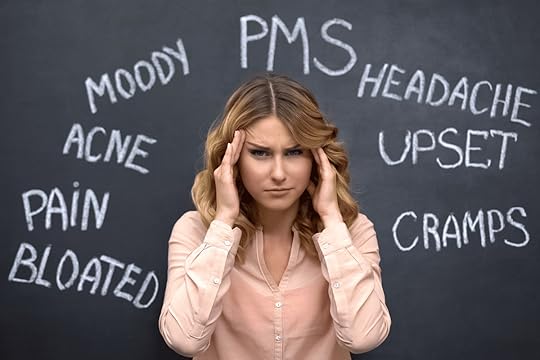 Study Finds Tapping Helps Reduce PMS Symptoms
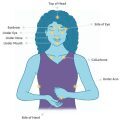 Tapping for Intrusive Thoughts: How to Break Free from the Mental Spiral