Jessica Mesman Griffith's Blog
October 5, 2023
Horror movie mom

If what remained of my family prayed together the night my mother died, I have forgotten. In my memory, there is only darkness and silence. When my dad, sister, and I went to bed after leaving the hospital, we were inexplicably afraid. We didn’t turn on the lights or the television. We slept together in my sister’s room, my dad on a pallet on the floor. I lay there still with the covers pulled to my chin, listening to them breathe. I had the feeling that something powerful had taken notice of my family, that we had attracted the eye of something monstrous.
For years I’ve been looking for a way to tell the story of my mother’s death and everything that came after, and I’ve also been trying to explain to myself and others why I–pathologically nervous and unable to watch any living thing suffer–love the horror genre so much. Writing this essay, I started to unlock some of the answers. Read it at the Century.
And check out Benedetta Vialli, the artist who created the original illustration, on Instagram:


May 12, 2023

November 4, 2022
Desperately seeking Sinéad
I’ve been obsessed with Sinead O’Connor since she tore up the pope. I wrote about her memoir, Rememberings, and the recent documentary Nothing Compares for the Century.
She’s one of the most famous lapsed Catholics (another obsession of mine) but what intrigues me most is how many elements her life story shares with the hagiographies of some of my favorite catholic saints.

November 2, 2020
Grief and the land
“I think for a long time I was writing about home because I was just dreadfully homesick and grieving, but I’ve gone down all these other rabbit holes and found that it’s a much deeper, interconnected problem. And there’s nothing I love more than, like, trying to figure out a really arcane problem, which is why I’m Catholic. And an essayist.
I think most of my writing has been about grief in whatever tangential way. It’s always motivated by longing, whether for my home, or my mother, which are kind of the same for me; it’s a searching for a restoration of that loss. But in the act of writing, that loss is temporarily restored to me. So that is one concrete way that I act out of grief that I think is positive and productive and healing. I also think that just the action of not forgetting, of remembering–Memento Mori–that it’s a productive practice. That when we think remembering the dead and caring for their graves, those are works of mercy for us as Catholics. Those are tangible actions that we’re supposed to engage in. We’re not supposed to deny death and pretend that it doesn’t reshape us and our souls.
We are all of us connected by either guilt or grace. Examining the ways in which everyone that we’ve come into contact with in our lives has had some shaping impact on us, and vice versa, increases our understanding of our responsibility to each other. These relationships are important beyond the temporal. It’s a pretty awesome responsibility.
I’m not willing or able to let go of a relationship as transformative as a relationship between mother and daughter. So for anyone to suggest that is a healthy thing to do, I dispute that. I also have to admit that it’s just not in my nature to do so. So how do I live a productive, Christian life when I can’t let go of that? I have to find a way to frame it in those terms. But I’m not inventing this. It’s all there in church teaching. You just have to dig for it, because we don’t talk about it anymore in Christian publishing.”
[image error]
Listen to my interview with Elise Lonich for the Beatrice Podcast here.
July 13, 2020
Covid mystics
I find myself repeating a prayer cribbed from Flannery O’Connor’s A Prayer Journal: “Oh Lord, I am saying, at present I am a cheese, make me a mystic, immediately. But then God can do that—make mystics out of cheeses.”
I wonder if a pandemic might also do the trick.
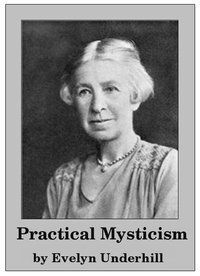
Evelyn Underhill, one of the greatest teachers of mysticism, points out in slightly different terms in Practical Mysticism, her most accessible work, that under extraordinary circumstances even the greatest cheese may become a mystic. A mystic is, in simple terms, someone who is in touch with eternity. Imagine how time distorts when you experience a death in the family, a long illness, a house fire, a war. Sometimes the occasion is happier, like when we fall in love or experience a rapturous moment in a scene of natural beauty. But more often than not, we are like a character in one of O’Connor’s stories. A violent action is the only thing that shakes us awake to the reality of eternity and our place in it. But how to maintain that stance? “The doors of perception are hung with the cobwebs of thought; prejudice, cowardice, sloth,” writes Underhill. A practical mystic doesn’t rely on “fleeting and ungovernable” experiences to blow away the cobwebs. A practical mystic trains her perception and will. She orients her heart to eternity.
The first step toward mystical practice has been made for me. My attention has been restricted, my movements confined. Faced with the suddenly undeniable reality of being unable to direct my own fate or the fates of my children, I have been forced into a mystic’s stance—which is not one of self-improvement or cleverness but of unknowing. “I do not require you now to meditate on [God] or raise various conceits, nor to form great and curious considerations with your understanding,” St. Teresa of Ávila told those who wished to learn her mystical ways. “I require of you no more but to look on [God].” A mystic is a patient observer of what already is—and what is, Underhill says, is God.
Yet mysticism doesn’t require inactivity and is not the province of “idle women and inferior poets,” as Underhill anticipates the objections of her challengers. She says, “The active man is a mystic when he knows his actions to be a part of a greater activity.” The pandemic implications are clear to me: We have become aware that staying home alone unites us in a common cause and that our private actions and mundane choices have meaning beyond our own daily lives. They always did, of course, and to believe so is part of having religious faith. But our attention has been turned by the novel coronavirus to, as Underhill writes, “new levels of the world.” A mystical moment is upon us, whether we’d have it or not.
So I have undertaken during this period of staying at home to, as Underhill put it, stand back and observe the furniture: that which was always there but has been overlooked because of my preoccupations, anxieties, and busyness. Can I work, then, to take the next steps according to Underhill—to recognize and simplify my affections, to reorient my heart?
read the rest at US Catholic.
Covid Mystics
I find myself repeating a prayer cribbed from Flannery O’Connor’s A Prayer Journal (Farrar, Straus and Giroux): “Oh Lord, I am saying, at present I am a cheese, make me a mystic, immediately. But then God can do that—make mystics out of cheeses.”
I wonder if a pandemic might also do the trick.
Evelyn Underhill, one of the greatest teachers of mysticism, points out in slightly different terms in Practical Mysticism, her most accessible work, that under extraordinary circumstances even the greatest cheese may become a mystic. A mystic is, in simple terms, someone who is in touch with eternity. Imagine how time distorts when you experience a death in the family, a long illness, a house fire, a war. Sometimes the occasion is happier, like when we fall in love or experience a rapturous moment in a scene of natural beauty. But more often than not, we are like a character in one of O’Connor’s stories. A violent action is the only thing that shakes us awake to the reality of eternity and our place in it. But how to maintain that stance? “The doors of perception are hung with the cobwebs of thought; prejudice, cowardice, sloth,” writes Underhill. A practical mystic doesn’t rely on “fleeting and ungovernable” experiences to blow away the cobwebs. A practical mystic trains her perception and will. She orients her heart to eternity.
The first step toward mystical practice has been made for me. My attention has been restricted, my movements confined. Faced with the suddenly undeniable reality of being unable to direct my own fate or the fates of my children, I have been forced into a mystic’s stance—which is not one of self-improvement or cleverness but of unknowing. “I do not require you now to meditate on [God] or raise various conceits, nor to form great and curious considerations with your understanding,” St. Teresa of Ávila told those who wished to learn her mystical ways. “I require of you no more but to look on [God].” A mystic is a patient observer of what already is—and what is, Underhill says, is God.
Yet mysticism doesn’t require inactivity and is not the province of “idle women and inferior poets,” as Underhill anticipates the objections of her challengers. She says, “The active man is a mystic when he knows his actions to be a part of a greater activity.” The pandemic implications are clear to me: We have become aware that staying home alone unites us in a common cause and that our private actions and mundane choices have meaning beyond our own daily lives. They always did, of course, and to believe so is part of having religious faith. But our attention has been turned by the novel coronavirus to, as Underhill writes, “new levels of the world.” A mystical moment is upon us, whether we’d have it or not.
So I have undertaken during this period of staying at home to, as Underhill put it, stand back and observe the furniture: that which was always there but has been overlooked because of my preoccupations, anxieties, and busyness. Can I work, then, to take the next steps according to Underhill—to recognize and simplify my affections, to reorient my heart?
read the rest at US Catholic.
May 20, 2020
The Church as muse
In my writing about faith, I’m always trying to keep my footing on the highwire. I hope that struggle speaks to people.

Thanks to Sister Julia Walsh for inviting me to be her guest on Messy Jesus Business. We talked about the arts, the usual suspects (Greene and O’Connor), and the Roman Catholic Church as both muse and provocateur.
Walsh is a writer and a Catholic sister living in community in Chicago, where she resists “comfortable Christianity” and has a hand in all kinds of good work, like the Kolbe House Jail Ministry. Her writing about faith is as challenging as it is inspiring. Follow her on Twitter @juliafspa
You can listen to the episode here.

Despite myself, nothing inspires me like sitting in a Catholic Church: https://www.patheos.com/blogs/sickpilgrim/2020/02/ash-wednesday-with-st-anne/
The Church as Muse
In my writing about faith, I’m always trying to keep my footing on the highwire. I hope that struggle speaks to people.
[image error]
Thanks to Sister Julia Walsh for inviting me to be her guest on Messy Jesus Business. We talked about the arts, the usual suspects (Greene and O’Connor), and the Roman Catholic Church as both muse and provocateur.
Walsh is a writer and a Catholic sister living in community in Chicago, where she resists “comfortable Christianity” and has a hand in all kinds of good work, like the Kolbe House Jail Ministry. Her writing about faith is as challenging as it is inspiring. Follow her on Twitter @juliafspa
You can listen to the episode here.
[image error]
Despite myself, nothing inspires me like sitting in a Catholic Church: https://www.patheos.com/blogs/sickpilgrim/2020/02/ash-wednesday-with-st-anne/
April 28, 2020
Major malfunction
The explosion of the space shuttle Challenger was a defining moment for my generation. We remember where we were when the shuttle exploded on January 28, 1986, killing all seven crew members. Most of us were watching the launch on live television. I was 9 years old and at home, sick with a January cold, convalescing in my older sister’s bed, which she’d never have allowed had she been home. When something had clearly gone wrong, a “major malfunction” as the announcer had said, I called for my mom.
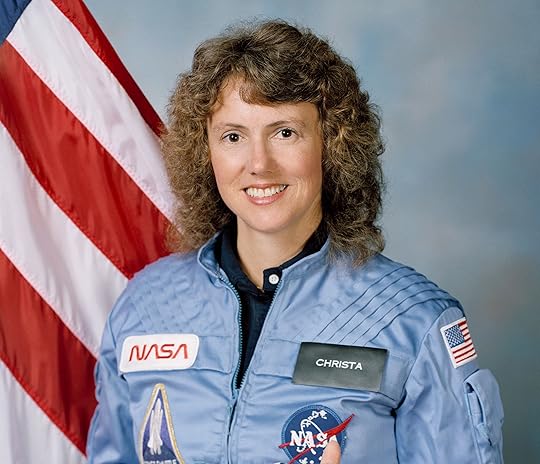
I remember it felt like a personal loss. Christa McAuliffe, the civilian teacher on board, looked like my mom, who was also in her mid-30s, with the same midlength perm and bangs. We lived in Slidell, Louisiana, home to a NASA computer facility and situated between two major NASA production sites in Mississippi and New Orleans. Many of my friends’ parents worked for NASA. McAuliffe really could have been any of our moms.
But even if you didn’t grow up in a town with close ties to the space program, you were, as a child in the mid-’80s, encouraged to be invested in McAuliffe’s space odyssey. She was going to teach us from space! A woman was ushering in the promised era of civilian space travel. The future was upon us. Instead, the Challenger tragedy resulted in widespread NASA layoffs and a chilling of the space program in general. The promised future didn’t arrive—or rather, it didn’t look anything like they promised.
Major Malfunction
The explosion of the space shuttle Challenger was a defining moment for my generation. We remember where we were when the shuttle exploded on January 28, 1986, killing all seven crew members. Most of us were watching the launch on live television. I was 9 years old and at home, sick with a January cold, convalescing in my older sister’s bed, which she’d never have allowed had she been home. When something had clearly gone wrong, a “major malfunction” as the announcer had said, I called for my mom.
I remember it felt like a personal loss. Christa McAuliffe, the civilian teacher on board, looked like my mom, who was also in her mid-30s, with the same midlength perm and bangs. We lived in Slidell, Louisiana, home to a NASA computer facility and situated between two major NASA production sites in Mississippi and New Orleans. Many of my friends’ parents worked for NASA. McAuliffe really could have been any of our moms.
But even if you didn’t grow up in a town with close ties to the space program, you were, as a child in the mid-’80s, encouraged to be invested in McAuliffe’s space odyssey. She was going to teach us from space! A woman was ushering in the promised era of civilian space travel. The future was upon us. Instead, the Challenger tragedy resulted in widespread NASA layoffs and a chilling of the space program in general. The promised future didn’t arrive—or rather, it didn’t look anything like they promised.