Nancy Flinchbaugh's Blog
March 18, 2025
Traveling Gullah Land, Writing Revelation on the Sea Island
My latest novel, Revelation on the Sea Island, involves a exploration of Gullah roots in the American South. To write this book, my husband and I traveled to the South twice, visiting Black heritage sites in Georgia, South and North Carolina. I went to learn about the past, and the people of the present.
I am a beginner. I am not an expert on Gullah culture, but I’m glad I’m learning. Although I studied American history in public school, and later became certified to teach American history, grades 6-12, I would say my understanding of the plantation system, the Jim Crow laws and the new Jim Crow laws have been a slow awakening for me. I would not say I am “woke”, but I am awakening and I think it’s an important part of my journey as a child of God.
I do want to applaud the many tourist sites in the South that have helped teach me. Quite a few years ago, I visited Brookgreen Gardens, with some friends who liked to spend a month at Myrtle Beach every winter. This remarkable place includes the land of four plantations. Anna and Hyatt Huntington of New York purchased the property, when Anna’s doctor recommended she spend time near the sea. They were determined to turn the former slave plantations into a place of beauty, employing local Gullah people, and telling the truth about the days of slavery. As a sculptress, Anna’s vision included an outdoor sculpture garden, now one of the largest in the country. Their house, built on the beach, Atalaya, is designed of Scottish moor, She kept live animals on the property, and her studio provided areas where they could live and be live models for her.
I remember being so impressed with their ingenuity and their creativity, starting this venture when they were both in their 50s. At the time, it gave me hope I could do more creative ventures as I aged. I loved walking through their gardens in February and see spring coming, several months before it would come back home in Ohio.
And then, I went to a presentation by Ronald Daise, their creative director at the time. He was once an actor on a Nickelodeon program, “Gullah, Gullah Land” about the Gullah people. He became the Director of Creative Education at Brookgreen. In a game show format, he taught us about the Gullah Geechee people, the enslaved Africans, kidnapped and brought to the sea islands. They already knew how to cultivate rice in the marshes of the South, so similar to their native land of Africa. He awakened in me a desire to learn more. I remember purchasing an artistic rendition of a Gullah woman and framing it for a friend, keeping a photo for myself. Daise has since retired, but he left his mark in the educational programs there.
And the seeds planted by Ron’s presentation continued to grow in me. A few years later, I aspired to write about the Gullah people. The MAMs (The Magnificent and Marvelous Book Club) who starred in my first novel, Revelation in the Cave (2012), started recovery/re-entry group homes in my second novel, Revelation at the Labyrinth (eLectio Publishing, 2017), In their next adventures, I decided to explore genealogy and DNA, and they discovered that some of the MAMs and their group home members had a variety of ethnic DNA. The fictitious MAMs wrote a grant to take their recovery individuals to the lands of their DNA. This led to Revelation in the Roots: Emerald Isle (All Things that Matter Press, 2022), an exploration of Ireland and their Irish roots, and then to my new novel Revelation on the Sea Island (All Things that Matter Press, 2025) exploring their Gullah/African DNA.
We visited Georgia, exploring the various tourist sites, with an eye to learning about Black history. We learned from a “Journey by Faith” Black history walking tour in downtown Savannah, seeing the places of the slave trade and hearing harrowing accounts of life for the early enslaved people. Visiting the auction building, the holding cell by the port, described as a place where grain was stored, where in fact, Africans were held with little ventilation or sanitation, makes the story come alive.
Near Savannah, we visited the Pin Point Museum, a place that free Blacks worked in the early days after emancipation, etching a good life for themselves in their Pin Point community, where many were able to purchase coastal land, unwanted by the plantation owners in the days after slavery.
From there, we landed on Hilton Head Island. Although this has become quite an upscale and expensive tourist attraction, it also still includes Gullah heritage sites. There, we enjoyed a Gullah Heritage tour, led by the Campbell family, descended from the Gullah people. It’s quite remarkable to see the Gullah neighborhoods that have survived and thrived, in spite of widespread development. We visited the site of Mitchelville, an early settlement of freed people, and also visited the Coastal Museum, as well as a sunset cruise, imagining life for the early Gullah residents there.
We learned that after slavery, before bridges and development, the Gullah culture thrived, as it did during slavery. Island life, removed from the mainland, provided a place for the Africans to maintain their culture. They continued speaking their native language, enjoying traditional food and social traditions, practicing spirituality, and making music in ways learned in their homeland.
In Charleston, South Carolina, we visited the Angel Oak, once part of a plantation, as well as went on a Gullah bus tour of the town, learning about the influences of Gullah culture and art on Charleston. Near Charleston, we visited the Boone Hall Plantation, which also told the story of the early Gullah people. And also, Cypress Gardens in Monck Corners. Most of these plantations have been turned into gardens, but also tell the story of the enslaved people who once lived there.
Our final stop on our way back north was Wilmington, NC, the northmost part of the Gullah Sea Island Corridor, which extends south to Florida. Here the freed Blacks thrived in the late 1800s, with their own newspaper and professional people, until the whites burned their houses and businesses down in 1898. Learning about the violence they faced and discrimination with Jim Crow laws, keeping them from full citizenship, is very disturbing to me.
The discrimination didn’t stop after the Civil rights movement. What has been called the New Jim Crow has incarcerated more Blacks that were once enslaved in a very intentional political movement. It is for that reason that I wanted to write about the Sea Islands and the Gullah people. I want to lift up the history of hatred and discrimination that has affected them. I also want to lift up the gifts of their culture that ripples into American life in so many ways.
I offer Revelation on the Sea Island, hoping that it will encourage others to visit and learn, and celebrate the Gullah culture and the African Americans among us.


March 17, 2025
February 21, 2025
Why I Wrote Revelation on the Sea Island
As I begin to launch my book, Revelation on the Sea Island, I’m taking time today to reflect on why I wrote this book, why it’s important to me and why I hope it will be important to you. Since I began my writing career over twenty-five years ago, I’ve been writing in Springfield, Ohio, the hometown of John Legend, a place where artists grow. I started because my friends told me, “Nancy, you’re a writer.” I began by exploring this idea by using Julia Cameron’s book, the Artist’s Way, a practice I continue to this day. I began to write essays, then I one morning, I decided to write a novel with God.
I first wrote Revelation in the Cave for peace. This book introduced the Magnificent and Marvelous Book Club (the MAMs), a diverse group of Christian ladies, spanning the religious and political spectrum. They read In Search of Paul by John Dominic Crossan, an exploration of the early church in light of new discoveries about the Roman Empire. When they became enamored with Thecla on the cover of the book, they embarked on an archaeological dig in Turkey, which shed new light on the book of Revelation.
The MAMS next adventure, Revelation at the Labyrinth, I wrote for the Earth. After reading about environmental issues, including Al Gore’s book, The Inconvenient Truth, they wanted to take action. They created recovery/re-entry group home cottage industries, including an organic farm and a solar panel business for men and women. Their story unfolded with hope: healing, recovery, and solutions to climate change. There are rarely dull moments with the MAMs.
Next, the MAMs began a round of reading exploring of genealogy. They capped it off with getting their DNA tested, offering this also to their group home members. After discovering diverse roots, they applied for a grant to take their re-entry, recovery group members to the lands of their DNA: Ireland, Gullah land of the Sea Islands, and West Africa. The third MAMs novel, Revelation in the Roots: Emerald Isle unfolded as they flew to Ireland to explore Irish roots, play tourist and grapple with political differences among them.
Next up, the MAMs read about the Gullah people and traveled to explore their West African roots in the American South, in Georgia, South Carolina and North Carolina. Hence, I wrote Revelation on the Sea Island as I followed the journey of the MAMs and their group home members. They visited former plantations, learning about life for enslaved Africans, as well as their liberation.
Why did I write this book? In part, because I follow my characters into their stories. This was their adventure. But I join them in believing it’ s important to learn about the history of African Americans in our country. For the hundreds of thousands of Africans who were kidnapped from their native land, forced into servitude to build the American South and develop wealth for the plantation owners, the story is important. As I continue to learn about the many ways the descendants of those West African Gullah people have been mistreated in my country for over four hundred years, I want to speak up.
I wrote this book, as I learned, as I came to respect and honor the Gullah culture. I wrote this book as I traveled in the American South to African American heritage sites. And I wrote this book because I believe we are all connected. Some people have both Irish and African DNA, as do some of the MAMs and group home members. All people have human DNA, which connects us and I believe should bring us together. I wrote this book as I continue to hope for justice and fairness for all people in my country.
October 12, 2024
About My Writing as a Christian Contemplative
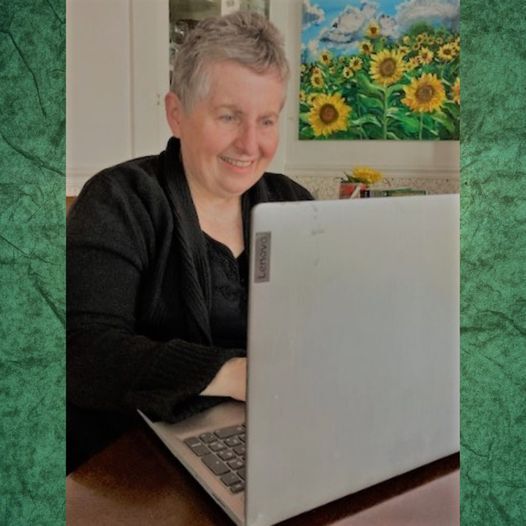
Hi! I’m Nancy Flinchbaugh, a Christian contemplative, seeking to write books for change, for peace, for justice and the Earth, close to the heart of God. I consider my writing as a spiritual practice. Every morning, I meditate for 20 minutes. After meditating, I journal and then I write. My books contain elements of contemplative practice. My fictional characters engage in meditation, labyrinth walking, silent retreats and contemplating nature. My nonfiction books include my experiences with contemplative practice and instructions for others seeking to engage in contemplative practice.
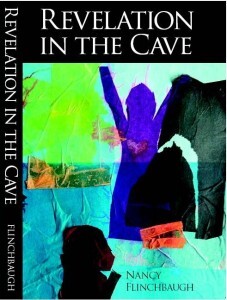
Revelation in the Cave (Spiritual Seedlings, 2012) I finished this book while in training with the Shalem Institute for Spiritual Formation on Leading Contemplative Small Groups and Retreats. This book features the Magnificent and Marvelous Book Club (the MAMS), as they retrace the journeys of St. Paul on a Mediterranean cruise and engage in a dig in Turkey at the archaeological site of Ephesus. The book speaks for peace and concludes on Patmos at a conference of mystics.
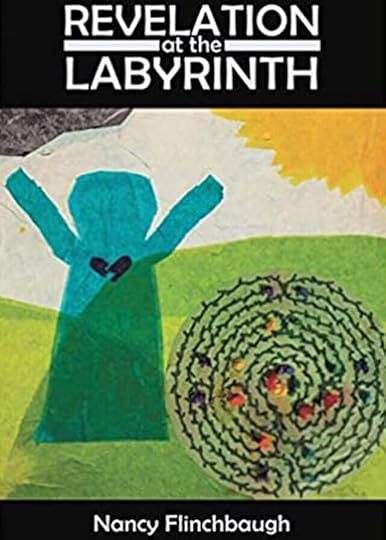
Revelation in the Labyrinth (eLectio Publishing, 2017) The ancient walking meditation design of the labyrinth provides a guiding motif for this novel. It features “The Living Vine Labyrinth,” created at my church while I was in the Shalem program. The MAMs read about climate change and act on a call to create an organic farm for women in recovery and re-entry. The ecospiritual visionary thoughts of Fr. Thomas Berry are highlighted. Thomaseena moves from prison into the MAMs program, finding a healing path. It’s a message of healing and hope for individuals and the Earth.
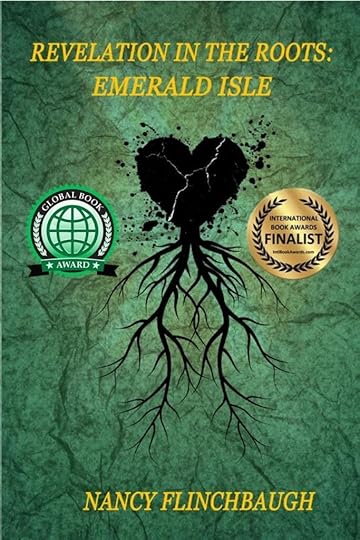
Revelation in the Roots: Emerald Isle (All Things That Matter Press, 2022) In this novel, the MAMs take up reading about genealogy. After some of them discover their combined Irish/African DNA, they journey to the lands of origins, beginning with Ireland. As they explore the Emerald Isle, they engage in silent retreats, labyrinths, and listening circles. St. Brigid, Grand Ma Ma and a leprechaun conspire to create a lively exploration of roots, and political differences. A message of hope, love and bridging the things that divide us.
Revelation on the Sea Island has been accepted for publication with All Things That Matter Press, and I’m currently writing Revelation in West Africa. In these sequels to Revelation in the Roots, the MAMs continue to explore the lands of their DNA.
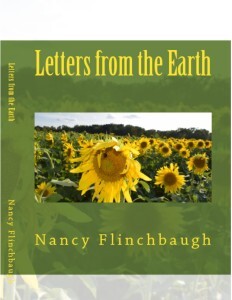
Letters from the Earth (Higher Ground Books and Media, 2018) Inspired to write letters to myself from the Earth by Joanna Macy and Chris Johnstone in their book Active Hope, I discovered wonderful messages of hope and guidance as I grappled with climate change and other life events. This memoir includes 24 letters I received during a year in my life, with my introductions and responses. I believe these are messages from God that I received while journaling after meditation. The practice of Lectio Divina is featured in this book, as well as a contemplative retreat.
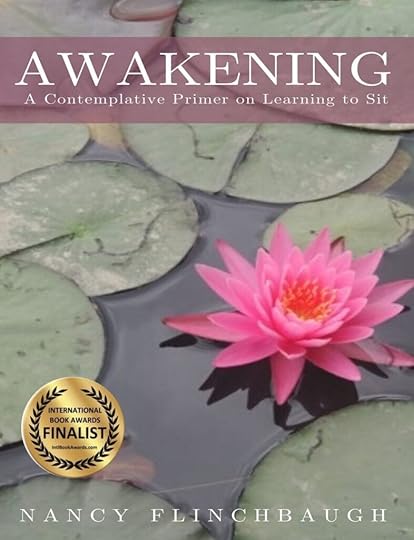
Awakening: A Contemplative Primer on Learning to Sit (Higher Ground Books and Media, 2020) I started this book when planning a weekend retreat to introduce contemplative practices to my friend’s church. The book provides a primer on a variety of contemplative practices, including a summary of each practice, my personal experiences of the practice, a letter from the Earth on each practice, as well as suggestions for individual and group practice.
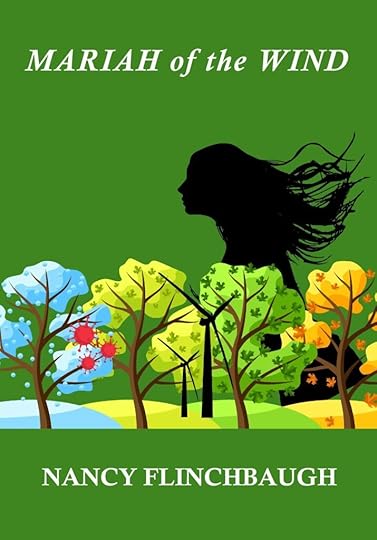
Mariah of the Wind (All Things That Matter Press, 2023) As my contemplative practice leads me into love, I feel a growing connection with all of God’s creation. In this environmental love story, I write about Mariah, a young woman with indigenous roots who is enamored with the Earth. She meets a grieving wind scientist who is harassed by a troll from the fossil fuel industry. Mariah meditates, takes walks in nature and seeks healing for our Earth.
Find out more about my writing at nancyflinchbaugh.com. Follow me on Facebook at Nancy Flinchbaugh Author and on YouTube@nancyflinchbaugh for a variety of videos and interviews exploring themes in my writing. My books are available on Amazon (Paperback/Kindle/Audible), Barnes and Noble, and from the publishers. Signed copies also available by emailing Nancy.Flinchbaugh@gmail.com.
July 19, 2024
Guest Blog: Writing for Change: Who Am I? By Rev Dr. Ken Whitt
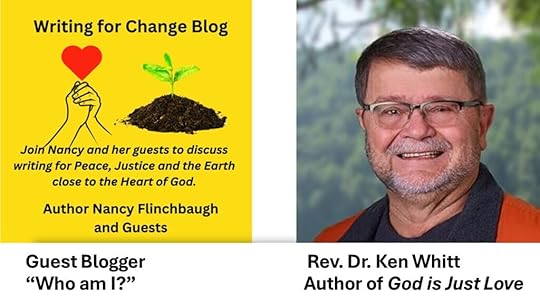
I recently interviewed Rev. Dr. Ken Whitt about his work writing for change. We talked about his book, God is Just Love. In this guest blog post, Ken writes about his work to help us all live God’s love and find ways to be resilient, build community and develop adaptive skills in the midst of climate change and collapsing structures.
Who Am I? My name is Ken Whitt. I am a retired American Baptist Pastor, having served local churches for over 45 years, and counting. I am a Spiritual Counselor, retreat leader, and the Executive Director of the spiritual formation ministry, “Traces of God.” I live in the community of Hide-Away Hills, Ohio, a neighborhood association of 740 families where I volunteer as the chair of the Children And Family Enrichment Committee (CAFÉ) and am responsible for communicating with our community on behalf of the Emergency Preparation Team (EPT). I am an artist in the medium of wood. I am happily and wonderfully married to Kathy, have four children and fourteen grandchildren.
My identity as I write this blog is that I am an author who has written a couple of books, a Doctoral dissertation on the subject of transformation, many articles and a few thousand sermons. The most relevant writing that led to my interview with Nancy Flinchbaugh, on the subject of writing for change, is my book, “God Is Just Love; Building Spiritual Resilience and Sustainable Communities for the Sake of Our Children and the Creation,” published at the very moment that a pandemic was overwhelming and disrupting our lives in so very many ways, including a severe disruption of our plans to promote the book.
What Change Was I Seeking When I Wrote, “God Is Just Love”? That’s easy. I was writing on behalf of, and in obedience to, God who is Just Love, to encourage the spiritual journeys of everyone who has learned that knowing God as Just Love, is the one and only way we can become this love. Being one with God, being Just Love, empowers us to live well no matter what circumstances we encounter in our lives. In the midst of suffering, grief, crisis, hopelessness, we can become love and be loving, no matter what is going on in our lives and our world. No exceptions.
Why is knowing Just Love and becoming this love so critical right now? This emotional and spiritual goal has always been the most important purpose of our lives. However, the collapse of empires—this being the ongoing reality of our lives and our world—and the collapse of the systems that we have come to depend on for our well-being—all kinds of systems, such as governments, economic institutions, environment, religious structures, and many more—guarantee that Just Love, knowing and being this love, is the only road that we can travel is we want to live well and confidently and with hope and joy, as the world crumbles..
Towards whom must I Be Love? In other words, specifically, to whom am I do direct my loving action in these dangerous days? I hope you will read my book, “God Is Just Love,” because I tried very hard to share what I have learned, often the very hard way, to know and to be love. First and foremost, I am to be love to my wife, our children and grandchildren. I am to, by words sometimes, but mostly by example, teach them to know and to be love. Second, I am to be this love to my communities. For me this primarily includes the community of Hide-Away Hills and the spiritual community of Carbon Hill Christian Church. My books, and other writings, certainly reach out towards larger communities. I participate in various conversations with some friends in international communities. But, where I can most effectively be an agent for transformational change in with my family, friends and neighborhood. Ultimately, all solutions to the crisis of our world will be local.
How do I put Just Love into practice in these communities? In a lot of ways. I bake bread and make soups and distribute them freely and widely, simply as random acts of kindness and sometimes in response to people who are suffering and need to know that someone cares. I become a leader who knows that all the people I serve have themselves the capacity to be kind and generous and filled with hope and love. I invite my grandchildren to spend a day and an overnight with Kathy and I. They learn to love and they learn skills that will help them to adapt to the changes they are likely to experience in their lifetimes; adaptive skills like building fires and cooking outdoors, building wood projects with hand tools, baking break, weaving rugs, knowing and loving the forests and the gardens and all of God’s creatures and the whole creation, foraging, and many more. I write articles for my community on how to be prepared for calamities, the kind that already happen frequently and the kind that humanity will inevitably face in a collapsing world.
Summary? God is Just Love. We can know and become this love. We can awaken everyday and find a way to be loving in a way that empowers us personally to not give into despair and fear. We can lead others to find the path that will lead them towards the fulfillment of the purpose of their lives, no matter the crisis they face.
You can listen to my interview with Ken at these links: YouTube Spotify Apple Podcasts Amazon Music.
Connect with Ken by email at: drkenwhitt@gmail.com
Follow “Traces of God Ministries” on Facebook at: www.facebook.com/groups/TracesofGodMinistries
Writing for Change: About my Interview with Author, Leah Rampy who is Reweaving Earth and Soul on the Edge of Loss
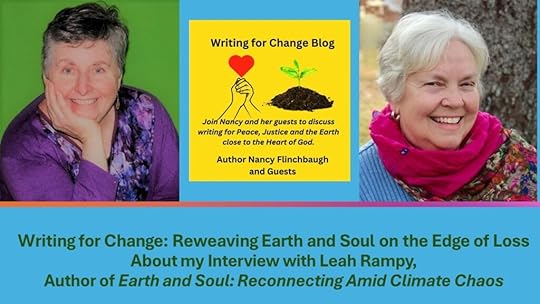
In this blog post, Author Nancy Flinchbaugh discusses her recent interview with Author Leah Rampy, author of Earth and Soul: Reconnecting Amid Climate Chaos. Leah writes to reweave earth and soul on the edge of loss. Listen to Nancy’s interview with Leah on YouTube.
Recently, I interviewed Leah Rampy, a writer, speaker, retreat leader and educator. In her work, Leah weaves ecology, spirituality, personal stories, and practices to help others deepen their relationship to the natural world.
I first asked Leah about her background. She told me her past careers have included teaching and working in the corporate world. She led training and development departments as an executive coach and also did leadership development as an entrepreneur. Then, she led the Shalem Institute for Spiritual Formation for six years as the executive director. Now, in addition to her writing, she leads retreats and a monthly gathering of the Church of the Wild Two Rivers. She lives in Shepherdstown, West Virginia with her husband in a cohousing community. She’s also active in a local group called “Save our Soil.”
Leah has been very concerned about climate change for the past few decades and wondered what she could do about it. In 2013, she and her daughter attended Al Gore’s Climate Reality Training in Chicago which is based on an updated version of his book and movie An Inconvenient Truth.
While living in the DC area, she connected with the group “Biodiversity for a Livable Climate.” She learned more about how carbon dioxide is causing warming in the world and how detrimental this has been. She became aware of the challenges of ecosystem and species loss as well as the impacts including melting ice, rising oceans, increased storms, droughts, and floods.
She told me, “We can go on and on with that, because we know we’ve really changed the world significantly from the time that we were young. And then I became more aware or the incredible impact to lose all of these beautiful, wonderful, wild places.”
She began weaving the Earth issues into her retreats, inviting people into practices that would help them connect more deeply. She taught, “Love more. Love the earth more.”
Gradually she became clearer on what she wanted to say and began to write. She explained, “When you write, you have to put it on the page and that helps you clarify.” Her goal became offering spiritual practices to deal with the climate change situation that would also help people discern what is theirs to do.
Leah talks about spiritual practices involving both the inward and outward approach. The outward practices help us connect more deeply, more fully, with the world around us.
Leah laments that Western culture teaches that Earth is other, leading us into deep loneliness. We’re lonely for connections to the living Earth, but don’t even realize it.
Therefore, she advocates for practices that invite us to reconnect with the Earth.
One approach is to use our senses to connect, gazing and listening more deeply to the Earth, and opening to the senses of smell and touch. We can be aware while eating that we are actually eating the natural world. These very basic practices require slowing down and dropping from our head to our heart.
“The world is full of magic things, patiently waiting for our senses to grow sharper.” [i] Leah recommends going outside and focusing on a very small area in nature, thinking about all that is happening and evolving in that little space. Whether you understand exactly what is happening scientifically or not, you can still be amazed. The call is to pay attention, seeking not only connection but communion.
We must also engage inward on the journey to heart and soul. She teaches us to cultivate openness and spaciousness, to listen in discernment for Wisdom deep within, for a true sense of who we are and who we’re called to be.
She explained, “In going out into the living world we become more deeply attuned to ourselves. And in becoming more deeply attuned to the essence of our soul, we are more open and available to that living world. So, it’s woven together. It’s not an either/or journey.”
We talked about grief. As we become more in tune with the living world, we are subjected to grief because the world is changing. We have changed the world, and also change is part of the natural cycle. She noted we are tempted to shut down and not connect, because we are afraid of the loss. Yet she explained, “When we dull ourselves to loss, we also dull ourselves to joy and beauty and wonder. I think those live together. As we bear witness to the losses and grieve for the many things that are no longer what they once were — for lands, for us, for waters, then I think we also need to be attentive to the beauty that is still around us, and the beauty that is within the losses. That helps sustain us.”
Mr. Rogers used to say that we can look for helpers when something is really difficult. She suggests we need support for our heart and soul when it’s breaking.
One of the spiritual practices Leah recommends in her book is to take a long strip of paper and on one side to write everything that you love about the Earth. On the other side, write your grief about climate change and the loss of the natural world. Then tape them together, like a mobius strip, to see that the joy and the grief are interconnected.
Leah talked about how each of us must find what is ours to do. We must ask: “How are we being called?” She believes our answers will evolve as spend time listening to the Earth.
Rather than making a list of 10 or 100 things to do, she encourages us to take the time in discernment to find what is written within us, what gifts are calling us to action in this time. A daily walk can be a good time to listen.
She cautioned, “We have such good intentions about things we want to fix, and try to move into fixing something, but this is human-centric.” We may think we are here to fix the earth, but the Earth has age and wisdom. Instead, we must listen for what wants to unfold and match that to our gifts and our calling. And it’s so important to join in community, particularly with our friends and neighbors. “I’m not suggesting that’s an easy process,” she added. “But this leads to helping birth what’s waiting to be born.”
She suggests that we are hospice workers and midwives asking the Earth, “How can we to help?” Perhaps a forest or woods nearby need guardianship, so protect it from being cut down. Or perhaps they need someone to weed out invasive plants, such as garlic mustard?
Keep listening for what the Earth is telling you about what’s invited. Some are invited to big things on the world stage. Many are invited to things that are very near home. Plant a garden. Give some food to the pollinators. Save the dandelions for the bees in spring. There are myriads of things that we can do when we are attentive, available and present.
Leah and some of her neighbors have started a group called “Save our Soil,” as they realized the importance of soil health. They support regenerative farming, raising awareness of those farms around them that are engaged in that practice. They support both growing and buying local food. They work at composting and encouraging others to do likewise. They plant native plants for pollinators. In the cohousing community where she lives, they have very small yards, so it’s easy to plant food of some sort, food for people and the critters, rather than grass. They give tours and presentations. She found these things to do very close to home, with friends, and they support one another.
She talked about the concept of biomimicry which involves asking what would Earth do here? You let the Earth be a model and a teacher as you observe the incredible things that Earth is already doing. For example, watch beavers bringing water back to the land. They can go into a place that seemingly has no water anywhere and go to work. All of the sudden there are streams everywhere. Look for how Earth would solve these challenges. Ask what the Earth wants to flourish.
Leah also seeks to give encouragement to people who work so hard in the environmental area and don’t see changes. She tells us that it’s okay to say that in our lifetimes we can’t do it all, but remember the Earth has miraculous ways to heal herself. This is not an invitation to do nothing, but to do what we can. We plant the seeds but may not live to see them harvested. We lay steppingstones to a future where there is more of a sense of mutual well-being and flourishing and less othering.
Leah reminds us that we are part of a huge history where the cosmic story is so important. We’re a part of that 13.8 billion years, not just this little hair on the timeline and not the end of the story. It’s still very important to do what we can, as we are called, and to not lose hope. There’s more that is possible beyond what we now know or understand. Leah explained that this is not a Disneyland sort of hope with beauty and balloons, but rather an active hard hope, knowing that you know we are doing everything that you believe you were called to do, in collaboration with the living world, for the collective well-being of all.
Leah is co-authoring another book with Beth Norcross, Discovering the Spiritual Wisdom of Trees, to be released in spring of 2025. This book grew out of a class they led together. Broadleaf Books approached them about writing it into a book. Leah said that she loves trees and that it’s a joy to be learning more and writing more about them with Beth.
Leah Rampy began the Church of the Wild Two Rivers five years ago, part of the wild church network extending across the United States and Canada. These churches have a common theme of inviting people into deeper spirituality in the living world. They meet once a month with people from different denominations and no denomination. People may have different religious traditions, but together they are focused on spirituality in the living world, connecting more deeply to the land, the trees, and the water around us. Leah explained, “We meet and connect around a theme for a little bit. For the sermon, we go for a forty-minute silent walk within nature. Then they come back together to share what they observed and noted during their walk. They might have a song or a dance. People share their own gifts. The important part is we’re in this practice together, connecting and learning from being open to the world around us.”
I am so grateful for Leah Rampy’s work in bringing this teaching to us. My life has been enriched by reading her book Earth and Soul: Reconnecting Amid Climate Chaos, listening and learning from her as I continue to live what is mine to do in these late days of the changing climate.
I encourage you to connect with Leah through her website at leahmoranrampy.com where you can sign up for her newsletter, find a link to purchase her book and find her upcoming events. For more information about Save our Soil, visit their website at https://www.saveoursoilwv.com/and learn more about the Church of the Wild Two Rivers at: www.churchofthewild2rivers.com. If you would like to listen to our full interview, you can find the podcast on YouTube, Spotify, Amazon or Apple Podcast.
And if you are also writing for the Earth, please do contact me at nancy.flinchbaugh@gmail.com so I can interview you about your work. Find out more about my own writing for change and the Earth on my website at nancyflinchbaugh.com.
[i] This quote is often attributed to the Irish poet, William B. Yeats.
Writing for Change: Joyce Gardner Hurd Writes for the Deaf
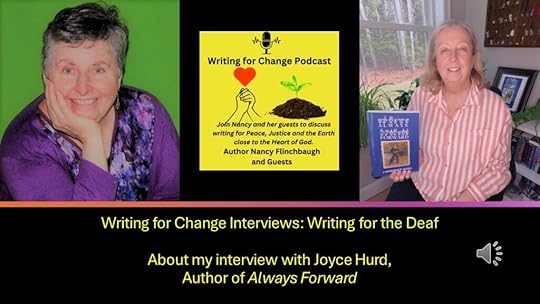
Recently, I interviewed Joyce Gardner Hurd, an author of fiction, essays and short stories. Originally from Massachusetts, Joyce now lives on the seacoast in New Hampshire with her Maine Coon cat, Kiki. She enjoys traveling, reading, gardening, cooking, seeing friends. Growing up as a child of deaf parents gives her insight into the worlds of silence, physical disabilities, and the stereotypes they faced.
After retiring from her career as an advertising executive in the Boston area, Joyce decided to return to college to fulfill an earlier dream of becoming a writer. She completed a degree in creative writing. Her debut novel, Always Forward, was published by All Things That Matter Press in 2023. She also has published essays in the 2020 Spring issue of the SNHU Penman as well as in the 2020 Boston Book Festival. She enjoys writing both essays of current events and personal reflections as well as longer form fiction.
As the child of deaf adults (CODA), Joyce was motivated to write her first novel. She told me, “My parents were pretty remarkable. I think that deafness is very misunderstood, by people who don’t know anybody that’s deaf. My motivation was to write about my parents, mostly my dad.”
She explained to me that there are ranges of deafness and that you can’t define people just by their deafness, because deaf people are such a diverse group of individuals. She laments that often the label of being deaf is very limiting and unfair. Joyce knows that deaf people are amazing people, with their own culture and their own language. She wanted to explore this in her writing.
While the main character, Alex, was based on her dad, she cautions that his fictitious wife was not her mother. She had to warn her brother that ahead of publishing the work. When you read the novel, you’ll understand.
Many of the challenges her dad faced on a day-to-day basis included being dismissed out of hand because he was deaf. Another problem he faced was not being able to enter the military, which still happens today.
She also depicted Alex’s mother similar to her real-life paternal grandmother. Some book reviewers complained that this character wasn’t well-rounded enough and appeared too saintly. Joyce explained to me that was her grandmother’s true personality.
One of her goals in writing was to demonstrate what a deaf man could do, even in the 1940s and 1950s when there was much less awareness of deafness and much more discrimination.
I asked Joyce what change she wanted to see come from her writing. She told me that she hopes those who read the book will learn to be more open-minded about deaf people and realize that one size doesn’t fit all. Her own dad had a long career as a printer, which was a great occupation for deaf men at that time. They entered that profession because all that noise didn’t really bother them. He had a house, a family, a career, and friends. She also wants people who are deaf to see that about themselves. She wants them to know that they are seen, that they are heard, that they have a voice and that they can be represented in art.
I thought Joyce did a great job showing the intelligence of her main character, Alex. He was very capable of learning complicated mathematical theories, although people often assumed he was incapable because he was deaf. After reading this book myself, I do believe the next time I see some people signing in public, I’ll remember Alex, and think to myself, “I bet that person is very intelligent,” as I remember Alex.
Joyce also cautions that sometimes people with disabilities are put on a pedestal, assuming they have no faults. This is sometimes called the saintliness of a disability. She explained, “I wanted to show that just because you have a handicap, that does not mean that you’re always perfect or a good person. Deaf people are three-dimensional.”
Her father, born in 1927, used to tell them as he shared family stories that many children who were deaf in that period were institutionalized, such as his good friend’s sister. Her dad observed that as they got older, his friend had a difficult time trying to absorb the contrast between his sister’s life vs. Joyce’s father, who lived a very full life. She said that was very sad.
I recommend that you read Joyce’s book, Always Forward. It’s a great book and a riveting story, gently written and I really enjoyed it.
Look for Joyce’s next novel, a coming-of-age story of a young woman in the seventies in the New England. The story takes place in America and Nova Scotia, the places of Joyce’s family. The woman is not deaf but faces other challenges.
Follow Joyce on Facebook a J. Gardner Hurd and check out her website at jgardnerhurd.com. Always Forward is available on Amazon and Barnes and Noble.
Listen to the interview on Spotify, YouTube, Amazon Music, or iTunes.
Guest Blogger Steve Schlather Writes for the Earth
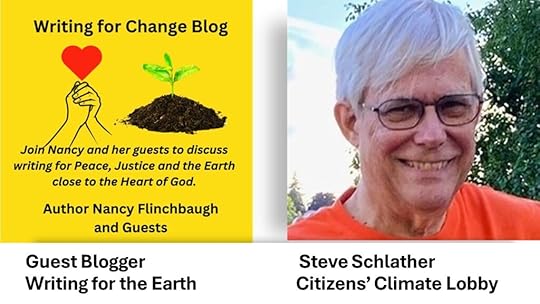
Steve Schlather is retired from careers in daily newspapers as a reporter and copy editor and from doing outreach and education for recycling and waste reduction. He is the leader of the Springfield, Ohio chapter of Citizens’ Climate Lobby.
Listen to Nancy’s interview with Steve Schlather on YouTube
The climate scientist Katharine Hayhoe says the most important thing we can do about climate change is to talk about it – bring up the subject of our changing planet in everyday conversation. If we don’t talk about something, no one realizes that other people like them are concerned about that issue.
I try to follow that advice. So, if someone asks me what I’ve been up to, I’ll often remark that I’m spending a lot of my time working on climate advocacy through Citizens’ Climate Lobby, then wait to see how the other person responds. Usually, their reactions fall into one of three categories:
1. Someone who quickly changes the subject or gives me a blank look, like I just said I’m learning to juggle weasels. These are people who don’t understand how serious climate change is and/or don’t want to think about it.
2. Someone who launches into a recitation of what they’re doing about climate change or what the real solution is. These are people who understand the gravity of the situation and are trying to respond to it. (This is a small group.)
3. Finally, some people ask me questions, such as “what is Citizens’ Climate Lobby?” or “does advocacy really make any difference?” These are folks who have some sense that the changing climate is a threat to people they love but are what to perplexed about what to do.
The folks in category 3 are the ones I really focus on, because they have a feeling they should be doing something to address climate change, but don’t know what would be effective. Citizens’ Climate Lobby exists for people like this, people very concerned about the changing climate, but unsure how they can make a difference. CCL brings people together to work on the climate issue, provides training and support, and identifies promising legislation to advocate for. When you join CCL, you get a variety of action items that you can do on your own or with others. These range from easy, quick things like making a phone call to longer things like tabling for two hours at a festival to really challenging efforts like planning a months-long campaign to influencing office holders. You decide what works for you and get involved in working for more sustainable society.
If you want to learn more about CCL, here’s a few options:
1. Explore the CCL website (citizensclimatelobby.org) to learn more about our approach. You can find your local chapter by going to the “About” tab and scrolling down to chapters.
2. A 45-minute informational session to introduce newcomers to CCL is held on Zoom every Wednesday at 8 p.m. ET. Sign up and get the Zoom link on the website by going to the “Take Action” tab, scrolling over to “Get Started” and down to “Informational Session.”
3. If you want to learn more about the Miami Valley CCL group, email me at sschlather@sbcglobal.net. If you get involved with our group, you’ll meet some dedicated, thoughtful people who are also good company.
4. One quick way to see our group in action is to join the Thursday evening Laser Action Call, at which we meet on Zoom, take one or two simple actions, and end by 7:15. Here’s the Zoom link:https://us02web.zoom.us/j/89566741720?pwd=ZHI3NXErWVBKY1RCa0xpK05mdW5MUT09
May 6, 2024
Writing for Change:
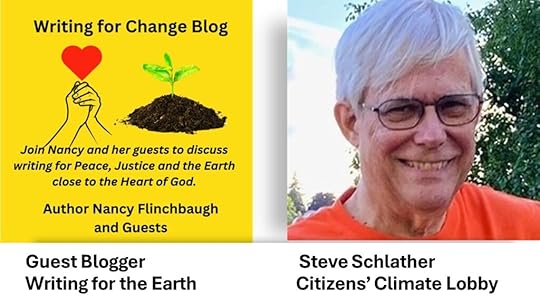
Steve Schlather is retired from careers in daily newspapers as a reporter and copy editor and from doing outreach and education for recycling and waste reduction. He is the leader of the Springfield, Ohio chapter of Citizens’ Climate Lobby.
The climate scientist Katharine Hayhoe says the most important thing we can do about climate change is to talk about it – bring up the subject of our changing planet in everyday conversation. If we don’t talk about something, no one realizes that other people like them are concerned about that issue.
I try to follow that advice. So, if someone asks me what I’ve been up to, I’ll often remark that I’m spending a lot of my time working on climate advocacy through Citizens’ Climate Lobby, then wait to see how the other person responds. Usually, their reactions fall into one of three categories:
1. Someone who quickly changes the subject or gives me a blank look, like I just said I’m learning to juggle weasels. These are people who don’t understand how serious climate change is and/or don’t want to think about it.
2. Someone who launches into a recitation of what they’re doing about climate change or what the real solution is. These are people who understand the gravity of the situation and are trying to respond to it. (This is a small group.)
3. Finally, some people ask me questions, such as “what is Citizens’ Climate Lobby?” or “does advocacy really make any difference?” These are folks who have some sense that the changing climate is a threat to people they love but are what to perplexed about what to do.
The folks in category 3 are the ones I really focus on, because they have a feeling they should be doing something to address climate change, but don’t know what would be effective. Citizens’ Climate Lobby exists for people like this, people very concerned about the changing climate, but unsure how they can make a difference. CCL brings people together to work on the climate issue, provides training and support, and identifies promising legislation to advocate for. When you join CCL, you get a variety of action items that you can do on your own or with others. These range from easy, quick things like making a phone call to longer things like tabling for two hours at a festival to really challenging efforts like planning a months-long campaign to influencing office holders. You decide what works for you and get involved in working for more sustainable society.
If you want to learn more about CCL, here’s a few options:
1. Explore the CCL website (citizensclimatelobby.org) to learn more about our approach. You can find your local chapter by going to the “About” tab and scrolling down to chapters.
2. A 45-minute informational session to introduce newcomers to CCL is held on Zoom every Wednesday at 8 p.m. ET. Sign up and get the Zoom link on the website by going to the “Take Action” tab, scrolling over to “Get Started” and down to “Informational Session.”
3. If you want to learn more about the Miami Valley CCL group, email me at sschlather@sbcglobal.net. If you get involved with our group, you’ll meet some dedicated, thoughtful people who are also good company.
4. One quick way to see our group in action is to join the Thursday evening Laser Action Call, at which we meet on Zoom, take one or two simple actions, and end by 7:15. Here’s the Zoom link:https://us02web.zoom.us/j/89566741720?pwd=ZHI3NXErWVBKY1RCa0xpK05mdW5MUT09
You can listen my interview with Steve on YouTube, Spotify, iTunes or Amazon Music.
April 28, 2024
Writing for Change: Writing Mariah of the Wind
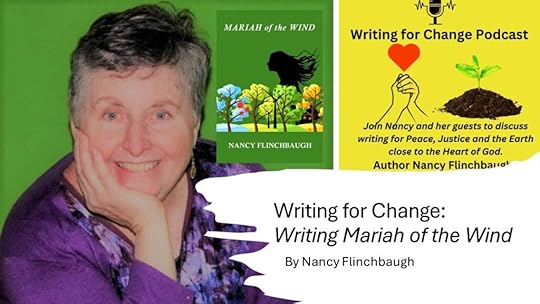
As Earth Day comes this year, I’m reflecting on my work to Write for Change in how we treat the Earth. And so today, I want to tell you why I wrote my most recent book, Mariah of the Wind.
First of all, let me say that I keep writing books because I believe that God is still speaking. I believe God speaks through us. I believe God and I write together. We are writing important things for people to hear today.
Every morning, I begin the day in God’s presence in meditation, and then I write. I let my book unfold as I write, rather than plotting it out. In Mariah of the Wind, I hoped to celebrate the beauty of God’s creation, and to speak up about climate change.
I started this book with a young woman, Mariah, who loves the Earth like I do. You’ll see her walking among autumn trees, taking fall leaves back to the diner to share with her customers. You’ll watch her twirl through the winter snow. You’ll see her planting seeds in the greenhouse, and later transplanting them into the ground in spring. You’ll accompany her as she enjoys spring wildflowers, tulips and daffodils. Later, comes summer. I wanted to celebrate the miraculous transformations of the seasons with my words.
She meets a grieving wind scientist, a target of a troll from the fossil fuel industry. And the story continued to unfold from there, during the pandemic.
As a Christian, I believe I am called to be a good steward of the Earth. I invested all the time to write, rewrite and edit this book to join the cacophony of voices calling us to change our ways, move away from fossil fuel use and take better care of God’s miraculous creation.
One of my early reviewers started her review saying, “if you like happy endings, you’ll like this book.” I have to admit that I do like happy endings. I choose to remain hopeful. But as the Catholic priest, Thomas Berry, once wrote, we live in the Ecozoic Age in which we must come to terms with our relationship with Earth. We must make needed changes now. He also said, “We will walk together into the future as one sacred community, or we will perish in the desert.”
Some of my readers tell me this is my best book yet. I hope you’ll read it and enjoy it and that it will inspire you to love and care for God’s magnificent creation!
You can read more about it on my website with links to purchase at: Mariah of the Wind. Watch a trailer about the book on my YouTube channel at: Mariah of the Wind Trailer. Listen to a podcast version of this blog at Why I Wrote Mariah of the Wind. Listen to My interview with Jean Bloom, the Audible narrator of the book.