Dominic Carrillo's Blog
March 24, 2023
new WWII/Holocaust historical fiction
Just wanted to share with all Goodreads readers that my new book is out, and if you're into Salt to the Sea or The Book Thief, then you might want to put this on your TBR list! It came out on March 21st and I'm just trying to spread the word-- hoping for new readers and reviews. Please check out the ACTS OF RESISTANCE page for more info. Thanks, Dominic
https://www.goodreads.com/book/show/8...
https://www.goodreads.com/book/show/8...


October 16, 2021
LBB featured book at Texas Book Festival
Honored to have my short story mentioned in the Texas Book Festival post on their upcoming event, featuring "Living Beyond Borders: Growing up Mexican in America." Check it out:
https://www.texasbookfestival.org/202...
https://www.texasbookfestival.org/202...
June 11, 2019
Sequel to The Unusual Suspects is out!
NIA AND THE DEALER came out last week and already has some great reviews! Nia is on the run again, and this time her rebellious mission takes her down the coast of California with a questionable guy named Jesse and new dangers.
Perfect addition to your summer reading list: https://www.goodreads.com/book/show/4...
Perfect addition to your summer reading list: https://www.goodreads.com/book/show/4...
May 6, 2018
The Unusual Suspects- new YA novel
FREE Kindle book for contemporary YA fans!
THE UNUSUAL SUSPECTS
School Library Journal said, "This fun, fast-paced novel will appeal to fans of contemporary coming-of-age stories about finding family in the most unexpected of places. VERDICT: A fun contemporary adventure for teens clamoring for a road trip gone wrong with a Murder on the Orient Express vibe."
Please spread the word about this 2-day promo freebie!!!
https://www.amazon.com/Unusual-Suspec...
THE UNUSUAL SUSPECTS
School Library Journal said, "This fun, fast-paced novel will appeal to fans of contemporary coming-of-age stories about finding family in the most unexpected of places. VERDICT: A fun contemporary adventure for teens clamoring for a road trip gone wrong with a Murder on the Orient Express vibe."
Please spread the word about this 2-day promo freebie!!!
https://www.amazon.com/Unusual-Suspec...
June 18, 2017
99 cents! June 18-20th
In celebration of the SD Book Award-- my novel is 99 cents for the next 24 hours. Please spread the word and share the link with those who might like to read Paco Jones on their Kindle this summer!
https://ebookdaily.com/bargain-kindle...
The Improbable Rise of Paco Jones
https://ebookdaily.com/bargain-kindle...
The Improbable Rise of Paco Jones
March 27, 2016
The Improbable Rise of Paco Jones

My debut YA novel is now available on Amazon and other online bookstores. It is FREE if you have Kindle Unlimited! It recently got a glowing review from Kirkus Reviews. Please check it out and spread the word.
http://www.amazon.com/dp/B01DHRD2CU?r...
September 22, 2015
Reading Abroad
One of the best things about traveling is hearing the voices and perspectives of people from different countries and cultures. If you’re in an extroverted mood and are fortunate enough to meet some locals, this can happen over drinks and some ESL conversation. If you’re on the introverted side, there’s nothing better than finding a foreign author you love. It feels like a true discovery when you’ve dug into a foreign bookstore and found an English translation that’s not in bookstores in the US. ‘Bookstores? Seriously?’ you might ask. Even if your Kindle allows you to never set foot in any bookstore again, being in a foreign country allows you to come across books and authors that Amazon or Goodreads would probably never recommend.
I will skip some big names because, I assume, they are popular enough to have crossed your radar before. Authors such as Japan’s Haruki Murakami, or Nigerian born Chimamanda N. Adichie come to mind. There are many other seemingly foreign authors, like Jhumpa Lahiri, who are American yet have roots elsewhere. (They belong in an esteemed category of their own.)
The following are a few foreign authors I recommend checking out:
1. Erri de Luca.
I came across his novel 'Me, You' in a bookstore in Trapani, Italy. The owner recommended this and 'Three Horses'. I enjoyed both of them so much that I’ll be searching for others the next time I’m in Italy. His simple, clear, honest style reminded me of Hemingway. His stories are timeless, and his themes are subtle yet strong.
2. Naguib Mahfouz.'
He won the Nobel Prize for Literature in 1988, but few Americans have heard of him. I happened to be in the American University bookstore in Cairo and, again, an employee recommended 'The Journey of Ibn Fattouma' and likened it to 'The Alchemist'. Honestly, I thought it was better than Coelho’s classic. I have since read 'The Search' and 'Miramar' and look forward to the next.
3. Zachary Karabashliev.
This author was bartending in San Diego, California while his book was a bestseller in Bulgaria. I found it in a bookstore in Sofia. I may be a bit biased because '18% Grey' begins in San Diego, my hometown, and from there takes the reader on an 'Easy Rider'-like journey across America—through the unique, creative eyes of a Bulgarian immigrant.
4. Ismail Kadare.
Of the authors mentioned here, Kadare is perhaps my least favorite because he leans toward the magical realism (or literary surrealism) that tends to lose me. The thing is, there’s something about his style—his poetic use of language—and odd, original story lines that keep me interested in reading another one of this famous Albanian’s novels.
I will skip some big names because, I assume, they are popular enough to have crossed your radar before. Authors such as Japan’s Haruki Murakami, or Nigerian born Chimamanda N. Adichie come to mind. There are many other seemingly foreign authors, like Jhumpa Lahiri, who are American yet have roots elsewhere. (They belong in an esteemed category of their own.)
The following are a few foreign authors I recommend checking out:
1. Erri de Luca.
I came across his novel 'Me, You' in a bookstore in Trapani, Italy. The owner recommended this and 'Three Horses'. I enjoyed both of them so much that I’ll be searching for others the next time I’m in Italy. His simple, clear, honest style reminded me of Hemingway. His stories are timeless, and his themes are subtle yet strong.
2. Naguib Mahfouz.'
He won the Nobel Prize for Literature in 1988, but few Americans have heard of him. I happened to be in the American University bookstore in Cairo and, again, an employee recommended 'The Journey of Ibn Fattouma' and likened it to 'The Alchemist'. Honestly, I thought it was better than Coelho’s classic. I have since read 'The Search' and 'Miramar' and look forward to the next.
3. Zachary Karabashliev.
This author was bartending in San Diego, California while his book was a bestseller in Bulgaria. I found it in a bookstore in Sofia. I may be a bit biased because '18% Grey' begins in San Diego, my hometown, and from there takes the reader on an 'Easy Rider'-like journey across America—through the unique, creative eyes of a Bulgarian immigrant.
4. Ismail Kadare.
Of the authors mentioned here, Kadare is perhaps my least favorite because he leans toward the magical realism (or literary surrealism) that tends to lose me. The thing is, there’s something about his style—his poetic use of language—and odd, original story lines that keep me interested in reading another one of this famous Albanian’s novels.
December 3, 2011
Venice Experiment
I actually purchased a five-dollar train ticket to Venice today. My only new justification for doing the right thing was simply that I had an odd feeling that I should. Call it instinct. For weeks I’d been jumping onto trains without buying tickets, daring the Trenitalia personnel to catch me. I guess it had become my own little discount travel game. But the thing was, on short train rides, they never really checked tickets anyways. Today’s rail journey from Padova to Venice was a case in point. Nobody hole-punched or ripped, or so much as glanced at my ticket. So much for instinct. Another five dollars down the drain.
But that wasn’t my ‘Venice Experiment.’ The Italian train-hopping thing has been ongoing.
I came up with the ‘Venice Experiment’ 4 days ago when I was approached by 2 Chinese tourists who were hopelessly lost. They spoke to me in broken English and asked how to get to Piazza San Marco, making spastic gestures at their enormous map. I used my finger and what probably came across as a retarded form of English in order to explain where they needed to go. I asked if they understood my directions. They said yes, waved goodbye, and proceeded to head the wrong way—the exact opposite direction from what I had told them. ‘Just follow me,’ I said. They smiled and trusted me for some strange reason and acted very grateful. As we walked through the maze, struggling through some small talk, I realized that I was providing a guide service that others were paid fairly well for: up to 50 euros per hour! On the way out of Venice that afternoon, I noticed even more tourists with perplexed, frustrated looks on their faces, peering down narrow paths, referring back to their maps. And my new niche occurred to me: I could become a Venice tour guide! I knew Venice pretty well—well enough to get to the major landmarks without a map, which was miles ahead of most visitors. Thus, the Venice experiment was born.
It officially began this morning at my apartment by printing out a sign that said “FREE Venice Guide” and taping it to a piece of cardboard. Yes, I was willing to do it for free at first in hopes that it would eventually evolve into tips, a set hourly rate, and financial independence soon after. When I got off the train in Venice, I didn’t immediately post up and whip out the sign. Instead I circled around the train station, already feeling I looked suspicious, scoping out a place to set up camp and advertise. I thought about it over a cappuccino and decided the best way to make my services known would be to strategically position myself on a bench where all the freshly arriving travelers passed by.
So I sat there and held my sign up proudly. Well, proudly might not be the right word. It was awkward. I was in a foreign country holding up a sign in English that curiously advertised my services for free. Right away, I began to see the holes in my marketing approach. Why would anyone trust a guy with a cardboard sign in a train station to lead them through the dense labyrinth of alley ways that was Venice? From the beginning, my sign received a variety of facial responses. They revealed everything from momentary interest to confusion to hushed laughter to head shaking disapproval. But not one human actually approached me. No one seemed to be interested enough in my free directional assistance. It’s a good thing I had a book to read as I sat there and held my sign. After 40 minutes of neglect, I resolved to wait there for only 20 more because that was when the next big train was coming in from Milan, and it was probably all I had the patience for.
That’s when the police approached me. There were three of them. They had guns. They eyed my makeshift advertisement with a mixture of disgust and amusement. Then one of them asked me:
“Parli Italiano?”“Si.” I said, which was technically a lie.That gave the policeman a green light to ramble a very long and incomprehensible sentence off in Italian. Surprisingly, I got the gist of it. He wanted to know what the hell I thought I was doing.“E un esperimento” I said.“Di che?” (What kind?)“Ehh… Un esperimento sociologico.” (I was guessing and hoping that these were actually words in Italian—and they were!)The police officer laughed a little. He looked at his carabinieri colleagues and asked them-- amongst a jumble of other words I couldn’t understand-- if unauthorized tour guides were allowed to offer free guide services as sociological experiments. They said no.“No posso?” I said, for confirmation.“No.”And that was the end of my Venice tour guide career. I didn’t get too upset or put up any fight because my ‘creepy train station guy’ guide business hadn’t seemed to be very promising anyways.
Since I’d barely been there for an hour and already wasted 5 bucks on a train ticket, I decided to test my Venetian navigational skills on my own. With the setting sun’s amber light hitting the tops of age-old bridges and church towers, I decided to embark on a new Venice experiment: to wander down entirely new streets and take some pictures. And, unlike many men, I’m not ashamed to admit that I got lost—multiple times. I must have looked like a talented, up and coming tour guide—real potential. Maybe those cops had saved me from much greater embarrassments, I thought. Anyways, though I hit more than a few dead ends, it was well worth it. And I have the photographic evidence to prove it.
When I made it back to my apartment in Padova-- along side brainstorming for a new career-- I set to work on a new slideshow. The soundtrack is my recently recorded version of a Miles Davis tune (“All Blues”) that was playing in my head (courtesy of an Ipod) as I wandered, roamed and photographed Venice at sunset. It documents the beginning and end of today’s ‘Venice Experiment.’


November 25, 2011
SPAIN: Donde Esta El Flamenco?
I’m discovering that writing about a great trip, one that’s largely problem free and quite enjoyable, can quickly become a boring process. Happiness and smooth sailing just doesn’t seem to translate well into my style of storytelling (unless I was getting paid by National Geographic—but I’m not). So-- after considering a number of highly inappropriate writing angles-- I decided that the most engaging way to reflect on my recent Spanish travels would be to simply pose some questions— innocent questions—that popped up here and there during the course of my recent Andalusian experience.
Language quethstion: In what other country does the national language require—or at least heavily encourage-- a known speech impediment? I think the Spanish lisp might be one of the few things left on the planet that I can ridicule without feeling an ounce of guilt. In fact, it makes me feel better. Unlike my language experiences in Italy, the Spaniards really made me grateful that my accent was unlike theirs, and that the little Spanish I do know is both Mexican-influenced and lisp-free. It’s a good thing my girlfriend and travel partner is a physical therapist and not a speech therapist because I imagine that all those lispy mouths would give one recurring nightmares.

Food question: What’s up with the unpredictable, inescapable tapas? First of all, what does “tapas” really mean? A brief history of these typical Spanish appetizers might give some insight as to why they are so hit and miss. Apparently there are two stories. In one version, an old Spanish king was quite ill, so he could only eat very small portions of food at a time—with his wine, of course. He then advised all of his fellow Spaniards to eat and drink accordingly-- like birds. The other version (the one I believe) is that once upon a time an old Spanish king (maybe the same guy) used a piece of bread to cover his wine so fruit flies wouldn’t get in it. Bread-based tapas eventually became common as snacks to accompany (and still cover) their wine glasses, which makes sense because tapar means “to cover” in Spanish. But the main reason I buy this history over the first one is because the tapas’ original function was protection, not as quality cuisine. This might explain why some tapas turn out to be culinary delights, while others taste like they were made out of public school cafeteria leftovers. I suppose it didn’t help that most of the tapas I saw were made out of pig, and my stomach had grown sick of having to choose between smoked, minced, pastry-puffed, linked, dried or fried pork. The English menu translations didn’t help my appetite much either: ‘pig intestines’, ‘ear of a cow’, ‘raw squid’. I was also a bit disappointed by the advertisements for free tapas with the purchase of a drink which were posted in front of some bars-- which leads to more of an economic question: What does “free tapas” really mean in Spain? I ask this only because, after seeing offerings of “free” tapas, we would sit down, peruse the tapas menu, order a drink, and then select our free tapa from the waiter. Uhh, no puede hacer, amigo. Turns out they choose the free tapa for you. I imagine that they keep them in the back of the kitchen in a box that’s labeled ‘Mierda’ or ‘Crap the chef wants to get rid of.’ That is, if there is a chef. In most places the bartender would just dart to the kitchen, turn on a fryer or a microwave, and then emerge 1 minute later with chicken skewers. Who cooks chicken in less than a minute?—in a microwave? Needless to say, the tapas selections were not always the most satisfying, and I learned that nothing worth eating there is absolutely free.
 Columbus question: Why is there an elaborate monument to Christopher Columbus still standing in the Sevilla Cathedral? I understand that he’s been given credit for “discovering” America and all, but since then we’ve found out a lot about the guy. For one, he was a failure-- navigationally speaking. He thought he was about to hit China and was a stone’s throw from India when he stumbled upon and misnamed the Caribbean islands the “Indies”. Then, tragically, he proceeded to rape, pillage, enslave, torture, embezzle, cheat, steal and murder in the name of Spanish royalty and the Catholic church! The Vatican knew he was way worse than the Inquisition’s Torquemada, yet he’s got this huge, elaborate sculpture in the largest church in Spain? And it wasn’t like they were unaware. They knew he was a criminal back in the 1490’s, that’s why he spent time in a Spanish prison. Yet the Catholic church is still okay with memorializing him? Of course it is. The church in Sevilla is adorned with gold and silver, worth millions, probably brought back from the Americas, mined by the slave labor of indigenous Indians. To add insult to ignorance, Columbus wasn’t even Spanish! (Neither is soccer star Lionel Messi, BTW) WTF!?

Flamenco question: ‘Donde esta el Flamenco?’ That’s what I kept saying as we hiked through the hilly neighborhood of Sacromonte in Granada, known for the best flamenco shows; known as the birthplace of Flamenco. Yet we had walked for 40 minutes and found nothing, though still listened for the distant sounds of stomping heels and frantic hand clapping. Finally we found a place and asked: Cuanto cuesta? 22 euro? 30 dollars!Para Flamenco? ‘Si’, the old man said.If I was fluent in Spanish I would have told him that I wouldn’t pay 22 euro if it was the Gypsy Kings and Selma Hayek was dancing nude (OK, I may be lying about the Selma Hayek part, but I’m sticking to the rest of it). So I said, Como se dice ‘highway robbery’?—but I said it with an exaggerated Americano accent to drive my point home. I’d been drinking. I waited for the old man to throw back a lower number or offer a two for one, until his lisp reminded me that I wasn’t in Mexico. I was in Spain, and apparently they don’t negotiate cover charges. As we departed we were nearly crushed by a stampede of two hundred Japanese tourists just bused into the area, looking eager to dish out 22 euros to see anyone with a Spanish guitar, castanets, and a lisp. So that night in Granada, the so-called birthplace of flamenco music, we did not see one flamenco show, but instead ended up in a discoteca that was actually called “The Discoteca”. It pulled us in with the offer of free drinks to offset the small cover charge. But as soon as we approached the bar, we recognized that old Spanish “free tapa” trick. The bartenders were handing out their choice of free drink (one), which happened to be diluted soda-style sangria, served in Dixie cups at 15-minute intervals.
My ‘Donde esta el flamenco?’ inquiry was ultimately answered with a floor stomping, energetic, 3 euro show in Malaga—the other self-proclaimed birthplace of Flamenco (along with every other town in Southern Spain). The performance was beautiful and romantic and dramatic—really dramatic. The facial expressions of the dancers were so intense that I thought they might be in serious pain, or about to commit a crime of passion. But at the end of the song they would smile and bow just like actors on a stage, releasing the crowd’s tension. These talented musicians turned wooden boxes into drum sets, one guitar into a string ensemble, and sang like Middle Eastern mystics giving birth to something forbidden. Their vibrant show inspired me to create my own imitation Spanish flamenco piece, which I recorded upon my return from Malaga. It is entitled Donde Esta el Flamenco? ( click here for song and slideshow )
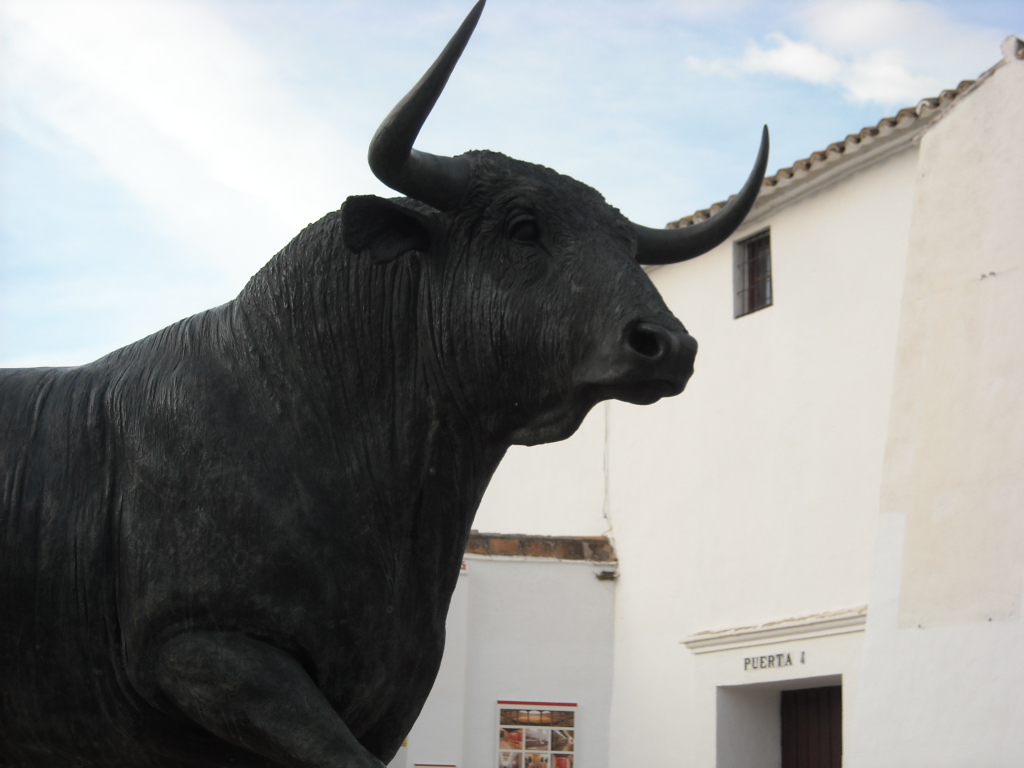
So those are my questions to Spain, Spaniards and Spanish history. Please consider them an exercise in writing and expression, not my comprehensive view of Spain. They represent only one aspect of my trip to Andalucia, and are not intended to discourage anyone from traveling to that part of the world. It is a truly awe-inspiring region (And, no, I don’t have a contract with their board of tourism). The Alhambra in Granada is a must-see; the mosque in Cordoba the most interesting religious building I’ve ever been in; Ronda the most jaw-dropping small town I’ve ever walked through. It oozes with history (especially once you get into the centro historico). It was romantic and beautiful-- so much so that I had to edit that part almost completely out of this blog for fear that it might sound too sappy, mushy, and cheesy.
Hasta luego.



November 22, 2011
Do I Really Know How to Speak English?

So far, having been in Italy for 5 weeks, I’ve unintentionally managed to ask a kind old lady for another serving of pussy (Gnoccha) with pesto, and ordered a plate of angry penis (Pene arrabiata) from an unsuspecting waiter. Miss just one vowel, or mispronounce a double “n” as a single “n” and this is what can happen here. It’s not that difficult. For instance, when I recently asked an Italian “In che anno sei nato?” (In what year were you born?), I was pretty proud of myself as the words flowed out of my mouth, surprisingly smoothly. But I didn’t realize I’d mispronounced the double “n”, so I was a little confused when this woman started laughing at me. Apparently, I had asked her what “anus” she was born in!
So, it’s clear to me by now that there’s no question about the state of my Italian. I can’t really speak it, and I won’t be anywhere near fluent by the time I leave here. But the other, perhaps more troubling, question that has recently emerged is whether or not I can really speak and understand English. This uncertainty has come up after only 2 weeks of teaching private English lessons here in Padova.
This issue first came to my attention when my 16-year-old high school student, Matteo, brought his English homework to our lesson. First of all, his English speaking ability was not in question. He was nearly fluent. His assignment was to analyze a poem called “Virginia” by T.S. Eliot. I had him read it out loud and when he finished he said that he didn’t understand it. Neither did I. So then I read it aloud and explained to him that it was indeed difficult to understand. He looked at me, puzzled. He must have been amazed that a native speaker of English didn’t even understand poems in his own language. 'Who is this dumbass that my mom hired?' I pictured him thinking. And so we jumped right into the meaning of some of the words. He asked what “still” meant. I told him it could signify continuity as in “I’m still waiting,” or it could mean not moving as in “standing still”. He nodded and then asked which one it was. I looked back at the poem’s line. It was unclear to me. Still. I changed the subject. “Ok,” I said, “Let’s focus on the color symbolism.” So we looked at the lines with “purple trees” and “red river.” Of course, then he asked me what the symbolism was about. I paused, gazed out the window, and decided to make some shit up. I told him that red probably symbolized blood and death, and purple-- the almost dead leaves of fall—symbolized a dying soul. And that might have worked for him, but then I went into how T.S. Eliot, and most modernists, were greatly impacted by the devastation of World War I and that perhaps all this symbolic “death” referred to the millions of soldiers that perished in WWI. I thought it sounded pretty decent for being unprepared and half bullshit. Then Matteo said, in rather articulate English, “But isn’t Virginia in the United States?” “Yes”, I replied. “Well, World War I was fought in Europe, so why would a river in Virginia be used to symbolize deaths in Europe?" “I don’t know, Matteo. Good question,” I said. The rest of the lesson was not so pathetic on my end, and I’d like to think I recovered at some point, but it definitely brought up the question of my own shaky English comprehension.
Then there’s Riccardo’s fill-in-the-blank homework that he brings to me every Monday. It’s usually much easier. He’s also 16, but I imagine he must be in the class that’s analyzing “Cat in the Hat” rather than T.S Eliot. Even so, there are still uncertainties that pop up. The directions say to fill in the blank. He_____ feeling well. Some of the choices are “hasn’t been” or “wasn’t.” Jesus Christ, they both work! And another option is “mightn’t.” Who ever says “mightn’t”!? I told Riccardo that I’d never used the word “mightn’t” in my entire life. He gave me that same puzzled look that Matteo did. Then I scanned the directions and saw words like “conditional” and “past perfect” and “imperfect” and realized that I didn’t really know what the hell these things meant anymore. So I ended up working backwards with Riccardo in order to figure out what the goddamn instructions actually meant. By the time we had finished his worksheet, I felt like a fraud; a charlatan—mainly because I realized the fact that I wasn’t teaching these kids English as much as I was doing their homework for them. I figured why not just put up a flyer at the local high school that says, “Pay me 20 euros-- I’ll do your English homework!” I might as well.
Thankfully, tutoring the 50-year-old Rosella makes me feel a little bit better. Maybe it’s because her English is actually worse than my Italian. Maybe it’s because her mistakes are equally comical. My favorite one so far was when she invited me into her “kitchen” to see the fresh pesto she’d made that day. She said, “Come in my chicken.” That was a first. We both laughed, but I don’t think she got half of it. She ran into her kitchen and brought out a small green jar. “I am pleased of my pesto,” she told me with pride and then offered it to me as a gift. Maybe that’s why she’s my favorite student? --She’s given me fresh pesto, an Italian language book, and a bottle of wine. And she always pays me right after the lesson. Or, perhaps she’s my favorite because I end up learning more Italian from her than she learns English from me? Rosella speaks to me in Italian about 80% of the time and then asks me to translate it to English so she can repeat the words. Of course, that makes me feel like I can speak Italian, if only for a few moments-- and that’s a nice feeling after being here for over a month. Nevertheless, when she hands me the 30 Euros at the end of the lesson, I can’t help but feel like I’m running a sham language business. As I walk home, I shake my head at the fact that I don’t really know the rules of my own language, and in some ways English makes no sense to me. Still. I just happen to know how to speak a universal, highly valued language mostly because of geographical luck and circumstance.
Just as I make it back to my apartment, I see that Rosella has sent me a text message. It says, “Your muffler lives in my house." Oddly enough, I immediately understand her bad English. Translation: “You left your scarf at my house.” Well, I think to myself, at least I made 30 Euros, got some free pesto, and have one student that could actually use my help.