John Backman's Blog
January 5, 2022
What Constitutes Right Action in a Failing Democracy?
Recently, from somewhere in my spiritual practice, this question has arisen and will not let me go. It may be my “question for 2022,” if there is such a thing. In this space, I’ll share some background to explain what the question means to me and why it’s captured my attention.
First, to restate: What constitutes right action in a failing democracy?
The words failing democracy may have grabbed you, so let’s look at them. The current issue of The Atlantic features several articles on this idea, including Barton Gellman’s “January 6 Was Practice” (may require sign-in/subscription). The essential idea is that officials in the Trump wing of the U.S. Republican Party—which is now most of the Republican Party—are laying a more extensive foundation for ensuring that Trump returns to the White House in 2024, even if it means contravening the election results. Because this effort is more extensive and more organized, it is more likely to succeed. Even typically restrained commentators are wondering openly about the death of democracy, hence the failing democracy phrase.
(It’s worth noting that Gellman wrote a similar piece around mid-2020, forecasting how Trump might react to an electoral loss, and nearly everything he forecast came true.)
I am in no position to speak for Trump devotees, but I wonder whether the phrase failing democracy might resonate with them too. As best I understand it, they are convinced not only that the 2020 election was stolen from Trump, but that we are moving toward socialism and away from democracy. That may qualify for them as failing.
The other bit that may need explanation is right action. It’s one component of the Noble Eightfold Path, which the Buddha described as the way to extinguish suffering. The commentaries I’ve read tend to concentrate on the fundamentals of the Buddha’s idea here: do not take life, do not steal, be honest, refrain from illegitimate sex. (This may sound familiar to my Christian siblings!) For me, the words right action can connote more—this article on the Noble Eightfold Path asserts that “right action aims at promoting moral, honorable, and peaceful conduct.” Part of our job, as I understand it, is to explore what that might mean in specific situations, like the situation of living in a failing democracy.
There are, of course, many quick and ready answers to this question: protest, write your congressperson, etc. These have never sat well with me. They are good and noble actions, to be sure. But from my perspective, as a response to a failing democracy, they do not address the fundamental truth of our condition as individuals—i.e., the relative smallness of our influence among billions of people and vast, entrenched systems of power. So I’m setting aside the standard answers in favor of a deeper, more contemplative meditation on the question itself.
So far, what’s arisen for me have been other questions: What do we really mean by fail? What is a democracy, after all? What other forms might it take? What’s important about democracy? If democracy fails, what will we lose? Who precisely would be undertaking this right action anyway?
If you decide to ponder this yourself—more deeply than a quick response—let me know, either soon or anytime in 2022. Maybe we can do some of this work together. May all of you have a meaningful year ahead.


August 20, 2021
Diving into Afghanistan
This week I’ve been reading news from Afghanistan in a spirit of…I guess the best word is repentance.
In the process I’ve found some fascinating sources. Al Jazeera has an entire Afghanistan page. Ariana News is, I think, the leading TV news medium within Afghanistan; the Daily Outlook Afghanistan claims to be the country’s “leading independent newspaper.” I read them all and look at the photos and run place names through Google Maps to see where they are and what kinds of public buildings live there.
Here are two things I’ve found.
First, Afghanistan is more than I thought, way more. In a small eastern city I noticed a pharmacy, a shoe store, a mall, a cellphone store, a barbecue joint. A photo from Kabul depicts a Taliban fighter in the street, next to a passing (shiny, new?) car. I’m embarrassed that those images shock me. I’ve spent too much time watching American media, which have me hearing Afghanistan and thinking vast desert waste. On top of that, well beyond Taliban fighters and warlords and corrupt officials, there are millions of Afghans who have tasted freedom and are hell-bent on preserving it. Every place is more complicated than it looks in the news.
The other sense I get is that, today at least, the whole country is poised, teetering, atop a knife point. One article noted that Kabul residents are “mostly satisfied” with the security and normality that have returned to the capital in the last day or so. Another cites a UN threat assessment that the Taliban—contrary to the shiny new image they’re trying to portray—are searching door-to-door for Afghans who worked with the US or NATO. Revenge is an obvious motive. Meanwhile, this lovely personal essay describes the terror that the author hears from many Afghans, especially women, including his girlfriend.
It sounds, right now, as though no one knows which version of the Taliban they’ll get. Or…maybe every Afghan bloody well knows, and they’re just waiting for the other shoe to drop.
I mentioned repentance. I know there’s a lot of blame to go around for the Taliban takeover. I also know that most of us, individually, can do next to nothing about world situations. But I can’t help thinking: I’ve had 20 years to pay attention and I didn’t. This isn’t about me right now, not even close, so you’ll hear no rants about my sense of shame, etc. All I can do right now is turn—which is what repentance is, a turning of the heart—and pay attention now.
June 24, 2021
Who Am I Today? (the COVID-Brain Version)
I don’t know whether the term long COVID applies to me yet, but 12 weeks of brain fog and fatigue must count for something.
In the grand scheme of long COVID, my symptoms are mild. Some long haulers have multisystem inflammatory symptoms, for crying out loud. Others get winded just walking across a room. All I have is a sort of hard upper limit on what I can do. I read to a certain word count and my brain shuts off. I stay active until my body says that’s it, you’re done, go lie on the futon. There are days when I so want to be done with this nonsense.
At the same time, the persistent symptoms are teaching me something. The lesson stems from the variation of symptoms over time.
My doctor asked me to try putting a number to how well I functioned on any given day. For the first few weeks, the best I got was 70% of pre-COVID normal. Then came several days of 20-30%–otherwise known as I can’t put ONE freaking thought together, let alone two. There was a week of near-total clarity, and I dared to think, OMG, have I turned a corner? Yeah, right, don’t count your chickens: the fog came back the next week.
How am I supposed to function when I don’t know which version of me will show up?
As it turns out, that question carries the seeds of its own answer. Each morning, right after wakeup, I’ve taken to asking myself who am I today? A quick internal check gives me a sense of how I’m feeling, what my capabilities and limitations might be, and what therefore might be the best course of action for the day.
Who am I today? is only the first step. As the day goes on, various inputs may change the answer. So the question becomes who am I this moment?
Asking these questions, and sitting with the answers, has enabled me to stay quasi-useful while working around the symptoms. But now something else is dawning on me: this is a valuable practice not just when I’m cognitively impaired, but anytime, maybe for anyone.
Buddhism, and Zen in particular, are very big on two related observations: the impermanence of everything, all the time, and the need for attention to the here and now because, in essence, the here and now is all we have. Staying mindful of these two truths, I’ve found, enables me to embrace them and work within them, to bring all I can bear to the only place I can help make the world better: this present moment.
I have no idea when or if these symptoms will recede. No one does. Asking who am I today? helps me do the most with what I’ve got, which makes it a good question for me at any time, symptoms or no symptoms. Would this be useful for you?
May 20, 2021
A Hot Shower and a Spiritual Practice for Seeing Privilege
Last year I described a practice I’d begun during the pandemic: applying lectio divina—a slow, contemplative reading of sacred texts—to stories and photos from the world’s most ravaged places. Let’s call it photo divina for lack of a better term. The practice, even though I’ve only used it occasionally, has had a powerful effect on the way I think about aspects of my daily life.
Like hot showers.
I love a hot shower. No, it’s more than that: on most days I have to shower before I can function. And the shower has to be hot. I could work up a snit about someone draining the hot water tank right before my shower, but fortunately our tank is big enough to accommodate our household.
Now put that first-world mindset up against this fact from 2017, reported by WHO and UNICEF (via the CDC): “About 3 billion people worldwide lack adequate facilities to safely wash their hands at home.” Forget about hot water, or hot water tanks, or anything of the sort. These folks have to worry whether their water could kill them.
Facts like these throw a stark light on many details of my life. We own two cars when many people walk hours to gather fuel for their cooking fires. Owning an entire house is unthinkable in huge swaths of the world. Compared with billions of people, Americans have scads of wealth and privilege.
How do we Americans respond to this? My automatic response has always involved shame: “We don’t deserve all this stuff.” It’s been a vague kind of shame, briefly felt in response to a stimulus (like a news report from Africa) before I move on to the next thing in my life. For me, this brief shame is useless; it doesn’t change anything, for the world’s poorest people or within me.
The contemplative nature of photo divina is leading me to a different approach. For now, it wants me to simply detect and observe the privilege I have: how pervasive it is, how it shapes my expectations and assumptions (e.g., “I have to shower before I can function”). Contemplation wants me to simply observe the stories and photos over which I linger, and feel the stark difference between our lives, and how their lives are different—no more and certainly no less valuable than mine.
I want the resulting awareness to seep right into my bones and into my neurons, so that it never leaves me. This kind of awareness, for contemplatives like me, is what fuels our ability to do good in the world—or, as one of the closing prayers in the Episcopal liturgy (p. 366) puts it, “to do the work You have given us to do.”
Not everyone resonates with contemplative practice, though, and I’m sure other folks have found other ways to address this. How do you respond—within yourself—to the disparity between what you have and what others don’t? How does your inner response shape your ability to do good?
May 14, 2021
In the Aftermath of COVID
In the last week of March, having shown my first signs of COVID, I wrote my spiritual director to postpone our appointment. He wrote back something no one else said: “May this be a challenging and deepening time for you.”
Not everyone’s idea of comfort words. But he was right. The time did challenge, and it did deepen. Here’s one thing I learned and have come to cherish: the simple art—long known to many people with chronic conditions—of figuring out who you are on any given day.
Learning this was not exactly a choice. While fully recovered from acute COVID, I’m still fighting two symptoms common in the aftermath: severe fatigue and cognitive issues, especially reduced attention span. These come and go as they please. This past Saturday I could barely put two thoughts together. On Sunday my brain was clear.
Because of the sudden swings in this condition, I have to devote part of my brain to simply observing what’s going on with me, what I can do and what I can’t, day by day and sometimes minute by minute.
The variations in my condition go way beyond I feel tired or I don’t feel tired. On Saturday, even with the dense brain fog, I quickly found I could focus on one task at a time when it was right in front of me. In between tasks, I was lost in the fog. So I managed to move myself through paying bills, turning the compost pile, mowing the lawn.
On another day, I scanned the paper over morning coffee, as always, and found I couldn’t read everything I wanted to. A little voice went off in my head: that’s enough of this story. I went with it. I had to.
My life situation gives me a lot of schedule flexibility, so I have the privilege of ample time to observe myself. That may enable the weird sense of adventure I’m feeling about all this. It’s interesting to have to ask, Who will I be today? What can I do? How will COVID redraw my limitations at this moment, and this moment, and this moment?
A couple of people have told me I’m a “good person” for “taking a positive attitude.” Honestly, I haven’t taken any attitude at all. It’s arisen on its own. And I think my experience with contemplation—in this case, with Zen—has a lot to do with it.
Zen insists on attention to the present moment. It also asserts the idea of no-self—that there is no fixed, permanent self at our core. The way I read that, it gives me the freedom to adjust to anything “me”-related on the fly. Zen doesn’t allow me to get caught up in “I can’t do that” or “that’s just not me” or even “I was able to do this yesterday, why not today?” I have only the present to assess, and I can assess it (on my good days) without clinging to preconceived notions.
Lord knows, not everyone with COVID has the luxury of doing this. Still, I get excited when I see the fruit of my spiritual practice in everyday life. It reminds me that some of the world’s most celebrated mystics were eminently practical people. That’s no accident. Far from “useless navel gazing,” contemplation brings us deep into God, into Reality, into the Ground of All Being, and then sends us back out, refreshed, to bear fruit in the “real world.”
December 1, 2020
What Do You See in the Photo?
I stumbled onto a new spiritual practice during the COVID shutdown last spring. Maybe you’d like to give it a try.
A little background first. For years I’ve written about lectio divina—the slow, contemplative reading of sacred texts, with pauses to listen and ponder when a particular phrase strikes a chord. Apparently there’s a version of this for visual media too: visio divina.
A few months ago, like so many people, I was growing anxious over certain aspects of the shutdown. The more I thought about them, the more I realized they’re first-world problems: figuring out whether to wear a mask in each unique situation, wishing I could go out for dinner, that sort of thing. As a way to gain proper perspective, I hit on a thought experiment: think of the most ravaged place on earth, and learn about the people who struggle to live there.
Syria’s Idlib province leapt to mind: the last bastion of rebel holdouts against a murderous regime in a nine-year civil war. An entire province bombed to rubble by its own president. Look at any news footage from Idlib and you’d swear no one lived there.
So I ran web searches for stories of people in Idlib. As it turns out, many still live there, trying to cobble together their daily lives while on constant high alert for sudden danger. The articles were compelling but the photos had their own stories to tell. The longer I looked at them, the more I experienced visio divina at work.
Take this example from a UN site (photo © UNOCHA):
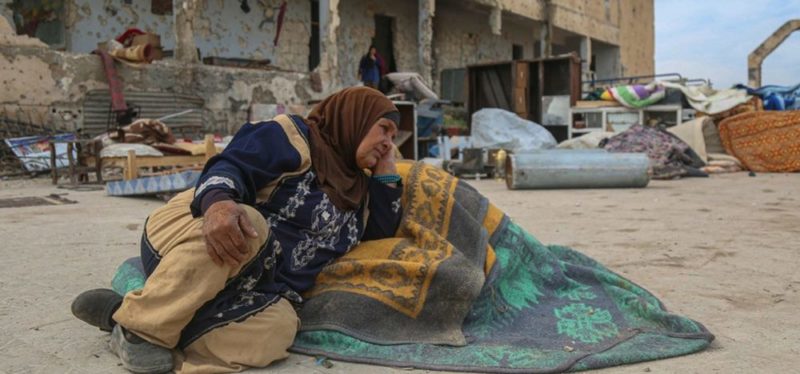
Caption: In Idlib, Syria, a displaced woman sits on the floor outside the damaged school that she now lives in.
On one level it’s the picture of despair, as you’d expect from Idlib. But while gazing at it I started to notice other things. A great deal of rubble lies about—it’s a war zone, after all—but notice how it’s all cleared to one side. Someone in Idlib, possibly the people living in the school, thought it important to put some order to the rubble. That’s what people do to keep daily life moving: they tidy up. But the resilience it must have taken to keep daily life moving took my breath away.
There’s more. Who, for instance, is the person standing on the porch in the background? Maybe she’s family to the woman in the foreground, or maybe they’re former strangers who’ve taken each other into their makeshift homes during a catastrophe. (Maybe that’s not a porch but instead a bombed-out hallway.) Again, it’s what people do: show compassion.
I have zero desire to romanticize the conflict. I’ve read about the horrific conditions, the doctor who kisses his wife goodbye each morning without knowing if he’ll ever see her again, the teen girl who chokes back her terror to comfort her younger siblings. It wasn’t until I started gazing at these photos that I saw the raw and beautiful traits—like resilience, like compassion—that make us human, that we persist in upholding.
What do you see?
November 20, 2020
Does America Have a Future?
The other day I hit a quandary. Maybe you can help me resolve it.
A little background will help you understand how I got to the quandary. Ten years ago I wrote a book. It gives people a way, drawn from ancient spirituality, to change from the inside out so they can bridge divides. Before and since writing the book, I’ve gotten to know and learn from a pantheon of brilliant people in such fields as dialogue and listening. So there’s a lot of data in my head and heart around the idea of reaching across the proverbial aisle.
Based on all this, you might suppose I have an outlook on America’s current polarization. I do, and here it is:
I have no idea how we get past this.
I won’t bore you (not too much, anyway) with the current national conditions that have brought us here: a widespread disregard for facts, a deep rage from many quarters, a fear, just as deep, of engaging anyone in this uber-hostile environment. Not to mention all the actors that, intentionally or not, stoke this environment: social media, talk radio, inflammatory (often fact-free) websites. Amidst it all, a president who marshals these forces for his own ends.
Now the opposite poles cannot even agree on one of America’s most fundamental underpinnings: who won the presidential election. There are indications that each pole will act on its own narratives. As several commentators (notably Barton Gellman in The Atlantic) have noted, we could end up with two men showing up to be inaugurated on January 20, each claiming a right to the presidency.
I have no idea how we get past this.
Since the election, I have seen many messages of hope, a desire for unity, relief that maybe we can get back to political normal. I’m sure my dialogue and listening colleagues are marshaling their time-tested strategies for healing relationships. I probably should be re-touting my book.
But, with the utmost respect and affection for everyone with hope, I am not sure any of this will work—because I don’t see the collective will for it.
It’s impossible to overstate the stakes here. You know that. We’re all terrified that America is devolving into something dark. Yet I don’t know that, as an aggregate, we care enough to reverse course.
What should we do? I’m not sure, but I keep coming back to my understanding of Carl Jung: it is vital to take a long, honest look at our collective “shadow side”—the hidden part of us, which we typically repress or try to ignore. I see too many folks trying to jump right to the positive stuff—healing and reconciliation and all that—without honestly grappling with our darker selves. Without that grappling, I gather from Jung, there is no wholeness or reconciliation.
That’s my quandary. I would dearly love to hear your thoughts.
October 27, 2020
What This White Person Can Do About Racial Conflict, Maybe, God Willing
A few months ago, I wrote about America’s racial conflict in the wake of George Floyd’s murder. The linchpin of that blog post was my desire to shut up and listen—as openheartedly as possible, for as long as possible—to people of color and their experience. At the same time, I knew that somewhere along the line, even while continuing to learn, I would be called upon to act.
The form of that action has just barely begun to emerge now, in a way I never expected. I’m telling you this because it has to do not just with race, but also with God or Spirit, and the way Spirit engages with my life and maybe yours too.
There are some oft-heard narratives of how white people should respond to racism: We should call out expressions of racism whenever we hear them. We should raise our voices in direct public protest against police brutality. We should organize to dismantle structural injustice.
These approaches are essential. We do need white people to act on them. But they are a complete mismatch for who I am: my gifts, my skills, my faults and foibles. If I tried them, I’d be laughably ineffective.
So what can I do? And who decides?
A little context. As a contemplative, I aim to live my life in response to Spirit. That means a ton of listening in silence, reading sacred texts, and meditating to discern what Spirit might require of me. It means examining my Spirit-given talents and heart’s desires and aspects of my deepest self to discern what Spirit has shaped me for.
When I do all those things, I see that—first, last, and always—I am a writer. So writing about race would be a natural response to the imperative to do something.
But write how?
This is where Spirit has surprised me. Two years ago, without warning, my writing took a sharp turn away from discursive blog posts like this one toward intense, creative, personal essays (like this 500-word flash essay and this longer one). The usefulness of this I could not fathom, but a lifetime of Spirit has taught me to just run with a development like this when it presents itself.
Now, in the past month, something remarkable has happened. I have worked on two essays about personal matters, and before I knew it they’d become essays about race. Voilà: Spirit’s first response to what shall I do? It’s left me a bit breathless.
Does it make sense to respond to race with creative writing? The wise words of a beloved writer colleague suggest that it does. While we were discussing the breakdown in listening and reaching across divides, she observed that when every other form of communication breaks down, the only thing we have left is the arts. This makes sense to me: I often think of the arts, including my essays, as an invitation, and people respond well to invitations. Here’s something that happened to me, my essays say. See what you can make of it.
There are concrete lessons to be drawn from this, as you might imagine. I’ll leave it to you to ponder them for yourself. In other words, here’s something that happened to me. See what you can make of it.
September 25, 2020
That’s Not How This Works
My brain is hyperactive. It likes to spin out ideas, fantasies, things I want to say, actions I want to take. An insight comes to me and within seconds I’ve leapt to wordsmithing it for Facebook or presenting it to an audience of hundreds. This has gone on for years. I’m learning to accept it for what it is: twitchy neurons firing at high speed, mostly without value, occasionally with.
The other day, for whatever reason, I wondered about my heart’s deepest desire in all of this. Why does this happen—especially in the context of when and where I live, the 2020 version of America—and what does my heart want to do with it?
In part, I think, my heart wants to heal things. It wants to help Americans expand their own hearts, reach across divides, truly listen to one another. It wants to help people build resilience in the face of this strange, strange year. It wants to say just the right thing that will wake millions up to the plagues and evils around us. I’ll bet many hearts across the planet have the same primal urge.
Right around this point in my ponderings, a message popped to mind. It had that out-of-nowhere quality I often ascribe to God:
That’s not how this works.
I’m not sure what it means, not fully, but I can guess. For one thing, I’m thrown back on something I’ve come to value: my status as a nearly imperceptible blip in the cosmos. Being exactly one person, I have exactly one person’s influence over the world, which is tiny in the extreme but not negligible. I find this liberating. It’s not up to me to heal the world or wake millions up to the evils around us, because I can’t. I can only do what I can.
And even if I could heal the world, maybe some things can’t be healed. Epidemiologists now think the COVID-19 virus is here to stay, and our species will have to learn ways to live with it. Not long ago people dreamed of a post-racial society, but now (thanks in part to reading Ta-Nehisi Coates’ We Were Eight Years in Power) I’m starting to think we’ll never achieve a full resolution to racial injustice, because racial injustice has been part of America’s genetic material from the beginning.
That does not, of course, mean I can or should do nothing: the struggle for racial justice, to take one issue, demands far more. Maybe all I can do is what’s right in front of me, whatever that is. Maybe I continue working on the transformation of my deepest self toward openheartedness and compassion and justice—the work of contemplation, as it were—and out of that depth I do and say what I can, because often, that depth bears more fruit and makes more impact than anything else I could do.
But I don’t write the magic words or take the magic action that will bring widespread healing—as much as my heart yearns to do so—because that’s not how this works.
What do you think?
September 24, 2020
Ears to Hear
Three months ago I wrote about wanting to shut up. As it turns out, shutting up happened, and only now am I starting, maybe, to figure out why.
It was never intentional. Since my Black Lives Matter post on June 26 (the “shut up” post), I’ve written two pieces for this blog. Both are OK. Both may be useful to others. But something held me back from publishing them.
Then yesterday I posted an angry comment to a friend’s political post about the Supreme Court nominations. (I sharply refuted my friend’s premise and called Mitch McConnell a hypocrite.) I believe the word hypocrite is accurate. I saw, and still see, value in countering the argument (made in the original post) that “both sides are guilty.” Yet something else hit me too: my comment might alienate friends, and it will change nothing.
Which got me thinking that posting to social media in 2020—especially opinions and perspectives about the state of the world—is pointless. At least for me.
It’s pointless because of a saying attributed to Jesus: those who have ears, let them hear. As a group, as a nation, as a culture in 2020, America no longer has ears. If you want evidence, visit some of the more contentious corners of social media. You won’t have to look far.
I wonder if this is feeding my heart’s desire to shut up. Why share a thought in the American public square (of which social media has become a central part) when America has no ears to hear?
It’s not all this way, of course. A few of my most amazing friends are managing to have honest, tough, openhearted, and/or respectful conversations on social media. May they do so forever. I have to find another way.
To date I’ve found several activities that look like “another way,” and maybe they are. Not long ago, one of those amazing friends said this to me: in a culture where no one’s listening to one another, the saving grace might be art. To oversimplify, comments and opinions try to tell people what things mean; art invites people to make their own meaning. So I’m writing personal essays as a way of saying to readers, “Here’s something I learned/wrestled with in my life. See what you can make of it.”
There’s also prayer. Wouldn’t you know it, today’s email brings a message from Richard Rohr, ecumenical teacher and mystic, quoting 20th-century teacher Bede Griffiths: It is only in prayer that we can communicate with one another at the deepest level of our being. The idea that we can connect with one another by going inward—via God, through the vehicle of prayer—is classic contemplative thinking.
All of this is in the early stages, and I’m sure there might be other “other ways” to connect and communicate as well. What do you think? What in this post, if anything, resonates with you? What new ideas does it spark?