Brandon C. Jones's Blog
November 30, 2017
...and the short goodbye
In high school I found a home in debate and forensics. We'd travel throughout eastern Kansas, competing with our peers. It was the first time I really traveled, and I enjoyed the sights and sounds of places near and far. Inspired by Uncle Traveling Matt from Fraggle Rock, I wrote up some pieces about the places we'd be visiting as a team. Those were the first Brandon's Bits: partly true, somewhat informative, and hopefully funny.
 When I became a pastor in South Dakota I was transitioning from writing for an academic audience to a general one, so I started this blog for training. I gave myself a deadline of one post per week, whether I had anything worth saying or not.
Over the years this blog never seemed to mean much to most of the flock I shepherded, but it sharpened my skills as a communicator and gave me an outlet in more recent years when I no longer had a self-imposed weekly deadline, but did have something to say.
Now that I am transitioning from pastoring to being a missionary the time for this blog has come to an end.
When we are nearer to reaching Brazil I plan on starting a new family blog that will give regular updates from the field. Until then you can keep current on our latest news by visiting our missions page at: http://nabonmission.org/missionaries/brandon-marci-jones/ We also have an email newsletter list that you can join, if you're not receiving our emails already (warning, they focus on fundraising right now).
My email address will remain pastorbcjones@gmail.com, so write me a message if you'd like to join our list.
Also feel free to write me anytime for any reason. Although I am no longer pastoring a local church, my wife has reminded me since our move to our halfway house in Missouri that I am still a pastor--and always will be.
Thanks for reading,
Brandon Jones
 When I became a pastor in South Dakota I was transitioning from writing for an academic audience to a general one, so I started this blog for training. I gave myself a deadline of one post per week, whether I had anything worth saying or not.
Over the years this blog never seemed to mean much to most of the flock I shepherded, but it sharpened my skills as a communicator and gave me an outlet in more recent years when I no longer had a self-imposed weekly deadline, but did have something to say.
Now that I am transitioning from pastoring to being a missionary the time for this blog has come to an end.
When we are nearer to reaching Brazil I plan on starting a new family blog that will give regular updates from the field. Until then you can keep current on our latest news by visiting our missions page at: http://nabonmission.org/missionaries/brandon-marci-jones/ We also have an email newsletter list that you can join, if you're not receiving our emails already (warning, they focus on fundraising right now).
My email address will remain pastorbcjones@gmail.com, so write me a message if you'd like to join our list.
Also feel free to write me anytime for any reason. Although I am no longer pastoring a local church, my wife has reminded me since our move to our halfway house in Missouri that I am still a pastor--and always will be.
Thanks for reading,
Brandon Jones


November 7, 2017
The Long Goodbye Part Two: The People
‘Well, there’s a lot of risk, but with any luck they’ll be happy enough, which is the English version of a happy ending.’ ‘What do you think makes the English the way we are?’‘I don’t know. Opinions differ. Some say our history, but I blame the weather.’ – Downton Abbey
“Many people are just waking to the reality that unlimited expansion, what we call progress, is not possible in this world, and maybe looking to monks (who seek to live within limitations) as well as rural Dakotans (whose limitations are forced upon them by isolation and a harsh climate) can teach us how to live more realistically. These unlikely people might also help us overcome the pathological fear of death and the inability to deal with sickness and old age that plague American society” – Kathleen Norris, Dakota: A Spiritual Geography.
This summer our family was in Houston for a church conference. While I was at a meeting the rest of the family went out to eat and their server made small talk. When they told her they lived in South Dakota she was shocked, saying, “just the other day my co-worker was trying to convince me that no one actually lives in the Dakotas. He said it was a secret government base. I told him that wasn’t true. He replied, ‘have you ever met someone from there?’ I said, no. Well, now I can say I have.”
Maybe you too have never met someone from the Dakotas. South Dakota boasts political figures such as George McGovern and Tom Daschle. Wiz Khalifa was born in North Dakota, but grew up elsewhere. Phil Jackson went to high school in North Dakota. Carson Wentz too.
Let’s stick with Wentz for a minute. When there was speculation that the Philadelphia Eagles were going to draft the Bismarck, North Dakota native, Philadelphia Magazine sent a reporter to get the scoop on what Bismarck was like. Here’s what happens before he even checks in at his hotel:
He didn’t plan ahead for a ride from the airport and discovered there was no Lyft or Uber in Bismarck. As he was searching on his phone for taxi info, since zero taxis were waiting for fares at the airport, a fellow passenger asked him if he needed a ride. She said her cousin was coming to Bismarck from three hours away to pick her up, and they would be happy to take him to his hotel. He agreed. Once the cousin came they had to make a pit stop at a gas station, although they got no gas. Instead, they came back with some pot roast. He was amazed that they both left the car unlocked and running while they went inside. Once back in the car they asked him if he’d heard of the two major Bismarck hospitals and were surprised when he said he hadn’t. Neither hospital is the Mayo Clinic, in case you were wondering. They also stopped at an auto-parts store for a car battery and then went to the grocery store for several items, once again leaving the car running and unlocked (after all, it was still winter). Eventually, the reporter made it to his hotel, which was but a few miles from the airport.
Those familiar with the Coen brothers movies have heard about “Minnesota Nice,” and its bubble extends from Minnesota to include the Dakotas, much of Wisconsin, and the UP of Michigan. People will strike up conversations with strangers all the time. They’re also super-helpful if you need something small, and they love to rally around cherished local institutions and specific needs that may come up.
But there’s a flipside, especially in rural areas. Decades of decline amid brutal isolation, severe weather, boom/bust economies, and remnants of a once-thriving history, have all gradually placed a heavy burden on each small town and its residents as they collectively hang on in quiet desperation—it isn’t just the English way.
Some people tend to respond to the burden by becoming naysayers. They root against any and all new ideas and people. Like some sort of cultural George Soros they bet against everything, figuring they’ll more often be right than wrong. And they love being able to say “I told you so” when something doesn’t pan out. “Oh, the newcomer left after six years. Well, I’ve always thought he would think he was too good for us. Told you he was going to leave.”
Those people aren’t too interesting, though, and I doubt they’re unique to the Dakotas either. It’s the other people I’ll miss. Those who, despite all the challenges living on the northern plains gives them, remain full of love and live by hope.
The church I pastor is German Baptist by way of Russia. In the 19th century Catherine the Great sought to see her people more cultured, so she enticed foreigners to come if they knew arts and trades. In order to bring them in she made concessions regarding taxes and military conscription, drawing many Germans to her land. But once she died her son was not as welcoming, and in response many Germans in Russia left, but instead of returning to Germany they settled in America right when the Dakotas were opened for homesteading.
Those who didn’t know how to farm, learned. And everywhere they settled they built up churches. Our church was established in 1897 as a “hub and spokes” setup. Herreid, the hub, had the parsonage, but the pastor only preached here once a month. Other weeks he’d preach at a spoke location in a circuit. He used horses to get everywhere and had a stable on church property by the parsonage. He’d preach in German too. All the worship would be in German. It took World War II for our church to finally switch to English.
German-Russians, as they are called around here, mingled with some Norwegians, Swedes, and Dutch folk, but German food rules the land. There’s kuchen, a lovely custard desert that can also be consumed for breakfast. Fleischkuechle, which is a savory fried meat pie. Knoepfla soup is similar to a creamy chicken-based broth, but way saltier. And there’s other influences as well, including fry bread tacos and combinations such as chili with cinnamon rolls and—one of my personal favorites—walking tacos. There’s plenty of sausage and sauerkraut to go around too, especially at a church potluck. I’m getting off track. After all, even grumpy people can cook and eat great food.
Were I to use one word to describe the people of the Dakotas it is resilient. They aren’t like those who retire to Florida or Arizona and try to convince you it’s not too hot there. Dakotans will tell you it is ridiculously cold in the winter. In January they’ll openly wonder with you why anyone bothers living here. But they’ll also say, “the weather keeps the riff raff out.”
To some extent I suppose it does. People can rattle off the worst winters of their lifetimes. The most recent “famous winter” was in 1997. Another was 1966. I’ve been told I never experienced a bad winter here, which is likely true. But they’ve all been pretty cold to me. Last December the temperature hit -20 degrees Fahrenheit, colder than both poles and anywhere in Canada or Siberia at the time, save for one ridiculous mountain city in Russia that is surely unsuitable for human habitat. The winter wind when it's below zero can sometimes freeze your bones and definitely your snot. It can sting your eyes for them to be opened beyond slits for a second. If experiencing this kind of weather half the year every year doesn’t make you resilient, what will?
Resilience is getting up to milk cows every morning, sometimes having to use a rope tied between the barn and the house to find your way in feet of snow.
Resilience is giving birth at home when the nearest hospital is 30+ miles away.
Resilience is riding a horse to a one-room school with a packed lunch of some ham and a potato.
Resilience is ranching on a land that can withhold rain for what sometimes seems like years or more.
Resilience is growing crops between the nearly minuscule window of frosts in May and October. Oh, and relying on rain alone to water them in between.
Resilience is rebuilding towns that were wiped out by floods and fires.
Resilience is losing siblings and children to diseases and accidents, the latter of which continue to happen today. America’s deadliest roads are rural two-lane highways.
Resilience is staying and caring for your parents after all your siblings have left.
Resilience is moving into town and letting one of your kids live in the old farmhouse.
Resilience is insisting to live alone in town, years after your spouse has died, because that’s all you know how to do.
Another word that comes to mind to describe Dakotans is reserved. I’ve sat with grown children, preparing for their parent’s funeral only to discover they’ve never once heard the stories of how their parents met, fell in love, or even married. People don’t tend to talk much about themselves around here. They don’t cry a whole lot either. Greeting cards often are just signed without much of a note for why they were sent, but they still mean a lot to the person who receives them.
Behind such steely reservation lies some of the steadiest and fiercest love I’ve ever come to know. People who hold the nice, warm hands of loved ones as they’ve died in hospitals and nursing homes. People who rise up early to shovel and clear their elderly neighbors’ snow. People who gather to paint the house of someone who no longer has the strength to do it on his own. Who clean up what others may have broken, somewhat wondering when it will all break again.
Some people here have only read my newspaper columns or heard me pray once or twice at a community event. I once attended a graduation party and had a guy point a finger in my face and ask the guy next to him, “who’s this guy?” Others might just sit and watch as I preach from a stage. But those who really know me are the ones I’ve chatted with at their work, or in their truck, or seeder, or combine, or living room, or hospital room, or nursing home room or perhaps they’ve come to my living room to pray or shared a meal with my family. They’ve allowed me to be a witness to what they have endured and are struggling against right now. They’ve let me come to know them as I’m coming to know myself and the pains I've carried as those around me too have died and left.
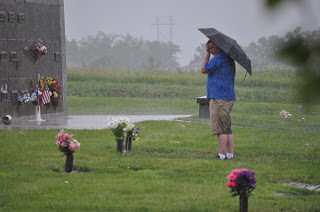 At my Dad's grave in Kansas I might be readying to leave the Dakotas, but its people will always be a part of my story, and their presence will remain through my preaching, teaching, and mentoring of pastors in the far south of Brazil. I’m thankful for the joys of new life, healed bodies, filling food. And also in some way grateful for the journey of losses, deaths, quietude, and painful longing. A journey I've walked myself while living here.
Lastly, I’d say Dakotans are honest, mostly. I was told a lot how young I was for a pastor when I first moved here. I’ve also been told how easy it is to stop coming to church (I’ve always likened it to how easy I find it to stop exercising). There’s little Christianese spoken here. People tell you just what they think from the ugly color of the church building’s siding to how fat I am.
And so when people around here have told me that they will miss me, I know it’s true. One man had watery eyes as I was exiting his living room for the last time. He didn’t say anything. He didn’t have to.
When I receive cards that have more than a signature and include a handwritten message that compliments my preaching, pastoral care, counseling, and even administrative skills, I smile, And when someone writes that my legacy at our church includes influencing our church to be more outwardly focused I say to myself, “yes, somebody got it.” Every Saturday afternoon before I’d rehearse my sermon to an empty sanctuary I’d walk up and down the center aisle, touch every pew, and pray. I'd pray that on the Lord’s Day it wouldn't matter what kind of week someone had coming in, that they would meet God here. Not because of me, but because of him.
Despite all my shortcomings, mistakes, and missteps, God actually used me here.
And I know he will continue using Dakotans here and elsewhere. I hope everybody, like that server in Houston, gets to meet one eventually.
“Many people are just waking to the reality that unlimited expansion, what we call progress, is not possible in this world, and maybe looking to monks (who seek to live within limitations) as well as rural Dakotans (whose limitations are forced upon them by isolation and a harsh climate) can teach us how to live more realistically. These unlikely people might also help us overcome the pathological fear of death and the inability to deal with sickness and old age that plague American society” – Kathleen Norris, Dakota: A Spiritual Geography.
This summer our family was in Houston for a church conference. While I was at a meeting the rest of the family went out to eat and their server made small talk. When they told her they lived in South Dakota she was shocked, saying, “just the other day my co-worker was trying to convince me that no one actually lives in the Dakotas. He said it was a secret government base. I told him that wasn’t true. He replied, ‘have you ever met someone from there?’ I said, no. Well, now I can say I have.”
Maybe you too have never met someone from the Dakotas. South Dakota boasts political figures such as George McGovern and Tom Daschle. Wiz Khalifa was born in North Dakota, but grew up elsewhere. Phil Jackson went to high school in North Dakota. Carson Wentz too.
Let’s stick with Wentz for a minute. When there was speculation that the Philadelphia Eagles were going to draft the Bismarck, North Dakota native, Philadelphia Magazine sent a reporter to get the scoop on what Bismarck was like. Here’s what happens before he even checks in at his hotel:
He didn’t plan ahead for a ride from the airport and discovered there was no Lyft or Uber in Bismarck. As he was searching on his phone for taxi info, since zero taxis were waiting for fares at the airport, a fellow passenger asked him if he needed a ride. She said her cousin was coming to Bismarck from three hours away to pick her up, and they would be happy to take him to his hotel. He agreed. Once the cousin came they had to make a pit stop at a gas station, although they got no gas. Instead, they came back with some pot roast. He was amazed that they both left the car unlocked and running while they went inside. Once back in the car they asked him if he’d heard of the two major Bismarck hospitals and were surprised when he said he hadn’t. Neither hospital is the Mayo Clinic, in case you were wondering. They also stopped at an auto-parts store for a car battery and then went to the grocery store for several items, once again leaving the car running and unlocked (after all, it was still winter). Eventually, the reporter made it to his hotel, which was but a few miles from the airport.
Those familiar with the Coen brothers movies have heard about “Minnesota Nice,” and its bubble extends from Minnesota to include the Dakotas, much of Wisconsin, and the UP of Michigan. People will strike up conversations with strangers all the time. They’re also super-helpful if you need something small, and they love to rally around cherished local institutions and specific needs that may come up.
But there’s a flipside, especially in rural areas. Decades of decline amid brutal isolation, severe weather, boom/bust economies, and remnants of a once-thriving history, have all gradually placed a heavy burden on each small town and its residents as they collectively hang on in quiet desperation—it isn’t just the English way.
Some people tend to respond to the burden by becoming naysayers. They root against any and all new ideas and people. Like some sort of cultural George Soros they bet against everything, figuring they’ll more often be right than wrong. And they love being able to say “I told you so” when something doesn’t pan out. “Oh, the newcomer left after six years. Well, I’ve always thought he would think he was too good for us. Told you he was going to leave.”
Those people aren’t too interesting, though, and I doubt they’re unique to the Dakotas either. It’s the other people I’ll miss. Those who, despite all the challenges living on the northern plains gives them, remain full of love and live by hope.
The church I pastor is German Baptist by way of Russia. In the 19th century Catherine the Great sought to see her people more cultured, so she enticed foreigners to come if they knew arts and trades. In order to bring them in she made concessions regarding taxes and military conscription, drawing many Germans to her land. But once she died her son was not as welcoming, and in response many Germans in Russia left, but instead of returning to Germany they settled in America right when the Dakotas were opened for homesteading.
Those who didn’t know how to farm, learned. And everywhere they settled they built up churches. Our church was established in 1897 as a “hub and spokes” setup. Herreid, the hub, had the parsonage, but the pastor only preached here once a month. Other weeks he’d preach at a spoke location in a circuit. He used horses to get everywhere and had a stable on church property by the parsonage. He’d preach in German too. All the worship would be in German. It took World War II for our church to finally switch to English.
German-Russians, as they are called around here, mingled with some Norwegians, Swedes, and Dutch folk, but German food rules the land. There’s kuchen, a lovely custard desert that can also be consumed for breakfast. Fleischkuechle, which is a savory fried meat pie. Knoepfla soup is similar to a creamy chicken-based broth, but way saltier. And there’s other influences as well, including fry bread tacos and combinations such as chili with cinnamon rolls and—one of my personal favorites—walking tacos. There’s plenty of sausage and sauerkraut to go around too, especially at a church potluck. I’m getting off track. After all, even grumpy people can cook and eat great food.
Were I to use one word to describe the people of the Dakotas it is resilient. They aren’t like those who retire to Florida or Arizona and try to convince you it’s not too hot there. Dakotans will tell you it is ridiculously cold in the winter. In January they’ll openly wonder with you why anyone bothers living here. But they’ll also say, “the weather keeps the riff raff out.”
To some extent I suppose it does. People can rattle off the worst winters of their lifetimes. The most recent “famous winter” was in 1997. Another was 1966. I’ve been told I never experienced a bad winter here, which is likely true. But they’ve all been pretty cold to me. Last December the temperature hit -20 degrees Fahrenheit, colder than both poles and anywhere in Canada or Siberia at the time, save for one ridiculous mountain city in Russia that is surely unsuitable for human habitat. The winter wind when it's below zero can sometimes freeze your bones and definitely your snot. It can sting your eyes for them to be opened beyond slits for a second. If experiencing this kind of weather half the year every year doesn’t make you resilient, what will?
Resilience is getting up to milk cows every morning, sometimes having to use a rope tied between the barn and the house to find your way in feet of snow.
Resilience is giving birth at home when the nearest hospital is 30+ miles away.
Resilience is riding a horse to a one-room school with a packed lunch of some ham and a potato.
Resilience is ranching on a land that can withhold rain for what sometimes seems like years or more.
Resilience is growing crops between the nearly minuscule window of frosts in May and October. Oh, and relying on rain alone to water them in between.
Resilience is rebuilding towns that were wiped out by floods and fires.
Resilience is losing siblings and children to diseases and accidents, the latter of which continue to happen today. America’s deadliest roads are rural two-lane highways.
Resilience is staying and caring for your parents after all your siblings have left.
Resilience is moving into town and letting one of your kids live in the old farmhouse.
Resilience is insisting to live alone in town, years after your spouse has died, because that’s all you know how to do.
Another word that comes to mind to describe Dakotans is reserved. I’ve sat with grown children, preparing for their parent’s funeral only to discover they’ve never once heard the stories of how their parents met, fell in love, or even married. People don’t tend to talk much about themselves around here. They don’t cry a whole lot either. Greeting cards often are just signed without much of a note for why they were sent, but they still mean a lot to the person who receives them.
Behind such steely reservation lies some of the steadiest and fiercest love I’ve ever come to know. People who hold the nice, warm hands of loved ones as they’ve died in hospitals and nursing homes. People who rise up early to shovel and clear their elderly neighbors’ snow. People who gather to paint the house of someone who no longer has the strength to do it on his own. Who clean up what others may have broken, somewhat wondering when it will all break again.
Some people here have only read my newspaper columns or heard me pray once or twice at a community event. I once attended a graduation party and had a guy point a finger in my face and ask the guy next to him, “who’s this guy?” Others might just sit and watch as I preach from a stage. But those who really know me are the ones I’ve chatted with at their work, or in their truck, or seeder, or combine, or living room, or hospital room, or nursing home room or perhaps they’ve come to my living room to pray or shared a meal with my family. They’ve allowed me to be a witness to what they have endured and are struggling against right now. They’ve let me come to know them as I’m coming to know myself and the pains I've carried as those around me too have died and left.
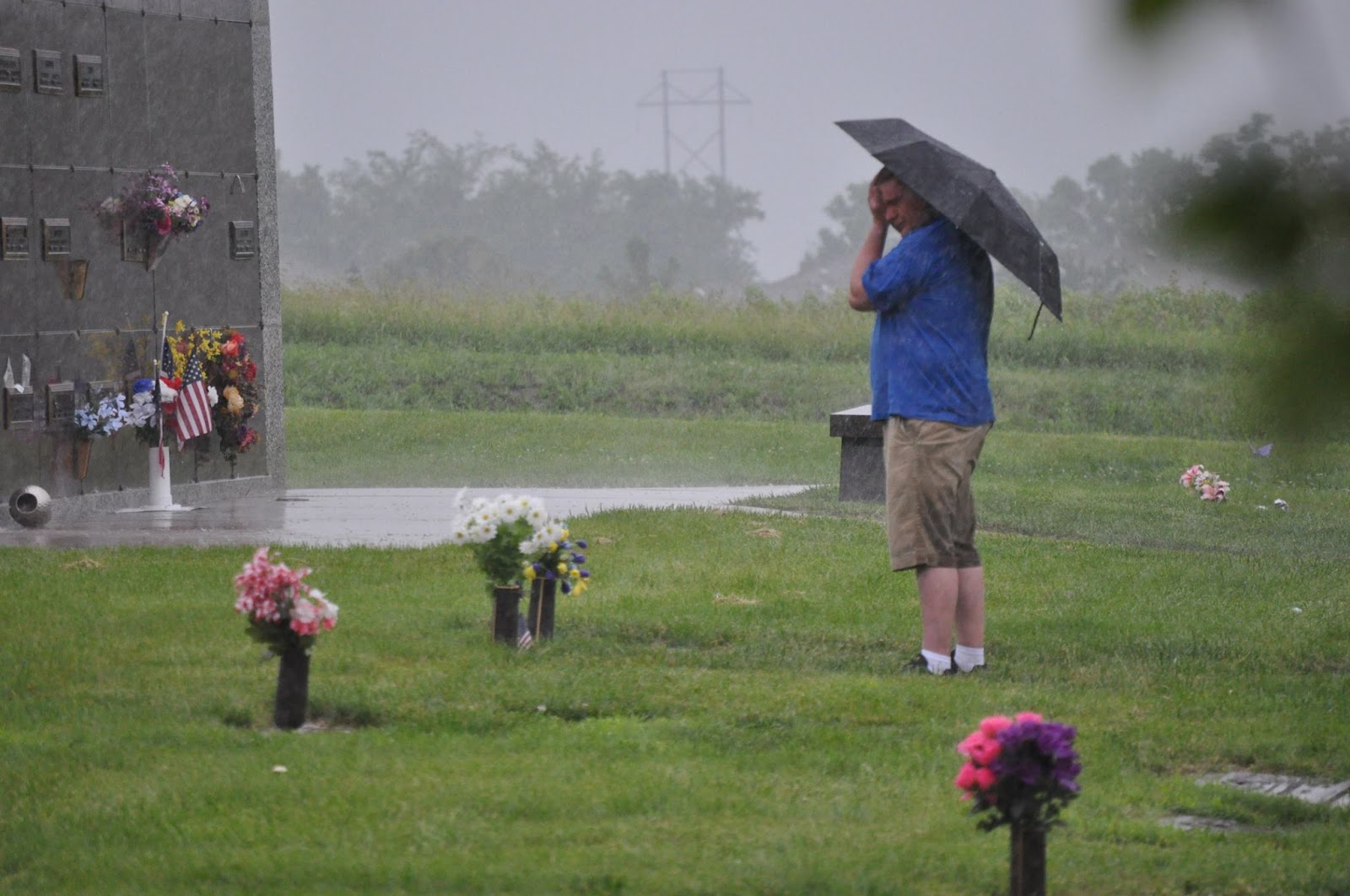 At my Dad's grave in Kansas I might be readying to leave the Dakotas, but its people will always be a part of my story, and their presence will remain through my preaching, teaching, and mentoring of pastors in the far south of Brazil. I’m thankful for the joys of new life, healed bodies, filling food. And also in some way grateful for the journey of losses, deaths, quietude, and painful longing. A journey I've walked myself while living here.
Lastly, I’d say Dakotans are honest, mostly. I was told a lot how young I was for a pastor when I first moved here. I’ve also been told how easy it is to stop coming to church (I’ve always likened it to how easy I find it to stop exercising). There’s little Christianese spoken here. People tell you just what they think from the ugly color of the church building’s siding to how fat I am.
And so when people around here have told me that they will miss me, I know it’s true. One man had watery eyes as I was exiting his living room for the last time. He didn’t say anything. He didn’t have to.
When I receive cards that have more than a signature and include a handwritten message that compliments my preaching, pastoral care, counseling, and even administrative skills, I smile, And when someone writes that my legacy at our church includes influencing our church to be more outwardly focused I say to myself, “yes, somebody got it.” Every Saturday afternoon before I’d rehearse my sermon to an empty sanctuary I’d walk up and down the center aisle, touch every pew, and pray. I'd pray that on the Lord’s Day it wouldn't matter what kind of week someone had coming in, that they would meet God here. Not because of me, but because of him.
Despite all my shortcomings, mistakes, and missteps, God actually used me here.
And I know he will continue using Dakotans here and elsewhere. I hope everybody, like that server in Houston, gets to meet one eventually.
November 1, 2017
The Long Goodbye Part One: The Land
On November 16, 2017, one month shy of my sixth anniversary serving as pastor of Herreid Baptist church, our family will head south on Highway 83 as a caravan of a moving truck and family vehicles. The sun will set as we leave behind Herreid, South Dakota, never to call it home again.
Years ago when I was adjusting to living in Herreid my heart would sometimes sink as I returned from a trip and saw the highway sign that read, “Herreid 4 miles.” After passing that last sign I’d scope the skyline, made up of a water tower and two grain elevators and wonder how this became home. It’s too hot here in the summer, much too cold in the winter, and often too windy to be sensible in all seasons. There are no proper restaurants to speak of. Sometimes my wife and I, especially in the months of January and February, would jokingly fantasize about this million-dollar idea where people would prepare good food and you could go to them and pick it up for a price or even have it delivered to you. But not in Herreid.
One honest relative dismissed Herreid as a stupid little town, vowing never to visit. And they never have in six years’ time. But it’s their loss. They can keep their higher skylines, take-outs, and deliveries. I’ll keep Herreid. That same heart that used to sink as I would return to the geographical center of the Dakotas, and not too far from that of North America, has now been dropped firmly to the bottom of my feet as I contemplate moving away from this town of 438 people on the northern plains of the Dakotas.
Herreid, like the cat we acquired shortly after moving here, somehow transformed from being strange and uneasy to a beloved part of our family that we could never live without. Herreid, the only place my daughters remember living. Herreid, the city forged by the railroad that endures long after the railroad left it behind. Herreid, named for a governor of South Dakota who was never enticed to retire in the place of his namesake and remained 25 miles east of it till he died. Herreid, which even has a song written about it that’s posted up on YouTube.
I’ll spare the audience any singing, but I can’t leave Herreid without saying a proper goodbye. Or, as they might say in the north, a long goodbye. The kind of goodbye where you say it before putting on your shoes. And again as you put on your coat, hat, and gloves. And once more in the entryway. Then again on the porch. And just one more time in the driveway. And so allow me to put on my shoes, hat, and gloves and say goodbye to the land and its people.
The Land
When you only flyover the Midwest its beauty is often unnoticed. There are farms of varying colors and sizes and tiny towns here and there as roads and highways connect them. But on the ground there’s much more to see. Trees are okay in towns, but they obscure much. In the Dakotas most every tree you come across was put there on purpose by someone. A few might be native to the prairie, hugging onto some little creek that lost its way to the mighty Missouri River. But most trees were planted in towns or to shield farmhouses from the northwest winds.
Without all those trees in the way you see sky and land as far as your eye will let you take them in. The hills will roll. The farm fields will grow, shrivel, and grow again. For five weeks in late summer the sunflowers rise and bloom before bowing in solemnity to the autumn chill. Closer to the river the bluffs will break forth from the ground and undulate across the plain, but never high enough to block the ever-present horizon. by Marci Jones
The horizon is a constant companion on the prairie. It’s always there, reminding me this world is bigger than I imagine and never quite within my grasp. I see the rain falling down the western sky dozens of miles before driving into it. On a clear day the sky mimics a painting with a hue too bright for reality. When it’s partly cloudy the shadows will dance over the bluffs, drawing my attention to every single one—each with their own greeting as I pass them by. And if there are clouds out around sunset the sky becomes a backdrop to a symphony of pastel colors, changing by the minute. The sun takes its time to set up here. Maybe it feels a little more appreciated.
 by Marci Jones
Most drives I encounter more wildlife than people. Sure, the cows might be stuck in the fields and there’s even one buffalo ranch close by. But the plains are the domain of the birds, while the deer and coyotes share it with them at night. Hawks perch on hay bales, fence posts, and even electric wires. Geese come from the south, sometimes much too early in the spring, and then return there again when they’ve figured winter’s returning. Pelicans and herons hang out in the summer for the prime fishing. An eagle or two might also stick around. The owls are more shy, but have been known to make an appearance around dusk just to let me know they’re still here.
I laughed when I moved to Herreid and saw the old state flag hanging in the school’s gymnasium, advertising that South Dakota, and not Florida or California, was the true “Sunshine State,” but just one winter here made me a believer. That sun shines brightly on even the coldest winter’s day.
I can’t speak for my whole family, but I’ll miss Herreid’s winters. Snow absorbs sound and our sleepy town is quietest when I’m out shoveling snow or taking a walk alone. The snow blankets over everything as each flake is like a sentinel from above reminding us that we are not forgotten once the temperature drops below freezing. The snow comes and stays for weeks, a silent companion during the longest months of winter. Out of town it transforms the fields, bluffs, and hills to an icy sea of tranquility.
At night the contrast of the ice with the pitch-black sky that shows up early in the evening makes for fine viewing of Orion, the Big Dipper, and many other constellations I’ve never bothered looking up. When 1,200 people live in the county there’s little artificial light to interfere with the stars that declare God’s handiwork. The northern lights, though, were tricksters who eluded me for six years. Always promising me their presence, but never actually showing up.
Spring is muddy, and my wife’s number-one goal is to convince our children to change their footwear in the entryway to our house. Her message often goes unheeded. After the snow run-off and the budding of new life, summer is soon to follow. Despite being farther away from an ocean than anyone else on this continent, we still enjoy the water. Ponds and lakes are nice, especially for our early-summer baptisms, but the dammed-up Missouri River also called Lake Oahe is the best place to go. Around Pollock, about 15 miles away from Herreid, the River is easily a mile wide. On windy days, which is just about every day, the waves crash on the shore. Hours fly by on the lake and many a Sunday afternoon is spent in the water, the sand, and the sun.
Summer departs suddenly. A frost comes one night, and then it’s fall. With few trees, fall is not a big deal in these parts. But we still carry on with cold football games and Halloween. I note the sunrises this time of year, because I’m awake for them, but they still don’t beat the sunsets.
There’s an unstated working relationship between a land and its people. That’s easy to miss when you live in a suburb that by-design resembles every other suburb in the country. As much as I’ve been drawn to this land for six years, its people fascinate me more. I’ll say goodbye to them in part two next week.
Years ago when I was adjusting to living in Herreid my heart would sometimes sink as I returned from a trip and saw the highway sign that read, “Herreid 4 miles.” After passing that last sign I’d scope the skyline, made up of a water tower and two grain elevators and wonder how this became home. It’s too hot here in the summer, much too cold in the winter, and often too windy to be sensible in all seasons. There are no proper restaurants to speak of. Sometimes my wife and I, especially in the months of January and February, would jokingly fantasize about this million-dollar idea where people would prepare good food and you could go to them and pick it up for a price or even have it delivered to you. But not in Herreid.
One honest relative dismissed Herreid as a stupid little town, vowing never to visit. And they never have in six years’ time. But it’s their loss. They can keep their higher skylines, take-outs, and deliveries. I’ll keep Herreid. That same heart that used to sink as I would return to the geographical center of the Dakotas, and not too far from that of North America, has now been dropped firmly to the bottom of my feet as I contemplate moving away from this town of 438 people on the northern plains of the Dakotas.
Herreid, like the cat we acquired shortly after moving here, somehow transformed from being strange and uneasy to a beloved part of our family that we could never live without. Herreid, the only place my daughters remember living. Herreid, the city forged by the railroad that endures long after the railroad left it behind. Herreid, named for a governor of South Dakota who was never enticed to retire in the place of his namesake and remained 25 miles east of it till he died. Herreid, which even has a song written about it that’s posted up on YouTube.
I’ll spare the audience any singing, but I can’t leave Herreid without saying a proper goodbye. Or, as they might say in the north, a long goodbye. The kind of goodbye where you say it before putting on your shoes. And again as you put on your coat, hat, and gloves. And once more in the entryway. Then again on the porch. And just one more time in the driveway. And so allow me to put on my shoes, hat, and gloves and say goodbye to the land and its people.
The Land
When you only flyover the Midwest its beauty is often unnoticed. There are farms of varying colors and sizes and tiny towns here and there as roads and highways connect them. But on the ground there’s much more to see. Trees are okay in towns, but they obscure much. In the Dakotas most every tree you come across was put there on purpose by someone. A few might be native to the prairie, hugging onto some little creek that lost its way to the mighty Missouri River. But most trees were planted in towns or to shield farmhouses from the northwest winds.
Without all those trees in the way you see sky and land as far as your eye will let you take them in. The hills will roll. The farm fields will grow, shrivel, and grow again. For five weeks in late summer the sunflowers rise and bloom before bowing in solemnity to the autumn chill. Closer to the river the bluffs will break forth from the ground and undulate across the plain, but never high enough to block the ever-present horizon.
 by Marci Jones
The horizon is a constant companion on the prairie. It’s always there, reminding me this world is bigger than I imagine and never quite within my grasp. I see the rain falling down the western sky dozens of miles before driving into it. On a clear day the sky mimics a painting with a hue too bright for reality. When it’s partly cloudy the shadows will dance over the bluffs, drawing my attention to every single one—each with their own greeting as I pass them by. And if there are clouds out around sunset the sky becomes a backdrop to a symphony of pastel colors, changing by the minute. The sun takes its time to set up here. Maybe it feels a little more appreciated.
 by Marci Jones
Most drives I encounter more wildlife than people. Sure, the cows might be stuck in the fields and there’s even one buffalo ranch close by. But the plains are the domain of the birds, while the deer and coyotes share it with them at night. Hawks perch on hay bales, fence posts, and even electric wires. Geese come from the south, sometimes much too early in the spring, and then return there again when they’ve figured winter’s returning. Pelicans and herons hang out in the summer for the prime fishing. An eagle or two might also stick around. The owls are more shy, but have been known to make an appearance around dusk just to let me know they’re still here.
I laughed when I moved to Herreid and saw the old state flag hanging in the school’s gymnasium, advertising that South Dakota, and not Florida or California, was the true “Sunshine State,” but just one winter here made me a believer. That sun shines brightly on even the coldest winter’s day.
I can’t speak for my whole family, but I’ll miss Herreid’s winters. Snow absorbs sound and our sleepy town is quietest when I’m out shoveling snow or taking a walk alone. The snow blankets over everything as each flake is like a sentinel from above reminding us that we are not forgotten once the temperature drops below freezing. The snow comes and stays for weeks, a silent companion during the longest months of winter. Out of town it transforms the fields, bluffs, and hills to an icy sea of tranquility.
At night the contrast of the ice with the pitch-black sky that shows up early in the evening makes for fine viewing of Orion, the Big Dipper, and many other constellations I’ve never bothered looking up. When 1,200 people live in the county there’s little artificial light to interfere with the stars that declare God’s handiwork. The northern lights, though, were tricksters who eluded me for six years. Always promising me their presence, but never actually showing up.
Spring is muddy, and my wife’s number-one goal is to convince our children to change their footwear in the entryway to our house. Her message often goes unheeded. After the snow run-off and the budding of new life, summer is soon to follow. Despite being farther away from an ocean than anyone else on this continent, we still enjoy the water. Ponds and lakes are nice, especially for our early-summer baptisms, but the dammed-up Missouri River also called Lake Oahe is the best place to go. Around Pollock, about 15 miles away from Herreid, the River is easily a mile wide. On windy days, which is just about every day, the waves crash on the shore. Hours fly by on the lake and many a Sunday afternoon is spent in the water, the sand, and the sun.
Summer departs suddenly. A frost comes one night, and then it’s fall. With few trees, fall is not a big deal in these parts. But we still carry on with cold football games and Halloween. I note the sunrises this time of year, because I’m awake for them, but they still don’t beat the sunsets.
There’s an unstated working relationship between a land and its people. That’s easy to miss when you live in a suburb that by-design resembles every other suburb in the country. As much as I’ve been drawn to this land for six years, its people fascinate me more. I’ll say goodbye to them in part two next week.
September 13, 2017
Someone Who's Bananas for Jesus: My Youth Pastor Cam South
“I’ll give you a definition of someone who’s a Christian: someone’s who’s bananas for Jesus” – Keith Green
My church growing up was an independent fundamentalist Baptist church. Our worship included singing congregational hymns from the 19thand 20th centuries, hearing high quality choir numbers and special music, followed by a sermon out of the King James Bible. Some 500 people faithfully attended Sunday mornings, and a good half of them would return each Sunday and Wednesday night. The church’s youth group ran around 100 kids, many of whom did not have parents who attended the church.
Other churches sent their leaders to Overland Park, Kansas to try to figure out the secret. Was it the teaching style? Was there a program to replicate? Was there some curriculum that just couldn’t miss? Was there a revolutionary change in how to run youth group meetings? I was once summoned in as a teenager to interview with a group from a church in the Chicago suburbs that wanted to learn from our youth group. Back then I probably wasn’t of much help, but were I to talk to them again today, here’s what I would tell them. The secret to our church’s youth group was a leader who loved kids, making each of us feel like we mattered to him—and to God—by pouring his life into us and building us up. The secret was Cam South.
 His building us up wasn’t primarily through teaching us as a group each week. I can’t recall a particular sermon or lesson that stood out, but in and through each lesson was his passion for Jesus. His voice would become quite strained and even whispery as he’d turn our focus to God’s eternal glory in Christ.
What Cam did best was old-fashioned discipleship, where the mentor takes the protégé along to learn by doing. Cam would take us along for fun things: Royals games and cards at his house. He’d also take us along for service, even if it was deploying us to help upkeep some elderly church members’ yards. That was when he really taught us, often through his actions rather than his words. We’d see how he interacted with people, how he treated others, and how he would care for all he met. Eventually, if you gave him enough time, he’d talk about Jesus.
Once we’d accompanied him enough, we’d have a better idea on how to follow suit. He’d rarely shoot down our ideas, letting us lead as we saw fit. I remember leading a group of friends to march around our high school—a rather big campus—seven times before the school year started, reminiscent of Joshua and Jericho. We didn’t want the walls to crumble, of course, but we did want to see God at work inside that huge building.
One morning I woke up to drive to the first day of school and Cam had put a posterboard on top of my windshield with this verse written on it: “My message and my preaching were not with wise and persuasive words, but with a demonstration of the Spirit’s power, so that your faith might not rest on human wisdom, but on God’s power” (1 Cor 2:4-5). Cam saw me as a preacher long before I saw myself as one.
Like most people I’ve come to know over the years whom God has used mightily, Cam is never one to talk about himself. So allow me to say it: Cam, God has blessed you throughout the years. You have a wonderful family, and you did well loving them while serving Christ’s church. I am just one of dozens of men and women you influenced to grow in Christ and make a difference for God’s kingdom. I’m proud to have been part of your youth group, and you will always be a part of my journey with God. A journey that is that much sweeter, having known you.
Thank you!
My church growing up was an independent fundamentalist Baptist church. Our worship included singing congregational hymns from the 19thand 20th centuries, hearing high quality choir numbers and special music, followed by a sermon out of the King James Bible. Some 500 people faithfully attended Sunday mornings, and a good half of them would return each Sunday and Wednesday night. The church’s youth group ran around 100 kids, many of whom did not have parents who attended the church.
Other churches sent their leaders to Overland Park, Kansas to try to figure out the secret. Was it the teaching style? Was there a program to replicate? Was there some curriculum that just couldn’t miss? Was there a revolutionary change in how to run youth group meetings? I was once summoned in as a teenager to interview with a group from a church in the Chicago suburbs that wanted to learn from our youth group. Back then I probably wasn’t of much help, but were I to talk to them again today, here’s what I would tell them. The secret to our church’s youth group was a leader who loved kids, making each of us feel like we mattered to him—and to God—by pouring his life into us and building us up. The secret was Cam South.
 His building us up wasn’t primarily through teaching us as a group each week. I can’t recall a particular sermon or lesson that stood out, but in and through each lesson was his passion for Jesus. His voice would become quite strained and even whispery as he’d turn our focus to God’s eternal glory in Christ.
 What Cam did best was old-fashioned discipleship, where the mentor takes the protégé along to learn by doing. Cam would take us along for fun things: Royals games and cards at his house. He’d also take us along for service, even if it was deploying us to help upkeep some elderly church members’ yards. That was when he really taught us, often through his actions rather than his words. We’d see how he interacted with people, how he treated others, and how he would care for all he met. Eventually, if you gave him enough time, he’d talk about Jesus.
Once we’d accompanied him enough, we’d have a better idea on how to follow suit. He’d rarely shoot down our ideas, letting us lead as we saw fit. I remember leading a group of friends to march around our high school—a rather big campus—seven times before the school year started, reminiscent of Joshua and Jericho. We didn’t want the walls to crumble, of course, but we did want to see God at work inside that huge building.
One morning I woke up to drive to the first day of school and Cam had put a posterboard on top of my windshield with this verse written on it: “My message and my preaching were not with wise and persuasive words, but with a demonstration of the Spirit’s power, so that your faith might not rest on human wisdom, but on God’s power” (1 Cor 2:4-5). Cam saw me as a preacher long before I saw myself as one.
Like most people I’ve come to know over the years whom God has used mightily, Cam is never one to talk about himself. So allow me to say it: Cam, God has blessed you throughout the years. You have a wonderful family, and you did well loving them while serving Christ’s church. I am just one of dozens of men and women you influenced to grow in Christ and make a difference for God’s kingdom. I’m proud to have been part of your youth group, and you will always be a part of my journey with God. A journey that is that much sweeter, having known you.
Thank you!
August 17, 2017
Back to Church: How good news was bad news, but became good again
We used to just go on Sunday mornings, prefaced by a trip to the local donut shop, which wasn’t bad. One day my parents said we were going to return to church each Sunday evening from now on. I couldn’t believe it, thinking of all the premium Sunday night television I was about to miss, not to mention playing outside.
Not long after that both of them joined the church choir, which practiced an hour before church on Sunday evenings, regardless of whether or not the football game I was watching had ended. The choir also practiced a half-hour after church on Wednesday nights. We even started going to church on Wednesday nights! I couldn’t believe it.
As a kid my life naturally revolved around myself, so worshipping God with his church made little sense. Even though I wasn’t thrilled about going, my parents still made me go, just like they made me go to school, eat my vegetables, and wear a seatbelt in the car. They knew what was best for me even when I didn’t.
A funny thing happened, though, as the years went on. I was seized by God’s love for me in Christ. I was in awe of the opportunity to worship him with fellow believers that made up our church. I was excited to learn the Holy Scriptures together with others. Before long I found myself enjoying the extra time with the church while my parents practiced choir. I was even entrusted to teach my first church class one summer during choir practice time.
I’ve found a lot of parents today treat church differently than mine did when I was young. Whereas the average church member attended three times a week back then, today that number is reduced to three times a month. Has life really changed that much that quickly in our country? Or have we changed? I couldn’t say.
What I do know is this: God’s Word hasn’t changed. Paul calls the church, “God’s household…the pillar and foundation of truth.” He also says, “Christ loved the church and gave himself up for her to make her holy, cleansing her by the washing with water through the word…to present her to himself as a radiant church, without stain or wrinkle or any other blemish, but holy and blameless.”
Many people who claim to be Christians are content to remain distant from Christ’s church. They may have grown up with church, but supposedly outgrew it. They had a bad experience once or twice. They’ve come up with supposedly better ways to connect with God than the ways God chose.
Contrast that attitude with what Paul said above about Christ loving his church as a good husband loves his wife. He loved his church so much he gave himself for it. When we grow cold, distant, and even stand-offish with Christ’s church, it affects our relationship with him. It’s like telling your friend you like them and all, but really can’t stand being around their spouse.
The musician Keith Green said that going to church doesn’t make you a Christian any more than going to McDonald’s makes you a hamburger. And he’s right. But let’s not fool ourselves that the opposite is completely true. When the community of Christ’s redeemed meet regularly on the Lord’s day to worship him, pray, hear from his Holy Scriptures, and partake of his means of grace, your continued absence means something.* It’s certainly saying something to your kids, if they’re still at home.
I’ve got three kids getting ready to go back to school next Monday. They’ll soon have to adjust when they go to bed each night, when they wake up each morning, and how they’ll spend their time each weekday. It might be tough, but it will be worth it.
Why not take advantage of this time of year and come back to church? It might be tough, but it will be worth it.
*Pastor Kevin DeYoung first made me think of this point.
Not long after that both of them joined the church choir, which practiced an hour before church on Sunday evenings, regardless of whether or not the football game I was watching had ended. The choir also practiced a half-hour after church on Wednesday nights. We even started going to church on Wednesday nights! I couldn’t believe it.
As a kid my life naturally revolved around myself, so worshipping God with his church made little sense. Even though I wasn’t thrilled about going, my parents still made me go, just like they made me go to school, eat my vegetables, and wear a seatbelt in the car. They knew what was best for me even when I didn’t.
A funny thing happened, though, as the years went on. I was seized by God’s love for me in Christ. I was in awe of the opportunity to worship him with fellow believers that made up our church. I was excited to learn the Holy Scriptures together with others. Before long I found myself enjoying the extra time with the church while my parents practiced choir. I was even entrusted to teach my first church class one summer during choir practice time.
I’ve found a lot of parents today treat church differently than mine did when I was young. Whereas the average church member attended three times a week back then, today that number is reduced to three times a month. Has life really changed that much that quickly in our country? Or have we changed? I couldn’t say.
What I do know is this: God’s Word hasn’t changed. Paul calls the church, “God’s household…the pillar and foundation of truth.” He also says, “Christ loved the church and gave himself up for her to make her holy, cleansing her by the washing with water through the word…to present her to himself as a radiant church, without stain or wrinkle or any other blemish, but holy and blameless.”
Many people who claim to be Christians are content to remain distant from Christ’s church. They may have grown up with church, but supposedly outgrew it. They had a bad experience once or twice. They’ve come up with supposedly better ways to connect with God than the ways God chose.
Contrast that attitude with what Paul said above about Christ loving his church as a good husband loves his wife. He loved his church so much he gave himself for it. When we grow cold, distant, and even stand-offish with Christ’s church, it affects our relationship with him. It’s like telling your friend you like them and all, but really can’t stand being around their spouse.
The musician Keith Green said that going to church doesn’t make you a Christian any more than going to McDonald’s makes you a hamburger. And he’s right. But let’s not fool ourselves that the opposite is completely true. When the community of Christ’s redeemed meet regularly on the Lord’s day to worship him, pray, hear from his Holy Scriptures, and partake of his means of grace, your continued absence means something.* It’s certainly saying something to your kids, if they’re still at home.
I’ve got three kids getting ready to go back to school next Monday. They’ll soon have to adjust when they go to bed each night, when they wake up each morning, and how they’ll spend their time each weekday. It might be tough, but it will be worth it.
Why not take advantage of this time of year and come back to church? It might be tough, but it will be worth it.
*Pastor Kevin DeYoung first made me think of this point.
August 10, 2017
On reading Luke and the weekly obituaries: The rich men who did and didn't invent the Nobel Prize
Our weekly newspaper always has at least one obituary. As I read them I learn about family relations, upbringing, jobs, and things the deceased found important. I also wonder what it would be like to read my own obituary.
Alfred Nobel got to read his own obituary not long after his brother died. His local newspaper mistook his brother for Alfred, the man who made a fortune off of inventing dynamite. While obituaries are rarely punchy, someone wrote in Alfred’s obituary that he alone made it possible to kill more people more quickly than anyone else in human history. Alfred was horrified by this and wondered what he could do to alter his legacy. Hence, the Nobel prizes for those who benefit mankind in politics, science, and art.
Treasures on Earth Expire
Unlike Nobel, most people don’t get a chance to think about how they spent their lives until it’s too late to change anything. In Luke’s Gospel Jesus introduces us to an unnamed rich man and his poor neighbor Lazarus. The rich man lived in luxury, oblivious to his neighbor Lazarus, who struggled to eat and maintain good health. When both men died the rich man woke up in torment in Hades, while Lazarus was in a sort of paradise with Father Abraham.
Death is a great equalizer in that worldly riches, status, and luxury have no bearing on the afterlife. All the rich man wanted in the afterlife was the tiniest bit of comfort and someone to warn his friends and family that there really is life after death and they’re all doing life wrong. But Abraham denied him, saying that even if someone came back from the dead to warn these oblivious people, it wouldn’t matter because they already have the Bible and fail to take it seriously.
It’s remarkable what we take seriously and what we don’t. We live and die by our sports teams. We let our blood pressure increase over partisan politics. We sacrifice our health to earn our wealth and then reverse the process when we get older. We fool ourselves that God can be found in our hobbies at the lake or right at home, always thinking that there’s time to put things in order before it’s too late. Before it’s our obituary running in the paper.
But, just like the rich man in Jesus’ story, we don’t know what the future holds. If there’s one thing I’ve learned from reading obituaries it’s that people of all ages die in all sorts of ways. All we can do is be ready, and Jesus teaches us that investing in worldly riches is the wrong way to be prepared. Instead, he tells us to store up treasures in heaven, because where our treasure is our heart will be also.
Treasures in Heaven Don't
How do you store up treasure in heaven? The first step is you have to take seriously the Holy Scriptures and what they say about creation, sin, redemption, and new creation. God made you, and although sin and death separate you and him—because we all sin, he has defeated sin and death by sending his Son, Jesus Christ, to take on our nature and pay the penalty of our sins by tasting the curse of death for us all. Just as God raised Jesus from the dead, he promises that Jesus will return to earth one day and everyone will be raised from the dead, some to new life in God’s kingdom and some to go to the place prepared for the Devil and his angels. In Jesus’ story Lazarus was in one, while the rich man was in the other.
Where will you go after you die? Alfred Nobel may have changed his earthly legacy after reading his obituary, but such efforts wouldn’t change what happened after he actually died. The only thing that matters for him, you, me, and everyone else is being seized by God’s love in the gospel of Jesus Christ.
The Scriptures say confess with your mouth that Jesus is Lord and believe in your heart that God raised him from the dead and you will be saved. For whosoever calls upon the name of the Lord will be saved. The next step is growing up in Christ, and he has given us his bride and body, the church, to nurture us along the way.
If you’ve never taken these steps, don’t delay. Next week’s obituaries haven’t been written yet.
Alfred Nobel got to read his own obituary not long after his brother died. His local newspaper mistook his brother for Alfred, the man who made a fortune off of inventing dynamite. While obituaries are rarely punchy, someone wrote in Alfred’s obituary that he alone made it possible to kill more people more quickly than anyone else in human history. Alfred was horrified by this and wondered what he could do to alter his legacy. Hence, the Nobel prizes for those who benefit mankind in politics, science, and art.
Treasures on Earth Expire
Unlike Nobel, most people don’t get a chance to think about how they spent their lives until it’s too late to change anything. In Luke’s Gospel Jesus introduces us to an unnamed rich man and his poor neighbor Lazarus. The rich man lived in luxury, oblivious to his neighbor Lazarus, who struggled to eat and maintain good health. When both men died the rich man woke up in torment in Hades, while Lazarus was in a sort of paradise with Father Abraham.
Death is a great equalizer in that worldly riches, status, and luxury have no bearing on the afterlife. All the rich man wanted in the afterlife was the tiniest bit of comfort and someone to warn his friends and family that there really is life after death and they’re all doing life wrong. But Abraham denied him, saying that even if someone came back from the dead to warn these oblivious people, it wouldn’t matter because they already have the Bible and fail to take it seriously.
It’s remarkable what we take seriously and what we don’t. We live and die by our sports teams. We let our blood pressure increase over partisan politics. We sacrifice our health to earn our wealth and then reverse the process when we get older. We fool ourselves that God can be found in our hobbies at the lake or right at home, always thinking that there’s time to put things in order before it’s too late. Before it’s our obituary running in the paper.
But, just like the rich man in Jesus’ story, we don’t know what the future holds. If there’s one thing I’ve learned from reading obituaries it’s that people of all ages die in all sorts of ways. All we can do is be ready, and Jesus teaches us that investing in worldly riches is the wrong way to be prepared. Instead, he tells us to store up treasures in heaven, because where our treasure is our heart will be also.
Treasures in Heaven Don't
How do you store up treasure in heaven? The first step is you have to take seriously the Holy Scriptures and what they say about creation, sin, redemption, and new creation. God made you, and although sin and death separate you and him—because we all sin, he has defeated sin and death by sending his Son, Jesus Christ, to take on our nature and pay the penalty of our sins by tasting the curse of death for us all. Just as God raised Jesus from the dead, he promises that Jesus will return to earth one day and everyone will be raised from the dead, some to new life in God’s kingdom and some to go to the place prepared for the Devil and his angels. In Jesus’ story Lazarus was in one, while the rich man was in the other.
Where will you go after you die? Alfred Nobel may have changed his earthly legacy after reading his obituary, but such efforts wouldn’t change what happened after he actually died. The only thing that matters for him, you, me, and everyone else is being seized by God’s love in the gospel of Jesus Christ.
The Scriptures say confess with your mouth that Jesus is Lord and believe in your heart that God raised him from the dead and you will be saved. For whosoever calls upon the name of the Lord will be saved. The next step is growing up in Christ, and he has given us his bride and body, the church, to nurture us along the way.
If you’ve never taken these steps, don’t delay. Next week’s obituaries haven’t been written yet.
June 1, 2017
McGill and Me: How a theologian fixated on poverty, suffering, and death inspired me when I needed it most
I’d been a Boy Scout, earned four college degrees, served as a foster parent, and even published a book. But nothing in my life has been as draining as the past five months raising funds to be a missionary. God’s call to the mission field disrupted my life by making me so needy and so helpless in meeting my needs, and that’s in just getting to Brazil.
It’s also turned me to God with the help of Arthur McGill, a little-known American theologian who battled diabetes his whole life, eventually dying after complications with a kidney transplant. McGill talked about death more than life and God’s neediness more than God’s might. His only published works are entitled: Sufferingand Death and Life—two topics Joel Osteen will likely never write about.
Terrible, Horrible, No Good, Very Bad Missionaries
Everything these days is terrible with missions, at least that’s the message I often see on social media. Some missionaries aren’t directly involved in churches overseas, hard-earned money gets wasted on people who don’t deserve it, and the ones who think they are helping others across the ocean are actually hurting those poor people.
Maybe American Christians have finally gotten the message. The largest Baptist group in America, the Southern Baptist Convention, recently downsized their international missions efforts, laying off hundreds of people in the field and selling off global assets left and right in order to balance their budget. The Baptist group I grew up in once boasted hundreds upon hundreds of missionaries in the 1970s with my in-laws being among them. Today they still have over a hundred missionaries, but those young men and women from forty years ago are nearing retirement age. Most of them will not be replaced.
And why should they? If the message is that missions is something of the past and perhaps even harmful in the present, that’s going to do little to inspire anyone to become one, especially considering how hard we make it on people to become missionaries. Not only do you have to move to another country, become fluent in a foreign language, and figure out how to thrive once there. You also have to convince a large group of people to fund your efforts in doing so. Oh, and until you do convince enough of them, you likely won’t have any income for your family in the meantime. And yet, by the grace of God, there go I.
Excited, Eager, Persistent, and Burned Out
Six months ago my wife and I signed the paperwork to become appointed missionaries to Brazil, sent by our conference of churches, the North American Baptists (NAB). Originally started by German Baptists in Philadelphia in the mid-1800s, the NAB today has 400 churches scattered across Canada and the United States. The NAB is active in a handful of mission fields across the world, focusing on supporting local churches in the field through assisting with education, medicine, and even technology. Liberally adding up our career, short-term, and partner missionaries, the NAB boasts about 30 or so missionaries out of 400 churches. That’s roughly one missionary for every 13 churches.
Thirteen churches should easily be able to send one missionary, so with those odds I didn’t think it would be too difficult to find supporting churches and get to the field within 18 months or so. After all I’d served as a pastor in the conference for several years and never once been personally contacted by an NAB missionary who is raising support. I’d like to think that if I ever did receive such a call or email I’d respond and want to help. But perhaps not. Pastors and church leaders by and large do not welcome being contacted by a missionary in need of money. Most emails go unreturned and voicemails go unanswered. For example, I emailed and then later called every pastor of an NAB church in one state, and the only two who responded were pastors who at one time were themselves missionaries. After going through that I wondered if these are the unresponses from my NAB colleagues this is going to be a lot tougher than I thought.
Despite the overwhelming indifference to my letters, emails, and phone calls, I was still able to get ahold of several NAB churches. Some of them would respond that they just didn’t have space in their budget for a new missionary. Others were more frank, saying not only do they not have the funds, but even if they did other missionaries would get them before I would. A couple pastors explained their church’s strategy for supporting missions, and how I didn’t fit into it. A few welcomed me to come and present at their church, but without any guarantee of support other than a one-time love offering coupled with a potluck meal or trip to the local café afterwards.
Like the parable of the sower and the seed, some of my correspondence fell on good ground. I’d contact a church that not only had available funds but, more importantly, my mission of helping train church planters and leaders in southern Brazil matched their church’s investment in missions. In Jesus’ parable the good ground seemed to receive about a fourth of the seed. In my five months of fundraising I’d say the good ground is around 5-10% or so. That same percentage holds when it comes to reaching out to family, friends, and neighbors—a number that I assumed would be quite lower than the response from churches, but it’s not.
The Extras of Life
Whether I contact churches or people I sometimes get the vibe that few of them have any extra money laying around and what I am asking for is something extra. That makes sense because our family doesn’t have any extra money laying around either. Our church, on the other hand, is more flexible. When I became pastor I wanted our church to become more missions-minded. I vowed that we’d always have a missionary speak at our missions-emphasis Sunday. We’d also look to increase our missions giving each year by giving the church a bigger target to hit with hopes we could add more missionaries with more money. Without leadership driving them toward a specific goal, few churches will accidentally give more money to missions. Given the responses I received from my pastoral colleagues, word seemed to have gotten out that missions was a thing of the past. Few pastors would even feign interest in what God was calling my family to do and where. They just wanted to tell me quickly how they couldn’t help me, especially if I’d tried contacting them several times before without any response.
In some of my most cynical moments I’d imagine myself a salesman, trying to convince a person or a church who had extra money that I was worth giving it to. And who wants to do that? No missionary wants to reach the field through someone’s excess money. Rather, we need partners, whether families or churches, who are willing to adjust their lives to make room for being a part of what God’s doing overseas. When our family became foster parents it was not out of any excess time, energy, or love we had among the five of us. Rather, we decided we would invest in the children that were brought to us and adjust our lives accordingly. Making room in a family or church budget is much less disruptive than opening your home to little strangers, but it is disruptive nonetheless. And we Americans don’t like to be disrupted. We like being needy even less.
Good Neediness?
Raising funds has brought intense focus, which is sometimes good but usually comes with heartache. When I was writing my book I was focused on my argument incessantly, thinking about it morning, noon, and night. I devoted hours of my day to finessing it until it was complete. At that time I had a big goal to finish the book and could work as hard as I wanted to work toward completing it. Now, I have a big goal, raising $8,900 a month to be a missionary, but there is very little I can actually do toward completing it. It’s not really my goal, it’s God’s. He will have to provide. Human nature often shouts out God’s revelation in presuming his provision comes in health, wealth, and blessings. But when God has spoken in the prophets, Scriptures, and Jesus Christ, he reveals his provision also comes in neediness and poverty, which create space for us to receive his love.
Fundraising not only makes me needy in front of churches, family members, and friends, but also in front of God. I always should be needy in front of God, but I often forget to be.
As Americans we are so used to enabling ourselves. I’m only in my thirties, but I remember having five television stations and just watching what happened to be on one of them. My kids can choose on a whim any number of hundreds of programs online. Instead of catching people at home on the phone or leaving a message, we text and expect an immediate response, worrying if it even takes one minute for their reply. With headphones and smartphones we don’t need anyone or anything, except free Wi-Fi.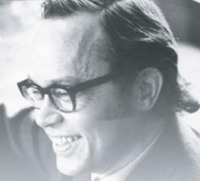 Arthur C. McGillWe turn to the things we have in order to tell ourselves we don’t really need anything, but to be human is to be needy, no matter what things we have. As Christians, McGill argues, the lesson of the Incarnation and Atonement is that to be needy is also divine:
The focus of God’s claim in Jesus is rather for the growth and rootage of human existence in that receiving which is based on neediness, and in that sharing which opens boundaries and involves vulnerability. Yet no instance of the temptation to refuse these qualities is more destructive than the effort to worship an unneedy and invulnerable God. If such a God indeed excludes every possibility of needy brokenness, this God also excludes the life actualized in Jesus. For this God is not the creator of shared life but simply a product of the human outrage at evil. This God canonizes the life of wealth. If God’s rule in Jesus Christ points away from suffering, it is not because God stands in inviolable self-sufficiency. Such self-containedness is precisely a source of human suffering, the avarice and arrogance to exclude neediness from ourselves, and the heartless refusal to respond to the neediness in others. The love of God sanctifies our neediness for God and for one another, because neediness belongs properly and naturally to God (Sermons of Arthur C. McGill, 51).
Ancient people who first heard the gospel of Jesus Christ often imagined that what separated the gods from mere mortals was their lack of neediness. Whatever a god is, they figured, that god must be by definition beyond all need. When Christians preached a God who became needy flesh in Jesus, ancient people often balked. Paul said the gospel was a stumbling block to fellow Jews and foolishness to Gentiles for good reason (1 Cor 1:23).
The Needy, Eternal God
McGill covers the disputes over Arianism in the fourth century on this exact point: if being divine means being self-sufficient and without need, then the eternal Son sent to become flesh and dwell among us cannot be divine, just as Arius thought. But if Arius was wrong, and the church concluded that he was, then God knows what it is like to be needy, to be dependent, and calls us to go and be likewise. God didn’t give out of his excess. He gave himself.
The Arian controversy might’ve been ecclesiastically settled long ago, but there is no shortage today of American Christians, myself included, who tend to equate neediness with the evils of the world rather than God and his rich blessings. We think of love in terms of what we can give rather than what we receive. Here’s McGill again on the Beatitudes (Matt 5:3-12):
The meaning of these beatitudes becomes a bit clearer when we remember the New Testament emphasis on love as giving and receiving. When churches address affluent people like us, they tend to talk about the importance of giving, of attending to the poor, the sick and the oppressed. The assumption always is that these teachings refer to other people we are called to help. What churches have not made clear is that the primary human relation to love does not consist in giving but in receiving. In fact the New Testament is wholly preoccupied with God’s loving the world that people may receive. Beatitude is to receive the fullness of life. What Jesus’s beatitudes do is to make clear the indispensable condition for receiving. We cannot receive unless we lack, unless we are in need. The need doesn’t have to be excruciating, though it may be. But if we are to know the kind of love emphasized in the New Testament, the love that constantly gives nourishment and strength and order for a true life, we can only receive that gifted nourishment to the extent that we need it. Otherwise the gift will not touch us deeply, and receiving the gift will not arouse in us much gratitude or much life. What Jesus’s beatitudes say is simply this: Blessed are those who receive into the depths and center of themselves. And only those can receive into the depths and center of themselves who are impoverished there, or who are sorrowful there, or who are hungry there, or who are persecuted there. In other words, if you are not willing to be one with your neediness, you cannot be blessed (Sermons of Arthur C. McGill, 28, emphasis mine).
Earlier this week America observed Memorial Day, and I sat with dozens of people in our local school gym to pay respects to the men and women who died in uniform, serving our country. All of us there were touched deeply with the gift these people gave us, arousing in us much gratitude and much life. Yet I couldn’t help but think about the previous day, the Lord’s Day, and how the gospel of Jesus Christ doesn’t seem to touch us as deeply or arouse in us much gratitude. But why? It reminds me of Jesus’ statements that healthy people don’t seek out physicians and those who think they don’t owe much aren’t very grateful. It’s the sick and the poor who flock to Jesus, and in America we despise being sick and poor, so we don’t flock to Jesus. Instead, we’ll do whatever it takes to avoid being sick, poor, or needy.
The message of Madison Avenue is built on the foundation that neediness is evil, but the message of Golgotha rests on the foundation that neediness is necessary. As Leonard Cohen once sang, “There’s a crack, a crack in everything. That’s how the light gets in.”
We Are Not Good Samaritans
Once we’re cracked we can receive the light. My favorite McGill sermon in print is on Jesus’ story of the Good Samaritan (Luke 10:25-37). He also writes about it in his book on suffering:
The good Samaritan is Jesus Christ. This story is indeed a parable. Like all Jesus’ other parables, it does not tell us about our human love and how we can go about displaying it to needy people. It tells us about God’s love for us in Jesus Christ. It requires us to identify ourselves, not with the heroic Samaritan, but with the poor wounded man on the side of the road. It reminds us that the one who truly serves us and is our neighbor, who saves our life and therefore draws forth our love, does not come with all the badges and character recommendations that we expect. He does not come with charity shining conspicuously all over him. He does not come as a priest or a Levite. The parable warns us, not of the difficulty we face in trying to love others, but of the difficulty that all of us will have in appreciating the one who loves us and lays down his life for us, namely, our neighbor Jesus Christ. Jesus alone is our true neighbor. He comes to us as a Samaritan might come to a Jew. On the surface he is simply not impressive enough to satisfy us. And yet he heals our deepest wounds and brings us the gift of eternal life. From the world’s viewpoint, he comes in a broken and contemptible form, apparently incapable even of preserving himself. He is not powerful in terms of his title and function, as is the priest and the Levite, or the chairman of the United Fund or the director of the Red Cross. He is only powerful—but supremely powerful—in the life that he gives to men, healing their human sickness and opening to them the gates of paradise. He so fully restores them that they are enabled to become his servants, and in his name may be compassionate to others as he has been to them. He so heals men that by his power they too can go and do likewise. They too can be a neighbor to others in his name. The fact that we may be neighbors to one another, however, is only the consequence of the fundamental fact that God himself has given Jesus Christ as our neighbor (Suffering: A Test of Theological Method, 110-11).
Who wants to relate to the man who was attacked, stripped of his clothes, beaten, and left for dead? We’d rather see ourselves as givers, rather than the needy. As Will Willimon says, “we prefer to see ourselves as givers,” but the biblical account of Christmas portrays us, “not as the givers we wish we were but as the receivers we are.” We humans can take no more credit for Christmas than we can for being Good Samaritans. Paul asks the Corinthians, “What do you have that you did not receive? And if you did receive it, why do you boast as though you did not?” (1 Cor 4:7b).
The Wounded Giver
When we reach Brazil we will have nothing that we didn’t receive. Literally. God has so far raised up many people and churches who have not just given out of their excess but have partnered with us, and I’m amazed at how God works. Right now, five months into the fundraising process we are about a fourth of the way there. Has God provided?
Yes, not only through the 25% but the other 75% as well. His provision comes through my intense neediness. His provision comes through my reliance on receiving his love. And if I turn to him to receive his love, there will likely be something real that I can share with others.
All of us are hurting, not just people like me raising funds. We all hurt, and we hurt in such a way that no prescription, liquid bottle, push-button notification, or human relationship will heal. Living as only givers and never receivers will not last us very long in this fallen world.
If you, like me, are needy, then embrace it. It won’t magically solve all of life’s problems: God never promises such things in this life. But it will open you to receiving from him again and again and again, and in that learning you will discover his love in all its height, breadth, and depth.
Here’s how McGill concluded his sermon on the Beatitudes:
When Jesus relates a need and suffering to love, when he calls people into the life of love, this call is not a call for people to give love. It is also a call for people to receive love in connection with their suffering. Just at this point the power of the mind to hide our suffering from us comes into play. Because the mind is the greatest narcotic, it is extremely difficult for any of us to know our suffering, especially the deep suffering that belongs to our daily life. Therefore, to know our suffering, much less to discover the meaning of love in connection with that suffering, involves a work and a constant learning the whole rest of our lives (The Sermons of Arthur C. McGill, 30).
I should’ve been learning this all along. Sometimes God gets through to me, like when my father died of cancer or I struggled to find a job after training for it for more than twelve years. These past five months he’s gotten through to me once again amid all the prayers, phone calls, and emails.
Maybe he wants to get through to you too.
It’s also turned me to God with the help of Arthur McGill, a little-known American theologian who battled diabetes his whole life, eventually dying after complications with a kidney transplant. McGill talked about death more than life and God’s neediness more than God’s might. His only published works are entitled: Sufferingand Death and Life—two topics Joel Osteen will likely never write about.
Terrible, Horrible, No Good, Very Bad Missionaries
Everything these days is terrible with missions, at least that’s the message I often see on social media. Some missionaries aren’t directly involved in churches overseas, hard-earned money gets wasted on people who don’t deserve it, and the ones who think they are helping others across the ocean are actually hurting those poor people.
Maybe American Christians have finally gotten the message. The largest Baptist group in America, the Southern Baptist Convention, recently downsized their international missions efforts, laying off hundreds of people in the field and selling off global assets left and right in order to balance their budget. The Baptist group I grew up in once boasted hundreds upon hundreds of missionaries in the 1970s with my in-laws being among them. Today they still have over a hundred missionaries, but those young men and women from forty years ago are nearing retirement age. Most of them will not be replaced.
And why should they? If the message is that missions is something of the past and perhaps even harmful in the present, that’s going to do little to inspire anyone to become one, especially considering how hard we make it on people to become missionaries. Not only do you have to move to another country, become fluent in a foreign language, and figure out how to thrive once there. You also have to convince a large group of people to fund your efforts in doing so. Oh, and until you do convince enough of them, you likely won’t have any income for your family in the meantime. And yet, by the grace of God, there go I.
Excited, Eager, Persistent, and Burned Out
Six months ago my wife and I signed the paperwork to become appointed missionaries to Brazil, sent by our conference of churches, the North American Baptists (NAB). Originally started by German Baptists in Philadelphia in the mid-1800s, the NAB today has 400 churches scattered across Canada and the United States. The NAB is active in a handful of mission fields across the world, focusing on supporting local churches in the field through assisting with education, medicine, and even technology. Liberally adding up our career, short-term, and partner missionaries, the NAB boasts about 30 or so missionaries out of 400 churches. That’s roughly one missionary for every 13 churches.
Thirteen churches should easily be able to send one missionary, so with those odds I didn’t think it would be too difficult to find supporting churches and get to the field within 18 months or so. After all I’d served as a pastor in the conference for several years and never once been personally contacted by an NAB missionary who is raising support. I’d like to think that if I ever did receive such a call or email I’d respond and want to help. But perhaps not. Pastors and church leaders by and large do not welcome being contacted by a missionary in need of money. Most emails go unreturned and voicemails go unanswered. For example, I emailed and then later called every pastor of an NAB church in one state, and the only two who responded were pastors who at one time were themselves missionaries. After going through that I wondered if these are the unresponses from my NAB colleagues this is going to be a lot tougher than I thought.
Despite the overwhelming indifference to my letters, emails, and phone calls, I was still able to get ahold of several NAB churches. Some of them would respond that they just didn’t have space in their budget for a new missionary. Others were more frank, saying not only do they not have the funds, but even if they did other missionaries would get them before I would. A couple pastors explained their church’s strategy for supporting missions, and how I didn’t fit into it. A few welcomed me to come and present at their church, but without any guarantee of support other than a one-time love offering coupled with a potluck meal or trip to the local café afterwards.
Like the parable of the sower and the seed, some of my correspondence fell on good ground. I’d contact a church that not only had available funds but, more importantly, my mission of helping train church planters and leaders in southern Brazil matched their church’s investment in missions. In Jesus’ parable the good ground seemed to receive about a fourth of the seed. In my five months of fundraising I’d say the good ground is around 5-10% or so. That same percentage holds when it comes to reaching out to family, friends, and neighbors—a number that I assumed would be quite lower than the response from churches, but it’s not.
The Extras of Life
Whether I contact churches or people I sometimes get the vibe that few of them have any extra money laying around and what I am asking for is something extra. That makes sense because our family doesn’t have any extra money laying around either. Our church, on the other hand, is more flexible. When I became pastor I wanted our church to become more missions-minded. I vowed that we’d always have a missionary speak at our missions-emphasis Sunday. We’d also look to increase our missions giving each year by giving the church a bigger target to hit with hopes we could add more missionaries with more money. Without leadership driving them toward a specific goal, few churches will accidentally give more money to missions. Given the responses I received from my pastoral colleagues, word seemed to have gotten out that missions was a thing of the past. Few pastors would even feign interest in what God was calling my family to do and where. They just wanted to tell me quickly how they couldn’t help me, especially if I’d tried contacting them several times before without any response.
In some of my most cynical moments I’d imagine myself a salesman, trying to convince a person or a church who had extra money that I was worth giving it to. And who wants to do that? No missionary wants to reach the field through someone’s excess money. Rather, we need partners, whether families or churches, who are willing to adjust their lives to make room for being a part of what God’s doing overseas. When our family became foster parents it was not out of any excess time, energy, or love we had among the five of us. Rather, we decided we would invest in the children that were brought to us and adjust our lives accordingly. Making room in a family or church budget is much less disruptive than opening your home to little strangers, but it is disruptive nonetheless. And we Americans don’t like to be disrupted. We like being needy even less.
Good Neediness?
Raising funds has brought intense focus, which is sometimes good but usually comes with heartache. When I was writing my book I was focused on my argument incessantly, thinking about it morning, noon, and night. I devoted hours of my day to finessing it until it was complete. At that time I had a big goal to finish the book and could work as hard as I wanted to work toward completing it. Now, I have a big goal, raising $8,900 a month to be a missionary, but there is very little I can actually do toward completing it. It’s not really my goal, it’s God’s. He will have to provide. Human nature often shouts out God’s revelation in presuming his provision comes in health, wealth, and blessings. But when God has spoken in the prophets, Scriptures, and Jesus Christ, he reveals his provision also comes in neediness and poverty, which create space for us to receive his love.
Fundraising not only makes me needy in front of churches, family members, and friends, but also in front of God. I always should be needy in front of God, but I often forget to be.
As Americans we are so used to enabling ourselves. I’m only in my thirties, but I remember having five television stations and just watching what happened to be on one of them. My kids can choose on a whim any number of hundreds of programs online. Instead of catching people at home on the phone or leaving a message, we text and expect an immediate response, worrying if it even takes one minute for their reply. With headphones and smartphones we don’t need anyone or anything, except free Wi-Fi.
 Arthur C. McGillWe turn to the things we have in order to tell ourselves we don’t really need anything, but to be human is to be needy, no matter what things we have. As Christians, McGill argues, the lesson of the Incarnation and Atonement is that to be needy is also divine:
The focus of God’s claim in Jesus is rather for the growth and rootage of human existence in that receiving which is based on neediness, and in that sharing which opens boundaries and involves vulnerability. Yet no instance of the temptation to refuse these qualities is more destructive than the effort to worship an unneedy and invulnerable God. If such a God indeed excludes every possibility of needy brokenness, this God also excludes the life actualized in Jesus. For this God is not the creator of shared life but simply a product of the human outrage at evil. This God canonizes the life of wealth. If God’s rule in Jesus Christ points away from suffering, it is not because God stands in inviolable self-sufficiency. Such self-containedness is precisely a source of human suffering, the avarice and arrogance to exclude neediness from ourselves, and the heartless refusal to respond to the neediness in others. The love of God sanctifies our neediness for God and for one another, because neediness belongs properly and naturally to God (Sermons of Arthur C. McGill, 51).
Ancient people who first heard the gospel of Jesus Christ often imagined that what separated the gods from mere mortals was their lack of neediness. Whatever a god is, they figured, that god must be by definition beyond all need. When Christians preached a God who became needy flesh in Jesus, ancient people often balked. Paul said the gospel was a stumbling block to fellow Jews and foolishness to Gentiles for good reason (1 Cor 1:23).
The Needy, Eternal God
McGill covers the disputes over Arianism in the fourth century on this exact point: if being divine means being self-sufficient and without need, then the eternal Son sent to become flesh and dwell among us cannot be divine, just as Arius thought. But if Arius was wrong, and the church concluded that he was, then God knows what it is like to be needy, to be dependent, and calls us to go and be likewise. God didn’t give out of his excess. He gave himself.
The Arian controversy might’ve been ecclesiastically settled long ago, but there is no shortage today of American Christians, myself included, who tend to equate neediness with the evils of the world rather than God and his rich blessings. We think of love in terms of what we can give rather than what we receive. Here’s McGill again on the Beatitudes (Matt 5:3-12):
The meaning of these beatitudes becomes a bit clearer when we remember the New Testament emphasis on love as giving and receiving. When churches address affluent people like us, they tend to talk about the importance of giving, of attending to the poor, the sick and the oppressed. The assumption always is that these teachings refer to other people we are called to help. What churches have not made clear is that the primary human relation to love does not consist in giving but in receiving. In fact the New Testament is wholly preoccupied with God’s loving the world that people may receive. Beatitude is to receive the fullness of life. What Jesus’s beatitudes do is to make clear the indispensable condition for receiving. We cannot receive unless we lack, unless we are in need. The need doesn’t have to be excruciating, though it may be. But if we are to know the kind of love emphasized in the New Testament, the love that constantly gives nourishment and strength and order for a true life, we can only receive that gifted nourishment to the extent that we need it. Otherwise the gift will not touch us deeply, and receiving the gift will not arouse in us much gratitude or much life. What Jesus’s beatitudes say is simply this: Blessed are those who receive into the depths and center of themselves. And only those can receive into the depths and center of themselves who are impoverished there, or who are sorrowful there, or who are hungry there, or who are persecuted there. In other words, if you are not willing to be one with your neediness, you cannot be blessed (Sermons of Arthur C. McGill, 28, emphasis mine).
Earlier this week America observed Memorial Day, and I sat with dozens of people in our local school gym to pay respects to the men and women who died in uniform, serving our country. All of us there were touched deeply with the gift these people gave us, arousing in us much gratitude and much life. Yet I couldn’t help but think about the previous day, the Lord’s Day, and how the gospel of Jesus Christ doesn’t seem to touch us as deeply or arouse in us much gratitude. But why? It reminds me of Jesus’ statements that healthy people don’t seek out physicians and those who think they don’t owe much aren’t very grateful. It’s the sick and the poor who flock to Jesus, and in America we despise being sick and poor, so we don’t flock to Jesus. Instead, we’ll do whatever it takes to avoid being sick, poor, or needy.
The message of Madison Avenue is built on the foundation that neediness is evil, but the message of Golgotha rests on the foundation that neediness is necessary. As Leonard Cohen once sang, “There’s a crack, a crack in everything. That’s how the light gets in.”
We Are Not Good Samaritans
Once we’re cracked we can receive the light. My favorite McGill sermon in print is on Jesus’ story of the Good Samaritan (Luke 10:25-37). He also writes about it in his book on suffering:
The good Samaritan is Jesus Christ. This story is indeed a parable. Like all Jesus’ other parables, it does not tell us about our human love and how we can go about displaying it to needy people. It tells us about God’s love for us in Jesus Christ. It requires us to identify ourselves, not with the heroic Samaritan, but with the poor wounded man on the side of the road. It reminds us that the one who truly serves us and is our neighbor, who saves our life and therefore draws forth our love, does not come with all the badges and character recommendations that we expect. He does not come with charity shining conspicuously all over him. He does not come as a priest or a Levite. The parable warns us, not of the difficulty we face in trying to love others, but of the difficulty that all of us will have in appreciating the one who loves us and lays down his life for us, namely, our neighbor Jesus Christ. Jesus alone is our true neighbor. He comes to us as a Samaritan might come to a Jew. On the surface he is simply not impressive enough to satisfy us. And yet he heals our deepest wounds and brings us the gift of eternal life. From the world’s viewpoint, he comes in a broken and contemptible form, apparently incapable even of preserving himself. He is not powerful in terms of his title and function, as is the priest and the Levite, or the chairman of the United Fund or the director of the Red Cross. He is only powerful—but supremely powerful—in the life that he gives to men, healing their human sickness and opening to them the gates of paradise. He so fully restores them that they are enabled to become his servants, and in his name may be compassionate to others as he has been to them. He so heals men that by his power they too can go and do likewise. They too can be a neighbor to others in his name. The fact that we may be neighbors to one another, however, is only the consequence of the fundamental fact that God himself has given Jesus Christ as our neighbor (Suffering: A Test of Theological Method, 110-11).
Who wants to relate to the man who was attacked, stripped of his clothes, beaten, and left for dead? We’d rather see ourselves as givers, rather than the needy. As Will Willimon says, “we prefer to see ourselves as givers,” but the biblical account of Christmas portrays us, “not as the givers we wish we were but as the receivers we are.” We humans can take no more credit for Christmas than we can for being Good Samaritans. Paul asks the Corinthians, “What do you have that you did not receive? And if you did receive it, why do you boast as though you did not?” (1 Cor 4:7b).
The Wounded Giver
When we reach Brazil we will have nothing that we didn’t receive. Literally. God has so far raised up many people and churches who have not just given out of their excess but have partnered with us, and I’m amazed at how God works. Right now, five months into the fundraising process we are about a fourth of the way there. Has God provided?
Yes, not only through the 25% but the other 75% as well. His provision comes through my intense neediness. His provision comes through my reliance on receiving his love. And if I turn to him to receive his love, there will likely be something real that I can share with others.
All of us are hurting, not just people like me raising funds. We all hurt, and we hurt in such a way that no prescription, liquid bottle, push-button notification, or human relationship will heal. Living as only givers and never receivers will not last us very long in this fallen world.
If you, like me, are needy, then embrace it. It won’t magically solve all of life’s problems: God never promises such things in this life. But it will open you to receiving from him again and again and again, and in that learning you will discover his love in all its height, breadth, and depth.
Here’s how McGill concluded his sermon on the Beatitudes:
When Jesus relates a need and suffering to love, when he calls people into the life of love, this call is not a call for people to give love. It is also a call for people to receive love in connection with their suffering. Just at this point the power of the mind to hide our suffering from us comes into play. Because the mind is the greatest narcotic, it is extremely difficult for any of us to know our suffering, especially the deep suffering that belongs to our daily life. Therefore, to know our suffering, much less to discover the meaning of love in connection with that suffering, involves a work and a constant learning the whole rest of our lives (The Sermons of Arthur C. McGill, 30).
I should’ve been learning this all along. Sometimes God gets through to me, like when my father died of cancer or I struggled to find a job after training for it for more than twelve years. These past five months he’s gotten through to me once again amid all the prayers, phone calls, and emails.
Maybe he wants to get through to you too.
May 8, 2017
When Love Isn't Enough: How we became a foster family and then in an instant, didn't
My Adopted Childhood
I’m adopted. My older sister is too. She once found her birth family. I didn’t. She said I’d change my mind when I had kids of my own. Nope. Every now and then, especially when pro-life and pro-choice themes clash in the headlines, I think about my birth parents and thank them both in my heart, especially my birth mother. But that soon passes.
All I know about my birth parents was that they were young and not ready to start a family in 1978. They weren’t married. I doubt they were even a serious couple. She was part of the prestigious music program at the University of Missouri-Kansas City. He was a welder. I’ve supposedly got some Mexican blood in me, but my sunburns, blonde hair, and blue eyes make me doubt just how much. I’m no musician, either. I was given birth one hot summer’s night in the downtown hospital of Kansas City, Missouri—the one that takes in anybody who comes in because they have to.
After spending several weeks in foster care my adoptive parents, or who I call my parents, raised me in the suburbs of Kansas City. They always told my sister and me that we were adopted. It was our normal. I never thought much more about being adopted than I did being left-handed, and being left-handed was quite annoying in school with special scissors and writing desks to use. Sometimes classmates would be shocked to hear I was adopted, but I wouldn’t know why. I never viewed it as something bad, let alone odd. After all, my sister was just like me. It’s who we were.
Sometimes I’d go with my Dad to work. Well, “go to” is a bit much. He was a courier who used his own vehicle. I’d walk into offices and machine shops to pick up and drop off deliveries where people would make the usual small-talk about taking the kid to work. They’d also say I looked just like my Dad. He had a dark complexion, was tall, and very big. He too was adopted. My Dad would smile in reply, but not say much. We both knew we looked nothing alike, but what’s the point in saying that out loud. After all, my Mom said one reason they got to adopt me was because I was a big baby and my Dad was a big man.
Our Natural Family
Once I grew up and got married my wife and I had no trouble having kids of our own. We conceived somewhat accidentally a whopping seven weeks into our marriage. We were both students and scared out of our minds. I worked part-time stocking grocery shelves at one of our college town’s seven Wal-Marts. “Babies aren’t as much trouble as people make them seem,” said my mother-in-law. “They certainly don’t need all the stuff people say they do. Just give them love, and they’ll be fine.”
She was right. We were fine after one child and then two and three. The year my wife turned twenty-eight years old we were already a family of five. I was still a student, but no longer working at Wal-Mart. I had moved on to raising funds on the phone and stocking light bulbs at a warehouse. With one boy and two daughters we were blessed, but my wife always thought we’d have more children. There was one problem, though. Each pregnancy was harder on my wife’s body. She almost died after giving birth to our oldest daughter and the last trimester of her third pregnancy left her body on the brink of diabetes. It didn’t seem wise for us to try to have any more kids. It was…settled. But we weren’t.
Our Hopes to Adopt
Once I finally stopped being a student and moved into our first home we thought about how our family might still grow. My sister had adopted an older boy out of the foster system in their state after having two kids of her own. We had lots of friends too who were adopting kids out of foster care in the state where we used to live. We caught the fever. “Why don’t we adopt?”
That’s the easy part. We told our kids about the idea. One of them asked where we’d get these kids from. “Are they, like, just on the street or something?” We told them that some parents aren’t able to raise their kids, so they need families like ours to say we’ll raise them and they’ll be part of our family. I told them about me and my sister, about their Papa who was also adopted, and about his Dad, their great-grandfather, who was an orphan at one time.
We live in a city of 450 people in rural South Dakota. The nearest private adoption agency is a good 4-to-5-hour drive away. We quickly learned it wasn’t feasible, or affordable, to go that route. We contacted our state’s Department of Social Services. It took some time for us to be licensed, but once we were we could then look at matches: the right fit for our family.
Unfortunately, we learned rather slowly, that no child was ever going to be deemed a good match. We never even got to the first step of being considered as adoptive parents with any child we inquired about. If there were special needs, our community wasn’t a good fit to provide for them. If it was a child in our state’s foster system, it was likely Native American, making us by federal law a last resort—at best—to be their forever family. Adopting turned into a pipe dream.
Our Foster Family
Although we never thought we’d end up as a foster family, that’s exactly what we became. We were already licensed, so when the first call came with a child who needs a place now, not a forever family, not someone to raise them for years, but just somebody for now, for however long “now” may last, it was hard to say no. We found each time we answered that call how much harder it is to say yes.
In five years we’ve had about a dozen different children come through our home. Some were just for a night or two. Others, for a week. A few of them for months. They’ve ranged in age from ten years to two months. All of them were easy to love, and most of them presented challenges while in our care.
One infant was freaked out, never resting day or night. She finally got on a reasonable schedule the day before she left us. One toddler couldn’t speak well and wouldn’t go to bed on night one without his “aerbayy!!!!” We had no idea what that meant. We’d just met him. He got out of bed continuously. He screamed. He cried. He punched. He kicked. The next morning we were putting on his jacket in our entryway and a tiny toy airplane fell out of the pocket. He happily said, “aerbayy!!!.” I looked at my wife, wondering why we couldn’t be lucky enough have this epiphany twelve hours prior.
The oldest kid we ever had was shuffled to our home after a teenager sibling at his foster family was killed in an auto accident. Although we weren’t the ones who made the decision for him to move to another home away from us, he thought we were mad at him. He had much anger in general and a lot of scars. Actual, physical scars all over his body. His emotional scars, though, dug much deeper. His little brother, who was at an institution across the state, was about eight years old and didn’t even speak.
Fostering is an intensifier. Whatever your normal life holds as a poker hand, foster care gives you a wild card. The good times get better, the bad times get worse, and the stressful times…well, you can only imagine.
But each placement has always been worth it, even when they’d leave and there was a pit in your chest that replaces where they once were. After some time without foster kids in the house our life would return to normal till we’d get the next call and say yes again. Repeat. Our Foster Family on Easter 2017
The Last Time
We’re about to move out of state again. I don’t know when, exactly. It depends on our missionary fundraising efforts.* But with all the changes coming to our family this year we had to make the hard decision that we’d no longer be a foster family. We had a couple kids, starting in late January, and we hoped they would be able to find a good long-term fit by the end of May, before we go on some lengthy fundraising trips this summer.
That was the plan, anyway. In early May my wife had to undergo some rather serious surgery. At first we thought it wouldn’t be too serious. We thought we could have our foster kids back after a day or two, or maybe the weekend, or…maybe not at all. She’ll take weeks, not days, to fully recover.
I hate having to gather all the things up when the kids leave for good: clothes, supplies, toys. My wife has a no-trash-bag policy when it comes to gathering up our foster kids' belongings. But without any planning, I had to use some of them for clothes. It’s a little like cleaning out a loved one’s room when they die. Each item put away brings back painful memories. It’s like a funeral in our family—one that we invite and ask for again and again and again. Things are so quiet.
“Oh, we could never foster. We’d love the kids so much and wouldn’t be able to let them go.” That’s the standard, #1 response people give foster parents. And, on behalf of foster parents everywhere, let me tell you what we’re really thinking in our heads when you say that to us: “We love them too! It’s hard for us to let them go too! We’re not monsters. Like Shakespeare’s Venetian merchant, if you prick us we bleed too. It’s a sucker punch to the gut to let them go, leaving you collapsed on the pavement gasping for air only to be kicked in the ribs.”
But, it’s still worth it, and here’s why:
Hospitality: I can’t say for other adoptees, but hospitality is something I will always treasure. I cry each time the bishop welcomes Jean Valjean in Les Mis. I let strangers come into my home. I get to know people who stay at our little motel across the street. A family took me in when I was most vulnerable, so I love taking others in too. Where we live right now lacks a culture of hospitality, at least for people who aren’t family. Likewise, not many adventurers accidentally wander through our part of the prairie, especially in winter. Fostering has been a way for our family to befriend the stranger, welcome the other, and show God’s love to the most vulnerable.
Selflessness: I love the phrase, “foster family,” because my wife and I are not just the parents, our kids are foster siblings. They give up their space and their parents’ attention. They play, mentor, and encourage. Foster children are often developmentally behind their peers and need intense therapy. Our local physical therapist jokes that the Jones kids are some of the best physical therapists he knows. He gives my kids the next goal for their foster sibling, and they get working on it immediately. As a Christian I believe we are all set to selfish default-modes, especially as children. Fostering has a been a great tool in teaching my kids to be more selfless
We parents must learn selflessness too. Parenting in general is an ongoing exercise in selflessness and foster parenting is doubly so. When I’m cleaning up spoiled-yogurty vomit and changing explosive diapers all in the same morning, I may daydream about a tangent of my life where I’m not caring for these kids right now. The irony being that the only reason I am caring for them is that their own parents, for whatever reason, decided not to. I’ve Facebook stalked birth parents before. The lowest was when one of them was at an art show in my hometown, while I was dealing with a kid who took his diaper off in the middle of the night and created a laundry disaster the next morning. I like art too and haven’t been in my hometown for years after my Dad died and my Mom moved away. But, sure let me go back to smelling things I hadn’t smelled before and doing laundry on little sheets for the fourth day in a row.
Patience: I’d not known about the anger I had in me until I had kids, but I’d not known about the extent of my self-control until I became a foster parent. None of the things they do that annoy me is their fault. None. But I’m tempted to blame, yell, cry, or bargain all the same. Like humility, patience is something never completely mastered, and foster parenting is graduate studies in the endeavor.
Joy: We live in a bustling world that’s loads of fun. Being human, too, is a blast. You get the privilege of introducing bubbles, lemons, Blue’s Clues, crossing state lines, dancing, and more to kids. The first time a little stranger in your house gives out a belly laugh at a dopey dog video on YouTube, you can’t help but smile. The morning routine of dancing before the older kids go to school, as the baby grabs a toy microphone and croons, sticks with you throughout the day.
Hospitality, selflessness, and patience culminate in joy. Fostering has enhanced our lives together as a family, not diminished it. For whatever reasons people tell themselves as to why they would never foster, I say you’re missing out.
The first week after our last foster kids left has been hard. I held my pain in quite a bit as I ran errands, walking back and forth to our main street with watery eyes. I miss those two little kids every day, and I never even got to say a proper goodbye. They’ll always be in my heart.
But we had to let go, and when we did I’m so thankful there was another foster family who could take our place.
Maybe you’ll be that family for someone else.
*I’m always fundraising. If you would like to know more about our journey, checkout: http://nabonmission.org/missionaries/brandon-marci-jones/
I’m adopted. My older sister is too. She once found her birth family. I didn’t. She said I’d change my mind when I had kids of my own. Nope. Every now and then, especially when pro-life and pro-choice themes clash in the headlines, I think about my birth parents and thank them both in my heart, especially my birth mother. But that soon passes.
All I know about my birth parents was that they were young and not ready to start a family in 1978. They weren’t married. I doubt they were even a serious couple. She was part of the prestigious music program at the University of Missouri-Kansas City. He was a welder. I’ve supposedly got some Mexican blood in me, but my sunburns, blonde hair, and blue eyes make me doubt just how much. I’m no musician, either. I was given birth one hot summer’s night in the downtown hospital of Kansas City, Missouri—the one that takes in anybody who comes in because they have to.
After spending several weeks in foster care my adoptive parents, or who I call my parents, raised me in the suburbs of Kansas City. They always told my sister and me that we were adopted. It was our normal. I never thought much more about being adopted than I did being left-handed, and being left-handed was quite annoying in school with special scissors and writing desks to use. Sometimes classmates would be shocked to hear I was adopted, but I wouldn’t know why. I never viewed it as something bad, let alone odd. After all, my sister was just like me. It’s who we were.
Sometimes I’d go with my Dad to work. Well, “go to” is a bit much. He was a courier who used his own vehicle. I’d walk into offices and machine shops to pick up and drop off deliveries where people would make the usual small-talk about taking the kid to work. They’d also say I looked just like my Dad. He had a dark complexion, was tall, and very big. He too was adopted. My Dad would smile in reply, but not say much. We both knew we looked nothing alike, but what’s the point in saying that out loud. After all, my Mom said one reason they got to adopt me was because I was a big baby and my Dad was a big man.
Our Natural Family
Once I grew up and got married my wife and I had no trouble having kids of our own. We conceived somewhat accidentally a whopping seven weeks into our marriage. We were both students and scared out of our minds. I worked part-time stocking grocery shelves at one of our college town’s seven Wal-Marts. “Babies aren’t as much trouble as people make them seem,” said my mother-in-law. “They certainly don’t need all the stuff people say they do. Just give them love, and they’ll be fine.”
She was right. We were fine after one child and then two and three. The year my wife turned twenty-eight years old we were already a family of five. I was still a student, but no longer working at Wal-Mart. I had moved on to raising funds on the phone and stocking light bulbs at a warehouse. With one boy and two daughters we were blessed, but my wife always thought we’d have more children. There was one problem, though. Each pregnancy was harder on my wife’s body. She almost died after giving birth to our oldest daughter and the last trimester of her third pregnancy left her body on the brink of diabetes. It didn’t seem wise for us to try to have any more kids. It was…settled. But we weren’t.
Our Hopes to Adopt
Once I finally stopped being a student and moved into our first home we thought about how our family might still grow. My sister had adopted an older boy out of the foster system in their state after having two kids of her own. We had lots of friends too who were adopting kids out of foster care in the state where we used to live. We caught the fever. “Why don’t we adopt?”
That’s the easy part. We told our kids about the idea. One of them asked where we’d get these kids from. “Are they, like, just on the street or something?” We told them that some parents aren’t able to raise their kids, so they need families like ours to say we’ll raise them and they’ll be part of our family. I told them about me and my sister, about their Papa who was also adopted, and about his Dad, their great-grandfather, who was an orphan at one time.
We live in a city of 450 people in rural South Dakota. The nearest private adoption agency is a good 4-to-5-hour drive away. We quickly learned it wasn’t feasible, or affordable, to go that route. We contacted our state’s Department of Social Services. It took some time for us to be licensed, but once we were we could then look at matches: the right fit for our family.
Unfortunately, we learned rather slowly, that no child was ever going to be deemed a good match. We never even got to the first step of being considered as adoptive parents with any child we inquired about. If there were special needs, our community wasn’t a good fit to provide for them. If it was a child in our state’s foster system, it was likely Native American, making us by federal law a last resort—at best—to be their forever family. Adopting turned into a pipe dream.
Our Foster Family
Although we never thought we’d end up as a foster family, that’s exactly what we became. We were already licensed, so when the first call came with a child who needs a place now, not a forever family, not someone to raise them for years, but just somebody for now, for however long “now” may last, it was hard to say no. We found each time we answered that call how much harder it is to say yes.
In five years we’ve had about a dozen different children come through our home. Some were just for a night or two. Others, for a week. A few of them for months. They’ve ranged in age from ten years to two months. All of them were easy to love, and most of them presented challenges while in our care.
One infant was freaked out, never resting day or night. She finally got on a reasonable schedule the day before she left us. One toddler couldn’t speak well and wouldn’t go to bed on night one without his “aerbayy!!!!” We had no idea what that meant. We’d just met him. He got out of bed continuously. He screamed. He cried. He punched. He kicked. The next morning we were putting on his jacket in our entryway and a tiny toy airplane fell out of the pocket. He happily said, “aerbayy!!!.” I looked at my wife, wondering why we couldn’t be lucky enough have this epiphany twelve hours prior.
The oldest kid we ever had was shuffled to our home after a teenager sibling at his foster family was killed in an auto accident. Although we weren’t the ones who made the decision for him to move to another home away from us, he thought we were mad at him. He had much anger in general and a lot of scars. Actual, physical scars all over his body. His emotional scars, though, dug much deeper. His little brother, who was at an institution across the state, was about eight years old and didn’t even speak.
Fostering is an intensifier. Whatever your normal life holds as a poker hand, foster care gives you a wild card. The good times get better, the bad times get worse, and the stressful times…well, you can only imagine.
But each placement has always been worth it, even when they’d leave and there was a pit in your chest that replaces where they once were. After some time without foster kids in the house our life would return to normal till we’d get the next call and say yes again. Repeat.
 Our Foster Family on Easter 2017
The Last Time
We’re about to move out of state again. I don’t know when, exactly. It depends on our missionary fundraising efforts.* But with all the changes coming to our family this year we had to make the hard decision that we’d no longer be a foster family. We had a couple kids, starting in late January, and we hoped they would be able to find a good long-term fit by the end of May, before we go on some lengthy fundraising trips this summer.
That was the plan, anyway. In early May my wife had to undergo some rather serious surgery. At first we thought it wouldn’t be too serious. We thought we could have our foster kids back after a day or two, or maybe the weekend, or…maybe not at all. She’ll take weeks, not days, to fully recover.
I hate having to gather all the things up when the kids leave for good: clothes, supplies, toys. My wife has a no-trash-bag policy when it comes to gathering up our foster kids' belongings. But without any planning, I had to use some of them for clothes. It’s a little like cleaning out a loved one’s room when they die. Each item put away brings back painful memories. It’s like a funeral in our family—one that we invite and ask for again and again and again. Things are so quiet.
“Oh, we could never foster. We’d love the kids so much and wouldn’t be able to let them go.” That’s the standard, #1 response people give foster parents. And, on behalf of foster parents everywhere, let me tell you what we’re really thinking in our heads when you say that to us: “We love them too! It’s hard for us to let them go too! We’re not monsters. Like Shakespeare’s Venetian merchant, if you prick us we bleed too. It’s a sucker punch to the gut to let them go, leaving you collapsed on the pavement gasping for air only to be kicked in the ribs.”
But, it’s still worth it, and here’s why:
Hospitality: I can’t say for other adoptees, but hospitality is something I will always treasure. I cry each time the bishop welcomes Jean Valjean in Les Mis. I let strangers come into my home. I get to know people who stay at our little motel across the street. A family took me in when I was most vulnerable, so I love taking others in too. Where we live right now lacks a culture of hospitality, at least for people who aren’t family. Likewise, not many adventurers accidentally wander through our part of the prairie, especially in winter. Fostering has been a way for our family to befriend the stranger, welcome the other, and show God’s love to the most vulnerable.
Selflessness: I love the phrase, “foster family,” because my wife and I are not just the parents, our kids are foster siblings. They give up their space and their parents’ attention. They play, mentor, and encourage. Foster children are often developmentally behind their peers and need intense therapy. Our local physical therapist jokes that the Jones kids are some of the best physical therapists he knows. He gives my kids the next goal for their foster sibling, and they get working on it immediately. As a Christian I believe we are all set to selfish default-modes, especially as children. Fostering has a been a great tool in teaching my kids to be more selfless
We parents must learn selflessness too. Parenting in general is an ongoing exercise in selflessness and foster parenting is doubly so. When I’m cleaning up spoiled-yogurty vomit and changing explosive diapers all in the same morning, I may daydream about a tangent of my life where I’m not caring for these kids right now. The irony being that the only reason I am caring for them is that their own parents, for whatever reason, decided not to. I’ve Facebook stalked birth parents before. The lowest was when one of them was at an art show in my hometown, while I was dealing with a kid who took his diaper off in the middle of the night and created a laundry disaster the next morning. I like art too and haven’t been in my hometown for years after my Dad died and my Mom moved away. But, sure let me go back to smelling things I hadn’t smelled before and doing laundry on little sheets for the fourth day in a row.
Patience: I’d not known about the anger I had in me until I had kids, but I’d not known about the extent of my self-control until I became a foster parent. None of the things they do that annoy me is their fault. None. But I’m tempted to blame, yell, cry, or bargain all the same. Like humility, patience is something never completely mastered, and foster parenting is graduate studies in the endeavor.
Joy: We live in a bustling world that’s loads of fun. Being human, too, is a blast. You get the privilege of introducing bubbles, lemons, Blue’s Clues, crossing state lines, dancing, and more to kids. The first time a little stranger in your house gives out a belly laugh at a dopey dog video on YouTube, you can’t help but smile. The morning routine of dancing before the older kids go to school, as the baby grabs a toy microphone and croons, sticks with you throughout the day.
Hospitality, selflessness, and patience culminate in joy. Fostering has enhanced our lives together as a family, not diminished it. For whatever reasons people tell themselves as to why they would never foster, I say you’re missing out.
The first week after our last foster kids left has been hard. I held my pain in quite a bit as I ran errands, walking back and forth to our main street with watery eyes. I miss those two little kids every day, and I never even got to say a proper goodbye. They’ll always be in my heart.
But we had to let go, and when we did I’m so thankful there was another foster family who could take our place.
Maybe you’ll be that family for someone else.
*I’m always fundraising. If you would like to know more about our journey, checkout: http://nabonmission.org/missionaries/brandon-marci-jones/
May 3, 2017
Send in the Clowns: Experiencing Crisis from the Other Side
I was working at a call center once again. Instead of peddling long distance plans, I was quick dialing, leaving messages, and desperately trying to figure out who would take in our foster kids for a few nights and who’d be able to watch our own kids after school tomorrow. I blissfully imagined having family live nearby, which would make everything easier. But they don't, so the phone jockeying must continue. I even had to call back our piano tuner who only comes twice a year. When I spoke with him the day before I didn’t know that by the next afternoon my wife would be on an operating room table undergoing surgery.
The Help We Got
All those logistical issues fell into place within an hour or so. It was now supper time, but I wasn’t hungry. I wanted to be strong, reassuring, and calm for my wife. We had a total of five kids in the house who also needed to be fed and go to bed without grown-up stuff on their minds. But inside all I could do was worry.
The next morning each of the five kids left, and then it was just me and her by 8AM. We hugged and prayed. The fog outside seemed to be lifting. Farmers around here say that means we’ll get moisture in three months. I’ve never bothered to check if they are right. Making the 90 mile drive we listened to KT Tunstall and talked about anything but the reason why we were driving at all.
I brought two books, one brainy, one not. The hospital was abuzz by mid-morning. I had to slowly stalk in my car some guy walking in the parking lot from the building, like we were at a suburban mall in the middle of December. Once inside there was paperwork and then more paperwork. Volunteers herded old and sick people through registration lines. While we waited I got to people-watch, something I rarely get to do in my town of 450 people. Anxiety leads people to be pushy, scatter-brained, or even angry. To their credit, the paperwork people know how to deal with us all.
Once we signed our lives away my wife and I parted: she to pre-surgery and me to watery coffee, mindless television, generic lemon cookies, and fellow anxious people. One person knitted. Another scrolled on their phone. I chose the non-brainy book I got for a dollar at a local thrift store and dug in.
When our kids were born my job was to update family and friends from the hospital with joy. Now I was manning two phones, not wanting to use either of them. But people care, and that’s good. I just wanted it to be over.
An hour later the phone rang in the waiting room. One by one the room had emptied out. Although it was just me, I didn’t answer. The person at the desk told me to pick it up. Duh. The surgeon said all went well and gave some brief aftercare instructions. Now it was just a matter of time for her to wake up.
I finished the non-brainy book and just wasn’t in the mood for the brainy one, volume one of a lengthy study of Paul. Lunchtime came and went, and a cookie here and there plus too much coffee sufficed. I then spotted a rare diamond in the rough of magazines about what Hollywood star wore what to some dumb event. My diamond was a North Dakota history journal. I read about the young sons of German farmers going to the Philippines to fight for America, chuckling at the weather and culture shock that awaited them there. Also, with all the German immigrants North Dakota was more anti-World War I than the rest of the country, and that's saying something. At the time it was quite an unpopular war. I wonder if we'll ever have one of those again.
Almost two hours after I spoke with the surgeon my wife awoke. She didn’t remember anything about the procedure. I told her there are a lot of doctory shows on television in the afternoons, tackling important scandals such as not trusting pills that say they’ll shrink your butt in two weeks. I probably shouldn’t have, but I also mentioned the front-page news story on a malpractice case against the very hospital we were sitting in. The nurse gave us final instructions, we filled our prescriptions, and then headed on our way. The parking lot was mostly empty. Things were going to be okay.
The Help I Didn't Get
Just about every family goes through something like this. I should know because I’m a pastor. I’ve entered countless ICUs, hospital rooms, and waiting rooms with the knitting, phone-scrolling, mindless television, and celebrity gossip magazines. I’ve silently sat, actively listened, hopefully prayed, and even nervously laughed a time or two.
I had a friend who was both a part-time pastor and part-time janitor. He said he enjoyed the janitor job quite a bit because at the end of a shift he could inspect the building, how clean it was and say to himself, “I did that.” As a pastor, on the other hand, we come home from Sunday worship, remove our shoes, sit on our bed, and sometimes wonder what just happened. Or we come back from a home that just lost a loved one to a fatal car crash, peek on our sleeping kids, and then cry. Or we deal with routine reminders of our failure as leaders and spiritual mentors: Poorly-attended prayer meetings, dysfunctional groups, grumbling feedback, 250 sermons and not much perceptible growth. I’m no janitor, but I did enjoy working my lawn last Sunday afternoon. In what felt like no time I could look around at a cleaned-up yard and say, “I did that.”
When I trained in pastoral care one mentor said that we pastors and chaplains, especially when we are in hospitals, are the clowns of the circus. All the other acts with their physical strength and death-defying dares receive the crowd’s awe, while what we do is taken for granted. It requires much skill to be a good clown, but everyone thinks it looks easy. And yet clowns add a lot to the show. The circus would never be the same without them. My other mentor said what he loved most about being a pastor and a chaplain was that he could really help people in a way no one else ever could.
 It often doesn’t seem like much from the pastor side: being a low-anxious presence, entering your own pain to enter into someone else’s, witnessing a crisis as a conduit of God’s presence in a heavy room. I suppose it is as prestigious as being a clown when compared to a group of board-certified surgeons. But when I was the one on the other side, sitting in the waiting room in my own anxious pit, I craved pastoral care. It would’ve really helped. Who will pastor the pastors of this world?
Our 90-mile drive home was quiet. She slept as Neil Young narrated the rolling plains, scurrying birds, and setting sun along the highway. One of our church members delivered our girls to us. Another dropped off supper for tomorrow. Both listened. Both cared. Real family lives nearby, the kind that only Christ can bring together.
I rescheduled some pastoral visits I had planned for the next day, so I could stay with my wife as she recovers. But when I do get back to them I’ll be reminded of what it’s like to be on that other side. And I’ll know just how helpful it is to send in the clowns.
The Help We Got
All those logistical issues fell into place within an hour or so. It was now supper time, but I wasn’t hungry. I wanted to be strong, reassuring, and calm for my wife. We had a total of five kids in the house who also needed to be fed and go to bed without grown-up stuff on their minds. But inside all I could do was worry.
The next morning each of the five kids left, and then it was just me and her by 8AM. We hugged and prayed. The fog outside seemed to be lifting. Farmers around here say that means we’ll get moisture in three months. I’ve never bothered to check if they are right. Making the 90 mile drive we listened to KT Tunstall and talked about anything but the reason why we were driving at all.
I brought two books, one brainy, one not. The hospital was abuzz by mid-morning. I had to slowly stalk in my car some guy walking in the parking lot from the building, like we were at a suburban mall in the middle of December. Once inside there was paperwork and then more paperwork. Volunteers herded old and sick people through registration lines. While we waited I got to people-watch, something I rarely get to do in my town of 450 people. Anxiety leads people to be pushy, scatter-brained, or even angry. To their credit, the paperwork people know how to deal with us all.
Once we signed our lives away my wife and I parted: she to pre-surgery and me to watery coffee, mindless television, generic lemon cookies, and fellow anxious people. One person knitted. Another scrolled on their phone. I chose the non-brainy book I got for a dollar at a local thrift store and dug in.
When our kids were born my job was to update family and friends from the hospital with joy. Now I was manning two phones, not wanting to use either of them. But people care, and that’s good. I just wanted it to be over.
An hour later the phone rang in the waiting room. One by one the room had emptied out. Although it was just me, I didn’t answer. The person at the desk told me to pick it up. Duh. The surgeon said all went well and gave some brief aftercare instructions. Now it was just a matter of time for her to wake up.
I finished the non-brainy book and just wasn’t in the mood for the brainy one, volume one of a lengthy study of Paul. Lunchtime came and went, and a cookie here and there plus too much coffee sufficed. I then spotted a rare diamond in the rough of magazines about what Hollywood star wore what to some dumb event. My diamond was a North Dakota history journal. I read about the young sons of German farmers going to the Philippines to fight for America, chuckling at the weather and culture shock that awaited them there. Also, with all the German immigrants North Dakota was more anti-World War I than the rest of the country, and that's saying something. At the time it was quite an unpopular war. I wonder if we'll ever have one of those again.
Almost two hours after I spoke with the surgeon my wife awoke. She didn’t remember anything about the procedure. I told her there are a lot of doctory shows on television in the afternoons, tackling important scandals such as not trusting pills that say they’ll shrink your butt in two weeks. I probably shouldn’t have, but I also mentioned the front-page news story on a malpractice case against the very hospital we were sitting in. The nurse gave us final instructions, we filled our prescriptions, and then headed on our way. The parking lot was mostly empty. Things were going to be okay.
The Help I Didn't Get
Just about every family goes through something like this. I should know because I’m a pastor. I’ve entered countless ICUs, hospital rooms, and waiting rooms with the knitting, phone-scrolling, mindless television, and celebrity gossip magazines. I’ve silently sat, actively listened, hopefully prayed, and even nervously laughed a time or two.
I had a friend who was both a part-time pastor and part-time janitor. He said he enjoyed the janitor job quite a bit because at the end of a shift he could inspect the building, how clean it was and say to himself, “I did that.” As a pastor, on the other hand, we come home from Sunday worship, remove our shoes, sit on our bed, and sometimes wonder what just happened. Or we come back from a home that just lost a loved one to a fatal car crash, peek on our sleeping kids, and then cry. Or we deal with routine reminders of our failure as leaders and spiritual mentors: Poorly-attended prayer meetings, dysfunctional groups, grumbling feedback, 250 sermons and not much perceptible growth. I’m no janitor, but I did enjoy working my lawn last Sunday afternoon. In what felt like no time I could look around at a cleaned-up yard and say, “I did that.”
When I trained in pastoral care one mentor said that we pastors and chaplains, especially when we are in hospitals, are the clowns of the circus. All the other acts with their physical strength and death-defying dares receive the crowd’s awe, while what we do is taken for granted. It requires much skill to be a good clown, but everyone thinks it looks easy. And yet clowns add a lot to the show. The circus would never be the same without them. My other mentor said what he loved most about being a pastor and a chaplain was that he could really help people in a way no one else ever could.
 It often doesn’t seem like much from the pastor side: being a low-anxious presence, entering your own pain to enter into someone else’s, witnessing a crisis as a conduit of God’s presence in a heavy room. I suppose it is as prestigious as being a clown when compared to a group of board-certified surgeons. But when I was the one on the other side, sitting in the waiting room in my own anxious pit, I craved pastoral care. It would’ve really helped. Who will pastor the pastors of this world?
Our 90-mile drive home was quiet. She slept as Neil Young narrated the rolling plains, scurrying birds, and setting sun along the highway. One of our church members delivered our girls to us. Another dropped off supper for tomorrow. Both listened. Both cared. Real family lives nearby, the kind that only Christ can bring together.
I rescheduled some pastoral visits I had planned for the next day, so I could stay with my wife as she recovers. But when I do get back to them I’ll be reminded of what it’s like to be on that other side. And I’ll know just how helpful it is to send in the clowns.
April 10, 2017
All of my love, all of my kissin', you don't know what you've been a missin': Oh Girl!
Our foster daughter is a makeout destroyer, constantly crying and screaming whenever I kiss my wife. Hugs are also unacceptable. Holding hands is iffy.
I responded to this annoyance as any other grown person would: I whined. Then I courageously went out of my way to hug and kiss in front of the girl, hoping she’d just get over it. She didn’t. I then told her loudly to to cut it out. That didn’t work either.
I’ve lived in a small town long enough to know that the next stage in dealing with this issue was gross speculation. We don’t get a whole lot of information about the backgrounds of our foster kids, so I figured it was possible the girl had seen domestic violence at home. She acted so traumatized when I’d do something. It’s so obvious.
I could’ve stuck with that answer and moved on with my life, assuming the worst out of others and loathing the tiny chaperone now living in my house, but then I started to notice something. The little girl wasn’t scared of me. She’d always enjoyed my affection, coming up to my lap, twirling my hair, and grabbing my face. She held in every one of my hugs and kisses as if they were precious gems that would crumble within seconds of being let go. "Little Hand" by Nathan Marx
Her protests against my affection were no different, whether I was loving my wife or my kids. If my daughter came up on my lap the little girl would stomple over to make it stop at once. But she never wants my love to stop. She just wants to be the one who’s loved.
She wants all the love. She’s making up for lost time, and she’s not yet two. I wonder how often she craved love and attention, but never got it. She isn’t about to let any chance go.
A friend of mine adopted an orphaned boy from Bulgaria. They could only adopt one, but their stories about the orphanage were crushing. It was full of children so malnourished they were half the size they should be. These kids hadn’t developed properly because the care they received, if you can call it care, was the bare minimum. No love, just some food and drink.
To be an infant orphan is to cry out again and again, but have no one come alongside you. On Holy Week, before Jesus is crucified, dead, and buried, he tries to prepare his followers for his absence, which at first lasted for a little over a day and then lasted a lifetime. He says, “I will ask the Father, and he will give you another advocate to help you and be with you forever—the Spirit of truth.”
Advocate sounds so formal. Jesus describes the Spirit as an advocate, yes, but the image of the word he uses is one who comes alongside another who cries out for help. I suppose you could refer to the help of lawyers this way, but just a few verses later Jesus says, “I will not leave you as orphans; I will come to you.” Perpetrators need advocates. Orphans need parents.
People can be orphans at any age. They’ve craved this world’s love, but it never loved them back. They’ve thirsted for God’s love, but have found his Spirit elusive, crying out for him in all the wrong places. They’re constantly making up for lost time.
If you’re around a perpetual killjoy, maybe even a person you might call a makeout destroyer, you could react as I did to my foster daughter at first. Or you could see them as the orphans that they are and introduce them to Jesus.
Jesus ends his talk with his followers by saying this: “I have told you these things, so that in me you may have peace. In this world you will have trouble. But take heart! I have overcome the world.”
This world can be overcome in many ways, including long, sweet hugs to one little girl. How is Jesus using you to overcome it?
I responded to this annoyance as any other grown person would: I whined. Then I courageously went out of my way to hug and kiss in front of the girl, hoping she’d just get over it. She didn’t. I then told her loudly to to cut it out. That didn’t work either.
I’ve lived in a small town long enough to know that the next stage in dealing with this issue was gross speculation. We don’t get a whole lot of information about the backgrounds of our foster kids, so I figured it was possible the girl had seen domestic violence at home. She acted so traumatized when I’d do something. It’s so obvious.
I could’ve stuck with that answer and moved on with my life, assuming the worst out of others and loathing the tiny chaperone now living in my house, but then I started to notice something. The little girl wasn’t scared of me. She’d always enjoyed my affection, coming up to my lap, twirling my hair, and grabbing my face. She held in every one of my hugs and kisses as if they were precious gems that would crumble within seconds of being let go.
 "Little Hand" by Nathan Marx
Her protests against my affection were no different, whether I was loving my wife or my kids. If my daughter came up on my lap the little girl would stomple over to make it stop at once. But she never wants my love to stop. She just wants to be the one who’s loved.
She wants all the love. She’s making up for lost time, and she’s not yet two. I wonder how often she craved love and attention, but never got it. She isn’t about to let any chance go.
A friend of mine adopted an orphaned boy from Bulgaria. They could only adopt one, but their stories about the orphanage were crushing. It was full of children so malnourished they were half the size they should be. These kids hadn’t developed properly because the care they received, if you can call it care, was the bare minimum. No love, just some food and drink.
To be an infant orphan is to cry out again and again, but have no one come alongside you. On Holy Week, before Jesus is crucified, dead, and buried, he tries to prepare his followers for his absence, which at first lasted for a little over a day and then lasted a lifetime. He says, “I will ask the Father, and he will give you another advocate to help you and be with you forever—the Spirit of truth.”
Advocate sounds so formal. Jesus describes the Spirit as an advocate, yes, but the image of the word he uses is one who comes alongside another who cries out for help. I suppose you could refer to the help of lawyers this way, but just a few verses later Jesus says, “I will not leave you as orphans; I will come to you.” Perpetrators need advocates. Orphans need parents.
People can be orphans at any age. They’ve craved this world’s love, but it never loved them back. They’ve thirsted for God’s love, but have found his Spirit elusive, crying out for him in all the wrong places. They’re constantly making up for lost time.
If you’re around a perpetual killjoy, maybe even a person you might call a makeout destroyer, you could react as I did to my foster daughter at first. Or you could see them as the orphans that they are and introduce them to Jesus.
Jesus ends his talk with his followers by saying this: “I have told you these things, so that in me you may have peace. In this world you will have trouble. But take heart! I have overcome the world.”
This world can be overcome in many ways, including long, sweet hugs to one little girl. How is Jesus using you to overcome it?