Evan Meekins's Blog
May 13, 2013
Life as a Student Author
Life as a Student Author
Much attention nowadays is given to the levels of stress among college students, much of which is due to finances, living away from home, and the sheer work-load of the numerous classes that they take. As opposed to the jokes about taking “Basket-weaving 101”, almost all of the classes a college student today takes are required for their major, minor, or general education requirement, and a failure in any of these classes could put the student at risk for graduating (at least) a semester later than originally planned. Further stress to achieve and spend great amounts of time studying for class is introduced if the student needs to maintain a high GPA, be it for their major, academic society, or scholarship. With all of these demanding, time-consuming, stressful, and crucially important hours of study (which appear vastly more important to the student in the now than they often actually are), then where can anyone find or slip in any real time to write, to be a student author?
Speaking from personal experience, the only way to allot such time to being a writer, which is a passion of mine now and will probably remain so far into my life, requires working, not necessarily harder, but more proactively than the regular college student, and making slight, but significant changes to one’s social life. Let me explain what I mean by “proactively”. Say Evan and Sally are in a GHIST 102 class one Monday, and the professor assigns a 5-page paper that is due in one week. While Sally may not start the paper until Friday, I, needing that extra bit of time to devote to my writing, sit down at my computer right as I get back to my dorm room and start writing about the Opium Wars, and continue to do so in any free time that I have until the first draft is done. More than likely, though, I’ll have homework, papers, projects, etc. due in other classes as well, so I spend some time knocking those out before revisiting my paper, revising it, and printing out the final copy for GHIST. Essentially, the work ethic of a student author cannot be a game of “catch-up”, but rather it needs need to be a “finish ASAP” mentality in order for any real time to be given to writing. Again, this does not mean that a productive student author necessarily “works harder” than other students, it has nothing to do with it, really, but that he/she gets everything “off of their plate” early, though this is much easier said than done in the demanding college environment of today.
One of the most challenging aspects of college life for students today is finding that perfect balance between work and play; of how many hours one can/should spend studying versus how many hours one spends socializing, playing sports, and even sleeping. Personally, I need at least six hours of sleep to function properly the next day, so I only tend to stay up all night writing either if I nothing to do the next day or if I’m really, really “in the zone”. As a result, in conjunction with the work ethic I described before, I free up time for myself to write by omitting to participate in a staple of college life, partying. As a clarification, I’m not speaking of “get-togethers” or hanging out with friends on a regular basis, but spending much of the evening, on a weekly basis, at a frat house, or other social site, dancing with strangers and, for any “real” college parties, drinking. This is not to say that I do not attend social functions, even popular dances, where alcohol is not served, nor is it to say that parties where alcohol is served are inherently immoral or a waste of time. The latter is an argument for another time and another place. This is just a personal account demonstrating that, as a student author, a good chunk of time should be devoted to one’s writing, and even with a proactive work ethic, other aspects of modern college life, more than likely, must be foregone in order to gain such time.
As a final note, one of the most crucial habits, that I exhibit as a student author is that I never stop thinking about my writing. In every bit of free time that I have, and sometimes during my not-so-free time, the words, paragraphs, and pages of my work run through my head in an effort to improve on either what I have already written or will write in further chapters, and even further novels. While this trait is greatly important for any author, it is most crucial for the student author, who lacks the proper time to sit down and study his or her own work for more than the fewest of hours. This habit can be thought of as an adaptation of multitasking, a habit which almost every successful college student has either already mastered or will soon fully master.
The time that a student author has to devote to their passion is scarce, so therefore time must be created through proactive work, multitask, sacrifice. Although it is a tough lifestyle, I have found that it is a fulfilling one, and a greatly unique artistic expression.
I hope you all have enjoyed this first installment of “Life as a…”, and I hope that you will stick around for the next many to come!
As always, thanks for the support!
~Evan Meekins


May 6, 2013
Life As A...
Hey guys,
Soon I will be starting a set of blog-posts analyzing different aspects of my life that I hope a lot of you can relate to.
I hope these blog-posts will not only be interesting to you, but will also give you an idea of who I am, both as a writer and a person.
As always, thanks for the support, and I hope that you all will enjoy these future posts!
~Evan Meekins
Soon I will be starting a set of blog-posts analyzing different aspects of my life that I hope a lot of you can relate to.
I hope these blog-posts will not only be interesting to you, but will also give you an idea of who I am, both as a writer and a person.
As always, thanks for the support, and I hope that you all will enjoy these future posts!
~Evan Meekins
April 17, 2013
Customer Review of "The Black Banner"
Hey guys,
As popularity of "The Black Banner" is slowly but surely steaming ahead, I have noticed a new review of the book that I feel very much so describes how most people view the book after reading it (just by talking to people who have read it and other such things).
Here's the content of it:
As someone who loves a good fantasy series, I was extremely excited to pick up a copy of the Black Banner, by Evan Meekins, shortly after it was released to the public. I hoped it would be a series I could follow and re-read for years to come. I was not disappointed.
From the outset, we are introduced to an interesting world beset with a myriad of problems. There is definitely a feel that a series will develop; though some may complain that the book doesn't end with everything tied up perfectly, it makes sense; there's a greater story to be told here that can't be told in just one book. While some book series get unnecessary sequels, that won't happen with this one.
As far as the book itself is concerned, it is extremely well-done. The various sub-plots weave fairly well together and connect the story. It's quite fast-paced, very easy to read, and hard to put down. I was worried that some of the characters would be fairly one-dimensional. It is always difficult to create complex characters, when an "evil" race is made, since the author must add dimensions to them. Luckily, Mr. Meekins handles this well, making it clear that each race has mixtures of good and bad qualities; even the Elves, who, all things considered, are the "neutral" race, are hinted at having problems later in the book.
I look forward to reading the rest of the series and seeing the direction Mr. Meekins takes his characters, his world, and his story.
Be sure to check out "The Black Banner" for yourself and tell me what you think! The book is currently available for order at your favorite local bookstore (or online at Amazon) and on all major eBook services.
As always, thanks for the support! As a young author looking to making his name in this competitive business it really, really means a lot to me
Evan Meekins
As popularity of "The Black Banner" is slowly but surely steaming ahead, I have noticed a new review of the book that I feel very much so describes how most people view the book after reading it (just by talking to people who have read it and other such things).
Here's the content of it:
As someone who loves a good fantasy series, I was extremely excited to pick up a copy of the Black Banner, by Evan Meekins, shortly after it was released to the public. I hoped it would be a series I could follow and re-read for years to come. I was not disappointed.
From the outset, we are introduced to an interesting world beset with a myriad of problems. There is definitely a feel that a series will develop; though some may complain that the book doesn't end with everything tied up perfectly, it makes sense; there's a greater story to be told here that can't be told in just one book. While some book series get unnecessary sequels, that won't happen with this one.
As far as the book itself is concerned, it is extremely well-done. The various sub-plots weave fairly well together and connect the story. It's quite fast-paced, very easy to read, and hard to put down. I was worried that some of the characters would be fairly one-dimensional. It is always difficult to create complex characters, when an "evil" race is made, since the author must add dimensions to them. Luckily, Mr. Meekins handles this well, making it clear that each race has mixtures of good and bad qualities; even the Elves, who, all things considered, are the "neutral" race, are hinted at having problems later in the book.
I look forward to reading the rest of the series and seeing the direction Mr. Meekins takes his characters, his world, and his story.
Be sure to check out "The Black Banner" for yourself and tell me what you think! The book is currently available for order at your favorite local bookstore (or online at Amazon) and on all major eBook services.
As always, thanks for the support! As a young author looking to making his name in this competitive business it really, really means a lot to me
Evan Meekins
March 2, 2013
"The Black Banner" is at Bookstores!
"The Black Banner" is now available in print at your local favorite bookstore and available for purchase online!
Be sure to check out this new work in young adult fantasy fiction, written for young adults by a young adult (me)!
I want to thank everyone for supporting me and "The Black Banner" on this journey and I want to thank those of you who continue to support this novel simply through reading it.
Again be sure to check out the book and write some reviews online! I love hearing what you guys have to think!
As always, thanks for the support.
Evan Meekins
Be sure to check out this new work in young adult fantasy fiction, written for young adults by a young adult (me)!
I want to thank everyone for supporting me and "The Black Banner" on this journey and I want to thank those of you who continue to support this novel simply through reading it.
Again be sure to check out the book and write some reviews online! I love hearing what you guys have to think!
As always, thanks for the support.
Evan Meekins
January 31, 2013
"The Black Banner" eBook Releases Feb. 1st
"The Black Banner", my first novel, is hitting Amazon eBook stores tomorrow!
Be sure to download it for your Kindle, or if you prefer paperback, preorder it now at either Amazon or Barnes & Noble for a discounted price!
The print version hits shelves March 1st in all major bookstores.
For more information about this new fantasy novel geared towards young adults and both fantasy and regular fiction readers alike, check out my website www.evanmeekins.com, the publisher's page http://www.koehlerbooks.com/books/the-black-banner/ or search it on Amazon or Barnes & Noble.
As always, thanks for the support!
~Evan Meekins
Be sure to download it for your Kindle, or if you prefer paperback, preorder it now at either Amazon or Barnes & Noble for a discounted price!
The print version hits shelves March 1st in all major bookstores.
For more information about this new fantasy novel geared towards young adults and both fantasy and regular fiction readers alike, check out my website www.evanmeekins.com, the publisher's page http://www.koehlerbooks.com/books/the-black-banner/ or search it on Amazon or Barnes & Noble.
As always, thanks for the support!
~Evan Meekins
January 10, 2013
Chapter 1 of "The Black Banner"
Hey guys, here's the first chapter of my upcoming young adult fantasy book "The Black Banner".
Please share this with your friends and visit my website www.evanmeekins.com for more info!
The paperback releases March 1st, with the eBook copy preceeding it by a few weeks.
As always, thanks for the support!
~Evan Meekins
"The Black Banner" Chapter 1Nearly seventeen years laterIt was another day in the mines of Fargranther City, where thesound of pickaxes chipping away at hard rock never stoppedechoing throughout the cave in which it was seated. The constantclatter was not what caused Milcas to awaken, though. The boyhad grown used to the noise, to the smell, to everything. Butno Roegan could sleep through the savage barking of the guarddogs on morning patrol much less survive the consequencesthat followed sleeping in.So, Milcas rose from his bed of dirt and straw at the soundof the hounds. Just another day in Fargranther.Milcas was twelve Roegan years old and lived with his motherand four siblings in a plain red clay hut in the heart of where theRoegans were forced to reside. The air reeked of rats, sweat, androt. Being a major Dwarven city, Fargranther was underneaththe surface of a mountain, and being so close to precious metals,their main source of income was through mining.The inside of the cavern was almost entirely illuminatedby thousands of torches that burned throughout the day andeven into the cold night, save for the dark corridors where the***Roegans lived. The inner walls of the mountain were the sameorange-red material that made up Milcas’s house, and in places,the cavern ceiling could be as high as a castle. Milcas wouldnot know that, though, because he had worked and lived in themines for as long as he could remember. Every Roegan did.It’s said that the Roegans were once a free race, but eventuallythey were cast down from society and labeled as lesser beingsand slaves. The legend of how this occurred varies, but it isgenerally accepted that the Humans, Dwarves, and Elves unitedto overpower the Roegan people and claim them as property.Whether this act was out of fear, hatred, or greed dependedsolely on whom you ask. It occurred about five hundred yearsago, so firsthand accounts were all too often distorted intonothing more than fairytales. Such is history, and none of theRoegans in Frothgarr had the education, funds, resources, orthe time to find out the truth. The Dwarves made sure of that.The history of his people interested Milcas, but it was oftenconsidered a rebellious act in the Dwarven kingdom of Frothgarrto speak of the times before the war or the enslavement of theRoegan people. Thus, many of the Roegans in Frothgarr simplyfocused on the now instead of the past. Their only concernswere that they were able to earn enough rations to feed theirfamily, to stay alive in the treacherous mines and to avoid beingblacklisted or beaten by their Dwarven overlords.Milcas once knew a man who had been blacklisted. He wastwice the age of Milcas, in his mid-twenties, and had broadshoulders and enough strength to move earth like no otherRoegan. He worked harder than any other Roegan and alwaysseemed to give others a sort of hope. A hope for what, though,Milcas did not know.That man was unusual in one way, though, in that heprayed. Any Roegan is allowed to pray, but none were terriblyconcerned with any of the gods, for they all thought that theirpredicaments were inescapable and that nobody, neither mannor a god, would be able to alleviate their seemingly eternalburden. Well, at least none of the sanctioned gods. This man,obedient and non-rebellious, prayed to the only god that theDwarves had not recognized and therefore banned. He prayedto Grothak, the god of dissent.***The Dwarves, even though they despised Grothak, allowedthe man to pray to him, for they did not want to risk losing theirmost profitable laborer who, by himself, would rake in hundredsof pounds of precious metals day after day. He could have takencredit for much more, too, because he often gave out pounds ofmetals that he had mined to his fellow Roegans so as to earnthem a few more rations.One day, though, armed Dwarven guards, stumpy yetmuscular in stature with overgrown beards knotted in variousstyles and braids, seized him and questioned him. “Why doyou worship Grothak? Don’t you know that it is forbidden toworship a god that does not exist?”“My God does exist,” replied the man calmly, “and it wouldbe a great sin if I stopped worshipping him.”“How dare you!” the Dwarf barked at the man. “Do you haveany idea what we can do to you? How easy it is for us to breakyou for not cooperating with our laws?”“Do what you will, but no matter what you do to me, I willnever stop preaching the name of Grothak.”The Dwarven guard grew furious at the man’s resistance,and he swung his hammer against the man’s knee, shatteringit and sending blood spurting down his leg. The man stumbled,but he did not scream. Instead, he stared at the Dwarf, as if tofurther portray his defiance.He made a statement before everyone that day in themines—that he was a free man, and that the Dwarves could dono real harm to him. This gave a glimmer of hope to the otherRoegans in the mines, but the Dwarves were quick to extinguishit. He was dragged into the Underkeep, where it is rumored thatno matter what tortures they inflicted upon him, he only praisedthe name Grothak, never giving them satisfaction.After the man was taken away, the miners broke into a maddash to seize any of the rocks in his stockpile and claim themas their own. Milcas took part in the rush, and although hewas unable to grab one of the bigger stones in the pile, he didobtain one—a small, black, perfectly round rock that was leftat the bottom of the pile. Instead of giving it to the guards toearn rations, though, Milcas stored the rock in his pocket andplaced it beside his bed, to remember always the man that did***not break.This day, on the other hand, was fairly orthodox forMilcas. After preparing to work in the mines, he set out alongwith the rest of the Roegans, a hair under 400,000 in all, andmade his way through the five-mile long passage into the raw,underdeveloped areas of the mine. Milcas worked in the minesas well, but unlike the rest of the Roegans his age, he worked asa Fetcher, and always had. Usually small children were assignedto be Fetchers and tasked to retrieve any precious metals foundwithin tunnels and crevices too small or narrow for the grownminers to fit into.Milcas utterly dreaded his assigned occupation. Even thoughhe was smaller than everybody else his age, Milcas had becomemuch too large to traverse through the pitch-black caverns. Hisexposed flesh often scratched against the jagged rocks, his shortblack hair always brushed against the rock ceiling, and sometunnels were so low that he needed to crouch or even kneel sohe could move through them. Milcas wanted to talk with theDwarven labor-master about his problem, but he knew it was nouse. They didn’t care about him. They didn’t care about any ofthe Roegans. All the Dwarves cared about was their metal, andthey didn’t mind at all if there was any Roegan blood, sweat, ortears on it; those could easily be wiped off.Milcas hated being a Fetcher and dreamed of being a Sender.The Senders were an elite group of Roegan intellectuals whocollaboratively planned on which mining route to take throughthe mountains across Frothgarr. Senders were highly reveredamong the Roegans, so much so that they were called not bysolely their birth name, but with Sender in front of it. It was thetitle of nobility amongst slaves.Each mining complex had its own individual body of Senders,but they often collaborated on particularly delicate or complexroutes. Assigned to each group was a Dwarven engineer, incharge of managing the Senders and approving any plans theydraw up. They almost always just let the Senders do as they bestsaw fit, taking credit if they succeeded, and blacklisting themin the event of any accidents or unforeseen problems withinthe mines. Even though the risks were high and there was nosubstantial difference in the rations given, Milcas yearned to***be in that sort of position of importance and responsibility,especially if it helped the Roegans.The Roegans too large to be Fetcher and not intellectualenough to be Sender were put to work as Breakers. Encompassingjust about every single man, woman, and teenager, the Breakersformed the bulk of the Roegan workforce in Frothgarr. Thosewere the workers who would spend every hour of every daystriking and collecting rocks, using nothing but hammers andpickaxes along the path the Senders had designated for them.Milcas’s mother was a Breaker, and so he always had to cookdinner for his family after they returned from the mines,because his mother’s arms would be so sore and her hands soinflexible that she could barely even pick up her wooden forkto eat dinner, much less cook it. Some Breakers did not have asbad a problem after a day of mining, though; they either grewused to the toil and pain, or stopped feeling it altogether.After a full day in the mines, the Roegans were coated in adense layer of grime and coal dust, painting their once tan skinsa strong shade of black. They would return home, spend at mosthalf an hour with their family, and then prepare for another dayof demanding work in the mines. Milcas used to always ask hismother when things in Fargranther would change. Usually, shewould either deflect the topic with some fairytale or wordlesslystare out the ruined window of their home. Eventually, Milcasstopped asking, knowing that he would never receive the answerhe wanted to hear.Milcas was not the only Roegan who held disdain towardthe Dwarves, though. In fact, every single Roegan despised theDwarves and abhorred their enslavement. If it weren’t for thetight restrictions and the grim consequences for free speech,the gilded streets of upper Fargranther would be filled, not withpompous Dwarven nobles but with enraged mobs of Roegansdemanding a better future. But in a demented way, that woulddefy a sort of sacred tradition for the Roegan people. Thislifestyle, this inescapable situation, had been repeated as longas any Roegan in Frothgarr could remember, and although theydespised it with every fiber of their being, it was a ritual thatevery Roegan had to adhere to without hesitation or complaint.There were those who went against the system, though.***In the parade of the downtrodden, Milcas spotted Falkreith,a midsized, muscular, and very lean Roegan who was only fiveRoegan years older than Milcas. He was the younger brother ofthe blacklisted man. As Milcas studied Falkreith’s stoic features,parted black bangs, almost equally as black eyes, and narrowface, he wondered if Falkreith was influenced by his brother,then remembered the answer, feeling foolish that he could everstart to forget what happened.About a week after his brother’s death, Falkreith stooddefiantly in front of the giant iron and brick mason gate thatdivided the Roegan slums from the rest of Fargranther.“You think you’re big, huh Dwarves? You think that you ownme like some hunk of meat? You think that you can do whateveryou want with me? Kill me? Torture me like my brother? WellI’ve got news for you, you sadistic little boar-faced, gluttonoushogs! You have never owned me, my brother, or any of theRoegans!”Falkreith continued to rage for a whole hour, yellingobscenities and rebellious remarks at the gate. No Dwarvesappeared to give him an audience until a squad of four guardsapproached him.“What are you going to do now?” Falkreith growled. “Kill melike you killed my brother?”“Oh no, we won’t kill you,” replied the guard captain. “We’llsimply make an example out of you.”Two guards flanked Falkreith; restraining each arm as theguard captain punched him in the stomach, causing him tokeel over in pain. A third guard bashed him on the back of hishead with a small club, sending blood trickling down his back.Falkreith did not give in, though, and even on the brink ofunconsciousness he struggled to break free.“Oh, a bit of a fighter, aren’t ya?” mused the Dwarf as heopened Falkreith’s slack jaw and grabbed his tongue. “This’ll getya to shut up.”The guard captain pulled his serrated knife from its sheath,raised it to Falkreith’s face, and in one simple, horrendousmotion, severed the young man’s tongue, leaving only a bloodystump inside of his mouth. Warm crimson poured fromFalkreith’s mouth as he kneeled down in front of the iron gate,***hunched over to keep himself from drowning in his own blood.“Let’s go boys,” commanded the guard captain. “We’veshown these brutes what happens when a mongrel barks tooloud in Fargranther.”There he laid for the rest of the night, dark bangs coveringhis hate-filled eyes, motionless, broken, and defeated.The next day, he joined the rest of the miners as if nothing hadever happened; outwardly conforming his life to the submissiveimage the Dwarves wanted to see in him and in every Roegan,though from time to time he would simply stare at the gate to theDwarven District. Dark, brutal, hateful imagination glimmeredin his eyes whenever he stared at the wall, and images of theslaughter that he would unleash if given the chance reflected offthem all too clearly. Milcas shuddered every time he saw thatlook in Falkreith’s face, that dark, hate-drenched look.Falkreith did not scare Milcas, though, for the boy held nosympathy for the Dwarves, nor was he the target of Falkreith’saggression. He simply dropped his gaze from the silencedRoegan and pointed his eyes toward home.Throughout a large dinner of a handful of moldy bread anda small chunk of burnt fat, Milcas could not stop thinking aboutFalkreith’s brother. Why had the guards decided to arrest himthen instead of earlier? What was the source of his inspirationto pray? What hope, if any, did he attempt to spread to the otherRoegans? After dinner, and while still contemplating thesequestions, Milcas entered the room he shared with his siblingsto study the black rock that he had retrieved from the man’spile.It was the first time Milcas had intently studied it, and, as heassumed before, it was black, dull, and had nothing of substanceto it. It had no meaning, no hidden message carved on thebottom, no secret button revealing a hidden compartment.Nothing.Outside in the streets, a large hound barked at the top of itsthick, snappy voice, breaking the silence, and Milcas fumbledthe rock and let it slip from his grasp. The rock fell, breakinginto countless pieces across the barren floor. A Dwarven voicecursed the dog, followed by repeated thumps and high-pitchedyelps, but Milcas did not peer outside to see. No, to Milcas, what***was happening outside had no importance in contrast to whathe discovered inside his own room.At the center of the rock’s black remnants on the floor was asmall object that was unlike the other pieces of shattered rock.Milcas knelt down, picked up the object, and held it close, as ifhe were examining an insect. He gently blew the black dust andsediment off the object, and nearly fainted at what he held in histiny little black fingers.It was a key.A key to what?Milcas thought as his imagination explodedwith possibilities. He continued pondering the meaning ofthe key, what it might unlock, what could be inside the chest,door, case or whatever it was meant for. His questions wereunnecessary, though, for Milcas already knew the answer.Whatever this key is for,thought Milcas, it will show me thehope behind the man in the mines… I must find Falkreith!Milcas raced out his door, anxious to find the answerto this riddle and discover the source of hope for a Roeganin Fargranther; the propellant of an unheard of, forgotten,impossible, and by all accounts, damned idea.“The Black Banner”-Evan Meekins
/*disclaimer: this css is php-generated, so while it isnt pretty here it does look fine where its generated*/#fsml_ff, #fsml_ffhidden { top: 10px; background-color: #fff; border: 2px solid #ddd; box-shadow: 0 0 5px #000; border: none; padding: 1px; right: 0; }.fsml_xlr { right: 0; } #fsml_ff { border-radius: 6px; border-top-right-radius: 0; }#fsml_ff { width: 3.4%; margin: 0 .3%; } .fsml_fflink img, #fsml_twfollow, img#fsml_ytsub { margin-bottom: 3px; }

Please share this with your friends and visit my website www.evanmeekins.com for more info!
The paperback releases March 1st, with the eBook copy preceeding it by a few weeks.
As always, thanks for the support!
~Evan Meekins
"The Black Banner" Chapter 1Nearly seventeen years laterIt was another day in the mines of Fargranther City, where thesound of pickaxes chipping away at hard rock never stoppedechoing throughout the cave in which it was seated. The constantclatter was not what caused Milcas to awaken, though. The boyhad grown used to the noise, to the smell, to everything. Butno Roegan could sleep through the savage barking of the guarddogs on morning patrol much less survive the consequencesthat followed sleeping in.So, Milcas rose from his bed of dirt and straw at the soundof the hounds. Just another day in Fargranther.Milcas was twelve Roegan years old and lived with his motherand four siblings in a plain red clay hut in the heart of where theRoegans were forced to reside. The air reeked of rats, sweat, androt. Being a major Dwarven city, Fargranther was underneaththe surface of a mountain, and being so close to precious metals,their main source of income was through mining.The inside of the cavern was almost entirely illuminatedby thousands of torches that burned throughout the day andeven into the cold night, save for the dark corridors where the***Roegans lived. The inner walls of the mountain were the sameorange-red material that made up Milcas’s house, and in places,the cavern ceiling could be as high as a castle. Milcas wouldnot know that, though, because he had worked and lived in themines for as long as he could remember. Every Roegan did.It’s said that the Roegans were once a free race, but eventuallythey were cast down from society and labeled as lesser beingsand slaves. The legend of how this occurred varies, but it isgenerally accepted that the Humans, Dwarves, and Elves unitedto overpower the Roegan people and claim them as property.Whether this act was out of fear, hatred, or greed dependedsolely on whom you ask. It occurred about five hundred yearsago, so firsthand accounts were all too often distorted intonothing more than fairytales. Such is history, and none of theRoegans in Frothgarr had the education, funds, resources, orthe time to find out the truth. The Dwarves made sure of that.The history of his people interested Milcas, but it was oftenconsidered a rebellious act in the Dwarven kingdom of Frothgarrto speak of the times before the war or the enslavement of theRoegan people. Thus, many of the Roegans in Frothgarr simplyfocused on the now instead of the past. Their only concernswere that they were able to earn enough rations to feed theirfamily, to stay alive in the treacherous mines and to avoid beingblacklisted or beaten by their Dwarven overlords.Milcas once knew a man who had been blacklisted. He wastwice the age of Milcas, in his mid-twenties, and had broadshoulders and enough strength to move earth like no otherRoegan. He worked harder than any other Roegan and alwaysseemed to give others a sort of hope. A hope for what, though,Milcas did not know.That man was unusual in one way, though, in that heprayed. Any Roegan is allowed to pray, but none were terriblyconcerned with any of the gods, for they all thought that theirpredicaments were inescapable and that nobody, neither mannor a god, would be able to alleviate their seemingly eternalburden. Well, at least none of the sanctioned gods. This man,obedient and non-rebellious, prayed to the only god that theDwarves had not recognized and therefore banned. He prayedto Grothak, the god of dissent.***The Dwarves, even though they despised Grothak, allowedthe man to pray to him, for they did not want to risk losing theirmost profitable laborer who, by himself, would rake in hundredsof pounds of precious metals day after day. He could have takencredit for much more, too, because he often gave out pounds ofmetals that he had mined to his fellow Roegans so as to earnthem a few more rations.One day, though, armed Dwarven guards, stumpy yetmuscular in stature with overgrown beards knotted in variousstyles and braids, seized him and questioned him. “Why doyou worship Grothak? Don’t you know that it is forbidden toworship a god that does not exist?”“My God does exist,” replied the man calmly, “and it wouldbe a great sin if I stopped worshipping him.”“How dare you!” the Dwarf barked at the man. “Do you haveany idea what we can do to you? How easy it is for us to breakyou for not cooperating with our laws?”“Do what you will, but no matter what you do to me, I willnever stop preaching the name of Grothak.”The Dwarven guard grew furious at the man’s resistance,and he swung his hammer against the man’s knee, shatteringit and sending blood spurting down his leg. The man stumbled,but he did not scream. Instead, he stared at the Dwarf, as if tofurther portray his defiance.He made a statement before everyone that day in themines—that he was a free man, and that the Dwarves could dono real harm to him. This gave a glimmer of hope to the otherRoegans in the mines, but the Dwarves were quick to extinguishit. He was dragged into the Underkeep, where it is rumored thatno matter what tortures they inflicted upon him, he only praisedthe name Grothak, never giving them satisfaction.After the man was taken away, the miners broke into a maddash to seize any of the rocks in his stockpile and claim themas their own. Milcas took part in the rush, and although hewas unable to grab one of the bigger stones in the pile, he didobtain one—a small, black, perfectly round rock that was leftat the bottom of the pile. Instead of giving it to the guards toearn rations, though, Milcas stored the rock in his pocket andplaced it beside his bed, to remember always the man that did***not break.This day, on the other hand, was fairly orthodox forMilcas. After preparing to work in the mines, he set out alongwith the rest of the Roegans, a hair under 400,000 in all, andmade his way through the five-mile long passage into the raw,underdeveloped areas of the mine. Milcas worked in the minesas well, but unlike the rest of the Roegans his age, he worked asa Fetcher, and always had. Usually small children were assignedto be Fetchers and tasked to retrieve any precious metals foundwithin tunnels and crevices too small or narrow for the grownminers to fit into.Milcas utterly dreaded his assigned occupation. Even thoughhe was smaller than everybody else his age, Milcas had becomemuch too large to traverse through the pitch-black caverns. Hisexposed flesh often scratched against the jagged rocks, his shortblack hair always brushed against the rock ceiling, and sometunnels were so low that he needed to crouch or even kneel sohe could move through them. Milcas wanted to talk with theDwarven labor-master about his problem, but he knew it was nouse. They didn’t care about him. They didn’t care about any ofthe Roegans. All the Dwarves cared about was their metal, andthey didn’t mind at all if there was any Roegan blood, sweat, ortears on it; those could easily be wiped off.Milcas hated being a Fetcher and dreamed of being a Sender.The Senders were an elite group of Roegan intellectuals whocollaboratively planned on which mining route to take throughthe mountains across Frothgarr. Senders were highly reveredamong the Roegans, so much so that they were called not bysolely their birth name, but with Sender in front of it. It was thetitle of nobility amongst slaves.Each mining complex had its own individual body of Senders,but they often collaborated on particularly delicate or complexroutes. Assigned to each group was a Dwarven engineer, incharge of managing the Senders and approving any plans theydraw up. They almost always just let the Senders do as they bestsaw fit, taking credit if they succeeded, and blacklisting themin the event of any accidents or unforeseen problems withinthe mines. Even though the risks were high and there was nosubstantial difference in the rations given, Milcas yearned to***be in that sort of position of importance and responsibility,especially if it helped the Roegans.The Roegans too large to be Fetcher and not intellectualenough to be Sender were put to work as Breakers. Encompassingjust about every single man, woman, and teenager, the Breakersformed the bulk of the Roegan workforce in Frothgarr. Thosewere the workers who would spend every hour of every daystriking and collecting rocks, using nothing but hammers andpickaxes along the path the Senders had designated for them.Milcas’s mother was a Breaker, and so he always had to cookdinner for his family after they returned from the mines,because his mother’s arms would be so sore and her hands soinflexible that she could barely even pick up her wooden forkto eat dinner, much less cook it. Some Breakers did not have asbad a problem after a day of mining, though; they either grewused to the toil and pain, or stopped feeling it altogether.After a full day in the mines, the Roegans were coated in adense layer of grime and coal dust, painting their once tan skinsa strong shade of black. They would return home, spend at mosthalf an hour with their family, and then prepare for another dayof demanding work in the mines. Milcas used to always ask hismother when things in Fargranther would change. Usually, shewould either deflect the topic with some fairytale or wordlesslystare out the ruined window of their home. Eventually, Milcasstopped asking, knowing that he would never receive the answerhe wanted to hear.Milcas was not the only Roegan who held disdain towardthe Dwarves, though. In fact, every single Roegan despised theDwarves and abhorred their enslavement. If it weren’t for thetight restrictions and the grim consequences for free speech,the gilded streets of upper Fargranther would be filled, not withpompous Dwarven nobles but with enraged mobs of Roegansdemanding a better future. But in a demented way, that woulddefy a sort of sacred tradition for the Roegan people. Thislifestyle, this inescapable situation, had been repeated as longas any Roegan in Frothgarr could remember, and although theydespised it with every fiber of their being, it was a ritual thatevery Roegan had to adhere to without hesitation or complaint.There were those who went against the system, though.***In the parade of the downtrodden, Milcas spotted Falkreith,a midsized, muscular, and very lean Roegan who was only fiveRoegan years older than Milcas. He was the younger brother ofthe blacklisted man. As Milcas studied Falkreith’s stoic features,parted black bangs, almost equally as black eyes, and narrowface, he wondered if Falkreith was influenced by his brother,then remembered the answer, feeling foolish that he could everstart to forget what happened.About a week after his brother’s death, Falkreith stooddefiantly in front of the giant iron and brick mason gate thatdivided the Roegan slums from the rest of Fargranther.“You think you’re big, huh Dwarves? You think that you ownme like some hunk of meat? You think that you can do whateveryou want with me? Kill me? Torture me like my brother? WellI’ve got news for you, you sadistic little boar-faced, gluttonoushogs! You have never owned me, my brother, or any of theRoegans!”Falkreith continued to rage for a whole hour, yellingobscenities and rebellious remarks at the gate. No Dwarvesappeared to give him an audience until a squad of four guardsapproached him.“What are you going to do now?” Falkreith growled. “Kill melike you killed my brother?”“Oh no, we won’t kill you,” replied the guard captain. “We’llsimply make an example out of you.”Two guards flanked Falkreith; restraining each arm as theguard captain punched him in the stomach, causing him tokeel over in pain. A third guard bashed him on the back of hishead with a small club, sending blood trickling down his back.Falkreith did not give in, though, and even on the brink ofunconsciousness he struggled to break free.“Oh, a bit of a fighter, aren’t ya?” mused the Dwarf as heopened Falkreith’s slack jaw and grabbed his tongue. “This’ll getya to shut up.”The guard captain pulled his serrated knife from its sheath,raised it to Falkreith’s face, and in one simple, horrendousmotion, severed the young man’s tongue, leaving only a bloodystump inside of his mouth. Warm crimson poured fromFalkreith’s mouth as he kneeled down in front of the iron gate,***hunched over to keep himself from drowning in his own blood.“Let’s go boys,” commanded the guard captain. “We’veshown these brutes what happens when a mongrel barks tooloud in Fargranther.”There he laid for the rest of the night, dark bangs coveringhis hate-filled eyes, motionless, broken, and defeated.The next day, he joined the rest of the miners as if nothing hadever happened; outwardly conforming his life to the submissiveimage the Dwarves wanted to see in him and in every Roegan,though from time to time he would simply stare at the gate to theDwarven District. Dark, brutal, hateful imagination glimmeredin his eyes whenever he stared at the wall, and images of theslaughter that he would unleash if given the chance reflected offthem all too clearly. Milcas shuddered every time he saw thatlook in Falkreith’s face, that dark, hate-drenched look.Falkreith did not scare Milcas, though, for the boy held nosympathy for the Dwarves, nor was he the target of Falkreith’saggression. He simply dropped his gaze from the silencedRoegan and pointed his eyes toward home.Throughout a large dinner of a handful of moldy bread anda small chunk of burnt fat, Milcas could not stop thinking aboutFalkreith’s brother. Why had the guards decided to arrest himthen instead of earlier? What was the source of his inspirationto pray? What hope, if any, did he attempt to spread to the otherRoegans? After dinner, and while still contemplating thesequestions, Milcas entered the room he shared with his siblingsto study the black rock that he had retrieved from the man’spile.It was the first time Milcas had intently studied it, and, as heassumed before, it was black, dull, and had nothing of substanceto it. It had no meaning, no hidden message carved on thebottom, no secret button revealing a hidden compartment.Nothing.Outside in the streets, a large hound barked at the top of itsthick, snappy voice, breaking the silence, and Milcas fumbledthe rock and let it slip from his grasp. The rock fell, breakinginto countless pieces across the barren floor. A Dwarven voicecursed the dog, followed by repeated thumps and high-pitchedyelps, but Milcas did not peer outside to see. No, to Milcas, what***was happening outside had no importance in contrast to whathe discovered inside his own room.At the center of the rock’s black remnants on the floor was asmall object that was unlike the other pieces of shattered rock.Milcas knelt down, picked up the object, and held it close, as ifhe were examining an insect. He gently blew the black dust andsediment off the object, and nearly fainted at what he held in histiny little black fingers.It was a key.A key to what?Milcas thought as his imagination explodedwith possibilities. He continued pondering the meaning ofthe key, what it might unlock, what could be inside the chest,door, case or whatever it was meant for. His questions wereunnecessary, though, for Milcas already knew the answer.Whatever this key is for,thought Milcas, it will show me thehope behind the man in the mines… I must find Falkreith!Milcas raced out his door, anxious to find the answerto this riddle and discover the source of hope for a Roeganin Fargranther; the propellant of an unheard of, forgotten,impossible, and by all accounts, damned idea.“The Black Banner”-Evan Meekins
/*disclaimer: this css is php-generated, so while it isnt pretty here it does look fine where its generated*/#fsml_ff, #fsml_ffhidden { top: 10px; background-color: #fff; border: 2px solid #ddd; box-shadow: 0 0 5px #000; border: none; padding: 1px; right: 0; }.fsml_xlr { right: 0; } #fsml_ff { border-radius: 6px; border-top-right-radius: 0; }#fsml_ff { width: 3.4%; margin: 0 .3%; } .fsml_fflink img, #fsml_twfollow, img#fsml_ytsub { margin-bottom: 3px; }
December 27, 2012
A Call to the Fantasy Community
Hey guys, my first fantasy book "The Black Banner" releases March 1st, and I'm hoping to build up a fan base before it launches and find a number of "big name" people in the Fantasy Community to review it before it releases.
If anyone who sees this post can share news about "The Black Banner" that would be amazing!
Thank you so very much for your support, and for more information about "The Black Banner", check out my blog or visit my website www.evanmeekins.com
~ Evan Meekins
If anyone who sees this post can share news about "The Black Banner" that would be amazing!
Thank you so very much for your support, and for more information about "The Black Banner", check out my blog or visit my website www.evanmeekins.com
~ Evan Meekins
December 16, 2012
Prologue of "The Black Banner"
"The Black Banner" -Evan Meekins Prologue Prince Julius Hargren of Myradon ran through the lushgardens of his father’s palace. Still too young to be concernedwith the welfare and the future of his kingdom, Julius spentmost of his days acting like any regular energetic, curious boy,even playing with other common children.It was a very special day for the royal family. The Hargrenbloodline had been the rulers of Myradon, the Human kingdomof the land of Verden, for centuries, and today was Genetica, theannual festival celebrating their royal, historic lineage. In thecapital city of Micos, the noble families would join together foran afternoon of fine dining and entertainment, while all over therest of the country, the Humans would partake in an energeticcelebration.To Julius, the festivities in Micos seemed rather boringcompared with those throughout the rest of the country, but theboy had a knack for creating his own entertainment. Julius lovedto explore Micos. The city was an endless labyrinth of interestand discoveries, and no matter how many times he venturedthrough its white corridors or luscious gardens, now litteredwith the fallen pink cherry blossom petals of spring, Julius wasalways able to discover something new.***As Julius shrugged off his princely duties, he stumbledacross an entirely unfamiliar and dim district in Micos. Thefestive music died down and the granite pillars were replacedwith rotted wooden beams as he continued down narrowalleyways. Julius stopped when the light breeze froze to an eeriestillness. The scent of fresh flowers turned to mold, and thecolorful mosaics of honor and nobility were nonexistent. Rundowntenements were shadowed by its surrounding buildings,as if the capital itself wanted to conceal its existence.He felt a chill as he gazed upon one of the ominous structuresthat lined the dark alleyway, but insatiable curiosity drove himforward.Julius slowly approached the dark, dreary one-story buildingbefore him, his nerves propelling him onward more than pullinghim back. He laid his small hand upon the building’s rough,worn, splintered wooden door, and gently creaked it open, justenough for him to slip noiselessly through. The inside was bleak,almost deserted looking, and only one light guided Julius fromtripping over himself on the coarse dirt that coated the otherwisebarren floor. A flickering light radiated behind a doorway madeof a blanket nailed to both sides of the doorframe and drapedacross the entrance. It barely held together from the abundanceof moldy holes that seemed as if a bear had gnawed through it.Julius peeled back the curtain, and behind it sat a large,brutish figure hunched over a table. Julius stood in place andstared at the creature.It looked Human, but its disproportionately large hands andfeet made it seem as if it were from a different world altogether.The clothes on its back were thin, riddled with breaks in theseam, and had no sort of design to them.As Julius leaned closer to get a better view of his discovery,he shuffled his feet on the floor. Julius held his breath as thecreature merely turned its head and made eye contact. Fullyseeing its flat and broad forehead allowed Julius to recognizethe creature; a Roegan, a male one too.Roegans were the servants for the nobles of Micos, butanybody throughout Myradon with enough coin could buy oneto be their personal assistant or farmhand. Although universallyperceived as the lesser race in all of Verden, each kingdom dealt***with how they would be treated in their society individually andwith many differences.Julius, unlike most other Humans, felt the Roegans wereno different than any other being in the land. In fact, he wascurious about who they were and their style of life, but wheneverhe tried to converse with a Roegan, they would either slink awaywith their heads low or be violently pushed away by guards. Theonly Roegan that did not shy away from him was Ayla, his bestfriend, but she didn’t count. No, Julius wanted to talk to anadult Roegan, one that had lived long enough to tell an actualstory, and in that building, almost entirely alone, he had his bestchance of doing it.Julius opened his mouth to speak to the Roegan, but theRoegan hunched over the table even further, as if he wasashamed. Julius approached him, hoping to ease his shame, butjust as Julius was about to place his gentle hand on the Roegan’srugged shoulder, the front door slammed open and shouts rangout through the hallow tenement.Palace guards stormed the room, and the Roegan livened uptheir shouts. He stumbled out from his chair, knocking it overin his haste, and scurried over to the dark corner of the roomfarthest from Julius, where he huddled and trembled in fear.The guards tore down the curtain to the room, and one ofthem picked up Julius and started to carry him out. At the sametime another guard, a tall, muscular man with a dark red goatee,made a beeline for the Roegan.“How dare you kidnap the King’s son!” barked the guard. “I’llhave you hanged for that!” Then he beat the Roegan, punchinghim until his wounds burst open and blood leaked into a smallpuddle around his decrepit body.“NO!” screamed Julius, as he wiggled his way out of theguard’s grasp and pounded his fists on the red-haired man’sbackside. “You can’t do this! He didn’t even know I was here!”Tears streamed down his face as he pleaded for an end to thesuffering.The guard ignored his efforts and continued the brutishonslaught as the others struggled to maintain control of the boy.“Stop!” a powerful voice rang out, and the world stoodstill. The guards rapidly lined themselves on the edges of the***room, and even the Roegan, bloody and beaten, tried to standat attention. The man from whom the shout echoed out strodeinto the room, helped the Roegan to his feet, and orderedthe commanding guard to escort the Roegan to the hospital,ensuring that he receive the utmost attention and care.The Roegan tried to say “Thank you,” but only blood spurtfrom his mouth, concealing his words in a flow of crimson.The man, Julius’s father, took his son with an arm aroundthe shoulder. No matter how many times he saw it, Julius couldnot help but stare at the magnificent golden ring with a hexagonof triangular rubies, the Hargren royal crest, on his father’sfinger.“It’s time to go home, Julius,” the King said, and they walkedout of the tenement and back to the royal palace in silence.Once home, the festivities had not stopped; the winecontinued to pour, the band never missed a note, and evenJulius’s father did not stop speaking to the crowd. It was as ifthe world was oblivious to the horror that had just occurred,like it did not matter. For Julius, though, it was as if his life hadstalled and turned upside down.He could not take part in the festivities, for in every Roeganserving mead or escorting a noble, Julius saw the image of thebeaten Roegan—helpless, innocent, and bloody. He could neverreturn to the carefree childhood that he was blessed with for somany years. He could no longer take his future responsibilitiesas the next king without care or importance. The life he had justfive minutes ago had ended.Julius was no longer a boy. Now Julius was a prince.
December 6, 2012
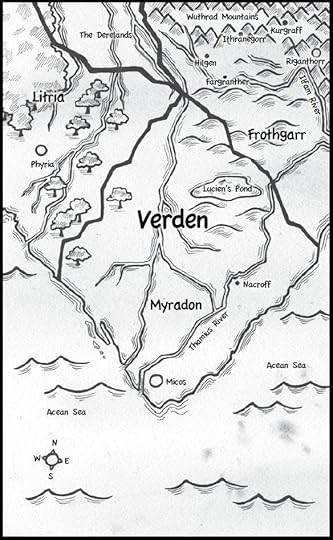
"The Black Banner" Map
The official map of "The Black Banner has just been released! The book drops this coming March, be sure to tell your friends about this upcoming fantasy-fiction novel!

November 25, 2012
Ask the Author
I'm always free for conversation with anyone interested in literature, so feel free to visit the "Ask the Author" page on my new website, www.evanmeekins.com to email me!
Follow this link to the direct "Ask the Author" page; http://www.evanmeekins.com/ask-the-author/
As always, thanks for the support, and be sure to spread the word about my upcoming book, "The Black Banner"!
~Evan Meekins
Follow this link to the direct "Ask the Author" page; http://www.evanmeekins.com/ask-the-author/
As always, thanks for the support, and be sure to spread the word about my upcoming book, "The Black Banner"!
~Evan Meekins